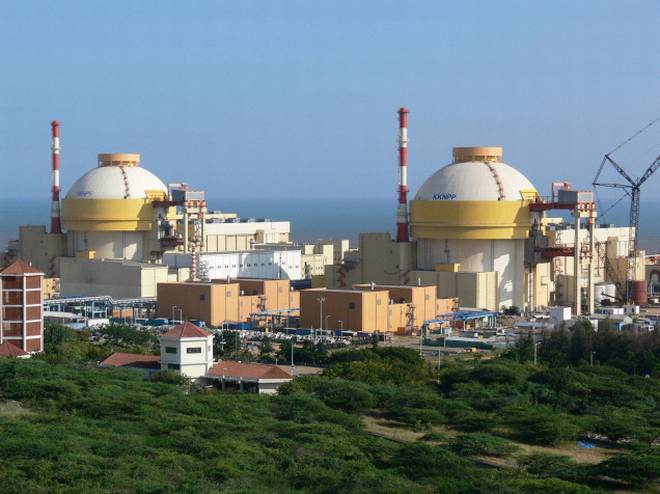
nuclear power reactors at Jaitapur site in Ratnagiri district of Maharashtra

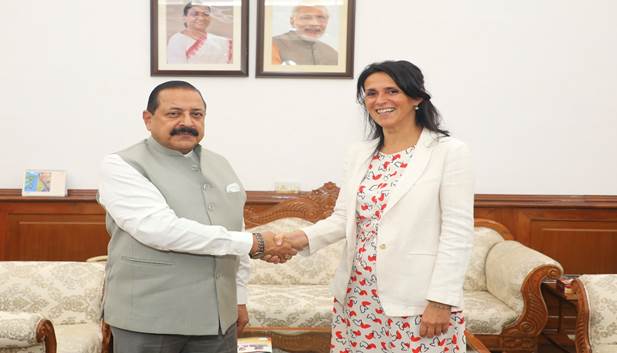
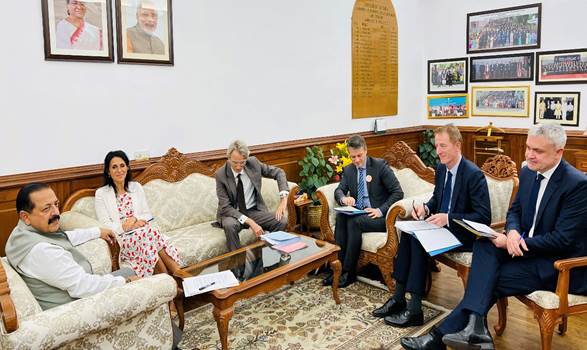
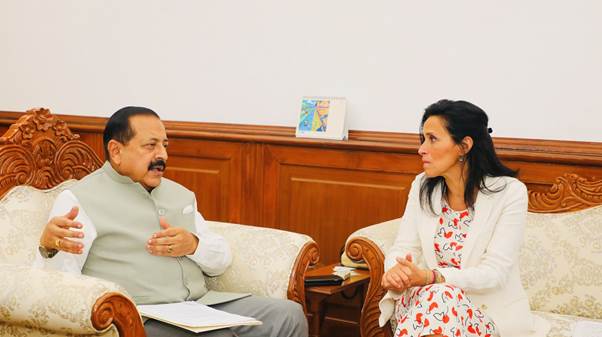
 France Minister, Ms. Chrysoula Zacharopoulou, currently on India visit, called on Union Minister of State (Independent Charge) Ministry of Science & Technology, Minister of State (Independent Charge) Ministry of Earth Sciences, MoS PMO, DoPT, Administrative Reforms, Public Grievances, Pensions, Space and Atomic Energy, Dr Jitendra Singh at North Block, New Delhi to discuss Indo-French collaboration in Nuclear Energy. She was accompanied by a high-level French delegation.

The two sides discussed ways to speed up the setting up of the nuclear power reactors at Jaitapur site in Ratnagiri district of Maharashtra by joint collaboration. Emmanuel Lenain, Ambassador of France to India and other French officials including Thomas Mieusset, Nuclear Counsellor joined the deliberations. 
https://static.pib.gov.in/WriteReadData/userfiles/image/image001VS0O.jpg

Indian Government has already accorded ‘In-Principle’ approval for setting up six nuclear power reactors of 1650 MW each in technical cooperation with France which would make it the largest nuclear power generating site with a total capacity of 9900 MW as part of an umbrella nuclear deal signed with France in September 2008

The French company EDF last year submitted to Nuclear Power Corporation of India Ltd (NPCIL) its binding techno-commercial offer to build six European Pressurised Reactors (EPRs) at Jaitapur. In May, this year, a high-level team from EDF visited India and held detailed talks with NPCIL officials.

Dr Jitendra Singh assured the France Minister that the technical, financial and civil nuclear liability issues will be resolved at the earliest by both the sides and well before the scheduled visit of the French president Mr Emmanuel Macron in early 2023 as announced by Ms Chrysoula Zacharopoulou. The France Finance Minister Bruno Le Maire is also scheduled to visit India by the middle of December.
https://static.pib.gov.in/WriteReadData/userfiles/image/image002SX12.jpg

Referring to warm and all-encompassing bilateral ties between the countries, Dr Jitendra Singh underlined that Indian Prime Minister Narendra Modi, who was on a 3-day Europe visit, met President of France, Emmanuel Macron in Paris during the final leg of his tour in May this year. Both the leaders spoke on various subjects, including bilateral and global issue, and Mr Modi remarked that “India and France are proud developmental partners and this partnership is being spread across different sectors”.

In today’s meeting, both the sides reaffirmed the commitment to the success of the strategic Jaitapur EPR project for access to reliable, affordable and low-carbon energy and agreed to sort out the pending issues at the earliest. 

NPCIL will be responsible for the construction and commissioning of the units, as well as obtaining all necessary permits and consents in India as the owner and future operator of the plant. This includes certification of the EPR technology by the Indian regulator.

Dr Jitendra Singh recalled that nuclear power is clean and environment friendly, apart from having a huge potential to ensure the country’s long term energy security on a sustainable basis. The nuclear power plants have so far generated about 755 billion Units of electricity saving about 650 million Tons of CO2 emission.
https://static.pib.gov.in/WriteReadData/userfiles/image/image003KL2N.jpg

Dr Jitendra Singh said that the net zero targets are expected to be met through a combination of various clean energy sources including nuclear power. In this context, the present nuclear power capacity of 6780 MW is planned to be increased to 22480 MW by 2031 on progressive completion of projects under construction and accorded sanction. 


Stories of Tragedy: Chernobyl

Sky documentary The Real Chernobyl tracks the true tragedy | Metro ...

Hello Reader.

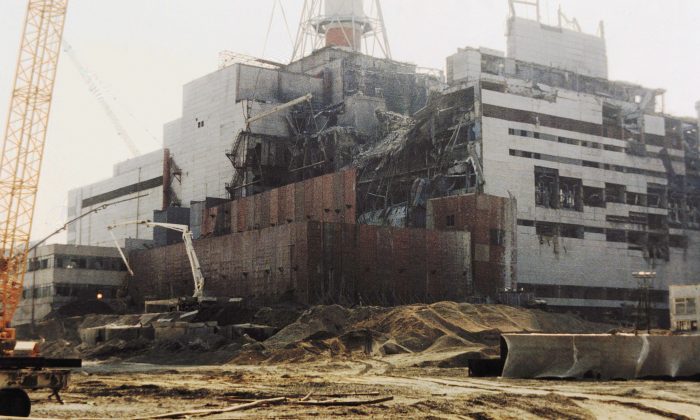
Today we look back at one of the worst man made disasters of our civilization. The Chernobyl Nuclear Accident. Late 20th century, times of nuclear expansion. Soviet Union, under the leadership of General Secretary Mikhail Gorbachev, was steaming forward with their nuclear policy. Several nuclear plants were setup to harness clean energy. But several policy decisions and human elements came back to haunt mankind after the reactor 4 of the Vladimir Ilyich Lenin Nuclear Power Plant, Chernobyl, Ukraine, exploded early in the night of April 26, 1986, giving out huge quantities of radiation in the surrounding areas.

Town of Pripyat

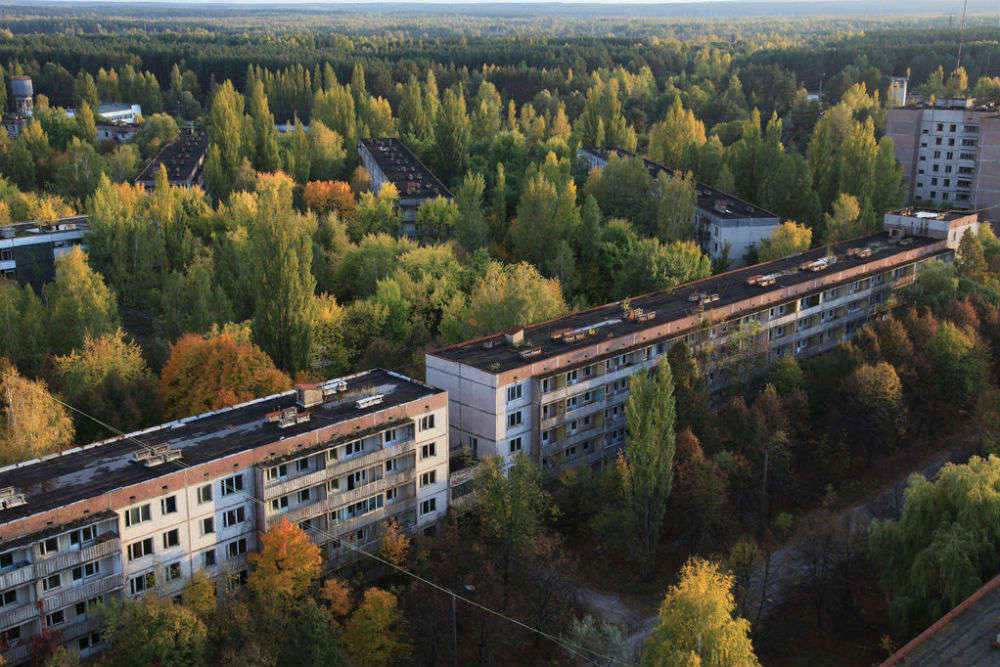
Chernobyl and Pripyat: where time came to a standstill in 1986 ...

The plant was located 130 km North of Ukraine capital Kiev, near the Belarusian border. To accommodate the families of people working at the plant, a new town was built about 3 km away in 1970. They called it Pripyat. During the accident it was host to nearly 49,000 souls. The town was surrounded by woodland and was a pleasant place. There were several schools, parks, theaters, hospital. Everything a town can ask for. This was the worst affected human settlement in the accident. Everyone was forced to evacuate within three days of the accident. People were told it would be for a couple of weeks. But they never returned. Radiation level to this day remains too high for this place to be inhabited. Today this town stands covered by the woods, infested by wild animals and everything it’s inhabitants left behind, a true ghost town.

April 26, 1986

What went wrong on that fateful night? Some human error coupled with some huge design flaws of the reactor put a question mark in global nuclear safety for decades to come. Chernobyl, like most Soviet nuclear power plants back in the day, used Soviet made RBMK-1000 reactors with Uranium as it’s chief fuel. This fuel when starts reacting through fission generates huge amount of energy in form of heat. That heat is used to convert water into pressurized steam and then steam is channeled on to turbines to generate electricity. Simple. But there’s a catch. The energy rising from fission is too high if remained unchecked and this energy release is continuous as Uranium neutrons doesn’t stop reacting. So to control this high rate they had something called Control rods. These are columns made of Boron which enters the reactor and reduces this huge energy surge. So when there was too much output, you simply push the control rods in and reduce reactivity.

Scientists Develop New Theory on Chernobyl Blasts

But this system had a design flaw. For a fraction of second control rods increased reactivity, instead of reducing it. They were lined with graphite as a measure to cut costs. This was not known to the operators. And on the day of accident, a test was going on to reduce the output of the reactor to see if it can still support the water pumps through turbine. The output went too low, but the management still went ahead with the test and the result was a huge surge. Seeing this, the operator decided to push the control rods to kill the reactor function, unaware of the hidden consequence. Just as he pushed the button, the reactivity skyrocketed, converting every bit of water into steam and under high pressure there was an explosion. Hydrogen was produced from the fuels reaction with the steam and another explosion blew the roof off. Oxygen from outside rushed in and several fires started. Reactor with a capacity of 3200 MW output showed a last recorded output of 12000 MW before going off. Open roof carried the radioactive vapor into the atmosphere and wind distributed it all over Europe. It was felt in far away places like Sweden and England.

Consequences

Chernobyl New Safe Confinement - Wikipedia

2 operators died due to the explosion. 28 others died due to radiation related causes within few weeks. Thousands were exposed to radiation. There was an instant spike in cancer rates in the areas of Ukraine and Belarus after this accident. A 30 km Chernobyl exclusion zone was declared by Soviets. Thousands had to leave never to return. State did their best to hide the actual causes and consequences. Eventually had to give in and review the safety norms. The world scientific community blamed the Soviet isolation policy of the cold war era as a catalyst for this disaster. Maybe they were right. 34 years have passed since. Life has moved on. A steel structure, called New Safe Confinement, has recently been mounted over the old sarcophagus of Reactor 4 to keep the radiation in check. But Chernobyl still stays one of the most costly and haunting tragedies of the era.

Until next time…

Cyber Attacks on Indian Nuclear Power Plants

Recently, there was an identification of a malware infection on Kudankulam Nuclear Power Plant (KKNPP) administrative network which is used for day to day administrative activities.  The affected system contains data related to administrative function. Plant control and instrumentation system is not connected to any external network such as Intranet, Internet and administrative system. The plant systems, which are isolated and not accessible from this administrative network, were not affected.

Various measures for further strengthening of Information Security in administrative networks have been taken up viz. hardening of internet and administrative intranet connectivity, restriction on removable media, blocking of websites & IPs which have been identified with malicious activity etc.

The Computer & Information Security Advisory Group (CISAG) of Department of Atomic Energy (DAE) has recommended certain measures for immediate and short term implementation. These are being complied with.

The expenditure towards cyber security is a part of the regular revenue expenditure.

This information was provided by the Union Minister of State (Independent Charge) Development of North-Eastern Region (DoNER), MoS PMO, Personnel, Public Grievances & Pensions, Atomic Energy and Space, Dr Jitendra Singh in written reply to a question in Rajya Sabha today.


****