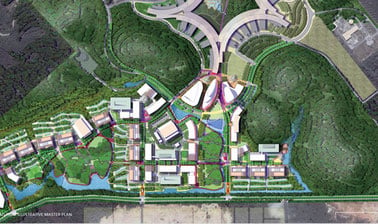
What are Contents of a Sector Plan

 A sector plan consists of a group of neighborhoods where it is possible to provide higher order facilities for larger population. 

Contents of a Sector Plan 

  • It is a detailed site plan with broad identification of residential clusters 
  • Allocation of commercial areas and other facilities based on access requirement 
  • Formation of a boundary depending on circulation pattern and administrative setup 
  • Social and physical infrastructure to be allocated based on development control norms laid down in master plan 
  • Traffic links to be identified between arterials and collector roads 

Functions of a Sector Plan 

  • Each sector plan has to identify the various neighborhoods with population ranging from 3500-15000 
  • It is the lowest level plan for the implementation of the various levels of planning proposals extensively detailed out

What are Contents of a Local Area Plan

 A local area plan (lap) sets out a strategy for the proper planning and sustainable development of a specific area within a local authority and for a timescale as specified by the authority.

Contents of a Local Area Plan 

  • Land use zoning & density 
  • Public open space 
  • Private open space 
  • Car parking 
  • Provision of infrastructure 
  • Conservation of built heritage 
  • Conservation of natural environment 
  • Provision of traveler accommodation 
  • Community facilities 
  • Design and development standards

Functions of a Local Area Plan 

  • A local area plans gives plot level detail 
  • It is also used to check if the master plan is confirming with land

What is Zonal Plan

 Zonal development plans are the next level hierarchical policy plans after the master plans which detail out the broad objectives of the master plan at comparatively smaller regions while incorporating the guidelines and proposals by the master plan without deviating far from the primary goal of development set by master plan. Unlike master plans here these zonal plans are prepared for shorter terms with more focus on detailing. 

The Zonal Development Plan details out the policy of the master plan and acts as a link between the layout and the master plan. Indian master plan approach was fundamentally guided by the British town planning legislation. And further integrating the western concept of ‘zoning’ into the master planning lead to the preparation of new lower hierarchy development plans called ‘zonal development plan’ handling more comprehensive and more focused objectives derived from the master plan. 

As the city is in its initial stage of growth there is urban agglomeration taking place into the city which usually derived due to one or a few unique characteristics spreading almost homogeneous throughout the city. But as the city keeps growing bigger, there are different new characteristics brushed without the prior knowledge on different parts of the city holding huge population. This arises new problems with solutions generally out of the scope of the single character oriented Master plans which treats the whole city equal and develops the regulations based on the common or prominent character of the city with major aspects in detail. Also it is impossible to advocate these changes into the master plan due to its long term visionary approach. 

At this point the Authorities have come up with such inspiring solution of preparation of separate development plans for different smaller regions called zones which are divided based on the broad prevailing character of the area. Now, having an opportunity of independent planning for each zone, these zonal development plans put their focus on those sub objectives developed according to the uniqueness of the zones. Coming to the question of legality of the zonal development plans, though both zonal plans and master plans are approved and authorized equally by the State Governments, any changes or amendments are directed only towards the statutory master plan which reflects those changes onto the lower hierarchy plans further. Most development authorities prefer the development of these zonal plans simultaneously with the preparation of the Master plans to provide immediate aid as tool to the Master plan implementation at ground level.

The master plan divides the city into subdivisions or zones. Criteria’s followed are: 

  • Physical and Historical growth 
  • Character of land 
  • Intensity of land use 
  • Circulation pattern (Railways, Major arteries etc. ) 
  • Municipal boundaries, election and census wards 

Contents of a Zonal Plan 

  • Land use plan confirming to the master plan 
  • Location and extent of land uses 
  • More detailed circulation pattern 
  • Special objectives of the zone if any 
  • Allocation of use zones into further use premises 

Functions of a Zonal Plan 

  • A zonal development plan details out and elaborates the policies of the master plan 
  • Acts as a link between the master plan and the layout plans 
  • Contains a land-use plan for the development of the zone and show the approximate locations and extents of land-uses proposed in the zone 
  • The schemes and layout plans indicating use premises should confirm to the master plan 

ZDP to be prepared by the local planning authority may propose or provide for all or any of the following matters. 

  • Laying out or relaying of land either vacant or already built upon as building sites 
  • Construction, diversion, extension, alteration, improvement or closure of lanes, streets, roads and communication 
  • Construction, alteration, removal or demolition of buildings, bridges and other structures 
  • Land acquisition by purchase, exchange or otherwise of any land or other immovable property within the area included in the ZDP whether required immediately or not 
  • Redistribution of boundaries and the reconstitution of existing plots 
  • Disposal by sale, exchange, lease or otherwise of land acquired 
  • Transport facilities, water supply, lighting etc. 
  • Drainage inclusive of sewage and of surface draining and sewage disposal 
  • Allotment or reservation of land for public purposes 
  • Defining, demarcating of the reconstituted plots 
  • Construction of buildings, housing or resettlement of persons displaced by ZDP’s 
  • Demarcation of places or objects and building of archaeological, religious, historical or environmentally sensitive areas 

Contents of Zonal Development Plan 

1) Introduction 

  • A brief introduction to the city comprising its regional setting, functional character growth trends.
  • Development plan / Master plan context 
  • Interdependence of zones on other parts of the city 

2) Site Background and Analysis 

  • Land use distribution and analysis 
  • Population and density 
  • Built‐up area, character, extent and delineation 
  • Transportation: Circulation network, traffic flow (people and goods) and terminal facilities 
  • Physical and social infrastructure 
  • Land ownership 
  • Slope analysis 
  • Micro‐zoning hazard mapping 
  • Green cover: Parks/open spaces, forest, orchards, green belts, etc. 
  • Site potentials and constraints 
  • Security mapping: Specifying relatively safe and unsafe areas, streets etc. 
  • Types of housing subsystems: low cost housing, affordable housing 

3) Conceptual Framework 

  • Planning parameter 
  • Planning concept and hierarchy till community level 
  • Projected requirements 
  • Urban design framework 

4) Proposals and Development Strategy 

  • Land use plan 
  • Proposed circulation system 
  • Proposals for physical infrastructure 
  • Proposals for community facilities 
  • Strategy for new development, redevelopment and improvement 
  • Proposal for integrating and developing urban villages 
  • Proposals for informal sector 
  • Strategy for rehabilitation/regularization of unauthorized colonies 
  • Strategy for maintenance of services 
  • Provision for facilitating physically challenged and disabled in urban development 
  • Proposals regarding vending zones: Transit oriented markets and market streets can be pedestrianized or only NMVs and buses be permitted in vending zones. 

5) Conservation and Improvement of Environment 

  • Conservation and Improvement of land profile 
  • Proposals for conservation and improvement of rivers streams and water‐sheds 
  • Conservation and Improvement of green cover and landscape 
  • Conservation of heritage areas/zones 
  • Energy efficient and environmentally sustainable development 
  • Provision for rainwater harvesting and common infrastructure at LAP level 
  • Integration of proposals regarding air water and noise pollution control 
  • Security mapping: Focusing on provision of appropriate street furniture including lighting, spacing of police booths. Consideration is recommended for providing security for women 

6) Compliance of Government Policies 

  • State Land Utilization Policy 
  • State Perspective Plan and/or State Urbanization Policy 
  • State Urban Housing or Affordable Policy 
  • Township and Integrated Township Policy 
  • Rainwater Harvesting Policy 
  • Energy Policy 
  • Disaster Management Policy 
  • Industrial and Service Sector Investment Policy 
  • Barrier‐free Environment for Physically Disabled 
  • Information Technology Policy 
  • Tourism Policy 
  • Other Policies 

7) Zoning Regulations 

  • Definitions of various use zone premises 
  • Use restrictions (uses permitted, conditionally permitted and uses prohibited) 
  • Proposal for mixed land uses 
  • Strategy for non‐conforming land uses 
  • Strategy for hazard zone and regulations 
  • Proposals for meeting women’s needs: mixed use development with focus on street activities/ TOD/ space for street vendors/encourage areas to be active at various times of day and night 

8) Development Regulations 

  • Building regulations and building bye‐laws 
  • Urban design of major hubs, if required 
  • Architectural Control, if necessary 
  • Specific development controls for heritage areas and other special areas traditional areas as defined by the local authorities if any may be provided 

9) Resource Mobilization and Implementation 

  • Institutional set‐up for Implementation 
  • Physical Infrastructure development cost including annual and 5 year phasing 
  • Resource mobilization for implementation through public private and other sectors 

10) Implementation Framework 

  • Phasing and prioritization of development 
  • Development Management 

11) Annexures

  • Detailed scaled maps of prevailing situation 
  • Detailed scaled maps of existing land use 
  • Detailed scaled maps of proposed land use 
  • Detailed scaled maps of proposed location of infrastructure and social services 
  • Detailed scaled maps of vending zones in the planned local area 
  • Any other proposal necessary for the development of the zone or ward or area

Subdivision Practice in Town Planning

 Subdivision and site design standards are used by communities to regulate how parcels of land are divided into developable lots, and how those lots are subsequently designed and laid out through the development process. Subdivision typically includes the creation of a sketch plan (showing basic lot layout and provisions for public infrastructure), and subsequent creation of a more detailed preliminary plat (indicating building footprints and specific measurements), and then culminating in a final plat that creates the new lots. Abbreviated procedures are typically established for minor subdivisions that involve the creation of just a handful of lots. 

Site design standards are related and define the basic parameters for development on individual lots, including maximum or minimum lot size, how buildings are situated on a lot, traffic and circulation patterns, pedestrian connectivity, preservation of open areas, and avoidance of hazardous areas. 

Communities increasingly consider hazard mitigation when adopting site layout standards. For example, applicants are required to avoid mapped hazard areas (like floodplains) in new development or to develop strategies to mitigate the hazard risk. In terms of hazard mitigation, the primary benefit of adopting effective subdivision and site design standards is to ensure that new development occurs in a high quality, well designed manner that avoids potential high hazard areas, in addition to meeting other important community goals. Other benefits include: 

  • Effective at managing new development in growing communities. Clearly defining hazard areas allows elected officials to say no to new development in unsafe areas. 
  • Provides additional protection for defined hazard areas without negotiation on a case by case basis. Approval criteria can be stated in the code, making expectations clear to the developer and the decision makers. 
  • Can be tailored to fit a common set of review procedures. Adding natural hazards as a component of existing subdivision regulations can be done relatively easily through an ordinance amendment. 
  • Relatively easy to maintain over time, following initial adoption.

Subdivision of Land 

Earlier in every city much land is either vacant or inefficiently used – speculative prospect. Various methods have been proposed to emphasize taxation on land. Necessity for regulations over the subdivision of urban land was urgent, since use and development of land constitute a right best owed by the community upon the individual and this right may be withdrawn if he violates the conditions. A piece of land divided into more than 8 parcels, each of which is to be sold separately is called Layout, whereas less than or equal to 8 divisions is called a subdivision of land. 
To the land developer the subdividing of land is primarily a matter of profit. To the community, it is a matter of public concern, activities determine quality of living. Many elements in the overall plan are realized at the time the land is developed, highways, streets and alleys, sewer and water lines, power lines, schools, transportation lines, police and fire protection etc. 

Subdivision Procedure 

  • Land is surveyed 
  • Officials records consulted – proposed highway, special easements, right of way etc. 
  • Amenities, cultural and social facilities 
  • Refer Subdivision ordinances
  • Planner or engineer to prepare preliminary plan – include size, shape no of lots, location of streets, radii, drainage, utilities etc. 
  • Estimate is prepared – cost of development 
  • Tentative map is file with local agency – approval obtained else incorporate suggestion made, if any and re-submit

Sub Division Practice 

Local Administration and Social Welfare Department Kerala building rules 1984. In the case of residential development, every plot shall have an average width of not less than 7.5 m and an average depth of not less than 12m. In the case of row housing where side open spaces are not required , plots shall have an average width of not less than 4.5 m and an average depth of not less than 10 m. Area of any newly subdivided, reconstituted or building plots shall not be less than 1.2 Ares (120 sq.m). Every plot shall have a frontage of not less than 6 m on any abutting street. 
According to Rule no 27 of KMBR, for developments including land subdivision and plot development for residential use.- All new developments including land subdivisions and plot developments shall be subject to the following, namely:- 
  1. The area of any newly subdivided plot, reconstituted plot or building plot shall be not less than 125 square meters with an average width of 6.m: provided that for row housing where side open spaces are not required, it is sufficient if the plot has an average width of 4.50 m. 
  2. Every plot shall have a frontage of not less than 4 meters on any abutting street. 
  3. Every street shall have not less than 7.00 meters width and shall be motorable. 
  4. When the area of the land under development work, layout or subdivision is 50 Ares or more, ten percent of the total area shall be provided for recreational open spaces and shall be suitably located to be accessible the residents of the layout. Provided that while considering the area of the land, the area of any contiguous land belonging to the same owner, though not proposed immediate development shall be taken into account. 
  5. The recreational open space to be provided under item (iv) shall have an access as if it were a separate plot and as far as possible it shall be in 1 piece and in no case less than 2 areas in area with a minimum width of 6 m. 
  6. The layout or subdivision proposal shall be in conformity with the provisions of published or sanctioned development plan for the area and if the land is affected by any reservation for a public purpose, the Secretary may agree to adjust its exact location to suit the development but not so as to affect its area. 
  7. The street junctions shall be splayed or rounded off to give sufficient turning radii and sight distance for vehicles and the side if the splay shall be a minimum of 4 meters for roads up to 10 meters and shall be a minimum of 1 meters for roads exceeding 10 meters width. 
  8. In the case of lay out or sub division of land having an area of two hectares or more a suitable plot for an electric transformer shall be provided. 
  9. In the case of development permits, approval of the District Town Planner shall be obtained for land up to 0.5 hectares in area and approval of chief Town Planner shall be obtained for land exceeding that area. 
  10. If the site forms part of approved layout, copy of sub division layout shall be enclosed along with the plans for approval. 
  11. Adequate arrangements for surface water drainage shall be provided.

Residential Plots 

The area of any newly subdivided plot, reconstituted plot or building plot shall be not less than 125 square meters with an average width of 6.00 meters, provided that for row housing where side open spaces are not required, it is sufficient if the plot has an average width of 4.50 meters. Every plot shall have a frontage of not less than 4 meters on any abutting street; every street shall have not less than 7.00 meters width and shall be motorable: Provided that in the case of cul-de-sacs with length not exceeding 250 meters, it is sufficient if the street (cul-de-sac) has not less than 5.00m width and in the case of cul-de-sacs not exceeding 75 meters, it is sufficient if the street (cul-de-sac) has not less than 3.00 meters width. 

According to Rule 29 development including land sub-division and plot development for industrial development.- All new developments including land sub divisions and plot developments shall be subject to the following:- 
  1. The width of every new street, public or private, intended for use as a cart or carriage way giving access to or through an organized industrial area with not less than six constituent units, shall be minimum 10 meters: Provided that in the case of small industrial units or cul-de-sac not exceeding 150 meters length, the minimum road width shall be 7 meters. 
  2. The minimum size of industrial plot abutting street shall be 400 sq. meters in extent with a width of not less than 15 meters: Provided that the minimum plot requirement in item (ii) shall not apply to small industrial units. 
  3. In industrial layouts a place for installation of transformer shall be provided in consultation with the Chief Electrical Inspector or an officer authorized by him. 
  4. The approval of the Chief Town Planner or an officer authorized by him shall be obtained for the layout of industrial streets and land sub-division exceeding five plots. Note:- For the purpose of these rules small industrial unit means an industrial unit classified as such by Government from time to time or an industrial unit not included in Schedule 1 of the Factories Act, 1948. 
  5. The usage of plots proposed for development or redevelopment shall be governed by the provisions contained in the development plan or detailed town planning scheme prepared for the locality. Provided that where no such plan exists, the usage of plots shall be as approved by the Chief Town Planner or an officer authorized by him.


Process of Planning and Designing a New Town

 Planning is the process of thinking about and organizing the activities required to achieve a desired goal. The process of planning includes the determination of objectives and outlining the future actions that are needed to achieve these objectives. Various steps that are followed in the process of planning are:

1) Identifying the problem 

It involves the identification of the aim for the fulfillment of which the plan is being formulated. If a new plan is require or the modification of an existing plan could help in achieving these aims. 

2) Gathering information about the activities involved 

An effective plan needs complete knowledge of the activities involved and their effect on other external and internal activities. 

3) Analysis of information 

This information is then analyzed minutely and the information related with similar subjects is classified so that similar type of data can be kept together. 

4) Determining alternate plans 

There are alternate plans available for the achievement of the objectives and ingenuity and creativeness are required as some plans are also developed at this stage. 

5) Selecting the plan 

At this stage the plan which is acceptable to the operating personnel is proposed. The adaptability and the cost of the plan are also taken into consideration. 

6) Detailed sequence and timing 

Detailed like who will perform which activity under the plan and the time within which the plan should be carried out is determining in this step. 

7) Progress check of the plan 

The provisions are made for the follow up of the plan as the success of any plan can be measured by the results only. 

8) Implementation 

Implementation is the carrying out, execution, or practice of a plan, a method or any design, idea, model, specification, standard or policy for doing something. As such, implementation is the action that must follow any preliminary thinking in order for something to actually happen. 

9) Monitor and Control 

Managers must continually monitor the actual performance of their work units against the unit’s goals and plans. Manager’s also need to develop control systems to measure that performance and allow them to take corrective action when the plans are implemented improperly or when the situation changes.

MARS (Modern Architectural Research Group) Plan

 In the inter war years, there was a war between two rival camps for urban planning, the highdensity housing with lots of communal space, or low-density with lots of private space. One group was known as The Modern Architectural Research Group (MARS), founded in 1933, with luminaries as varied as Morton Shand, Wells Coates, Maxwell Fry, F. R. S. Yorke, Ove Arup and John Betjeman. 

As an organization though, it is probably most famous for a radical plan for the redevelopment of London, the details of which were published the Architectural Review in June 1942. They pretty much planned to rebuild London in its entirety – the entire city was to be rebuilt from scratch. Away with haphazard layouts they provided with an organized “herringbone” arrangement of homes, factories and facilities. 

Although the report was presented in terms of preventing the further expansion of the built-up area of London and planning for new growth, it was suggested that redevelopment might extend the linear city corridors inwards as well, slowly stripping away the mass of buildings that had built up over centuries to create a utopian linear city.

MARS plan

The plan included a “vertebra” of the herringbone that comprised the areas of administrative and commercial buildings, with the docks and industries at its ends. The “bones” are the residential areas with the local industries at their ends. Between the residential ribbons are parks and recreation grounds would have been where the schools and playing fields were to be located. All parts of the city would have been then connected by a railway, whose stations were to be within walking distance even from the remote parts of the residential area. The long-distance railways were then to be connected by means of a belt which forms a traffic ring to the north and south, meeting in a central line where the main passenger stations are located. 

One of the main criticisms of the plan wasn’t just how utterly bonkers it was, but that the finer details were less than ideal. For example, placing factories at the ends of the spines meant more travel was needed to go between residential and work zones within the city. Blending them more closely would reduce travel times the critics argued. 

The plan was overshadowed by the release of a much more famous planning document, Abercrombie’s County of London Plan which came out two years later, in 1944 and was seen as a blueprint for post-war rebuilding, not just of London but also other bomb damaged cities. The welcoming of Abercrombie, and the rejection of MARS pretty much signed the death warrant for MARS, and its direction changed in subsequent years. The group finally disbanded in 1957. 

SCHEDULING

How Can You Plan Your Days?

There are two kinds of people, first ones are those who like to plan their days and the other one are those who like spontaneity. Being spontaneous adds a level of excitement to your life because you don’t know what you are going to do next. This behavior is good when you are enjoying leisure time. But if you are a working professional or a student it is necessary to have a schedule drawn up so you know how to proceed with your day without wasting time. Scheduling brings a certain discipline that certainly makes your life easier.

Planning helps you get control over your life. If you are a serious procrastinator , planning is exactly what you need to make you more productive. If you are not much of a planner, the below mentioned tips might help you understand how you can plan your days.

  • Start with planning your week: For a first timer it is advised that you start planning for a week rather than a day. For example, a student can plan to study a particular subject for 5 hours that week. This gives them room to decide what day they want to study that subject and in how many shifts. Allot your time in hours rather than days. Planning for a week takes the pressure off your daily commitments. Once you are able to complete all your tasks for the week, you can start planning for each day.
  • Plan your day the night before: It is always a good idea to plan the next day, the night before. This helps you make room for your professional as well as personal commitments. You can allot time to any plans that arise suddenly and also plan your work commitments around that.
  • Plan at the same time: It is advised to plan at the same time everyday. It will act like a closing task for the day and will make you feel a lot better about everything that you have accomplished that day.
  • Prioritize your tasks: Planning is done so you can finish the important tasks and everything gets done on time. The activity would only be successful if you prioritize your tasks and perform them starting from most important to least important. People are generally productive in the morning and thus it is beneficial to get all the heavy tasks done during the day so the rest of the day feels lighter and the pressure is off.
  • Take regular breaks: It is very important to take breaks between your work/study sessions. Plan to make a wiggle room for rest after a number of hours. Plan in a manner that your day does not only involve tasks. On the other hand it is also important to keep in mind that the breaks must not be too long. This will reduce your overall productivity.
  • Follow through: Planning your day is easy but the challenging task is to get through with it. Display the timetable directly before your eyes so that you are constantly reminded of all the things you need to get done. If you slack off, don’t give up on the whole constitution of planning. Make room for the left out task the next day. Think of planning and scheduling as developing a habit and do it regularly for 21 days before it becomes a conscious part of your life.

Planning breaks the streak of unproductivity. Once you plan and go through with it the, you won’t be asking yourself “What did I do all day?”. Instead You would be proud about how much you got done. As an added bonus, planning helps reduce the stress quotient and you achieve peace of mind because you framed a plan with all the goals you can attain and there is no room for procrastinate. If this article fails to convince you on planning your day, why don’t you give it a try and experience the results yourself.

Your True Potential Awaits

This morning I was working on something for my college project and made an interesting metaphorical observation.

pot3The cutting discs that are used on a rotary tool are very brittle. You can easily break them or snap them in two with your fingers. However, mounted on a spindle and spun at thousands of rotations per minute, those very same fragile discs can cut through steel.

This is similar to what happens to us, humans. We have our moments of weakness and we fall. But we should know and always remember that at times like these we may not be getting properly utilized. Subjected to the right conditions and determination, our true potential awaits us to realize it.

As you grow older, not realizing your true potential at the right time becomes one of your biggest regrets. That is why it is quintessential that you capitalize on the opportunity to self-actualize and be the best that you can be.

  • Self-introspect: Each one of us, either implicitly or explicitly, wants to have some meaning in our lives – to be a part of something bigger than ourselves. One way for this is to recognize what you are passionate about and follow that. This requires lots of self-introspection and brutal honesty with you. It is not necessary for your passion to earn you money; it just needs to be able to make you feel happy and fulfilled. Your passion could be as complex as painting on a canvass or as simple as sitting down and reading a book.
  • Say ‘no’: The society today is such where people have an intense fear of missing out (or FOMO, if you will). Saying ‘no’ is extremely underrated. But you need to realize that every time you say ‘yes’ to something that you don’t want, you are essentially saying ‘no’ to something that you do want. Learn to wisely say ‘no’ to the things pot2which are not instrumental in reaching your true potential. After all, your time is very limited and you wouldn’t want to waste it on trivial things that don’t even make you happy.
  • Success is a process: People often glorify success, but they don’t see the blood and sweat from the endless hours of effort that is put in getting there. They miss out on recognizing the journey to reach the destination. Remember during your darker days that success is not an event; it is a process. Doing something every day helps more in achieving your goal than sporadic periods of work.
  • Know your weaknesses: In order to achieve the best version of you, know what your strengths and talents are, and use them to focus on your goal. But more importantly, know where your weaknesses lie. Always be on the lookout for areas where you can improve on. Be better than you were yesterday. This does not mean you shouldn’t be proud of yourself; it is saying you should never be stagnant.

pot

Time is forever fleeting. Do not put off anything that you will regret later. The best time to start something was always yesterday. But the clock is still ticking; you are not out f time yet. The next best time is now. Now go out there and spin really fast, cutting through the steel while figuring out life along the way.

mage COurtesy: GOOGLE

Urban Structure and its Characteristics

 Urban structure is the arrangement of land use in urban areas. Urban planners, economists and geographers have developed several models that explain where different types of people and businesses tend to exist within the urban setting. Urban structure can also refer to urban spatial structure, which concerns the arrangement of public and private space in cities and the degree of connectivity and accessibility. 

The term “urban form” is used to describe a city’s physical characteristics. It refers to the size, shape, and configuration of an urban area or its parts. How it will be understood, structured or analyzed depends on scale. Characteristics of the urban form range from at a very localized scale, features such as building materials, facades and fenestration to at a broader scale, housing type, street type, and their spatial arrangement or layout. 

Elements of urban structure includes the following.

  • Natural environment 
  • Topography
  • Soil types (Bearing capacity) 
  • Water courses (Rivers, streams and lakes) 
  • Types of vegetation 
  • Climate and micro climate 
  • Environment characteristics
  • Landscape features 

Types of Urban Structures/Patterns

1) Grid Iron/Rectangular Pattern

The grid plan, grid street plan or gridiron plan is a type of city plan in which streets run at right angles to each other, forming a grid. The infrastructure cost for regular grid patterns is generally higher than for patterns with discontinuous streets. E.g. Plan of Chandigarh city. 
Costs for streets depend largely on four variables: street width, street length, block width and pavement width. Two inherent characteristics of the grid plan are frequent intersections and orthogonal geometry, facilitate pedestrian movement. The geometry helps with orientation and way finding and its frequent intersections with the choice and directness of route to desired destinations. 
In ancient Rome, the grid plan method of land measurement was called centuriation. The grid plan dates from antiquity and originated in multiple cultures; some of the earliest planned cities were built using grid plans.

Advantages 

  • Shorter routes 
  • Easy to extend 
  • Easy to find places 

Disadvantages 

  •  Associated with traffic congestion 
  •  Many intersections/robots
  •  Time consuming
  •  Fuel consuming
  •  Road rage/frustration

 Grid system

2) Radial/Concentric system 

Radial design offers a method for organizing visual material by arranging it around a central point. Features of radial city pattern include 
  • Inner outer ring roads linked by radiating roads 
  • Core has the business area 
  • Industrial area interspersed within the residential 
  • Periphery has green belts 

Advantages 

  • A direct line of travel 
  • Centrally directed flows 
  • Economics of a single point or origin point 
  • Less intersections 
  • Easier flow of traffic 
  • Aesthetic appeal 

Disadvantages 

  • Central congestion 
  • Local flow problems 
  • Difficult building sites 
  • Unplanned growth can create traffic problems
Radial/Concentric system

3) Linear System

The linear city was an urban plan for an elongated urban formation. The city would consist of a series of functionally specialized parallel sectors. Generally, the city would run parallel to a river and be built so that the dominant wind would blow from the residential areas to the industrial strip. As the city expanded, additional sectors would be added to the end of each band, so that the city would become ever longer, without growing wider. The sectors of a linear city would be 
  • A purely segregated zone for railway lines 
  • A zone of production and communal enterprises, with related scientific, technical and educational institutions 
  • A residential zone, including a band of social institutions, a band of residential buildings and a “children’s band” 
  • A park zone 
  • An agricultural zone with gardens and state run farms 

Advantages 

  • High accessibility 
  • Adaptability to linear growth 
  • Useful along limited edge 

Disadvantages 

  • Very sensitive to blockage 
  • Requires control of growth 
  • Lack of focus 
Linear system

4) Multi Centered System 

City grows from several independent points rather than from one central business district. 

Advantages 

  • Optional locations for focal activities and system terminals 
  • Good psychological orientation 
  • Adaptability to existing conditions 

Disadvantages 

  • Depends on stability to key locations 
  • Potential accessibility problems 
  • Tendency to dilute focal activities

Multi centered system

5) Irregular System 

No set pattern. It develops due to relief. e.g. goes around hilly areas. 

Advantages 

  • Creates aesthetic appeal due to different roads 
  • Less traffic congestion 
  • Less intersections 

Disadvantages 

  • Can get lost 
  • Travel longer distances
Irregular system