Designing a New Town

 A new town built on land strongly controlled under unified public or semi public ownership, should be distinguished by combination of town and country life style and of environment, an uninterrupted greenbelt encircling and intersecting the town. A planned urban community that combines residential, commercial and recreational areas. Due to increasing population, we provide new town for reducing the burden of the city. Designing a new town for self-sufficient and providing housing, commercial, basic facilities and recreational area . 

New towns are playing in the economic development of the countries they are emerging in, it is clear that economic motives are the dominant factor behind most new town initiatives. The present new towns are populated by the middle and upper classes, while the lower income groups live in the old city or in self organized cities and slums.

The New Town Movement 

The new town movement refers to towns that were built after World War II and that have been purposefully planned, developed and built as a remedy to overcrowding and congestion in some instances and to scattered and settlements in others. The main reason for it was to decongest larger industrialized cities, rehousing people in freshly built, new and fully planned towns that were completely self-sufficient and provided for the community. 
Records exist of plans for new towns back as far as the ancient Egyptians. Most of the “planned towns” in history were based on providing for military, trade or harbor needs. The idea of planning a city for the needs of the people who would live there didn’t crystallize until the end of the 19th century when Sir Ebenezer Howard, first suggested a series of “garden cities” north of London. However, it was another 50 years, at the end of World War II, when these garden cities really began to flourish. 
The world was moving into a new era of rapid urbanization. The problems of pollution, traffic congestion and the impersonalized isolation of urban sprawl were growing. The concept of creating new towns spread across Europe with the creation of planned communities to deal with these problems. These “new towns” sought to plan in advance the design and growth of cities. Some of the key features were: 

  • Pedestrian friendly walkways separated from vehicle traffic to promote the safe movement of people between neighborhoods, schools and shopping 
  • Architecturally innovative housing 
  • Community owned land to create activity areas and a sense of openness 
  • Community works of art 
  • Close proximity of commercial and industrial parks for people to live close to where they work 
  • A development philosophy to respect the land 

Need For New Towns 

Developing new towns for various purposes, such as, to exploit natural resources, to provide raw material to industries, to serve nuclei and act as catalytic agents for stimulating economic growth in backward areas, for administration and for special purposes. Although in most cases new towns are expensive to build and they take several years to develop fully, still they offer several benefits. Building of new towns does not mean that, we should stop the growth of major cities. Major cities develop, but new towns reduce the rate of growth of metropolitan cities. In this regard it is necessary to prepare national and state physical plans. The national physical plan should be the physical and ecological guide of the policies, programmes and strategies relating to population changes and distribution. 

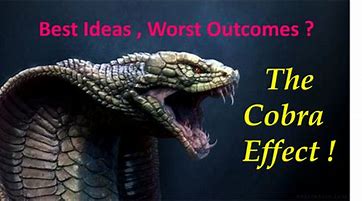
THE COBRA EFFECT

The economic term ‘The Cobra Effect’ was coined by German economist Horst Siebert. The Cobra Effect refers to a situation where in, an attempted well planned and intended solution given to any problem makes the problem worse. This leads to an unintended negative consequence. This term is used to illustrate the causes of incorrect solutions in economy and politics.

This term was coined with regards to a real situation that occurred in Colonial India. There was an alarming increase in the number of venomous cobras in the city of Delhi. The British government expressed their concern regarding this issue. The government planned to offer a sum to the public for killing the cobras. A large number of venomous snakes were captured and killed by people in order to earn the reward. This served as a very successful strategy initially. But, over a period of time, people began to trick the officials by breeding cobras, expanding their numbers and later killing them to continue getting the reward from the government. Ultimately, the government became well informed about the ill happenings in hunger for the reward. Hence, they scrapped this entire plan. After scrapping of the scheme, people were no more interested in capturing, breeding and killing cobras. Therefore, they set all their wild cobra population free in the city. This in turn, increased the population of venomous cobras in the city. Thus, a planned solution to the problem lead to the problem worsening.

A similar instance occurred in Hanoi, Vietnam during the French Colonial rule. The officials designed a scheme in which people would earn a bounty upon killing rats. In order to earn the cash reward, people had to kill a rat, chop off it’s tail and provide it to the responsible officials. Over a span of time, the government noticed rats wandering in places without tails. They were surprised on being aware of the fact that, rat catchers were collecting rats, chopping off their tails and later leaving them into sewers where breeding would take place. This produced a humongous number of rats. The idea of offering a bounty on exchange of dead rat tails failed miserably.

Airbus Airlines, formally suggested their design engineers to make it’s airplane cabins quieter to ensure a pleasant travel experience. The idea was executed and cabins were made more silent than usual. Instead of making the travel more peaceful, it worsened the travel experience of the passengers onboard. People could easily eavesdrop on other people’s conversations, could hear louder noises of food and beverage trollies rolling in the aisle, babies crying on board and restroom doors opening and shutting throughout the journey. This economic decision of Airbus did not succeed.

In 1989, Mexico proposed a plan of action called – ‘Hoy No Circula’ . According to this scheme, people were debarred from using their private vehicles from 5:00 a.m to 10:00 p.m depending on the last digit of their vehicle’s number plate. This was in context of odd and even numbers. The scheme was introduced to limit the number of vehicles on road which in turn would cut down release of pollutants in the atmosphere. Instead of abiding by the norms in a fair manner, people began purchasing two vehicles in the same household, one with an even number plate and another with an odd one. This particular scheme did not serve very fruitful in the longrun.

Perverse Incentive or better known as Cobra Effect may not always be an outcome of poorly planned modules or shortsighted decisions. It may cause due to unpredictable behaviors of the recipients. A strategy planned to curb anything may cause adverse outcomes when people find the same strategy rewarding. In such contrast outcome scenarios, planning authorities may either scrap the plan or re-design it in order to get constructive outcomes.

Have you ever thought about Factors affecting launching of a Business Unit?

i) Business Unit, also referred to as a department, division, or functional area is a part of a company or an organization that represents a specific business function and is a part of firm’s value chain of activities like accounting, human resources, marketing, sales, purchasing and manufacturing.

ii) Establishment is a business location of a company that is engaged in a single activity. It’s a place where the business is conducted with the objective of getting paid for selling goods or services

Choosing the Best Location for Your Business | AllBusiness.com

iii) Plant Location refers to the choice of the region where men, materials, money, machinery and equipment are brought together for setting up a business or factory. A plant is a place where the cost of the product is kept to low in order to maximize gains.

iv) Plant Layout is a plan for effective utilization of facilities for the purpose of manufacturing of products, involving most efficient and economical arrangement of machines, materials, personnel, storage space and all supporting services, within available floor space.

v) Feasibility studies are the researches and studies that determine whether to go ahead with the business plan or any other idea and plan should be adopted.

Franchise Feasibility check

Material requirement planning

Material Requirement Planning is a special technique to plan the requirements of materials for production. For the manufacturing company to produce the end items to meet demands the availability of sufficient production capacity must be coordinated with the availability of all raw materials and purchased items from which, the end items are to be produced.

In other words, there is a need to manage the availability of dependent demand items from which the products are made. Dependent demand items are the components, i.e., materials or purchased items, fabricated parts or sub-assemblies that make up the end product.

One approach to manage the availability of dependent demand items is to keep a high stock of all the items that might be needed to procured the end items and when the on-hand stock drops below a present re-order level, the items are procured or bought as the case may be to replenish the stock to the maximum level.

However, this approach is costly due to the excessive inventory of components, fabricated parts and sub-assemblies to ensure high service level.

An alternative approach to manage these items is to plan for procurement or manufacture of the specific components that will be required to produce the required quantities of end products as per the production schedule indicated by the master production schedule (MPS). The technique is known as Material Requirement Planning (MRP) technique.

https://www.google.com/url?sa=t&source=web&rct=j&url=https://www.twi-global.com/technical-knowledge/faqs/what-is-material-management&ved=2ahUKEwj6xaWE7tPxAhUJ4zgGHQLcBEgQFjAfegQIGxAC&usg=AOvVaw3iPV9U4G6DVDyzhqrjim1W

https://www.google.com/url?sa=t&source=web&rct=j&url=https://www.toolshero.com/management/materials-management/&ved=2ahUKEwj6xaWE7tPxAhUJ4zgGHQLcBEgQFjAgegQIIhAC&usg=AOvVaw0Q0D2QED4kJwgSL82fe_XY

How to set Financial goals

Setting financial goals is essential for personal finance management and budgeting. In order to efficiently manage spending, savings and investments and be financially secure, one must set financial goals.

Being unprepared and spending mindlessly can be quite risky. One should be as prepared as they can be in case of emergencies or financial crises.

Moreover, saving and investing your earnings can help you grow your wealth and utilise your earnings in a profitable manner.

Before setting goals

Financial goals and objectives can vary from person to person depending on their income, investments, expenses, life stage/age, needs etc. Hence, it is important to assess the objective and duration of the goal by following the steps mentioned below-

  1. Identify starting point: Set a date for implementing the plan and its duration
  2. Set priorities: Identify your objectives; Are you saving to invest or to buy or to set up an emergency fund?
  3. Document your spending: Calculate your monthly expenditure. Analyse them and try to reduce them.
  4. Pay down your debt: Reduce your debt and pay it off first to reduce your interest expenses.
  5. Secure financial future: Implement the plan to become financially secure.

Most importantly, financial goals should be S.M.A.R.T – Specific, Measurable, Attainable, Relevant, Time-based.

Specific: Financial goals should be specific in terms of objective, time and amount.

Measurable: Goals should be measurable and expressed in monetary terms. For example, goal to be rich is not measurable as it is a subjective term. Hence, an amount limit suitable for every person should be set.

Attainable: A reasonable amount and time and limit should be set so it is possible to achieve them. For example, saving up to buy a car on a monthly salary of ₹30,000-₹40,000 within one year is not realistic and attainable.

Relevant: Every individual’s financial goal should be relevant to and in sync with their individual financial needs and objectives. For example, if a person wants to save up for retirement, they should focus on saving to invest in schemes specially designed for retirement planning.

Time-based: In order to achieve a goal, it should have an end period which motivates one to achieve it. They cannot be never ending as different stages of life have different financial requirements. At the end of the time period, one should evaluate and see if they were successful in achieving it or not.

Duration of Financial goals

As mentioned above, setting time-based goals is very important. Duration of each goal varies and is dependent on its nature and the income and expenses of the individual. For example, saving up to buy a TV should take between 3-6 months depending on the saving capacity of each individual. However, saving up for retirement takes years of planning, saving and investing.

Financial goals can be classified into Short-term, Mid-term and Long-term goals.

Short-term goals have a duration of 2 or less than 2 years. Example- Stick to weekly/monthly budget, reduce unnecessary expenses.

Mid-term goals have a duration of 2-years. Example- Build and diversify portfolio.

Long-term goals have a duration of more than 5 years. Example- Make a retirement plan and implement it.

PLANNING- process and importance

WHAT IS PLANNING?????
Planning is a common term which focuses on pre deciding the things which we have to do later. Not only deciding the things but also planning includes thinking of the ways by which we can complete a particular plan successfully. It is an important parameter of the management and we need to plan things in the every sphere of life so that we can go on accordingly. Planning is the combination of creativity and innovation. Planning is done to perform any task effectively and efficiently so that there is no hurdle between the complete process of the task which we wish to perform. In the business world, it is said that planning acts as a bridge to reach the position where we wish to reach.
STEPS OF PLANNING
Planning is not an easy task rather it is a combination of several steps. The complete process of planning has been divided into 7 different steps which are mentioned below –

  1. To set objectives i.e. to decide where we aim to reach. It is basically aiming the destination. Every organization has some targets and thus has to complete them so setting objectives is the first and important step of the planning process.
  2. To develop premises i.e. to set assumptions. No work is completed without a risk and assuming things. So premises are basically assuming what can be done. So making those assumptions is the next step.
  3. To identify alternative courses of action is the third step i.e. once the objective has been set and assumptions have been made, then it is the time to identify and think the proper course of actions which must be performed to reach that particular aim.
  4. To evaluate alternative course i.e. to think of the advantages and disadvantages of each course of action and to find what alternative can work for it if that would not happen.
  5. The next step is to select the best alternative which would be suitable according to our aim. The best plan is adapted and implemented.
  6. The next step is to implement the actual plan which has been thought of yet. This is the step where actually planned course of actions take place and where actually the work is done by the individuals.
  7. The next and final step of the process of planning is to follow-up the actions. In this step all the validation and verification occurs that whether the planned process is going on with the same flow or not. Also it is seen that whether the plan needs any change or it should go on like that only.

IMPORTANCE OF PLANNING

  1. Planning tends to reduce the uncertainty of occurring a process.
  2. It is very essential to provide a proper direction to the plan.
  3. Planning helps to promote innovative ideas and thus the planned work is done more efficiently.
  4. Planning helps in decision-making and dividing the equal amount of work to each individual of the group or team.
  5. Planning reduces confusion at any level of the process.
  6. Planning helps in setting some goals and thus an organization does better work.

PLANNING IN MANAGEMENT

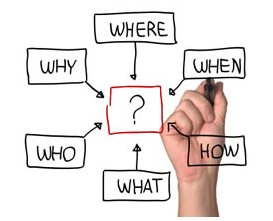
Planning is deciding the objectives and methods to achieve them. Planning involves deciding in advance what is to be done, how is to be done, where is to do, how is to done and by whom is to be done and it makes things happen which may not occur otherwise and it bridges the gap between where we are and where we want to go, the process of planning includes two things:

             1. Deciding objectives

             2. Choosing best from available alternatives

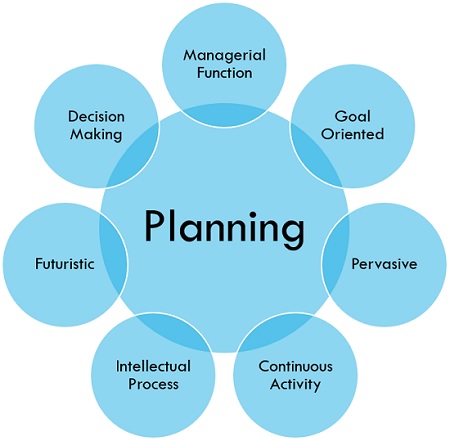
Planning is a fundamental managerial function planning implies an arrangement for doing something as considered in advance and simple words, planning is deciding in advance and Prof. Urwick rightly said: “Planning is fundamentally a mental predisposition to things in an orderly way, to think before acting and to act in the light of facts rather than guesses”. Thus, a plan is a predetermined course of action and it is an attempt on the part of a manager to anticipate the future to achieve better performance, and planning is based on the principle, Look before you leap’.

CONCEPT OF PLANNING

Planning requires goals and it focuses attention on purposes and determines ways achieving them and planning is necessarily a problem of choice and it involves the selection of the most feasible course of action from all available alternatives. Planning is a means of building a bridge to span the present position of the firm with its desired future position. It implies the work of both problems solving as well as decision-making. Man possesses a unique power of reasoning and he often evaluates the pros and cons before proceeding further into the matter.

NATURE OF PLANNING

1. Planning focuses on achieving objectives:

 Planning is to facilitate the attainment of objectives of the organization and planning focuses action on purposes. Planning is merely an empty mental exercise if it loses sight of the organizational objectives and every plan should contribute towards the achievement of company goals. Thus, all plans are directly linked with the goals and objectives of the enterprise and contribute to its attainment and if there are objectives, there is no need for any planning.

2. Planning is a primary function of Management

 Planning is a primary function of management and a manager must perform efficient and intelligent planning before performing any other managerial activities. Thus, planning comes before the execution of all other managerial functions. Planning function of management has the distinction of establishing objectives and all managerial efforts of organizing, staffing, directing, and controlling are directed towards their attainment.

3. Planning is pervasive  An element of planning can be seen behind every human activity in an organization and God has gifted man with the faculty of reasoning and this enables a person to measure the consequences of his planned actions and we can quote several examples where planning precedes individual or group action. Planning is a pervasive activity covering the entire enterprise will all its segments and every level of management. Top management does strategic planning, middle management looks after the administrative planning and the lower management concentrates on operational planning.

Regional Planning

 Region means a tract of land; any area; a portion of earth’s surface. Regional planning deals with the efficient placement of land use activities, infrastructure and settlement growth across a larger area of land than an individual city or town. Regional planning is a sub-field of urban planning as it relates land use practices on a broader scale. Regional planning deals with the planning of areas which constitutes both urban and rural areas. Urban planning, city planning or town planning concerns a city or a delimited urban area which covers a city or town, however a regional plan can have number of urban areas.


A ‘region’ in planning terms can be administrative or at least partially functional and is likely to include a network of settlements and character area. A region scheme usually covers more than one local government area. The content of the scheme may vary for each region, but they generally set out broad land use zones or policy areas and identify land required for regional purposes. Regions require various land uses; protection of farm land, cities, industrial space, transportation hubs and infrastructure, military bases and wilderness. 

Integrating a much wider areas for overall growth of region is the purpose served by regional planning, planning for integration of rural area and the overall balanced development of the region. Fulfilling the needs of a backward region and providing higher order services for relatively developed areas. Strategies are formulated carefully to keep the goods and resources available to all the places as per their requirements.

Regional planning encompasses even larger area when compared to city planning, number of cities might be covered when considering a region but rural area remains at the core for which planning is to be done. Along with rural areas many lower level towns in addition to the villages witnessing transformation to towns also adds up to area for which regional plans is made. Regional plans can cut across the boundaries of different states.

Regional planning also helps in reducing the conflicts and competition for resources between cities in a region. Developing small towns or satellite towns helps in relieving the stress from higher order town thus increasing efficiency. Regional plans takes into account the economic, spatial and environmental goals and tries to address national level issues. Integrated development and critical analysis of functional linkages is one of the key to achieve the desired growth.

Unlike city planning where land use plans are prepared regional planning lays emphasis on policy for the region. Policies are them elaborated and objectives are formed which differ from area to area within the region. Regional plans are a must when cities start to influence development even in far places which might end up in under-utilization and wastage of resources without proper planning.
Polices have a larger and longer impact on the overall growth of region and might conflict with the land use plan or plan prepared for a specific city. Allocation of funds for different activities and different areas can also be taken up by the regional planning board/authority. Government intervention such as implementing a new scheme or policy for a region can also boost the growth perspectives and aide the policy prepared by regional board.

Reduced disparities help directly and indirectly by reducing forced migration, reducing trip lengths, providing better and more job opportunities in nearby areas, having the required services instead of letting them emerging randomly. A Special Economic Zone (SEZ) are also established to support the growth of a region and attract investments.

Regional plans take into account the existing condition of an area and all the surrounding areas. The urban area or the core area might have its own development plan in place for its growth and in such cases the existing plan is also taken into account. The existing plan helps in understanding the vision and growth of the existing urban areas and helps in formulating better policies for the surrounding area. Regional plan might help the existing urban area by decongesting it by catering to the need of satellite cities or developing nearby regions for industrial units.

City Planning & Regional Planning
City planning focuses on the land use plans, spatial growth and policies which are at local level (affecting that particular city or town), whereas in case of regional planning the emphasis on the policies is more. Those policies becomes the guidelines for the urban areas and their existing plans are modified accordingly. This helps in meeting the larger requirement of the whole region.

Additionally, regional plans cover more of national level policies and issues and strengthens integrated development. City planning looks as a limited area when compared to a regional plan. Regional plan covers rural areas and undeveloped areas too which are usually not covered in town plans. The categories, chapters, topics and aspects covered in both plans also differs because of the different needs and the existing developments. Village area, forests, undeveloped land and waste land might be completely missing from a city plans whereas it forms an important part of regional plan.

Importance & Need of Regional Plan
A city or any area might grow in size and hamper the development on its surrounding area. Over the decades it starts competing with the surrounding areas and this results in imbalance. It creates economic as well as functional misbalance in areas. Increases migration, decreases efficiency, results in undue waste of resources and might also find it difficult to meet its needs. To prevent such imbalance regional plans are very much required.

It helps in reducing disparities, promoting growth, promoting sustainable development, economic growth of collective region based on its potential. Also, issue of migration is also solved to an great extent because the required facilities are more evenly distributed rather than being concentrated in a specific urban area. These plans ensures a much better connectivity within the region and takes care of future growth.

Implementation of Regional Plans
Since regional plans covers various types of settlements they require multiple agencies working together for its implementation. This can be done in various manner, either forming a new development authority/regional board or giving this responsibility to an existing development authority. This newly formed body or the new department in existing development authority then works actively with various other departments. This is required because regional planners need to have a broad overview of the whole region. The plan formed needs to meet the requirement of whole region and at same time should also cater to the existing requirements.
Allocation of funds is another important aspect of regional planning as the funds are collected and received from various sources. There are various sources since the area covered under a regional plan is a part of various states and different administrative areas. Thus funding might be collectively from state government, central government, special allocation of funds and partially by its own means.

Objectives of Regional Planning
  • Economic growth
  • Attaining economic equality and social justice
  • Achieving full employment
  • Attaining economic self-reliance
  • Modernization of various sectors
  • Redressing imbalances in the economy
Principles of Regional Planning 
  • Resist development in flood plains or along earthquake faults. These areas may be utilized as parks or unimproved farmland.
  • Designate transportation corridors using hubs and spokes and considering major new infrastructure.
  • Some thought into the various settlements in the region may play, for example some may be administrative with others based upon manufacturing or transport.
  • Consider designating essential nuisance land uses locations, including waste disposal.
  • Designate green belt land or similar to resist settlement amalgamation and protect the environment.
  • Set regional level policy and zoning which encourages a mix of housing values and communities.
  • Consider building codes, zoning laws and policies that encourage the best use of the land.

Problems faced by the town due to lack of proper planning

 1. Lack of essential amenities like electricity, watersupply and drainage.

2. Uncontrolled development of the town.
3. Unhealthy conditions.
4. Development of slums.
5. Defective road system resulting in the formation of narrow streets and lanes.
6. Heavy traffic congestions during the peak of hours of working period.
7. Haphazard location of some industrial units of small and medium scale.
8. Inadequate open spaces for parks and playgrounds.
9. Noisy atmosphere in some localities.
10. Waste disposal problems.
11. Housing problems.
12. Lack of public awareness for community benefits andexploiting means of amenities and
      utility service facilities provided by the concerned authorities.
13. Lack of engineering infrastructure.
14. Inadequate ware houses and industrial sites.
15. Defective locations of schools.
16. Inadequate space on the main roads for footpath and town squares, circles etc.