
INCLUSIVE GROWTH AND ISSUES ARISING FROM IT

Inclusive growth means economic growth that creates job opportunities and contributes to poverty alleviation. This means that the poor have access to basic education and health services. This involves ensuring equal opportunities for all, as well as empowering everyone through education and skills development. For rapid and sustainable poverty reduction, everyone must be able to both contribute to and benefit from economic progress. Rapid growth is necessary for poverty alleviation, but it must be widespread across all sectors and include a large portion of the country’s workforce to be sustainable in the long term.

FEATURES OF INCLUSIVE GROWTH

About Overcoming the constraints of excluded and marginalized people. Participation of all segments of society, Reduce the disparity in per capita income between: Different sectors of the economy, Different segments of society Rural and urban areas different genres

No – discrimination Poverty reduction potential is higher Ensure people have access to basic infrastructure and basic services/capabilities such as health and basic education. This approach should include not only the quantity but also the quality of these basic services. Includes poor and lagging socio-economic groups and lagging regions, as well as partners in this growth.

ELEMENTS OF INCLUSIVE GROWTH

The elements of inclusive growth are Skills development. Harnessing the demographic dividend will depend on the employability of the working-age population, their health, education, vocational training and skills. Skills development plays an important role here. India faces a dual challenge in skills development: Firstly, there is a shortage of skilled labor Second, there is no employment of conventionally trained young people.

UNICEF 2019 reports statistics that at least 47% of young Indians do not have the education and skills necessary to get a job by 2030. Financial inclusion Financial inclusion is the process of ensuring access to financial services at a reasonable cost to vulnerable groups. Financial inclusion is necessary for inclusive growth because it leads to a culture of thrift, creating a virtuous circle of economic development. Technological Advancement The world is moving towards the era of industrial revolution 4.0. These technological advances have the potential to reduce or increase inequality depending on how they are used. Several initiatives have been taken by the government, e.g. Digital India Mission, so that a digitally literate population can leverage technology for endless possibilities. Technology can also help address other challenges, for example: Agriculture – Modern technology can make the agricultural value chain from farmer to consumer more efficient and competitive. Production – Technology can solve financial problems, provide raw materials, land and link with the user market. GST is only possible with the help of solid technology. Education – Advanced digital technologies can create new forms of adaptive and peer-to-peer learning, increase access to faculty and mentors, and deliver actionable data in real time. Health technologies can transform the delivery of public health services – expanding care through telemedicine services Governance – Technology can reduce delays, corruption and inefficiencies in public service delivery Economic growth India is one of the fastest growing major economies in the world. However, the Indian economy is currently facing a slowdown due to both cyclical and structural challenges. However, the goal of becoming a $5 trillion economy by 2024-25 could enable India to reduce inequality, increase social spending and provide jobs for all. Social development This means empowering all marginalized sections of the population such as SC/ST/OBC/Minorities, Women and Transgenders. Empowerment can be accomplished by improving the institutions of the social structure, i.e. hospitals, especially primary care in rural areas, schools, universities, etc. Investing in social structures will not only promote growth , but also create a healthy and capable generation. for future work management.

INDIA’S NEED FOR INCLUSIVE GROWTH

Many thinkers and government officials have emphasized the importance of inclusive growth for long-term prosperity and fair income distribution. Comprehensive growth is a difficult task in India. In a democratic country like India, the vast majority of people live in rural areas, and integration into society is a major concern. The Government of India faces the daunting task of spreading progress across all sections of society and across the country. The best way to achieve inclusive growth is to empower people. Government officials argue that progress requires a multifaceted approach to education and skills development. Public-private partnerships can help solve the problem of lack of skills. Since independence, India’s economic and social growth has improved significantly, enabling India to prosper in the 21st century.

The factors listed below allow India to focus on inclusive growth.

Poverty

Unemployment

Agricultural backwardness

Regional disparities

Issues relating to social development

GOVERNMENT MEASURES FOR INCLUSIVE GROWTH

  1. Pradhan Mantri Jan Dhan Yojana
  2. MUDRA (Micro Units Development and Refinance Agency)Bank
  3. SETU(Self Employment and Talent Utilization)
  4. Skill India
  5. Mahatma Gandhi National Rural Employment Guarantee Act (MGNREGA)
  6. Kisan Card
  7. Pradhan Mantri Krishi Sinchayee Yojana (PMKSY)
  8. National Agriculture Market (NAM)
  9. Pradhan Mantri Jeevan Jyoti Beema Yojana
  10. Pradhan Mantri Jeevan Suraksha Yojana
  11. Atal Pension Yojana(Social Security Schemes)
  12. Digital India programme

All these measures and policies will help in achieving inclusive growth and hence will help in developing country.

“Policy and Regulatory framework on Conformity Assessment for Telecom products: Global Best Practices and Priorities”

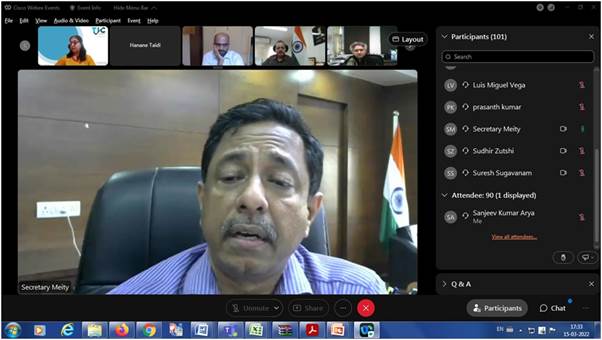
 Telecom Engineering Centre (TEC), a National telecom standard setting organization under the aegis of Department of Telecommunications, Ministry of Communications has conducted a webinar titled “Policy and Regulatory framework on Conformity Assessment for Telecom products: Global Best Practices and Priorities” here yesterday. This webinar is organised by TEC in collaboration with TIC Council (India) and witnessed the presence of senior policy makers from Department of Telecom, India, E.U & FCC (U.S) along with senior Industry representatives from the Telecom, Labs, sharing their experience, global trends, and best practices towards ensuring Quality and safety of Telecom products in India. During session, Mr Luis , Policy officer from EU and Mr George from FCC, USA shared global best practices and Mr Prasanth DDG , TEC and Mr Zutshi TIC Council  have presented  India specific regulatory framework.


The event was graced by Shri K.Rajaraman, Secretary (Telecom), Government of India as chief guest and Shri Ashok Kumar Mittal, Member (Services), DoT, Smt. Deepa Tyagi, Sr. DDG (TEC) and Shri Sh. Suresh Sugavanam, Chairman TICC, India.  This event was witnessed by participants from across the globe and it is moderated by Dr Aparna  ED, TICC.

Shri K.Rajaraman, Secretary (Telecom) in his keynote address mentioned that the country is investing heavily in public and private partnership model to increase the penetration in mobile and broadband sector in urban and rural area. He also stressed that the telecom services shall be affordable to the bottom of the pyramid. He mentioned that testing and certification ecosystem should be the integral part of manufacturing ecosystem to become manufacturing hub. He also mentioned that very robust capacity of testing facilities, skills set is required to meet the requirement of manufacturing hub. He also urged the industry to explore the innovative idea of lab equipment lying in various part of the country to use as a service model like OLA/UBER type platform based model in testing.

Shri Ashok Kumar Mittal, Member (Services), DoT in his opening address mentioned that it is matter of pleasure that TEC has come up to organise internationally collaborative knowledge sharing webinar on the regulatory practices. He also appreciated the endeavours of TEC encouraged to do such discourses as many as possible.

Smt Deepa Tyagi Sr DDG, TEC has emphasised the importance of global collaboration and bringing global best practices so that India would become global test bed for ICT products.

RKJ/M

Monetary and Fiscal Policy

Monetary and fiscal policy refer to the policies of the government aimed to solve the economic problems in a country.
A monetary policy is a credit control measure adopted by the central bank of an economy. It deals with the demand and supply of money.
Fiscal policy refers to the use of taxation and public expenditure by the government to stabilise the economy.
A monetary policy aims at achieving full employment. Unemployment leads to wastage of potential and resources. Price stability is another goal of monetary policy. Changes in price levels lead to uncertainty in the economy. Achieving economic growth and maintaining a favourable balance of payments are some of the objectives of this policy.
A fiscal policy aims at achieving full employment, stabilizing the price levels and growth rate of the economy, maintaining equilibrium in the balance of payments. It uses taxation to affect national income, output, prices etc.
Monetary policy uses various instruments to achieve it’s goals. Open market operations, bank rate policy, selective credit controls, changes in reserve ratios are some of the instruments of monetary policy. Open Market Operations refers to sale and purchase of securities in money market by the central bank. Bank rate is the minimum lending rate of the central bank. When there is rise in prices, the central bank raises the bank rate and vice versa. Selective Credit Controls are used to influence specific types of credit for specific purposes.
A monetary policy can be classified as an expansionary or a contractionary policy. In the former case, monetary policy is used to overcome a recession or deflationary gap. It generally happens when there is a reduction in demand for consumer goods or investment goods. To control this central bank starts an expansionary monetary policy that reduces credit market conditions and leads to upward shift in demand. In the later case, monetary policy is used to curtail aggregate demand. When the economy faces inflationary gap due to rise in demand for consumer goods and increase in business investment, the central bank increases the cost of bank credit. This is often done by selling government securities, rising discount rate etc.
Similarly, fiscal policy can be classified as neutral, expansionary and contractionary. Neutral policy is usually undertaken when an economy is in equilibrium. In this instance, government spending is fully funded by tax revenue, which has a neutral effect on the level of economic activity. Expansionary policy is usually undertaken during recessions to increase the level of economic activity. In this instance, the government spends more money than it collects in taxes. Contractionary type of policy is undertaken to pay down government debt and to cap inflation. In this case, government spending is lower than tax revenue.
Monetary and Fiscal policy both have their own advantages and disadvantages. Fiscal policy may sometimes result in a domino effect causing one problem to make another and repeat. Fiscal policy can also have issues with time lags. Although monetary policy is not very effective in a recession, it is flexible and works well to slow down the economy. Most people however, prefer fiscal over monetary because its brings low taxes and low interest rates.
https://www.ukessays.com/essays/economics/fiscal-and-monetary-policy-economics-essay.php


https://courses.lumenlearning.com/boundless-economics/chapter/introduction-to-fiscal-policy/

NEED OF FINANCIAL SUPPORT OF GOVERNMENT TO EDUCATION SECTOR

COVID-19 has halted all the productive sectors of economy resulting in financial imbalance. However, a unique sector that has emotions of our kids attached to it is their school, where they prepare themselves for the future. The teachers too have been forced to stay away from the school due to COVID-19 outbreak.

We have been hearing that government is providing some financial relief to certain sector. However, there is a necessity to provide some relief to the education sector too. Many educational institutes have taken loan to cater for variety of courses of instructions. The teachers of private and public educational institutes require support of the government, so that they can survive this tough phase. All the educational institutes and the staff working there needs to be supported financially for the time being.

We should ensure a respectful and dignified life for the teachers and support them to be stable and stay cheerful so that they develop the patience required to conduct the online classes for a longer period. A committee of educationist can be set up to look in to the concept of providing insurance cover against the Coronavirus to the school staff and the students. The government can include the public and private education sector in the list of sectors requiring economical support. Education sector has suffered financially and emotionally too.

A minimum financial help can be provided to all the teachers belonging to private sector on priority as it is a fact that they have not received their salaries since lock down was imposed from the month of March 2020.The plight of private school teachers has increased as these schools are totally dependent on fees from the parents.The management running the schools can support the teachers and hold their hands during this period of financial and health related crisis caused due to spread of Coronavirus.

The policies to hire and retain the teachers needs to be strengthened and redefined in the light of certain evil practices of hiring that are in vogue and have been in practiced. Such practices go unchecked specifically in the private hiring of the teachers. Hiring agencies are providing teachers to educational institutes at times overlooking all the laid down rules by the government. Though the efforts of private schools is commendable in contributing positively towards the growth of the students and in turn that of the society, certain scope of improvement in terms of treating teachers with respect exists. As a onetime special case some financial support can definitely be extended to the teachers so that they can support themselves during this uncertain lock downs due to COVID-19 spread.

A complete redefining of education sector can be done and many issues or evil practices that have intruded the system can be resolved and a new energy can be given to education sector for its revival. All the stakeholders need to accept the change for the betterment of students. The government has a greater role to play in this scenario and should come up with flexible policies for the revival of the education industry that can include granting subsidy to the educational institutes and extending some financial help to the teachers. The risk of COVID-19 is still there in the environment. We all have to treat this situation as an opportunity to learn.