About Teen Pregnancy

The US teen birth rate (births per 1,000 females aged 15 to 19 years) has been declining since 1991.  Teen birth rates continued to decline from 17.4 per 1,000 females in 2018 to 16.7 per 1,000 females in 2019.  This is another record low for US teens and a decrease of 4% from 2018. Birth rates fell 7% for females aged 15 to 17 years and 4% for females aged 18 to 19 years.

Although reasons for the declines are not totally clear, evidence suggests these declines are due to more teens abstaining from sexual activity, and more teens who are sexually active using birth control than in previous years.

Still, the US teen pregnancy rate is substantially higher than in other western industrialized nations, and racial/ethnic and geographic disparities in teen birth rates persist.

Disparities in Teen Birth Rates

Teen birth rates declined from 2018 to 2019 for several racial groups and for Hispanics. Among 15- to 19-year-olds, teen birth rates decreased:

  • 5.2% for Hispanic females.
  • 5.8% for non-Hispanic White females.
  • 1.9% for non-Hispanic Black females.

Rates for non-Hispanic American Indian/Alaska Natives (AI/AN), non-Hispanic Asians, and non-Hispanic Native Hawaiian, and other Pacific Islander teenagers were unchanged.

In 2019, the birth rates for Hispanic teens (25.3) and non-Hispanic Black teens (25.8) were more than two times higher than the rate for non-Hispanic White teens (11.4). The birth rate of American Indian/Alaska Native teens (29.2) was highest among all race/ethnicities.

Birth Rates for Females Aged 15 to 19 Years, by Race and Hispanic Origin of Mother: United States, 2018 and 2019
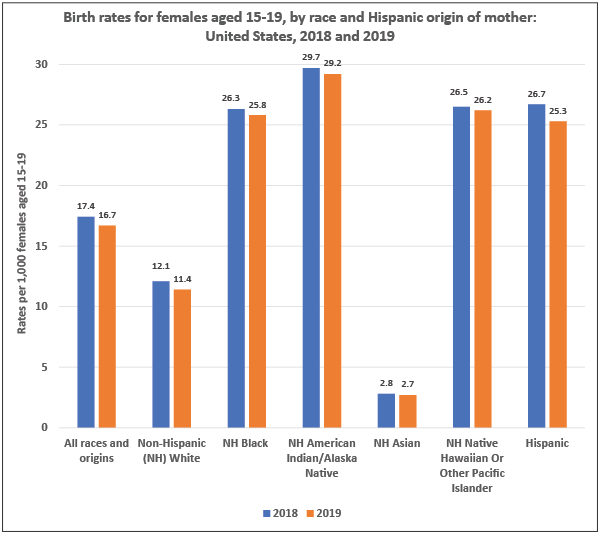
Birth Rates per 1,000 Females Aged 15 to 19 Years, by Race and Hispanic Origin of Mother: United States, 2018 and 2019.  All races and origins, 2018: 17.4; 2019: 16.7 Non-Hispanic White, 2018: 12.1; 2019: 11.4 Non-Hispanic Black, 2018: 26.3; 2019: 25.8 Non-Hispanic American Indian/Alaska Native, 2018: 29.7; 2019: 29.2 Non-Hispanic Asian, 2018: 2.8; 2019: 2.7 Non-Hispanic Native Hawaiian or Other Pacific Islander, 2018: 26.5; 2019: 26.2 Hispanic, 2018: 26.7; 2019: 25.3

Data source: Martin JA, Hamilton BE, Osterman MJK, Driscoll AK. Births: final data for 2019. Natl Vital Stat Rep. 2021;70(2):1–50.

Geographic differences in teen birth rates persist, both within and across states. Although among states with low overall teen birth rates, some counties have high teen birth rates.

Social determinants of health, such as low education and low income levels of a teen’s family, may contribute to high teen birth rates. Teens in certain settings are at higher risk of teen pregnancy and birth than other groups. For example, young women living in foster care are more than twice as likely to become pregnant than young women not in foster care.

To improve the life opportunities of adolescents facing significant health disparities and to have the greatest effect on overall US teen birth rates, CDC uses data to inform and direct interventions and resources to areas with the greatest need.

The Importance of Prevention

female  and male teen

Teen pregnancy and childbearing are associated with increased social and economic costs through immediate and long-term effects on teen parents and their children.

  • Pregnancy and birth are significant contributors to high school dropout rates among girls. Only about 50% of teen mothers receive a high school diploma by 22 years of age, whereas approximately 90% of women who do not give birth during adolescence graduate from high school.
  • The children of teenage mothers are more likely to have lower school achievement and to drop out of high school, have more health problems, be incarcerated at some time during adolescence, give birth as a teenager, and face unemployment as a young adult.
  • On a positive note, between 1991 and 2015, the teen birth rate dropped 64%, which resulted in $4.4 billion in public savings in 2015 alone.
Should commercial surrogacy be banned in India?

Commercial surrogacy is the process by which an individual or couple pays a fee to a woman in exchange for her carrying and delivering a baby. At birth the child, homo-sexual couples, and single people who wish to be parents are the most common types of people who seek surrogate mothers.

Commercial surrogacy has been legal in India from 2002 onwards but due to unethical practices, a bill has been approved by the Union Cabinet in August 2016. This one lapsed when Parliament adjourned without taking the measure for a vote.

The new proposal came in 2019 that is to ban commercial surrogacy. The Indian minister of health has called the 2019 bill a “need of the hour” citing a rough estimate that between 2000 to 3000 unregulated clinics currently operate in the country. Under the new law anyone who performs or promotes this would be punished with up to 10 year of imprisonment and a fine up to one million rupees. The surrogacy bill’s provision restricting surrogacy to married heterosexual couples within strict age ranges also discriminates against members of L G B T community, older couples and unmarried people who might seek to have a child. The bill goes against the principles of equality provided under Article 14 of the Indian constitution.

Regulation, not ban, is needed. The commercial surrogacy in India needs a regulation and stricter rules that could ensure good care and pay to the woman alone and not agents or others. Good clinical facilities for the surrogate mother and a healthy environment where she could stay safely before and after delivery could lessen exploitation. There is no provision in the law about the custody of the child if the couple later refuse to accept it if the child is mentally challenged or born with a defect. People who hire surrogates have a need to do so due to medical reasons. It is not their choice. Regulation on this practice is very much needed and must be done to close loopholes due to which exploitation of surrogate mothers is taking place.

Indian society is yet to progress so much as to accept surrogate motherhood. The woman who rents her womb even if for the cause of humanity towards an unfortunate couple will never be accepted in society when she goes back to her normal life. People will look down on her and she may probably not be able to find a husband, if she was unmarried at the time of surrogacy. We need to be broad-minded and accept these women and respect their choice of renting their wombs.

Giving women a safe and free environment for surrogacy can help in curbing the evils attached and the industry could do well along with giving good money to such poor women so that they can make their lives better as well as give prosperity to their families.

Thank you for reading. Have a nice day!

An Unexpected Guest

Don’t you find it a bit ironic that India is a country where women have no reproductive rights yet our nation is known worldwide for the Taj Mahal, a monument breathing the story of a queen who lost her life at the altar of her childbirth?

Today, the number of teenage girls popping the easily procured abortion pills, away from the knowing and reproachful eyes of their parents, is alarming. Buried under their winter jackets, they don’t even realize that a baby is growing.

guestTeenage pregnancy usually tends to occur within marriages, more often than not, set up by the parents of adolescents. On the other hand, some cases are the result of teenagers engaging in unprotected sex simply because they were not aware of the consequences or how to deal with them.

Either way, their ignorance leads them to get an abortion in a later stage which is not the ideal scenario, either for the baby or for the mother. In many cases, the complications are such that only one of them could be saved, putting the families in a position of dilemma and jeopardizing the futures of many. Here are a few measures to make people understand the consequences of teen pregnancy.

  1. Have ‘The Talk’

It is no secret that many parents in Indian society believe that talking about sex is a hushed or taboo topic. This ends up in many teenagers getting their share of knowledge from the internet, a place where most of the facts about this are misguiding and misleading, ending up in them having unprotected sex. If you are a parent, sit down with your children and let them know about this natural process, about their bodies. Since it is coming from a trusted source, they will be encouraged to ask their doubts and share their insecurities. This will help them in making an informed choice about their future.

  1. Know your Child

A parent’s duties involve fending for their children and to provide for them until they come of a certain age. This also includes protecting them from the evils of the world. Know who are your children’s closest friends and other people in their social circle. Try to keep a healthy atmosphere in your home and have open communication with your children so that they never have to lie about their whereabouts. Parenting is a two-way relationship; understand your children’s needs and try to help them cope up with their difficulties.

  1. guest2Sex Ed Classes

School is the place where you go to learn. If they can teach you your History and Math, then why not your Biology too? There should be a special Sex Education class for adolescents where they are taught about their bodies and the role they play in reproduction in detail. Students should be taught about the consequences of having sex including the diseases and made aware of all the birth control methods available to them. Counselors should be made available to the students, aiding and guiding them in times of crisis.

After all, awareness is the key to prevention.

Image Courtesy: GOOGLE