Key Projects worth more than Rs 13 crores added at Paradip Port, Enhancing Infrastructure and Services

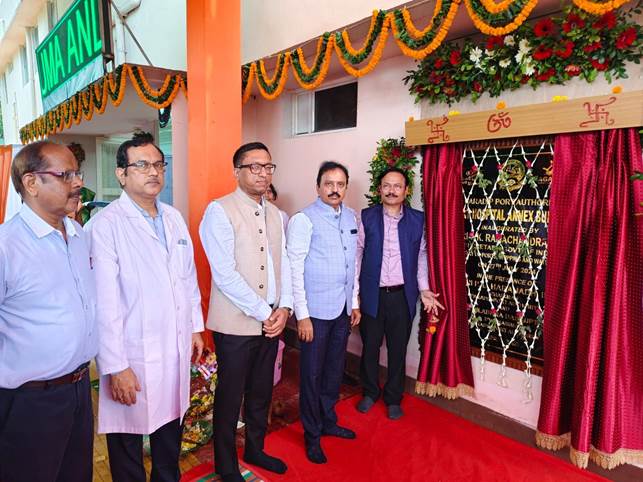
 Shri T.K. Ramachandran, Secretary, Ministry of Ports, Shipping and Waterways (MoPSW), made his maiden visit to Paradip Port Authority (PPA). During his visit he inaugurated and laid foundation stone of several significant projects worth more than Rs. 13 crores.

He inaugurated the Trauma and Burn Care (TBC) Centre in the newly constructed Annex building of Paradip Port Hospital. Constructed at a cost of Rs. 2.90 Crores, the centre will provide curative and rehabilitative services for trauma and burn victims in and around Paradip.

Secretary, Shri Ramachandran laid the foundation stone for the Water Treatment Plant of PPA. The project, being constructed at a cost of Rs. 10.50 Crores, will receive raw water through Taldanda Canal and will have the capacity to filter 16 million litres of water per day. The plant is expected to be completed by December 2024, enhancing the water infrastructure of Paradip Port and supplying quality drinking water to the citizens of Port Township.

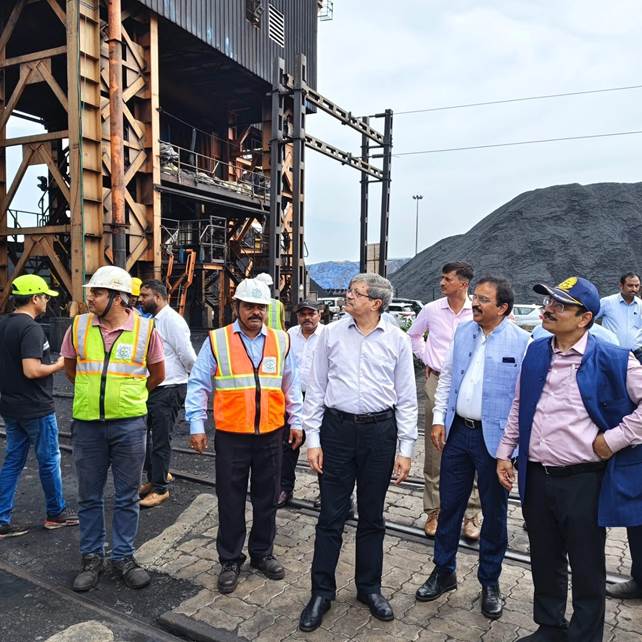
Shri Ramachandran reviewed the functioning of the PPA and interacted with Heads of Departments and Deputy Heads of Departments. He also inspected and reviewed port operations, planning, and expansion at the Mechanized Coal Handling Plant, Twin Wagon Tipplers at JSWPTPL, and KICT silos. He suggested system improvement measures to increase productivity.

The Secretary suggested several measures aimed at improving the overall performance of the port operations. These recommendations are expected to enhance the capacity and streamline the workflow, contributing to Paradip Port’s long-term growth and success.

It is to be noted that, the Paradip Port in Odisha is the highest cargo handling major port of the country. In the financial year 2023-24 PPA became highest cargo handling port by handling 145.38 million metric tonnes (MMT) cargo throughput.

The goal under Vision 2047 is to increase the port handling capacity to 10,000 MTPA. Contours of the plan will soon be spelled out. There will be avenues for private participation that are being worked upon. All ports are preparing a master plan in order to become mega ports by 2047. Improving port infrastructure and facilities, reducing turnaround time, and increasing handling capacity will be the bedrock of the 2047 target.

The latest goal is well above the targets set under the ongoing Sagarmala programme that aims boosting port capacity by 800 MMTPA to an overall 3,500 MMTPA by 2035.

As a part of Sagarmala programme, more than 800 projects at an estimated cost of Rs 5.5 lakh crore have been identified for implementation during 2015-2035. In a nearer goal, the Maritime India Vision (MIV) 2030 has a goal to develop global standard ports in India. The MIV 2030 estimates investments to the tune of Rs 1-1.25 lakh crore for capacity augmentation and infrastructure development at Indian ports.

*****

74th Meeting of Network Planning Group under PM GatiShakti evaluates five key infrastructure projects

 The 74th meeting of the Network Planning Group (NPG) under PM GatiShakti was convened in New Delhi yesterday under the chairpersonship of Additional Secretary, Department for Promotion of Industry and Internal Trade (DPIIT), Shri Rajeev Singh Thakur. The meeting focused on evaluating five significant infrastructure projects from the Ministry of Railways (MoR), Ministry of Road Transport and Highways (MoRTH), and Ministry of Housing and Urban Affairs (MoHUA). These projects were assessed for their alignment with the principles of integrated planning outlined in the PM GatiShakti National Master Plan (NMP).

Balaram – Tentuloi New Railway Line (MCRL Phase II) in Odisha

This greenfield project involves the construction of a 49.58 km rail line at an estimated cost of INR 1,404 Crores in Angul district to provide vital first-mile rail connectivity for 11 coal blocks. It aims to reduce logistics costs for industries and generate employment, thus contributing to regional development. The project is expected to significantly enhance the transport efficiency of coal, benefiting both the local economy and the broader industrial landscape of the state of Odisha.

Budhapank – Luburi New Railway Line (MCRL Outer Corridor) in Odisha

Spanning 106 kilometres, this greenfield rail line at an estimated project cost of INR 3,478 Crores will support efficient coal evacuation from the Mahanadi River Basin. The proposed alignment facilitates the transportation of coal from Talcher Coal Fields, providing first-mile rail connectivity to 21 coal blocks reducing the average distance to rail head from 43 km to 4.2 km enhancing logistical efficiency and reducing costs for core industries like iron and steel.

Lucknow Metro Rail Project Phase I-B East – West Corridor (Charbagh to Vasant Kunj) in Uttar Pradesh

This project involves extending the Lucknow Metro corridor by 11.165 kilometres to address the city’s growing transportation needs. While the existing metro line caters to 80,000 passengers per day (PPD), this additional new line is expected to cater to an additional 200,000 PPD. This proposed new corridor will serve the city’s most densely settled central business districts (CBDs), including Aminabad, Alambagh, Faizabad and Charbagh area. The stations are proposed to be strategically located to seamlessly connect points of interchange through foot overbridges (FoBs) and underpasses. The project is expected to cost INR 5,801 Crores and aims to reduce congestion, vehicular pollution, and enhance public transport accessibility through an integrated network. The development plan emphasizes the use of renewable energy through rooftop installations to reduce conventional energy consumption.

Upgradation of existing 6 Lane Road including elevated corridor of NH-47 (Narol Jn. to Sarkhej Jn.) in Gujarat

This brownfield project involves upgrading a 10.63 km section of NH-47 at an estimated cost of INR 1,295 Crores to address increasing traffic congestion in the southern part of Ahmedabad connecting to major highways and expressways. The project aims to enhance smooth and safe traffic flow, thus improving service levels. Upgrading this critical segment of NH-47 is expected to facilitate more efficient movement of goods and people, contributing to the economic vitality of the region.

4-laning of Section of NH-166 from Chokak to Sangli (Ankali) in Maharashtra

This project involves the four-laning of a 33.6 km section of NH-166, enhancing connectivity between key regions i.e., between Kolhapur & Sangli in the state of Maharashtra, at an estimated cost of INR 864 Crores. This development will reduce the travel time by 50% and the distance by about 5.4 km. This will also have a significant impact on environmental attributes. The improvement of this road will save fuel and time as well as help in controlling the pollution measures due to emission of smoke from vehicles.

Network Planning Group (NPG) evaluated all the projects from the perspective of principles of PM GatiShakti i.e., integrated development of multimodal infrastructure development, last mile connectivity to economic and social nodes, intermodal connectivity and possible synchronized implementation of the projects. These projects are expected to play pivotal roles for nation-building, integrating various modes of transport, and providing substantial socio-economic benefits and ease of living, thereby contributing to the overall development of the regions.

***

Project PARI

 Public art spaces of India are a reflection of our Lok Kala and Lok Sanskriti. When we talk about Public Art, it is very dynamic and is an intersection of past, present, and future. Through it, we can see the amalgamation of different ideas in various art forms like traditional and contemporary. This art form which is freely accessible to the public; attracts not only attention but even thoughts begin to gather as to why this work of art is here, what is its uniqueness, what material it is made up of, and what is the thought of the artist behind this artwork. Making it open to various interesting interpretations. These are the few aspects that make this art very special. It connects the public to the art.

With rapid urbanization, Public Art enhances a sense of distinctiveness and adds aesthetic value to the image of a city. It contributes to the visual quality of the public arena encouraging community pride with a sense of belonging. It uplifts and engages visitors or passers-by’s travel experience by leaving an imprint in their minds. The outreach of Public Art is immense and thought-provoking. It acts as a significant factor in giving visual recognition to a specific place. The public art augments and induces meaning to a public space making it an integral part of the culture and society.

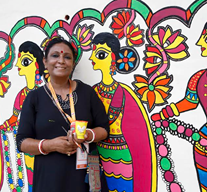
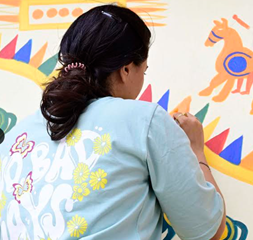
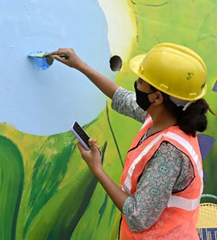
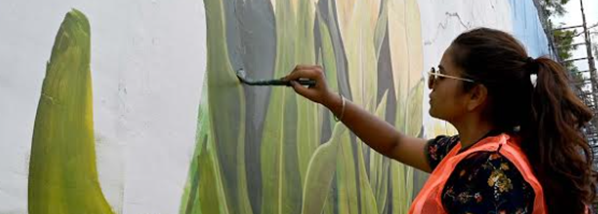
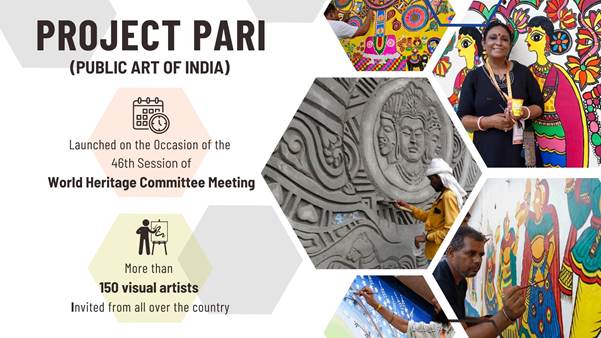
The Ministry of Culture, Government of India, on the occasion of the 46th Session of the World Heritage Committee Meeting, which is being held in New Delhi from 21st-31st July 2024, has initiated Project PARI (Public Art of India). Under it, Lalit Kala Akademi, an autonomous institution under the Ministry of Culture, has invited more than 150 visual artists from all over the country. The Project PARI aims to provide a platform to uplift the aesthetic and cultural outlook of Delhi while adding grandeur to the rich historical legacy of our national capital.

Lalit Kala Akademi and the National Gallery of Modern Art seek to bring forth public art that draws inspiration from millennia of artistic heritage (lok kala/lok sanskriti) while incorporating modern themes and techniques. These expressions underscore the intrinsic value that art holds in Indian society, serving as a testament to the nation’s enduring commitment to creativity and artistic expression. These artists are working on various sites in the national capital for the beautification of the public spaces for the upcoming event.
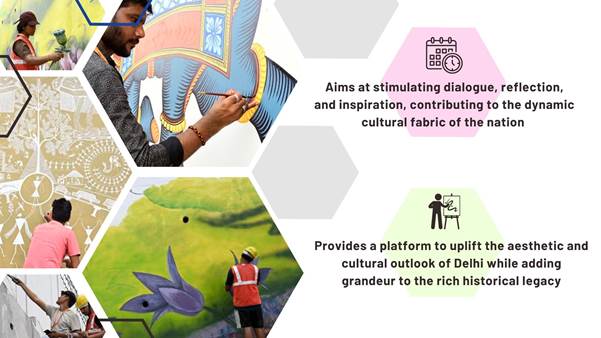
The representation of Art in public spaces is particularly significant as it showcases the nation’s rich and diverse cultural heritage. The democratization of art through public installations transforms urban landscapes into accessible galleries, where art transcends the confines of traditional venues such as museums and galleries. By integrating art into streets, parks, and transit hubs, these initiatives ensure that artistic experiences are available to one and all. This inclusive approach fosters a shared cultural identity and enhances social cohesion, inviting citizens to engage with art in their day-to-day life. Project PARI aims to stimulate dialogue, reflection, and inspiration, contributing to the dynamic cultural fabric of the nation.

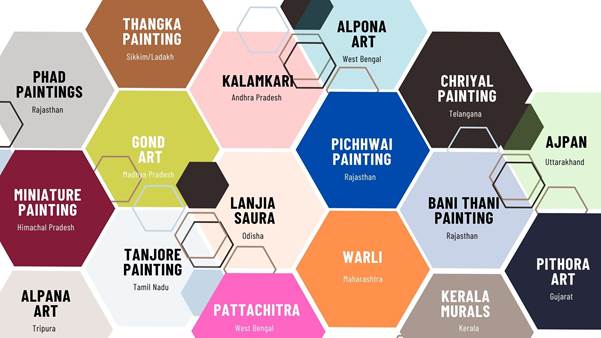
Traditional art forms as well as sculptures, murals, and installations have been created under this beautification project. More than 150 visual artists from all over the country have come together to create the various wall paintings, murals, sculptures, and installations being prepared under this project. The creative canvas includes but is not limited to artwork inspired by and /or drawn in styles of Phad paintings (Rajasthan), Thangka painting (Sikkim/Ladakh), miniature painting (Himachal Pradesh), Gond art (Madhya Pradesh), Tanjore paintings (Tamil Nadu), Kalamkari (Andhra Pradesh), Alpona art (West Bengal), Cheriyal painting (Telangana), Pichhwai Painting (Rajasthan), Lanjia Saura (Odisha), Pattachitra (West Bengal), Bani Thani Painting (Rajasthan), Warli (Maharashtra), Pithora Art (Gujarat), Aipan (Uttarakhand), Kerala Murals (Kerala), Alpana art (Tripura) and more.
The proposed sculptures being created for Project PARI include wide-ranging ideas such as paying tributes to nature, ideas inspired by the Natyashastra, Gandhi ji, toys of India, hospitality, ancient knowledge, Naad or Primeval Soun, Harmony of life, Kalpataru – the divine tree, etc.

Furthermore, in sync with the proposed 46th World Heritage Committee Meeting, some of the artworks and sculptures draw inspiration from World Heritage Sites such as Bimbetka and the 7 natural World Heritage Sites in India find a special place in the proposed artworks.


Women artists have been an integral part of Project PARI and their participation in large numbers is a testimony of Bharat’s NARI SHAKTI.
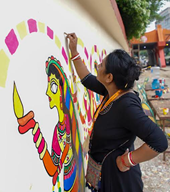
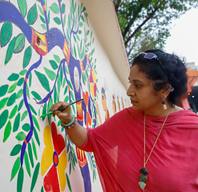


Project PARI stands as a monumental effort to infuse Delhi with the rich and diverse artistic heritage of India, while simultaneously embracing contemporary themes and expressions. As the city prepares to host the 46th session of the World Heritage Committee, the initiative not only beautifies public spaces but also democratizes art, making it accessible to all. This cultural renaissance, brought to life by the collaborative efforts of over 150 visual artists, showcases the profound and multifaceted traditions of Indian art. By engaging citizens and fostering a shared cultural identity, the initiative not only enriches the urban landscape but also inspires a deeper connection with our heritage.

Come and join the celebrations. Click your selfie with a Project PARI creation and share your pictures on social media with #ProjectPARI.

References

· https://www.pib.gov.in/PressReleasePage.aspx?PRID=2031268 .

· https://lalitkala.gov.in/pariproject

*****

Must Do activities for College Student

As a college student and a teen you are at the most important entropy peak of your life, because it’s the turning point moment in your life where you can, build the best version of yourself and excel in life.

So for doing that there are lots of ways and methods to do that but the basic things which we can add up in our daily life routine and it will definitely proved to be an asset in your life.


1. Planning The Day.

At this young age we mostly focus on enjoying life and not taking thing’s seriously and we end up wasting lots of time. So have a fixed sleeping routine, plan your Daily work schedule and stick to it. Because this will not only make you productive but also saves lots of time to enjoy, because enjoying is also necessary for healthy and happy life.

2. Daily Exercise or Workout 

It is mandatory for everybody to exercise daily, whether its Gyming or doing Yoga thats your choice. Because for working productively you need to be healthy. So, try to sleep early at night and wake up early in the morning, so that you can complete your exercise at morning it will be better, otherwise its your choice but perform your exercises daily.


3. Gain Knowledge, Out of your syllabus.

It means that don’t only stick to the college course material, follow your passion and work on it by taking help of books, articles, journals, online courses, etc. Because it will not only make you happy but also provide you a special recognition in your group.

4. Real Life experiences 

Try to gain some real life experiences by others people experiences, they can be your family members or someone unknown to you. Watch various Podcasts, interviews etc. This will help you tremendously in your personal and Professional life both.

5. Be Socially active

Don’t be the book worm always. Divide some time to your activities, be socially active and available to people around you by various social media sites like LinkedIn, Facebook, Instagram, etc. This will help you being connected with others and also let you updated with whats happening in the world amd also let you aware of different opportunities .

6. Be Spiritual 

Now with this, I mean that you should believe in the different kinds of energies around you, whatever the from may be that’s your choice and be thankful for what you have in life. Because it will help you in being happy from inside and makes you a humble person, who is free from problems like stress, anxiety in life.

That’s it!, these are the must do things which will help us develp ourselves and a happy environment for society.

Thank You 🙂

 ॐ नमः शिवाय

Article Written by: Ratan Kumar Ojha

Kisan Rail

The First Kisan Rail introduced by the Ministry of  Railways will start  from Devlali in Maharastra Nashik at 11 am  to Danapur  in Bihar’s  capital , patna ,on August 7 , 2020. 

Narendra singh Tomar , Union Agriculture Minister will launch the country’s first kisan special parcel Train via video conference which was announced in budget 2020.
The train will make stoppage at different stations carrying fruits , vegetables ,etc and it will be not carrying regular passengers . It will have coaches 10 +1.
This train will  be going on weekly basis  and will reach Danapur at 6.45 pm the next day , after completing the distance of 1519 km in over 31 hours .
The stoppages of this train – Manmad, Naski Road ,Bhusaval ,Jalgaon ,Burhanpur ,Itarsi , khandwa  , katni , Jabalpur , Satna , Manikpur ,pt. Deendayal upadhyay Nagar , Prayagraj clhheoki , Buxar.
As per the railway ministry , Nasik and the surrounding region provides a high quality of fruits and vegetables , onions , flowers , other perishables mainly also  transported to the region around Allahabad , patna , satna and Katni.
There shall be refrigerated coaches in freight trains and express as well. A cold supply chain to be build for meat , milk and fish for transportation of perishable traffic.

Time capsule

 
As  stated , In Ayodhya , lord Ram and his place of birth where time capsule will be  placed inside a  copper plate  before placing it before the site. As per chaupal , sanskrit is choosen as per long sentences can be changed into few words.
The first and foremost time capsule is placed by Indira Gandhi  , outside one of the gate of Red forts. It was named as kalpaatra  which contain post independence history on 15 August 1972. It will be opened 
 After 1000 times..
In 2010 , another time, first and foremost  female president of India  to date , prathibha patel  buried on March 6  it was buried near auditorium  of IIT kanpur .
In 2010 another capsule was buried  in Mahatma  Mandir ,Ghandhinagar to mark 50 years of foundation of temple .
In 2014 , Alexandra Girl’s Education Institution buried one time capsule  which is scheduled to be open on sep 1 ,2062 on ocassion of bi- centennial anniversary of Institution.
A time capsule has been placed in Lovely professional University  in the presence of prime minister Modi on occassion of 106 th Indian science congress organised by LPU. It contains 100 different items  that represents cross examination of technology at the time in India for the next 100 years by three distinguised noble laureates-Hungry -Born israeli  biochemist Avram Hershko, British Born American physicist F .Duncan M.Haldane and German-American Biochemist  Thomas christian sudhof.

Actually a time capsule is made from metals such as aluminium, stainless steel  or copper and the message is written on acidic free paper so that paper donot rot even after hundreds of year . The time capsule container is 3 feet longer  and buried deep inside the ground .

The time capsule is a historic cache of information or goods to communicate  with future generations. It also helps  archaeologists , anthropologists  and historians to study about a site. With this capsule the future generation an get total idea of a particular era , society or community . They are generally placed in foundation of buildings.

Civic Sense

Life is a journey from beginner to a pro. It drives us from a million ways through which we live, learn, seek, embrace and grow. The growth of a human being into a person is what involves the entire journey of a lifetime. For every second a person lives, he grows in a million uncounted, un-felt ways. The greatest mechanism for the transformation of a human being to a person is education. Education is the power that can change the world.

Education is an integral part of human development and there exist an essential need for the same. But as always said, Growth is always multidimensional. Education teachers of person theoretically. There is a need of social recognisation and realisation in people which we call the Civic sense. The sense of responsibility and concern towards being a good human is what constitutes to an important branch of growth. Teaching makes people intelligent but civic sense makes people gentleman. Also, What point is it to have an education system which lacks the basic education?
people lack in having civic sense as they were never taught about the importance regarding the same. In rushing after our ambitions, we often forget that we need to be responsible and sensible about our living too. There are many strategies and steps which could be followed in order to improve the current situation of our generation as lack of civic sense does not only pulls human away from being a complete person but also exploits the environment. Instances like dumping garbage in the middle of high speeding road, leaving over the packages marks how can professional and uncivilized this generation is.
There should be a systemised remedy provided for the same. As qualities like these are developed in the early stages, the schools should have a subject about Moral Education or  Values to Uphold to highlight the importance of being a good human being and how to pursue it.
Only if we start it from the initials, we will make it to the finals too. It is high time for the generation to step out and see the ways to turn their imperfection into areas of improvement. Besides, awareness programs should be held, laws should be made for betterment of the same. When the people will come together, the environment, ethics and morals will never have to be compromised.
Education drives human to a person but civic sense a person to the person.

Bullet Train is required in India or not

What is Bullet Train?


The shinkansen high speed trains are colloquially called as  bullet train  for their apperance and speed. It is generally used  to describe a high-speed train of speeds above 250kmph.  Its key characteristics is its key exclusive grade seperated tracks which  enables high capacity utilization to be achieved  while maintaining  high service reliability and high safety performance.
India project

The first india bullet train will run in the Mumbai and Ahmedabad high speed rail corridor,whose construction began in 2017. The train will run at speed of 320 kmph and is expected to be completed by 2022.It is 750-seat train.The entire corridor estimated cost is Rs1,08,000 crore .Japan has offered a loan to India. There will be 12 stations on route ,majority of route will be elevated. A part of it will run through a 7 km long undersea tunnel. It will usher a new era of development.

Why Need of this service?                                    Bullet train project is expected to create 4000 direct job opportunities,along with 20000 indirect job and 20000  construction workers will also be employed.                                                                         set up of stations will come up as will attract urban growth..In the backdrop of increasing concerns over environmental pollution and degradation of fossil   fuels ,energy efficient  and environment friendly. IT emit Eighth and fifth of carbon dioxide as against automobiles and aeroplanes per passenger km.India is vast country,it requires to travel faster.while air transport can cater to such needs but simply cannot match that of railways. It is important to adopt proven  state of the art technologies.It will save time and boast business.

Seems redundant ?
 
The Mumbai -Ahmedabad train costs around one lakh crore Indian rupees. It may further get increased due to delays and further inflation.
The fare may range from 4000  to 5000 rs to make the running of trains economically variable. Such may be afforded by rich who would rather prefer air tickets. Travel by train in India is mostly done by poor class.
The complexities of the project will give rise to land acquisition ,rehabilitation and environmental concerns. It will give rise to poverty.
Facts
 The indian  Railways is in worrying state. There is first need to strengthening the present infrastructure of the railways.
The recent increase in rail accident strengthen this case.
The committee also recommended  a complete shift to LHB coaches to minimize the loss of lives due to derailment.

Corporate Social Responsibility

Benefits to Corporate:
Corporate Social Responsibility

  1. Eligible under CSR Rules, Companies Act 2013.
  2. Eligible for Tax Exemption u/s 80G of Income Tax Act.
  3. Customize projects as per the need of the Donor Company.
  4. No minimum or maximum size of Donation. You may support us by any amount.
  5. All Documentation Support provided like 3 years Balance Sheet, Registration Certificate, etc.
  6. Project Name shall be on your organization name if you require.
  7. Promotions of your company on our Social Media Platforms and website.
  8. All the beneficiary of the projects can be seen and a meeting can be organized with them like in AGM or any other event of company.
  9. Your funds shall be used on the sector you choose – Education or Health Care
What we can do for corporates?
We, at Drishti Foundation Trust have a vast network of experienced, highly qualified and committed professionals, who have successful track record of dealing in various social initiatives from time to time. Over the years we have been associated with number of corporate houses as CSR partner/collaborators. At this juncture we offer our following specialized services to corporate sector;

PRORITIES OF THE PROGRAMME

PRORITIES OF THE PROGRAMME

  • The need based action plans to be prepared, implemented and reviewed annually by the village communities in facilitation of the other stakeholders.
  • All the stakeholders will be involved at various stages to share learn and contribute their inputs, which lead to better results and create opportunities for its wider dissemination by them at their levels.
  • The project provide platform for the community to set their own priorities and decide possible solution which can initially be the low cost traditional system or technologies already in use.
  • Furthermore opens opportunities for research on community preferred need based new technologies as basket of choice to select the best fit in their system / region with some modifications on recommendation of community.
  • Added – value.
  • Innovation approaches.
  • Models for good practices.
  • Promotion of gender equality and equal opportunities.
  • Fostering co-operation.