Numerous of us have transferred our lives to the web. Managing an account, work emails, social media, dating profiles, therapeutic records – all that imperative, touchy data. So it could be a small perturbing that the web features a lethal security imperfection.
Don’t freeze; our private data is safe for presently. But some time recently exceptionally long the encryption calculations that ensure us online are attending to crack. That is the pressing driving drive behind a modern, more secure kind of web that saddles the control of the quantum domain. Once up and running, the framework will be able to do a parcel more than ensure our data.
It could bring us unanticipated quantum apps, and possibly gotten to be the platform for a world-spanning quantum computer of extraordinary power. Building the quantum web could be a colossal and multi-faceted building challenge, but the establishments are as of now being laid. Systems of filaments are spreading. Researchers are chatting in mystery on neighborhood systems. There are indeed plans to utilize minor satellites to empower long-dist
Forget about Fuchsia and Google Search. Researchers from Google, Stanford, Princeton and other institutions could have discovered a computer breakthrough so significant we can’t completely grasp it yet. Even Google scientists aren’t convinced whether their time crystal finding is correct. However, if the report is correct, Google may be one of the first corporations to provide the globe with a critical technical improvement in the future. Quantum computers, which can tackle difficult problems with amazing speed and power using technologies that have yet to be created, will require time crystals as a building component.
What is a quantum computer?
Google isn’t the only business working on quantum computers, and these devices continue to make headlines daily. Quantum computers won’t be able to reach your phone, and they won’t be able to play games with you. Even if they did, Nintendo’s future systems will be completely devoid of the latest computing technologies.
According to The Next Web, we intend to use quantum computers to solve difficult issues. Warp drives, for example, might allow for rapid interstellar travel. And medical technologies capable of curing almost every ailment.
Earlier this year, Google teamed up with Michael Pea for a quantum computing demonstration at I/O 2021:
Quantum computers, on the other hand, are extremely difficult to create, maintain, and even operate. That’s where Google’s time crystals may be useful. Qubits, or quantum computer bits, are now used in quantum computers. When these qubits are seen, they behave differently than when they are left alone. It’s because of this that measuring qubit states is challenging. Because of this instability, using a quantum computer is difficult. That’s when time crystals enter the picture.
Google’s time crystals
The time crystal idea, first proposed in 2012, is a new phase of matter. According to The Next Web, time crystals defy one of Sir Isaac Newton’s renowned principles. “An object at rest tends to stay at rest, and an object in motion tends to stay in motion,” according to Newton’s first law of motion.
There’s something called high entropy in our cosmos (disorder). Energy transfers constantly cause something to happen. When there are no processes, entropy is constant, but it increases when they are present. However, this is not the case with time crystals. Even when employed in a process, they can preserve entropy.
The Next Web gives a fantastic analogy with snowflakes to explain Google’s time crystals. Because the atoms are organized in precise ways, they have distinct patterns. Snow falls, melts, water evaporates, and ultimately turns back as snow. All of these processes entail energy transfers. A time crystal is analogous to a snowflake that can switch between two configurations without consuming or wasting energy. Time crystals can have their cake and eat it too, and they can do it indefinitely.
What does it mean for you and me?
The time crystals that Google uses do not belong to Google. Even the Google crew is unsure if they were developed by them. The study is only available in pre-print form while it is being peer-reviewed.
However, if Google can figure out how to build them, next-generation quantum computers may include time crystals. These computers might be built by anyone. They’d also bring quantum coherence to a region where there’s a lot of decoherence — the restless qubits we talked about before.
Even yet, the development of quantum computers based on time crystals is still in its infancy. Google may have demonstrated that time crystals aren’t simply a theory, but it hasn’t built any.
To develop warp drives or uncover “universally effective cancer therapies,” we may require decades of quantum computing research to produce quantum computers with time crystals. And it will take decades to fully comprehend quantum computers and time crystals. This is the URL to Google’s paper. Furthermore, Quanta Magazine provides a comprehensive overview of Google’s findings, replete with a time crystal animation.
As far as we currently know, there is a single expanding blob of spacetime speckled with trillions of galaxies – that’s our Universe. If there are others, we have no compelling evidence for their existence.
That said, theories of cosmology, quantum physics, and the very philosophy of science have a few problems that could be solved if our blob of ‘everything’ wasn’t, well, everything.
That doesn’t mean other universes must exist. But what if they do?
What is a universe?
It should be a simple question to answer. But different areas of science will have subtly different takes on what a universe even is.
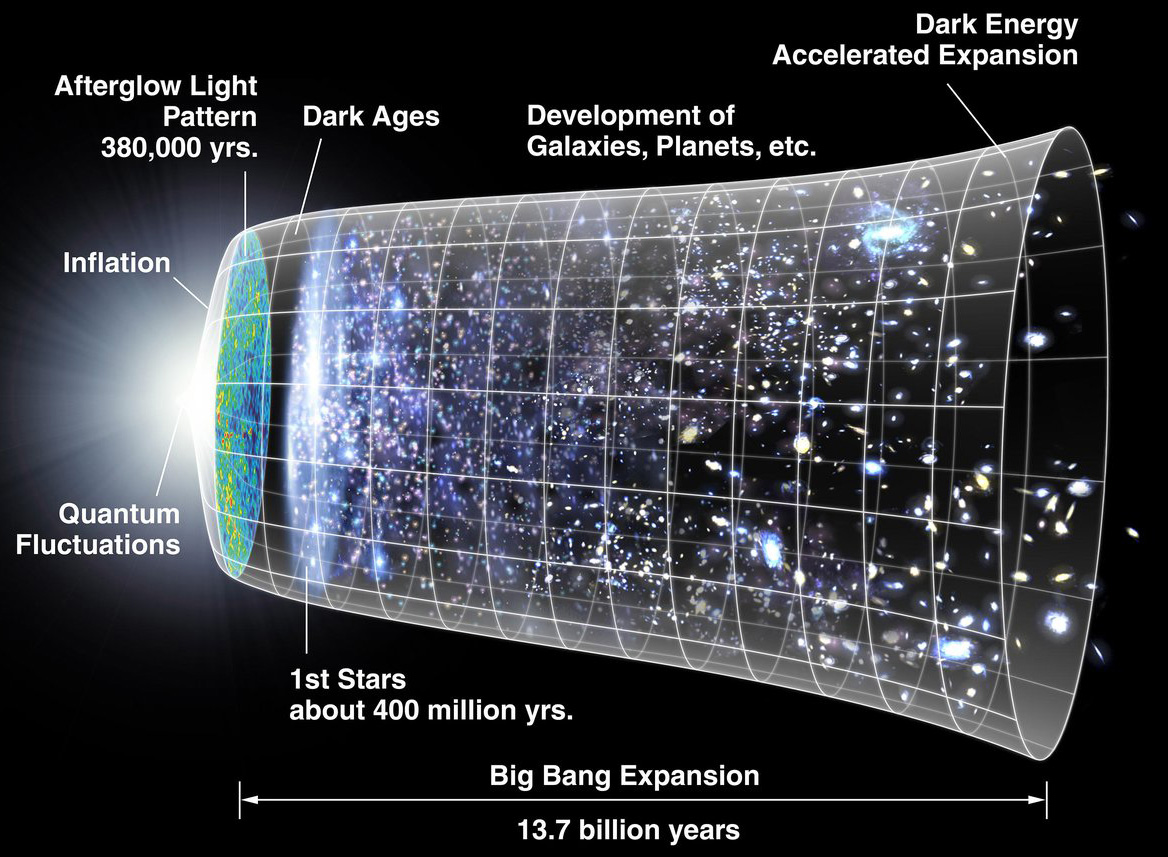
Cosmologists might say it describes the total mass of stuff (and the space in between) that has been slowly expanding from a highly concentrated volume over the past 13.77 billion years, becoming increasingly disordered with age.
It now stretches 93 billion light years from edge to edge, at least based on all of the visible (and invisible) stuff we can detect in some way. Beyond that limit, there are either things we can’t see, an infinite expanse of nothingness, or – in the unlikely scenario that all of space bends back around on itself – a round-trip back to the start across a hyperspherical universe.
If we’re talking quantum physics, though, a universe might refer to all fields and their particles, and their combined influences over one another. As a general rule, a universe (like ours, at least) is a closed system, meaning it can’t suddenly lose or gain a significant sum of energy.
Philosophically speaking, a universe might be a discrete set of fundamental laws that governs the behavior of everything we observe. A universe would be defined by its own rules that set its unique speed for light, tell particles how to push or pull, or space how it should expand.
What is a multiverse in cosmology?
A century of astronomical observations has told us a lot about the age, size, and evolution of galaxies, stars, matter and the four dimensions we sum up as spacetime.
We can theoretically squeeze all of the matter of the Universe down to a point where the concentration of energy reduces atoms to a soup of simpler particles and forces combine until we can’t tell them apart. Any smaller than that? Big shrugs.
If we go with what’s known as a cyclic model of cosmology, the parent universe preceded ours in some way. It might even be a lot like this one, only running in reverse compared with ours, shrinking over time into a concentrated point only to bounce back out for some reason. Played out for eternity, we might imagine the respective universes bounce back and forth in an endless yo-yo effect of growing and collapsing.
Or, if we go with what’s known as a conformal cyclic model, universes expand over trillions upon trillions of years until their cold, point-like particles are so spread out, for all mathematical purposes everything looks and acts like a brand new universe.
If you don’t like those, there’s a chance our Universe is a white hole – the hypothetical back end of a black hole from another universe. Which, logically, just might mean the black holes in our Universe could all be parents, pinching off new universes like cosmic amoebae.
What is a multiverse in quantum physics?
Early last century, physicists found theories that described matter as tiny objects only told half of the story. The other half was that matter behaved as if it also had characteristics of a wave.
Exactly what this dual nature of reality means is still a matter of debate, but from a mathematical perspective, that wave describes the rise and fall of a game of chance. Probability, you see, is built into the very machinery that makes up the gears of a universe like ours.
Of course, this isn’t our daily experience as vast collections of atoms. When we send a bucket of molecules called a rocket to the Moon as it zooms past 300,000 kilometres away, we’re not rolling dice. Classical old physics is as reliable as tomorrow’s sunrise.
But the closer we zoom in on a region of space or time, the more we need to take into account the possible range of measurements we might find.
This randomness isn’t the result of things we don’t know – it’s because the Universe itself is yet to make up its mind. There’s nothing in quantum mechanics explaining this transition either, leaving us to imagine what it all means. https://www.youtube.com/embed/dzKWfw68M5U?ab_channel=PBSSpaceTime
In his 1957 doctoral dissertation, American physicist Hugh Everett suggested the range of possibilities are all as real as one another, representing actual realities – separate universes, if you like – just like the one we’re all familiar with.
What makes any one universe in this many worlds interpretation distinct is how each wave correlates with a specific measurement taken of other waves, a phenomenon we call entanglement.
What ‘we’ means, and why ‘we’ experience one entangled set over waves over another, isn’t clear, and in some ways presents an even bigger problem to solve.
What is a multiverse in philosophy?
One of science’s most fundamental starting assumptions is that in spite of what your mother tells you, you’re not special. Nor is any other human, or our planet, or – by extension – our Universe.
While rare events occur from time to time, we don’t answer The Big Questions with ‘it just happened that way’.
So why does our Universe seem to have just the right tug-of-war of forces that allow not just particles to appear, but to congeal for long enough periods into atoms that can undergo complex chemistry to produce thinking minds like ours?
Philosophically speaking, the anthropic principle (or principles, since there are many different ways to spin the idea) suggests we might have it backwards. Without these conditions, no minds would have arisen to consider the amazing turn of events.
If just a single universe ‘just happened that way’ early one spring morning, it’d be one big coincidence. Too big really.
But if there were infinite universes, with infinite combinations of forces pushing and pulling, some would inevitably give rise to minds that just might ask ‘are we part of a multiverse?’
Will we ever discover other universes?
Given the very definition of a universe relies on some kind of physical fence keeping influencing factors apart, it’s hard to imagine ways we might ever observe the existence of a sibling for our universe. If we did, we might as well see it as an extension of our own Universe anyway.
That said, there could be some cheats that could give us a glimpse.
Any experiment to find one would have to rely on that ‘fence’ having some holes in it that allow particles or energy to leak across, either into ours, or away from it. Or, in the case of universes existing in our past, monumental events that left enough of a scar that not even a rebirth could erase.
For now, we still have no good reason to think our blob of everything is anything but unique. Given we’re still learning how our own Universe works, the current gaps in physics could yet be plugged without any need to imagine a reality other than ours.
In countless other versions of this article scattered throughout the multiverse, however, the question of whether we are alone just might have a different answer.
Tachyon, hypotheticalsubatomic particle whose velocity always exceeds that of light. The existence of the tachyon, though not experimentally established, appears consistent with the theory of relativity, which was originally thought to apply only to particles traveling at or less than the speed of light. Just as an ordinary particle such as an electron can exist only at speeds less than that of light, so a tachyon could exist only at speeds above that of light, at which point its mass would be real and positive. Upon losing energy, a tachyon would accelerate; the faster it traveled, the less energy it would have.
The name ‘tachyon’ (from the Greek ‘tachys,’ meaning swift) was coined by the late Gerald Feinberg of Columbia University. Tachyons have never been found in experiments as real particles traveling through the vacuum, but we predict theoretically that tachyon-like objects exist as faster-than-light ‘quasiparticles’ moving through laser-like media. (That is, they exist as particle-like excitations, similar to other quasiparticles called phonons and polaritons that are found in solids. ‘Laser-like media’ is a technical term referring to those media that have inverted atomic populations, the conditions prevailing inside a laser.)
an experiment at Berkeley to detect tachyon-like quasiparticles. There are strong scientific reasons to believe that such quasiparticles really exist, because Maxwell’s equations, when coupled to inverted atomic media, lead inexorably to tachyon-like solutions.
“Quantum optical effects can produce a different kind of ‘faster than light’ effect (see “Faster than light?” by R. Y. Chiao, P. G. Kwiat, and A. M. Steinberg in Scientific American, August 1993). There are actually two different kinds of ‘faster-than-light’ effects that we have found in quantum optics experiments. (The tachyon-like quasiparticle in inverted media described above is yet a third kind of faster-than-light effect.)
“First, we have discovered that photons which tunnel through a quantum barrier can apparently travel faster than light (see “Measurement of the Single-Photon Tunneling Time” by A. M. Steinberg, P. G. Kwiat, and R. Y. Chiao, Physical Review Letters, Vol. 71, page 708; 1993). Because of the uncertainty principle, the photon has a small but very real chance of appearing suddenly on the far side of the barrier, through a quantum effect (the ‘tunnel effect’) which would seem impossible according to classical physics. The tunnel effect is so fast that it seems to occur faster than light.
“Second, we have found an effect related to the famous Einstein-Podolsky-Rosen phenomenon, in which two distantly separated photons can apparently influence one anothers’ behaviors at two distantly separated detectors (see “High-Visibility Interference in a Bell-Inequality Experiment for Energy and Time,” by P. G. Kwiat, A. M. Steinberg, and R. Y. Chiao, Physical Review A, Vol. 47, page R2472; 1993). This effect was first predicted theoretically by Prof. J. D. Franson of Johns Hopkins University. We have found experimentally that twin photons emitted from a common source (a down-conversion crystal) behave in a correlated fashion when they arrive at two distant interferometers. This phenomenon can be described as a ‘faster-than-light influence’ of one photon upon its twin. Because of the intrinsic randomness of quantum phenomena, however, one cannot control whether a given photon tunnels or not, nor can one control whether a given photon is transmitted or not at the final beam splitter. Hence it is impossible to send true signals in faster-than-light communications.
Quantum mechanics is a field of physics which has grown to the best and still growing endlessly from its first proposal by Niels Bohr and Max plank. It has influenced greatly the way humanity approaches the advancement in each and every field including technology. Now this quantum theory has birthed a new contrivance called Quantum dots and there is no doubt that they are going to show substantial influence on our near future. The quantum dots are very small particles of a few nanometers size. But their properties vary from the larger particles due to quantum mechanics. Even though size is the main criteria for quantum dot’s exceptional behaviour, their shape, structure and composition also play a major role. They act like artificial atom showing similar electronic wavefunctions to atoms, and artificial molecules can be prepared from them, exhibiting hybridization. Alexander Efros was first to theorize the quantum dots. And then Alexei Ekimov first time produced a quantum dot. Now quantum dots of different materials are produced for the different purposes of research and technologies.
What makes us to call quantum dot the near future? From their first synthesis to today quantum dots have shown immense application throughout the varying science fields. Quantum dots are used in biological imaging and labelling of live cells as they can be injected into the cells and can be attached to biomolecules. Quantum dots conjugated to immunoglobulin G and streptavidin are used as label to malignant cells of breast cancer. Cells can easily engulf these quantum dots. And their capacity to show symmetrical emission, broad excitation and ability to be excited in single excitation make them a potential replacement to organic label dyes.
They can be used as absorbing photovoltaic material. Quantum dots produce multiple excitons from a single photon compared to today’s solar cells which produce only one. So bulk materials like silicon can be replaced by these materials. Hence QDs promise to extract more energy per photon and also require less space. Thermodynamic calculations by National renewable energy laboratory in Colorado, United states has shown that solar cells developed by quantum dots operating under concentrated sunlight have theoretical conversion efficiency of 66% compared to 31% of present-day solar cells.
There is one more interesting thing. In an article by NCBI headed QUANTUM DOTS AS A PROMISING AGENT TO COMBAT COVID-19 says Carbon based quantum dots could be used to disable S protein of SARS COV-2. And quantum dots incorporated with suitable functional groups interacts with the entry receptors of the virus and affects genomic replication. These things can turn into potential solutions to the pandemic.
Apart from all these, quantum dots find real and potential applications in single electron transistors, lasers, LEDs, microscopy and many other things. They are more promising, efficient compared to the conventional ones. Their application in technologies like quantum computing are signs to hope for a revolution. All these technologies are half the way and can surely become our present very soon.



 (
(


 Eduindex
You must be logged in to post a comment.