DST to Announce Quantum Start-ups under National Mission on Interdisciplinary Cyber Physical Systems and National Quantum Mission

Start-ups selected for support under the newly established guidelines in Quantum Technologies will be officially unveiled by the Union Minister of State (Independent Charge) for Science and Technology, Minister of State (Independent Charge) for Earth Sciences, MoS PMO, Department of Atomic Energy, Department of Space, Personnel, Public Grievances and Pensions, Dr. Jitendra Singh at an event, scheduled for 26th November 2024.

Department of Science and Technology (DST) has established detailed guidelines to support and nurture startups in the field of quantum technologies. These comprehensive guidelines provide a structured framework for startups to access essential resources, funding opportunities, mentorship, and infrastructure support, empowering them to accelerate innovation and contribute to India’s quantum ecosystem.

The unveiling of the startups by the Union Minister, who will be the Chief Guest for the occasion will showcase India’s growing prowess in quantum research, development, and commercialization.

A Call for Proposals was launched earlier this year by the I-HUB Quantum Technology Foundation, a Technology Innovation Hub (TIH) established at the Indian Institute of Science Education and Research (IISER), Pune, under the National Mission on Interdisciplinary Cyber-Physical Systems (NM-ICPS). The response from start-ups across the nation showcased the increasing interest in quantum technologies and the potential for ground-breaking advancements.

The selected start-ups, representing cutting-edge innovation across diverse domains such as quantum communication, computing, sensing, and materials, were chosen through a rigorous evaluation process. These pioneering ventures are poised to contribute significantly to India’s quantum ecosystem, addressing critical technological challenges and driving economic growth.

With the growing momentum in India’s start-up ecosystem, the National Quantum Mission is dedicated to nurturing ventures in quantum technology, and propelling the nation toward world-wide excellence in this transformative field.

***
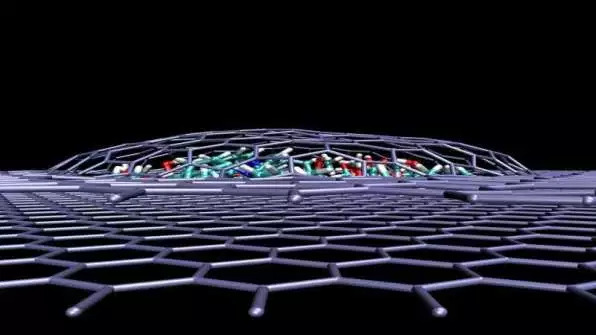
Wonder Material Graphene Revolutions :Super Exclusive

Thanks to the application of the wonder material graphene, the quest for producing durable, affordable, and mass-produced “smart textiles” has been given a new push.

Headed by Professor Monica Craciun from the University of Exeter Engineering department, an international group of researchers has developed a novel method for producing fully electronic fibers that can be integrated into the production of day-to-day clothing.

The development of the current generation of wearable electronics involves fixing devices to fabrics, which could make them extremely rigid and prone to malfunctioning. However, in the latest study, the electronic devices are embedded in the material’s fabric, and this is done by coating electronic fibers with durable and lightweight components that will enable showing images directly on the fabric.

Credit: Third Party Reference

According to the scientists, the discovery could transform the development of wearable electronic devices for applications in many different day-to-day applications, and also medical diagnostics and health monitoring, like blood pressure and heart rates. The international collaborative study has been reported in the scientific journal Flexible Electronics. Experts from the Centre for Graphene Science at the University of Exeter, CenTexBel in Belgium, and the Universities of Aveiro and Lisbon in Portugal took part in the study.

For truly wearable electronic devices to be achieved, it is vital that the components are able to be incorporated within the material, and not simply added to it.

Monica Craciun, Professor and Study Co-Author, Engineering Department, University of Exeter. & “Dr Elias Torres Alonso, former PhD student in Professor Craciun’s team at Exeter and now Research Scientist at Graphenea.”

“This new research opens up the gateway for smart textiles to play a pivotal role in so many fields in the not-too-distant future. By weaving the graphene fibres into the fabric, we have created a new technique to all the full integration of electronics into textiles. The only limits from now are really within our own imagination.”

Credit: Third Party Reference

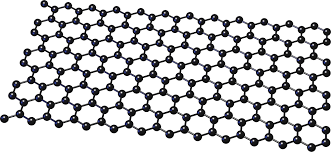
Graphene is only one-atom thick, which makes it the thinnest substance with the ability to conduct electricity. It is also one of the strongest known materials and quite flexible. In recent years, the race has been on for engineers and scientists to adapt graphene for applications in wearable electronic devices.

The latest study applied existing polypropylene fibers—often employed in an array of commercial applications in the textile sector—to fix the novel, graphene-based electronic fibers to develop light-emitting and touch-sensor devices. The innovative method means that the fabrics will be capable of integrating truly wearable displays but without the requirement for electrodes—wires of extra materials.

The incorporation of electronic devices on fabrics is something that scientists have tried to produce for a number of years, and is a truly game-changing advancement for modern technology.“Saverio Russo, Professor and Study Co-Author, Physics Department, University of Exeter.”

The key to this new technique is that the textile fibres are flexible, comfortable and light, while being durable enough to cope with the demands of modern life.“Dr Ana Neves, Study Co-Author, Engineering Department, University of Exeter.”

Credit: Third Party Reference

Earlier in 2015, an international group of researchers, including Dr Ana Neves, Professor Russo, and Professor Craciun from the University of Exeter, had developed a novel method to integrate flexible, transparent graphene electrodes into fibers often associated with the textile sector.

Reference- https://divyanshspacetech.wordpress.com