Dependence on River Water

 As per the CWC Study “Reassessment of Water Availability in India using Space Inputs, 2019”, the average annual water availability of 20 river basins of the country is 1999.20 BCM. As per the aforesaid report, the average annual water availability of 3 river basins located in the north-eastern region of the country, viz, 1) Brahmaputra, 2) Barak & Others, and 3) Minor rivers draining into Myanmar and Bangladesh is 644.84 BCM, which is quite significant. However, dependence of any area on one source of water, i.e. the surface water exposes it to the vulnerabilities of climate change and erratic precipitation patterns. Therefore, the best strategy to deal with the dynamic nature of hydrological cycle is by ensuring sustainability of groundwater and surface water resources through convergence of various schemes.

Water being a State subject, steps for augmentation, conservation and efficient management of water resources are primarily undertaken by the respective State Governments. In order to supplement the efforts of the State Governments, Central Government provides technical and financial assistance to them through various schemes and programmes. 

Various initiatives have been undertaken by Govt. of India relating to water resources conservation throughout the country including the north-eastern region are as follows:

  1. Master Plan for Artificial Recharge to Groundwater- 2020 has been prepared by Central Ground Water Board (CGWB) in consultation with States/UTs. The Master Plan envisages construction of about 1.42 crore rain water harvesting and artificial recharge structures in the country to harness 185 Billion Cubic Metre (BCM) of monsoon rainfall. The Master Plan has been circulated to all the States/UTs for implementation.
  2. Central Ground Water Authority (CGWA) constituted under Section 3 (3) of the “Environment (Protection) Act, 1986” grants No Objection Certificates (NOCs) for ground water abstraction to Industries, Infrastructure units and Mining projects in feasible areas in certain States/UTs where regulation is not being done by the respective State/UTs.
  3. A nationwide programme of “National Aquifer Mapping and Management (NAQUIM)” for mapping of aquifers, their characterization and development of aquifer management facilitate sustainable development of ground water resources. Under NAQUIM 2.0 programme, various studies have been taken up based on ground water related issues including areas with springs in North Eastern Region. The core objective of NAQUIM 2.0 is to present implementable ground water management plans and strategies. Public Interaction Programs are also being organised at grass root level for disseminating the tenets under National Aquifer Mapping and Management (NAQUIM) Programme for the benefit of the stakeholders.
  4. Government has been implementing Pradhan Mantry Krishi Sinchayee Yojana (PMKSY) since 2015-16 in the country including north-eastern states with an aim to enhance physical access of water on farm and expand cultivable area under assured irrigation, improve on farm water use efficiency, introduce sustainable water conservation practices etc. Central funding is also being provided to schemes for Repair, Renovation and Restoration (RRR) of Water Bodies of various State Governments, including north-eastern states.
  5. Mahatma Gandhi National Rural Employment Guarantee Scheme (MGNREGS) includes water conservation and water harvesting structures as one of the activities under its natural resource management (NRM) component.
  6. Jal Jeevan Mission is implemented for ensuring sustainability of groundwater resources and surface water-based sources through convergence of various schemes.
  7. 15th Finance Commission grants have been released to States to be utilized through Rural Local Bodies. Financial assistance given to various States under 15th Finance Commission tied grants can be inter alia utilised for rainwater harvesting.
  8. Department of Agriculture & Farmers Welfare is implementing Per Drop More Crop scheme which is operational from 2015-16 in the Country. The Per Drop More Crop scheme mainly focuses on water use efficiency at farm level through Micro Irrigation (Drip and Sprinkler Irrigation System). 
  9. ‘Sahi Fasal’ campaign was launched by National Water Mission (NWM) to nudge farmers in the water stressed areas to grow crops which use water very efficiently, are economically remunerative, are healthy and nutritious, suited to the agro-climatic-hydro characteristics of the area, and are environment friendly.
  10. The Hon’ble Prime Minister launched the “Jal Shakti Abhiyan: Catch the Rain” (JSA:CTR) with the theme “Catch the Rain – Where it Falls When it Falls” on 22nd March 2021, the World Water Day, to cover all the blocks of all districts (rural as well as urban areas) across the country during 22nd March, 2021 to 30thNovember, 2021 – the pre-monsoon and monsoon period. JSA:CTR campaign had five focused interventions-(1) rainwater harvesting & water conservation (2) enumerating, geo-tagging & making inventory of all water bodies; preparation of scientific plans for water conservation (3) setting up Jal Shakti Kendras in all districts (4) intensive afforestation and (5) awareness generation. ‘Jal Shakti Abhiyan: Catch the Rain-2022’ has been launched by the Hon’ble President of India on 29.03.2022. The Ministry of Jal Shakti has been implementing Jal Shakti Abhiyan (JSA) since 2019 on an annual basis except 2020 due to Covid pandemic. In the current year, Jal Shakti Abhiyan: Catch the Rain 2023, 4th in the series of JSA, has been launched for implementation during 04.03.2023 to 30.11.2023.
  11. Mission Amrit Sarovar has been launched on 24th April, 2022 with the aim to construct/rejuvenate at least 75 Amrit Sarovars (with a pondage area of 1 acre having water holding capacity of 10000 cubic metre) in each district across India to overcome the water crisis.
  12. Mass awareness programmes (Trainings, Seminars, Workshops, etc.) are conducted from time to time each year under the information, Education & Communication (IEC) Scheme of DoWR, RD & GR in various parts of the Country to promote rain water harvesting and artificial recharge of ground water. Posts on awareness on water harvesting and conservation have been shared regularly on the Department’s social media platforms.
  1. The Ministry has instituted National Water Awards to incentivise good practices done in water conservation and management. The first National Water Awards were launched in 2018, the second in 2019, the third in 2020. These awards focused on recognizing good work and efforts by individuals and organisations across all sectors to create awareness among people about importance of water including water harvesting and conservation.
  2. Ministry has circulated a Model Bill to all the States/UT to enable them to enact suitable ground water legislation for regulation of its development, which also includes provision of rain water harvesting. So far, 21 States/UTs have adopted and implemented the ground water legislation including North Eastern States Assam and Nagaland.
  3. Ministry of Housing & Urban Affairs has released Model Building Bye-laws, 2016 which recommends Rainwater Harvesting for all types of Building with plot size 100 sq.m or more. So far, 35 States including North Eastern States Arunachal Pradesh, Assam, Manipur, Meghalaya, Nagaland, Sikkim and Tripura have incorporated the provisions in their respective building bye laws.

This information was given by the Minister of State for Jal ShaktiShri Bishweswar Tudu in a written reply in Rajya Sabha today.

****
River Cities Alliance

 The River Cities Alliance (RCA) has been launched with the objective to provide the member cities with a platform to discuss and exchange information on aspects that are vital for sustainable management of urban rivers, sharing best practices and supporting innovation. The alliance has been launched initially with 30 cities namely Dehradun, Rishikesh, Haridwar, Srinagar, Varanasi, Kanpur, Prayagraj, Farrukhabad, Mirzapur, Mathura, Bijnor, Ayodhya, Patna, Bhagalpur, Begusarai, Munger, Sahibganj, Rajmahal, Howrah, Jangipur, Hugli-Chinsurah, Behrampore, Maheshtala, Aurangabad, Chennai, Bhubaneshwar, Hyderabad, Pune, Udaipur and Vijaywada.


The Alliance is open to all river cities of India. Any river city can join the Alliance at any time.


 State Governments are implementing Action Plans for restoration of water quality of the identified polluted river stretches. The implementation is being monitored regularly at State level by Chief Secretary of the respective State/UT and at Central level by the Central Monitoring Committee under the Chairmanship of Secretary, Ministry of Jal Shakti.


In addition, under Namami Gange Programme, the progress and activities are reviewed regularly by National Mission for Clean Ganga (NMCG), State Governments and District Ganga Committees.


RCA is envisaged as a facilitatory platform for initiating river-sensitive planning and development. Namami Gange through its integrated and comprehensive framework has been working towards rejuvenating Ganga river basin. As cities start to implement the river-sensitive development agenda, the River Cities Alliance will support them to learn from each other and inspire others to take up progressive action on this front.


 For adjudication of disputes relating to waters of inter-State rivers and river valley thereof, the Parliament has enacted the Inter-State River Water Disputes (ISRWD) Act, 1956. When any request under the said Act is received from any State Government in respect of any water dispute on the inter-State rivers and the Central Government is of the opinion that the water dispute cannot be settled by negotiations, the Central Government constitutes a Water Disputes Tribunal for the adjudication of the said water dispute. Currently, 5 such water disputes Tribunals are active, the details of which are given at Annexure. In addition, Inter State Water disputes has been raised by Government of Bihar in respect of Tilaiya-Dhadhar Diversion scheme concerning States of Bihar, Jharkhand and West Bengal and by Government of Tamil Nadu (TN) in respect of use, distribution and control of Pennaiyar river and its tributaries concerning States of Tamil Nadu, Karnataka, Andhra Pradesh and UT of Puducherry.


This Information was given by the Minister of State for Jal Shakti, Shri Bishweswar Tudu in a written  reply in Lok Sabha today.

 *****


BY

ANNEXURE

Status of active Inter-State Water Disputes Tribunals relating to the sharing of
river water


S. No

Name of Tribunal

States concerned

Date of constitution

Present Status

1.

Krishna Water Disputes Tribunal – II(KWDT-II)

Karnataka, Telengana, Andhra Pradesh and Maharashtra

April, 2004

Report and decision given on 30.12.2010. Further report given by the Tribunal on 29.11.2013.


However, as per Supreme Court Order dated 16.9.2011, till further order, decision taken by the Tribunal on references filed by States and Central Government shall not be published in the official Gazette. As such, matter is sub-judice. Term of the Tribunal was extended for a period of two years w.e.f. 1st August, 2014 to address the terms of reference as contained in section 89 of Andhra Pradesh Reorganisation Act, 2014. Thereafter, the term of the Tribunal has been extended six times for period of one year latest being w.e.f. 01.08.2021.

2.

Mahanadi Water Disputes Tribunal

Odisha and Chhattisgarh

12th March, 2018

The Government of Odisha had filed a complaint dated 19.11.2016 with the Ministry of Water Resources, River Development and Ganga Rejuvenation under Section 3 of the Inter-State River Water Disputes Act, 1956 read with Inter-State River Water Dispute Rules, 1959.


The Central Government has constituted Mahanadi Water Disputes Tribunal vide Notification dated 12.03.2018. Subsequently, the reference was made to the Tribunal under Section 5(1) of the ISRWD Act, 1956 on 17.04.2018. The matter is thus under adjudication in the Tribunal. The Central Government, vide Notification dated 3rd June, 2021 has extended the tenure of the Tribunal for a period of two years upto 11th March, 2023 or till the submission of report, whichever is earlier.

3.

Mahadayi Water Disputes Tribunal

(MW DT)

Goa, Karnataka

and Maharashtra

16th November, 2010 However, vide notification dated 13.11.2014 date of reckoning of the constitution of the Tribunal is w.e.f. 21.08.2013

The MWDT submitted its report under Section 5(2) of the ISRWD Act, 1956 to the Central Government on 14.08.2018. Further references under Section 5(3) have been filed by the party States and the Central Government before the Tribunal. The matter is subjudice. The term of the Tribunal has been extended for a further period of one year w.e.f. 20.08.2021 to submit its Further Report under Section 5(3) of ISRWD Act, 1956.


The Central Government has notified the Award and Final Decision of the MWDT given on 14.08.2018 in the Gazette of India vide notification No. S.O. 888(E). dated 27.02.2020.

4.

Ravi & Beas Water Tribunal

(RB WT)

Punjab, Haryana

and Rajasthan

April, 1986

Report and decision under section 5(2) given in April, 1987. Clarification/explanation sought from the Tribunal under File No.H-11016/134/2021-BM Section-MOWR I/53475/2021 25 Section 5(3) of the said Act by the party States. Presidential Reference 1 of 2004 was made on the Punjab Termination of Agreements Act, 2004. The Hon’ble Supreme Court has pronounced the judgement on Presidential Reference in negative. Further, Government of Haryana has filed IA No. 6 of 2016 in OS No. 6 of 1996 in the matter. The matter is subjudice.


5.

Vansadhara Water Disputes Tribunal

(VW DT)

Andhra Pradesh &

Odisha

February, 2010 However, as per the Supreme Court order the date of reckoning of the constitution of the Tribunal is w.e.f. 17.9.2012

The Tribunal has submitted its report to the Central Government under Section 5(2) of the ISRWD Act, 1956 on 13.09.2017. Further, State of Odisha and the Central Government filed reference under Section 5(3) of the ISRWD Act, 1956 on 11.12.2017 and 12.12.2017 respectively. The State of Odisha has also filed I.A. No.1 of 2019 before the Tribunal and the Tribunal gave its judgement in the matter on 23.09.2019. Subsequently, the State of Odisha has filed SLPC(C) No.27930/2019 before the Supreme Court against Order dated 23.09.2019 which is subjudice. Now, the Tribunal has furnished its Further Report dated 21.06.2021 under section 5(3) of the ISRWD Act.


*****

THE HIMALAYAN RIVERS: PART 1

The three main Himalayan rivers are the Indus, the Ganga and the Brahmaputra. The river Ganga starts from the glacier called Gangothri Glacier, which is in Uttarakhand. At its birthplace, it is known as the Bhagirathi. the Brahmaputra also originates from a glacier, the Angsi glacier in Tibet. Indus originates from the Tibetan plateau near Lake Manasarovar and enters India in Ladakh.

THE GANGA

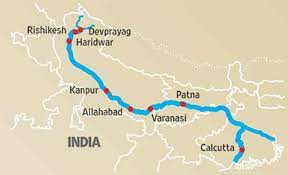
The mighty Ganga isn’t confined to one country. Its valleys stretch across India and Bangladesh. In fact its basin covers parts of China and Nepal too. Born in the lofty peaks of Himalayas, in the Gangotri glacier, it begins its journey as Bhagirathi. The Bhagirathi rushes down to meet the Mandakini, and then the Alaknanda at Dev Prayag. From then on, the river is known as Ganga. After cutting through the Himalayas, the Ganga breaks out of the foothills at Haridwar, and flows across the vast Gangetic plain. Midway in its course, near Allahabad, it is joined by one of its chief tributaries, the Yamuna river. The Ganga is one of the greatest rivers. The 2525 km long journey finally ends at Bay of Bengal. Thus it is called a river without boundaries.

Tributaries of the Ganga

Rivers have headstreams, tributaries and distributaries. A headstream is a stream that is a source of a river. The Ganga’s headstreams are the Alaknanda, DhauliGanga, Nandakini, Pindar, Mandakini, and Bhagirathi rivers. A tributary is a freshwater stream that joins a larger river. Most large rivers are formed from many tributaries and the Ganga has more than a dozen. Among them are the Ghagara, Yamuna, Koshi, Ramganga, Gomti, Gandaki, Burhi Gandak, Mahananda, Tamsa, Son, Punpun. the Ghaghara is the largest tributary of the river Ganga followed by Yamuna and Koshi. Though Yamuna is a separate river system in itself it is a tributary of the Ganga. A distributary is a branch of rivers that flows away from it. The Hooghly is a distributary of the Ganga that provides water for irrigation for west Bengal. It leaves Ganga just before the river enters the Bangladesh.

Rivers that join the Ganga

The river Ganga actually begins at Dev Prayag, the meeting place of two of its headstreams- the Bhagirathi and Alaknanda. After merging from the mountains of Rishikesh, the Ganga is joined by Ramganga. Later, it joins the Allahabad. The Hindus believe that the mythical river Saraswati too joins here. Hence the name Triveni Sangam, means the meeting place of three rivers. Next the Ganga flows east to meet the river Tamsa, later on, the river Gomti joins it. The next river to join the Ganga is the Ghaghara. Further downstream, the river Son joins the Ganga from the south, the river Koshi from the north. By the time the Ganga reaches the bay of Bengal, its waters have mingled with those of several other rivers, making it mystically representative of a soul of India itself.

Why is the Ganga important to Bangladesh?

The Ganga’s river basin is one of the most fertile and densely populated in the world. It covers an area of1000000 sq.km. For most 150 km, the Ganga forms the boundary between India and Bangladesh. When it enters Bangladesh, it is known as the Padma. The upper Padma flows southeastward to receive the mighty Brahmaputra river. The Brahmaputra is known as the Jamuna river in Bangladesh. The Padma joins the Meghna river, before it empties into the bay of Bengal. The Padma river is known for the frequent erosion of its banks, and sandbars that continually emerge in its course. The river is a busy waterway, and fishing is an important industry along its banks. A number of fast developing urban centres have also come up along its banks. 

Yamuna

The river Yamuna is the most famous and greatest tributary of Ganga. One of the country’s most sacred rivers, its birthplace is the Yamunotri glacier, high up in the Himalayas in Uttarakhand. It flows through the foothills of the Himalayas into the Indo-Gangetic plain, flowing through Uttar Pradesh, Himachal Pradesh, Haryana, Rajasthan, Madhya Pradesh and Delhi. After 1376 km, the Yamuna meets the Ganga at Allahabad. Their confluence is well known. The important tributaries of the Yamuna river are Tons, Chambal, Hindon, Betwa and Ken. Other small tributaries of the Yamuna river include the Giri, Sind, Uttangan, Sengar and the rind. Thus, though the Yamuna is a tributary of the Ganga, it has many tributaries of its own as well. Therefore, the Yamuna is considered to be a river system in itself.

Ghaghara

The Ghaghara is the largest tributary of the Ganga. It is a river that crosses many countries in the journey. Born in Himalayas in Tibet, it flows southeast through Nepal. Later it splits into two branches  that rejoin south of Indian border. The Ghaghara flows through Uttar Pradesh and Bihar, and then joins the Ganga. Its major tributaries – the Kuvana, the Rapti and the little Gandak rivers – all flow into the Ghaghara from the mountains to the north. The river’s flow is influenced by both the glacial melt and the monsoon together with the Ganges and its tributaries, the Ghaghara has helped to form the vast, fertile, alluvial plain of northern Uttar Pradesh.

Gomti

The river Gomti, a tributary of the Ganga, has great mythological significance. Most Hindus believe that a ritual dip in its waters will purify a person from all sins. According to legend, the river the daughter of sage Vasishta, who brought the river from heaven to earth. The river is also associated with the epic Ramayana. Lord Rama is believed to have taken a dip in the river on the advice of sage Vasishta. Lakshmana, the younger brother of lord Rama, is believed to have Lakshman Teela – part of present day Lucknow on the banks of river Gomti. Some even trace the name of Lucknow city to Lakshmana. The Gomti rises in northern Uttar Pradesh, and flows through the state, draining an area of 18750 sq. km. It is joined by one of its own tributaries before flowing into Ganga.

Gandak

The river Gandak is formed by the union of two rivers that have their own source in the Himalayas in Nepal. These rivers are the Kali and the Trisuli, and once they merge, the river is known as the Narayani in Nepal. The river then flows southwards into India. It is joined at the Indo – Nepalese border by two other rivers from Nepal – the Panchnad and Sohna. Once it enters India, the river is known as the Gandak. After winding its way through 765 km, it merges with the Ganga opposite the Patna. The Gandak is one of the major rivers in Nepal and India. It is distinguished for the deep gorge across which it flows, and for a large hydroelectric facility in Nepal. This river also provides water for a major irrigation and hydroelectric power facility at the Indo Nepal border at Valmikinagar.  

Koshi

The Koshi river also called the Kosi – is an important tributary of the Ganga. It flows through Tibet and Nepal, before entering India from the Himalayas. The river is joined by major tributaries, approximately 48 km north of the Indo Nepal border, breaking into more than 12 distinct channels. These channels shift during flooding and so, the river shifts course frequently. The river basin is surrounded by the ridges separating it from the Brahmaputra in the north, the Gandaki in the west, the Mahananda in the east, and by the Ganga in the south. The river, along with its tributaries, drains a total area of 69300 sq.km up to its confluence with the Ganga in India.

Tamsa

The Tamsa river flows through Madhya Pradesh and Uttar Pradesh. A tributary of the Ganga, its origin is at Tamakund in Kaimur range. The Tamsa is 264 km long. It is famous for the many waterfalls through which it tumbles during its journey to meet the Ganga. The river has great significance for Hindus for their belief that lord Rama spent his first night during 14 years of forest exile on the banks of Tamsa. There is also a belief that the rare and elusive Fwindoju fish lives in this river. The ashrams of the sage Valmiki and Bharatwaj are also believed to have been located on the banks of the Tamsa.

Son 

The Son, a tributary of the Ganga, is one of the largest rivers in India. It starts near Amarkantak in Madhya Pradesh and has a total length of 784 km. The Son’s main tributaries are the Rihand and the North Koel. It flows through Uttar Pradesh, Jharkhand, and Bihar to join the Ganga just above Patna. When fed by the monsoons, it becomes a roaring force. However, during  the summer, it dries up in places, leaving large pools of water along its course. The Indrapuri barrage is located on the Son. It is one of the longest dams of India and it irrigates vast areas of agricultural land.

Triveni Sangam

In Hindu tradition Triveni Sangam is the “confluence” of three rivers (Ganga, Yamuna and Sarasvati). The point of confluence is a sacred place for Hindus, with a bath here said to flush away all of one’s sins and free one from the cycle of rebirth.

Triveni Sangam in Prayagraj (Prayag), has the confluence of three rivers — the Ganges , the Yamuna and the Sarasvati (it is invisible, because according to Hindu mythology it flows underground). The two rivers maintain their visible identity and can be identified by their different colours. The water of the Ganges is clear, while that of the Yamuna is greenish in colour.

A place of religious importance and the site for historic Kumbh Mela held every 12 years, over the years it has also been the site of immersion of ashes of several national leaders, including Mahatma Gandhi in 1948.

The auspiciousness of the confluence of two rivers is referred to in the Rigveda, which says, “Those who bathe at the place where the two rivers flow together, rise up to heaven”.

Ganges River

The Ganges or Ganga, is a trans-boundary river of Asia which flows through India and Bangladesh. The 2,704 km river originates from the Gangotri Glacier of western Himalayas in the Indian state of Uttarakhand, and flows south and east through the Gangetic Plain of India and Bangladesh, eventually emptying into the Bay of Bengal.The Ganges is a lifeline to millions who live along its course. It is a sacred river and worshipped as the goddess Ganga in Hinduism. It has been important historically; many former provincial or imperial capitals (such as Prayagraj, Dhaka, Baharampur, Bikrampur, Kampilya, Kannauj, Kara, Kashi, Kolkata, Murshidabad, Munger, Patliputra, and Sonargaon) have been located on its banks.

The Ganges is threatened by severe pollution. This poses a danger not only to humans but also to animals; the Ganges is home to approximately 140 species of fish and 90 species of amphibians. The river also contains reptiles and mammals, including critically endangered species such as the Gharial and South Asian river dolphin. The levels of fecal coliform bacteria from human waste in the river near Varanasi are more than a hundred times the Indian government’s official limit. The Ganga Action Plan, an environmental initiative to clean up the river, has been considered a failure which is variously attributed to corruption, a lack of will in the government, poor technical expertise, environmental planning and a lack of support from the native religious authorities.

Yamuna River

The Yamuna, is the second-largest tributary river of the Ganga and the longest tributary in India. Originating from the Yamunotri Glacier at a height of 6,387 metres on the southwestern slopes of Banderpooch peaks of the Lower Himalaya in Uttarakhand, it travels a total length of 1,376 kilometres and has a drainage system of 366,223 square kilometres, 40.2% of the entire Ganga Basin. It merges with the Ganga at Triveni Sangam, Prayagraj, which is a site of the Kumbh Mela, a Hindu festival held every 12 years.

It crosses several states: Haryana and Uttar Pradesh, passing by Uttarakhand and later Delhi, and meeting its tributaries on the way, including Tons, Chambal, its longest tributary which has its own large basin, followed by Sindh, the Betwa, and Ken. From Uttarakhand, the river flows into the state of Himachal Pradesh. After passing Paonta Sahib, Yamuna flows along the boundary of Haryana and Uttar Pradesh and after exiting Haryana it continues to flow till it merges with the river Ganga at Sangam or Prayag in Allahbad (Uttar Pradesh). It helps create the highly fertile alluvial Yamuna-Ganga Doab region between itself and the Ganga in the Indo-Gangetic plain. Nearly 57 million people depend on the Yamuna’s waters. With an annual flow of about 10,000 cubic billion metres (cbm; 8.1 billion acre⋅ft) and usage of 4,400 cbm (of which irrigation constitutes 96 percent), the river accounts for more than 70 percent of Delhi’s water supply. Like the Ganga, the Yamuna is highly venerated in Hinduism and worshipped as the goddess Yamuna. In Hindu mythology she is the daughter of the Sun Deva, Surya, and the sister of Yama, the Deva of Death, hence also known as Yami. According to popular legends, bathing in its sacred waters frees one from the torments of death.

Sarasvati River

The Sarasvati River is one of the rivers mentioned in the Rig Veda and later Vedic and post-Vedic texts. It plays an important role in the Vedic religion, appearing in all but the fourth book of the Rigveda. The goddess Sarasvati was originally a personification of this river, but later developed an independent identity. The Sarasvati is also considered by Hindus to exist in a metaphysical form, in which it formed a confluence with the sacred rivers Ganges and Yamuna, at the Triveni Sangam.According to Michael Witzel, superimposed on the Vedic Sarasvati river is the heavenly river Milky Way, which is seen as “a road to immortality and heavenly after-life.” Rigvedic and later Vedic texts have been used to propose identification with present-day rivers, or ancient riverbeds. The Nadistuti hymn in the Rigveda (10.75) mentions the Sarasvati between the Yamuna in the east and the Sutlej in the west. Later Vedic texts like the Tandya and Jaiminiya Brahmanas, as well as the Mahabharata, mention that the Sarasvati dried up in a desert.

Since the late 19th-century, scholars have identified the Vedic Saraswati river as the Ghaggar-Hakra River system, which flows through northwestern India and eastern Pakistan, between the Yamuna and the Sutlej. Satellite images have pointed to the more significant river once following the course of the present day Ghaggar River. Scholars have observed that major Indus Valley Civilization sites at Kalibangan (Rajasthan), Banawali and Rakhigarhi (Haryana), Dholavira and Lothal (Gujarat) also lay along this course. However, identification of the Vedic Sarasvati with the Ghaggar-Hakra system is problematic, since the Sarasvati is not only mentioned separately in the Rig Veda, but is described as having dried up by the time of the composition of the later Vedas and Hindu epics. In the words of Annette Wilke, the Sarasvati had been reduced to a “small, sorry trickle in the desert”, by the time that the Vedic people migrated into north-west India.

We will launch ‘Project Dolphin’ for protecting ocean and Gangetic dolphins : PM MODI

The Gangetic dolphins have been declared as the National Aquatic Animal of India. This decision was first taken in the meeting of the National Ganga River Basin Authority (NGRBA) chaired by then Prime Minister Dr.Manmohan Singh on 5th October, 2009.

Ganges river dolphins once lived in the Ganges-Brahmaputra-Meghna and Karnaphuli-Sangu river systems of Nepal, India and Bangladesh. But the species is extinct from most of its early distribution ranges. The Ganges river dolphin can only live in freshwater and is essentially blind.

Ten years after Gangetic dolphins were declared National aquatic animals, Prime Minister Narendra Modi announced on 15th August, 2020 a conservation project for the species. This conservation project is named as the Project Dolphin’.

This project aims to give a stronger impetus for conservation of the aquatic mammals in the lines of ‘Project Tiger’ – a tiger conservation programme launched in April 1973 and ‘Project Elephant’ launched in 1992 to provide financial and technical support to wildlife management efforts by states for their free-ranging populations of Wild Asian Elephants.

According to the environment ministry, the project envisages to address conservation concerns and empower the stakeholders such as the river-dependant population in reducing the pollution and allowing sustainable fishery and river-based other livelihood options through scientifically oriented conservation methods. Implementation of the “Project Gangetic Dolphin” envisions a healthy river ecosystem not only protecting the biodiversity of the river but also taking into consideration the well-being of the people depending on its resources.

Addressing the nation from the ramparts of the Red Fort on India’s 74th Independence Day, Modi said, “We will launch ‘Project Dolphin’ for protecting ocean and Gangetic dolphins”. It may be mentioned here that the Ministry of Environment, Forest and Climate Changes has made elaborate plans to launch the 10-year project ‘Gangetic Dolphin’ led by Environment Minster Prakash Javadekar.

The Gangetic river dolphin is a species of freshwater dolphins primarily found in the Ganga and Brahmaputra rivers and their tributaries in India, Bangladesh and Nepal. Ganges river dolphins prefer deep waters, in and around the confluence of rivers. The distribution range of the Ganges river dolphins in India covers seven states namely Assam, Uttar Pradesh, Madhya Pradesh, Rajasthan, Bihar, Jharkhand and West Bengal.

There are around 3700 Gangetic River Dolphins in Indian river systems, according to official figures. The Ganga dolphin is one of only three freshwater dolphins left in the world. There are about 1800 left in the Indian part of the Ganga-Brahmaputra-Meghna basin, down from about 4500 as recently as 1982. There may be around 600 more left in Bangladesh, a few in Nepal, all part of the same basin. In Bhutan, the fourth country in the basin, the Ganga dolphin has not been seen for many years.

The Ganga dolphin is given the highest level of protection possible under the 1972 Indian Wildlife Protection Act. It is categorised as “endangered” by the International Union for conservation of Nature.

As river dolphins acts as indicators of healthy river ecosystems, their conservation would also ensure controlling river pollution and improving the availability of fishes and enhancing economies of local communities through sustainable fishery, the ministry said. They were declared National Aquatic Species in 2010.