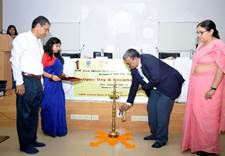
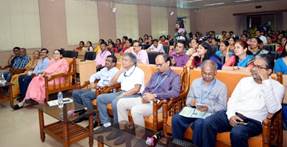
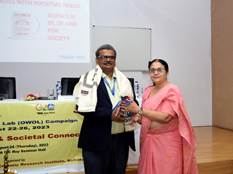
As a part of “One Week One Lab (OWOL)” programme, CSIR-Central Glass and Ceramic Research Institute (CGCRI), Kolkata organized an Open Day and Skill Development event on 24.08.2023, with an aim of creating awareness in S&T among common people and artisans. Dr Suman Kumari Mishra, Director, CSIR-CGCRI welcomed the participants. Dr. Ramanuj Naryan, Director, CSIR- Institute of Minerals and Materials Technology graced the occasion as Chief Guest, delivering a lecture highlighting the connection between science and society. Around 100 participants from rural and urban areas participated in the programme and underwent skill development/demonstration on making terracotta potteries. CSIR-CGCRI products and technologies were also showcased during the event.
In today’s competitive world, internships have become invaluable stepping stones for students and aspiring professionals to gain real-world experience and enhance their skillsets. Track2Training, a renowned and esteemed organization, offers exciting opportunities for internships in various fields. This essay will outline the essential steps and strategies to successfully secure an internship at Track2Training.
Step 1: Understand Track2Training’s Mission and Values
Before embarking on your journey to secure an internship at Track2Training, take the time to understand the organization’s mission, values, and areas of expertise. Familiarize yourself with their website, blog posts, and social media channels to grasp their work culture, achievements, and ongoing projects. This knowledge will not only demonstrate your genuine interest but also help you align your goals with the company’s vision.
Step 2: Tailor Your Application Materials
Crafting a tailored and compelling application is crucial to stand out among other applicants. Carefully review the internship requirements and qualifications, and highlight your relevant skills, experiences, and achievements. Customize your resume, cover letter, and any additional documents to showcase your passion for the field and demonstrate how your unique attributes align with Track2Training’s values.
Step 3: Network and Connect
Networking plays a pivotal role in the internship application process. Leverage your existing connections, join relevant online communities, and attend career fairs or events where you might meet Track2Training representatives or employees. Engage in meaningful conversations, express your interest in the organization, and seek advice from individuals who have previously interned at Track2Training or worked in a similar capacity.
Step 4: Demonstrate Your Skills and Expertise
In addition to your application materials, consider showcasing your skills and expertise through a portfolio or personal website. Depending on the field you are interested in, you can share relevant projects, articles, or creative works that reflect your capabilities. A well-curated portfolio can leave a lasting impression on recruiters and demonstrate your dedication to your craft.
Step 5: Prepare for the Interview
If your application stands out, you may be invited for an interview. Thoroughly research Track2Training’s current projects, recent achievements, and the internship role you applied for. Prepare thoughtful questions to ask during the interview, showcasing your genuine interest and enthusiasm. Practice common interview questions and rehearse your responses to present yourself confidently and professionally.
Step 6: Showcase Your Passion and Enthusiasm
During the interview, emphasize your passion for the field and your eagerness to contribute to Track2Training’s mission. Demonstrate your ability to adapt, learn, and collaborate with others in a team-oriented environment. Highlight any previous experiences that align with the internship’s responsibilities, and share your long-term career goals to showcase your commitment to personal and professional growth.
Conclusion:
Securing an internship at Track2Training is an exciting opportunity to grow, learn, and contribute to a reputable organization in your field of interest. By understanding Track2Training’s mission, tailoring your application materials, networking, showcasing your skills, and preparing diligently for the interview, you can increase your chances of standing out among other applicants and secure the coveted internship position. Remember that persistence, dedication, and an authentic passion for your chosen field will undoubtedly be noticed and appreciated by the selection committee. So, take the leap, and let your journey to success with Track2Training begin!
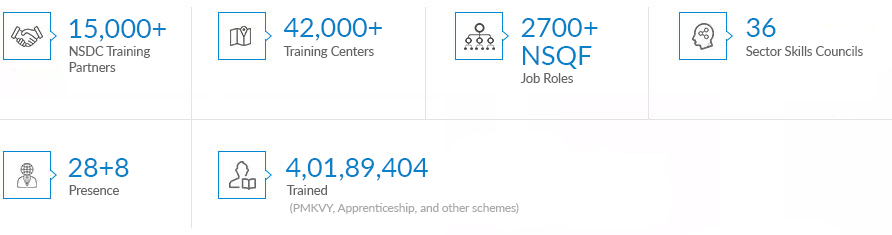
National Skill Development Corporation (NSDC) is a not-for-profit public limited company incorporated on July 31, 2008 under section 25 of the Companies Act, 1956 (corresponding to section 8 of the Companies Act, 2013). NSDC was set up by Ministry of Finance as Public Private Partnership (PPP) model. The Government of India through Ministry of Skill Development & Entrepreneurship (MSDE) holds 49% of the share capital of NSDC, while the private sector has the balance 51% of the share capital.
NSDC aims to promote skill development by catalyzing creation of large, quality and for-profit vocational institutions. Further, the organisation provides funding to build scalable and profitable vocational training initiatives. Its mandate is also to enable support system which focuses on quality assurance, information systems and train the trainer academies either directly or through partnerships. NSDC acts as a catalyst in skill development by providing funding to enterprises, companies and organizations that provide skill training. It also develops appropriate models to enhance, support and coordinate private sector initiatives. The differentiated focus on 37 sectors under NSDC’s purview and its understanding of their viability will make every sector attractive to private investment.
General science is a field of study that encompasses a wide range of scientific disciplines, including biology, chemistry, physics, and earth sciences. It is the foundation upon which many scientific discoveries and advancements are made. In this article, we will explore some of the key concepts and branches of general science.
Biology: Biology is the study of living organisms and their interactions with each other and the environment. It covers a wide range of topics, from the structure and function of cells to the behavior and ecology of entire ecosystems. Biology plays a crucial role in many areas of our lives, including medicine, agriculture, and environmental management.
Chemistry: Chemistry is the study of matter and its properties. It covers topics such as the structure of atoms and molecules, chemical reactions, and the properties of different elements and compounds. Chemistry is a key discipline in many fields, including materials science, medicine, and engineering.
Physics: Physics is the study of matter and energy and their interactions with each other. It covers topics such as mechanics, thermodynamics, electromagnetism, and quantum mechanics. Physics is essential to many areas of modern technology, including telecommunications, electronics, and aerospace.
Earth Sciences: Earth sciences cover a wide range of topics related to the planet we live on, including geology, meteorology, and oceanography. These fields of study help us understand the physical processes that shape the earth’s surface and climate. They are also important in managing natural resources, predicting and mitigating natural disasters, and understanding the impact of human activity on the environment.
Scientific Method: The scientific method is a systematic approach to scientific inquiry. It involves observing phenomena, formulating hypotheses, testing those hypotheses through experiments, and drawing conclusions based on the results. The scientific method is a key tool for scientists in all fields, allowing them to gather reliable data and draw meaningful conclusions.
Scientific Discoveries: Science has led to many important discoveries throughout history. Some of the most notable include the discovery of penicillin, the development of the theory of evolution, and the discovery of the structure of DNA. These discoveries have had far-reaching impacts on our understanding of the world and have led to many important advancements in medicine, agriculture, and technology.
Science Education: Science education is crucial in developing scientific literacy and promoting scientific thinking. It helps individuals understand the natural world and the scientific principles that govern it. Science education is also essential in preparing individuals for careers in science, technology, engineering, and mathematics (STEM) fields.
Conclusion: In conclusion, general science is a vast field that encompasses many different scientific disciplines. It is the foundation upon which many scientific advancements are made, and it plays a crucial role in our lives. Through the scientific method, scientists are able to make important discoveries and advancements that help us understand the world around us. Science education is also critical in developing scientific literacy and promoting scientific thinking, which is essential in preparing individuals for careers in STEM fields.
India is projected to assemble up to 50 per cent of Apple’s iPhones by 2027, which will be a significant increase from the current rate of less than five per cent. According to a report by the South China Morning Post, it will bring India’s level of production in line with that of mainland China.
India could produce one in two of the world’s iPhones by 2027 as compared to the current percentage which stands at less than 5 percent, as per a latest forecast by Luke Lin.
Here Luke Lin is an analyst at the research unit of Taiwan’s DigiTimes newspaper, in the South China Morning Post.
It appears that this forecast is more aggressive than JPMorgan’s earlier prediction that India would assemble 25 percent of total Apple iPhones worldwide by 2025.
A plan is a determined course of action for achieving a specific objective. An individual may prepare a plan for his journey or tour or for a family function. Similarly, a business unit may prepare a plan to achieve a particular objective. It is called a business plan which includes production plan, sales plan, and so on. A business unit prepares a master plan for the whole unit. Such master plan is again divided into departmental plans for actual execution. Planning is a process of thanking to action. It is a means to achieve well defined objectives. Business plan and business planning move together.
Planning is the primary function of management and occupies the first position in the management process. It is the starting point of the whole management process as other management functions are related to planning function. Planning, in simple words, means to decide the objectives clearly and to prepare a plan. Thereafter to take suitable steps for the execution of the plan. Planning function is performed by managers at all levels. It is deciding the objective to be achieved and taking suitable follow-up steps for achieving the same.
Planning is, now, universally accepted as a key/passport to success, progress and prosperity in business as well as in all other aspects of life. It acts as a base of all purposeful human activities. The concept of planning is old enough. Planning was advocated by Confucius almost 2500 years ago. He said “A man who does not think and plan long ahead will find trouble right at his door”. Thus, planning is the centre around which all business activities move.
In planning, various business problems are studied, decisions are taken regarding the future course of action and business activities are adjusted accordingly. Thus, planning means deciding in advance the objectives to be achieved and preparing plans/programmes for achieving them. In other words, planning is the process of foreseeing desired objectives – anticipating problems and developing solutions. It serves as a core of the whole management process.
Planning bridges the gap from where we are to where we want to go. In the absence of planning, events are left to chance. A plan is to-day’s projection for tomorrow’s activity.
2. Definitions of Planning
According to Koontz and O’Donnell, “Planning is deciding in advance what to do, how to do it, when to do it, and who is to do it. Planning bridges the gap between where we are and where we want to go. It makes it possible for things to occur which would not otherwise happen”.
According to George R Terry, “Planning is the selecting and relating of facts and the making and using of assumptions regarding the future in the visualization and formulation of purposed activities believed necessary to achieve desired results”.
According to Philip Kotler, “Planning is deciding in the present what to do in the future. It is the process whereby companies reconcile their resources with their objectives and opportunities”.
3. Need of Planning
The need of planning is universally accepted in the business as well as in other aspects of life. The following points justify the need of business planning/planning in business:
Planning is needed for survival and growth of a business unit in an orderly manner.
Planning is needed in order to face new problems/difficulties developed due to growth of markets, market competition, changes in consumer expectations and so on.
Planning is needed in order to face challenges created by changing environmental factors/forces.
Planning is needed as it acts as a pre-requisite to good management. It is needed as it is the core of the whole management process.
Planning is needed in order to achieve the objectives decided by the management. It is also needed as it ensures accuracy, economy and operational efficiency in busin6s management.
4. Importance of Planning in Business Management
The importance of planning as an element in the management process is universally accepted. It plays a positive role in the management of a business unit. Planning brings stability and prosperity to a business unit. It brings unity of purpose and diverts all efforts in one direction for the achievement of certain well defined objectives. Planning also improves the performance of a business unit. In fact, in the absence of planning there will be disorder, confusion, inefficiency, wastage of human efforts and material resources. Planning is rightly treated as the pre-requisite to efficient management. The fact that large majority of business units use planning as a tool of management indicates its utility and importance. Planning brings safety to business operations. It is the only way for survival in the competitive business world.
Planning is important as it is more than a mere theoretical exercise or paperwork. It has practical utility and creative value. Planning is also a rational and intelligent activity. It is, now, rightly treated as a highly professionalized aspect of business management.
Planning is important but planning alone is not adequate. It should be supplemented by suitable follow-up actions on the part of managers. Planning may not be able to solve all managerial problems, but it certainly helps the thoughtful managers in overcoming various managerial problems. A plan will remain on paper if suitable follow-up steps are not taken at different levels for its execution. Thus, planning is a means and not the end in itself
5. Advantages of Planning
Facilitates quick achievement of objectives: Planning facilitates quick achievement of business objectives. In the planning process, the objectives to be achieved are clearly decided / finalised and plans are prepared and executed for achieving such well defined objectives. Planning ensures achievement of objectives in an orderly and quick manner.
Brings unity of purpose and direction: Planning brings unity of purpose and direction before the entire organisation as it is for achieving certain well defined goals. Planning diverts all resources in one direction for achieving well defined objectives.
Ensures full utilisation of resources: Planning ensures effective/maximum utilisation of available human and material resources. It eliminates wastages of all kinds (of material resources and human efforts) and this ensures fuller utilisation of available resources.
Avoids inconsistency in efforts: Planning avoids inconsistency in efforts and also avoids possible frictions and duplications. It ensures economy in business operations.
Raises competitive capacity/strength: Planning raises competitive potentialities of a business unit. It enables a business unit to stand with confidence in a competitive market. It keeps ready solutions for possible problems and enables a business unit to function with confidence.
Promotes managerial efficiency: Planning promotes managerial efficiency. It covers all managerial functions and helps management to execute future programmes in a systematic manner. It makes managerial direction and control effective.
Avoids hasty decisions and actions: Due to planning, hasty decisions and haphazard actions by managers are avoided. It also encourages systematic thinking by the managers. Planning facilitates effective delegation of authority, removes communication gaps and thereby raises overall efficiency. It even encourages innovative thinking among managers.
Ensures effective control on the Organisation: Planning ensures effective control on the whole organisation. It fixes targets in clear terms and draws plans and programmes for achieving them. This facilitates effective control on the functioning of the business unit.
Acts as an insurance against future uncertainties: Planning acts as an insurance against future uncertainties. It takes care of all business uncertainties. In fact, in planning, future problems and situations are studied in advance and alternative solutions are kept ready. This enables management to face any type of critical situation with ease and confidence.
Facilitates other managerial functions: Planning facilitates other managerial functions. It is the basic managerial function and other managerial functions such as organising, etc. move as per the plans prepared. It acts as a motivating force behind other managerial functions.
Improves motivation: Planning facilitates participation of managers and workers in the normal functioning of an enterprise. It develops team spirit and raises morale and motivation of employees. Workers know what is expected from them. This ensures high degree of efficiency from them. Planning also provides training to managers. It serves as a tool for manpower development in an Organisation.
Planning ensures survival, stability and progress of a business unit.
Ensures uniform decision-making.
Acts as a key to solve problems and challenges faced by a business unit.
Sets performance standards for functional departments.
Planning enables a business unit to adjust itself with ever changing business environment.
6. Limitations of Planning
Time-consuming and costly: It is argued that planning is a lengthy process as it involves collection of data, forecast, research and analysis. Similarly, planning is essentially the job of highly paid experts. As a result, planning is a time-consuming and costly activity. Only large firms can undertake planning due to heavy cost and lengthy procedure involved in it.
Ineffective due to environmental changes: Business environment changes frequently and plans are required to be adjusted as per the changes in the situation through suitable modifications. However, such revision/modification creates a number of problems. Such adjustments in the operational plan are always costly, time-consuming.
Dangers of unreliable data: Planning needs accurate data from internal and external sources. The quality of planning depends on such accurate feedback. If the information supplied by various departments is unreliable, the planning process will be adversely affected. Planning based on incomplete information may prove to be even dangerous. In brief, plans based on unreliable data are not useful /effective. Securing reliable information is always difficult and this brings deficiencies in the entire planning process.
Encroachment on individual freedom and initiative: Planning is a centralized process. At the lower levels, plans are to be executed as per the directives issued. This affects individual freedom and initiative at the lower levels. Employees at the lower levels act as instruments for the execution of plan prepared by the top level managers. People are asked to become cogs in the machine with little scope for initiative or independent thinking.
Delays actions: Planning is a lengthy process. As a result, the actions to be taken for execution are delayed. Planning is not useful when quick decisions and actions are required.
Unsuitable to small firms: Small firms prefer to function without long term comprehensive planning as they find planning rather costly and time-consuming. They prefer to face the situations as they come. Similarly, quick decisions and prompt actions are necessary in the case of certain business activities. Here, long term planning is not suitable.
Limited practical value: It is argued that planning is too theoretical and has limited practical utility. Planning takes long time for preparation and the situation changes when such plans are ready for execution. Planning for example, is not suitable in the case of speculative business. It is also not useful for taking quick benefits of business opportunities. In brief, planning has limited practical value.
No guarantee of expected results: Planning is for achieving certain well defined objectives. However, there is no guarantee that the objectives will be achieved within the specific time limit by using planning as a tool. Actual performance may not be as per the expectation due to various reasons. Thus planning has an element of uncertainty. Planning leads to probable results and not the expected results. It gives benefits but may not be exactly as per the expectation. Thus, there is no guarantee that planning will give 100 per cent positive/expected results.
Generates frustration: At the lower levels, plans are imposed on the employees. No consideration is given to their difficulties, views and opinions. The targets may be too ambitious and the employees may not be able to achieve them in spite of best efforts. This leads to frustration among employees at lower levels.
Involves huge paper work: Planning involves huge paper work in the preparation of master plan and departmental plans.
Danger of overdoing: Sometimes, planners overload the work. Elaborate reports are prepared without practical utility.
The advantages of planning are more important/significant while its limitations are few and also not of serious nature. Moreover, these limitations can be minimized. The practical utility of planning is universally accepted. It is not fair to give up the concept of planning due to certain limitations. The better alternative is to make it more effective, purposeful and result oriented.
7. Steps in Planning Process
Planning is a lengthy process which moves gradually and step by step approach is usually adopted. These steps are like stations in the journey of planning process. Usual steps in the planning process are as briefly explained below:
Classifying the problems: The planning process starts with clear understanding and classifying business problems faced by a business unit. Identification of problems or opportunities by managers justifies the need for action. It is like the diagnosis of the health problem of a patient by his doctor. Planners have to understand the problems of the Organisation first and, then, prepare a plan to deal with the problems in the light of the prevailing business environment.
Determining the objectives: In this second stage in the planning process, the planners decide the overall objectives to be achieved. Planning is always for achieving certain well defined objectives and naturally objectives must be spelt out precisely. Objectives act as pillars of the entire planning process. Business objectives may be decided in terms of profit, sales, production or market reputation. Objectives may be defined in quantitative or qualitative terms.
Collecting complete information and data: The planners have to collect information relating to problems facing the business unit. Such information is necessary and useful for analyzing the problems in depth and also for accuracy in planning. Information can be collected from internal and external sources. Reliable, updated and adequate data make planning process result-oriented.
Analyzing and classifying the information: At this stage, the information collected is analyzed and interpreted systematically for drawing specific conclusions. This facilitates purposeful use of information, while preparing alternative plans. Irrelevant information can be discarded through such analysis.
Establishing planning premises: Planning premises are various assumptions and predictions about the future business situation. Such premises act as background for planning activities. The planning premises are expected to supply relevant facts, information and data on the basis of which forecasts are prepared and future trends are indicated. Planning premises reduce uncertainties in the planning process. Planning premises are three in number viz., (a) Controllable permises, (b) Semi-controllable permises, and (c) Uncontrollable premises.
Determining alternative plans: Here, the planners prepare and keep ready alternative plans suitable for use under different situations. The best among the available alternative plans is used for actual execution. The preparation of alternative plans is essential as one plan is normally not adequate under all types of situations. It is a type of stand-by arrangement useful for meeting any emergency situation.
Selecting operating plan and preparing derivative plans: After study of the business environment and the alternative plans available, the planners select the best plan for actual execution. This decision is a delicate one and must be made with proper care. After the selection of operating plan, the planners have to prepare derivative plans. Such plans are related to different departments/activities and constitute sub-sections of the operating plan. The division of overall plan into derivative plans is necessary for effective execution.
Arranging timing and sequence of operations: Timing involves fixation of starting and finishing time for each job or piece of work. Sequence of operations ensures proper flow of work. This step in planning process is important as it brings coordination in the activities of different departments. The timings and sequence of operations must be communicated to concerned departments, managers and staff for implementation of the plan.
Securing participation of employees: Planning needs willing participation of all employees and departments. For this, information regarding the operative plan should be given to employees well in advance. Here, the internal communication system should be used extensively. For such participation, employees should be associated with the planning process.
Follow-up of the proposed plan: The purpose of follow-up is to make periodical review of the execution process. It is useful for understanding actual progress and deficiencies in the process of execution of the plan. This also facilitates adoption of suitable remedial measures as and when required.
RSETIs have trained 44 lakh youths of which nearly about 31 lakh candidates have settled so far
Giriraj Singh says, out of 44 lakh youths trained, about 29 lakhs are women candidates (about 66%), which underlines RSETIs mandate and role for “Women Empowerment”
14.28 Lakh trained candidates received cumulative credit to the tune of Rs.7200 crores from Banks and Financial Institutions at the behest of RSETIs
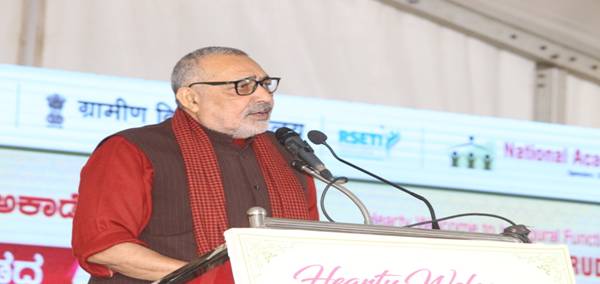
Union Minister of Rural Development and Panchayati Raj Shri Giriraj Singh has called for need-based skill mapping for employment and training to India’s youth, mainly in the rural areas. Noting that the quality of job training is important, the Minister urged to explore means to see how best the traditional trades can be integrated with electronic, education and training, IT & BPO and tourism and hospitality sectors to create more employment opportunities for the youth in the country.
The Minister was speaking after opening the new campus of the National Academy of Rural Development and Self Employment Training Institute (RUDSET) – NAR at Kumbalagodu in Bengaluru on today.
Chief Minister of Karnataka, Shri Basavaraj Bommai, Sadhvi Niranjan Jyoti, Union Minister of State for Rural Development, Consumer Affairs, Food, and Public Distribution, Sri Faggan Singh Kulaste,
Union Minister of State for Rural Development and Steel, Dr. C N Ashwath Narayan, Minister of Skill Development, Entrepreneurship, and Livelihoods of Karnataka State, Sri S T Somasekhara, Minister of Co-operation of Karnataka State and Dr. Dr. Veerendra Heggade, MP and President, NAR joined the inaugural event.
Shri Giriraj Singh said, the Rural Self Employment Training Institutes – RSETIs have a significant role in building India into a major human resources hub and added that RSETIs have trained 44 lakh youths of which nearly about 31 lakh candidates have settled so far. The Minister also informed that of the total candidates trained, about 29 lakhs are women candidates, over 66 %, which proves that RSETIs are giving lot of importance to “Women Empowerment”.
Dr Giriraj Singh cited a United Nation’s report that says in the coming 20 years, India’s work force would grow by 32 per cent while the overall global manpower would dip by four per cent. He said that RSETIs are following up with the Banks and Financial Institutions to make available required credit to the trained candidates for their successful settlement. 14.28 Lakh trained candidates were credit linked and the cumulative credit disbursed is to the tune of Rs.7200 crores. The average level of credit linkage of RSETI trained candidates is 51%, the Minister added.
A sum of Rs 25 crores has been approved for the project of new campus of NAR in Bengaluru. The State Government has allotted 3.5 acres of land. At present, there are 590 RSETIs functioning covering 572 districts spreading over 27 States and six Union Territories. These include 33 RSETIs in Karnataka having trained 3.49 lakh unemployed youths so far. RSETIs are sponsored by 24 banks including banks in public, private, co-operative sectors and Garmin Banks.
In 1982, Canara Bank, erstwhile Syndicate Bank and SDME Trust, Dharmasthala pioneered the unique concept of Rural Development and Self Employment Training Institute (RUDSET) to address the problem of unemployment amongst the rural youth in the country under the leadership of Dr. D. Veerendra Heggade, Dharmadhikari, Sri Kshetra Dharmasthala. The Ministry of Rural Development has since replicated RUDSETI model across the country and advised banks to set up Rural Self Employment Training Institute (RSETI) in each of their Lead District. The National Academy of RUDSETI-NAR, set up in 2008 entered a Memorandum of Understanding with the Rural Development Ministry in 2011 for providing training to youths in self-employment ventures.
Earlier, Shri Giriraj Singh formally opened the Hostel Block while Shri Bommai inaugurated the Admin Block of the new campus. The Chief Minister also addressed the gathering.
Shri Shailesh Kumar Singh, Secretary, Rural Development, Government of India, Shri Karma Zimpa Bhutia, Joint Secretary, Ministry of Rural Development, senior officers of Government of Karnataka and top bank executives attended the event.
An experience sharing session of successful RSETI trainees and distribution of bank loans to entrepreneurs also formed part of the programme.
According a report by Economics Times : The Indian telecom eco-system could absorb up to 30% of the workforce laid off at the big tech firms and who chose to return to India. These include employees across technical and service profiles, say staffing experts.
Companies like Meta, Amazon, Twitter, Microsoft and Stripe among many others have laid off employees and rationalised their employee base. According to estimates by TeamLease, over 62,000 employees have received the pink slip in 2022.
While employees at tech firms are facing headwinds in light of the pink slips being dealt out, the Indian telecom eco-system has increased its hiring over the past few quarters in light of the 5G rollout.
Given the hiring impetus that the telecom sector is seeing, one would expect it to absorb a majority of the employees laid off. However, there is only so much of a skill overlap between the workforce being laid off, and the requirement at the telecom companies say experts.
Union Education and Skill Development and Entrepreneurship Minister Shri Dharmendra Pradhan addresses 22ndConvocation of University of Hyderabad today. Dr. Tamilisai Soundararajan, Governor of the State of Telangana and Chief Rector, University of Hyderabad graced the occasion.
While addressing the gathering he said that Hyderabad is known as the city of decorative pearls. It is also a city that is generating intellectual pearls. He further added that Hyderabad is known for its IT prowess. It is also emerging as a leading medical technology hub of the country. University of Hyderabad is emerging as a centre-of-excellence and expressed his confidence that the University will be a torchbearer of knowledge-based economy in the 21st century, he added
Shri Pradhan shared that a lot of girl students being honored at the University of Hyderabad Convocation. Our NariShakti will play a major role in the economic well-being of our country.
Shri Pradhan said that today, climate change, changing agricultural patterns, new diseases are a concern for everybody. Society is looking towards knowledgeable people for providing solutions to these pressing challenges and University of Hyderabad is capable of providing solutions to these challenges. He stated that India is aspiring to become a leading economic superpower and a knowledge-based economy. Innovation and entrepreneurship will take us forward. We must create more wealth-creators and job-creators for our society to grow, he added.
Shri Pradhan also said that India is a very old civilization with strong linkages with science and technology. The Covid19 pandemic has shown that Indian Knowledge Systems and the Indian way of life have much to offer to the world. We have to promote IKS with a modern context.
Shri Pradhan asserted that world is looking towards India with great hope. The next 25 years are important for all of us. As we enter the AmritKaal, NEP 2020 remains a guiding philosophy for the welfare of humanity. India’s responsibility is to take care of the planet.
He further said that India is going to be the benchmark for the world in fighting climate change, food scarcity, in paving the way for peace and harmony and in providing healthcare and economic models. India will emerge as a leading light of humanity based on the philosophy of NEP 2020, he added.
Later, Shri Pradhan added that when India will be celebrating 100 years of independence, Hyderabad University will be one of the major epicentre of our knowledge-based society. He urged students to give back to society to make their education more meaningful and purposeful.
The University of Hyderabad gave away the coveted degrees to 4800 students enrolled in various programs, with 1631 receiving their degrees in person and remaining in absentia; 573 are Ph.D. Scholars and multiple students were felicitated with awards and medals for their extraordinary performances.
If you’re reading this, then chances are that you are looking for some way to improve your life. Maybe you need help with personal development or maybe you’ve been thinking about starting a new job or volunteering at an organization. Whatever your reason for wanting to make changes in your life, it’s important that we keep our eyes open and try new things so we can be successful in achieving our goals.
Without encouragement, it is difficult to change.
Without encouragement, it is difficult to change. You need to believe in yourself and think that you can improve your life by making positive changes. The first step is believing that you can improve for the better—that’s because it will make all the difference. If you do not believe that things can get better, then no one else will either.
If someone says they are going through hard times or struggling with something difficult right now, try giving them some words of encouragement as a way of showing them how much strength there is inside themselves despite their circumstances (or lack thereof). This could mean saying something like “I know what it’s like when things keep getting worse instead of better.” Or maybe even just “I’m sorry about everything happening right now.” These small gestures go a long way towards helping those around us feel supported during times when we feel isolated from others’ understanding due to our own struggles.
You are most likely to succeed if you focus on one change at a time.
The key to success is to focus on one change at a time. This can be as easy as focusing on improving your diet, or it may be more complex—it depends on what you’re trying to accomplish and how long it will take for you to reach your goal.
For example: If you want to lose weight, then focus on eating healthier food and making more exercise a part of your daily routine. Once that’s accomplished and needs adjusting (such as adding more fruits or vegetables), move onto the next step by increasing the amount of exercise in your schedule again until all of these changes have been completed successfully.
Changing your life takes time and daily effort.
Changing your life takes time and daily effort. You can’t change a habit overnight, nor can you expect to change your lifestyle or attitude overnight.
You have to commit to making positive changes in the way you think and act for them to stick. This includes changing negative beliefs about yourself and others, as well as changing other people’s perceptions of you—for example, by doing something nice for someone else instead of taking advantage of them.
The changes you make will have an impact on other people, so talk to them about what you are doing.
Make sure you have a support network:
You can’t do it alone! You need people who believe in you and want to help support your goals.
Be honest with yourself:
Don’t let yourself get discouraged by results because they won’t always be immediate or easy to achieve; this is just another step in the process of self-improvement.
You are more likely to change your behavior if you write down your goals and track your progress toward them.
If you want to make changes in the way that you live your life, it’s important to write down your goals. The more specific and detailed they are, the easier it will be for you to stay focused on achieving them.
You can use a notebook or spreadsheet as a place where you put down all of the things that matter most to you—including what motivates each goal and any additional details about how long until completion or other deadlines associated with achieving each goal (if applicable). Then once per month or so (depending on how often progress is made toward those goals), go back through this list of ideas and see where there are still opportunities for improvement or new additions which may help bring about change faster than otherwise would be possible otherwise.”
Sometimes people need a second or third try before they can achieve their goals.
Change is a process that can happen gradually if we give ourselves permission to not be perfect.
It’s okay to fail. You don’t have to make every mistake in the world, but you do need to take risks and learn from them. If you’re going through a difficult time, it may feel like everything is stacked against you, but remember: You’re stronger than that! Don’t let anyone else dictate what your limits are; set boundaries for yourself so that everyone around you knows where they stand with respect toward how much weight/pressure/stressors they bring into your life (and vice versa).
You can’t change everything at once! Change takes time and effort—you might not see results right away on day one of starting something new at work; sometimes there are things we need practice doing before learning how good our new skills actually feel like coming out of our mouths (or fingers). Make sure whatever goal(s) this month has been focused on has been well-thought out beforehand so as not waste valuable resources unnecessarily trying out half-baked ideas prematurely – because even though change doesn’t happen overnight…it does happen eventually
Conclusion
If you are ready to start changing your life and make some changes in your life, then this is the right time. Start now.
An online learning platform is a webspace or portal for educational content and resources that offers a student everything they need in one place: lectures, resources, opportunities to meet and chat with other students, and more. It is also an excellent way for the student and the teacher to monitor student progress. Whether you want to learn a new language or obtain career-advancing certifications, signing up for an online course could be just the perfect solution. The online class is typically provided through online learning platforms.
Online learning has numerous advantages over traditional learning methods. Some of these include the possibility for students to make use of self-paced learning and to choose their own learning environments. Additionally, e-learning is both cost-effective and cost-efficient, as it removes the geographical obstacles often associated with traditional classrooms and education. The benefits of an online course platform are that both students and teachers can track the students’ progress through the course material, and everything is neatly organized in one place. Additionally, students may also have an option of interacting with each other on the platform.
Some of the popular Online learning (e-learning) platforms.
Coursera.
Coursera isn’t just a place to take classes that are like college courses—it actually offers real academic courses from real professors and universities at a fraction of the cost of getting an online degree. The platform partners with over 200 universities and companies to provide real learning experiences that can connect to real-world benefits. In some cases, you can even earn certifications or degrees entirely through Coursera, which can then potentially lead to professional benefits like raises, promotions, and more.
Course Hero.
Course Hero is home to study resources, 24/7 homework help and textbook guides to provide students across top institutions with tailored reinforcement of the courses in which they are enrolled. The library of materials uploaded to Course Hero’s platform can be searched by either school or textbook to find the exact resource a student needs, with tutors available to provide total support.
Edx.
Generally, this online learning platform has a high-end pedigree. edX was established by graduates from both MIT and Harvard University. Real college courses that are generated and taught by real college tutors are available in a vast array of topics and fields. They have a slight leaning toward the Science, Technology, Mathematics, and Engineering fields. Nonetheless, there are plenty of topics in the humanities, arts, and languages as well. By partnering with the universities, this course provides professional degree certificates as well as the “micro” degree programs at both the bachelor’s and the master’s levels. In this sense, they largely serve as tools for professional development.
Skill Share.
Whereas many online class platforms do confer college-style classes, Skillshare is not formal and is mainly targeted at boosting creative skills. Some business and marketing classes exist on this online education platform. Most of the courses though tend to have a focus on the creative fields and are administered by practicing experts in various fields. Common examples of these fields are interior design, visual arts, animations, films, and photography.
LinkedIn Learning.
Formerly called Lynda.com, LinkedIn Learning is an educational platform that confers professional course training in the fields of technology, business, creative fields, and technology-related areas mainly in the form of videos. The online learning marketplace is largely available as a premium service for the users of LinkedIn and has so far provided well over 16,000 courses in a whopping 7 languages. Its focus is mainly to aid individuals in investing in their professional development.
Udemy.
If you want to learn something, it’s probably on Udemy. The site is less of a unified platform and more of a portal or repository where students can access well over 100,000 courses on every topic imaginable. There’s not one standard format for a Udemy course—the platform allows instructors to design multimedia lectures with audio, video, and text elements, plus readings, quizzes, and other activities. Udemy allows students to preview classes they’re interested in and does offer a 30-day refund if you’re dissatisfied.
FutureLearn.
FutureLearn lets you learn online from universities and companies all over the world, including Anglia Ruskin University, King’s College London, Monash University, and the University of Wollongong. On top of their university partnerships, they also partner with specialist organizations such as Accenture, Amnesty International, the British Library, and UNESCO. From personal development video lessons to employment-related course content, FutureLearn definitely deserves its place near the top of our best online learning platforms list.
Learning new skills is a habit that helps in career, profession, business, and daily life. It can be a technological skill, business management, resume writing, designing, marketing, advertising skills or basic computer skills. Consistent learning and skills development is important for everyone. It’s not only important for students, job seekers, professionals but also important for housewives, seniors citizens and leaders of various field.
Learning means, one self is practicing existing skills, experimenting with new imaginations, reading from books, learning from the internet, doing online and offline courses, learning by observing others, learning from failures and success of others and learning from the problems that you’re facing. Learning new skills is like watering a plant. Its connect to growth. And to grow in business, career and a student it’s important to learn new skills. So that you will become fruitful for companies, people and nation.
Some of the key soft skills are.
Communication skills
Communication skills are the most common and frequently used professional skills in our life. You use communication skills to give and receive different kinds of information, and it helps you to understand and be understood by others while communicating. These skills may include sharing ideas with others, actively listening to conversations, responding, and public speaking.
Teamwork skills
Teamwork skills are the qualities and abilities that allow you to work with a group of people during conversations, projects, meetings or other collaborations to achieve a common goal. Your teamwork skills are dependent on your ability to communicate well, actively listen and be responsible and honest.
Time management
Time management is the process of organising, planning, and dividing your time between specific activities. Good time management skills enable you to work smarter, not harder. If you work smartly, you will get more done in less time, even when time is tight and pressures are high. Failing to manage your time while performing a task will damage your effectiveness and cause stress.
Creative Thinking
Creative thinking means your ability to use the imagination to generate new ideas or ability to think about a task or a problem in a new or different way. Creative thinkers look at things from a unique perspective which is invisible to others. They can find patterns and make connections to find opportunities in complex systems. If you are a creative thinker, it will assist you to solve complex problems or find interesting ways to approach tasks.
Interpersonal skills
Interpersonal skills are the traits you rely on when you are interacting and communicating with others. These skills often indicate your ability to communicate and build relationships with others. Interpersonal skills are often called people skills. Because they combine both your innate personality characteristics and how you’ve learned to handle certain social situations. If you use interpersonal skills effectively, these skills can help you during the job interview process and can also have a positive impact on your career advancement.
Leadership skills
Leadership skills are those skills you often use when organizing other people to reach a shared goal or complete a task. It doesn’t matter if you are in a management position or leading a project, leadership skills require you to motivate others to complete a series of tasks before the deadline.
Some of the professional skills, one should learn are.
Graphics Designing
Graphic design is the art of making visual content to communicate messages. Designers apply different page layout methods and visual hierarchy by using letters and pictures to meet the need of end-users. Most companies use graphic design to sell their product or services and to convey complicated information by using infographics.
Web Development
It refers to developing and maintaining web pages, including bits and pieces of concepts like web design, web programming, web publishing, and database management. Further, it includes various types of web development tools and techniques such as text editors for manually coding the websites, Dreamweaver for developing a web page, using a blogging website to update blogs, and more. Having web development language skills will help candidates stand out from the rest. Prominent web developer skills include understanding HTML, design skills, and analytical knowledge.
Animation Designer
Animation design requires a balance of computer software and creativity skills to create animating graphics for an array of industries, including film, television, and marketing. Animation design is the act of creating visual effects and animations for a variety of multimedia, including video games, videos, and digital assets like websites and apps. These effects and animations can be 2D or 3D (CGI) and range from a simple loading icon that indicates something is happening behind the scenes to a full-scale animated video.
Audio and Video editing
Knowing how to alter video and audio files can be a useful skill, especially for jobs in marketing and entertainment. This capability often requires expertise in editing software, which allows you to manipulate individual clips or add special effects.
Search Engine Optimization
Search engine optimization (SEO) is a digital marketing strategy that allows companies to improve their website content so it might appear higher on the first page of a search engine’s results. This may involve using best technical practices to compose text, select image formats and include links that connect between two separate pages on a website.
Key skills are employability skills that you need for work and they are very important for life also. By developing these skills, you can improve the chances of a better job and better career. These play a great role in your CV also. You have better chances of selection for the job if you have better skills.
Key skills are of two types:
Soft skills- Soft skills are personal qualities that show your personality trait such as leadership, communication, problem-solving, Work ethic, Interpersonal Skills, Leadership skills, Stress Management, Organizational skills, Analytical skills, etc.
Hard skills- Hard skills are based on the job you need to perform. They are related to specific technical knowledge and training like technical Skills, Presentation skills, Design skills, Data analysis skills, Writing Skills, Marketing skills, Project management skills, etc.
Soft skills
1. Communication skills
Communication skills are the most common and frequently used professional skills in our life. You use communication skills to give and receive different kinds of information, and it helps you to understand and be understood by others while communicating. These skills may include sharing ideas with others, actively listening to conversations, responding, and public speaking.
2. Teamwork skills
Teamwork skills are the qualities and abilities that allow you to work with a group of people during conversations, projects, meetings, or other collaborations to achieve a common goal. Your teamwork skills are dependent on your ability to communicate well, actively listen and be responsible and honest.
3. Time management
Time management is the process of organizing, planning, and dividing your time between specific activities. Good time management skills enable you to work smarter, not harder. If you work smartly, you will get more done in less time, even when time is tight and pressures are high. Failing to manage your time while performing a task will damage your effectiveness and cause stress.
4. Problem-solving skills
Problem-solving skills help you determine the source of the problem and find effective solutions and will advance your professional skills. Companies rely on people who can assess both types of situations and quietly identify solutions. Problem-solving skills are valued by employers in any job and are extremely useful in other areas of life such as relationship building and day-to-day decision-making.
5. Creativity
Creative thinking means your ability to use the imagination to generate new ideas or the ability to think about a task or a problem in a new or different way. Creative thinkers look at things from a unique perspective that is invisible to others. They can find patterns and make connections to find opportunities in complex systems. If you are a creative thinker, it will assist you to solve complex problems or find interesting ways to approach tasks.
Hard Skills
1. Technical Skills
Technical skills include specialized knowledge and expertise in fields such as IT, engineering, or science. Typical technical skills are abilities to use specialized software or equipment.
2. Presentation skills
If you want to deliver effective and engaging presentations to a variety of audiences, you need to have good presentation skills. It includes interaction with the audience, transmitting messages with clarity, engaging the audience in presentation, etc.
3. Design skills
The design industry is growing nowadays. As a designer, you can bring out your creative side with interesting visuals and graphics. There is no limit to what a designer can illustrate with their unique skill. If you want to be self-employed and work as a freelancer, you should learn how to design, and it is an excellent skill to have.
4. Data Analysis Skills
Data analysis is the process of retrieving, organizing, and analyzing information to help a company to improve production, efficiency, or other valuable aspect of the business’s operations. Data analysts generally work in all industries, from retail to academia. They have to collect their data. From the collected data they create reports that summarize patterns and offer solutions to their customers in the form of updated systems, procedures, or protocols.
5. Writing skills
Writing is one of the important skills that is used in almost every organization. Effective written content help to influence the reader. These skills are also used in technical and scientific jobs, to write emails, documents, etc.
Thus, we came through various key skills that are useful to work effectively. If you want to get the job you should work on improving your skill whether it is soft skills or hard skills.
Professional skills are important to succeed in your career. They are the soft skills a person should have when he or she is contributing towards their company . This skills are not specific to any job but those who knows this skills and understand them they will be more beneficial in their future.
Soft skills such communication, leadership, time management and way of talking, can also help professionals work with the people around them and help them manage tasks.
Top 10 professional skills a person should have
1. Leadership skills –
Those who is having leadership quality in them will be more succeed in their life. They should know how to manage people, how to motivate them , how to help others with their work. Many things contribute in the leadership skills . For managers and supervisors, leadership may also involve knowing when and how to delegate tasks and adjusting your management style according to the personality and working style of each employee.
2. Teamwork skills –
As we know Teamwork skills is important for any company to work efficiently. It’s important for professionals to be able to work effectively as part of a team , which means completing your own tasks while remaining aware of your colleagues abilities and need .
3. Organisation skills –
You should know how to organise a thing in effective manner so you can complete your task in given timeline. For completing a task every employee has different timeline and different type of task so they work according to their task but always remember you should complete your task in given timeline then only it make sure that you are having organisation skills .
It’s also important that you’re able to prioritise tasks and complete them in an appropriate order, starting with the most important.
4. Communication skills –
Everyday we communicate with eachother so having communication skills is soo important . If you are not having communication skills then you are lacking in skills . Communication skills include the ability to adapt your delivery or tone of voice to the task at hand . For example, if you are a manager in a company then you should know how to communicate with your employees and if you are employee then you should Kno how to communicate with your manager these things always affect the person mindset.
5. Problem – solving skills –
Every company has their own problems as they work on different purposes so manager always look on those employees who is having problem solving skills on them .
Imagine a company having some problem related to their sales but you don’t know what to do for inhance their sales then manager will not appreciate you they just criticize you for not knowing the things and not having any problem solving skills .
So it’s important to have this skills .
6. Emotional intelligence –
Emotional intelligence refers to how we express our feelings, relate to other people and interpret their actions or behaviours. People with emotional intelligence are good at understanding how others feel based on their actions, speech , body language or behaviours.
If manager understand what employee feels and employees understand what manager feels then it easy to work together in the same company.
7. Adaptability –
Adaptability is the quality to adapt the situation whether it is comfortable to them or not . Manager is always looking for the team members who are flexible and able to adapt their work and behaviours to the situation at hand .
If employee adapt the situation and work accordingly it will surely beneficial to the company as well as for the employee also as employee will get appreciation from the manager.
8. Negotiation and persuasion –
These skills involve the ability to listen to the other person’s perspective and come up with valid compromises that allow both parties to get what they want and feel positive about it . If a person having negotiation skills it will surely help him to make friendly environment in the surroundings. As every company has their own rules and regulations and they don’t want to change it so negotiation will help to come up with a solution which help both the parties having equal value and benefit.
9. Ability to work under pressure –
Well not everyone having the ability to work under pressure they get frustrated easily which is not good for the company’s environment. Employee should keeping calm and work with the greater extend to get the result . Employers understand everyone gets stressed from time to time , but knowing that you will be able to remain calm and continue working even in high stress situations can give them confidence in your ability, making this is an important professional skill to develop.
10. Confidence –
Professionals who are confident with their work always get success in their hand . Having confidence in your work not only help you to perform better, but it can also help convince your managers or supervisors of your capabilities and may lead to opportunities for advanced in the future.





















 Eduindex
You must be logged in to post a comment.