Key Initiative and Achievements of Department of Social Justice and Empowerment- 2023

 Key Initiative and Achievements of Department of Social Justice and Empowerment under Ministry of Social Justice and Empowerment in the year 2023 are-


  1. Initiatives for the welfare of Scheduled Caste


  1. Pre-Matric and Post Matric scholarship scheme for SC students

The Department of Social Justice and Empowerment with an objective of appreciably increasing the Gross Enrolment Ratio of SC students in higher education, with a focus on those from the poorest households, has been implementing Centrally Sponsored Scheme “Post-Matric Scholarships to the students belonging to Scheduled Castes for studies in India”.

DoSJE introduced Centrally Sponsored Scheme of Pre-Matric Scholarship for SC students & Others which aims to support, through financial assistance, parents of children belonging to Schedules Caste and other disadvantaged categories for education of their wards studying at the pre-matric stage.


Achievements under the schemes:

  • During the year 2023 to till date (22.12.2023), a total of 34,58,538 SC beneficiaries have been released scholarship amounting to Rs. 3546.34 Cr under Post-Matric scholarship scheme for SC students;
  • During the year 2023 to till date (22.12.2023), a total of 18,32,628 beneficiaries have been released scholarship amounting to Rs. 369.03 Cr under Pre-Matric Scholarship scheme for SC students;
  • Aadhaar- based payment system is being utilized to ensure that the scholarship funds are received by the student through DBT directly into his/her aadhaar seeded account;
  • Some of the States/ UTs viz. Tamil Nadu, Karnataka have automated the process of receipt and processing of applications by digitalization of certificates and auto- fetching of eligibility data to ensure minimum manual intervention and increased transparency;
  • Seven States/UTs viz. Assam, Chandigarh, Gujarat, Himachal Pradesh, Jharkhand, Karnataka and Odisha have covered more beneficiaries as against their annual targets under Post Matric SC scheme for the year 2022-23;
  • Under Component-II of the Pre-matric Scheme which deals with children whose parents are engaged in cleaning and hazardous occupations, numbers of participating States have increased from one in 2022 to nine in 2023 to provide scholarship to disadvantaged students.


  1. Scholarships for Higher Education for Young Achievers Scheme (SHREYAS) for SCs

The Department conceptualized Umbrella scheme namely ‘Scholarship for Higher Education for Young Achievers Scheme (SHREYAS)’ to ensure convergence of resources across the four smaller Central Sector Schemes of the Department catering to SC/OBC students desirous of pursuing higher education (in India and abroad) and/or obtaining employment in Group A/Group B services of centre or State Governments. The schemes has the following components –


  1. Top Class Education for SCs:
  • The Scheme Guidelines of the scheme have been revised by this Department and 44 new institutes have been empanelled under the scheme raising the total count of institutes to 266
  • Scholarship benefits have been provided to 3999 beneficiaries till date.
  1. Free Coaching scheme for SCs and OBCs:
  • The Scheme Guidelines of the scheme have been revised by this Department and from F.Y 2023-24 the scheme will be run by Dr. Ambedkar Foundation (DAF) through empanelled Central Universities.
  • Scholarship benefits have been provided to 483 beneficiaries from January 2023 till date.
  • III. National Overseas Scholarship for SCs:

Under NOS Scheme financial assistance is provided to the selected students from SCs (115 slots); De-notified, Nomadic and Semi-Nomadic Tribes (6 slots); landless agricultural labourers and traditional artisan categories ( 4 slots), for pursuing masters and Ph.G. level courses abroad. Presently, 125 slots are allotted under the scheme. 107 students has been awarded scholarship out of 125 for the S.Y. 2023-24 till date.

  1. National Fellowship for SCs:

The objective of the Scheme is to provide fellowships in the form of financial assistance to students belonging to Scheduled Caste category to pursue higher studies leading to M. Phil., Ph.D. in Science, Humanities and Social Science streams, in Indian Universities/Institutions/Colleges recognized by University Grants Commission (UGC).


Under NFSC scheme fellowship is provided to Scheduled Castes students for pursuing higher education leading to M.Phil/Ph.D degrees in Sciences, Humanities and Social Sciences in Indian Universities/Institutions/Colleges recognized by University Grants Commission. The scheme is being implemented by National Scheduled Castes Finance and Development Corporation. The scheme provides for 2000 new slots per year who have qualified the National Eligibility Test-Junior Research Fellowship (NET-JRF) of UGC and Junior Research Fellows for Science stream qualifying UGC-Council of Scientific and Industrial Research (UGC-CSIR) Joint Test. The rates under the scheme has been revised i.e. Rs. 37,000/- p.m. for JRF and Rs. 42,000/- p.m. for SRF w.e.f. 01.01.2023.


  1. SHRESHTA (RESIDENTIAL EDUCATION FOR STUDENTS IN HIGH SCHOOLS IN TARGETED AREAS)

The department has been implementing Scheme for Residential Education for Students in High Schools in Targeted Areas (SHRESHTA) to enhance the reach of development Intervention of the Government and to fill the gap in service deficient SCs dominant areas, in the sector of education through the efforts of grant-in-aid institutions (run by NGOs) and residential high schools offering high quality education and to provide environment for socio economic upliftment and overall development of the Scheduled Castes (SCs).

The scheme is being implemented in two modes. In mode-I, each year a specified number (3000) of meritorious SC students in States/UTs are selected through the National Entrance Test for SHRESHTA (NETS) conducted by the National Testing Agency (NTA) and admitted in the best private residential schools affiliated by CBSE/State Boards in classes 9th and 1lth. In mode-2, financial assistance is provided to the NGOs for running the schools/hostel projects related to Education sector to Scheduled Caste students. The Scheme broadly covers 3 types of projects namely (i) Residential Schools (ii) Non- Residential Schools and (iii) Hostels, both for Primary and Secondary Students.


Achievements under the scheme:

Under this scheme, total 2564 students were admitted in 142 Private Residential Schools affiliated by CBSE/State Boards for academic session 2023-24 and school fee of an amount of Rs. 30.55 Crore is reimbursed by this Department.

Details of funds released and number beneficiaries during F.Y. 2023-24 is under:

(Rs. In Lakh)

Sr. No.

2023-24

Total

Amount

released

2023-24

Total No of Students

1

Amount Released to

Private

Residential

Schools

(Mode-1)

No. of

Students

Fund

released to

NGOs/VOs

(Mode -2)

No. of

Students


4921.28

4134*

236.11

3409

5157.39

7543


*(as on 10.12.2023)

*2564 students selected during 2023-24 and 1570 studentys carry forward from selected during 2022-23 and 2021-2022 in mode-1


  1. Pradhan Mantri AnusuchitJaati Abhyuday Yojana (PM-AJAY)


The Department under Pradhan Mantri AnusuchitJaati Abhyuday Yojana (PM-AJAY) merged 03 erstwhile Centrally Sponsored Schemes, namely, Pradhan Mantri Adarsh Gram Yojana(PMAGY), Special Central Assistance to Scheduled Castes Sub Plan(SCA to SCSP) and Babu Jagjivan Ram Chhatrawas Yojana(BJRCY) with an aim to reduce poverty of the SC communities by generation of additional employment opportunities through Skill development, income generating schemes and other initiatives; and to improve socio-economic developmental indicators by ensuring adequate infrastructure and requisite services in the SC dominated villages. the Scheme has now the following three components:

  1. Development of SC dominated villages into an ‘Adarsh Gram’
  2. Grants-in-aid for District/State-level Projects for socio-economic betterment of SCs
  3. Construction of Hostels in Higher Educational Institutions


Achievements under the scheme:


  • Grants-in-Aid’ component: Since 1st January, 2023, a total of 3132 projects have been approved and sanctioned benefitting a total number of 1,14,722 beneficiaries. During the period, a total fund of Rs. 117.54 Cr. has been released to the State Governments/ UTs.
  • ‘Hostel’ component: Since 1st January, 2023, Rs. 56.04 Cr. Has been released for construction of 20 girls’ hostel and 10 boys’ hostel.
  • ‘Adarsh Gram’ Component: Since 1st January, 2023, a total of 1786 Village Development plans (VPDs) have been generated and 1899 villages have been declared Adarsh Gram. A total fund of Rs. 106.01 Cr. has been released to States/ UTs.


  1. The protection of Civil Rights Act, 1955 and the Scheduled Castes and the Scheduled Tribes (Prevention of Atrocities) Act, 1989:


  • Central Assistance of Rs. 496 Crores (approx..) has been released to the States/UTs under the Centrally Sponsored Scheme for the implementation of the PCR Act, 1955 and the SC/ST (PoA) Act, 1989 for effective implementation of these Acts in the year 2023.
  • Approx 92093 number of atrocity victims/dependents have been provided relief in the year 2023 under the scheme.
  • Approx. 20000 inter-caste marriage couples have been provided incentive in the year 2023 under the scheme.
  • Meeting of the committee constituted for effective coordination to devise ways and means to curb offences of untouchability and atrocities against SCs and STs and effective implementation of the PCR Act, 1955 and PoA Act, 1989, has been held on 21.11.2023 under the Chairpersonship of the Hon’ble Union Minister for Social Justice & Empowerment, under which the implementation of the PCR Act, 1955 and the SC/ST (PoA) Act, 1989 in all the States/UTs has been reviewed.


  1. Initiatives for the welfare of Backward Class


  1. PM-YASASVI


The DoSJE devised an umbrella scheme namely; PM-YASASVI for OBC, EBC and DNT students with five sub-schemes to streamline scholarship schemes for students from OBC, EBC and DNT communities to ensure timely disbursement to them. The erstwhile Schemes of Dr. Ambedkar Scheme of Post-Matric Scholarship for Economically Backward Classes (EBCs), Dr. Ambedkar Scheme of Pre-Matric and Post-Matric Scholarship for DNTs have been subsumed in the umbrella Scheme of PM YASASVI with effect from 2021-22.

    1. Pre-Matric Scholarship for OBC/EBC & DNT Boys and Girls
    2. Post- Matric Scholarship for OBC/EBC & DNT Boys and Girls
    3. Construction of hostels for OBC Boys and Girls
    4. Central Sector Scheme of Top Class Education in College for OBC,EBC and DNT students
    5. Central Sector Scheme of Top Class Education in Schools for OBC,EBC and DNT students
  1. SHREYAS

The Department for Educational Empowerment of OBC & EBC students by way of awarding fellowship (financial assistance) in obtaining quality higher education and interest subsidy on educational loan for overseas studies, has been implementing Scholarships for Higher Education for Young Achievers Scheme- SHREYAS with two ongoing Central Sector schemes as components

      1. National Fellowship for OBC students
      2. Dr. Ambedkar Central Sector Scheme on Education loans for Overseas Studies for OBC & EBC

Achievements under PM-YASASVI and SHREYAS:


  • Under Pre-Matric Scholarship for OBC, EBC & DNT students Rs. 383.24 lakh has been released from 01.01.2023 to 22.12.2023 and no. of beneficiaries are 21.727 lakh for 2022-23 and beneficiaries for 2023-24 will be provided with subsequent year’s proposal.
  • Under Post-Matric Scholarship for OBC, EBC & DNT students Rs. 1064.26 lakh has been released from 01.01.2023 to 22.12.2023 and no. of beneficiaries are 25.55 lakh for 2022-23 and beneficiaries for 2023-24 will be provided with subsequent year’s proposal.
  • Under Construction of hostels for OBC Boys and Girls Rs. 21.6365 lakh has been released from 01.01.2023 to 22.12.2023 for 1800 No. of Seat for 2022-23 and 496 No. of Seats for 2023-24.
  • Under Central Sector Scheme of Top Class Education in Schools for OBC, EBC and DNT students Rs. 1.891 lakh has been released from 01.01.2023 to 22.12.2023 for 1291 students.
  • Under Dr. Ambedkar Scheme of Interest Subsidy for Overseas Studies for OBC/EBC students Rs. 48.09 lakh has been released for 1570 students in 2022-23.
  • Under National Fellowship for OBC students Rs. 56.38 lakh has been released for 2734 beneficiaries (upto 31 Dec. 2022).


  1. Initiatives for Welfare of Safai Karamchari


  1. National Action for Mechanized Sanitation Eco-system (NAMASTE).


Self Employment Scheme for Rehabilitation of Manual Scavengers (SRMS) has been modified during the FY 2023-24 with a new nomenclature i.e. National Action for Mechanized Sanitation Eco-system (NAMASTE). NAMASTE is a joint initiative of the Ministry of Social Justice and Empowerment (MoSJE) and Ministry of Housing & Urban Affairs (MoHUA) and NSKFDC is the implementing agency.


The primary target of NAMASTE is the sewer and septic tank sanitation Workers (SSWs) involved in hazardous cleaning operations and directly dealing with human faecal matter. Interventions for rehabilitation of manual scavengers under SRMS will continue under NAMASTE.


Achievements under NAMASTE


  • Online training on the NAMASTE Mobile App for the profiling of sewer and septic worker has been conducted in 27 State/UTs
  • Profiling camps for identification of SSWs have commenced in Delhi and Chandigarh in the month of December.
  • Skill Development Training has commenced for 1306 candidates
  • Rs. 0.85 Crore has been released as Capital Subsidy for self employment projects for 79 Manual scavengers/dependants
  • Rs. 3.21 Crore has been released as Capital Subsidy for 84 beneficiaries for Sanitation related projects. In addition Rs.0.51 Crore released for 16 projects of previous year which could not be released due to PFMS problem.
  • 307 Workshops have been conducted in various ULBs on Prevention of hazardous cleaning of sewer and septic tanks


  1. Initiatives for Welfare of Senior Citizens


  1. Atal Vayo Abhyuday Yojana (AVYAY)

The department under Integrated Programme for Older People (IPOP) component of the scheme provides basic amenities like shelter, food, medical care and entertainment opportunities and by encouraging productive and active ageing through providing support for capacity building of Government/ Non-Governmental Organisations/Panchayati Raj Institutions/ local bodies and the Community at large. Assistance under the scheme will be given to the Panchayati Raj Institutions/local bodies and eligible Non-Governmental Voluntary Organisations.


  1. RashtriyaVayoshri Yojana (RVY)- launched in 2017 to assist BPL senior citizens suffering from age related disabilities/ infirmities. Assistive Devices distributed free of cost.


Achievements under AVYAY and RVY


  • The meeting of EFC of the schemes to be funded from the Senior Citizens Welfare Fund (SCWF) amounting Rs. 979.85 Crore for the year 2021-22 to 2025-26 was held on 09th August, 2023 under the Chairmanship of Finance Secretary.
  • The guidelines for implementation of the Atal Vayo Abhyuday Yojana(AVYAY)-CS was revised in respect of the components to be funded from the Senior Citizens’ Welfare Fund(SCWF) in line with the recommendations of the EFC in its meeting held on 09th  August, 2023.
  • In respect of the scheme of Elderline: National Helpline for Senior Citizens, the Request for Proposals (RFP) procedure has been finalized.
  • Distribution camps at 28 locations were conducted on 24.09.2023 under the scheme of RashtriyaVayoshri Yojana (RVY) wherein assistive devices worth Rs. 9.05 Crore have been provided to 12562 (approx.) senior citizens.
  • Under the scheme of Training of Geriatric Care Givers, applications of training partners/training institutes were invited till 20.10.2023. Applications have been scrutinized and MOU along with work order has been processed for 36 training partners and Training Institutes including NISD and RRTCs.
  • Under the Integrated Programme for Senior Citizens (IPSrC), a total of 88 new old age homes included during past 2 financial years.
  • With National level conferences and regular monthly meetings, the participation of the State Governments has increased.
  • The Screening Committee of Department has recommended a total amount of Rs.76.95 Crore under the State Action Plan for Senior Citizens(SAPSrC).


  1. Initiatives for prevention of Drug Abuse


The Ministry of Social Justice and Empowerment has launched the National Action Plan for Drug Demand Reduction (NAPDDR) which is an umbrella scheme under which financial assistance is provided to (i) ‘State Governments/ Union Territory (UT) Administrations for Preventive Education and Awareness Generation, Capacity Building, Skill development, vocational training and livelihood support of ex-drug addicts, Programmes for Drug Demand Reduction by States/UTs etc. and (ii) NGOs/VOs for running and maintenance of Integrated Rehabilitation Centers for Addicts (IRCAs), Community based peer Led Intervention (CPLI) for early Drug Use Prevention among Adolescents, Outreach and Drop In Centers (ODIC), District De-Addiction Centers (DDACs); and (iii) Addiction Treatment Facilities (ATFs) in Government hospitals .

The Ministry has initiated the Nasha Mukt Bharat Abhiyan with the aim of creating awareness about the adverse effects of substance abuse among youth in all districts across countries.

Achievements Under NAPDDR

  • The Ministry has released an amount of Rs. 95.97Cr. to NGOs/VOs/SAPs under NAPDDR scheme during calendar year 2023.
  • During the saidperiod, fund have been sanctioned to 310 Organizations and a total of 740616 beneficiaries have been benefited under the Scheme.
  • The Ministry has sanctioned setting up of 47 DDACs (District De-addiction centre) in the GAP districts across the country during the year.
  • 25 ATFs were dedicated to the nation during the year.
  • Expert Working Group meeting on Drug Demand Reduction held on 7.4.2023 under India’s Chairmanship of Shanghai Cooperation Organization (SCO) Council of Heads of State. All Member States participated in the meeting online through Zoom platform.

Achievements of NMBA

  • Since launch of NMBA and till now, through the various activities undertaken on-ground, 10.74+ crore people have been sensitized on substance use including 3.38+ Crore Youth and 2.27+ Crore Women.
  • Participation of 3.28+ Lakh educational institutions has ensured that the message of the Abhiyaan reaches children and youth of the country.
  • A strong force of 8,000+ Master Volunteers (MVs) have been identified and trained.
  • Awareness through official Social Media accounts of the Abhiyaan on Twitter, Facebook & Instagram.
  • NMBA Mobile Application developed to gather and collect the data of NMBA activities and represent on the NMBA Dashboard at district, state and national level.
  • NMBA Website (http://nmba.dosje.gov.in) provides detailed information and insights to the user/viewer about the Abhiyaan, an online discussion forum, NMBA dashboard, e-pledge.


  1. Welfare of Transgenders and Persons engaged in Begging


Support for Marginalized Individuals for Livelihood and Enterprise (SMILE)


  1. Comprehensive Rehabilitation of persons engaged in the act of Begging’
  • Department has approved the revised scheme guidelines (23.10.2023)
  • Department identified 30 cities/places and received consent, action plan and other documents
  • Conducted orientation programme with Nodal officers from all 30 cities.
  • 25 cities submitted their consent to implement the scheme.
  • Rs. 5.00 crore has been released to CNA (NISD) towards 1st instalment to implementing agencies.
  1. Comprehensive Rehabilitation for Welfare of Transgender Persons


  1. Pradhan Mantri Dakshta Aur KushaltaSampannHitgrahi (PM-DAKSH)

PM-DAKSH Yojana, a Central Sector Scheme, was launched during 2020-21. The main objective of the Scheme is to enhance competency level of the target groups (SCs, OBCs, EBCs, DNTs, Safai Karamcharis including waste pickers etc) to make them employable both in self- employment and wage-employment for their socio-economic development.


Achievement under the scheme:

  • During 2023-24, 28 Government and 84 private training institutes have been empanelled for implementation of the Scheme.   More than 95000 trainee targets have been distributed among these 112 empanelled training institutes.
  • The practice of empanelling institutes on yearly basis has been discontinued and now the institutes are empanelled for minimum period of three years subject to satisfactory physical and financial progress and non-indulgence of institutes concerned in any malpractices relating to implementation of the scheme.
  • For the first time, while allotting the States, Districts, job roles etc., a transparent process was adopted due to which 411 Districts including 82 Aspirational Districts have been covered for implementation.
  • Further, latest job roles have been allotted to these training institutes.
  • Out of existing 38 training sectors, 32 sectors have been covered which are likely to diversify the training opportunities to the desirous trainee candidates and will also facilitate better employment opportunities to them.  
  • More than 55,000 applicants have already applied on the PM-DAKSH portal for 821 centers seeking training in 247 different courses. 
  • Out of these 55,000 plus applicants more than 37,000 applicants are female who are one of the important target groups for the training. 
  • 574 batches for training have already been formed and they are ready for commencement of training. 
  • The training is likely to commence in all sanctioned centers in the month of December, 2023 itself.

****   
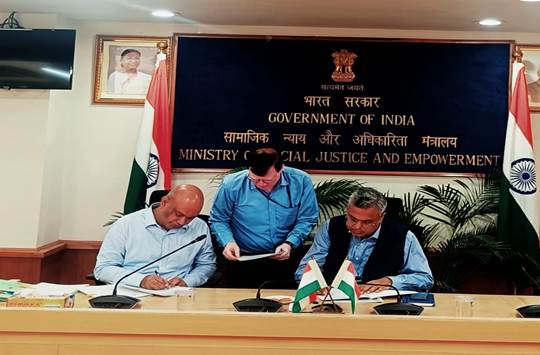
Ministry of Social Justice & Empowerment and National Safai Karamcharis Finance & Development Corporation

 A momentous collaboration has been cemented as the Ministry of Social Justice & Empowerment and the National Safai Karamcharis Finance and Development Corporation (NSKFDC) inked a Memorandum of Understanding (MoU) for the fiscal years 2023-24 and 2024-25. This strategic partnership aims to enhance the socio-economic upliftment of Safai Karamcharis, Manual Scavengers, Waste Pickers and their dependants focusing on empowering these marginalized communities across the nation.

The MoU underscores the commitment to accelerate inclusive growth through the effective allocation and utilization of funds for targeted welfare programs. The joint endeavor strives to amplify initiatives that promote safety, education, skill development, entrepreneurship, and sustainable employment opportunities, contributing to the holistic advancement of these workers who toil hard braving inclement weather to keep our surroundings clean.

NSKFDC, a prominent organization dedicated for this cause will collaborate closely with the Ministry to ensure the transparent and effective utilization of allocated funds. This alliance seeks to synergize expertise and resources for impactful implementation of programs that empower these marginalized populations.

The signing of this MoU is a testament to the shared vision of fostering equal opportunities and societal progress. Both parties are eager to channel their collective efforts to drive positive changes, fostering an environment where every individual can thrive and contribute to the nation’s growth.

****

'Divya Kala Mela' starts for the first time on Kartavya Path

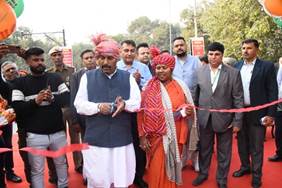
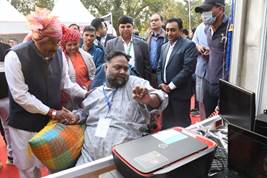
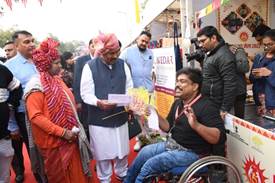
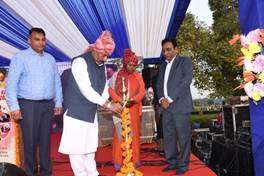
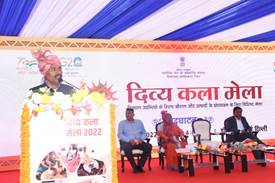
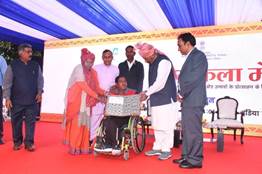
 Union Minister for Social Justice and Empowerment Dr. Virendra Kumar inaugurates the Divya Kala Mela in Kartavya Path at India Gate, Delhi. Minister of State for Social Justice and Empowerment Sushri Pratima Bhowmik was also present on the occasion. The Divya Kala Mela will be held from 2nd to 7th December and it’s aims to provide a great platform for the products and craftsmanship of Divyang artisans, craftsmen and artisans from across the country. On this occasion, Union Minister for Social Justice and Empowerment Virendra Kumar said that the objective of the fair is to bring self-reliance in the lives of Divyangjan, he said that this type of event will provide a big platform to the Divyangjans as well as display and sale of their products and in future Will also provide an opportunity to connect with big businessmen. With this, he said that Divya Kala Mela will now be organized across the country. The four finance corporations under this ministry, NHFDC, NBCFDC, NSFDC and NSKDFC k provide financial assistance under term loan schemes and micro finance schemes to the artisans through various channel partners.

The ambitious plan of P M Modi, P.M. is Training in skill upgradation and skill development under Daksh is also important for our target group of corporates as the group is mostly engaged in traditional economic activities which require continuous improvement of their skills as per the market requirement. Therefore, to make the economic activities of the target groups compatible with market competition, emphasis is also being laid on skill up gradation. They just need to identify their needs and potential and training and match it with their access to government resources and soft loans. PM Rs 495 crore has been distributed to more than 5 lakh trainees under Daksh.

 The event will provide an exciting experience to the visitors to see vibrant products, handicrafts, handlooms, embroidery work and packaged food items, etc. from different parts of the country including Jammu & Kashmir and North Eastern States. Around 200 Divyang artisans, artists and entrepreneurs from 22 states and union territories will showcase their products and skills in the fair. The fair showcased products from the categories of home decor & lifestyle, clothing, stationery & eco-friendly products, packaged food, organic products, toys & gifts, personal accessories-jewellery, clutch bags, a fair for all’ Vocal for Local’ and will provide an opportunity to see and buy products made by Divyang artisans through their additional resolution, the six-day Divya Kala Mela will open from 11.00 am to 8.00 pm. It will host a range of cultural activities including performances by differently-abled artists and eminent professionals. Visitors can also relish their favorite food from different regions of the country at the event.


********

'Divya Kala Mela' starts for the first time on Kartavya Path

 Union Minister for Social Justice and Empowerment Dr. Virendra Kumar inaugurates the Divya Kala Mela in Kartavya Path at India Gate, Delhi. Minister of State for Social Justice and Empowerment Sushri Pratima Bhowmik was also present on the occasion. The Divya Kala Mela will be held from 2nd to 7th December and it’s aims to provide a great platform for the products and craftsmanship of Divyang artisans, craftsmen and artisans from across the country. On this occasion, Union Minister for Social Justice and Empowerment Virendra Kumar said that the objective of the fair is to bring self-reliance in the lives of Divyangjan, he said that this type of event will provide a big platform to the Divyangjans as well as display and sale of their products and in future Will also provide an opportunity to connect with big businessmen. With this, he said that Divya Kala Mela will now be organized across the country. The four finance corporations under this ministry, NHFDC, NBCFDC, NSFDC and NSKDFC k provide financial assistance under term loan schemes and micro finance schemes to the artisans through various channel partners.

The ambitious plan of P M Modi, P.M. is Training in skill upgradation and skill development under Daksh is also important for our target group of corporates as the group is mostly engaged in traditional economic activities which require continuous improvement of their skills as per the market requirement. Therefore, to make the economic activities of the target groups compatible with market competition, emphasis is also being laid on skill up gradation. They just need to identify their needs and potential and training and match it with their access to government resources and soft loans. PM Rs 495 crore has been distributed to more than 5 lakh trainees under Daksh.

 The event will provide an exciting experience to the visitors to see vibrant products, handicrafts, handlooms, embroidery work and packaged food items, etc. from different parts of the country including Jammu & Kashmir and North Eastern States. Around 200 Divyang artisans, artists and entrepreneurs from 22 states and union territories will showcase their products and skills in the fair. The fair showcased products from the categories of home decor & lifestyle, clothing, stationery & eco-friendly products, packaged food, organic products, toys & gifts, personal accessories-jewellery, clutch bags, a fair for all’ Vocal for Local’ and will provide an opportunity to see and buy products made by Divyang artisans through their additional resolution, the six-day Divya Kala Mela will open from 11.00 am to 8.00 pm. It will host a range of cultural activities including performances by differently-abled artists and eminent professionals. Visitors can also relish their favorite food from different regions of the country at the event.


********

Role of NGOs in India

    Role of NGOs in India

NGO means non-Governmental organization, which is a voluntary group with social mission. These organization are independent from government. These are non-profitable organization whose mission is to fight the social issues and do charity for public good. They have high degree of public trust which make them more concerned about the society. People join NGOs as their member to work for the welfare of society from their end by keeping the goal of NGO as their primary concern. NGOs receive funding from the government, an individual, or an organization.

NGOs were first called in Article 71 in the charter of newly formed United Nation in 1945. NGOs activity includes environment, social advocacy, human rights, consumer protection, health, development, etc. They work at different level like local, regional, national, international, etc.

Different NGOs work in different form like providing charity (beneficiaries provide input) to the needy people, providing healthcare and education services, by participating in the cause in the form of money, land, material, etc., by aware and empowering the poor people to understand the social, political, economical factor which affects their lives.

Different NGOs in India

1.   CHILDLINE India foundation

CHILDLINE aims to reach out to every child in need and ensure their rights and protection. There four Cs model – Connect, Catalyse, Collaborate and Communicate – is the system that enables them to reach out to more and more children, every year.

2.  Pratham

Pratham is one of the largest NGO in India that provides innovative learning to improve the quality of education in the country. It focuses on high-quality, low-cost interventions to address the gaps in the education system. Pratham partners with several state governments to help children acquire foundational skills. Their programs have successfully reached millions of children every year.

3.   Smile Foundation

Smile Foundation wants to bring about change in the lives of the underprivileged society by enabling civil society to engage proactively in the change process.Smile Foundation aims to empower the lower strata of society especially children and women through relevant education, innovative healthcare and market-focused livelihood programs.

4.   CRY (Child rights and you)

Their vision is that every child is happy, healthy and creative and whose rights are protected and honoured in an equal and dignified society. They want to enable people to take responsibility and make them aware of their potential for action and change. It wants people to commit to helping secure, protect and honor the rights of Indian children.

5.      Nanhi kali

This education NGO aims to positively impact India’s development by educating girls and encouraging people to contribute to a worthy cause. Nanhi Kali has ensured that 90% of girls in their program successfully complete their schooling till Class X. Project Nanhi Kali supports underprivileged girls by providing them daily academic assistance through Academic Support Centres, Annual Supplies Kit and Digital Tablets to secondary school girls.

Thus, The numbers of NGOs are not limited. There are a lot NGOs who are working to reframe the society and it’s our responsibility to support them in their good cause. As much as we become responsible, the quality of life of needy people will increase. If we share a little part of what we have we can build a great nation.

Issues relating to development and management of Social Sector/Services relating to Health, Education, Human Resources.

For inclusive growth and employment, spending on social services as a share of GDP and investment in social infrastructure are of prime importance. The social sector pursues economic and social goals and is involved in providing social services to disadvantaged groups and communities, whether in urban or rural areas. Recent Economic Research focuses on social services including education, sport, arts and culture; public health and medical, family welfare; water supply and drainage and environmental sanitation; hotel; Urban Development; SC, ST and OBC welfare, labor and labor benefits; social security and welfare, nutrition, disaster relief, etc.

As education and health are two major areas of concern in the context of social sector development and human development achievements, this article explores their situation in India.

ISSUES REGARDING DEVELOPMENT AND MANAGEMENT OF SOCIAL SECTORS

In this regard, issues related to the development and management of social sectors/services are as follows:

1) Fundamental changes in the design of policies/programs needed to approach all segments of society.

2) Expand outreach equitably through people participation, outreach, use of technology, and direct transfer of benefits.

3) Access to education at all levels in rural and urban areas with necessary reforms of the education system to encourage career development.

4) Intensify efforts to impart skills needed to face the 4th industrial revolution, which is a fusion of the physical, digital and biological worlds.

5) An increase in total formal employment in the economy.

6) Challenges of providing both access to health care and access to quality health care nationally.

7) Construction rate of pucca structure housing in rural and urban areas.

EDUCATION

The liberalization of India’s economy has had a major impact on the country’s Gross Domestic Product (GDP) growth, with its economic growth accelerating f. The literacy rate has increased from 77.7% in 2020, while primary education universalization has largely been achieved and the dropout rate has decreased. However, despite significant progress, strong exclusions and disparities exist. Combining accessible affordability and quality assurance with good governance and adequate funding is always a concern.

HEALTH

Significant progress has also been made on the medical side, some diseases have been eradicated or are on the verge of eradication. There have been significant declines in the Index of Fertility (ISF) and the Infant Mortality Rate (IMR), and life expectancy has fallen from 36.7 years in 1951 to 69.66 In 2019. These achievements are impressive, but at the same time, our failures are more prominent. As such, this volume brings together the contributions of leading Indian scholars on a wide range of social issues, including the link between growth, poverty, and the social sector; efficiency of social sector spending in India; disparities in health status; Protecting IPRs in Health Innovations; pollution and health; universal primary education; problems encountered at higher education levels; and child labor issues.

ROLE OF CONSTITUTION IN ENSURING ECONOMIC AND SOCIAL JUSTICE

The right to health is not directly included as a fundamental right in the Constitution of India. The maker of the Constitution placed this obligation on the State to ensure economic and social justice. The fourth part of the Indian constitution is the Directive Principles of State Policy which has imposed obligations on the states. If we just look at these terms, we see that some of them are directly or indirectly related to public health. The Indian constitution does not stipulate the right to health care as a fundamental right. The Constitution orders the State to take measures to improve the health care conditions of the people. Thus, the preamble of the Constitution of India, among other things, aims to ensure social and economic justice for all its citizens. It provides a framework for achieving the goals set out in the introduction. The preamble is amplified and developed in the Guiding Principles of State Policy.

Article 38 of the Indian Constitution places on the state the responsibility that states must ensure social order to promote the welfare of the people, but without public health we cannot achieve this. this. This means that without public health, everyone’s happiness is impossible. Article 39(e) concerned workers to protect their health. Article 41 imposes on the State the obligation to provide public assistance mainly to the sick and disabled. Article 42 provides for the protection of the health of children and mothers through the maternity regime. In India, the guiding principle of state policy under Article 47 states that the primary duty of the state is to improve public health, ensure justice, the human condition at work, and prolong time sickness, old age, disability and maternity benefits are also being considered. In addition, state duties include the prohibition of intoxication and drugs harmful to health. Section 48A ensures that the state strives to protect and enforce a pollution-free environment for good health.

Social Justice and Empowerment

 1. NASHA MUKT BHARAT ABHIYAN

To tackle the issue of Substance Abuse and a vision to make India Drug Free, Nasha Mukt Bharat Abhiyaan (NMBA) was launched on 15th August 2020, in 272 Districts identified as most vulnerable in terms of usage of drugs in the country. These vulnerable districts were identified on the basis of findings from the Comprehensive National Survey and the inputs provided by the Narcotics Control Bureau (NCB).

The Abhiyaan is a three-pronged attack combining the supply curb by Narcotics Control Bureau, Outreach and Awareness and Demand Reduction effort by Social Justice and Empowerment and treatment through Health Department

Youth, Educational Institutions, Women, Children, Civil Society Organizations/NGOs are envisioned as major target populations and stakeholders of the Nasha Mukt Bharat Abhiyaan

The Nasha Mukt Bharat Abhiyaan was launched in the identified 272 districts on 15th August 2020 and since its launch, a wide range of activities have been conducted throughout the country that have fostered participation from all quarters of society and stakeholders. District Level Nasha Mukt Committees which are headed by the District Collector/Magistrate charted out, planned and taken the lead in the implementation of the Abhiyaan in their respective districts.

  • Till now through the various activities undertaken for the Abhiyaan, 1.4+ Crore people have been reached out so far in the identified districts
  • More than 45+ lakh youth have actively participated in the activities of the Abhiyaan
  • The contribution of 29.5+ Lakh women have been vital in reaching out to a larger community through the Anganwadi & ASHA Workers, ANMs, MahilaMandals& Women SHGs
  • Across the country till now, 30+ lakh students have been reached with events, competitions and sessions organized in 55,000+ educational institutions such as schools & colleges
  • Master Volunteers have been selected and trained to lead the Abhiyaan activities in the 272 identified districts. A strong network of 8,000+ Master Volunteers are actively participating in the Abhiyaan.  
  • The Ministry has tried to take over the online space and engage with the various stakeholders through a range of activities and online events. The Social Media accounts of the Abhiyaan on Twitter, Facebook & Instagram have acted as effective medium for the online presence. 
  • A host of online events like Panel Discussion with DC/DMs, Expert Panel Discussion, Online competitions etc. have also been organized with the involvement and participation from the highest authorities from the Ministry as well as the States & Districts, subject matter & domain experts from different fields, professionals working in the area of substance abuse and the youth at large. 
  • A Mobile Application for the Nasha Mukt Bharat Abhiyaan was launched by the Ministry to gather and collect the data and the information of the activities that are happening on-ground. This App is being used by the selected Master Volunteers who are involved in organizing and conducting activities for the Abhiyaan and also by the District Officials. All this collected data is represented in the NMBA Dashboard where detailed information can be viewed on a district, state and national level. 
  • A Website (http://nmba.dosje.gov.in) for the NMBA has been made live and public with the intention of providing detailed information and insights to the user/viewer about the Abhiyaan. 
  • The NMBA website also has an interactive space for Forum & Discussion to questions on anything related to substance abuse which is answered within the next 24 hours by subject matter and domain experts who are affiliated to eminent institutions like NIMHANS & PGIMER
  • All the rehabilitation, treatment and counselling facilities supported by the Ministry have been geo-tagged 
  • (https://www.google.com/maps/d/u/0/viewer?mid=1tdLtmShkciGDV57B25ZpzI_Mp6CDiN7U&ll=23.65618657066699%2C85.93051471425989&z=5)  to make them accessible and easier to locate. 
  • A short film on the Abhiyaan, its objectives and the efforts of the districts has been made 
  • Eminent Universities & Colleges across the country such as Christ University, Manipal Academy of Higher Education, VIT are actively involved in the implementation of Abhiyaan activities in their campuses and vulnerable communities present around them. 
  • To celebrate Azadi ka Amrit Mahotsav, Ministry has planned to declare 100 districts as ‘Drug Sensitized Districts’ from August 2021 to August 2022 as per defined parameters

2. SMILE-Support for Marginalized Individuals for Livlihood and Enterprise.

The Ministry of Social Justice and Empowerment has formulated an umbrella scheme “SMILE – Support for Marginalized Individuals for Livelihood and Enterprise”, which includes two sub-schemes – ‘Central Sector Scheme for Comprehensive Rehabilitation for Welfare of Transgender Persons’ and ‘Central Sector Scheme for Comprehensive Rehabilitation of persons engaged in the act of Begging’. This umbrella scheme covers several comprehensive measures including welfare measures for both transgender persons and persons who are engaged in the act of begging with focus extensively on rehabilitation, provision of medical facilities, counselling, education, skill development, economic linkages etc with the support of State Governments/UTs/Local Urban Bodies, Voluntary Organizations, Community Based Organizations (CBOs) and institutions and others. The Scheme is expected to be launched soon.

3. Post –Matric Scholarship Scheme for SC students.

Under Post-Matric Scholarship Scheme for SC students, the Union Cabinet approved transformatory changes in the scheme in December, 2020 for the period of 2020-21 to 2025-26 which included fixed sharing pattern of 60:40 between Centre & States and DBT of Central Share to beneficiaries from 2021-22 onwards. Despite having a short implementation time of the revised scheme during March 2021, the achievement of the release made under the scheme was extraordinary and over 105% of the allocated budget. The central assistance amounting to Rs. 4008.60 cr was released covering over 62 lacs beneficiaries (exact figure yet to be reported by States).

As one of the major interventions of the Government was to introduce direct central share to the beneficiary account from FY2021-22 inwards, the Department successfully implementing this provision and in this regards an amount of Rs 245.42 cr has been released to over 4 lakh beneficiaries on 6th December, 2021 as of now.

4. Achievements of NSKFDC

  1. Achievements of loaning scheme of NSKDSC
  • NSKFDC has disbursed Rs. 99.33 Cr to its Channelizing Agencies for extending the benefits of various loan schemes of NSKFDC to 21869 beneficiaries during the calendar year 2021 as on 21.12.21. 
  • With a view to promote mechanized cleaning and also provide livelihood opportunities to the target group, NSKFDC is also providing financial assistance under its Swachhta Udyami Yojana (SUY) for procurement of mechanized cleaning equipments. The beneficiaries from the target group are provided long term work contact for mechanized cleaning from the Urban Local Bodies and related equipments/vehicles are financed under SUY scheme with provision of capital and interest subsidy under SRMS scheme.
  • 28 Loan Mela’s were organised in various cities under Safaimitra Surkasha Challenge to provide financial assistance to target group of NSKFDC for procurement of mechanised cleaning equipments/vehicles under Swachhta Udyami Yojana (SUY) of NSKFDC. 
  • NSKFDC has also provided capital subsidy of Rs.5.19 Cr against 142 beneficiaries from the target group of NSKFDC for procurement of 117 units of mechanized cleaning equipments having total cost of Rs. 13.73 Cr.
  1. Swachhta Udyami Yojna (SUY)

Swachhta Udyami Yojna (SUY) was launched by NSKFDC on the birth anniversary of Mahatma Gandhi on 2nd October 2014 with twin objectives of cleanliness and providing livelihood to Safai Karamcharis and liberated Manual Scavengers and their dependents. NSKFDC provides financial assistance to its target group for procurement of operation of mechanised sanitation related equipments and vehicles.

  1. Financial assistance to Urban Local Bodies (ULBs) under Swachhta Udyami Yojana (SUY) of NSKFDCLoans are provided to Urban Local Bodies (ULBs) under SUY scheme of NSKFDC for procurement of any mechanised cleaning equipment/vehicle having unit cost not exceeding Rs.50.00 Lakhs as per the details given below:

Beneficiary Profile

Maximum Limit (upto)

Rate of Interest

NSKFDC Loan Share

ULB Share

Repayment period

Municipal Corporation/Jal Boards, Public Health & Engineering Departments, Cantonment Boards etc.

Rs.50.00 lacs per unit (no. of units could be more than 1)

4% p.a.(1% rebate for timely repayment)


90%


   10%

Upto 10 years


  1. Financial assistance to is also provided through State Channelizing Agencies (SCAs) under Swachhta Udyami Yojana (SUY) of NSKFDC
  2. Financial assistance to the target group under SUY Scheme 

Grant of Capital and Interest Subsidy under SRMS Scheme: NSKFDC is actively working for the objective of manhole to machine-hole transformation by providing upfront capital Subsidy and interest subsidy under SRMS scheme to promote this initiative.  

CAPITAL SUBSIDY:- Upfront capital subsidy is also admissible for procurement of mechanised cleaning equipments under SRMS Scheme as under:


Range of Project Cost (Rs.)

Capital Subsidy

For individuals

Upto Rs. 5,00,000 

50% of project cost

5,00,000 to 15,00,000

Rs. 2.5 lakh + 25% of remaining project cost 

For Group Projects: 

Upto Rs. 10,00,000 per beneficiary with maximum project cost upto Rs. 50,00,000

Same as admissible to individuals subject to maximum Rs. 3.75 lakh per beneficiary


INTEREST SUBSIDY– The rate of interest as per the scheme is 6% per annum. The difference between the rate of interest charged by the Bank and the rate of interest as per scheme is paid as interest subsidy on monthly basis.

Progress under SUY Scheme For Sanitation Related Projects 

During 2021-22, so far 139 beneficiaries have been provided with upfront capital subsidy of Rs. 5.09 crores for procurement of equipments/machines related to sanitation related projects.

  1. ACHIEVEMENTS OF PRADHAN MANTRI DAKSHTA AUR KUSHALTA SAMPANN HITGRAHI (PM-DAKSH) YOJANA

In 2020-21, Department modified the existing Scheme of Assistance to skilling for OBCs/EBCs/DNTs with inclusion of SCs and Safai Karamcharis including Waste Pickers and  renamed it as PM DAKSH Yojana,  a Central Sector Scheme. The objective is to provide high quality skills through good quality institutions and reputed Training institutes/partners (TIs/TPs) so as to ensure higher employability for the target group. Apart from this, rural artisans who have become marginalized owing to newer technologies in market, would be trained so as to adopt newer processes and increase their incomes. As approved by SFC, the Ministry of Social Justice & Empowerment is to continue Pradhan Mantri Dakshta Aur Kushalta Sampann Hitgrahi (PM-DAKSH) Yojana, with a target to skill around 2,71,000 SCs/OBCs/EBCs/DNT/Safai Karamcharis including Waste Pickers during next five years (2021-22 to 2025-26) with a budget outlay of Rs.450.25 crore.

1.1 Initiative taken under PM DAKSH

  • PM-DAKSH Portal and PM-DAKSH Mobile App were launched by Dr. Virendra Kumar, Hon’ble Minister of Social Justice and Empowerment on 07.08.2021.  The PM-DAKSH portal offers on-line registration for a Free of Cost Skill Development Training Programmes under ‘Pradhan Mantri-Dakshta  Aur  Kushalta  Sampann  Hitgrahi (PM-DAKSH) Yojana’. Applications are invited from the candidates belonging to SCs, OBCs,EBCs,DNTs,  Sanitation workers including waste picker in the age group of 18 to 45 years. 
  • The four interventions such as Up-skilling/Re-skilling, Short Term Training, Long term training and Entrepreneurship Development Programmes (EDB) are introduced for enhancing skill of them. The interested candidates may register themselves at pmdaksh.dosje.gov.in or on Mobile App “PM-DAKSH” to be downloaded from Google Play Store.
  • Letter have already written to Principal Secretaries of State Governments and DMs/DCs to make wide publicity of the PM-DAKSH Yojana. 

       1.2 Year end Achievement of PM-DAKSH

  • PM-DAKSH Portal and PM-DAKSH Mobile App were launched by Dr. Virendra Kumar, Hon’ble Minister of Social Justice and Empowerment on 07.08.2021.  The PM-DAKSH portal offers on-line registration for a Free of Cost Skill Development Training Programmes under ‘Pradhan Mantri-Dakshta  Aur  Kushalta  Sampann  Hitgrahi (PM-DAKSH) Yojana’. Applications are invited from the candidates belonging to SCs, OBCs,EBCs,DNTs,  Sanitation workers including waste picker in the age group of 18 to 45 years in four interventions such up-skilling/re-skilling, Short Term Training, Long Term Training and Entrepreneurship Development Programmes (EDP) are introduced for enhancing skill of them.
  • The portal has opened from 08.08.2021 to 30.09.2021 for online registration by the candidates. Status of PM-DAKSH Portal as on 30.11.2021 is as under:

Sl. No.

Interventions

1

Total number of Candidates Registered

51608

2

Total number of Registered Institute/Center

76

3

Total number of training/Courses offered

341

4

Total number of ongoing batches

537

5

Total  number of candidates for which training is commenced

19199

   The physical achievements, Corporation-wise, are as under:-

Physical Achievements (As on 30.11.2021)

Year

NSFDC

NBCFDC

NSKFDC

Total

2021-22*

6539

9770

2890

19,199

* Out of the target (49,800), the training programme has been commenced for 19,199 candidates. The commencement of further training is in progress.


  • Financial Achievement

During 2021-22, an amount of Rs.80.19 crores has been allocated under the scheme. No fund has been released to the Corporations for PM-DAKSH in 2021-22 as it has been decided that the Corporations should first utilize the unspent amount lying with them and after utilization of 80% of fund released  to them in 2020-21, they may send the proposal for further release. 

  1. SCHEME OF SELF EMPLOYMENT SCHEME FOR REHABILITATION OF MANUAL SCAVENGERS (SRMS)
  1. The Scheme has been revised w.e.f. 1.4.2021.  Major revisions made under the Scheme are:-
  1. Enhancement of limit of maximum amount of capital subsidy for self employment projects from Rs. 3.25 lakh to Rs. 5.00 lakh. 
  2. Capital Subsidy to be paid upfront and not  back-ended, as earlier.
  3. Sanitation workers and their dependants have also been made eligible for receiving capital subsidy and interest subsidy for sanitation related projects.
  4. Assistance would also be admissible for group projects costing upto Rs. 50.00 lakh.  Each member of the group can have project share upto Rs. 10.00 lakh. Maximum capital subsidy admissible to each member of the group is Rs. 3.75 lakh. Maximum capital subsidy admissible to group upto Rs. 18.75 lakh.
  1. During 2021, so far 142 sanitation workers have been provided capital subsidy of Rs. 5.19 crore for sanitation related projects.

5. Senior Citizen

On the occasion of International Day of Older Persons (IDOP), the Ministry organized a function at Vigyan Bhawan, New Delhi which was chaired by the Hon’ble Minister of Social Justice and Empowerment. The Hon’ble Vice President of India was the Chief Guest in the function named Vayo Naman-2021. The following activities were done on the occasion:-

  1. Conferment of Vayoshreshtha Samman- National Awards for Senior Citizens 

The Hon’ble Vice President of India conferred Vayoshreshtha Samman to 05 institutions and 06 individuals. The Awards were conferred to institutions for providing services in the field of welfare of the elderly, and to individual senior citizens for showing exemplary work in different fields. 

  1. Dedicating Elderline to the Nation

The Hon’ble Vice President of India dedicated a toll free National Helpline for Senior Citizens named Elderline – 14567- to the Nation. The Helpline provides a platform to the senior citizens for grievance redressal. The Helpline also contributes in the field of awareness generation in respect of the Maintenance and Welfare of Parents and Senior Citizens (MWPSC) Act, 2007, and the Schemes of the Central Government meant for welfare of senior citizens.

  1. Launching of SACRED Portal

A portal namely Senior Able Citizens for Re-Employment in Dignity (SACRED) (https://sacred.dosje.gov.in/) was launched by the Hon’ble Vice President of India. The portal was launched to provide employment to willing senior citizens by virtually matching their preferences with preferences of companies ready to engage such senior citizens.

  1. SAGE portal

A scheme for promoting Silver Economy in the country was launched under Atal Vayo Abhuday Yojana, which aims at assisting start-ups in the field of elderly welfare (silver economy) by the Government of India. These start-ups are to be assisted by way of equity participation of GOI subject to a maximum of 49% equity, and subject to a maximum Rs. 1 crore, per start up. On the occasion of IDOP, selected start ups for F.Y. 2021-22 were announced.

6. Scheme for Economic Empowerment of DNT Communities (SEED)

The Ministry, for the welfare of DNT communities has formulated a scheme namely “ Scheme for Economic Empowerment of DNT Communities (SEED)” with total outlay of Rs. 200 Crore for next five years, having following four components:-

  1. To provide coaching of good quality for DNT candidates to enable them to appear in  competitive examinations, 
  2.   To provide Health Insurance to them, 
  3.   To facilitate livelihood initiative at community level and 
  4. To provide financial assistance for construction of houses for members of these communities.

  *******