Theory of Social Evolution :- Herbert Spencer


Evolution was in the air and developmental thinking can be found in
a variety of different fields.

The word evolution was borrowed from Latin ēvolūtiō, ēvolūtiōnis, which means , “the act of unrolling, unfolding or opening .

Evolution is a process full of complexity .
Evolution is a principle of internal growth . It shows not merely what happens to a thing but also what happens within it .

Their term evolution is borrowed from the biological science of sociology ,Frome the term ” organic evolution ” .
Whereas organic evolution is used to denote the evolution of organisms ,social evolution is used to denote the evolution of human society .

Herbert Spencer (27 April 1820 – 8 December 1903) was an English philosopher, biologist, anthropologist, and sociologist famous for his hypothesis of social Darwinism.
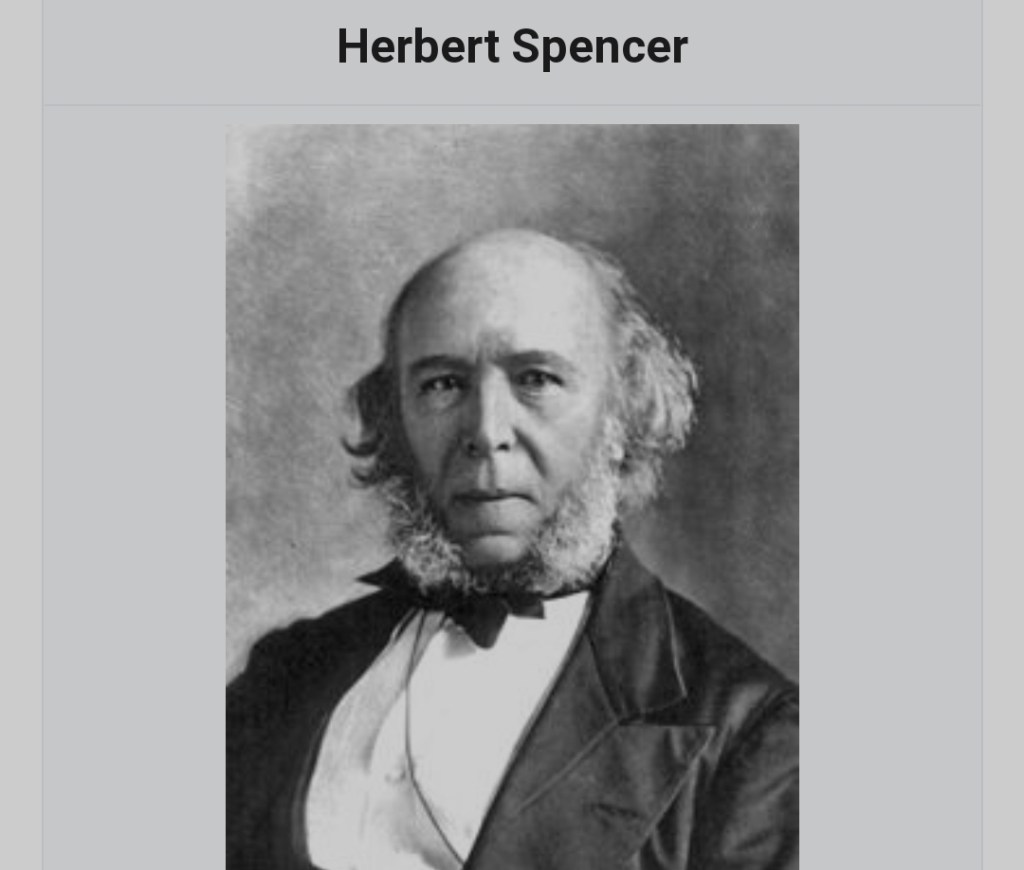
Spencer in his essay “The Social Organism”,
stated that the social organism itself is subject to evolutionary developments as a separate entity and much of the idea that societies, like individual organisms, “spontaneously evolved” .

On passing from Humanity under its individual form, to Humanity as socially
embodied, social evolution can be exemplified .

Spencer said , “Evolution is an integration of matter and concomitant dissipation of motion, during which the matter passes from an indefinite, incoherent homogeneity to a definite, coherent heterogeneity and during which the retained motion undergoes a parallel transformation.”

One of the most important contribution of Herbert Spencer to Sociology is the theory of evolution

His principles included physical and biological evolution in order to elaborate and explain his theory of Social evolution.
He sketches a comprehensive account of evolution of the inorganic, organic, and
human and social realms.

He stated ,
In respect to that progress which individual organisms display
in the course of their evolution,”

He explained this course of evolution through , the development of a seed into a tree, or an ovum into an animal, constitute an
advance from homogeneity of structure to heterogeneity of structure .

He continue with, the change
from the homogeneous to the heterogeneous is displayed in the progress of civilization as a whole, as well as in the progress of every nation; and is still going
on with increasing rapidity.

Spencer adopted his principle of evolution from naturalist Charles Darwinwho developed the concept of evolution in his “Origin of Species” in 1859.

Herbert Spencer, used Darwin’s theory and applied it to how societies change and evolve .According to Spencer societies were bound to change automatically .

Spencer in his theory applied a comparison of societies with organisms that progress through changes similar to that of a living species.

He included three types of systems where societies can be compared to organisms .
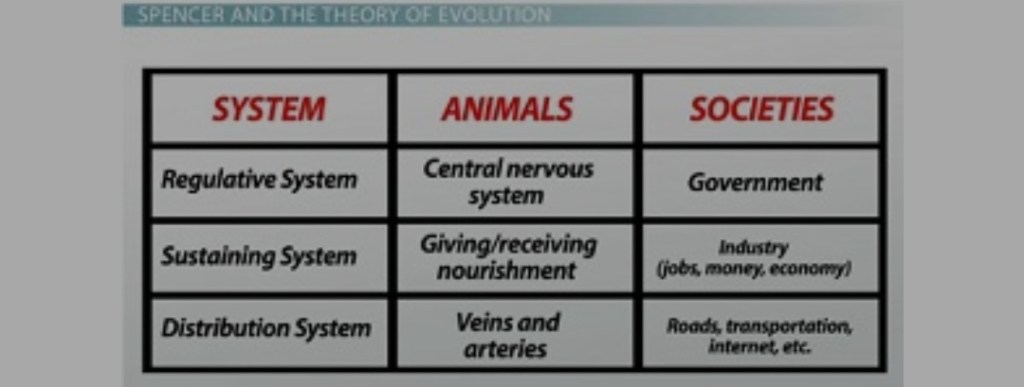
The first system is the regulative system.
In animals, that would be the central nervous system and in societies, it would be a government that regulates everything.

The second system is the sustaining system.
For animals, that’s the giving and receiving of nourishment. For societies, that would be industry – jobs, money, economy and those sorts of things.

The third system would be the distribution system.
In animals, that would be the veins and arteries. In societies, it would be roads, transportation, internet – anything in which information and goods and services are exchanged.

Survival of the fittest” expounded by Darwin was highly believed by him . According to Spencer only strong creatures survive and evolve; only strong makes progress. And that animal has to struggle to preserve its existence.

All universal phenomena-inorganic, organic, super organic—are subject to the natural law of evolution.

A definite pattern of change is followed by all the phenomena of nature—the stars and planetary systems, the earth and all terrestrial phenomena, biological organisms and the development of species, all the psychological and sociological processes of human experience.

Herbert Spencer includes physical evolution in the form of indefinite incoherent situations to definite and coherent situations.
The underlying principles of physical evolution are a movement from simple to complex and homogeneity to heterogeneity.

According to him , following the Darwin theory of ” Survival of fittest ” the biological evolution only those creatures survive in the struggle for existence who are able to make effective adjustment with changing circumstances.

Herbert Spencer utilized these two principles, physical and biological evolution in order to explain social evolution.

Spencer’s theory of social evolution points out to two stages:

1. The movement from simple to compound societies.

This movement from simple to compound societies can be seen in four types of societies in terms of evolutionary levels

• Simple Society:
• Compound societies
• Double Compound societies
• Trebly Compound societies

2. Change from militant society to industrial society.

According to Spencer, the law of evolution is the supreme law of every becoming.
From the analysis of biological evolution Spencer established the theory of evolution.
He argued that the evolution of human societies, far from being different from other evolutionary phenomena. It is a special case of a universally applicable natural law.

According to some social thinkers Herbert Spencer’s has several criticism ,
They said that theory lacks practicability and is realistic.
It also lacks uniformity.
Qualities like sympathy, sacrifice, kindness, love etc. are of much Importance in human survival . These are quite different from the struggle for existence.

Despite of several criticism Spencer Theory of Evolution is the fundamental base for understanding evolution of man and society .

What is Empathy

 Empathy is the capacity to understand or feel what another person is experiencing from within their frame of reference, that is, the capacity to place oneself in another’s position. 

Empathy is, at its simplest, awareness of the feelings and emotions of other people. It is a key element of Emotional Intelligence, the link between self and others, because it is how we as individuals understand what others are experiencing as if we were feeling it ourselves.

Empathy goes far beyond sympathy, which might be considered ‘feeling for’ someone. Empathy, instead, is ‘feeling with’ that person, through the use of imagination.


On the other hand, sympathy involves understanding from your own perspective. Empathy involves putting yourself in the other person’s shoes and understanding why they may have these particular feelings. In becoming aware of the root cause of why a person feels the way they do; we can better understand and provide healthier options.

“Unsympathetic” is a word that may be used to describe a person who lacks empathy. Someone may also use the terms “insensitive or “uncompassionate” to describe people who lack empathy.


Signs of a Lack of Empathy

  • Being extremely critical of other people.
  • Blaming the victim.
  • Not forgiving people for making mistakes.
  • Feeling like other people are too sensitive.
  • Not listening to other people’s perspectives or opinions.
  • An inability to cope with emotional situations.


What causes lack of empathy?


Low emotional intelligence, burnout, and stress
Being under prolonged stress may also lead someone to be less tolerant of other people’s behavior and have lower cognitive empathy. In some cases, emotional avoidance may also be a reason why someone may not develop or practice empathy.


Elements of Empathy


Understanding Others

Developing Others

Having a Service Orientation

Leveraging Diversity

Political Awareness

1.Understanding Others: This is perhaps what most people understand by ‘empathy’ “sensing others’ feelings and perspectives, and taking an active interest in their concerns”. Those who do this:

·         Tune into emotional cues. They listen well, and also pay attention to non-verbal communication, picking up subtle cues almost subconsciously. For more, see our pages on Listening Skills and Non-Verbal Communication.

·         Show sensitivity, and understand others’ perspectives.

All these are skills which can be developed, but only if you wish to do so. Some people may switch off their emotional antennae to avoid being swamped by the feelings of others.

2. Developing Others: means acting on their needs and concerns, and helping them to develop to their full potential. People with skills in this area usually:

  • Reward and praise people for their strengths and accomplishments, and provide constructive feedback designed to focus on how to improve. See our page on Giving and Receiving Feedback for more.
  • Provide mentoring and coaching to help others to develop to their full potential. See our pages on Mentoring and Coaching Skills for more.
  • Provide stretching assignments that will help their teams to develop. See our page on Delegation Skills.

3. Having a Service Orientation: Primarily aimed at work situations, having a service orientation means putting the needs of customers first and looking for ways to improve their satisfaction and loyalty.

People who have this approach will ‘go the extra mile’ for customers. They will genuinely understand customers’ needs, and go out of their way to help meet them.

In this way, they can become a ‘trusted advisor’ to customers, developing a long-term relationship between customer and organisation. This can happen in any industry, and any situation.

4. Leveraging diversity: means being able to create and develop opportunities through different kinds of people, recognising and celebrating that we all bring something different to the table.

Leveraging diversity does not mean that you treat everyone in exactly the same way, but that you tailor the way you interact with others to fit with their needs and feelings.

5. Political Awareness: Many people view ‘political’ skills as manipulative, but in its best sense, ‘political’ means sensing and responding to a group’s emotional undercurrents and power relationships.

Political awareness can help individuals to navigate organisational relationships effectively, allowing them to achieve where others may previously have failed


Empathy, Sympathy and Compassion

There is an important distinction between empathy, sympathy and compassion.

Both compassion and sympathy are about feeling for someone: seeing their distress and realising that they are suffering. Compassion has taken on an element of action that is lacking in sympathy, but the root of the words is the same.

Empathy, by contrast, is about experiencing those feelings for yourself, as if you were that person, through the power of imagination.

Three Types of Empathy

Psychologists have identified three types of empathy: cognitive empathy, emotional empathy and compassionate empathy.

  • Cognitive empathy is understanding someone’s thoughts and emotions, in a very rational, rather than emotional sense.
  • Emotional empathy is also known as emotional contagion, and is ‘catching’ someone else’s feelings, so that you literally feel them too.
  • Compassionate empathy is understanding someone’s feelings, and taking appropriate action to help.


How Do We Empathize?

Experts in the field of social neuroscience have developed two theories in an attempt to gain a better understanding of empathy. The first, Simulation Theory, “proposes that empathy is possible because when we see another person experiencing an emotion, we ‘simulate’ or represent that same emotion in ourselves so we can know first-hand what it feels like,” according to Psychology Today.

There is a biological component to this theory as well. Scientists have discovered preliminary evidence of “mirror neurons” that fire when humans observe and experience emotion. There are also “parts of the brain in the medial prefrontal cortex (responsible for higher-level kinds of thought) that show overlap of activation for both self-focused and other-focused thoughts and judgments,” the same article explains.

Some experts believe the other scientific explanation of empathy is in complete opposition to Simulation Theory. It’s Theory of Mind, the ability to “understand what another person is thinking and feeling based on rules for how one should think or feel,” Psychology Today says. This theory suggests that humans can use cognitive thought processes to explain the mental state of others. By developing theories about human behaviour, individuals can predict or explain others’ actions, according to this theory.

While there is no clear consensus, it’s likely that empathy involves multiple processes that incorporate both automatic, emotional responses and learned conceptual reasoning. Depending on context and situation, one or both empathetic responses may be triggered.

Cultivating Empathy: Empathy seems to arise over time as part of human development, and it also has roots in evolution. In fact, “Elementary forms of empathy have been observed in our primate relatives, in dogs, and even in rats,” the Greater Good Science Centre says. From a developmental perspective, humans begin exhibiting signs of empathy in social interactions during the second and third years of life. 

This suggests we have a natural predisposition to developing empathy. However, social and cultural factors strongly influence where, how, and to whom it is expressed. Empathy is something we develop over time and in relationship to our social environment, finally becoming “such a complex response that it is hard to recognize its origin in simpler responses, such as body mimicry and emotional contagion,” the same source says.

Psychology and Empathy: In the field of psychology, empathy is a central concept. From a mental health perspective, those who have high levels of empathy are more likely to function well in society, reporting “larger social circles and more satisfying relationships,” according to Good Therapy, an online association of mental health professionals. Empathy is vital in building successful interpersonal relationships of all types, in the family unit, workplace, and beyond. Lack of empathy, therefore, is one indication of conditions like antisocial personality disorder and narcissistic personality disorder. In addition, for mental health professionals such as therapists, having empathy for clients is an important part of successful treatment. 

Empathy plays a crucial role in human, social, and psychological interaction during all stages of life. Consequently, the study of empathy is an ongoing area of major interest for psychologists and neuroscientists in many fields, with new research appearing regularly. 


How to Develop Empathy at Work

1.Give Your Full Attention: Listen carefully to what someone is trying to tell you. Use your ears, eyes and “gut instincts” to understand the entire message that they’re communicating.

Start with listening out for the key words and phrases that they use, particularly if they use them repeatedly. Then think about how as well as what they’re saying. What’s their tone or body language  telling you? Are they angry, ashamed or scared, for example?

Take this a stage further by listening empathically . Avoid asking direct questions, arguing with what is being said, or disputing facts at this stage. And be flexible – prepare for the conversation to change direction as the other person’s thoughts and feelings also change.


2.Consider Other People’s Perspective: You’re likely familiar with the saying, “Before you criticize someone, walk a mile in their shoes.” Examine your own attitude, and keep an open mind. Placing too much emphasis on your own assumptions and beliefs doesn’t leave much space for empathy!

Once you “see” why others believe what they believe, you can acknowledge it. This doesn’t mean you have to agree with it, but this is not the time for a debate. Instead, be sure to show respect and to keep listening.

When in doubt, invite the person to describe their position some more, and ask how they think they might resolve the issue. Asking the right questions  is probably the simplest and most direct way to understand the other person.

3.Take Action: There’s no one “right way” to demonstrate your compassionate empathy. It will depend on the situation, the individual, and their dominant emotion at the time. Remember, empathy is not about what you want, but what the other person wants and needs, so any action you take or suggest must benefit them.

And remember that empathy is not just for crises! Seeing the world from a variety of perspectives is a great talent – and it’s one that you can use all of the time, in any situation. And random acts of kindness brighten anyone’s day.


What is Empathy

Empathy is the capacity to understand or feel what another person is experiencing from within their frame of reference, that is, the capacity to place oneself in another’s position. 

Empathy is, at its simplest, awareness of the feelings and emotions of other people. It is a key element of Emotional Intelligence, the link between self and others, because it is how we as individuals understand what others are experiencing as if we were feeling it ourselves.

Empathy goes far beyond sympathy, which might be considered ‘feeling for’ someone. Empathy, instead, is ‘feeling with’ that person, through the use of imagination.


On the other hand, sympathy involves understanding from your own perspective. Empathy involves putting yourself in the other person’s shoes and understanding why they may have these particular feelings. In becoming aware of the root cause of why a person feels the way they do; we can better understand and provide healthier options.

“Unsympathetic” is a word that may be used to describe a person who lacks empathy. Someone may also use the terms “insensitive or “uncompassionate” to describe people who lack empathy.


Signs of a Lack of Empathy

  • Being extremely critical of other people.
  • Blaming the victim.
  • Not forgiving people for making mistakes.
  • Feeling like other people are too sensitive.
  • Not listening to other people’s perspectives or opinions.
  • An inability to cope with emotional situations.


What causes lack of empathy?


Low emotional intelligence, burnout, and stress
Being under prolonged stress may also lead someone to be less tolerant of other people’s behavior and have lower cognitive empathy. In some cases, emotional avoidance may also be a reason why someone may not develop or practice empathy.


Elements of Empathy


Understanding Others

Developing Others

Having a Service Orientation

Leveraging Diversity

Political Awareness

1.Understanding Others: This is perhaps what most people understand by ‘empathy’ “sensing others’ feelings and perspectives, and taking an active interest in their concerns”. Those who do this:

·         Tune into emotional cues. They listen well, and also pay attention to non-verbal communication, picking up subtle cues almost subconsciously. For more, see our pages on Listening Skills and Non-Verbal Communication.

·         Show sensitivity, and understand others’ perspectives.

All these are skills which can be developed, but only if you wish to do so. Some people may switch off their emotional antennae to avoid being swamped by the feelings of others.

2. Developing Others: means acting on their needs and concerns, and helping them to develop to their full potential. People with skills in this area usually:

  • Reward and praise people for their strengths and accomplishments, and provide constructive feedback designed to focus on how to improve. See our page on Giving and Receiving Feedback for more.
  • Provide mentoring and coaching to help others to develop to their full potential. See our pages on Mentoring and Coaching Skills for more.
  • Provide stretching assignments that will help their teams to develop. See our page on Delegation Skills.

3. Having a Service Orientation: Primarily aimed at work situations, having a service orientation means putting the needs of customers first and looking for ways to improve their satisfaction and loyalty.

People who have this approach will ‘go the extra mile’ for customers. They will genuinely understand customers’ needs, and go out of their way to help meet them.

In this way, they can become a ‘trusted advisor’ to customers, developing a long-term relationship between customer and organisation. This can happen in any industry, and any situation.

4. Leveraging diversity: means being able to create and develop opportunities through different kinds of people, recognising and celebrating that we all bring something different to the table.

Leveraging diversity does not mean that you treat everyone in exactly the same way, but that you tailor the way you interact with others to fit with their needs and feelings.

5. Political Awareness: Many people view ‘political’ skills as manipulative, but in its best sense, ‘political’ means sensing and responding to a group’s emotional undercurrents and power relationships.

Political awareness can help individuals to navigate organisational relationships effectively, allowing them to achieve where others may previously have failed


Empathy, Sympathy and Compassion

There is an important distinction between empathy, sympathy and compassion.

Both compassion and sympathy are about feeling for someone: seeing their distress and realising that they are suffering. Compassion has taken on an element of action that is lacking in sympathy, but the root of the words is the same.

Empathy, by contrast, is about experiencing those feelings for yourself, as if you were that person, through the power of imagination.

Three Types of Empathy

Psychologists have identified three types of empathy: cognitive empathy, emotional empathy and compassionate empathy.

  • Cognitive empathy is understanding someone’s thoughts and emotions, in a very rational, rather than emotional sense.
  • Emotional empathy is also known as emotional contagion, and is ‘catching’ someone else’s feelings, so that you literally feel them too.
  • Compassionate empathy is understanding someone’s feelings, and taking appropriate action to help.


How Do We Empathize?

Experts in the field of social neuroscience have developed two theories in an attempt to gain a better understanding of empathy. The first, Simulation Theory, “proposes that empathy is possible because when we see another person experiencing an emotion, we ‘simulate’ or represent that same emotion in ourselves so we can know first-hand what it feels like,” according to Psychology Today.

There is a biological component to this theory as well. Scientists have discovered preliminary evidence of “mirror neurons” that fire when humans observe and experience emotion. There are also “parts of the brain in the medial prefrontal cortex (responsible for higher-level kinds of thought) that show overlap of activation for both self-focused and other-focused thoughts and judgments,” the same article explains.

Some experts believe the other scientific explanation of empathy is in complete opposition to Simulation Theory. It’s Theory of Mind, the ability to “understand what another person is thinking and feeling based on rules for how one should think or feel,” Psychology Today says. This theory suggests that humans can use cognitive thought processes to explain the mental state of others. By developing theories about human behaviour, individuals can predict or explain others’ actions, according to this theory.

While there is no clear consensus, it’s likely that empathy involves multiple processes that incorporate both automatic, emotional responses and learned conceptual reasoning. Depending on context and situation, one or both empathetic responses may be triggered.

Cultivating Empathy: Empathy seems to arise over time as part of human development, and it also has roots in evolution. In fact, “Elementary forms of empathy have been observed in our primate relatives, in dogs, and even in rats,” the Greater Good Science Centre says. From a developmental perspective, humans begin exhibiting signs of empathy in social interactions during the second and third years of life.

This suggests we have a natural predisposition to developing empathy. However, social and cultural factors strongly influence where, how, and to whom it is expressed. Empathy is something we develop over time and in relationship to our social environment, finally becoming “such a complex response that it is hard to recognize its origin in simpler responses, such as body mimicry and emotional contagion,” the same source says.

Psychology and Empathy: In the field of psychology, empathy is a central concept. From a mental health perspective, those who have high levels of empathy are more likely to function well in society, reporting “larger social circles and more satisfying relationships,” according to Good Therapy, an online association of mental health professionals. Empathy is vital in building successful interpersonal relationships of all types, in the family unit, workplace, and beyond. Lack of empathy, therefore, is one indication of conditions like antisocial personality disorder and narcissistic personality disorder. In addition, for mental health professionals such as therapists, having empathy for clients is an important part of successful treatment.

Empathy plays a crucial role in human, social, and psychological interaction during all stages of life. Consequently, the study of empathy is an ongoing area of major interest for psychologists and neuroscientists in many fields, with new research appearing regularly.


How to Develop Empathy at Work

1.Give Your Full Attention: Listen carefully to what someone is trying to tell you. Use your ears, eyes and “gut instincts” to understand the entire message that they’re communicating.

Start with listening out for the key words and phrases that they use, particularly if they use them repeatedly. Then think about how as well as what they’re saying. What’s their tone or body language  telling you? Are they angry, ashamed or scared, for example?

Take this a stage further by listening empathically . Avoid asking direct questions, arguing with what is being said, or disputing facts at this stage. And be flexible – prepare for the conversation to change direction as the other person’s thoughts and feelings also change.


2.Consider Other People’s Perspective: You’re likely familiar with the saying, “Before you criticize someone, walk a mile in their shoes.” Examine your own attitude, and keep an open mind. Placing too much emphasis on your own assumptions and beliefs doesn’t leave much space for empathy!

Once you “see” why others believe what they believe, you can acknowledge it. This doesn’t mean you have to agree with it, but this is not the time for a debate. Instead, be sure to show respect and to keep listening.

When in doubt, invite the person to describe their position some more, and ask how they think they might resolve the issue. Asking the right questions  is probably the simplest and most direct way to understand the other person.

3.Take Action: There’s no one “right way” to demonstrate your compassionate empathy. It will depend on the situation, the individual, and their dominant emotion at the time. Remember, empathy is not about what you want, but what the other person wants and needs, so any action you take or suggest must benefit them.

And remember that empathy is not just for crises! Seeing the world from a variety of perspectives is a great talent – and it’s one that you can use all of the time, in any situation. And random acts of kindness brighten anyone’s day.


The Need For Population Control Legislation

It goes without saying that the population of India is increasing very rapidly which is a cause of grave concern for all of us especially those who are Indians. It is a no-brainer that there are so many disadvantages of population increase like the resources shrink, jobs shrink, living space shrink, water shrinks and what not! So there can be no two views that all possible steps must be taken to control population because if it is not controlled even now then not only are we going to overtake China as the world’s most populous country by 2027 as a UN report said in 2019 but shall also suffer in innumerable ways which our nation can certainly ill afford at this juncture. 

It cannot be lightly dismissed that India is expected to add nearly 273 million people to its population between now and 2050. We also have to concede that with Chinese birth fertility rate expected to drop in the coming years, demographers have predicted that India with its much higher fertility rate will overtake China as the world’s most populated country by 2023 or 2024. China’s state run Global Times daily quoted Chinese demographers as saying that India’s population may overtake China’s well before 2027. How can all this be lightly dismissed? 
There can be no gainsaying the irrefutable fact that increasing population is the biggest hurdle to development and we cannot take it just lying down. It is the bounden duty of our policymakers and lawmakers to ensure that population is at least controlled to some extent and all steps must be taken now to ensure the same. If population is not controlled even now then certainly our country can never become hunger free or poverty free or free from other such problems as the population rise is the root cause of all such problems with which our nation is seriously grappling also! So, it merits no reiteration that population control has to be on the top priority of the government both in the Centre and in the States also. It cannot be kept on the backburner any longer now! 
As we all know, Pandit Jawaharlal Nehruji took the single biggest and the most commendable step of controlling the population of Hindus by restricting Hindus to just one marriage. Prior to Pandit Nehruji’s government framing “The Hindu Marriage Act, 1955”, Hindus both men and women could marry as many as they wanted and there was just no limit on either men or women. Lord Krishna had 16,108 wives as was reported in “The Times of India” newspaper in 2018. Similarly Ashoka also had thousands of wives and so was the case with not just kings but even among the common man and women. There was just no limit and both men and women had the liberty even during British rule to marry as many as they wanted. But Pandit Nehruji brought down both Hindu men and women to just one which is the most commendable step since independence ever taken by any PM for which Hindus must always be grateful to Pandit Nehruji! This alone explains why I always refer to Pandit Nehruji as the “Real Reformer of Hindus” but Pandit Nehruji didn’t touch Muslims as the country then was reeling fresh from the partition wounds and Nehruji didn’t want to do anything that would create insecurity among Muslims in any manner! But what about the other PM who ruled after Nehruji till PM Narendra Damodardas Modi who is ruling since last more than 7 years? 
But my best friend Sageer Khan differed with me on this. He was strongly critical of Pandit Nehruji’s decision to impose monogamy on Hindus alone. He said in 1995 that, “What is UN? It is ruled by just US and UK. France, China and Russia are just servants of US and UK and China got permanent membership because of US and UK. Who created India and got it partitioned in 1947 on the basis of religion? It is again UN ruled by US and UK. UN loves Pakistan and hates India. So never get surprised that why Taliban aided, abetted and armed by Pakistan have taken over Afghanistan and UN watching with smile on face! Hindus, Shia Muslims, Sikhs, Indian Muslims who migrated to Pakistan called Mohajjirs are raped, insulted, punished and then killed! Yet UN is proud always of Pakistan as it is the brain child of US and UK who rule UN and who want to crush India as patriotic Indians especially Hindus in large numbers forced Britishers to leave India. It was UK who did not forget its defeat and so again advised Nehru our first PM to disregard the advice of Dr BR Ambedkar who favoured retention of polygamy in his Hindu Code Bill 1951 and he did accordingly by abolishing polygamy and polyandry among Hindus and also heeded to UK’s decision to not abolish polygamy among Muslims so that slowly Muslims become majority and Hindus become minority and India never gets stability and they could again come back to rule India. Why monogamy imposed only on Hindus alone? Muslims enjoy maximum liberty in India all over the world and it is Muslims who can still indulge in polygamy even though Nehru abolished it among Hindus in 1955. This is most unfair and must be strongly condemned. Why Hindus are forced to become Muslims to marry more than once? Polygamy should have been abolished for both or for none but Nehru very wrongly imposed monogamy only on Hindus which is most disgraceful and cannot be ever justified. Similarly why Muslims fight with Hindus in Ayodhya, Kashi and Mathura which have been Hindu worshipping sites since ages. Should Ram temple be built in Mecca, Medina or in Ayodhya? Muslims should never fight over Ayodhya, Kashi and Mathura which since thousands of years have been Hindus sites of pilgrimages just like Mecca and Medina are for Muslims. Muslims should be treated on par with Hindus and polygamy should be abolished among us also. This will greatly help in controlling the population also in our country. When Hindus can be brought down to one both male and female then why can’t Muslim males be also not brought down to one and Muslim females are already one as they unlike men cannot marry more than one? Centre and our law makers must give it a serious thought!” 
For far too long this most pressing issue of uniform civil code has been hanging fire and our law makers have just callously preferred to always look the other way around on it. Why is it that film actor Dharmender had to become Muslim to marry a second time? Why is it that the son of former Chief Minister of Haryana – Bhajan Lal named Chander Mohan also had to change his name to Chander Mohammed and so also Anuradha Bali had to assume a Muslim name Fizza and convert to Islam just to marry each other as Chander was already married and in Hindu religion one cannot marry than one? There are millions of such cases where the conversion is purely on the temptation to marry more than one women! Why can’t this sham end once and for all? Why can’t law be same for one and all? Will it not help control population also if monogamy is imposed on one and all? 
To put it mildly: When Hindus can be made to shun polygamy and polyandry in 1955 then why can’t the same be done among Muslim men in 2021? My best friend Sageer Khan also always wanted Muslims to abolish polygamy as it is a bad practice and cannot be ever condoned! Sageer Khan also used to often ask: “Why Centre trembles to do anything on this score? Why can’t monogamy be imposed equally on people of all religion alike? It has become a fashion to marry more than one. This is the root cause of increase in population in India.” Centre must seriously ponder on it. 
If Centre takes decisive action and after 75 years of independence summons the courage to abolish polygamy among people of all religions just like Pandit Nehruji summoned to do the same for Hindus in 1955 not just among men but also among women that is abolishing both polygamy and polyandry then population can be controlled to a great extent! But what an unbeatable irony that in last 75 years of independence no PM nor any Supreme Court Judge has gathered the guts, gall and gumption to call a spade a spade and abolish polygamy among people of all religion as my best friend Sageer Khan always advocated also! 
Of course, it goes without saying that using force to control population can never be feasible nor advisable! It would only worsen the situation further! We all saw how late Sanjay Gandhi who during Emergency in 1975-77 had thought that he could control population by using forcible methods of sterilisation floundered as he enjoyed unbridled powers and Congress party also lost power as people certainly didn’t approve of it in any way. It must be underscored that Centre as also the States must now launch more awareness campaign to ensure that the people themselves become more aware of the dangerous consequences of over population and should work most actively in this direction! 
In addition, Centre and States must give more and more concessions to those families where the children are just one or two. This can certainly go a long way in motivating others to follow suit! But both Centre and States ought to be more proactive on it as population explosion is the most serious problem confronting India since last many years! It merits no reiteration that a dormant snail like approach would only serve in further exacerbating this problem further which our country can ill afford at this juncture! So now the ball is clearly in the court of the government! 
It must be strictly ensured that child marriages does not take place to achieve fertility decline and this holds true especially in villages and remote areas where we keep hearing increasing incidents of child marriages taking place even now! There has to be zero tolerance on child marriages as it is because of child marriages that a women has many children and that too very early in her life! If child marriage is seriously and strictly checked it will ensure that population is also checked to a great extent. 
Not just this, the marriage age must also be increased to 25 for both men and women. This can go a long way in ensuring that both men and women attain maturity when they marry and in their early youth don’t indulge in the mistake of having many children. This can prove to be a big leap in the direction to control population to a great extent! 
It also must be mentioned here that serious, sincere and steady counselling must be done of all the parents the moment they give birth to one child irrespective of whether it is male or female to not produce more children. When parents have two children then they must be shown the copies of the laws of such states like UP, Assam and Rajasthan among others where having more than 2 children carries lots of disadvantages and bars one from several benefits! On the contrary, those who have just one child can get several benefits like preference in admission in all educational institutions and preference to single child in government jobs as we see in case of UP’s population draft bill also! 
It cannot be overemphasized that parents must be also made more aware about the preference that is given to a single child in getting free health care facility and insurance coverage also till he attains the age of twenty years as we again see in the case of UP’s draft population bill which is also welcome! This will certainly propel parents to not have more than one children! Also, when parents will be barred from getting many benefits and from either contesting elections or holding any public post or getting other similar benefits this also can prove to be a big checker in population increase but apart from just creating strict laws what matters most is their implementation in totality and on one and all! 
In conclusion, it is high time and now polygamy should be completely abolished in India just like Pandit Nehruji abolished it among Hindus in 1955! But the moot question certainly is: Can any PM ever dare to do what Pandit Nehruji did not do? Impose monogamy on one and all and not just Hindus alone as he did in 1955! 
Sanjeev Sirohi

Major World Religions

Religions exist in all parts of the world, in different forms. Religion is prominent worldwide because it gives answers to the age-old questions of where humans came from, what is our place in this world, and where do we go after we die. Religions are systems of belief that have developed in response to these and other eternal mysteries. Hence, they were formed as a way to explain humanity’s unanswerable questions and comfort us with the fact that there is some higher power(s) acting as the controlling force in the universe. With time, many new religions have developed in the world, each giving their own explanations and defining their own gods/principles. Obviously, it is impossible to know which religion is accurate, or whether any religion is accurate at all. However, it is important to understand the various religions we have in the world, as they provide meaning and purpose to many individuals. Here is a brief look at some of the major world religions.

Hinduism

It is the major religion of India, but is also present in other parts of the world. There are a variety of beliefs and spiritual practices in Hinduism, which is why it is sometimes referred to as a ‘way of life’ as opposed to a single organized religion. There is a pantheon of gods in Hinduism, and different people may worship different deities. Hindus believe in the doctrines of samsara (the continuous cycle of life, death, and reincarnation) and karma (the universal law of cause and effect). One of the key thoughts of Hinduism is atman, or the belief in a soul. This philosophy holds that living creatures have a soul, and they are all part of the supreme soul (paramatman). The goal is to achieve moksha, or salvation, which ends the cycle of rebirths to become part of the absolute soul. Furthermore, Hindus strive to follow dharma, which is a code of living that emphasizes good conduct and morality.

Judaism

Judaism is the world’s oldest monotheistic religion, dating back nearly 4,000 years. It is most commonly practiced in the USA and Israel. Unlike Hinduism, followers of Judaism believe in only one God who communicates to believers through prophets. The Jewish sacred text is called the Tanakh or the Hebrew Bible, and Talmud is a collection of teachings and commentaries on Jewish law and principles. Jewish people worship in holy places known as synagogues, and their spiritual leaders are called rabbis. The six-pointed Star of David is the symbol of Judaism.

Buddhism

Buddhism is a religion that was founded by Siddhartha Gautama (the Buddha) more than 2,500 years ago in India. Its practice has historically been most prominent in East and Southeast Asia, but its influence is growing in the West. Followers of Buddhism do not acknowledge a supreme god or deity. Instead, they focus on achieving enlightenment, which is a state of inner peace and wisdom. When followers reach this spiritual echelon, they are deemed to have experienced nirvana. The path to enlightenment is attained by following morality, meditation and wisdom. Buddha’s most important teachings, known as The Four Noble Truths, are essential to understanding this religion.

Christianity

Christianity is the most widely practiced religion in the world. The Christian faith centers on beliefs regarding the birth, life, death and resurrection of Jesus Christ. This is also a monotheistic religion. Christians believe there is only one God, and he created the heavens and the earth. This divine Godhead consists of three parts: the father (God himself), the son (Jesus Christ) and the Holy Spirit. The Holy Bible includes Jesus’s and his disciples’ most important teachings, and offer instructions for how Christians should live. The cross is the main symbol of Christianity, representing the crucifixion of Jesus Christ and how he died as a sacrifice for everyone’s sins.

Islam

Islam is the second largest religion in the world after Christianity, with about 1.8 billion Muslims worldwide. Muslims are also monotheistic and worship only one, all-knowing god known as Allah. Islam teaches that Allah’s words first reached the people in Mecca, through the divine messenger known as prophet Muhammad. Muslims live a life of complete submission to Allah, and believe that all that happens in life is god’s will. The Quran is the major holy text of Islam, and Mosques are the places of worship for Muslims. Followers worship Allah by praying and reciting the Quran. They believe there will be a day of judgment, and life after death.

Conclusion

The religions mentioned here are only some of the most popular ones in the world. In fact, there are hundreds of religions with different beliefs and practices. Religion has been an aspect of culture for as long as it has existed, and its main purpose is to provide a person with insight into life and give them some meaning. A person can choose to follow whichever religion fulfils his spiritual needs and gives him something meaningful to believe in.

New Rules Notified To Make Social Media And OTT Platforms Accountable

It warms the innermost cockles of my heart to see that the Centre has in a bold, balanced and brilliant move weeks after a long spat with Twitter very rightly decided to take the right course of action of tightening of rules governing social media and streaming companies, requiring them to take down contentious content quicker, appoint grievance redressal officers and assist probe. This comes in the backdrop of so many anti-India messages being propagated on Whatsapp, Twitter and other social media platforms which were less against farm laws but more against the very unity and integrity of India by espousing a separate nation for Sikhs termed as ‘Khalistan’. How can any self respecting nation ever tolerate this brazen, open and completely anti-India activity to be carried on so brazenly in social media without being held liable to anyone?

Needless to say, when there are rules for news channels and for newspapers then why should the social media and news media also not be held accountable? It is therefore in the fitness of things that Centre has after considering the pros and cons decided to finally take the bull by the horns! There is no reason why this should not be appreciated, applauded and admired in no uncertain terms. 
After all, how can we be oblivious of the irrefutable fact that concerns have been raised about abuse of platform in social media and news media for airing anti-India views in Supreme Court as also in Parliament itself? We all know too well that just recently on February 15, 2021, the Supreme Court Bench comprising of Chief Justice Sharad Arvind Bobde and Justice AS Bopanna and Justice V Ramasubramanian had agreed to examine the new privacy policy of Whatsapp under which it had allegedly planned to share the data of its users with Facebook and other companies. So we finally see that for social media platforms, the draft titled ‘Information Technology (Guidelines for Intermediaries and Digital Media Ethics Code) Rules, 2021’ has been notified replacing the moribund and outdated previous Code from 2011 that will now govern online content which includes allowing users to dispute action taken against them by social media intermediaries such as Facebook and Twitter and others and hold social media, news media and other companies accountable for “misuse and abuse”. This will also obligate the big tech platforms to constitute stronger grievance redressal mechanisms and appoint executives to coordinate with law enforcement in India. 
Truth be told, these rules very rightly makes it mandatory to identify the ‘first originator’ of the content that authorities consider anti-national. It is good to see that for social media platforms like Twitter, Facebook, etc the guidelines essentially remove the “safe harbor” provided to these companies – it wrongly limited their liability over content that users posted on their platforms – if the platforms do not comply with due diligence norms. The rules also call for a three-tier regulation mechanism for over-the-top (OTT) platforms like Netflix, YouTube etc and require them to self-classify their content into five categories based on age suitability. 
It must be mentioned here that online curated content that is suitable for children and for people of all ages shall be classified as “U”, and content that is suitable for persons aged 7 years and older and which can be viewed by a person under the age of 7 years with parental guidance, shall be classified as “U/A7+ rating. Similarly, the content that is suitable for persons aged 13 years and above and can be viewed by a person under the age of 13 years with parental guidance shall be classified as “U/A13+ rating. Also, content which is suitable for persons aged 16 years and above, and can be viewed by a person under the age of 16 years with parental guidance shall be classified as “U/A16+ rating. 
It also deserves to be mentioned that online curated content which is restricted to adults shall be classified as “A” rating. Platforms would be required to implement parental locks for content classified as U/A13+ or higher, and reliable age verification mechanisms for content that is classified as “A”. Very rightly so!
It would be pertinent to mention here that Ravi Shankar Prasad who is the Union Minister for Electronics and Information Technology very rightly pointed out that, “The rules establish a soft touch, self-regulatory architecture and a Code of Ethics and a three-tier grievance redressal mechanism for news publishers and OTT Platforms and digital media”. He also clarified in no uncertain terms that social media intermediaries are welcome to do business in India and while the government welcomes dissent, abuse of social media has to be curbed. Also, Union Minister of Information and Broadcasting (I&B) Prakash Javadekar very rightly said that , “A free press symbolises the spirit of democracy, but no one should be allowed to spread fake news.” He also hastened to rightly add that while legacy media were governed by Press Council of India rules, there has been no such regulations for online media, stressing the need for a level playing field. No denying it! 
What’s more, beyond streaming and messaging, the Code will also set guidelines for digital publishers of news and current affairs content requiring them to disclose their ownership and other information. Ravi Shankar Prasad rightly said that the Code was needed to make social media and OTT companies accountable for “abuse”. 
It must be borne in mind that at a press conference, Union Law & IT Minister Ravi Shankar Prasad had cited a 2018 Supreme Court observation and also a 2019 Supreme Court order in addition to discussion in Rajya Sabha which took place once in 2018 and then through a report laid by a Committee in 2020 to finally press ahead for the dire need to come up with rules to “empower the ordinary users of digital platforms to seek redressal for their grievances and command accountability in case of infringement of their rights.” It also cannot be overlooked that the government has not done it in a hurry as an “overnight exercise” but rather it has been first discussed, debated and deliberated upon each and every aspect of it for over three years. For this Centre has to be applauded in no uncertain terms.
Not just this, Centre as revealed by a statement by the Ministry of Information and Broadcasting said that it held consultations in Delhi, Mumbai and Chennai over the past one-and-a-half years wherein OTT operators had been urged to develop a “self-regulatory mechanism”. The statement also added that, “The government also studied the regulatory models followed in other countries including Singapore, Australia, EU and UK and has gathered that most of them either have an institutional mechanism to regulate digital content or are in the process of setting-up one.” Very rightly so!
To put things in perspective, the rules are definitely users friendly as they seek to empower users by mandating the intermediaries which includes social media ones, to establish a grievance redressal mechanism. A Grievance Officer appointed for the purpose shall acknowledge the complaint within 24 hours and resolve it within fifteen days. Also, social media platforms on being asked by court or government will be required to disclose the first originator of the mischievous information that undermines the sovereignty of India, security of the state or public order which till now they were not obliged to disclose! This has to be welcomed in no uncertain terms!
As it turned out, the government also made it clear that, “The rules will come in effect from the date of their publication in the gazette except for the additional due diligence for significant social media intermediaries, which shall come in effect three months after publication of these rules.”
Of course, it has been rightly reported that social media companies need to appoint officers who will be responsible for complying with content moderation orders and both they and streaming service providers will be brought under a three-tier regulatory framework, according to the proposed new rules that will cover high profile media companies such as Facebook and OTTs such as Netflix. Apart from this, it has already been stated above that these platforms will have to carry ratings such as (U)Universal or (Adult) – something they are not required to do currently. This is definitely a good development. 
No doubt, the final trigger for pushing ahead with these guidelines came after it was reported that more than 300 to 400 anti-India messages were sent from Pakistan alone and about 1500 from other countries to incite violence and which we saw culminating in the most infamous and worst unprecedented violence in Red Fort on January 26 due to which Centre and Twitter were deeply embroiled in a huge spat over the removal of certain accounts from social media platform but which was not complied with by them accordingly and it was after huge pressure that Twitter initially while refusing to remove allegedly inflammatory tweets and hashtags supporting farmer protests finally agreed to withdraw them! It must be noted that in the Information Technology (Guidelines for Intermediaries and Digital Media Ethics Code) Rules, 2021, the government cited powers provided to it under Section 87 of the Information Technology Act, 2000. This Section 87 allows the government to make rules to carry out the provisions of the law by notification in the Official Gazette and in the Electronic Gazette. 
Be it noted, the policy which has been notified on evening of February 25 also brings digital news publishers under the ambit of Section 69(A) of the Information Technology Act which empowers the government to order the blocking of access to content that is considered a threat to public order. It is true that the new rules take effect immediately but it is equally true that significant social media providers (based on number of users) will get three months before they need to start complying. We need to pay attention here to this vital fact that an authorized officer from the I&B Ministry who will head an Inter-Ministerial Committee at the apex of the self-regulatory system can also issue this order under emergency circumstances where the companies will not be given a chance to offer an explanation. The Committee will have to meet within 48 hours to ratify the emergency block. 
What is capturing maximum eyeballs is the commendable rules that lay down 10 categories of content that the social media platform should not host. These include content that “threatens the unity, integrity, defence, security or sovereignty of India, friendly relations with foreign States, or public order, or causes incitement to the commission of any cognizable offence or prevents investigation of any offence or is insulting any foreign States”; “is defamatory, obscene, pornographic, paedophilic, invasive of another privacy, including bodily privacy; insulting or harassing on the basis of gender; libelous, racially or ethnically objectionable; relating or encouraging money laundering or gambling, or otherwise inconsistent with or contrary to the laws of India”, etc. It is also really good to note that the rules stipulate that upon receipt of information about the platform hosting prohibited content from a court or the appropriate government agency, it should remove the said content most promptly within 36 hours. 
It has to be said with a big smile on face that Union Law Minister Ravi Shankar Prasad was fully right when he underscored that the platforms cannot follow double standards when it comes to different countries. He rightly said that, “There can’t be a double standard for Capitol Hill and Red Fort violence.” We all saw how all human rights activists all over the world condemned the violence by supporters of former US President Donald Trump but those very same activists start questioning Indian government itself when it comes to Red Fort violence even though no force was used against those vandalisers who never deserved so much of kid glove treatment! This is what pinches us most as an Indian! 
It is a no-brainer that what Centre has done now was the crying need of the hour also! Now the executives of intermediaries which fail to act on an order issued by the government citing threat to sovereignty or integrity, defence, security of the state or public order, can be jailed for up to a period of seven years under Section 69 of the IT Act. The Internet and Mobile Association of India (IAMAI) whose members include Amazon Prime, Netflix, Hotstar, Facebook and Twitter very rightly welcomed the announcement of the framework. It said in a statement that, “IAMAI has welcomed the much awaited Intermediary Guidelines 2021. The guidelines, focused primarily on consumer complaints, will help users of online content and social media resolve their complaints in a process oriented manner.” A Facebook spokesperson said that, “We have always been clear as a company that we welcome regulations that set guidelines for addressing today’s toughest challenges on the Internet. Facebook is committed to people’s ability to freely and safely express themselves on our platforms.” The spokesperson for Facebook also added that, “We acknowledge and appreciate the recognition from the Minister on the positive contributions of social media to the country. Facebook is an ally for India and the agenda of user safety and security is a critical one for our platforms. We will continue to work to ensure that our platforms play an enabling role in fuelling the exciting digital transformation of India.”
On balance, it is high time and now Opposition parties too must stop smelling fishy on whatever government does and applaud it in totality as those big Companies like Facebook and Twitter among others have themselves welcomed it sincerely even though it is they themselves who will now be subjected to the strictest scrutiny wherever the matter involves our national security and honour of the nation or compromises with the privacy of an individual in any manner! It cannot be lightly dismissed that India has 53 crore WhatsApp users, 44.8 crore You Tube users, 41 crore Facebook users, 21 crore Instagram users and 1.75 crore are on Twitter! So regulation over all these big companies was certainly needed also! What Centre has done is a watershed moment and it must be welcomed with both arms! All the big Companies who are operating social media and news media will now be held accountable and answerable for what they publish and propagate and not just escape away conveniently without any accountability with impunity as most unfortunately we had been seeing until now! 
Sanjeev Sirohi

Termination Of Female Foeticide Is Destruction Of Woman Of Future

We all keep hearing the old adages like “Where woman is worshipped, God resides there” and “When you educate a man you educate an individual but when you educate a woman you educate the entire family” so on. But in actual practice we see the stark truth as to how woman has to face discrimination even before she is born. Many parents resort to prenatal sex determination and prefer to abort child if the child is a female. How on earth can this be justified?

How can it be lightly dismissed that none other than the Punjab and Haryana High Court in Hassan Mohd vs State of Haryana in CRM-M-34797 of 2020 delivered on October 30, 2020 has expressed its serious concern and fulminating anger over the reprehensible and retrograde practice of prenatal sex determination? It minced no words to say unequivocally that, “Considering the disdainful attitude of the society to a female child and use of diagnostic equipment for female foeticide Act was enacted to curb the pre-natal sex determination. Despite the specific legislation the menace of sex-based destruction of foetus continues to plague the society.” How can this be just glossed over?
To start with, the ball is set rolling by Justice Avneesh Jhingan of the Punjab and Haryana High Court in the opening para by first and foremost observing that, “The matter is taken up for hearing through video conference due to COVID-19 situation.” It is then observed in the next para that, “The petition is filed seeking anticipatory bail in FIR No. 226 dated 29.9.2020, under Sections 353, 186, 420 IPC and Sections 4, 5, 6, 23 and 29 of the Pre-conception and Pre-natal Diagnostic Techniques (Prohibition of Sex Selection) Act, 1994 (for short, \’the Act\’).”
While elaborating on the facts of the case, it is then envisaged that, “The facts in brief are that the police received a secret information about the illegal activities being carried out under the Act. A team of doctors was associated for raiding the location. A decoy customer was deployed to get an ultra sound done, for determining sex of foetus. Payment was made through marked currency notes. The petitioner dramatised conducting of ultra sound of decoy customer and played a prerecorded video on the LCD to show that ultra sound was being conducted. In the raid, LCD and the equipment for playing videos along with marked currency notes were seized.”
On the one hand, it is pointed out that, “Learned counsel for the petitioner submits that there was not even a single complaint by any one. Moreover as no ultra sound machine was recovered from the premises, the provisions of the Act will not apply.” 
On the other hand, it is then pointed out that, “Learned counsel for the State opposes the grant of anticipatory bail and submits that custodial interrogation is necessary as number of people have been defrauded. He further submits that the allegations are serious, there is recovery of marked currency and the equipment being projected to the customers as ultra sound machine.”
Most significantly, what forms the cornerstone of this latest, landmark and laudable judgment is then stated without mincing any words as “Determination of sex of the foetus is a malaise which is affecting the society day in and day out. The desire to have a male child is an open secret. It has affected the gender ratio of the society. Considering disdainful attitude of the society to female child and use of diagnostic equipment for female foeticide Act was enacted to curb the pre-natal sex determination. Despite the specific legislation the menace of sex based destruction of foetus continues to plague the society. It is classic case of misuse of gift of development of technology. The Constitution guarantees equality to genders but pre natal sex determination deprives a female foetus to come to this world. In a civilized society, the sex of foetus cannot be a determining factor for having lease of life to see this world, if permitted the consequences would be devastating, the civilization itself would be endangered. To put in other words termination of female foeticide is destruction of woman of future. There cannot be a dispute on the fact that female has multi-facet role in society.”
No less significant is what is then stated that, “The Supreme Court in Voluntary Health Association of Punjab v. Union of India and others, 2016 (10) JT 570 held: “Before parting with the case, let it be stated with certitude and without allowing any room for any kind of equivocation or ambiguity, the perception of any individual or group or organization or system treating a woman with inequity, indignity, inequality or any kind of discrimination is constitutionally impermissible. The historical perception has to be given a prompt burial. Female foeticide is conceived by the society that definitely includes the parents because of unethical perception of life and nonchalant attitude towards law. The society that treats man and woman with equal dignity shows the reflections of a progressive and civilized society. To think that a woman should think what a man or a society wants her to think is tantamounts to slaughtering her choice, and definitely a humiliating act. When freedom of free choice is allowed within constitutional and statutory parameters, others cannot determine the norms as that would amount to acting in derogation of law. Decrease in the sex ratio is a sign of colossal calamity and it cannot be allowed to happen. Concrete steps have to be taken to increase the same so that invited social disasters do not befall on the society. The present generation is expected to be responsible to the posterity and not to take such steps to sterilize the birth rate in violation of law. The societal perception has to be metamorphosed having respect to legal postulates.” 
While pooh-poohing the petitioner’s contention, it is then held that, “The contention of the petitioner that there was no complaint against him holds no water. The person who is in active participation against an enactment, in other words is a party to the illegal act, is not expected to come forward to make a police complaint. The persons who were being fleeced probably would not be aware that in the name of determination of sex they were shown pre-recorded video.”
Moving on, it is then also made clear that, “The next contention of learned counsel for the petitioner that the provisions of the Act will not apply as no ultra sound was conducted does not enhance the case of the petitioner. The fact remains that the assurance given and the picture projected was that her ultra sound is being carried out. Even of decoy customer, the ultra sound gel was applied, the probe was put on her abdomen and thereafter video recording was played on the LCD.”
To say the least, it is then observed that, “In the present case, albeit the petitioner was not conducting an ultra sound yet he had to give result of sex determination as he was charging for the same, his conduct would determine the fate of the foetus.”
Be it noted, it is then disclosed that, “At this stage, it would be relevant to quote Section 5 and 6 of the Act: 
5. Written consent of pregnant woman and prohibition of communicating the sex of foetus. 
(1) No person referred to in clause (2) of section 3 shall conduct the pre-natal diagnostic procedures unless- 
(a) he has explained all known side and after effects of such procedures to the pregnant woman concerned; 
(b) he has obtained in the prescribed form her written consent to undergo such procedures in the language which she understands; and
(c) a copy of her written consent obtained under clause (b) is given to the pregnant woman. 
(2) No person including the person conducting pre-natal diagnostic procedures shall communicate to the pregnant woman concerned or her relatives or any other person the sex of the foetus by words, signs, or in any other manner.
6. Determination of sex prohibited. -On and from the commencement of this Act,– 
(a) no Genetic Counselling Centre or Genetic Laboratory or Genetic Clinic shall conduct or cause to be conducted in its Centre, Laboratory or Clinic, pre-natal diagnostic techniques including ultrasonography, for the purpose of determining the sex of a foetus;
(b) no person shall conduct or cause to be conducted any prenatal diagnostic techniques including ultrasonography for the purpose of determining the sex of a foetus; 
(c) no person shall, by whatever means, cause or allow to be caused selection of sex before or after conception.”
Moving on, it is then observed that, “As per Section 5 (1), no pre-natal diagnostic procedure shall be carried without explaining the side effects to pregnant lady and without obtaining her consent. Section 5 (2) states that the sex of the foetus shall not be communicated to the pregnant woman or her relatives or any other person by words, signs or in any other manner. Section 6 prohibits various centres to use the diagnostic techniques for determining the sex of the foetus.”
Finally, it is then held that, “At the stage of grant of anticipatory bail, a prima facie case is to be seen and the matter is not to be decided finally. Considering the nature of allegations and the evidence collected, no case is made out for grant of anticipatory bail. The petition is dismissed.”
For the sake of clarification, it is then stated that, “It is clarified that observations made hereinabove are only for deciding the anticipatory bail.”
To conclude, the sum and substance of this latest, landmark and laudable judgment is that the termination of female foeticide is destruction of woman of future. At the cost of repetition, it must be again said that, “Determination of sex of the foetus is a malaise which is affecting the society day in and day out. The desire to have a male child is an open secret. It has affected the gender ratio of the society. Considering disdainful attitude of the society to female child and use of diagnostic equipment for female foeticide Act was enacted to curb the pre-natal sex determination. Despite the specific legislation the menace of sex based destruction of foetus continues to plague the society. It is classic case of misuse of gift of development of technology. The Constitution guarantees equality to genders but pre natal sex determination deprives a female foetus to come to this world. In a civilized society, the sex of foetus cannot be a determining factor for having lease of life to see this world, if permitted the consequences would be devastating, the civilization itself would be endangered. To put in other words termination of female foeticide is destruction of woman of future. There cannot be a dispute on the fact that female has multi-facet role in society.” Why then should female foeticide be tolerated? Why should there not be the most strictest punishment for female foeticide? Why can’t the laws be amended to ensure the same? What is needed is just a strong political will. But just enacting strict laws alone is not enough. Implementing them with alacrity and without any discrimination will ensure that it serves the purpose for which it is enacted! There can be no denying it!
Sanjeev Sirohi, Advocate,
s/o Col BPS Sirohi,
A 82, Defence Enclave,
Sardhana Road, Kankerkhera,
Meerut – 250001, Uttar Pradesh