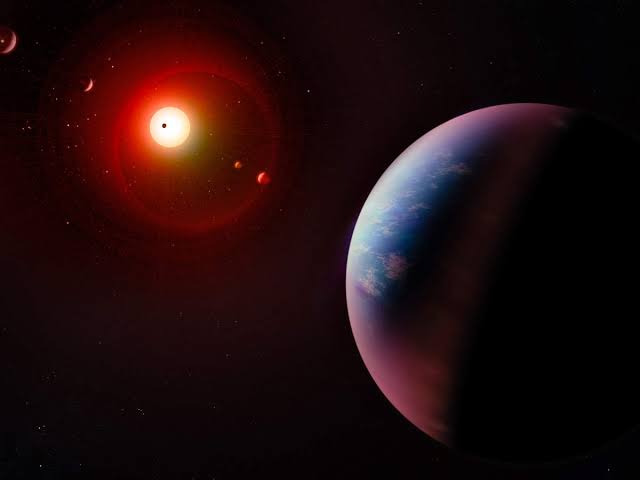
Not so fast,Earthling ! Outer space is a big place, and one thing scientists have learnt from studying life on Earth is that organisms can thrive in all sorts of harsh environments. Meanwhile, astronomers have discovered nearly 4,000 Earth like planets beyond our solar system and are spotting more everyday. Some of these ” exoplanets ” orbit their stars in the “Goldilocks zone”, a distance that neither too hot nor too cold to support liquid water and possibly alien life. Who knows? Maybe an alien kid somewhere up there is wondering if you exist.
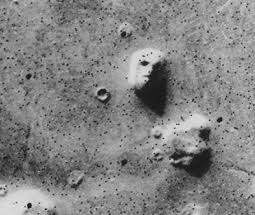
Why does Mars have a face on it?
When the Viking I aur picture pictures of Mars in 1976, one photo became a hit for its apparent portrayal of a mountainous Martian face resembling An Egyptian Pharaoh. Eager to set the record straight on this crowd- pleasing Mars anomaly, NASA used a satellite to re photograph the region in 1998 and 2001. The high resolution images revealed a natural geological feature rather than a monument to Martiankind.
How many exoplanets might support life?
After analysing the known exoplanets and comparing that data with what they know about the Milky Way, astronomers at Cornell University predict that as many as 100 million worlds in our galaxy could support complex life.
So why we haven’t met aliens yet?
Because space is big. The galaxy might be teeming with life, but the gulfs between stars make visiting our neighbours an impossible mission – at least for now. Remember, it would take thousands of years to travel to the closest star outside our solar system using modern spaceship technology.
What about the possibility of life closer to home?
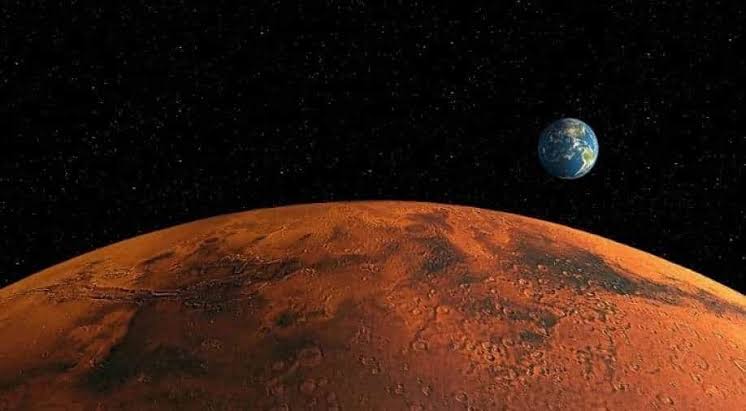
Where? Like in London? Ah, you mean in our solar system! Mars was once considered a top candidate for alien life,but so far we haven’t found any Martians. ( Anything that lived on the red planet is most likely long dead). Astronomers seeking signs of life are now turning their attention to the solar system’s moons instead of its planets.
Why did people once think Martians lived on Mars?
Astronomers peering at mass in the 17th,18th, and 19th centuries saw signs of life everywhere. Seas ! Continents ! Canals that carried water to Martian farms ! But modern telescopes, probes, and NASA landers ruined the fun by revealing our planetary neighbor’s dry details:It’s just a lifeless ball of red rock. Early astronomers had confused Mars’s ancient seas and riverbeds for signs of civilisation.
Which of the solar system’s moons might have life?
The Frozen surface of jupiter’s moon Europa hides a liquid Ocean that might contain alien creatures. Enceladus, one of Saturn’s many moons, has a sea the size of Lake Superior under its icy surface. And Titan, Saturn’s largest moon, has vast lakes of liquid methane. If life existed here, it would be truly alien.
How are astronomers searching for alien life?
BY DIGGING: Robotic rovers are sampling Martian soils for science of ancient life.
BY VISITING: Probes are being dispatched to spots across the solar system that might harbor life today.
BY LOOKING: NASA’S Earth- and space -based telescopes have been scanning galaxy for earth like exoplanets outside our solar system capable of supporting life.
BY LISTENING: In 1960, scientists began scanning the universe with special telescope for radio signals from alien civilizations. The project is called SETI, for the Search for Extraterrestrial Intelligence. It hasn’t picked up any alien broadcast yet, but we haven’t stopped listening.
Why is the U.S government hiding evidence of alien life?
Ah, you must be thinking of the “Rosewell incident”, in which an unidentified craft crashed near the small town of Roswell, New Mexico, U.S.A., in 1947. Conspiracy theorist claim the craft was a flying saucer and that the U.S military whisked away the wreckage along with the bodies of its alien pilots. The U.S government released a report on Rosewell in the mid -1990s claiming the debris was actually a crashed balloon in its top-secret “Project Mogul,” which used high-altitude sensors to monitor for enemy nuclear-missile tests. “Likely story,” claim the conspiracy theorists.
China’s driven plans with respect to its missions to the Moon are not unused. In January 2019, China had as of now earned the refinement of being the primary nation to arrive a test on the distant side of the Moon, that’s the area of the characteristic adherent that faces absent from the Soil. Presently, after two a long time, it shows up that China is prepared to broaden its skyline when it comes to Moon travel and is taking dynamic steps to empower kept an eye on landing on the Moon. A brief news report distributed by the Xiamen College School of Flight and Astronautics on July 1 has pointed at the nation pointing to create a “human landing framework for lunar missions.
The report (by means of Space News) alludes to the lunar landing extend as a “national strategy” and has too named striking people heading the different united ventures. The initial news report was distributed within the scenery of an scholarly visit by the concerned parties. Several individuals at China Foundation of Space Innovation (CAST) — a wing of the state-owned space and defense temporary worker China Aviation Science and Innovation — are working on a modern dispatch vehicle for people, that’s one of the key and as of now lost compliments in China’s Moon mission plans.
As per the report, the assembly did not uncover what plans were in store for the advancement of the lander, but “current advance and future plans for human moon landings” were talked about. Whereas the nation has had a history of creating and testing dispatch vehicles, considering it a “national strategy” recommends the significance that’s being connected to the project. Earlier this year, in Walk, China had moreover reported that they were working on two variations of super-heavy dispatch vehicles that are appropriate for lunar ventures. Inside the following five a long time, the China Foundation of Dispatch Vehicle Innovation (CALT) said that it would create a modern era group dispatch vehicle as well as a overwhelming dispatch vehicle. China’s 14th Five-Year Arrange for 2021-2025, that was endorsed in Walk, did not highlight a particular kept an eye on lunar landing extend.
The space rock that wiped out dinosaurs hit the Soil close Mexico. Named Chicxulub impactor, the huge rough question had an assessed width of generally 6 miles (10km). It delivered a hole that covers an zone of around 90 miles (145km) and the affect is credited with not fair the termination of dinosaurs, but moreover around 75 percent of add up to creature species at the time.
This mass termination occasion happened 66 million a long time back and has come to be broadly acknowledged as the conclusion of the Mesozoic time. Presently, analysts have figured out where the pillaging space rock originated. Using computer models, analysts considered 130,000 demonstrate space rocks to conclude that this one circled the Sun with others within the fundamental space rock belt some time recently slamming into Earth. Researchers at the Texas-based Southwest Inquire about Founded (SwRI) said the impactor likely came from the outer half of the most space rock belt. The space rock belt is between Defaces and Jupiter.
The analysts moreover say that the forms that convey expansive space rocks to Soil from that locale happen at slightest 10 times more as often as possible than already thought. The SwRI group, counting lead analyst Dr. David Nesvorný and colleagues Dr. William Bottke and Dr. Simone Marchi, said a few considers have been conducted over the past decade on the mass termination that finished the rule of dinosaurs but each of them has driven to modern questions. Two basic questions remained unanswered, Bottke said. One of them was almost the source of the impactor and the other one almost the recurrence of these Earth-crashing occasions. So, the analysts begun with knowing more almost the space rock, that driven them to recognize the Chicxulub impactor as carbonaceous chondrite. Numerous objects encompassing Soil share comparative compositions to the impactor but these are much littler in measure. “We chosen to hunt for where the kin of the Chicxulub impactor could be hiding,” said Nesvorný.
The analysts at that point utilized NASA’s Pleaides Supercomputer. To their shock, they found that 6-mile-wide space rocks from the external half of the space rock belt strike the Soil at slightest 10 times more as often as possible than already found.
Blue origin, the space company claimed by Jeff Bezos, is suing the US government over its choice to grant a enormous Moon investigation contract to its competitor SpaceX, it said in a articulation Monday.The company has recorded a suit with the US Court of Government Claims “in an endeavor to cure the blemishes” in how the contract was granted, agreeing to the statement.The human landing framework (HLS) contract, worth $2.9 billion (generally Rs. 21,540 crores), was given to SpaceX, possessed by Bezos’ very rich person equal Elon Musk, in April
It was dissented by the other bidders, who contended NASA was required to form different grants which the assessment prepare was unfair. “We immovably accept that the issues recognized in this obtainment and its results must be tended to to reestablish decency, make competition, and guarantee a secure return to the Moon for America,” Blue Beginning said.Since losing the contract, Blue Root has unequivocally campaigned to have the choice turned around. It recorded a dissent with the Government Responsibility Office, but in July the guard dog maintained NASA’s choice
NASA said in a explanation Monday that it was informed of Blue Origin’s claim and it is investigating the case. “With our accomplices, we’ll go to the Moon and remain to empower science examinations, create unused innovation, and make tall paying occupations for the more noteworthy great and in arrangement to send space travelers to Damages,” the explanation said. Under the Artemis program, NASA is arranging to return people to the Moon within the center of this decade and construct a lunar orbital station, some time recently a manned mission is sent to Defaces within the 2030s. Musk’s company, established in 2002, is right now NASA’s driving private segment accomplice.
A black hole is a region of spacetime where gravity is so strong that nothing—no particles or even electromagnetic radiation such as light—can escape from it. The theory of general relativity predicts that a sufficiently compact mass can deform spacetime to form a black hole. The boundary of no escape is called the event horizon. Although it has an enormous effect on the fate and circumstances of an object crossing it, according to general relativity it has no locally detectable features. In many ways, a black hole acts like an ideal black body, as it reflects no light. Moreover, quantum field theory in curved spacetime predicts that event horizons emit Hawking radiation, with the same spectrum as a black body of a temperature inversely proportional to its mass. This temperature is on the order of billionths of a kelvin for black holes of stellar mass, making it essentially impossible to observe directly.
Objects whose gravitational fields are too strong for light to escape were first considered in the 18th century by John Michell and Pierre-Simon Laplace. The first modern solution of general relativity that would characterize a black hole was found by Karl Schwarzschild in 1916, and its interpretation as a region of space from which nothing can escape was first published by David Finkelstein in 1958. Black holes were long considered a mathematical curiosity; it was not until the 1960s that theoretical work showed they were a generic prediction of general relativity. The discovery of neutron stars by Jocelyn Bell Burnell in 1967 sparked interest in gravitationally collapsed compact objects as a possible astrophysical reality. The first black hole known as such was Cygnus X-1, identified by several researchers independently in 1971. Black holes of stellar mass form when very massive stars collapse at the end of their life cycle. After a black hole has formed, it can continue to grow by absorbing mass from its surroundings. By absorbing other stars and merging with other black holes, supermassive black holes of millions of solar masses may form. There is consensus that supermassive black holes exist in the centers of most galaxies.
The presence of a black hole can be inferred through its interaction with other matter and with electromagnetic radiation such as visible light. Matter that falls onto a black hole can form an external accretion disk heated by friction, forming quasars, some of the brightest objects in the universe. Stars passing too close to a supermassive black hole can be shred into streamers that shine very brightly before being “swallowed.” If there are other stars orbiting a black hole, their orbits can be used to determine the black hole’s mass and location. Such observations can be used to exclude possible alternatives such as neutron stars. In this way, astronomers have identified numerous stellar black hole candidates in binary systems, and established that the radio source known as Sagittarius A*, at the core of the Milky Way galaxy, contains a supermassive black hole of about 4.3 million solar masses.
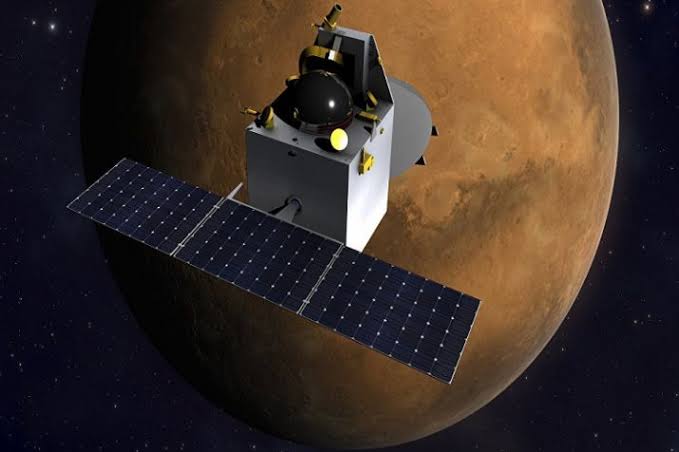
The Mars Orbiter Mission (MOM), also called Mangalyaan is a space probe orbiting Mars since 24 September 2014. It was launched on 5 November 2013 by the Indian Space Research Organisation (ISRO).It is India’s first interplanetary mission and it made it the fourth space agency to achieve Mars orbit, after Roscosmos, NASA, and the European Space Agency. It made India the first Asian nation to reach Martian orbit and the first nation in the world to do so on its maiden attempt.
Names Mangalyaan Mission type Mars orbiter Operator ISRO COSPAR ID 2013-060A SATCAT no. 39370 Website http://www.isro.gov.in/pslv-c25-mars-orbiter-mission Mission duration Planned: 6 months Elapsed: 6 years, 9 months, 19 days
Start of mission
Start of mission Launch date 5 November 2013, 09:08 UTC Rocket PSLV-XL C25 Launch site Satish Dhawan FLP Contractor ISRO
Timeline of Operations Phase Date Event Detail Result References Geocentric phase 5 November 2013 09:08 UTC Launch Burn time: 15:35 min in 5 stages Apogee: 23,550 km (14,630 mi) 6 November 2013 19:47 UTC Orbit raising manoeuvre Burn time: 416 sec Apogee: 28,825 km (17,911 mi) 7 November 2013 20:48 UTC Orbit raising manoeuvre Burn time: 570.6 sec Apogee: 40,186 km (24,970 mi) 8 November 2013 20:40 UTC Orbit raising manoeuvre Burn time: 707 sec Apogee: 71,636 km (44,513 mi) 10 November 2013 20:36 UTC Orbit raising manoeuvre Incomplete burn Apogee: 78,276 km (48,638 mi) 11 November 2013 23:33 UTC Orbit raising manoeuvre (supplementary) Burn time: 303.8 sec Apogee: 118,642 km (73,721 mi) 15 November 2013 19:57 UTC Orbit raising manoeuvre Burn time: 243.5 sec Apogee: 192,874 km (119,846 mi) 30 November 2013 19:19 UTC Trans-Mars injection Burn time: 1328.89 sec Heliocentric insertion Heliocentric phase December 2013 – September 2014 En route to Mars – The probe travelled a distance of 780,000,000 kilometres (480,000,000 mi) in a Hohmann transfer orbit around the Sun to reach Mars. This phase plan included up to four trajectory corrections if needed. 11 December 2013 01:00 UTC 1st Trajectory correction Burn time: 40.5 sec Success 9 April 2014 2nd Trajectory correction (planned) Not required Rescheduled for 11 June 2014 11 June 2014 11:00 UTC 2nd Trajectory correction Burn time: 16 sec Success August 2014 3rd Trajectory correction (planned) Not required 22 September 2014 3rd Trajectory correction Burn time: 4 sec Success Areocentric phase 24 September 2014 Mars orbit insertion
Recognition
In 2014, China referred to India’s successful Mars Orbiter Mission as the “Pride of Asia”. The Mars Orbiter Mission team won US-based National Space Society’s 2015 Space Pioneer Award in the science and engineering category. NSS said the award was given as the Indian agency successfully executed a Mars mission in its first attempt; and the spacecraft is in an elliptical orbit with a high apoapsis where, with its high resolution camera, it is taking full-disk colour imagery of Mars. Very few full disk images have ever been taken in the past, mostly on approach to the planet, as most imaging is done looking straight down in mapping mode.
The wormhole theory postulates that a theoretical passage through space-time could create shortcuts for long journeys across the universe. Wormholes are predicted by the theory of general relativity. But be wary: wormholes bring with them the dangers of sudden collapse, high radiation and dangerous contact with exotic matter.
Wormhole theory
Wormholes were first theorized in 1916, though that wasn’t what they were called at the time. While reviewing another physicist’s solution to the equations in Albert Einstein’s theory of general relativity, Austrian physicist Ludwig Flamm realized another solution was possible. He described a “white hole,” a theoretical time reversal of a black hole. Entrances to both black and white holes could be connected by a space-time conduit.
In 1935, Einstein and physicist Nathan Rosen used the theory of general relativity to elaborate on the idea, proposing the existence of “bridges” through space-time. These bridges connect two different points in space-time, theoretically creating a shortcut that could reduce travel time and distance. The shortcuts came to be called Einstein-Rosen bridges, or wormholes.
PLAY SOUND
“The whole thing is very hypothetical at this point,” said Stephen Hsu, a professor of theoretical physics at the University of Oregon, told our sister site, LiveScience. “No one thinks we’re going to find a wormhole anytime soon.”
Wormholes contain two mouths, with a throat connecting the two. The mouths would most likely be spheroidal. The throat might be a straight stretch, but it could also wind around, taking a longer path than a more conventional route might require.
Einstein’s theory of general relativity mathematically predicts the existence of wormholes, but none have been discovered to date. A negative mass wormhole might be spotted by the way its gravity affects light that passes by.
Certain solutions of general relativity allow for the existence of wormholes where the mouth of each is a black hole. However, a naturally occurring black hole, formed by the collapse of a dying star, does not by itself create a wormhole.
Through the wormhole
Science fiction is filled with tales of traveling through wormholes. But the reality of such travel is more complicated, and not just because we’ve yet to spot one.
The first problem is size. Primordial wormholes are predicted to exist on microscopic levels, about 10–33 centimeters. However, as the universe expands, it is possible that some may have been stretched to larger sizes.
Another problem comes from stability. The predicted Einstein-Rosen wormholes would be useless for travel because they collapse quickly.
“You would need some very exotic type of matter in order to stabilize a wormhole,” said Hsu, “and it’s not clear whether such matter exists in the universe.”
But more recent research found that a wormhole containing “exotic” matter could stay open and unchanging for longer periods of time.
Exotic matter, which should not be confused with dark matter or antimatter, contains negative energy density and a large negative pressure. Such matter has only been seen in the behavior of certain vacuum states as part of quantum field theory.
“A wormhole is not really a means of going back in time, it’s a short cut, so that something that was far away is much closer,” NASA’s Eric Christian wrote.
Although adding exotic matter to a wormhole might stabilize it to the point that human passengers could travel safely through it, there is still the possibility that the addition of “regular” matter would be sufficient to destabilize the portal.
Today’s technology is insufficient to enlarge or stabilize wormholes, even if they could be found. However, scientists continue to explore the concept as a method of space travel with the hope that technology will eventually be able to utilize them.
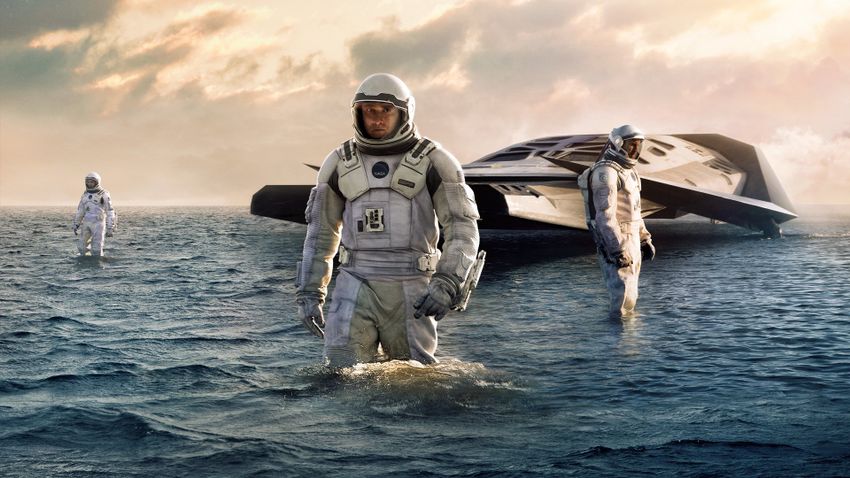
In Interstellar, the final frontier is not outer space but the fifth dimension, which exists beyond the three dimensions of space and the time dimension of relativity. This is not surprising: director Christopher Nolan conducted ambitious experiments with space and time in his prior films Memento and Inception. Here he returns to the set with a hypothesis that rests somewhat uneasily on both the hardheaded persistence of science and the earnest vulnerability of the human condition. For instance, it is noteworthy that Kip Thorne, a theoretical physicist who specializes in gravitational physics, served as a consultant and executive producer. Yet, Interstellar is a movie where “love” is uttered in the same breath as explanations for Einstein’s theory of relativity, and the formula to break the space-time continuum can be found in a child’s bedroom. What Nolan conveys is that the problem, the drive that pushes mankind to explore space is connected—inseparable, even—to the spaces of interiority we inhabit as individuals, and the solution lies beyond the perceptions cast in three dimensions.
What distinguishes Interstellar from his prior work is the way that Nolan tackles the consequences of the very same pleasure found in the technological offerings in his other films like The Dark Knight trilogy and The Prestige. Accordingly, his latest movie builds off these premises: that humans have exhausted all resources within 3D Earth, technology has accelerated its obliteration, and time is pushing the planet forward to ruin. The Atlantic’s Noah Gittell writes that when it comes to addressing the effects that technological fallout may have on the environment, “Hollywood has yet to adequately address [it]… When faced with unpleasant [End Page 92] realities, we all prefer a fantasy.”1 This is a movie that explores ways to escape Earth, and the protagonist Cooper (Matthew McConaughey), is charged with carrying out an undercover NASA mission to find a suitable planetary replacement. Cooper agrees to the mission after discovering NASA’s underground headquarters and meeting its de facto head Brand (Michael Caine), who spells dire consequences for Earth. This imperative pushes mankind out of the dust and out into the stars.
In the world of Interstellar, if man is contesting his place under the sun, then where does technology fall? Computers no longer serve as totemic objects; rather, they appear in a home-worn ubiquitous way, much in the same vein as Her, Gravity, and other recent sci-fi films. In Interstellar, technology is no longer representational—it does not appear as glitzy gadgetry that typically serve as plot gimmicks nor as the focus of cyborgian suspicion like with Ridley Scott’s David in Prometheus or Spike Jonze’s Samantha in Her. The film’s droids come in the form of TARS and CASE, and the former, voiced with deadpan humor by Bill Irwin, portrays none of the tension that arises from artificial sentience the way that his predecessors do. In fact, most of the technology looks worn: the ship is called the Endurance and the images of the team’s take-off look like they were pulled from footage of Cold War era space missions. Man’s greatest endeavors are meant to look fragile. At a moment of grave miscalculation, Cooper rages at Brand, the professor’s daughter and a scientist of her own right (Anne Hathaway): “We’re not prepared for this.” Movie critic A.O. Scott observes, “The Nolans cleverly conflate scientific denialism with technophobia, imagining a fatalistic society that has traded large ambition for small-scale problem solving and ultimate resignation.”2 The movie occupies half of its screen time in dust-baked American farmland. By juxtaposing scenery evocative of the 1930s Dustbowl with televised memorials of elderly Americans recounting the blight with an innocuous black laptop on a kitchen table collecting dust, the film subtly jolts viewers back to the movie’s futuristic premise.
When scientists talk about the expanding universe, they mean that it has been growing ever since its beginning with the Big Bang.
The galaxies outside of our own are moving away from us, and the ones that are farthest away are moving the fastest. This means that no matter what galaxy you happen to be in, all the other galaxies are moving away from you.
However, the galaxies are not moving through space, they are moving in space, because space is also moving. In other words, the universe has no center; everything is moving away from everything else. If you imagine a grid of space with a galaxy every million light years or so, after enough time passes this grid will stretch out so that the galaxies are spread to every two million light years, and so on, possibly into infinity.
The universe encompasses everything in existence, from the smallest atom to the largest galaxy; since forming some 13.7 billion years ago in the Big Bang, it has been expanding and may be infinite in its scope. The part of the universe of which we have knowledge is called the observable universe, the region around Earth from which light has had time to reach us.
One famous analogy to explain the expanding universe is imagining the universe like a loaf of raisin bread dough. As the bread rises and expands, the raisins move farther away from each other, but they are still stuck in the dough. In the case of the universe, there may be raisins out there that we can’t see any more because they have moved away so fast that their light has never reached Earth. Fortunately, gravity is in control of things at the local level and keeps our raisins together.
Who Figured This Out?
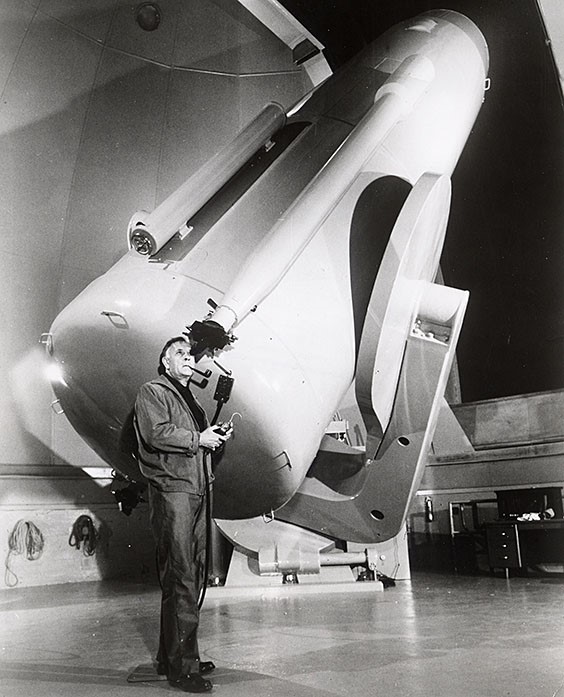
The American astronomer Edwin Hubble made the observations in 1925, proving that there is a direct relationship between the speeds of distant galaxies and their distances from Earth. The observation that galaxies are moving away from the Earth at speeds proportional to their distance has traditionally been known as Hubble’s Law, although it should be noted that, in 2018, the International Astronomical Union (IAU) voted to recommend amending the name to the Hubble–Lemaître law, in recognition of the contributions of both Hubble and the Belgian astronomer Georges Lemaître to the development of modern cosmology.
The Hubble Space Telescope was named after Edwin Hubble, and the single number that describes the rate of the cosmic expansion, relating the apparent recession velocities of external galaxies to their distance, is called the Hubble Constant.
Is the Universe Infinite?
It might be easier to explain about the beginning of the universe and the Big Bang Theory, than to talk about how it will end. It is possible that the universe will last forever, or it may be crushed out of existence in a reverse of the Big Bang scenario, but that would be so far in the future that it might as well be infinite. Until recently, cosmologists (the scientists who study the universe) assumed that the rate of the universe’s expansion was slowing because of the effects of gravity. However, current research indicates that the universe may expand to eternity. But research continues and new studies of supernovae in remote galaxies and a force called dark energy may modify the possible fates of the universe.
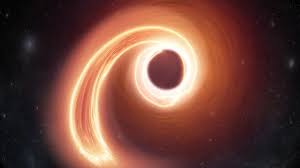
The awesome spectacle of a black hole ripping a star to shreds can be seen in this striking new visualization from the Deutsches Elektronen-Synchrotron (DESY), a particle accelerator lab in Hamburg, Germany.
Such events are known as stellar tidal disruptors, and they are fairly rare, occurring just once every 10,000 years in a typical galaxy, according to NASA. Stars are typically flung toward a ravenous black hole after interacting gravitationally with another star or massive object, only to become stretched and devoured should they come too close to the black hole’s maw in a process called spaghettification.
Gravitational tidal forces, similar to the ones that cause the moon to raise tides on Earth, are responsible for most of the destruction. At first, the star’s outer atmospheric layers will get pulled toward the black hole, spinning around its edge like water going down a drain and forming what’s known as an accretion disk, as the video depicts.
Surprisingly, the black hole only consumes about 1% of a star’s mass, according to NASA. The majority will actually get catapulted back out into space in the form of enormous jets of energy and matter that shoot from the black hole’s central region.
These jets can sometimes light up the cosmos, allowing astronomers on Earth to catch glimpses of distant black holes, which are otherwise mostly invisible. Tiny, ghostly particles called neutrinos will also be flung from the black hole, occasionally giving researchers insights into processes occurring during the consumption event.
Some of the star’s material does fall past the event horizon, the point after which nothing, including light, can escape. The visualization shows some of the strange optical effects that the event horizon produces, such as bending light so much that regions at the back of the accretion disk can be seen from its front.
Witnessing how swiftly the black hole dismembers and dispatches the star is an excellent reminder that no one should want to get anywhere near such a powerful object any time soon.
Chinese scientists are planning to fire more than 20 rockets into space to divert an asteroid impact that has a small chance of one day ending life on Earth.
Their target is an asteroid named Bennu, a 85.5-million-ton (77.5 million metric ton) space rock that is on track to swoop within 4.6 million miles (7.5 million kilometers) of Earth’s orbit between 2175 and 2199. Although Bennu’s chances of striking Earth are slim — at just 1 in 2,700 — the asteroid is as wide as the Empire State Building is tall, meaning that any collision with the Earth would be cataclysmic.
The estimated kinetic energy of Bennu’s impact with Earth is 1,200 megatons, which is roughly 80,000 times greater than the energy of the bomb dropped on Hiroshima. For comparison, the space rock that wiped out the dinosaurs delivered about 100 million megatons of energy.
Scientists at China’s National Space Science Center calculated that 23 Long March 5 rockets, each weighing 992 tons (900 metric tons), pushing against the rock simultaneously would be necessary to divert the asteroid away from a fatal course by nearly 6,000 miles (9,000 km) — 1.4 times the Earth’s radius. Their calculations are detailed in a new study published in the forthcoming Nov. 1 issue of the journal Icarus.
A mosaic image of the asteroid Bennu, taken by NASA’s OSIRIS-REX spacecraft. (Image credit: NASA/Goddard/University of Arizona)
“Asteroid impacts pose a major threat to all life on Earth,” Mingtao Li, space science engineer of the National Space Science Center in Beijing and lead author of the new study, wrote in the paper. “Deflecting an asteroid on an impact trajectory is critical to mitigating this threat.”
The Chinese scientists’ plan would sidestep the need to stop the asteroid by more direct, yet riskier, means — like the atomic bomb method popularized by Bruce Willis in the film “Armageddon.” In reality, nuking the incoming space rock would break it into multiple smaller chunks that could still collide with Earth, leading to devastating consequences.
The Chinese plan follows a similar, yet slightly more costly, past proposal made by the United States. The NASA plan, called Hypervelocity Asteroid Mitigation Mission for Emergency Response (HAMMER), would send a fleet of 30-foot-tall (9 meters) spacecraft with battering rams to bump the asteroid off course. NASA simulations suggest that 34-53 blows from HAMMER spacecraft, launched 10 years before Bennu collides with Earth, would be needed to shift the asteroid.
NASA and the ESA (European Space Agency) will be the first to test a novel asteroid nudging method in two joint missions launching November 24 of this year. The DART mission (Double Asteroid Redirection) will send a spacecraft to arrive a year later at the 7 million mile (11 million kilometer) distant Didymos asteroid system. Once there, the NASA spacecraft will slam into Didymos’s moonlet — a rock in orbit around the asteroid. The ESA’s mission, Hera, will then monitor how DART has budged the moonlet off-course.
Bennu is a B-type asteroid, which means that it contains high amounts of carbon and, potentially, many of the primordial molecules present when life emerged on Earth. NASA already sent a spacecraft, called Osiris-Rex, in pursuit of samples from the asteroid. Osiris-Rex arrived above Bennu in October 2020, floating above it for long enough to collect loose pieces from its surface with its 10-foot (3 m) arm. Osiris-Rex is expected to return to Earth with its spoils in 2023.
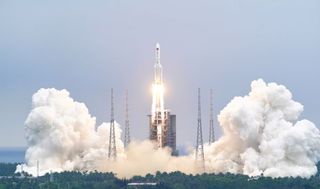
Long March 5 rockets are the workhorses of China’s space program, completing most of the deliveries to China’s space station and launching Chinese probes to Mars and the moon. The rockets have caused concern in the past due to their uncontrolled reentry to Earth. In May, the 22-ton (20 metric ton) section of a Long March 5 rocket fell to Earth, either burning up or landing in the sea near the Arabian peninsula. In May 2020, fragments from a previous March 5 rocket were believed to have crashed into two villages in the Ivory Coast.
Long March 5 rockets are the workhorses of China’s space program, completing most of the deliveries to China’s space station and launching Chinese probes to Mars and the moon. The rockets have caused concern in the past due to their uncontrolled reentry to Earth. In May, the 22-ton (20 metric ton) section of a Long March 5 rocket fell to Earth, either burning up or landing in the sea near the Arabian peninsula. In May 2020, fragments from a previous March 5 rocket were believed to have crashed into two villages in the Ivory Coast.
Astrophysics is a branch of space science that applies the laws of physics and chemistry to explain the birth, life and death of stars, planets, galaxies, nebulae and other objects in the universe. It has two sibling sciences, astronomy and cosmology, and the lines between them blur.
In the most rigid sense: Astronomy measures positions, luminosities, motions and other characteristics Astrophysics creates physical theories of small to medium-size structures in the universe Cosmology does this for the largest structures, and the universe as a whole.
In practice, the three professions form a tight-knit family. Ask for the position of a nebula or what kind of light it emits, and the astronomer might answer first. Ask what the nebula is made of and how it formed and the astrophysicist will pipe up. Ask how the data fit with the formation of the universe, and the cosmologist would probably jump in. But watch out — for any of these questions, two or three may start talking at once! Goals of astrophysics Astrophysicists seek to understand the universe and our place in it. At NASA, the goals of astrophysics are “to discover how the universe works, explore how it began and evolved, and search for life on planets around other stars,” according NASA’s website.
NASA states that those goals produce three broad questions:
How does the universe work?
How did we get here?
Are we alone?
It began with Newton
While astronomy is one of the oldest sciences, theoretical astrophysics began with Isaac Newton. Prior to Newton, astronomers described the motions of heavenly bodies using complex mathematical models without a physical basis. Newton showed that a single theory simultaneously explains the orbits of moons and planets in space and the trajectory of a cannonball on Earth. This added to the body of evidence for the (then) startling conclusion that the heavens and Earth are subject to the same physical laws.
Perhaps what most completely separated Newton’s model from previous ones is that it is predictive as well as descriptive. Based on aberrations in the orbit of Uranus, astronomers predicted the position of a new planet, which was then observed and named Neptune. Being predictive as well as descriptive is the sign of a mature science, and astrophysics is in this category.
Milestones in astrophysics
Because the only way we interact with distant objects is by observing the radiation they emit, much of astrophysics has to do with deducing theories that explain the mechanisms that produce this radiation, and provide ideas for how to extract the most information from it. The first ideas about the nature of stars emerged in the mid-19th century from the blossoming science of spectral analysis, which means observing the specific frequencies of light that particular substances absorb and emit when heated. Spectral analysis remains essential to the triumvirate of space sciences, both guiding and testing new theories.
Early spectroscopy provided the first evidence that stars contain substances also present on Earth. Spectroscopy revealed that some nebulae are purely gaseous, while some contain stars. This later helped cement the idea that some nebulae were not nebulae at all — they were other galaxies!
In the early 1920s, Cecilia Payne discovered, using spectroscopy, that stars are predominantly hydrogen (at least until their old age). The spectra of stars also allowed astrophysicists to determine the speed at which they move toward or away from Earth. Just like the sound a vehicle emits is different moving toward us or away from us, because of the Doppler shift, the spectra of stars will change in the same way. In the 1930s, by combining the Doppler shift and Einstein’s theory of general relativity, Edwin Hubble provided solid evidence that the universe is expanding. This is also predicted by Einstein’s theory, and together form the basis of the Big Bang Theory.
Also in the mid-19th century, the physicists Lord Kelvin (William Thomson) and Gustav Von Helmholtz speculated that gravitational collapse could power the sun, but eventually realized that energy produced this way would only last 100,000 years. Fifty years later, Einstein’s famous E=mc2 equation gave astrophysicists the first clue to what the true source of energy might be (although it turns out that gravitational collapse does play an important role). As nuclear physics, quantum mechanics and particle physics grew in the first half of the 20th century, it became possible to formulate theories for how nuclear fusion could power stars. These theories describe how stars form, live and die, and successfully explain the observed distribution of types of stars, their spectra, luminosities, ages and other features.
Astrophysics is the physics of stars and other distant bodies in the universe, but it also hits close to home. According to the Big Bang Theory, the first stars were almost entirely hydrogen. The nuclear fusion process that energizes them smashes together hydrogen atoms to form the heavier element helium. In 1957, the husband-and-wife astronomer team of Geoffrey and Margaret Burbidge, along with physicists William Alfred Fowler and Fred Hoyle, showed how, as stars age, they produce heavier and heavier elements, which they pass on to later generations of stars in ever-greater quantities. It is only in the final stages of the lives of more recent stars that the elements making up the Earth, such as iron (32.1 percent), oxygen (30.1 percent), silicon (15.1 percent), are produced. Another of these elements is carbon, which together with oxygen, make up the bulk of the mass of all living things, including us. Thus, astrophysics tells us that, while we are not all stars, we are all stardust.
Astrophysics as a career
Advertisement
Becoming an astrophysicist requires years of observation, training and work. But you can start becoming involved in a small way even in elementary and high school, by joining astronomy clubs, attending local astronomy events, taking free online courses in astronomy and astrophysics, and keeping up with news in the field on a website such as Space.com.
In college, students should aim to (eventually) complete a doctorate in astrophysics, and then take on a post-doctoral position in astrophysics. Astrophysicists can work for the government, university labs and, occasionally, private organizations.
Take math and science classes all through high school. Make sure to take a wide variety of science classes. Astronomy and astrophysics often blend elements of biology, chemistry and other sciences to better understand phenomena in the universe. Also keep an eye out for any summer jobs or internships in math or science. Even volunteer work can help bolster your resume.
Pursue a math- or science-related bachelor’s degree. While a bachelor in astrophysics is the ideal, there are many other paths to that field. You can do undergraduate study in computer science, for example, which is important to help you analyze data. It’s best to speak to your high school guidance counselor or local university to find out what degree programs will help you.
Take on research opportunities. Many universities have labs in which students participate in discoveries — and sometimes even get published. Agencies such as NASA also offer internships from time to time.
Finish a doctorate in astrophysics. A Ph.D. is a long haul, but the U.S. Bureau of Labor Statistics points out that most astrophysicists do have a doctoral degree. Make sure to include courses in astronomy, computer science, mathematics, physics and statistics to have a wide base of knowledge.
Natalie Hinkel, a planetary astrophysicist who was then at Arizona State University, gave a lengthy interview with Lifehacker in 2015 that provided a glimpse into the rewards and challenges of being a junior astrophysics researcher. She described the long number of years she has put into doing her research, the frequent job switches, her work hours and what it’s like to be a woman in a competitive field. She also had an interesting insight about what she actually did day to day. Very little of her time is spent at the telescope.
“I spend the vast majority of my time programming. Most people assume that astronomers spend all of their time at telescopes, but that’s only a very small fraction of the job, if at all. I do some observations, but in the past few years I’ve only been observing twice for a total of about two weeks,” Hinkel told Lifehacker.
“Once you get the data, you have to reduce it (i.e. take out the bad parts and process it for real information), usually combine it with other data in order to see the whole picture, and then write a paper about your findings. Since each observation run typically yields data from multiple stars, you don’t need to spend all of your time at the telescope to have enough work.”
ELON MUSK, the famous and most successful person in the tech world, who played many roles and faced many struggles to become what he is today. Elon Musk was born and raised in South Africa.
We all know him as an entrepreneur, businessman, CEO of Tesla and spacex, but he is also a skilled investor, software developer, designer, inventor, rocket scientist, actor, film producer, one of the richest man in the world.
During his school days, he was a victim of severe bullying. At the age of 12, he created a video game(blaster) and sold it to a computer magazine. Elon Musk is the founder of X.com (later it became paypal), spacex, Tesla motors.
Recently Elon Musk turned 50, over the past decades Musk managed to become CEO of Tesla and spacex, founder of the boring company, co-founder of OpenAI, Neuralink. He also played a vital role in space rockets, electric cars, solar batteries.
“”Failure is a option here, if things are not failing then you are not innovative enough.””. – Elon Musk
“” I think it’s possible for ordinary people to choose to be extraordinary.”” –Elon Musk
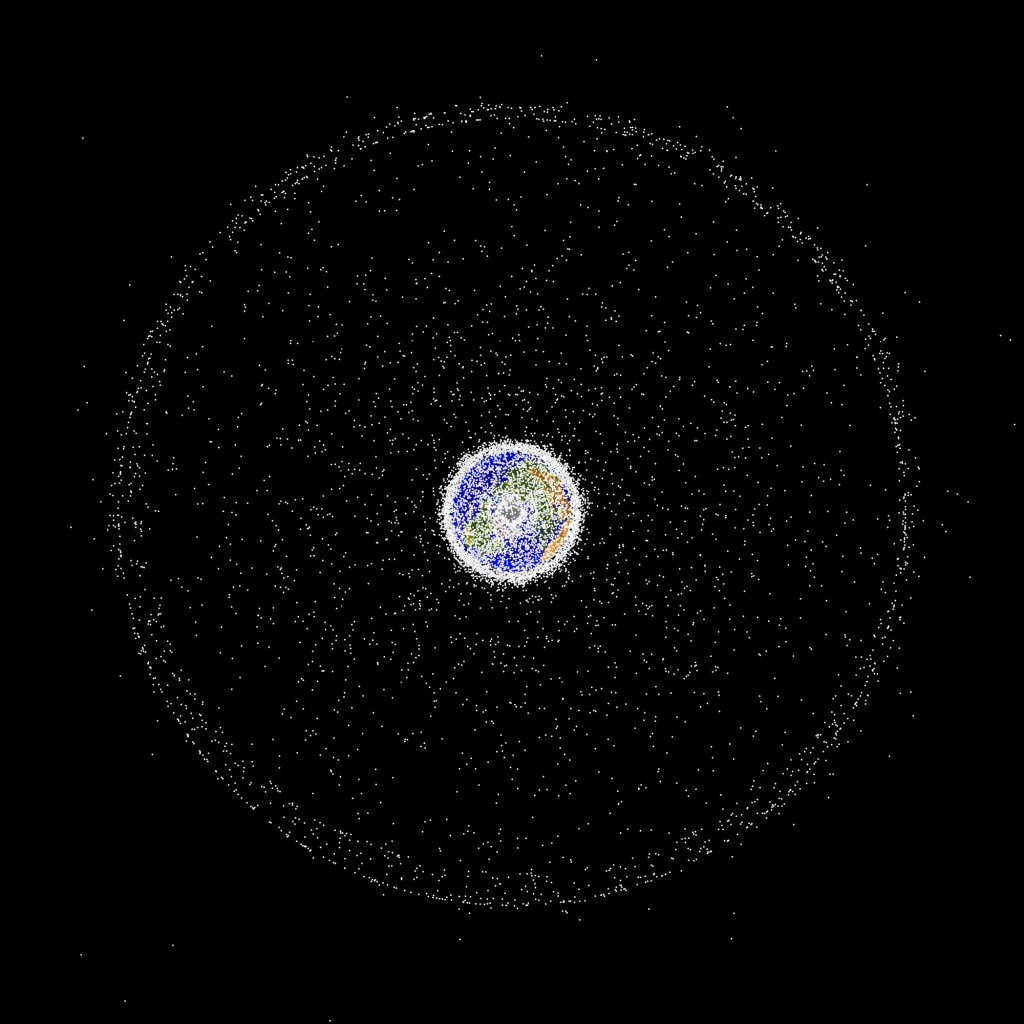
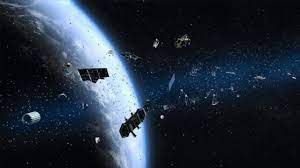
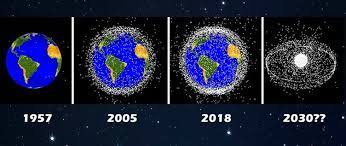
Space debris is the combination of natural(meteoroid) and artificial(man-made) particles. Natural debris orbits around the sun and artificial debris orbits around the earth. Hence they are called Orbital Debris. This can be any man-made object in the orbit moving in the earth’s orbit. Such debris includes nonfunctional spacecraft, abandoned launch vehicle stages, mission-related debris, and fragmentation debris.
In this article, we are going to focus on Artificial Debris, the Reason for its cause, and its prevention.
Space debris
What is Artificial space debris?
Any non-functional man-made object in space is called Artificial debris.
They come from
Satellites and spacecraft which are failed.
Satellites whose life has ended.
Rocket dismantle stages during the launch.
Hardware like nuts, bolts, payload covers, etc.
Solid propellant slag.
Cast aways during space activities like human wastes.
Fragments due to battery explosions, collisions, etc.
When two satellites collide they produce thousands of particles that are dangerous and can cause further destruction which makes Earth’s orbit unfit for satellite launches.
Artificial means man-made satellites
The number of satellite and rocket launches as of April 2021 is given below:
Number of rockets launched(excluding failures) since 1957
5560
Number of satellites carried by rockets launched
11139
Number of satellites still in space
7389
Number of satellites still functioning
3170
Let’s have a look at the number of satellites launched only in 2020 and 2021(April)
Satellites launched in 2020
1283
Satellites launched in 2021 (April)
853(65% of 2020)
History
In the year 2009, 19,000 debris over 5 cm in size were tracked.
In July 2013, more than 170 million debris smaller than 1 cm(0.4), around 670,000 debris of 1 to 10 cm in size, and approximately 29,000 larger debris were detected.
By July 2016, nearly 18,000 artificial debris were orbiting the earth.
In October 2019, nearly 20,000 artificial objects including 2,218 were tracked.
The speed with which the debris travel is more than 28,000 kph(23 times the speed of sound).
Have you heard of Kessler syndrome?
NASA scientist Donald Kessler in 1978, proposed that more launches could increase the junk around the earth which results in the chain reaction of collision of objects in space and further making the earth’s orbit unfit for satellites.
This situation would be extreme, but some experts worry that a variant of this could be a problem one day, and precautionary steps should be taken to avoid the problem.
How do they track space debris?
The USA and Russia have set up tracking networks to monitor the orbital space object population. The European Union is also starting to develop its ways to track debris.
Powerful lasers are used to measure the distance of these objects, like radar or sonar. When a laser beam hits the debris and bounces back to Earth, ground crews can measure how long it takes to figure out where they are and where they are going it alerts the ground stations in case of collisions. But usually, laser technology is used to detect the movement of satellites and if the same technique is used to detect the debris then continuous monitoring should be there since debris are found randomly in space.
Detection of objects through laser technology
India’s status on tracking debris
NETRA(Network for space Objects, Tracking, and Analysis)
Till now, ISRO was dependent on NORAD(North America Aerospace Defense Command) data,
which is available in the public domain, to keep track of space debris and monitor our active and passive satellites. However, this global data is not accurate but NORAD keeps accurate data available for those who are members of its network. Therefore, ISRO cannot access the data.
But now, ISRO has decided to set up telescopes and radars in four corners of the country to get accurate data and avoid unwanted collisions of the satellites.
In September 2019, India launched the early warning system NETRA to secure satellites and other assets in space.
Can satellites be protected from space debris?
There are two ways in which the satellites and spacecraft can be protected:
Computer programs can search for possible collisions between large debris. This system is used in the International Space Station to detect. These operations are expensive and can disturb delicate experiments. Space tracking networks can only track objects more than 100 mm in size. Even a 10 mm object can cause big trouble this cannot be called 100% effective.
A debris shield can be designed to provide additional protection for a spacecraft. One way is to increase the thickness of the craft but that can increase the mass of the craft/satellite. Hence, a specially designed shield called the Wipple shield was used. It was made of two thin walls separated by some space. It was observed that this wall was more resistant to debris. The outer layer absorbs a lot of debris energy so that the inner wall is not punctured.
Protection of satellites through shields
Space debris Removal
Removing space junk, especially larger pieces before they fragment is not easy. The best way to do this is retarding the force and deorbiting the junk. When it drops in altitude less than 400 km above the earth it is burnt.
For years NASA, ESA, and other space agencies are studying debris removal technologies. Some of the ideas include the usage of nets to gather junk and robotic arm. Japanese are now developing a type of satellite that uses magnets to catch and destroy the debris. Last year, UK has successfully cast a net around a dummy satellite.
Clearspace one
Clearspace-1 will be the first space mission to remove debris from the Earth orbit, it was planned to launch in 2025. The technology demonstration satellite was first developed by the Swiss Federal Institute of Technology in Lausanne.
Clearspace one
Many countries are trying to invent new technologies to reduce the threat of debris. Russia invented a Self Destroying Satellite. Australian researchers are developing the Hunter-Killer satellite to neutralize space junk. Finland has developed a Wooden Satellite and planning to launch this year.
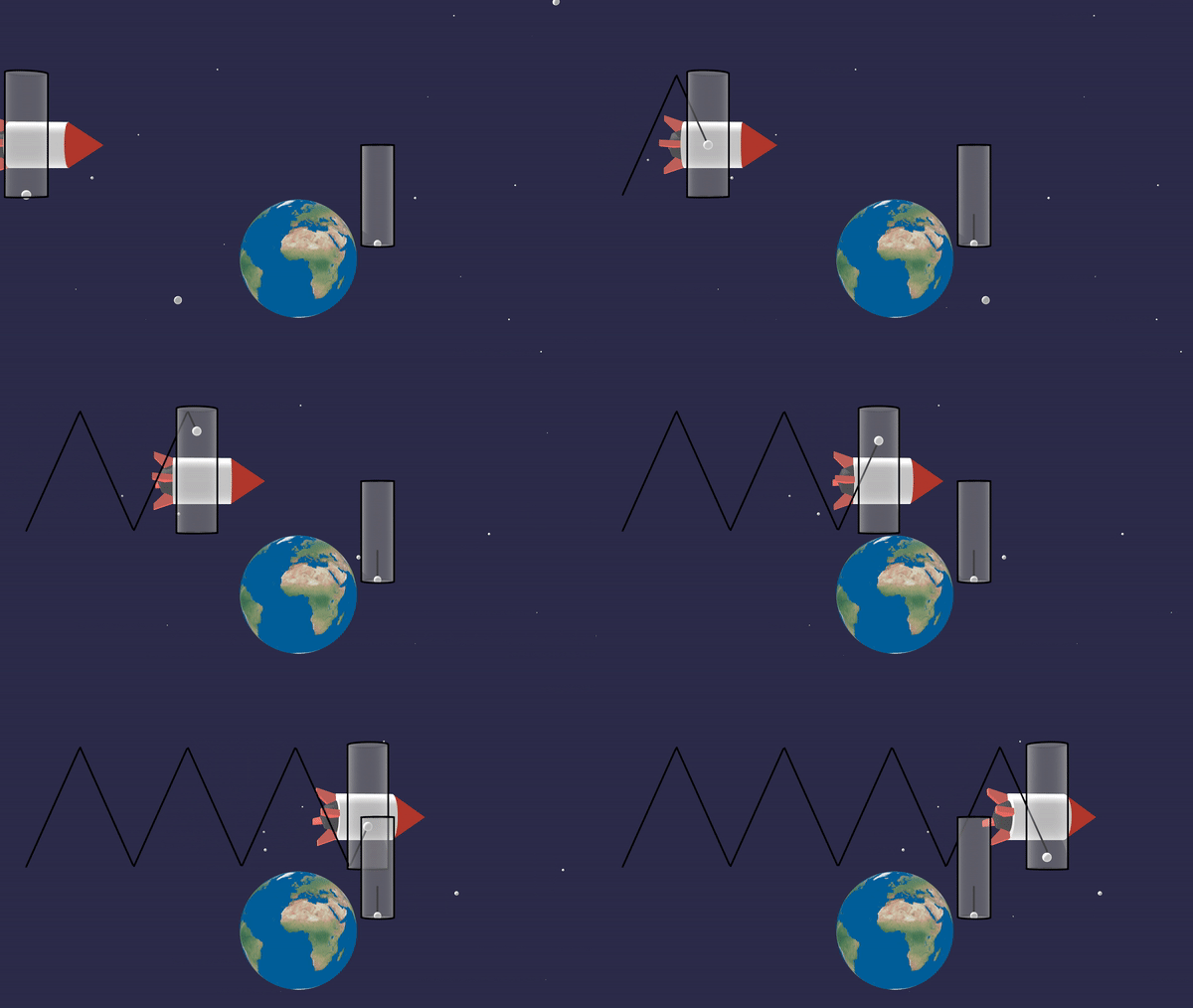
It turns out that as an object moves with relativistic speeds a “strange” thing seems to happen to its time as observed by “us” the stationary observer (observer in an inertial reference frame). What we see happen is that the “clock” in motion slows down according to our clock, therefore we read two different times. Which time is correct??? well they both are because time is not absolute but is relative, it depends on the reference frame. Let’s look at the following classic example. There is a set of twins, one an astronaut, the other works for mission control of NASA. The astronaut leaves on a deep space trip traveling at 95% the speed of light. Upon returning the astronauts clock has measured ten years, so yhe astronaut has aged 10 years. However, when the astronaut reunites with his earth bound twin, the astronauthe sees that the twin has aged 32 years! This is explained due to the fact that the astronaut’s twin is traveling at relativistic speeds and therefore his “clock” is slowed down.
Let’s see how we can calculate the time “difference”. The equation for calculating time dilation is as follows:
t = t0/(1-v2/c2)1/2
where: t = time observed in the other reference frame
t0 = time in observers own frame of reference (rest time)
v = the speed of the moving object
c = the speed of light in a vacuum
so in our problem we will let v = .95c, t0 = 10 years and we will solve for t which is the time that the earth bound brother measures.
t = 10/(1- (.95c)2/c2)1/2
t = 10/(1- .952)1/2
t = 10/ .312
t = 32 years (the time the earth bound brother measures)
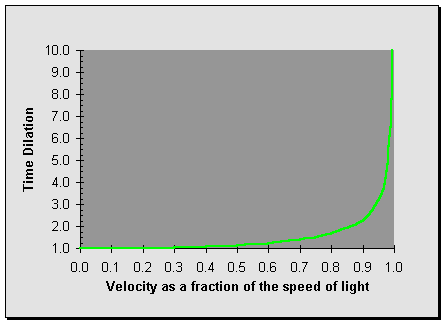
Now let’s have a closer look at the equation and determine just what impact the speed of the object has on time dilation. We can see that is the velocity is small compared to the speed of light the quantity v2/c2 approaches 0 and the equation simplifies t0: t = t0/1 which is simply t. So at relatively slow speeds (our everyday speeds) time dilation is not a factor and Newton’s Laws are still applicable. Now let’s look at high speeds (close to the speed of light), from the equation that as velocity increases the quantity v2/c2 approaches 1 (but will never quit reach it), causing the quantity(1-v2/c2)1/2 t0 become smaller and smaller….therefore causing the time measured by the other observer t0 become greater thus making our time appear slower (refer back to the example). I know its so confusing!!! read it again, think about it, then study the graph below. As one can see in the graph time dilation starts t0 “show up” between .4c and .5c. Also notice that the closer one gets to the speed of light the greater impact speed has on time dilation (notice how steep the curve gets towards the end)..













 Eduindex
You must be logged in to post a comment.