Top Universities in Karnataka

 Karnataka is home to some of India’s most prestigious universities, known for their academic excellence, research output, and innovative programs. Here are the top universities in Karnataka:

  1. Indian Institute of Science (IISc), Bangalore: One of India’s premier research institutions, renowned globally for its contributions to science, engineering, and research.

  2. National Institute of Technology Karnataka (NITK), Surathkal: A top engineering institute known for its strong academic programs and research in engineering, technology, and sciences.

  3. University of Mysore, Mysore: One of the oldest universities in India, offering a wide range of undergraduate, postgraduate, and doctoral programs in arts, sciences, commerce, and social sciences.

  4. Visvesvaraya Technological University (VTU), Belgaum: A leading technical university that affiliates engineering colleges across Karnataka and offers programs in engineering, technology, and management.

  5. Manipal Academy of Higher Education (MAHE), Manipal: A prominent private university known for its programs in medicine, engineering, management, and humanities, with a strong focus on research and international collaborations.

  6. Christ University, Bangalore: A well-regarded private university offering diverse programs in arts, science, commerce, law, and management, known for its holistic approach to education.

  7. Bangalore University, Bangalore: A major public university offering a wide range of programs in arts, science, commerce, law, and management, with a strong emphasis on research and community engagement.

  8. Jain University, Bangalore: A leading private university known for its programs in engineering, management, humanities, and sports, with a focus on entrepreneurship and innovation.

  9. Karnataka State Law University (KSLU), Hubli: A specialized university focused on legal education, offering undergraduate and postgraduate law programs.

  10. Jawaharlal Nehru Centre for Advanced Scientific Research (JNCASR), Bangalore: A multidisciplinary research institution known for its advanced research in science and engineering.

These universities are recognized for their academic rigor, research contributions, and strong industry connections, making them top choices for students in Karnataka and beyond.

Eduindex News: Global Education News from Campuses Worldwide

 Eduindex News (www.eduindex.org) is a prominent platform dedicated to bringing the latest updates and insights from educational institutions across the globe. As a reliable source of information, Eduindex News covers a wide array of topics that resonate with students, educators, researchers, and policymakers.

This platform offers in-depth coverage of campus news, including academic achievements, research breakthroughs, and educational events. Whether it’s the unveiling of new academic programs, collaborations between universities, or policy changes affecting education, Eduindex News ensures that readers stay informed about the latest trends and developments.

Eduindex News also highlights the voices of students and educators by featuring interviews, opinion pieces, and expert analyses. By providing a global perspective on education, the platform bridges the gap between institutions from different regions, fostering a better understanding of the diverse approaches to learning and teaching.

With a commitment to delivering accurate and timely news, Eduindex News has become a go-to resource for anyone interested in education-related topics. Its focus on global coverage ensures that readers can gain insights into the evolving landscape of education, making it an essential platform for staying connected with educational trends worldwide.

Atal Innovation Mission and World Intellectual Property Organization

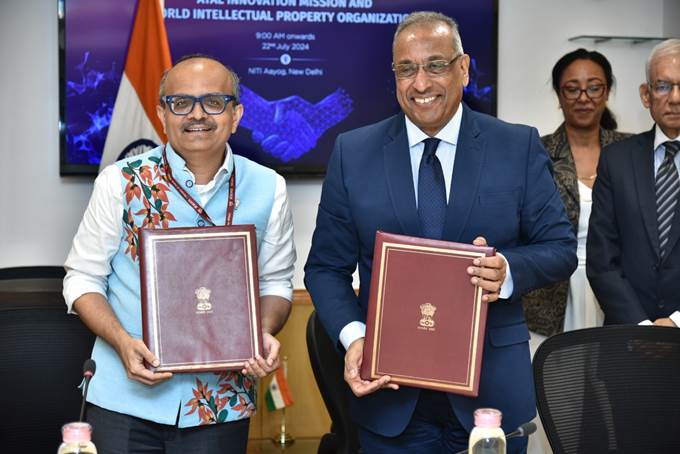
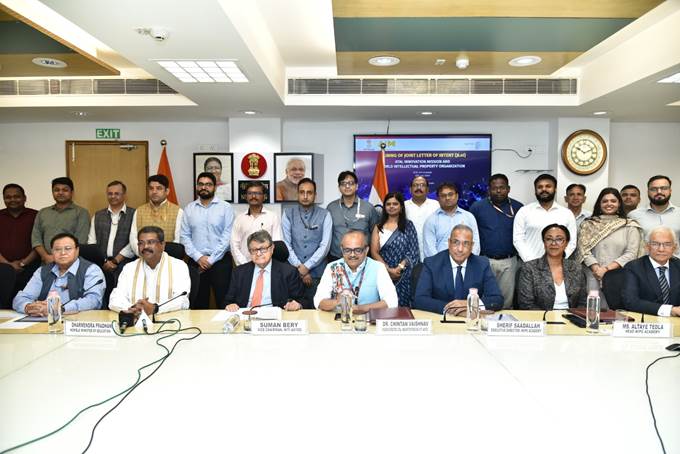
 A high-level delegation from World Intellectual Property Organization (WIPO) comprising of Mr. Sherif Saadallah, Executive Director, WIPO Academy and Ms. Altaye Tedla, Head WIPO Academy visited NITI Aayog for signing of a Joint Letter of Intent (JLoI) between Atal Innovation Mission (AIM) and WIPO. The JLoI is aimed at building programs for Innovation, Entrepreneurship & Intellectual Property (IP) for countries in the Global South.

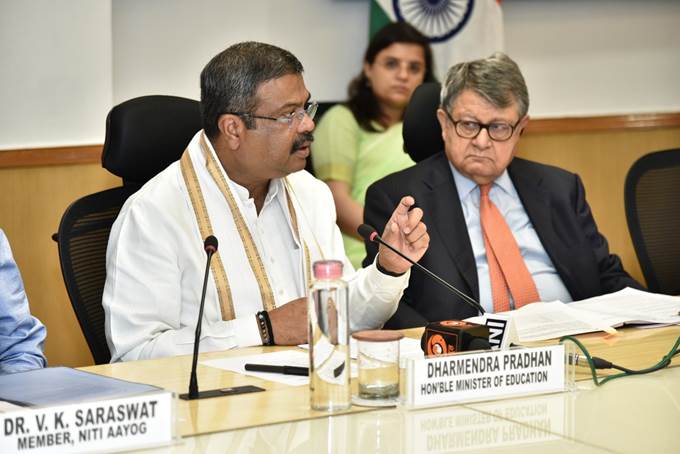
Shri Dharmendra Pradhan, Cabinet Minister for Education and Skill Development and Entrepreneurship in the Government of India graced the occasion with his presence. From NITI Aayog the dignitaries present included Shri Suman Bery, Vice Chairperson, NITI Aayog, Dr. V.K. Saraswat, Member NITI Aayog, and Dr. Chintan Vaishnav, Mission Director, Atal Innovation Mission.

Shri Dharmendra Pradhan Cabinet Minister for Education and Skill Development and Entrepreneurship, Government of India said “I am very pleased to see that India’s innovation ecosystem is going global. Innovation is India’s strength. This pathbreaking partnership between AIM and WIPO will take the best of India’s innovation models to countries that are on similar development trajectories, and will enhance understanding and awareness about IPR right from the school-level and unlock the innovation potential of the world as well as foster inclusive and sustainable economic growth.

Mr. Sherif Saadallah, Executive Director, WIPO Academy during his address said – “Intellectual property (IP) is a powerful catalyst for innovation and creativity, essential for addressing development of youth and achieving the Sustainable Development Goals. Our focus on youth is an integral part of our work to build a more inclusive global IP ecosystem, and our partnership with Atal Innovation Mission demonstrates WIPO’s commitment to ensure youth’s participation in innovation and creativity so that IP ecosystems are utilized by a wider demographic, fostering a more innovative and creative global economy.”

Last year, Mr. Daren Tang, Director General, WIPO had visited the AIM ecosystem and advocated for Atal Tinkering Labs (ATL) and Atal Incubation Centers (AIC) to be a good template for innovation and entrepreneurship through South-South cooperation. His observations prompted WIPO to invite Dr. Chintan Vaishnav, Mission Director AIM to showcase these flagship initiatives earlier this year in front of the member nations at the Committee on Development and Intellectual Property (CDIP) at the WIPO headquarters in Geneva, Switzerland. The agreement signed today has transpired from these conversations.

Speaking at the occasion, Shri Suman Bery Vice Chairperson, NITI Aayog said “WIPO’s recognition of India’s entrepreneurship development model is a proud moment for India and NITI Aayog which hosts the Mission. This deepens an already productive relationship between NITI Aayog and WIPO on national competitiveness”

As one of the specialized agency of the United Nations, WIPO is the nodal institution that releases the Global Innovation Index (GII) annually. As per the GII 2023 report, India had retained the 40th position of 132 economies featured in the GII ranking. As per WIPO Report 2022, India has experienced sixth straight year of growth in patent filing, posting the highest growth of 31.6% globally. Importantly, a substantial increase in resident filings was the main driver of growth overall in 2022.

Dr. V.K. Saraswat, Member NITI Aayog in his address underlined that, “In the last few years, India has made huge strides in its entrepreneurial journey in line with our international aspirations in this domain. This partnership between AIM and WIPO would help position India as a global leader in innovation, leveraging our vast talent pool and dynamic market to attract international investments. This partnership can be a game changer in fostering a culture of IP-led Innovation and hence safeguarding the future of our nation’s technological advancements.”

Sharing his thoughts on the importance of this JLoI, Dr. Chintan Vaishnav, Mission Director Atal Innovation Mission said, “It is our hope that the AIM-WIPO partnership will benefit many nations for whom models such as Atal Tinkering Labs and Atal Innovation Centres are needed to build their innovation ecosystems. The experience of the two sides coming together helps us make these models significantly more holistic as now Innovation & Entrepreneurship meets Intellectual Property (IP) in a serious way.”

The WIPO delegation is on a 4 day visit to India, and will take part in a workshop on Intellectual Property in Innovation organised at AIC GGSIPU, Dwarka, on 23rd July. The delegates will also interact with school students from Atal Tinkering Labs and Industry Experts from FICCI, NASSCOM, PHDCCI among others during their visit.

About Atal Innovation Mission:

Government initiatives to increase Hydrocarbon Production

 The government has been taking various steps to increase hydrocarbon production whichinter- alia include:

  1. Policy for Relaxations, Extensions and Clarifications under Production Sharing Contract (PSC) regime for early monetization of hydrocarbon discoveries, 2014.
  • ii. Discovered Small Field Policy, 2015.
  1. Hydrocarbon Exploration and Licensing Policy (HELP), 2016.
  2. Policy for Extension of Production Sharing Contracts, 2016 and 2017.
  3. Policy for early monetization of Coal Bed Methane 2017
  4. Setting up of National Data Repository, 2017. Further, the National Data Repository (NDR) is now being further upgraded to a cloud-based system for seamless dissemination of Exploration & Production data to global investors.
  5. Appraisal of Un-appraised areas in Sedimentary Basins under National Seismic Programme, 2017;
  6. Re-assessment of Hydrocarbon Resources, 2017.
  7. Policy framework to streamline the working of Production Sharing Contracts in Pre- NELP and NELP Blocks, 2018.
  8. Policy framework for extension of Production Sharing Contracts for Discovered Fields and Exploration Blocks under Pre-New Exploration Licensing Policy (Pre-NELP), 2016 and 2017.
  9. Policy to Promote and Incentivize Enhanced Recovery Methods for Oil and Gas, 2018.
  10. Policy framework for exploration and exploitation of Coal Bed Methane (CBM) from areas under Coal Mining Lease allotted to Coal India Limited (CIL) and its subsidiaries, 2018.
  11. Policy Framework for exploration and exploitation of Unconventional Hydrocarbons under Existing Production Sharing Contracts (PSCs), Coal Bed Methane (CBM) Contracts and Nomination Fields, 2018.
  12. Reforms in Hydrocarbon Exploration and Licensing Policy for enhancing domestic exploration and production of oil and gas, 2019.
  13. Natural Gas Marketing Reforms, 2020.
  14. Reforms in Model Revenue Sharing Contracts (RSCs) for Blocks under Open Acreage Licensing Programme (OALP), 2023.
  15. Lower Royalty Rates, Zero Revenue Share (till Windfall Gain) and no drilling commitment in Phase-I in OALP Blocks under Category II and III to attract bidders.
  16. Release of about 1 Million Sq. Km. ‘No-Go’ area in offshore which were blocked for exploration for decades. In these erstwhile ‘No-Go’ area, after the release now, so far bids/ expression of interests received for 1,52,325 Sq. Km. area.Two gas discoveries have also been made by ONGC in Mahanadi offshore recently in a block having 94% area in ‘No-Go’ area.  Andaman offshore area has also been opened for exploration and production activities after a long time post removal of restrictions imposed by defence and space agencies in 2022.
  17. Till now, 12 hydrocarbon discoveries have been made in blocks awarded under OALP, one already producing gas (0.44 MMSCMD) and condensate (819 BBL/Day) in Gujarat while other discoveries are under appraisal.
  18. Government is spending about Rs.7500 Cr. for acquisition of seismic data in onland and offshore areas and drilling of stratigraphic wells to make quality data of Indian Sedimentary Basins available to bidders.
  19. Government has also approved acquisition of additional 2D Seismic data of 20,000 LKM in onland and 30, 000 LKM in offshore beyond Exclusive Economic Zone (EEZ) of India.
  20. Production of Coal Bed Methane (CBM) has reached 2 Million Standard Cubic Meters per day and will increase further in coming years. More blocks are being identified for offer in future bid rounds.
  21. Cumulative production from Discovered Small Fields (DSF) till FY 2023-24 are ~5,56,000 bbl Oil and ~139 MMSCM Gas. More fields are being planned for offer in future rounds.

Various steps have been taken to reduce import of crude oil. These inter alia include demand substitution by promoting usage of natural gas as fuel/feedstock across the country towards increasing the share of natural gas in economy and moving towards gas based economy, promotion of renewable and alternate fuels like ethanol, second generation ethanol, compressed bio gas and biodiesel, refinery process improvements, promoting energy efficiency and conservation, efforts for increasing production of oil and natural gas through various policies initiatives, etc. To give a major thrust to Ethanol Blending Programme, Government of India through Oil Marketing Companies (OMCs) is establishing 2G Ethanol plants across the country.Also, for promoting the use of Compressed Bio Gas (CBG) as automotive fuel, Sustainable Alternative Towards Affordable Transportation (SATAT) initiative has been launched.

Health Sector in India

 A sound healthcare system interconnected with long-term factors responsible for inclusive growth is vital for a resilient economy, underscores the Economic Survey 2023-24 tabled by the Union Minister of Finance and Corporate Affairs Smt. Nirmala Sitharaman in Parliament today.

Aligned with the Government’s commitment to ensuring sound health and well-being of all ages through a preventive and promotive healthcare orientation in all developmental policies and universal access to good quality healthcare services, the Survey highlights key initiatives and schemes of the Government to ensure ‘Quality Healthcare for All’.

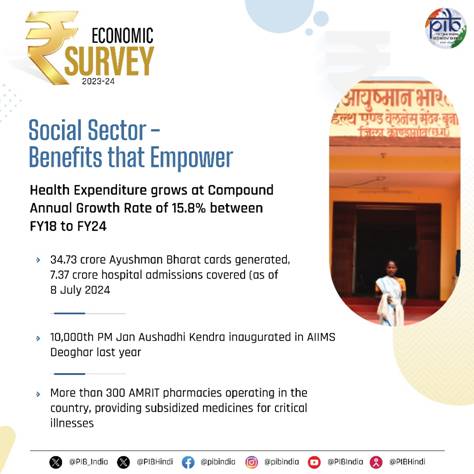
  • Ayushman Bharat Pradhan Mantri Jan Aarogya Yojana (AB-PMJAY):  Aimed at providing health insurance cover of ₹5 lakh/ year for underprivileged families for secondary and tertiary hospitalization, as of 8th July 2024, 34.73 crore Ayushman Bharat cards have been generated and 7.37 crore hospital admissions have been covered by the scheme. Notably, 49% of the beneficiaries of this scheme are women.
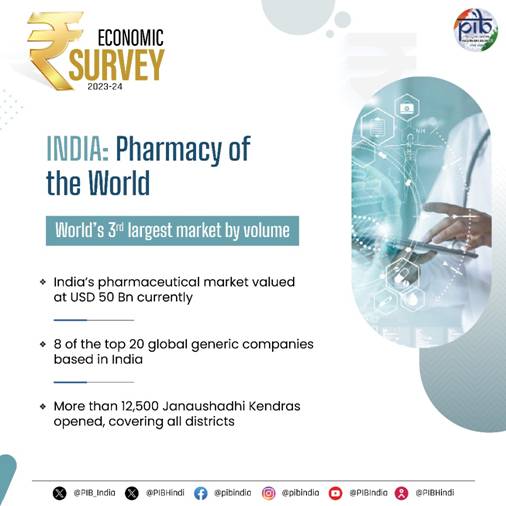
  • PM Jan Aushadhi Kendras: This scheme aims to provide quality medicines at 50-90 per cent cheaper than market rates. Under the scheme, 10,000th Jan Aushadhi Kendra was inaugurated in AIIMS Deoghar last year. 1965 medicines & 293 surgical equipments are available at the kendras.
  • AMRIT (Affordable Medicines and Reliable Implants for Treatment): More than 300 Amrit pharmacies are operating in different States/UTs. These aim to provide subsidized medicines for critical illnesses.
  • Ayushman Bhav Campaign: Launched in September 2023, this campaign aims to saturate selected healthcare services in every village/town across the country and inform citizens about the Government’s flagship schemes. Commendable milestones achieved during the campaign are:
    • 16.96 lakh wellness, yoga, and meditation sessions; 1.89 crore Tele consultations held
    • Free drugs availed by 11.64 crore people and free diagnostics services availed by 9.28 crore people
    • Ante-natal check-up (ANC) and Immunization availed by 82.10 lakh mothers and 90.15 lakh children
    • Seven types of screening (TB, Hypertension, diabetes, Oral Cancer, Breast Cancer, Cervical Cancer and Cataract) availed by 34.39 crore people.
    • 2.0 crore patients consulted general OPD, while 90.69 lakh patients consulted specialist OPD, and 65,094 major surgeries and 1,96,156 minor surgeries were conducted.
    • 13.48 crore ABHA accounts were created, 9.50 crore Ayushman cards were generated, and 1.20 lakh Ayushman Sabhas organized.
    • Cumulative footfall of 20.66 crore in 25.25 lakh health melas (as of 31 March 2024)


  • Ayushman Bharat Digital Mission (ABDM): Launched in 2021, the Scheme aims to create a national digital health ecosystem across the country. Under this scheme, 64.86 crore Ayushman Bharat Health Accounts (ABHA) have been created, 3.06 lakh Health Facility Registries generated, 4.06 lakh healthcare professionals registered, and 39.77 crore health records linked with ABHA.
  • eSanjeevani:  Launched in 2019, this scheme for telemedicine for virtual doctor consultations in remote areas has served 26.62 crore patients across 128 specialties at 1.25 lakh Health & Wellness Centres, now known as Ayushman Arogya Mandirs (as Spokes) through 15,857 hubs, as of 9th July 2024.

***

Expenditure on Social Services

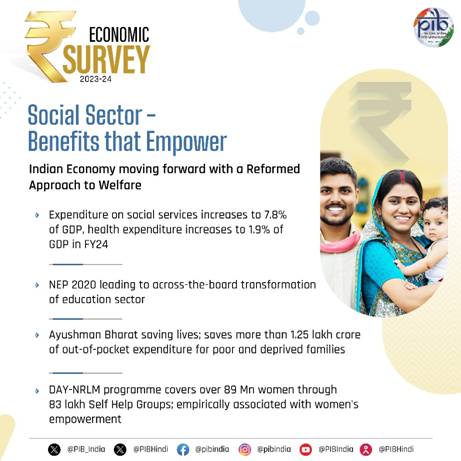
 India’s social and institutional progress in recent years has been achieved through an empowering approach to welfare as the new approach focuses on transforming the implementation and cost effectiveness of the Government programmes. The approach comprises targeted implementation of reforms for last-mile service delivery and affordable social security schemes for the unorganized sector workers through schemes such as Atal Pension Yojana (APY). This was stated by the Economic Survey 2023-24 tabled by Union Minister for Finance and Corporate Affairs Smt. Nirmala Sitharaman in the Parliament today.

Decline in Multidimensional Poverty

The expenditure on social services has increased from 6.7 % of GDP in 2017-18 to 7.8 % of GDP in 2023-24. The enhanced economic thrust along with better implementation of programmes has led to a sharp decline of Multidimensional Poverty with (National) Multidimensional Poverty Index (MPI) nearly halving from 0.117 in 2015-16 to 0.066 in 2019-21. Resultantly, 13.5 crore Indians are estimated to have escaped multidimensional poverty between 2015-16 and 2019-21, the Economic Survey 2023-24 noted.

The trend is driven by rural India, with the most significant improvements occurring in states like Bihar, Madhya Pradesh, Uttar Pradesh, Odisha and Rajasthan. Uttar Pradesh registered the most significant decline in the number of poor people, with 3.43 crore people escaping multidimensional poverty between 2015-16 and 2019-21.

Reduced Inequality and Decline in Rural-Urban divide

The Economic Survey also points out that the results of various initiatives in the social sector have translated into reduced inequality. The Gini coefficient has declined from 0.283 to 0.266 for the rural sector and from 0.363 to 0.314 for the urban sector in the past decade.

Similarly, the rural-urban divide has also declined considerably, as the difference between rural and urban monthly per capita consumption expenditure (MPCE) declined from 83.9 % in 2011-12 to 71.2 % in 2022-23.

***

Industrial Sector in India

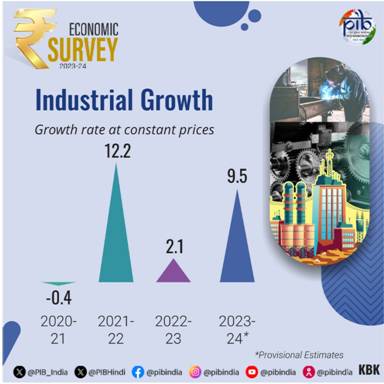
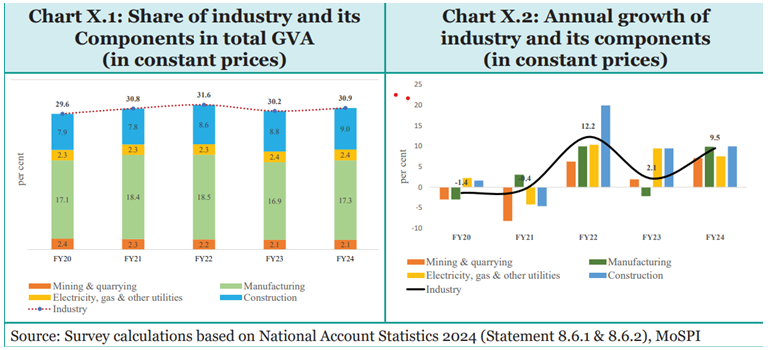
 Robust industrial growth of 9.5 percent was a key highlight of the Economic Survey 2023-24, presented by the Union Minister of Finance and Corporate Affairs, Smt. Nirmala Sitharaman, in Parliament today.

According to the Economic Survey, manufacturing remained at the forefront of the Indian industrial sector achieving an average annual growth rate of 5.2 per cent in the last decade. The sector had a gross value added at 14.3 per cent in FY23 and an output share of 35.2 per cent during the same period, indicating that the sector has significant backward and forward linkages. The HSBC India Purchasing Managers’ Index (PMI) for manufacturing also consistently remained well above the threshold value of 50 in all months of FY24, which is proof of a sustained expansion and stability in India’s manufacturing sector.

The Survey notes that about 47.5 per cent of the total value of output in the country is used as inputs in productive activities (inter-industry consumption). Manufacturing activities account for about 50 per cent of the inter-industry consumption and, at the same time, supply almost 50 per cent of inputs used in all productive activities (agriculture, industry and services).

Annotation 2024-07-21 140347.png

Physical infrastructure, logistics and compliance bottlenecks slowed capacity creation and expansion in the past. The Survey optimistically notes that majority of these restrictions have been now been lifted. The Survey states that physical infrastructure and connectivity is improving at a rapid pace. It further comments that the Goods and Services Tax has created a single market for several commodities, enabling manufacturing at scale. The Survey underlines the importance of deregulation along with the role of private sector in long-term investment. Boosting competitiveness and expanding the Indian manufacturing sector remains key to generation of semi-skilled employment thus bringing development closer to the people.

*****

Agriculture Sector in India

 Economic Survey 2023-24 presented in the Parliament today by Union Finance and Corporate Affairs Minister Smt. Nirmala Sitharaman. Economic Survey says that smallholder farmers need to move to high-value agriculture. The Survey says once the incomes of smallholders increases, they will demand manufactured goods, spurring a  manufacturing revolution.

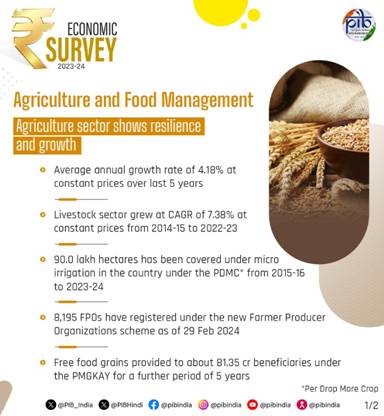
Economic Survey says that the Indian agriculture sector provides livelihood support to about 42.3 per cent of the population and has a share of 18.2 per cent in the country’s GDP  at current prices. The sector has been buoyant, which is evident from the fact that it has registered an average annual growth rate of 4.18 per cent at constant prices over the last five years and as as per provisional estimates for 2023-24, the growth rate of the agriculture sector stood at 1.4 percent.

Economic Survey states that the Investment in agriculture research and support of enabling policies have contributed substantially to food security. It is estimated that for every rupee invested in agricultural research (including education), there is a payoff of ₹13.85. In 2022-23, ₹19.65 Thousand Crore was spent on agriculture research.

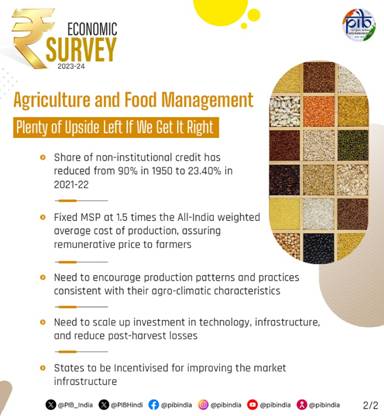
Economic Survey calls for enhancing private sector investment in agriculture saying it is vital to provide impetus to the agriculture sector. Investment in technology, production methods, marketing infrastructure, and reduction in post-harvest losses need to be scaled up. A greater focus on post-harvest infrastructure and the development of the food processing sector can reduce wastage/loss and increase the length of storage, ensuring better prices for the farmers.

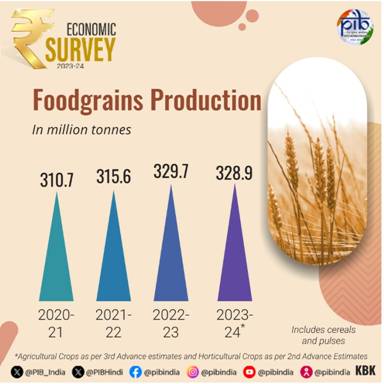
Economic Survey says that in 2022-23, foodgrain production hit an all-time high of 329.7 million tonnes, and oilseeds production reached 41.4 million tonnes. In 2023-24, food grain production is slightly lower at 328.8 million tonnes, primarily because of poor and delayed monsoons. The domestic availability of edible oil has risen from 86.30 lakh tonnes in 2015-16 to 121.33 lakh tonnes in 2023-24. The total area coverage of all oilseeds has increased from 25.60 million hectares in 2014-15 to 30.08 million hectares in 2023-24(17.5 percent growth). This has reduced the percentage share of imported edible oil, from 63.2 per cent in 2015-16 to 57.3 percent in 2022-23, despite rising domestic demand and consumption patterns.

Economic Survey suggests that to promote efficiency in agriculture marketing, and improve price discovery, the government implemented the e-NAM Scheme and as of 14th March 2024, more than 1.77 Crore farmers and 2.56 Lakh traders have been registered on the e-NAM portal. The Government of India launched the scheme to form and promote 10,000 FPOs in 2020 with a budget outlay of ₹6.86 thousand crore till 2027-28. As of 29 February 2024, 8,195 FPOs have registered under the new FPO scheme, and equity grants of ₹157.4 crore were released to 3,325 FPOs. Credit guarantee cover worth ₹278.2 crore was issued to 1,185 FPOs.

Economic Survey states that the Agricultural price support assures farmers of remunerative returns, increasing income and allows the Government to ensure a stable supply of staples at reasonable prices. Accordingly, the Government has been increasing the MSP for all Kharif, Rabi and other commercial crops with a margin of at least 50 per cent over the all-India weighted average cost of production since the agricultural year 2018-19.

Economic Survey shows that to provide social security to the most vulnerable farmer families, the Government implements Pradhan Mantri Kisan Maandhan Yojna (PMKMY). The scheme offers a monthly pension of ₹3,000 to the enrolled farmers on the attainment of 60 years of age, based on a nominal premium between ₹55 to ₹200 per month paid by the applicant (in the age group 18 to 40 years) subject to exclusion criteria. As of 07 July 2024, 23.41 lakh farmers have enrolled under the scheme.

Economic Survey, on focusing to reduce the use of chemical fertilizer, states that the PM Programme for Restoration, Awareness Generation, Nourishment, and  amelioration of Mother Earth (PM-PRANAM ) initiative incentivises states to reduce chemical fertiliser use. It promotes sustainable methods such as the use of alternative fertilisers, viz. Nano Urea, Nano DAP, and organic fertiliser.

Focusing on the security of farmers’ crop, Economic Survey highlighted the Pradhan Mantri Fasal Bima Yojana (PMFBY) which offer a safety net against crop losses due to natural calamities, pests, or diseases, ensuring financial stability for farmers. The scheme safeguards farmers’ livelihoods and encourage them to adopt modern farming practices and technologies. PMFBY is the largest crop insurance scheme in the world in terms of farmer enrolment and is the third largest scheme in terms of insurance premiums. The scheme ensure comprehensive risk cover for crops to farmers against all non-preventable natural risks from pre-sowing to post-harvest. The overall insured area in 2023-24 reached 610 lakh ha compared to 500.2 lakh ha in 2022-23. A total of 5549.40 Lakh farmer applications were insured under the scheme since 2016-17, and ₹150589.10 Crore has been paid as claims.

***

Gross Capital Formation

 Economic Survey 2023-24 was presented in the Parliament today by Union Finance and Corporate Affairs Minister Smt. Nirmala Sitharaman. The Economic Survey states that the Gross Capital Formation (GCF) of the agriculture sector and the share of GCF in the agriculture and allied sectors as a percentage of Gross Value Added (GVA) has been growing steadily, mainly due to increased public investment. The GCF of the agriculture sector grew at the rate of 19.04 per cent in 2022-23, and the GCF as a percentage of GVA rose from 17.7 per cent in 2021-22 to 19.9 per cent in 2022-23, suggesting an increase in investment in agriculture. The average annual growth in GCF from 2016-17 to 2022-23 was 9.70 percent. The Survey states that despite the increasing trend in GCF, there is a need to further boost agriculture investment, especially in the context of doubling farmers’ income. The DFI 2016 report indicated that to double farmers’ income over the period of 2016-17 to 2022-23, income would need to grow at an annual rate of 10.4 per cent in the farm sector, which in turn would require an annual growth rate in agriculture investment of 12.5 percent.

The government’s priority has been to provide timely, cost-effective, and adequate credit that reduces the dependence on non-institutional credit and increases investment. The measures have reduced the share of non-institutional credit from 90 per cent in 1950 to 23.40 per cent in 2021-22. As of 31 January 2024, the total credit disbursed to agriculture amounted to ₹ 22.84 lakh Crore, with ₹13.67 lakh Crore allocated to crop loans (short term) and ₹ 9.17 lakh Crore to term loans.

Kisan Credit Card(KCC):

The Economic Survey states that the Kisan Credit Card (KCC) has streamlined agricultural credit accessibility and as of January 31, 2024, banks issued 7.5 crores KCC with a limit of ₹9.4 lakh crores. As a further measure, the KCC was extended to meet the working capital needs of fisheries and animal husbandry activities in 2018-19, along with the enhancement of the limit for collateral-free loans to ₹1.6 lakh. In the case of a Tri-Partite Agreement (TPA) among borrowers, milk unions, & banks, the collateral-free loan can go up to ₹3 lakh As of March 31, 2024, 3.49 lakh KCC and 34.5 lakh KCC were issued to fisheries and animal husbandry activities, respectively. Economic Survey states that  Joint Liability Groups (JLGs) have emerged as an essential source of credit for tenant farmers. JLG accounts have grown at a compound annual growth rate (CAGR) of 43.76 per cent over the past five years, emerging as a vital source in meeting the credit needs of tenant farmers and  marginalised segments.

Agriculture Infrastructure:

Economic Survey shows that as of 30th April 2024, 48357 projects were sanctioned for storage infrastructure with ₹4570 Crore released as subsidy, and 20878 other projects are also under progress with ₹2084 Crore released as subsidy. To give further fillip to farm gate infrastructure and also involve the private sector more actively, the Agriculture Infrastructure Fund (AIF) was launched with a financing facility of ₹1 lakh Crore to be disbursed between FY 2020-21 to FY 2025-26 with support extending till FY 2032-33.

The Economic Survey states that the Agriculture Infrastructure Fund(AIF)  provides medium-term debt financing for post-harvest management and community farming projects, offering interest subvention and credit guarantee support. As of 5th July 2024, AIF mobilised an investment of ₹73194 Crore, supporting 17196 custom hiring centres, 14868 primary processing units, 13165 warehouses, 2942 sorting and grading units,1792 cold storage projects, and 18981 other projects. In addition, the Pradhan Mantri Kisan SAMPADA Yojana (PMKSY) introduced credit-linked financial assistance through grants-in-aid to build efficient supply chain management from farm to retail to reduce the wastage of perishable produce and extend food shelf life. Under PMKSY 1044 projects were completed till end March 2024. A total of 1685 projects with project cost ₹ 32.78 thousand crore and approved subsidy of ₹ 9.3 thousand crore have been approved till end March 2024.

***

Trade Policy of India

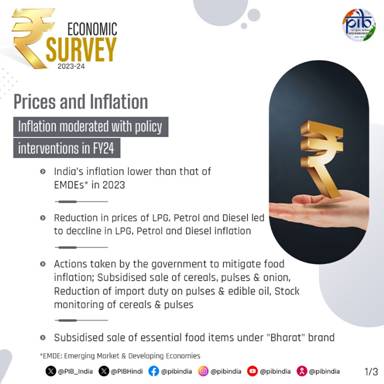
 The Economic Survey 2023-24, that was tabled in Parliament today, lays special emphasis on controlling Prices and Inflation as ‘Low and stable inflation is key to sustaining economic growth.’ It states that Governments and Central Banks face the challenge of keeping inflation at a moderate level while ensuring financial stability. Achieving this delicate balance requires careful monitoring of economic indicators and taking appropriate and timely corrective actions. With the commitment of the Reserve Bank of India (RBI) to the goal of price stability and policy actions by the Central Government, India has successfully managed to keep retail inflation at 5.4 per cent in FY24, the lowest level in 4 years, since the Covid-19 pandemic period.

The Economic Survey highlights the fact that India’s retail inflation is lower than the emerging markets & developing economies (EMDES) and world average in 2022 and 2023 as per IMF data. Survey states that factors such as established monetary policies, economic stability, well-developed and efficient markets that balance supply and demand conditions, and stable currencies contribute to the effective management of inflation. Historically, inflation in advanced economies has generally been lower than in EMDEs.
Inflation Management

With the goal of maintaining price stability, many countries have established their own inflation targets based on various factors that serve their economic objectives best. Lauding India’s Inflation Management, the Economic Survey states that interestingly, India is performing better than various developed and emerging economies in relation to its inflation target. In 2023, India’s inflation rate was within its target range of 2 to 6 per cent. Compared to advanced economies like the USA, Germany, and France, India had one of the lowest deviations from its inflation target in the triennial average inflation from 2021-2023. Despite the challenges posed by global demand- supply imbalances due to ongoing geopolitical tensions, India’s inflation rate was 1.4 percentage points below the global average in 2023.

Since 2020, countries have been facing challenges in controlling inflation. India has been able to bring about a declining trend in Headline and Core Inflation through its prudent administrative measures and monetary policy. As per the Economic Survey, since May 2022, monetary policy broadly focused on absorbing excess liquidity in the system by increasing the policy repo rate by 250 basis points from 4 per cent in May 2022 to 6.5 per cent in February, 2023. Thereafter, the policy rate was kept unchanged by focusing on the gradual withdrawal of accommodation, aiming to align inflation with the target, while simultaneously fostering growth. Consequently, the persistent and sticky core inflation observed in FY23 declined to 3.1 per cent in June, 2024

The Survey further asserts that administrative measures such as price cuts for LPG, petrol, and diesel led to lower LPG and petroleum product inflation. LPG inflation rate has been in the deflationary zone since September 2023 while retail inflation in petrol and diesel moved to the deflationary zone in March 2024. Additionally, global commodity prices declined in 2023, reducing price pressure in energy, metals, minerals, and agricultural commodities through the imported inflation channel. Low fuel and core inflation ensured a downward trajectory for headline inflation, despite volatility in food prices in FY24. As per the recent data released by MoSPI, the retail inflation rate was 5.1 per cent in June 2024.

Core inflation, measured by excluding food and energy items from CPI headline inflation has witnessed a four year low in FY24. From the pandemic-driven highs, inflationary pressures in India eased in FY22, aided by softening food inflation. Inflationary pressures firmed up in FY23 yet again driven by the Russia-Ukraine war disrupting the recouping supply chains leading to a rise in food and fuel prices. In FY24, the price situation improved. CPI inflation moderated, driven by a decline in core inflation in both goods and services. Core services inflation eased to a nine-year low in FY24; at the same time, core goods inflation also declined to a four-year low.
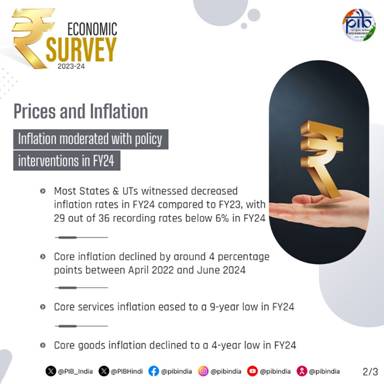
Trends in core inflation are important in determining the contours of monetary policy. Assessing the emerging patterns of price pressures, the RBI increased the repo rate gradually by 250 basis points since May 2022 to curtail inflationary pressures, leading to reduction of around 4 percentage points in core inflation between April 2022 and June 2024. This was aided by moderation in housing rental inflation, with a significant increase in the stock of new houses in 2023.

Consumer durables inflation increased progressively between FY20 and FY23 by more than 5 percentage points, mainly due to increase in gold prices in FY21 and clothing in FY22 and FY23. With the improvement in the supply of key raw materials, the inflation rate for consumer durables declined in FY24. However, record-high gold prices, driven by anticipated Fed rate cuts and escalating geopolitical uncertainty, have exerted upward pressure on overall durables inflation. Consumer non-durables (CND) inflation plunged in FY20, it started to inch up in FY21, reached an all-time in FY22, and declined sharply in FY23 and FY24.

Food Inflation has been a global phenomenon in the last two years. Research indicates the rising vulnerability of food prices to climate change. In FY23 and FY24, the agriculture sector was affected by extreme weather events, lower reservoir levels, and damaged crops that adversely affected farm output and food prices. So, food inflation based on the Consumer Food Price Index (CFPI) increased from 3.8 per cent in FY22 to 6.6 per cent in FY23 and further to 7.5 per cent in FY24. However, the government took prompt actions, including open market sales, retailing in specified outlets, and timely imports, to ensure an adequate supply of essential food items. Additionally, to ensure food security for the poor, the Pradhan Mantri Garib Kalyan Anna Yojana, which provides free food grains to more than 81 crore beneficiaries, was extended for a period of five years starting from January 2024.

Global Food Prices and Domestic Inflation

Global food prices also have an impact on domestic inflation. In India, the edible oil market is heavily depends on imports, with more than 50 per cent of the total edible oil requirement being imported, making it sensitive to global prices. The Government closely monitors global market trends to ensure the availability of edible oils for consumers at an affordable price. Efforts are also made to balance imports with domestic production to mitigate the risks associated with global price volatility. In this context, the National Mission on Edible Oils Oil Palm aims to increase domestic crude palm oil production to reduce the import burden. In the case of sugar, the Government announced restrictions on export in June 2022 to ensure sufficient local supplies and thereby manage sugar inflation. These export restrictions have indeed played a role in stabilising domestic sugar prices. As a result, even though the global sugar price index inflated and has been showing volatility since February 2023, domestic sugar prices have remained much less volatile.

Elaborating on the Interstate variations in Retail Inflation, the Economic Survey asserts that inflation rate was less than 6 per cent in 29 out of the 36 States and Union Territories. These Interstate variations in inflation are more pronounced in rural areas since rural consumption basket has a much higher weightage of food items (47.3%) than the urban (29.6%). Hence, in the last two years, States that witnessed elevated food prices also experienced higher rural inflation.

Future Inflation Projections

RBI and IMF have projected India’s consumer price inflation will progressively align towards the inflation target in FY26. Assuming a normal monsoon and no further external or policy shocks, the RBI expects headline inflation to be 4.5 per cent in FY25 and 4.1 per cent in FY26. IMF has projected an inflation rate of 4.6 per cent in 2024 and 4.2 per cent in 2025 for India. The World Bank expects that the global supply of commodities will increase, and so will their demand due to improved industrial activity and trade growth. It projects a 3 per cent decline in the commodity price index in 2024 and a 4 per cent decrease in 2025, mainly driven by lower energy, food and fertiliser prices. The energy price index is expected to reduce due to significant declines in coal and natural gas prices this year. Fertiliser prices are likely to weaken but remain above 2015-2019 levels due to strong demand and export restrictions. Base metal prices are projected to rise, reflecting increased global industrial activity and clean energy production. In general, the current downward movement in the prices of commodities imported by India is a positive for the domestic inflation outlook.
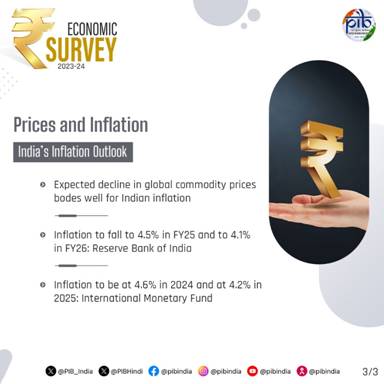
The short-term inflation outlook for India is benign. However, from the angle of long-term price stability, the Economic Survey suggests exploring the following options as the way forward:

1. Reducing import dependence for edible oils by increasing domestic production of major oilseeds, Exploring potential of non-conventional oils such as rice bran oil and corn oil and expanding scope of National Mission on Edible Oils

2. Expand the area under pulses, particularly lentils, tur, and urad, in more districts and rice- fallow areas. Promoting the summer cultivation of urad and moong in areas with assured irrigation facilities.

3. Further improving and developing modern storage and processing facilities for vegetables, especially tomatoes and onions.

4. Improving swiftness and effectiveness of administrative action by the Government to deal with price flare-ups in specific items by collating high-frequency price monitoring data, from the farm gate to the final consumer, in a quantifiable manner. Expediting producer price index for goods and services for better grasp on episodes of cost-push inflation and

5. Revising the consumer price index with fresh weights and item baskets using Household Consumer Expenditure Survey, 2022-23.


*****

Infrastructure Expansion

 With increased public investment over the last five years, India has witnessed significant expansion in physical and digital connectivity and social infrastructure including sanitation and water supply helping to improve quality of life of the people, states the Economic Survey 2023-24 tabled by Union Minister of Finance and Corporate Affairs, Smt Nirmala Sitharaman in Parliament today. The Survey notes that the foremost among the responses initiated by the Union Government to overcome the pandemic-driven slowdown in the economy was increase in capital expenditure, aimed particularly at the creation of high quality physical and social infrastructure facilities. Keeping the momentum going over the last five years, the Survey says, capital expenditure of the Government has seen an almost three-fold increase in FY24, relative to FY20 levels. It added that the major beneficiaries of this step-up are key foundational assets like roads and railways.

ROAD INFRASTRUCTURE:

The Economic Survey observes that strategic planning and step-up in public investment have resulted in the upgradation of the road network system into a resilient and efficient infrastructure. The capital investment by the Government and private sector rose from 0.4 per cent in FY15 to about 1.0 per cent of GDP (around ₹3.01 lakh crore) in FY24. The sector has attracted its highest-ever private investment in FY24 as the private sector capitalises on a conducive policy environment, mentions the Survey.

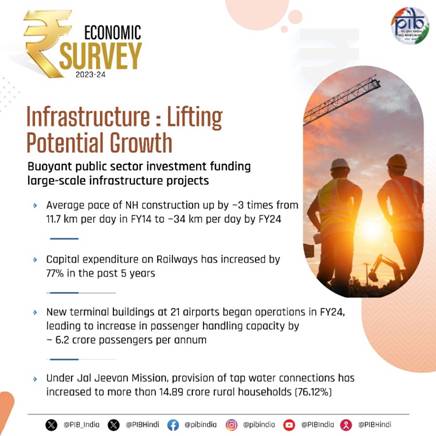
Referring to the significant progress in the development of national highways, the Survey says that the development of national highways, over the last ten years, has increased by 1.6 times from 2014 to 2024. It states that the Bharatmala Pariyojana has significantly expanded the national highway network, increasing the length of high-speed corridors by 12 times and 4-lane roads by 2.6 times between 2014 and 2024. Further, the Survey notes that the efficiency of highway construction has improved due to the systematic push through the corridor-based National Highway development approach. The average pace of NH construction increased by 3 times from 11.7 km per day in FY14 to 34 km per day by FY24, it states. The survey observes that the remarkable improvement of the NH network has brought about substantial advancements in logistics efficiency which  is evidenced by the consistently rising India’s ranking in the World Bank’s ‘Logistics Performance Index, from 54 in 2014 and 44 in 2018, to 38 in 2023.

To further enhance logistic efficiency, the Economic Survey has mentioned that the Ministry of Road Transport & Highways (MoRT&H) has dedicated Multi-Modal Logistics Parks (MMLP). It says that a total of six multimodal logistics parks (MMLPs) have been awarded until FY24, and ₹2,505 crore have been awarded for dedicated multimodal logistics parks (MMLPs) in FY24. Further, it stated, seven MMLPs are planned to be awarded in FY25.

RAILWAYS INFRASTRUCTURE

According to Economic Survey 2023-24, Indian Railways, with over 68,584 route km (as of 31st March 2024) and 12.54 lakh employees (as of 1st April 2024), is the fourth largest network in the world under single management. Survey states that the capital expenditure on Railways has increased by 77 per cent over the past 5 years (₹2.62 lakh crore in FY24) with significant investments in the construction of new lines, gauge conversion, and doubling.

The Survey notes that the Railways has  achieved its highest-ever production for both locomotives and wagons in FY24. Survey states that 51 pairs of Vande Bharat have been introduced until March 2024. The fast pace of infrastructure augmentation has been the result of a substantial increase in financial allocation along with close project monitoring and regular follow-up with stakeholders for expeditious land acquisition and clearances, the Survey observes.

The Survey has also mentioned about the initiatives undertaken by Railways for providing clean environment in and around railway stations and trains, such as replacement of conventional toilets with bio-toilets on coaches leading to clean tracks, segregation of bio-degradable/non bio-degradable waste, solid waste management and discouraging use of single use plastic.

The key focus areas for Railways, according to Economic Survey 2023-24 include fast capacity augmentation, modernisation of rolling stock and maintenance, improving quality of services and energy efficiency. In line with this, the Survey states that the  investments are prioritised in areas like dedicated freight corridors, high-speed rail, modern passenger services like Vande Bharat, Amrit Bharat Express, Aastha Special Trains, high-capacity rolling stock and last-mile rail linkages. Projects for three major corridors viz. (1) High-traffic density corridors, (2) Energy, Mineral and Cement Corridors and (3) Rail Sagar (port connectivity) corridors are also planned to reduce logistics cost and carbon footprint, the Survey said. As per the Survey,  Railways has also planned to reduce its carbon footprint primarily through sourcing of its energy requirements through renewable energy sources and the expected requirement of installation of renewable capacity by 2029-30 is around 30 Giga Watts. Other strategies mentioned by Survey  include shifting from diesel to electric traction, promotion of energy efficiency and afforestation.

*****

Placing of the Budget by a third term government is being seen as a glorious event by the nation

 The Prime Minister Shri Narendra Modi gave a statement to the media before the start of the Budget Session.

Speaking on the occasion, the Prime Minister reiterated the pride in the fact that after a gap of 60 years a government has come for the third consecutive year. Placing of the Budget by a third term government is being seen by the nation as a glorious event, said the Prime Minister. The Prime Minister said that the Budget is a milestone budget of the Amrit Kaal and the government is working to realize the guarantees given over a period on the ground. “This Budget will set the direction of the next five years of the current government and will lay a strong foundation for the dream of Viksit Bharat by 2047”, he added. 

He highlighted that India is the fastest growing country among the major economies with about 8 percent growth in the last three consecutive years. Today, opportunities are at the peak due to positive outlook, investment and performance, he said. 

Noting that all the battles have now been fought among political parties and that the citizens have elected the government after the conclusion of the Lok Sabha elections, the Prime Minister urged all Members of Parliament to come together and fight for the country for the next 5 years. He also urged all political parties to rise up above their organizations and commit to the nation by making use of  the dignified platform of the Parliament for the next four and a half years. “Go to the battlefields of election in January 2029. Till then, the only priority should be the country, its poor, farmers, women and the youth”, he exhorted. He added that no stone will be left unturned to realize the dreams and resolutions of a Viksit Bharat in 2047.  

The Prime Minister lamented that due to the negative approach of some political parties, many Parliamentarians could not get any opportunity to put forward their views and the issues pertaining to their constituencies. He appealed to all the parties to give opportunities to all members, especially the first time members, to present their views. Shri Modi reminded the people about the efforts to muzzle the elected government and the Prime Minister’s speech in the Parliament. “This has no place in democratic traditions’, PM Modi asserted.  

The Prime Minister reminded the Parliamentarians that the people of the country have given their mandate to serve the county and not the agendas of political parties.“This House is not meant for political parties, this House is meant for the country. It is not meant to serve the Parliamentarians but 140 crore citizens of India”, he emphasized. Concluding the address, the Prime Minister expressed the belief that all Members of Parliament will contribute towards fruitful discussions. He added that the country requires positive views that take it forward. “Views that oppose are not bad, instead it is negative views that hamper development”, he added, concluding with confidence that this temple of democracy will be used to fulfil the dreams and aspirations of the common citizens. 


***

DS/TS

Cricket World Cup

 The Cricket World Cup stands as one of the most prestigious and eagerly awaited events in the cricketing calendar. This global extravaganza showcases the prowess, talent, and sheer passion of cricketing nations from around the world. Organized by the International Cricket Council (ICC) every four years, the tournament brings together top teams to compete for the coveted title of world champions.

The history of the Cricket World Cup dates back to 1975 when the inaugural tournament was held in England. Since then, it has evolved into a spectacle that captivates millions of fans globally. The tournament format has undergone changes over the years, shifting from a modest eight-team event to accommodating more teams, providing opportunities for emerging cricketing nations to showcase their skills on a grand stage.

Each World Cup edition has witnessed unforgettable moments etched in cricketing history. From the West Indies’ dominance in the late 1970s and 1980s to India’s triumphs in 1983 and 2011, Australia’s consecutive wins in 1999, 2003, and 2007, and other notable victories, the tournament has seen its share of thrilling matches, nail-biting finishes, and exceptional individual performances.

The tournament format typically consists of round-robin group stages followed by knockout rounds, culminating in the grand finale where the top two teams battle it out for supremacy. The atmosphere during the World Cup is electric, with fans turning up in large numbers, showcasing their support with colorful costumes, chants, and flags, creating an ambiance that adds to the thrill of the game.

Players often consider the World Cup as the pinnacle of their careers, with dreams of lifting the prestigious trophy for their nation. Legends like Sachin Tendulkar, Vivian Richards, Ricky Ponting, Wasim Akram, and many others have left an indelible mark with their stellar performances on this grand stage.

Beyond the boundaries of cricket, the World Cup unites people across diverse cultures and geographies, transcending borders and fostering a sense of unity and camaraderie among cricket enthusiasts worldwide.

The most recent editions have seen an increase in competitiveness and drama, with emerging teams challenging traditional powerhouses, making the tournament even more unpredictable and exciting. As the Cricket World Cup continues to evolve, it remains a celebration of the sport, showcasing the skill, talent, and passion that make cricket a beloved game around the globe.

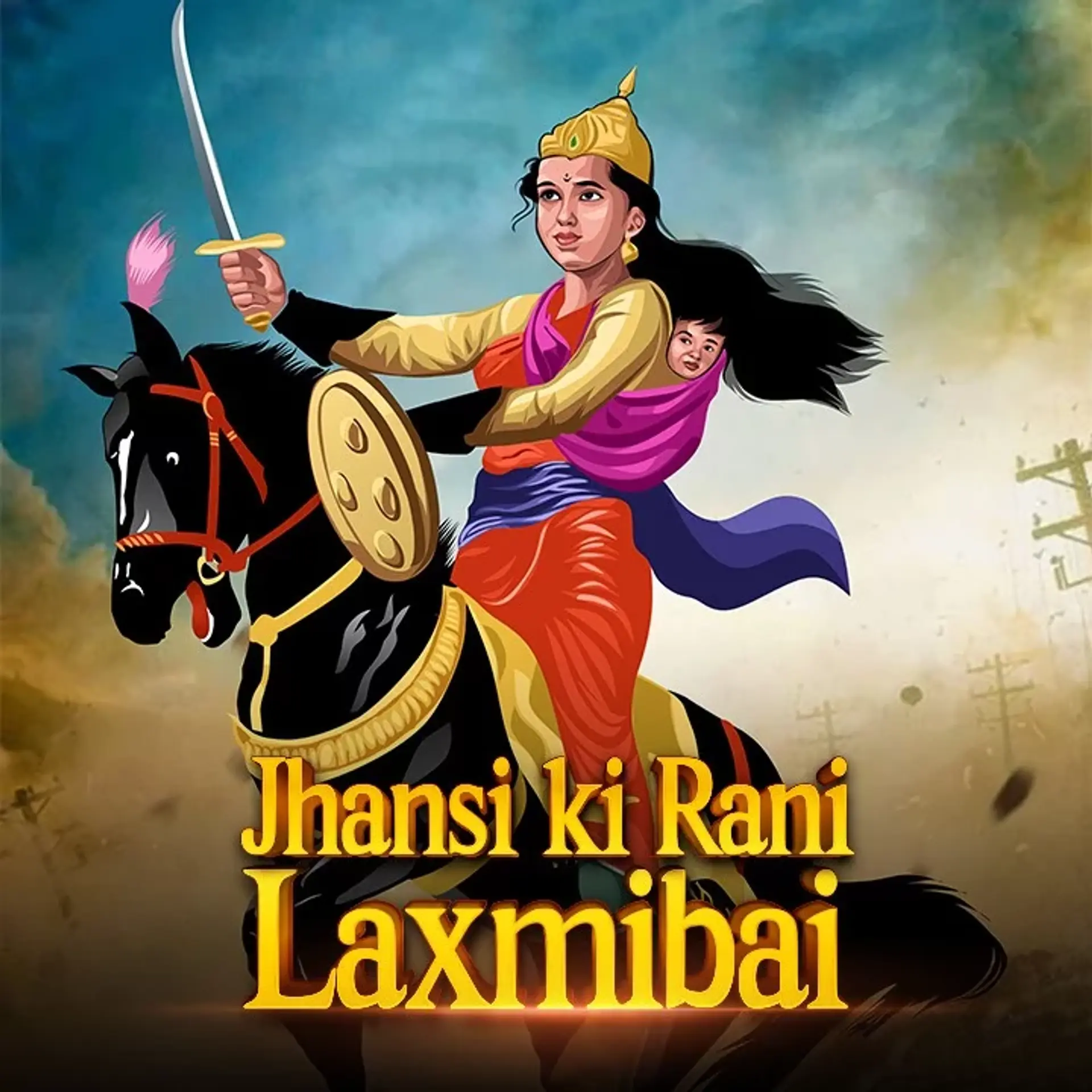
Rani Lakshmibai

 Rani Lakshmibai, also known as the Rani of Jhansi, was a prominent figure in the Indian Rebellion of 1857 against British colonial rule. Her bravery, leadership, and unwavering commitment to the cause of Indian independence have made her an iconic figure in Indian history. Here’s an overview of her life and legacy:

Early Life and Background:

  • Birth and Name: Rani Lakshmibai was born as Manikarnika Tambe on November 19, 1828, in Varanasi. She was affectionately called Manu.

  • Marriage to Maharaja of Jhansi: Manikarnika was married to the Maharaja of Jhansi, Raja Gangadhar Rao Newalkar, at an early age and was given the name Lakshmibai.

Role in the Indian Rebellion of 1857:

  • Leadership during the Rebellion: After the death of her husband, Lakshmibai became the regent for her adopted son. When the Indian Rebellion of 1857 erupted against British rule, she emerged as a courageous leader and took an active role in the uprising.

  • Battle of Jhansi: Rani Lakshmibai played a pivotal role in the defense of Jhansi against British forces. Her leadership and valor during the siege of Jhansi became legendary.

  • Icon of Resistance: She became a symbol of resistance against British imperialism and oppression, inspiring many Indians to join the fight for independence.

Legacy and Rememberance:

  • Valor and Sacrifice: Rani Lakshmibai’s bravery, determination, and sacrifice for her country’s freedom have earned her a revered place in Indian history and folklore.

  • Inspiration for Future Generations: Her courageous stand against injustice and her fight for freedom continue to inspire generations of Indians, especially women, to stand up for their rights and for the principles they believe in.

  • Remembered in Folklore and Culture: Her story is celebrated in folklore, literature, and popular culture, including poems, songs, books, and movies, depicting her as a fearless warrior and a symbol of resilience.

Rani Lakshmibai’s legacy as a warrior queen and her significant contribution to India’s struggle for independence remain etched in the annals of Indian history. Her bravery and sacrifice continue to inspire and evoke admiration for her remarkable courage in the face of adversity.

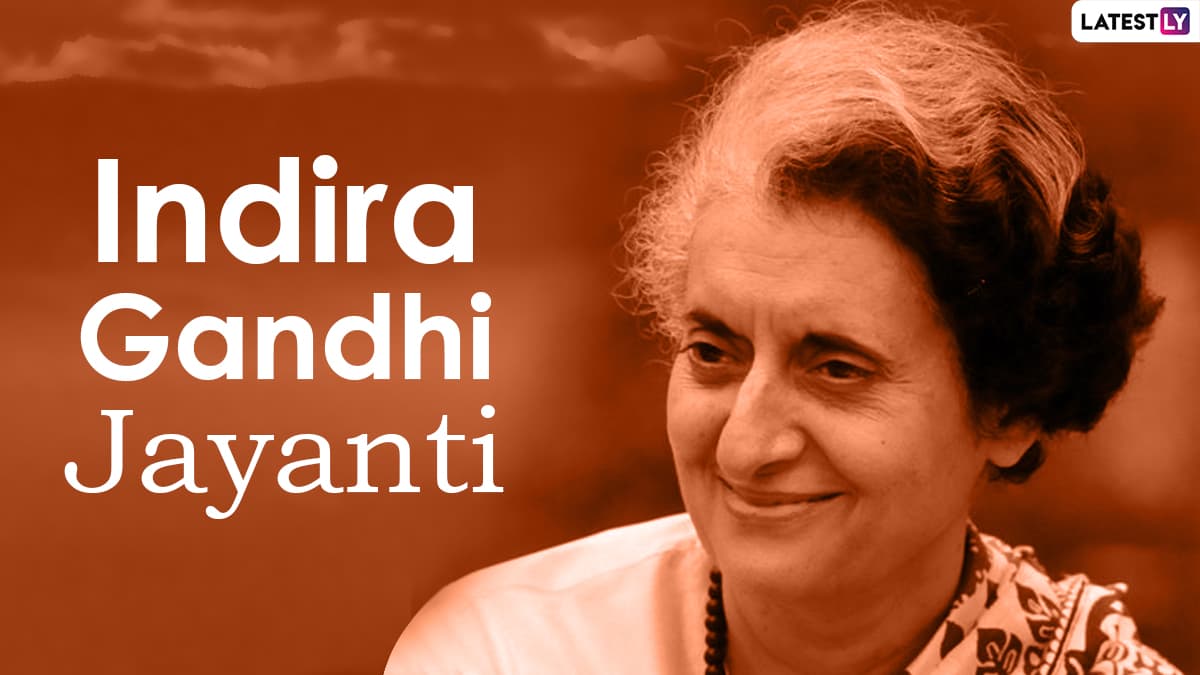
Indira Gandhi

 Indira Gandhi was a prominent political figure in India, serving as the Prime Minister of India for multiple terms and leaving a lasting impact on the country’s political landscape. Here are some key highlights of her life and legacy:

Early Life and Background:

  • Birth and Family: Indira Priyadarshini Gandhi was born on November 19, 1917, in Allahabad (now Prayagraj), into the Nehru-Gandhi family. She was the daughter of Jawaharlal Nehru, India’s first Prime Minister, and Kamala Nehru.

  • Education: She studied at Oxford University and later became involved in India’s freedom struggle, influenced by her father’s political activism.

Political Career:

  • Entry into Politics: Indira Gandhi entered politics under the guidance of her father, Jawaharlal Nehru, and held various positions within the Congress party.

  • Prime Ministerial Tenures: She served as Prime Minister of India from 1966 to 1977 and later from 1980 until her assassination in 1984, making her India’s first and only female Prime Minister to date.

  • Major Policy Initiatives: During her tenure, she implemented several policies aimed at nationalizing banks, initiating the Green Revolution in agriculture, and leading the country during the Bangladesh Liberation War in 1971, which led to the creation of Bangladesh.

  • Emergency Period: Her declaration of a state of emergency in 1975, due to political unrest and economic challenges, was a controversial period marked by curtailment of civil liberties.

Assassination and Legacy:

  • Assassination: Indira Gandhi was assassinated on October 31, 1984, by her own bodyguards in retaliation for ordering a military operation against Sikh militants in the Golden Temple in Amritsar.

  • Legacy: Indira Gandhi’s legacy is complex and multifaceted. She is remembered for her strong leadership, resilience, and contributions to India’s development and foreign policy. Her policies left a lasting impact on India’s political and economic landscape.

  • Criticism and Controversy: Her tenure also faced criticism for authoritarian tendencies, censorship, and the declaration of Emergency in 1975, which led to curtailed civil liberties.

Indira Gandhi’s political journey, leadership during challenging times, and significant policy decisions have left a lasting impact on India’s history and continue to be a subject of debate and analysis in Indian politics.