FINDING YOURSELF

Your Perception Of Yourself And The Truth
Sometimes we imagine ourselves as different than what we really are. We think we are one way, at least we picture ourselves as this, and yet in reality we do not fit this picture.

See the real you
We all know that how we perceive things basically makes them so. If we see a situation as hard, it sure will feel this way. If we view our life as a struggle, we will look for ways to validate this. Our perception changes our reality. it alters our experiences, and inhibits or propels us forward in life. One of the most important aspects of our perception we need to look at is how we see ourselves, and not just in broader terms, but in the small details as well.

Letting go of Our Ideas of self
Often, we decide who we are and who we will be without thought of our real selves. We program ourselves into being a certain person, with certain characteristics and behaviors. This internal processing and control inhibits our growth and closes us off from our real selves.

Finding your true self
When we are caught up in things that do not matter, we are not existing as our true form. Any emotional drama comes from us not being who we really are. Any thought process that distracts us, worries us, or pulls us away from life is not a thought process from our true self, for who we really are underneath all of this is someone that is at ease in life, that welcomes everything, and understands who we are.

See yourself who you really are
Seeing yourself for who you really are is about letting yourself find the true you. We all have a part of us that lies hidden underneath the person we think we are. Sometime we hide

Finding yourself
Finding yourself is about emptying out the ideas, the foundation of who you think you are, so that you can reside in life as you really are.

Be and feel empowered
When we think less of ourselves, we are only harming who we are. When we believe that others are better than us, we are giving them a false identity, for all people, no matter their background, upbringing, or place in life, are equal.

Existing as your true self
Existing as your true self is living with the world as you are meant to. It is living your life from a place that is connected to your purpose, a place that resonates deeply within you.

How to reclaim the real you??
How do you reconnect to the real you when life has pushed you so far away from where you started? Never leave the real one you are. Never get so far that you forget yourself that what actually you are. Evolve yourself , changes are good and everyone need change as time is going but with your own personality.

Letting go so that you can be you
We all need to find a way to let go of what is holding us back and preventing us from reaching our true selves. We should leave them all behind and move on. Just trust on yourself that you can do anything. Nothing can hold you back now, go can achieve your aim of life and give your best performance. Live up to your expectations.

Dexamethasone- Corona Vaccine Update!!!

Finally some good news today dexamethasone is now being called a major breakthrough based on a recent randomized controlled trial in the UK. Dexamethasone also known as Decadron is an example of a glucocorticoid are sometimes referred to as corticosteroids other examples of glucocorticoids include hydrocortisone methyl prednisolone prednisolone, prednisone beta methazone and triamcinolone so glucocorticoids are a class of steroid hormones that bind to the glucocorticoid receptor in the body cortisol aka hydrocortisone is the glucocorticoid.

pexels-photo-4031867.jpeg
Photo by Edward Jenner on Pexels.com

We naturally make in our body it’s essential for life it regulates or supports various cardiovascular metabolic and homeostatic functions it also plays a big role in our immune system especially when it comes to reducing certain aspects of inflammation this is why we use them all the time in medicine we sometimes give these steroids for asthma copd rheumatologic type diseases and countless more diseases. Sometimes it is also given for steroids for meningitis and also for some forms of cancer we also give them in the early course of severe ards acute respiratory distress syndrome whether that ards is due to infection such as pneumonia or vaping lung injury or whatever the cause for severe ards we typically give methylprednisolone or solumedral at a dose of one milligram per kilogram per day. So, for most people that ends up being around 80 milligrams per day so this is the equivalent of 15 milligrams of dexamethasone the idea here is to suppress the cytokine storm that has taken place meaning that the massive amount of inflammation that causes lung damage and can indirectly cause damage to other organs as well our body naturally makes cortisol in our adrenal glands specifically in the zona fasciculata of the adrenal cortex the adrenal gland then secretes cortisol into the bloodstream and the cortisol travels to different tissues of the body and then binds to the glucocorticoid receptor inside cells it then stimulates the cell to make more anti-inflammatory proteins and causes the cell to make less pro-inflammatory proteins but giving someone glucocorticoids meaning steroids to someone who has an infection is somewhat of a tricky thing because the fear is that if you suppress the body’s immune system it has the potential to make the infection worse. Sometimes the body’s immune system does more damage than the actual infection for example in cases of meningitis that is due to either streptococcus or tuberculosis we give steroids because the medical evidence shows that they have better outcomes when we do so and giving someone steroids for viral pneumonias like influenza is more controversial because doing so generally leads to worse infection with that said if the viral pneumonia is so bad to the point of causing severe ards most doctors will give steroids in that situation. So this is why, the general medical guidelines so far recommend against giving steroids for covert pneumonia unless the patient has severe ards and we’ve been waiting for randomized controlled trials to come out for steroids in covid and here we are now with this study so in march of 2020 the recovery trial which stands for randomized evaluation of covid-19 therapy was one of the randomized control trials that actually looked at several different potential treatments for covid which included low-dose dexamethasone this trial was done in the UK.

skynews-dexamethasone-covid-19_5014958

Image source: Sky News

Over 11 500 patients in it so this trial has not been peer reviewed as of has not been published in the journal yet so everything I know so far is based on what’s been released to the general public in this trial over 2100 patients were randomized to receive dexamethasone specifically six milligrams once per day for 10 days and this group was compared with over 4 300 patients that were randomized to the standard care alone so 6 milligrams of dexamethasone is the equivalent of 32 milligrams of methylprednisolone so this is about half the dose we would typically use for someone with severe ards so among the patients who received standard care alone 20-day mortality was highest in those who required mechanical ventilation this was 41 and then intermediate in those patients who required supplemental oxygen only this was mortality rate of 25 percent and the mortality rate was lowest among those who did not require supplemental oxygen in which that mortality rate was 13 for patients who were on mechanical ventilators dexamethasone reduced mortality from 41 percent to 28 percent for patients who needed supplemental oxygen it reduced mortality from 25 percent to 20 percent and there was no benefit among those patients who do not require supplement oxygen in other words if someone only had mild disease there was no point in giving dexamethasone so based on these results one death would be prevented by the treatment of around eight ventilated patients. So that’s the number needed to treat for ventilated patients and then the number needed to treat for the ones who required supplemental oxygen that number needed to treat would be 25 so these preliminary results are significant but it doesn’t mean that dexamethasone is a miracle drug it’s certainly not a cure but it does seem to help based on these numbers index and methazone could be of huge benefit and not just rich countries but poorer countries as well because this drug is very cheap and is widely available so this is great news and very exciting but there are still a lot of questions that need to be answered like what is the ideal dose should we use higher doses in patients who are mechanically ventilated with ards and when will it be approved for use in the united states and we’ll get these answers pretty soon now another.

person holding petri dish
Photo by Anna Shvets on Pexels.com

Interesting question is should we give decadron dexamethasone to people who have mild disease now even though this study didn’t show any benefit the reason why i bring this up is because some people start out with mild disease and then go on to have moderate or severe disease and we have no way of predicting who goes on to do that and also it happens very quickly lots of times someone could be doing just fine and then all of a sudden within hours they all of a sudden are deteriorating and they have severe disease so should we give those patients decadron regardless is there any harm doing so that’s another question that remains to be seen.

Books-Our Best Companion

“A book is a good companion, and a good companion never leaves you”. Books are always knowledge. They always give us, never take anything from us. They are like an ocean, we can always gain knowledge from them. Human relations can be deceptive and unreliable but our relation with books will always be reliable and honest.

Good books enriches our mind with good thoughts and knowledge just like a good friend. Books-our best companions because it gives knowledge and peace of mind unconditionally. Books also offer knowledge about different aspects of life. They are well known for accurate and impartial information. Books are our best friends because they inspire us ti do great things in life and overcome our failures. Books teach us to have dreams. Books bring positive values to our life.

The poet Robert Southery has beautifully called books his never failing friends with everyday. Books enlighten, give knowledge, entertain and inform us. We can’t feel alone in the company of books. They inspire us to overcome failure, to make a balance between success and failure.

Books always acts as a companion. The more we read books, the more we gain. Books are educative as well as informative.

In the end, I just want to quote a line “A room without books is a body without soul.”

Bermuda triangle: An unsolved Mystery

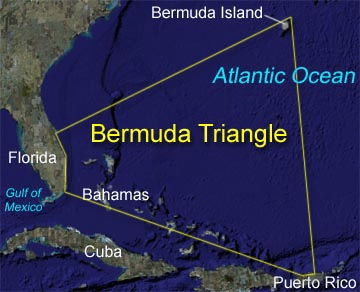
This triangular shaped area has been under the radar for many years due to the suspicious activities and multiple missing cases of humans and airplanes. Many state that all the mystical phenomenons which have occurred in the Bermuda triangle are obscure and esoteric.

The Bermuda triangle is known by multiple names many call it Devil’s Triangle, it’s also called Hurricane alley as that area always experience violent weather characterised by hurricanes, cyclones and wild winds which is said to be one of the causes behind the missing cases of ships and aeroplanes. It’s located towards the extreme south eastern part of North America.

Location of The Bermuda Triangle.

The term was coined by Vincent Gaddis (author) in 1964.Many claim that there is no region called Bermuda triangle and all the theories associated with it are absolutely fake and most of the incidents have been created for controversial purposes.

Scientists state it all started when Christopher Columbus was out exploring the sea and in search of new land he saw paranormal activity(fire balls crashing in that sea) in that area.

One of the very first cases which came to light was when a US Navy ship went missing in that triangle.

Charles Berlitz and his theory-

Theorist even claim the existence of extra-terrestrial beings from outer space and also claim the existence of an underwater city called Atlantis, Charles Berlitz was the one who propounded this theory, he supported all the claims toward the existence of Atlantis and also extra-terrestrial beings as part of this city. In his book ‘The Bermuda Triangle’ he expresses his hypothesis stating that Atlantis was a real city in the Bermuda Triangle.

High Magnetism-

Some claim that unlike others surfaces that area  is characterised by high magnetism which leads to the sinking of ships and Airplanes due to strong gravity. Some theorists who are supporters of Charles Berlitz’s theory claim that the city is made of stones and special crystals which is characterised by vigorous gravity due to which planes, ships and helicopters drown in the ocean.

Illogical Claims-

Some of the illogical claims made by many theorist stated that the extra-terrestrial beings from outer space have their base located within the triangle and hence destroy everything and anything that passes over their base. Though this is mostly a bogus theory with hardly has any proofs or references.

Overactive Environment –

Many also claim due to the overactive environment, feral winds and other natural activities which are violent in nature have caused the destruction of ships and airplanes. Also because of a strong gravitational pull within the Bermuda Triangle it causes humongous waves which could have engulfed anything coming in its way.

Larry Kusche and his theory-

Though Critics like Larry Kusche claim that these all manmade theories have been hyped to create terror and controversies amongst people and also because it adds up to the fake news which becomes a part of continuous loops and is always under observation. In his book ‘The Bermuda Triangle – Mystery Solved’ he claims all of these enigmas surrounding the missing cases to be absolutely fraudulent.

Though researchers are continuing with their search to know the exact reason behind the weird phenomenons.Nature really never fails to amuse us.

IS It Good To Be Idle?

If one asks the above question nearly all the people in the world will say that it is not good to remain idle. Remaining idle is often looked down upon in our society whereas remaining busy in life is often glorified. Literally, the antonym of idle is busy which has been inflated to quite some extent meaning you have a life, you have friends, you have very important things to attend to and most things seem so darn important.

There has been a common perception associated with the state of remaining busy in life irrespective of the societies and religious beliefs. In every religion people who remain busy are treated as capable starting from Hinduism to Protestantism. For instance, in Hinduism, the role of work ( Karma) has been emphasized upon whereas in Protestantism work is called worship. The religious heads in Protestantism continuously preach that wasting time by remaining idle is a sin as time is considered as very precious. Even French philosopher Pascale Brukner once said that it was essential to work hard to be called a good Christian and that would be possible if the person remains busy.

Along with the spiritual, societal sanctions against the idleness of a person, ethical concerns are also there. Often it is said that idle hands often make devil’s work. Examples have been cited on many occasions to support such claims. People who remain idle in life also face the problems of depression and remain unsatisfied in their life.

However, remaining busy throughout the life has various ill effects on the concerned person. First of all, too much work pressure hampers the mental balance and affects the health of the person. People’s family life and social life get affected by the extra pressure of work in today’s globalized world where there is less free time for the person.

More arguments are in favour of remaining idle in life. Research shows that when the brain remains idle, blood flow to brain doesn’t decrease. This means that the extra blood flow to the brain in idle condition is used to store data in permanent memory of the brain in an orderly manner in different compartments. Hence, the state of idleness improves the sensitivity of the brain and consolidates the memory.

Further, a person can not think those things which he/she can think when he is idle. Creativity often comes from idle minds as one travels through the enchanted territories of the brain at the time of idleness. That is why many startups like Facebook have been developed by people in the college days when they were free. Definitely, one will accept that productivity increases when the person’s brain remains idle on many occasions.

From the ancient days, Indian Yogis had known the power of being idle and the result of such was meditation. Shiva,the greatest Yogi in Hinduism, used to remain in samadhi for years and the logic behind that was to gain power, aura and knowledge from the state of idleness. Meditation is probably idleness in its highest form since one is completely relaxed, the mind just observes the thoughts that flicker across its screen until they fade away. The mind and body do absolutely nothing in meditation, bringing them to a state of calm.

Herein lies the paradox: meditation is increasingly considered as valuable for our well-being and mental health, and yet it means being idle contrary to remain busy.

So, the next time you feel like being idle, be idle! Watch the sun as it sets, or the rain as it trickles down your windowpane. Watch TV, read, lie on your couch, listen to music and the things you can’t hear, eat your favourite food feeling the taste of every bite. Let’s not feel guilty about our idleness and enjoy this precious time of being idle because there will be many times when you cannot be idle.

From the last one month this is what the author has done and has got the valuable time of introspection about life. The most important outcome of the author’s idleness is that the idea of thinking about idle state and its relevance in human life and the result is this write up about idle state of humans.

So, it’s good to remain idle at times in life as that brings freshness, enthusiasm for life and in case one needs further convincing logic regarding this one must follow another great idler, Winnie the Pooh who said- “People say nothing is impossible, but I do nothing every day.”

Social Gathering: Going, Going, Gone!

We were used to having all kinds of events in the conventional way till the announcement of the lockdown on 25 March, which was a Wednesday. There were social gatherings planned for the weekends. The gatherings were to have a wide range. Some would be get-togethers of personal friends and some of official colleagues. Those were arranged for networking and for extending contacts for business. Those were also arranged simply for fun and frolic to release stresses of life. We used to forget various problems in life at favourite spots with our favourite companions. We felt happy and relaxed when we communicated face-to-face. There is a difference in nature of various social gatherings. The purpose of business gatherings is different from wedding ceremonies. The gathering of office colleagues has a different purpose from that of friends.  Unfortunately social gatherings are spoken in the ‘past tense’ now.  Strict restrictions during the pandemic have a vast effect on our social life.

In the new development people are adjusting to the ‘virtual’ social gatherings. It can no more be physical, at least not in near future. Gatherings of all age groups are taking help of various video-calling applications— Zoom, Skype, Google Meet, WhatsApp and Facebook Messenger. WhatsApp only used to allow four for video call before the lockdown. But afterwards it has been upgraded to eight. The party-goers have changed their party mode. They are sending invitations via Zoom links to have a “Zoom Party” in houses instead of physically attending house party or bar or disc. Whenever there is time for celebrations or even for any stress call friends are there to meet via video calls. We can talk there for hours because of user-friendly network plans. Delicious food from restaurants was paused for about three months. Now due to the Unlockdown 1.0 restaurants and food stalls are opening gradually. But people are still feeling uneasy to have food from there. Some food bloggers are now going out to review the protections taken by the restaurants. It is helping foodies to gain confidence about the places they used to frequent.

Companies like TCS, Infosys have announced that a section of workers can continue their ‘work from home’ without losing the jobs. The decision is taken for maintaining social distancing in offices. No more brainstorming in cosy conference rooms. The ‘new’ conference rooms are virtual. The great fun and dance in weddings are not viable as the number of invitees has been severely restricted by rule. Not more than fifty people are allowed in such event of a lifetime. The families of brides and grooms are now in a dilemma in choosing the preferred guests in the stipulated fifty-people guest list. Newly-wed couples have to wait for the whole year to go for honeymoon because of flight restrictions, both domestic and international.

Educational institutions used to have lively seminars in auditoriums or lecture halls. Now it is time for Webinars. Students are given the links to attend educational webinars from home. But it is ‘beneficial’ for backbenchers. They log in and put audio and video in mute mode to ignore the lectures. They can do whatever they want in their rooms while the speakers are busy speaking. Some companies have started giving free online courses on various topics for two weeks or for a month. The target audience is the youth who will be given e-certificates on completion. There has been a huge increase in demand for virtual internships or remote internships from college and university students and freelancers. They have decided not to waste time and do something which will be useful for the future. It seems the youths have become more matured in this lockdown.

The entire routine and plans have gone upside-down for people everywhere. We even do not know when will the normal time be back. For people this is a pretty unusual, if not abnormal, year. Many are getting adjusted to this sort of routine but it is more difficult for the elderly, especially who live alone. We have to think about them and take care of them in this situation.

Finally, some of us think that we the human beings deserve this for destroying the Mother Nature for long. Thus, we now face the consequences of our Karma. However, it calls for a different debate.

The Need of Career Counselling in Today’s World.

What is counselling?

Counselling is a general process of helping or guiding an individual to solve one’s personal or psychological problems. Counselling is usually done by someone who is a professional in that particular field and knows how to deal with human behavior,their personality and provide right direction to their thoughts. A counsellor is a person whom you can visit anytime when you feel to as the relationship between the visitor and the counsellor is based on and should be based on trust and good moral support, on the other hand the individual’s identity and problems shared stays confidential.

What is Career Counselling?

It is also a process which focuses on helping an individual understanding his own worth as well as the work trends so that the individual can take a better decision about their career and education. Career counselling gradually helps in the time management issues among the students and children and also solve the trust issues and misunderstandings among the parents and children regarding which career to opt.

Why does one need Career Counselling?

Each and everyone of us require guidance at some point in our life as it is tough to make a significant decision. By career counselling we understand our potential and future aspect of our career and how to improve it. Some of the benefits of career counselling are given below.

  • The major benefit of career counselling is that it helps an individual in choosing the right carrier as the counsellors are experts in their field and help to asses an individual’s aptitude,personality,interests and other aspects. By evaluating the results of the source of information which came from the student, the counsellar suggests the best available career options.
  • As the career counselling provides an access to wide range of resources and knowledge which helps the student and parents to choose the right path and option as they might not be familiar to that kind of expert knowledge.
  • Career cousnelling will help the student to understand the difficulties and hurdles which would arise in the path of their career.The extra knowledge that the student achieves through counselling results in the rise in confidence and enthusiasm.
  • Such counselling will help the students in breaking some of their day to day habits which is not required such as procrastinating and not keeping update on the particular field or career. A career counsellor helps in breaking such behavioral patterns and lead to productive environment.
  • In most of the situations it is a difficult task for both the parents and the students in choosing the right career option and leads to frustration. Career counselling provides such a platform where frustrations can be reduced and the focus is redirected towards the best career options.
  • It helps the students in the connecting to the best experts available with enough life experiences and accomplishments. They become role models for the student in most of the cases who serve as an inspiration for the students.

Status of Career Counselling in India.

Career counselling in India may be a huge addressable market as currently India needs a minimum of 1.4 million career counsellors to take care of a globally acceptable student to high school counsellor ratio. While a few national boards have mandated schools to have counsellors, over 93% schools in India don’t have a professional counsellor on board. There is urgent need of career counsellors at the varsity level in India.

The government had done a survey of over 150,000 households across India between April and December of 2015 showed some startling data – a highly educated Indian youth is quite five times as likely to be unemployed as an uneducated one. Nearly 35% of Indian youth who possess graduate degrees and above are unemployed, while relatively uneducated young workers (6.2% unemployment) do far better . This clearly points to the very fact that there’s a significant mismatch between skill building and contemporary jobs. Timely career guidance can help bridge this gap.

That India features a counselling- deficit education sector may be a critical challenge. We have around 1 Lakh professional career counsellors compared to the necessity for 15 lakh career counsellors to cater to 315 million strong student market. Comparing to the US, they have about 2.6 million student counsellors for 56 million students.
Career Counselling is only now beginning to gain the recognition it deserves and is witnessing exponential growth as a profession. While the developed nations have recognized the criticality of career counselling, and a vast number of progressive schools in India are also waking up to the fact, over 90% of Indian schools still don’t have career counsellors and there’s a shortage of nearly 14 Lakh trained career counsellors within the country.

Market size and expected growth for career assessment.

The size of the market for career assessment and guidance is currently estimated at over Rs 5,000 crore in India and growing at a dramatic rate.The Developing economies are increasingly appreciating the impact of career counselling in aligning students with the proper career options and thus contributing towards the nation building with youth icons.

Allahabad HC Grants Wife Guardianship Of Husband In Comatose Condition

It is most refreshing, most pleasing and most heartening to see that in a commendable, courageous and conscious decision, the Allahabad High Court in Uma Mittal & Ors. v. Union of India & Ors in Case – Writ – C No. – 40096 of 2019 delivered just recently on June 15, 2020 has very rightly and remarkably allowed the plea of a wife to be appointed as the guardian of her husband lying in vegetative state even though it conceded that there is no law for appointment of guardians for a person in a comatose state. It also added that the court was obliged in its capacity as a ‘parens patriae’ to do justice to the petitioner. No wonder that this is being very rightly hailed in many newspapers and media! Why on earth should a woman who is a man’s wife be denied this?

                                           To start with, we see that in this latest, landmark and extremely laudable judgment authored by Justice Shashi Kant Gupta for himself and Justice Saurabh Shyam Shamshery, the ball is set rolling in para 1 wherein it is observed that, “The present writ petition has been preferred seeking the following relief:

(a)          issue a writ, order or direction in the nature of mandamus appointing petitioner No. 1, namely Uma Mittal, W/o Sri Sunil Kumar Mittal, as the guardian of her husband to protect his interest, administer bank accounts, investments, proprietorship business, etc. and in the event of necessity, to sell the immovable property standing in the name of her husband and to use the proceeds towards medical treatment of her husband and family welfare expenses.”  

                                         As it turned out, para 11 then reveals that, “In support of his contention, learned counsel for the petitioner has placed reliance upon the following decisions:-

(I)                         Aruna Ramchandra Shanbaug Vs. Union of India; (2011) 4 SCC 454 (Paras 127 & 131);

(II)                     Shafin Jahan Vs. Asokan KM; (2018) 16 SCC 368 (Paras 45 & 46);

(III)                  Shobha Gopalakrishnan and others Vs. State of Kerala and others; (2019) SCC Online Ker 739 (Para 42 & 43);

(IV)                 Vandana Tyagi Vs. Government of National Capital Territory of Delhi and others; (2020) SCC Online Del 32 (Para 76);

(V)                     Philomena Leo Lobo Vs. Union of India and others; (2017) SCC Online Bom 8836 (Para 6);

(VI)                 Dr. Kuldeep Chand Maria Vs. Union of India & Others; (2016) SCC Online HP 497 (Para 4).”

                                            While dwelling on the Medical Examination Report, it is then pointed out in para 17 that, “A perusal of the said report clearly indicates that on examination, the patient was found in an unconscious state and is not oriented in time or place and was also not responding to any painful stimuli. Patient is also not in a position to recognize the people around him and not in a position to make any signatures or perform any other physical activity. Thus, the husband of Petitioner No. 1 was found in a vegetative state.”

                                              To put things in perspective, it is then envisaged in para 18 which is briefly stated here that, “From a perusal of the record and the submissions made by the learned counsel for the petitioner, it is evident that the husband of the petitioner, SKM is lying in a comatose state. The petitioners have already incurred huge expenses in connection with the treatment and have exhausted their financial resources. They are in a state of despair, abandonment, isolation and are undergoing agony, stress and depression on account of pathetic condition of the victim who is lying in a vegetative state, as such, the petitioners were compelled to approach this Court for appointing the petitioner no. 1, wife of the SKM to be his Guardian submitting that no legislation in India provides for appointment of Guardian for a person lying in comatose state unlike legislation for appointment of Guardians for minor and persons with other disabilities like mental retardation etc. While referring to the judgment passed by Kerala High Court in the case of Shobha Gopalkrishnan (supra), learned counsel for the petitioner has submitted that, while invoking the doctrine of “parens patriae”, the Kerala High Court, has appointed the legal heir of the victim as a guardian, holding that no legislation in India provides for appointment of guardian to a person in a comatose state. The said judgment of Shobha Gopalkrishnan (supra) has been followed by the Delhi High Court in the case of Vandana Tyagi (supra), wherein discussions in this regard have been made from Paragraphs 57 to 68.”

                                        Be it noted, it is then stipulated in para 25 that, “Thus, a perusal of the aforesaid decisions clearly indicates that the Constitutional Courts may also act as parens patriae so as to meet the ends of justice. The Constitutional Courts in the country have exercised parens patriae jurisdiction in the matter of child custody, treating the issue of custody of a child to be of paramount concern. Similarly, the doctrine has been invoked in cases where a person who is mentally retarded, is produced before a Court in a writ of Habeas Corpus. These are the rare situations, when the Court can invoke the aforesaid doctrine.”

                            More significantly, the Bench then minces no words to state in para 26 that, “In our opinion, in the present case this Court cannot shirk its responsibility when a distress call is given by a sinking family of a person lying in a comatose state for the past year and a half. The dominant factor, after all, is not enforcement of rights guaranteeing protection of life of warring parties under Article 226 of the Constitution but the protection of the rights of a human being lying in a comatose state under Article 21 of the Constitution of India. The Court under Article 226 can pass orders and give direction as are necessary for subserving the ends of justice or to protect the person who is lying in a vegetative state. Under the circumstances, this Court, under Article 226 of the Constitution of India, is the ultimate guardian of a person who is lying in a comatose/vegetative state and may provide adequate relief of appointment of a Guardian.”    

                                  Equally significant if not more is what is then stated in para 27 that, “It may be noted that the Division Bench of Kerala High Court in the case of Shobha Gopalkrishnan (supra) has framed certain broad guidelines with regard to appointment of guardian qua a person lying in a comatose state since no specific provision was available in any statute in this regard. The guidelines framed by the Division Bench of Kerala High Court appear to be formidable and sound and, therefore, can be used as framework for formulating guidelines that need to be implemented in the State of Uttar Pradesh till such time, the legislative enactments are framed and specific provisions are made as to how guardians are to be appointed qua persons in a comatose state.”

                                   Most significantly, it is then laid down in para 28 that, “Thus, taking a cue from the decision of Shobha Gopalakrishnan (supra), we fix the following norms/guidelines as a temporary measure till an appropriate enactment is legislated as to how guardians are to be appointed vis-à-vis an individual who is lying in comatose state:-

“Guidelines

(i)  A person(s) who seek(s) to be appointed as guardians vis-à-vis an individual, who is lying in comatose state, shall in their petition to the High Court (in short ‘Court’) disclose the details of all tangible and intangible assets of such an individual. The details as to their location and approximate market value shall also be disclosed. In case of bank accounts, stocks, shares, and debentures and other investments are concerned, material particulars will be provided.

(ii) The Court will have the person lying in comatose examined by a duly constituted medical board which would include, inter alia, a neurologist.

(iii) The court will also direct the concerned SDM/Tehsildar in whose jurisdiction the person lying in comatose is said to be located to carry out an enquiry to establish the veracity of the assertion and to gather material particulars concerning the person(s) who approach the court for being appointed as guardians. The enquiry will, inter alia, gather information as regards the relationship that the person(s) who wish to be appointed as guardians has/have with the person lying in comatose state. Information with  regard to the financial condition of persons wanting to be appointed as guardians shall also be collected apart from other aspects which may have a material bearing in then discharging the duties of a guardian. Any conflict of interest concerning the affairs of the person lying in comatose state will be brought to fore in the report generated during the course of the enquiry.  

(iv) Ordinarily only that person will be appointed as guardian who is a spouse or a progeny of the person lying in comatose. The person seeking appointment as a guardian in his petition to the court will, however, disclose the particulars of all legal heirs of the person lying in comatose. In the event, the person lying in comatose has neither a spouse nor any children or even any legal heirs or if he/she has such persons in his life but stands abandoned by them subject to the permission of the court his next friend who wishes to be appointed as a guardian can approach the court with such a request. In the alternative, the Court could direct the Department of Social Welfare, GNCTD to appoint a public official such as a Social Welfare Officer or a person holding equivalent rank to act as the guardian of the person lying in comatose state.  

(v) Only that person shall be appointed as a guardian who is otherwise in law competent to act as a guardian.

(vi) The order directing appointment of a guardian shall specify the assets qua which the guardianship order is passed. The court will be empowered to modify the order and bring within its sweep other assets, if required, in the interest of the person lying in comatose state. In case liquid funds are not available and there is a requirement to sell the assets of the persons lying in comatose state, upon the guardian approaching the court, necessary directions could be passed in that behalf.

(vii) The person appointed as a guardian will file every six (6) months (or within such period as the court may indicate in its order) a report with the Registrar General of this Court. The report shall advert to the transactions undertaken by the guardian in respect of the assets of the person lying in comatose state. Besides this, the report shall also indicate the funds, if any, received by the guardian and their utilization for the purposes of maintaining the person lying in comatose state.

(viii) The Registrar General of this court will cause a separate register to be maintained which will set out inter alia the details of the proceedings, the particulars of the person appointed as a guardian and orders, if any, passed after the appointment of the guardian. Measures will also be taken by the Registrar General to preserve the reports filed by the guardian from time to time.

(ix) It will be open to the court to appoint a guardian either temporarily or for a limited period, as may be deemed fit.

(x) In the event, the guardian appointed by the court misuses his/her power or misappropriates, siphons or misutilizes the assets of the person lying in comatose state or fails to utilize the assets in the best interest of the person lying in comatose state, the court would have the power to remove the guardian and appoint another person in his/her place. The substituted person could also be a public officer such as a Social Welfare Officer or an officer holding an equivalent rank.

(xi) The guardian appointed by the court will ensure that the transactions entered into by him or her comport with the relevant provisions of the law.

(xii) In case a relative or a next friend of the person lying in comatose state finds that the guardian is not acting in the best interest of the person lying in comatose state, such person will also have the locus to approach the court for issuance of appropriate directions and/or for removal of the guardian.    

(xiii) In case, the guardian wishes to move the person lying in comatose state to another state or even to another country for the purposes of securing better medical treatment for the person lying in comatose state, he/she would approach the court for necessary permission before undertaking such an exercise.”

                                For the sake of brevity, the essence of what is mentioned in para 33 is that the Bench directs that while accepting the medical report of SKM submitted by the Medical Board, we hereby appoint the Petitioner No. 1, Uma Mittal, wife of SKM as the guardian of her husband SKM, who is in a comatose condition, vested with the property of her husband SKM to do all acts, deeds and things for the proper care, welfare and benefit of the SKM and his children and with power to do all acts, deeds and things with respect to assets and properties of the SKM.

                                          What’s more, the Bench then notes in para 36 that, “It is further directed that the Petitioner No. 1 would file a report with the Registrar General of this Court every six months, detailing the transactions in respect of the assets of SKM.”

                                         Furthermore, the Bench then observes in para 37 that, “Before parting, we wish to recommend to the Central Government to consider enacting an appropriate legislation pertaining to appointment of guardians qua persons lying in a comatose state, as no remedy is provided in any statute to persons in comatose/vegetative state, (as already discussed in detail in earlier part of this judgment), unlike legislations for appointment of guardians for minors and persons with other disabilities, including like mental retardation etc.”

                                        Finally, it is then held in para 40 that, “Registry is required to forward a copy of this judgment to the Secretary, Law, Ministry of Law and Justice, Government of India, for information and appropriate steps.”

                                       To sum up, this is a very well written, well reasoned and well worded judgment which goes beyond the drafted law for which it has rightly received huge applause from all quarters. The two Judge Bench of Allahabad High Court very rightly empowers the wife to be the guardian of her husband lying in vegetative state by allowing her plea. It also very rightly calls upon the Central Government to pass an appropriate legislation on this subject. Needless to add, Centre must now act promptly on this accordingly!    

Sanjeev Sirohi, Advocate,

s/o Col BPS Sirohi,

A 82, Defence Enclave,

Sardhana Road, Kankerkhera,

Meerut – 250001, Uttar Pradesh.

PIL Challenging Relaxations Prescribed Under MHA’s ‘Unlock 1.0’ With Cost

In a latest and fresh development, the Delhi High Court has just recently on June 12, 2020 in a latest, landmark and extremely laudable judgment titled Arjun Aggarwal Vs Union Of India And Anr in W.P. (C) 3449/2020 & C.M. No. 12224/2020 (stay) dismissed a PIL filed by a petitioner who is a law student. The PIL had challenged the June 30 order of the Ministry of Home Affairs wherein considerable relaxations from lockdown were operationalised under ‘Unlock 1.0’. The Delhi High Court has taken a very stern view of this PIL and termed it as “completely misconceived” and “has been filed only to gain publicity”.

                                  To begin with, this noteworthy judgment authored by Justice Subramonium Prasad for himself and Justice Hima Kohli sets the ball rolling by first and foremost pointing in para 1 that, “The instant Public Interest Litigation (PIL) challenges the order dated 30.05.2020 bearing No. 40-3/2020-DM-1, issued by the Government of India, Ministry of Home Affairs. By the impugned order, in exercise of powers under Section 6 (2) (i) of the Disaster Management Act, 2005, the Government of India has extended the lockdown which had initially been issued by an order bearing the same number, dated 25.03.2020 for containment of COVID-19 in the country up to 30.06.2020, in containment zones and to reopen activities in a phased manner outside containment zones.”    

                                           To put things in perspective, it is then laid bare in para 8 that, “The writ petitioner has averred that he is a 5th year student of BA LLB (Hons.) course, studying in Guru Gobind Singh Indraprastha University and has the means to pay, if any cost is imposed by the Hon’ble Court. The instant writ petition challenges the guidelines on the ground that phased reopening will result in rampant spread of COVID-19 in the country. It is contended in the writ petition that the impugned Notification will deprive the citizens of their basic fundamental rights such as life and it ignores the health of its citizens by exposing them to the threat from COVID-19. It is stated in the writ petition that the reopening has been done only keeping in mind economic considerations while endangering its citizens to the extent of succumbing to a contagious disease in the absence of any proven medical cure for it. It is stated that there was no need or justification for reopening the prohibited activities.”

                                       As it turned out, the Delhi High Court Bench after hearing Mr Apratim Animesh Thakur who is the learned counsel for the petitioner as pointed out in para 10, it then goes on to state in para 12 that, “A series of orders have been passed starting from the month of March, 2020 to tackle the situation and decisions have been taken by the Government to ensure minimum hardship to the people. Several economic packages have been announced to regenerate the economy. This Court can also take judicial notice of the fact that world over, the trend is now to reduce the restrictions which were imposed due to lockdown and to return to normal life. In order to ensure a proper balance between containing the spread of COVID-19 pandemic and at the same time make certain that people are not forced to starvation the Government has issued the impugned order. The re-opening has been directed in a phased manner and is not a decision that appears to have been taken in haste. The Government is expected to remain cognizant of the situation and evaluate it closely. If it is found that the rate of infection is going up, they can always review their decision and impose curbs, depending upon the situation.”

                                                  More crucially, while drawing a red line for itself, the Delhi High Court Bench then minces no words to make it clear in para 13 that, “The scope of judicial review of Government policies is well known. Courts do not and cannot act as an appellate authority examining the correctness, suitability and appropriateness of the policy; nor are court advisors to the executive in matters of policy which the executive is entitled to formulate. Courts cannot interfere with the policy either on the ground that it is erroneous or on the ground that a better or a wiser alternative is available. Illegality of the policy and not the wisdom and soundness of the policy is the subject matter of judicial review. (see: Union of India v. J.D. Suryavanshi, (2011) 13 SCC 167 and Directorate of Film Festivals & Anr. vs. Gaurav Ashwin Jain & Ors. (2007) 4 SCC 737.)”.  

                                                     Most crucially, it is then made pretty clear by the Delhi High Court Bench in para 15 that, “The instant writ petition has been filed by the petitioner who is a law student without looking at the abovementioned position in law. Nothing has been shown as to how the impugned order is so arbitrary or is based on such irrelevant consideration that it deserves to be struck down as being violative of Article 14 of the Constitution of India. The writ petition is completely misconceived and has been filed only to gain publicity. It cannot be said that this instant petition has been filed bonafide. In State of Uttaranchal vs. Balwant Singh Chaufal and Ors., (2010) 3 SCC 402, Supreme Court has given guidelines in order to streamline the growing abuse of public interest litigation which read as under:

“180. In our considered view, now it has become imperative to streamline the P.I.L.

181. We have carefully considered the facts of the present case. We have also examined the law declared by this court and other courts in a number of judgments. In order to preserve the purity and sanctity of the PIL, it has become imperative to issue the following directions:-

(1) The courts must encourage genuine and bona fide PIL and effectively discourage and curb the PIL filed for extraneous considerations.

(2) Instead of every individual judge devising his own procedure for dealing with the public interest litigation, it would be appropriate for each High Court to properly formulate rules for encouraging the genuine PIL and discouraging the PIL filed with oblique motives. Consequently, we request that the High Courts who have not yet framed the rules, should frame the rules within three months. The Registrar General of each High Court is directed to ensure that a copy of the Rules prepared by the High Court is sent to the Secretary General of this court immediately thereafter.

(3) The courts should prima facie verify the credentials of the petitioner before entertaining a P.I.L.

(4) The court should be prima facie satisfied regarding the correctness of the contents of the petition before entertaining a PIL.

(5) The court should be fully satisfied that substantial public interest is involved before entertaining the petition.

(6) The court should ensure that the petition which involves larger public interest, gravity and urgency must be given priority over other petitions.

(7) The courts before entertaining the PIL should ensure that the PIL is aimed at redressal of genuine public harm or public injury. The court should also ensure that there is no personal gain, private motive or oblique motive behind filing the public interest litigation.

(8) The court should also ensure that the petitions filed by busybodies for extraneous and ulterior motives must be discouraged by imposing exemplary costs or by adopting similar novel methods to curb frivolous petitions and the petitions filed for extraneous considerations.”

The instant writ petition does not satisfy the dictum of the Guidelines laid by the Supreme Court and this Court.”

                                             Equally significant if not more is what is then stated in para 17 while deprecating the petitioner’s careless conduct that, “During the counsel hearing, we had informed learned counsel for the petitioner that we are not inclined to entertain the petition as we find that it is an abuse of the process of the law. We had also warned the counsel that if he presses the petition, we would be constrained to dismiss it with costs. We cautioned learned counsel only because the petitioner is a law student. Despite that, counsel for the petitioner upon taking instructions from the petitioner, continued to addressing arguments, wasting valuable judicial time. We deprecate this conduct of the petitioner. He has not cared to read the judgments relating to public interest litigations and the limits on the Court while exercising its power of judicial review on policy matters.”  

                                            Finally, it is then held in the last para 18 that, “The writ petition is accordingly dismissed along with pending application with costs of Rs. 20,000/- imposed on the petitioner who is directed to deposit the same in the Delhi High Court Bar Association Lawyers’ Security and Welfare Fund within a period of two weeks from today, with proof of deposit to be filed with the Registry of this Court.”

                                             To sum up, this latest, landmark and extremely laudable judgment by a two Judge Bench of the Delhi High Court is a very loud and strong wake up call to all the litigants that they should not waste the precious time of the court without any firm reason! If they dare to do still then they would have to be ready to pay the costs as we see in this leading case also! Centre took this daring decision after lots of deliberations, discussions and debate with the concerned experts which we all must admire, appreciate and applaud and not instead resort to gimmicks like filing PIL against it as we see in this case!

Sanjeev Sirohi, Advocate,

s/o Col BPS Sirohi,

A 82, Defence Enclave,

Sardhana Road, Kankerkhera,

Meerut – 250001, Uttar Pradesh

Who is Owner of the Vehicle?

In a fresh development, the Supreme Court just recently on June 18, 2020 in a latest, landmark and extremely laudable judgment titled Surendra Kumar Bhilawe vs The New India Assurance Company Limited in Civil Appeal No. 2632 of 2020 (Arising out of Special Leave Petition (C) No. 20569 of 2016) has laid down in no uncertain terms that it is the person in whose name the motor vehicle stands registered, who would be treated as the owner of the vehicle, for the purposes of the Motor Vehicles Act. The case arose out of an insurance claim made by one Surendra Kumar Bhilawe. Surendra’s insurance claim was thus upheld!

                                           To start with, this noteworthy judgment authored by Justice Indira Banerjee for herself and Justice R Banumathi sets the ball rolling in para 2 wherein it is observed that, “This appeal is against a judgment and order dated 23.2.2015 passed by the National Consumers Disputes Redressal Commission, New Delhi, hereinafter referred to as ‘National Commission’, allowing Revision Petition No. 4126/2014 filed by the Respondent, hereinafter referred to as ‘the Insurer’, setting aside an order dated 09.01.2014 passed by the District Consumer Disputes Redressal Forum, Raipur, hereinafter referred to as ‘the District Forum’ allowing the Complaint Case No. 404 of 2012; and an order dated 22.7.2014 passed by the Chhatisgarh State Consumer Disputes Redressal Commission Pandri, Raipur (C.G), hereinafter referred to as the State Commission, dismissing an appeal being Appeal No. FA/14/85 of the Insurer against the said order of the District Forum; and dismissing the said complaint filed by the Appellant.”  

                                         To be sure, para 3 then states that, “The Appellant was the owner of Ashok Leyland 2214 Truck bearing Registration Number C.G.04/JA3835, which was covered by a Policy of Insurance issued by the Insurer being Policy Number was 45030031110100001693, effective for the period from 2.6.2011 to 1.6.2012.”

                                          Needless to say, it is then mentioned in para 4 that, “On 11.11.2011, the said lorry, which was loaded with Ammonia Nitrate at Raipur, commenced its journey for Dhanbad, where the Ammonia Nitrate was to be unloaded. The lorry was driven by Driver, Rajendra Singh.”

                                                   While elaborating further, it is then specified in para 5 that, “On 13.11.2011, at about 1.45 p.m., while the said truck was on its journey from Raipur to Dhanbad, it met with an accident near Bhakuwa Toil Police Station, Gumla in Jharkhand. It is stated that while negotiating the said truck, near a culvert, to save a cow, which had come on its way, the Driver lost control, as a result of which the said truck turned turtle and fell into a river by the side of the road and was extensively damaged. The Ammonia Nitrate, carried in the truck was also washed away.”

                                           On expected lines, we then see that it is revealed in para 6 that, “The accident was reported to the Gumla Police Station, District Gumla, Jharkhand on 16.11.2011 and on 25.11.2011 the Appellant lodged a claim with the Insurer, through one Mohammad Iliyas Ansari.”    

                                     What followed next is then stated in para 7 that, “On receipt of information regarding the accident, and the claim, the Insurer appointed an independent Surveyor and Loss Assessor to conduct a spot survey. The independent Surveyor and Loss Assessor appointed by the Insurer, namely, Shri Birendra Kumar Gupta, conducted a spot survey and submitted his report on 29.11.2011.”

                                    As it turned out, para 8 then notes that, “The Insurer, thereafter, appointed one Shri Gyan Chandra, Valuer, Surveyor, Loss Assessor and Investigator to conduct the final survey.  The said Shri Gyan Chandra submitted a report dated 25.1.2012 assessing the loss recoverable from the insurer at Rs. 4,93,500/- after deduction of salvage value.”

                                           While explaining the twists and turns that followed, it is then enunciated in para 9 that, “However, instead of reimbursing the loss, the Insurer issued a show cause Letter dated 22.3.2012 to the Appellant requiring the Appellant to show cause why the claim of the Appellant should not be repudiated, on the allegation that, he has already sold the said truck to the said Mohammad Iliyas Ansari on 11.4.2008. It is, however, not in dispute that the Appellant continued to be the registered owner of the said truck, on the date of the accident.”

                                        While dwelling on the appellant’s version, it is then enshrined in para 10 stating: “It is the case of the Appellant that the said truck which had been purchased with finance from ICICI Bank, stood hypothecated to ICICI Bank, and the same could not be transferred without the consent of ICICI Bank. ICICI Bank had not issued ‘No Objection’ to the Appellant for transfer of the said truck, as the dues of ICICI Bank had not been repaid in full till the date of the accident. Admittedly, however, the Appellant had entered into a sale agreement with the said Mohammad Iliyas Ansari.”

                             While carrying on forward in the same vein, it is then pointed out in para 11 that, “The Appellant claims that he duly replied to the show cause letter and that he also sent a legal notice on 2.6.2012 to the Insurer to which there was no reply. The Insurer was disputing the claim, as it had been submitted by Mohammad Iliyas Ansari, and also on the ground of delay in filing the police complaint and in reporting the accident to the Insurer.”

                                     Furthermore, it is then revealed in para 12 that, “The Appellant himself submitted a motor claim again on 22.8.2012, but the Insurer refused to accept the same. Under cover of a letter dated 22.8.2012, the Appellant sent the claim form, along with the requisite documents, to the Insurer by Registered Post.”

                                                As a consequence, what then unfolds is elaborated in para 13 stating that, “Aggrieved by the action of the Insurer company in not releasing the claim of the Appellant, towards reimbursement of losses on account of the Accident, the Appellant approached the District Forum with the complaint numbered Case No. 404 of 2012, referred to above.”  

                                         What came as a shot in the arm for the Appellant is then enumerated in para 14 stating that, “By a judgment and order dated 9.1.2014, the District Forum allowed the complaint filed by the Appellant and directed the Insurer to pay Rs. 4,93,500/- to the Appellant within a month along with interest @ 6% per annum from the date of filing of the complaint, that is, 6.10.2012 till the date of payment and further directed the Insurer to pay the Appellant a sum of Rs. 5,000/- towards compensation for mental agony and Rs. 2,000/- towards cost of litigation.”

                                Against this backdrop, what follows next is then explained in para 15 holding that, “The Insurer appealed to the State Commission. The said appeal, being Appeal No. FA/14/85, was dismissed by the State Commission by an order dated 22.7.2014, which was challenged by the Insurer before the National Commission by filing the Revision Petition No. 4126 of 2014.”

                                  What ultimately turned the tables is then stated in para 16 as follows: “By the judgment and order impugned bfore us, the National Commission has allowed the Revision Petition, set aside the orders of the District Forum and the State Commission respectively, and dismissed the complaint of the Appellant.”

                                    No doubt, the tables were again restored to its original state by the Supreme Court Bench and this is best manifested in para 29 wherein it is held that, “There was no material evidence at all before the National Commission, on the basis of which the National Commission could have reversed the concurrent factual findings of the District Forum and the State Commission which unerringly led to the conclusion that ownership of the said truck never stood transferred to Mohammad Iliyas Ansari.”    

                                            In a stinging rebuke to the National Commission, the Apex Court Bench also noted in para 28 that, “The National Commission completely ignored the following concurrent findings of the District Forum and State Commission:-

(i)                         Even after the date of the purported sale agreement, that is, 11.4.2008, the Appellant continued to pay instalments to ICICI Bank towards repayment of the loan for purchase of the said truck.

(ii)                      The ICICI Bank had neither released the said truck from hypothecation nor given ‘No Objection’ for the sale of the said truck.

(iii)                   The Appellant paid the premium and took out the policy of insurance on or about 31.5.2011 covering the period from 2.6.2011 to 1.6.2012 in his own name. This was over three years after the date of the purported sale agreement.

(iv)                   No steps were taken by the Appellant or by Mohammad Iliyas Ansari to have the registration of the said truck transferred in the name of Mohammad Iliyas Ansari.

(v)                      The permit for operating the said truck was still in the name of the Appellant over three years after the purported sale agreement.”

                                            More damningly, it is then also held in para 39 that, “It appears that the National Commission patently erred in holding that the Appellant had been paid the consideration without even examining if Mohammad Iliyas Ansari had paid any instalments to ICICI Bank.”   

                               Most significantly, it is then very rightly held in para 53 that, “In our considered opinion, the National Commission erred in law in reversing the concurrent factual findings of the District Forum and the State Commission ignoring vital admitted facts as stated above, including registration of the said truck being in the name of the Appellant, even as on the date of the accident, over three years after the alleged transfer, payment by the Appellant of the premium for the Insurance Policy, issuance of Insurance Policy in the name of the Appellant, permit in the name of the Appellant even after three years and seven months, absence of ‘No Objection’ from the financier bank etc. and also overlooking the definition of owner in Section 2(30) of the Motor Vehicles Act and the Rules framed thereunder, including in particular the transferability of a policy of insurance under Section 157.”

                                      Be it noted, it is then envisaged in para 54 that, “In view of the definition of ‘owner’ in Section 2(30) of the Motor Vehicles Act, the Appellant remained the owner of the said truck on the date of the accident and the Insurer could not have avoided its liability for the losses suffered by the owner on the ground of transfer of ownership to Mohammad Iliyas Ansari.”

                                           Finally, it is then held in the last para 57 that, “The judgment and order of the National Commission is unsustainable. The appeal is, therefore, allowed. The impugned order of the National Commission under appeal is set aside and the order of the District Forum is restored. The Insurer shall pay to the Appellant a sum of Rs. 4,93,500/- as directed by the District Forum with interest as enhanced by this Court to 9% per annum from the date of claim till the date of payment. The sum of Rs. 5,000/- awarded by the District Forum towards compensation for mental agony and Rs. 2,000/- awarded towards the cost of litigation, is in our view grossly inadequate. The Insurer shall pay a composite sum of Rs. 1,00,000/- to the Appellant towards cost and compensation for the agony caused to the Appellant by withholding his legitimate dues. The amounts as directed above shall be paid to the Appellant within six weeks from date of the judgment and order.”

                                          To sum up, this carefully drafted, excellently worded and well reasoned judgment delivered by a two Judge Bench of the Apex Court comprising of Justice Indira Banerjee and Justice R Banumathi speaks for itself! It makes it abundantly clear that the Insurer cannot shirk of his responsibility in case of an accident on any ground if the insured continues to remains the owner of the vehicle as we see in this case also! Very rightly so! No denying or disputing it!

Sanjeev Sirohi, Advocate,

s/o Col BPS Sirohi,

A 82, Defence Enclave,

Sardhana Road, Kankerkhera,

Meerut – 250001, Uttar Pradesh. 

Situation getting more tensed between India and China at Ladakh

Recently how our brave 20 soldiers were martyred at Ladakh border, is really painful for all of us. . From all over the states, the situation is getting too much tensed and everyone wants the revenge from China. At other side China is not ready to even accepting it’s mistake. This is not good. Our Govt. is also now in action. Various steps had been taken for it .

The real problem is that China is that only nation who had 14 nation’s borders are connected. And at all there China is claiming some region under him. This is not only the problem, China is also saying over 23 countries had taken the land which is part of it’s country. China is the major manufacturer hub for all over the country. That attracts all the countries, but the problem arises when it trying to capture the land of it’s neighbouring countries.

But China also Know that India is not likely a weak country, India is a major powerful developing country, and at any time ,this nation can really give tough competition globally. India also had support from various Asian countries as well as super POWER USA also a friendly nation of India. And on the conflicts of Ladakh, india will never tolerate the China’s hypocrisy. Necessary action are already taken from military and Air Force both. Many fighter jets are taking rounds on the border of Ladakh. And in any mis happening, we can take the control over there.

So at last we should pray for the martyred soldiers, any necessary action must be taken from our Govt, and China have to accept it’s mistake. And should take step out of our land.Otherwise the war must be go on and it has several results too.

WHY ADVERTISE?

PC: Importance of Advertising.

It is the age of marketing. Ads have become an indispensable part of our modern life. From old ways of beating drums to making announcements, we have arrived at the most advanced stage where there is no end in creative modes and methods of communication through advertisement. We see a banner here, and a leaflet there; celebrities endorsing products appear over the streets of our cities. Television, radio, newspaper, mobile and all sorts of media provide us with a message regarding some promo, offers and discounts. We also see ads printed on cars and other vehicles now and then. When we are surfing the internet or checking our mail, we get promotional messages. Information is being disseminated very fast as everyone is reachable through media. Information about products and services is at our doorstep and even inside the room, and that is because of advertisements. We learn about companies, their offerings and uses through ads. There are various brands with a variety of products, and we have unlimited options at our disposal. So, it means that a company’s success is now dependent on advertising efforts.

Today we are the recipient of exceptionally innovative ads which are the representation of best work of human imagination. In the early days, word of mouth was a predominant mode of advertisement, and it still holds the most potent ground. Today so many ads reach us, and it is not easy to find the most meaningful products of companies which are relevant to us. Ads give us the power to choose what we want. They also entertain us. In my opinion, they are a necessary evil, many of us do not like them, but people need them. No urban society can imagine life without them.

We have seen many things from our shoes, and we must see things from other’s perspective to understand how beneficial ads are. The process of making the smallest ad to the biggest one requires a workforce with skills, money and machinery. So, even before an ad is made, jobs are created; capabilities are added in people to cater to demand, and creativity is attained as a result of the process. Ads are also used for job offers. They also encourage healthy competition in the market since best ads make their products and services sell while others lag.

From the music industry to the acting industry, from writers to dancers, everyone is involved in the process of ad making to make it lucrative. People are making their fortunes and bread and butter from advertising. However, every coin has two sides and ads to have a negative side to it. Some ads mislead, and we have to be careful and decide to choose wisely. It is a fact that we have been bombarded with so many ads for so long that we get irritated once in a while and wish they were gone. Sometimes, they come to places where they should not, in front of the audience which should not watch them. We witness this when we surf the internet, and a pop-up flash or misleading ad comes up. Many companies obtain our personal information without our notice and target us with their advertisements. This activity is highly unwarranted, and the initiation of it violates our privacy. They become a source of irritation and frustration when they become invasive. For instance, we are watching a movie or any program on TV. We see that commercial break that is inserted in between that program has unsolicited ads which make our experience less than enjoyable. Even in our electronic mails, we receive fake lottery notices. They make doubtful claims and take away our trust from the boons of ads. They also are infamous for manipulating our spending habits as we engage in consumerism. We have been victims of false decision making due to the overwhelming impression of ads.

Since many are invading our personal space and life, we need a watchdog to oversee and monitor the advertisement industry. Young minds have been corrupted, indulged into bad eating habits, desiring fashionable items and dreaming of leading an unattainable celebrity-like lifestyle. Status is attached to products, and so people aspire for them. Companies hire highly paid social psychologists to move among the people and feel their pulse. They advise their employers, in most cases, how to deceive the gullible customers just for selling the goods and services by hook or by crook. Hidden languages in the advertisement are common. Only the glitter is shown, and the dirt is hidden. Unwary viewer falls prey to it.

We must check, control them, put them under the ethical radar through authorities and take actions against violence. Only then will an atmosphere of good advertising will take place.

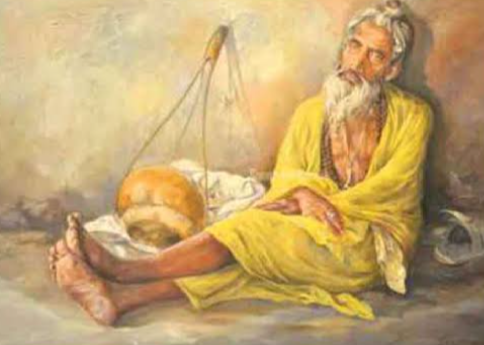
Revisiting the Life of a Renowned Bengali Sufi Saint: Lalon Fokir

Milon hobe koto dine aamar moner manushero shone, Oh aamar moner manushero shone! (When will I be united with the Man of my Heart?). ~ Lalon Shah

Also known as Lalon Fokir (a Bengali word for fakir Or saint), Lalon Shah belonged from Baul community of the 18th century Bengal. However, he’s the most respected personality of Baul community as most of the modern day Bauls are influenced from this great bard. In fact, although Baul sect had declared itself different from Sufi sect, Lalan Fokir organized the entire sect through his knowledge and poetic skills, spreading the real essence of this sect through his poetry only. He established his own hospice,which was known as Akhara that later became a tradition of the Baul sect.

Some of his major compositions are –

  • Milon Hobe Koto Dine
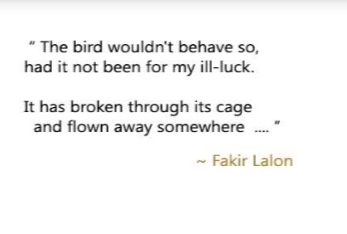
  • Khachar Bhetor Ochin Pakhi
  • Dhonno Dhonno Boli Taare
  • Jaat Gelo Jaat Gelo Bole
  • Shob Loke Koye Lalon Ki Jaat Shongshaare
  • Bhakter Daare Bandha Ache Sai
  • Dildoriyaar Majhe Dekhlam etc
Some lines of Khachar Bhitor Ochin Pakhi in English.

However, what’s not known about him is regarding his birth. It’s really not clear whether he was a Hindu or a Muslim. Moreover, an anecdote is there about him, that goes as – Lalon Fokir was born in Bhanrara village in Kushtia district in Bangladesh in 1774,where his father was Madhab Kar and mother was Padmavati. According to another tradition, he was born on 17th October 1772 in Jhinaidah village in district Harishpur ,where his father was Daribullah Dewan while his mother was Amina Khatun.

Furthermore,it is pertinent to mention that Duddu Shah, one of the key disciples of Lalon, claims that his Murshid (Lalan Fokir) had told him not to make his personal details public, but he did so after Lalon’s death. Researchers have generated a doubt over the authenticity of this poem and believe that the poem actually wanted to display Lalon as a Muslim saint.

One story narrates that Lalon, during a pilgrimage to the temple of Jagannath with his companions, got smallpox and was abandoned by his companions on the banks of the river,due to the prevailing superstitions of the era. Later, Malam Shah and his wife Matijan, members of the weaver community in a Muslim-populated village, Cheuriya, took him to their home. They gave Lalon land to live where he formed a musical organisation and composed along with performing his songs, inspired by Shiraj Sain, a musician of the same village.

A picture of Lalon Fokir sitting at rest.

It was believed that Lalon had left no written work of his songs, as they were transmitted orally to his pupils. Later, his followers compiled all his compositions and preserved them by creating some copies of the same.

Also, Lalon was one of the greatest philosophers of his time and he deliberately criticised the casteism prevailing in the society.

Last year, a three-day programme was held to commemorate the 129th death anniversary of Lalon Shah, at Chheuriya in Kushtia district (Bangladesh). In the modern scenario, a Bengali movie named “Moner Manush” was released to depict the life of Lalon Fokir. Several musicians still create a base to sing his compositions. As a matter of fact, Lalon holds a respectable position in the history of Bengal, who’s in actual sense, a reflection knowledge and philosophy, hence.

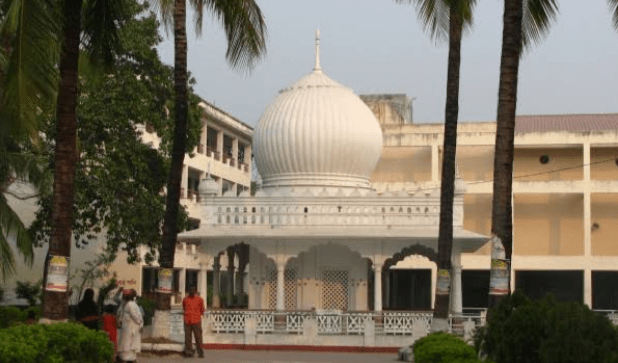
Unfortunately, the Baul king Lalon Fakir died at Chheuriya on October 17, 1890 at the age of 116 years. He was buried at his Akhara only (in Bangladesh).

Lalon Fokir’s shrine in Bangladesh.

https://thefinancialexpress.com.bd/national/country/lalon-shah-a-bard-a-philosopher-1571154750

Are blogs made out of blogs?

The tricky thing about blogging is that there’s always something stopping you. You often stare at the blank page, wondering whether what you will write will be good enough. You get distracted. Or you have this idea that you really love, but someone else is already written about it.

What is the point of blogging if someone has already covered what you want to write about? Well, here’s a thing almost all of my articles are about topics that have been already covered by others, calling them as universal topics. What I blog is the sum total of all that I have ever internalized; a bit of Tony Robins, a bit of Mark Manson and so on. There’s a fact that people cannot get enough of certain topics because they form the foundation of who we are as human beings.

Your uniqueness as a blogger is not about writing something new but it is about the perspective from which you cover those topics. No one can write in the same way as you do. I often pressure myself to be original as in one thousand person original, something out of the blue. To uncover something hidden or depths of the human soul that has been locked since eternity.

And the truth is trying to do that is a recipe of disaster. Besides, inspiration often tends to evaporate under pressure. Trying to be original is a fire way to get bankrupt in ten or less blog posts. That’s why inside of trying some fiery idea, I think about the readers out there, what is that they would like to read about. We humans get inspiration or at least we try to take some by knowing or reading someone’s journey, so I started to add myself in my blogs. It worked many of my readers could relate. You do not read my words for the information they share but the way you can derive a sense of purpose.

Blogging is a simple process. It is us; bloggers who make it seem too terrifying and complicated. A blank page gives you the freedom to create anything you want, as long as you don’t try to create everything at once, or something that no one ever created before. It is about punching the damn keys.  One word at a time.

If you need inspiration, just take a look at what people have been fascinated about since forever. Even books are made out of books, so why not blogs!

Plastic and Sustainability

The disposal of plastic has been an unsolved problem since humans began using them in large scale. The problem with plastic is it takes more than 1000 years before it disappears to another form, until then it stays as plastic. Some of the disposal methods adopted for plastic are landfills, incineration and recycling. 

LANDFILL

  Landfill is generally a place where plastics are dumped and left there indefinitely. This method is considered as the least GHG(GreenHouseGas) emitting method when compared to incineration and recycling. The landfills require a large unusable land for dumping while space  is a major issue in the urban areas.

INCINERATOR

It has become the most opted option among cities in developed countries as it consumes very less space. Some countries have resorted to utilise the heat generated for electricity production and heat applications which can be used by the residents of the city. Though it may seem to eliminate plastic from ground, it releases highly toxic gases into the atmosphere.  

RECYCLING

Recycling process involves converting plastic wastes into usable form again. This process eliminates the need for new plastic. It is more economical than the other two methods listed above. But the only disadvantage is that it still produces GHG.

Bio-plastic

Scientists tried solving this problem by replacing the conventional plastic with bio-degradable or bio-plastic. But the problem with bioplastic is they would stay intact on-ground, underground and water for several years. Because they needed a suitable environment with specified temperature , moisture and other conditions for their degradation. So, an industrial setup is needed to degrade them quickly and completely. Anaerobic degradation is one of the best methods to decompose them, in addition it produces biogas. However, one cannot use conventional industrial setup that is used for degrading other biodegradable wastes. The bioplastic usually take longer time to degrade compared to other biodegradable waste. 

What is the solution?

“Prevention is better than cure”   

At present, there is no viable solution for producing a 100% eco-friendly plastic. Stopping the usage of plastic is the only solution for our current plastic problem. A significant reduction of plastic usage can be easily attained by adopting simple change in our lifestyles.