Defamation

Defamation (sometimes known as calumnyvilificationlibelslander ) is the oral or written communication of a false statement about another that unjustly harms their reputation and usually constitutes a tort or crime.
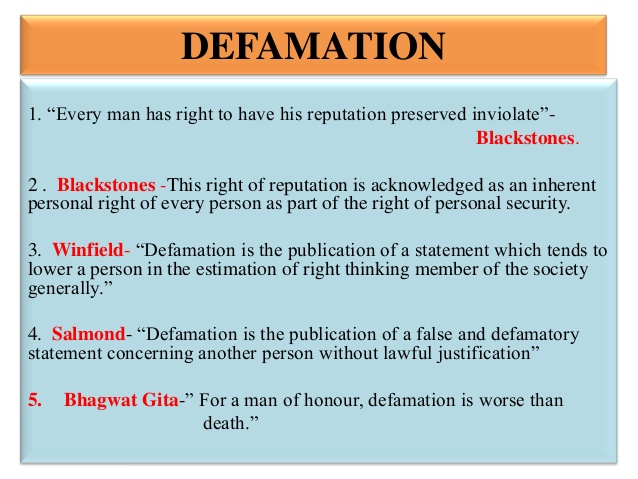
Under common law, to constitute defamation, a claim must generally be false and must have been made to someone other than the person defamed. Some commmon law jurisdictions also distinguish between spoken defamation, called slander and defamation in other media such as printed words or images, called libel.

Libel and slander are the legal subcategories of defamation. Generally speaking, libel is defamation in written words, pictures, or any other visual symbols in a print or electronic (online or Internet-based) medium. Slander is spoken defamation. The advent of early broadcast communications (radio and television) in the 20th century complicated this classification somewhat, as did the growth of social media beginning in the early 21st century.

Generally, defamation requires that the publication be false and without the consent of the allegedly defamed person. Words or pictures are interpreted according to common usage and in the context of publication. Injury only to feelings is not defamation; there must be loss of reputation. The defamed person need not be named but must be ascertainable. A class of persons is considered defamed only if the publication refers to all its members—particularly if the class is very small—or if particular members are specially imputed.

Usually, liability for a defamation falls on everyone involved in its publication whose participation relates to content. Thus, editors, managers, and even owners are responsible for libelous publications by their newspapers, whereas vendors and distributors are not.

Right to Freedom of speech and expression

Article 19 (1) (a) of the Constitution of India guarantees to every citizen of India the right to freedom of speech and expression. The Supreme Court has recognised that the liberty of press is an essential part of this freedom. Article 19 (2) of the Indian Constitution, which lists out those subjects on which reasonable restrictions can be made on the right to free speech, includes defamation. And, in India, the law recognises both civil and criminal defamation as valid restrictions.

The law on defamation

Sections 499 and 500 of the Indian Penal Code, 1860 (“IPC”) collectively criminalize defamation. Section 499 is the charging section and the punishment is prescribed under Section 500. Section 499 stipulates that whoever, by words either spoken or intended to be read, or by signs or by visible representations, makes or publishes any imputation concerning any person intending to harm, or knowing or having reason to believe that such imputation will harm, the reputation of such person, is said, except in the cases provided, to defame that person. It provides three exceptions to the offence: one, imputation of truth which public good requires to be made or published; two, public conduct of public servants; and, three, conduct of any person touching any public question.

Section 500 says that whoever defames another shall be punished with simple imprisonment for a term, which may extend to two years, or with fine, or with both. Both of these provisions were challenged as unconstitutional before the Supreme Court. However, their validity was upheld in Subramanian Swamy v. Union of India & Ors (2016). This judgment has been widely criticized, because, among other things, it ignores the chilling effect that criminalizing defamation has on free speech and the free press. The judgment also ignores the fact that in almost no other constitutional democracy is defamation a criminal offence.

But as a result of this judgment in Subramanian Swamy, and, as a result of the development of the law of criminal defamation, over the years, an onerous burden has come to be placed on persons who are charged with the offence and courts have been reluctant to quash proceedings at the first instance. At the same time, though, the scope of civil defamation in India has been narrowed with a view to advancing the value of free expression. 

In R. Rajagopal v. State of Tamil Nadu (1994). In this case, a popular Tamil magazine, Nakkheeran, field a writ petition under Article 32 of the Constitution, seeking to restrain the state government and the prison authorities from taking action that might halt the publication of an autobiography of Auto Shankar, who, while on death row, had written a letter to the magazine. Here, the Court was specifically concerned with the question of how to balance the freedom of press vis-à-vis the right to privacy of the Indian citizens. In this context, questions also arose over the scope of the right of the press to criticize and comment on the acts and conduct of public officials. The Supreme Court referred to various decisions of American courts, including New York Times v. Sullivan, on the freedom of press, and, finally, amongst other things, held that the State or its officials cannot impose a prior restraint on the press/media, and that, Government or its other organs cannot maintain a suit for damages. Through this judgment, the Court also effectively adopted the test in Sullivan for proceedings of civil defamation. This was recognised by a division bench of the Madras High Court in R. Rajagopal v. J. Jayalalitha(2006)

Women in batterfield

           In today’s world women are showing their interest in every field, especially the army Many females soldiers like Kristen Marie Griest, Jessica lynch, Lisa Jaster, Mary, Margaret Burcham, Sherri Gallagher, Lynndie England, Sabrina Harman, Megh ambuni, Michael s.jones, Linda l.singh, Mitali Madhumita, Madhuri Panikkar are showing their love towards the country by joining the battlefield. Not female army soldiers many female nurses are joining the military hospitals, Behind every successful man there is a woman”. 

         Lakshmibai, also known as rani of Jhansi, the women of every Indian’s heart and bravery.

In the year 1851, the entire country suffering for independence, the first Indian women rebel fought for independence, the name for the bravery.

    Mitali Madhumita is the first woman officer in the Indian army to receive a gallantry award and sena medal in 2011.

    Prime Minister Narendra Modi said “I am looking at women soldiers in front of me.on the battlefield at the border, this view is inspiring…..Today I speak of your glory and commend you” in Ladakh 

  Every woman in India should join the military because women are the faces of the country, people usually define women are weak and never tolerate the pain but while giving birth women are facing the pain that even a dead person can’t

 In rural towns in India are also not encouraging women because of backward and thinking of women are only fit for household works.PV Sindhu, Sudha Murthy was the inspiration for every woman

  Padma Bandopadhyay is the inspiration person because she is the first women joins India army

  India as women as prime minister, chief ministers as women but in the 150 million polluted countries, India army has only a few for the female army officers because some women are not getting chance and some women are not getting support, this makes the women far from the battlefield, Mom mission also called mars orbital mission, this mission is prepared by women of India with less cost of 450 crores, this is a big opportunity to a country.india women made mom but not war because of people thinking, everyone’s ideology is should change to make a country strong the women should be strong.

      “The bravery that you and your compatriots showed, a message has gone to the world about India’s strength… Your courage is higher than the heights where you are posted today,” PM Modi said.

     If anyone thinks women are weak, then need to know a story of Jhansi rani Lakshmi bai, on the last day of her fight for independence only 100 members left for the fight every solider ran off because of a feat but Lakshmi bai fought for freedom even she knows she will die but she never feared for her death, she fought and died as a women

               Being a woman, living like women, dying as a woman is not easy, it’s like fighting a war 

      Divya Kumar is first India women lady cadet 

Women and battlefield are not two separate words they are both are same being a woman and battlefield everything is the same in the current society, every one ideology should be change because ideology is something rules the mankind, it’s the cause of good and bad, and if it’s changed then everyone will change and we can see a new India

Let’s aim for a new India with women as an army that can change a country, that can even change a good country

    New India with new force should be the tagline for every person that can make a better country

If women won the battlefield of birth they can even win a war because wining a birth it’s not easy and winning a war is something that can win with strategy but birth can not win with any strategy 

Most of the women are fearless like stars sunny leone they even faced the camera, they do not even have fear of society if you just believe about you then you can win, if you believe others then you can win a war

Never think of society just think of yourself because society never gives respect to the feelings it just gives priority to useless knowledge,I believe women can taken this country to the next level because I believe “Behind every successful men there is a women”

The legal issue of Custodial Violence in India


The term “custodial violence” has not been defined under any law. It is a combination of two word custody and violence. The word ‘custody’ implies guardianship and protective care. Even when applied to indicate arrest or imprisonment, it does not carry any evil symptoms during custody. In a law dictionary the word ‘custody’; has been defined as charge and with regard to a person in imprisonment: judicial or penal safekeeping. As Per Chamber Dictionary, the condition of being held by the police, arrest or imprisonment is called ‘custody’. As Per Legal Glossary Dictionary, custody is imprisonment, the detaining of a person by virtue of lawful Power or authority.

Section 167 of the Code of Criminal Procedure speak about two type of custody i.e. police custody and judicial custody. As per section 167(1) of Cr. P.C., “the magistrate to whom an accused person is forwarded under this section may whether he has or not has jurisdiction to try the case, from time to time, authorize the detention of the accused in such custody as he may think fit. Provided that the magistrate may authorize the detention of the accused person, otherwise than in the custody of the police, beyond the period of 15 days if he is satisfied that adequate ground exist for doing so. So as per section 167 (1) of Cr. Pc. ‘police custody’ can be granted for a maximum period of fifteen days only’ Police custody basically means police remand for the purpose of interrogation. In law actually a police officer has two occasion to keep a person in its custody firstly, from the period when he arrest a person till he produce the said person in the court i.e. first 24 hours of the arrest of accuse. Secondly, when police gets, remand from court after producing the accuse in the court which can be extend up to a maximum period fifteen days, thereafter, a person is sent in judicial custody which in general terms means jail or prison, where an accuse remain in custody till he gets bail or if convicted and sentenced to jail till the completion of sentence. As per law, ‘custody’ of a person begins when the police arrest him.

Other type of custody as mentioned earlier is ‘judicial custody’ which means sending a person in jail or prison. As per section 3 (1) of ‘The Prison Act, 1894’, ‘Prison’ means any jail or place used permanently or temporarily under the general or special order of a State Government for the detention of prisoners and include all land and building appurtenant thereto, but does not include:-

(a) Any place for the confinement of prisoners who are exclusively in the custody of police; or
(b) Any place specially appointed by State Government under section 541 of the old Criminal Procedure Code, 1882,
(c) Any place, which has been declared by the State Government by general or special order to be subsidiary jail.

The term ‘violence’ is the state or quality of being violent, excessive unrestraint or unjustified force, outrage perforate injury. ‘Violence’ in its literal sense has been defined as the use of force by one person over another so as to cause injury to him. The injury may be physical, mental or otherwise. The simple definition of violence is behaviour designed to inflict injury on a person or damage to property. Custodial violence is a term, which is used for describing violence committed against a person by a police authority. Thus, custodial violence can be defined as “an inhuman trait that springs out of a perverse desire to cause suffering when there is no possibility of any retaliation; a senseless exhibition of superiority and physical power over the one who is overpowered.” According to Law Commission of India, crime by a public servant against the arrested or detained person who is in custody amounts to custodial violence. According to Dr. S. Subramaniam, “Any use of force threat psychological pressure is termed as custodial violence. According to Justice B.P. Jeevan Reddy, “Custodial violence includes torture, death, rape and excessive beating in police custody”.

Although, overcrowding, malnutrition, unhygienic conditions and lack of medical care are some of the factors of death in police and judicial custody, but custodial violence remains the common cause of deaths in prisons and lock-ups. The custodial violence is a generic term and includes all and every type of torture, third degree, harassment, brutality, use of force not warranted by law, etc. custodial violence include illegal detention, arrest which is wrongful or on illegal or on insufficient grounds using third degree method, on the suspects, humiliating them, using filthy language, not allowing them to sleep, extorting confession under pressure, padding up of additional evidence, misuse of the power regarding handcuffing not allowing to meet counsel or family member to accuse, denial of food etc. However since the torture or third degree in the most common and prominent form of custodial violence by the police.

The police officials commit an act of violence upon the persons in their custody under the guise of investigation and interrogation. The heinousness of this crime is that it is committed upon the citizens by the very person who is considered to be the guardian of the citizens. It is committed under the shield of uniform and authority within the four walls of Police Station or lock up, the victim being totally helpless in these circumstances. The protection of an individual from torture and abuse of power by police and other law enforcing officers is a matter of deep concern in a free society.

The chances of violence committed by police on persons in its custody are much greater than any other form of violence. The basic reason behind it is that the victims of such violence are unable to protest against it. The police officers use their official position to manipulate evidences against themselves. Death in custody is generally not shown on the records of the lock-up and every effort is made by the police to dispose of the body or to make out a case that the arrested person died after he was released from jail. Any complaint against torture is not given attention because of ties of brotherhood. No direct evidence is available to substantiate the charge of torture or causing hurt resulting into death, as the police lock- up where generally torture or injury is caused is away from public gaze and the witnesses are either policemen or co-prisoners who are highly reluctant to appear as prosecution witness due to fear of retaliation by the superior officers of the police.

However, in spite of the Constitutional and Statutory provisions contained in the Criminal Procedure Code and the Indian Penal Code aimed at safeguarding personal liberty and life of a citizen, the growing incidence of torture and deaths in police custody has been disturbing. Experience shows that the worst violations of human rights take place during the course of investigation when the police, with a view to securing evidence or confessions, often resort to third-degree methods including torture and techniques of arrests by either not recording them or describing the deprivation of liberty merely as “prolonged interrogations”. A reading of the morning newspapers carrying reports of dehumanising torture, assault, rape and death in police custody or other governmental agencies almost every day is, indeed, depressing. The increasing incidence of torture and death in custody has assumed such alarming proportions that it is affecting the credibility of the rule of law and the administration of the criminal justice system. As a result the society rightly feels perturbed. The society’s cry for justice becomes louder.

Any form of torture or cruel, inhuman or degrading treatment, whether it occurs during investigation, interrogation or otherwise needs the severest condemnation. If the functionaries of the Government become law-breakers, it is bound to breed contempt for the law and no civilised nation can permit that to happen. Custodial violence may be both physical and or mental. It may also consist of gross negligence or deliberate inaction. In a case, when a person was suffering from high blood pressure or similar type of disease, almost for which continuous medicine is essential, and he is not allowed to take medicines the men develop serious health problem or dies. The Apex Court held it to be a case of custodial violence and the State was made liable for damages for their gross negligence in protecting the person in custody.

Steps to finding the Right Career for You

While it will likely change over time, focusing on a certain career path can help inform your decisions about your professional growth as you gain skills and experience. It’s important to reflect on your interests, skills and career goals as you make certain life choices such as which school to apply for, which entry-level job is right for you, whether to get a post-graduate degree or specialized certification and more.

In this article, I will focus on how to identify your key skills and interests, match those qualities to a potential job field and start a career.

1- WRITE DOWN CAREER GOALS

Before selecting a career, start with self-reflection by asking and answering certain questions. Active reflection helps narrows your choices into something more specific.

Consider asking yourself:

  • What do I want from my career?
  • What are my core values?
  • What activities do I most enjoy, professionally or in my free time?
  • What are my interests?
  • What are my strengths and aptitudes? Soft skills? Hard skills?
  • Do I want to specialize in certain technical skills or take on management roles?

Once you answer questions like these (and any others that are important to you), you can better research potential careers paths. It’s also important to revisit your career goals as you grow personally and professionally to ensure your goals remain achievable and aligned with your interests.

2- Set one short term & one long term goal

Once you have narrowed down your options, consider establishing milestones for your career. Research where other people in your field are at five or ten years into their career, and make note of the job titles they have. Decide what title or advancements you want to have at these future points. Then research what you can do to reach those goals. You may need to undergo training programs, take on specific responsibilities or hold prerequisite positions.

By establishing career goals five or ten years in the future, you can plan based on what progress you should expect every year. Schedule time regularly to reflect on your career and goals.

3- Identify your Personality Type

A personality type is a set of personality traits that can be grouped together. There are multiple methods for discovering your personality type, many of which focus on your responses to different situations. Different personality types may naturally gravitate toward different interests and develop different strengths, including careers.

Different tests list common career choices for each personality type. If you take a variety of tests and one or two careers appear across multiple tests, that specific career is likely worth researching.

4- Did you enjoy your previous job/internship?

Your job satisfaction in previous roles can also help guide your career choices. Identify trends in your previous positions, such as focusing on a specific technical skill. Also, review your job history to identify positions that you felt fulfilled in.

5- Educate yourself with the Job requirements – skills, knowledge, interests,etc

Many jobs have specific education requirements for applicants and new hires, such as obtaining a high school diploma, completing a bachelor’s degree program or having a master’s degree. Some positions also require applicants to have their degrees in a specific field related to the position.

Review the education requirements for jobs you are interested in, and apply for jobs that accept your current level of education or research additionally degrees or certifications you may need.

6- Work on gaining expertise in the skills you already possess

Make a list of your current skills, certifications and areas of expertise. Also ask for feedback about your technical, interpersonal and people management skills from coworkers and colleagues. This evaluation can help you find careers that match what you are best at.

7- If you can choose your interest as your career,what will it be?

Depending on your personality, you may have interests that lend themselves to different careers. Examine your hobbies, past volunteer experiences and interests to identify activities or fields you enjoy. While this information is outside of a professional context, creating a list of activities you like can help you focus a career search. For example, you may enjoy a career in cybersecurity if you enjoy logic puzzles, or you may enjoy a traveling sales role if you like meeting new people.

Use this knowledge to apply for short-term positions or volunteer opportunities to explore new career options. This first-hand experience allows you to test your suitability for a career. If you are currently in school or have a job, consider taking a course or certification program that is required for a field that interests you. This experience can help you determine if the career’s skills and content are something you enjoy.

8- Consider your salary needs

Depending on your lifestyle, you may require a certain salary. Find average salaries by job title, company and location on salaries. This can be a good starting point for determining how much money you may have when first starting out, as well as your earning potential after you’ve gained a certain amount of time and experience. While salary certainly does not equal an engaging, satisfying job, it is an important factor to consider when mapping out your career path.

Make your body your slave

Here , the thing comes into mind from  the phrase ‘make your body your slave ‘ is obesity. Its a very complex disease which stores excessive fats in your body. So it gives a bad outlook and not only that  it also increases your risk  of other diseases like  heart disease, cancer, diabetes, high blood pressure. Excess weight may  led to  short and long -term health problems for you and  your child. It turns a young person also into older outlook.

Body mass index is one which tells whether you are having normal weight or overweight or obesity. It    declares by measuring your weight  in relation to  your weight.
Lets see the chart –
Normal range -18.5 to  24.9(Bmi)
Overweight-25 to 29.9(Bmi)
Obesity-30 or higher (Bmi)
Along with BMI ,  there also exists  waist size   ,if there is increase in waist size ,there will be increase in health risks  more than any other part . Women should have less than 35 waist and men should have  less than 40  waist.
Health issues- 

1.  You will be shocked to know almost  87% of patients with obesity or overweight are having diabetes. Makes Insulin  hormone resistant , Insulin carries sugar from blood to cells which is used for  energy. This may give rise to high blood pressure 
2. Obesity may led to  more likely to high blood pressure, abnormal cholesterol levels  which are led to heart diseases and  stroke.
3.obesity increase your chance for cancer in cervix, ovary , uterus,breast , colon , rectum ,etc.
4. Digestive problem- obesity increases likelihood that you’ll develop gallbladder,liver diseases.
5. sleep apnea,  it means breathing starts and stops.
6. Women may suffer from infertility, pcos, irregular periods.
7. Osteoarthritis  due to gain of weight.

Mentally disable – aside from health issues and dangers , it also effect physically , that is shame and guilt, fatigue, sex problems, depression.

Prevention from this curse– 
 Well its really tough, one have to wait year after year to  try to bring oneself  a perfect shape and diseases risk free. the way to lose weight is similar to gaining wait. One should go for morning walk. 150 to 300 minutes exercise training to get result and sweat shall fall. Can go for skipping , brisk climbing ,swimming.
.can  focus on low calories and low fat transfer foods like oats, fruits , vegetables. choosing food is very important to  keep one’s body healthy.
 Exercise and dieting are best to work in this ground . so focus on this.
 Until it gives pain its not working. Choose wisely to look young or older  and have more disease risk or have a healthy life. Our lifestyle responsible for everything.

DEFAMATION

Introduction 

Every Person has right to maintain and preserve his reputation. The Right of reputation is more valuable than right to property. Law gives protection to a man’s reputation. Chapter XXI, Section  499 to 502 of Indian Penal Code relates to offenses of Defamation. 

Meaning of Defamation 

   When injury caused to the reputation of a person it can be termed as defamation. Defamation is both a crime and civil wrong

Definition of defamation

Section 499 of Indian Penal Code defines defamation with for Explanations and ten exceptions and number of illustrations

 Defamation 

 “whoever by words either spoken or intended to be read, or by signs or by visible representations, makes or publishes any imputation concerning any person intending to harm, or knowing or having reason to believe that such imputation will harm, the reputation of such person, is said, except in the cases hereinafter excepted, to defame that person.

The definition of the Defamation contains three essential elements

i) the person

ii) his reputation, and

iii) the harm to reputation of the person with necessary mens rea  (guilty mind)

Essential Ingredients

                         The offence of defamation consists of the following essential Ingredients :

1) Making or Publishing of an Imputation concerning person. 

2) Such Imputation must have made by

     i) words either Spoken or

     ii) signs or

     iii)  visible representations;

3)  offender intends to harm, or knows or has reson to believe that such imputation will harm the reputation of that person.

Explanations 

  1. It may amount to defamation to impute anything to a deceased person, if the imputation would harm the reputation of that person if living, and is intended to be hurtful to the feelings of his family or other near relatives.
  2. It may amount to defamation to make an imputation concerning a company or an association or collection of persons as such.
  3. An imputation in the form of an alternative or expressed ironically, may amount to defamation.
  4. No imputation is said to harm a person’ reputation, unless that imputation directly or indirectly, in the estimation of others, lowers the moral or intellectual character of that person, or lowers the character of that person in respect of his caste or of his calling, or lowers the credit of that person, or causes it to be believed that the body of that person is in a loathsome state, or in a state generally considered as disgraceful.

Examples 

  1. A says-“Z is an honest man; he never stole B’ watch”, intending to cause it to be believed that Z did steal B’ watch. This is defamation, unless it fall within one of the exceptions.
  2. A is asked who stole B’ watch. A points to Z, intending to cause it to be believed that Z stole B’ watch. This is defamation, unless it fall within one of the exceptions.
  3. A draws a picture of Z running away with B’ watch, intending it to be believed that Z stole B’ watch. This is defamation, unless it fall within one of the exceptions.

Exceptions 

1) Imputation of truth which public good requires to be made or published –

                  It is not defamation to impute anything which is true concerning any person, if it be for the public good that the imputation should be made or published. Whether or not it is for the public good is a question of fact.

2) Public conduct of public servants – 

                   It is not defamation to express in good faith any opinion whatever respecting the conduct of a public servant in the discharge of his public functions, or respecting his character, so far as his character appears in that conduct, and no further.

3) Conduct of any person touching any public question. –

                   It is not defamation to express in good faith any opinion whatever respecting the conduct of any person touching any public question, and respecting his character, so far as his character appears in that conduct, and no further.

Example

It is not defamation in A to express in good faith any opinion whatever resepting Z’ conduct in petitioning Government on a public question, in signing a requisition for a meeting on a public question, in presiding or attending at such meeting, in forming or joining any society which invites the public support, in voting or canvassing for a particular candidate for any situation in the efficient discharge of the duties of which the public is interested.

4) Publication of reports of proceedings of courts –

                 It is not defamation to publish a substantially true report of the proceedings of a Court of Justice, or of the result of any such proceedings.

         Explanations – A Justice of the Peace or other officer holding an inquiry in open Court preliminary to a trial in a Court of Justice, is a Court within the meaning of the above section.

5) Merits of case decided in Court or conduct of witnesses and others concerned –

                  It is not defamation to express in good faith any opinion whatever respecting the merits of any case, civil or criminal, which has been decided by a Court of Justice, or respecting the conduct of any person as a party, witness or agent, in any such case, or respecting the character of such person, as far as his character appears in that conduct, and no further.

Examples – 

a) A says-“I think Z’ evidence on that trial is so contradictory that he must be stupid or dishonest.” A is within this exception if he says this in good faith, inasmuch as the opinion which he expresses respects Z’ character as it appears in Z’ conduct as a witness, and no farther.

b) But if A says-“I do not believe what Z asserted at that trial because I know him to be a man without veracity”; A is not within this exception, inasmuch as the opinion which expresses of Z’ character, is an opinion not founded on Z’ conduct as a witness.

6) Merits of public performance –

                    It is not defamation to express in good faith any opinion respecting the merits of any performance which its author has submitted to the judgment of the public, or respecting the character of the author so far as his character appears in such performance, and no farther .

Explanation  –

          A performance may be submitted to the judgment of the public expressly or by acts on the part of the author which imply such submission to the judgment of the public .

Examples –

a) A person who publishes a book, submits that book to the judgment of the public.

b) A person who makes a speech in public, submits that speech to the judgment of the public.

c) An actor or singer who appears on a public stage, submits his acting or singing to the judgment of the public.

d) A says of a book published by Z -“Z’ book is foolish; Z must be a weak man. Z’ book is indecent; Z must be a man of impure mind.” A is within the exception, if he says this in good faith, inasmuch as the opinion which he expresses of Z respects Z’ character only so far as it appears in Z’ book, and no further.

e) But if A says -“I am not surprised that Z’ book is foolish and indecent, for he is a weak man and a libertine.” A is not within this exception, inasmuch as the opinion which he expresses of Z’ character is an opinion not founded on Z’ book.

7) Censure passed in good faith by person having lawful authority over another –

                         It is not defamation in a person having over another any authority, either conferred by law or arising out of a lawful contract made with that other, to pass in good faith any censure on the conduct of that other in matters to which such lawful authority relates .

Example –

       A Judge censuring in good faith the conduct of a witness, or of an officer of the Court; a head of a department censuring in good faith those who are under his orders; a parent censuring in good faith a child in the presence of other children; a schoolmaster, whose authority is derived from a parent, censuring in good faith a pupil in the presence of other pupils; a master censuring a servant in good faith for remissness in service; a banker censuring in good faith the cashier of his bank for the conduct of such cashier as such cashier are within this exception .

8) Accusation preferred in good faith to authorized person –

                       It is not defamation to prefer in good faith an accusation against any person to any of those who have lawful authority over that person with respect to the subject-matter of accusation .

Example – 

       a) If A in good faith accuses Z before a Magistrate; if A in good faith complains of the conduct of Z, a servant, to Z’ master;if A in good faith complains of the conduct of Z, a child, to Z’ father-A is within this exception .

9) Imputation made in good faith by person for protection of his or other’ interests –

                         It is not defamation to make an imputation on the character of another provided that the imputation be made in good faith for the protection of the interest of the person making it, or of any other person, or for the public good.

Examples 

a) A, a shopkeeper, says to B, who manages his business-“Sell nothing to Z unless he pays you ready money, for I have no opinion of his honesty.” A is within the exception, if he has made this imputation on Z in good faith for the protection of his own interests.

b) A, a Magistrate, in making a report to his own superior officer, casts an imputation on the character of Z. Here, if the imputation is made in good faith, and for the public good, A is within the exception.

10) Caution intended for good of person to whom conveyed or for public good –

                      It is not defamation to convey a caution, in good faith, to one person against another, provided that such caution be intended for the good of the person to whom it is conveyed, or of some person in whom that person is interested, or for the public good.

Punishment for defamation (Section 500 I.P.C) –

       Whoever defames another shall be punished with simple imprisonment for a term which may extend to two years, or with fine, or with both.

        The offence under Section 500 is non-cognizable, bailable, compoundable, with the permission of the Court, and triable by the Court of Session.  

 Printing or engraving matter known to be defamatory Section 501 – 

           Printing or engraving matter known to be defamatory – Whoever prints or engraves any matter, knowing or having good reason to believe that such matter is defamatory of any person, shall be punished with simple imprisonment for a term which may extend to two years, or with fine, or with both.

Sale of printed or engraved substance containing defamatory matter Section 502 – 

          Sale of printed or engraved substance containing defamatory matter – Whoever sells or offers for sale any printed or engraved substance containing defamatory matter, knowing that it contains such matter, shall be punished with simple imprisonment for a term which may extend to two years, or with fine, or with both.

    The offence under section 502 is non-cognizable, bailable, compoundable and triable by the Court of Session

Succession Planning

One of the hardest task of an HR manager in any organization is talent management. It is the process of identifying the existing talent in the organization and then assessing the talent needs, followed by talent acquisition, talent engagement and finally by talent retention. The hardest part of this is not the process of talent acquisition or engagement, but rather it is the supply of talent itself. Most of the business and operating managers are of the notion that there exist an ample amount of talent in the labour market and that talent identification or acquisition would be easy. But the bitter truth is that, talent with the specific skill set and qualities is in scarce quantity in the talent market and thus the talent acquisition strategies should be very streamlined and well-defined so as not to lose out on the desired candidates. But on top of all this, one very important way that should be followed by each and every organization is Succession Planning.

Succession Planning is the process of identification and development of new leaders, usually at the executive level, with the intention to replace the old leaders when they die, retire or they leave the organization abruptly. This is a practice which is followed so that the existing capable leaders develop themselves so that they can assume the positions of the higher authorities as and when that become vacant. Succession planning is extremely important in an organization because of multiple reasons:

  1. Talent resource with the desired skill set is very scarce in the labour market.
  2. If an executive leaves the organization abruptly, there would be no qualified candidate to become the successor of the vacant position.
  3. Even if a candidate is selected to fill the vacant position, there would be loss in terms of acquisition costs, loss of productivity and hence un-productive costs and then the cost of upskilling among the few direct costs.

Considering the fact that talent is scarce in this unpredictable talent market, it is important for every organization to take strategic decisions as to how to implement the succession planning. It is a way by which an organization can plan for the future in case of uncertain events.

Now, while planning on how to conduct succession planning, an organization can follow a few steps. Some of the steps are:

  1.  At first, try to understand that how the organizational structure is going to be affected if some executive at the key position abruptly leaves the organization. And then while charting out the organizational hierarchy structure, identify the employees who play a critical role in the organization.
  2. Try to identify which are the key positions in your organization which if left vacant even for a single day will create a he dent in your organization.
  3. Scanning the organizational hierarchy, try to identify the top and the bottom players, by looking at their performance records, their career growth and majorly by discussing with their managers.
  4. For any single key position, always try to keep more than one option open.
  5. One of the most crucial step is to communicate who is selected and what is the purpose of selection. This communication should be done to both the new selects as well as the key position holders.
  6. After selection of the individuals, provide them the required training so as to make them ready to occupy the upper positions as and when required.

These is the backbone of succession planning which should be followed by every organization so that the entire organizational structure does not crumble down for a key member leaving the organization.

Source: https://www.insperity.com/blog/5-ways-your-org-chart-can-kick-start-your-succession-plan/

Quality of Work Life

Quality of work life is very important for employee because employee work in which era and society . If the employees work more times in the office and after that they not have enough time to spend with their family , have not good relationships with their colleagues and employers it’s affect the employee’s quality of work life. It’s affects the working in the office and it’s upset mentally to employee.

Some knowledge workers work for more than 60 hours a week. As a result of this, their personal hobbies and interests clash with their work. Life is a bundle that contains all the strands together and hence the need to balance work life with other related issues.’ One must have both love and work in one’s life to make it healthy. Gone are the days when the priority of employees used to be for physical and material needs. With the increasing shift of the economy towards knowledge economy, the meaning and quality of work life has undergone a drastic change.

MEANING OF QUALITY OF WORK LIFE

Quality of work life refers to the favourable favourableness or unfavourable unfavourableness of a job environment for the people working in an organisation. The period of scientific management which focused solely on specialization and efficiency , has undergone a revolutionary change.

The traditional management inadequate ttention to human values. In the present senario , needs and aspirations of the employees are changing . Employers are now redesigning job for better quality of work life .

# The QWL as strategy of Human Resource Management has assumed increasing interest and importance. Many other terms have come to be used interchangeably with QWL such as ‘humanisations of work’ ‘quality of working life, ‘industrial democracy’ and ‘participative work’.

# “Quality of work life is based on a general approach and an organisation approach. The general approach includes all those factors affecting the physical, social economic, psychological and cultural well-being of workers, the organisational approach refers to the redesign and operation of organisations in accordance with the value of democratic society.”

“The overriding purpose of QWL is to change the climate at work so that the human-technological-organisational interface leads to a better quality of work life.”

Quality is work life involves three major parts :

Occupational health care : Safe work environment provides the basis for people to enjoy his work. The work should not pose health hazards for the employees.

Suitable work time: Companies should observe the number of working hours and the standard limits on overtime, time of vacation and taking free days before national holidays.

Appropriate salary: The employee and the employer agree upon appropriate salary. The Government establishes the rate of minimum salary ; the employer should not pay less than that to the employee. Work represent a role which a person has designated to himself. On the other hand, work earns one’s living for the family , on the other hand it is a self realization that provides employment and satisfaction.

work life quality- defined as the balance between an employee’s work demands and outside interests or pressures – is a long – standing but ever- evolving area of corporate social responsibility . Some organisations view QWL as important, but do not formally link it to their strategic or business plans.

Some people by nature are not committed to anything and anyone and as such they would not be committed to their employers also. Commitment is an attitude and those who lack it will not be committed to their jobs.

Importance of quality of work life

▪︎Enhance stakeholder relations and credibility

▪︎Increase Productivity

▪︎Attractions and retention

▪︎Reduces absenteeism

▪︎Improve the quality of working lives

▪︎Beneting families and communities

▪︎Job involvement

▪︎Job satisfaction

▪︎Company reputation

Significance of good quality of work life:

# Decrease absenteeism and increase turnover

# Less number of accidents

# Improved labour relations

# Employee personification

# Positive employee attitudes toward thei work and the company.

# Increase productivity and intrinsic motivation

# Employee gain a high sense of control over their work

Problems in improving the quality of work life:

These problems may occur because of:

poor reward and recognition: People will not do their best when they feel that employers’ commitment in terms of reward and recognition is lacking. Commitment is a mutual phenomenon. When employers want to get the best from employees but do not give them reward and recognition, people will not be committed to work.

Dead-end jobs: Work which does not offer opportunities for growth and promotion is one of the greatest reasons for employees’ de-motivation and non-commitment. Jobs which deprive employees of self-development and growth opportunities lead to high dissatisfaction and disloyalty.

Managing by intimidation : Mistreating people and managing them by threats and embarrassment leads to employees’ dissatisfaction and weakens their commitment. In a best seller book” The Loyalty Link” Dennis G. Mc Carthty has identified managing by intimidation as one of the seven ways which undermine employees’ loyalty.

Negative working environment: Non-acceptance by colleagues, non-cooperation, too much politics, and negative behaviour by colleagues, supervisors and other people in the company also hamper commitment. At the end of the day people want peace of mind, which if not available in the work environment will discourage them to show total support to the company.

No job security: One of the major needs of employees is job security. If the employee feels that he can lose his job anytime, he would not be committed towards company’s goals.

Negative attitude: Some people by nature are not committed to anything and anyone and as such they would not be committed to their employers also. Commitment is an attitude and those who lack it will not be committed to their jobs.

India’s Shifting Export Market and Global Economy Change Under Pandemic

India the only major Asian economy that’s grown its export share since the start of the tariff wars in 2018 is the one with the fewest trade links to China. India’s share of world exports rose to 1.71% in the first quarter of 2019 from 1.58% in the fourth quarter of 2017, data compiled by Bloomberg show. The share of every other economy among Asia’s 10 biggest exporting nations fell in the same period.

The two largest goods traded by India are mineral fuels (refined or unrefined) and gold (finished gold ware or gold metal). In the year 2013-14, mineral fuels (HS code 27) were the largest traded item with 181 billion USD worth imports and 64.685 billion USD worth re-exports after refining. In the year 2013-14, gold and its finished items (HS code 71) were the second largest traded items with 58.465 billion USD worth imports and 41.692 billion USD worth re-exports after value addition. These two goods constitute 53 per cent total imports, 34 per cent total exports and nearly 100 per cent of total trade deficit (136 billion USD) of India in the financial year 2013-14. The services trade (exports and imports) are not part of commodities trade. The trade surplus in services trade is 70 billion USD in the year 2017-18.

Part of the reason for India’s outperformance is that it’s not as integrated into global manufacturing supply chains as peers, which means exporters are cushioned from rising trade tensions in the region.

It’s a sentiment that was flagged by central bank Governor Shaktikanta Das in an interview.

“India is not part of the global value chain,” he said. “So, U.S.-China trade tension does not impact India as much as several other economies.”

China is the biggest buyer of goods from South Korea and Japan, whose share of world exports have fallen the most in Asia. For India, China is the third-largest market, after the U.S. and the U.A.E.

“Our biggest advantage is that our product basket and market basket are both quite diversified,” said Rakesh Mohan Joshi, a professor at the Indian Institute of Foreign Trade in Delhi.

Trade tensions between the U.S. and China have given India an opportunity to ramp up exports to both countries, according to Ajay Sahai, director general and chief executive officer of the Federation of Indian Export Organisations.

India’s exports to the U.S. grew at the fastest pace in six years in the year ended March 2018, while exports to China surged 31%, the second highest annual pace of growth in more than a decade, data from India’s Ministry of Commerce show.

“China is more willing to give market access to India than ever before,” said Sahai, pointing to increased access for products such as rice, fruits and vegetables, with potential for greater exports of pharmaceuticals and automobile components to China.

On the other hand, India’s exports to the U.S. could lose momentum. President Donald Trump has criticized India for its tariffs on U.S. products, and withdrew trade concessions on $6.3 billion of Indian goods on June 1. India responded with higher tariffs on about 30 American products.

India stands at number 16 in the list of global trading partners and the nation is running with its pace to reach under top 10 in the list but the covid-19 pandemic has hit not just Indian economy but the entire world economy. The all of world would take steep financial dive with this epidemic before reaching on its initial status, till then let’s hope for the betterment of not just India, but the whole of world and the severely impacted victims of this contagious virus.

Most frightening moments

MOMENT 1:

The doctor said I had three more hours.
I think I was stabbed, I don’t remember much. Nevertheless, I was at my home. I was going to take a bath. Something didn’t add up. I then woke up
I still felt the pain. Fear gripped me.
I was frightened that this might come to pass

MOMENT 2:

Dogs were crying, Cricket was on peak
Ticking of clock, Subtle BREATHING
Silence EVERYWHERE, Not in my heart, it was beating, STILL postures, Pointed look of eyes, Somewhere in the air
LIFE was LOST.

MOMENT 3:

I had never been more frightened than when I noticed I was walking alone and felt someone followed me. I hurriedly climbed the stairs with bags full of weekly groceries and went straight into the kitchen. No one are at home back home and I was expecting my father and mother in some time from their evening walk and as usual would expect the soup and salad immediately, followed with regular dinner. I suddenly felt silence all over and heard noise from my lift but ignored it. The fear wasn’t subsiding, I entered my room to safe guard myself . To my horror, It was my parents who are in the lift.

MOMENT 4:

I have never been more frightened than when, I remember was a kid playing at home, my mumma was taking afternoon nap and suddenly when I opened window I saw a big cat which was about to attack me.
That dreadful and cruel look of cat is still in my mind and always reminds me of that incidence whenever I see a cat.
“Ailurophobia is now part of my life”

MOMENT 5:

I had never been so frightened than the day I was standing alone among the gushing crowd of people! I felt as if I’m alone as I missed my 3 years old younger brother in the exhibition!

I still remember my promise to my aunt, “Don’t worry aunt, I will take care of him to the fullest! The exhibition might be crowded but my eyes will be fixed on him… Please send him with me!”

But now I feel like I can’t move to search for him. The feel of ‘he is gone forever’ never leaves my anxious heart! Nobody is here for me among the hundreds around me! My God! Am I still alive?

Child Labour

Child labour is a term you might have heard about in news or movies. It refers to a crime where children are forced to work from a very early age. It is like expecting kids to perform responsibilities like working and fending for themselves. There are certain policies which have put restrictions and limitations on children working.
The average age for a child to be appropriate to work is considered fifteen years and more. Children falling below this age limit won’t be allowed to indulge in any type of work forcefully. Why is that so? Because child labour takes away the kids opportunity of having a normal childhood, a proper education, and physical and mental well-being. In some countries, it is illegal but still, it’s a far way from being completely eradicated.

Causes of Child Labour
Child Labour happens due to a number of reasons. While some of the reasons may be common in some countries, there are some reasons which are specific in particular areas and regions. When we look at what is causing child labour, we will be able to fight it better.
Firstly, it happens in countries that have a lot of poverty and unemployment. When the families won’t have enough earning, they put the children of the family to work so they can have enough money to survive. Similarly, if the adults of the family are unemployed, the younger ones have to work in their place.
Child labour is a term you might have heard about in news or movies. It refers to a crime where children are forced to work from a very early age. It is like expecting kids to perform responsibilities like working and fending for themselves. There are certain policies which have put restrictions and limitations on children working.

Health benefits of various juices.

We get various nutrients by drinking fresh fruit juices or vegetable juices. The daily needs of minerals, vitamins, fiber and antioxidants can be fulfilled by having these juices. Also, drinking juices increases our metabolism and helps in weight loss.

Fiber burns fat and helps in weight loss. You will be surprised to know that vegetables that have high fiber content absorb water from the body and helps indigestion. Along with this, you will not feel hungry for long time. Consuming juices of many vegetables and fruits is beneficial for burning calories and weight loss.

Orange juice: Fresh orange juice not only tasty, it can also be helpful in reducing your weight. Orange is also called anti-calorie fruit because it has very few calories and drinking it provides many benefits to the body.

Bitter gourd juice: Drinking Bitter Gourd Juice helps us to increase the metabolism. Also, bitter gourd helps in keeping our weight under control due to being a low-calorie food.

Cucumber Juice: This vegetable contains a lot of water and hence, cucumber keeps the body hydrated. Also, due to being a low-calorie food this juice makes you feel full for a long time. So, you don’t have any unhealthy cravings.

Pomegranate juice: Pomegranate contains antioxidants and polyphenols. Therefore, it is considered to increase metabolic rate, decrease appetite, and burns fat.

Pineapple juice: Pineapple juice is rich in nutrients. This is considered good for gym lovers, people can have it after their workouts. In it, elements called vitamin C and bromillian are found. which, reduces inflammation of the body.

Poverty; the silent killer of Indian society

Haven’t we heard this word too often or have we stopped listening? We have all felt a shortage of cash at times. That is an individual experience. It is not the same as the social problem of poverty. While money is a measure of wealth, lack of cash can be a measure of lack of wealth, but it is not the social problem of poverty.

Poverty as a social problem is a deeply embedded wound that permeates every dimension of culture and society. It includes sustained low levels of income for members of a community. It includes a lack of access to services like education, markets, health care, lack of decision making ability, and lack of communal facilities like water, sanitation, roads, transportation, and communications. Furthermore, it is a “poverty of spirit,” that allows members of that community to believe in and share despair, hopelessness, apathy, and timidity. Poverty, especially the factors that contribute to it, is a social problem, and its solution is social

Poverty is a peculiar problem from which various countries of the world, particularly the Third World, have been suffering. There cannot be a common definition of poverty which can be broadly accepted everywhere. Thus there are large differences between the definitions of poverty accepted in various countries of the world.

Poverty is considered as the greatest challenge faced by the societies in the third world countries. Poverty is also concerned with the comparison with respect to a fixed line—known as poverty line. However, the poverty line is fixed extraneously and, therefore, remains fixed for a certain period.

Poverty Line:

Normally poverty is defined with poverty line. Now the question which is relevant at this point is what the poverty line is and how is it fixed? The answer to the question is that the poverty line is a cut-off point on the line of distribution, which usually divides the population of the country as poor and non-poor.

Accordingly, people having income below the poverty line are called poor and people with income above poverty line are called non-poor. Accordingly, this measure, i.e., the percentage of people living below the poverty line is known as head count ratio.

In India, broadly accepted definition of poverty emphasises more on minimum level of living rather than on reasonable level of living. Accordingly, it is broadly agreed that poverty can be termed as a situation where a section of the population fails to reach a certain minimum consumption standard. Differences arise with the fixing of this minimum consumption standard.

After a thorough examination, the study group set up by the Planning Commission in July 1962 recommended a standard of private consumption expenditure of Rupees 20 (at 1960-61 prices) per capita per month as the bare minimum amount common to both rural and urban areas.

Top 7 Causes of Poverty in India

1. Lack of Inclusive Economic Growth:

The first important reason for mass poverty prevailing in India is lack of adequate economic growth in India. In the first three decades of planned development (1951-81) in India, annual average growth in national income had been 3.6 per cent. With 2.1 per cent per cent per annum growth in population, per capita income grew by only 1.5 per cent per annum during this period. In addition, with the increase in saving rate from about 9 per cent in 1950-1951 to 20 per cent of GDP in 1979-80, increase in per capita consumption expenditure was too small to make any significant dent on the problem of poverty. Besides, because of prevailing income inequalities per capita consumption expenditure of the poor could have hardly risen.

2. Sluggish Agricultural Performance and Poverty:

Many economists have pointed out that in the year of good agricultural output, poverty ratio declines. Good performance in agriculture leads to more employment opportunities and fall in prices of food grains. More employment opportunities and lower food price cause poverty ratio to decline. The experience of Punjab and Haryana shows that with agricultural growth through use of new high yielding technology (popularly called green revolution); poverty ratio can be significantly reduced. However, in various states of the country such as Orissa, Bihar, Madhya Pradesh, Assam, East Uttar Pradesh, where poverty ratio is still very high new high-yielding technology has not been adopted on a significant scale and as a result agricultural performance has not been good. As a result, poverty prevails to a larger extent in them.

3. Non-implementation of Land Reforms:

Equitable access to land is an important measure of poverty reduction. Access to adequate land, a productive asset, is necessary for fuller employment of members of an agricultural household. Most of the rural poor are agricultural labourers (who are generally landless) and self-employed small farmers owning less than 2 acres of land.They are unable to find employment throughout the year. As a result, they remain unemployed and under-employed for a large number of days in a year. No wonder that these landless agricultural labourers and self- employed small farmers remain poor. Land-reforms were intended to provide them equitable access to land.

4. Rapid Population Growth:

Rapid population growth since 1951 is another important factor responsible for persisting poverty in India. Population in India has increased from 36 crores in 1951 to 102.7 crores in 2001, that is, 66 crores people have been added to the Indian population in the last about 50 years since independence. Rapid population growth causes excessive sub-division and fragmentation of holdings. As a result, per person available land has greatly declined so that households do not have access to sufficient land to produce enough output and income for them.

Further, rapid growth of population increases the dependency ratio, that is, an earning member has more persons to support. This causes lower per capita consumption expenditure which is not enough even to meet the basic needs.

5. Unemployment and Under-employment:

The existence of unemployment and under­employment in the Indian economy is another cause of poverty in India. Unemployment prevails more among casual labour whose proportion in labour force has been increasing and in their case unemployment and poverty go together.

The unemployment has been caused by rapid growth of population and labour force on the one hand and relatively low rate of capital formation and economic growth on the other. Besides, the generation of employment opportunities by the organised sector has been quite insignificant.

As a result, the demographic reassure on land has been increasing resulting in unemployment, and disguised unemployment in agriculture and the informal sector. Thus has caused low productivity, low incomes and poverty.

6. Slow Growth of Employment:

In the beginning of the planning era it was thought the organised sector over a period of 20 years will generate sufficient employment opportunities for the unemployed poor. The actual experience has belied these hopes. Take, for instance, the experience of the last decade (1990-2000) of economic development.

7. Inflation and Food Prices:

Rate of inflation and level of food prices is an important factor that causes poverty. Inflation, especially rise in food prices, raises the cost of minimum consumption expenditure required to meet the basic needs. Thus, inflation especially raises in food prices pushes down many households below the poverty line.

Global Programmes Impacting against Poverty in India

Many initiatives are being taken up at the global front as well to help solve the problem of hunger and poverty. Some of these are:

1.      Ending Child Hunger and Undernutrition Initiative (ECHUI)-

This is a global initiative started by World Food Programme (WFP) that ensues global partnership and aims at reducing the causes and effects of child hunger and undernutrition. It aims to mobilise resources for actions on national levels to build awareness and address the issue on a global scale. On any given day, WFP has 5,000 trucks, 20 ships and 92 planes on the move, delivering food and other assistance to those in most need. Every year, they distribute more than 15 billion rations at an estimated average cost per ration of US$ 0.31.

2.      Agenda 2030-

Agenda 2030 is the shortened name given to the Sustainable Development Goals (SDGs) is 17 goals set by the UN General Assembly in 2015. The top two goals of the agenda are to “End Poverty in all its forms, everywhere” and “End Hunger, achieve food security and improved nutrition, and promote sustainable agriculture”. This shows that the need of the hour is focusing on the poverty and its most drastic side effect of hunger. Most countries lack data on poverty and especially child poverty and thus it makes it difficult to make projections for the future.

3.      US Government Global Food Security Strategy (2017-2021)-

After the Global Food Security Act on 2016, the US Government, in partnership with other governments, universities, research institutes, civil societies and private sector built this strategy to focus on challenges like poverty and hunger. The vision of this strategy is “A world free from hunger, malnutrition and extreme poverty.”

Mercy Corps worked closely with private sector partners, other NGOs, academic and research institutions, the faith community and Members of Congress to help pass H.R. 5129 and S. 2269 amendment bills. This bill ensures the Global Food Security Act’s improvements to the Global Food Security Strategy and the Feed the Future Initiative will continue beyond 2018.