Increases rates of fruits and vegetables making a new trouble in Lockdown….

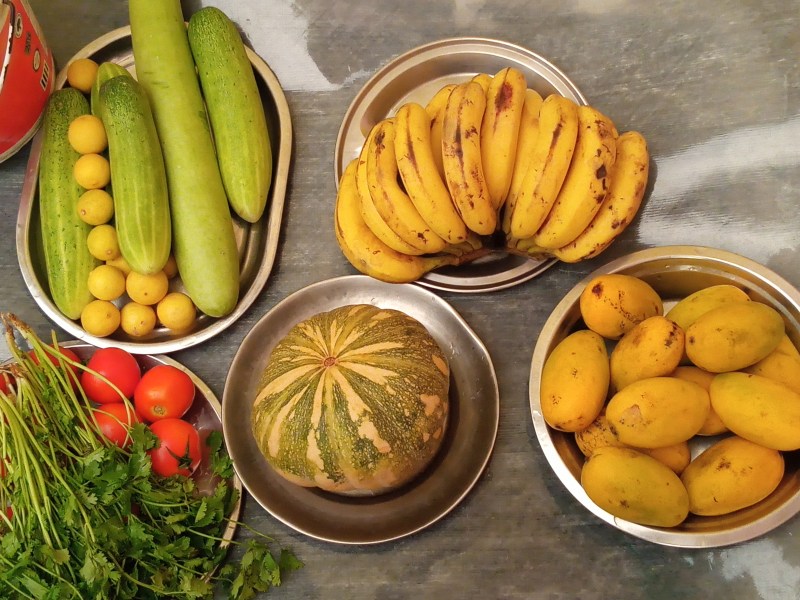
The rates of fruits and vegetables are now hiked from previous week. In Delhi many fruit sellers and vegetable sellers told that due to Corona the supply chain has been totally disturbed also due to massive heat season, the vegetables and fruits goods are affected to it. So, the prices are hiked around 20 to 40%.

For the analysis previous and now a days price , here is a list:

  • Tomato -. 30 RS per kg. Now 50 rs
  • Potato-20 rs per kg. . Now 40 rs
  • Banana- 30-40 rs per dozen Now 50-60 rs
  • Apple- 60-90 rs . Now 90-120 rs

This is really shocking how the rates of these necessary items are uprising day to day. Govt had provided the ration for the people . They also take some necessary action to these things too. Now in 10-20 days, monsoon will come. The price of vegetables and fruits will surely go high. So, in this tensed situation, the Govt should take some action on time.

In this difficult situation, we have to together help each other and maintain the peace in our society. And govt should make a tag through which the illegal hikes in rate of daily essentials reduced…

COVID-19 and its effect on students career

In his prophetic Ted talk on ‘The Next Outbreak’ in 2015, Bill Gates mentioned  the great danger posed to humankind by global epidemics as compared to nuclear war. Five years later, we are right in the middle of what may be termed as the greatest global crisis since the Second World War. Covid 19 pandemic has swept the globe and is perhaps going to be recorded in history as the most impactful and consequential event of this century. It has stretched capacities of governance , public , health , infrastructure etc.

The covid 19 started out as a health pandemic, has created  long-lasting changes to the way we live and work. As it continues to spread across the globe, many countries have decided to close the schools as part of a social distancing policy. However, these closure od educational institutions has affected the education of more than 1.5 billion children and youth worldwide due to the amid pandemic situation.

1.students re-evaluating their career choices

With a lot of uncertainty surrounding future educational prospects a report says that 63% students feel that their initial career plans have been severely affected due to Covid-19, while 42% students feel that they have been forced to reconsider their preferred career choices and are thinking of having a backup plan now. The ongoing pandemic has further triggered and put question marks about travelling overseas for education. A lot of students who were originally planning on studying at an overseas university are now likely to change their higher education plans.

With the Covid-19 pandemic has  impacted student’s career plans and according to a report its  seen that careers like medicine, life sciences and allied medicine are among the top 15 careers which students are looking at pursuing. The top five career choices of students include business management, computer applications and IT, entrepreneurship, medicine and design.

2. E-learning

With all the educational institutes being  closed, its one of the biggest test of online teaching and home-schooling amid the covid 19 situation In these testing circumstances due to impromptu closure, the biggest scourge and the blessings in disguise are the online learning platforms also known as eLearning. This online learning method is catering  to the growing demands of the students in the most efficient manner. The online learning platforms have seen a spur in the number of students who are enrolling in the plethora of courses they offer. From courses on various Government sector exams, technical courses to activities like painting and even dancing there is a unceasing list that is available to the students at the most affordable price. Technology and online learning platforms have become increasingly crucial and due to this college costs could dwindle tremendously as more students will like via online methods. 

Nevertheless we cant deny the fact that this pandemic has  widen the digital divide.A country like India, which is not new to eLearning but it should be kept in mind that closures of schools are likely to widen the learning gap between children from lower-income and higher-income families. While many parents with access to technology and internet are progressively turning to online education technology to keep their kids learning at home while some may not be able to. In a recent survey from India Welfare Trust, it has shed light on how children are bearing the impact of the unprecedented outbreak.

3.Graduates facing uncertainty

  • Unemployment -Students graduating from college in 2020, will have a tougher time finding their first job, unlike your immediate seniors, and its obvious that unemployment levels three months after graduation will be higher.
  • Job first, choice later -Students will  start off fast through by making more efforts and by taking risks. Salaries may be lower by nearly 20% and students may not find jobs in their preferred domain so its important to prioritise getting any job to gain work experience and shift domains once the market improves. It is advisable that working through unpaid internships or investing  your time in family business will be beneficial
  • Digital skills– The job market always changes after a major crisis. This time, the change is an increased focus on online, technology and digital skills that enable workers to contribute remotely. Whatever your line of education be, you are unlikely to be considered unless you demonstrate comfort with digital tools in your field of work.

In this time of crisis well rounded and effective educational practice is what is needed for capacity building of young minds .

Need to introduce sex education in school curriculum…

There are many cases which shows that Sexually Transmitted Diseases (STDs) unwanted pregnancy and unsafe abortion are very common in youngsters. This is due to the insufficient knowledge which they get from media or by listening from here and there.

So it is important to include sex education as a part of school curriculum. Formal sex education include educating children about Sexually Transmitted Disease (STDs) and their spreading and protecting oneself from unplanned pregnancies.

As we know at the adolescent age children become aware about the changes in their body and they also get very curious to know about it. So, it is far better to teach them all about human sexuality in a professional and structured manner, than led them to find out from unreliable sources. It help them to protect themselves from STDs, sexual abuse so, we must provide them correct guidance.

Since the young age, we should take children to say NO and they must be taught that their body is their own and their consent is extremely important. They should encourage to ask question and clarify their doubts, as half knowledge is dangerous. If they don’t want to ask questions in public, we can keep an anonymous box in classroom where children can write down their questions on a slip of paper, and get them clarified from the teacher.

Sex education should begin from primary school level itself in a mild level. They must be taught about different parts of body and about good touch and bad touch. As we have heard many cases of abuse of 3-4 year old child so these help us to protect them from child abuse.

There are some people who are against sex education for young children. But it is necessary to understand that by providing them knowledge we are ensuring that they will make informed decisions about themselves. We are leaving choice to them to practice safe sex if they want to be sexually active. So, instead of forbidden them from having sex, by clearly explaining risk and concepts we are making them more responsible.

So, sex education is important, and it should be enforced in school curriculum through which we are able to protect youngsters from STDs, abuse and unwanted pregnancy and help them in being a informed person.

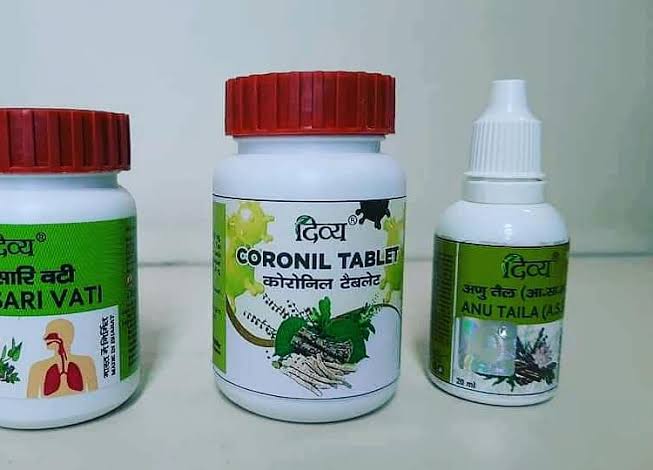
Coronil: an immunity booster not as corona cure.

Today, The Ayush ministry permitted Patanjali to sell Coronil as an immunity booster and not a coronavirus ‘cure’.

Yogguru Ramdev’s Patanjali Ayurved also said there are no Ayush Ministry restrictions on selling Coronil, the drug the company recently launched as medicine for Covid-19 but is now calling it a product to “manage” the disease.

The Union ministry confirmed that Patanjali can sell the product but not as a cure for Covid-19.

“Ayush Ministry has only given permission to sell this particular formulation as an immunity booster and not as a medicinal cure for Covid-19,” it said.

Ram dev baba’s coronil had received licensing from the Uttarakhand government, where Patanjali headquarters are located.

On Tuesday, Acharya Balkrishna, the MD of Patanjali Ayurved said that the company never claimed its drug could cure the highly-contagious virus that has infected more than 1 crore people around the world.

He said the company had not claimed the drug is a cure but simply publicised the results of its study.

Now the drug will be available in stores for public.

The Qutub Complex

The Qutub Minar, that resides in the Mehrauli Village in Delhi, is one of the major constructions of the Sultanate Period, that marks the typical architecture of the Slave (Ilbari Turks) Dynasty- beginning with the ruler Qutubuddin Aibak. The Complex consists of :-

  • Qutub Minar, the main minaret
  • Alai Darwaza
  • Quwat-ul Islam Mosque
  • Iron Pillar of Vikramaditya
  • Alai Minar
  • Alauddin Khilji’s Tomb and Madarsa
  • Tomb of Iltutmish

As a matter of historical fact, it was claimed by several scholars that the main minaret- the Qutub Minar – was an observatory named Dhruv Stambh or the Vishnu Stambh, built during the reign of King Vikramaditya of the Gupta Dynasty and Mehrauli was known as Mihirawali, after the name of the renowned astronomer Mihir, who’s supposed to be the architect of the Dhruv Stambh Or the modern day Qutub Minar. According to the archaeologists also, the Minar was originally an observatory (called Vishnu Stambh), that was used for studying astronomy during the reign of King Vikramaditya.

Let us now talk about the architecture of each element present in the Complex.

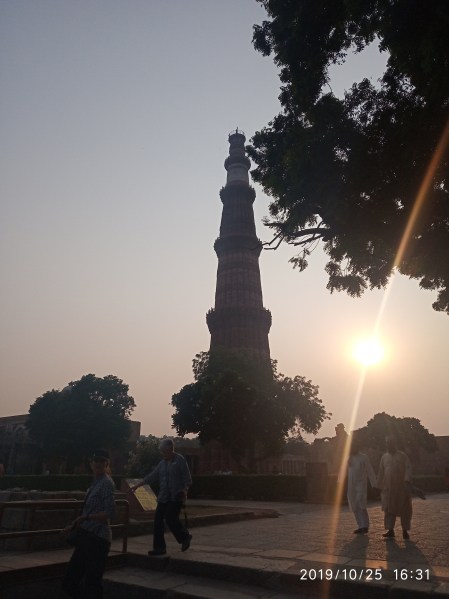
Qutub Minar- inspired by the Minaret of Jam in Afghanistan, Qutub Minar is a 72.5m high minaret and an UNESCO World Heritage Site, having 5 storeys, each marked by a projecting balcony, that are designed with several combinations of stars, columns and other patterns. The red sandstone acts as a foil to the ornamental bands with elegant carving of Arabic inscriptions, foliage and scrolls. The minaret is surrounded by bands of intricate carvings in the Kufic style of Islamic calligraphy. Inscriptions also reflect that repairs were done to the minar by Sikandar Lodhi, when it was struck by lightening. Built as a victory tower by Qutubuddin Aibak, it’s construction actually marked the rise of the Muslim rule in India.

A beautiful capture of Qutub Minar in the eve.

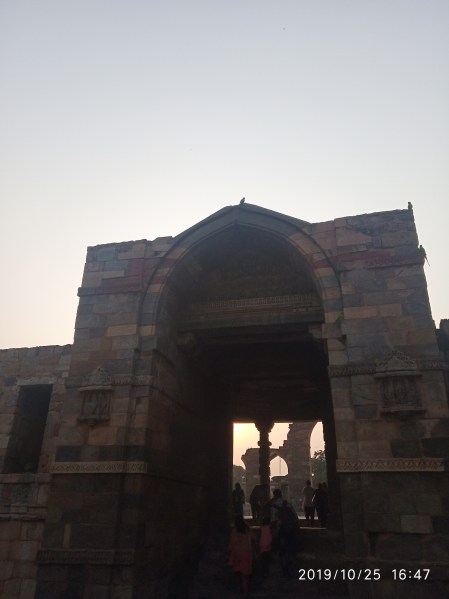
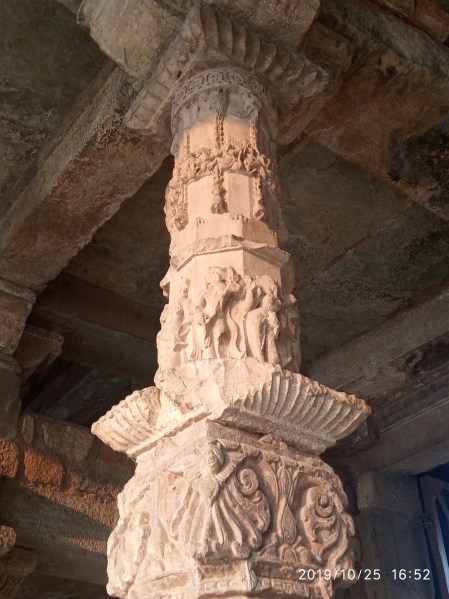
Quwat-ul Islam Mosque- the construction of the mosque was done in 1199CE by destroying the 27 Hindu and Jain temples, that stood erect prior to the construction of the same. The mosque wouldn’t have had accommodated more than 2000 people, though it was the largest mosque of Delhi in the 12th century. The original dimensions of the mosque was 43m×33 m, while the prayer hall measures 45m×12m. Also, the pillars inside the mosque are those of the demolished temples, so one can easily locate the figures of lotus, bell, female figurines, kalash etc. The mosque is raised on a paved courtyard measuring 43m×32m, surrounded by pillared cloisters. 3p years later, this mosque was enlarged by Alauddin Khilji.


Entrance gate of the Quwat-ul Islam Mosque
Pillars of the destroyed Hindu and Jain temples inside the mosque.

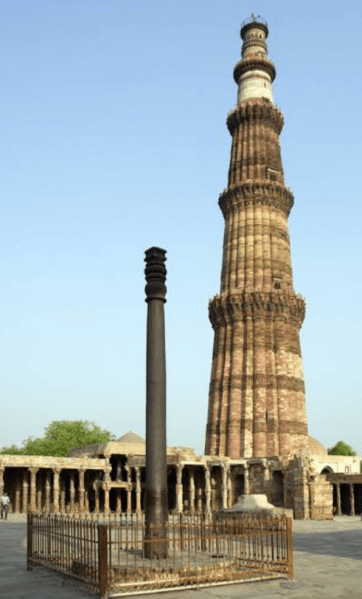
Iron Pillar of King Vikramaditya- it is said that the iron pillar inside the Quwat-ul Islam mosque is of the King Vikramaditya (Chandragupta II), which is 7.21meter high and weighs more than 6 tonnes. It bears an inscription in Sanskrit in Brahmi script dating back to the 4th century CE. The estimated weight of the decorative bell of the pillar is 646 kg and a deep socket on the top of this capital shows that there was an idol of Garuda too.

The Iron Pillar of King Vikramaditya

Alai Darwaza- is the main gateway from the southern side of the Quwat-ul Islam mosque, that was actually constructed by Alauddin Khilji in 1311 CE. This doned gateway is decorated with red sandstone and white marble . It has jharokhas, latticed stone screens as well as inscriptions in Naqsh style of calligraphy. It too reflects Turkish architecture.

Alai Minar- constructed by Alauddin Khilji with the motive of doubling the height of the Alai Minar than that of Qutub Minar. However, the construction was abandoned only after the completion of the 80 feet high first storey. This minaret was made up of giant rubble massonry core.

Alauddin Khilji’s Tomb and Madarsa- at the back of the Complex, stands an L-shaped construction having Alauddin Khilji’s tomb and madarsa. The central room of the building has now lost its dome. There were 2 small chambers connected to the tomb by passages on the either side. It was the first examples of a tomb standing alongside a madarsa in India.

Alauddin Khilji’s

Tomb of Iltutmish- the tomb of Iltutmish has a central chamber measuring 9 square metre. The main cenotaph, in white marble, is placed on a raised platform in the centre of the chamber. The facade is having an ornate carving. The interior west wall has a mihrab decorated with marble and Hindu motifs, such as bells, lotus etc.

So these were the major architectural features of each construction present inside the Qutub Complex hence.

‘Vocal for Local’: A Good Slogan Needing Proactive Policies

On 12 May, 2020, Prime Minister Narendra Modi in his address to the nation raised this important and attractive slogan. The immediate spark was to call for support to the local Indian brands which are facing terrible crisis due to the pandemic and the subsequent lockdown. The broader goal was to provide a rallying point for his idea of Atmanirbharata— self-reliance. The timing could not be better for such appeal. If not now, then never— one may argue. The Prime Minister who has great oratory skill, also justified his favour for the local by reminding ‘every Indian’ that what are now the distinguished and coveted global brands were local in their origin. True, because brands do not enter the world from the blue sky. They firmly originate in the rugged soil of the countries of their origin. But the question is, such slogan can only materialize when it is backed up by appropriate and proactive policies.

To establish legitimacy of the local products is not an easy task. It involves huge arrangement of human, financial and material resources. India is an exceptionally large country with rural-urban divide and steep social and economic inequality. One may argue that closer home China has managed to make use of the local production efficiently and has been able to spread local products throughout the world. But we have to remember that China has been able to systematically establish supportive policies to promote local production. It is true that China has less problems in formulating such policies because of her authoritarian political system which dictates public policies from the top of the ruling Communist Party. But that does not take away China’s credit in making her local products global. Today, with China’s infiltration in Ladakh there is a shrill cry for boycott of Chinese goods and Chinese apps. But even when one acknowledges the justification of patriotic emotion in such cry the fact remains that Chinese products and services have penetrated the Indian market too deeply to be removed by the sleight of the hand. We may, for instance, remove fifty nine Chinese apps but the Chinese phones remain. The irony evident in the joke that China has started supplying India with millions of ‘Boycott Chinese Products’ stickers cannot be underestimated. It is also an open secret that China’s aggressive presence in consumer goods market, including electronics industry, and in pharmaceutical industry, is to a great extent due to her ability to decentralize production.

Let us agree that basically lack of supportive financial and developmental policies has crippled the ‘local’ in post-independent India. India always had wonderful local production hubs— with immaculate artistic and engineering skills— the list is too long to mention here. But lack of support compelled them to either remain confined to dingy kiosks or to down their shutters. Our rulers were not wrong in emphasizing industrial development but they faltered in privileging large scale industries at the cost of medium, small and cottage industries. We sought to be global by neglecting the local. In underestimating local knowledge and local skill India is lagging far behind in creating micro-entrepreneurs. Take the case of textile industry. We have mega textile industries, some of which connect with the local but we have not been able decentralized it. One should also learn a lesson from the next door neighbour, Bangladesh. The small neighbour of ours has made global progress in garment manufacturing and has a staggering growth in garment exports. If Bangladesh can do it, why not India?— the question begs serious attention and scrutiny.

The issue is not just being vocal about local but to follow it up with the right kind of local-friendly policies to lend it first national and then global status. With the onset of the “Make in India’ policy there have been some progress in policy circle to cater to the MSME (Micro, Small and Medium Enterprises). It is needed because this sector’s contribution is 37.5% of the GDP. India also has a dynamic minister in charge of MSME, Mr. Nitin Gadkari. But lot more needs to be done without delay. New technology is to be introduced with vigour in local production shops, and taxes and tariff should be substantially reduced to generate competitiveness in them. Local producers should be freed from the tangled web of red-tapism and indifference when they come up with new ideas. National and foreign collaborators should also be encouraged to have tie-up with local entrepreneurs. In doing so we, Indians, have nothing to lose but our indifference and contempt for the anything local. The road to the global after all lies through the local. Thus, the local has to be in the loop beyond the realm of words.

Closing in Generation Gap

Do you often have arguments with your family members, especially the older ones? Do you think that they don’t understand you or you don’t understand them? If yes, then the reason is the difference in mindsets between an older person and a younger person which is called age gap or generation gap. Generation gap occurs when two people with a decade or more of an age gap between them have very different opinions regarding a specific topic.

The world is changing every second. We are all developing and evolving by every hour passing. Fifty years ago people had no idea what a mobile phone or smartphone or internet was.

If technology can change so much with time, imagine how time would affect one’s mentality. Ethics, values, etiquettes are all dynamic characteristics which develop over time and change. That is why our values, ethics, mindsets don’t usually tally with the ones older than us and we feel like they do not understand us. This leads to arguments and fights, we even say very mean and inappropriate things in the heat of the moment.

Their opinions might not agree with us or might not be in our favour but we need to try to understand that they say what they say from a standpoint of their generation. Things were surely different back in their days and that’s the reason there is a difference in thinking. Generation gap can not be avoided. It is a natural shift in mindsets due to age and it will continue to exist as long as the human race does but instead of reacting to it in a negative way and ruining relationships here are some healthy ways you can try to close or reduce the generation gap. We also need to remember that we can only try and being aggressive can make matters worse. 

  1. Try to talk to them- If you believe that your opinion about something is right and how they feel about the same thing is wrong, try to make them see it, explain it to to them why and how they are wrong and give a better solution. Always try to support your answers with genuine points and facts. 
  2. Listen to them- Old people usually speak from experience and beliefs so there is a possibility that they might be right and you might be wrong. So try to understand their point of view and even if you do not agree to them do not misbehave or get angry. Just listen and try to understand, they have more experience than us and might see things which you fail to. 
  3. Silent treatment- Sometimes people do not agree or even try to understand even if you try really hard to make them understand. In such cases its better to just ignore them and let everything calm down around you. Some people do not understand anything when you try to make them aware  about a topic. In such times giving the silent treatment is best for you and your relationship with that person. 

Generation gap is a natural phenomenon but do not let it spoil your relationships with your family. Try the above three tips mentioned, the next time you have a dispute. 

Wagging tails will never disappoint

I was 19 when my father brought an angel home, who seemed like a roly poly cotton candy with his cute little eyes which were blackmailing me to hold him in my arms. At first I felt little scared because equal to the size of my palm but suddenly I got used to it and now he is much more taller than me. Life is so uncertain right, it gives you such unexpected gifts which add more colours to it and makes it colourful. I never liked dogs, I was always in my nutshell busy with many things but he made me realised the true meaning of life, he taught me that their are many other things to focus on that are present around you, we human beings just need to understand their pain, give them love, feed them and just make them believe that yes human beings are nice, they are the ones whom we(animals) can rely on till their last breath.

Since many days I was confused and had no ideas for writing an article in my mind, I was always thinking that what should be that one thing which you people would love to read, what would be that one thing that will ring a bell in your mind and help you to wake up from your deep slumber and then I met him,

Brownie, who was sitting like this with his cute and sad eyes. I just couldn’t ignore him, he was wagging his tiny tail with a desire to pick him up and give him lots of love. I couldn’t help it, just did what he asked for and then we fell in love and became best friends(just kidding). He is the only reason behind this article. I am writing all of this to make you all understand that please start adopting rather than buying and if you can’t adopt them, just provide them with a bowl of milk and water. The sun is melting outside with fiery heatwaves which is making their survival much more difficult. There are people who take an initiative to help them but are not able to because our society is too self-centred that they can’t step out of their AC rooms or can’t pause their Netflix web series to check whether these helpless animals are fine or not, whether they are in some need or anything else. Thankfully this lad has been blessed with a home and a happy future but what about the others who are roaming aimlessly in search for a better survival.

This is the time guys wake up, enough of sleeping, enough of going spending loads of money on your lavish life. Get out of the reel life and come back to your real life, understand the basics of life, help the needy, wish everyone with a smile, never hurt or beat an animal, they are just like us in fact much better than us, it’s just that God has not blessed them with the right to speak and on the other hand we have everything but are still not making use of it. Think about it and be the perfect example of humanity.

Right to write

What makes someone like us to earn something by knowing something. Writing about the wrong things in a right way leaves us the wrong money.  writing about right things in right way and wrong things in wrong way  is only possible with one’s own choice writing good content. People start to write before they start to think which leads them to make wrong choices and lead them to make their earnings in a short-cut way by believing without seeing and writing without thinking.

It is easier to follow the below mentioned steps than climbing up the steps of your apartment.

Step 1: Start to write your thoughts or opinions in some apps like Quora or Your quote. Then think about starting a blog. Choosing the sites is not at all a problem because we are just in a prototype stage. You can create your blog in the websites like WordPress.com, Medium or Blogger. Website doesn’t matter, only content does.

Step 2:Learn to get familiarised with the options in order to make your blog colorful. Apply the themes, select the layout and try to build up the network. The main thing that you should focus on is to increase your readers and followers.

Step 3: Once you become eligible to the adsense then you can buy domain name and hosting so that you can earn money by posting the ads.

The only thing that matters is content.write to earn and earn to write. Your writing should earn you a name and earning should make your writing better. Content writing never dies even in corona break down because there is no death to creativity.  Covid-19 had effected many industries but it cannot effect the creative field because people earn by making it a topic. Covid-19, itself had became a topic for creative writers.

Content writers write about something which turns into sensation. If not so they take sensational topics like covid-19 and write about it. Either way content writers will get a topic to write irrespective of the global economy or market. The only request from my side is to write genuine content. Don’t write before you have a proof. Earning by writing is good but writing only to earn is wrong. Writing right content and earning is good. Writing matters and it effects life of others. Some people are too sensitive to hear about such and take their lives because of your lies. Don’t write lies for your earning. Earning doesn’t matter, lives matter. Earn by writing genuine content.

Another boiler blast in Tamil Nadu.

While the nation is battling against COVID, the beginning of the new month brought sad news. About 6 people died and 17 injured in the boiler blast at Neyveli Thermal Power Station in Tamil Nadu on Wednesday. https://twitter.com/i/status/1278219558432591872

The accident happened on the morning of Wednesday when the laborers we’re proceeding with their work in the morning. The thermal station Inspector Latha notified that “Six people have died and 17 are injured. Eleven among them are said to be in severe condition. They have been admitted to NLCIL General Hospital in Neyveli. The injured include employees who have sustained at least 40 percent burn injuries according to an initial assessment, the official said. Some of them had 40% burns and we’re sent to Chennai. The accident happened at 10 a.m when workers we’re resuming.”Some workers are feared trapped,” an official told. This incident is said to be the second blast at the plant in previous months. The previous blast took the lives of eight workers and occurred in the sixth unit of the second power plant while the recent happened in the fifth unit of the same plant.

Amit Shah’s message

Union Home Minister Amit Shah, expressed sorrow over the loss of lives, spoke to Chief Minister Edappadi K Palaniswami and assured all possible help. The home minister said on his twitter handle: ‘Anguished to learn about the loss of lives due to a blast at Neyveli power plant boiler in Tamil Nadu. Have spoken to @CMOTamilNadu and assured all possible help.‘@CISF HQrs is already on the spot to assist the relief work. Praying for the earliest recovery of those injured.’

Tamil Nadu CM provides relief

Tamil Nadu chief minister M Edappadi K Palaniswami announced an optional payment of Rs 3 lakhs each to the families of those who lost their lives in a boiler explosion at Neyveli Lignite Plant on Wednesday. Rs 1 lakh has been announced as compensation for those who have sustained severe injuries while those with minor injuries will be provided with Rs 50,000. ANI (@ANI) Tweeted:

CM Edappadi K Palaniswami announces an ex-gratia of Rs 3 lakhs each to families of those who lost their lives in a boiler explosion at Neyveli Lignite Plant. Rs 1 lakh&Rs 50,000 have been announced for those who have sustained severe & minor injuries, respectively: Tamil Nadu CMO https://twitter.com/ANI/status/1278272654592610304?s=20 

Previous boiler blast in TN

The accident happened in the boiler at an NLC India thermal power plant exploded in Tamil Nadu’s Neyveli on May 7, the sixth unit of the Thermal Power Station-II, in the evening and two workers sustained serious burn injuries, an NLC official said.

“Due to pressure, there was an explosion in the boiler that led to a flash fire injuring six workers and two technicians,” when asked about the accident.

The boiler is 84-meter high and when the accident occurred, the workers and technicians were at a height of about 32 meters, the official added. On initial inspection at the health facility, doctors said two contract workers suffered serious burn injuries while the injuries of others were comparatively minor.

“Strength and growth come only through continuous effort and struggle” —Napoleon Hill

We all have been in a situation where we feel disappointed, whether by job rejection, loss in business, fail in exams or might have been facing a lot of problems in the relationship. All have experience downfalls at least once in their life. We feel devastated and stop putting our effort due to fear of failure. It happens with all of us might be at a different stage of life. I know it’s not easy to say it’s okay, everything will be alright to yourself. No one knows the effort you have put it in your work, rather than you yourself. Always remember, there is no point crying over the failure rather than always embrace the mistakes and learn from them. You can’t change your past just focus on the present and glorify it. Maybe according to you, you have put your hundred percent but that particular thing I.e. Business, relation or might be anything else may require your more effort. It’s not that businessman become a millionaire overnight or the perfect couple doesn’ t have any sort of arguments ever in their life they all have gone through downfalls but what they never lose is faith in themselves, they don’t stop putting their effort. They never give up. So what really never give up means for everyone? It’s a continuous struggle and acceptance to failures embracing the mistake and learning from them and making yourself better day by day. Always be determined to your goal. It’s hard to reach you will find numerous obstacle but don’t stop your struggle. Every successful person has tackled numerous obstacles and continued their struggle. One of the instance is Colonel Sanders. You all might have known the story of KFC’s Colonel Sanders. The person faced rejection several times but never lose hopes. His father died when he was just six years old, and leaving him to take care of his siblings. At seventh he dropped out of school work as a farmhand. At the age of 16, he faked his age to get selected in the united state army and later on hired by the railway as a labourer and got fired. It’s not all he was fired many times. At the age of 40, he starts selling chicken dish in the service station, later he decided to franchise his restaurant. His dish was rejected not one not two but 1009 times but he never give up and continued his struggle and finally, his secret recipe names as “Kentucky Fried Chicken”, got super hit. After so many fail but he doesn’t stop putting continuous efforts and he finally made it. His KFC broadened internationally, was sold at 2 million dollars whose net worth is around $15.3 today. The never give up attitude made him achieve that even today he remains eternal on the centre of KFC branding. That’s the power of never give up attitude. He’s not the only one many businessmen have work overnight to fulfil their ambition whether Bill Gates, Steve Jobs and many more. Whenever you feel low just let the title reach out to you and trust yourself and your preparation one day you will be at the height of success with a strengthen soul.

Please let me know your thoughts in the comment below and have a wonderful day.

Why go Veg?

Why are people drawn to vegetarianism? Some just want to live longer, healthier lives. Others have made the switch to preserve Earth’’s natural resources or from a love of animals and an ethical opposition to eating them.

Thanks to an abundance of scientific research that demonstrates the health and environmental benefits of a plant-based diet, even the federal government recommends that we consume most of our calories from grain products, vegetables and fruits.

And no wonder: An estimated 70 percent of all diseases, including one-third of all cancers, are related to diet. A vegetarian diet reduces the risk for chronic degenerative diseases such as obesity, coronary artery disease, high blood pressure, diabetes and certain types of cancer including colon, breast, prostate, stomach, lung and esophageal cancer.

Why go vegetarian? Chew on these reasons: 

You’ll ward off disease. 

Vegetarian diets are more healthful than the average American diet, particularly in preventing, treating or reversing heart disease and reducing the risk of cancer. A low-fat vegetarian diet is the single most effective way to stop the progression of coronary artery disease or prevent it entirely. Cardiovascular disease kills 1 million Americans annually and is the leading cause of death in the United States.

But the mortality rate for cardiovascular disease is lower in vegetarians than in nonvegetarians, says Joel Fuhrman, MD, author of Eat to Live: The Revolutionary Formula for Fast and Sustained Weight Loss. A vegetarian diet is inherently healthful because vegetarians consume less animal fat and cholesterol (vegans consume no animal fat or cholesterol) and instead consume more fiber and more antioxidant-rich produce——another great reason to listen to Mom and eat your veggies!

You’ll keep your weight down. 

The standard American diet—high in saturated fats and processed foods and low in plant-based foods and complex carbohydrates——is making us fat and killing us slowly. According to the Centers for Disease Control and Prevention (CDC) and a division of the CDC, the National Center for Health Statistics, 64 percent of adults and 15 percent of children aged 6 to 19 are overweight and are at risk of weight-related ailments including heart disease, stroke and diabetes.http

A study conducted from 1986 to 1992 by Dean Ornish, MD, president and director of the Preventive Medicine Research Institute in Sausalito, California, found that overweight people who followed a low-fat, vegetarian diet lost an average of 24 pounds in the first year and kept off that weight 5 years later. They lost the weight without counting calories or carbs and without measuring portions or feeling hungry.

You’ll live longer. 

If you switch from the standard American diet to a vegetarian diet, you can add about 13 healthy years to your life, says Michael F. Roizen, MD, author of The RealAge Diet: Make Yourself Younger with What You Eat. “People who consume saturated, four-legged fat have a shorter life span and more disability at the end of their lives. Animal products clog your arteries, zap your energy and slow down your immune system. Meat eaters also experience accelerated cognitive and sexual dysfunction at a younger age.”

Want more proof of longevity? 

Residents of Okinawa, Japan, have the longest life expectancy of any Japanese and likely the longest life expectancy of anyone in the world, according to a 30-year study of more than 600 Okinawan centenarians. Their secret: a low-calorie diet of unrefined complex carbohydrates, fiber-rich fruits and vegetables, and soy.

You’ll build strong bones. 

When there isn’t enough calcium in the bloodstream, our bodies will leach it from existing bone. The metabolic result is that our skeletons will become porous and lose strength over time. Most health care practitioners recommend that we increase our intake of calcium the way nature intended——through foods. Foods also supply other nutrients such as phosphorus, magnesium and vitamin D that are necessary for the body to absorb and use calcium.null

People who are mildly lactose-intolerant can often enjoy small amounts of dairy products such as yogurt, cheese and lactose-free milk. But if you avoid dairy altogether, you can still get a healthful dose of calcium from dry beans, tofu, soymilk and dark green vegetables such as broccoli, kale, collards and turnip greens.

You’ll reduce your risk of food-borne illnesses. 

The CDC reports that food-borne illnesses of all kinds account for 76 million illnesses a year, resulting in 325,000 hospitalizations and 5,000 deaths in the United States. According to the US Food and Drug Administration (FDA), foods rich in protein such as meat, poultry, fish and seafood are frequently involved in food-borne illness outbreaks.

You’ll ease the symptoms of menopause. 

Many foods contain nutrients beneficial to perimenopausal and menopausal women. Certain foods are rich in phytoestrogens, the plant-based chemical compounds that mimic the behavior of estrogen. Since phytoestrogens can increase and decrease estrogen and progesterone levels, maintaining a balance of them in your diet helps ensure a more comfortable passage through menopause. Soy is by far the most abundant natural source of phytoestrogens, but these compounds also can be found in hundreds of other foods such as apples, beets, cherries, dates, garlic, olives, plums, raspberries, squash and yams. Because menopause is also associated with weight gain and a slowed metabolism, a low-fat, high-fiber vegetarian diet can help ward off extra pounds.null

You’ll have more energy. 

Good nutrition generates more usable energy—energy to keep pace with the kids, tackle that home improvement project or have better sex more often, Michael F. Roizen, MD, says in The RealAge Diet. Too much fat in your bloodstream means that arteries won’t open properly and that your muscles won’t get enough oxygen.

The result? You feel zapped. Balanced vegetarian diets are naturally free of cholesterol-laden, artery-clogging animal products that physically slow us down and keep us hitting the snooze button morning after morning. And because whole grains, legumes, fruits and vegetables are so high in complex carbohydrates, they supply the body with plenty of energizing fuel.

You’ll be more ‘regular.’  

Eating a lot of vegetables necessarily means consuming more fiber, which pushes waste out of the body. Meat contains no fiber. People who eat lower on the food chain tend to have fewer instances of constipation, hemorrhoids and diverticulitis.

You’ll help reduce pollution. 

Some people become vegetarians after realizing the devastation that the meat industry is having on the environment. According to the US Environmental Protection Agency (EPA), chemical and animal waste runoff from factory farms is responsible for more than 173,000 miles of polluted rivers and streams. Runoff from farmlands is one of the greatest threats to water quality today. Agricultural activities that cause pollution include confined animal facilities, plowing, pesticide spraying, irrigation, fertilizing and harvesting.

You’ll avoid toxic chemicals. 

The EPA estimates that nearly 95 percent of the pesticide residue in the typical American diet comes from meat, fish and dairy products. Fish, in particular, contain carcinogens (PCBs, DDT) and heavy metals (mercury, arsenic, lead, cadmium) that can’t be removed through cooking or freezing.

Meat and dairy products can also be laced with steroids and hormones, so be sure to read the labels on the dairy products you purchase.

You’ll help reduce famine. 

About 70 percent of all grain produced in the United States is fed to animals raised for slaughter. The 7 billion livestock animals in the United States consume five times as much grain as is consumed directly by the American population. “If all the grain currently fed to livestock were consumed directly by people, the number of people who could be fed would be nearly 800 million, says David Pimentel, professor of ecology at Cornell University. If the grain were exported, it would boost the US trade balance by $80 billion a year.

You’ll spare animals. 

Many vegetarians give up meat because of their concern for animals. Ten billion animals are slaughtered for human consumption each year. And, unlike the farms of yesteryear where animals roamed freely, today most animals are factory farmed: crammed into cages where they can barely move and fed a diet tainted with pesticides and antibiotics.

These animals spend their entire lives in crates or stalls so small that they can’’t even turn around. Farmed animals are not protected from cruelty under the law——in fact, the majority of state anticruelty laws specifically exempt farm animals from basic humane protection.

You’ll save money. 

Meat accounts for 10 percent of Americans’ food spending. Eating vegetables, grains and fruits in place of the 200 pounds of beef, chicken and fish each nonvegetarian eats annually would cut individual food bills by an average of $4,000 a year.

Your dinner plate will be full of color. 

Disease-fighting phytochemicals give fruits and vegetables their rich, varied hues. They come in two main classes: carotenoids and anthocyanins. All rich yellow and orange fruits and vegetables—carrots, oranges, sweet potatoes, mangoes, pumpkins, corn—owe their color to carotenoids. Leafy green vegetables also are rich in carotenoids but get their green color from chlorophyll. Red, blue and purple fruits and vegetables—plums, cherries, red bell peppers——contain anthocyanins. Cooking by color is a good way to ensure you’re eating a variety of naturally occurring substances that boost immunity and prevent a range of illnesses.

Going vegetarian is a breeze. 

It’s almost effortless these days to find great-tasting and good-for-you vegetarian foods, whether you’re strolling the aisles of your local supermarket or walking down the street at lunchtime. If you need inspiration in the kitchen, look no further than the internet, your favorite bookseller or your local vegetarian society’s newsletter for culinary tips and great recipes. And if you’re eating out, almost any ethnic restaurant will offer vegetarian selections. In a hurry? Most fast food and fast casual restaurants now include healthful and inventive salads, sandwiches and entrees on their menus. So rather than asking yourself why go vegetarian, the real question is: Why haven’t you gone vegetarian

How To Make Peace With Your Noisy Mind- 7 Tips

“Leave your front door and your back door open. Let thoughts come and go. Just don’t serve them tea.” ~Shunryu Suzuki

There are few things more exasperating in life than having a noisy chatterbox in residence between your ears—a busy mind that never stops and won’t leave you in peace for a moment.

You are sitting by the pool on your long-awaited vacation.

The weather is perfect. Your diary is clear. You settle down on your deckchair with an ice-cold drink and your favorite book.

Everything is perfect—well, almost everything.

The message “on vacation” clearly hasn’t got through to the mind department.

“Man, that drink was expensive. Better suck your belly in, there’s someone coming. You are as white as a sheet. What on earth will people think? Okay, that’s it. I’m starting a diet on Monday. Oops, I forgot I’m on holiday. Okay, I’ll start when I get home.”

Just writing about it is exhausting enough, let alone living it.

Being subjected to a relentless torrent of mindless chatter and having no idea how to stop it can be exasperating to say the least.

I know. It was the intense suffering inside my own head that led me to sign up for a six-month meditation retreat and later become ordained as a monk.

Happily, I quickly discovered that quieting a noisy mind isn’t nearly as difficult as I’d imagined.

Hint: You don’t even have to change or fix your thoughts.

These days, although I still have my crazy moments when the mind shoots off on a mad rant, my general experience is so much quieter and more peaceful than it used to be.

I’d love to share some (possibly surprising) truths that will hopefully help you achieve the same.

Here are seven tips you can start applying right away.

  1. Accept Your Mind is busy.
    Did you know that the average mind churns out around 70,000 thoughts per day? That’s a lot of thoughts.

No wonder it feels so busy in there!

Even people who are relatively laid back have a lot of traffic going on between their ears.

So don’t be surprised that your mind is busy. Don’t create an additional layer of suffering by thinking there’s something wrong with you for having a ton of thoughts. There isn’t.

Expecting your mind not to be busy is like expecting the grass not to be green.

Let it be busy.

  1. Engaging with the mind is optional.
    If I were to choose one thing I learned about the mind in my time as a monk—the one thing that had the greatest impact on my peace, it would be this:

Engaging with the mind is optional.

It is not so much the thoughts themselves that cause us to suffer but our fascination and preoccupation with them.

We spend our days chewing on them, wallowing in them, stewing in them, and generally giving them an inordinate amount of our time and attention.

And we don’t need to.

Want to know the secret to ongoing peace?

The less you get involved in what the mind gets up to, the more peace you will experience.

Sit back and let the mind do its dance. Your involvement is not mandatory.

Which brings us to the next point.

  1. Watch your thoughts from a distance.
    In order to disentangle ourselves from our thoughts, we need to create some distance, some breathing space, between ourselves and the mind.

Most of the thinking patterns that rob us of our peace run unconsciously on autopilot. The same old patterns play over and over, day in, day out—like broken records. And it is so habitual, we don’t even notice we are doing it.

The key is to bring more awareness to these unconscious patterns.

The first step when you learn to meditate is to take a step back and watch the mind objectively—with an attitude of curiosity and non-judgmental acceptance.

You may also find that the simple act of watching thoughts, rather than being wrapped up in them, will stop thinking it in its tracks—or at least slow it down.

  1. Give your thoughts the freedom to come and go.
    If you want to tame an angry bull, the worst thing you can do is to tie him up or try to confine him in any way. This will only make him angrier and more difficult to control.

The best way to calm him down is to give him a huge open field to run around in. Meeting with no resistance, he will quickly run out of steam.

And it’s the same with the mind.

Thoughts themselves don’t cause trouble. Left alone, they appear in your awareness, remain for a moment, and move on again.

No problem.

It is when we try to control or manage them—through labelling them as bad, wrong, or unacceptable—that we get into trouble and create suffering for ourselves.

Let them wander freely through the vast, open field of your awareness and they will quickly run out of steam. Don’t energize them with your resistance.

If thoughts are there anyway, it is much better to befriend them rather than struggle against them.

What happens to a sad thought or an angry thought if you welcome it rather than reject it?

What happens if you don’t mind it being there?

  1. Don’t take your thoughts personally.
    Seeing that ‘my’ thoughts are not personal was another game-changing insight for me.

For most people, what typically happens is this:

You feel jealous. You feel afraid. You feel angry. And you then beat yourself up, believing you are personally responsible for the thoughts (feelings and emotions too) that show up in your head—believing there’s something wrong with you for having these thoughts.

There isn’t. You are not the author of your thoughts.

If you watch the mind closely, you’ll notice that thoughts appear by themselves, apparently out of nowhere.

In mindfulness training, we use the analogy of “the undercurrent and the observer” to illustrate our relationship with the mind.

The key understanding is that the undercurrent—the continuous stream of thoughts, feelings and emotions that pass through your awareness—is self-arising.

It is not within your control and therefore impersonal.

What most people do is thrash about midstream, like a crazed thought traffic policeman, frantically trying to control the flow—welcoming this thought, rejecting that one.

Trying to control the river is futile and exhausting.

Better to be the observer, sitting calmly on the riverbank watching the river flow by—knowing it’s not personal.

The less involved you are in trying to control the flow, the more peace you’ll experience.

  1. Know the difference between thoughts arising and thinking.
    Although there’s nothing you can do about the thoughts that show up in your head, thinking is another matter.

Let’s say the thought appears, “My boss doesn’t like me.”

It then triggers a dialogue in your head, “He’s definitely going to overlook me for the upcoming promotion. It is so unfair. I’ve been working here much longer than Jane. But he seems to like her a lot. Things never go my way. I’m just unlucky in life.”

This type of unproductive thinking is the primary cause of suffering for most people—and it is entirely within our control whether we choose to indulge in it or not.

Replaying the past over and over, catastrophising about the future, wallowing in unfounded beliefs and assumptions—these are some of the patterns that can create so much unnecessary misery.

And it’s entirely avoidable.

When you notice you’re caught up in an unproductive mind-movie, STOP.

There is nothing that can compel you to continue if you choose not to.

You’re the one in charge.

Focus instead on being present in the moment. Put your attention on your breath, on the sensations in the soles of your feet, on the sound of the wind rustling through the trees.

Unproductive thinking is mostly a habit. And like most habits, with a little awareness, it can be broken.

  1. Live more in the present moment.
    One of the main insights in meditation practice is that your awareness can only be in one place at a time.

If you are lost in your thinking mind, you can’t simultaneously be aware of your surroundings. Likewise, when you shift your attention to the present moment, thinking stops.

When you are present here and now, the mind automatically becomes quiet.

Whenever you are aware enough to catch yourself falling into habitual thinking patterns, stop and engage your senses.

Tune into the sensation of the air caressing your skin, feel the weight of your body coming into contact with the chair, listen to the sounds around you.

Be intensely aware that now is happening and notice what happens to your thinking mind

Take Back Control From Your Busy Mind
The mind isn’t a bad thing of course. It would be pretty hard to get through life without one.

It can come in very useful for problem solving, writing articles, booking flights, or remembering which house is yours when you get home from work.

Used productively to carry out specific tasks, the human mind is an incredible tool.

But it can also be deeply destructive—like an out of control Frankenstein monster with a life of its own.

The mind can be a beautiful servant or a dangerous master.

It all depends on who’s in charge.

The next time you’re sitting on your deck chair trying to relax and the mind kicks off with its crazy dance (as it will do) remind it who’s boss.

Don’t give it the power to ruin your holiday.

Appearance vs Reality of Merchant of Venice

One of the greatest writers of history is Shakespeare. William Shakespeare was an English playwright, poet, and actor, widely regarded as the greatest writer in the English language and the world’s greatest dramatist in the history of English literature.

He has written many masterpieces. In which are are Macbeth, Othello, Romeo and Juliet extra etc. 

In which Merchant of Venice is one. The storyline of the play goes :

The play commences on a street in Venice. Shakespeare introduces the central character of the play, Antonio, as a Merchant of power and influence. Bassanio, his friend, confesses to him that he is in love with Portia, a rich heiress of Belmont. To present himself as an eligible suitor to Portia, he seeks a loan from Antonio. Antonio has no money in hand to lend as his fortunes are tied up with his ships at sea. However, he promises to help us Bassanio to take a loan from money lenders using his(Antonio’s)name. The entire play is based on the scenario that happens as a continuation of this situation. And then the place carried on by the test of Fortune, the bond story, Jessica’s deceit, the choice of caskets, the trial scene and the happy ending.

The play has many teams which include love, friendship and loyalty, love of wealth, justice and Mercy, and most importantly appearance and reality.

In this segment of the blog, I have decided to give my point of view of a very famous question which is discussed in this play. Which is the theme of appearance and reality in the play.

The most obvious points would be:

1. How Shylock was discussing the terms of the bond appearing friendly to Antonio but had an ulterior motive of taking revenge on him.

2.How in Jessica-Lorenzo Love Story where Jessica pretends to be meek and submissive in front of her father; though in reality, she is rebellious.

3. The message of how outward appearance is liable to be deceptive which is shown in in the play through the principle of the lottery caskets. The lottery ordeal has been used to test the sincerity and character of the suitors for Portia. In the choice of caskets, not only their appearance but also the mottoes inscribed on them are to be considered.

Throughout the play, we see how each character is portrayed.

Antonio is characterised as a wealthy merchant, a popular figure, a true friend, philanthropist, a gentleman and melancholic in nature.

Bassanio is shown to be an extravagant young man, a true lover, optimistic, cheerful and has genuine affection for Antonio.

 Portia’s portrayed to be beautiful, witty, humourous, resourceful, has a compassionate nature and is a loyal daughter.

While Shylock is attested to be having a complex personality, greed for money, ribbons for, deceitful and crafty and is suspicious in nature.

I strongly believe these are these things that Shakespeare, himself, wants his audience to believe in the play. but deep down I feel different. My real question is are all the characters in Merchant of Venice as good or as bad as they are portrayed in the play?


How to stay positive always?

Positivity is crucial in our day to day life. To feel positive, we need to work on our perspectives, our outlooks towards life. With a positive attitude, one can become more confident, and confidence is the key to success, as we all know. But, positivity takes a setback whenever we face hard, rough days. Now, that is precisely the moment when you need to look through the difficult times and hold on to the ray of hope, otherwise known as positivity. Here is a list of ways, following which you can move past the negativity and welcome your life’s positive values.

List of Ways to become more Positive

  • Always look at the brighter side

Most important point to become more positive, is to always look for the happy moments, cheerful memories, whenever you face a difficult situation. You need to become optimistic, and think of the brighter side; only then, you will be able to come out of negativity.

  • Choose to stay with positive-minded people.

You cannot choose your family members, but you can definitely choose your friends. Hence, you need to make a suitable choice when it comes to your peer group. Don’t go for an unstable environment, and know when to leave. To stay positive, you need friends who make you happy and values you. Don’t mix with the wrong crowd. It would inevitably affect your mental health.

  • Think before you act

This is extremely important. We tend to act first, which ends in disastrous consequences, leading to negative thoughts. Always think about the results, take slow steps, and you will reach success in no time. Don’t hurry or choose crooked methods. They would only lead to the feeling of guilt, and you would fall in the trap of negativity.

  • Don’t overexaggerate situations

We, as human beings, tend to overexaggerate certain situations, and overthink about the consequences more, rather than working on the present. This tends to self-doubt and low confidence levels. Many times, we face anxiety or nervous breakdown due to overthinking. This should be severely neglected, and not all encouraged. Try not to panic and put your mind only on the present situation rather than anticipate the future.

  • Get rid of your Fears

Fear is the only feeling that holds us back. To gain a positive outlook, you need to face your fears. Facing your fears would lead to increasing of more confidence and positivity in life. You need to do the impossible, achieve the extraordinary, and only then realize how easy it is to live without fear. Positivity leads to self-independence, which is extremely important for everyone.

Positivity is exceptionally essential, and it should be preached everywhere. People miss out on the decisive moments in life, out of fear, out of staying with negativity. You need to search for the light and come out of the dark. We all should work on ourselves and get rid of our negative approach towards life. It is only through positivity, we can achieve heights and stand tall, happy, and cheerful always. So, let’s work on our outlook, and towards a better, positive future.