

 Largely, lies hide truth, mystery or reality. A lie is something that is believed to be false and generally it carries a negative connotation. And it gives you a sense of success in doing that. By hoaxing the other you derive pleasure or fun out of that. Lying to another person acts as a solution to your mind’s turmoil. It gives the satisfaction of creating something new or non-existent. It is an attempt to get away with something that we don’t want to occur. You badly want to abstain from the unpleasant consequences of truth. Because you are afraid to face them, that’s why you prefer to lie. But why would someone get this feeling of achievement or kind of satisfaction after lying? Of course, it is because achievement is their top priority. Most do that out of their ignorance that they cannot get deeper and longer satisfaction by lying. At one point, when you manage to fool someone, you develop a hidden feeling of superiority complex (in clinical terms) and often lies get reflected on your face. Lies can serve as instrumental, interpersonal or Psychological ways for the individuals who use them. You get the joy of preserving the truth within your inside by not disclosing it. Some derive sadistic pleasure in duping the other by giving wrong information or creating improbity. Some do it because they are habitual of lying and then only lying can give them satisfaction. They do not understand that except instant contentment or insignificant satiety lying costs you your dependability, trustworthiness and goodwill. People tend to lying also to ensure harmony, security, freedom from fear. Do you know when you lie there is a weird feeling of achievement? It’s because we expect and wish that our excuse should be accepted by others because it is right. Sometimes people lie because they want to appear better than they are. Lying does not work every time, sometimes we get stuck badly in the situation where the only solution to get out is by telling the truth, Truth is preferable, but remember the corporate sector, as well as the business, which doesn’t work on a full truth policy. The outcomes of lying are transient that will fade away very soon. When the truth is highlighted, it makes you look miserable in your own eyes. So, if one is a self-critic, they must be careful before lying. But the one who are prudent, you cannot dodge them as they have ability to judge your false wordings. If you are lying to someone from words of mouth, your feelings/emotions and body language is expressing the truth. People come to know of the truth as you come to know of others. It is different that they would not let you know about it, as you also never disclose for not creating unpleasantness. Truth satisfies your trinity (mind, body and soul), which lying can never. Your one lie can make someone’s life hell or heaven. Learn! To tell a lie is to keep others in the dark. Lie can even seperate you from your family, friends and society. Lying can only give you satisfaction on a temporary basis but not for your whole life. So remember, do think about it before commuting.
Day: September 8, 2020
The Organic Evolution: How Did The Current Biodiversity Reached Its Present Form
We see the actual spirit of diversity in Nature.But have things always been like this, barring a few minor change-in-scenes, since times immemorial? If not, how did and how much has life forms changed? So, let’s find out from where all this started.
The Beginning: Life on Earth
After formation, Earth was not exactly suitable for housing or nurturing any kind of organisms. After undergoing drastic changes -including solidification of crust, formation and accumulation of various gases (like nitrogen,ammonia,methane,oxygen,hydrogen etc.) in the atmosphere, gradual development of ozone layer and formation of water molecules- Earth became close to be able to support even the most basic forms of ‘life’.
The earliest organic forms, though did not really satisfy our definition of life, but are considered to be the most basic forms of living cells.Experiments by Stanley Miller (1953), Sidney Fox and Oparin (1936), gave the world some theories about the formation of living organisms. Another mention worthy point is that the first life forms originated in water, as for the longest time, Earth was what we can imagine as a giant sea, with no signs of land whatsoever. These organic forms might have developed into self replicating units, then into primitive organisms and at later stages, resulted into some distinct type of chlorophyll synthesizing bacteria, some 2.5-2.3 billion years ago. This gradual process of arising of life from non-living matter (such as simple organic compounds) is termed as abiogenesis.
Evolution of chlorophyll occured around 600 million years ago. With that, the production of oxygen and ozone (after chemical conversion under suitable circumstances) sped up and gradually accumulated in the atmosphere. Ozone layering encased the surface of Earth and provided protection against UV rays, which is detrimental for living organisms. Before that, all organisms developed in deep water, which provided protection against the UV rays. Only after the formation of ozone layer did life flourished on land surface.
The Precambrian age, that last from 4600 to 542 million years old, has very few fossil records. Hence, such a large period of time is not subdivided into further categories in terms of biological evolution. The fossil of this period mainly of cellular organisms.The first living organisms are believed to have developed around 3.8-3.6 billion years ago, from the primitive organic soup (accumulation of large number of complex organic molecule assemblages). Around 3.5 billion years ago,first organisms with prokaryotic cells (cells without true nucleus and having a rudimentary cell structure) are believed to have developed. Those cells were at similar cell complexity level like the present day bacteria.Skip to 2.4 billion years later, the eukaryotic cells are supposed to have developed. For the longest period of time, only unicellular life forms flourished on Earth. Then,evidences indicated that, around 700 million years ago, the first signs of multicellular organisms were traced. Since then, there has been a steady flow of evolution.
The ‘Complex’ Evolution
The Cambrian period (542- 488.3 million years) is considered to be a milestone in evolution. Even the fossils have records from around 600 million years ago. It is widely assumed that around 600 million years ago, organisms had developed to be able to leave fossilized records. The transition of life forms from water to land had supposedly begun around 500 million years, when plants started growing on land.Later different varieties of plants and animals populated the lands.
The Carboniferous period was an important landmark, which lasted from about 359 to 299 million years in the past, is an important landmark in the journey of evolutionary history. The environ domain was actively dynamic during that period. Humid and warm climate, swampy large areas, changes in sea levels, flood, mud and sand were deposited over the vegetations, etc.
Due to compaction and incomplete decomposition of plant material in swamps, they converted into peat bogs, and then, into coal. Hence the name carboniferous. In the late Carboniferous period (about 300 million years) tropical rainforests were present in the equator region of Euramerica. Later, ferns replaced the forests, which are present even today.These vascular plants are without seeds as they do not produce flowers and fruits, and are generally found in temperate to tropical parts of Earth. These plants can be mainly divided into stem, leaves and true root; reproduction being facilitated through special structures, known as sporangia (singular:sporangium), that contain spores, which are dispersed into different mediums and germinates on coming in contact with the soil with suitable conditions.
Next period in the geological time scale in the Permian period, which started off around 299 million years ago. This period witnessed major altering activities in the continental lithosphere (which are broken into tectonic plates) starting from the joining of Euramerica, Asia and Gondwana led to the formation of a single landmass called Pangea (Greek translation: All lands), which is considered to be a supercontinent. In terms of ecology, this period was mainly dominated by forests of conifers and tree ferns,large amphibians and reptiles habituating them, and a huge variety of fish and shellfish in the ocean. But, at the end of Permian period, a mass extinction took place, commonly referred to as the ‘Great Dying’. It occured around around 252 million years ago, and wiped out about 90% of all the species present on Earth.Also, trilobites (meaning: three lobes), which a group of arthropod (a group of invertebrate animals with exoskeleton, segmented body, and appendages) and sea scorpions, which had survived the tides of oceans and time for hundreds of million of years, went extinct.
Next in the line, the Triassic period had set off around 240 million years ago.It is believed that true mammals first evolved during this period, more precisely, during late Triassic period. Also, a specialized subgroup of Therapsids, which is a group of reptile-like animals that included mammals and their ancestors, also evolved. Early Therapsids demonstrated traits of the present day mammals, such as erect posture. First flying vertebrate animals are supposed to have originated around 215 million years ago, and lasted for 150 million years, vanishing at the end of the Cretaceous period. Another mention worthy occurence in the Triassic period timeline is the splitting of Pangea into two separate land masses. The northern one was named Laurasia and the southern one, Gondwana. Primitive forms of dinosaurs are said to have emerged around 231.4 million years ago.
The Jurassic period is known as the ‘Age of Reptiles’, as they were present in abundance and had a diverse variation throughout this period. The land animals included Stegosaurus, Ceratosaurus, Brachiosaurus and Allosaurus. The oceans were traversed by Ichthyosaurus and Plesiosaurus and the skies are believed to be dominated by the likes of Rhamphorhynchus and Archeopteryx. This period coincided with the emergence of first mammals and birds.
The Cretaceous period, which started around 145 million years ago, is geologically characterized by separation of India from Gondwanaland, formation of Andes and Rocky mountains, and extensive volcanic activities. Dinosaurs dominated the face of Earth and were of different types. They lived through a period of 135 million years, that is , throughout the Jurassic and Createceuos period. The Cretaceous-Paleogene mass extinction is considered to be the main cause of dinosaurs disappearing from Earth. An important claim by the scientists, on the basis of fossil records, is that the birds evolved from the Theropod dinosaurs, and the development took place in the Jurassic period. Some birds lived through the extinction and their descendents continue to live presently. This period also marks the appearance of angiosperms; plants that could produce flowers.
Next chapter
The next major development in the course of evolution is considered to be the evolution of humans. But that’s a story for another day. As for our evolution is anything but simple and short. As Carlo Rovelli said in his book, Seven Brief Lesson of Physics: “We are a species which is naturally moved by curiosity, the only one left of a group of species (the genus Homo) made up of a dozen equally curious species. The other species in the group have already become extinct; some, like the Neanderthals, quite recently, roughly thirty thousand years ago. It is a group of species which evolved in Africa, akin to the hierarchical and quarrelsome chimpanzees — and even more closely akin to the bonobos, the small, peaceful, cheerfully egalitarian and promiscuous type of chimps. A group of species which repeatedly went out of Africa in order to explore new worlds, and went far: as far, eventually, as Patagonia — and as far, eventually, as the moon.
It is not against our nature to be curious: it is in our nature to be so.”
Website References
https://en.wikipedia.org/wiki/Abiogenesis
https://www.goodreads.com/quotes/9344668-we-are-a-species-which-is-naturally-moved-by-curiosity
Bibliography
Extinctions: No Comebacks by M.A. Haque
Grand Canyon University
The Beginning as Grand Canyon College
Grand Canyon College was chartered on Aug. 1, 1949, with 16 faculty and approximately 100 students in Prescott, AZ. In 1951, the college relocated to a 90-acre tract in West Phoenix and was fully accredited in 1968 by the Commission on Institutions of Higher Education. Established as a Baptist-affiliated institution with an emphasis on religious studies, the school initially offered bachelor’s programs in education. Programs expanded to include the sciences, nursing, business, music and fine arts. It was during this time when the college started to develop a reputation for producing effective teachers, nurses and health care professionals in the Southwest.
Becoming Grand Canyon University
While planning to change in institutional organization and status to Grand Canyon University, Grand Canyon College identified several landmark events during this transition: organizing programs and departments into colleges, offering graduate degree programs, establishing the Grand Canyon University Foundation and the generosity of those who pledged or gave unrestricted gifts valued at $1 million dollars or more. In May of 1984, college trustees voted to prepare for transition to university status on the school’s 40th anniversary. Then GCU moved from being owned and operated by the Arizona Southern Baptist Convention to being self-owned by the Board of Trustees.
New Mission and Vision
By the early 2000s, GCU struggled with maintaining its operations in light of dwindling financial support. The university faced a critical juncture in September 2003, teetering on the verge of insolvency and facing the prospect of bankruptcy. A small group of investors acquired the university and refocused on online education for working adults. With an improving financial structure, the university recruited a new leadership team in 2008 to envision a future that centered around a hybrid campus strategy—combining traditional students with nontraditional students (primarily working adults studying at the graduate level). The university completed an initial public offering in 2008 to generate the capital necessary to improve its online infrastructure and expand its campus.
University Transformation and Investment
The university grew its campus student body from fewer than 1,000 students in 2009 to over 19,000 ground students in fall 2017, where the incoming student GPA was 3.5. By 2016, more than 75% of the university’s traditional students study in rigorous STEM and business programs. GCU’s nontraditional student body increased from approximately 22,000 students at the start of 2009 to over 60,000 online students currently. Over 47% of GCU\’s online student body is studying at the graduate level and that percentage is growing.
In total since 2009, the university had invested over $1 billion dollars—and today, continues to invest in full-time faculty, improved technology infrastructure, new facilities and programmatic expansion in high-growth, high-demand areas such as engineering, computer science and IT. The university has been able to self-fund these investments with only nominal increases in tuition for nontraditional students, while freezing tuition for traditional students for 10 straight years.
Back to Non-Profit Roots
In 2018, GCU transitioned back to a non-profit institution, which provided faculty and students with equitable opportunities to:
Participate in academic and co-curricular opportunities with peer institutions
Operate a philanthropic foundation
Provide grant writing and research opportunities for faculty and students
Invest in educational infrastructure
Allow the university to continue offering tuition at levels that make private higher education affordable to all Americans despite socio-economic class
Provide employment and career growth opportunities for faculty and staff
Continue to invest in the communities where the university serves
Permit student athletes to participate in governance opportunities afforded by the NCAA
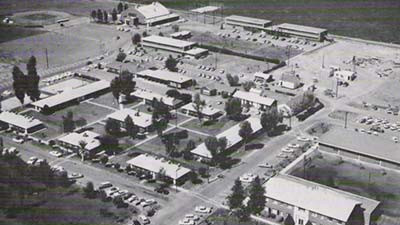
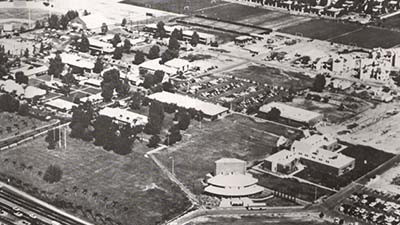
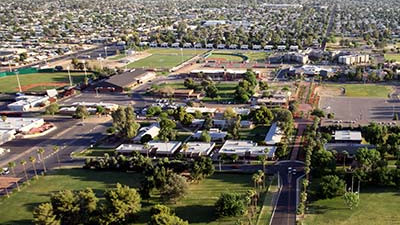
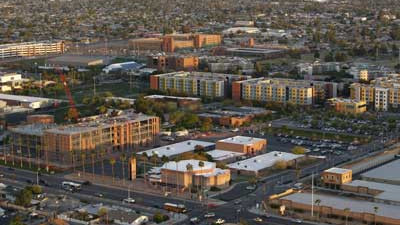

1 / 7
University Development
GCU\’s campus continues to grow to meet the needs of students and cultivate world-class learning experiences. Here\’s a snapshot of the campus today – a home away from home for our Lopes:
State-of-the-art GCU Stadium and GCU Arena
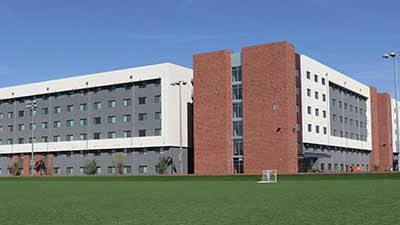
Contemporary residence halls and apartments with resort-style swimming pools
Recreation and fitness centers
Student Union and popular eateries along Lopes Way
Two new engineering classroom buildings dedicated to cutting-edge STEM learning
The Grove – a community of four suite-style residence halls exclusively for freshmen
Division I athletics, club sports teams, intramural sports teams
Academic, professional, social and recreational clubs
Academic and student support resources
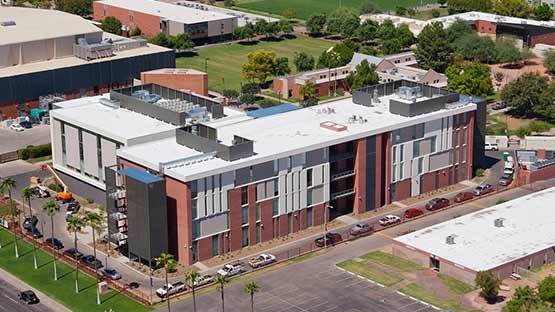
State-of-the-art STEM building opened in fall 2015
Community Transformation
West Phoenix is where GCU calls home. That\’s why GCU stands committed to transforming the surrounding neighborhoods into a safe, thriving place for those in the community to live with hope and better futures. Along with providing academic excellence and a vibrant campus life, GCU believes its purpose is to partner together to implement initiatives in the area that open educational opportunities for all, create jobs, restore housing and reduce crime. GCU calls this United by Purpose. 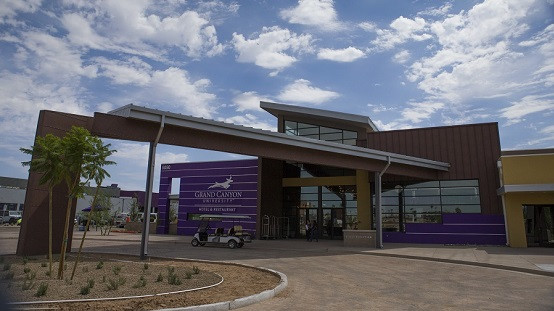
One aspect of this transformative endeavor starts with the new development project at 27th Avenue and Camelback Road that\’s changing the face of the Canyon Corridor. Developed to be the gateway into West Phoenix, this new development will serve as a commercial hub featuring:
A four-story office complex
Renovated GCU Hotel, resort-style pool and fitness center
Canyon 49 Grill and Grand Canyon Beverage Co. coffee shop
Building that will be home to a future business, economic and education innovation center
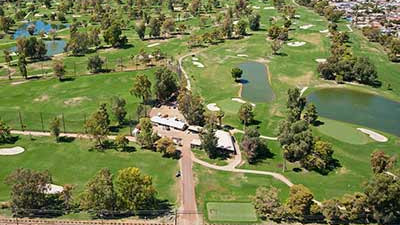
This development is only the beginning for reshaping West Phoenix into a destination of economic, tourism, business, employment and educational growth. Our new enterprises (GCU Golf Course, GCU Hotel, Canyon 49 Grill, Grand Canyon Beverage Co.) also play a role in reviving the local community.
Tremendous transformation is happening now, and the future looks even brighter.
Money does not get Locked ,it’s get invested:MUTUAL FUNDS
A mutual fund is a company that pools money from many investors and invests the money in securities such as stocks, bonds, and short-term debt. The combined holdings of the mutual fund are known as its portfolio. Investors buy shares in mutual funds.
Mutual funds are a popular choice among investors because they generally offer the following features:
- Professional Management. The fund managers do the research for you. They select the securities and monitor the performance.
- Diversification or “Don’t put all your eggs in one basket.” Mutual funds typically invest in a range of companies and industries. This helps to lower your risk if one company fails.
- Affordability. Most mutual funds set a relatively low dollar amount for initial investment and subsequent purchases.
- Liquidity. Mutual fund investors can easily redeem their shares at any time, for the current net asset value (NAV) plus any redemption fees.
How to buy and sell mutual funds
Investors buy mutual fund shares from the fund itself or through a broker for the fund, rather than from other investors. The price that investors pay for the mutual fund is the fund’s per share net asset value plus any fees charged at the time of purchase, such as sales loads.Mutual fund shares are “redeemable,” meaning investors can sell the shares back to the fund at any time. The fund usually must send you the payment within seven days.
Types of mutual funds
- Money Market Funds: have relatively low risks. By law, they can invest only in certain high-quality, short-term investments issued by U.S. corporations, and federal, state and local governments.
- Bond funds: have higher risks than money market funds because they typically aim to produce higher returns. Because there are many different types of bonds, the risks and rewards of bond funds can vary dramatically.
- Stock funds: invest in corporate stocks. Not all stock funds are the same. Some examples are:
- Growth funds focus on stocks that may not pay a regular dividend but have potential for above-average financial gains.
- Income funds invest in stocks that pay regular dividends.
- Index funds track a particular market index such as the Standard & Poor’s 500 Index.
- Sector funds specialize in a particular industry segment.
- Target date funds: hold a mix of stocks, bonds, and other investments. Over time, the mix gradually shifts according to the fund’s strategy. Target date funds, sometimes known as lifecycle funds, are designed for individuals with particular retirement dates in mind.
Nalanda University
Today Nalanda is an UNESCO world heritage site.Nalanda University, which was set up at Rajgir in Bihar in 413 AD during the Gupta dynasty, had emerged as a world seat of learning before it was destroyed sometime in the 11th century.According to historical studies, University of Nalanda was established during the era of the Kumaragupta. He was a famous Gupta emperor. Prajnavarman and Xuanzang, both claimed him as the laying founder of the university, which is also proved by the seal discovered at the site of ruins of the Nalanda University.Today Nalanda is an UNESCO world heritage site.It is believed that the whole University campus is spread across over 15,000,000 sq meters and only 10% of which has been excavated while the rest of the ruins still lie under the ground.At that time it was the only international university in the world. There were around 10000 students and 2700 faculties in the university who came from all over the world like Korea, Japan, China, Tibet, Indonesia, Iran, Persia, Greece, Mongolia and many more.Nalanda was first of its kind which was a boarding university.
During the reign of Skandagupta, Huns were the first one who tried to destruct the university under Mihirakula. But the library was restored and improved with bigger building and better faculties by Skanda’s successors. The second invasion was done by the Gaudas which was again restored by Harshavardhana; the Buddhist king. Khilji was an illiterate person who was hired by some Turkish rulers due to his military skills. But the army led by Turkish leader Bakhtiyar khilji did the most destructive attack in 1193 who tried to destroy the roots of knowledge, Buddhism and Ayurveda, from the country.
The curricula of the university offered the study Philosophy, Religion, Logic, Astronomy, Mathematics, Medicine,theology, grammar,History,Linguuistic,Literature etc.
In each classroom, there used to be 100s of students and they were not allowed to go outside until the lecture was over.To add to their facility, even a well was there in most of the classroom to quench the thirst of the students if they were thirsty and teachers used to sit on the dash and students on the ground.
At that point of time, the Library was a very prestigious and renowned repository of the Buddhist knowledge throughout the world. The library of the Nalanda University was called Dharma Gunj which meant the “Mountain of Truth”. The library constituted of three main buildings, which stood up to nine stories. It was composed of hundreds and thousands of volumes of books. This is quite evident from the fact that it took about 3-6 months for it to burn down completely, at the time when it was set aflame by the Muslim invaders. The three library buildings were called upon by their respective names that included Ratnasagara-The Sea of Jewels, Ratnarañjaka-Delighter of Jewels and Ratnodadhi-The Ocean of Jewels. The library constituted of three main buildings, which stood up to nine stories.It was composed of millions of manuscripts. This is quite evident from the fact that the library kept burning for more than 5 months when it was set aflame by the Muslim invaders.
Till today, a number of ruined structures survive at the ruins of the university. The excavated ruins are known to extend over an area of about 150,000 square foot meters. According to the report, it is believed that 90% of the remains at Nalanda University is still unexcavated.
Nalanda University certainly was one of the only Universities that was closed for around 800 years after is destruction. In recent times the University was reopened after efforts made by A.P.J Abdul kalam during his visit.
Presently, Nalanda University is also considered as one of the self-sustained campus oriented universities of the country.
Road Safety
We all live in a world where we take our lives for granted, we always forget safety measures and put ourselves in constant risk especially while driving. Driving safely and using appropriate measures not only saves our lives but also of the ones around us. Everyday we can see new cases being reported of accidents been caused due to carelessness. These happen due to our own little mistakes, if we take proper precautions we can always be safe from these kind of accidents. Wearing safety belts and helmets whenever we go out always ensures us of our safety while driving.
It is advisable to not mix drinking and driving together. Using phones while driving leads to a lot of accidents these days. Drunken drivers had often ended up bringing trouble to other passengers too. Many accidents have been reported across the countries where drunken dries has run over homeless people especially during night time .
Road safety is an important part of our lifestyle. We take issues like this so lightly that we forget its gravity and how it can affect us. Driving rashly can cost us our lives. There is no point in regretting after things have happened, we always have to be careful and fully aware of our surroundings while driving and on road.
It is high time that we take issues like road safety very seriously. Government of India has taken up various policies for the safety of its citizens but what’s more disturbing is that people do not follow it. People have gained ignorance and have not so caring attitudes towards road safety. Often we see people paying fine for overspeed or not wearing a helmet or seatbelt.
Listed below are a few basic road safety rules that applies to everyone.
- As per the Indian law, you should have minimum 18 years of age to avail a driving license.
- While driving, you should not use mobile phones as it can cause serious road accidents
- Drinking and driving is not allowed as it seems to be a deadly combination for you
- You need to wear seat belt while driving a four wheeler
- Helmets are necessary when you use two wheelers for travelling.
- Make sure that you keep left on the road, when you use cycles for travelling.
Recently road safety has gained enough amount of attention among people, especially the youth. They have taken up initiatives to rise the issue in various platforms. Many organisations have been build by students across the country to spread awareness on the need for road safety.
Hoping to see people taking issues like road safety more into perspective so as to see a budding nation of responsible adults. As a citizen of India it is very important for us to follow the rules and regulations made for us. It is in the best interest of the citizens of the nation these laws are made. Traffic signs provide valuable information to drivers and other road users. They represent rules that are in place to keep you safe, and help to communicate messages to drivers and pedestrians that can maintain order and reduce accidents. Neglecting them can be dangerous.
Amitabh Bachchan begins shooting for KBC during this Pandemic
Weeks after recovering from COVID-19, bollywood megastar Amitabh Bachchan kickstarted the shoot of his quiz reality game show Kaun Banega Crorepati 12, as he shared pictures from the set and wrote, “20 saal, 12wa parva, KBC: Kaun Banega Crorepati, aarambh! (sic)”.The pictures feature the production unit of the show clad in blue coloured PPE kits.”It’s back to work .. in a sea of blue PPE .. KBC 12 .. started 2000 .. today year 2020 .. 20 years ! Amaze .. that’s a lifetime,” Bachchan wrote in the caption of the post.
He added, “this was never expected .. never the time to see such visuals .. but there it is …. recognised faces now unrecognisable .. and the doubts whether we are in the right place , with the right people .. but .. we muster up the fears and be on …. there is great consideration and care being extended .. all precautions carefully worked out and followed …. precautions were there earlier too in times of distress .. but this time its severe .. its personal .. this time they know its fatality , God forbid .. and that lingers .. the lightheartedness has sealed itself .. isolated .. do the do and leave ..
“In July, four members of the Bachchan family including Big B, Abhishek, Aishwarya and Aaradhya tested positive for COVID19. Junior Bachchan took to Twitter to share the information with his fans. After undergoing treatment, the family recovered from the deadly virus. Abhishek had tweeted, “My father, thankfully, has tested negative on his latest Covid-19 test and has been discharged from the hospital. He will now be at home and rest. Thank you all for all your prayers and wishes for him.”
Sexism in India

What is Sexism?
Sexism is defined as discrimination against a person solely on the basis of their sex or gender. This may lead to constraints on a certain gender in social, economic, cultural and political spheres. People tend to be prejudiced against women because they perceive them as inferior to men or believe that they should be prevented or oppressed from occupying the position they deserve in society. A product of society and its culture is gender roles which means assigning certain tasks or roles to genders which they are expected to fulfil. For instance, a widely popular gender role is that women belong inside households and the outer world is only for men.
History of Sexism in India
For centuries, gender bias has been prevalent in India. From the earliest times, the Indian society has followed patriarchy, a system in which men are seen as superior and as authority figures whereas women are forced to take a backseat. In the Vedic period, any political rights that they earlier had were taken away and practices such as child marriage became popular. This started a long history of gendered bias against women marked by dislike towards the birth of daughters to such an extent that female infanticide and foeticide were and are in practice even today. The social structure developed in such a way that women came to be seen as assets that men had to protect. Men were taught that their duty was to protect their two possessions- ‘zan and zamin’, women and land. Moreover, Brahmanical texts which laid down the laws did not give women equal rights. Women were expected to devote their lives to their husband and children, whereas polygamy among men was not uncommon. Women did not possess the right to property or inheritance, the only wealth they could own was ‘stridhan’, the money they received as a gift at their wedding. Moreover, Manusmriti advised women to not be greedy and use this money after their husband’s permission. During the British rule as well, the social customs did not change. However, there was a rise in demand for women empowerment. It was in the post Independence era that positive changes were observed but equality has not yet been achieved.
There remain many sexist issues that women have to overcome. Many female students still do not have access to education as reflected by the high elementary drop out rate and the low rate of women pursuing higher education. Apart from this, women are restricted by their families or taunted by society for wearing clothes that are not ‘acceptable’ whereas men feel free to urinate on the street or walk around in their underpants.
The minimum age of marriage is not gender-neutral in our country. When women get married, they are burdened with the responsibility of taking care of a new family along with giving up their identity by changing their surname.
Growing up in a society which places them on a pedestal, men often develop a feeling of entitlement over women. The bias towards men is clearly visible and we have to work till women are given equal status in the society.
Let’s shatter the patriarchy together.
POVERTY LEADS TO INEQUALITY.
Even though money won’t buy happiness in today’s era most people are willing to sacrifice their happiness for money and we cannot blame them because everyone judges you based on how much money you earn and spend. If you earn a lot then you hold a special place in society.Inequality has been surging sharply since the last three decades. The wealthiest have cornered an enormous portion of the assets built through cohort capitalism and legacy. They are becoming richer at a very faster speed while the underprivileged are still trying to earn a minimum wage and access standard education and healthcare services, which continue to suffer. People in poverty are those who are considerably worse-off than the majority of society. Their level of need means they are powerless to obtain gains and aids that most people hold necessary to an adequate measure of existing.The best example is inequality in healthcare facilities which has taken a serious.
Inequality, by distinction, is always a comparative term that relates to the disparity within levels of living standards, wages, etc. across the entire financial division. Poverty and inequality oftentimes up rise and befall collectively though this need not surely be the fact. Inequality can be high in a society without great levels of poverty due to a huge distinction within the top and the middle of the revenue spectrum. An important part of inequality is apparent because of the high numbers of labor organizations work in sectors with low productivity for example agriculture. To overcome inequality, low- productivity workers should be incentive to shift to more fecund sectors. Concurrently, structural improvements require to be fulfilled to improve the fecundity of these divisions.
Technology should not be made a substitute or deemed a rival. It should be seen as a means to address inadequacy and inequality. Enhanced technology can create more prominent demands. These next can enable more inclusive hiring of the low and the medium-skilled. Technology can enhance the potency of the agrarian sector. It can further promote versatility to sectors with tremendous productivity, as is apparent from the vast numbers of people foregoing farming for jobs in the help sector.
Education is the foundation for a fulfilling and leading a satisfactory life. For a nation to be packed with the understanding it has to adopt education as it is the solitary guarantee for a stable economy and a secure domain. Education shapes people into efficient and hardworking individuals. The importance of such an accomplished and knowledgeable society would help nurture a community that is operating as one for the economic advancement of the entire nation. The proficient workforce would be formed by education. Also of vital importance is the contribution of education towards the development of best economic policies. The government should break the cruel progress of poverty which makes inequality, which does not only negatively harms sustainable financial growth but also creates various socio-economic problems. The government should create job opportunities and employment that will be the key strategy to eradicate poverty and inequality.
A bad workman always blames his tools.
The meaning of this proverb is—your success does not depend on what Kind of tools we have but how we use them.
A person may have all the equipments in the world but if he does not know how to use them he can never complete a job successfully. Whereas a person who can make effective use of what is available with him can make a success of any work given to him.
The same can be said of real life situations too. We must learn to hone our talents and tabs maximum benefit out of them and not blame destiny or fate when something goes wrong.He has an ego and the demand of the ego is that he should not confess his own fault and limitation which, in themselves, are responsible for his failure or loss. Similarly, if a radio machine is incapable of finding out the defect in your radio setting it right, he will postpone the issue by saying that he has not with him then the proper has to handle or test same parts of the radio.Men with a little beauty are haughty and vain, they are always trying to conceal their shortcomings from their friends or customers. On the other road, a really learned and wise man never quarrels with his tool, never puts the blame for his own failure on other factors with a view of hiding his faults and limitation. He is polite and not in the best show, if he cannot handle a job, he will lose no time in telling you that his is incapable of performing the job and that you should better hire the services of some more competent head.
The idea behind this expression is that a good workman would take full responsibility for any fault and not try to blame his equipment. Therefore, someone blaming poor work on his or her tools must not be very skilled.
In other words, a person who is unskilled cannot do skilled work even with the very best tools.
People use this expression to talk about a person’s work in his or her profession. However, it is also possible to use this idiom to discuss any task that a person completes.
People can generally be classified into two groups, those who have talents and those who have not. A really talented person succeeds in all the work assigned to him. He is confident of doing his work. He uses his tools in the right way, even if they are not excellent. At the same time, a person without talents even if given excellent tools, fails to achieve good results. His talents are limited. He finds lame excuses for his failure. He blames his tools for the bad work he has done. He does not want to admit that he is a bad workman. He deliberately forgets the fact that his talents are limited. Even if good opportunities are provided for the less talented person he fails to exploit the chances and succeed in life. But if the talented person is given the right opportunity, he makes use of it to the full and thereby achieves good results in life.
What is Bioluminescence?
In the branch of aquatic science, we are yet to discover so much, though the things we have already discovered are so fascinating, it’s amazing how nature still manages to surprise us! Bioluminescence? What does this giant word mean? Let’s see!
- Etymology
What does etymology mean? Well, etymology means the origin of words through history. For eg. Probiotic word comes from Greek and Latin meaning ‘for life.’ This is used because, English composes of many different and ancient languages. So, the etymology of Bioluminescence comes from two Greek words, bios- which means living, and lumen- means light.
- Explanation
Okay! Now let’s get to our topic. Bioluminescence.Have you ever seen fireflies? That is some wonderful sight to see! But have you ever wondered what causes it to glow? Due to a certain kind of chemical reaction, makes the abdomens to glow. These are insects, but do you know the Bioluminescence in the oceans…?

Source: Pinterest
- Ocean Bioluminescence
Many organisms living in the ocean have the property of bioluminescence. Bioluminescence can be found in bacteria ( living in the ocean), algae,jellyfish, worms,crustaceans(a sea animal), seastars, and some species of sharks. Mind you, these are comparatively just a few listed. For the organism to produce light, it must contain a compound called Luciferin – meaning light bearer in Latin. Now, when this compound(luciferin) comes in contact with oxygen, it reacts with the gas, converting into light energy. An organism must contain luciferin in order to become bioluminescent. There are many types and varieties of this compound present in different creatures. But generally, most of the organisms produce luciferin catalysts. This sight is more prominent in the deep sea region but the most breathtaking scene is on the surface of the oceans when tiny micro organisms grow making it seem..just magical. According to a research , fishes of about 1500 known species have the ability to produce this light through luciferin. Bioluminescence are wonderful sights to look at. From the study of 2018, scientists discovered that the ray finned fishes have evolved about 27 on the basis of this property .Amazing,isn’t it?

Source: By Smit Patil from unsplash
•Use
Now, the question might come into your mind that ‘ what is the actual use of bioluminescence?’ Well, for us it might be just a great scene to look at but for the sea animals, it’s likely a vital property.
- Prey- These animals use their light to lure their prey to come near them, making it easy and convinient to hunt. This technique can also fool larger animals.For example. The cookie cutter shark(weird name) attracts squids and sharks from its light and when they are close enough, it bites on them.
- Communicate- For the bioluminescent animals, they have to be safe from being eaten or getting hurt. So they use these methods, maybe to communicate.
- To attract mates- Females usually use bioluminescence to attract male species to come to them.(Pretty sneaky, aren’t they?)
- Protection- Animals can potentially hide themselves through the surface of ocean, when using bioluminescence. It helps them to survive and make themselves invisible
- Confuse- Some species of squids splash bioluminescent liquid rather than ink, simply to confuse their predators.
- Vision- Many seaanimals live on the lower surfaces of the ocean. Bioluminescence helps the organisms to see clearly.
- Is it dangerous?
No, not necessarily every bioluminescent organism is toxic. But yes, they do exist. The dinoflagellates a microbe which is found in the Matsu islands of Taiwan,China. The microbe is also called China’s ‘blue tears.’ It is because the organism has an eerie glow to it. Many tourists come here to observe this phenomenon . But these dinoflagellates are toxic. But why? Well, dinoflagellates is an algae which is harmful to many sea organisms and humans as well. What makes them toxic is, when they eat, they release ammonia particles in the sea. Not only that, but also, they take up all the oxygen available for the atmosphere, leaving nothing for the other sea animals,hence causing them to die. And what is more disastrous,that their numbers are increasing by every year. It is also known as harmful algal blooms(HAB’s).Some say that it is romantic to look at, but I really wouldn’t think choking myself to death as romantic..
A Hawaiian bobtail squid actually has an organ which is practically filled with bioluminescent bacteria just after hours of its birth. But it usually contains the chemicals needed within its body.
- How many colours..?
We all know that light travels in the form of something called ‘wavelenghts’. Some wavelengths are short, whereas others are big. The visible spectrum of light is VIBGYOR (violet, indigo,blue,green,yellow,red) and all the shades from the mixture of them. Light cannot travel in the deep sea as the wavelengths are unable to travel that far. Hence, most of the colours in bioluminescence are blue-green. Infact, only some animals living in the deep sea have the vision to see the colours of greater wavelength like red.

Source:<span>Photo by <a href=”https://unsplash.com/@bigmck56?utm_source=unsplash&utm_medium=referral&utm_content=creditCopyText”>Trevor McKinnon</a> on <a href=”https://unsplash.com/s/photos/bioluminescence?utm_source=unsplash&utm_medium=referral&utm_content=creditCopyText“>Unsplash</a></span>
Bioluminescence is also used to solve the vast mysteries of den in the oceans. According to a site, Edie Widder- specialising in bioluminescence made some very mind boggling facts about squid etc.
This phenomenon is really beautiful and magnetic to see and can be spotted from even far away. Unfortunately, only some sea surfaces have the bioluminescent property, maybe due to some climatic conditions, or maybe they are everywhere, we just can’t see them !!
What happens when you type an URL into the search bar?
All of us had came across lot of websites. Each website will have URL. First of all, What is URL? What is it used for? What does URL contains? What happens when you type an URL and hit search inany search engine? Let us know about each of these.
URL stands for Uniform Resource Locator. As the name specifies, it is used to locate the address of a website in World Wide Web. URL contains a lot of text in it alphabet, numbers etc. Usually we have five parts in a URL, they are Scheme Or Protocol, Sub domain, Top-level domain, Second-level domain and Subdirectory
Let us consider an example URL to demonstrate more clearly.
In the above URL the Protocol is http which stands for Hyper Text Transfer Protocol is the first part of URL. It specifies the protocol that the browser must use. There are many protocols such as ftp (File Transfer Protocol), the secured version of http that is https and mailto: etc.
The second part is Domain. In the above URL the portion from ‘www’ to’.com’ is the domain of the URL. The domain consists of three parts: Subdomain, Top-level domain, second-level domain. Top level domain is .com and the second level domain is the one that is directly below the top level domain. In our example it is exampleurl. Subdomain is a part of the URL that comes before domain name(exampleurl) and extension (.com). In our example it is www. You can learn more about World Wide Web(www) and it’s role in URL if you want to.
The next part is Subdirectory or Path. In our case it is example1. The path says where the browser should take us to in a particular website. In our example, browser takes to the on of the exampleurl websites page example1.
No we know the complete anatomy of a URL. Now, let us know the procedure by which we can see the webpage, by which browser returns us the well structured webpage. If we have to understand that then we should know about DNS, Server.
DNS stands for Domain Name System. Think ii as a phone book which maintains a phone number for each name. In the similar way, DNS maintains the IP address of each Domain. Every URL will have a unique IP Address. All these IP Addresses are maintained by DNS.
The definition of Server is well known to everyone. Server is a computer which provides data to another computer. There are many types of servers such as web server, mail server, file server.
We know that every web page is written in HTML and is stored with .html extension. Then are we able to see a structured web page which shows no code? Let us know now. Now, let us exactly know what happens when you type a URL and hit search.
- The browser sends the domain name to DNS
- The DNS returns the IP Address corresponding to that domain name
- The browser receives that IP Address, sends to the Server and asks the file that may be a html file or image or sound etc.
- The Server receives the request and sends back the requested file to the browser.
- The browser then converts the code in the file into a well structured document and then finally displayed to us. This conversion happens due to the presence is DOCTYPE in the code of that file. You will learn more about these in HTML.
We are very lucky because long time ago, there were no domain names, we have to know the IP Address of the page to access that. An IP Address is a set of integers. But now, it is very because the domains can be chosen by us according to our needs and can be accessed with out headache.
Let’s K-Pop
K-Pop is now extremely popular amongst youth across the globe. Whether or not you may have yourself looked up a song on YouTube, there are chances that you have a friend who is interested or has asked you to give a song a listen. The truth is that the K-pop industry is huge. There are several agencies representing such idols and most of them have more than two groups under their agency. While you may have come across BTS or Blackpink already, there are many other equally talented but lesser known groups and soloists that are worth stanning.
If you are new to K-pop or want to explore it further, given below is a short list of some of my favourite releases so far in this quarantine struck year. The YouTube links to their music videos is attached alongside.
January
- SF9- Good Guy
- Zico- Any Song
- Ong Seong Wu- We Belong
February
- Loona- So What
- Rocket Punch- Bouncy
- Dreamcatcher- Scream
March
- Sejeong- Plant
- Itzy- Wannabe
- Suho- Let’s Love
April
- Apink- Dumhdurum
- April- Lalalilala
- Oh My Girl- Nonstop
May
- ASTRO- Knock
- NCT 127- Punch
- Baekhyun- Candy
June
- IZ*ONE- Secret Story of the Swan
- Stray Kids- God’s Menu
- Weki Meki- Oopsy
July
- GFriend- Apple
- Red Velvet Irene & Seulgi- Monster
- EXO-SC- 1 Billion Views
August
- (G)I-dle- Dumdi Dumdi
- Cravity- Flame
- Kang Daniel- Who U Are
With four months of the year still left, there will be plenty to look forward to for k-pop fans as there is still loads in store. With Blackpink slated to drop their first full length album in October and comebacks from BTS and Twice lined up as well. Moreover, EXO’s Kai will debut as a soloist before the end of 2020 and this has been a hot topic among K-pop fans.
As for September, we are a week in and we’ve already seen some good comebacks. Lovelyz made their comeback after more than a year with Obliviate on September 1 and so did CLC with Helicopter on September 2. A.C.E and Super Junior D&E also made their comebacks this past week. Yesterday, on September 7, SHINee’s Taemin made his solo comeback with his third full album and the day also saw solo debuts of Oh My Girl’s YooA and Apink’s Kim Namjoo.
Only 3 months after their most recent release, Stray Kids will be back with their first repackaged album on September 14. The same day will also mark the debut of ASTRO’s first unit comprising of Moonbin and Sanha. VAV will release their sixth mini album on September 15 and SuperM will release their first full album on September 25.
If you’re a K-pop fan, you clearly have a lot on your plate. And if you aren’t a fan yet, what are you waiting for? Dive in!
Empowering the Rural India : A step closer towards building “The New INDIA”
Article by – Shishir Tripathi
Intern at Hariyali Foundation
In collaboration with
Educational News
It is generally said that behind a properly functioning, powerful system there is another support system i.e. the base on which the system is set up. There are many such examples to support the above statement. In case of Computer, it’s the motherboard that serves as the backbone of the system connecting all the major parts in it. Another example is the human body itself, the spinal cord or simply the backbone serves as the medium to support the whole body.
Similarly in case of a Nation, there are different fields and sectors together forming a support system for the nation. Particularly talking about Indian Economy, her it is all about the rural India which forms the backbone of the Indian Economy. It is generally said that a tree can stay straight for years, only if its roots are strong. In the same fashion, a nation will survive and prosper if its roots are so strong.
The condition of Rural India at present is not so good. There is the problem where the system gets stuck. The service sector and the manufacturing sectors are performing at their best level they could operate. Some technological upgradations will work. But what about the agriculture sector which is basically in the rural India.
The condition of farmers in India is not so good. Being an agrarian economy, India has to take a lot of steps for performing at the optimum level in the agricultural sector and other small sectors too which come from Rural India.
There are several problems in the villages of India. The primary problem for the people living in Rural Indian is the problem of proper sanitation and drainage system. In rains, water logging is the main problem in general with almost every village. Under the Swachh Bharat Mission, toilets are built in villages but more attention is needed to be paid there too. Sometimes, the contractors use poor quality material for building the toilets and as a result of which the toilets don’t stand for so long. Secondly, not only toilets, but a proper drainage system should be there for exit of water from the villages to avoid drenching of streets in villages.
Moving ahead towards the agricultural sector that fulfills the requirements of food for the Nation and even exports the agricultural products. Firstly, there should be development of proper irrigation techniques. Promoting inventions in such fields or sectors should be encouraged by the means of advertising so that others could also use those techniques in their fields. Due to unavailability of financial resources, farmers in India depend entirely upon rain and hence are at loss due to uneven rainfall. Big farmers afford techniques like tube wells and other such techniques but the small farmers with no such resources have to entirely depend upon rains.
Also, availability of efficient harvesting techniques at cheaper rates to small farmers will eventually lead to better harvest and proper collection of yield within lesser time too.
When it comes to selling of agricultural products farmers are again at loss because their products even after being of superior quality do not get proper advertising and attractive packaging. Other cheaper products from foreign firms dominate the Indian Market and as a result of which the local products and producers suffer.
When it comes to the matter of Finance, there too Farmers suffer. Banks say farmers are unable to pay the loans back when sudden loss occurs due to floods, fires, pest attacks, etc. Government should encourage the Insurance and other policies covering the crops of different seasons at lesser premiums. Also, from the side of farmers it is generally heard that they didn’t get the loan because of the long documentation process.
A proper mechanism is needed to be developed here again which will help the agriculture sector flourish and also minimizing the loss of banks.
Moving further, setting up of small manufacturing units for women there in villages only is again very important for making the core of the Indian Economy. Though, the governments have done a lot in the field of small scale industries in the form of allowing the loan availability through Self Help Groups but still some medications, some alterations in the policies for the local manufacturers should be considered by the government.
A farmer working happily on his farm, a woman working with pride in the small scale industry of her village will succeed the dream of New India in true sense and will bring wholesome prosperity to the Nation.
Fossil Fuels
A fossil fuel is a fuel that consists of natural processes, such as the anaerobic decomposition of buried dead organisms that contain ancient photosynthesis-based organic molecules that release energy during combustion. Typically, these organisms and their fossil fuels are over 650 million years old and over a million years old. Fossil fuels contain high carbon levels, including oil , coal and natural gas. Peat is also a fossil fuel sometimes. Kerosene and propane are common derivatives of fossil fuels. The fossil fuels differ from low carbohydrogen ratios (such as methane) to volatile materials (such as petroleum) and almost pure carbohydrate products, such as anthracite gas. In hydrocarbon fields alone, oil-related or in the form of methane, methane can be detected.
As of 2018, oil (34%), coal (27%) and natural gas (24%) were the world’s main sources of energy, accounting for an 85% share of fossil fuels in worldwide primary energy use. Nuclear (4.4%), hydro-electric (6.8%) and other renewable sources (4.0%), including geothermal, solar, tidal, wind, wood and waste). The sources were non-fossil (4.0%). The world ‘s share of the final energy intake of renewables (including conventional biomass) was 18% in 2018. Global energy demand rose almost double its average of ten years by 1.5 percent annually and the highest since 2010, at 2.9 percent over 2017.
Fossil fuels are continuously made up of natural processes, but are commonly categorised as non-renewable resources, as they are created millions of years in length and are exhausted much quicker than new ones.
According to the World Bank ‘s development indices collected from officially recognised sources, fossil fuel consumption (half of total) in India was 73,58 half in 2014.
The oil and natural gas sector in India was first discovered in 1889 near the village of Digboi in the state of Assam, where oil and gas were deposited in the region. The Indian natural gas industry started in the 1960s, when the Assam and Gujarat gas fields were discovered. India’s crude oil reserves as of March 3 1 , 2018 were estimated at 594.49 million tonnes ( MT) or 1339.57 billion cubic metres (BCM) of natural gas reserves.
India imports 82% of its oil needs by 2022, and aims for 67% to be replaced by local science, renewable energy and indigenous ethanol fuel by 2022. In 2018, India was the 3rd largest importer of 205.3 million tonnes, including crude petroleum products.
There are significant environmental issues about the use of fossil fuels. The fossil fuel consumption produces approximately 35 trillion tonnes (35 gigatons) carbon dioxide (CO2) annually. Natural systems are expected to consume just a small amount of this, with a net rise of several billion tonnes of carbon dioxide in the atmosphere per year. CO2 is a greenhouse gas that increases radiative forcing and causes global warming and acidification of the oceans. A global campaign for low carbon renewable energy production is ongoing to help reduce global greenhouse gas emissions.
 Eduindex
You must be logged in to post a comment.