The Oxford student atlas for India uses the state-of-the-art techniques to produce maps that are accurate and easy to read. Thoroughly researched and up-to-date, this third edition of the atlas caters to the needs of the students preparing for competitive examinations conducted by the UPSC, state Public Service Commissions and other examining bodies. Exam-oriented features includes a revised section of practice questions based on the question pattern of competitive exams provides specific references to maps with relevant data to solve the practice questions acts as an easy-to-use practice guide for map and atlas-based questions General features provides the latest available socio-economic maps and data culled from authoritative sources provides special sections on the history of map-making, and concepts of contour and Landforms in the beginning of the atlas covers important topical themes such as biosphere reserves, wetlands and Wildlife, power projects, agricultural regions, levels of industrial development, human development, tourism and mass media, cultural realms, heritage, etc. Includes an informative section on world history, a world time Zone map and world—geographic comparisons includes 24 maps focusing on the history of Indian subcontinent, and 8 maps focusing on Environmental concerns and natural disasters of the country provide symbols for each place name for India and the world according to population range contains a fully updated and revised index br>pull-outs poster size wall map of India—political poster size wall map of the world—political poster size wall map of India—physical full size to PO sheet no. 45 br>D/7 download the free Oxford Areal app and scan the Oxford student atlas for India cover for: an exhaustive store of reference maps a plethora of exercises in the form of multiple choice questions interactive map-based exercises to facilitate learning and quick revision informative animations and videos explaining important geographical and historical concepts printable quizzes and printable outline maps for practice.
Month: September 2020
Ikigai: The Japanese secret to a long and happy life
We all have an ikigai.
It’s the Japanese word for ‘a reason to live’ or ‘a reason to jump out of bed in the morning’. It’s the place where your needs, desires, ambitions, and satisfaction meet. A place of balance. Small wonder that finding your ikigai is closely linked to living longer. Finding your ikigai is easier than you might think. This book will help you work out what your own ikigai really is, and equip you to change your life. You have a purpose in this world: your skills, your interests, your desires and your history have made you the perfect candidate for something. All you have to do is find it. Do that, and you can make every single day of your life joyful and meaningful. ‘I read it and it’s bewitched me ever since. I’m spellbound.’ Chris Evans ‘Ikigai gently unlocks simple secrets we can all use to live long, meaningful, happy lives. Science-based studies weave beautifully into honest, straight-talking conversation you won’t be able to put down. Warm, patient, and kind, this book pulls you gently along your own journey rather than pushing you from behind.’ Neil Pasricha, bestselling author of The Happiness Equation
Think Like a Monk
Jay Shetty, social media superstar and host of the #1 podcast ‘On Purpose’, distils the timeless wisdom he learned as a practising monk into practical steps anyone can take every day to live a less anxious, more meaningful life.
Over the past three years, Jay Shetty has become one of the world’s most popular influencers. One of his clips was the most watched video on Facebook last year, with over 360 million views. His social media following totals over 32 million, he has produced over 400 viral videos, which have amassed more than 5 billion views, and his podcast, ‘On Purpose’, is consistently ranked the world’s #1 health-related podcast. In this inspiring, empowering book, Shetty draws on his time as a monk in the Vedic tradition to show us how we can clear the roadblocks to our potential and power. Drawing on ancient wisdom and his own rich experiences in the ashram, “Think Like a Monk” reveals how to overcome negative thoughts and habits, and access the calm and purpose that lie within all of us. The lessons monks learn are profound but often abstract. Shetty transforms them into advice and exercises we can all apply to reduce stress, improve focus, improve relationships, identify our hidden abilities, increase self-discipline and give the gifts we find in ourselves to the world. Shetty proves that everyone can – and should – think like a monk.
Sex…Still a taboo?..

SEX…Oops!. I broke the stereotype of running away from this topic. Yes, even we are 130 crore population but ironically sex is still a taboo here. Generations after generations, we’ve been running from talking about sex, neither grandparents told this to our parents nor they tell us. Even a condom advertisement on the television make us feel uncomfortable just because we never talked about it. Sex is still a curiosity for a teenager. When parents and even teachers keep this as a secret, it adds into the curiosity. When a human hits puberty, it’s normal that he/she gets attracted to opposite sex, harmones rule them in this age. But the thing is nobody know the real science. So porn which is abundantly available on the internet becomes the saviour. These innocent teenagers go through such stuff and then they start exploring. The tag “relationship”works in the name of exploring the opposite sex and our body needs. In this cyclone of curiosity, things go beyond limit at times. Now the blame game begins, because whoever accepts sex as a need will be called characterless by the society. This goes to heartbreaks and emotional breakdowns. But they forget that their partner is of the same age and also learning things as you are. Now the society “4 log” will come into the picture. Everyone will judge you by all means and you’ll also try to prove partner guilty in the fear of society. The thing is these 4 long don’t even care. Our loved ones, family and friends will stay by our side.
Now here’s my question, can this be avoided?
Yes, together we can. Instead of running away from it, lets talk about it. Let’s educate ourselves and the upcoming generations rather than protest after something bad happens. Let’s not hesitate, let’s educate!…
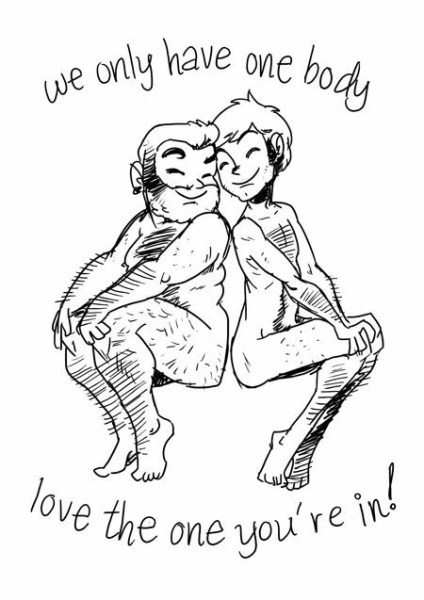
My Body – My pride!…

Have you every watched yourself standing infront of the mirror NAKED?. I bet most of you will say No. But why?, because we never loved our body. We grew up watching people teasing and judging each other by their body shape, size and color. “Look he’s so fat, looks like a balloon”
“Hey, why do you need a table, you’ve your own belly”
“Ohh you’re so dark, nobody will marry you”
“He’s wandering without a shirt, he should’ve shaved the body hair atleast. He looks like a gorilla wandering on the beach”
“She’s wearing a sleeveless and she didn’t even shave her underarms,Eww!”
We all grew up hearing such stuff including people commenting about our eyes, nose, hair, height and even sizes of sexual parts.
This hammering since the childhood made us hate our bodies. Even if we face mirror naked by mistake, we rush to cover ourselves up, cause this feeling that we lack something, we are not good is always there in back of our mind making us hate what god has given us.
But the basic thing is people are nobody to judge you regarding your body. You can grow body fat as you want, grow body hair anywhere you want, unless and until it’s causing use some physical trouble, don’t try to hesitate loving your body. People gonna say, even if your transform yourself from fat to fit or grew hair on your head. They will always have something to say. But it’s your self confidence which will make you love your body. Just give it a try. Explore yourself. Observe every mole, every scar, every stretch mark the life gave you till now. Cry one or two times if you want, but then feel proud of yourself the way you are. You’ll definitely feel strong and your confidence will rise high. Even I’ve tried to feel myself positive towards my body. Though I haven’t succeeded in it totally but I’m sure I’ll reach there soon. The feeling of liberation when we’re confident of whatever we have inside out is what we actually crave for. That’s why I’ve so much respect for boudoir artists. I mean we don’t even dare to face the mirror and they face the camera with pride. What an amazing level of self acceptance they’ve. They accepted themselves the way they are and carry that much pride to flaunt. I even interacted with few of them and they told me how it helped them to boost their confidence, how they feel positive inside out. If they can, then we also can! And yes it’s not necessary to face the camera always. Be yourself. Take pride in it. Even if you atleast start loving your body, it’s a clear win for you. Say it with pride, I’m proud of my body and I’m not ashamed!…
Social media in today’s era
Priya Yadav,
Social Media creates a virtual world through the internet which the user can access using any social media platform (Facebook, Twitter, Instagram). In today’s era, social media has become an important part of life, which has many features, such as providing information, entertaining, and educating. About 700 million people in India’s 125 billion populations have phones. From which 25 crore people have smartphones in their pockets. 155 million people visit Facebook every month and 16 crore people live on WhatsApp every month.
While social media plays a positive role, some people also misuse it. By using social media incorrectly, such people try to divide people by spreading maliciousness. Misleading and negative information is shared through social media, which adversely affect the public. And through social media, also there have been many developmental works that have enriched democracy, which has increased the unity, integrity secularism, socialist qualities of any country.
These days, the increasing trend of social media has not only caught the youth, but even the teenage students have not been able to stay away from its attraction. The habit of accessing these websites until the morning and before going to sleep at night has left the children far away from the real world. When the students sitting with their hands on their mobile phones will have time to introspect. The main reason for the increasing problem of stress among students is their increasing busyness on social media.
Disadvantages of social media
Loss of memory
According to a study done by social media, more use of social media has the opposite effect on memory. Important information is not safe in the minds of such people. Actually, in spare time, the brain works to secure information. But even in free people are busy in online activities, due to which their mind is not able to get rest and it directly affects their memory.
Communication skills are lacking
There is a lack of sociality in students who are always engaged in online conversation, that is why they avoid communication face to face with people in private, due to which they lack communication skills while every area of life, whether academic or having professional, excellent communication skills is very important because the art of effective communication increases your success percentage.
Concentration is affected
Even during studies, most of the attention of the children remain on the message notification on their phones, due to which their attention is not focused on education. The distraction caused by social media sites like Facebook, WhatsApp, Twitter, etc. That means the academic performance of students also falls due to distraction.
Dr. Harsh Vardhan digitally interacts with Executive Director, Stop TB Partnership
Dr. Harsh Vardhan, Union Minister of Health and Family Welfare digitally interacted with Dr Lucica Ditiu, Executive Director, Stop TB partnership, here today.
The Union Minister stated that elimination of TB is a priority for the Indian government. He added that the Government is committed to scaling up access to free diagnosis through rapid molecular tests, provide information on drug resistance and also free treatment for all people with TB with best-quality drugs and regimens, financial and nutritional support to patients. Dr Harsh Vardhan added that the Government is committed to the use of digital technologies for notification and adherence and linking with interface non-governmental agencies to strengthen private sector engagement.
Dr Harsh Vardhan emphasised that though the country is fighting with the COVID pandemic for the last eight months, it is ensured that the health department and health officials in all the states were constantly reminded about the target of elimination of TB by 2025. “Through our efforts on the front of fighting COVID, we have shown to the world that India can be a role model for other countries as we have achieved self reliance in terms of domestic manufacturing of masks and PPE kits”, he stated.
“India, under the guidance of our Hon’ble Prime Minister, Shri Narendra Modi, has accorded a high priority for ending tuberculosis in India by 2025, five years ahead of the Sustainable Development Goals (SDG) target of 2030, and stepping forward as a leader for a TB-free world”, Dr Harsh Vardhan said during the digital interaction. In the recent years, India has already taken several critical steps to showcase itself as a leader for a TB-free world, with impressive and ambitious policies and plans, he emphasised.
Dr Lucica applauded and thanked the Government of India for its commendable efforts in fighting TB.
Advisory issued on safety precautions for rural Water Sanitation and Hygiene (WASH) service providers
In compliance of the Hon’ble Supreme Court Order dated 3.4.2020 in WP (PIL) No.10808/2020 for ensuring safe drinking water during lock down period due to CoVID-19 pandemic, Department of Drinking Water & Sanitation (DDWS), Ministry of Jal Shakti had issued an advisory to all States/ UTs on April 13, 2020.
With the lockdown eased out and socio-economic activities resumed, especially with the commencement of post-monsoon working season, the water supply infrastructure activities have to be implemented on a bigger scale and with speed to achieve the goal of providing tap water connections to all rural households. Hence, it is imperative for WASH service providers at the forefront to follow all the necessary precautions to avoid contraction and spread of the virus.
Current evidence indicates that the CoVid-19 virus is transmitted through respiratory droplets or contact, and transmission occurs when contaminated hands touch the mucosa of the mouth, nose, or eyes; the virus can also be transferred from one surface to another by contaminated hands, which facilitates indirect contact transmission. Along with physical distancing, hand hygiene is the most effective single measure to reduce the spread of infections through multimodal strategies, including access to the appropriate supplies.
To ensure hand hygiene is practiced through hand wash at regular intervals, in order to contain the spread of the Corona virus, there is an urgent need to make tap water available inside every rural household premises. For this purpose, adequate fund has been made available under Jal Jeevan Mission. The mission presents an excellent opportunity to mitigate the ongoing pandemic situation not just by ensuring water supply but also by generating employment to labour who have migrated back home.
In this context, this supplementary advisory is issued by DDWS for assured safe water service delivery to every home with focus on various aspects.
Arrange hand-washing equipment: Hand-washing arrangements with soap and water at the entrance of every water supply establishment may be made to allow everyone to practice it before entering and when leaving. Installation, supervision and regular refilling of the hand washing equipment are the overall responsibility of PHE/ RWS Department;
Ensure potable water in quarantine/ isolation centres: Potable water arrangements are to be ensured at all camp sites, schools/ hostels that have been turned into quarantine/ isolation centres. The arrangements may include tanker water supply, providing temporary stand-posts from near-by potable water source, retrofitting/ repairing existing functional infrastructure wherever required, etc.;
Prioritize health care centres and facilities: A quick gap assessment on potable water facilities in health care centres may be undertaken and immediate arrangements may be made to ensure safe and clean water in all health care facilities;
Promote physical distancing of communities while fetching water: Wherever community members fetch water from stand posts, efforts may be made to widely communicate the importance of physical distancing by maintaining 6 feet gap (2 gaj doori), covering their mouth and nose, etc. All persons must wash hands thoroughly before fetching water;
Increase water supply duration: Given the need to practice physical distancing at stand posts, the duration of water supply may be increased for facilitating the same. Announcements may be made to spread awareness on physical distancing norms and increased water supply hours;
Provide personal protective gear to water supply service providers: Provide soaps/ sanitizers, gloves, masks, gumboots, wipes, etc. to all individuals involved in water supply service provision. All the contractors are to be briefed the precautionary measures regularly, if possible through texts or whatsapp, and ensure they make adequate arrangements for all the labour they employ. Posters of the precautions may also be circulated to GPs, water supply establishments, etc.;
Grievance redressal: Toll-free number at district/ state level may be set up (if not existing already) and the number may be widely circulated/ disseminated through social media, FM radio channels and local TV channels. Students/ volunteers from the operational PMKVY centres/ skill development centres, colleges, etc. can be quickly trained online for handling grievance calls and supporting respective district/ state administration; and
Prioritize retrofitting in schools/ anganwadis: Children will eventually return to schools and anganwadis and there is an urgent need for retrofitting of existing water and sanitation infrastructure for ensuring access to potable water and clean toilets. The ‘swachh vidyalaya’ guidelines clarify the norms in terms of requirement. Both, adequacy of the infrastructure and the appropriateness from a hygiene perspective needs to be ensured.
Precautionary measures are recommended particularly for community-level service providers, viz. plumbers, electricians, motor mechanics, sanitation workers, etc. especially when leaving home for work, when at work and when reaching home. States/ UTs have been requested to give wide publicity to the supplementary advisory.
Minister for Tribal Affairs Sh. Arjun Munda to inaugurate tomorrow the two day National Tribal Research Conclave to be held virtually on 3rd and 4th September, 2020
The Minister for Tribal Affairs Sh. Arjun Munda will inaugurate tomorrow the two day National Tribal Research Conclave to be held virtually on 3rd and 4th September, 2020. The Conclave has been organized by Ministry of Tribal Affairs and Indian Institute of Public Administration(IIPA). The Minister of State for Tribal Affairs, Smt Renuka Singh Saruta will also address the participants at the conclave. This is the second workshop of its kind. The first such workshop was organized in January 2020.
IIPA is working on Tribal Talent Pool and on Strengthening of TRIs in partnership with Ministry of Tribal Affairs. The 2 days review workshop to be Chaired by Shri Arjun Munda will review the progress on the outcome of various projects being implemented under different partnerships and the best practices to be show cased to all stakeholders. Ten research partners will be sharing their projects in this conclave. The road map of National Tribal Research Institutes will also be shared. MoTA is also coming up with NTRI in collaboration with IIPA.
Ministry of Tribal affairs is funding 24 TRIs for research under Grant to TRIs and is engaged in quality research in collaboration with reputed Government and Non Government Organizations spread over the country. These partner organizations are designated as Centres of Excellence. MoTA along with such partner organisations designs workable models which provide end to end solution, like problem identification, finding solution and execution of the project as part of Action research which can be implemented by policy initiatives. The themes are Health, Livelihood, Education, digitalisation, water conservation, data sciences and development models for aspiration and model villages.
Centre for Excellence for Data Analytics (CEDA) is analysing tribal data for various schemes and has developed “Performance and Monitoring Dashboard” (dashboard.tribal.gov.in) which was recently launched by Sh Amitabh Kant, CEO NITI Aayog and Sh. Ramesh Chand, Member NITI Aayog. Bharat Rural Livelihood Foundation, an autonomous organisation under RD Ministry is working on gradation of NGOs and improving monitoring for NGO projects. Piramal Foundation is working for creation of a consolidated health and nutrition data repository for tribal population and for providing data analytics support to facilitate evidence-based policy making and implementation strategies, and has helped MoTA launch Swasthya portal (swasthya.tribal.gov.in). TERI is engaged with MoTA on developing an economical model for Community Rights under Forest right Act. IIT Delhi has been given a project for development of a Data driven framework by using Data analytics to identify the villages that are having maximum socio-economic gaps, so that data drive planning can be made. Likewise NIT Rourkela, Indian Institute of Forest management, NIRTH, JNU, Jamia Milia Islamia, Bhasa, BAIF, FICCI, Assocham are working on livelihood and Health projects in MP, Gujrat, Maharashtra, Jharkhand and other States. Many other Civil Societies and Corporates have offered partnership with MoTA to work together for welfare of tribal in areas of Livelihood, Education, Health, Water Conservation, Organic Farming, Skill Developement, Tribal Culture & Festivals and are keen to become part of “Affirmative Action.
MoTA has taken unique initiative in solving water problems and Livelihood problems of the tribal areas. Action Research project has been given to SECMOL-LADAKH, wherein they would establish Ice stupa in 50 villages and which will solve problem of drinking water and water required for agriculture. SECMOL will also plant trees through community participation. UNDP is working on 1000 springs project with community participation to revive drying streams (https://thespringsportal.org/).
Himmotthan Society, Uttarakhand, which is managed by Tata Foundation has been given project on sheep rearing, Packaging of Apricot and Peas as these are perishable items and locals do not get remunerative price for their products.
Tribal Healers and Tribal medicines: Tribals have vast traditional knowledge of treating diseases with locally available medicinal plants. In order to protect this knowledge, which is fast vanishing, Patanjali Research Institute has been given pilot project for research on Tribal Healers and Medicinal Plants in Uttarakhand. Similar projects have been given to AIIMS-Jodhpur, Parvara Institute of Medical Science and Mata Amritamai Institute for Rajasthan, Maharashtra and Kerala.
Through CII, FICCI, Assocham many Corporates and NGOs have also shown interest to support and act as mentor for such talent and offered to give Internships to interested Scholars. Many Civil Societies and Corporates have also offered partnership with MoTA to work together for welfare of tribal in areas of Livelihood, Talent pool, Tribal healers, Tribal Culture & Festivals and are keen to become part of “Affirmative Action”. Philips India has offered scholarship to 30 medical students who could not be accommodated under the Top Class Scholarship scheme of MoTA. GOAL (Going Online As Leaders) is also one such initiative of Facebook, which is funded by Facebook and various organisations working with MoTA are the Institutional partners in this project.
Minister for Tribal Affairs Sh. Arjun Munda to inaugurate tomorrow the two day National Tribal Research Conclave to be held virtually on 3rd and 4th September, 2020
The Minister for Tribal Affairs Sh. Arjun Munda will inaugurate tomorrow the two day National Tribal Research Conclave to be held virtually on 3rd and 4th September, 2020. The Conclave has been organized by Ministry of Tribal Affairs and Indian Institute of Public Administration(IIPA). The Minister of State for Tribal Affairs, Smt Renuka Singh Saruta will also address the participants at the conclave. This is the second workshop of its kind. The first such workshop was organized in January 2020.
IIPA is working on Tribal Talent Pool and on Strengthening of TRIs in partnership with Ministry of Tribal Affairs. The 2 days review workshop to be Chaired by Shri Arjun Munda will review the progress on the outcome of various projects being implemented under different partnerships and the best practices to be show cased to all stakeholders. Ten research partners will be sharing their projects in this conclave. The road map of National Tribal Research Institutes will also be shared. MoTA is also coming up with NTRI in collaboration with IIPA.
Ministry of Tribal affairs is funding 24 TRIs for research under Grant to TRIs and is engaged in quality research in collaboration with reputed Government and Non Government Organizations spread over the country. These partner organizations are designated as Centres of Excellence. MoTA along with such partner organisations designs workable models which provide end to end solution, like problem identification, finding solution and execution of the project as part of Action research which can be implemented by policy initiatives. The themes are Health, Livelihood, Education, digitalisation, water conservation, data sciences and development models for aspiration and model villages.
Centre for Excellence for Data Analytics (CEDA) is analysing tribal data for various schemes and has developed “Performance and Monitoring Dashboard” (dashboard.tribal.gov.in) which was recently launched by Sh Amitabh Kant, CEO NITI Aayog and Sh. Ramesh Chand, Member NITI Aayog. Bharat Rural Livelihood Foundation, an autonomous organisation under RD Ministry is working on gradation of NGOs and improving monitoring for NGO projects. Piramal Foundation is working for creation of a consolidated health and nutrition data repository for tribal population and for providing data analytics support to facilitate evidence-based policy making and implementation strategies, and has helped MoTA launch Swasthya portal (swasthya.tribal.gov.in). TERI is engaged with MoTA on developing an economical model for Community Rights under Forest right Act. IIT Delhi has been given a project for development of a Data driven framework by using Data analytics to identify the villages that are having maximum socio-economic gaps, so that data drive planning can be made. Likewise NIT Rourkela, Indian Institute of Forest management, NIRTH, JNU, Jamia Milia Islamia, Bhasa, BAIF, FICCI, Assocham are working on livelihood and Health projects in MP, Gujrat, Maharashtra, Jharkhand and other States. Many other Civil Societies and Corporates have offered partnership with MoTA to work together for welfare of tribal in areas of Livelihood, Education, Health, Water Conservation, Organic Farming, Skill Developement, Tribal Culture & Festivals and are keen to become part of “Affirmative Action.
MoTA has taken unique initiative in solving water problems and Livelihood problems of the tribal areas. Action Research project has been given to SECMOL-LADAKH, wherein they would establish Ice stupa in 50 villages and which will solve problem of drinking water and water required for agriculture. SECMOL will also plant trees through community participation. UNDP is working on 1000 springs project with community participation to revive drying streams (https://thespringsportal.org/).
Himmotthan Society, Uttarakhand, which is managed by Tata Foundation has been given project on sheep rearing, Packaging of Apricot and Peas as these are perishable items and locals do not get remunerative price for their products.
Tribal Healers and Tribal medicines: Tribals have vast traditional knowledge of treating diseases with locally available medicinal plants. In order to protect this knowledge, which is fast vanishing, Patanjali Research Institute has been given pilot project for research on Tribal Healers and Medicinal Plants in Uttarakhand. Similar projects have been given to AIIMS-Jodhpur, Parvara Institute of Medical Science and Mata Amritamai Institute for Rajasthan, Maharashtra and Kerala.
Through CII, FICCI, Assocham many Corporates and NGOs have also shown interest to support and act as mentor for such talent and offered to give Internships to interested Scholars. Many Civil Societies and Corporates have also offered partnership with MoTA to work together for welfare of tribal in areas of Livelihood, Talent pool, Tribal healers, Tribal Culture & Festivals and are keen to become part of “Affirmative Action”. Philips India has offered scholarship to 30 medical students who could not be accommodated under the Top Class Scholarship scheme of MoTA. GOAL (Going Online As Leaders) is also one such initiative of Facebook, which is funded by Facebook and various organisations working with MoTA are the Institutional partners in this project.
Metro Operations to Resume in a Graded Manner from 7th September 2020
Shri Hardeep S Puri, MoS, (I/C), Ministry of Housing and Urban Affairs has announced the SOP guidelines for metro operations in a media interaction today. As per MHA order No 40-3/2020-DM-I(A) dated 29.8.2020, metro services will resume from 7th September, 2020 in a graded manner. For this purpose, SOP guidelines have been prepared by Ministry of Housing and Urban Affairs, which have been concurred by the Ministry of Home Affairs.
Broad features of the same are as below: –
a. Metro operations to be resumed in graded manner. Metros having more than one line should open different lines staring from 7th September, 2020 onwards in a graded manner so that all corridors become operational by 12th September 2020. Daily hours of operations may be staggered initially, which needs to be increased gradually with resumption of full revenue service by 12th September, 2020. Frequency of trains to be regulated to avoid passenger crowding at stations and in trains.
b.Stations/ entry-exit gates in containment zones to be closed.
c.In order to ensure social distancing, suitable markings at stations and inside trains to be done.
d.Wearing of face mask to be mandatory for all passengers and staff. Metro rail corporations may make arrangements for supply of masks on payment basis to the persons arriving without mask.
e.Only asymptomatic persons to be allowed to travel after thermal screening at entry into the stations. Symptomatic persons should be advised to go to nearby COVID Care Centre/Hospital for testing/medical attention. Use of Aarogya Setu App to be encouraged.
f.Provision of sanitizers to be made at entry into the stations for use by passengers. Sanitization of all areas having human interface viz. equipment, train, working area, lift, escalators, handrail, AFC gate, toilets etc. needs to be done at regular intervals.
g.Use of Smart Card and cashless/online transactions to be encouraged. Tokens and paper slips/ticket to be used with proper sanitization.
h.Adequate dwell time at stations to be provided to enable smooth boarding/deboarding ensuring social distancing. Metro rail corporations may also resort to skipping of stations to ensure proper social distancing.
i.Passengers to be advised to travel with minimum luggage and avoid carrying metallic items for easy and quick scanning.
j.Operation of Heating, Ventilation and Air-Conditioning (HVAC) system as per the Central Public Works Department (CPWD) & Indian Society of Heating, Refrigerating and Air Conditioning Engineers (ISHRAE) guidelines. Intake of fresh air in air-conditioning system to be increased to the extent possible.
k.Information, Education and Communication (IEC) campaign to be launched for passenger and staff through electronic/print/social media, poster, banner, hoarding, website etc.
l.Metro rail corporations to keep close liaison with state police and local administration for regulating crowd outside station and to deal with contingencies.
Based on above guidelines, Delhi, Noida, Chennai, Kochi, Bangalore, Mumbai Line-1, Jaipur, Hyderabad, Maha Metro (Nagpur) Kolkata, Gujarat and UP Metro (Lucknow) have prepared their SOPs. Government of Maharashtra has decided not to resume operation of metro during September, 2020. Hence, Mumbai Line-1 and Maha Metro operations shall commence from October, 2020 or as State Government may decide further.
CBDT provides ITR Filing Compliance Check Functionality for Scheduled Commercial Banks
Central Board of Direct Taxes in exercise of powers conferred under section 138(1)(a) of Income Tax Act, 1961, has issued Order inF.No. 225/136/2020/ITA.II dated 31.08.2020, for furnishing information about IT Return Filing Status to Scheduled Commercial Banks, notified vide notification No. 71/2020 dated 31.08.2020 under sub-clause (ii) of clause (a) of sub-section (1) of section 138 of the Act.
The data on cash withdrawal indicated that huge amount of cash is being withdrawn by the persons who have never filed income-tax returns. To ensure filing of return by these persons and to keep track on cash withdrawals by the non-filers, and to curb black money, the Finance Act, 2020 w.e.f. 1st July, 2020 further amended Income-tax Act, 1961 to lower the threshold of cash withdrawal to Rs. 20 lakh for the applicability of TDS for the non-filers and also mandated TDS at the higher rate of 5% on cash withdrawal exceeding Rs. 1 crore by the non-filers.
Income Tax Department has already provided a functionality “Verification of applicability u/s 194N” on http://www.incometaxindiaefiling.gov.in for Banks and Post offices since 1st July, 2020. Through this functionality, Bank/Post Office can get the applicable rate of TDS under section 194N of the Income-tax Act, 1961 by entering the PAN of the person who is withdrawing cash.
The Department has now released a new functionality “ITR Filing Compliance Check” which will be available to Scheduled Commercial Banks (SCBs) to check the IT Return filing status of PANs in bulk mode. The Principal Director General of Income-tax (Systems) has notified the procedure and format for providing notified information to the Scheduled Commercial Banks. The salient features of the using functionality are as under:
- Accessing “ITR Filing Compliance Check”:The Principal Officer & Designated Director of SCBs, which are registered with the Reporting Portal of Income-tax Department (https://report.insight.gov.in) shall be able to use the functionality after logging into the Reporting Portal using their credentials. After successfully logging in, link to the functionality “ITR Filing Compliance Check” will appear on the home page of the Reporting Portal.
- Preparing request (input) file containing PANs: The CSV Template to enter PAN details can be downloaded by clicking on “Download CSV template” button on the “ITR Filing Compliance Check” page. PANs, for which IT Return filing status is required, are required to be entered in the downloaded CSV template. The current limit of PANs in one file is 10,000.
- Uploading the input CSV file: Input CSV file may be uploaded by clicking on Upload CSV button. While uploading, “Reference Financial Year” is required to be selected. Reference Financial Year is the year for which results are required. If selected Reference Financial Year is 2020-21 then results will be available for Assessment years 2017-18, 2018-19 and 2019-20. Uploaded file will start reflecting with Uploaded status.
- Downloading the output CSV file: After processing, CSV file containing IT Return Filing Status of the entered PANs will be available for download and “Status” will change to Available. Output CSV file will have PAN, Name of the PAN holder (masked), IT Return Filing Status for last three Assessment Years. After downloading of the file, the status will change to Downloaded and after 24 hours of availability of the file, download link will expire and status will change to Expired.
Scheduled Commercial Banks can also use API based exchange to automate and integrate the process with the Bank’s core banking solution. Scheduled Commercial Banks are required to document and implement appropriate information security policies and procedures with clearly defined roles and responsibilities to ensure security of information.
Union Home Minister, Shri Amit Shah hails approval of Mission Karmayogi, the National Programme for Civil Services Capacity Building (NPCSCB), by the Cabinet
Union Home Minister, Shri Amit Shah has hailed the approval of the Mission Karmayogi, the National Programme for Civil Services Capacity Building (NPCSCB), by the Cabinet today, terming it as aimed at bringing about a “transformational change in Civil Services”.
Shri Amit Shah expressed gratitude to the Prime Minister Shri Narendra Modi, “for this visionary reform”. “This holistic & comprehensive scheme will focus on individual aswell as institutional capacity building”, he said.
The Union Home Minister said, “It is a landmark reform for the 21stcentury which will end the culture of working in silos and bring out a new work culture. Goal driven and constant training will empower and sensitize the civil servants to ensure accountability and transparency in the system”.
Shri Amit Shah said, “This reform will not only provide a mechanism for Government functionaries to improve their own performance but also enable them to fulfill and live upto the aspirations of NewIndia.”
“Modi Government is fully committed towards building of a future ready civil service, ‘Civil Service for a New India’,” he said.
NPCSCB has been carefully designed to lay the foundations for capacity building for Civil Servants so that they remain entrenched in Indian Culture and sensibilities and remain connected, with their roots, while they learn from the best institutions and practices across the world. The Programme will be delivered by setting up an Integrated Government Online Training Platform, “iGOTKarmayogi”. To cover around 46 lakh Central employees, a sum of Rs.510.86 crore will be spent over a period of 5 years from 2020-21 to 2024-25.
Mission Karmayogi to radically improve the Human Resource management in the Government says PM
In a series of tweets, Prime Minister Shri Narendra Modi said that Mission Karmayogi – National Program for Civil Services Capacity Building will radically improve the Human Resource management practices in the Government. It will use scale & state of the art infrastructure to augment the capacity of Civil Servants.
He tweeted “iGOT platform will enable the transition to a role-based HR management & continuous learning. Mission Karmayogi aims to prepare Civil Servants for the future by making them more creative, constructive & innovative through transparency and technology.”
Income Tax Department carries out searches in Srinagar and Kupwara
The Income Tax Department has carried out simultaneous search and seizure operations on 2nd September, 2020 in the case of three prominent businessmen in Srinagar and Kupwara. These operations have, prima facie, led to the detection of huge amount of undisclosed income, seizure of unaccounted assets and incriminating evidence and involvement in benami transactions by these three groups.
The search action revealed that the key person of one of the groups, although engaged in Cross-LOC trade until the suspension of trade by the Government in April 2019, has not filed his Income Tax Returns. He was also found to be having two active PANs. His proprietory concern has made exports of over Rs. 25 crore in the last few years. However, no income tax has been paid at all. Incriminating documents related to the LoC trade have been seized from the Custodian of cross-LOC trade, indicating large-scale tax evasion. There are also evidences of unexplained expenditure on the education of his daughter in Pakistan.
In another case, the key person and his brother were engaged in Cross-LOC trade until the suspension of trade by the Government. He had made total exports of Rs 3 crore in the last two years, while he had filed his Income Tax Return for only one year and that too, showing meager receipts. The Income Tax Return filed also does not match with the credits in multiple bank accounts which run into crores of rupees. Further, evidences showing illegal trade in violation of suspension of cross LoC trade have been seized. The passport of the assessee reveals that he had travelled to Pakistan for 20-25 days every calendar year since 2017 and the source of expenditure on this account is prima-facie unexplained.
In yet another case, it was seen that the group was engaged in Cross- LOC trade of vegetables and fruits. In this case, unaccounted cash of Rs. 15 lakh has been seized. The group is having multiple concerns. However, transactions of these concerns have not been reflected in their Income Tax Returns. In the case of a person of this group, who is a non-filer, documents pertaining to the unaccounted business transactions of about Rs.10 crore have been seized. In another case of a firm, one of the partners in the firm has admitted that his name was only being used, though he was not involved in any activity of the firm. The matter is being examined from the angle of Benami transactions. A locker has also been found which is yet to be searched and has been placed under restraint.
Further investigations are going on.


You must be logged in to post a comment.