Post Poll Violence in West Bengal: Shame to Democracy

In a democratic society some people will vote for the party which is in power and some will vote for opposition parties. This is a simple rule in democracy. But what has been happening in West Bengal after 2 May 2021 is highly deplorable, sad and heart wrenching as a State with all “Bhadraloks” have proved that many of them can go at any level of violence i.e. killing, arson, assault etc. irrespective of any political party.  It is pertinent to mention that same time along with few other states elections were held in Assam. But not a single violence took place in Assam, a neighbouring State so “Bhadraloks” of West Bengal should learn. Few years ago I visited across West Bengal for academic woks and I observed huge unemployment. Many educated youths were literally crying as there were no employment opportunities. Many told​ me ​ educated​ ​​youths  were working as security personnel by getting paltry amounts.  Also it is interesting to mention here that many were proud of Sri Ramakrishna Paramahamsa, Gurudev Rabindranath Tagore, ​ Sri Aurobindo, Kazi Nazrul Islam, Swami Vivekananda, Netaji Subhas Chandra Bose, and many others as they were from Bengal. I highly praise this theory ‘but one should also do his or her good activities’. Anyway, West Bengal was once an economically prosperous state  ​now stands at low level in terms of development. During the 1960s many people used to go to West Bengal in general and Kolkata/Calcutta in particular for work. Against this backdrop, Labour Migration from the State in recent years is high as job opportunities are less. ​A​ccording to the Census 2011​, West Bengal ranks fourth among the states from where people migrate for work and employment. “Between 2001 and 2011, nearly 5.8 lakh people migrated from​ West​ Bengal looking for work, which is only after Uttar Pradesh (37.3 lakh), Bihar (22.6 lakh) and Rajasthan (6.6 lakh)” (The Times of India, 3/11/2019).  

​  ​A few data about post poll violence may be presented here.  According to the Times of India dated May 4, 2021 “11 killed in Bengal post-poll violence”. This is highly deplorable in a so-called   “Bhadralok” State. Killing of any person irrespective of party supporter, religion, caste language etc never can be supported, rather very very deplorable.  By quoting India Today dated 5/5/2021, it may be mentioned that “as post-poll violence grips West Bengal following the announcement of the assembly poll results, hundreds of BJP karyakartas and family members reportedly fled the state and have now taken shelter in Assam by crossing the inter-state border. Senior minister in the Assam government, Himanta Biswa Sarma on Tuesday claimed that around 300-400 BJP karyakartas and family members have crossed over to Dhubri in Assam after post-poll violence in West Bengal. The Assam minister further added that the state government is providing food and shelter to the party workers who have fled West Bengal”.

My fervent request to Didi as you are CM kindly saves the lives and properties of all. Because in school days read, “Violence is the last refuge of the incompetent”

Dr Shankar Chatterjee, Hyderabad, Dt 5 May 2021

Complete lockdown imposed in Bihar and Odisha to contain spread of Coronavirus

Complete lockdown has been imposed in Bihar and Odisha to contain spread of Coronavirus. Bihar government has imposed complete lockdown in the state till 15th of this month to contain the spread of Corona. Vaccination centres, banks and essential services will remain functional during the lockdown.
 
As per new guidelines, government offices and public corporations will remain closed. All educational institution, private and commercial establishments will also remain closed. Cinema halls, Shopping Mall, Gyms, stadium and parks have also been closed. Movement of public transport except train and flights has been stopped. Transport of emergency services has been allowed.
 
However, ration shops, dairy, vegetables and meat shops will remain open between 7 am and 11 am.
 
Home delivery from restaurants will be allowed from 9 am to 9 pm. All places of worship and religious gatherings will also be closed. The concerned authorities have been instructed to encourage home delivery to minimize the movement of individuals outside their homes.
 
Marriage ceremony with a limit of 50 persons has been allowed. For marriage ceremony permission has to be taken three days in advance from the concerned police station. Only 20 persons will be permitted in funeral processions. 
 
Odisha government has also imposed a state-wide lockdown for 14 days beginning today. The lockdown will be effective till 19th of this month. State’s Covid active caseload has jumped to 73,548 with the detection of 8,216 new cases yesterday. AIR correspondent reports, the state that used to report a peak of 4 to 5 thousand infections per day, during the first wave of the pandemic last year, has suddenly been confronted with daily highs of 8 to 10 thousand new cases. The 14 days’ statewide lockdown that aims at an early arrest of the virus, has spared certain essential activities including health services, covid test, vaccination and movement of goods, among others. Certain utility services like petrol pumps, cooking gas, ATM and postal service have also been exempted from the lockdown.
 
People will be allowed to walk down to the nearest roadside or street corner shops within 500 metres of their residence to purchase food items on all week days only between 6 in the morning to 12 noon. While marriage functions with a cap of  50 participants and funeral related rituals with a maximum of 20 participants will be allowed with prior approval and with full adherence to covid 19 protocols, all sorts of socio, religious , political, cultural, sports and entertainment related congregations  will remain barred during the period.

ICMR issues advisory for Corona testing; recommends measures to reduce pressure on diagnostic labs

Indian Council of Medical Research (ICMR) has issued advisory for COVID-19 testing during the second wave of the pandemic. It said, at present, the laboratories are facing challenges to meet the expected testing target due to extraordinary case load and staff getting infected with COVID-19. In view of this situation, it is imperative to optimize the RTPCR testing and simultaneously increase the access and availability of testing to all citizens of the country. In its advisory, the ICMR has recommended measures to optimize RTPCR testing. It said, RTPCR test must not be repeated in any individual who has tested positive once either by RAT or RTPCR. No testing is required for COVID-19 recovered individuals at the time of hospital discharge in accordance with the discharge policy of the Union Health Ministry.
 
Besides, the need for RTPCR test in healthy individuals undertaking inter-state domestic travel may be completely removed to reduce the load on laboratories. Non-essential travel and interstate travel of symptomatic individuals should be essentially avoided to reduce the risk of infection. All asymptomatic individuals undertaking essential travel must follow COVID appropriate behaviour. The ICMR said, mobile testing laboratories are now available on GeM portal and States are encouraged to augment RTPCR testing through mobile systems.
 
With regard to measures to ramp up testing through Rapid antigen test (RAT), the ICMR said, RAT may be allowed at all available Government and private healthcare facilities. Dedicated RAT booths should be set up in cities, towns and villages to offer testing to people. It said, testing booths may be set up at multiple locations including healthcare facilities, RWA, offices, schools, colleges, community centers and other available vacant spaces. These booths should be operational round the clock to improve access and availability of testing. It has also suggested that  stringent measures must be instituted to avoid overcrowding at RAT testing facilities.
 
The ICMR said, all states are advised to ensure full utilization of the available RTPCR testing capacity, both in public and private laboratories.
 
Symptomatic individuals identified positive by RAT should not be re-tested and advised to go through home-based care as per ICMR guidelines. It said, symptomatic individuals identified negative by RAT should be linked with RTPCR test facility and in the meantime be urged to follow home isolation and treatment. It said, all RTPCR and RAT test results should be uploaded on ICMR portal. It also said that the vaccination status of all individuals tested for COVID-19 must be entered into the Sample Referral Form (SRF) in the RTPCR app both for individuals tested by RTPCR and RAT as this information is of critical importance.

Govt identifies 581 sites for setting up medical oxygen plants in various states

Government has identified 581 sites for setting up additional Pressure Swing Absorption (PSA) medical oxygen plants in various states. In a series of tweets, Road, Transport and Highways Minister Nitin Gadkari said, National Highway Authority of India (NHAI) will be the nodal agency for executing civil and electrical work for these plants and will complete them on war footing.

He said, our engineers will work with the doctors to ensure oxygen supply to needy patients. The Minister said, like record speed in roads, NHAI will construct infrastructure in record speed to save life of every Indian.

India, UK adopt Roadmap 2030 to elevate bilateral ties to comprehensive Strategic Partnership

Prime Minister Narendra Modi and his British counterpart Boris Johnson have adopted an ambitious ‘Roadmap 2030’ to elevate bilateral ties to a ‘Comprehensive Strategic Partnership’. The Roadmap will pave the way for a deeper and stronger engagement over the next ten years in the areas of people to people contacts, trade and economy, defence and security, climate action and health.
 
In a Virtual Summit held yesterday, the two leaders discussed the Covid19 situation and ongoing cooperation in the fight against the pandemic, including the successful partnership on vaccines. Prime Minister Modi thanked Prime Minister Johnson for the prompt medical assistance provided by the UK in the wake of the severe second wave of Covid19 in India. Prime Minister Johnson appreciated India’s role in extending assistance to the UK and other countries over the last year, including by way of supply of pharmaceuticals and vaccines.
 
The two Prime Ministers launched an ‘Enhanced Trade Partnership’ to unleash the trade potential  by setting an ambitious target of more than doubling bilateral trade by 2030. As part of the ETP, India and the UK agreed on a roadmap to negotiate a comprehensive and balanced FTA, including consideration of an Interim Trade Agreement for delivering early gains. The enhanced trade partnership will generate several thousands of direct and indirect jobs in both the countries.
 
A new India-UK ‘Global Innovation Partnership’ was announced at the Virtual Summit that aims to support the transfer of inclusive Indian innovations to select developing countries, starting with Africa. Both sides agreed to enhance cooperation on new and emerging technologies, including Digital and ICT products, and work on supply chain resilience. They also agreed to strengthen defence and security ties, including in the maritime, counter-terrorism and cyberspace domains.
 
Both Prime Ministers also exchanged views on regional and global issues of mutual interest, including cooperation in the Indo-Pacific, and G7. They reiterated commitment to climate action to achieve the goals of the Paris Agreement and agreed to closely engage in the run up to CoP26 hosted by the UK later this year.
 
India and the UK also launched a comprehensive partnership on migration and mobility that will facilitate greater opportunities for the mobility of students and professionals between the two countries.

Call for Papers IJR


Why to publish a paper with IJR?

  • The papers of this journal has an open access to all
  • Great source of reviewers from academics as well as industries.
  • Rapid publication.
  • Authors will get INDIVIDUAL SOFT COPY THE CERTIFICATE.
  • High Impact Factor
  • Indexed in more than 20 reputed databases
  • Nominal fees of publication / Article Processing Charges
  • 8 Years of track record
  • 2300+ papers indexed in google scholar
  • Served 7000+ authors from more than 40 countries 
  • A team of 200+ Editors and Reviewers from reputed institutes over the world


How to publish a paper?

Many primary authors may deal with this question, many of us may have innovative ideas to be published but they may not know the general steps of publishing a paper. The publication of the paper is simply done as per the following steps.

  • Research over the topic
  • Study what others have done
  • Finalize your key area of research
  • Work over the idea
  • Prepare a draft(generally 6-8 pages)
  • Revise the draft
  • Check for the grammatical mistakes
  • Check for the plagiarism
  • Revise the draft
  • Get opinion of other on your draft
  • Make final corrections
  • Submit the paper to the journal
  • Wait for the reviewers comments
  • Correct the paper and resubmit
  • Complete the registration
  • Congratulations!!! Your paper is published

Easy way of paper publication

IJR is trying to make the paper publication easy for the authors. We are working on reduction of the time for completion of the review process for the paper. The paper publication for the authors is a great learning experience where one can understand how to analyze, create, prepare, present and revise the technical details.

Invitation for journal publication

IJR invites the manuscripts in the areas of Engineering, Technology, and Sciences. All the areas of these broad categories are cover under the scope of IJR. The authors are requested to submit the original creativity of the data to this journal publication. 

Formal Conditions of Acceptance:

  • English is the compulsory language for the paper
  • Paper should be original and should avoid the plagiarism
  • Paper should present some contribution to the scientific research

How to Submit Papers

Send papers for review to ijr@ijrjournal.com 

Garden City

 The garden city movement is a method of urban planning in which self-contained communities are surrounded by “greenbelts”, containing proportionate areas of residences, industry and agriculture. The idea was initiated in 1898 by Sir Ebenezer Howard in the United Kingdom and aims to capture the primary benefits of a countryside environment and a city environment while avoiding the disadvantages presented by both. 

Inspired by the utopian novel “Looking Backward” and Henry George’s work “Progress and Poverty”, Howard published the book “To-morrow: a Peaceful Path to Real Reform” in 1898 (which was reissued in 1902 as “Garden Cities of To-morrow”). His idealized garden city would house 32,000 people on a site of 6,000 acres, planned on a concentric pattern with open spaces, public parks and six radial boulevards, 120 ft (37 m) wide, extending from the centre. The garden city would be self-sufficient and when it reached full population, another garden city would be developed nearby. Howard envisaged a cluster of several garden cities as satellites of a central city of 58,000 people, linked by road and rail. 

Howard believed that all people agreed the overcrowding and deterioration of cities was one of the troubling issues of their time. It is important to understand the context to which Howard’s work was a reaction. London (and other cities) in the 19th century were in the throws of industrialization, and the cities were exerting massive forces on the labour markets of the time. 

Massive immigration from the countryside to the cities was taking place with London. This situation was unsustainable and political commentators of all parties sought “how best to provide the proper antidote against the greatest danger of modern existence”. To Howard the cure was simple – to reintegrate people with the countryside. 

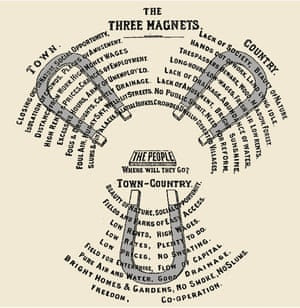
Concept of Three magnets 

He had no training in urban planning or design but excelled in creating places which he called “magnets” where people would want to come to reside and work. His garden cities were planned, contained communities surrounded by a green belt (parks), containing proportionate areas of residences, industry and agriculture. Garden city movement aimed at addressing the urban problems plaguing the industrial city of that time. Garden city concept was an effective response for a better quality of life in overcrowded and dirty industrial towns which had deteriorated the environment and posed serious threat to health. 

Garden city movement had the “Three Magnets” to addresses the question ‘Where will the people go?’ the choices being ‘Town’, ‘Country’ or ‘Town Country’.

Concept of three magnets

Town 

The pull of ‘Town Magnet’ are the opportunities for work and high wages, social opportunities, amusements and well – lit streets. It was closing out of nature, offered isolation of crowds and distance from work. But it came at a cost of foul air, costly drainage, murky sky and slums. Town life has good and bad characteristics. Positive and negative aspects of town include; 
  •  Social opportunity 
  •  Closing out of nature 
  •  Isolation of crowds 
  •  High rents and prices 
  •  Places of amusement 
  •  Foul air and murky sky 
  •  Chances of employment 
  •  Slums and gin palaces 
  •  High money wages 
  •  Costly drainage 
  •  Well-lit streets 
  •  Palatial edifices 

Country 

The pull of ‘Country Magnet’ is in natural beauty, fresh air, healthfulness. It offered natural beauty, low rents, fresh air, meadow but had low wages and lack of drainage. Country has dullness, lack of society, low wages, lack of amusements and general decay. Positive and negative aspects of town include; 
  •  Beauty of nature 
  •  Lack of society 
  •  Land lying idle 
  •  Hands out of work 
  •  Wood, meadow, forest 
  •  Trespassers beware 
  •  Fresh air 
  •  Low wages 
  •  Low rents 
  •  Lack of drainage 
  •  Abundance of water 
  •  Lack of amusement 
  •  Bright sunshine 
  •  No public spirit 
  •  Need for reform 
  •  Crowded dwellings 
  •  Deserted villages

Town- Country 

It was a combination of both town and countryside with aim of providing benefits of both and offered beauty of nature, social opportunity, fields if easy access, low rent, high wages and field of enterprise. Thus the solution was found in a combination of the advantages of Town and Country – the ‘Town Country Magnet’ – it was proposed a town in the country, and having within it the amenities of natural beauty, fresh air and healthfulness. Thus advantages of the Town – Country are seed to be free from the disadvantages of either. Town-country combination has the advantages of both aspects. 

  •  Beauty of nature 
  •  Peace all-over the places 
  •  Social opportunity 
  •  Cumulative growth 
  •  Fields and parks of easy access 
  •  Equal chances 
  •  Low rents- high wages 
  •  Low rates- plenty to do 
  •  Low prices- no sweating 
  •  Field for enterprise- flow of capital 
  •  Pure air and water- good drainage 
  •  Bright homes & gardens- no smoke, no slums 
  •  Freedom- co-operation

Principles of Garden City 

  • Co-operative holding of land to insure that the advantage of appreciation of land values goes to the community, not the private individuals 
  • Economic and social advantages of large scale planning 
  • Establishment of cities of limited size, but at the same time possessing a balanced agricultural industrial economy 
  • Urban decentralization 
  • Use of a surrounding green belt to serve as an agricultural recreational area

Features of Garden City 

An ideal garden city is a compact town of 6000 acres, 5000 of which is permanently reserved for agriculture. It accommodates a maximum population of 32,000. There are parks and private lawn everywhere. Also the roads are wide, ranging from 120 to 420 feet for the Grand Avenue, and are radial rather than linear. 
Commercial, industrial, residential, and public uses are clearly differentiated from each other spatially. Additional elements include unified land ownership –co-operatives, there was no individual ownership of land. Local community also participated in the decision making regarding development. As we can see in the diagram, there is a central park containing public buildings. It is surrounded by shopping streets which are further surrounded by dwelling units in all directions. The outer circle contains factories and industries. Rail road’s bypasses the town, meeting the town at tangent.
After a city reaches its target population, new interconnected nodes can be developed. A Garden city is built up and its population has reached 32,000. It will grow by establishing another city some little distance beyond its own zone of ‘country’, so that the new town may have a zone of country of its own.
Sir Ebenezer Howard’s Garden city

Circular city growing in a radial manner or pattern

  • Divided into six equal wards, by six main Boulevards that radiated from the central park/garden 
  • Civic institutions (Town Hall, Library, Hospital, Theatre, Museum etc. ) are placed around the central garden
  • The central park enclosed by a crystal palace acts as an arcade for indoor shops and winter gardens 
  • The streets for houses are formed by a series of concentric ringed tree lined avenues 
  • Distance between each ring vary between 3-5km 
  • A 420 feet wide, 3 mile long, Grand avenue which run in the center of concentric rings , houses the schools and churches and acts as a continuous public park 
  • The municipal railway was placed in another ring closer to the industrial ring, so that the pressure of excess transport on the city streets is reduced and the city is connected to the rest of the nation.

Main components of Howard’s Garden city movement 

1) Planned Dispersal 

The organized outward migration of industries and people to towns of sufficient size to provide the services, variety of occupations and level of culture needed by a balanced cross – section of modern society. 

2) Limit of Town Size 

The growth of towns to be limited, in order that their inhabitants may live near work, shops, social centers and each other and also near open country. 

3) Amenities 

The internal texture of towns to be open enough to permit of houses with private gardens, adequate space for schools and other functional purposes, and pleasant parks and parkways. 

4) Town and Country Relationship 

The town area to be defined and a large area around it reserved permanently for agriculture; thus enabling the farm people to be assured of a nearby market and cultural center, and the town people to have the benefit of a country situation. 

5) Planning Control 

Pre – planning of the whole town framework, including the road – scheme and functional zoning; the fixing of maximum densities; the control of building as to quality and design, but allowing for individual variety; skillful planting and landscape garden design. 

6) Neighborhoods 

The town to be divided into wards, each to some extent a developmental and social entity. Two garden cities were built using Howard’s garden city movement concept are Letchworth Garden City and Welwyn Garden City, both in Hertfordshire, England. 

Letchworth Garden City 

The first garden city developed in 1903 by Barry Parker and Raymond Unwin was Letchworth garden city. It is 34 miles away from London. It has an area of 5000 acres with 3000 acres of green belt. It had an agricultural strip at periphery to check the invasion of urban area i.e. the sprawling. It showed Howard’s general principles, including the communal ownership of the land and the permanent green belt has been carried through. It was a town of homes and gardens with ample open spaces and a spirited community life. A great attention was paid to landscaping and planting.
  • Its plan was based on population of 30000 with living area of 1250 acres and 2500 acres of rural green belt. 
  • Communities ranged from 12000 – 18000 people, small enough which required no vehicular transportation. 
  • Industries were connected to central city by rapid transportation. 
  • In 30 years, the city developed with 15000 population and 150 shops, industries. 

Welwyn Garden City

It was the second garden city founded by Sir Ebenzer Howard and designed by Louis De Soissions in 1920 and was located 20 miles from London. It was a town visually pleasing and was efficient technically and was human in scale. 
  • It started with area of 2400 acres and 40000 populations. 
  • Had a parkway, almost a mile long central mall. 
  • Town laid out along tree-lined boulevards with Neo Georgian town center. 
  • Every road had a wide grass verge. 
  • In 15 years – developed with 10000 population and 50 shops, industries. 

Failure of Garden Cities

Letchworth slowly attracted more residents because it was able to attract manufacturers through low taxes, low rents and more space. Despite Howard’s best efforts, the home prices in this garden city could not remain affordable for workers to live in. Although many viewed Letchworth as a success, it did not immediately inspire government investment into the next line of garden cities. In frustration, Howard bought land at Welwyn to house the second garden city in 1919. The Welwyn Garden City Corporation was formed to oversee the construction. But Welwyn did not become self-sustaining because it was only 20 miles from London. Even until the end of the 1930s, Letchworth and Welwyn remained as the only existing garden cities.