

Department of Fertilisers is ready with an action plan to make India Aatmanirbhar in Rock Phosphate, the key raw material of DAP and NPK Fertlisers. Minister of State for Chemicals and Fertilisers Mansukh Mandaviya held a meeting yesterday with officials and stakeholders of Fertiliser industries to improve the availability of phosphatic fertilisers and to reduce the dependence on imports.
Rock Phosphate is the key raw material for DAP and NPK fertilisers and India is 90 per cent dependent on imports. Volatility in international prices affects domestic prices of fertilisers and hinders the progress and development of agriculture sector in the country.
In view of this, the Minister had a meeting with stakeholders to expedite the exploration and mining of available rock phosphate reserves in India. He directed to commercially exploit and ramp up the production in the existing 30 lakh MT of Phosphorite deposits which are available in Rajasthan, central part of peninsular India, Hirapur, Lalitpur, Mussoorie syncline and Cuddapah basin.
Discussion and planning with Department of Mining and Geological Survey of India is going on to expedite the exploration in the potential potassic ore resources in different parts of the country.
Day: June 29, 2021
Central govt plans to develop rating system for MSMEs
Central government is planning to develop a system of financial ratings for upcoming micro, small and medium enterprises (MSMEs). Union Minister for MSMEs Nitin Gadkari said that this system of ratings will help banks to make better credit judgments for such borrowers.
The Union Minister was speaking at the launch of the Maharashtra chapter of Indian Bank’s business mentoring programme for MSMEs. Mr Gadkari informed that as per the draft plan, the system of ratings for MSMEs will depend on the annual turnover, goods and services tax (GST) records, income tax records, exports and the credentials of each company.
Mr Gadkari added that the Ministry of MSME is working to develop a portal as a single-point platform for all the services offered by the government for small businesses. The Minister also said that the Ministry of Road Transport and Highways expects the launch of flexible-fuel vehicles in India in the coming months and these, too, should offer financing opportunities for banks.
Centre announces stimulus package worth over Rs 6,28,993 crore to boost economy; focus on Health & Tourism sectors in fresh package
The Union Government has announced stimulus package of six lakh 28 thousand 993 crore rupees to boost economy during the fight against COVID-19 pandemic. Finance Minister Nirmala Sitharaman announced several economic relief measures amid COVID pandemic including eight economic relief measures, of which four are absolutely new and one is specific to health infrastructure. Addressing media in New Delhi, the Finance Minister announced 1.1 lakh crore rupee Loan Guarantee Scheme for COVID affected sectors. She said, of them 50 thousand crore rupees will be for health sector.
The scheme is aimed at upscaling medical infrastructure targeting unreserved areas. Ms. Sitharaman said that the guarantee cover will be for expansion and new projects related to medical infrastructure in cities other than eight metropolitan cities.
The Finance Minister also announced 1.5 lakh crore rupees for Emergency Credit Line Guarantee Scheme, ECLGS which was launched as part of Atmanirbhar Bharat Package in May, 2020.
In another relief measure, Ms. Sitharaman announced Credit Guarantee Scheme which is a new scheme to facilitate loans to 25 lakh people through Micro Finance Institutions, MFI.
In yet another decision related to reviving the tourism sector, Ms Sithraman announced financial support to more than 11 thousand Registered Tourist Guides and Travel and Tourism Stakeholders. The Finance Minister also announced free tourist visa to five lakh tourists.
The total financial implication over it will be 100 crore rupees. Ms Sitharaman announced extension of Atmanirbhar Bharat Rojgar Yojana from 30th of June, 2021 to 31st of March, 2022. Ms Sitharaman also informed about extension of Pradhan Mantri Garib Kalyan Anna Yojana, PMGKAY as announced earlier by the government.
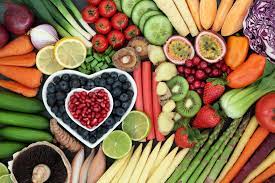
SIMPLE FOODS TO BUILD IMMUNITY

| DESCRIPTION | 08:38 (0 minutes ago) |
Nowadays we are changing to modern so that we are losing our old things and habits. The olden days we used to eat Ragi, wheat, pluses, cereals, grain, veggies and fruits. In modern days we are taking all these less and other items heavy. We should eat for our body it must get strength to fight with diseases so that olden days foods and medicines are the best. In olden days also there was diseases but now before curing one disease many diseases are coming line by line. So to cure this we need olden days food.
Ginger: This ginger helps to raise immunity in our body. It is very good throat infections and it kills all the viruses which enters through throat. While drinking hot tea mixed with crushed ginger it will kill all the infections in your throat if you don’t like to eat ginger mixed in food. We should use ginger everyday in everything so that it will be powerful and helpful for your body.
Papaya: In fruits this also a best fruit which helps human body function abundantly. That to country papaya is the best it will not be good as hybrid. All good this will be worst for kids even though try to eat country papaya. It is good in every thing. It really raises the immunity level. What is possible to eat near us and good in everything. “If we eat apple we can keep doctor away” this is same like that but only the country papaya.Turmeric: This the best medicine in food for all things we can use from our head to toe we can use turmeric. It’s a gift from god because it can cure what kind of thing as soon as possible. Turmeric we can use in milk and food. Turmeric is a best fighter against diseases this turmeric is used as powder in packets but the pure turmeric which is used in olden days it cures all things. Turmeric not only gives color but also taste and kills the any kind of diseases, injuries and bacteria.Almonds: We should eat at least four almonds daily. It is very helpful for body and brain. If we eat daily we could remember each and everything and our body remains healthy. Almonds we should soak in water night and in morning remove the outer cover and eat in empty stomach. Almonds also fights against viruses and diseases. It also burns fat.These are some of the immunity raising foods we eat without knowingly there is so much good things in each and everything

| THE FIRST WEALTH OF OUR LIFE IS OUR HEALTH | TO ENHANCE YOUR BODY REPLACE HEALTHY FOOD |
IMPORTANCE OF INTERNSHIPS
“Successful People are not gifted. They just work hard, then succeed on purpose” – G.K.Nelson.

In the initial years of college, we all will be living in a fantasy world where we are with a feeling that we have everything one could wish for. The reality hits us hard on the pre-placement phases of our college. At this point in time, we are obscure about our future. The situation can be handled with ease if we start to do an internship after the first year of our college. This could be either a remote one or a full-time one. Choose according to your convenience and college practices.
Sites for getting your first intern:
“Your big opportunity may be right next to where you are now” – Napoleon Hill.
There are a handful of trustworthy sites for choosing your intern from. Some of them are as follows:
- Internshala.
- Letsintern.
They have internships for various fields and experiences. Choose one which suits you the best. Never fall for internships that ask you for money. Even if it’s an unpaid internship but it could provide you a better experience then never hesitate to go for it. Most companies don’t expect much from an intern in the beginning. They look for the dedication and interest in the role assigned to you. They assist you well in the beginning so that you can move forward without any hurdles.
Perks of an Internship:
- They mold you from the scratch into something which you never expected.
- It provides you better clarity on the career path you need to choose from and the skillsets needed for the same.
- Most importantly you will get to know yourself better. In college, we would have a bunch of friends with whom we are comfortable playing around. In a workplace, this may or may not happen. But you will get adapted to the environment to deal with different kinds of people at an early stage which will for sure help you in the future.
- Some companies provide internship extension and full-time work opportunities for their interns based on their performance which will turn into a hassle-free process for both sides.
- In case if it’s a paid internship, you will realize the value of money you have been using in the past and this will make you utilize the economy better.
- During the internship, you will have to manage your college assignments, studies, and exams. Although the process seems to be hard in the beginning, once you master the multi-tasking and time management skills you are ready to face the real-time challenges of the world.
- In case if the internship domain did not excite you much then it’s also a good sign. You have neglected out an option at an early stage.
Nothing can be mastered at its best in the first attempt. Try hard, learn and unlearn to make the best out of it. Never have hesitation or fear to start again. As experts say you are not starting from scratch , you are starting with experience.
COUNTERING THE NEXT WAVE of covid -19
News
• State preparedness to manage the possible third wave of Covid-19 .
• Provides a real time analysis of data – few
suggestions and strategies for effective management
Delhi Administration’s policy responses .
• In January 2021 – first wave subsides – the need for hospitalisation of covid-19 patients fell drastically.
Delhi administration was using less than 20% of its bed capacity.
• In February 2021 – Delhi Government reduced the bed capacity to the level of just above 5,000
• In March 2021 – health system collapsed – increase in the number of covid-19 cases hit by the second wave of pandemic.
• In April 2021 – bed occupancy went from 33%
to over 90%
Government – increased its bed capacity – could not keep pace with the rise in covid
cases .
• In May 2021 – utilisation of government hospital beds went rapidly back to 30%
Many other areas in the country were experiencing a rise in cases.
Inference
• COVID-19 waves require the health infrastructure to be elastic .
• Demand for COVID-19-specific health infrastructure is spatially varied – health
capacity at a fixed location will not be sufficient.
• Conveys the difficulty that several administrations in the country face
Hard to increase the capacity in response to the kind of surge – in April 2021
Key health infrastructures don’t exist in all areas in our country
Real time analysis of data .
• 145 districts – accounted for 75% of the cases during the 1st wave – Same accounted
for up to 80% of cases during the 2nd wave.
Permanently at risk Districts – districts that were hit by the 1st wave, affected in the 2nd wave to a greater extent
Population size, density and mobility make them prone to rapid spread.
Need reserve capacity and resources to be expanded – prevent any risk associated
with possible 3rd wave
Suggestions
• Mobility framework – capacity to move healthcare facilities from one area to another
Identify what resources can be moved – based on mobility costs and supply elasticity.
• Policy innovations in three areas
Personnel management – Inducting trained final year medicine and nursing students – Rehiring of retired medical personnel – use
paramedical workers
Resources with high mobility costs need to be evenly distributed – ensure equity in access in poorly served areas
Spatial equity
Expanding the health infrastructure covering all regions
Providing accessibility through enhanced regional and area connectivity .
• Leads to sharing of resources within the country – reduces inaccessibility and
inequity.
• Efficiency of resource-sharing increases with the
area of coverage.
States or districts – benefits of resource sharing is larger – coordinate and build trust
among themselves.
• Greater institutional coordination for a long run is
necessary
Bodies such as the National Disaster Management Authority and the NITI Aayog could play a vital role.

AN ANLYSIS ON OVERALL GROWTH IN THE INDIAN ECONOMY [2020-2021]
![AN ANLYSIS ON OVERALL GROWTH IN THE INDIAN ECONOMY [2020-2021]](https://eduindex.org/wp-content/uploads/2021/06/1609833276_axhez7_istock_indian_economy_stocks_markets_915768_1605451970.jpg?w=700&h=1&crop=1)
The following research paper discuses about the various aspects of the Indian economy, GDP, Economic slowdown etc. The COVID-19 pandemic ensued global economic downturn, the most severe one since the Global Financial Crisis. The lockdowns and social distancing norms brought the already slowing global economy to a standstill. Global economic output estimated to fall by 3.5% in 2020 (IMF January 2021 estimates).Governments and national banks across the globe conveyed different arrangement instruments to help their economies, for example, bringing down strategy rates, quantitative facilitating measures, and so forth India received a four-column methodology of control, financial, monetary, and long haul underlying changes: Calibrated financial and money related help was given, padding the defenseless during the lockdown and boosting utilization and speculation.
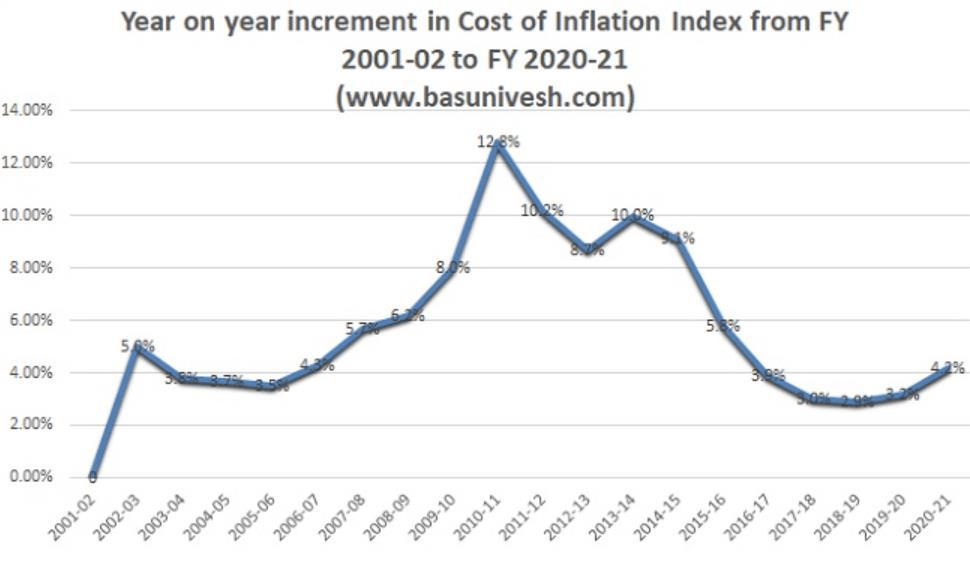
PRICES AND INFLATION
Sustainable Development and Climate Change
Voluntary National Review (VNR) presented to the United Nations High-Level Political Forum
(HLPF) on Sustainable Development . Limitation of SDGs is significant to any methodology pointed toward accomplishing the objectives under the 2030 Agenda. Sustainable advancement remains center to the improvement technique regardless of the remarkable COVID-19 pandemic emergency .Eight National Missions under National Action Plan on Climate Change (NAPCC) zeroed in on the targets of variation, relief and readiness on environment chances. India’s Nationally Determined Contributions (NDC) states that money is a basic empowering influence of environment change activity . The financing contemplations will subsequently stay basic particularly as the nation ventures up the objectives considerably .The objective of mutually preparing US$ 100 billion every year by 2020 for environment financing by the created nations has stayed tricky.
GDP
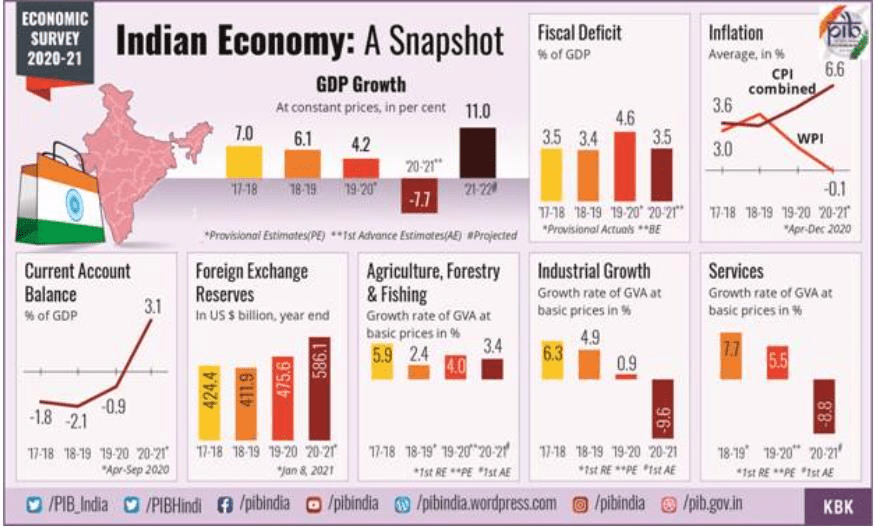
India’s real GDP has recorded a growth of 11 per cent in 2021-22 and the nominal GDP by 15.4 per cent- which has been the the highest since independence. The V-shaped economic recovery is supported by the initiation of a mega vaccination drives with the hopes of a robust recovery in the services sector and prospects for robust growth in consumption and investment. The Union Minister for Finance & Corporate Affairs, Nirmala Sitharaman presented the Economic Survey 2020-21 in Parliament, which stated that the rebound will be led by the low base and continued normalization in economic activities as the rollout of COVID-19 vaccines gathers traction. The fundamentals of the economy remain strong as gradual scaling back of lockdowns along with the astute support of Atmanirbhar.
Conclusion
India has evolved through the pandemic on the back of strong policy initiatives by the government, along with an optimistic outlook for economic recovery. India has administered ~4 million doses of COVID-19 vaccines in two weeks since January 16, 2021, becoming the fifth-largest inoculated country globally. India has become the world’s vaccine hub and extended support to 90+ countries seeking to stock up vaccines.
Since March 2020, early lockdown, health-infra ramp-up, incremental unlocking, blanket testing, social distancing, tailored fiscal stimulus (to reduce supply-side disruptions and revive demand) and structural reforms initiated by the government have helped restrict the fatality rate in India to 1.2%—one of the lowest in the world. India is emerging as the world’s fastest-growing major economy, with the IMF holding its growth forecasts as high as 6.8% for FY23. Also, the Economic Survey 2020-21 has drawn attention to the V-shaped economic growth—a testament to the burgeoning Indian economy and its intrinsic strength. India is not yet out of the danger of the pandemic. Social distancing continues to be the most effective tool to combat the pandemic as activity levels continue to rise in the economy boosted by the rapidly escalating inoculation drive in the country. Infrastructure to boost sectors to grow with unlocking of economy Terming investment in infrastructure “quintessential” to boost growth, the Economic Survey on Friday said post unlocking of the economy, infra sectors are poised for growth and construction of roads is expected to return to the high pace attained before COVID-19. The infrastructure sector will be the key to overall economic growth and macroeconomic stability, the Survey said emphasizing that the year after the crisis (2021-22) will require sustained and calibrated measures to facilitate the process of economic recovery and enable the economy to get back on its long term growth trajectory.
 Eduindex
You must be logged in to post a comment.