
Why current Generation are more vulnerable to Mental Illness than their predecessors?

Photo by Anete Lusina on Pexels.com

It is one of the inevitable topics of the millennial generation and that is, “Mental Illness”. It has become one of the terminal topics of all yet it’s high time to focus on our young minds!

So the question here is, why every fourth out of seven has a mental illness? Is it due to a new way of living life? Or is it the society? Well, we can’t blame society for every cause, right? Instead of living in a society, it is us who should be blamed.  Yes, the destruction is due to unawareness which we didn’t appreciate.

These young minds are an asset to our bright future, but what they are suffering from is the worst disease of all. Medically, there is a cure to all sorts of diseases but the question is, where is the essence of this disease? Why is this happening in excess amount to our young buds? Here are some of the elements which can be the reasons for the illness present in our young  minds :

  1. Giving more priority to the unrealistic world of social media: Teenagers are the most popular groups of all ages who dedicate most of their time to social media and thus, for them, it’s ‘The second home’. They dwell so much in these media platforms that the unrealistic world makes them feel like it is reality.

Specially they tend to create fake personalities in front of their friends and colleagues and when they are avoided or not popular then they think of themselves as ‘worthless’.  

It is highly observed that teenagers are dwelling so much into the ocean of social media life that; they start to judge themselves based on; number of likes they got, followers, and people’s comments. This makes them feel depressed and their minds start to break down in this fake world.

Many times, these youngsters are targeted and bullied on social media through certain comments and unknown threats that they don’t even communicate with their parents to provide no harm to their parents.

  • Fractured child-parent relationship: Contemporary parenting can be one of the elements which lead to their child to depression. Since parents are working 24/7, they don’t give much emphasis on their children and often there is a barrier of communication between the parent and child. Due to the unavailability of the parent’s presence, the child feels more ignorance and often lives in his/her thoughts which leads them to have a mental illness.  

We can also see that; these ignorant kids are often lured to follow the wrong path which leads them to devastation as a result.

  • Academic pressures and Moral dilemmas: Kids these days are often pressurised by their parents to score high marks, study in a decent university, and earn pounds which will raise their status in society.

Often, due to this academic pressure children don’t feel themselves and rather they are distracted and even take difficult steps at a tender age. As we can see those suicides are due to academic pressures is in high rates which are also one of the common factors on the mental health in millennials.

  • Pandemic – A Misery to the Millennial generation: This is one of the latest reasons why kids these days feel depressed about the new normal. The social interactions which made them feel positive are gone in the realms of social distancing and quarantine.

Attending online classes is one of the tiring jobs also several factors for them not being productive and lack in the concentration of academia. This leads to a very high amount of stress as we are humans and when we are clutched or burdened in result we act opposite to it, so the impact of online classes makes them vulnerable when they are facing so many pressures at the same time.

  • Addiction leads to depression among youngsters: It is very unfortunate but a fact that the present generation youngsters face different types of addiction in different platforms and therefore they tag themselves as ‘FREAKS’; notably, these addictions vary from one kid to another, some are addictive to social media, some with games, some mislead their minds to pornography world and some are highly addictive towards drugs and sedatives, etc.

There are endless reasons why kids are being addictive but one of the central reasons is due to the exposure to technology at a very tender age. Often, they are misled by their friends and colleagues and due to fewer interactions with elders, they indulge themselves in these forms of bad impact on themselves.

  • The cure to the sickness among youngsters:

Every disease has a cure at its end and to find this cure is that we should look into the core or the root of the disease. As rightly said, love and acceptance is a human need. The kids these days need parent’s support and guidance and a sense of belongingness so that they wouldn’t feel they are alone.

To bring them to their right place it is the elders who can try some old traditions to introduce among the young minds and let them know about the authenticity of their predecessors. As being together, loving each other and living in harmony can make youngsters feel accepted and so the cause of this disease can soon end.  

Youngsters on the other side can also sense their responsibility by being positive and having a good relationship with their family and creating kindness more instead of hatred.

ONAM- THE HARVEST FESTIVAL

ONAM – the festival of colour in Kerala

Onam is one of the famous festivals of the colourful India. It is actually a major event  of kerala. The people inside and outside of Kerala enjoy it too much. It is a harvest festival . 

According to history, Onam has a long religious context and history of Kerala. According to an earlier reference , Onam is found in Maturaikkaci – a Sangam ers Tamil poem. It says that when games and duels were held in Madurai temple , immolation was sent to the temple , then  the people wore new clothes and celebrated it. On the other hand , in the 9th-century according to Pathikas and Ballads by Periyazharwar , Onam is celebrated as offerings to Vishnu God with feasts and community events. 

According to Kurup  , Onam is a historical hindu-temple based cultural festival which is celebrated for many days. This is a harvest festival and its significance is of 2 Hindu-legends, Mahabali legend and Parashurama legend.

According to the Malayalam calendar Chingam is the 1st month  and the Onam is celebrated in this month. It is marked as the Malayalam New Year. It is celebrated over 10 days and concludes with Thiruvonam. The ten days are sequentially known as Atham, Chithira, Chodhi, Vishakam, Anizham, Thriketta, Moolam, Pooradam, Uthradam and Thiruvonam. The first and the last day are particularly important in Kerala and to Malayalee communities elsewhere.

The 1st day of this festival is Atham ws marked at Vamanamoorthy Thrikkakara temple in Kochi. This temple is the focal center of this festival and the abode of Mahabali legend with raising their festive flag. There are celebrated the parades and those are colourful ,whimming  and floating.

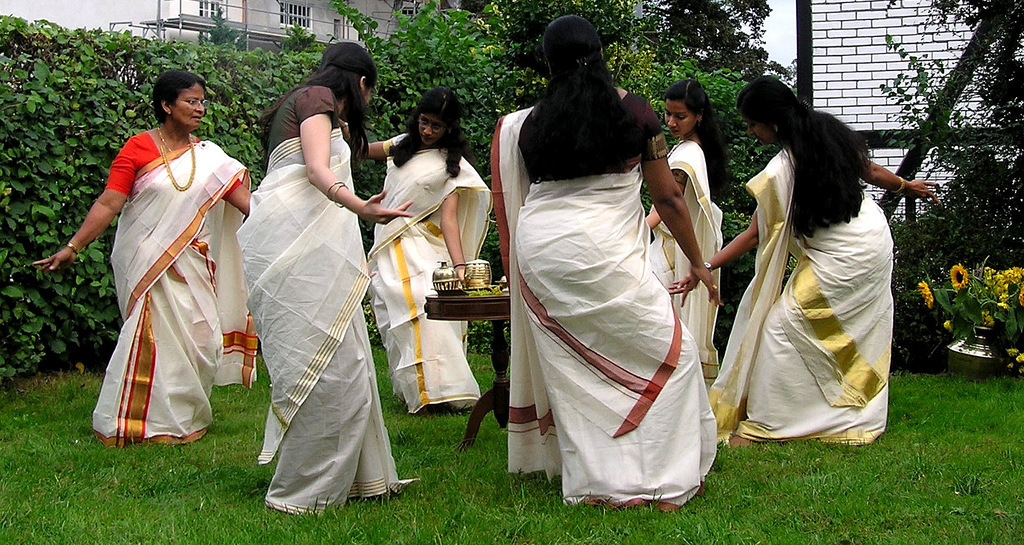
On other days there are celebrated different types of events like boat races which are most popular and stunning , different types of cultural programmes , martial arts, dance, rangoli etc.  People celebrate their times in those days by shopping, donating time or food for the charities and spending quality times with family. The men and women wear their traditional dress . Basically women wore Kasavu saree on this day. 

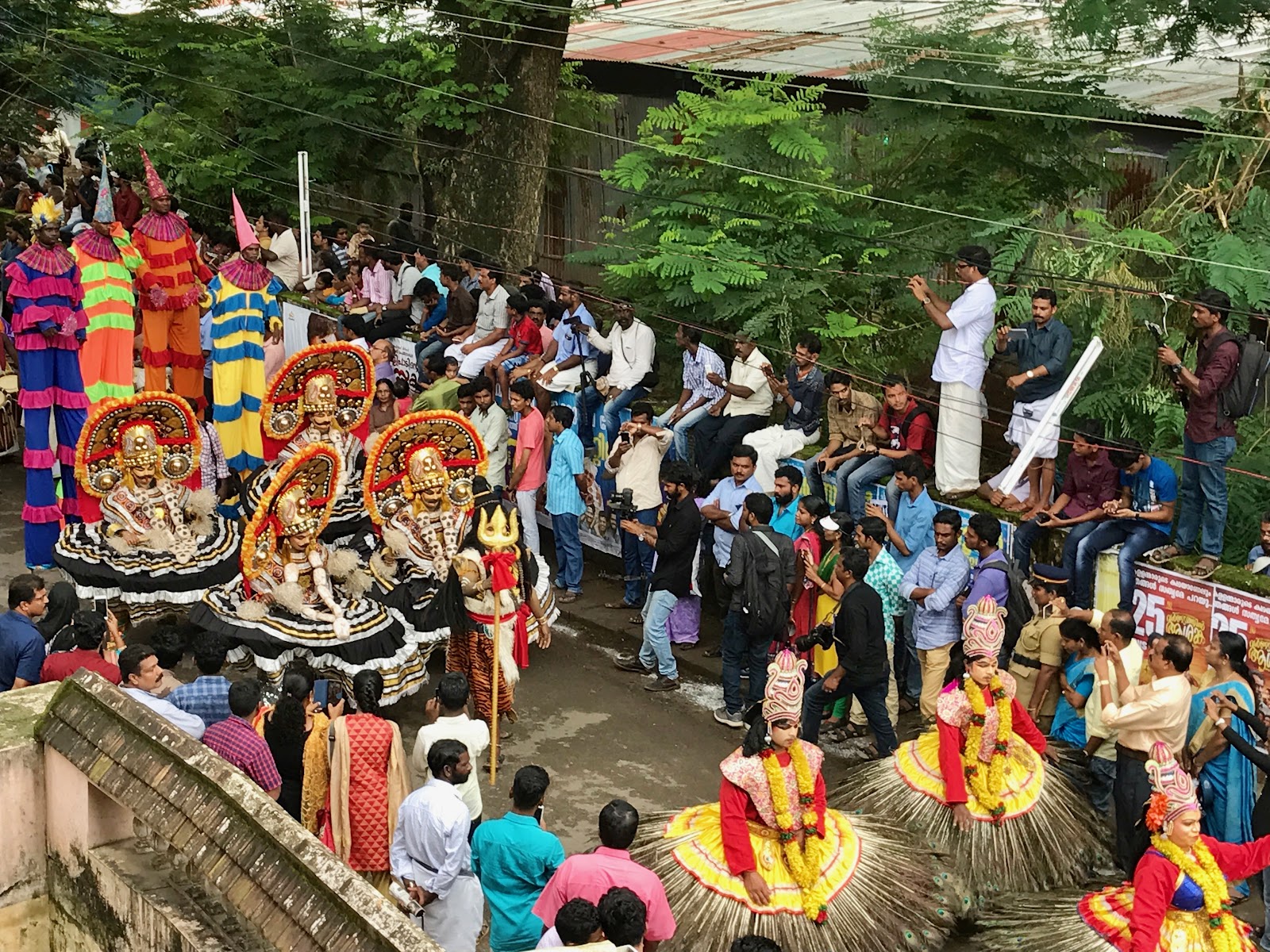
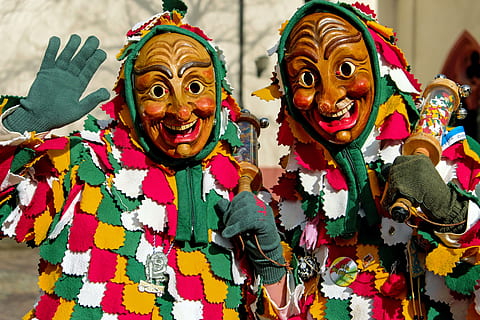
At Tripunithura near Kochi the Onam is celebrated with a grand procession which is called ‘Athachamayam’ , it is also addressed by ‘Thripunithura Athachamayam’. There are elephant marching, drum beats and other music , floats, folk art forms and colourful dressed people and with their masks which is wonderful. According to Kerala history the Kochi king conducted a grand military procession which has now become a state-supported event

There are epic scenes from Mahavarat and Ramayana in this traditional float procession . There are also themes from the Bible .From Tripunithura to the Vamanamoorthy Temple in Thrikkakara, Ernakulam district , is the traditional path. It is  the temple of Vishnu in his Vamana (dwarf) avatar. After arrival at the temple, the marchers offer a prayer.

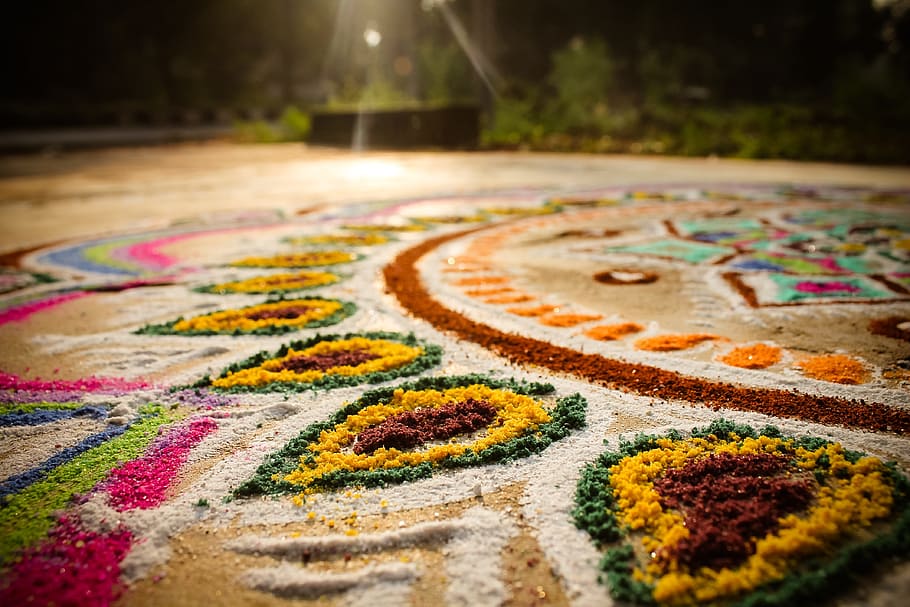
In this festival ‘Pookalam’ , which is called floral rangoli in general, is an attraction. It is known as Onapookalam or Pookalam. There are so many types of flower, basically marigold is the main blossom. It is decorated particularly at the entry point and temple premises like a flower mat. On Atham the Pookalam is called Athspoo and for this day it is comparatively small in size. It grows in size gradually with each day of this festival. In this Pookalam the Dasapushpam (10 types of flower) is used. In Kerala Pookalam competitions are common everywhere on Onam day.

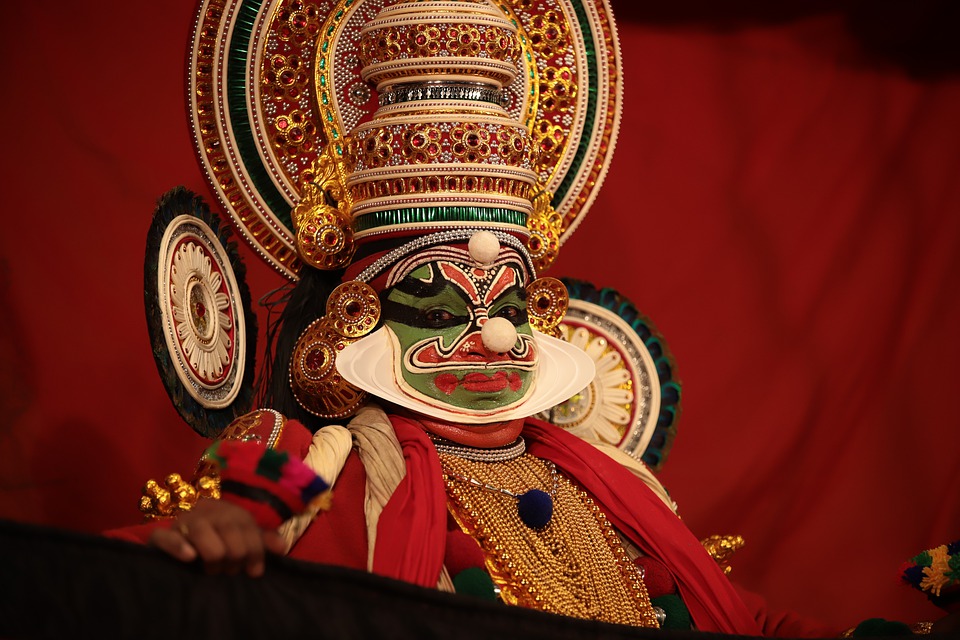
In this festival there are so many types of traditional dance performed like Kathakali , Pulikali, Kummattikali, Thumbi Thullal, Onam Kali etc. Thiruvathira Kali is a women’s dance, where they circle around a lamp. Kummattikali , which is a colorful-mask dance. In Thrissur, festivities include a procession consisting of caparisoned elephants surrounded by Kummatikali dancers. Onam Kali is a form of dance where players circle around a pole or tree or lamp,dance and sing songs from the Ramayana and other epics.  Kathakali is the most famous dance type. 

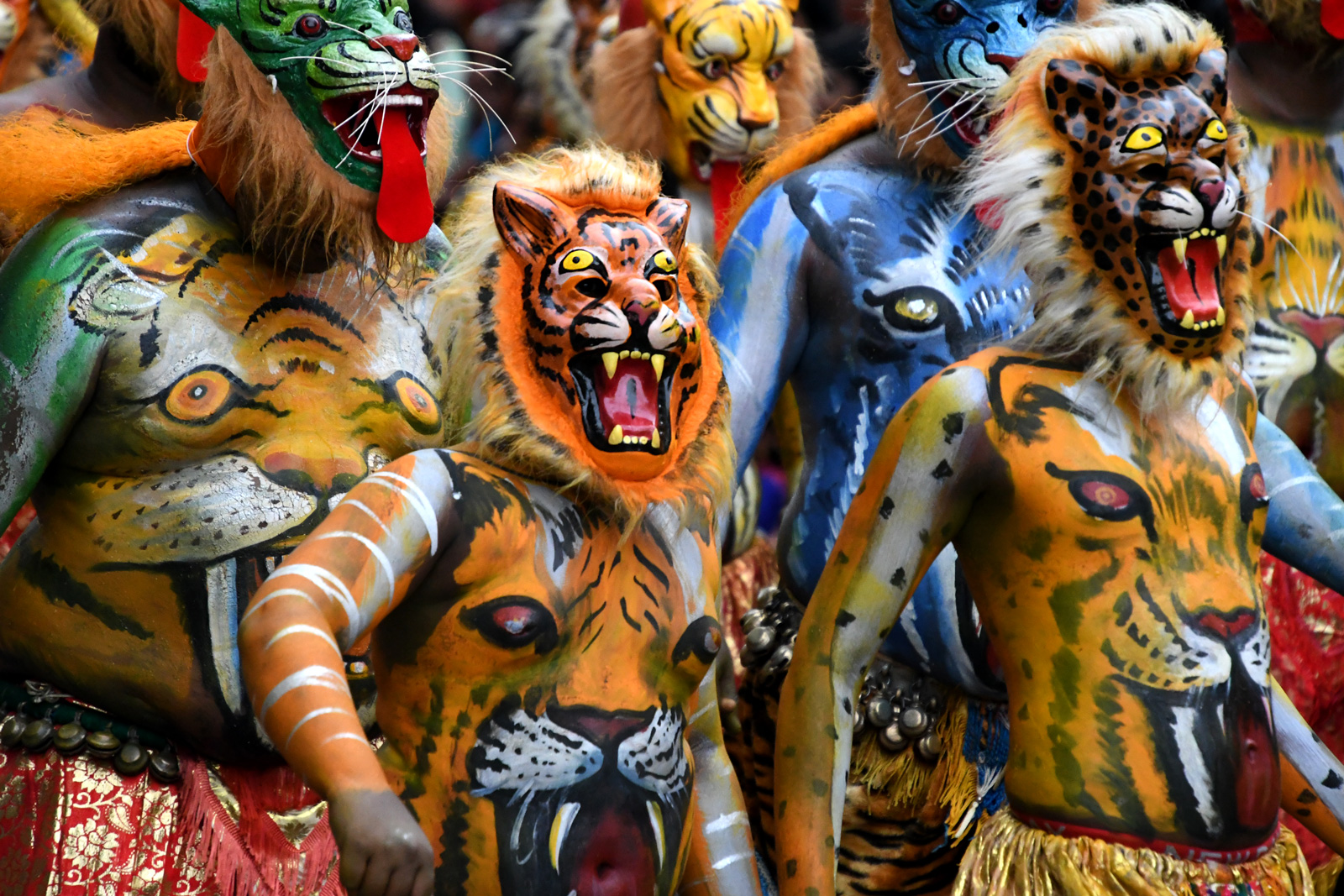
Pulikali is a different type of dance which is known as Kaduvakali during this festival where the performer is painted like tigers in bright yellow, red and black, and dances to the beats of instruments like Chenda and Thakil. It is a type of folk dance.

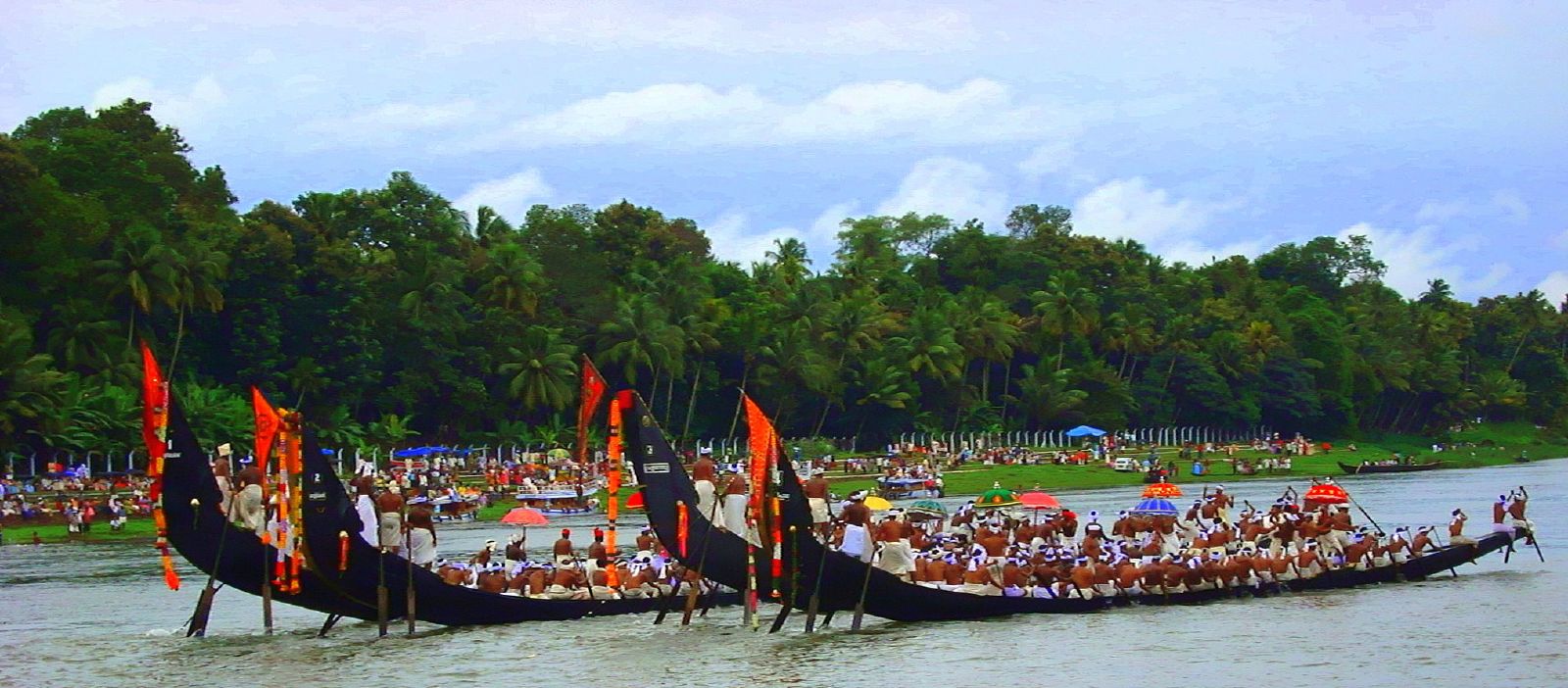
Another amazing part of this festival is Vallamkali which is a snake boat race. In this boat race numerous oarsmen row huge snake-shaped boats and men and women come from far and near to watch and cheer the snake boat race through the water. Particularly it happened on the Pampa River.

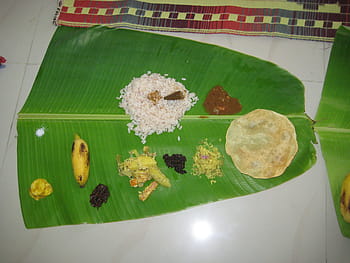
The Onam sadya, which is the feast, is  another amazing part of Thiruvonam and it is observed in every Keralite attempt . Chips , Sharkaraveratti ,Pappadam, various vegetable and soups such as Injipuli, Thoran, Mezhukkupuratti, Kaalan, Olan, Avial, Sambhar, Dal served along with a small quantity of ghee, Erisheri, Moloshyam, Rasam, Puliseri, Kichadi and Pachadi, Moru , Pickles both sweet and sour, and coconut chutney are the menu.

So it is the very interesting festival of our colourful India which is more colourful and delightful to us.

ORIGIN OF THE BUSINESS MANAGEMENT-A HISTORICAL OUT LOOK

In todays world , management is the base of any organization or administration to accomplish the desired goals . It is not a new term or a new skill because it has always been a part and parcel of all the ancient civilizations in the world.

Ancient texts and scriptures of many countries like India, china, America throws the important light on management. We can find the fundamentals of management in the ancient scripture of Bhagwat Gita. Bhagwat Gita contains rich of managerial techniques which was written a thousands of years ago.

During the first pre world war phase (1870-1974) there is a rapid change in economies in terms of trade, transportation and communication which indeed led to globalization. Globalization made management as one of the important aspect of development where the classical management theories were developed.

Classical Theories Of Management :

SCIENTIFIC MANAGEMENT THEORY :

Scientific management theory was developed by “FREDRICK WINSLOW TAYLOR”. This theory got popularity in the period of 1880s and 1890s in U.S manufacturing industries with its analyzing techniques of work flow .

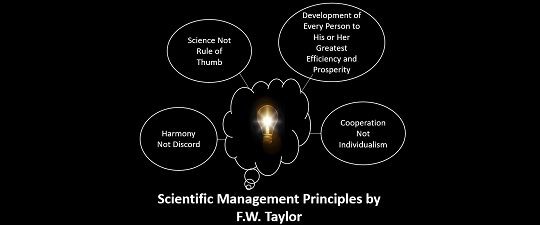
The Principles Of Scientific Management Theory are:

Taylor theory was mostly concentrated on shop floor level and suggested functional foremanship to the industries.

1:Science not a rule of thumb, this principle specifies that organizations should constantly develop new methodologies which makes work easier, faster and quicker rather than sticking to the old methods.

2:Harmony,not discord, this principle specifies that maintaining a positive atmosphere in the organization improves the productivity.

3:Cooperation, not individualism, all the activities of the organization must carried with mutual coordination in order to get improved results.

4:Development of each and every person to his (or) her greatest efficiency, this principle specify that organization should ensure the growth of every individual according to their performance.

ADMINISTRATIVE THEORY:

Administrative theory was developed by “HENRY FAYOL (1841-1925)” .Fayol mainly focused on the administrative management of the organization and structure of work tasks.

Fayol concentrated on top level management and he suggested unit of command. Administrative theory is quite opposite to the scientific theory.

Fayol’s generalized principles of management:

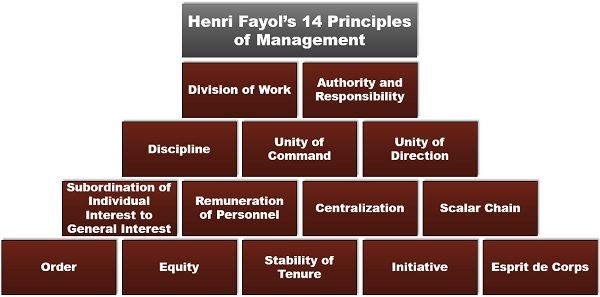
Fayol developed 14 principles for the organizational development. Fayol consider that effective management of an organization would lead to efficient results.

Fayol’s five functions of management:

Fayol considered that categorizing the functions of management helps the organization in day to day progress of work. The five management functions are:

Planning: This function is used to classify the needs of an organization and arranging them into tasks to develop strategies in order reach the desired goals.

Organizing: This function is used to determine the appropriate process to complete a task.

Commanding: This function is used to supervise the subordinates in completion of day to day tasks.

Coordinating: This function helps in integrating with different kind of groups and making things get done efficiently.

Controlling: This function ensures in evaluating the overall tasks according to the plan set and making changes if needed.

BUREAUCRATIC THEORY:

Bureaucracy theory was developed by “MAX WEBER(1864-1920)” .This theory was generated during the industrial revolution of Germany to manage it’s growing industrial enterprises.

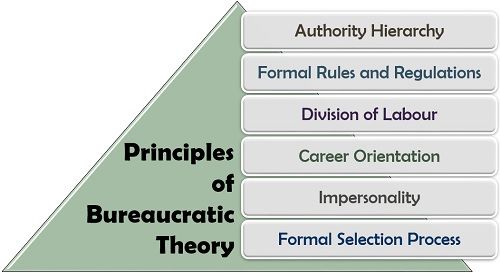
Weber mainly concentrated on the top level management of an organization. According to weber the bureaucratic organization is more rational and can get control over every individual employ. He developed six ideal principles of bureaucracy.

Six principles of bureaucratic theory:

Authority Hierarchy: It is a chain of command to promote individual’s effort to accomplish the organizational goal.

Formal rules and Regulations: These are rules and procedures that are to be followed by the employ’s of entire organization .

Division of Labour: The whole work flow is divided into tasks and distributed among the employees according to their ability.

Career Orientation: Promotion of loyalty among the employs and making the long term relations with the organization.

Impersonality: Making decisions according to the facts rather than personal interests.

Formal selection process: Hiring employ’s according to their skills, qualification , experience etc…

CONCLUSION:

As management & leadership are closely related to each other which has been provided since ages. With globalization management studies has undergone changes in formal study of management which needs a constant experimenting. These classical theories enhance the management abilities and predicts the control behavior of an organization.

The Restoration Period: Verse (Part 2)

Please ensure to read the part 1 of the Restoration Literature.

  1. Restoration Tragedy  – Heroic Tragedy – combination of Epic and tragedy; Tragedy – a tragic flaw but Heroic Tragedy, not because of tragic flaw but by Failure, hero failing by his failure may be in a duel/battle, in Restoration Tragedy – hero’s failure isn’t something inherent from the beginning of the play, but when he tries something –an act, he fails – Nicholas Rowe, John Dryden, Thomas Otway.
  2. Epic – a lengthy poem – often poets never able to completely write it, due to its extreme length – a stylised life off a person, dictated in a formal manner, not a person existing alone but connected to society – it begins in media rest – not a liner progression of events but could begin anywhere. Alexander Pope wrote a Mock Epic, written using the style of the Epic, making fun of it.
  1. Restoration Comedy – Comedies in Elizabethan Period – love and its tribulations – romances written in the Elizabethan Period is congratulatory praises the Monarch – Elizabeth mainly. With restoration, comedy comes back, but a different set; a class bound comedy – to deal with the upper classes, Shakespearean plays enacted by Shakespearean Company, which in Jacobean period the company was renamed under Jing James – ‘Kings Men’ – which catered to the needs on general people and not aristocracy, but was later seen to align to the needs of Aristocracy, therefore the comedies written during Restoration was class bound, and lot of upper class people were represented in that way. Metropolis – London, urbanised metropolitan – filled with stereotypes – innocent with faulty characters; ‘predatory widows’ looking for men with money, as well as men looking for women with good estates – money. Restoration Comedy emphasis on love triangle and rivalries, among parallel plots. Restoration Comedy – marriages are regarded as a boring restrictive system, ‘looking for estates’ as well as a boring restrictive system. Both narratives existed the latter was unique, where women had a voice of their own and men objecting towards the institution of marriage. Adultery/Carnality/Folly and Vices/ Proviso Scene – ‘Way of the World’ by William Congreve  – a prenup – a marriage bargaining scene. William Congreve, George Etherege, William Wycherley, George Fraquhar, John Vanburgh – Big five of Restoration Comedy – portraying the upper class yet critiquing – subverting them.  London – the urban side is a setting for all of them and there would be a juxtaposition between the urban and rural side of London.Attacks on Immorality – genre of drama is declining, Theatre Licensing Act of 1737, granting license to any play or refuse on any grounds – the initial half of 18th Century; revival of this particular form of writing – 1770’s Restoration Comedies – Oliver goldsmith – 1773, ‘She stoops to Conquer’ and Sheridan in 1775 and 1777 ‘Rivals’ ways in which the RC is revived in the 1770’s. And Oscar Wilde in ‘the Importance of Being Ernest’.

How to set Financial goals

Setting financial goals is essential for personal finance management and budgeting. In order to efficiently manage spending, savings and investments and be financially secure, one must set financial goals.

Being unprepared and spending mindlessly can be quite risky. One should be as prepared as they can be in case of emergencies or financial crises.

Moreover, saving and investing your earnings can help you grow your wealth and utilise your earnings in a profitable manner.

Before setting goals

Financial goals and objectives can vary from person to person depending on their income, investments, expenses, life stage/age, needs etc. Hence, it is important to assess the objective and duration of the goal by following the steps mentioned below-

  1. Identify starting point: Set a date for implementing the plan and its duration
  2. Set priorities: Identify your objectives; Are you saving to invest or to buy or to set up an emergency fund?
  3. Document your spending: Calculate your monthly expenditure. Analyse them and try to reduce them.
  4. Pay down your debt: Reduce your debt and pay it off first to reduce your interest expenses.
  5. Secure financial future: Implement the plan to become financially secure.

Most importantly, financial goals should be S.M.A.R.T – Specific, Measurable, Attainable, Relevant, Time-based.

Specific: Financial goals should be specific in terms of objective, time and amount.

Measurable: Goals should be measurable and expressed in monetary terms. For example, goal to be rich is not measurable as it is a subjective term. Hence, an amount limit suitable for every person should be set.

Attainable: A reasonable amount and time and limit should be set so it is possible to achieve them. For example, saving up to buy a car on a monthly salary of ₹30,000-₹40,000 within one year is not realistic and attainable.

Relevant: Every individual’s financial goal should be relevant to and in sync with their individual financial needs and objectives. For example, if a person wants to save up for retirement, they should focus on saving to invest in schemes specially designed for retirement planning.

Time-based: In order to achieve a goal, it should have an end period which motivates one to achieve it. They cannot be never ending as different stages of life have different financial requirements. At the end of the time period, one should evaluate and see if they were successful in achieving it or not.

Duration of Financial goals

As mentioned above, setting time-based goals is very important. Duration of each goal varies and is dependent on its nature and the income and expenses of the individual. For example, saving up to buy a TV should take between 3-6 months depending on the saving capacity of each individual. However, saving up for retirement takes years of planning, saving and investing.

Financial goals can be classified into Short-term, Mid-term and Long-term goals.

Short-term goals have a duration of 2 or less than 2 years. Example- Stick to weekly/monthly budget, reduce unnecessary expenses.

Mid-term goals have a duration of 2-years. Example- Build and diversify portfolio.

Long-term goals have a duration of more than 5 years. Example- Make a retirement plan and implement it.

The Restoration Period: Prose (Part 1)

Restoration Period is during 1660 and the monarch and its influence in England. This period marked the return of Charles II as King (1660–85) following the period of Oliver Cromwell’s Commonwealth

  1. history writing – a significant contribution made during the Restoration Period, documenting the religious and political history of England. The English Prose written to popularise Science – in Renaissance – emergence of new cosmos and science able to release from the clutches of religion, and during the Restoration Period – The Royal Society of London – for the improvement of Natural Knowledge – a learned society thinking about rationality, factual interpretation, empirical reasoning, clearly the opposite of the Medieval Period, where we don’t question authority – a significant thread carried forward in the Restoration is the spirit of Science and Technology. The Royal Society of London – a scientific advisor to the British Government, a principal advisor as well. Thomas Sprat – history piece, on The History Royal Society of London.  Gilbert Burnet.
  2. Diary writingPepys and Evelyn diaries- social documents –  presenting grant details, gossip and rumours of 17th Century intellectuals, discussing events like  – coronation of Charles II, Fire of London (1666) Plague of England (1665), wars fought.  Evelyn’s work Fumifugium – smokiness of London, how it was becoming increasingly populated , Sylva – reforestation, and pollution, how river Thames was becoming increasingly populated.
  3. Travel Writing – sponsored by The Royal Society of London to make a systematic documentation and collection of natural knowledge, funding foreign travels – only condition is to report the travels. Samuel Smith, Benjamin Walford, William Dampier – traveler belonging to the Restoration Period, connection is restoration science and travellers as they work hand in hand, beyond providing data  but also their direct interaction with a new land would impact – direct experience of the new land and not just the marvels of travel documentation. Richard Haklyut and Thomas Roe (India is a very rich country and they sell Jewels on the streets of India).
  4. Biographies – secular as well as religious people as well – Izeak WaltonLives’, John Dryden the History of particular mens life. Hagiography – biography of a christian Saint – the pious life of a saints life.

Why you should read ‘The Lowland’ by Jhumpa Lahiri

Like her previous works, this is also a saga of Indians in the states away from the motherland. This time we follow three generations of the Mitra family.

The book starts in the 1950’s Tollygunge, Calcutta. Subhash and Udayan Mitra, born fifteen months apart , true soulmates in all regards. Udayan is brave, impulsive and ‘blind to self-restraint,like an animal incapable of perceiving certain colors. But subhash strove to minimize his existence, as other animals merged with bark or blades of grass ‘

The first 20 pages are comfortable and happy. We see subhash and udayan grow up together, get their education and make habits together.
The lowland i.e. the place between the the two ponds a metaphor for the two brothers
Just like the lowland there are more geographical characters, like the tolly club, the mosque near their house.
In 1960s, udayan is drawn towards the Naxalite movement. He is passionate about the movement and  chooses to work for it abandoning his studies wheras subhash earns a scholarship to study in the states and moves to Rhode Island to study and subsequently get a job as a professor.

Years go by, udayan gets married and subhash learns to live alone.

Everything that can go wrong, goes wrong and the two brothers never see each other again. The story goes back and forth from Calcutta to states. Once again in similar jhumpa lahiri fashion we follow generations of characters while still staying true and attached to first generation.
We start from Subhash and udayan, to their daughter Bela and get glimpses of their mother bijolis life.
This book is no way a happy book. There are violent details of the naxalite movement in the 1960s and its repercussions on the  brothers.
Then the story shifts to Rhode Island, Subhash Mitra  starts a new life as a husband and father. He carries secrets and lies and is burdened by it.We also get a namesake-like parent-child scene of confrontation and reconciliation.

Overall, the book is a good read and will stay with you.If you enjoy books that stretch across generations, this is definitely a must read!

Ps : There’s a NDTV interview of Jhumpa lahiri in the real tolly club, check it out!

SELF-HELP IS THE BEST HELP

“Don’t start your day with the broken pieces of yesterday. Every day is a fresh start. Each day is a new beginning. Every morning we wake up is the first day of our new life.” …….. Self-Help Quotes

WHAT IS SELF-HELP?

Self-help asserts developing one’s competences or solving one’s own problems, fighting against social, physical, professional, and psychological complications, with or without the association with other individuals having similar interests. Self-help demands the use of one’s own efforts, resources, etc. to achieve things, without depending on others. It is a great virtue. It provides courage to meet the difficulties of life bravely. It is the secret of success in life.

SELF-HELP GENERATES SELF-CONFIDENCE WHICH LEADS TO SUCCESS

The life of man is very complex. He is always placed in adverse situations. Every dawn of man comes with a shining hope and a whole day’s gruelling work and crushing ups and downs, frustrate and betray many dreams he had stored for the future. If his dreams depend on others whims and wishes, then his success is questionable. If for every short decision he waits for other assertion then he/she certainly under the shadow of life long pain.  It is his strong will, determination and repeated attempt that help him to overcome difficult situations. His indomitable will power coupled with his irresistible effort for the liberation, help him to rise above all odds. Supports him every moment to beat dark clouds of devastation. Being self-confident he stands like rock and defeats all oppositions. He who depends on his own efforts and resources is the most successful man because the best kind of help comes from within.

GOD HELPS THOSE WHO HELP THEMSELVES.

God has sent us on this earth with many gifts like a body, mind and a soul. How we make use of these gifts is our own discretion. It is the way we use our faculties that makes all the difference. Some people share hard work and believe that whatever is in store for them, would be theirs ultimately. This blind faith in one’s destiny is in itself defeating and damaging. God helps those who help themselves. We have to make efforts: otherwise, all promising opportunity will vanish and will leave us mourn over our sluggish helplessness. One has to sow the seed, till the land and plough the fields, water them, nurture them carefully and only then can we expect good crop. God’s mercy is also important because for good crop, we must have rains at the right time, but if we have not sown the seeds, rain or no rain, we would not get any crop. So, destiny or luck, no doubt, plays an important part in our life but we can’t depend on that only. Destiny, along with right efforts in the right direction, will bless us with our desires fulfilled.

THE BEST KIND OF HELP COMING FROM WITHIN

The deer do not enter into the mouth of a sleeping lion. The lion has to run after it. The fan does not give air by itself. It has to be operated manually or electrically. A plate full of delicious meal doesn’t go automatically within the mouth, hands pick it up and take it to the mouth. A job doesn’t come to the job seeker, he or she has to put her effort to grab it. There are several examples of self-made men and countries. Though Vidyasagar was born poor, poverty could not dampen his spirit. His courage and determination helped him in every field of activity. Japan which was weakened in 1945 in the atomic bomb explosion has now become a superpower because of self-efforts.

So, leaving behind all weakness, closing all the doors of begging attitude and silly dependency, diminishing expectation and appreciating every little step of achievement, come, let us be winner by changing our views about the happening, rewarding world.

A wise man says……

“You can’t go back and change the beginning, but you can start where you are and change the ending.”

A guide to take your business international

As Globalisation takes over the world, more and more businesses are expanding and opening their manufacturing units, branches, outlets, offices all over the globe. While some grow exponentially and expand their market, sales and customer base, some fail to get any response and incur huge promotional, travel, administration and financial costs.

This is why it is extremely crucial to form an entry strategy that suits the organisation. It is also important to assess the financial position and capacity of the organisation and to understand that International business gives delayed returns as spreading awareness, competing with the competitor’s product and building an International customer base takes time and incurs promotional costs.

Once the business is ready to enter the international market, there are several factors to be considered.

  1. Firstly, the organisation needs to conduct market research and choose the country and the specific locations where there is demand for their product/service.
  2. Secondly, assessing the culture, language of the country and city is also very important. The organisation can make the necessary changes (if any) to its product/service and its packaging and labelling accordingly.
  3. The last step is to form an entry strategy that suits the organisation and the market and implement the stategy.

Ways of entering an International Market

There are several ways to enter a market depending on the product/service reach preferred by the organisation and the financial capacity of the organisation.

  • Direct Exporting- In this method, the organisation directly sends its products, transfers its employees and workers to the location chosen. It involves huge setup, transportation and transfer costs. Therefore, this method is only used when the product that is being exported has a lot of demand in the new market and will definitely get a response from the target audience. For example, exporting machines to developing countries where there’s no manufacturing of such machines but a huge demand for the same.
  • Through a distributor- In this method, products are sold to distributors who are wholesale buyers. The distributor uses his own selling and pricing strategies to sell the product in the market.
  • Licensing- Through licensing, the organisation can share its technology, method and basic know how with local companies. However, through this method, the product is sold under the local companies’ name and brand so there is no scope of building an international brand and consumer base.
  • Contract Manufacturing– Through this method, the company pays a local manufacturing unit to manufacture their products by sharing their technology and design. It saves the cost of exporting or setting up a manufacturing unit abroad and is ideal for products that require large scale production.
  • Strategic Alliance- This method includes Mergers, Acquisitions and Joint Ventures. In Joint Ventures, two companies form another company to work as partners. For example, Hero Honda. In Mergers and Acquisitions, one company merges with or acquires another company. There is no formation of third company or new identity in this case. For example, Walmart acquired Flipkart.
  • Through an Overseas agent- Using this method, the company hires a local agent to make business relationships on behalf of the company. The agent acts as a sales representative who sells the products on behalf of the company and has no direct relationship with the customers. The agent gets commission on his sales. This is an effective method to save costs in case the organisation wants to test out the response of the foreign potential consumers or distribute their products on small scale without incurring huge costs.

Should reading be an important part of our life?

Let me start it here by pointing out that, if you’re here already and reading, it simultaneously becomes an activity you engage into.. so yes, reading is important.

But the question is how important; am I right? Education doesn’t have to be what you have studied over the years inside an institution; it could be beyond that — books, per se, they have the ability to enable you with a education that knows no bounds, be it a sci-fi comic, a text on Newton’s thesis, or just some legal content; the best thing about reading is you get to choose what you like, what you prefer, what interests you, beyond institutionalised barriers. Reading is essentially a generic term, panning across undefined boundaries, anything could be considered a text, and you just read it. Nothing is good or bad, you have to just invest yourself into it, and surely over a period of time human brain will adapt into what is becoming the ew normal, and you’ll noting changes — good changes, within yourself. You’ll be moving towards a plane where you have the level of objectivity, where you are aware, and won’t be swayed by anyone around you, you will have the power for yourself to act like how you want to.. and isn’t that almost an ultimate goal amongst us beings, to be liberated and be this autonomous being?

Its also significant to not label what you read, because no matter what genre, or what kind of a text you read, the essence of it would always be to analyse it, not just absorb the words at face value, but rather delve deeper into what or why an author writes the way they do, or what does if a certain section written differently could do to a text, brush up your imagination, glide smoothly with any text you adopt, but absorb a lot more, nothing can ever be set-in-stone, people change, time changes, though written words can’t; they have the potential to be perceived the way someone wants to perceive it, and no one can fight over one’s views, that’s counterproductive to what we’ve been trying to establish. However, don’t forget; if someone’s entitled to their opinion, you are entitled to yours and you have the power to keep on bettering it, to be better and as much you exercise reading into your daily existence, you are stepping closer to what I would consider is being a better being — for that, make sure to keep your eyes and brain open, and not rigid. 

The Pursuit Of Happiness Will Not Make You Happy

A few years ago, I gave up my excessive pursuit of happiness. I used to think that the purpose of life was happiness. But that philosophy didn’t work for me. I realized that happiness is always a byproduct. 

When you spend time with people you love, you feel happy. When you invest four years in getting a degree, you feel happy and accomplished when you graduate. You feel happy when you come up with a useful idea at work. You feel happy when you finish a hard workout. You feel happy when you listen to good music. 

You see? Happiness is the byproduct of an action. It can be as simple as having a conversation with someone or listening to a song. 

But happiness doesn’t last. 

It’s a feeling that comes and goes. Some people disagree with that and say you can always be happy. I think you can be happy the majority of time—not all the time. Why? Because even the best life has bad times.

When You Try Too Hard

If you’re unhappy or frustrated, it doesn’t mean you should do everything to become happy again. 

When you try too hard to be happy, you become impatient. You’re more likely to chase pleasure. And that can lead you to a negative cycle that only raises your bar of pleasure. You will need more pleasure to satisfy your desires. 

In the book Positive Emotion, there’s a chapter called ‘Paradoxical Effects of Pursuing Positive Emotion’ that talks about this principle. In that chapter, written by two UC Berkley professors, Brett Q. Ford and Iris B. Mauss, I read the following:

“Those pursuing happiness may set high standards for their levels of happiness. When their happiness falls short of their standards—which is likely when the standards are high—the resulting disappointment and frustration impedes the experience of happiness.”

Increasing your standards of happiness is a dangerous game. Instead of trying too hard to be happy, seek the truth. 

If you’re unhappy, a different job or city is not the answer. You can travel to every country in the world, but if you don’t have inner peace, your problems will follow you wherever you go. 

Daily life is the same for every individual. We all have to wake up, eat, wash, go to the toilet. We will all experience death, loss, and grief. We all get rejected. We all get injured and ill. And your level of happiness will not change anything about being human. 

Sometimes we forget that. We think that everything will be better if we only feel happy. That’s not the case.

Build A Life Around Things You Value

You will never be truly happy when you live a shitty life of your own making; if you live below your potential, give up on life, and don’t reach for something better, you will be miserable. 

By contrast, if you’ve built a life you’re in control of and have goals you’re working towards, you will be mostly happy. 

One of my close friends has 3 kids. He works as a network engineer and many people count on him at a telecom provider. If he doesn’t solve certain network issues, thousands of people will be affected. 

But despite his responsibilities, his boss gives him a lot of freedom. Why? Because my friend made arrangements with him. 

A lot of people assume you have to work for yourself to be free. That’s not true. If you’re employed, your company or organization wants you to do your job. 

If you’re happy and free, you do a better job. That’s why it’s important to have an open discussion at your workplace about the way you work and live. My friend drops off his kids at school and comes home for lunch. He has enough freedom to enjoy his life. That wasn’t always the case. 

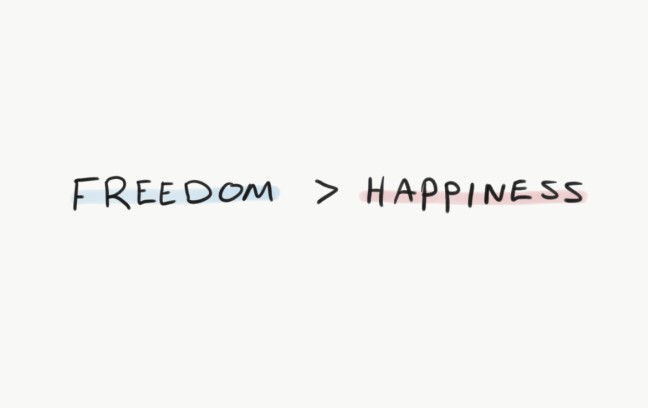
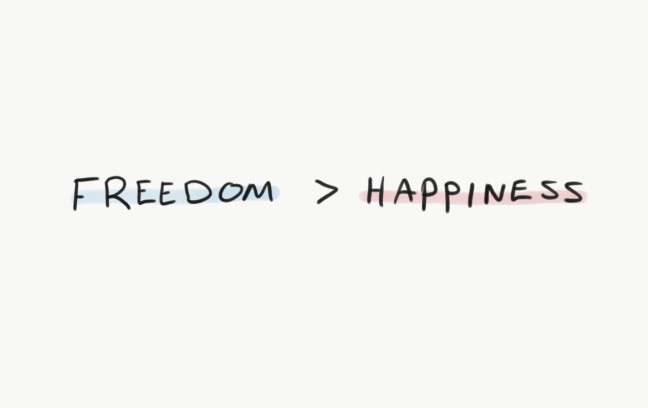
Just two years ago he complained a lot about his work situation. But now his life has more balance because he made a few clear decisions. He didn’t even switch jobs. He simply committed to freedom. That means no more spending time with negative co-workers. Instead, he’s doing his best and prioritizing family and health. He no longer “hangs out” with everybody he knows. 

He works, spends time with his family, and goes to the gym. That’s his decision. Sure, he can’t pick up his kids from school when they are done, but he has peace with that. He’s still around a lot in the morning and for lunch. You can’t have everything. But as long as you have freedom, you will be happy.

After Rain Comes …

Look, no matter how free you are, no one is immune to being unhappy at times. But regardless of how bad life is at times, unhappy moments always pass. 

Time moves in one direction. And even the worst times are not here to stay. If you’re unhappy, you don’t have to fight it. Accept it. And go through it. Know that everything will pass. That’s also true for good times. Everything we do or experience is temporarily. 

In The Netherlands, we have this saying, “After rain comes sunshine.” We use it to remind ourselves and others that good times are on the horizon.

That’s the nature of life. Sometimes it’s good, sometimes it’s bad. Once we accept that, we become free from trying too hard to change how our life is during a specific moment. 

Some things, we have to endure. But it doesn’t mean that you can’t change your life. Since all life situations are temporary, you get a new chance every hour and day. You can commit to making your life better by taking action. No matter what your circumstances are, you can build a life that gives you inner joy.

Start now.

Our earth,our habit,our home

Since 1974,World Environment Day has been celebrated every year on 5th June. People from more than 100 countries celebrate this day. Furthermore, the world environment day is run by the United Nations Environment Programme(UNEP). Since the year 1973. Above all the main purpose of celebrating this day was to spread awareness. The awareness was about the conservation of our environment.

World environment day Essay – Our environment is one of the most important aspects to survive on this planet. Moreover, it is the only thing that can make life sustainable. Without it, we cannot survive even a single day. For instance, our skin will burn, the lungs will get ruptured, our blood pressure would rise.

Moreover to also take various preventive measures to avert the effects of Global warming. Since we all know that GLOBAL WARMING is the root cause of the ruin of our environment. Therefore it is our duty to protect our environment. And stop all the exploitation that is destroying it. Because in the end, it is our basic need for our survival and our generations ahead.

Our environment is getting damaged due to pollution which is affecting very badly towards human resources. The earth is getting damaged due to humans as we are polluting the environment .

Humans impact the physical environment in many ways:

overpopulation,pollution, burning fossil fuels, and deforestation. Changes like these have triggered climate change, soil erosion, poor air quality, and undrinkable water.

We need to plant more and more sappling so that we can get oxygen. Now a days we are not able to get oxygen properly. Due to this covid we faced lack of oxygen. This is very bad situation. This is happened due to humans as we are affecting the environment by cutting trees.

SLOGANS :-

• Save earth to save life.

• Don’t let future dry up.

• Keep clean and go green.

• Global warming is global warning.

• Save the earth by afforestation and don’t let the trees cut down. Afforestation is the best way to increase our resources for the present and future generations.

• Deforestation effects the environment. Oxgyen levels decreases as pollution is increasing due to cutting down of trees.

• We need to do more afforestation and protect our environment.

Reuse , Recycle , Reduce these are the main points to be noted so that we can protect our environment.

PLANT FOR THE PLANET”.

Depression and it’s symptoms

Depression is a mood disorder that involves a persistent feeling of sadness and loss of interest. It is different from the mood fluctuations that people regularly experience as a part of life.

Major life events, such as bereavement or the loss of a job, can lead toTrusted Source depression. However, doctors only consider feelings of grief to be part of depression if they persist.

Depression is an ongoing problem, not a passing one. It consists of episodes during which the symptoms last for at least 2 weeks. Depression can last for several weeks, months, or years.

Signs and symptoms
The symptoms of depression can include:

a depressed mood
reduced interest or pleasure in activities once enjoyed
a loss of sexual desire
changes in appetite
unintentional weight loss or gain
sleeping too much or too little
agitation, restlessness, and pacing up and down
slowed movement and speech
fatigue or loss of energy
feelings of worthlessness or guilt
difficulty thinking, concentrating, or making decisions
recurrent thoughts of death or suicide, or an attempt at suicide

POLYCYSTIC OVARY SYNDROME

Introduction

Polycystic Ovary Syndrome is a condition where the ovary produces an abnormal amount of androgens, male hormones that are present in a small amount in women. The name polycystic describes that there are numbers of small cysts that are forming in the ovaries. PCOS doesn’t always mean that you will be diagnosed with cysts. However, some women are diagnosed with cysts even without this disorder. When a woman doesn’t produce enough hormones for ovulation, the ovaries can develop small cysts and these cysts release hormones called androgens. Women having PCOS are seen with a high level of androgens, which leads to an unusual or irregular mensuration cycle.

What causes PCOS?

There is no particular cause of PCOS. However, because of this disorder, many women develop insulin resistance. This means that the body cannot use insulin well, which leads to the build-up of insulin in the body and may cause higher androgen levels. Obesity is also one of the reasons for an increased level of insulin. PCOS may also run in families. It’s common for sisters or a mother and daughter to have PCOS.

What are the symptoms of PCOS?

  • Missed periods, irregular periods, or very light periods
  • Ovaries that are large or have many cysts
  • Excess body hair, including the chest, stomach, and back (hirsutism)
  • Weight gain, especially around the belly (abdomen)
  • Acne or oily skin
  • Male-pattern baldness or thinning hair
  • Infertility 
  • Small pieces of excess skin on the neck or armpits (skin tags)
  • Dark or thick skin patches on the back of the neck, in the armpits, and under the breasts

How is PCOS diagnosed?

PCOS diagnosis process generally starts with a:

1) Pelvic exam will check the health of the reproductive organs from inside and outside. 

2) Ultrasound will check the size of the ovaries and the number of cysts present. The test can also look at the thickness of the lining of the uterus (endometrium).

3) Blood tests will check the level of androgens and other hormones in our blood. This also helps to examine the level of glucose in our blood. We can also get our cholesterol and triglyceride levels checked.

How is PCOS treated?

Treatment for PCOS depends on a number of factors. These may include your age, how severe your symptoms are, and your overall health. The type of treatment may also depend on whether you want to become pregnant in the future.

If you do plan to become pregnant, your treatment may include:

  • A change in diet and activity. A healthy diet and more physical activity can help you lose weight and reduce your symptoms. They can also help your body use insulin more efficiently, lower blood glucose levels, and may help you ovulate.
  • Medications to cause ovulation. Medications can help the ovaries to release eggs normally. These medications also have certain risks. They can increase the chance of multiple births (twins or more). And they can cause ovarian hyperstimulation. This is when the ovaries release too many hormones. It can cause symptoms such as abdominal bloating and pelvic pain.

If you do not plan to become pregnant, your treatment may include:

  • Birth control pills. These help to control menstrual cycles, lower androgen levels and reduce acne.
  • Diabetes medication. This is often used to lower insulin resistance in PCOS. It may also help reduce androgen levels, slow hair growth, and help you ovulate more regularly.
  • A change in diet and activity. A healthy diet and more physical activity can help you lose weight and reduce your symptoms. They can also help your body use insulin more efficiently, lower blood glucose levels, and may help you ovulate.
  • Medications to treat other symptoms. Some medications can help reduce hair growth or acne.

References : 1)https://www.hopkinsmedicine.org/health/conditions-and-diseases/polycystic-ovary-syndrome-pcos#:~:text=Polycystic%20ovary%20syndrome%20(PCOS)%20is,that%20form%20in%20the%20ovaries.

2) https://www.mayoclinic.org/diseases-conditions/pcos/symptoms-causes/syc-20353439

Character of Banquo

Shakespeare in Macbeth has drawn Banquo as someone who is noble and is a man who obeyed orders and possessed unwavering loyalty towards those he acknowledges. Although he is ambitious in nature but like Macbeth he does not bring those corrupt thoughts to light. Banquo, like Macbeth is a brave general even the hero himself admits Banquo’s bravery and courage on the battlefield “… tis much he dares, And to that dauntless temper of his mind He hath wisdom that doth guide his valour To act in safety”.

At the very beginning of the play we find Macbeth and Banquo returning from a battle and are received by very ambitious prophecies from the three weird sisters. Unlike Macbeth Banquo takes his predictions half- heartedly and even cautions Macbeth from blindly trusting the three witches. Banquo being the wise individual reacts differently to the prophecies, Macbeth considers murdering the noble king of Scotland, Duncan while the latter calmly ignores such urges.

Banquo in the play represents virtue and honour. King Duncan gives greater appreciation to Macbeth’s performance in the battle than Banquo yet he is not at all envious. He praises Macbeth which evokes admiration in King Duncan ” True worthy Banquo: he is full so valiant, And in his commendation I am fed, It is a banquet to me.” On his arrival at Macbeth’s castle Banquo praises the wholesome atmosphere of the castle, which shows him to be a thorough gentleman without any suspicion of evil. Banquo is unsuspecting in nature. Even when the murderers had surrounded him, he doesn’t suspect the danger hovering on him.

Banquo has been accused of being careless and not prudent enough to take timely action. This character trait in him led him to his untimely death. Banquo suspects Macbeth, but he is not prudent enough to take steps to protect himself. Banquo inspite of being a trusted general, ignored Macbeth’s heinous crime against his king, Duncan.

Banquo has an obvious dramatic purpose to fulfil in his relation to the character of Macbeth and the main theme of the play. But he is carefully kept in a subordinate position. His dramatic purpose is to form a foil, and at the same time, a parallel illustration to Macbeth’s temptation.