EXTREMOPHILES: SALINITY AND AT LOW NUTRIENT LEVELS

BY DAKSHITA NAITHANI

Prokaryotic life has dominated much of our planet’s evolutionary history, developing to fill nearly every possible environmental niche. Extremophiles are one of these. Extremophiles have been identified on Earth that can survive in conditions that were previously considered to be inhospitable to life. Heat, extremely acidic conditions, extreme pressure, and extreme cold are examples of extreme environments. The thermophiles were the first extremophiles to be discovered in the 1960s by Thomas Brock of Indiana University. He was investigating life in Yellowstone National Park’s super-hot water pools. He discovered tiny microorganism mats at Octopus Spring in 1965, when temperatures reached 175 degrees Fahrenheit. Thermus aquaticus was discovered, which led to the discovery of PCR and the creation of a new multibillion-dollar enterprise.

EXTREMOPHILES IN SALINITY: HALOPHILES

The halophiles live in high salt concentrations and are named after the Greek term for “salt-loving.” While the majority of halophiles belong to the archaea domain, some bacterial halophiles and eukaryotic species, such as the alga Dunaliella salina and the fungus Wallemia ichthyophaga, do not. Carotenoid chemicals give certain well-known species, such as bacteriorhodopsin, a red hue. They may be found in salty water bodies such as the Great Salt Lake in Utah, Owens Lake in California, the Dead Sea, and evaporation ponds, where the salt content is more than five times that of the ocean. They’re thought to be a viable contender for extremophiles living in Jupiter’s Europa and other comparable moons’ salty subsurface water oceans.

CELLULAR ADAPTATIONS BY HALOPHILES

High salt-in strategy

The high-salt-in approach protects halophiles from a saline environment by accumulating inorganic ions intracellularly and balancing the salt content in their surroundings through KCl influx. Cl- pumps, which are only found in halophiles and transfer them from the environment into the cytoplasm, are involved in this process. Extreme halophiles of the archaeal and bacterial families keep their osmotic equilibrium by concentrating K + inside their cells. The membrane-bound proton-pump bacteriorhodopsin works to accomplish this.

Low-salt, organic solute-in strategy

The high-salt-in approach necessitates physical modification of all macromolecules in order to survive in a very saline environment, which is incompatible with the survival of moderate halophiles that flourish in salinity-varying environments. Osmolytes protect microbial proteins against dissociation in low-salt water while also improving the bacteria’ tolerance to drastic changes in external saline conditions. Glycine betaine was the first bacterial osmolyte discovered in Halorhodospria halochloris.

The majority of halophiles are unable to thrive outside of their high-salt natural habitats. Many halophiles are so delicate that putting them in distilled water causes them to lyse due to the shift in osmotic circumstances. Halophiles include phototrophic, fermentative, sulfate-reducing, homoacetogenic, and methanogenic species in anaerobic conditions whereas in aerobic conditions include phototrophic, fermentative, sulfate-reducing, homoacetogenic, and methanogenic species.

The Haloarchaea, notably the Halobacteriaceae family, belong to the Archaea domain and make up the bulk of the population in hypersaline settings. The family currently has 15 recognised genera. Bacteria (mostly Salinibacter ruber) can make up to 25% of the prokaryotic community, although it usually makes up a considerably smaller portion of the overall population. In this habitat, the alga Dunaliella salina can sometimes thrive.

EXTREMOPHILES AT LOW NUTRIENT LEVELS: OLIGOTROPHS

An oligotroph is an organism that can survive in a low-nutrient environment. Oligotrophs are usually known for their sluggish development, low metabolic rates, and sparse population density. The settings are ones that provide little in the way of life support. Deep marine sediments, caverns, glacial and polar ice, deep underground soil, aquifers, and leached soils are examples of these habitats.

The cave-dwelling olm the bacteria Pelagibacter ubique, which is the most numerous creature in the seas and lichens with their incredibly low metabolism are all examples of oligotrophic species.

Caulobacter crescentus is an oligotrophic Gram-negative bacteria found in freshwater waterbodies. The whole cell functions as an integrated system in the control circuitry that controls and paces Caulobacter cell cycle development. As it orchestrates activation of cell cycle subsystems and Caulobacter crescentus asymmetric cell division, the control circuitry monitors the environment and the internal status of the cell, including the cell topology. The control system has been meticulously tuned as a whole system for reliable functioning in the face of internal stochastic noise and external unpredictability by evolutionary selection.

The bacterial cell’s control system is organised in a hierarchical manner. The signalling and control subsystem communicates with the outside world through sensory units that are mostly found on the cell surface. To adjust the cell to current conditions, the genetic network logic responds to signals received from the environment as well as internal cell status sensors.

ENVIRONMENT AND LOCATIONS

Oligotrophic lakes are often found in northern Minnesota, with deep clear water, stony or sandy bottoms, and minimal algae.

Oxygen levels are high throughout the water column in oligotrophic lakes. Cold water may store more dissolved oxygen than warm water, thus oligotrophic lakes’ deep regions remain quite cold. Low algal content also provides for more light penetration and less breakdown. Algae, zooplankton, and fish die and are degraded by bacteria and invertebrates at the bottom of the ocean. The process of breakdown consumes oxygen. 

Locations

 Oligotrophs and eutrophs coexist in natural ecosystems, and their proportions are determined by an individual’s capacity to prevail in a given environment.  Despite their capacity to exist in low-nutrient settings, they may struggle to survive in nutritionally- rich ones. Most microorganisms are not well adapted to exist in nutrient-limited circumstances and frigid temperatures (below 5 °C), Antarctic habitats offer very little to sustain life. Some of the documented examples of oligotrophic environments in Antarctica are:

Lake Vostok, a freshwater lake cut off from the rest of the world by 4 kilometres (2.5 miles) of Antarctic ice, is often cited as a prime example of an oligotrophic ecosystem. Because of the lake’s severe oligotrophy, some people assume that sections of it are entirely sterile. This may be used as a model to simulate alien life investigations on frozen planets and other celestial worlds.

Oligotrophic soil environments

In general, nutrient availability decreases as the depth of the soil environment increases, since organic molecules degraded from detritus are swiftly eaten by other microorganisms on the surface, resulting in nutritional deficiency in the deeper levels of soil.

Collimonas is one of those species that may survive in an oligotrophic environment as it has the capacity to not only hydrolyze the chitin generated by fungus for nutrition, but also to create materials. Fungi are a prevalent element of the habitats where Collimonas thrives. In oligotrophic settings, reciprocal relationships are prevalent. Weathering also allows Collimonas to access electron sources from rocks and minerals.

The environment of soil in polar locations, such as the Antarctic and Arctic regions, is termed oligotrophic since the soil is frozen and biological activity is minimal. Actinobacteria, Proteobacteria, and Cyanobacteria are the most common bacteria in frozen soil, with a tiny quantity of archaea and fungus. Under a wide range of low temperatures, actinobacteria can keep their metabolic enzymes active and continue their biochemical processes.

The following are the characteristics that a bacterium should have in order to be labelled as an oligotroph:

(a) Having a form with a high surface-to-volume ratio.

(b) Having an innate propensity for using metabolic energy for food absorption during phases of growth stagnation.

(c) Possessing nutrition absorption abilities that are expressed in a constitutive manner.

(d) Presence of a low-specificity, high-affinity transport mechanism that allows for simultaneous absorption of mixed substrate.

 (e) Having systems for conserving nutrition after it has been absorbed.

Extremophiles and their products have revolutionised many aspects of our home and professional life, from household materials to molecular diagnostics. It is not unlikely that new and medically useful discoveries will be found in the realm of extremophile research; the potential of these organisms is so fresh and huge that their applications may be restricted only by imaginations.


Stage of personality development

Personality is the term used for the integrated and dynamic organisation of the physical, mental, moral and social qualities of an individual. Personality development is very important for all. It helps in all sectors.

Stage of personality development

1 Learning and growth :- Development of people depends upon the work of people in which they have interest according to the age the understanding level of children will be increased by the passing of time.

2 Learning and maturity :- At the age many types of changes comes in the children life. Many types of changes are seen in the children and after that they can understand any thing.

Process of development :- process of development depends upon the daily work of children and from that any one can understand and personality development of children.

Important of personality development

From the personality development any one get confidence from their work. Life is more easier if we do something new for students. It helps us in achieving the goal of our lige. At the time of interview the interviewer 1st see the personality of a person and then after the education. For the success personality development is very important.

Educational value of travelling

As the name suggests I think you can get a idea what are we talking about. In book we read only if ideas, thoughts and experiences of other person. The knowledge thus acquired is theoretical. In day to day life, we cannot be successful with mere theoretical knowledge. We must also know about the habits, manners and ways of living of other persons. We can learn about others by coming in contact with them. Travelling takes us from the field of bookish knowledge to the field of practical knowledge.

An individual who has never gone out of home has very narrow outlook. He feels his own way of living to be the best and perfect. He also fails to understand the effect of environment on the life of man but a well travelled man sees for himself the life of different people their culture, tradition and taste. He can easily understand the point of view of others. By travelling mental outlook is broadened.

There are various difficulties when anyone is away from home. Sometimes he doesn’t find a suitable place for his lodging or the food is not hygienic and not according to the taste preference. Language barrier is often a common problem. But these barriers make the person more resourcefulness, initiative taking and develops a positive approach towards them.

That education is good which make a man readily adjustable to changed circumstances. We cannot acquire this ability from books while travelling, we have to adjust ourselves to the new conditions in different difficulties which we meet, various new problems which arise in our way, make us really adjustable. This is the greatest advantage of travelling.

A traveller must keep his mind open on his tour. He must not imitate the fashions, manners habits of other people. He must adopt the things which are good. He must tell his experiences to others in a realistic way. Travelling can be useful for the young as well as for the old age, only if they keep their minds open and start exploring.

That’s all for today… Thank you keep reading, keep knowing…

Rabindranath Tagore

I have read many books by different authors. But Shakespeare and John Bernard Shaw among English authors. Dinkar Nirala and Tagore are my favorite among Indian authors. Rabindranath Tagore is one of the greatest poets of the world. Let’s come to know something more about Rabindranth Tagore.

Rabindranath Tagore belongs to a very respectable family of Bengal. He was born on 7th May, 1861 at Jorsanko in Kolkata. His father’s name was Shri Devendranath Tagore. Rabindranath Tagore received elementary education at two schools of Kolkata. They were the oriental seminary and Calcutta Normal. Tagore sailed for England in 1871 for higher education. He joined the university of London. Tagore ‘s family life was very sad. He was married in 1888. But his wife died in 1902. His second daughter died in 1904. His father passed away in 1907. These sad events in life made Tagore more and more religious.

Rabindranath was a great writer. He was the editor of several magazines. Tagore ‘s “Gitanjali ” is one of the best books. Some English poets like W. B. Yeats and Stopford Brook praised Tagore ‘s Gitanjali. His poems combine the tender humanity with a deep religious touch. And the Nobel Prize was awarded to him by the Swedish Academy. Balka and Purabi are his great creations. One of his greatest poetical dramas is Chitrangada. He also wrote some beautiful short stories.

Rabindranath was a great lover of India. He raised his voice against the Britishers. He fought the war for freedom through his writings. Tagore was a great educationist also. He founded the Vishwabharti in 1901. He wanted to make India a home of culture and education. It has become the famous university of the world. But this great son of India died on 7th Aug, 1941. Tagore is my favorite author. He was a writer, educationist, social reformer and patriot – all combined in one.

Above all, was Rabindranath ‘s love for children. He used to lose himself in joy when he taught little children. He was indeed a Gurudev, a great teacher in this earth. To more than a generation of Indians he stands in the position of a great teacher who taught them to learn a beautiful language to the finer shades of poetic art. He opened up to us beauties of nature in a way which no one else did before.

Thank you for today….!!!

Books

Today’s article is about books. We all know that man is social in nature and can’t live alone . A company is needed at times . He wants a friend who may share his joys and sorrows. But in the modern age man has grown selfish and tries to serve his own interests. At that time a traditional company can be beneficial. Yes they are books. Books are our best companion and we know that there are no complains and no demands from them…. Hahaha but apart from jokes book is proved to be our best friend.

Books take us into a different world of imagination. They give us plenty of joy and improve our standard of living. They tone up our intellectual taste they make our outlook broad. They encourage us at our worst times, doesn’t make us feel depressed and inspire us to work hard with hope and courage. Books enrich our experience and sharpen our intellect. They remove our ignorance and add to our knowledge.

It is important to differentiate between good and bad books as bad books ruin our intellect and may mislead or misguide and that will not be beneficial. We must try to read good and inspiring books that make our mind to think about that in our way. The book reading time must be fully utilised and must be understanding. A good book is our ‘ friend, philosopher and guide ‘.

I would also like to review a book that I have read. The book is well known to you ‘SITA – The Warrior of Mithila ‘by the author ‘Amish ‘. It changed the whole thinking about Sita and I must suggest that you should also read it once. She was not only a princess, a wife, a daughter in law but much more than that. She lived as a warrior in disguise. She was talented, calm, intelligent and a pious. A woman should consider her as her own ideal.

A well read man is loved by all. He is a store house of information and can give extraordinary facts what he has understand by reading several books. Books are of different kinds. A general reader likes to read books of general nature. They give us knowledge and pleasure.

Thank you and yes keep reading..!!!

KURINJI FLOWER

“Which blooms once in a bluemoon like the kurinji flower but remains etched in memories forever to be sought for again and of course hard to pursue….”

~Shree abhy

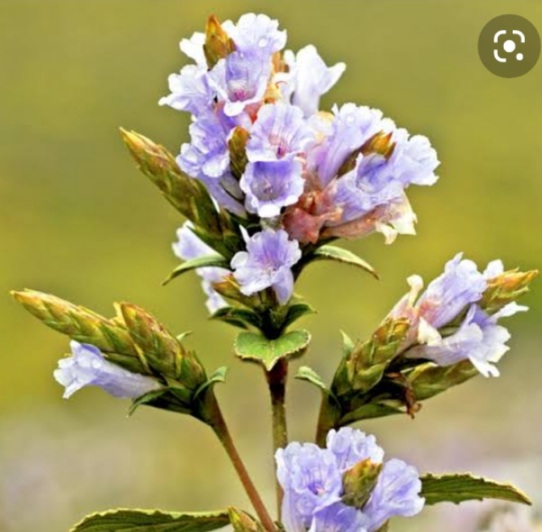
Kurinji is a shrub that is also called Strobilantheskunthiana or neelakurinji. Found along the Western Ghats in the Shola forests in South India, the specialty of the flower is that it blooms in 12 years. The rare sightings of the flowers have been rigorously demonstrated in the years 1838, 1850, 1862, 1874, 1886, 1898, 1910, 1922, 1934, 1946, 1958, 1970, 1982, 1994, 2006 and 2018 respectively.

To put things into perspective, the neelakurinji flowers were documented first in 1858 and since then, they have bloomed only for 15 times. The last time the flowers were bloomed in 2006, you witnessed Saddam Hussein being executed by the American Armed Forces, Italy won the football world cup and Pluto was declared a dwarf planet.

In India, there are 250 different types of kurinji flowers and 46 types of neelakurinji in India. The red and maroon kurinji flowers are also available but it is the blue, azure neelakurinji that is widely popular and most-coveted.

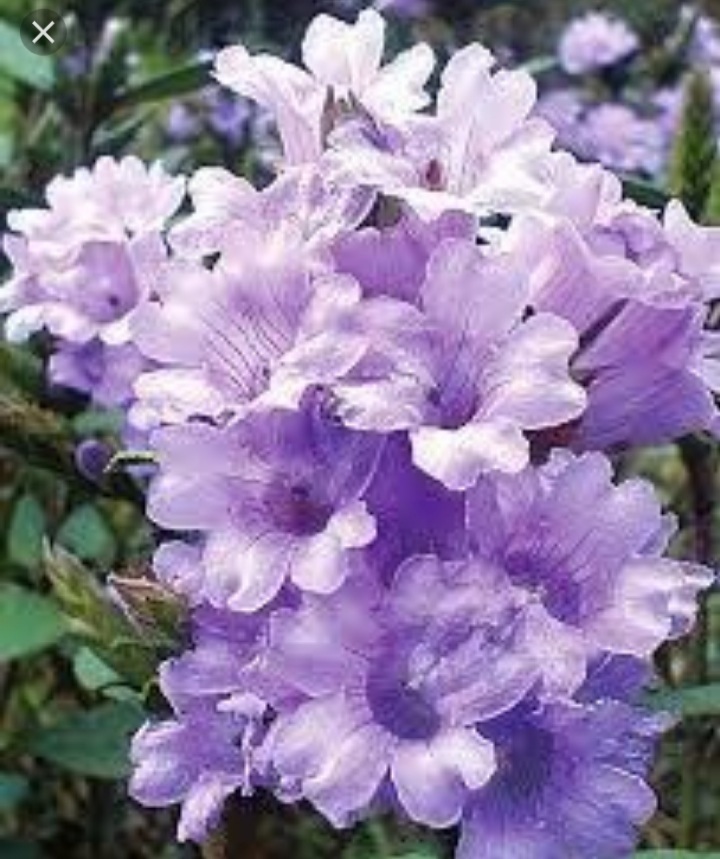
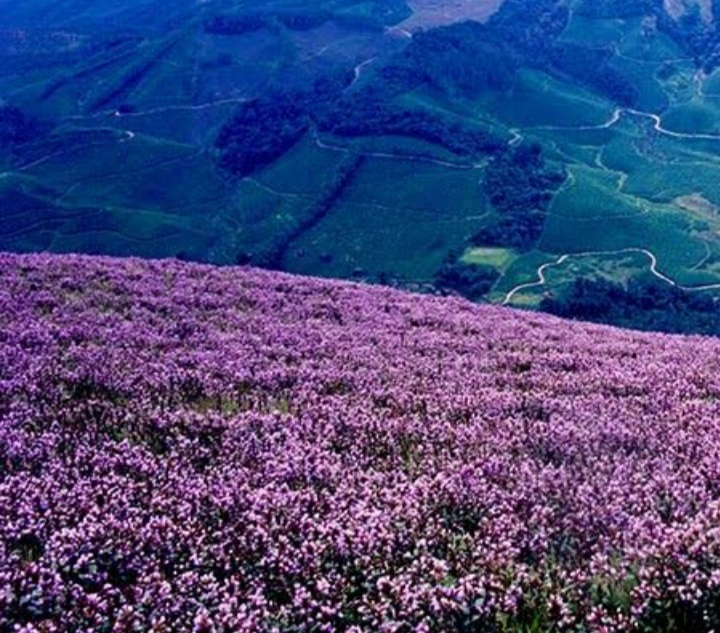
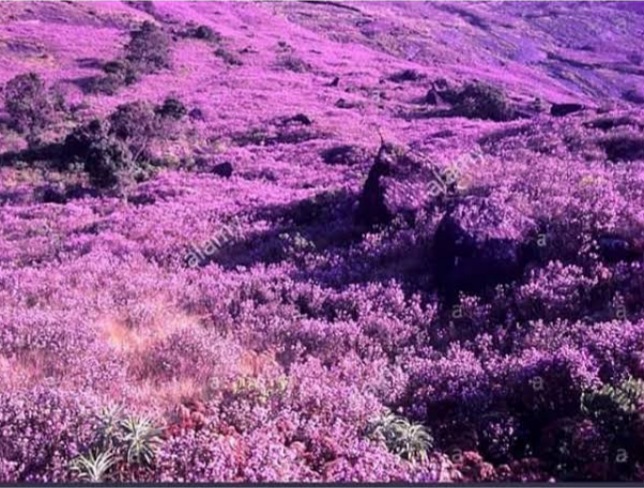
The flowers are purple-blue- showering the valley with the sublime purple haze when they bloom. A rarest of the rare sight, which happens once in a blue moon literally!  The blooming of kurinji flowers happens during September-October. People from all over the world come to Neelgiri Hills to see this rarest phenomenon unfolding in front of their eyes. The Neelgiri hills or the Blue Mountains get their name from the blue Kurinji flowers that cover the entire landscape during the period of 12 years.

KURINJI FLOWER HAD UNUSUAL BLOOMING CYCLES

In the world of flowers, such plants with unusual blooming cycles with long intervals are called plietesials. Besides, the blooming cycle, the plant shows other signature characteristics of being one such as gregarious flowering, supra-annual synchronized monocarpy and mast seeding. Mast seeding of Strobilanthes refers to the reproduction of the seeds once during their lifetime.  The synchronized monocarpy implies flowering once in a lifetime and dying after fruiting.

Similarly , strobilanthescuspidatus, other kurinji species, blooms once in every seven years and then subsequently, wilts and dies. The seeds take seven years to sprout, grow and bloom. Each species of kurinji flower takes different time to mature. Neelakurinji takes 12 years to grow and bloom gregariously.

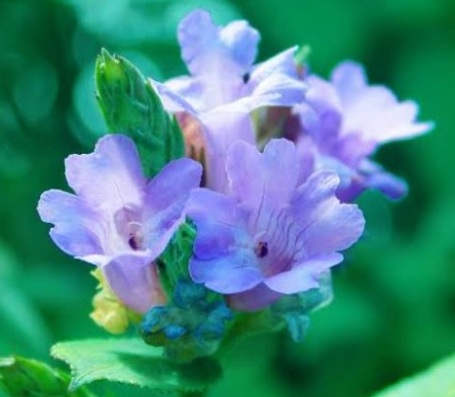
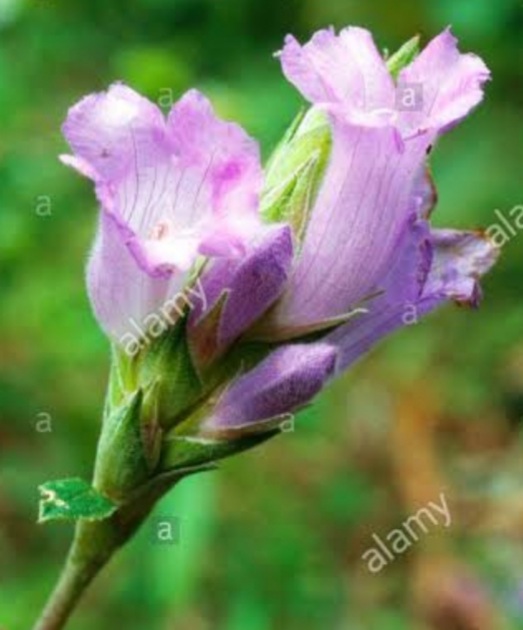
The kurinji flower is a bright coloured, bell-shaped blue flower. In the local language, it is called Kunthiana, referring to the river Kunthi that flows through the Silent Valley National Park in Kerala.  Kurinji flowers grow in the lower expanse of the valley that has no dense tree forest.

The plant of kurinji is a bushy shrub with hairless reddish branches. The leaves are hairless and have a leathery texture. Elliptic in shape, the size of the leaves are 6 x 3 cm.

In the 19th century, Christian Gottfried Daniel Nees von Esenbeck first discovered and described the genus, Strobilanthes.The flowering periods of Strobilathes vary from one species to another, as explained in the journals like Indian Foresterand Journal of Bombay Natural History Society.

All species belonging to this genus have an unusual flowering patternranging from annual blooming cycle to the longest with 16-year! The flowers grow in the cluster of 2-5 and have woolly texture. The flowers are hairy and grow in a linear pattern. The lance-shaped petals are almost 2.5 cm long and are attached to the spikes 3-5 cm long.

The plant is usually 25 to 60 cm high and grows at an altitude of 1,300 to 2,200 metres.

KURINJI HONEY

The flowers are pollinated by honey bees. The honey collected by these bees is very sweet, nutritious and has high medicinal value.

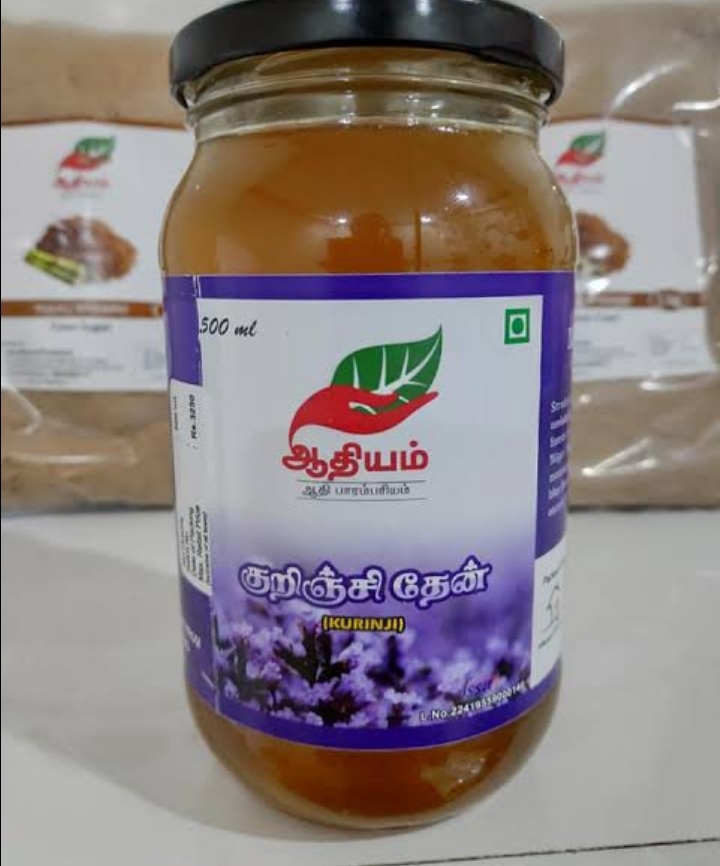
Butterflies, eastern honeybees and insects love these nectar-filled blue flowers. The nectar collected by the honeybees is regarded to be superlative and healthier. This rarest honey can last for more than 15 years.  The indigenous tribe Paliyan harvests the honey from hives. The tribe calls it ‘liquid gold’ for its value. Unlike other brands of honey available in the market, it is transparent and a bit greenish-yellowish in colour. The taste is unique and so far, it hasn’t been artificially cultivated at all. Besides, the honey is only available when the flowers bloom once in 12 years. For now, you need to wait until 2030 to get some.

BLOOMING SEASON FOR NEELAKURINJI

Covering the 3,000 hectares of hills in blue-purple carpet and filling the air with intoxicating sweet fragrance, this is a phenomenon that only happens in India!

The most interesting fact about the blooming phenomena of kurinji is that scientists and botanists have failed to arrive at any conclusion that how these flowers manage to adhere to their blooming periods, which range from 3, 7, 12, 17 to even 36 years!

The plants begin flowering in the last phase of Monsoon. By the time rains vanish, the valleys are covered with neelakurinji flowers. India receives the last rains of monsoon season during September and October, so if you want to witness this beauty first-hand, this is when you should visit Munnar or any Southern hill station.

However, with the erratic climate situation, we are dealing with, the blooming of neelakurinji flowers too has been impacted. It is advised to check the monsoon schedule before you make any plans.

HABITAT OF KURINJI FLOWERS

Earlier, kurinji flowers used to envelope the entire landscape of Nilgiri Hills, Bababudangiri, Cardamom Hills, Palani Hills and Anamalai Hills. There were times when one could witness the splurge of purple shade throughout the Chandra Drona Hill Range in Chikkamagaluru, Karnataka and Datta Peeta. With private real estate and plantations, their habitat has become limited in the area.  Apart from the Western Ghats, the magical growth of Kurinji flowers can be seen in the layout of Eastern Ghats namely Idukki district, Agali hills, Palakkad, Sanduru Hills in Bellary, Karnataka.

Ootacumend, the Queen of Hills or Ooty is home to 33 varieties of kurinji flowers and is popularly called Blue Mountain for kurinji flowers that cover the landscape.  Apart from Ooty, one can see the blue, bright flowers in their glory in Coonoor, Lamb’s Rock and Kothagiri. 

Thanks to these flowers and their unique blooming period, the sleepy town of Munnar, Kerala made it to the list of “Top Places to Visit in Asia in 2018” by the Lonely Planet.

THE WESTERN GHATS AND KURINJI FLOWERS

The Western Ghats wrap in an extraordinaire world of endemic fauna and flora. The alpine climate of plateaus and hills promote the growth and habitat of a wonderful ecosystem above 1,500 meters, known as the Shola. According to S.K. Seth and H.G. Champion, the sholas are the wet temperate stunted evergreen forest. The trees have crooked branches with an abundant supply of moss, lichens, orchids, epiphytes and pteridophyte, making the entire system hygroscopic- the phenomenon of attracting and absorbing water from the surrounding atmosphere. To avoid the high-velocity western monsoon winds, the shola trees have developed interlocking branches. The grasslands, where kurinji plants grow are open meadows and valleys-in the midst of misty hills.

Some botanists and experts refer to this ecological climate of the Himalayan range as “Islands in the Sky” because these habitats are divided by several low-lying inhabitable areas, making the grassland vegetation and fauna of the Southern Western Ghatare unique, highly evolved and nothing like other.

The Flora of British India enlists more than fully detailed species of Strobilanthes species in this region. Similarly, James Sykes Gamble, the noted botanist of the British era has also detailed 46 species in his book Flora of Madras Presidency.

SIGHTING OF NEELAKURINJI FLOWERS

Neelakurinji was sighted in the year 2006 after 12 years, in Tamil Nadu and Kerala. Kurinji flowers of Strobilanthescuspidatus species were again witnessed in their full glory in the year 2016 in Udhagamandalam.

In Munnar, the last mega kurinji bloom was spotted in 2006. In 2017, the purple flowers were recorded in their full glory in Bellary, behind Kumaraswamy temple.

In 2006, the neelakurinji flowers were last bloomed in Tamil Nadu and Kerala. The flowers were spotted after 12 years. To commemorate this rare sighting, the state government released a stamp and declared the year as the “Year of Kurinji.”

The flowers were seen again after exact 12 years in South India in the year 2018.

The next flowering season in Munnar will be in the year 2030.

REFERENCES IN LITERATURE ABOUT NEELAKURINJI

Since Kurinji flowers have their home in Tamil Nadu, the Tamil literature is rich with their references and similes. In Tamil Nadu, Kurinji is the part and parcel of everyday life. A temple is dedicated to the flower deity called Kurinji AndavarTemple in Kodaikanal. Commonplace references to the deity and kurinji flowers can be found in Kurunthogai, the classic Sangam Age literature of Tamil Country. The blooming season of kurinji is celebrated with small-scale and big-scale festivities among locales, who believe it to be the enduring symbol of secret love and romance. For a tribal community in Munnar, the neelakurinji is the symbol of self-awakening of a woman.

The Tamil Country literature classified the land into five types, which were Kurinji (mountainous), Mullai (forested), Marutham (agricultural), Neithal (coastal) and Paalai (desert) – based on their geographical topography and the plants found in these ecosystems.

In a classic Tamil Literary piece, Kuruntokai- the flower is used indirectly for the poetic verse, Red Earth and Pouring Rain. In Clare Flynn’s novel, Kurinji Flowers, the flowers’ association with clandestine love affair is used as a backdrop to narrate a fictional account of a tragic romance in India of the 1940s.

WHY DOES NEELAKURINJI FLOWER BLOOM AFTER 12 YEARS?

It is called survival mechanism in botany. The longer pollination helps the plant to survive through the periodical blooming, natural calamity as well as protect it against the predators. The plant is a favourite of birds and mammals, rendering it vulnerable and at a great threat. In such a scenario, the annual pollination may not be a favourable condition for the plant and leave it more defenceless and weaker. The extended period of blooming is determined by the internal mechanism clock of the plant. The neelakurinji plants, much like bamboo plant, follow the records of daytime, variation in monsoon season and bloom accordingly. Until the kurinji plants are ready, they may or may not bloom at all.

On the recommendations of “Save Kurinji Campaign Council,” the Kerala cabinet has decided to increase the 3200 hectares and redraw the boundaries of the sanctuary. The cabinet also took decisions to appoint a settlement officer and conduct drone surveys on a regular basis. A decision was also taken on the Kerala Promotion of Tree Growth in Non-Forest Act 2005 to stop the encroachment of other plant species to steer clear of the ground for kurinji flowers.

Besides, the need to educate people is the must. Responsible tourism is still not a thing in India and because of this, the growth of kurinji flowers gets affected adversely. The influx of tourism affects the environment and natural habitat of the flowers. Be it at the micro-level, it changes the structure of soil and nutrients to a level that it alters the blooming pattern of flowers and affects their pollination cycle.

Around 3,500 people were allowed to visit the Eravikulam National Park in 2006. There were reports that they plucked the flowers and took them home- just for the thrills.  This impact of this encroachment of this will be seen later when the next round of blooming period will occur…or not.  The managing committee of National Park, Munnar Wildlife Division has provisioned a fine of Rs. 2,000 on damaging the plants under Section 22 of the Wildlife Protection Act.

According to the local people in Munnar, the climate of the hill station was cool and a balancing mix of mist and rain- favourable to the growth of neelakurinji flowers. However, it is not anymore. The climate is also rapidly changing and becoming unpredictable, making the flowering of neelakurinji flowers big guesswork.

History of twitter

Twitter is an American social networking and microblogging service. Twitter users interact with small messages called, “tweets”. Currently twitter has more than 330 million monthly active users. It is in the league of big social media platforms like Facebook, Instagram etc. It was created by Jack Dorsey, Noah Glass, Biz Stone and Even Williams in March. In this article I will take you through the journey of creation and rise of twitter.

Initial history

In 2006, Jack was an undergraduate student at New York University. He came up with an idea of an SMS service to communicate with small group. He shared his idea with board members of a podcasting members Odeo. Williams was also part of board members. He later ascribed the idea to Noah. They decided to name this project twttr as domain twitter.com was already in use. Later they bought the domain name and changed the name of service to twitter. Twitter spun off its own company in 2007.

Work on the project started on March 21, 2006 and full version was publicly in july 2006.

The first breakthrough moment for twitter came in 2007 through South by Southwest Interactive conference. During the event, twitter engagement increased from 20000 tweets par day to 60000. They placed two 60 inch plasma screens in the conference hallways. These screens were used to stream twitter messages.

This conference helped twitter in rapid initial growth. Almost 400k tweets were being posted on twitter per quarter in 2007. This increased to 100 million tweet per quarter in 2008. By 2010, company recorded over 70000 registered applications. In march 2021 it became third highest ranking social site. Prominent events like football world cup, NBA finals etc. helped twitter in growing quickly. When Michael Jackson died on 25th June 2009, twitter severs crashed as users were tweeting at the rate 100k tweets per hour.

Emergence of “New Twitter”

After gaining popularity, twitter started revamping it’s service. Initial changes included the ability to see pictures and videos without leaving twitter by clicking on link given in individual tweets of various sites like YouTube.

On 5 April 2011 , twitter released a new home page but due to some glitch it was relaunched on 20th April 2011. On 8th December 2011, twitter added a new feature to its website named “FLY”. In addition to home tab, the connect and discover were also introduced. On 21 March 2012, twitter celebrated its birthday and also announced that they have 140 million active users.

In 2012 twitter expanded at a fast rate. They opened an office in Detroit to work with automobile brands. In june 2012, logo of twitter was modified to bird symbol. Throughout next couple of years twitter acquired several companies like Vine, Crashlytics, Trendrr etc.

In 2014, twitter underwent a redesign which significantly changes its interface. Some of major changes included profile picture and biography in a column left to the timeline, and a full-width header image. Twitter acquired many different type of companies onwards 2014 like Namo Media ( a native advertising company) in 2014, Mitro( a password-security startup) on 31st july 2014, Niche(an advertising network) on February 2015 etc.

Twitter took an significant step in 2020 and started marking tweets which contain misleading information.

Twitter kept expanding its business and was announced to be the 10th most downloaded mobile app in 2019.

FOUNDATION AND CONCEALER HACKS

FOUNDATION HACKS.

  • Many of us face the problem of dry patches, to avoid dry patches apply moisturizer on your face then apply your foundation, you will find a smooth and polish look.
  •  Most of the girls find it difficult to get the perfect shade of foundation, if by mistake you bought lighter shade than your skin then gets a 2 shade darker concealer. Mix both and you will get your desirable shade
  • Your foundation doesn’t last for long? Here is a little tip. Spray any setting spray on a beauty blender and dap it on your face, after that apply your foundation, it will last for many hours.
  • Having an oily face melts your foundation, to avoid oiliness, at the beginning apply loose powder on your face then apply your foundation. Powder will absorb the excessive oil and the foundation will not melt from your face.
  • Even after applying foundation, you can still see your pores, to avoid that rub a ice cube on your face for 2-3 min it will shrink your pores and foundation will not get set in pores.
  • Your face becomes cakey after applying foundation to get rid of this dip your beauty blender into water and remove the excessive water from the blender and dap it on your face then apply foundation.
  • You can also use your foundation as a concealer, just take your foundation and loose powder mix them well and here your concealer is ready.

CONCEALER HACKS

  • Every girl has fine lines on her face, and of course nobody like that. Here you can use concealer to hide your fine lines
  • You can enhance the look of eyebrows. You just need to clean the area around your eyebrows which give them a perfect shape.
  • The toughest job for every girl is to make her winged eyeliner perfectly straight. No worries you can use concealer to fix your winged eyeliner and make it straight.
  •  You can turn your concealer as BB cream, you just need to add some primer and moisturizer
  •   You can use concealer as colour corrector, you can get concealer in many colours. It covers blemishes, dark circles, and redness of your face.
  •   If your concealer becomes cakey after some time. You can make it hydrate by adding eye cream and dap it with the sponge which will not make your concealer cakey.
  •  You can use concealer as highlighter, you just need to take two shade lighter than your skin tone. Apply your concealer under your eyes in triangular shape which will help to lift you face.
  •   You can use concealer to contour your face, you need two shade darker concealer than your face, apply it on cheek bones, on your nose and etc and blend it with brush and sponge.
  •  If your lips are dark, you can use concealer on your lips which helps to enhance your lips when you apply lipstick on concealed lips.
  • You can use concealer to fix the lip lines and give perfect shape to lips if by mistake your lipstick goes out of your lips you can fix it by applying concealer on it.

Incredible India!

“This is indeed India!… The land of
dreams and romance, of fabulous wealth and fabulous poverty, of
splendor and
rags, of palaces and hovels, of famine and pestilence, of genii and giants and
Aladdin lamps, of tigers and elephants, the cobra and the jungle, the country
of hundred nations and a hundred tongues, of a thousand religions and two
million gods, cradle of the human race, birthplace of human speech, mother of
history, grandmother of legend, great-grandmother of traditions, whose
yesterday’s bear date with the
moldering antiquities for the rest of nations-the
one sole country under the sun that is endowed with an imperishable interest
for alien prince and alien peasant, for lettered and ignorant, wise and fool,
rich and poor, bond and free, the one land that all men desire to see, and
having seen once, by even a glimpse, would not give that glimpse for the shows
of all the rest of the world combined”  –  
Mark Twain                                                                                   

As beautifully described my Mark
Twain, Keith Bellows and Ella Wheeler, India is a fabulous country which is a
must visit nation for anyone. But do you know what makes India an intriguing
place? Here are some unknown facts about our beloved nation :

1. Largest Post office network

India is known for having the largest network
of post offices in the world. It has over 1, 55,015 post offices. There is a
floating post office too in India which is situated at Dal Lake, Srinagar.


2. Kumbh Mela festival visible from space

Kumbh Mela or Kumbha Mela is grand and
important festival which is celebrated among Hindus. During 2011, over 75
million pilgrims were present at the festival! The number of people who
attended the festival were so huge that the crowd was visible from space!


4. Bandra Worli Sea link has steel wires equal to the earth’s
circumference

This architectural masterpiece was completed
by the hard work of a total of 2,57,00,000-man hours. The weight of such
masterpiece is equivalent to that of 50,000 African elephants.


5. World’s Highest cricket ground

India is the biggest fan of cricket. The
highest cricket ground in the world was also located in India. Built at an
altitude of 2,444 meters in 1893, the Chail Cricket Ground of Himachal Pradesh
is a part of the Chail Military School which is the highest cricket ground in
the world.


6. Shampoos were invented in India

Shampoos were first
introduced by India. They were made by herbal methods in initial stages.  Shampoos were derived from “Champu” which
means massage in Sanskrit.


7. A kabbadi pro nation

India is an incredible nation and is pro at
Kabaddi. The country has talented teams (both men and women), who won all
Kabaddi World Cups bravely and victoriously!


8. India’s first President only took 50% of his salary

Even though the salary of India’s first
President, Dr. Rajendra Prasad, used to be Rs. 10,000, he only accepted 50% of
his salary stating his belief that the amount which he had accepted was
sufficient for him and he didn’t want more. He accepted only 25% of his salary
when his 12-year tenure ended!


9. The first consumer of sugar

 Extraction and purifying techniques of sugar
was first developed in India. Refining and cultivation of sugar was also taught
by our country to many visitors from abroad.


  10. Havell’s: A purely Indian brand

Long time ago, Havells was bought for just Rs.
10 Lakhs which is now a famous and well-known electrical goods company making
billions. It is a purely Indian Company which was named after its original
owner Mr. Haveli Ram Gupta.


11. A special polling station is set up for a lone voter in the
middle of Gir Forest

A special polling booth was set up in the Gir
forest exclusively for a lone voter, Mr. Mahant Bharatdas Darshandas, who has
been voting since 2004. He is the sole voter from Banej in Gir forest.


12. Snakes and Ladders was invented in India

The game of “Snake
and Ladders” was first introduced in India and was previously known as Moksha
Patamu. The game was invented to teach the children about Karma. It was later commercialized
and has become one of the most played board games in the world.


International Conference on Innovation Challenges and Advances in Engineering & Technology: A road to self-reliant India (ICAET- 2021)

ISBN NO. for Print Proceedings of Conference

978-81-951121-1-1

Publisher of Print Proceedings of Conference Papers

Technoarete Research & Development Association

Imprint

Technoarete

Name of Conference

International Conference on Innovation Challenges and Advances in Engineering & Technology: A road to self-reliant India (ICAET-2021)


Date of Conference

05th – 06th September 2021

Venue of Conference

Virtual Conference

Conference Organizers Name and Details  


“Department of Mechanical Engineering, Vishwaniketan’s Institute of Management Entrepreneurship and Engineering Technology (VIMEET)

in Association with

Institute For Engineering Research and Publication (IFERP)”

Brief About Conference (100 to 500 words)


About Conference

The objective of ICAET-2021 is to present the latest research and results of scientists (preferred students, post graduate Students, Research Scholars and post-doc scientists) related to Electrical, Electronics & Communication Engineering and Computer Science & Engineering. The conference will feature traditional paper presentations as well as keynote speeches by prominent speakers who will focus on related state-of-the-art technologies in the areas of the conference.

For more Details: https://www.icaet.in/


Editor of Conference Proceedings


Dr. Sudha Arvind, Professor, ECE Department, CMR Technical Campus, Hyderabad, Telangana, India


Hard work or Smart work

Since childhood, we are taught that hard work is the key to success which is true but considering today’s scenario, hard work is not enough to fulfill your dreams. In this era of competition literally in every field, we need to be smart and act smarter.
Hard work is basically working over something for a very long period of time, struggling to achieve what you love and putting all your efforts into that particular thing.
On the other hand, if we work smartly, we can achieve more than what we wish to have in shorter period of time. Now, don’t confuse it with shortcut method to achieve something. Smart working means putting efforts and intelligence to attain our goal as soon as possible.
I don’t mean to say don’t work hard for your dreams, but we should be smart enough to know where to invest our hard work.
Now, let’s try to understand these concepts with an example:-
Ages ago, early man used to push cart or huge pieces of stone from one place to another. But later on, it was replaced by wheelbarrows that made their lives more convenient as compared to before.
Now, imagine what would’ve happened if there were no wheelbarrows. They were working hard before as well, but that didn’t changed their lives but invention of wheels did improved their lifestyles. The inventor of the wheel must’ve been really smart to think about making wheels and how to use it.
Being smart worker saves a lot of time as you can find ways and means to reduce your work by using logical and innovative ways to achieve your goals. This not only saves your time but it also gives you enough time to learn new task while completing the present one.
On the other hand, hard work requires a lot of effort and consistency and thus it becomes tedious and tiresome but still the result won’t be as much the efforts you put. While smart work is always more fruitful than you expect.