Metaverse

What is Metaverse?

In metaverse, people can interact with each other using virtual and augmented reality technologies. It will result in forming the shared virtual world.

Metaverse is considered web 3.0. The earlier version of the internet which consisted of web pages that provided information is termed web 1.0. The next version consisted of interactive web pages. Now, web 3.0 will be a result of assimilating virtual reality and augmented reality in web 2.0.

We can shop, play games, buy things and own places in the metaverse. Several companies are creating gaming metaverses. The game ‘Second Life,’ which was released in 2003, can be considered an early version of the metaverse.

Benefits of Metaverse

  • It will be quite beneficial to host meetings. Video conferencing has some drawbacks, such as the lack of a personal connection. Metaverse will make us feel like we are sitting at the same place by interacting through digital avatars.
  • It will also help people with special needs.
  • It can also be used to help people overcome phobias.
  • It is expected that virtual currencies in the metaverse will significantly influence the world economy. Decentralization will reduce the dependence on governments.

Challenges with Metaverse

  • Few companies may control the metaverse and hence power and influence may stay in the hands of a few people.
  • Government surveillance and control could be increased by collaborating with businesses.
  • Addictions to the internet and smartphones are becoming common. As a result, it’s possible that virtual world addiction will become the next huge concern. Furthermore, metaverse consists of entertainment, shopping, games and many other things that are addictive in nature.
  • Even in this modern era, not everyone has access to the internet. Many people are digital illiterates. Due to the digital divide, the benefits of metaverse will not be accessible to many.

Conclusion

Some people believe that the metaverse will be the internet’s future. Many businesses are investing in the development of the metaverse. It is important to ensure that no monopoly exists in the shared virtual environment.

The Geological time scale

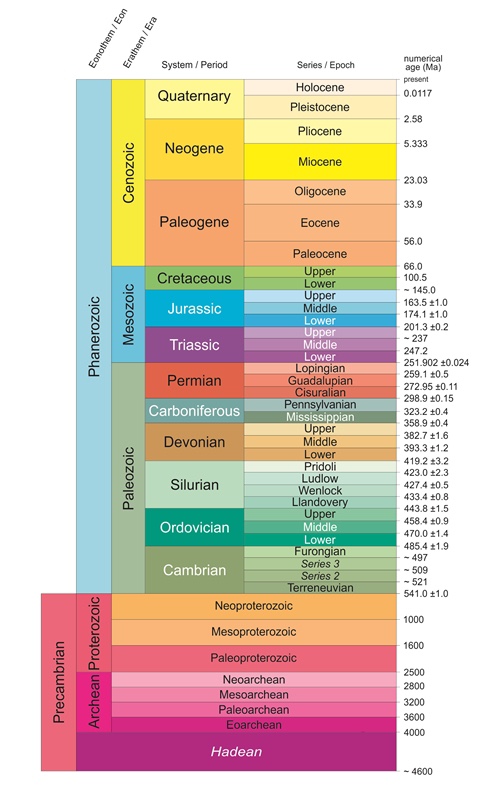
Geologists subdivide timescale by events that happened in geological history . These time intervals are unequal in length, geological timescale describes the timings and relationship of those events that changed Earth’s geology. This time scale is developed by carefully studying and analysing the rock layers ,evolution of species, rock dating, fossil samples and atmosphere.

Eons

Eons are the largest divisions in geological Time and span to millions of years . There are four eons catalogued till present day, these are — Hadean, Archean, Protozoic and Phenerozoic eon . The first three eons are collectively referred to as the Precambrian super eon.

Hadean Eon

The Hadean eon began when the earth formed about 4.6 billion years ago and ended 4 billion years ago . The planet’s condition was very dynamic , earth was still very hot and frequently collided with other planetary bodies.

Archean Eon

It began about 4 billion years ago till 2.5 billion years . The earth’s crust slowly started cooling and stabilising to form landmass .The earliest lifeform probably anaerobic microbes called stromatolites survived. example – Cyanobacteria, Proteo bacteria , microbial mats. Volcanic activity was very high and Archean rocks were often metamorphosised water segments like volcanic segments and mud rocks.

It is further divided into eras:

Eoarchean

( 4000 mya-3600 mya)

(mya- million years ago)

  • The first Supercontinent Vaalbara appeared.
  • Earth possessed a firm crust for the first time.
  • Prokaryotic microbes called Archaea appeared.

Paleoarchean

( 3600-3200mya)
  • Earliest confirmed evidence of life.
  • Stromatolites may have been created.
  • Microbial mats work present.

Mesoarchean

( 3200-2800mya)
  • Tectonic plates subduction.
  • Expansion of microbial life.
  • Ocean temperatures around 55-85°C
  • High levels of methane and carbon dioxide in the atmosphere.

Neoarchean

(2800-2500 mya)
  • Major development in complex life and continued formation.
  • Rise of oxygen in the atmosphere.

Proterozoic Eon

It spanned the interval from 2500-541 mya . For the first time oxygen appeared in the earth’s atmosphere . Mountain formation activity began because of the continuation of continental accretion .Glaciers began to form . Processes like subduction were active due to high tectonic plate movement. It is further divided into 3 eras-

Paleoproterozoic era

(2500-1600 mya)
  • Longest era
  • Continents stabilised
  • One day duration was 20 hours.
  • Enormous increase in oxygen.
  • Anaerobic life form largely died because oxygen was highly toxic for them.
  • First mass extinction happened.
  • Eukaryotes emerged.
  • Periods in which this era is divided- Siderian, Phyacean and Orosirian.

Mesoproterozoic era

( 1600-1000 mya)
  • Evolution of sexual reproduction.
  • Development of multi cellular organisms.
  • Break up of Columbia supercontinent.
  • Periods – Ectasian and Stenian .

Neoproterozoic era

( 1000-541 mya)
  • Most glaciation.
  • Ice sheets reached equator.
  • Snowball Earth formed.
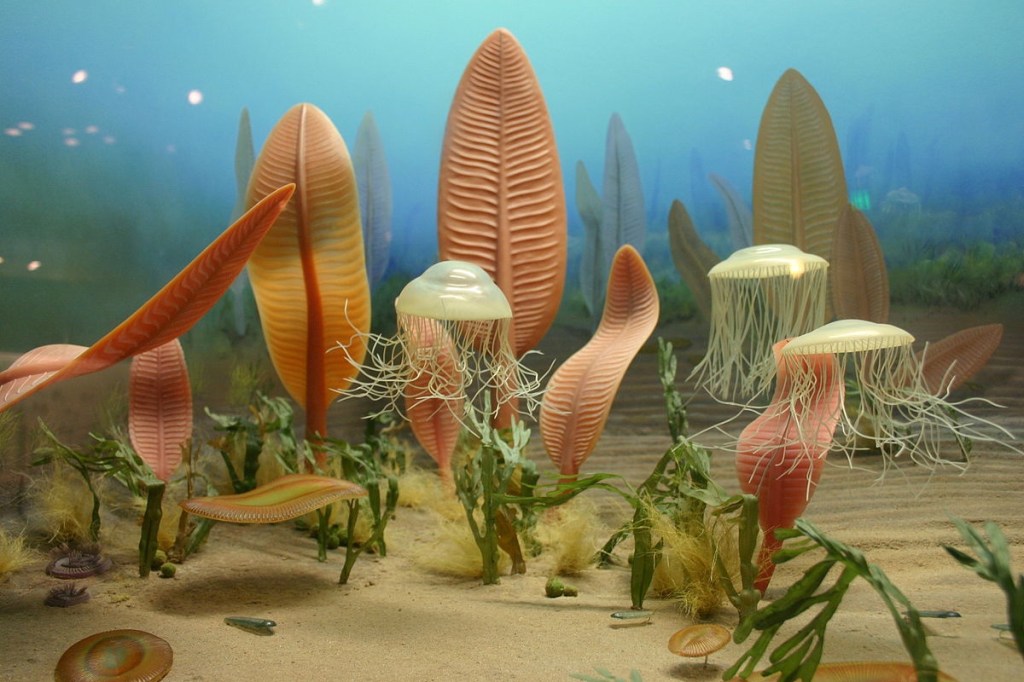
  • First appearance of Trilobites ans Sponges.
  • Periods- Tonian, Cryogenian and Ediacaran.

Phanerozoic Eon

It covers timeline from 541 million years ago to the present. At the start of this eon , complex plants and multi cellular organisms with hardshells appeared . There was a single landmass known as Pangaea. It is divided into 4 eras:

Paleozoic era

(541-252 mya)
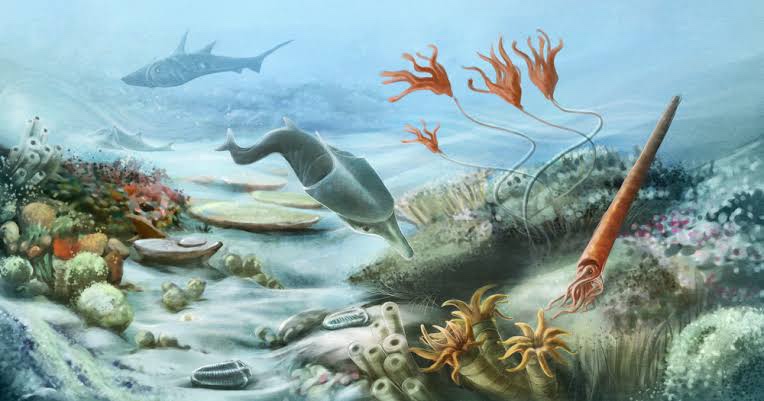
  • Most rapid diversification of life called Cambrian explosion.
  • Evolution of arthropods ,fish and amphibians.
  • Life transition to the land.
  • Forests of primitive plants appeared.
  • Largest extinction event called Permian- Triassic extinction event happened.
  • Appearance of invertebrate animals phyla.
  • Reptiles prospered.
  • Periods- Cambrian, Ordovian, Silurian, Devonian, Carboniferrous and Permian.

Mesozoic era

(252-66 mya)
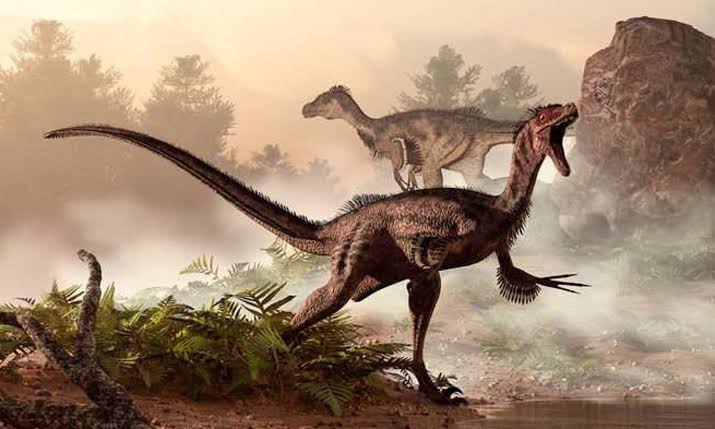
  • Dominance of reptiles like dinosaurs.
  • Abundance of Conifers and Ferns.
  • Breakup of Pangaea.
  • Dinosaurs appeared in mid Triassic period and remained till early Jurassic period (about 150-135 mya).
  • Archaic birds appeared in Jurassic period.
  • Flowering plants appeared in early Cretaceous period.
  • Periods- Triassic, Jurassic and Cretaceous.

Cenozoic era

( 66 mya – present)
  • Dominance of mammals , birds and flowering plants.
  • Cool and dry climate.
  • Complex life evolved.
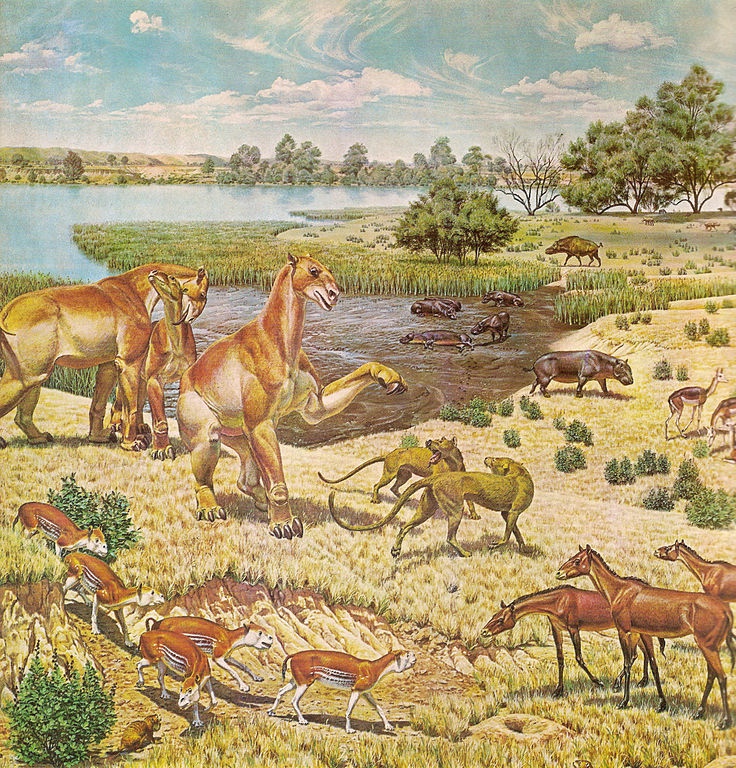
  • This error started with mass extinction event called Cretaceous spell Eugene extension event in which many species including non-even dinosaurs became extinct possibly due to a large asteroid impact
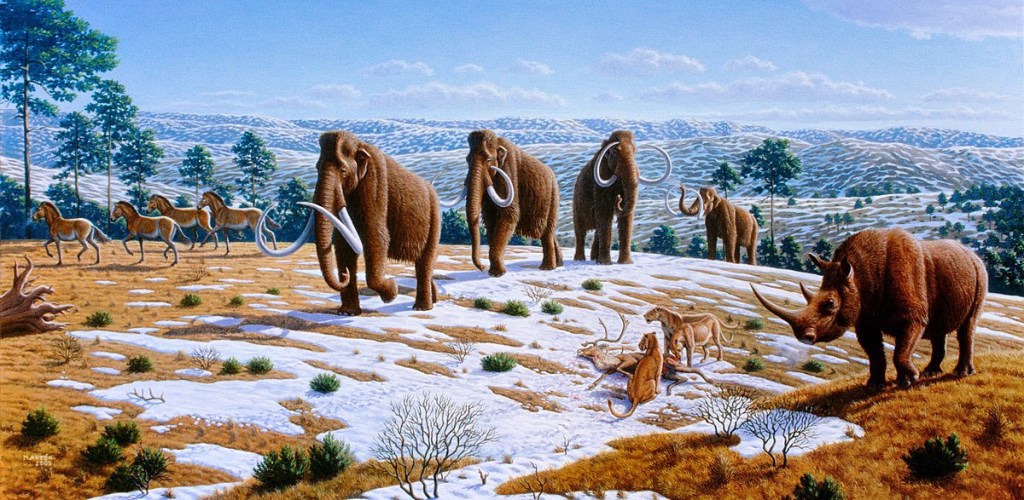
  • The Quarternary period saw Mammoths and wooly animals. It was marked by ice ages due to the cooling trend of earth.
  • Around 50 million years ago , Earth entered a cooling period mainly due to the collision of Indian tectonic plate with Eurasia. This caused the rise in the Himalayas.
  • Periods- Paleogene, Neogene and Quaternary.
The  Earth went through many violent and beautiful events before Homosapians arrived . We must make sure to protect and cherish our dear planet . 

Know your furry buddy

Giggling and playing with your new puppy is so mesmerising. It is fun to look how your new doggy is gradually being comfortable with you. Be honest, you love it when your puppy snuggle into you unknowingly while taking little naps right. We all love that isn’t it. There comes a phase during his adulthood where your grown up doggy follows your every command, protects you, helps you stay away from toxicity and one thing is sure that your dog is a free therapy to your mental health. Your dog will become a part of your family just like that. But everything comes with a responsibility. Would you like if your dog suffers from food poisoning just because you didn’t knew what he ate last time was injurious to his health?  Ofcourse not,  you’ll do whatever it takes to make your furry friend healthy. Pepperoni is one of the most delicious items we know so far.

Almost everyone loves it. Ever wondered if it is good for your dog? Is it something your dog should enjoy or suffer after consuming?  So, in this series of Know your furry buddy, we’ll mainly focus on one question, Can dogs eat pepperoni?

It might seem harmless, after all, it is just meat. But can dogs eat pepperoni? In this guide you’ll learn all about this meat and how much of it is safe for dogs to eat.

For ultimate pet safety, I recommend consulting with your vet about all the questions you have about your dog eating pepperoni.

Dogs should not eat pepperoni. It contains too much sodium and fat for dogs. Some flavors and types of pepperoni might have seasonings in them that are unsafe for dogs.Dogs can safely eat one slice of pepperoni once in a long while – like a few times a year. More than that and they run the risk of experiencing digestive issues, salt poisoning, pancreatitis, or kidney damage.

This situation alone comes with several questions. We’ll try to deal with few of them

Can Dogs Eat Hot Pepperoni?

No, dogs can not eat hot pepperoni. Spicy foods will upset their stomach and give them digestive problems. Do not let your dog eat hot pepperoni.If your dog eats some hot pepperoni, give them plenty of water and watch for any signs of lethargy or dehydration. 

Can Dogs Eat Pepperoni Jerky?

Do not give your dog pepperoni jerky more than once every few months. Avoid any flavors that have garlic or onion powder since that is toxic for dogs.Don’t give your dog spicy jerky.

Can Dogs Eat Pepperoni Slices?

It is safe to give your dog one pepperoni slice every few months, but do not give them more than that. Too many pepperoni slices could cause your dog to consume too much salt and fat – both of which have bad health effects for dogs.

Can Dogs Eat Pepperoni Sticks?

Do not give your dog entire pepperoni sticks to munch on. That is far too much sodium and fat for your dog to eat all at once. Instead, give your dog a small part of a pepperoni stick.

Can Dogs Eat Turkey Pepperoni?

Dogs can safely eat small amounts of turkey pepperoni, just like traditional pepperoni. The type of meat doesn’t matter, it’s the amount of salt, fat, and the types of spices it has. If the turkey pepperoni is just as high in salt and fat, then only give them a little bit of it. If it has garlic or onion powder, don’t let them eat any of it.

Can Dogs Eat Pepperoni Pizza?

No, dogs should never eat pepperoni pizza. Pizza crust and sauce usually has garlic and onion powder – both are toxic for dogs.Pizza is also really high in sugars, fats, and sodium. It will give your dog an upset stomach and could lead to long-term health effects if they eat it regularly.

Is Pepperoni Bad For Dogs? Can pepperoni kill dogs?

A few slices of pepperonis won’t kill your dog, but eating too much could make them very sick.Too much pepperoni is bad for dogs. If your dog eats it frequently, then watch out for these symptoms.

Increased thirst

Increased urination

Vomiting

Diarrhea

Abdominal pain

If your dog shows any of the above symptoms, please call your vet.

How Often Can Dogs Eat Pepperoni?

Try to keep pepperoni away from your dog. Dogs should only eat a few thin slices of pepperoni once in a while. In other words, dogs can eat one slice of pepperoni every few months. They should not eat it regularly.

Dogs might love the smell of the seasoned chewy pepperoni, but keep it away from them. It is perfectly safe to allow your dog to eat one slice every few months as a special treat. Since it has so much sodium and fat in it, be careful with everything else they eat that day.As always, call your vet if you notice your dog reacting negatively after eating pepperoni.

Conclusion

Your dog is your responsibility. Through this article, i’ve tried to answer almost all the questions related to the issue. It’s human nature to make mistakes, even if you mistakenly feed your dog with pepperoni, contact your vet immediately if your dog is showing negative symptoms. Be accountable for your dog’s poor health. Take good care of him afterwards and try not to let him eat pepperoni again.

That’s it for now, wish you and your Furry Buddy stays happy and healthy forever.

Social Media has helped in better communication

Gone are the times when people used to sit together with their family and friends and share the anecdotes which turns all the faces into smiles and laughter. From children to mid-age couples to older couples, they all enjoyed together and feel happy but now it is very rare to find where everone is present together. It rarely happens and the reason for that can be said as our fast moving lives.


In the era of globalization, everything has been changed from the chemistry of the country to the chemistry of the relationships. They are no more the same ones. The emotional aspect in the relationships which were present before and strongly connectd each other is now lost somewhere. The threads has become loose and scientifically speaking, whenever something becomes loose, it strangles. Strangles up to a extent that it is broken into the pieces. It changes the overall chemistry.


But whatever is happening cannot be said termed as intentional. It is not a choice but the need of the hour. The person is required to do work day and night if he wants to survive. Survival does not only means food, shelter and clothes but also mean the social standing in the society. Now, the need is to earn more than the bare minimum for the representation and in all these chaos and the race, family and friends are left behind.


So, the invention of social media is a big thank you from the side of busy people. They can connect with their friends and family while sitting in the bedroom of their house.


For the people who are not able to make time for their family and friends because of their busy and tight schedule, they can connect to them through social media platform. There they can chat, talk and see what what all is going on that person’s life. It gives an insight into the person’s life from a very far distance and that helps in the better communication.


Sometimes, it so happen that even if we have time we are not able to visit people because the time which we have is limited. It is not abundant but our family and friends are huge in number. They consist a lot of people and it is not possible to to go to each and every place in that limited time. It is really not possible. Then we resort to social media for communication.


Even in these pandemic times, social media platform helped us to stay in connect with our loved and dear ones. It was not possible for everyone to live together as that would increase the chances to contract the deadly virus. So, everyone had to stay at their own places. But living alone did not left the person to stay in solitude. Even though he could not meet his loved and dear ones but he can communicate to all of them through social media. He was able to know everything.


Lastly, I would conclude with my opinion that in the era of globalization and also in this tough times, social media was the only platform through which we were able to communicate to all family and friends. We were able to live with them in all the aspects of their life though virtually. Still, living is important and it was done.

Harming the Harmless

Don’t be bitter, save the critters’


From the above slogan, it is not very difficult to understand that what it is trying to say. It is putting forth an idea which says that don’t be harsh, rude, cruel and bitter against the animal. Save them.


In the world of modernisation and globalisation, development and invention are taking place at a very fast pace. People are so absorbed in moving forward that they doesn’t care that who all are affected or harmed in the said process. They simply want the progress to take place no matter what. One such group who faces the cruelty in the so called invention and the development of the mankind, are animals.


Talking about the animals and the cruelty faced by them in these times, they become the replacement of humans when it comes to testing for anything. Whenever any new science, technology , medicine or whatever the case may be requires the human testing in order to test and establish that it is safe and correct to be used by the masses, animals are tested in place of humans because their biological properties and attributes are in some or the other way similar to the human properties and attributes. Also, there will be no one who will raise objection regarding that.


But times are changing. It has not been that same old cruel world who will freely allow the cruelty in the name of development of science and technology. Now, it will raise objection and urge the people who are doing this to stop right away.


To be specific, animal cruelty happen in different ways like poisoning, shocking, burning and killing them for various outcomes. They are tested in the laboratory to see what will be the outcome of the particular drug or chemical when it will be given to the poisonous person and for that purpose animal are poisoned for the result. They face severe cruelty in the name of the development of the mankind which is definetly immoral.


The principle and the foremost reason that the animal cruelty should be stopped is that it is unethical. It does not hold any ethical importance in the right minded people. Using animal’s and their body for our own purpose is a very selfish act. It cannot be termed as the right thing to do in the name of the development of the mankind. Considering the word mankind, ‘kind’ is present but with the act of cruelty and selfishness, we leave behind kindness.


Also, it is not a good science. According to the report of the National Institutes of Health, 95 out of every 100 tests of the drugs which pass the animal tests fails in the humans. With this figure, it will not be wrong to interpret that testiing in animals is a bad science. In this process, the precious money, invaluable time and all other resources not to forget the precious lives of the animals are wasted. The outcome which comes out is not even an effective. The are so worthless that 50% of reports are not even published. Therefore, it is should be banned because it is unnecessary to take it further.

A Webinar organized to create awareness on newly notified CCS (Pension) Rules, 2021

 A webinar was organized for all the Pensioners’ Associations under the chairmanship of Shri V. Srinivas,   Secretary (P&PW) with the objective to create awareness on newly notified CCS (Pension) Rules, 2021 and generation of Digital Life Certificates using Face Authentication Technology.  Central Government Pensioners Associations from all parts of the country participated in the meeting. Presentations were given on CCS Pension Rules 2021 and on DLC generation through Face Authentication followed by a Question Answer session after each presentation.

Secretary (P&PW) expressed his happiness to meet such a large group of 52 participants from the various Associations and to have a constructive interaction. He appreciated the intensity of the discussion and the various queries raised, given the release of CCS Pension Rules 2021 on 25th December 2021 and the recent launch of DLC generation through face authentication. The curiosity among pensioners was very understandable and such interactions would continue with a view to stay in touch and ensure that every association reached out to.  He also requested each Association to have regular interactions with their membership.

He reiterated that the objective of the meeting was to enhance interaction between the department and the pensioners’ associations, especially at his level so that he could know each one personally and the associations could be assured that the Secretary would be in a position to understand and listen to areas where concern exists. He informed that since the pension department is a very legalistic and policy based department, it is important to understand where reforms are necessary and constant updations and amendments in law may be required to ensure greater benefits given to pensioners and that will be the objective of the entire exercise. He expressed hope that membership of each association is more than 300 and they are interacting regularly with the members.

Self reliance in Energy sector is must for achieving the goal

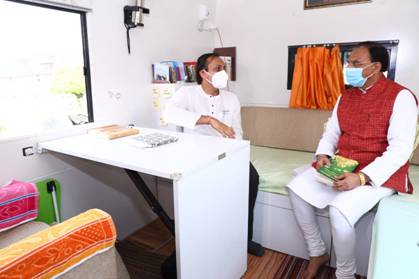
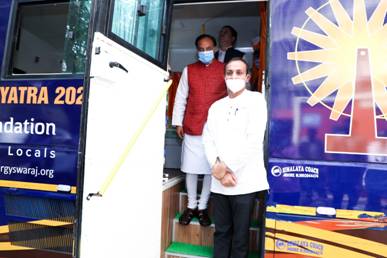
 Union Education Minister rode the Energy Swaraj Yatra Bus from his residence to his office today. The bus is fitted with solar energy and equipped to be a complete work cum residential unit. The Minister accompanied by Dr. Chetan Singh Solanki, a professor from IIT Bombay, who has conceptualised and built the Bus.


https://static.pib.gov.in/WriteReadData/userfiles/image/image0015THV.jpg

https://static.pib.gov.in/WriteReadData/userfiles/image/image002VN15.jpg

 Speaking on the occasion Shri Pokhriyal said that the New Education Policy has in-built framework under which life skills to use solar energy can be given at schools and colleges. Shri Pokhriyal said that climate change awareness is essential to attain sustainability. He further said that self reliance in Energy sector is integral in achieving the goal of Atmanirbhar Bharat. The Minister was happy to learn that in the wake of serious and catastrophic climate change, the Energy Swaraj Yatra is designed with purpose to create public movement towards adoption of 100% solar energy. The Minister appreciated Professor Solanki for this unique initiative.

Deeply committed to the mission of creating public movement towards adoption solar energy, Dr. Chetan Singh Solanki has pledged not to go home until 2030 and live & travel in the solar bus. The bus has facilities to go through all daily activities including sleeping, working, cooking, bathing, meeting, training, etc. The bus is fitted with 3.2 kW solar panels and 6 kWh of battery storage.

The Energy Swaraj Yatra began in year 2020 and will continue till 2030. Professor Solanki has been recently conferred with the Brand Ambassador of Solar Energy of Madhya Pradesh by Chief Minister, Madhya Pradesh, Shri. Shivraj Singh Chouhan.

*****

Basic charts for Data Analysis – Data Visualization in R

Data visualization helps to understand large chunks of data with pictorial representation. R is an amazing tool for data visualization. R provides a wide range of charts for data visualizing data. R is a language that is designed for computing statistical problems, graphical data analysis, and scientific research.

Basic charts for visualization we shall discuss :

  • Bar Plot
  • Histogram
  • Scatter Plot
  • Box Plot
  • Line Chart

Bar plot

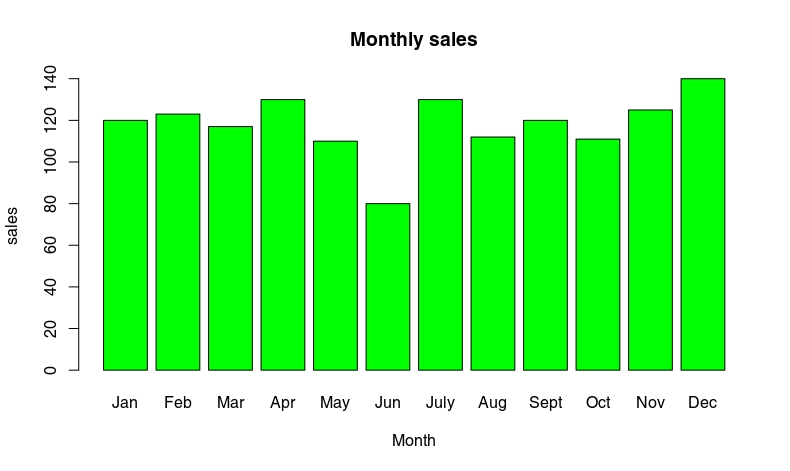
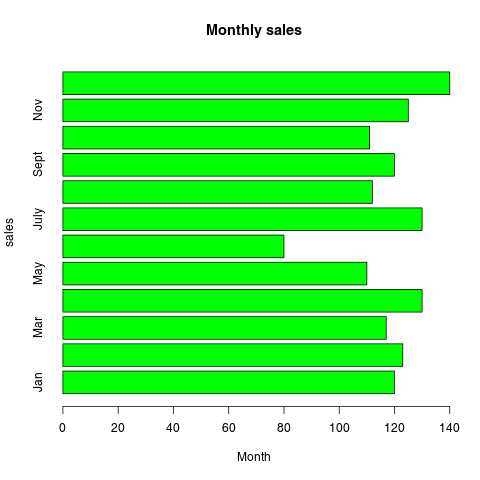
Barplot is used to visualize the relative or absolute frequencies of observed values of a variable. The frequency of the observation is the count of that observation in the data. They are used for continuous and categorical variable plotting.

#Lets suppose we have a monthly sales data
sales <- c(120,123,117,130,110,80,130,112,120,111,125,140)
barplot(sales,main = "Monthly sales",xlab = "Month",ylab="sales",
  names.arg = c("Jan","Feb","Mar","Apr","May","Jun","July",
                "Aug","Sept","Oct","Nov","Dec"),col="green")
barplot(sales,main = "Monthly sales",xlab = "Month",ylab="sales",
  names.arg = c("Jan","Feb","Mar","Apr","May","Jun","July",
                "Aug","Sept","Oct","Nov","Dec"),col="green",horiz = TRUE)

Histogram

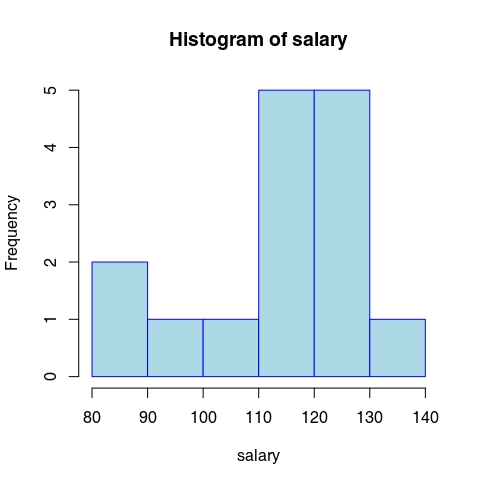
The histogram is used for data that is classified into different groups. The histogram has a similar appearance to the vertical bar chart but there are no gaps between the bars.

Generally, it is used to display the distribution of numerical variables.

salary <- c(120,123,117,130,110,98,80,130,112,120,89,111,130,125,140)
hist(salary,col="light blue",border = "blue",main ="Histogram of Salary")

Scatter Plot

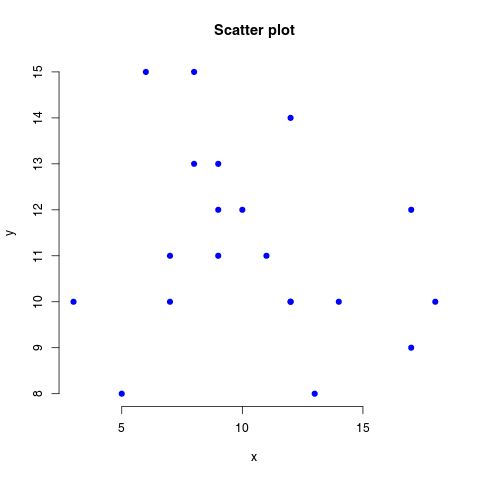
A scatter plot is used to identify relationships between two numerical variables. Each dot represents a pair of observations (x,y). They are commonly used to find correlational relationships between variables.

x = c(6,13,9,17,12,8,11,18,5,12,7,9,7,17,14,9,8,10,3,12)
y = c(15,8,11,12,10,15,11,10,8,14,11,13,10,9,10,12,13,12,10,10)
plot(x,y,main = "Scatter plot",col="blue",pch=19,frame=F)

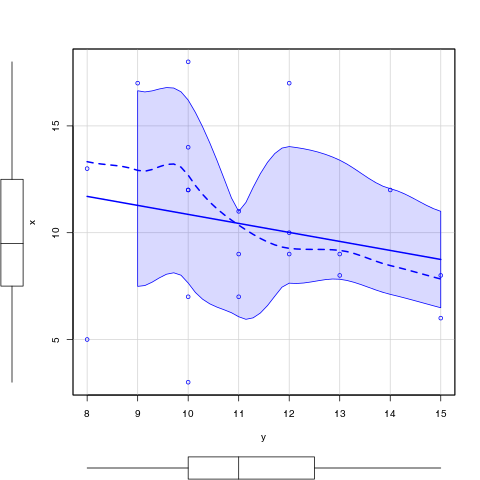
Another way of making a scatterplot using the “‘car” package:

library(car)
x = c(6,13,9,17,12,8,11,18,5,12,7,9,7,17,14,9,8,10,3,12)
y = c(15,8,11,12,10,15,11,10,8,14,11,13,10,9,10,12,13,12,10,10)
scatterplot(x~y)
The graph shows marginal box plots, a regression line (solid blue line), the smoothed conditional spread (blue region), the non-parametric regression smooth (blue dashed line)

Boxplot

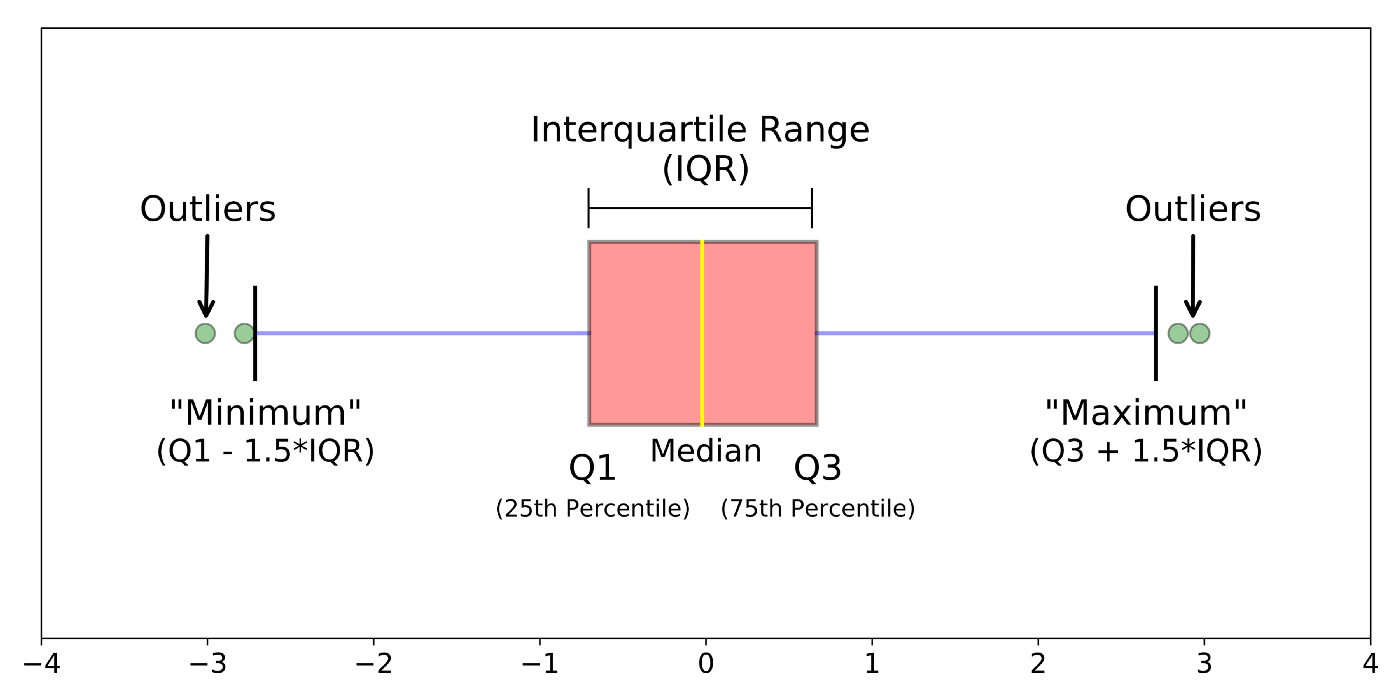
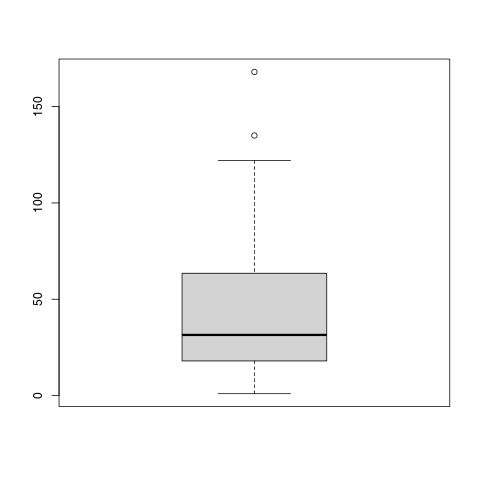
Boxplot is very useful in finding outliers in the data. Boxplot gives you a good representation of quartiles, mean, median, skewness, and spread of the data. Underlying distribution can be identified using a boxplot.

Different parts of a boxplot.
# boxplot() to create a boxplot for ozone in airquality dataframe.
# Ozone  : int  41 36 12 18 NA 28 23 19 8 NA ...
df = airquality
boxplot(df$Ozone)
Points at the extreme are outliers.
# Notch can be added by setting the notch parameter "notch = TRUE"
# Alignment can be change by setting horizantal parameter
boxplot(df$Ozone,main="Mean ozone",xlab="Parts per billion",ylab="ozone",col="yellow",
        border="brown",notch = TRUE,horizontal = TRUE)

Line Chart

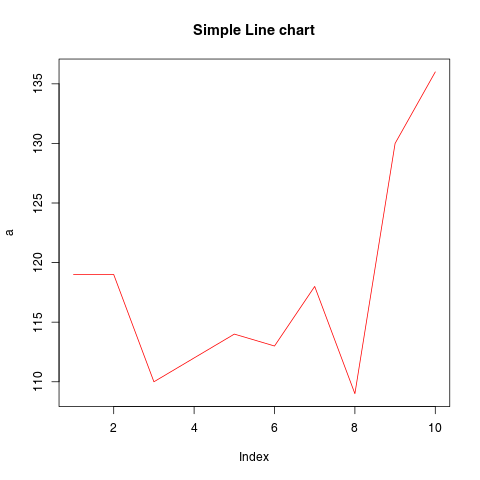
A line chart is a type of chart that represents information in a series of data points connected by a straight line segment. It is used to show a change in continuous variables over a time span. It is widely used for sales, share price analysis, weather recordings, etc.

#Simple Line chart
a = c(119,119,110,112,114,113,118,109,130,136)
plot(a,col="red",type="l",main = "Simple Line chart")
# Multiple Lines Chart
a = c(119,119,110,112,114,113,118,109,130,136)
b = c(132,126,113,115,120,111,136,121,122,116)
plot(a,col="red",type="l",main = "Multiple Line chart")
lines(b,col="blue")
legend(2,135,legend=c("a","b"),col=c("red","blue"),lty = 1,cex=0.8)

These are few of the many charts used in data analysis. R provides more than 400 different charts for data visualization.To explore more such blogs about data visualization follow us at EDUINDEX.

Ender’s Game by Orson Scott Card

Ender’s Game is a 1985 military science fiction novel by American author Orson Scott Card. The book originated as a short story of the same name, published in the August 1977 issue of Analog Science Fiction and Fact. The novel was published on January 15, 1985.

Reception of the book has been mostly positive. Ender’s Game was recognized as “best novel” by the 1985 Nebula Award and the 1986 Hugo Award in the genres of science fiction and fantasy.

Book Summary

This is a story about a boy named Ender who lives with his mother, father, and two older siblings, Peter and Valentine.  All of the children are intelligent, but Ender, unlike his siblings, seems to have the potential to be a brilliant military leader. As a result, he is taken away to be trained by Colonel Graff for the war against the buggers, an alien race looking to invade Earth.

When Ender arrives at battle school, he is put through a series of tests and introduced to various battle simulators, video game-like simulations of space battles.  He performs excellently and is assigned to one of the several armies. He is initially advised to remain out of the war games, but he discovers a superior winning strategy. Despite his success as a tactician, Ender is despised even more, but he does teach those who want to learn from him on the side.

Meanwhile, Peter and Valentine create fake personas and begin political discussions on the net.

After graduating early from battle school, Ender is trained on a dedicated battle simulator.  And when that becomes too easy, he trains with Mazer Rackham, an old war hero.

Under this new training, Ender is pushed to the limit and nearly breaks down as his battle simulations become increasingly more difficult.  

Ender finally has one last battle simulation that involves a planet and several thousand ships.  He wins the game, but then is told that all of it was real.  That he was commanding real ships in what he thought was a simulation.

Ender is proclaimed a hero, but still fears Peter, who has great political influence on Earth.  In the end, Ender finds a bugger cocoon and takes it with him as he travels in space with Valentine.

Analysis

There’s a lot to say about this story, but what draws my interest and attention is the idea of using children in intergalactic war.

Throughout the story, it is sometimes difficult to remember that most of the main characters are children.  In Ender’s society, children are often forced into maturing quickly for military endeavours.  

But why children?  Isn’t it more practical to train more physically mature people to fight? The explanation given is that the military wants individuals who are willing to react to situations without thinking about the consequences.  Children are able to act this way because they haven’t lived long enough to understand the scope and bigger consequences of their actions.  

While cruel, this type of thinking is valuable and necessary in the battle against the buggers because of how the buggers learn and adapt.

Also, a lot of the battles are battle simulations, or at least perceived as battle simulations to the children.  It’s this perception of a game that allows the children to learn, strategize, and take risks that would not be possible had they known it was happening in real time, which says a lot about how children learn and how humans learn in general. 

ADDICTION OF SOCIAL MEDIA

Social media is network based on computer that allows people to communicate, interact or associate with friends and family via an internet connection. One can chat, share videos, pictures, views and many other activities are also accessible through social media. If compared the social media sites are most visited other than any websites. At present, around three billion people globally have a social networking account. Social networking sites such as Facebook, Whatsapp, Snapchat, Instagram, Twitter, Pinterest and LinkedIn enables us to stay connected to our closed ones and also keep us updated by the day to day happenings worldwide.

Social media sites are often visited with about more than one billion users active on daily basis in order to count the number of likes on their post and update their status. As per various surveys conducted, it can be inferred that an individual spends about an hour minimum on these networking sites. The line between addiction and habit is very thin. The situation of addiction arises when an individual desires for something more than their actual need. It becomes addiction when people start to spend more and more time on social networking sites. Therefore, it is observed that in the present generation social media is becoming addicting and it is a matter to contemplate seriously. The increased dependency of an individual over a particular thing be it, food or drink or activity makes the person to feel helpless and eventually the person starts to loose control over themselves. The condition gradually turns worse leading to complex diseases related to brain.

“Social media is a wonderful medium, problem starts with its addiction.”

-Anonymous

The addiction of social media is severe that the person every now and then logs in their account meaninglessly and checks in at every place they go in order to update their status. The purpose behind to do so is sometimes just to kill or pass time. Such individuals begin to consider that posting pictures and informing about the day to day activities or chores on the social media is their moral duty. They begin to obsess over their activities on the networking sites.

The post effects of social media is not worth the while. The mental and emotional health of an individual is greatly disturbed. The often seem frustrated and an ease of escalating peer pressure is seen in them while comparing oneself with the other. They are surrounded by the sense of dissatisfaction and hopelessness. The individuals found suffering from social media addiction are desperate, stressed and fatigued. There is a constant rise in their level of anxiety and consequent fall in productivity. The frequent pop up notifications prevent them from focusing on essentials things in their lives.

Thus, it can be concluded that it is important to recognize the addiction of social media at an early stage prior the situation becomes worse. People must remember that it is not their social duty to be in social media throughout the day rather they must give themselves time to self- reflect and divert their attention to more essential things in life.

” One day you will look back and recall all the time you spent on social media and wonder why you didn’t invest that time someplace else.”

– Germany Kent

National Girl Child Day Celebrated Across the Country to Promote Awareness about the Rights of Girl Child

 The Ministry of Women and Child Development celebrated the National Girl Child Day on 24th January, 2022. In view of COVID-19 situation in the country, the programmes were organised on virtual/online mode across the nation to promote awareness about the rights of the Girl Child and to celebrate their achievements in various fields.

Online Interactive Programmes     

As part of Azadi Ka Amrit Mahotsav, a virtual function was organised to recognise the exemplary achievements of children by conferring Pradhan Mantri Rashtriya Bal Puraskar (PMRBP) Awards-2022. Prime Minister Shri Narendra Modi interacted virtually with the winners of PMRBP-2022.  The children along with their parents and concerned District Magistrate of their respective district joined the event from their district Head Quarters.

A series of online live interactive programmes were also organised by various Ministries in which the Ministers interacted with young girls and motivated them to have belief in their ideas and to follow their heart.

(i)The Ministry of Women and Child Development together with UNICEF celebrated ‘Kanya Mahotsav,’ a festival of the girl child. Union Women and Child Development Minister, Smt Smriti Zubin Irani, engaged in an interactive online conversation with nine adolescent children from different States. The interaction and the digital campaign emphasized, ‘Har Ladki Khaas Hai’, i.e. ‘every girl is special’.

Delivering the keynote address, Minister Smt Irani welcomed the participation by the adolescent girls and boys who shared their stories of courage, determination and hope. Acknowledging UNICEF’s support in bringing forth these voices of children from across India and suggestions from the children, the Minister  requested for focus on mental health challenges faced by children and support the Samvaad programme with Ministry of WCD; to bring together a coalition of young girls who contribute to ending child marriage in their communities and incorporate the recommendations for services for children in alternative care and family based care situations through Mission Vatsalya.

The Regional Director, UNICEF South Asia, George Laryea Adjei appreciated India’s steadfast commitment and significant progress in preventing child marriage, promoting adolescent empowerment, and ending violence against women and girls. He emphasized UNICEF’s commitment to this agenda and working with the Government of India.

(ii)Union Minister, Ministry of Textile, Commerce and Industries, Consumer Affairs and Food & Public Distribution, Shri Piyush Goyal held a virtual interactive session with young girls who have made noteworthy innovations in different areas.

(iii)Union Minister of State, Ministry of Science and Technology, Dr Jitendra Singh also interacted on a virtual platform with young women entrepreneurs who have made noteworthy achievements in the field of science, technology and innovation.


Webinars

Following webinars were organised by the WCD Ministry on the National Girl Child Day:

(i)National Commission of Women (NCW) organised a virtual discussion on the topic “Save the Girl Child” through which their speakers contributed to raise awareness about the rights of girls and on the importance of girl education. Shri Om Prakash Dhankhar Ex Cabinet Minister, Haryana discussed on the “Ideologies, Mindset and Role of the society towards saving the girl child” and Ms Pragya Vats, Head of campaigns- Save the Children, Bal Raksha Bharat enlightened the attendees on “Awareness about the rights of girls and the importance of girl education and  various policies and its outcomes”.

(ii)The Ministry of Women and Child Development and the National Institute of Public Cooperation and Child Development (NIPCCD) organized a National Webinar on “Addressing Comprehensive Needs of Adolescent Girls in India #ladkiyanjahankhusiyanwahan” on 24th  January, 2022, the National Girl Child Day. The objectives of the Webinar were to: celebrate the National Girl Child Day; provide an understanding on the nutritional needs of adolescent girls; identify the challenges faced by adolescent girls with reference to education; and understanding the importance of psycho-social development among the adolescent girls. A total of 3000 participants from across the country participated in the Webinar. The participants included: adolescent girls from child care institutions, students from colleges, Government Officials, Counsellors, functionaries of Anganwadi Services Scheme and Child Protection Scheme, principals, teachers, PhD scholars, officials from civil society organisations, social workers, administrators, etc.

(iii)National Commission for Protection of Child Rights (NCPCR) organised a webinar on the topic, ‘Legislative Rights of a Girl Child’ which was live streamed on NCPCR’s Facebook and Twitter. Justice Shri Kalpesh Satyendra Jhaveri, former Chief Justice of Orissa High Court was the main speaker for the webinar.


Programs organized by different Ministries

(i)M/o Education, M/o Skill Development, M/o Youth Affairs & Sports, Ministry of Science & Technology organised informative webinars on various issues to highlight the achievements of their Ministries in empowering girl child in the field such as education, health, hygiene, marriage, empowerment, gender equality etc. on the occasion of the National Girl Child Day.


(ii)The Department of school Education & Literacy, Ministry of Education celebrated the achievements of girls on National Girl Child Day under 75th Azadi Ka Mahotsav. The theme of the programme was ‘Hamari Beti Hamari Shaan’. 75 Girl achievers in different fields of academics, sports, Kala Utsav,  Rashtiya Avishkar Abhiyan, environment and culture were  selected across India to participate in the programme.


In this programme, panellists namely, (i) Ms. Anita Karwal, Union Secretary, Ministry of Education, (ii) Ms. Tessy Thomas, Scientist, (iii) Ira Singhal, IAS, (iv) Ms. Ankita Sharma, IPS (v) Ms. Kanta Singh , Deputy Representative, UN Women India and (vi) Ms. Bhavna Kanth, First Fighter Pilot were invited to interact with the achievers and share their life experiences  and success stories with the girls. The profile of the panellists were shown highlighting their work and achievements in the programme and a show reel was also shown during the programme depicting the success stories and the achievements of all the 75 participants.


(iii) Ministry of Culture organized Rangoli Utsav ‘Umang’ to celebrate National Girl Child Day under Azadi ka Amrit Mahotsav. A nationwide event was organized where the participants drew rangoli decorations on the roads and squares named after the female freedom fighters or the female role models of the country. The rangoli decorations were made at more than 70 locations in 19 States.


Celebration under BBBP scheme in districts

All the 405 multi-sectoral districts under BBBP organised programmes such as:

(i)Gram Sabha/Mahila Sabha on CSR

(ii)Programme with schools (Gov/Privates) on value of girl child

(iii)Posters/Slogan-writing/Drawing/ Painting competition among school on STEM related topics

(iv)Stories in local media about BBBP local champions etc.

Some of the events organised by the districts are as follows:

(i)Felicitation of talented girls by Dr. Virendra Kumar, Hon’ble Minister of State, Ministry of Minority Affairs in the Tikamgarh district of Madhya Pradesh.

(ii)Webinar session on menstrual hygiene in Saraikela, Jharkhand.

(iii)Felicitation of block level toppers of 10th and 12 and district toppers of 10th and 12th by District Collector Saraikela, Jharkhand.

(iv)Drawing competition among the Child club members of Ramachandi child club, Kendrapara District, Odisha.

(v)Additional District Magistrate and the team of ICDS Nalanda, Bihar celebrated the National Girl Child Day by blowing the balloon and discussing on to improve the level of health, nutrition and education of the girl child.

(vi)In North Sikkim, National Girl Child Day was celebrated at Mangshila Gram Prashashan Kendra. Shri Pintso Namgyal Lepcha MLA, Panchayats, Zilla Member and Adolescent Girls participated in the programme. Programme started with awareness on the scheme of Girls like Suknya Samridhi Yojana, Child rights, POCSO etc. by DPO/Mangan./North Sikkim.

(vii)Paintings were drawn by the students of GSSS JASSIA Rohtak, Haryana to mark the occasion of National Girl Child Day.

Some Important Tweets on National Girl Child Day

********

Enhance voting and credibility of election process

 Vice President of India Shri M. Venkaiah Naidu today urged the Election Commission and the citizens to ensure a voter turnout of 75% in the next general elections to make electoral democracy more inclusive and also sought consensus on simultaneous polls to sustain the tempo of development.

In a message on the occasion of the 12th National Voters Day today, Shri Naidu stressed that no voter should be left behind and urged the citizens to judge the contestants in the elections on merit. As Shri Naidu is in home isolation in Hyderabad after testing corona positive, his address was  read out at the  event in New Delhi.

Referring to the increase  in  voter turnout from 44.87% in the first general elections to Lok Sabha during 1951-52 to the highest ever 67.40% for the 17th Lok Sabha in 2019, marking an increase of 50% in  voting, Shri Naidu complimented all stakeholders for the same. Alluding to the sustained efforts of the Election  Commission of India in this regard striving for excellence during the 70 years of the country’s electoral journey, Shri Naidu hailed the Commission as a  credible, responsive and forward looking institution every  votary of democracy can legitimately be proud of.

Shri Naidu noted that the challenge before the Election Commission is to ensure a steady increase in voting in every election to make our electoral democracy more inclusive by addressing the barriers to voter participation.

The Vice President urged: “In the 75th year of our Independence, let us resolve to leave no voter behind and aim to increase the voter turnout to at least 75% in the next general elections. Let each one realize that vote is not only a right but a responsibility. We, as a nation, must think and arrive at a consensus to have simultaneous polls to all the three tiers of federal set up and move towards better governance by focusing our attention on all round development of our people”.

Shri  Naidu referred to the substantial 8% increase in voter turnout from 58.21% in 2009 general elections to 66.44% in 2014, suggesting that it is feasible to reach 75%  voter turnout target from 67.40% in 2019. He complimented the SVEEP(Systematic Voter Education and Electoral Participation) initiative of the Election Commission launched in 2009 for improving voter participation.

Shri Naidu expressed delight over women voting more than men in the 2019 general elections by a margin of 0.17%, for the first time in 70 years, ending the gender gap in the country. (In 1962  general elections, men voter turnout was 16.71% more than that of  women)

Shri Naidu stressed on the need for more swift resolution of election disputes and creation of a more informed citizenry empowered to judge the merits of each  candidate in the elections. He urged the Commission to further explore innovative ways in which technology can enhance the credibility and accessibility of the voting process. He also referred to high voter turnout in the range of 74% to 84% in the elections to five State Assembly held under covid protocol last year.

The 12th National Voters Day is being organized on the theme “Making our Elections Inclusive, Accessible and Participative”. January 25th is being so celebrated as the Election Commission was set up on January 25, 1950, a day before the country became a Republic with the Constitution coming into force from January 26, 1950.

Following is the full text of the Vice President’s message (It was read at 12th National Voters’ Day celebrations organized by Election Commission of India today) –

Chief Election Commissioner Shri Sushil Chandra, Election Commissioners, senior officials from the Union and State Governments, distinguished invitees and friends from the media !

At the outset, I extend my hearty felicitations and  greetings to all of you and all fellow citizens on the occasion of 73rd Republic Day tomorrow. We are meeting at the confluence of 70 years of elections in our country, the 73rd Republic Day and the 75th year of our hard fought Independence.

Looking back at the past seven decades, we can legitimately be proud of our achievements in various fields. However, what is most remarkable is our continuous endeavour to strengthen our democratic structures to transform India, the world’s largest democracy, into a vibrant, inclusive, participative and progressive democracy where each citizen has a voice that is heard and each citizen contributes to the governance and development of the nation.

We not only took the bold step of introducing universal suffrage right from the time we became independent but established a credible institutional framework to conduct elections to ensure that the voting right of every citizen is protected.

I compliment the Chief Election Commissioner, the Election Commissioners, the staff of the Election Commission and the Chief Electoral Officers in the states as well as every functionary engaged in conducting elections right up to the polling station level for continuously enriching our democracy. You are, indeed, the proud inheritors of an illustrious legacy that your predecessors have  left behind.

We have come a long way from the first General Elections of 1952 when only 44.87%  of the eligible voters turned out to vote. In the last general elections in 2019,  67.40% or more than two-third of the eligible voters exercised their franchise. It is heartening to note that today, we are among the highest voting nations in the world with a substantial  increase of 50%  in voter turnout in 70 years.

All this calls for a celebration of the remarkable foresight of our constitution makers, the indefatigable efforts of countless dedicated officials, the media, civil society partners and the active involvement of people and the political parties as well as their implicit faith in the Election Commission.

This is what we are doing today as we look back at the 70 years of our country’s electoral history and the ceaseless quest for excellence that has made the Election Commission of India a credible, responsive and forward-looking institution every votary of democracy can legitimately be proud of.

The theme of today’s 12th National Voters Day is ‘Making our Elections Inclusive, Accessible and Participative’.

The challenge before the Election Commission and the country is to ensure a steady increase in the voter turnout in every election to make our electoral democracy more inclusive by addressing the barriers to voting. This year’s theme of inclusive,  accessible and participative elections is, hence, very apt.

I am pleased to note the consistent efforts of the Election  Commission of India to improve voter turnout and also enhance the integrity of the election process.

Thanks to initiatives like Systematic Voter Education and Electoral Participation (SVEEP), voter turnout has increased by  8% from 58.21% in 2009 to 66.44%  in 2014. I am delighted that in the last general elections in 2019 and for the first time, women voter turn was more than that of men by a margin of 0.17%. Elections to five State Assemblies last year held under Covid protocol formulated by the Commission has witnessed huge voter turnout in the range of 74% to 84%.

Voter registration process is now considerably simpler with the  Election Laws Amendment Act, 2021 enabling voters to  register  four times in a  year. The Election Commission has ensured access to voters in remote areas like the Spiti valley located at 15,256 feet above sea level and has been making sustained efforts to curb electoral malpractices. However, there is much more to be done including a swifter  resolution of election disputes and creation of a more informed citizenry empowered to judge the merits of each candidate. The Commission can further explore innovative ways in which technology can enhance the credibility and accessibility  of the voting process.

In the 75th year of our Independence, let us resolve to leave no voter behind and aim to increase the  voter turnout to at least  75% in the next general elections.  Let each one realise that vote is not only a right but a responsibility. We, as a nation, must think and arrive at a consensus to have simultaneous elections to all the three tiers of federal set up and move towards better governance by focusing our attention on all round development of our people.

I compliment the awardees being recognized today for their commendable performance in the last elections.

I extend my greetings to the Election Commission and all the officials, to the enlightened leaders of political parties, to the media, civil society partners and most importantly, every citizen of our country who are making democracy work and are continuously contributing to a robust, well-functioning democracy.

*****


3 Midwest Cities to Think About the Next Time You Move

The midwest is one of the most well-known areas of the country, with an extremely
recognizable culture of neighborly behavior and dairy-laden dishes: but there’s nothing
here quite as amazing as the cities and homes.

This is why the Midwest is an area you’ll fall in love with the moment you arrive: and
these are the top three cities you’ll want to consider moving to! 

 Why the Midwest? 

 The midwest is fortunate enough to have mild summers, but the winters can be wild and
turn this entire portion of the country into a winter wonderland. If you’re new to the area,
you’ll be stunned by how fun and inventive the food is, and if you’ve been here before,
you’ll be looking forward to getting a taste of a Culver’s burger while you wash it down
with a cool Vernor’s ginger ale.

The following cities are the best part of the Midwest and are why everyone should
consider moving out here to get a fresh start! Nowhere feels like home quite like this
portion of the country! 

 Brainerd, Minnesota 

 Possibly best known for being the location where the movie Fargo is based, Brainerd is
a great area that’s the county seat of Crow Wing County and is one of northern
Minnesota’s largest cities.

From the chilly winters to the incredibly cool and calm summers, this area is lucky
enough to be surrounded by plenty of rivers, lakes, and forests for recreation. Best of
all, this city is incredibly affordable to live in and has a very low unemployment rate. As
a result, this is an amazing place to settle down! 

 Milwaukee, Wisconsin 

 On Lake, Michigan’s western shore is the gorgeous city of Milwaukee. Best known for
its sports teams, this metro area boasts a population of over 1.5 million people. You can
enjoy entertainment by visiting the Harley-Davidson Museum or even check out the
large-scale European Village you can walk through in the Milwaukee Public Museum.


 Buying property here isn’t cheap, with Milwaukee houses for sale at a higher price than
any other city on this list: but it’s worth it to live here. 

 Des Moines, Iowa 

 Des Moines is a mid-sized city with a metro population of over 700,000 people living
there. Countless museums, art galleries, and exhibits ensure that this city captures your
mind and imagination. 
 Housing here is some of the most affordable in the country, making the harsher winters
so enjoyable. The summers here can get hot, peaking in the low 90s, but the average
home and apartment have an HVAC system that can handle it. This is an amazing
place to move to for anyone ready to settle down.
The 

Midwest is a Fantastic Place to Call Home 

 Whether you’re from a southern state or moving from California, you’ll find that paradise
lives in the midwest. This portion of the country has a lock on heaven from fantastic
food and people to endless things to do and see: don’t be afraid to move here and find
yours happily ever after!

demand for Grants for Education

 Union Education Minister Shri Ramesh Pokhriyal‘Nishank’ replied to the discussion on the demand for Grants of Ministry of Education for Year 2021-22, in LokSabha on 16th March, 2021.

Speaking on National Education Policy 2020, Union Minister said NEP will build strong foundations for an Atmanirbhar Bharat and help India claim its status as a Vishwaguru.ShriPokhriyal emphasized that NEP was formulated after holding broadbase and wider consultations with every stakeholders including teachers, students, academicians, parents and students among others.

The Minister said that NEP is national, international, impactful, interactive, innovative and inclusive and is based on firm foundations of equity, quality and accessibility. He spoke about features of NEP 2020 which includes imparting vocational education from class 6 onwards, Progress Card in place of report card, 5+3+3+4 structure, multidisciplinary education with easy entry/exit options and academic bank of credit.ShriPokhriyal also added that several countries have acknowledged NEP as the biggest reform of the world.

Speaking on the Budget allocation for Education for year 2021-22, ShriPokhriyal said that for Department of School Education and literacy, total budget allocation in BE 2021-22 is Rs 54873.66 crore, which is an increase of Rs 2,684.59 crore as compared to RE Budget allocation in 2020-21. For Department of Higher Education, the total Budget allocation in BE 2021-22 is Rs. 38350.65crore, which is an increase of Rs. 5450.65 crore as compared to RE Budget allocation for the year 2020-21. Speaking about Government’s impetus to boosting research and innovation, Minister mentioned about National Research Foundation. He also said that there is a shift from package culture to patent culture among students now. 

Enumerating initiative and efforts taken by the government to ensure continuity of education during challenging times of covid, ShriPokhriyal said education was provided via Online and Digital mediums throughSwayam, SwayamPrabha, E Pathshala, DIKSHA. He also mentioned that Manodarpan Portal was launched to provide 24*7 counselling services to the students.Board Exams and competitive exams (JEE and NEET) were conducted successfully, he added.

Minister also highlighted that in year 2019-20, 8.19 lakh students were being provided education through IGNOU, while the figure was 3.98 lakh students in year 2013-14. Number of Research Scholars in Higher Education in the year 2019-20 stood at 2.02 lakhs while it was 1.07 lakh in year 2013-14, he added.   

Bhavika

 https://track2training.net/2022/01/17/best-app-for-online-education-zoom/

https://track2training.net/2022/01/17/%e2%9a%ab-topic-top-4-loud-music-player-for-android/

https://track2training.net/2022/01/17/%e2%9a%abrise-of-covid-19-cases-day-by-day/

https://track2training.net/2022/01/18/%e2%ad%95teachers-day%e2%ad%95/

https://track2training.net/2022/01/18/what-is-journalism-and-mass-communication/

https://track2training.net/2022/01/18/apj-abdul-kalam-the-missile-man-of-india/

https://track2training.net/2022/01/18/pandit-jawahar-lal-nehru-the-first-prime-minister-of-india/

https://track2training.net/2022/01/18/indira-gandhi-first-woman-prime-minister-of-india/

https://track2training.net/2022/01/18/personality-development/

https://track2training.net/2022/01/18/%e2%ad%95interpersonal-communication-%e2%ad%95/

https://track2training.net/2022/01/18/beti-bachao-beti-padhao/

https://track2training.net/2022/01/19/%e2%ad%95clean-india-%e2%ad%95/

https://track2training.net/2022/01/19/%e2%9a%abrepublic-day%e2%9a%ab/

https://track2training.net/2022/01/19/%f0%9f%94%98sports-can-boost-learning-effectiveness-%f0%9f%94%98/

https://track2training.net/2022/01/19/doing-your-best-is-better-than-being-the-best/

https://track2training.net/2022/01/19/health-is-wealth/

https://track2training.net/2022/01/20/entrepreneurship/

https://track2training.net/2022/01/20/what-is-controllingimportance-of-controlling-in-management/

https://track2training.net/2022/01/20/what-is-the-role-of-youth-in-present-india/

https://track2training.net/2022/01/20/why-is-self-care-important/

https://track2training.net/2022/01/20/unemployment/

https://track2training.net/2022/01/20/career-planning/

https://track2training.net/2022/01/20/%f0%9f%94%98depression-%f0%9f%94%98/

https://track2training.net/2022/01/20/drug-addiction/

https://track2training.net/2022/01/21/woman-enpowerment/

https://track2training.net/2022/01/21/child-marriage/

https://track2training.net/2022/01/21/women-molestation-and-sexual-assault/

https://track2training.net/2022/01/21/tryst-with-destiny/

https://track2training.net/2022/01/21/family%e2%9d%a4/

https://track2training.net/2022/01/21/women-should-also-be-financially-independent/