Child Marriage: A Legal View

In the culture of Indian society, the practice of child marriage still subsists. Child marriage refers to a marriage duly performed by minors mainly between a female below the age of 18 years and a male below 21 years. Child marriage is customarily in rural regions where there is increased rate of poverty and illiteracy. Social customs and rites, ignorance, benight and consideration of women as a burden financially, are few factors that causes solemnization of child marriage. Such marriages have their unintended consequences like problems related to health due to pregnancy at early age, deliberately cruel gender inequality cycle and further worsening of women status also happen.

Considering all these factors, the British government in 1929 enacted the Child Marriage Restraint Act. This was the first secular law towards restraining the child marriage peril. The Act only held punishments to those adult males who married minors and the parents who encouraged such marriages but the marriage was not made void. As the punishment and fine was considerably less, the Act was hence amended now and then to increase the limit of age.

Due to the inadequacy of the Child Marriage Restraint Act 1929, a new legislation was enacted namely, Prohibition of Child Marriage Act, 2006. This new Act anticipate in averting child marriage along with intensified punishments such as fine of Rs. 1 lakh or imprisonment for two years. Provisions for the maintenance of the girl child were also implied. In case if the husband is major, he is liable to pay for the maintenance and if the husband is minor, then his family is liable to pay for the same.

The marriage would be void if the child is used for trafficking or any sort of purpose that is immoral. Under the prohibition of Child Marriage Act 2006, the age of a female is 18 years and for male is 21 years. A girl can obtain a degree of nullity within two years before attaining the age of 18 years if entered into a child marriage under the Hindu Marriage Act 1956. The parties though not did consent to the union in child marriage yet they are punishable As for now there is no such provisions for punishing the people or the parents involved in the solemnization of marriage. A girl can declare a marriage invalid if she’s married off before attaining an age of 15 and can challenge it until she is 18. However till now there is no such provision which states child marriage invalid. In India, Muslim law is not codified, thus the scholars interpret provisions of the Quran. Child marriage is not barred under the Muslim law. A guardian has authority to get a child married. Although, there is an option of puberty available to the couple where they can refuse to accept the marriage after attaining puberty following the condition that they should do it before attaining the age of 18 then only the marriage can be said rejected. According to the Muslim law, the age of puberty is 15 years. Nevertheless, the marriage prior the age of 7 is void ab initio. Under the Indian Christian Marriage Act, if a marriage is to be contracted between the minors, a notice preliminary is set to be issued 14 days before marriage. Post the expiration of the 14 days, the parties have the right to go on with the solemnization of marriage without consent of the guardian or parents. Under the Parsi marriage and divorce Act, a child marriage is considered invalid. In India, Jewish law is uncodified. According to the Jewish law, the age of puberty is the marriageable age which is fixed at 12 years.

Child marriage is jeopardy and it cannot be restrained without the support of the society. Under the prohibition of child Marriage Act, several demands have been made to make the child marriage void ab initio but the society is complex as well as complicated and making child marriage void will only prove to be hazardous for the rights of women who are victims of child marriage.

HEARING VS LISTENING

When you’re in conversation with someone, it’s common for your mind to drift to other thoughts. For example, maybe you have a lot on your plate, and you’re thinking of what all you need to get done. Maybe you just argued with your partner, and you’re still upset about it. Or, maybe you’re exhausted, and you start fantasizing about how cozy your bed will be when you turn in for the night.

When your mind begins to wander, you’re likely still hearing the other person, but you’re not truly listening to what they have to say. However, this can negatively impact your conversations and relationships with people, if they feel that you’re rarely listening to them.

With inputs from a psychologist, this article breaks down the differences between hearing and listening and describes how they impact mental health. It also provides some tips to help you become a better listener and improve your relationships.

HEARING:

  • Passive
  • Involuntary
  • Requires no effort
  • Physiological perception of sound

Hearing is a passive, involuntary, and sensory process in which we perceive sounds. It is a physiological response that involves our perception of sound. It does not require focused attention.

For example, if you’re watching television, you can still hear the sound of traffic or sirens outside, your neighbour’s dog barking, and people laughing in the hallway.

LISTENING:

Listening is an active, voluntary, and intentional process that involves making sense of the words and sounds you hear; it requires your attention. In turn, you may develop an emotional response to what you hear. Listening with the intent to understand is referred to as active listening.

For example, if you’re listening to someone talk about a difficult day they had at work, you will probably have your full attention focused on them. As they speak, you will start to understand what their experience was like and the impact it had on them. This will help you make thoughtful comments and ask relevant questions to further understand their experience.

  • Active
  • Voluntary
  • Requires effort
  • Intentional interpretation of sound

THE ROLE OF HEARING AND LISTENING IN MENTAL HEALTH:

Both hearing and listening play an important role in our lives. Hearing is a form of sensory input whereas listening is a way to form connections with other people, according to Workman. She explains the role these functions play in our mental health.

IMPORTANCE OF HEARING IN MENTAL HEALTH: 

Hearing is an important sense that helps us navigate the world. The loss of hearing can have a profound effect on mental health as it could lead to anger, social withdrawal, changes in our sense of self-worth, and depression.

It is important to keep in mind that using sign language and paying attention to body language are ways you can listen without the sense of hearing. You can seek mental health care if you are experiencing depression or adjustment difficulties due to the loss of hearing. 

IMPORTANCE OF LISTENING IN MENTAL HEALTH: 

We are social beings and have a universal need for connection and belonging. Listening is what enables us to develop increased curiosity about other people’s experiences, increased compassion and empathy, and increased connection.

If you are not listening to others or being listened to, it can negatively affect your sense of connection and belonging. You can probably think of a time when you were not being listened to, the experience may have caused you to feel devalued, uncared for, and lonely, all of which can contribute to feelings of shame, anxiety, and depression.

TIPS TO BECOME A BETTER LISTENER:

It is in fact possible to become a better listener. Workman suggests some tips that can help you improve your listening skills:

  • Set an intention to improve: Setting a clear goal to work on your listening skills can help you think more concretely about how, when, and who you can practice with.
  • Practice mindfulness: Mindfulness helps you be more present. You can practice it simply by noticing what has your attention in the moment; is it the person speaking to you or something else? If your attention is on something else, you can gently redirect your focus back to the person by noticing the changes in their voice, the words they use, and their nonverbal expressions.
  • Be curious: Adopting a curious mindset allows you to truly listen and understand. In doing so, you might notice that you automatically become even more curious and interested in what the person is saying.
  • Let go of judgments and assumptions: When you judge and assume things, you essentially close the door to new information which means you are less likely to pay attention and listen. Letting go of judgments and assumptions will also help you become more curious.
  • Summarize what you are hearing: Repeating in your own words what you heard the other person say can communicate that you’re engaged and gives the other person an opportunity to clarify any misunderstandings.
  • Ask questions: Asking relevant, open minded questions shows that you are listening and responding in a thoughtful way. If you’re not sure what to ask, you can try to think of who, what, when, where, or how questions.
  • Use nonverbal gestures: Using non verbal cues, such as making eye contact and occasionally nodding your head, can communicate that you are listening and paying attention.
  • Try to validate: While giving someone your undivided attention can be validating in and of itself, being able to acknowledge how someone’s thoughts and feelings are understandable given their history or current circumstances can be quite meaningful.
  • Give advice only if required: Don’t try to solve the problem or give advice unless that is what the person is asking for. We often want to help others which is why we’re quick to offer solutions. However, this can be quite invalidating to people because a lot of the time they just want to be understood and listened to.
  • Put away distractions: This can be difficult since we are constantly surrounded by distractions. However, little gestures such as putting your phone face down so you can’t see messages or notifications come through or turning away from your computer screen can help you be more focused and attentive.
  • Practice compassionate listening exercises: You and a partner can each take three to five minutes to share a personal story. There should be a 15- to 30-second pause before the other person starts sharing. After both people have shared their stories, you can take a few minutes to discuss what it was like to listen and be listened to in this way.

CONCLUSION:

While we often equate hearing with listening, the former is typically a passive activity whereas the latter is more active. There are in fact steps you can take to become a better listener. Making the effort to actively listen to the people around you can help you connect with them and improve your relationships with them.

Solar Energy: Advantages and Challenges

What is Solar Energy?

Sunlight is a renewable source of energy which can be converted into usable energy by solar panels. There are two main types of solar energy. Solar photovoltaic (PV) panels which directly convert solar energy into a usable form of energy using a PV cell containing a semiconductor material. CSP (concentrating solar power) on the other hand, concentrates energy from sunlight to a heat receiver which transforms energy from heat into mechanical energy, and in turn, solar thermal electricity.

Photo by Pixabay on Pexels.com

Advantages of Solar Energy

  • Because solar energy does not emit greenhouse gases, there will be no negative environmental impact. It is a pollution-free and non-polluting source of energy.
  • Solar energy is a renewable source of energy. As a result, there will be no trouble using it all up without leaving any for future generations.
  • Expanding the solar energy business will result in a large number of green jobs.
  • Solar energy will benefit the economy in the long run because there will be no need to import fossil fuels like coal for energy.
  • There is no need to buy any resources because sunlight is free.
  • Solar energy requires money to install, but the energy generated is the cheapest electricity. So, many more people can have access to affordable electricity.
  • Even in disaster-hit places, off-grid solar systems provide power. Off-grid means buildings designed to be self-sufficient without depending on public electricity and water lines.
  • The production of electricity from fossil fuels requires a large amount of water. Solar energy production does not require the use of water. As a result, it saves water. Therefore, this makes solar energy more reliable. Even if there is a drought, power generation will not be affected.

Challenges in using solar energy 

  • Solar power generation on a huge scale requires a large area of land.
  • Solar cells currently only use a small portion of sunlight. Increasing the efficiency of solar cells is a big challenge. Moreover, as efficiency improves, the amount of land required decreases.
  • Solar energy production facilities need a huge investment to set up.
  • Not every part of the earth gets enough sunlight to totally rely on it.
  • Storage is required to ensure power supply during the night when there is no sunlight.
  • The clean energy industry is facing a skilled labour shortage. Another challenge is to train a large number of people in the required skill set to keep up with the increasing solar industry.
  • Toxic chemicals such as sulfuric acid and hydrochloric acid are used in the production of solar cells. Developing efficient solar cells using less toxic chemicals is a big challenge.

Conclusion

The use of solar energy will result in energy transformation from fossil fuels to clean and sustainable energy. It also helps in the fight against global warming. Government should provide subsidies and widespread awareness to encourage roof-top solar grids and solar farms, so that everyone will have access to affordable and clean energy.

Feminism and Women Empowerment

Feminism in general terms can be defined as equality among all genders holding equal rights and opportunities. The word feminism is evident whole around the globe and is concerned with activities mainly indulging women’s rights and interests. It is an approach against inequality  between men and women in this huge man domain world, it can be in form of social, economic, political movement aiming to establish social, economic, political and even personal equality among all. It ensures and encourages women to put forward their ideas, beliefs, utilize their knowledge and strengths and empower them to perceive their true rights. Feminist movements have organized course of action and are still continuing to do so for women’s rights including right to vote, receive education, equal wages, equal sibling property ownership and to safeguard women and girls from any sort of sexual harassment be it rape or domestic violence. These movements also make certain legal abortion and other social reforms for women.

Historically, women faced discrimination on the basis of their gender, they had to fight against the orthodox society with the result being constant failure. Now things have bit changed and such a result is feminism, an initiative to fight against gender stereotypes and bringing about a change in this unhealthy dynamics of society.

Feminism means congeries things to congeries of people, it is not expected to define a particular’s feminism in any way. Its all about cutting the difference between men and women and leveling them on the same scale. Thus, making similar opportunities available to both men and women in life.

Women Empowerment refers to steps taken in order to empower women. The following concept may be understood in a number of ways like, taking into consideration the opinions or views of women, encouraging women to pursue higher education and uphold a high rank in society and also to uplift the position of women through literacy, training etc. It also provides them to take their own life decisions, tackle various problems in society. Women empowerment can also be defined as to encouraging women to realize their self worth, their capacity to discover their own way out and most important their right to bring about effective social change for themselves and society.

In true sense, empowerment of women contributes greatly in the development of society. The advancement of status of women also intensifies their decision making ability at all scales in all volume of life, particularly in the field of reproduction and sexuality. This without doubt is necessary for the long term accomplishment of the population programmes. Women empowerment and ensuring women’s rights have now become a worldwide movement.

In this contemporary age, feminism and women empowerment is the talk of the town. Numerous developments have been seen till date in awake of both the elements. It is right to say that women empowerment is contributing greatly in the advancement of the society and will continue to do so. Gender discrimination has nearly diminished in the last few decades. But today also in some parts of the country such distinction still subsists. Thus, to tackle such situations it’s important for females to understand the true meaning of feminism and it is the essential right of the women to be empowered so as to hold an independent role in the society. But apart from these various developments, women and girls still face discrimination on some or the other ground and are victims to numerous harassments each day in every part of the world.

The Era of Digital Marketing

Almost 60 percent of the world population has access to the internet, which accounts for 4.66 billion active internet users in the year 2021. With the help of internet we can pay our bills, shop online, book tickets, even get an academic degree and much more. The possibilities are endless.

Other than that people also use internet as a medium of recreation such as for watching videos, playing games and most importantly spending their time on social media. In today’s time, an average internet user spends 7 hours of their day scrolling social media, answering emails, browsing websites for information, content, so on and so forth. Gone are the days when people had to physically travel to get their work done or just for entertainment. Now, everything is a click away, be it an important payment, or learning a skill, or playing any games.

The internet revolution also gave rise to a lot of industries and one such industry is of digital marketing. The rise in people buying smartphones and computers has essentially increased the numbers of people on the internet, and hence the era of digital marketing is growing at a phenomenal pace.

What is digital marketing?

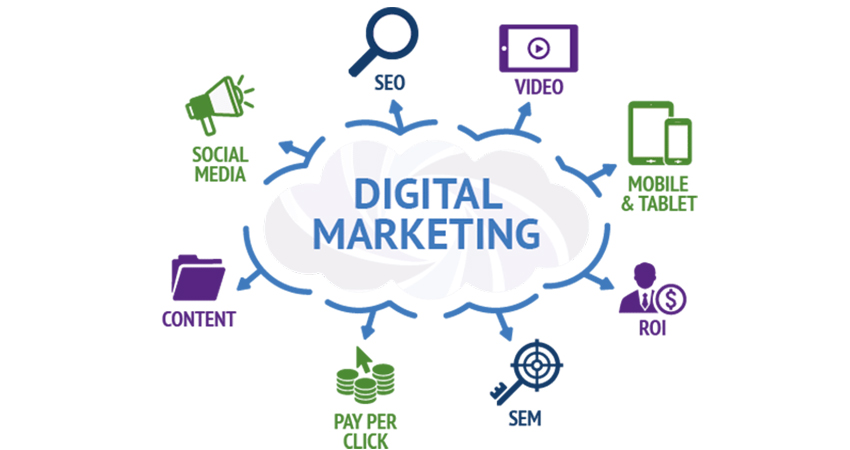
Digital marketing refers to a branch of marketing at caters to use the internet and other online technologies such as mobile phones, desktop computers and other digital channels such as search engines, social media, websites, email, etc., to sell or promote their products or services. The development of digital marketing goes hand in hand with technology. Digital marketing is considered to offers a wider range of pros as compared to traditional marketing.

  • Digital marketing helps in targeting the required audience.
  • Digital marketing is more economical.
  • Digital marketing allows marketers to track the performance of the products or services, in every way possible.

However, in spite of the rise in digital marketing, traditional marketing still play an important role.

Digital Marketing and Online business

Online business is the first thing that comes to our mind when we think of digital marketing. As the digital era is growing, the need for offline businesses to also have an online portal signifies the power, digital marketing holds. Digital marketing offers small scale businesses to reach maximum number of people without investing a lot on advertising.

During the pandemic, there has been a rise in the number of small businesses, and their primary way of promoting their business has been on social media by creating content, such as posting photos, reels and so on. If a particular reel or photos gains popularity, this would mean more customer interaction and eventually will lead to more selling of the product or service.

Jeff Bezos once said, “It’s hard to find things that won’t sell online.”

Digital Marketing as a career choice

Digital marketing has been growing at an unprecedented rate and the growth is an ever expanding one. And it only makes sense to invest in a career that yields lucrative results. The most convincing part of digital marketing is that, it is for everyone. No degree is required, just a bit of creativity and passion for marketing, that will help strive for a successful digital marketing career.

Digital marketing can get as specialised as social media marketing to email marketing, SEO, etc., and can be an all-encompassing field as well, which also benefits entrepreneurs to propagate their own ventures. The possibilities are never ending. Hence, choosing digital marketing as a career option can be called a safe bet.

Digital marketing as an industry is here to stay, and it would ripe benefits if used to its fullest content. The era of digital marketing is at its glory and its never too late to be a part of it.

Nobel prize

Photo by Nataliya Vaitkevich on Pexels.com

every year in he month of october, swedis and norgwegian committees award 6 nobel prizes to an individual or organization in 6 different fields for their ground breaking work in their respective fields and their contribution for the humanity. the 6 different fields include physiology or medicine, physics, chemistry, economic science, literature and peace work. the winners are awarded with a diploma and a degree with cash prize of about 1.1 million$. the prize money is divided when there are multiple winners.

GANDHI’S GOAL-SHANTI SENA

SHANTI SENA

              *    SHANTI SENA is a word derived from Sanskrit.

               *  SHANTI means peace and SENA Means army.

                *  SHANTI SENA is also called as peace army.


MAIN GOALS OF SHANTI SENA:

*.   Service to peoples as a volunteer at any time.

*.    Give to a cause close to your heart.

*.     Most important goal is to bring the non-violence.

*.       No religion diverse all religions must       get equal rights and respect.

All are equal

QUOTES BY PEACE ARMY:-

“THE GREAT GOOD IS WHAT WE DO FOR ONE ANOTHER”.

” TREES NEED FOR SEED PEOPLE NEED FOR SHANTI SENA”.

  NON – VIOLENT LIFE :-

                        *  Non violent is a personal practice to not make harm to others.

                        *  Gandhi introduced the concept of ahimsa ( Non-violence).

                         *. Non violence is powerful tool for the social protest.

                          *. To create non violent children.It is crucial to maintain the peaceful environment.

                          *. It is the active out pouring of one’s whole being of another.

                          *. Non violence love is active not passive.


IMPORTANT OF NON VIOLENT COMMUNICATION IN Society:-

* Non violent will bring peace among the people.

* Non violent communication help us to express our feelings.

* Non violent communication means complete lack of violence in the way we communicate with others.

* To respect our people.

MAIN COMPONENTS OF NON VIOLENT COMMUNICATION:-

* Observation.

* Feelings.

* Needs.

* Requests.

SHANTI SENA:-

* SHANTI SENA makes love and peace to the people.

* SHANTI SENA brings non violence to the people.

* SHANTI SENA is not only to maintain peace also good relationship.

* SHANTI SENA is the non weapon war of peace.

* If one should have shanti sena he should ignore annoyance.

* SHANTI SENA avoid us from the jealous and competition with the people.

* SHANTI SENA is one of the fundamental peace policy of people.

” soldiers army save country

Peace army save courtesy”.

GANGA RIVER

The Ganges is the largest river in India with a profound religious significance. It is known by several names, including Jahnavi, Gange, Shubhra, Sapteshwari, Nikita, Bhagirathi, Alaknanda, and Vishnupadi. Nothing can match the ever-lasting divinity of the holy River Ganga; the sacred river is a true mother by all means. 

Children’s Day

Children’s Day is a commemorative date celebrated annually in honor of children, whose date of observance varies by country. In 1925, International Children’s Day was first proclaimed in Geneva during the World Conference on Child Welfare. Since 1950, it is celebrated on 1 June in most Communist and post-Communist countries. World Children’s Day is celebrated on 20th of November to commemorate the Declaration of the Rights of the Child by the UN General Assembly on 20 November 1959. In some countries, it is Children’s Week and not Children’s Day.World Children’s Day

7 WONDERS OF THE WORLD

Our world is filled with the most unique structures that are both man-made and natural. Some of the man-made creations include churches, tombs, temples, monuments, mosques, buildings and even cities. These structures have withstood the test of time and they continue to leave many awestruck with their brilliance. There are many in the world, but only seven are selected, which are deemed to be the best.

The 7 wonders of the world are:

  • Taj Mahal – India
  • Colosseum – Italy
  • Chichen Itza – Mexico
  • Machu Picchu – Peru
  • Christ the Redeemer – Brazil
  • Petra – Jordan
  • Great Wall of China – China

TAJ MAHAL – INDIA

Taj Mahal India photo – Free Taj mahal Image on Unsplash
TAJ MAHAL

The Taj Mahal is well known across the world for its historical value, its tale of love, and its stunning beauty. The Taj Mahal is located in the historic Indian city of Agra. It houses the tomb of Mumtaz Mahal, the wife of the Mughal Emperor Shah Jahan. It is said that the Emperor loved his wife dearly and was prompted to build the Taj Mahal after her death as a testament to his love.The construction of the Taj Mahal was completed by 1632. It took 17 years, 22,000 laborers, stonecutters, painters, and embroidery artists, and 1000 elephants to complete the Taj Mahal. The construction of the temple cost the equivalent of US$827 million today. 28 types of precious and semi-precious stones were used to decorate the Taj Mahal. The monument changes color depending on the time of the day and the moon. In 1983, the Taj Mahal was inscribed by the UNESCO as a World Heritage Site. Today, it attracts 7 to 8 million annual visitors each year.

COLOSSEUM – ITALY

Visiting the Colosseum: Highlights, Tips & Tours | PlanetWare
COLOSSEUM

Rome, Italy, hosts the Colosseum, which is one of the world’s seven wonders. Sometimes called the Flavian Amphitheatre, the Colosseum is an oval-shaped amphitheater in the center of the city. Constructed from concrete and sand, it is the largest amphitheater in the world. The Colosseum’s construction was initiated in AD 72 by Emperor Vespasian and was finished by AD 80 by his successor, Titus. Domitian, another emperor of the Flavian dynasty later made certain modifications to the amphitheater. The labor of tens of thousands of slaves were used to build this magnificent structure. The Colosseum had the capacity to host about 80,000 spectators and 80 entrances at the time of its construction.Mock sea battles, animal hunts, famous battle re-enactments, executions, and mythological dramas were just some of the public spectacles held at the Colosseum. Entry to events in the Colosseum were free and paid from the Emperor’s treasury. However, the Colosseum bore witness to a lot of brutality. Often over 10,000 animals were killed in a day. Today, this wonder of the world is a popular tourist attraction and serves as the iconic symbol of Imperial Rome.

CHICHEN ITZA – MEXICO

Chichen Itza Sunrise Tour | Globol

Chichen Itza is an archaeological site located in Mexico’s Yucatán State. It is a pre-Columbian city that was built during the Terminal Classic period by the Maya people. Chichen Itza’s structures like the temples, arcades, and pyramids were sacred to the ancient Maya people. Chichen Itza is believed to have been one of the major cities of the ancient Mayan world and constructions in the city exhibit a variety of architectural styles.

The Temple of Kukulkan in Chichen Itza is an archeological marvel based on Maya astronomy. It has 365 steps for each day of the year. There are 91 steps on each of the four sides and the platform at the top serves as the 365th step. The site even houses a sophisticated ancient observatory that exhibits the excellent advanced astronomical knowledge possessed by the Maya people. Chichen Itza was abandoned in the 1400s. However, it is still not known why people left their homes in the city. The historical value of the site contributes to its status as a wonder of the world.

7

Distance Learning

Distance learning can truly be defined as the way of getting an education without visiting a school or attending a class physically.

Adaptability and Freedom:

One of the main advantages of distance learning can be the personalized approach to getting an education regardless of the channels or mediums you are using for this purpose. Whether you are getting study materials online or through posts you can learn only when a connection is developed between the material of the course and you. You get the freedom to deal with the study material in the distance learning process. You can plan your learning process at your convenience instead of sticking with a fixed schedule.

Self-inspiration:

Distance learning encourages you to motivate yourself to learn due to the absence of a traditional teacher to guide you. You will have to create a learning environment and control it effectively so that a band of self-motivation develops in you to inspire you to learn for your personal growth. You can cultivate this band in you by engaging yourself in distance learning methods.

Flexibility to Choose:

You will have to follow a set schedule of learning as per the curriculum of the school if you are following traditional ways of learning. But different types of distance learning allows you to set your learning schedule as per your convenience without following a regular schedule of learning. Even if you are out of touch with the learning process, a distance learning program offers you the flexibility to choose your course of learning.

Easy to Access:

If you cannot attend regular classes due to various reasons like time constraints and distance etc. then distance learning can be the best option for you to access the benefits of your education. If you opt for a correspondence course for distance learning then you will have to make postal delivery as a connection between you and your distance learning centre. But if you have a computer and internet connection then you can opt for an online learning method by using some video conferencing software like ezTalks Cloud Meeting etc. It will allow you to interact with your teachers face-to-face to resolve your problems. Moreover, you can continue learning even without taking leave from your job.

Earn While You Learn:

For those who want to improve their resume by getting a higher education and without breaking their existing job then distance learning can be the best option for them. You can go on earning your livelihood along with improving your qualification as distance learning will accommodate both, learning as well as earning.

Saves Money and Time Both:

By joining a distance learning course you can save money and time spent travelling to a nearby educational institution. Distance learning allows you to access your learning centre online without any additional cost. Moreover, the course offered at distance learning centres is cheaper than the courses provided at traditional education centres.

Easy Access to the Experts:

The students in traditional classes have limited options to guide them but distance learning by video conferencing will provide you expanded opportunities to access the experts in your course even if they are not located in your town or country. They can easily get connected with you from any part of the world to share their expertise and experiences with you. Such a facility is not possible in traditional classrooms.

Communicate with Other Educational Institutions:

You can also be in touch with several other e-schools by getting distance learning through video conferencing software. You can also connect with the students located at far locations from you, anywhere in the world, to mutually share the experiences and problems along with solving problems of each other. Distance learning through video conferencing also allows you to hone your interactive skills by collaborating with others from different work environments and cultures. Such facilities will not be available in the traditional classroom education system.

Virtual Trips:

Another important advantage for distance learning is to plan virtual trips if your budget does not allow you to go on trips from an actual school. Video conferencing allows the students of distance learning courses to visit the location important for them and experience the enjoyment even better than an actual trip. These virtual trips allow you to visit locations that you might have never thought of. Moreover, such trips can enable your teachers or lecturers to make your ordinary lessons more interesting than ever.

Thus, distance learning through video conferencing software tools like ezTalks Cloud Meeting or Skype etc. offers some benefits for those who want to improve their qualification even without disturbing their daily routine.

Me Before You- A Book Review

A love different than any, Me before you by Jojo Moyes is going the hug, twist, and crush your hearts. It is cruelly beautiful. Introducing us to the story of two strangers, who were never supposed to meet if wreckage had not greeted them if they hadn’t been completely flipped over again and again in the hands of their wicked lives, Will Traynor and Louisa Clark. Two souls, perfectly carved out for each other, like two jigsaw pieces fit together, and yet, all the while, poles apart.

The story starts with a small yet life-altering chronicle in the world of Will. We can see he is a dapper guy, with impossible fears, and a great liking for adventure and travel. But before we start hoping the rising scene starts, the climax greets upon our doors. Will has an accident. This is where we start our bewitching tale. Funny right? I thought so too at first. The fact that how an almost-fatal thing can start a love story is beyond my mental capability. But this happened, not only in this fictional tale but also in real life. I have seen numerous examples of how, when one type of living ends, the other starts, but the person inside stays constant. It is magnificent.

You will cry, OH, you will cry, at the sweetness, the unfairness, the predictable unpredictability, you will wholly devour this book with your soul. Or whatever sane part’s left of it, though I doubt there’ll be any after you read it. It is that good. I am not even trying to oversell this book, but it is hands-down beguiling. No matter how foreseeable the ending is, this book is all worth it. It is worth the time, the effort and the constant search of a dictionary on every page.

Instructions For Dancing: A Book Review

Though we can predict what happens on the next page, this dazzling book certainly doesn’t prove to be dull. Instructions for dancing by a very talented Nicola Yoon gives us the hypes for love, lust, and well…dance!. It starts with an obvious scenario Of almost every romance novel. The girl gives up her past life and self because of something tragic and life-changing which forced her not to believe in love and happily-ever-afters anymore. But, she knows, deep-down, the silent and loneliest place of her, That romance-novel reading girl with a pair of dreamy eyes containing unwavering fire still hopes for something magical to happen in her dreary life, and before she knows it, it does.

Yvette Antoinette Thomas, better known as Evie wakes up a simple morning, hoping for a normal day. Little does she know that she will not be the same anymore, ever again, and nor will her world. After she packs her old books with hopeless eyes and a forgone excitement for anything, she plans to give them away to the library. As soon as she paddles out with her unique but absolutely fabulous bicycle, it strikes her that it is a Sunday, and the library is shut on Sundays. With an even soulless, even more cynical sense of life(even she didn’t know it was possible) she paddled her way back to home, when, out of nowhere, she passed upon a little blue junction with a big board showing “open library”. The rest is history.

Comfort and luxury

“We act as though comfort and luxury were the chief requirements of life when all that we need to make us happy is something to be enthusiastic about.” – Albert Einstein

The Dip

Across language learning, company building, and any kind of creative project, there is a dip. The Dip is the long stretch between beginner’s luck and real accomplishment.
Extraordinary benefits accrue to the tiny minority of people who can push just a tiny bit longer than most.

The Start before the Dip

In any goal that has to be accomplished, there is a Start. It usually gets overlooked, as it’s always there. 
The Start is a much bigger problem since you can’t reach The Dip if you don’t get through The Start, and many more people fantasize about doing something than do it and give up.

Motivation management

The biggest problem we face with completing our projects isn’t productivity or time management, but motivation management. When you’re sufficiently motivated to accomplish something, you’ll move heaven and earth to do it.

Motivation Defined

Motivation is “the reason or reasons one has for acting or behaving in a particular way,” or rephrased, “the general desire or willingness of someone to do something.”

“When you quit something that you had initially wanted to do, it’s because the reasons to stop eventually came to outweigh the reasons to continue. Thus, to maintain your motivation you can either strengthen the reasons to keep going or weaken the reasons to quit. Successful motivation efforts generally include both.”

  • Ericsson & Poole

Getting Motivated to Start a Project

• Increase your reason to start a project, by increasing the value of starting it.
• Increase your expectancy of succeeding at that project.
• Decrease your reasons to delay, by increasing urgency, using a deadline.

Parkinson’s Law

It states that “work expands to fill the time available for its completion.”

A commitment Device

Many people use a commitment device or game their surroundings to get and stay motivated.
You can physically help your goal by things like throwing away your junk food, only showering at the gym so that you go there, and similar activities aimed at focussing on your goal. People also use public commitments in social media to stay motivated by peer pressure.

Stay Motivated 

Set small, incremental goals that are sufficiently exciting to be motivating and for which you have a reasonable expectation of completing.

How To Keep Going

• Maintain your sense of Expectancy in the project using small wins and accomplishments.
• Reward yourself.
• Maintain a sense of value by finding a way to remind yourself of the bigger picture of the small, everyday bouts of effort.
• Build positive habits.
• Find flow.
• Set clear follow-on goals.
• Maintain energy.

Governments budgeting

Description of the budget

The word ‘budget’ is derived from the French word, Bougette, which means a leather wallet or purse. Therefore, the term modern budget refers to a document that contains estimates of revenue and expenditure of a country, usually for one year.

Types of Budget
Budgets can be categorized based on the following principles:

(i) Combined time.
(ii) Number of budgets tabled in the legislature.
(iii) The overall finance budgets position is presented in the budget.
(iv) An approved policy on the takeover of revenue and expenditure in the budget.
(v) Division of receipts and expenses in the budget.

Based on these principles budgets can be:

(i) Annual budgets or long-term budgets.
(ii) One or more budgets.
(iii) Excess budgets, deficits or estimates.
(iv) Budget or revenue budget.
(v) Departmental budget or operating budget.

A brief description of the different types is as follows:

Annual or long-term budgets:
Generally, Government budgets are for one year, that is, for one year. In India, England and many other commonwealth countries the financial year starts on April 1 and ends on March 31, but in the U.S.A., Australia, Sweden and Italy the dates are 1st July and 30th June.
Some countries adopt a planned economic policy and meet the requirements for long-term planning, using a long-term budget, that is, preparing a budget for three years or more. Such a budget is a long-term plan rather than a long-term budget because what is offered is a financial plan over the years to fund the program.
These countries spread the use of program costs over many years. The legislature approves the plan and estimates its costs, but that does not equal the actual voting of all-time shares. Every year the national budget will include expenditure on a plan for that year to be approved by the legislature.

One or more budgets:
When the estimates of all Government functions are allocated to a single budget, it is known as a single budget. The advantage of a single budget is that it reflects the financpractisetion of the Government as a whole.
But if there are separate budget-related budgets passed by the legislature, it is called a mass budget. In India, we have two budgets — one for the railway line and one for the rest of the departments. The practise of having a separate train budget began in 1921. In England, there is one budget.

Extra income, deficit or limited budget:
A budget is a surplus if the estimated income exceeds the estimated cost/expense But if the expected revenue falls below the expected cost, it becomes a budget deficit. According to economists, a deficit budget is a sign of global development. A limited budget is when the expected revenue is equal to the expected cost/expense. Budgets are often in short supply.

Income or budget of income:
A budget is one in which the estimates of various items of income and expenditure include amounts to be acquired or used in one year.
In revenue and expenditure budgets, accumulated in one financial year, are planned for that financial year regardless of whether the revenue is available or expenses incurred in that financial year. In India, Britain and the U.S.A., counts are calculated, in France and other continents, counting income.

Departmental or operational budget:
The current practice is to have a departmental budget, that is, the revenue and expenses of one department are organized under it. It does not provide any information about the work or activity that has been budgeted for. The operating budget is another where the total cost of a particular project is compiled under the head of a specific program.
It is organized into activities, programs, activities and projects, for example, in the case of collaboration (employment), it will be divided into programs such as higher education, Secondary and Higher Education. Each program will be divided into activities, for example, teacher training is a task. The project is the final unit of division of labour.
It symbolizes work as a major project, such as the construction of a school building. The A.R.C. proposed the adoption of a budget for all the departments and agencies of the Central and provincial governments that have managed development programs.