Global Warming is a term almost everyone is familiar with. But, its meaning is still not clear to most of us. So, Global warming refers to the gradual rise in the overall temperature of the atmosphere of the Earth. There are various activities taking place which have been increasing the temperature gradually. Global warming is melting our ice glaciers rapidly. This is extremely harmful to the earth as well as humans. It is quite challenging to control global warming; however, it is not unmanageable. The first step in solving any problem is identifying the cause of the problem. Therefore, we need to first understand the causes of global warming that will help us proceed further in solving it. In this essay on Global Warming, we will see the causes and solutions of Global Warming.
Causes of Global Warming
Global warming has become a grave problem which needs undivided attention. It is not happening because of a single cause but several causes. These causes are both natural as well as manmade. The natural causes include the release of greenhouses gases which are not able to escape from earth, causing the temperature to increase.
Further, volcanic eruptions are also responsible for global warming. That is to say, these eruptions release tons of carbon dioxide which contributes to global warming. Similarly, methane is also one big issue responsible for global warming.
After that, the excessive use of automobiles and fossil fuels results in increased levels of carbon dioxide. In addition, activities like mining and cattle rearing are very harmful to the environment. One of the most common issues that are taking place rapidly is deforestation.
So, when one of the biggest sources of absorption of carbon dioxide will only disappear, there will be nothing left to regulate the gas. Thus, it will result in global warming. Steps must be taken immediately to stop global warming and make the earth better again.
Global Warming Solutions
As stated earlier, it might be challenging but it is not entirely impossible. Global warming can be stopped when combined efforts are put in. For that, individuals and governments, both have to take steps towards achieving it. We must begin with the reduction of greenhouse gas.
Furthermore, they need to monitor the consumption of gasoline. Switch to a hybrid car and reduce the release of carbon dioxide. Moreover, citizens can choose public transport or carpool together. Subsequently, recycling must also be encouraged.
For instance, when you go shopping, carry your own cloth bag. Another step you can take is to limit the use of electricity which will prevent the release of carbon dioxide. On the government’s part, they must regulate industrial waste and ban them from emitting harmful gases in the air. Deforestation must be stopped immediately and planting of trees must be encouraged.
In short, all of us must realize the fact that our earth is not well. It needs to treatment and we can help it heal. The present generation must take up the responsibility of stopping global warming in order to prevent the suffering of future generations. Therefore, every little step, no matter how small carries a lot of weight and is quite significant in stopping global warming.
Mud corresponds to prithvi (earth), one of the element among panchamahabhutas. It is considered as one of the ancient wisdom of universe in curing sickness and also for rejuvenation of health. Mud therapy in Naturopathy involves scientific use of moistened earth in a proper manner, so as to benefit the body from within.
It is a treatment in naturopathy. Clay holds the quality to get inside the system and treat all the imbalances. In naturopathy, Mud Therapy involves the scientific use of moistened earth in a proper manner to benefit the body from within. Mud possesses the quality of absorbing toxins from the body which eventually helps in the prevention of many diseases. There are many advantages of mud therapy such as:
The application of mud over the body causes cooling and helps to retain the moisture.
The shape and consistency can be changed easily by adding water.
Mud therapy is easily available and is an affordable procedure.
It has the property of absorbing all the colours from the sun and radiate them to the body.
The quality of Mud used
Mud used for therapeutic purpose should be clean and free from contamination. It should be taken at a 60cm depth from the surface of ground. Before using, the mud should be dried in sun rays, powdered and sieved to separate impurities.
Mud Pack-Local Application
It is a pack that is made by keeping soaked mud in a thin, wet muslin cloth and making it into a thin flat brick according to the size of the patient’s abdomen. The duration of the pack would be 20 to 30 minutes. It is advised to place a blanket over the mud pack and cover the body as well when it is applied in cold weather.
Benefits:
The mud pack is applied to the abdomen to relieve all the forms of indigestion. It is also effective in stimulating and decreasing intestinal heat.
A thick application of mudpack over the head proved to be effective in congestive headaches as it heals the pain quickly.
The application of mud over the eyes is recommended in case of conjunctivitis, haemorrhages in eyeball, itching, errors of refraction like short sighted and long sight especially efficient in glaucoma as it helps to reduce eyeball tension.
Mud Pack for Face
Mud therapy exerts positive effects on various organs of body but most of all it does wonders to the face. It creates cooling effect on skin and also improves the complexion of the skin. To reap the benefits of mud therapy, you must apply a thick application on the face and allow it to dry for 30 minutes. From helping in controlling the effects of pitta to treating dark circles, Mud Therapy is regarded as one of the best ways of detoxification since ancient times.
Mud Bath
In the Mud Bath therapy, mud is applied to the patient in a sitting or lying position. It involves the application of minerals rich mud and natural salts over the body. It successfully treats diseases like Psoriasis, Leprosy, Urticaria, leukoderma, and other skin allergy conditions. In this therapy, thorough care must be taken to ensure that the patient is safe from catching a cold during bath. Then, thorough washing of the patient with cold water jet spray is followed after the bath. In case a patient is feeling cold, warm water can be used. Afterward, the patient must be taken to a warm bed to avoid sickness. It should be noted that the duration of a mud bath should be 45 to 60 minutes.
Benefits:
The effects of mud are refreshing, invigorating, and vitalizing.
Gives a cooling effect to the body.
It dilutes and absorbs the toxic substances of body and ultimately eliminates them from body.
It relaxes the muscles, improves blood circulation and helps to regulate the metabolism.
Useful in conditions of inflammation/swelling and relieves pain.
In Ayurveda there are several ways to keep the body and mind fit. That is why, Panchakarma is important. To reduce the problems of body and mind with Panchakarma is helpful. Ayurveda says that the human body is made up of 5 elements (earth, water, fire, sky and air), the universe is also made of those same elements. When there is a disturbance in the ratio of these 5 elements in the body, then dosha i.e. problems occured. Ayurveda brings these elements back to normalize and thus cures diseases. Panchakarma is a special medical method of Ayurveda. is believed. It is used for purification and rejuvenation of the body. Through this method, all the 3 physical doshas: Vata, Pitta and Kapha are brought back to normal and they are removed from the body. Different types of procedures are used to remove different chemical and toxic substances from the body that contaminate the different organs and blood.
WHO CAN AVAIL PANCHKARMA?
It has 3 categories
First category
In this category a person who want to relax and detox their body are come under this.
The body is purified during detoxification by eliminating toxins (harmful chemicals) from the body. Disease can also be healed in this manner. It is the process of purification of the body which is also beneficial for a healthy human lifestyle.
Some of common problems in which one can take panchakarma:
Body relaxation
Headache
Stiffness in body
Tiredness due to hectic routine
For beauty purpose
For skin brightness and smoothness
to improve blood circulation
Therapies included:
Abhyanga (body massage)
Lepas
Sirodhara
Akshi tarpan
Fruit Mukha Lepam (Traditional Ayurvedic Fruit Facial)
Second category
Ayurveda is based on the principle of curing a patient’s condition and maintaining one’s health. As a result, Panchakarma is believed to be the ideal therapy for the treatment of both physical and mental disorders.
In second category severe patients with lifestyle disorders can have panchkarma.
Some of common problems in which one can take panchakarma:
This is primarily for chronic diseases. With the use of panchakarma, several major disorders that are persistent and untreatable in conventional ways can be treated.
Few common problems in which one can take panchakarma:
Search Engine Optimisation or SEO is the process of improving the quality and quantity of website traffic for a website or web page, through the use of search engines. SEO can be quite helpful in the realm of organic marketing, that is, it helps to generate unpaid traffic for a website or webpage. Ranking higher on search engine’s result page indicates a good SEO.
In order for small scale business owners to make a substantial online presence, developing SEO is of paramount importance. Learning to optimise search engine to the most of their advantage is a big advantage when it comes to selling of products and services. However, SEO is not just limited to benefitting businesses, but it is useful to rank any and every thing that we look for in search engines result pages. Having good SEO will help your website rank higher in searches, thus increasing your website traffic.
How does SEO work?
Search engines such as Google or Bing have bots that crawl or go through different websites and web pages, and collect information. These information are then indexed, that is, categorised to give the searcher exactly what they are looking for, when they are searching. After indexing the information, it is analysed to check for accountability and accuracy related to the given search query, and are then ranked accordingly in the search result pages.
Having a good SEO equals to higher rank in search engine result pages. SEO solely depends on organic search rankings and cannot be negotiated like paid search ads.
How to build a good SEO?
There are certain factors that affect SEO. Some of the factors are:
Keywords- It is immensely important to have relevant keywords in the website or webpage, that matches the searcher’s query.
Link- Having organic links in other websites can immensely boast with SEO.
User-friendly URL- Having a website or webpage that is user-friendly and compatible on both desktops and mobile phones are highly recommended for higher rankings.
Sitemaps- It is important to have a well-structured layout of the website.
Social Media- Having a good social media presence also helps with SEO.
Content- Content is king. A good content can automatically produce good SEO.
Tracking- it is important to track if the SEO efforts are working or not.
There are more such factors that help with SEO. There are SEO score trackers, that check the SEO of the website and give a score, along with the errors they found. Such as Ubersuggest by Neil Patel, and google itself and more.
SEO as a marketing strategy
As it has been mentioned above, a good SEO boasts the sites’ presence and ranking on search engine result pages, which in turn helps with marketing, without having to spend much on it. It is important to know what the consumers want and optimise their experience to exactly what they are searching for.
SEO is fundamental to digital marketing. A higher ranking can imply that the website is doing better than their competitors and thus increasing the website traffic. In short, SEO is the foundation of having holistic marketing, and can come in as pivotal element in both organic and paid marketing.
For any venture to make a place for itself, SEO is the way to go, especially in these times when online business has peaked and will continue to do so. However, not just businesses but SEO helps consumers in identifying the query and presenting them with what they searched for. Nonetheless, learning to optimise search engines can also be a skill too! If you’re looking for a digital marketing agency to boost your website’s SEO, check out Leading Solution.
Howrah Bridge is an architectural marvel and a well-known Kolkata landmark. It has served as a backdrop for numerous movies since the 1950s, including a 1958 film named after the bridge. One can walk across the bridge and admire its unique construction or glide underneath while on a boat ride along the Hooghly River. With a central span of 1,500 feet (457 meters) between its two towers, this enormous steel structure is one of the longest cantilever bridges of its type in the world. Howrah Bridge extends across the Hooghly River, connecting the city of Howrah to Kolkata.
Historic Background
The construction of the Howrah Bridge was first proposed in 1862. The Government of Bengal wanted to build a bridge over the Hooghly River. They asked the Chief Engineer of the East India Railway Company to study the feasibility of the idea and come up with a proposal. But for several reasons, his proposal never materialised.
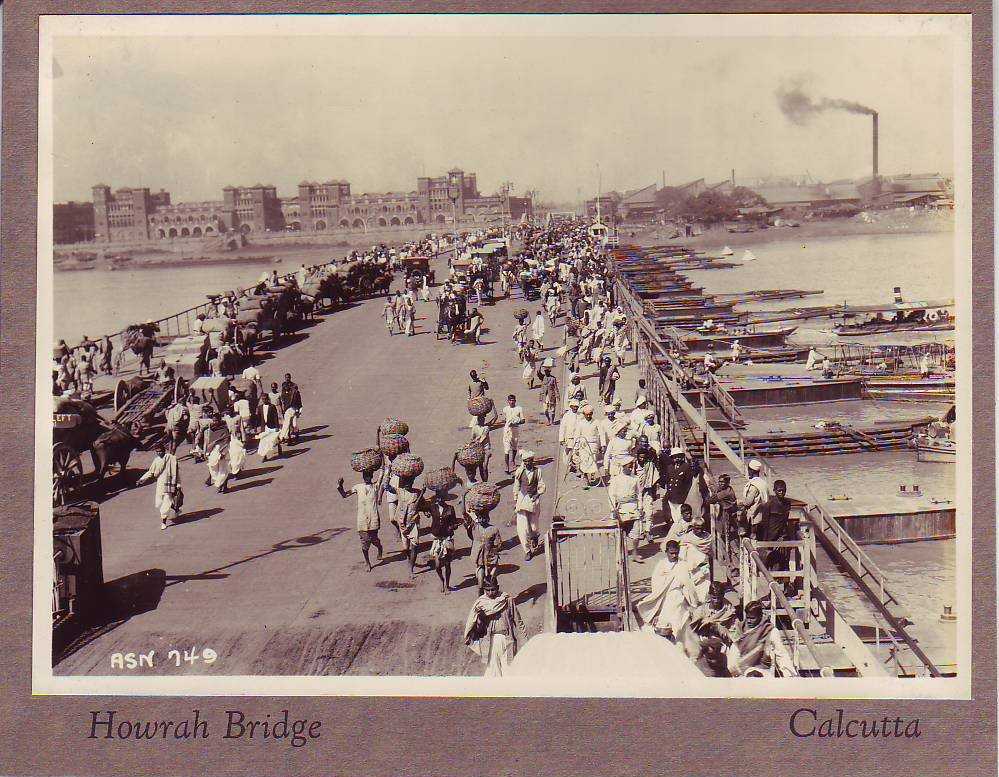
Later in the 1800s, a pontoon bridge or floating bridge was built between Howrah and Kolkata. But it wasn’t strong enough to handle the huge traffic between the two cities or to weather the frequent storms in the area. So the Bengal government continued to look for alternatives and, several decades later, the new bridge was finally commissioned. The contract to build it was awarded to a company called The Braithwaite Burn and Jessop Construction Company.The design of the Howrah bridge was made by Rendel, Palmer and Tritton and the bridge was constructed by Cleveland Bridge & Engineering Company. The construction of bridge was started on 1936 and ended in 1942. It was opened for the public transport on 3 Feb 1943. It was renamed as Rabindra Setu in June 1965 after the first Indian Nobel laureate Rabindranath Tagore.
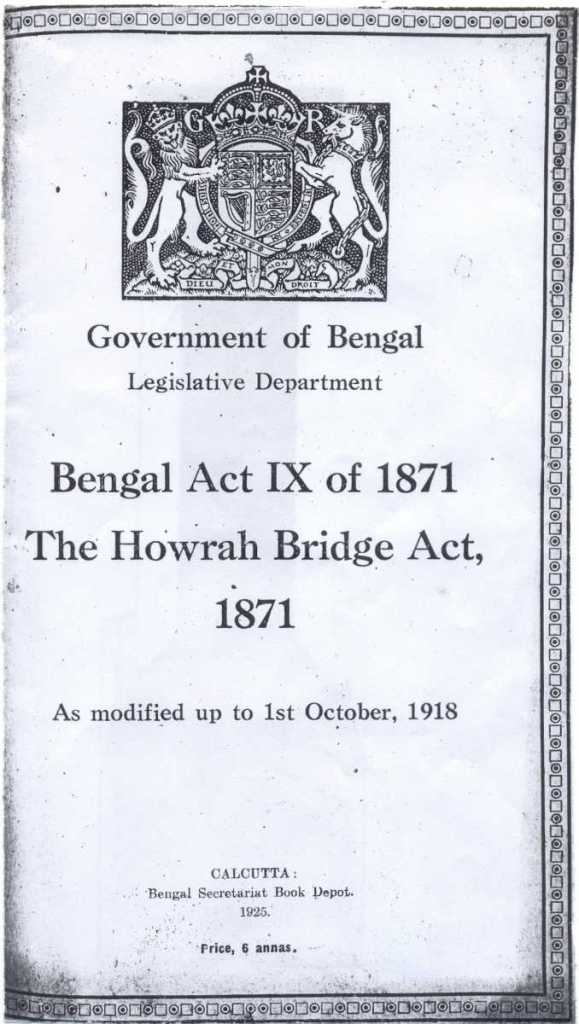
The Act for the construction of Howrah Bridge
Key Structure of The Bridge
The Howrah Bridge is a suspension-type balanced Cantilever Bridge. It has a central span of 1500ft between the main towers. The anchor and cantilever arms are 325ft and 468ft long, respectively.The suspended span has a length of 564ft. The main towers are 280ft-high above the monoliths and 76ft apart at the top. The bridge deck measures 71ft in width and features two footpaths of 15ft on either side.The super-structure is built up with riveted sections made of a combination of high tensile and mild steel. The bridge deck descends from panel points placed in the middle of the towers, which are located in the lower chord of the main trusses through hungers.The bridge deck consists of a 71ft carriageway and a 15ft pathway projected on both sides of the trusses and supported by a fascia girder.The carriageway outside the tower is backed on the ground by an anchor arm. The deck system includes cross girders suspended between pairs of hungers by a pinned connection. Six rows of longitudinal stringer girders are arranged between cross girders and floor beams support transversally on top of the stringers.These joints support a continuous pressed steel troughing system surfaced with concrete. Two main expansion joints are placed at the interfaces in the middle of the suspended span and the cantilever arms.Eight articulation joints exist at the cantilever arms and suspended portions and separate the bridge into segments by a vertical pin connection to allow the deck’s rotational movements. The bridge deck features a longitudinal ruling gradient at each end.The main tower is based on single monoliths with 21 chambers. The minimum vertical clearance for the carriageway is 5.8m and 8.8m for the river traffic.
The early days of Howrah Bridge
Specialities of The Bridge: What Made It A Heritage
Constructed without nuts and bolts, the Howrah Bridge was formed by riveting the entire steel structure. The bridge officially opened in 1943 when it was the world’s third longest cantilever bridge. Today, it is the sixth longest bridge of its type in the world. The Howrah Bridge is also thought to be the world’s busiest cantilever bridge.
In 1946, in a census carried out, it said that the bridge saw a daily traffic of 27400 vehicles and 12100 pedestrians. In fact ages ago the bridge had also carried trams that left from Howrah station terminus. However, it seemed like the bridge could not take the weight of the heavy weight and hence running trams on the bridge was discontinued. Currently, the bridge can bear the weight of 60,000 vehicles only but it still carried almost 90000 vehicles daily. The bridge also has a separate foot path for pedestrians to walk.While the bridge remains one of the key attractions in the city, the Howrah Railway Station at its Howrah end is another site of much historical significance as the country’s oldest railway station. At the Kolkata end, the bridge ends right by the stunning and colourful Mallick Ghat flower market, one of the city’s most vibrant markets.
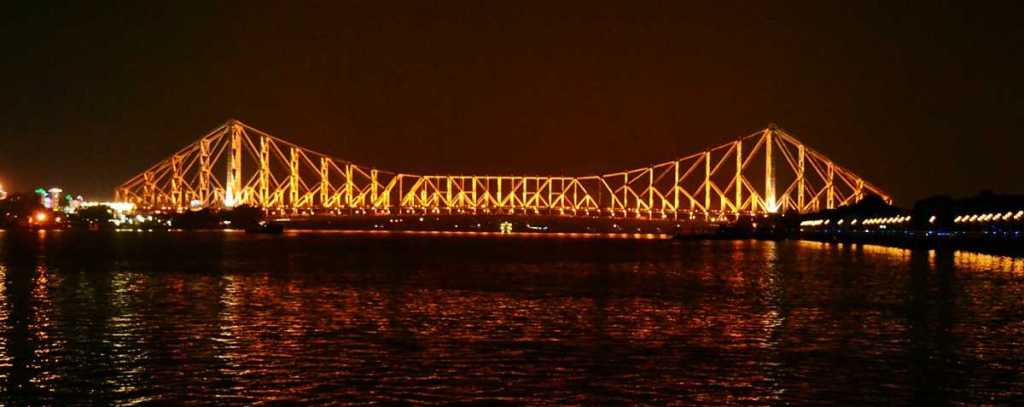
Night View of Howrah Bridge
Cultural Significance of The Bridge
Since the beginning of its journey, the bridge has been featured in numerous Bengali Hindi even International films, such as Do Bigha Zamin (1953), Bari Theke Paliye(1958), Parash Pathar(1958), Howrah Bridge(1958), Neel Akasher Neechey (1959), China Town(1962 ) and Amar Prem (1971), Teen Devian(1965), Calcutta 71 1972), Padatik (1973), Richard Attenborough’s 1982 Academy Award winning film Gandhi, Paar(1984), Ram Teri Ganga Maili (1985) , Nicolas Klotz’s The Bengali Night(1988), Rolland Joffé’s City of Joy (1992), Florian Gallenberger’s Shadows of Time (2004), Yuva(2004), Parineeta (2005) and the list goes on.
Recent Renovations of The Bridge
The articulation joints at deck level were renovated in 2008, and the bridge was illuminated in colours of gold and magenta in November 2006.Bridge operator Kolkata Port Trust (KPT) invested Rs35M in the project for laying 13km of cable, 700 lights, a new control tower and a sub-station. Around Rs27.3m was spent on the maintenance of the bridge in 2005.The pylons, the steel-lattice inner structure, the under-deck and the pathway were fixed with white and the upper structure with blue LEDs. Painted in June 2005, the bridge required more than 26,500l of aluminium paint to cover 23,500t of steel, occupying a surface area of 2.2mm².Prime Minister Shri Narendra Modi launched the interactive light and sound show of the bridge in January 2020. The new Rabindra Setu decorative lighting features 650 power-efficient LEDs and spotlight fittings for programmable multi-colour lighting, including a music-syncing show.
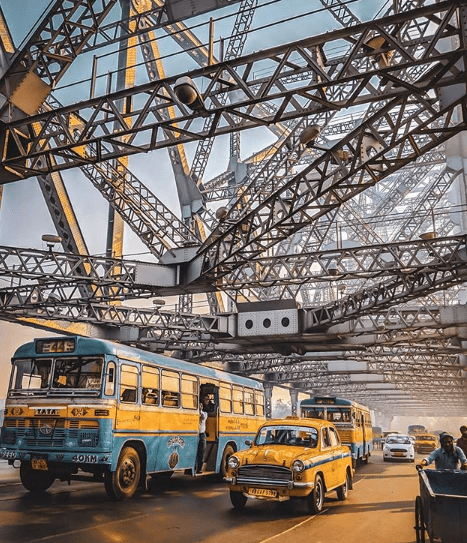
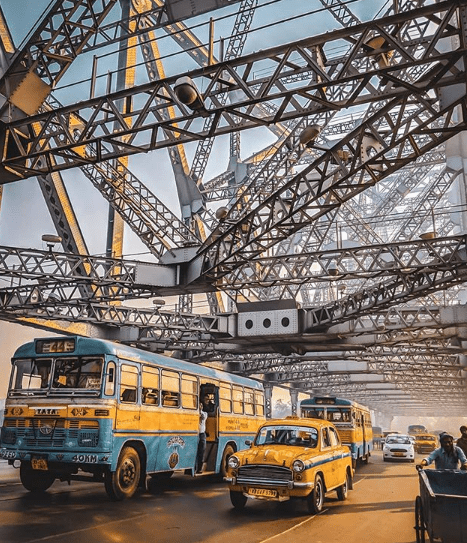
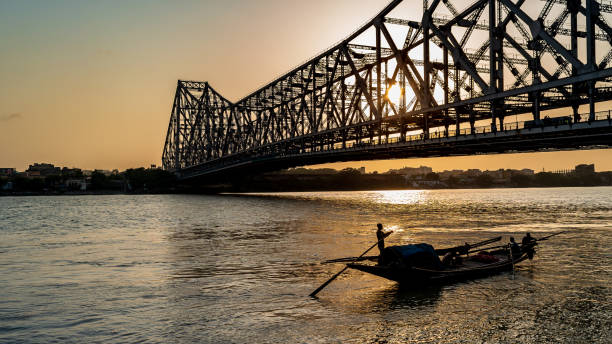
Silhouette of Howrah Bridge at the time of Sunrise. Howrah Bridge is a bridge with a suspended span over the Hooghly River in West Bengal.
Conclusion
The surprising fact about this bridge is that, despite being such a heritage, it has suffered a lot of damage. And the damage is not only because of trams plying heavy load, but it is also because of human spit and bird excreta.The corrosion on the bridge is because of prolonged chemical reaction that has occurred because of continuous bird droppings. Calcutta Port Trust is currently in charge for the maintenance of the bridge. Along with the authority, the citizens should also be responsible for protecting the living heritage of our country.
Flood Forecasting on International & Inter-state Rivers is formulated and issued by Central Water Commission (CWC) using statistical methods for short range forecasting and mathematical modelling for fiveday’s advance flood advisory. The main challenge being faced in flood forecasting is to accurately forecast the impending flood sufficiently in advance with high level of accuracy. Mathematical modelling based flood advisory although provide sufficient lead time, its accuracy is dependent on accuracy of weather(rainfall) forecasts. The growing incidents of high intensity rainfall in shorter duration due to likely impact of climate change poses another challenge for flood forecasting.
There is a continuous effort for improvement of Flood Forecasting using all the latest technology including space technology tools, Geographical Information System (GIS), web based applications, etc. Following steps have been taken to improve the Flood forecasting system in the country.
Expansion of Flood Forecasting Network: CWC flood forecasting network has been expanded to 331 Flood Forecast Stations(199 Level Forecast for Villages/Town on the bank of the rivers and 132Inflow Forecast Stations for Dams and Barrages) covering 23 States &2 UTs in 20 river basins for taking proper mitigation measures by respective State Governments. In the State of Andhra Pradesh, there are 13 level forecasting stations and 10 in flow forecasting stations.
Modernization of Flood Forecast Formulation: Flood forecasting is issued up to 5 days in advance for major river basins across the country including the State of Andhra Pradesh. The same is updated every three hours and is available online (https://120.57.99.138/index.php).
Modernization in dissemination of flood forecasts: Dissemination of flood forecasts has also been modernized through a dedicated website. Daily Flood Situation Report cum Advisory is shared with all stakeholders aswell as general public using social media platforms.
Bilateral agreements with upper riparian countries Nepal, Bhutan &China have been made for data sharing.
Common data platform, Water Information Management System(WIMS), under National Water Informatics Centre (NWIC), has been created to ensure seamless data flow from States and CWC formodelling work. In addition, arrangements for seamless data flow from agencies like INCOIS, NASA, JAXA, etc. have also been made.
The Prime Minister, Shri Narendra Modi addressed the valedictory function of the second National Youth Parliament Festival today via video conferencing. The Event took place in the Central Hall and the Prime Minister also heard the views of the three young national winners of the Festival. Lok Sabha Speaker Shri Om Birla, Union Education Minister Shri Ramesh Pokhriyal ‘Nishank’and MoS (I/C) for Youth Affairs & Sports Shri Kiren Rijiju were present on the occasion.
The Prime Minister addressing the young parliamentarians urged them and the youth of the country to take advantage of the flexibility and innovative learning format provided by the National Education Policy- 2020. An attempt is being made to create an ecosystem in the country, the absence of which often compels the youth to look towards foreign shores, which offered them better enterprise, opportunities, recognition and respect- the Prime Minister said.
Remembering Swami Vivekananda on his birth anniversary, the Prime Minister remarked that even with the passage of time, impact and influence of Swami Vivekananda remains intact in our lives. Swami ji’s views on nationalism and nation-building and his teachings regarding serving the people and serving the world continue to inspire us. Individuals who came into contact of Swami Vivekananda Ji were influenced to create institutions and they in turn created new institution-builders. This started a virtuous cycle of individual development to institution-building and vice versa.
Union Education Minister Shri Pokhriyal recalled Swami Vivekananda’s message that youth are the greatest strength of any country and the future of that country is shaped by the efforts of its youth. Emphasizing that the Youth plays an important role in the democratic system, he urged everyone to become responsible citizens and to contribute in the nation building by adopting Swami Vivekananda’s ideals and values in their lives.
Shri Pokhriyal said India, the largest democracy in the world, derives strength from our constitution, paving the way for the empowerment of the person at the bottom of the society. He said Preamble is the most important part of our constitution. The first word of the preamble is ‘WE’ ie “we the people of India”. This sentence is embedded in Indian society and keeps the society tied together to a national spirit, he added.
He appealed youth to use their tremendous energy, aspirations, dreams and will power to shape the future of the country. “I hope that under the able leadership of the Prime Minister Shri Narendra Modi, the young generation of the 21st century would form the strong foundation of Swarnim Bharat”, he said.
Kindly access below the education related excerpts from PM’s address on National Youth Parliament Festival today:






 Eduindex
You must be logged in to post a comment.