Start-up to success: OYO

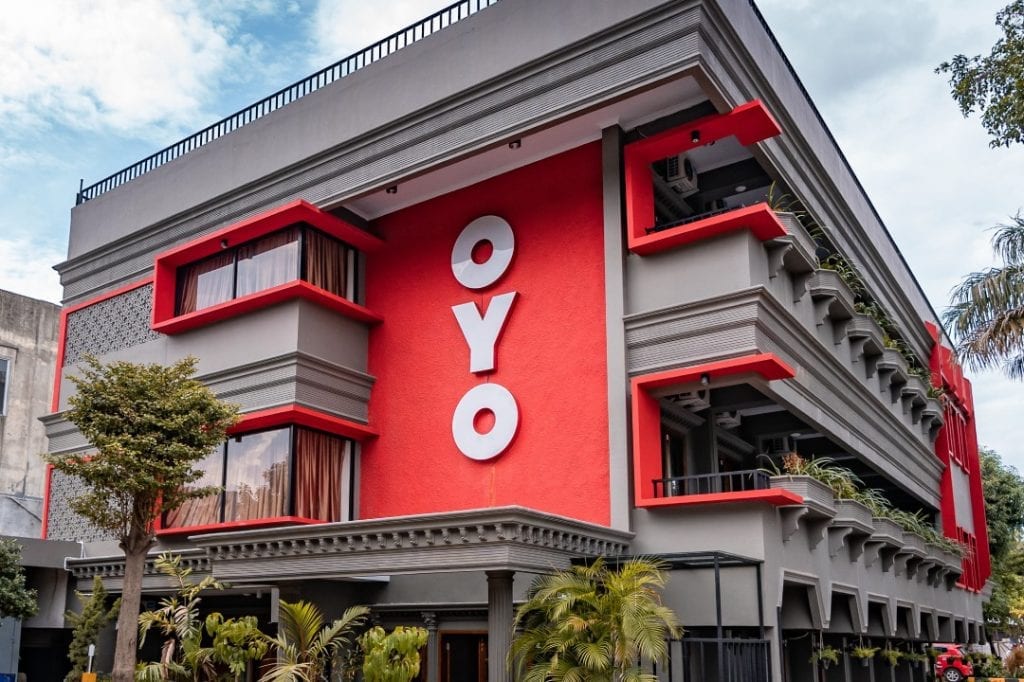
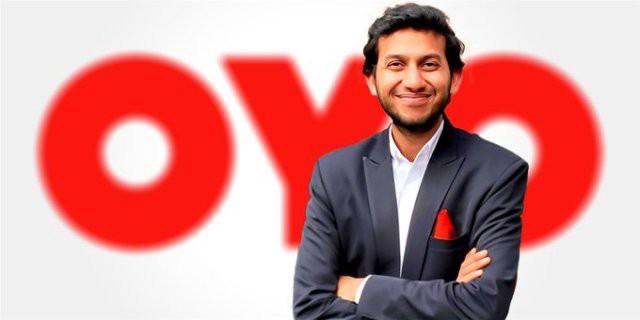
OYO Hotels and Homes is one of the first choices that comes to our mind when we think of affordable and comfortable accommodation while on a vacation. The success of OYO as a hospitability empire has been enormous, and it has been growing ever since the inception of the company in 2013 by Ritesh Agarwal.

OYO stands for ‘On Your Own’. And OYO has been a leading venture in the avenue of budget-friendly rooms along with offering commendable hospitability services. The company has been adding ways to improve its quality and services for the consumers over the years.
The origin of OYO

Ritesh Agarwal aspired to be a coder, and left for Kota in 2009. However he later realised that coding was not for him. Meanwhile he wrote and published his book ‘Indian Engineering Colleges: A Complete Encyclopaedia of Top 100 Engineering Colleges’, which turned out to be a hit. He was then selected for Asian Science Camp held at Tat Institute of Fundamental Research, Mumbai. Later he was among 20 students under 20 who received Thiel Fellowship with a sum of $100.000 for two years. Thus providing him with the resources to drop out of college to start something of his own.

Since Ritesh Agrawal travelled a lot and stayed in different hotels, he realised the poor condition of the hospitality sector, and was motivated to start Oravel Stays in 2011, which was later relaunched as OYO Hotels and Homes in 2013. He envisioned OYO as the all-encompassing accommodation system where people could enjoy all the best facilities of hospitality sector in a budget.

Eventually OYO spread all over India, generating revenue of 51 lacs in 2013-14 and 2.4 Crores in 2014-15. OYO also bagged investment from big shot companies like Lightspeed India, Sequoia, Softback and most recently Microsoft in 2021.

The Struggles of OYO

OYO did not become a success overnight. It had to endure its fair share of struggles and setbacks on its way to success. OYO was surrounded with allegations of cheating and fraud. In 2019, a Bengaluru hotelier accused OYO for not paying his dues. However, OYO rejected such claims.

Other instances includes the death of a national level shooter in an OYO hotel due to electrocution, and an OYO employee raping a women, and a few more. In all these cases OYO clarified its stand and coped with authorities to help with the investigations.  

Other then such instances of setbacks, OYO also had to deal with the obstacles of COVID-19. Like all businesses, the hospitality sector was also hit severely with the pandemic. The hospitality sector revenue generation was down by 50-60% in 2020, as a result the OYO employees had to go through a pay cut of 25%.
Success of OYO

After dealing with its fair share of struggles and shortcomings, OYO has established itself as the World’s third largest and fastest growing hotel chains and home and living spaces. After 8 years of business OYO operates in 800 cities in more than 80 countries. It has 23,000 hotels under, 850,000 rooms and 46,000 vacation homes worldwide.  

In 2019, OYO generated a revenue of $951 million, and is believed to revive itself from the effects of pandemic in the coming years. Ritesh Agarwal was declared the youngest CEO at 17, he was also declared the world’s youngest self-made Billionaire after Kylie Jenner in 2020. And he has a number of other titles to his name such as Forbes 30 under 30 and much more.

                      Nonetheless, the biggest takeaway is that, a teenager with an entrepreneurial mindset manifested his dreams into reality and made it big to a billion dollar industry. Ritesh Agarwal has an inspiring story that can surely encourage other young minds.

Electric Vehicles

At present, the technology is advancing day by day and so is pollution, global warming and increased demand for fuel. Thus, in order to tackle such issues and to be at par with the modern era, electric vehicles as a means of eco-friendly transport is a better option in future.

Electric vehicles refers to vehicles or transport means that consume electric energy in place of traditional fuels such as diesel, CNG and petrol. Such vehicles include an electric generator to convert fuel to electricity or maybe inbuilt with a solar panel, battery, fuel cells or electricity may be supplied via collector system from off-vehicle sources. The metros are already running with electricity around the world.

The contemporary age in which we all are living has now become an era of technology and this advancement in technology has greatly enhanced our human life. Thus, the use of electric vehicles is necessary in near future. The electric vehicles run from electricity and as a result no smoke is emitted, reducing the pollution, global warming and import of diesel and petrol. It would conserve natural resources like CNG, petrol and diesel that are non-renewable and promote the use of renewable energy. The over use of such fuels are harmful for the environment. It would also fulfill the requirement of growing demand of more means of transport. Electric vehicles are eco-friendly, thus it is good for both human beings and environment. As it is a new form of technology and with the increasing demand of this sector, more employment generation will take place. Electric vehicles will also reduce the nation dependency on petroleum export countries.

The electric vehicles are environment friendly and seemingly cheaper in the long run. Since past decade, many trains including the metros have been running on electricity. Even almost all the trains in the Indian Railways are running on electricity. As a result, the use of electric vehicles are continuously promoted by the government. Today, electric scooters or bikes, electronic rikshaw, electronic cars , etc. are already in the market. Various campaigns have been started by the government to promote the use of electric vehicles. Recently, a campaign named’ Switch Delhi’ was launched by the Delhi Government to promote the same. The Delhi government took this initiative to cut down the pollution of air which was caused by the smoke emitted by the traditional petrol and diesel vehicles. The smoke emitted is hazardous to human health. Prior in 2020, Delhi EV Policy was also introduced. Under this policy, a waiver on road tax was provided with a benefit up to Rs. 1.5 lakh on four wheelers and more.

Thus, it can be inferred that the people should use more electric vehicles instead of traditional petrol and diesel vehicles. Electric Vehicles are seemingly the future of means of transport. It becomes more essential when the increasing pollution, global warming and diseases borne out of pollution are considered.

“I really do encourage other manufactures to bring electric cars to market. It’s a good thing, and they need to bring it to the market and keep iterating and improving and make better and better electric cars, and that’s what going to result in humanity achieving a sustainable transport future. I wish it was growing faster than it is.”

– Elon Musk

Porter’s Five Forces Model

Porter’s 5 Forces Model is a business model and a tool which helps in identifying main competitive forces of an industry or a sector. The 5 Forces Model is mainly used to create a corporate strategy which will help a company to enhance its long- term profitability.

Understanding Porter’s Five Forces Model

The 5 Forces Model was created by Harvard Business School’s Professor Michael E. Porter and was published in his book “Competitive Strategy: Techniques for Analyzing Industries and Competitors” in 1980. The model was created to explain why various industries are able to maintain varying level of profitability. Porter’s 5 Forces helps in analyzing the industry of the company so that a company can adjust their corporate strategy, boost their profitability and beat their competition.

What are the five forces of the Porter’s Model?

  • Competition in the industry
  • Potential of new entrants into the industry
  • Power of Suppliers
  • Power of Customers
  • Threat of substitute products

Competition in the Industry

For most industry, the level of competition in the industry determines the positioning of the product in the market. The intense the competition in the market, the more the company has to focus on innovation, marketing, price, etc. of the product. When the competition is less, a company has more authority to charge higher prices and establish the terms of deals in order to increase sales and profits.

Potential of New Entrants into the Industry

A company’s positioning is also affected by the new entrants in the market.  This in turn puts pressure on prices, costs, and the rate of investment needed to sustain a business within the industry. The less the time, money and effort it takes for a competitor to enter the market, more is the threat for a company to lose its market share. On the contrary, if there are strong barriers to entry in the industry, companies more secure about their market share.

Power of Suppliers

Power of suppliers in a market means how easily suppliers can increase the cost of the inputs. The suppliers’ power in the market is determined by the factors like number of suppliers in the market, uniqueness of the inputs they provide, cost of switching a supplier for a company. If the number of suppliers in an industry is less, a company would depend more on its current supplier, thus giving more power to supplier in terms of cost of inputs and other advantages in trade. However, if the suppliers are more in the market, then company has the advantage of switching the supplier in case the supplier increases the price or if a company finds a cheap supplier, thus keeping their input costs low and increasing their profitability.

Power of Customers

Customers are more powerful in an industry when there are less number of customers in an industry and more number of suppliers. Because the client base for a company is smaller and more strong, each customer has greater negotiating leverage to get better rates and deals. A company with a large number of smaller, independent consumers will find it easier to raise prices and increase profits.

Threat of Substitute Products

A substitute is a product or service that can be easily replaced with another by consumers. In economics, products are often substitutes if the demand for one product increases when the price of the other goes up. When there are no close substitutes in the market, a company can take advantage of charging higher prices. However, if there is availability of close substitutes, customers will switch to substitutes in case of increase of the prices of the products of a company.

Understanding Porter’s Five Forces and how they apply to a particular industry can help a company change its business plan to make better use of its resources and generate more profits for its shareholders.

HEALTHY EATING FOR HEALTHY HEART

When stress hits hard as it has during the pandemic, many of us eat more, and less-than-healthy comfort foods may be the treats we reach for first. But an unhealthy response to stress can be hard on your body, especially your heart. That’s why it’s smart — at the top of the New Year, or anytime — to try to eat more foods that nourish. It’ll make your heart happier, and maybe trim your waistline, too.Don’t know where to start? Let the National Heart, Lung, and Blood Institute (NHLBI) help.”We have many recipes for healthy and really tasty dishes, plus an award-winning eating plan called Dietary Approaches to Stop Hypertension, or DASH for short,” says Charlotte Pratt, Ph.D., M.S., R.D., a nutrition expert at NHLBI. For years, the DASH eating plan has ranked among the U.S. News & World Reports’ best diets for healthy living and heart health. Its secret, says Pratt: “Eating nutrient-dense foods and meals that are lower in sodium and saturated fat, rich in fruits, vegetables, low-fat dairy, and legumes.”Some of the recipes NHLBI has developed to support the plan feature healthy versions of comfort foods, such as oven-baked french fries, chicken chile stew, and sweet potato custard. The recipes are easy to make and family-friendly. They include traditional African American, American Indian/Alaska Native, Vietnamese, Latino, and Filipino dishes. You can find these recipes, along with tips about safe cooking, what to stock in your kitchen online The DASH eating plan is scientifically proven to lower your blood pressure and cholesterol levels,” says Pratt. And NHLBI research shows that increasing your physical activity and watching your calories while following DASH will also help you lose weight.DASH requires no special foods, and it helps you set daily and weekly nutritional goals using these simple guides:

  • Eat vegetables, fruits and whole grains
  • Include fat-free or low-fat dairy products, fish, poultry, beans, nuts and vegetable oils
  • Limit foods that are high in saturated fat, such as fatty meats, full-fat dairy foods and tropical oils such as coconut, palm kernel and palm oils
  • Limit sugar-sweetened drinks and desserts

To make it easier to follow the DASH for life, these tips can help:

  • Change gradually. Add one more serving of vegetables a day. Read nutrition labels to choose the food lowest in saturated fat, sodium or salt and added sugar.
  • Vary foods high in proteins. Try a mix of lean cuts of meat. Remove the skin from chicken. Eat fish once or twice a week. Eat two or more meals without meat each week.
  • Select healthy, tasty snacks. Have a piece of fruit, a few unsalted snacks such as rice cakes, fat-free or low-fat yogurt or raw vegetables with a low-fat dip.
  • Find substitutes. Try whole-wheat bread or brown rice instead of white bread or white rice. Try beans or seeds such as flax or sunflower seeds, if you’re allergic to nuts.

Combining healthy eating habits with other self-care activities can help you reduce stress and take care of your heart. Top of the list: move more throughout the day, get 7 to 8 hours of sleep, and try relaxation exercises such as meditation or yoga. If you smoke, try quitting, and develop a strong social-support system to help keep you motivated. Delicious Oven-Baked French Fries Baking instead of frying these potatoes reduces the fat while keeping them crispy.Prep time: 10 minutes.
Cook time: 35 minutes.
Makes 5 servings.
Serving size: 1 cup.Ingredients4 large potatoes (2 lbs.) (regular or sweet potatoes)
8 C ice water
1 tsp garlic powder
1 tsp onion powder
1/4 tsp salt
1 tsp white pepper
1/4 tsp allspice
1 tsp hot pepper flakes
1 Tbsp vegetable oilDirections

  1. Scrub potatoes and cut them into long 1/2-inch strips. Place the strips in the ice water, cover and chill for 1 hour or longer.
  2. Remove potato strips and dry them thoroughly. Preheat oven to 475 degreeF.
  3. Place garlic powder, onion powder, salt, white pepper, allspice and pepper flakes in a plastic bag. Toss the potato strips in the spice mixture.
  4. Put the potato strips in a shallow baking pan and brush them with oil.
  5. Cover the baking pan with aluminum foil and bake at 475 degreeF for 15 minutes.
  6. Remove the foil and continue baking, uncovered, for an additional 15 to 20 minutes or until golden brown. Turn fries occasionally to brown on all sides.

An Integrated Mobile Service Delivery Van’for Divyangjan and Senior Citizens

 A ‘SamajikAdhikaritaShivir’ for distribution of aids and assistive devices to ‘Divyangjan’ under the ADIP Scheme and Senior citizens under ‘RashtriyaVayoshri Yojana’ (RVY Scheme) of the Ministry of Social Justice and Empowerment, Government of India will be organized by the Department of Empowerment of Persons with Disabilities (DEPwD) in association with ALIMCO and District Administration Chhatarpur at 12 Noon on 13.02.2022 at Government Higher Secondary School, No.1, Chhatarpur in Madhya Pradesh.

A total of 5286 aids and assistive devices valued at Rs. 2.33 crore will be distributed free of cost to 1391 Divyangjan and 553 Senior Citizens at Block/Panchayat levels by following the SOP prepared by the Department in view of  COVID-19 Pandemic.

Hon’ble Union Social Justice and Empower Minster Dr. Virendra Kumar will be the chief guest of the function wherein, Union Minister will also launch ‘An Integrated Mobile Service Delivery Van’ whichhas been developed by the ALIMCO to provide “After-Sale Service” and undertakean awareness campaign on the use of Aids and Assistive devices and offering in-situ repairs/ correction /adjustment and fitting of Prosthetics and orthotics devices at the destination for the Aids and Assistive devices being distributed under the ADIP/RVY Scheme of Govt. of India, in Districts where the distribution of aids and assistive devices has been done in recent past to Divyangjans and Senior Citizens. Shri Pradumn Singh Lodhi, Chairman Madhya Pradesh State Civil Supplies Corporation Ltd.,and MLA, Badamalhera, Madhya Pradesh will preside over the function.

SMILE: Support for Marginalised Individuals for Livelihood and Enterprise

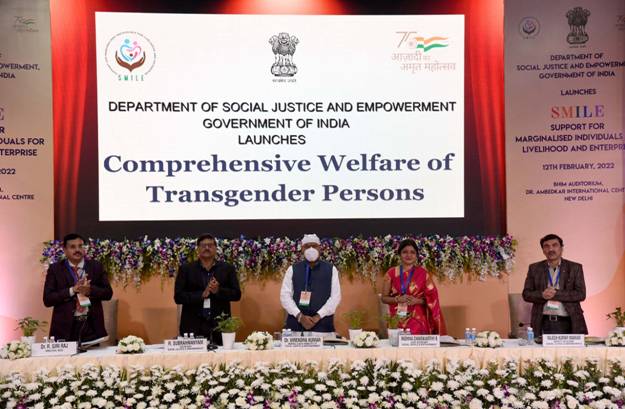
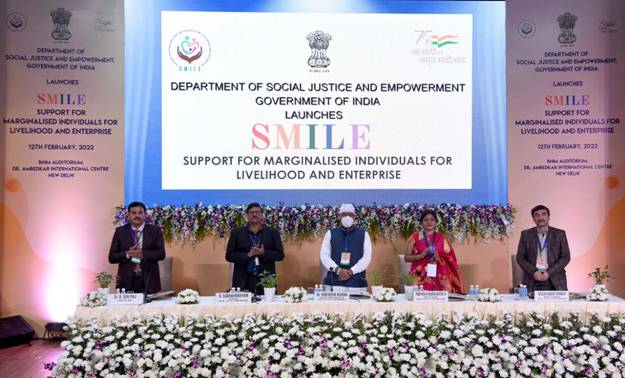
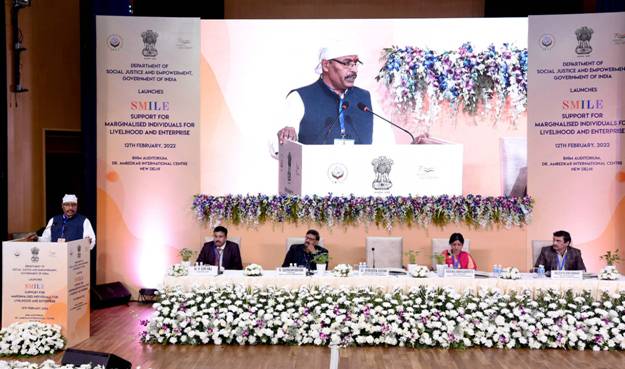
 Union Minister for Social Justice & Empowerment Dr. Virendra Kumar launched the Central Sector scheme “SMILE: Support for Marginalised Individuals for Livelihood and Enterprise” today at BHIM Auditorium, Dr. Ambedkar International Centre, 15, Janpath    Road, New Delhi. This umbrella scheme, designed by Department of Social Justice & Empowerment, is set to provide welfare and rehabilitation to the Transgender community and the people engaged in the act of begging.


Speaking on the occasion, Dr. Virendra Kumar said, “As a progressive and developing society it is our duty to respect the identity and dignity of all sections of society. The Ministry has ensured that each and every need of Transgender community and persons engaged in the act of begging are taken care of in most professional way.”

“The provision of National Portal & Helpline will provide necessary information and solutions to the problems of the Transgender community and the people engaged in the act of begging,” the Union Minister added.


The two sub-schemes of SMILE – ‘Central Sector Scheme for Comprehensive Rehabilitation for Welfare of Transgender Persons’ and ‘Central Sector Scheme for Comprehensive Rehabilitation of engaged in the act of Begging’ – provide comprehensive welfare and rehabilitation measures to the Transgender community and the people engaged in the act of begging.

The scheme keeps in mind the social security that is needed through multiple dimensions of identity, medical care, education, occupational opportunities and shelter. The Ministry has allocated Rs. 365 Crore for the scheme from 2021-22 to 2025-26.


The Sub-scheme – ‘Central Sector Scheme for Comprehensive Rehabilitation for Welfare of Transgender Persons’- includes various components.  It provides Scholarships for Transgender Students studying in IX and till  post-graduation to enable them to complete their education. It has provisions for Skill Development and Livelihood under PM-DAKSH scheme. Through Composite Medical Health it provides a comprehensive package in convergence with PM-JAY supporting Gender-Reaffirmation surgeries through selected hospitals. The Housing facility in the form of ‘Garima Greh’ ensures food, clothing, recreational facilities, skill development opportunities, recreational activities and medical support etc. to the Transgender community and the people engaged in the act of begging. The Provision of Transgender Protection Cell in each state will monitor cases of offences and to ensure timely registration, investigation and prosecution of offences. The National Portal & Helpline will provide necessary information and solutions to the Transgender community and the people engaged in the act of begging when needed.

The sub-scheme – ‘Comprehensive Rehabilitation of persons engaged in the act of Begging’ – will focus on Survey and identification, Mobilisation, Rescue/ Shelter Home and Comprehensive resettlement.

Besides, pilot projects have been initiated on Comprehensive Rehabilitation in ten cities namely Delhi, Bangalore, Chennai, Hyderabad, Indore, Lucknow, Mumbai, Nagpur, Patna and Ahmedabad.

Impact of caste dynamics in contemporary India

The association between various caste groups has now become more flexible and is now at ease. One of the significant impacts in the contemporary age is personal job preference. In the past, men believed in pursuing occupation under its caste like mainly they were engaged in pottery, blacksmithing etc. However, the current scenario is very much different, people have started pursuing jobs of their own choices irrespective of their caste such as in railways, teaching, government jobs, marketing and business. The food habits of the people have been modified, sharing of food is now common between both the sections of society and nowadays people of both upper and lower caste enjoy their food in restaurants in the local together. Power and wealth are almost in least association with the caste. The belief that the lower castes are responsible for pollution and freshness has now somewhat become extinct. However, in petto, rituals of purification with regard to one’s caste ranking, such practice still prevails. The custom of marrying only within the limits of a caste is still in practice, though not as severely as in the past. Lower sections of the society still faces difficulty in pursuing of caste related occupation and access to essential resources in extreme remote rural areas, however in urban areas, caste has almost nil significance in the society. The growth or ranking of women is still based on man’s positioning in the society. But today awareness of equal rights of women, education, employment are eventually advancing the modern society. The Indian Constitution made and implemented various special provisions, due to which competition among the caste groups in order to access the power and necessities like better life enhancement, educational benefits, government oriented jobs, etc. have gained force.

Implementation of such provisions and policies have always been the talk of the town and ground to numerous controversies, although political parties support these policies seemingly for their political benefits, but keeping it aside, it has been of great significant to the people belonging to the lower caste especially the Scheduled Castes (SCs), Scheduled Tribes (STs) and backward classes (OBCs). These groups have grabbed every opportunity provided to them and excelled in it. In the elected offices, these groups have greater representation. They have proved to be an essential part of the Indian political election system. They have also successfully mend their paths in each and every institution, be it political, legal or educational, and also secured high posts in government jobs. In a number of regions, these caste groups have succeeded in forming powerful parties in politics.

However, regrettably, a small portion of people belonging to the lower caste have gained profit from the policies and provisions made by the Indian Constitution. When observed from far, other sections of society seem to have willingly accepted the individuals of the lower castes, but the reality is quite contrary, in numerous parts of India, the upper castes still treat the lower caste’s individuals as outsiders and deny them access to resources. Such an incident came into light in parts of Bihar, India in 1994, the landowners of the upper caste formed a special army known as Ranvir Sena in order to defend themselves from lower caste’s individuals. Though fortunately by 1999, this was disbarred, the Ranvir Sena had already slaughtered 20 Dalits. The upper caste’s individuals who are against the special polices made for the lower castes and also those who are at any sort of economic disadvantage by the implementation of such policies, often are responsible for the mistreatments against lower sections.

The caste system has played a vital role in molding the ethics, principles as well as habitation of the society in India. The rituals  and customs of Hindu philosophy greatly influence the faith and lives of the Indians. Post independence, Indians are still in the clutch of beliefs regarding one’s social rank and their caste status. In the ancient days, people of a common society were divided on the basis of caste, sex and birth. Since birth they had their lifestyles organized according to their specific caste rule and had no choice preference as such. However, with the course of time the linkage between one’s occupation and caste has become almost insignificant. In urban areas, interaction among various castes is without restriction. The current Indian society is progressing eventually from the closed caste system to interactive functioning of the society irrespective of any caste. The various provisions and policies implemented by the government have encouraged the lower sections to come forward and represent themselves in the society. Such provisions have also encouraged the people of other caste groups to be secular towards one another. Therefore, it is essential to look after how caste discrimination has affected the standard of life and mobility of society in contemporary India.

Khadi: The Sustainable Fashion of India

Khadi, India‘s own versatile clothing material for ages

Introduction

Khadi, also known as Khaddar ,which started as a symbol of the Swadeshi Movement led by Mahatma Gandhi 100 years ago, is now a fashion statement in India and is gradually getting popular across the globe. Not only as an affordable and comfortable fabric for daily-wears, but also Khadi is now being considered as a Style Statement for its sustainability and eco-friendliness.

Khadi production

Nature of The Khadi Material

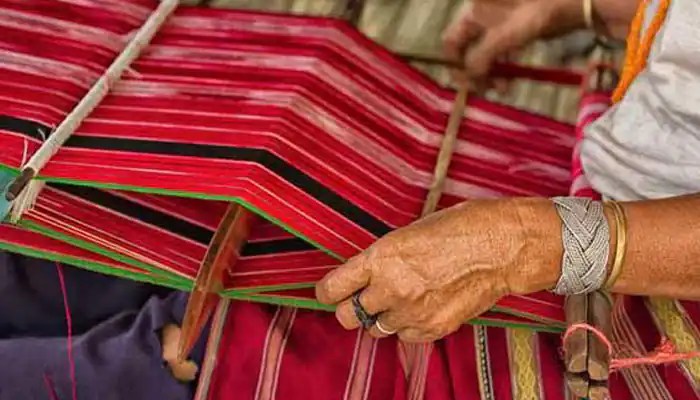
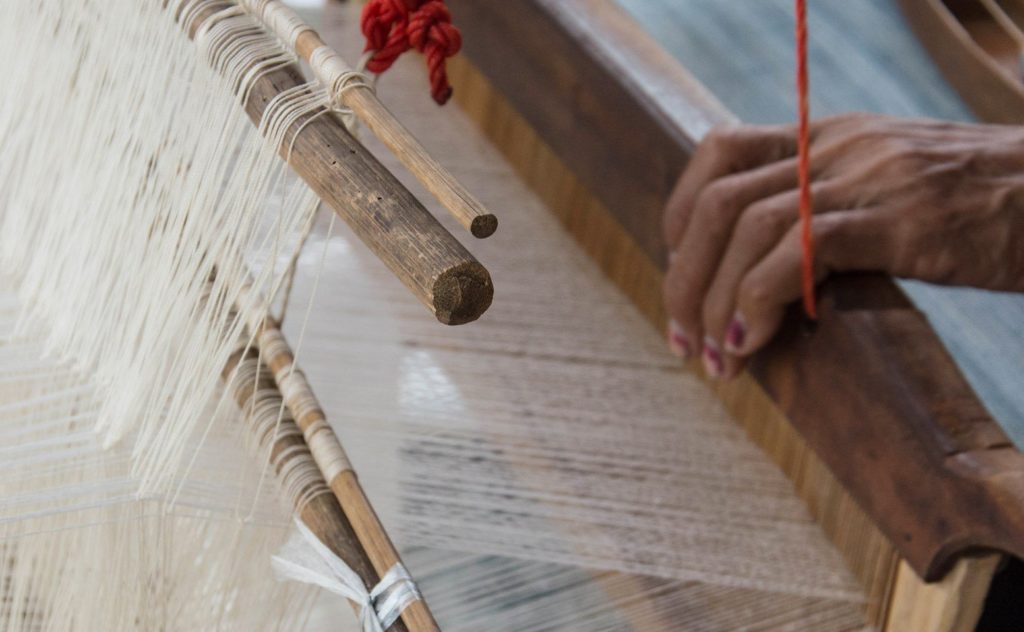
Khadi is a textile fabric made by hand-spun and hand-woven cotton, silk, wool or a mixture of these fibres. It is a traditional way of textile manufacturing and is generally produced by rural artisans. The method of manual spinning and weaving makes the fabric structure somewhat rugged and imparts a unique appearance and makes it soft and comfortable to wear. The spinning is carried out on a traditional wooden frame called charkha, while the weaving is done on a handloom. The specific fabric construction helps in circulation of air within the threads and imparts unique property of keeping the wearer warm in winter as well as cool in summer.

Weaving of Khadi

History of Khadi : Role in India’s Freedom Movement

India has an ancient heritage of cloth making based on the availability of natural fibrous raw material such as -agricultural cotton owing to the clement climatic conditions and fertile land, varieties of silk from different sericulture and wool from domestically reared sheep. The textile coloration was carried out using abundantly available natural dyes, derived from various plant and animal extracts. Such flourishing textile base was one of the major attractions for the Western world. After mechanised industrialisation, the situation changed and the basic raw material was exported from India, converted into mill-processed finished cloth and the imported fabric was brought back. This led to the demolition of traditional textile manufacturing in India and eventually the art and craft of fabric making diminished.

During the initial phase of the freedom movement, national leaders like Dadabhai Naoroji and Lokmanya Tilak initiated the Swadeshi Movement to promote Indian-made products. However, it was Mahatma Gandhi who in 1918 brought the focus of India’s freedom struggle to khadi by promoting that as a Swadeshi symbol.

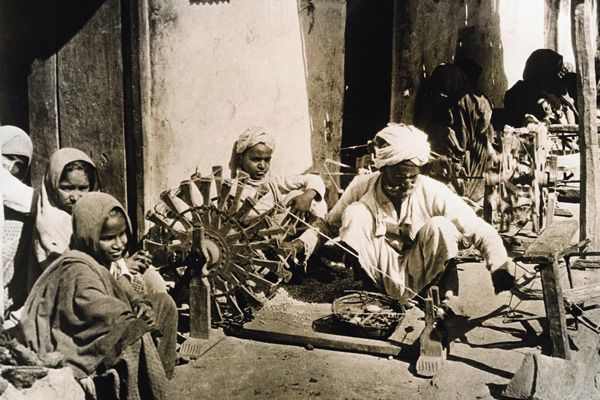
Under the leadership of Mahatma Gandhi, khadi-making regained momentum and became a symbol of revolution and resistance. It also provided employment to the vast rural population of India and achieved distinct identity as a common man’s cloth. As everybody could wear the same form of clothing without any distinctions of class, creed or religion, they could demonstrate solidarity in freedom struggle. Wearing khadi became a matter of national pride and united the population of India by surpassing the divisive system of the region, language, religion, caste, age and gender. It reflected our country’s legacy of sustainable living and self-reliance. The Indian national flag is also made from khadi material.

Khadi making with Charkha, during India‘s Freedom Movement

Government Initiatives After India’s Independence

The Khadi and Village Industries Commission (KVIC) is the Indian government body that promotes khadi, whose production and sale comes under the small scale industry sector. KVIC was created by a parliament act after which many KVIC outlets were opened across the country. These shops sell khadi fabrics and apparel. Every year between October to January, all Khadi Gramodyog Bhavans offer discounts on their products. KVIC also organises exhibitions and trade fairs in the country and abroad to promote khadi.

An estimated 15 lakh people are now engaged in producing over 12 crore metres of khadi. KVIC is taking further steps to enhance its production as the market demand for such products is much more than the supply. A new programme is expected to establish the ‘Khadi Mark’ and a logo to indicate the genuineness of the product. The financial support provided and the political will exerted by the present government and the special emphasis from Prime Minister Narendra Modi has helped boost employment in the manufacturing and promotion of khadi products. Leading film artists, sports personalities and fashion designers have come forward to promote this unique ‘Made in India’ fabric in the global arena.

Khadi used in sustainable fashion

Contribution of Khadi in World Fashion

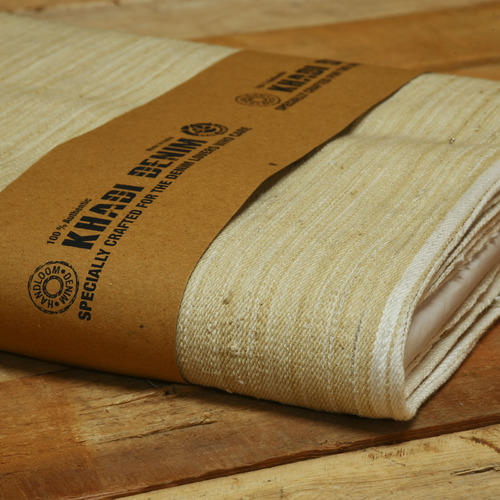
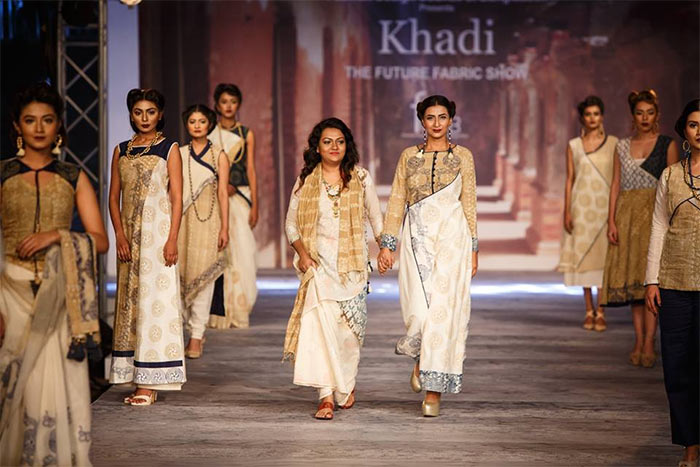
Considering khadi‘s eco-friendly and natural origin, it has become a focal point of global fashion owing to growing consumer awareness and the consistent demand for sustainability. Fashion designers have acknowledged the aesthetic appeal and comfort attributes of khadi and experimented it in blending with many other stuff to synergistically enhance the fashion appeal and outlook of products. Khadi is now used in denims, jackets, shirts, dress material, stoles, home furnishings and apparel accessories like handbags. Khadi, once considered as the fabric for political leaders and the rural folk, has entered the wardrobe of the fashion-conscious urban population. Wearing khadi now symbolises affluence as it offers a distinguished look. The ecological aspect and ethnic looks of khadi have caught the fancy of global brands and leading fashion designers have started including khadi material in their collections.

Global acceptance of the Khadi in fashion

Conclusion

Incorporating Khadi in our daily life may also pave the way for a simple spiritual living exuded by our clothing and home décor items. Khadi being such a versatile fabric can be easily incorporated, by changing the warp and weft, in a home decor and clothing lines. This will make us come closer to nature and add a touch of earthiness in our lifestyle.

National Education Policy (NEP) 2020: Implementation Plan for School Education


  1. The National Education Policy, 2020 is the third in the series of National Education Policies (1968 and 1986 modified in 1992) in India and is the first education policy of the 21st century. NEP 2020 covers wider spectrum of school education from pre-primary to senior secondary.
  2. The recommendations given have varied timelines as the policy is made for next 20 years. Therefore, the implementation of NEP is being carried out in a phased manner.
  3. ShikshakParv was organised from 8th to 25th September 2020 for discussing various recommendations of NEP 2020 and its implementation strategies. Around 15 lakh suggestions were received from the stakeholders, which are being examined.
  4. To achieve the goals and objectives of NEP 2020, DoSEL has prepared a draft implementation plan with Task lists linking each recommendation with tasks, responsible agencies to carry out the task, timelines and outputs. This task list was shared with the States/UTs/Autonomous Bodies on 10th September, 2020, to provide their feedback/suggestions till 12th October, 2020. Autonomous Bodies of this Department and 31 States and UTs provided 7177 suggestions/ feedback on the task list. These have been analysed by expert groups and important suggestions have been incorporated in the final version of implementation planIn addition to above, a series of national workshops on Implementation of NEP 2020 and revision of Samagra Shiksha was held under the chairpersonship of Secretary (SE&L) on 10th November, 27th November and 2nd December, 2020 covering all States and UTs. The document is being finalised and will be released shortly.
  5. Appropriate care is being taken to make this implementation plan realistic, flexible and collaborative by inviting suggestions from all corners of the society. It is hoped that this implementation plan so finalised with the inputs of all associates will be able to translate the vision of the policy in the field and will reach to grass root level creating adequate awareness and motivation and competencies among concerned stakeholders, thereby transforming the school education in the country.  
  6. The major portions of NEP will be covered under the new National Curriculum Framework (NCF) and centrally sponsored schemes. Groundwork for NCF is initiated and it is likely to be developed in the next academic session, that is 2021-22.
  7. The department has initiated implementation of NEP by undertaking following activities in accordance with the recommendations of the policy :
  1. To undertake 50 hours of mandatory Continuous Professional development of teachers, 18 modules of 4-5 hours each comprehensively covering all aspects of elementary education have been launched under NISHTHA on 6.10.20 for in service teacher training (CPD) in the online mode on DIKSHA platform. This has so far seen more than 3.4 cr course wise registrations and 2.8 cr completions from more than 23 lakh teachers.
  2. In-principle approval has been given for setting up the National Mission on Foundational Literacy and Numeracy Mission. A Committee has been formed for preparing framework on FL&N, codification of learning outcomes etc.
  3. E-learning has been expanded through DIKSHA. DIKSHA provides access to a large number of curriculum linked e-content through several solutions such as QR coded Energized Textbooks (ETBs), courses for teachers, quizzes etc. Till date DIKSHA houses over 3600 QR coded textbooks (tagged with e-content) from 29 states, 1.44 lakh e Contents and more than 300 courses.
  4. The department has launched an initiative called ‘Manodarpan’ for mental health and wellbeing of students. It aims to provide emotional support and counselling to the students under distress. Issuance of advisory guidelines, web page and national toll-free number, interactive online chat options and, national-level database and directory of counsellorsare part of the initiative. 
  5. MoU has been signed between Indian Sign Language Research and Training Centre (ISLRTC) and NCERT to develop Indian Sign Language dictionary for school education.
  6. CBSE exam reforms have been initiated; CBSE will introduce improvement examination from the year 2021 and will introduce English and Sanskrit in 2 levels from the session 2021-22 (already offers Mathematics and Hindi at two levels). Competency based questions have been introduced in the Board exams for class X and XII in a phased manner, increasing by 10% every year.
  7. Learning Outcomes upto Secondary level have been notified and draft of learning outcomes for senior secondary level have been released for inviting suggestions.
  8. The department is also aligning its existing schemes i.e, Samagra Shiksha, Mid Day Meal and Padhna Likhna Abhiyan with the recommendations of NEP 2020. 86 paras of NEP have been proposed to be covered/integrated under the revised scheme of Samagra Shiksha which includes phased introduction of:  1 year of Balvatika and TLMs to all children, Launch of National Mission of Foundational Literacy and Numeracy, upgradation of schools upto senior secondary level including residential schools and KGBVs, Holistic Progress Card (HPC) and tracking of learning outcomes as well as transition of children, appointment of Hindi and Urdu Language Teachers, Capacity building of teachers (50 Hrs CPD), Bagless days and internships, Support for OOSC, Activities of PARAKH, Separate stipend for CWSN girl child; provision for identification of CWSN and Resource Centre at block level, Provision for Hub and Spoke model in vocational education, Provision for Smart classroom and DIKSHA, Support for Assessment Cells in SCERT etc., etc.
  9. States and UTs are also constituting their own Task Force to steer implementation of the NEP provisions in their respective jurisdiction.

******


The Homecoming by Rabindranath Tagore

The Homecoming”, also known as “Chutti” is a Bengali short story written by Rabindranath Tagore (1892-93). This story depicts how much parental love and care is required for every child in its childhood days. It also depicts that if we abandon a child, definitely tragedy will take place.

SUMMARY

Phatik Chakravarthi was a fourteen year old Bengali boy whose father died very early. He grew up lazy, wild and disobedient. Makhan Chakravarthi, his younger brother, was quiet, good and fond of reading. Phatik thought about doing new mischief every day. One day, he and his gang of boys pushed a wooden log shaped like a boat’s mast into the river. Makhan, objecting to this and sitting firmly on the log, was thrown into the river along with the log. 

At home, when he was questioned about this, he beat not just his brother, but also his mother. His uncle from Calcutta City arrived at that time. He agreed to take the Phatik to Calcutta and educate him there. Phatik was excited to leave, but his mother was torn between relief and sadness.

Phatik’s uncle had three sons of his own, and his aunt was not pleased with the new addition to their family. A fourteen-year-old boy is bound to have his own set of challenges. He was neither a child nor a man, crossing the line in between.

He missed the meadow, mountain and river of his native village. As a result, it’s no wonder that he struggled in school. He refused to answer any questions, was severely beaten at school every day, and was mocked by everyone, including his cousins.

Despite these negative signs, Phatik begins penning a letter to his mother. At first he lies and asserts to her that everything is rosy with his life in Calcutta.  But when he starts recollecting how harshly he was treated by his aunt on the occasion of his losing his school bag, he changes his tone – he writes that he wants to return home.  He promises that he will be a good boy from now on and do whatever his mother tells him to do. 

Then Phatik goes to his uncle and tells him he wants to be taken back home. He tells Phatik that the soonest he can take him back to his home village is when Durga Puja holiday comes, which is several months away. Phatik insists he wants to go right away, but he can’t convince his uncle to listen to him. That night Phatik goes to bed and makes a decision.

The next morning his uncle learns that Phatik has run away during the night, and he notifies the police about the missing boy.  Now for the first time his uncle, aunt, and cousins feel anxiety about their own culpability in Phatik’s disappearance. 

That evening in a pouring rain, the police carry the weakened-by-fever Phatik back to the residence.  It is clear that the delirious boy is critically ill, and a summoned doctor is not optimistic.  Meanwhile, in his delirious state, Phatik has idyllic visions of his mother and little brother, evidently recalling, or dreaming of, some precious moments when he felt loved.

Soon Phatik’s mother, have been notified about her boy’s serious condition, tearfully rushes to his bedside and lovingly fondles his feverish head.  Phatik looks up at her, and in his closing words asks, “has the holiday finally come?”  Indeed it has.

The story is a sad one and reminds us that the awkward years of early adolescence, while displays the first impulses of boastful assertiveness, it also features a newly intense, but unexpressed need for love and affection. Instead of abandonment, Phatik would have survived if he had been treated with love and care. Finally, his uncle and aunt could only express their regret for failing to convey their love for Phatik.