HOW TO LIVE IN THE PRESENT?

Most of us have a tendency to live in the past or the future. How often do you find yourself thinking about what happened yesterday, or what might happen tomorrow? How does this affect your life and well-being?

In this article, we will discuss how to live in the present moment more frequently, and some ways that can help you get back into living mindfully.

NOTICE YOUR SURROUNDINGS: 

One way to be in the present moment is by noticing your surroundings. How often do you take time out of your day to actually look around and see what’s going on? When was the last time you sat down, closed your eyes, took a deep breath, and just looked at everything around you?

Take this opportunity right now: close both of your eyes and take a deep breath, then open them and really take in where you are.

  • How do the walls look? 
  • What about the floor or ceiling—what patterns can you see there? 
  • How many windows are there to your left and right? 
  • How many lights can you count from here? 

When you stop to look at your surroundings and take in everything around you, it’s easier to live in the present moment.

FOCUS ON ONE THING AT A TIME:

While it may feel more productive to multitask and work on more than one thing at a time, constantly juggling multiple tasks makes it hard to live in the present moment. While doing something that requires your full attention can seem overwhelming at first, be aware of how much more productive you are when fully engaged in a task. Compare this with trying to squeeze multiple things into one period of time or spending half of your energy on three different projects.

If you’re working on something, give it all of your attention. When you find yourself thinking about other things or checking your phone because you don’t feel like doing the task at hand, stop and turn that focus back to what’s in front of you. Research shows that when you are fully focused on what’s happening at that moment, you can better remember details in the long term anyway.

ACCEPT THINGS AS THEY ARE (NOT HOW YOU WANT THEM TO BE): 

If you want to start living in the present moment, you need to let go of how you think things should be and accept them for what they are. You cannot control everything that happens around you; sometimes life is going to be different than how you want it to be.  

SPEND TIME WITH PEOPLE WHO MAKE YOU FEEL HAPPY AND FULFILLED:

Spending time with people who make you feel happy and fulfilled can be a great way to help yourself live in the present moment. Surrounding yourself with positive, supportive people will increase your own positivity and happiness levels. In turn, this will allow you to focus on what is going well right now instead of dwelling on past or future events.

GET REGULAR EXERCISE OR DO SOME YOGA: 

Regular exercise or even just taking a stroll through the park can help you to stay more focused on your present activities. Including yoga as part of your daily routine is another great way to live in the present, especially if it’s coupled with meditation and mindfulness exercises.

If you can’t make time for all full yoga class, just stopping what you are doing to take a couple of minutes for some basic poses can help you to get back into the moment.

TAKE A BREAK FROM SOCIAL MEDIA AND TECHNOLOGY:

While you might think that constantly checking your social media accounts is helping you stay connected to the world, it is actually having a negative effect on your ability to be present.

How many times have you been doing something else and found yourself checking social media? It’s important that you learn how to avoid letting technology take over your life as this can really prevent you from being mindful of what is going on around you.

PRACTICE MINDFULNESS MEDITATION: 

One way to live more in the present moment is by practicing mindfulness meditation. This type of meditation helps people become aware and increase their concentration on what they are doing at any given time. Starting a daily meditation practice can help you become more aware of your thoughts and feelings, which can in turn increase the amount of time that you spend in the present moment.

CONCLUSION:

In conclusion, living in the present moment requires that you take the time to appreciate where you are, what you’re doing, and who is with you. Instead of becoming caught up in the past or worrying about what will happen in the future, try to savor each moment as it passes. If you need help with this process, talking to a therapist can be very helpful. They can give you tools and techniques that may make living in the present easier for you.

DREAMS

WHY DO WE DREAM?

The question of why we dream has fascinated philosophers and scientists for thousands of years. Despite scientific inquiry into the function of dreams, we still don’t have a solid answer for why we do it. While much remains uncertain about dreaming, many experts have developed theories about the purpose of dreams, with new empirical research providing greater clarity.

dreams

DREAMS PROCESS INFORMATION 

According to the activation synthesis model of dreaming, circuits in the brain become activated during REM sleep, which triggers the amygdala and hippocampus to create an array of electrical impulses.This results in a compilation of random thoughts, images, and memories that appear while dreaming.

When we wake, our active minds pull together the various images and memory fragments of the dream to create a cohesive narrative.

In the activation-synthesis hypothesis, dreams are a compilation of randomness that appear to the sleeping mind and are brought together in a meaningful way when we wake. In this sense, dreams may provoke the dreamer to make new connections, inspire useful ideas, or have creative epiphanies in their waking lives.

DREAMS AID IN MEMORY:

According to the information-processing theory, sleep allows us to consolidate and process all of the information and memories that we have collected during the previous day. Some dream experts suggest that dreaming is a byproduct, or even an active part, of this experience processing.

This model, known as the self-organisation theory of dreaming, explains that dreaming is a side effect of brain neural activity as memories are consolidated during sleep.During this process of unconscious information redistribution, it is suggested that memories are either strengthened or weakened. According to the self-organization theory of dreaming, while we dream, helpful memories are made stronger, while less useful ones fade away.

Research supports this theory, finding improvement in complex tasks when a person dreams about doing them. Studies also show that during REM sleep, low-frequency theta waves were more active in the frontal lobe, just like they are when people are learning, storing, and remembering information when awake.

Dreams Reflect Your Life 

Under the continuity hypothesis, dreams function as a reflection of a person’s real life, incorporating conscious experiences into their dreams.

 Rather than a straightforward replay of waking life, dreams show up as a patchwork of memory fragments.

Still, studies show that non-REM sleep may be more involved with declarative memory (the more routine stuff), while REM dreams include more emotional and instructive memories.In general, REM dreams tend to be easier to recall compared to non-REM dreams.

Under the continuity hypothesis, memories may be fragmented purposefully in our dreams as part of incorporating new learning and experiences into long term memory.Still, there are many unanswered questions as to why some aspects of memories are featured more or less prominently in our dreams.

OTHER THEORIES ABOUT WHY WE DREAM: 

Many other theories have been suggested to account for why we dream.

  • One theory contends that dreams are the result of our brains trying to interpret external stimuli (such as a dog’s bark, music, or a baby’s cry) during sleep.
  • Another theory uses a computer metaphor to account for dreams, noting that dreams serve to “clean up” clutter from the mind, refreshing the brain for the next day.
  • The reverse-learning theory suggests that we dream to forget. Our brains have thousands of neural connections between memories—too many to remember them all—and that dreaming is part of “pruning” those connections.
  • In the continual-activation theory, we dream to keep the brain active while we sleep, in order to keep it functioning properly.

TYPES OF DREAMS:

LUCID DREAMING: 

Relatively rare dreams where the dreamer has awareness of being in their dream and often has some control over the dream content. Research indicates that around 50% of people recall having had at least one lucid dream in their lifetime and just over 10% report having them two or more times per month.

It is unknown why certain people experience lucid dreams more frequently than others. While experts are unclear as to why or how lucid dreaming occurs, preliminary research signals that the prefrontal and parietal regions of the brain play a significant role.

STRESS DREAMS:

Experiences which are stressful show great frequency in our brain. Stress dreams may be described as sad, scary.

Experts do not fully understand how or why specific stressful content ends up in our dreams, but many point to a variety of theories, including the continuity hypothesis, adaptive strategy, and emotional regulation dream theories to explain these occurrences. Stress dreams and mental health seem to go hand-in-hand.

  • Daily stress shows up in dreams: Research has shown that those who experience greater levels of worry in their waking lives and PTSD report higher frequency and intensity of nightmares.
  • Mental health disorders may contribute to stress dreams: Those with mental health disorders such as anxiety, bipolar disorder and depression tend to have more distressing dreams, as well as more difficulty sleeping in general.
  • Anxiety is linked to stress dreams: Research indicates a strong connection between anxiety and stressful dream content.These dreams may be the brain’s attempt to help us cope with and make sense of these stressful experiences.

CONCLUSION:

While there are many theories for why we dream, more research is needed to fully understand their purpose. Rather than assuming only one hypothesis is correct, dreams likely serve a variety of purposes.

Knowing that so much is left uncertain about why we dream, we can feel free to view our own dreams in the light that resonates best with us.

If you are concerned about your dreams and/or are having frequent nightmares, consider speaking to your doctor or consulting a sleep specialist.

Women Entrepreneurship in India

Confucius once said ‘Choose a job you like , and you will never have to work a single day in your life’, and this stands true for all the entrepreneurs out there, who are following their passion, and dedicating their time, sweat and blood for the creation of their product or service. Entrepreneurship is a field which requires the individual to accept ambiguity and challenge despite being exposed to uncertainties and criticisms.

We all have heard and know of male entrepreneurs who envision their dreams into reality. However, this is not the case for the female counterpart. Female entrepreneurs have to break through centuries old conventions and take a stand for themselves to venture into the business world.

According to Forbes India, Women make up to 13.76 percent of entrepreneurs in India, this is fairly less than its male counterpart. However, it can be seen that the numbers are accelerating at an impressive rate.

Need of the Hour

According to an article by Times of India, Women owned business in India are likely to rise 90 percent in the next five years, as compared to the US (50%) and UK (24%). Such statistics are clearly impressive as it not only established the potential Indian women entrepreneur possess, but also encourages the younger generation to propagate venture on their own and not just depend on employers.  

The urge to have women entrepreneurs onboard will not only benefit to boast the economy of the country but also help to manifest the socio-political and economic development of women.

Government schemes for women entrepreneurs

The Government of India has launched substantial number of programs and schemes, that would benefit women entrepreneurs in India. According to an article by Indifi, GOI launches 9 such schemes that empowers women entrepreneurs. Few of the schemes are:

  1. Annapurna Scheme- this scheme provides loans to women in food catering industries who are still establishing their small scale business.  
  2. Dena Sakti Scheme- this scheme is for women entrepreneurs in the field of agriculture, retail, manufacturing or micro-credit business.
  3. Mudra Yojana Scheme- this scheme tries to improve the status of women by providing them loans to make them self-reliant and financially independent.

There are more such schemes that are especially catered to help empower women entrepreneurs coming from all walk of lives.

Pandemic and women entrepreneurs

The pandemic has affected employment all over the world, and women employees are no exception to it. With the on-going lockdowns many lot their jobs, and thus in order to make their living we could see a number of small women entrepreneurs trying to make their living by selling handmade masks, jewellery, embroidery, selling home cooked food on the streets and much more. This provided them the opportunity to be financially independent and make a living for themselves in their own terms. Although the sales and profit are not guaranteed, it at least helps them feed themselves, which is a better alternative to unemployment.

The pandemic also saw the rise of small urban-women owned businesses such as selling handmade crochets, macramé, resin products and much more, whose primary medium of marketing are through social networking sites. These are mainly owned by the young women who are treating it as a side hustle, along with focusing on their respective careers and educations. Thus, being self-reliant along with having a career alternative.

                   Being an entrepreneur requires a vision and dedication to achieve this goal. Falguni Nayyar started her entrepreneurship journey with Nykaa at the age of 50 and now she is one of the first two women self-made billionaires in India. Its never too late to start a venture of your own.

People Still Optimistic Despite Big Swings In The Market

Even though the stock market continues to engage in wild swings, people are still predicting a better year financially.

That sense of optimism was one of the most striking findings in Fidelity Investments’ tenth annual “New Year Financial Resolutions Study,” and could be an encouraging sign that – despite December’s rockiest performance in decades by all the major U.S. indexes – Americans still have confidence when it comes to the strength of the economy.

In fact, 75 percent of the adults age 18 and older who were surveyed envisioned a rosier financial future for 2019, and 42 percent say they were presently better off than the year before. What’s more the fact that far more people were even making financial resolutions compared to last year – saving more money topped the list – was telling, says Ken Hevert, Fidelity’s senior vice president of retirement and income solutions.

“This suggests people are no longer willing to remain complacent about their finances simply because the stock market has performed well in the last decade,” he says. “On the heels of what is the longest bull market in history, Americans are re-examining their past financial mistakes and revisiting areas that could stand improvement. They want to maintain momentum in the new year, no matter what the market brings.”

Fattening retirement nest eggs was among the long-term goals deemed especially important, so much so that 48 percent of respondents say they intended to boost their 401(k) and/or IRA contributions by at least 1 percent of their salary. How fortuitous: The limit on annual contributions was recently raised from $18,500 to $19,000 for the former, and from $5,500 to $6,000 for the latter.

As for “re-examining their past mistakes,” as Hevert puts it, 58 percent of respondents confessed to committing at least one of the following financial missteps last year: 
• Dining out too much (28 percent);
• Splurging on something they couldn’t really afford (19 percent);
• Neglecting to return or exchange unwanted purchases (18 percent);
• Continuing to pay for subscriptions like apps and streaming media services they no longer use (18 percent);
• Paying too much in fees for ATM machines and late payments (18 percent).

Many online tools exist to help people keep their resolutions. Fidelity, for example, has an entire webpage dedicated to the subject that anyone can access, and also 
offers a free “Retirement Score” tool that lets you see where you currently stand just by answering six simple questions.

So what were the top three financial resolutions for 2019? And who was the most optimistic?

The answer to the first question: Aside from saving more (a median of $200 per month), there was paying down debt and spending less. As for the second, Millennials – with 85 percent of them predicting better times ahead.

Call Me By Your Name: The Book Review

Call Me By Your Name, Cinematic Adaptation

Introduction

Call Me By Your Name is a book that throbs with desire. André Aciman’s 2007 novel (and the basis for the film of the same franchise in 2017) is a portrait of adolescent love and lust, experienced for the first time with an intensity that’s almost frightening in how all-consuming it feels. And Aciman devotes himself to chronicling every fleeting fantasy, every caress, with a fervour that matches what his characters are feeling.

About The Author

André Aciman is an Italian-American writer. Born and raised in Alexandria,Egypt, he is currently distinguished professor at the Graduate Center of City University of NewYork, where he teaches the history of literary theory  and the works of Marcel  Proust.

He is the author of several novels, including Call Me By Your Name and a 1995 memoir, Out of Egypt, which won a Whiting Award.  Although best known for Call Me by Your Name, Aciman stated in an interview in 2019 that his best book is the novel Eight White Nights.

André Aciman

Storyline of The Novel

It tells the story of a blooming romance between 17-year-old Elio Perlman, and 24-year-old visiting scholar Oliver, who comes to the summer home of Elio’s parents in Italy, 1983.

The story is told in retrospect, with grown-up Elio recalling the events of that fateful summer. He always resented his parents’ tradition of taking a doctorate student into their home for six weeks each year, forcing him to vacate his bedroom (that sacred space of a teenage boy) to make room for their guest. That all changed when Oliver, a Harvard graduate student comes to stay with the academic expat family in the Italian Riviera, where he will oversee the translation of his dissertation on Heraclitus. As he wins the family over with his breezy charm and preppy insouciance, Oliver also inspires the adoration of the professor’s teenage son, Elio, who relays to us each stage of his infatuation.

Elio catalogues every aspect of Oliver—his gazes, his phrases—and even augurs meaning from his clothing: “He had, it took me a while to realize, four personalities depending on which bathing suit he was wearing.” Elio, in turn, dazzles Oliver with his precocity—he’s a virtuoso on piano and on an enviously easy footing with literature from Ovid to Celan. But he is unsure and untested in carnal matters. His desire for Oliver literally false-starts when he accidentally (and discreetly) ejaculates in his presence (the scene recalls Marcel’s embarrassing tussle with Gilberte). But when Oliver starts sleeping with a local girl, it seems that Elio’s fantasies of consummation will never be realized. He muses about killing, or at least crippling, Oliver: “If he were in a wheelchair, I would always know where he was, and he’d be easy to find.”

But then, just as Elio has given up hope, it happens: He slips into Oliver’s room one night and so begins their five-week love affair. They have adventurous, almost incessant sex, during which, at Oliver’s prompting, they call each other by the other’s name. As a strategy for subsuming the other’s self, this verbal masquerade is strikingly successful. At first shameful for Elio, their passion quickly becomes all-consuming. The lovers revel in their sameness—they are both young Jews, “brothers in the desert”; they experience the same sexual pains and pleasures; their minds travel along the same currents to catch the right literary references.

Timotheé Chalamet as Elio Perlman and Armie Hammer as Oliver, in Call Me By Your Name (2017)

Analysis of The Story

Call Me by Your Name is the story of a sudden and powerful romance that blossoms between an adolescent boy and a summer guest at his parents’ cliff-side mansion on the Italian Riviera. Unprepared for the consequences of their attraction, at first each feigns indifference. But during the restless summer weeks that follow, unrelenting buried currents of obsession and fear, fascination and desire, intensify their passion as they test the charged ground between them. What grows from the depths of their spirits is a romance of scarcely six weeks’ duration and an experience that marks them for a lifetime. For what the two discover on the Riviera and during a sultry evening in Rome is the one thing both already fear they may never truly find again: total intimacy.

The psychological manoeuvres that accompany attraction have seldom been more shrewdly captured than in André Aciman’s frank, unsentimental, heartrending elegy to human passion. Call Me by Your Name is clear-eyed, bare-knuckled, and ultimately unforgettable.

Timotheé Chalamet as Elio Perlman

Criticism of The Story

Despite the fact that it’s a coming-of-age story, Call Me By Your Name is hardly a young adult book. For one, it’s quite erotic, albeit in a highly literary way. All of the sexual encounters (including one truly smutty incident with a peach) are depicted in detail, but not to titillate. It feels more like Aciman is simply demonstrating the depth and desperation of Elio and Oliver’s desire.

Call Me by Your Name ends with a series of unsatisfactory but still charged meetings between Elio and Oliver later in life. They have a rendezvous in New England, where Elio is traveling and where Oliver teaches and lives with his family. The novel, despite its melancholy send-off, ultimately holds out an extremely un-Proustian, optimistic promise: Love and understanding can endure hand in hand. Elio can still say of Oliver, “This was my favourite Oliver: the one who thought exactly like me.” Twenty years later, when they return to one of their cherished spots in Italy, Elio asks only to be called once more by the name Oliver—as if to imply that nothing has changed. For Proust, such naming is inevitably fraught with failure (Marcel at one point wishes he could give a different name to each of the Albertines he knows). The notion that the past could ever obey such a summons, that anyone could ever be so static, suggests that Elio has breached, but finally resisted, Proustian knowledge. This shying away leaves us with something less than we might have expected from Aciman’s previous reckonings with time.

Scene from the Movie Call Me By Your Name

Conclusion

Even with all the critical analysis, the storyline wins millions of hearts with the sweet message of love, that can happen to anyone under any circumstance. The story broke some stereotypes about how the meaning of Love is mostly depicted in society. It normalizes the simplicity, the beauty and the agony of love between two men, in a never seen before way. And that makes the book an ultimate winner for its modern day readers.

Tips for Product Review Writing Websites

 In this article, we will give you some tips for running successful Product review blogs. So let’s start learning about the different aspects of a good product review blog. Read the article till end to learn more and practice it. 

1. Pick Your Niche

If you are creating a product review blog, you should either have expertise in that industry or hire writers who are knowledgeable about that space.

In my opinion, nothing is worse than reading a review of a product by a writer who obviously either has no qualifications to review the product or didn’t actually use the product.


Product review topics can be very diverse and fall in a wide range of niches. Topics include:

  • Beauty
  • Fitness
  • Consumer
  • Food
  • Health
  • Digital
  • Computers and technology
  • Software

… to name just a few.

How to pick your niche is a topic in itself. But you should choose wisely and determine your niche before you proceed to the next steps.

If I were picking a topic for product reviews today, I would pick a niche about which I had a decent amount of knowledge and into which I also believed I could add more insight than the average writer.

2. Start a Blog

After you’ve determined your niche, the next step is creating your blog. (If you’re looking for detailed steps, check out my how-to start a blog article.)

I recommend Bluehost. It’s perfect for someone starting out with a product review blog.

If you order Bluehost through me, I will install and set up WordPress for you for free!You’ll get my recommended theme and plugins. You’ll also get access to my first Ready, Set… Blog! course for FREE.

3. Use a Product Review Template

The success of your product review blog depends on the layout you use and the details you include in each review. I recommend creating a standardized format for each review (or at least for all the reviews in the same category). This allows you to create a standard operating procedure that makes each review easier to write (and also easier to delegate to other reviewers).

Below is the product review template I recommend you use. It has taken me years of testing and looking at heat maps to perfect.

These are the recommended sections every review on your blog should contain:

As with any template, use it as a guideline. Your audience may have different needs. If so, adjust your template accordingly.

Psychology plays a critical part in the review template design. As a reviewer, you want your reviews to be the best-created articles on those products. You want the buyer to be sure they’ve made an informed decision on which product is right for them. To do this, you must get into the shoes of a prospective buyer.

A product may not be right for you personally. You can state that in a review, but realize that, for other buyers, the product might be perfect. Their decision-making process might be different than yours.

A well-designed review website helps three people in the transaction:

  1. The buyer — You help them purchase the best product for them
  2. The merchant — You send the best buyer to their product while directing other buyers to competing products that are more appropriate for their needs
  3. You (the blogger) — You get a commission for each affiliate transaction


You want to satisfy both types of visitors, but their needs are very different. On the web, most people skim content. So you want your review template to be easy to read and set up so the visitor can quickly gather the information they’re looking for.

There are many “Summary Susans” who just want quick answers to their problems. “Don’t make me think; just tell me the answer” is their thought process. You want to make sure you create a clear path to help them determine if the reviewed product is right for them. If the product you are reviewing isn’t right for them, you need to direct them to the alternatives.

The second type of visitor (“Detailed Dave”) wants to be sure they are making the right decision. The purchase may be a huge financial commitment for them, or it may have other social implications. Their job could be on the line, or a spouse could criticize the purchase for years to come.

For this type of visitor, this is where the layout, presentation, and content should shine. Just like “Summary Susan,” “Detailed Dave” is looking for you to be the expert in this niche.

The reader of your review wants to assure themselves they are making the right decision before they buy. Your review is the last step before they take the plunge.

This is one of the reasons why a good review format is so critical.

Not only does it help the reader, but — if you write a detailed review — they will purchase through the link given to them.

How to Write a Product Review

You should create a product review template that’s standard across your site.

A product review should contain nine components:

  1. Title/Brand Logo
  2. Summary
  3. Features
  4. What Is X?
  5. Pros and Cons
  6. Screenshots
  7. Pricing
  8. Alternatives
  9. Recommendation

What order you put these sections in can vary. Remember, this is meant to be a guideline.

As the reviewer, your subheadings should answer consumers’ common questions about the product or service.

Some niches have other additional keyword searches. If so, you should add them to your product review template.

Let’s break down each section in detail.

The first part of any review should make the reader sure they’re on the right page. You want it to be clear that they are seeing the review for the brand or product they’ve searched for. That means the headline for each review should start off with “Brandname Review” or some variant of this.

An optional subheading should highlight a key feature or aspect of the product. It can be a good or even a bad attribute.

If you can, also add a logo image of the brand to make it clear to the reader that they are looking at the right review.

Summary

The purpose of this section is to quickly capture the attention of your visitor to:

  • Help them decide if they want to read your review
  • Identify whom the product is for
  • Identify whom the product is NOT for
  • Potentially give a call to action

This section could display:

  • The brand logo
  • The name of the reviewer
  • The date the review was created
  • (Optional) The date review was last updated
  • An opinion of whom the product is best for
  • An overall rating
  • A product description
  • Whether the product is recommended or not
  • (Optional) Supplemental ratings
  • (Optional) A call to action

Rating

People want a visual representation of how good (or bad) the product you’ve reviewed is. They like to see how the review in question compares to other reviews you’ve done. It makes it easy for the reader to assess your review and decide if it’s worth reading further.

I highly recommend that you add a rating to each of your reviews.

This rating can also show up in a Google search (otherwise known as SERP).

Pros and Cons

The next important part of your product review is the pros and cons section. Readers want to find out about the good and bad features of the product.

No product is perfect, so if your review is listing only the positive aspects without discussing the negative… it’s not a review. It’s a puff piece, and your audience will realize that.

Your review will be more authentic and genuine if it includes the negative aspects of the product.

Features

Visitors to your blog want to see a list of the reviewed product’s features. Are there any aspects unique to the product?

I prefer bullet points or an HTML table that lists the attributes and the benefits. Remember, you are writing a review to help your visitor decide if they want to use or not use the product.

What Is “BRANDNAME“?

From my SEO research, I’ve found this to be one of the more common searches with a similar intent to the review itself. You replace “BRANDNAME” with the name of the brand in an H2. For example, I used the subhead “What Is ThriveCart?” in my review for the shopping cart service.

People are searching for the product and want to find out more about the product. You should answer the question directly.

Ideally, if you are looking for a featured snippets position in Google search, you should try to limit your description to around 50-60 words.

A variant of this is “How Does BRANDNAME Work?” Which subhead to use depends upon your niche and should be researched.

Screenshots

Before individuals buy a product, they want to see what it it looks like. If it’s a physical product, prospects like to see what it looks like in use. You’re better off creating your own product shots than relying on the stock photos supplied by the manufacturer.

However, if you don’t have the budget or the time, start off with photos from the maker.

I prefer placing all of the screenshots in one area using a slider. I dislike showing images all throughout the review and prefer to have one place for the reader to see the various aspects of the product.

In any product decision, price is an important factor. You must include pricing information in your review. “Pricing” is not only a common search term but including it in a subhead helps Google make sure you have the details on what the product you are reviewing costs.

Not every product sold has an easy-to-understand pricing structure. If the product has different price options or levels, be clear about what’s included in each one.

Does the vendor have a discount if you buy in bulk or long-term? Does the product come with any guarantees or warranties? Where can they buy the product? (Hint: via an affiliate link.)

Alternatives

People love to think in terms of comparisons. In fact, when we are already familiar with one product, it’s natural and easy for us to associate it with another possible product to use.

For the sake of simplicity, I would not recommend listing or recommending more than three alternative products. More options typically lead to more confusion.

However, you can offer and present other key features of various products to help differentiate them.

While people like to compare similar products on the market, they also want to be clear on how they are different. What key features do the alternatives offer that the reviewed product does not? Are they competitive in price only?

It’s more than likely you can find key distinctions for those other products to point out. And it’s probable those other products also have affiliate links available as well. So it would make sense to also offer a link to them as well. You get bonus points if you create a review for the alternative product and link to it.

The review may be the entry point to your brand, but it doesn’t have to end there. More often than not, a visitor will enter your blog via one review but wind up purchasing a competing product because of your detailed articles. They’ll use your comparison to find out the alternative product is a much better fit.

As an influencer, your goal is to make everyone — the vendor, the visitor, and you — happy with the affiliate marketing transaction.

You make the vendor happy because you sent the best visitor to its product.

You make the visitor happy because they bought the best product for them.

And of course, you make yourself happy because you get a commission for the purchase.

If you are using Amazon for your products, AAWP also has the ability to create nice-looking comparison tables similar to what was on my blog.

Disclosure

A disclosure isn’t part of the format I gave you up top, but it’s critical you include one in your product reviews. In fact, it should be the first section of your review.

If you are in the United States, per FTC guidelines, you must disclose links on an article that are monetized. According to the FTC, the disclosure must be “clear and conspicuous.” It cannot be a hidden legal disclaimer that you must expand with a button click or live at the bottom of the page.

I’m not a lawyer — nor do I play one on TV — so please consult counsel on the matter. However, there are some good articles out there on the basics.

4. Grow Your Search Traffic

One of the disadvantages of monetizing via affiliate links is the need to acquire traffic for your product reviews.

The primary method is via organic search traffic. That means SEO for bloggers is critical.

The reason why most product review blogs rely on SEO traffic is simple: Most merchants do not allow members of their affiliate marketing programs to bid on paid traffic for their brand.

So you must build your traffic organically. After all, if you are creating a review, it’s the only way you can get brand search terms like:

  • BRANDNAME Review”
  • BRANDNAME Alternatives”
  • BRANDNAME Pricing”
  • “What Is BRANDNAME?”

All of these are common search terms, and because of my recommendations, you have a better chance of ranking for these SEO terms.

5. Update Blog Post Reviews

Unlike other types of blog posts, review posts are evergreen. They have an unlimited timespan and can exist in perpetuity.

But as opposed to what many other affiliate marketing gurus will tell you, a product review blog is not passive income. From my experience, a review blog post is not “set it and forget it.”

On my previous blog, about 80% of our editorial calendar involved updating old articles and reviews. That’s because products were constantly adding new features and functionalities.

Nothing is worse for someone searching for a review than finding one that’s months (or years) out of date. You can create a better user experience if you keep your reviews current. Google will also reward you for it with higher SERP.

Unfortunately, many merchants don’t tell you about updates and you must seek out the product changes. I suggest subscribing to the company’s press releases and monitoring their various social media channels for product updates.


Process of Planning and Designing a New Town

 Planning is the process of thinking about and organizing the activities required to achieve a desired goal. The process of planning includes the determination of objectives and outlining the future actions that are needed to achieve these objectives. Various steps that are followed in the process of planning are:

1) Identifying the problem 

It involves the identification of the aim for the fulfillment of which the plan is being formulated. If a new plan is require or the modification of an existing plan could help in achieving these aims. 

2) Gathering information about the activities involved 

An effective plan needs complete knowledge of the activities involved and their effect on other external and internal activities. 

3) Analysis of information 

This information is then analyzed minutely and the information related with similar subjects is classified so that similar type of data can be kept together. 

4) Determining alternate plans 

There are alternate plans available for the achievement of the objectives and ingenuity and creativeness are required as some plans are also developed at this stage. 

5) Selecting the plan 

At this stage the plan which is acceptable to the operating personnel is proposed. The adaptability and the cost of the plan are also taken into consideration. 

6) Detailed sequence and timing 

Detailed like who will perform which activity under the plan and the time within which the plan should be carried out is determining in this step. 

7) Progress check of the plan 

The provisions are made for the follow up of the plan as the success of any plan can be measured by the results only. 

8) Implementation 

Implementation is the carrying out, execution, or practice of a plan, a method or any design, idea, model, specification, standard or policy for doing something. As such, implementation is the action that must follow any preliminary thinking in order for something to actually happen. 

9) Monitor and Control 

Managers must continually monitor the actual performance of their work units against the unit’s goals and plans. Manager’s also need to develop control systems to measure that performance and allow them to take corrective action when the plans are implemented improperly or when the situation changes.

Implementation of National Education Policy-2020

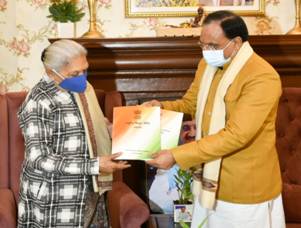
 The Governor of Uttar Pradesh Smt. Anandiben Patel called on Union Education Minister Shri Ramesh Pokhriyal ‘Nishank’ here today. Implementation of National Education Policy-2020 and other issues relating to Education sector were discussed during the meeting. Senior officials of the Ministry also attended the meeting.


During the meeting Smt. Anandiben Patel highlighted the initiatives taken by the State Education Department, Uttar Pradesh such as providing training to Anganwadi workers, teachers training, etc to ensure the academic welfare of the students. She also presented a copy of the book ‘Teacher’s guide’ for students of Pre-primary level and Primary level, to the Union Minister. The guide will help teachers to develop a better understanding of student centric teaching practices covering various subjects of environment, value education, etc in a joyful manner.

Shri Pokhriyal informed that as outlined in New Education policy, the foundation literacy and numeracy mission will be extended to Early Childhood Care Education for which a framework will be prepared on learning outcomes, teachers training, etc. He also informed that NCERT is developing a new National Curriculum Framework (NCF). He added that the suggestions given in the Teacher’s Guide will be examined and suitably incorporated in the NCF.

*****

TRIPLE TALAQ

According to the Islamic Law, different types of Talaq are there for men and women. There are three types of divorce for men, namely Talaq-e-Biddat (Triple Talaq), Hasan and Ahsan. Triple talaq is irrevocable whereas the other two are revocable. For women, there is ‘khula’, a traditional way of allowing the women to divorce their husbands by a judicial decree or mutual consent. Triple talaq is derived from an Arabic word which means divorce. It is divorce procedure of Islam. It is a practice among Muslims mainly Sunni Muslims about 1300 years old. The Indian Muslims consider it under the Personal Law. Triple talaq is a practice of Divorce under the Islamic Law.

In general terms, Triple Talaq also denotes irreversible and immediate divorce. The people of different countries including India who follow Islam i.e. who are Muslims follow this method of divorce. In triple talaq, a Muslim husband in one go gives divorce to his wife by uttering the word talaq three time. Once spoken, consequently the marriage becomes void. It can be oral and written. However, with the course of time, some individuals also consider it in digital form via whatsapp or email and regarded valid.

Triple Talaq Bill

Of lately, a major crowd is against the Triple Talaq practice as there is seen a dominance of men over women. Among the population of Muslim women in the nation, the practice went against the equality rights and empowerment of women. This procedure of divorce is not at par with the secularism and Fundamental principles of equity of gender. The Indian Muslim women are questioned of their basic human rights, dignity and justice. In the beginning, Muslim women raised voices against the practice of Triple Talaq and its abolishment at the State Election of Uttar Pradesh where the Prime Minister Shri Narendra Modi started a campaign. For the dissolution of the issues of women, the central government started finding solutions. As a result, in August 2017,Triple Talaq was considered unconstitutional by the Supreme Court and a number of religious, social and legal observations have been implemented against it.

Taking into account the Supreme Court’s judgment and barbarity faced by women, the Indian Parliament introduced the Triple Talaq Bill to make the Triple Talaq practice by Muslim men void. From 1st August 2019, the following bill became law, declaring that the Triple Talaq divorce is deemed to be void and subsequently illegal when given in any form, written, oral and digital. The Bill also declared Triple Talaq as perceptible as well as a non-bailable offense with imprisonment of three years along with fine. The women victim to such divorce is entitled to seek allowance for herself and the children from the husband.

Conclusion

The Triple Talaq practice has always been seen as a controversy by the entire world especially among those that follow Islam. Thus, it can be concluded that the main idea behind implementing such a bill to abolish Triple Talaq, was to maintain equity and prevent any sort of injustice and discrimination among the Muslims.

PRIORITIES OF WOMEN

According to a new survey from Edward Jones, “Female Financial Empowerment,”while women have made significant strides in gender and income equality in the workplace, one of the biggest obstacles they continue to face is the tendency to “prioritize immediate family needs” over saving for their own future.

That certainly helps explain what the financial services firm acknowledges is an inherent conflict in the findings: Although seven out of 10 women polled say they feel “confident” in their financial knowledge, all too many have actually done little to generate their own long-term wealth.

“Only 25 percent of women surveyed consider saving for retirement as their most important goal over the next three to five years,” says Nela Richardson, an investment strategist at Edward Jones. “That tells us that female financial empowerment should be next on the list of barriers women have broken over the past few decades.”

The two other biggest challenges women need to surmount, according to the national sample of 1,004 adult women ages 18 and older, is waiting for the “perfect” time to invest (something men do as well), or something else to motivate them.

Some examples: A big raise or other windfall (49 percent). A financial emergency (20 percent). A significant life event (20 percent). A market correction (12 percent).

“Waiting for a raise or a significant life event, by definition, isn’t a financial strategy,” Richardson says, “and they’ll always have competing priorities. The key is to anticipate both tailwinds and headwinds in life, and be flexible enough to adapt to changing situations so you can meet your long-term financial goals.”

Edward Jones lays out a female centric approach to handling your finances on its website. But here’s a quick cheat sheet to get you started:

• Make yourself a priority by starting to invest now in order to give your money time to grow – never underestimating the power of a wondrous thing called compound interest.

• Begin small with modest investments.

• Develop a goals-based financial strategy.

As for how much better women are doing financially, here’s one notable sign: Forbes’ list of the world’s 100 richest people featured just four females in 2000 compared to 10 this year. The richest woman – and fifteenth overall – is the L’Oréal heiress, Francoise Bettencourt Meyers ($49.3 billion), who is chairwoman of the family’s holding company.

But she inherited her wealth, you say? Well, the youngest billionaire ever, according to Forbes, is 21-year-old cosmetics wunderkind Kylie Jenner ($1 billion).

COVID-19 and its impact on LGBTQ+

The world came to a standstill with the spreading of the infectious coronavirus in 2020. In March 2020, the WHO declared the COVID-19 as a pandemic. Hence, the governments all around the world imposed (and are still imposing) nationwide/partial lockdown and curfew timings, as a measure to contain the spread of the virus.

With the imposition of lockdown came different sets of difficulties. The COVID-19 pandemic has had adverse impact on the world economy, and the impact is expected to be visible in the coming times as well. However, not just the economy but the social impact of the virus can be felt on different genders groups as well. Gender and sexual minorities are the one most prone to face the social impact of the virus.

COVID-19 and its discrimination towards LGBTQA+

The gender and sexual minorities (SGM) are especially vulnerable to the experiences of COVID-19. The SGM people collectively includes Lesbian, Gay, Bisexual, Transgender, Two-Spirit, Queer, Intersex, and Asexual (LGBT2SQIA+) people.  Hankivsky & Kapilashrami in their work ‘Beyond sex and gender analysis: An intersectional view of the COVID-19 pandemic outbreak and response’ (2020), mention that, While COVID-19 was initially framed as an illness that does not discriminate COVID-19, but like other biocultural health crises, it does in fact discriminate, and it does so in ways that mirror the discriminations that are fundamental to contemporary society.

It is not an uncommon fact for SGM people to face discrimination on a daily basis. Now in times of COVID and the past nation-wide lockdowns and state lockdowns, along with the mass hysteria of not-knowingness, their chances of facing discrimination is clearly higher than the usual.

In the work ‘Sexual and Gender Minority Health Vulnerabilities During the COVID‐19 Health Crisis’ (2020) by Gibb et al, they mention, the heteronormative structures of power, inequality and marginalisation have shaped the understanding of economic, social and political inequalities experienced by SGM people. The stigma, systemic discrimination and other forms of structural inequalities faced by SGM people’s reduces their access to vital resources such as basic healthcare, educational and employment opportunities, housing, wealth, social support and political power related to heterosexual cisgender people. Like other marginalised communities SGM people face the risk of behavioural and environmental inequalities linked to social and economic marginalisation. In the crisis of the COVID-19 pandemic, SGM people are being subjugated to the atrocities from the hysteria created by the public.

COVID-19 and mental health of LGBTQ+

With the imposition of nation-wide lockdowns and/or curfew timings, the livelihood of people came to a pause. This also meant that people had to return to their homes of safety. But, this option was not entirely available for people of SGM because of their past social unacceptance of their sexuality by their family and others. And hence, they had to take abode in unsafe neighbourhoods.

Gibb et al in their ‘Sexual and Gender Minority Health Vulnerabilities During the COVID‐19 Health Crisis’ (2020) further mention that, public health measures, such as social distancing and self-isolation, to protect the public from the pandemic may have unintended consequences for SGM people’s physical and mental health. Social distancing and isolation may lead SGM people to take shelter in dangerous places, and fall prey to experience violence and abuse. Such experiences also lead to cases of  anxiety and depression, increasing risks of suicide, self-harm and controlled substance dependence among the SGM people.

In worst case scenario when a LGBTQ+ person contacts the virus, the absence of love and care from loved ones can be damaging to their mental health. The emotional support from family could help them deal with the recovery process as they have someone to look forward to.

SGM and COVID-19 vaccination

The greater challenges faced by the LGBTQ+ was/is for getting the vaccination. There have been instances where members of the trans community were getting left out of the vaccination drive. One of the main reason for such exclusion is that it first requires the access to the web portal, which includes navigating through the sites, further demanding the need for identification to book a slot for the vaccine. This process can be quite complicated and not everyone has the access to the internet or other related means of access to it, thus creating a digital divide.

Apart from the challenge of booking a slot, there has been speculation regarding the efficacy of the vaccination and the possible side effects, which further limited the chances of them being vaccinated. However, different aid organisations are working towards especially vaccinating the LGBTQ+ community. Their efforts are yielding slow but visible results in vaccinating the community.

                         It can be regarded that the LGBTQ+ community members experienced the COVID-19 pandemic differently. These differences and discriminations always existed and will continue to do so. However, the pandemic has further exaggerated these already existing discriminations. Nevertheless, it is hopeful to anticipate that these discriminations would be reduced someday with collective efforts.

Pollution : A grim agenda

Pollution is a term which even kids are aware of these days. It has become so common that almost everyone acknowledges the fact that pollution is rising continuously. The term ‘pollution’ means the manifestation of any unsolicited foreign substance in something. When we talk about pollution on earth, we refer to the contamination that is happening of the natural resources by various pollutants. All this is mainly caused by human activities which harm the environment in ways more than one. Therefore, an urgent need has arisen to tackle this issue straightaway. That is to say, pollution is damaging our earth severely and we need to realize its effects and prevent this damage. In this essay on pollution, we will see what are the effects of pollution and how to reduce it.

essay on pollution

Effects of Pollution

Pollution affects the quality of life more than one can imagine. It works in mysterious ways, sometimes which cannot be seen by the naked eye. However, it is very much present in the environment. For instance, you might not be able to see the natural gases present in the air, but they are still there. Similarly, the pollutants which are messing up the air and increasing the levels of carbon dioxide is very dangerous for humans. Increased level of carbon dioxide will lead to global warming.

Further, the water is polluted in the name of industrial development, religious practices and more will cause a shortage of drinking water. Without water, human life is not possible. Moreover, the way waste is dumped on the land eventually ends up in the soil and turns toxic. If land pollution keeps on happening at this rate, we won’t have fertile soil to grow our crops on. Therefore, serious measures must be taken to reduce pollution to the core.

Types of Pollution

How to reduce pollution?

After learning the harmful effects of pollution, one must get on the task of preventing or reducing pollution as soon as possible. To reduce air pollution, people should take public transport or carpool to reduce vehicular smoke. While it may be hard, avoiding firecrackers at festivals and celebrations can also cut down on air and noise pollution. Above all, we must adopt the habit of recycling. All the used plastic ends up in the oceans and land, which pollutes them.

So, remember to not dispose of them off after use, rather reuse them as long as you can. We must also encourage everyone to plant more trees which will absorb the harmful gases and make the air cleaner. When talking on a bigger level, the government must limit the usage of fertilizers to maintain the soil’s fertility. In addition, industries must be banned from dumping their waste into oceans and rivers, causing water pollution.

Conclusion

To sum it up, all types of pollution is hazardous and comes with grave consequences. Everyone must take a step towards change ranging from individuals to the industries. As tackling this problem calls for a joint effort, so we must join hands now. Moreover, the innocent lives of animals are being lost because of such human activities. So, all of us must take a stand and become a voice for the unheard in order to make this earth pollution-free.

The Tourist Attraction by Sarah Morgenthaler

This book was so enjoyable and cute for 70% of it. Graham and Zoey have an instant connection. Graham is a grumpy, Alaska native who runs a local diner, has a blind dog that he dresses up in outfits, and is a woodcarver in his spare time. Zoey is a tourist who has been saving up for this Alaska trip for years (so ~she’s not like other tourists~ in this typical rich area). Because of their instant connection, the story provides a lot of cute moments of them feeling like a couple from nearly the beginning. There’s also the cool backdrop of Alaska, the vacation romance element, and the small town vibe that I loved.

But, firstly, the book went on too long. It started to drag a bit. Then, there was repeating conflict. The big conflict here is that this is short term, since Zoey is a tourist. That’s all well and good, but the characters decide to “fight” about this over and over at the end which feels inconsistent with the rest of the story because they are not a tumultuous couple.

Also, Graham has a violent streak which was so unnecessary. I loved his grumpy personality with a heart of gold. But then, he has these moments of “alpha male” where he wants to punch any other guy that shows interest in Zoey, he punches a wall at one point, and actually ends up punching another male character for a reason that I think was really weak and unjustified. Zoey at one point does call him an “alphahole”, which is a romance community word for these type of toxic masculine characters, but beyond that the narrative doesn’t really address this behavior as bad. He even breaks the law a few times and it’s brushed off because “he’s a local and knows everyone.” It was an addition that felt unnecessary because his grumpy but loveable personality that was present for the majority of the book was just fine!

The combination of the book dragging on so that I lost some of the tension, along with the bad behavior dropped this from what would have been a 4 star down to a 3/3.5 star. This is going to be a series set in this tourist town, and I will likely continue as I did enjoy the setting and am intrigued about some of the side characters and their stories.

tropes:
– nicknames
– small town romance
– vacation romance: tourist + local

Clap When You Land by Elizabeth Acevedo

It is hard to describe the space that yawned open in the life of Camino Rios and Yahaira Rios after their father died in a flight crash. It is harder still to describe the truths he left behind, cutting swift and deep, like a knife: Camino and Yahaira are sisters who, for sixteen years, hadn’t known of each other’s existence. Their world too had tipped, and fallen, and the secrets their father held aloft over their heads are seized by gravity. Now it was just the two of them, and the slow, outgoing tide of aftermath.

Camino and Yahaira are both desperately pawing for the truth of their father as they might paw at beach sand in hopes of finding a shell, hunting in the rubble of his life for answers, and trying to find their way to each other across the Rubicon that divided their two worlds.

On the screen, beyond where she can see, I trace her chin with my finger. & for the first time I don’t just feel loss. I don’t feel just a big gaping hole at everything my father’s absence has swallowed. Look at what it’s spit out & offered. Look at who it’s given me.

There’s no doubt that Acevedo is one of the brightest literary talents around.

Tender, patient and raw as a wound, “Clap When You Land” burrows deep under its reader’s skin while at the same time nudging them into inhabiting the perspective of its characters. The author possesses a unique musicality for language—her writing buoys and soothes at once, and I wanted nothing more than to breathe the words in until they ached inside my chest, to nestle into the story’s steady warmth like a well-worn sweater. But for all the novel’s poetry and lyricism, Acevedo never forgets to tell a gripping tale.

There’s a chafed, bruised feeling to this book, and something in me splintered while reading it. “Clap When You Land” is a novel that explores the wrenching depths of what it feels like to lose something and be unable to move on, not only a literal person, but also a way of life. This is Cami and Yaya’s story of weary grief and visceral longing—the novel alternating between their voices—but you are in there too, and that makes their loss your loss, the ache your ache, the anger you anger, and the secrets their father had sealed away inside him like a box with another box inside it and another inside something you too must process and come to terms with yourself. All of it burgeoning within you with every turn of the page, welling up like tears. And that owes in huge part to the author’s deft, tender characterizations, and the way she artfully infuses her novel with great empathy—offering the reader so many questions, but not giving any direct or easy answers.

Yaya and Cami’s father had been the life of their small universe, and without him their world felt huge and empty, like a shipwreck hull. They loved him, and they mourned him, but they also wondered if they could ever really forgive him. In the fraying cobwebs of their memories, the side of their father that they saw was polished to such a high gloss of perfection—the loving, attentive father—but it is now vying with this newly revealed side of him—the terrible husband, the selfish man—and the two are clashing like swords. Does one side cancel out the other? Will Cami and Yaya ever be able to think of him and see only the word “father” and not the things he left behind?

This is the “gift and curse” both Yahaira and Camino are wrestling with throughout the story. Camino and Yahaira didn’t have to articulate the curious shape of their grief because they could see it mirrored in each other’s eyes. Cami, on the one hand, is grateful, but she can’t help but think a little bit secretly—and resentfully—in her heart that life for Yahaira has been as easy as pulling strings: Yahaira, after all, got to live with their father nine months a year in their New York apartment, while Cami is the one he left behind, fighting off the unwanted advances of an older neighbor who refused to take no for an answer. Yahaira, on the other hand, can see the sadness in Cami’s anger, the guardedness of grief, and she’s grappling with her own relationship to her mother, both of them filled with a sadness that they could not articulate without fracturing their relationship.

As for other thematic notes, the novel probes achingly at the question of identity, what it means to grow up in a world you felt only halfway inside of, and to question your claim to your parents’ roots when you’ve never set foot in their world. The novel cracks open all that wordless agony like an egg and leaks out the words: “Can you be from a place you have never been? You can find the island stamped all over me, but what would the island find if I was there? Can you claim a home that does not know you, much less claim you as its own?” The author also skillfully articulates how different tragedies are portrayed in the media, especially the ones that touch a marginalized community, and how those stories tend to be quickly robbed of their sharp edges, easily dismissed even while those communities are still wrestling with the loss.

That said, Acevedo tempers the sting of that harsh reality with the beauty of hope in a way that is deeply affecting. Yahaira and Camino’s feelings are twins, even if they are not, and the ravine between them gets smaller enough to close with every page. There’s also so much sapphic tenderness nestled into this story: Yahaira and Dre’s relationship filled me with so much warmth.

I tell her that when we land some people on the plane might clap. She turns to me with an eyebrow raised. I imagine it’s kind of giving thanks. Of all the ways it could end it ends not with us in the sky or the water, but together on solid earth safely grounded.

Hello, Summer by Mary Kay Andrews

We all know Mary Kay Andrews is the Queen of summer reads. I read her books every May when they typically publish. I was super excited for Hello, Summer and let me just say this did NOT disappoint!

Conley is a big time reporter and is leaving her current company to start a bigger and better job. The day of her going away party her sister sends her an article that the company she’s transitioning to is going under and her current company already found her replacement. Not knowing where to go, she drives to her G’mama’s house in Florida to sort things out. Once she’s there she gets some pressure to help with the family’s local paper and it ends up being more than she bargained for.

Conley gets involved with a former high school flame as well as in the middle of a family political scandal. She is a witness at a scene of a crime and has to literally fight for her life. All the while she is trying to make amends with family she hasn’t visited in six years after she randomly shows up on their doorstep. Conley goes through about every emotion trying to really figure out what the important things are and she must learn to enjoy what’s right in front of her.

I loved this book so much and I think that it’s MKA’s best one yet. It is quite lengthy (500 pages) but I read it in under 2 days because I wanted to know what was going to happen with Conley and the rest of the characters. This is written in short chapters and they make you want to keep turning the pages as there were a few story lines going on at once. I felt the characters were relatable in some way or another. I also felt totally transported to the beach town Silver Bay and felt like a fly on the wall watching it all play out.

What I loved most about this book was it had everything I want in a book. It had characters I loved and characters I hated. It had a soft love story. It had a political family with a scandal. It has an investigation playing out. It has family drama, secrets and relationships that work through their problems. It had a strong female lead who figured out what she really wanted in life, not because anyone else told her what she should want. It had beautiful descriptions of the beach and sunsets. It just had everything I always look for in a beach read

Overall, this book was stellar. It may seem intimidating with the page count but don’t let that stop you. I promise it’s worth the read and I will definitely be recommending it to all during this summer season!

Thank you to St Martin’s Press, KCCPR and Tandem Literary for my ARC and finished copies of this book. Go pick this one up now!