Prime Minister’s Employment Generation Programme (PMEGP)

 Ministry of MSME is implementing Prime Minister’s Employment Generation Programme (PMEGP) since 2008-09 through Khadi and Village Industries Commission (KVIC) as nodal agency at the national level for generating employment opportunities in the country by setting up micro-enterprises in non-farm sector.


Under PMEGP, General Category beneficiaries can avail of Margin Money subsidy of 25 % of the project cost in rural areas and 15% in urban areas. For Special Categories such as SC/ST/OBC/minorities/women/ex-serviceman/physically handicapped /NER/Hill and Border areas, etc., the Margin Money subsidy is 35% in rural areas and 25% in urban areas.  Maximum project cost for manufacturing unit is Rs.25 lakh and for service sector is Rs.10 lakh.


            Since its inception upto 31.12.2021, about 7.38 lakh new micro units have been assisted utilizing margin money subsidy of Rs.17819.23 cr. generating estimated employment opportunities for about 60.60 lakh persons.

            The scheme has been successful in generating rural employment spread across various social categories. Around 80% of the PMEGP units have been set up in rural areas and about 50% of the units have been set up by SC/ST/Women entrepreneurs. Target set and achievement made under the PMEGP Scheme in the country during the last three years and current year as on 27.01.2022 is given below:


 Margin Money :- Rs. in lakh)

Year

Target

Achievement

No. of Units assisted

Margin Money disbursed

Estimated Employment Generated

No. of Units assisted

Margin Money disbursed

Estimated Employment Generated

2018-19

72381

206880.00

579048

73427

207000.54

587416

2019-20

79236

239644.00

633888

66653

195082.20

533224

2020-21

78625

228968.52

629000

74415

218880.15

595320

2021-22 (as on 27.01.2022)

92666

285000.00

741328

60180

185122.76

370840


State/UT-wise number of Women beneficiaries benefitted under PMEGP scheme during last three years and current year is given at Annexure.


Following steps have been taken for the effective implementation of PMEGP:


  1. The process of application flow, including bank sanctions and disbursement, has been made faster and transparent through introduction of on-line portal.
  2. The process of selection of entrepreneurs has been further streamlined with the discontinuation of the role of District Level Task Force Committee (DLTFC) since April, 2020, in recommending proposals/applications to financing banks. In the revised scenario, the proposals are now sent directly by Implementing Agencies to financing banks based on a Score Card model, thereby reducing the overall approval period.
  3. Organizing of Entrepreneurship Training Programme (EDP), mandatory before disbursal of loan by Banks, has been made online since October 2019 to provide expedited training and release of loan to the beneficiaries.
  4. Free two day online pre- EDP training has been introduced for interested applicants. 
  5. The list of activities has been expanded to attract entrepreneurs for setting up diverse units.
  6. Implementing Agencies like Khadi and Village Industries Commission (KVIC), State Khadi and Village Industries Board (KVIB) and District Industries Centres (DICs) are providing handholding to applicants, through call centres, online tutorials as well as with help desks with banking and marketing experts.
  7. Sector/industry wise webinars are also being organized every Sunday involving industry experts and banks with participation of more than 300,000 prospective applicants.


No. of  Women beneficiaries assisted under PMEGP during last three years and Current Year (as on 27.01. 2022)


Sr. No.


Name of State/UT


2018-19

2019-20

2020-21

2021-22

(as on 27.01. 2022)

1

Jammu & Kashmir

2449

1861

3235

5982

2

Ladakh

0

0

85

46

3

Himachal Pradesh

528

447

431

     279

4

Punjab

703

681

737

493

5

U.T. Chandigarh

13

8

6

5

6

Haryana

547

592

622

469

7

Delhi

54

41

33

30

8

Rajasthan

524

732

663

446

9

Uttarakhand

499

467

551

288

10

Uttar Pradesh

1433

1574

2777

2193

11

Chhattisgarh

726

670

753

444

12

Madhya Pradesh

738

627

1435

1075

13

Sikkim

27

29

24

13

14

Arunachal Pradesh

99

77

38

41

15

Nagaland

535

481

310

232

16

Manipur

533

518

725

265

17

Mizoram

542

389

417

110

18

Tripura

248

219

224

136

19

Meghalaya

126

117

140

102

20

Assam

999

798

951

464

21

Bihar

861

582

665

425

22

West Bengal

810

911

907

530

23

Jharkhand

428

451

444

256

24

Odisha

1185

1160

1319

936

25

A & N Islands

51

17

42

25

26

Gujarat*

2382

2719

1841

2061

27

Maharashtra**

1965

1636

1179

984

28

Goa

30

36

18

26

29

Andhra Pradesh

1101

1113

856

811

30

Telangana

668

735

734

579

31

Karnataka

1086

1167

1492

1160

35

Lakshadweep

0

0

2

33

Kerala

1052

1003

953

612

34

Tamilnadu

2463

2841

2663

1699

35

Puducherry

29

21

13

20

GRAND TOTAL

25434

24720

27285

23237


Guidelines on Extended Producers Responsibility on plastic packaging under Plastic Waste Management Rules, 2016

 Ministry of Environment, Forest and Climate Change has notified the Guidelines on Extended Producers Responsibility on plastic packaging under Plastic Waste Management Rules, 2016. The guidelines on extended producer responsibility coupled with prohibition of identified single use plastic items, which have low utility and high littering potential, with effect from 1st July 2022, are important steps for reducing pollution caused due to littered plastic waste in the country. 

In a tweet message, Minister for Environment, Forest and Climate Change, Shri Bhupender Yadav informing about the development stated that guidelines will promote development of new alternatives to plastics and provide a roadmap for businesses to move towards sustainable plastic packaging.

The Guidelines provide framework to strengthen circular economy of plastic packaging waste, promote development of new alternatives to plastics and provide further next steps for moving towards sustainable plastic packaging by businesses. Reuse of rigid plastic packaging material has been mandated in the guidelines to reduce the use of fresh plastic material for packaging. 

The enforceable prescription of minimum level of recycling of plastic packaging waste collected under EPR along with use of recycled plastic content will further reduce plastic consumption and support recycling of plastic packaging waste.

The EPR guidelines will give a boost for formalization and further development of plastic waste management sector. In a significant first, the guidelines allow for sale and purchase of surplus extended producer responsibility certificates, thus setting up a market mechanism for plastic waste management. 

The implementation of EPR will be done through a customized online platform which will act as digital backbone of the system. The online platform will allow tracking and monitoring of EPR obligation and will reduce the compliance burden for companies through online registration and filing of annual returns. In order to ensure monitoring on fulfilment of EPR obligations, the guidelines have prescribed a system of verification and audit of enterprises.

The Guidelines prescribe a framework for levy of environmental compensation based upon polluter pays principle, with respect to non-fulfilment of extended producer responsibility targets by producers, importers & brand owners, for the purpose of protecting and improving the quality of the environment and preventing, controlling and abating environment pollution. The funds collected shall be utilized for collection, recycling and end of life disposal of uncollected plastic waste in an environmentally sound manner. 

Under these producers, importers & brand owners, may operate schemes such as deposit refund system or buy back or any other model, in order to prevent mixing of plastic packaging waste with solid waste. 

Detailed Notification


***

STARS project signed between DEA and World Bank

 Agreement for the financial support of the implementation of Strengthening Teaching-Learning and Results for States (STARS) project of Ministry of Education was signed between Department of Economic Affairs (DEA) and World Bank along with Ministry of Education. The total project cost of STARS project is Rs 5718 crore with the financial support of World Bank amounting to US $ 500 million (approximately Rs. 3700 crore) and rest coming as State share from the participating States, over a period of 5 years.

STARS project would be implemented as a new Centrally Sponsored Scheme under Department of School Education and Literacy (DoSEL), MOE. Earlier Union Cabinet has approved the proposal of STARS project on 14th Oct 2020. The project covers 6 States viz Himachal Pradesh, Rajasthan, Maharashtra, Madhya Pradesh, Kerala and Odisha. The identified States will be supported for various interventions for improving the quality of education.

The Program envisions improving the overall monitoring and measurement activities in the Indian school education system through interventions in selected states. STARS will draw on existing structure under Samagra Shiksha with the DoSEL, MoE as the main implementing agency at the national level. At the State level, the project will be implemented through the integrated State Implementation Society (SIS) for Samagra Shiksha.

The proposed World Bank support under STARS is primarily in the form of a results-based financing instrument called Program for Results (PforR). This will ensure major reforms at the State level through a set of disbursement-linked indicators (DLIs). A State Incentive Grant (SIG) will be used to encourage States to meet desired project outcomes. The SIG matrix has been aligned with the intermediate outcome indicators as per the requirement of PforR instrument. An independent Verification agency (IVA) will verify each result before disbursement of funds.

STARS project will be instrumental in the implementation of various recommendations of National Education Policy 2020 i.e. Strengthening Early Childhood Education and Foundational Learning, Improving Learning Assessment System, ICT-enabled approaches in education, Teachers Development and Vocational education etc.

                                                               ******


Valedictory Function of Kala Utsav

 Union Education Minister Shri Ramesh Pokhriyal ‘Nishank’ today addressed the Valedictory Function of Kala Utsav 2020.

Addressing on the occasion, Shri Pokhriyal said that Kala Utsav realises the vision of the Prime Minister Shri Narendra Modi by giving the right direction and shape to the spirit of ‘Ek Bharat Shreshtha Bharat’. He appreciated the introduction of the Indigenous Toys and Games segment in Kala Utsav 2020 and emphasized that this promotes ‘Vocal for Local’.

Speaking on the National Education Policy 2020, Union Minister said the policy emphasises the promotion of arts and culture through education. Kala Utsav 2020 has also incorporated the recommendations of the National Education Policy 2020. Students, when indulging in any form of art, use their imagination and try to realise it and give it life thus turning it into reality. Kala Utsav gives an opportunity to this process. Such opportunities enhance the students’ reasoning, comprehensibility, problem solving, cognitive and decisive abilities, which are helpful in the all-round development of the student.

Shri Pokhriyal congratulated all the participants and the organisers for putting up such enthralling performances virtually, in the odd circumstances this year, an achievement unimaginable till a few months back. He expressed his happiness that  the unanimous participation of all the states with unparalleled enthusiasm prove once again that India is an epitome of Unity and Diversity which is also her speciality and source of strength. 

About Kala Utsav 2020:

Kala Utsav 2020 was launched online on 10 January 2021 through a digital platform. A total of 35 teams have participated in Kala Utsav 2020, from different states, union territories, Kendriya Vidyalaya Sangathan and Navodaya Vidyalaya Samiti schools where 576 students demonstrated their talent. Out of these participants, 287 girls and 289 boys participated in Kala Utsav 2020 including four divyang participants. The Department of School Education and Literacy, Ministry of Education and National Council of Educational Research and Training have done commendable work. Due to their tireless hard work, Kala Utsav 2020 has been successful, even in the circumstances of COVID-19.

In the competitions of Kala Utsav 2020 organised from 11 to 22 January 2021, a total of nine art forms, namely— 1. Classical singing 2. Traditional folk song 3. Classical instruments
4. Traditional/folk instruments 5. Classical dance 6. Folk dance 7. Visual Arts (Two-dimensional) 8.Visual Arts (Three-dimensional) 9. Local games-toys are included. Earlier there were only four art forms in Kala Utsav, now another five art forms have been added in it.

Click here to access the result of Kala Utsav 2020

MC/KP/AK

****

Azadi Ka Amrit Mahotsav

The government of India brought up the initiative of Azadi Ka Amrit Mahotsav to mark and celebrate the 75 years of developing independent India. The initiative is a personification of all the developments of India’s political, socio-cultural and economic identity and through this India is commemorating the glorious history of it’s culture, people and accomplishments.

On 12th March 2021, the Prime Minister of India, Shri Narendra Modi flagged off the beginning of the 75-week long ‘Azadi Ka Amrit Mahotsav’ from Sabarmati Ashram to celebrate 75 years of India’s freedom. This festival commenced the countdown to India’s 75th independence day anniversary and this will end after a year on 15th August 2023. A Dandi Yatra from Sabarmati Ashram was initiated by Mahatma Gandhi on 12th March 1930 in awake of nation’s self-esteem and self-reliance. On the same day in 2021, PM Modi started the emblematic Dandi Yatra which marked the amelioration of the journey of self-reliance and self-esteem through Azadi Ka Amrit Mahotsav. Azadi Ka Amrit Mahotsav is devoted to the people of India who have been contributory and influential in the evolutionary progress of India as well as who also hold within them the potential and capability to enable PM Modi’s vision to initiate the 2.0 version of India which is energized by the Atmanirbhar Bharat spirit.

The centre focus is on participation of citizen to make Azadi Ka Amrit Mahotsav a ‘Janandolan’ where local level minor efforts will accumulate notable national gains. Thus, a number of intensive campaigns are being organized countrywide. In order to celebrate the freedom of fighters, numerous programs of freedom with the name of Azadi Ka Amrit Mahotsav are being coordinated across the nation. These campaigns or programs include various competitions, photo exhibitions, etc. that portrays the contribution and struggle of the freedom fighters. In some places, the display of Azadi Ka Amrit Mahotsav is in two parts, one part depicting the freedom movement prior to the Mahatma Gandhi’s arrival and the other picturizing the struggle of freedom led by Gandhiji. Various historical photographs depict the contribution of the famous Lal-Bal-Pal, Lala Lajpat Rai, Lokmanya Tilak and Bipin Chandra Pal. The movements of various other revolutionaries are also displayed including Mangal Pandey, Rani of Jhansi Rani Laxmibai, Raja Rammohan Roy, Swami Vivekananda, Swami Dayanand, Chief Kartar Singh Sarabha, Veer Savarkar, Annie Besant, Khudiram Bose, Bhika Ji Cama and many more. The entry of Gandhi into Indian politics post his return to India from South Africa in 1915 is well portrayed in the photo exhibition series and his freedom movement was taken into a new era. The war fought through Satyagraha reaches Champaran Satyagraha (1917), Kheda Satyagraha (1918), Jallianwala Bagh Nar Sanhar (1919) from Non-Cooperation Movement (1921) to Dandi Satyagraha (1930) is shown along with special; reference to Sardar Vallabhai Patel’s role in the integration of nation and Netaji Subhash Chandra Bose’s role in the freedom movement. Meanwhile, the martyrdom of Chandra Shekhar Azad, Bhagat Singh, Sukhdev, Rajguru was also remembered. The exhibition as a whole depicts the chronological order of freedom fighters, independence movements and their struggle to make India free.

Thus, it can be inferred that the rapid strides that India took in the past 75 years is commemorated in the ‘Azadi Ka Amrit Mahotsav’ festival. This festival aims at encouraging us to retrieve our strengths that are hidden and prompts us to take sincere and collaborative action to regain our deserving place in the nation’s courtesy.

Water Taxi Service in Mumbai

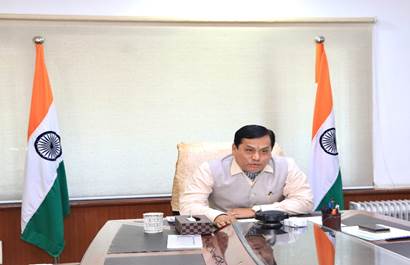
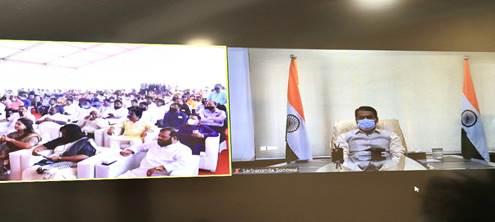
 Union Minister of Ports, Shipping and Waterways & AYUSH Shri Sarbananda Sonowal today virtually flagged off the ‘Most Awaited’ Water Taxi for citizens of Mumbai, from Belapur Jetty. Chief Minister of Maharashtra, Shri Udhav Thackeray presided over the on-ground function where he inaugurated the newly constructed Belapur Jetty.

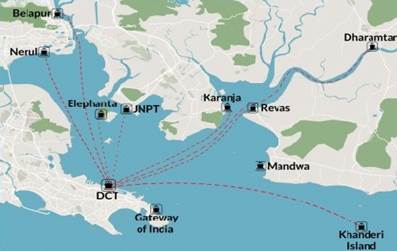
A long time aspiration of the people of coastal Maharasthra, the Water Taxi service will connect the twin cities of Mumbai and Navi Mumbai for the first time. The Water Taxi services will commence from the Domestic Cruise Terminal (DCT) and will also connect nearby locations at Nerul, Belapur, Elephanta island and JNPT. The service promises a comfortable, stress-free journey, is time-saving and promotes eco-friendly transport. 

The Water Taxi services are going to give huge impetus to the tourism sector, especially travel to the historic Elephanta caves from Navi Mumbai. Visitors will be able to travel easily from Navi Mumbai to Gateway of India.

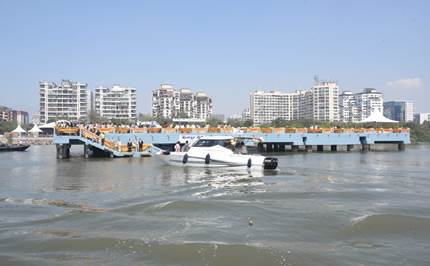
The newly constructed Belapur jetty, built at a cost of Rs. 8.37 crore was funded in the 50-50 model under the Sagarmala scheme of the Ministry of Ports, Shipping and Waterways. The new jetty will enable movement of vessels to locations like Bhaucha Dhakka, Mandwa, Elephanta and Karanja.

Addressing the physical event via VC, Shri Sarbananda Sonowal lauded the Mumbai Maritime Board and Central & State agencies for completion of the projects which brings huge benefits to the citizens, boosts tourism and opens avenues for employment generation.  “Sagarmala Programme has undertaken a range of projects across an array of categories such as port modernization, rail, road, cruise tourism, RORO & passenger jetties, fisheries, coastal infrastructure, skill development. 131 projects worth Rs. 1.05 lakh crore has been identified for implementation in Maharashtra,” the Union Minister stated.

The Union Minister added, “Out of 131, 46 projects worth Rs. 2078 crore being financially supported under Sagarmala scheme of Ministry of Ports, Shipping and Waterways. Maharashtra coast has huge potential for urban water transportation which can become an alternate mode of transportation. ROPAX movement between Mumbai Ferry Wharf and Mandwa has resulted in a positive impact with a reduction in travel time for passengers, quick and agile loading and unloading process of vehicles. More than 32 projects were undertaken in four clusters – Palghar, Mumbai & Raigad, Ratnagiri and Sindhudurg.”


“For upliftment of the fishing community, four fishing harbour projects have been sanctioned for funding under Sagarmala. Stage II expansion of Mirkawada Fishing Harbour in Ratnagiri District have been completed, modernization of Sassoon Dock and development of Karanja in Raigad and Anandwadi in Sindhudurg district are under implementation. Further, proposal for modernization of Mallet Bunder in Mumbai is under active consideration.” the Minister  stated.

Shri Sonowal thanked the Maharasthra Govt for their active role in developing the infra projects. “India’s is getting faster under the PM GatiShakti National master Plan. Under the leadership of Prime Minister Shri Narendra Modi  I believe we can achieve much as Team India, working with the spirit of brotherhood and oneness,” the Union Minister concluded.   

**********

winners of Freedom2Walk & Cycle challenge Awards

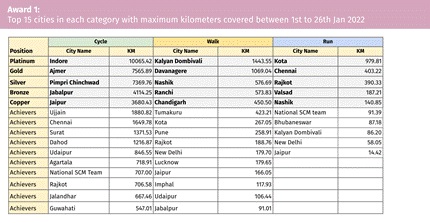
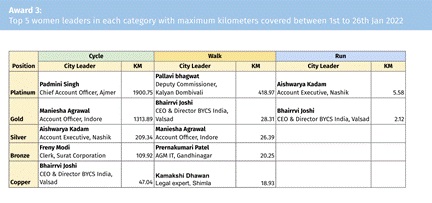
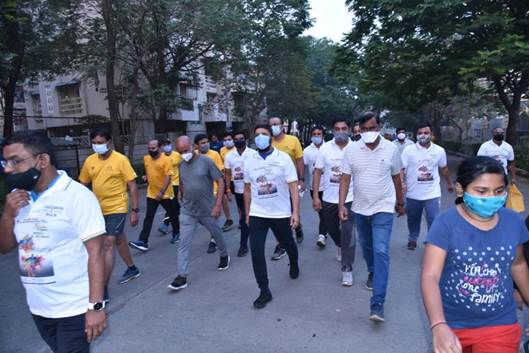
 Smart Cities Mission, Ministry of Housing and Urban Affairs (MoHUA), as part of the activities being undertaken under Azadi Ka Amrut Mahotsav (AKAM) launched two unique national level challenges for the first time- “Freedom 2 Walk & Cycle Challenge for City Leaders” & “Inter- City Freedom 2 Walk & Cycle Challenge for Citizens” between 1st to 26th January 2022. In addition to being events that motivate citizens to adopt healthier life choices in a celebratory spirit, the Challenges serve the larger purpose of a long-term behavioral change in citizens towards taking up walking & cycling, and to make city leaders as walking and cycling champions in each city. 

            An online awards event was hosted by MoHUA today to recognize the top performing cities and city leaders in both the challenges. The event also laid out the goals that cities from India Cycles4Change, Streets4People & Transport4All Challenges will be working towards 2023. The Institute for Transportation and Development Policy (ITDP) is the knowledge partners of Smart Cities Mission for the above-mentioned initiatives. 

Impact of the Challenges

            The city leaders Challenge saw registration from nearly 130 city leaders from across the country, comprising of Commissioners, Additional/Joint/Deputy Commissioners, Smart City CEOs and key SPV officials who jointly achieved nearly 47,000 kms of cycling, 7000 kms of walking and 2500 kms of running during the Challenge. The citizens challenge saw an overwhelming participation from nearly 22,000 citizens from the 75 registered cities, who achieved nearly 9,80,000 km of cycling, 1,82,000 km of walking and 9,350 km of running.

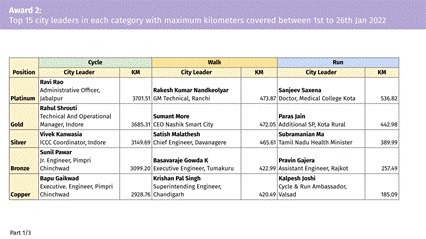
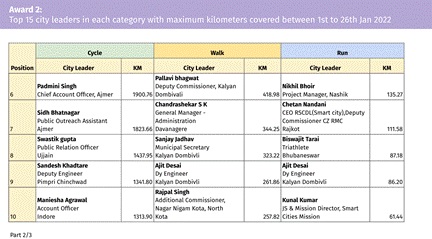
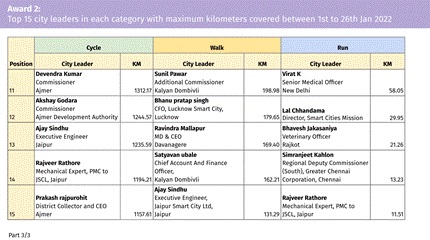
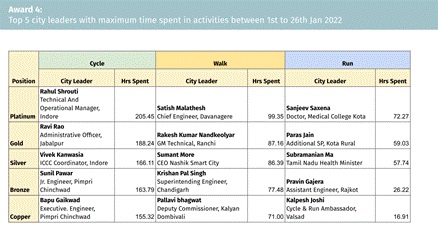
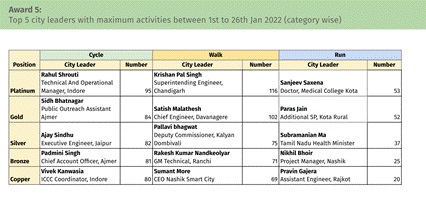
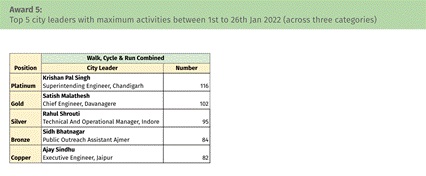
The awards for the city leaders challenge were given in the following categories for performance between 1st to 26th Jan 2022:

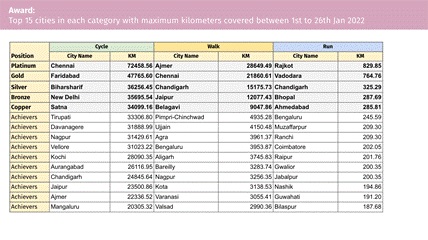
1. Cities with maximum kilometers  

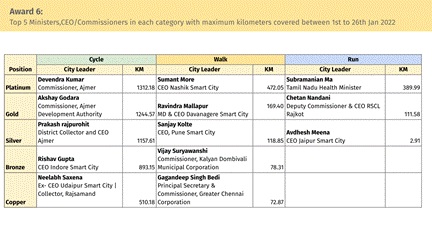
2. City leaders with maximum kilometers 

3. Woman city leaders with maximum kilometers 

4. City leaders with maximum time spent in activities 

5. City leaders with maximum number of activities during challenge 

6. Awards for Ministers, CEOs & Commissioners with maximum kilometers

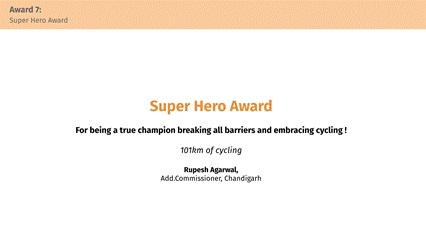
7. Super Hero Award 


            The awards for the citizens challenge were given in the following categories for performance between 1st to 26th Jan 2022:

1. Cities with maximum kilometers  

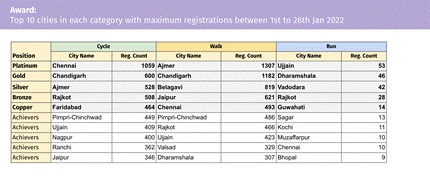
2. Cities with maximum registrations

            The list of awardees is mentioned in Annexure.


            Towards sustaining the momentum beyond the challenge, the participating cities are in the process of signing pledges committing towards institutionalizing activities like Cycle2Work, Open Street Events, Pedestrian Days and physical infrastructure to improve walking and cycling in cities. 18 Cities – Ajmer, Nashik, Rajkot, Lucknow, Kalyan Dombivli, Bhubaneshwar, Jabalpur, Tumakuru, Surat, Valsad, Dahod, Nagpur, Ranchi, Chandigarh, Kakinada, Ujjain, Pimpri Chinchwad, Indore have signed the pledges so far. Aurangabad, Jaipur, Davanagere, Sagar, Pune are in the process.


Goals for 2023: India Cycles4Change, Streets4People & Transport4All Challenges 

            In 2020, the Government of India launched the India Cycles4Change Streets4People Challenge to inspire over 100 cities to reimagine streets as safe, happy and healthy public spaces and towards creating cycling friendly cities. This is in line with the vision of National Urban Transport Policy (2006) that calls for a paradigm shift from car-centric roads to people-centric streets. The Transport4All Challenge was launched in 2021 aiming to bring together cities, citizens, and startups to develop solutions that improve public transport to better serve the needs of all citizens. Through these challenges, cities have adopted a new mantra of engaging with citizens, crowdsourcing ideas, and testing innovative, inexpensive, and quick ideas to create walking & cycling-friendly streets.

            The online event discussed on initiatives that the challenge cities should work towards till 2023 which includes permanent pilots, policy adoptions & institutional interventions. 

Annexure


1. Award Winners


2. Quotes from city leaders on the Freedom2Walk&Cycle Challenge

‘I have started cycling more often to work and for recreation over the last couple of years. Not only have I become more physically and mentally fit, it has given me a different perspective towards looking at the city and its needs. Cycling is a humble yet very powerful tool that can transform the cities we live in. I urge all city leaders and citizens to experience their cities through walk and cycle and become champions who inspire others’  

  • Kunal Kumar, Joint Secretary, Smart Cities Mission, MoHUA


‘The Challenge is an excellent initiative that brought me closer to my old love, cycling. The consistency of the other participants and the appreciation from my fellow colleagues has been motivating me every single day to clock in a ride. I also urge my fellow women leaders to break the stereotypes and take to cycling. It has empowered me and I’m sure it will do so for you too. Let’s seek inspiration from Serena Williams, Krishna Punia, Mithali Raj, PV Sindhu and let’s choose to be more fit, enjoy the thrill, and contribute to making the planet green.’

  • Padmini Singh, Chief Account Officer, ASCL, Ajmer

‘I am extremely grateful for the Freedom to Walk & Cycle Challenge for having triggered a regular walking habit and I look forward to continuing the walks even after the Challenge is complete! Overall, walking is a great solution for physical and mental health and I see the benefits first hand. It keeps my mind agile, fresh, active and focussed throughout the entire day! Over and above this, it is also a good environmental solution in times of climate change.Walking and cycling short distances to work, or to run small errands is absolutely doable by everyone. I urge my fellow colleagues, friends, other city leaders as well as citizens to pick up this habit as a way of life.’

  • Pallavi Bhagat, Deputy Commissioner, Kalyan Dombivli

‘Initiatives like these challenges for city leaders and citizens have the potential to change your life and the culture of your city. My personal journey of walking and cycling started in 2014 through a similar official assignment and it has been one of my best decisions! It improved my physical fitness and my productivity at work.  I have seen a huge impact of such interventions in the way people have responded to running, walking or cycling and it has also helped in bringing city leaders & citizens closer! I would strongly urge my fellow city officials and citizens to take up walking and cycling. Lets start walking and commutting to work on cycle whenever possible and let’s make a difference together.’

  • Chetan Nandani, CEO Rajkot Smart City Development Ltd (RSCDL) & Dy. Municipal Commissioner, Rajkot Municipal Corporation

‘It’s been heartening to see how citizens and city leaders embraced the two national level challenges and that nearly 15 cities have already signed pledges committing to institutionalizing initiatives that promote walking and cycling. It is campaigns like these that help instill long term behavioral change in citizens towards taking up walking & cycling!’ 

  • Aswathy Dilip, South Asia Director, Institute for Transportation & Development Policy, (ITDP India)

‘From international leaders being an inspiration for us walking and cycling to work, our leaders are now being an inspiration worldwide! Being part of the coordinating team for the challenges, it was inspiring for us to see the level of participation and excitement that cities and city leaders showed for the two national level challenges! The impact numbers and experiences shared by city leaders reflect the success of this initiative.’ 

  • A V Venugopal, Deputy Manager – Healthy Streets & Partnerships, Institute for Transportation & Development Policy (ITDP India)


3. Video Testimonials from City Leaders


1. Rupesh Agarwal, Add.Commissioner, Chandigarh

2. Rahul Kapoor, Director, Smart Cities Mission

3. Rajesh Pandya, Advisor, Surat Municipal Corporation

4. Bapusaheb Gaikwad, Executive Engineer, Transport Department, Pimpri Chinchwad

5. Sunil Pawar, Deputy Engineer, Transport Department, Pimpri Chinchwad

6. Sambhav Ayachi, Assistant Commissioner, Jabalpur

7. Dr. Sanjeev Saxena, Medical Officer, Kota


***

Women in Renewable Energy: Call for Action


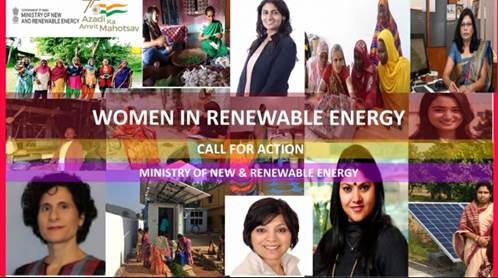
The Ministry of New & Renewable Energy (MNRE) observed the second day of its programme “New Frontiers: A Programme on Renewable Energy to celebrate Azadi ka Amrit Mahotsav. The Ministry organized an online session on “Women in Renewable Energy: Call for Action” to acknowledge the role of women entrepreneurs and leaders in the Renewable Energy Space. The session was attended by more than 200 participants including Padma Shree Awardee, Mr. Bunker Roy, officials of the Government of India, CEOs, CMDs, and representatives of NGOs, industries, banking institutions and, representatives from international organisations. 

Delivering the keynote address Secretary, MNRE recognised the role and importance of women’s participation in Renewable Energy and committed to formulation of a scheme for DRE applications, grater engagement with Ministry of Women and Child Development and addressing women’s issues in industry consultations.

Women RE entrepreneurs across the country shared their success stories, shining light on the impact of clean energy access on women. This was followed by the response to Call for Action by the stakeholders across policy makers, NGOs, Industries, international organisations and the Banking Institutions. Mr. Bunker Roy, founder Barefoot college, called for active engagement of women on RE platform. Mrs. Vaishali Nigam Sinha, founding chair for ReNew Power, and Ms. Mara Beatriz Orlando, energy specialist from WePower, highlighted how regular trainings and capacity building can change the lives of women entrepreneurs. Ms. A. Manimekhalai, Executive Director from Canara Bank called for earmarking funds for women, awareness campaign focused on women and sensitisation among financial institutions.

***

Frida Kahlo: Unconventional, Uncompromising and Unibrows

Frida Kahlo

Introduction

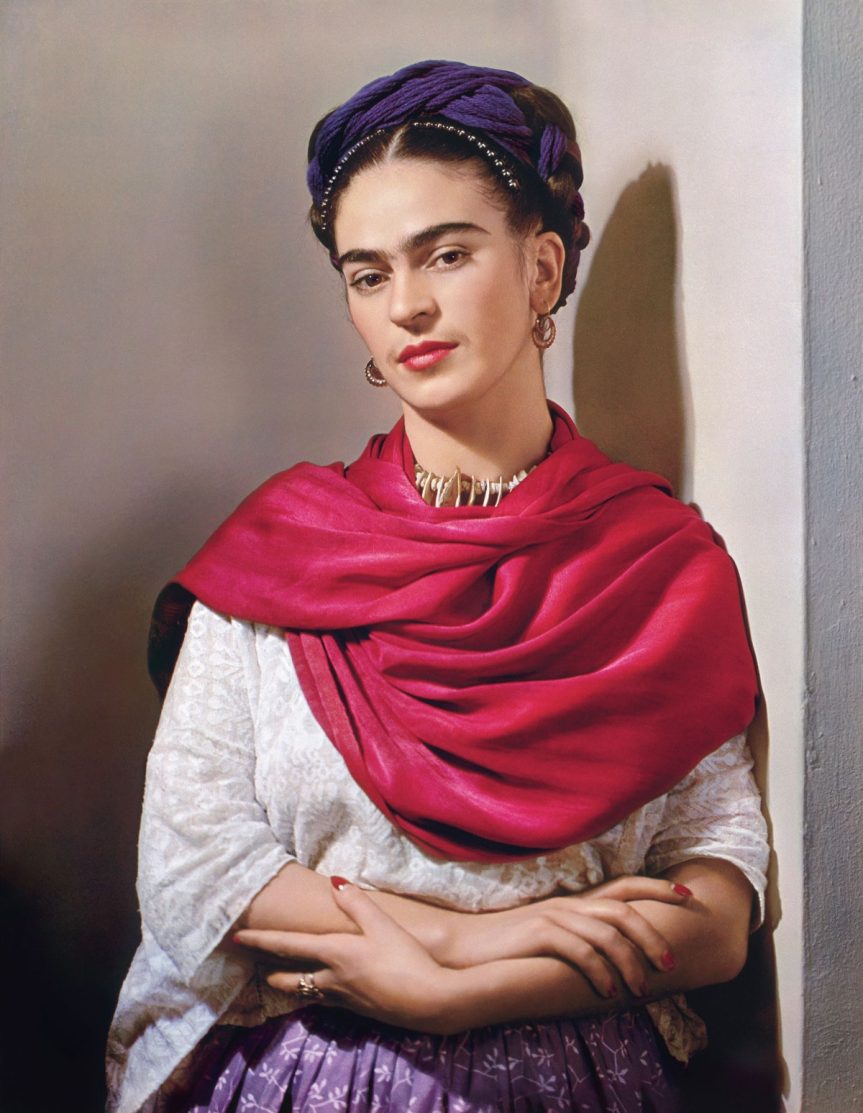
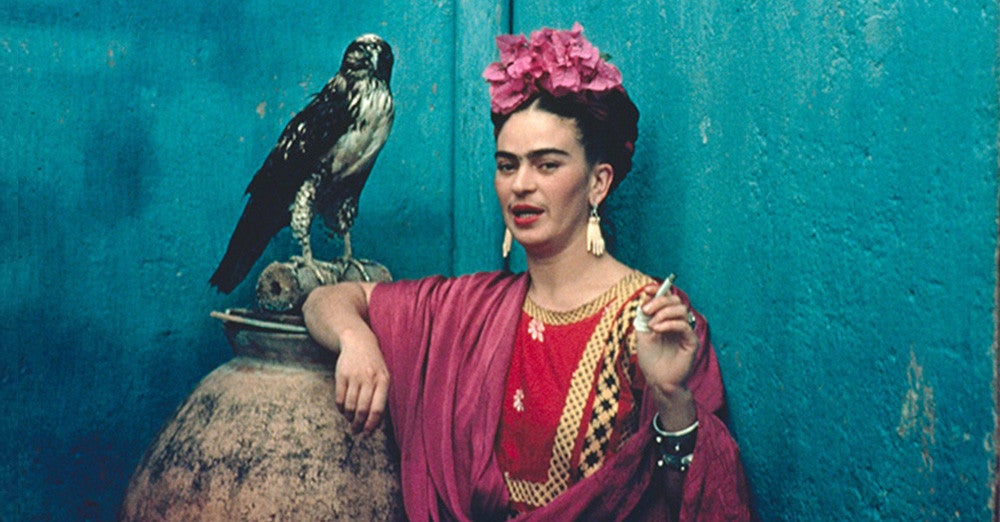
Even after years since Frida Kahlo’s demise, her charisma and powerful sense of style continue to captivate the world. The Mexican artist, famed for her self-portraits, is celebrated in her home country for her attention to indigenous culture, and by feminists worldwide for her depiction of the female experience and form. In fact, she was an advocate of feminism way before it became a staple in the social media age.

Frida

Early Life of Frida Kahlo

Magdalena Carmen Frida Kahlo y Calderón was born on 6 July 1907 in Coyoacán, a village on the outskirts of Mexico City. Born to a German father and a Mestiza  mother, Kahlo spent most of her childhood and adult life at La Casa Azul, her family home in Coyoacán  – now publicly accessible as the Frida Kahlo Museum. Although she was disabled by polio as a child, Kahlo had been a promising student headed for medical school until she suffered a bus accident at the age of 18, which caused her lifelong pain and medical problems. During her recovery, she returned to her childhood interest in art with the idea of becoming an artist.

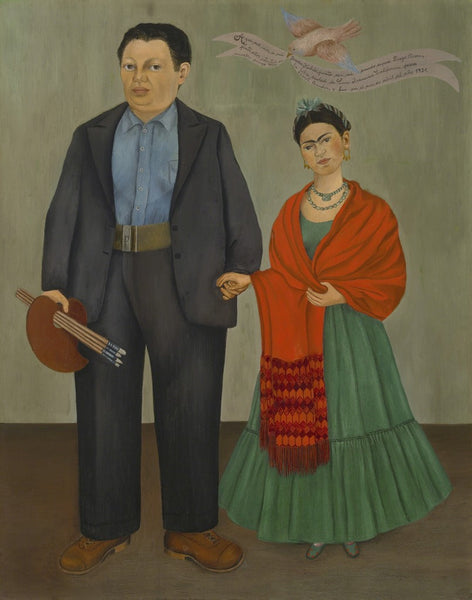
Diego and Frida, Self-Portrait With her Husband

Art Works of Frida Kahlo

Mexican artist Frida Kahlo is remembered for her self-portraits, pain and passion, and bold, vibrant colors. She is celebrated in Mexico for her attention to Mexican and indigenous culture and by feminists for her depiction of the female experience and form.

Life experience is a common theme in Kahlo’s approximately 200 paintings, sketches and drawings. Her physical and emotional pain are depicted starkly on canvases, because of her traumatic bus accident and multiple miscarriages depriving her of Motherhood and leading turbulent relationship with her husband, Mexican Mural artist Diego Rivera, who she married twice. Of her 143 paintings, 55 are self-portraits. She quoted, “I paint self-portraits because I am so often alone, because I am the person I know best.”

Kahlo’s first self-portrait was Self-Portrait in a velvet dress in 1926. It was painted in the style of 19th Century Mexican portrait painters who themselves were greatly influenced by the European Renaissance masters. She also sometimes drew from the Mexican painters in her use of a background of tied-back drapes. Self-Portrait Time Flies  (1929), Portrait of a Woman in White  (1930) and Self-Portrait  (1937) all bear this background.

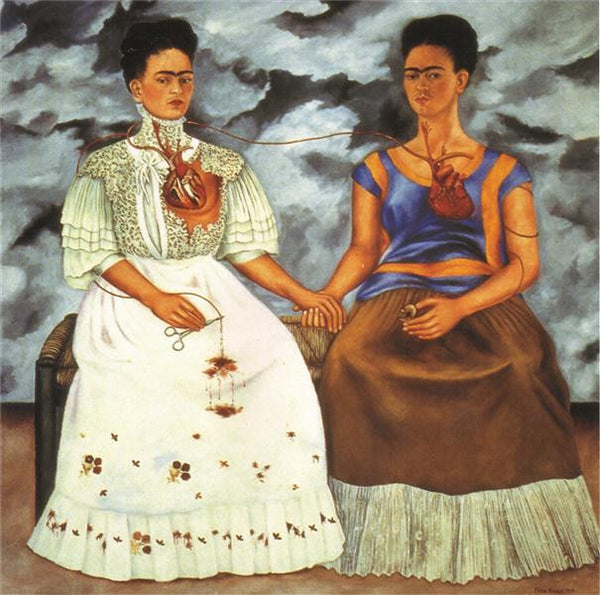
Two Fridas

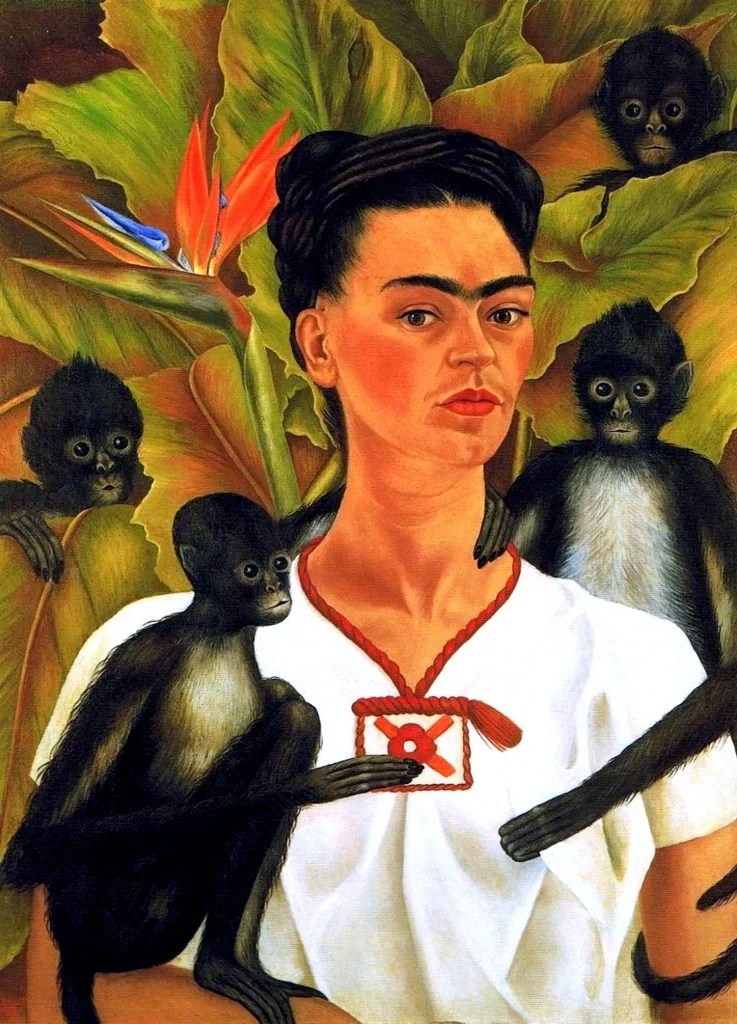
Self-Portrait With cropped hair (1940), Kahlo is depicted in a man’s suit, holding a pair of scissors, with her fallen hair around the chair in which she sits. This represents the times she would cut the hair Rivera loved when he had affairs. The 1937 painting Memory, The Heart, shows Kahlo’s pain over her husband’s affair with her younger sister Christina. A large broken heart at her feet shows the intensity of Kahlo’s anguish. Frida Kahlo and Diego Rivera divorced in 1939, but reunited a year later and remarried. The Two Fridas  (1939) depicts Kahlo twice, shortly after the divorce. One Frida wears a costume from the Tehuana region of Mexico, representing the Frida that Diego loved. The other Frida wears a European dress as the woman who Diego betrayed and rejected. Later, she is back in Tehuana dress in Self-Portrait as a Tehuana  (1943). Pre-Columbian artifacts were common both in the Kahlo/Rivera home (Diego collected sculptures and idols, and Frida collected Jewelry) and in Kahlo’s paintings. She wore jewelry from this period in Self-Portrait Time Flies  (1926), Self-Portrait With Monkeys  (1938) and Self-Portrait With Braid  (1941), among others. Other Pre-Columbian artifacts are found in The Four Inhabitants of Mexico City  (1938), Girl With Death Mask  (1938).

Frida‘s Self-Portrait With Monkeys

Analysis of Frida’s Artworks: Mexican Nationalism

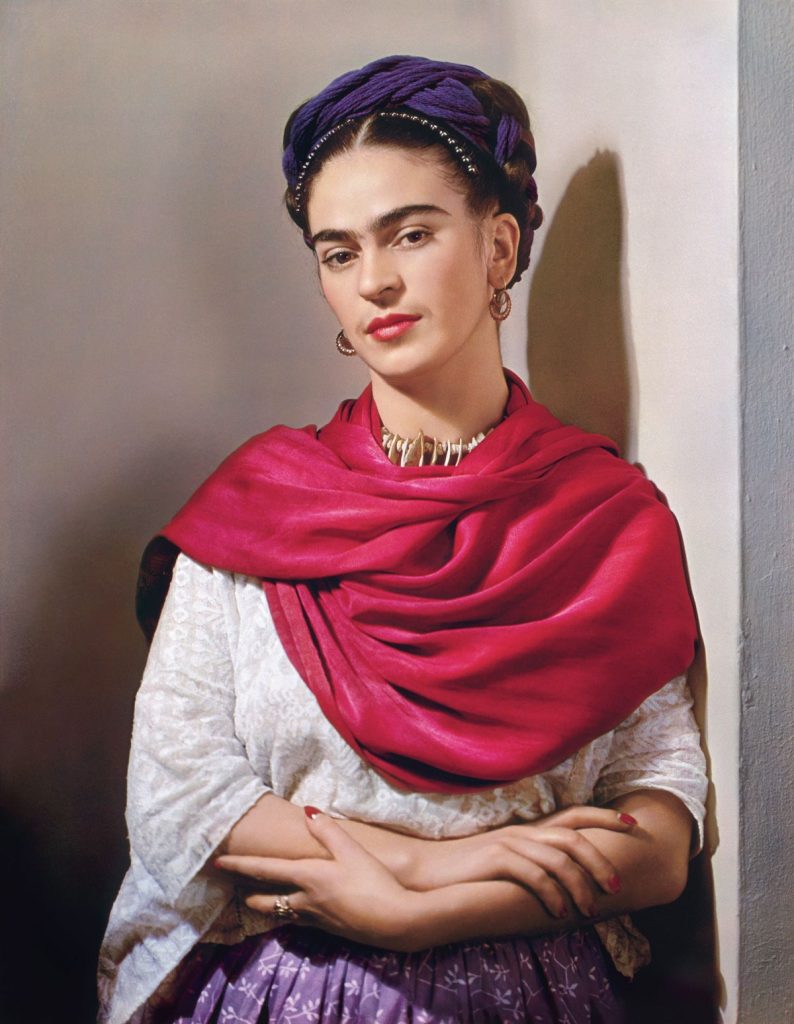
Frida Kahlo was heavily influenced by the Mexicayotl movement, which sprung from the colonialist mindset that native Mexican culture is inferior and that Mexico should emulate Europe. The Mexicayotl movement aimed at protecting the indigenous culture and traditions among the Mexican people. In most of Kahlo’s self-portraits, she paints herself in traditional indigenous Mexican dress. She wears long, colourful skirts, huiplis (loose-fitting tunic), rebozos (shawls) and elaborate headdresses. Painting herself in the Tehuana dress was a chance for Kahlo to express her anti-colonialist ideas and pay homage to her indigenous ancestry.

Frida‘s Portrait of Deer with Human Face

Symbolism and Surrealism

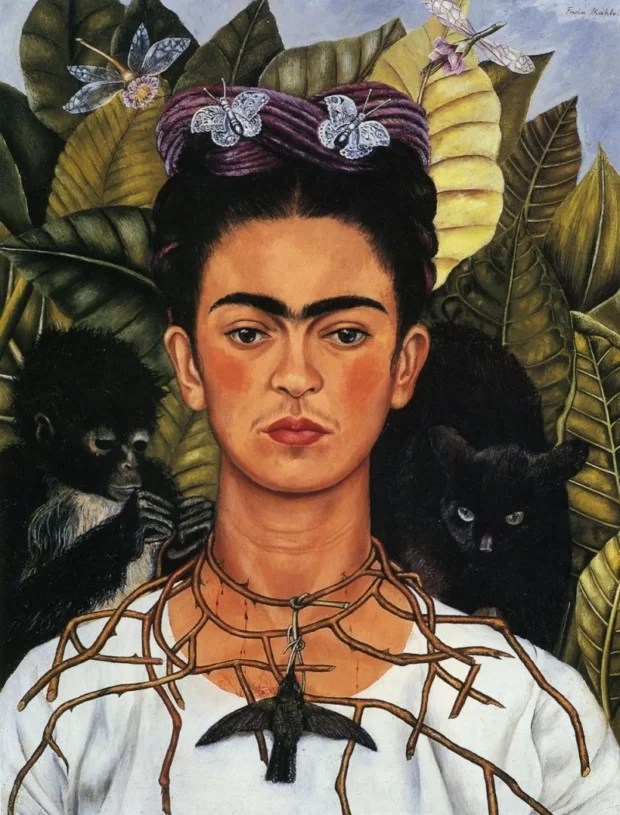
After periods of depression and miscarriages in her life she gave herself to pets around her. She liked to use animals as models in her artworks. Her paintings are domesticated by monkeys, hummingbirds, dogs, and cats. One of her self-portraits depicts her with three spider monkeys. The animals became protective and tender symbols to Kahlo. On the contrary, Mexican Mythology suggests monkeys are symbols of lust. Frida’s significant self-portrait was Self- Portrait with Thorn Necklace and Hummingbird. According to some art historians, Kahlo wanted to show that she had been resurrected and had started a new life with this painting. As a symbol of this idea, the hummingbird was placed in her necklace. The hummingbird symbolizes hope and good luck in Mexican culture. However, the audience may notice the black cat – known as a symbol of bad luck – taking its place behind the right shoulder of Kahlo. Different interpretations say that the hummingbird pendant refers to Huitzilopochtli. It is the Aztec god of war and may refer to the pain Kahlo suffered all her life internally. Other important symbols of the painting were butterflies and the thorn necklace. Butterflies symbolize resurrection and it may refer to her rebirth in life after the accident. Furthermore, the thorn necklace she wears may be the symbol of Jesus’ crown of thorns, which he bore while being dragged to his crucifixion. In addition to these symbols, Kahlo created a painting that both uses Christianity and animal symbolism in one subject matter. Painting The Little Deer, 1946 made by Frida  depicts her as a deer with a human face. The artist portrayed herself in this painting. However, there is a much more important detail in this artwork – the deer wounded by the arrows reminds us of Andrea Mantegna’s depiction of Saint Sebastian from 1480. It may also be a reference to crucifixion and resurrection.

Frida‘s Self-Portrait With Thorn Necklace and Hummingbird

Conclusion

Women prior to Kahlo who had attempted to communicate the wildest and deepest of emotions were often labelled hysterical or condemned insane – while men were aligned with the ‘melancholy’ character type. By remaining artistically active under the weight of sadness, Kahlo revealed that women too can be melancholy rather than depressed, and that these terms should not be thought of as gendered.

The Girl With a Pearl Earring: What Made It So Famous

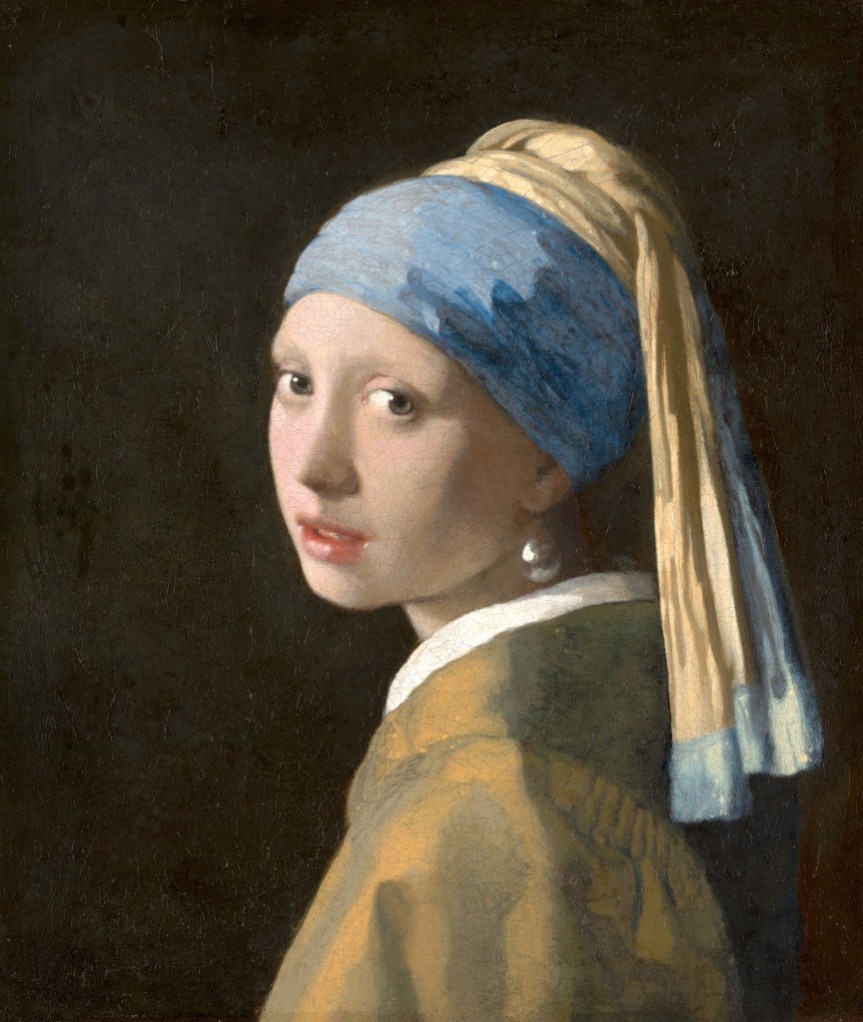
The Girl With a Pearl Earring (1665) by Johannes Vermeer

Introduction

Nicknamed the “Mona Lisa of the North“,the Girl with a Pearl Earring, is one of the masterpieces by famed Dutch painter, Johannes Vermeer. It hauntingly engages the viewer with enhanced realism, showcasing the electrifying gaze of a young girl adorned with a blue and gold turban. Created by Vermeer in 1665 during the Baroque period, the upper bust of the girl against a dark background has a three-dimensional effect that sets off her glowing appearance.

Historic Background

In Vermeer’s era, paintings were considered to be craftsmanship instead of art. Vermeer, a Dutch master painter at his peak, dedicated his life to developing his craft. By 1665, when the Girl with a Pearl Earring was created, Vermeer had begun to depict women, demonstrating a deep interest in their socio-cultural roles. The subject in this painting is believed to be Vermeer’s daughter, Maria.

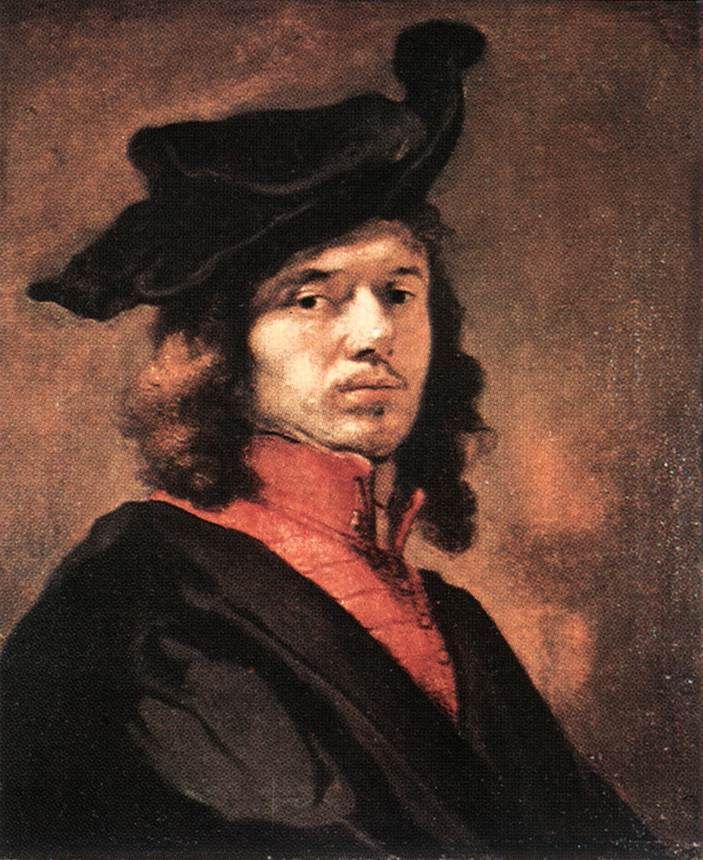
Self-Portrait of Johannes Vermeer

Subject of The Painting

The Painting was basically crafted with oil Painting on canvas and is categorized in Dutch Realism Movement arts. Although many art critics contend that the Girl with a Pearl Earring is a portrait, the prevailing argument is that it is a tronie, which is a study of the facial expressions of a living model. The composition of Girl with a Pearl Earring is delightfully simple. Unlike most of the other paintings by the Delft master, the subject here is only a simple head of a girl looking over her shoulder at the viewer. In Girl With a Pearl Earring, the young female model appears to be startled by something, while glancing taciturnly over her shoulder.No hint of a setting is provided, other than its atmospherically dark tone. This too is unusual for the mature Vermeer. The unusually direct contact between subject and spectator, and the slightly parted position of the lips, presents a sense of immediacy so great as to imply significant intimacy. The girl is wearing a simple brownish-yellow top, which contrasts strongly with her bright white collar. A further contrast is offered by her blue and yellow or turban (or chaperon) which gives the picture a distinctly exotic effect. During Vermeer’s time, the turban was a popular prop for tronies because of its deep folds and robust shades, which allowed artists to show off their skills and abilities.

Discussing the Painting: The uniqueness

Utilizing the technique of under-painting, or a monochromatic ground, Vermeer made the Girl with a Pearl Earring seem to lift from the canvas. Through careful use of his palette, he created the deep, rich tones of the girl’s headdress and gown. Then, to give her skin a glowing appearance, he used pigments to create light and shadow effect that contrasted the background. The Pearl Earring, status symbol of the period , worn by the subject, composed by only two brush strokes. The two whites, one on each corner of her mouth, helped to enliven the subject’s pensive smile.

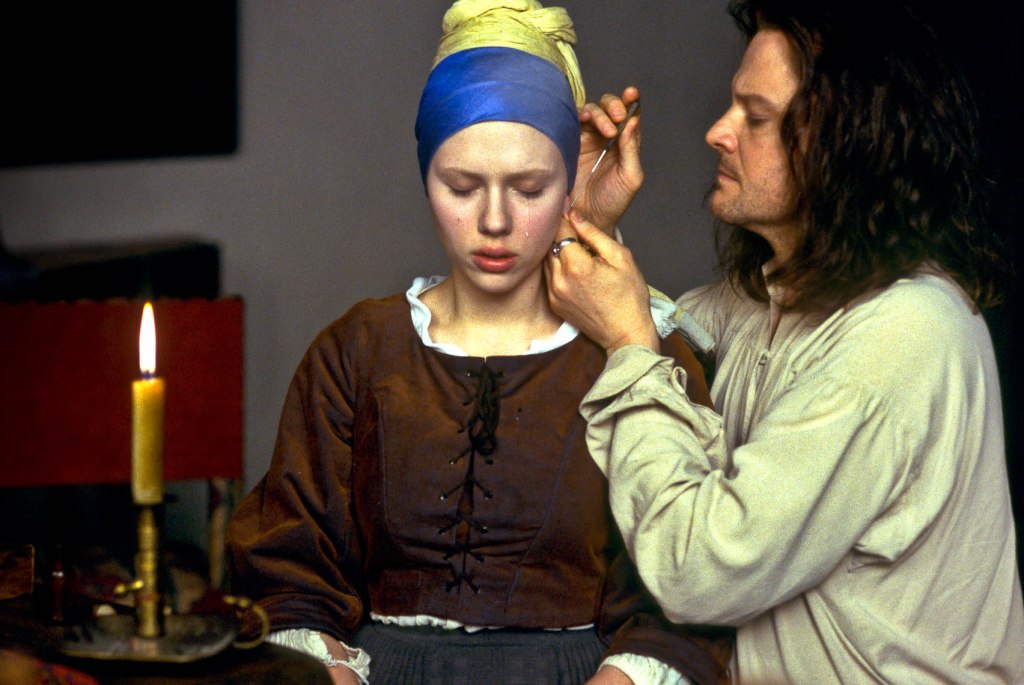
Scarlett Johansson in Girl With a Pearl Earring movie (2003)

The Painter’s Touch: The Cinematic Adoption

Although now a highly regarded artist, Vermeer was not well known outside of his native city of Delft during his lifetime or in the decades after. Historians credit the 19th-century French critic Étienne-Joseph-Théophile-Thoré (under the pseudonym of William Bürger) for reassessing the artist’s work, which eventually led to Vermeer’s distinguished reputation. Even so, Girl with a Pearl Earring became one of Vermeer’s more famous pieces only around the turn of the 21st century, with the 1995 blockbuster exhibition at the National Gallery of Art, Washington,D.C. and the publication of the best-selling novel Girl with a Pearl Earring by Tracy Chevalier in 1999. The book fashioned the painting’s subject into a housemaid named Griet who works in Vermeer’s home and becomes his paint mixer. It was adapted into an Oscar nominated movie in 2003 starring Scarlett Johansson as the fictional Griet and Colin Firth as Vermeer.

Scarlett Johansson as Griet and Colin Firth as Vermeer in Girl With a Pearl Earring movie (2003)

Where at Present Day

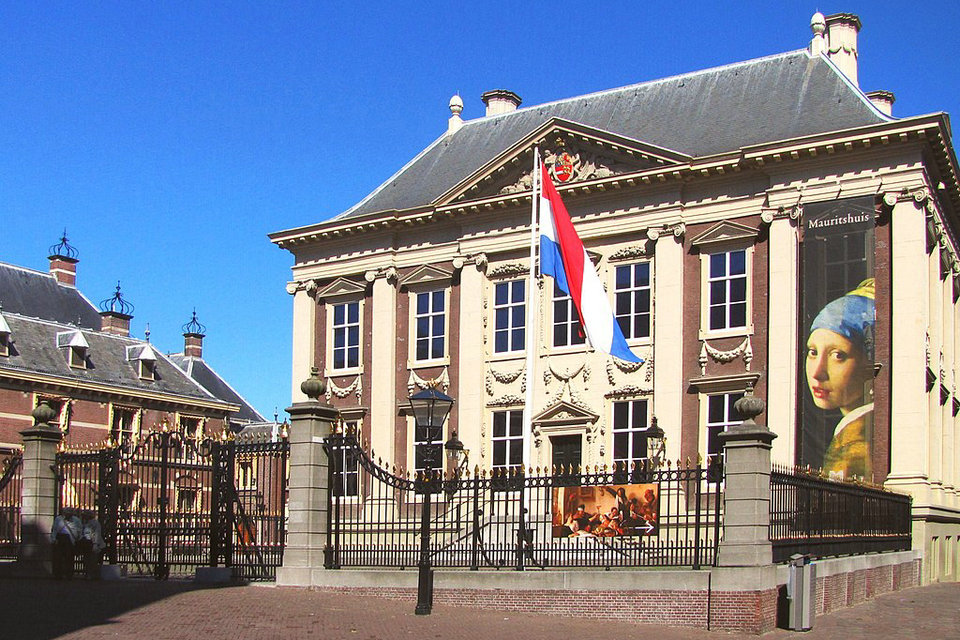
Mauritshuis, Den Haag, Netherlands

As the buildings of Mauritshuis Museum ,Hague underwent renovation in 2012, Girl with the Pearl Earring travelled to Japan, Italy, and the United States. It drew crowds in each location, attesting to its now firm place in audience regard. When Girl returned to the Netherlands in 2014, the Mauritshuis announced it would no longer lend out the painting, assuring visitors that the museum’s main attraction would always be in its home.

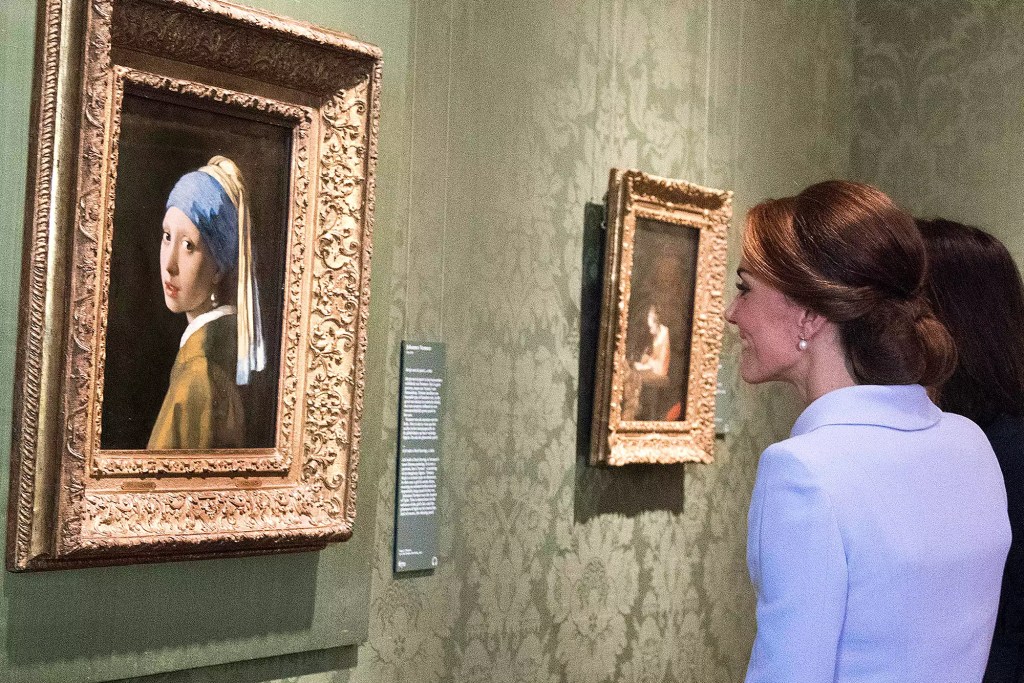
Princess Kate Middleton of England came face-to-face with one of the best-loved paintings in the world — “Girl with a Pearl Earring” — during a visit to the Mauritshuis museum in The Hague.
 

Conclusion

Humans have always adored paintings as one of the highest form of visual arts, and few of such arts can truly surpasses the inertness of still lives and remains immortal forever. The Girl With a Pearl Earring, poses the appeal of simplicity to rethink of life and consider the fact that beauty of life can also be found in the simplest joys around us.

KHADI PRAKRITIK PAINT

 Khadi Prakratik Paint has been developed from cow dung by Kumarappa National Handmade Paper Institute (KNHPI), Jaipur, a unit of Khadi and Village Industries Commission (KVIC), under the administrative control of the Ministry of MSME.  Khadi Prakratik paint is eco-friendly and cost effective.  The Khadi Prakratik Paint developed by KNHPI has been tested at National Test House, Ghaziabad (Govt. of India), National Test House, Mumbai (Govt. of India) and Shri Ram Institute of Industrial Research, Delhi (An ISO certified test lab) and satisfies the parameters required for paint.

It is envisaged that manufacture of Khadi Prakratik Paint will promote local manufacturing, create sustainable employment and generate additional revenue for farmers and cow shelter homes and will also generate employment in the rural areas, which will improve the rural economy and help in controlling the migration from rural to urban areas, in the country.

Cow dung is a major constituent used in the manufacture of Prakritik Paint. 100 kgs. of cow dung is utilized for making 500 liters of paint. Therefore, setting up of paint units would be helpful in utilization of cow dung and thereby help in cleaning the environment.

KNHPI imparts training in manufacture of Khadi Prakritik Paint. Prakritik Paint manufacturing units are being set up under Prime Minister’s Employment Generation Programme (PMEGP) scheme of Ministry of MSME. The technology for the manufacture of Khadi Prakritik Paint has been provided to many units in villages in the country.

Bible-Believing Studies in ROMANS

 These studies were originally prepared for a series of radio broadcasts. They have been edited for publication, but formality of style has not been a priority. I hope that the conversational tone of these studies will not be a stumbling block to you, but that it will, rather, make this work easier to read. May you find the commentary readable and enjoyable as well as instructive. This commentary is a book of STUDIES (please bear with me for the all capital letters that I use throughout this book for emphasis). However, they are also intended to be practical and devotional, as well as doctrinal. If our studies do not stir you to love God more and to live for Him better, then as an author I will have failed. I have no desire to increase your intellect without also influencing your will and challenging  you to follow the Lord Jesus Christ more fully.

Title of Book

Bible-Believing Studies in ROMANS                                                     

Editor Name

Michael D. O’Neal

ISBN no. 

9798418543578

Imprint

Independently Published

Year

2022

Edition

First

Language

English

Genre

Education

Publisher

Edupedia Publications Pvt Ltd


Convocation ceremony of Dayalbagh Educational Institution, Agra

 Secretary Department of Higher Education Shri Amit Khare addressed the Convocation ceremony of Dayalbagh Educational Institution, Agra today Prof.  Prem Kumar KalraDirector, Dayalbagh Educational Institute also graced the occasion.

Congratulating students on their graduation, Shri Khare said that “India’s journey from being a third world, fledgling democracy to this position of power and eminence is the result of the toil and dedicated contribution of every section of society. The role of the educated people in any sector has been especially significant because they have guided and led this change in various capacities. Today you are joining this rank of educated intellectuals, the young enlightened Indians who will lead the world”.

Shri Khare expressed confidence that students graduating today will become future leaders and lead the world.  “It is this confidence that fuels our dreams for country’s missions like Start Up India, Skill India, Make in India- Make for the World and Atma Nirbhar Bharat”, he added.

He urged students to emerge not as ‘job seekers’ but as ‘job givers’,  to promote the individual capability of each student, teach them to think, equip them with the skills required to face the 21st century and global leaders – while imparting values rooted in Indian culture.

Secretary Shri Khare also said that the experience of the Covid pandemic would have given students a fresh perspective to life, and prepared them better for facing its vagaries in future.   

He appreciated the efforts of DEI in imparting multidisciplinary education in subjects as diverse as Quantum Computing to Textile Designing to Music, and its Vision 2031 to support the same principles that have been recommended by the National Education Policy 2020.  He said that the institute’s focus on value based quality education, inclusivity, multidisciplinarity, research, use of ICT – all align well with the NEP 2020, he added.

In this context he recalled his conversation with Prof. Kalra a few years ago, when Shri Kalra had highlighted that Dayalbagh is a unique institution that brings education and values together something which is now talked about in the National Education Policy 2020.  Shri Khare said that Dayalbagh Educational Institution in its philosophy and vision has been much ahead of times in its thinking of the day, and many of the ideas of National Education Policy 2020 are already enshrined in the ethos of DEI.


Highlighting India’s growing presence in the international media space, Secretary Khare mentioned about IMF Chief Kristalina Georgieva praise on India’s decisive steps taken to deal with the COVID-19 pandemic”.

He prevailed upon the students to help those who have been less fortunate, who are deprived of the benefits that a good education provides.  He extended his best wishes to the students for a bright future.

*****

Is Indian Handicraft at risk ?

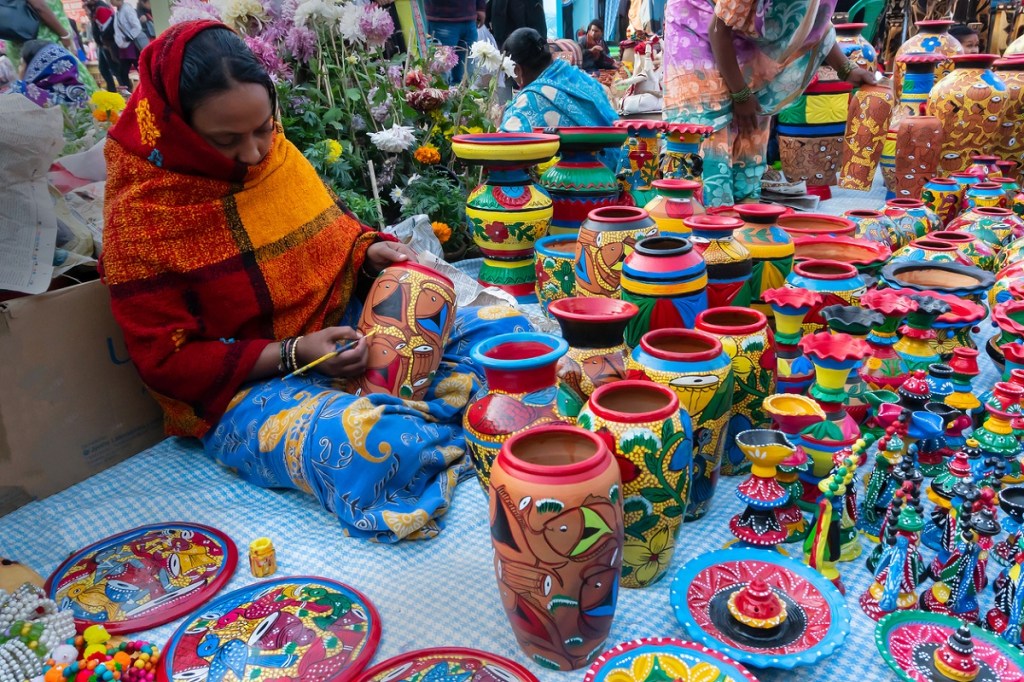
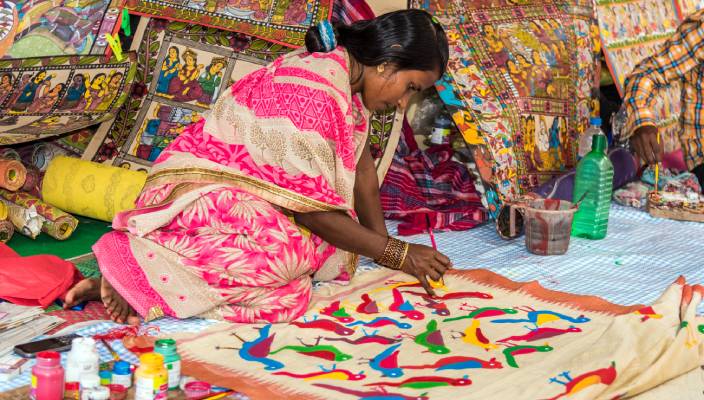
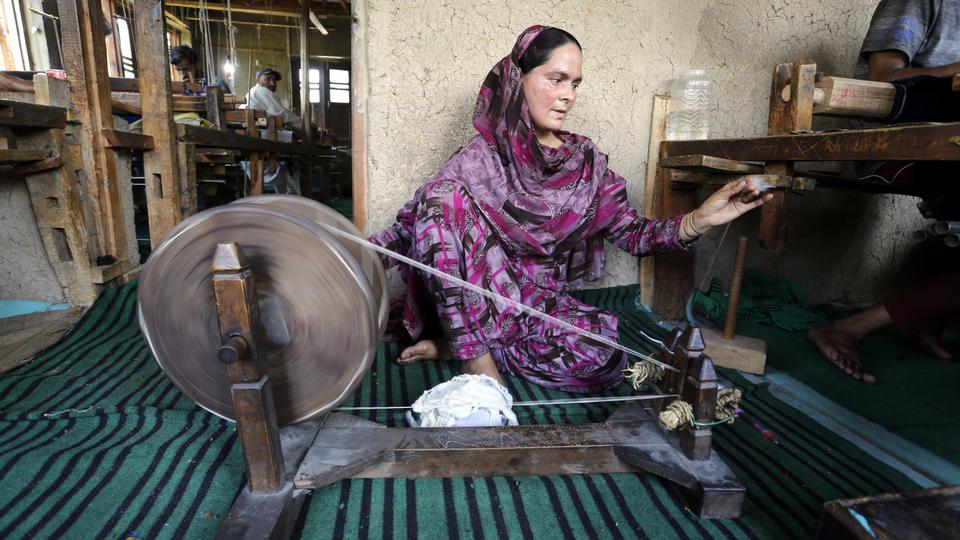
Handicraft as we all know it, is the craft work of processing materials by hands or simple hand tools. The outcome of such a craftwork involves decorative pieces or useful objects. The materials used in the making are mostly natural, but can be industrially processed or even recycled too.

Handicraft is an artform that is deeply rooted in the traditions of India. And the sector provides livelihood to lakhs of people. They produce goods ranging from carpets, potteries, paintings, embroidery and the list goes on. Every region in India has handicraft that is unique to that region. Such as Chikan Kari weaving from Lucknow. Madhubani paintings from Mithalia, Bidri metal handicraft from Karnataka, Pashmina shawls from Kashmir and so on.

However, over the years this industry had to endure certain challenges, making it hard for the artisans to flourish and make a living.

Issues faced by artisans

There are a number of reasons why artisans in the craft industry are facing problems. Some of the widely varied reasons are;

  • Informal sector- Handicraft industry is a highly informal sector. Artisans are usually structured through informal contracts between traders, middlemen, master artisans and low skilled artisans. Along with that, this industry is largely unorganised, making it hard for the industry to flourish organically.
  • Lack of education- The lack of education makes it difficult for the artisans to manage inventory, access government schemes information and bargain with traders and middleman.
  • Outdated production methods- Artisans lack the funds to upgrade to better tools and technologies or undergo training.
  • Competition from organised sector- Artisans are losing customers, due to the arrival of cheaply priced machine made products, especially Chinese made goods.

These are few of the reasons handicraft industry is lagging behind. However, it is never too late to make amends and prevent the sector from sinking.

How to revive the Handicraft industry?

One of the first steps to be taken to boast the Handicraft industry, is the action to make this industry organised. It is a given fact that middlemen and traders mend their ways into benefiting from the sales by jeopardizing the livelihood of artisans. Having an organised and formal sector will help with the righteous distribution  of profit. This is the task of the government to take needful action and prioritise this industry just like any other high yielding industry.

Along with taking into account the mission of creating awareness among the artisans and educating them on basic information about the working and functioning of the industry. Apart from that, it is also important for the government to create awareness among the common public and urge them to help save the livelihood of handicraft workers, and avoid choosing cheaper machine made alternative. Thus helping to preserve the Indian tradition.

Government’s role in empowering Indian Handicraft

Over the past few years, the Government of India has launched schemes and plans that could potentially benefit the handicraft artisans. Some of the schemes are;

  • National Handicraft Development Programme
  • Ambedkar Hastshilp Vikas Yojna
  • Handicraft Mega Cluster Mission
  • Integrated Handloom Development Scheme

Mentioned above are just few of the schemes launched by the government. But just launching schemes would not be of much help, until and unless those schemes are actually implemented at the grassroot level.

In instances like these, NGOs like Cradftizen Handicraft, Asha Handicraft Association, etc.,  play a vital role in campaigning such schemes across the artisans, and making them aware about their right and benefits.

                   The handicraft industry makes Rs 25,000 crores annually by exporting goods. This sector has a lot of potential that can be tapped and channelised into a highly profitable industry, along with benefit and uplifting the artisans, who are keeping the Indian traditions and craft alive.

Uniform Civil Code

Uniform Civil Code refers to implementation and application of such laws, personal in nature applicable to all the citizens equally irrespective of their race, religion, caste and creed. Ever since prior to India receiving independence, across the nation, the implementation and formulation of uniform civil code has always been a matter of controversy. In India, it is a significant issue regarding secularism in politics and today also it continues to be a disruptive matter for the political parties, some conservative religious sects and groups and Muslim groups in defense of the customs of their religion. At present, personal laws of different communities are different and it is governed according to their religious scriptures and text.

During the British rule, the codification procedure of Uniform Civil Code was first started. This set of rules were mainly for the Muslim and Hindu citizens. The British refrained from interfering in the domestic sphere as they feared opposition from the leaders of the community. In 1941, formation of B N Rau Committee took place in order to codify the Hindu Law post a long period. In 1956, a bill was adopted as the Hindu Succession Act on recommendations of B N Rau Committee after India’s independence. Thus, the law related to unwilled or undevised succession among the Jains, Buddhists, Hindus and Sikhs excluding the Muslims, Jews, Christians and Parsis as being distinct communities from Hindus, was codified and amended.

Uniform Civil Code is mainly concerned with the personal laws of all religions and communities. The laws personal in nature includes divorce, marriage, adoption, maintenance and inheritance. Under Article 44 of the Indian Constitution, the Indian states are expected to apply common laws and directive principles for all the citizens of India while formulating policies of the nation. On the other hand, Article 25-28 of the Constitution of India states religious freedom to all the citizens of India and allows the religious groups to keep up their own affairs.

The Uniform Civil Code is basically a set of three words i.e. Uniform, Civil and Code. Uniform refers to ‘same in all cases or not varying’, Civil refers to ‘associated with the people who live in the country’ and Code refers to ‘ a set of law or rules or a systematic law statement’. Thus, it can be inferred that the civil rules should not be different for all the people regardless of their religion. In Indian Context, Uniform Civil Code is the implementation of one such civil law that should be relevant to all the religious sects and communities in matters concerning marriage, maintenance allowance, divorce, adoption and inheritance. The Uniform Civil Code is mentioned under Article 44 of the Indian Constitution. The article states that, “the State shall endeavor to secure a Uniform Civil Code for the citizens throughout the territory of India.” As stated under the Indian Constitution, the Uniform Civil Code’s appeal is accordant with the principles of fairness, equity, justice and human rights. In order to bring uniformity in the personal laws, the courts have held in their judgements that the government should shift towards a uniform civil code. The same has been observed in many cases, Shah Bano case being a popular one among these.

After the Shah Bano case in 1985, Uniform Civil Code emerged as an important topic of interest. The women’s right to life and dignity is adversely affected by the polygamy and triple talaq practices. These law sets were a matter of debate when there was question of making certain laws applicable to all the Indian citizens. The fundamental rights to practice any religion should not be curtailed by these laws. The debate was then shifted to the personal law of Muslims which is partially related to Sharia law which permits polygamy and divorce. The implementation of Uniform Civil Code was primarily opposed by the Indian Muslims and some conservative religious groups considering it as a threat to freedom of the religion.