Indian society is a pluralistic society with a complex social order characterized by a multitude of ethnic, linguistic, religious, and caste divisions. It comprises people living in rural, urban, tribal setting and all sections which carry the ethos of Indianness.Amid the complexities and so much diversity among the nation, widely accepted cultural themes, the feeling of oneness, brotherhood, and values of constitution binds individuals and enhance social harmony and order.
MEANING OF SOCIETY-
Sociologist Peter L. Berger defines society as “a human product, and nothing but a human product, that yet continuously acts upon its producers.”It consists of groups of human beings who are linked together utilizing specific systems and customs, rites, and laws and have a collective social existence.
INDIAN SOCIETY AND ITS FEATURES-
1). Indian culture has been modified continuously, with times making India a composite culture.
2).Indian society was a stratified society from ancient times.The division of society into Aryans and non-Aryans was mentioned in Rig Veda. The Aryan society was further divided into four groups based on the pursuit of occupations.
3). The confrontation of Hindu and Muslim culture led to a synthesis with interesting results and mixed culture as a result of Sufi writings, the bhakti movement, Kabir Panth.
4).India today (after independence) amalgamated different caste groups religions, race tribes, linguistic groups. It glorifies the ideals of liberty, equality, fraternity as its goals in a secular, socialistic framework.
SALIENT FEATURES OF INDIAN SOCIETY-
1). Multi-Ethnic Society–
An ethnic group or ethnicity is a category of people who identify with each other, usually based on a common language or dialect, history, society, culture or nation.A society with the co-existence of a wide variety of racial groups is a Multi-ethnic society. India is home to almost all racial profiles.
2). Patriarchal Society–
Patriarchy is a social system in which men hold primary power and enjoy greater status than women.In this system, men make all decisions in both society and their family unit, hold all positions of power and authority and are considered superior.
3). Family-
The family forms the basic unit of social organization.It is the most immediate group a child is exposed It is in the family a child learns language, the behavioural patterns, and social norms in his childhood.
Family is a basic, definite, and enduringFamily is formed by the companionship of the husband, the wife who procreate children.
DIVERSITY-
Diversity is differences in racial and ethnic, socioeconomic, geographic, and academic/professional backgrounds. People with different opinions, backgrounds (degrees and social experience), religious beliefs, political beliefs, sexual orientations, heritage, and life experience.
India is the oldest civilization in the entire world. In this long journey of 5000 years, we were ruled by many rulers, belonging to different religions and cultures. Further, a lot of people migrated from other countries, and India accepted them with open hearts. Due to this exchange, we can observe a lot of diversity in terms of religion, culture, race, and religion in our country. However, despite all these diversities, India remained united even in dark hours and faced all the crises with a united spirit. The thread which binds all Indians together is known as “Unity among diversity”. In this article, we will explore the meaning of Unity in diversity in India, the types of diversity in India, what is diversity, provisions of unity in the constitution, its importance and the hurdle in achieving unity.
The unity in diversity is defined as the spirit of brotherhood without any discrimination.The term “Unity in diversity” implies the feeling of oneness or togetherness even after having a lot of diversity. Its spirit unites the people together and this bond shows the path of righteousness. This Diversity can be in the form of religion, colour, caste, creed, cultural practices, etc. In our country, these diversified traits are not seen as a conflict, but they are the varieties that enrich our society and the nation. It is used as a symbol of harmony and unity among people belonging to different religions or cultural backgrounds.
Indian society is a pluralistic society with a complex social order characterized by a multitude of ethnic, linguistic, religious, and caste divisions. It comprises people living in rural, urban, tribal setting and all sections which carry the ethos of Indianness.Amid the complexities and so much diversity among the nation, widely accepted cultural themes, the feeling of oneness, brotherhood, and values of constitution binds individuals and enhance social harmony and order.
MEANING OF SOCIETY-
Sociologist Peter L. Berger defines society as “a human product, and nothing but a human product, that yet continuously acts upon its producers.”It consists of groups of human beings who are linked together utilizing specific systems and customs, rites, and laws and have a collective social existence.
INDIAN SOCIETY AND ITS FEATURES-
1). Indian culture has been modified continuously, with times making India a composite culture.
2).Indian society was a stratified society from ancient times.The division of society into Aryans and non-Aryans was mentioned in Rig Veda. The Aryan society was further divided into four groups based on the pursuit of occupations.
3). The confrontation of Hindu and Muslim culture led to a synthesis with interesting results and mixed culture as a result of Sufi writings, the bhakti movement, Kabir Panth.
4).India today (after independence) amalgamated different caste groups religions, race tribes, linguistic groups. It glorifies the ideals of liberty, equality, fraternity as its goals in a secular, socialistic framework.
SALIENT FEATURES OF INDIAN SOCIETY-
1). Multi-Ethnic Society–
An ethnic group or ethnicity is a category of people who identify with each other, usually based on a common language or dialect, history, society, culture or nation.A society with the co-existence of a wide variety of racial groups is a Multi-ethnic society. India is home to almost all racial profiles.
2). Patriarchal Society–
Patriarchy is a social system in which men hold primary power and enjoy greater status than women.In this system, men make all decisions in both society and their family unit, hold all positions of power and authority and are considered superior.
3). Family-
The family forms the basic unit of social organization.It is the most immediate group a child is exposed It is in the family a child learns language, the behavioural patterns, and social norms in his childhood.
Family is a basic, definite, and enduringFamily is formed by the companionship of the husband, the wife who procreate children.
DIVERSITY-
Diversity is differences in racial and ethnic, socioeconomic, geographic, and academic/professional backgrounds. People with different opinions, backgrounds (degrees and social experience), religious beliefs, political beliefs, sexual orientations, heritage, and life experience.
India is the oldest civilization in the entire world. In this long journey of 5000 years, we were ruled by many rulers, belonging to different religions and cultures. Further, a lot of people migrated from other countries, and India accepted them with open hearts. Due to this exchange, we can observe a lot of diversity in terms of religion, culture, race, and religion in our country. However, despite all these diversities, India remained united even in dark hours and faced all the crises with a united spirit. The thread which binds all Indians together is known as “Unity among diversity”. In this article, we will explore the meaning of Unity in diversity in India, the types of diversity in India, what is diversity, provisions of unity in the constitution, its importance and the hurdle in achieving unity.
The unity in diversity is defined as the spirit of brotherhood without any discrimination.The term “Unity in diversity” implies the feeling of oneness or togetherness even after having a lot of diversity. Its spirit unites the people together and this bond shows the path of righteousness. This Diversity can be in the form of religion, colour, caste, creed, cultural practices, etc. In our country, these diversified traits are not seen as a conflict, but they are the varieties that enrich our society and the nation. It is used as a symbol of harmony and unity among people belonging to different religions or cultural backgrounds.
Most of us go through a frightening episode that we come out of without any damage or long term effects. But a large number of people exist who suffer the aftermath of a traumatic experience in unhealthy that puts pressure on one’s mental health. This condition, where negative thoughts interfere with daily life is called post-traumatic stress disorder or PTSD.
Posttraumatic stress disorder (PTSD), once called shell shock or battle fatigue syndrome, is a serious condition that can develop after a person has experienced or witnessed a traumatic or terrifying event in which there was serious physical harm or threat. PTSD is a lasting consequence of traumatic ordeals that cause intense fear, helplessness, or horror. Examples of things that can bring on PTSD include sexual or physical assault, the unexpected death of a loved one, an accident, war, or natural disaster. Families of victims can develop PTSD, as can emergency personnel and rescue workers.
It is natural to feel afraid during and after a traumatic situation. Fear triggers many split-second changes in the body to help defend against danger or to avoid it. This “fight-flight or freeze” response is a typical reaction meant to protect a person from harm. Nearly everyone will experience a range of reactions after trauma, yet most people recover from initial symptoms naturally. Those who continue to experience problems may be diagnosed with PTSD. People who have PTSD may feel stressed or frightened, even when they are not in danger. Ptsd isn’t failing of a person or doesn’t make one weak willed, it is a treatable malfunction of the memory of certain dangerous experiences that allows us to cope better with it
PTSD Symptoms
Symptoms of PTSD most often begin within 3 months of the event. In some cases, however, they don’t begin until years later. The severity and duration of the illness can vary. Some people recover within 6 months, while others have it much longer. A major challenge of coping is sensitivity to triggers, physical and emotional stimuli that the brain associates with the original trauma .Symptoms of PTSD often are grouped into four main categories, including:
Reliving: People with PTSD repeatedly relive the ordeal through thoughts and memories of the trauma. These may include flashbacks, hallucinations, and nightmares. They also may feel great distress when certain things remind them of the trauma, such as the anniversary date of the event.
Avoiding: The person may avoid people, places, thoughts, or situations that may remind them of the trauma. This can lead to feelings of detachment and isolation from family and friends, as well as a loss of interest in activities that the person once enjoyed.
Increased arousal: These include excessive emotions; problems relating to others, including feeling or showing affection; difficulty falling or staying asleep; irritability; outbursts of anger; difficulty concentrating; and being “jumpy” or easily startled. The person may also suffer physical symptoms, such as increased blood pressure and heart rate, rapid breathing, muscle tension, nausea, and diarrhoea.
Negative cognitions and mood: This refers to thoughts and feelings related to blame, estrangement, and memories of the traumatic event.
Anyone can develop PTSD at any age. According to the National Centre for PTSD, about 7 or 8 out of every 100 people will experience PTSD at some point in their lives. Women are more likely to develop PTSD than men, and genes may make some people more likely to develop PTSD than others.
It is important to remember that not everyone who lives through a dangerous event develops PTSD. In fact, most people will not develop the disorder. Many factors play a part in whether a person will develop PTSD. Some examples are listed below. Risk factors make a person more likely to develop PTSD. Other factors, called resilience factors, can help reduce the risk of the disorder.
Some factors that increase risk for PTSD include:
Living through dangerous events and traumas
Getting hurt
Seeing another person hurt, or seeing a dead body
Childhood trauma
Feeling horror, helplessness, or extreme fear
Having little or no social support after the event
Dealing with extra stress after the event, such as loss of a loved one, pain and injury, or loss of a job or home
Having a history of mental illness or substance abuse
Treatment
The goal of PTSD treatment is to reduce the emotional and physical symptoms, to improve daily functioning, and to help the person better manage with the event that triggered the disorder. The main treatments for people with PTSD are medications, psychotherapy (“talk” therapy), or both. Everyone is different, and PTSD affects people differently, so a treatment that works for one person may not work for another. It is important for anyone with PTSD to be treated by a mental health provider who is experienced with PTSD. Some people with PTSD may need to try different treatments to find what works for their symptoms. Medication for treating PTSD is antidepressants, which may help control PTSD symptoms such as sadness, worry, anger, and feeling numb inside. Other medications may be helpful for treating specific PTSD symptoms, such as sleep problems and nightmares.
Recovery from PTSD is a gradual and on-going process. Symptoms of PTSD seldom disappear completely, but treatment can help people learn to manage it more effectively. Treatment can lead to fewer and less intense symptoms, as well as a greater ability to manage feelings related to the trauma. Research is on-going into the factors that lead to PTSD and into finding new treatments.
Most of us go through a frightening episode that we come out of without any damage or long term effects. But a large number of people exist who suffer the aftermath of a traumatic experience in unhealthy that puts pressure on one’s mental health. This condition, where negative thoughts interfere with daily life is called post-traumatic stress disorder or PTSD.
Posttraumatic stress disorder (PTSD), once called shell shock or battle fatigue syndrome, is a serious condition that can develop after a person has experienced or witnessed a traumatic or terrifying event in which there was serious physical harm or threat. PTSD is a lasting consequence of traumatic ordeals that cause intense fear, helplessness, or horror. Examples of things that can bring on PTSD include sexual or physical assault, the unexpected death of a loved one, an accident, war, or natural disaster. Families of victims can develop PTSD, as can emergency personnel and rescue workers.
It is natural to feel afraid during and after a traumatic situation. Fear triggers many split-second changes in the body to help defend against danger or to avoid it. This “fight-flight or freeze” response is a typical reaction meant to protect a person from harm. Nearly everyone will experience a range of reactions after trauma, yet most people recover from initial symptoms naturally. Those who continue to experience problems may be diagnosed with PTSD. People who have PTSD may feel stressed or frightened, even when they are not in danger. Ptsd isn’t failing of a person or doesn’t make one weak willed, it is a treatable malfunction of the memory of certain dangerous experiences that allows us to cope better with it
PTSD Symptoms
Symptoms of PTSD most often begin within 3 months of the event. In some cases, however, they don’t begin until years later. The severity and duration of the illness can vary. Some people recover within 6 months, while others have it much longer. A major challenge of coping is sensitivity to triggers, physical and emotional stimuli that the brain associates with the original trauma .Symptoms of PTSD often are grouped into four main categories, including:
Reliving: People with PTSD repeatedly relive the ordeal through thoughts and memories of the trauma. These may include flashbacks, hallucinations, and nightmares. They also may feel great distress when certain things remind them of the trauma, such as the anniversary date of the event.
Avoiding: The person may avoid people, places, thoughts, or situations that may remind them of the trauma. This can lead to feelings of detachment and isolation from family and friends, as well as a loss of interest in activities that the person once enjoyed.
Increased arousal: These include excessive emotions; problems relating to others, including feeling or showing affection; difficulty falling or staying asleep; irritability; outbursts of anger; difficulty concentrating; and being “jumpy” or easily startled. The person may also suffer physical symptoms, such as increased blood pressure and heart rate, rapid breathing, muscle tension, nausea, and diarrhoea.
Negative cognitions and mood: This refers to thoughts and feelings related to blame, estrangement, and memories of the traumatic event.
Anyone can develop PTSD at any age. According to the National Centre for PTSD, about 7 or 8 out of every 100 people will experience PTSD at some point in their lives. Women are more likely to develop PTSD than men, and genes may make some people more likely to develop PTSD than others.
It is important to remember that not everyone who lives through a dangerous event develops PTSD. In fact, most people will not develop the disorder. Many factors play a part in whether a person will develop PTSD. Some examples are listed below. Risk factors make a person more likely to develop PTSD. Other factors, called resilience factors, can help reduce the risk of the disorder.
Some factors that increase risk for PTSD include:
Living through dangerous events and traumas
Getting hurt
Seeing another person hurt, or seeing a dead body
Childhood trauma
Feeling horror, helplessness, or extreme fear
Having little or no social support after the event
Dealing with extra stress after the event, such as loss of a loved one, pain and injury, or loss of a job or home
Having a history of mental illness or substance abuse
Treatment
The goal of PTSD treatment is to reduce the emotional and physical symptoms, to improve daily functioning, and to help the person better manage with the event that triggered the disorder. The main treatments for people with PTSD are medications, psychotherapy (“talk” therapy), or both. Everyone is different, and PTSD affects people differently, so a treatment that works for one person may not work for another. It is important for anyone with PTSD to be treated by a mental health provider who is experienced with PTSD. Some people with PTSD may need to try different treatments to find what works for their symptoms. Medication for treating PTSD is antidepressants, which may help control PTSD symptoms such as sadness, worry, anger, and feeling numb inside. Other medications may be helpful for treating specific PTSD symptoms, such as sleep problems and nightmares.
Recovery from PTSD is a gradual and on-going process. Symptoms of PTSD seldom disappear completely, but treatment can help people learn to manage it more effectively. Treatment can lead to fewer and less intense symptoms, as well as a greater ability to manage feelings related to the trauma. Research is on-going into the factors that lead to PTSD and into finding new treatments.
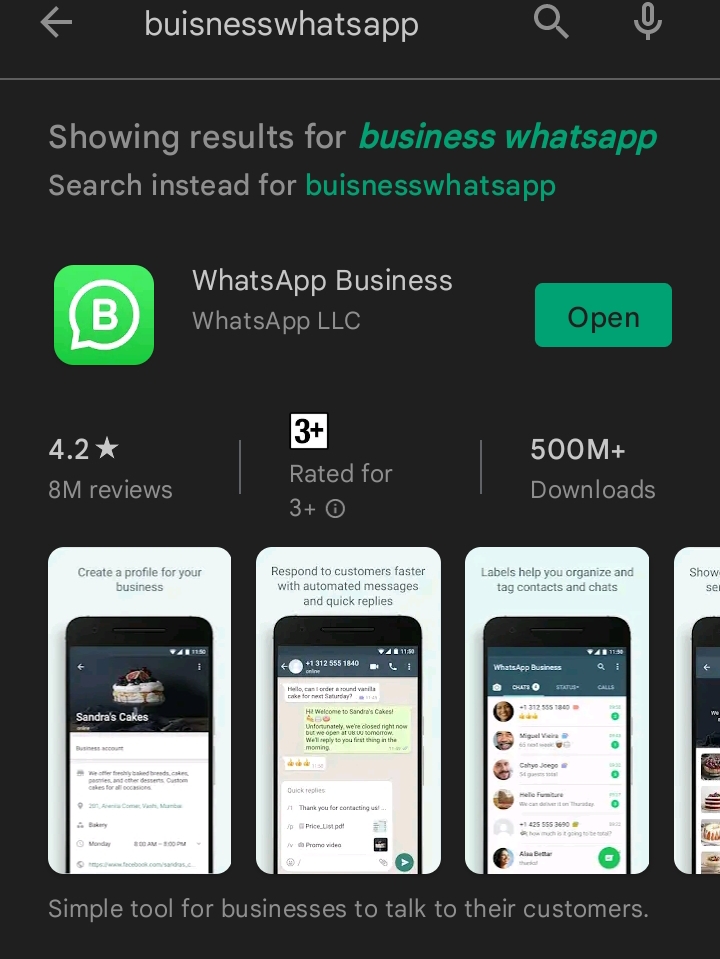
watsapp which well known to people of all generations including kids,now a days it is main source of communication or intraction between people’s.
Now a days buisness are going online so meta company also introduced a best application for buisiness it is watsapp buisines, although everyone who are reading this blog are familiar with this application but please spend some of your valuable time in reading this in which we know best updated buisines watsapp Together with WhatsApp chatbot, WhatsApp Business is a very powerful tool for commerce. Thanks to many new features that the platform keeps on releasing, WhatsApp is becoming a great retail place, especially during remote times. Even if you are not going to build a WhatsApp chatbot, there
Let’s look closer at WhatsApp Business app features that you might enjoy as much as we do:
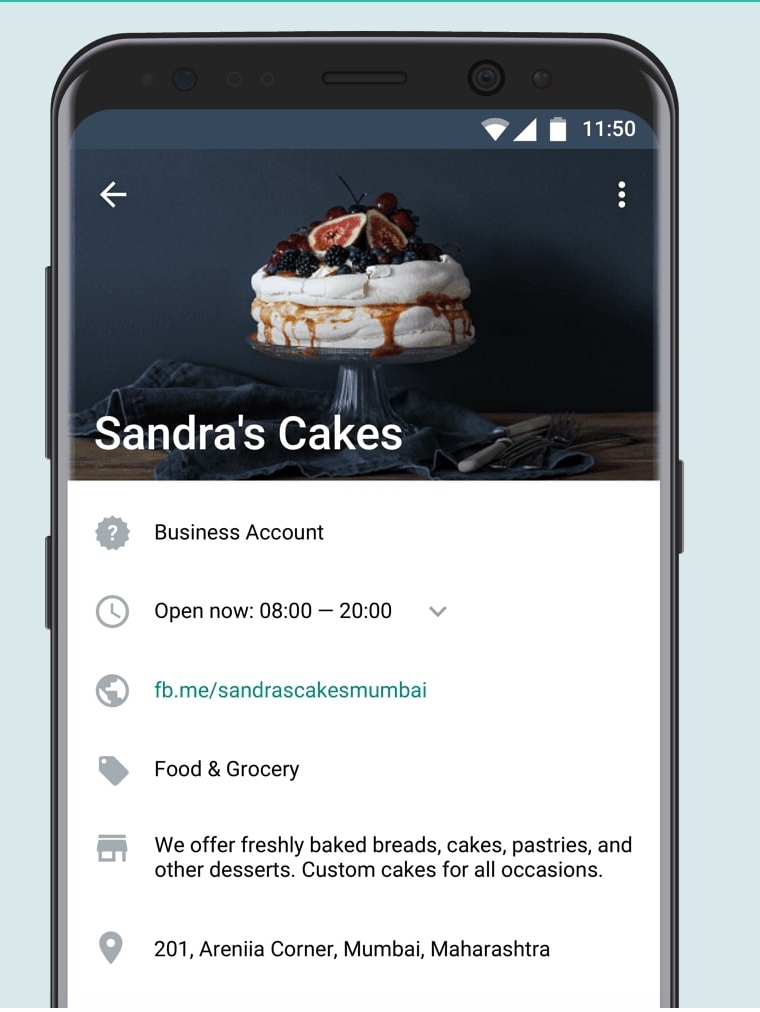
Create a business profile with helpful information for your customers, like your address, business description, email address, and website. Business accounts help brands to gain a user’s loyalty. A business profile gives the company a familiar “face” and identity. To have a “Verified” badge next to your company name, WhatsApp has to confirm that this is a verified business account.
Steps to add details about your business: Go to WhatsApp Business app – Open Settings > Business settings > Profile.
3.Quick Reply
These are frequent messages to answer common questions. Quick replies let you save and reuse messages you frequently send so you can easily answer common questions in no time. Simply press the “/” on your keyboard to select a quick reply and send.
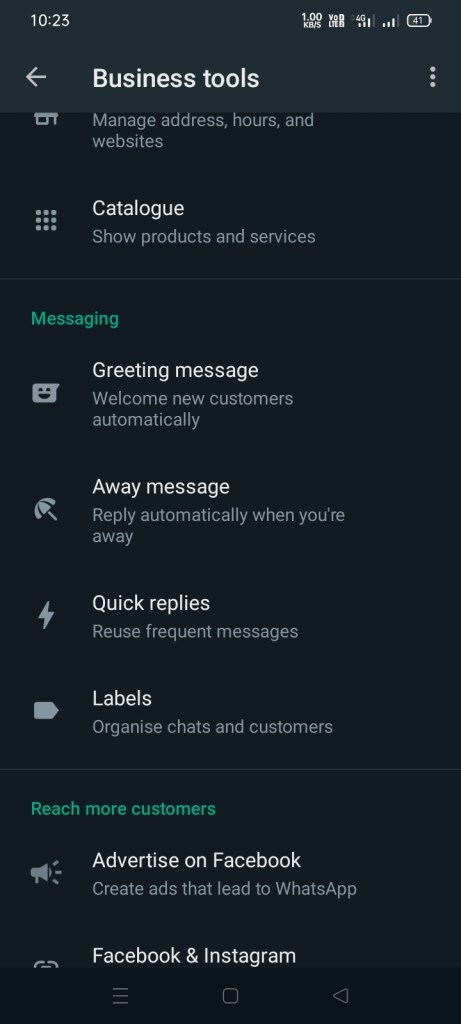
3.Automatic Greeting Message
WhatsApp for business enables you to create a greeting message that users will receive when they start a dialog with your company or after 14 days of inactivity. By sending an instant message, you welcome and introduce a company to a new potential customer with no delays and waiting time.
Steps to set up a greeting message: Settings > Business settings > Greeting message. From here, you can create a new greeting message or edit an existing one.
4.Setting Away Message
Away messages are like greeting messages. They send a custom message to people who are trying to connect with the company after your working hours. You can write a custom message or send your working hours. You can set up for them to activate at the chosen time.
Steps to set up an away message: Settings > Business settings > Away message > “Activate away message
You can also edit your away message from here and schedule when you want to send this message. You can choose from Always send, Custom schedule, or after your work hours
5.Label Contacts
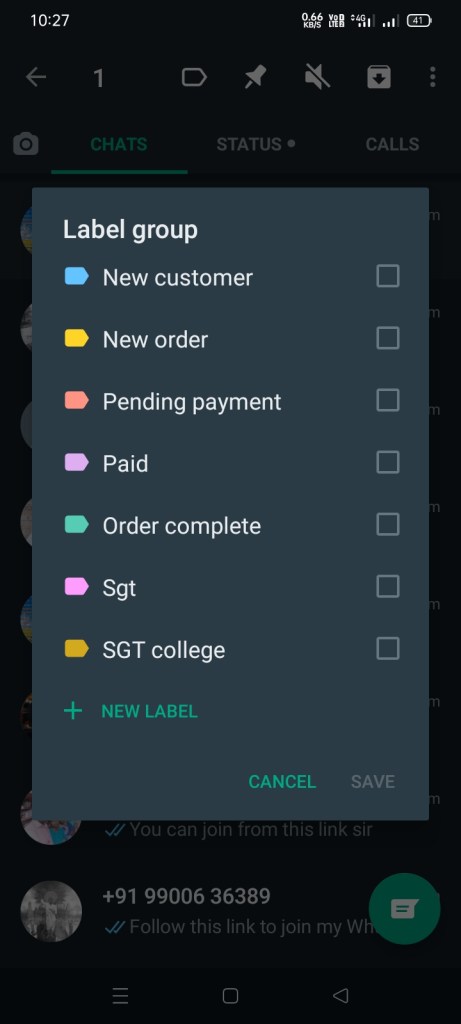
Businesses can organize their contacts and categorize them with labels for easy access. This way, you can easily search through your contacts and keep them grouped and organized.
Steps to add a label to a new contact: Click the menu button on the client’s chat page > choose a label and then save.
Steps to add a new label: Click the menu button on the client’s chat page > click “ New label” > click save
6.Access Message Statistics
WhatsApp for Business lets you access vital metrics like how many of your messages were sent, delivered, and read.
Steps to access statistics: Tap the Menu button > Settings > Business Settings > Statistics
7.Catalogs and Collections
The other feature that will be beneficial for your business is Catalogs. They look like this:
Catalogue for bakery
For each item in your catalog, you can add information, including price, description, and product code. This is so much easier for your customers than having to ask you about each item separately or go from WhatsApp to the website.
In October 2021, WhatsApp added Collections to make shopping even easier. They will act as folders to group items inside a business account. Users can navigate to the category they’re looking for right away without scrolling through the whole product list.Once added, you’re free to modify the Collection just like items to keep the information up to date.
Pro Tip: think of collections as categories on ecommerce websites. “Last chance” or “Sale” could be as converting in WhatsApp as they are on the website. Using these on WhatsApp Business account means providing similar well-paved shopping experience.
watsapp which well known to people of all generations including kids,now a days it is main source of communication or intraction between people’s.
Now a days buisness are going online so meta company also introduced a best application for buisiness it is watsapp buisines, although everyone who are reading this blog are familiar with this application but please spend some of your valuable time in reading this in which we know best updated buisines watsapp Together with WhatsApp chatbot, WhatsApp Business is a very powerful tool for commerce. Thanks to many new features that the platform keeps on releasing, WhatsApp is becoming a great retail place, especially during remote times. Even if you are not going to build a WhatsApp chatbot, there
Let’s look closer at WhatsApp Business app features that you might enjoy as much as we do:
Create a business profile with helpful information for your customers, like your address, business description, email address, and website. Business accounts help brands to gain a user’s loyalty. A business profile gives the company a familiar “face” and identity. To have a “Verified” badge next to your company name, WhatsApp has to confirm that this is a verified business account.
Steps to add details about your business: Go to WhatsApp Business app – Open Settings > Business settings > Profile.
3.Quick Reply
These are frequent messages to answer common questions. Quick replies let you save and reuse messages you frequently send so you can easily answer common questions in no time. Simply press the “/” on your keyboard to select a quick reply and send.
3.Automatic Greeting Message
WhatsApp for business enables you to create a greeting message that users will receive when they start a dialog with your company or after 14 days of inactivity. By sending an instant message, you welcome and introduce a company to a new potential customer with no delays and waiting time.
Steps to set up a greeting message: Settings > Business settings > Greeting message. From here, you can create a new greeting message or edit an existing one.
4.Setting Away Message
Away messages are like greeting messages. They send a custom message to people who are trying to connect with the company after your working hours. You can write a custom message or send your working hours. You can set up for them to activate at the chosen time.
Steps to set up an away message: Settings > Business settings > Away message > “Activate away message
You can also edit your away message from here and schedule when you want to send this message. You can choose from Always send, Custom schedule, or after your work hours
5.Label Contacts
Businesses can organize their contacts and categorize them with labels for easy access. This way, you can easily search through your contacts and keep them grouped and organized.
Steps to add a label to a new contact: Click the menu button on the client’s chat page > choose a label and then save.
Steps to add a new label: Click the menu button on the client’s chat page > click “ New label” > click save
6.Access Message Statistics
WhatsApp for Business lets you access vital metrics like how many of your messages were sent, delivered, and read.
Steps to access statistics: Tap the Menu button > Settings > Business Settings > Statistics
7.Catalogs and Collections
The other feature that will be beneficial for your business is Catalogs. They look like this:
Catalogue for bakery
For each item in your catalog, you can add information, including price, description, and product code. This is so much easier for your customers than having to ask you about each item separately or go from WhatsApp to the website.
In October 2021, WhatsApp added Collections to make shopping even easier. They will act as folders to group items inside a business account. Users can navigate to the category they’re looking for right away without scrolling through the whole product list.Once added, you’re free to modify the Collection just like items to keep the information up to date.
Pro Tip: think of collections as categories on ecommerce websites. “Last chance” or “Sale” could be as converting in WhatsApp as they are on the website. Using these on WhatsApp Business account means providing similar well-paved shopping experience.
@channa2021
Thank you for reading this blog i believe this is helpful to you
Public health is a core components of democracy. Contemporary Health policies are unenable to build coherence with SDGs. It reflected the major execution constraints. Health Policies of India always been a disappointment point; the indecisive nature of Governance dragged country on the dangerous edge. According to world bank, India spend in Public health 3.54% of their GDP on 136.64cr demographic capacity. It is the lowest budget in World. Comparing to countries like Nepal, Myanmar, Haiti, South Sudan, Algeria and Cuba invested more than India; all spend at least 6% of their GDP in public health. Other developed nations like UK, Germany, France spend more than 10% and USA give 16% of their GDP to health care sector.
Source: Commonwealth health hub
National health policy suggested that expenditure on health by states should be increased to up to 8% but none of the states ready to invest more than 5.4% of total budget in healthcare system. Spending less in health sector decrease our capacity to fight against the pandemic in most difficult times. We require to spend more, design appropriate Policy and most importantly implement and monitor those policies in structured manner for fruitful results.
National health mission was to provide health benefits in Rural(2005) & Urban (2013). Main functions of this programme are strengthening health system, prevention of communicable and non – communicable diseases, and create universal accessibility , affordable & quality healthcare service to all citizens in urban and rural areas. This programme was extended because of the tremendous outcome which only displayed on papers but still governance needs to played their proper role in designing and implementing accurate policy. India faces several challenges in the path of addressing health crisis; India lacks strategic Policy, constructive concepts, regulation and work ethics.
Source: ncbi.nih.gov.in
National health policy 1983 was the failure; cannot Considered to revive the healthcare crisis. Infact, liberalization opened the direction to move towards the public private partnership to achieve health services to all. To providing Healthcare services to urban poor is as essential as in rural areas. ORF mention in their report on URBAN HEALTH GOVERNANCE IN INDIA: A POLICY ROUNDTABLE addressing health as central component of urban planning and governance. Migration from rural to urban areas becoming extremely important aspect of urbanization, where people believes urban healthcare services are far more better than rural; but the urban system as crucially defected as the rural area, it raises question on the governance structure. Indian Health system cannot deal with diseases like tuberculosis, malaria, HIV+AIDS , deficiency of vitamins. Governance have to acknowledge the basic problem in health sector then only can able to build the health policy.
PUBLIC HEALTH ISSUES LEAD TO THE HEALTH CRISIS
National health policy 1983, 2002 and 2017 unleash to achieve an acceptable standard of good health system by upgrading infrastructure in existing public health; but it did not acquired the beneficial results out of these policies because Problem lying in Health Governance. Regulatory mechanism, Monitoring and evaluation of health policy aspects are not effectively pressuring for powerful outcomes. In India, 23% of sick population, 7% below poverty line population are not capable to afford Healthcare.
Source: Overview
According to spending in healthcare, India rank extremely low, estimation of spending Rs 3 per person on per day that count 1.02% of the GDP, meanwhile other countries average spending is 6%. WHO in Health financing profile 2017 depicted 67.78% of aggregate expenditure was paid out of pocket, on the other hand, the world average is 18.2%. let’s examine state – wise spending in public health.
Source: Overview
Bihar spend Rs 491 per capita on health (on 12.7cr population) less than half the Indian average spending 1.33. Madhya Pradesh spend Rs716 (on 86.8cr demography) and Uttar Pradesh Rs 733 (on 24.6cr population). On the contrary, we see complete different picture in Mizoram who spend Rs 5,862 of 4.2 % of it’s GDP (12.6cr population), Arunachal Pradesh Rs 5,177 (1.6% population) and Sikkim Rs 5126 (6.63 lakh). Two different spectrum in one country where few states neglect their public healthcare whereas others more inclined towards ensuring public health to their people.
Due to neglection of health sector, states who spend less suffering the most during Covid -19. These states had to faced the situation like lack of beds, hospital services, medical staff and medical equipments. This problem occurred because of years of neglection in health sector, health policy evaluation process was not used as weapon to counter the health crisis in India.
Lack of allocation to healthcare and lack of Governance capability caused the much bigger crisis. Covid -19 is global pandemic but it made Indian healthcare system came on it’s knees; when capital of country facing run out of beds, desperate hunt for oxygen cylinder, medical supplies it’s showed Indian healthcare system is rotten, toilsome and intricate.
Our Government and Governance is solemn enough to diminishing the health crisis. Capital of country not capable to fight against sudden health crisis then we can presuppose the conditions in rural areas. In this situation, Governance need to evaluate their mistakes that’s how Governance will play it’s sophisticated part, need some measures to ensure the public healthcare in entire country, should not resisted to only urban health centres.
Corruption in health sector, lowest quality health programme, poor cooperation between public & private sectors, lack of health awareness and no accessibility to medicines or testing machine services created cluster in health sector; which reflected as more weakness during Covid -19. When India became epicenter of global pandemic during dangerous second wave; India made international headline. The scenes of families from hospital were horrified. It also depicted how Government failed us.
Government and bureaucrats have no capability to overturn the crisis and find relevant solution in serious conditions in country. Indian government lack leadership quality, Political will. Governance cannot work until top political leaders and bureaucrats show some credibility to disperse the crisis. India estimated 4.34 lakh death due to covid-19. Health crisis is not new in india, Government never capable to find dynamic Policy to eradicate diseases like Tuberculosis, Malaria, HIV+AIDS. Tuberculosis caused 220,000 death every year. WHO estimated 2.64 million TB cases in 2020. KPMG report revealed that 74% doctors practice in urban areas this simply means rural area lack primary healthcare treatment facility. India has huge scarcity of doctors, nurses, paramedics and testing machines especially in rural areas. That’s how migration become prominent from rural to urban. WHO also suggested 1 doctor for 1000 people meaning 1:100 but India has 1:1445.
National TB Elimination Programme was not as effective as thought to obliterate the deadly disease from the country; where all other nation found the way to kill the health crisis. We need to revive the health policy structure and find new future oriented health policy to counter any sudden global health crisis. Let’s discuss few criteria to resist the health crisis in India.
RECOMMENDATIONS TO BUILD COLLAPSING HEALTH SYSTEM
PUBLIC PRIVATE PARTNERSHIP
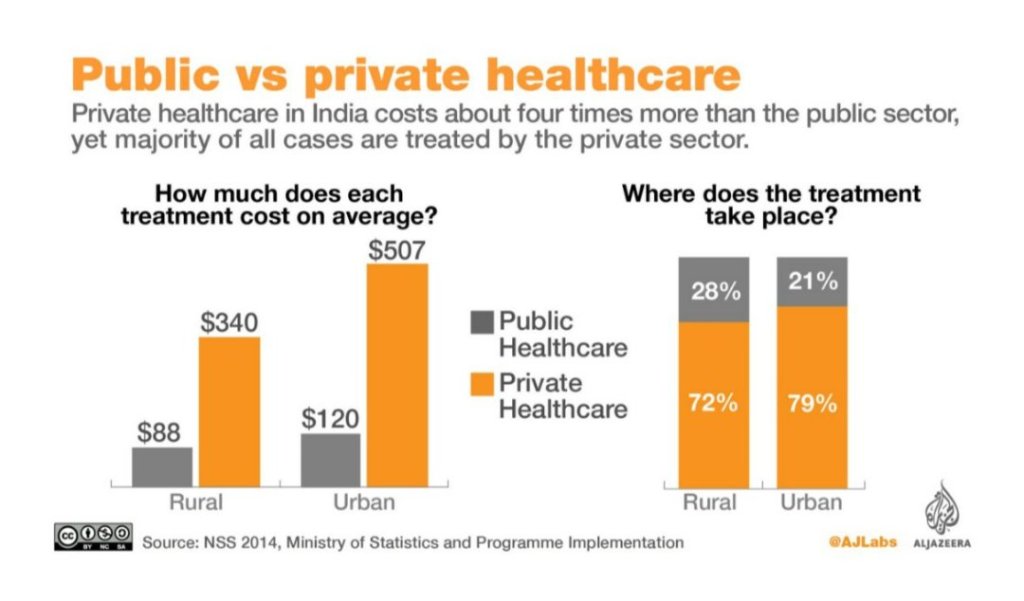
Last two years shook Indian healthcare system, demanded to take evident steps in healthcare sector. This is a accurate time to transform the ancient health policy and bring unique & innovative public health programme concerning the target population. Two main components of health crisis are affordability and accessibility which majority of population cannot reach to. Well governed PPP is the direction to improve the Indian healthcare system; through PPP India have seen success in the fields such as education, urban development and infrastructure.
Source: Alijazeera
• PPP provide resources to Government, which will bring experience and finances of the private sector. It will create a bridge between affordability and accessibility to all citizens.
• PPP ensures the expertise, finances, affordability, technology, specialist doctors.
• Now, one aspect need to consider that Public – Private sector will bring the resources but how, where, what to utilize at what place and in how much quantity for that Non – Government Organization can play the role of agent to fulfill the necessary requirements & provide research to private sector.
• Non – government organization can play essential role to ensure the PPP goals spread to all citizens. These organization overlook the formulation, Implementation and functioning of PPP. It can be great gap filler between affordability and accessibility.
• But, PPP should manage in control manner make sure by Governance it’s roles and functions otherwise PPP increase the burden of expenditure on common citizen. Governance needs to evaluate time to time the working mechanisms of PPP.
• Also, it is necessary to collaborate with non profit organization to maximize the result of PPP. Need to tackle down the any coming vagueness in PPP, maintain regulation.
INCREASE ALLOCATION TO HEALTHCARE
India must increase the spending on public healthcare. It should not differ state to state. Each state has to spend good amount of their GDP in Public health. Centre Government construct one same Affordable healthcare Programme for all states. Through INTER – GOVERNMENTAL RELATION center Government ensure overlapping authority model to communicate. Govt should spend at least more than 6% of their GDP. It will provide huge access to necessary medical services in the country.
NATIONAL FREE MEDICATION AND COUNSELING
Center and state government incite medication facility including counseling and spread awareness regarding health issues of human body. Make citizens more conscious about their body. Now, this method has challenging step concerning in rural areas with help of NGOs, ASHA workers, door to door awareness is necessary to spread the words about the sanitation, coronavirus precautions, HIV+AIDS awareness and TB awareness programme. In digitalized world, Mobile clinic can play great outlay of serving information of diseases to the people. Lunch effective powerful awareness programme in urban and rural areas Ensuring the awareness reaching to all citizens in country.
Center and state government incite medication facility including counseling and spread awareness regarding health issues of human body. Make citizens more conscious about their body. Now, this method has challenging step concerning in rural areas with help of NGOs, ASHA workers, door to door awareness is necessary to spread the words about the sanitation, coronavirus precautions, HIV+AIDS awareness and TB awareness programme. In digitalized world, Mobile clinic can play great outlay of serving information of diseases to the people. Lunch effective powerful awareness programme in urban and rural areas Ensuring the awareness reaching to all citizens in country.
CONCLUSION
Health Governance is one kind of Governance that we must deal with caution. Good Public Health Governance reflect the sincerety of Government ; it ensure the transparency, accountability and promote citizen centric Approach. Government determine universal Public healthcare no resistance to PAN areas. Providing Healthcare to citizens consider as enriching the immunity of country. Policy makers recite properly the Implementation part while performing the health policy; Keep the track of Monitoring then only we can decisively conclude the success of health policies.
Public health is a core components of democracy. Contemporary Health policies are unenable to build coherence with SDGs. It reflected the major execution constraints. Health Policies of India always been a disappointment point; the indecisive nature of Governance dragged country on the dangerous edge. According to world bank, India spend in Public health 3.54% of their GDP on 136.64cr demographic capacity. It is the lowest budget in World. Comparing to countries like Nepal, Myanmar, Haiti, South Sudan, Algeria and Cuba invested more than India; all spend at least 6% of their GDP in public health. Other developed nations like UK, Germany, France spend more than 10% and USA give 16% of their GDP to health care sector.
Source: Commonwealth health hub
National health policy suggested that expenditure on health by states should be increased to up to 8% but none of the states ready to invest more than 5.4% of total budget in healthcare system. Spending less in health sector decrease our capacity to fight against the pandemic in most difficult times. We require to spend more, design appropriate Policy and most importantly implement and monitor those policies in structured manner for fruitful results.
National health mission was to provide health benefits in Rural(2005) & Urban (2013). Main functions of this programme are strengthening health system, prevention of communicable and non – communicable diseases, and create universal accessibility , affordable & quality healthcare service to all citizens in urban and rural areas. This programme was extended because of the tremendous outcome which only displayed on papers but still governance needs to played their proper role in designing and implementing accurate policy. India faces several challenges in the path of addressing health crisis; India lacks strategic Policy, constructive concepts, regulation and work ethics.
Source: ncbi.nih.gov.in
National health policy 1983 was the failure; cannot Considered to revive the healthcare crisis. Infact, liberalization opened the direction to move towards the public private partnership to achieve health services to all. To providing Healthcare services to urban poor is as essential as in rural areas. ORF mention in their report on URBAN HEALTH GOVERNANCE IN INDIA: A POLICY ROUNDTABLE addressing health as central component of urban planning and governance. Migration from rural to urban areas becoming extremely important aspect of urbanization, where people believes urban healthcare services are far more better than rural; but the urban system as crucially defected as the rural area, it raises question on the governance structure. Indian Health system cannot deal with diseases like tuberculosis, malaria, HIV+AIDS , deficiency of vitamins. Governance have to acknowledge the basic problem in health sector then only can able to build the health policy.
PUBLIC HEALTH ISSUES LEAD TO THE HEALTH CRISIS
National health policy 1983, 2002 and 2017 unleash to achieve an acceptable standard of good health system by upgrading infrastructure in existing public health; but it did not acquired the beneficial results out of these policies because Problem lying in Health Governance. Regulatory mechanism, Monitoring and evaluation of health policy aspects are not effectively pressuring for powerful outcomes. In India, 23% of sick population, 7% below poverty line population are not capable to afford Healthcare.
Source: Overview
According to spending in healthcare, India rank extremely low, estimation of spending Rs 3 per person on per day that count 1.02% of the GDP, meanwhile other countries average spending is 6%. WHO in Health financing profile 2017 depicted 67.78% of aggregate expenditure was paid out of pocket, on the other hand, the world average is 18.2%. let’s examine state – wise spending in public health.
Source: Overview
Bihar spend Rs 491 per capita on health (on 12.7cr population) less than half the Indian average spending 1.33. Madhya Pradesh spend Rs716 (on 86.8cr demography) and Uttar Pradesh Rs 733 (on 24.6cr population). On the contrary, we see complete different picture in Mizoram who spend Rs 5,862 of 4.2 % of it’s GDP (12.6cr population), Arunachal Pradesh Rs 5,177 (1.6% population) and Sikkim Rs 5126 (6.63 lakh). Two different spectrum in one country where few states neglect their public healthcare whereas others more inclined towards ensuring public health to their people.
Due to neglection of health sector, states who spend less suffering the most during Covid -19. These states had to faced the situation like lack of beds, hospital services, medical staff and medical equipments. This problem occurred because of years of neglection in health sector, health policy evaluation process was not used as weapon to counter the health crisis in India.
Lack of allocation to healthcare and lack of Governance capability caused the much bigger crisis. Covid -19 is global pandemic but it made Indian healthcare system came on it’s knees; when capital of country facing run out of beds, desperate hunt for oxygen cylinder, medical supplies it’s showed Indian healthcare system is rotten, toilsome and intricate.
Our Government and Governance is solemn enough to diminishing the health crisis. Capital of country not capable to fight against sudden health crisis then we can presuppose the conditions in rural areas. In this situation, Governance need to evaluate their mistakes that’s how Governance will play it’s sophisticated part, need some measures to ensure the public healthcare in entire country, should not resisted to only urban health centres.
Corruption in health sector, lowest quality health programme, poor cooperation between public & private sectors, lack of health awareness and no accessibility to medicines or testing machine services created cluster in health sector; which reflected as more weakness during Covid -19. When India became epicenter of global pandemic during dangerous second wave; India made international headline. The scenes of families from hospital were horrified. It also depicted how Government failed us.
Government and bureaucrats have no capability to overturn the crisis and find relevant solution in serious conditions in country. Indian government lack leadership quality, Political will. Governance cannot work until top political leaders and bureaucrats show some credibility to disperse the crisis. India estimated 4.34 lakh death due to covid-19. Health crisis is not new in india, Government never capable to find dynamic Policy to eradicate diseases like Tuberculosis, Malaria, HIV+AIDS. Tuberculosis caused 220,000 death every year. WHO estimated 2.64 million TB cases in 2020. KPMG report revealed that 74% doctors practice in urban areas this simply means rural area lack primary healthcare treatment facility. India has huge scarcity of doctors, nurses, paramedics and testing machines especially in rural areas. That’s how migration become prominent from rural to urban. WHO also suggested 1 doctor for 1000 people meaning 1:100 but India has 1:1445.
National TB Elimination Programme was not as effective as thought to obliterate the deadly disease from the country; where all other nation found the way to kill the health crisis. We need to revive the health policy structure and find new future oriented health policy to counter any sudden global health crisis. Let’s discuss few criteria to resist the health crisis in India.
RECOMMENDATIONS TO BUILD COLLAPSING HEALTH SYSTEM
PUBLIC PRIVATE PARTNERSHIP
Last two years shook Indian healthcare system, demanded to take evident steps in healthcare sector. This is a accurate time to transform the ancient health policy and bring unique & innovative public health programme concerning the target population. Two main components of health crisis are affordability and accessibility which majority of population cannot reach to. Well governed PPP is the direction to improve the Indian healthcare system; through PPP India have seen success in the fields such as education, urban development and infrastructure.
Source: Alijazeera
• PPP provide resources to Government, which will bring experience and finances of the private sector. It will create a bridge between affordability and accessibility to all citizens.
• PPP ensures the expertise, finances, affordability, technology, specialist doctors.
• Now, one aspect need to consider that Public – Private sector will bring the resources but how, where, what to utilize at what place and in how much quantity for that Non – Government Organization can play the role of agent to fulfill the necessary requirements & provide research to private sector.
• Non – government organization can play essential role to ensure the PPP goals spread to all citizens. These organization overlook the formulation, Implementation and functioning of PPP. It can be great gap filler between affordability and accessibility.
• But, PPP should manage in control manner make sure by Governance it’s roles and functions otherwise PPP increase the burden of expenditure on common citizen. Governance needs to evaluate time to time the working mechanisms of PPP.
• Also, it is necessary to collaborate with non profit organization to maximize the result of PPP. Need to tackle down the any coming vagueness in PPP, maintain regulation.
INCREASE ALLOCATION TO HEALTHCARE
India must increase the spending on public healthcare. It should not differ state to state. Each state has to spend good amount of their GDP in Public health. Centre Government construct one same Affordable healthcare Programme for all states. Through INTER – GOVERNMENTAL RELATION center Government ensure overlapping authority model to communicate. Govt should spend at least more than 6% of their GDP. It will provide huge access to necessary medical services in the country.
NATIONAL FREE MEDICATION AND COUNSELING
Center and state government incite medication facility including counseling and spread awareness regarding health issues of human body. Make citizens more conscious about their body. Now, this method has challenging step concerning in rural areas with help of NGOs, ASHA workers, door to door awareness is necessary to spread the words about the sanitation, coronavirus precautions, HIV+AIDS awareness and TB awareness programme. In digitalized world, Mobile clinic can play great outlay of serving information of diseases to the people. Lunch effective powerful awareness programme in urban and rural areas Ensuring the awareness reaching to all citizens in country.
Center and state government incite medication facility including counseling and spread awareness regarding health issues of human body. Make citizens more conscious about their body. Now, this method has challenging step concerning in rural areas with help of NGOs, ASHA workers, door to door awareness is necessary to spread the words about the sanitation, coronavirus precautions, HIV+AIDS awareness and TB awareness programme. In digitalized world, Mobile clinic can play great outlay of serving information of diseases to the people. Lunch effective powerful awareness programme in urban and rural areas Ensuring the awareness reaching to all citizens in country.
CONCLUSION
Health Governance is one kind of Governance that we must deal with caution. Good Public Health Governance reflect the sincerety of Government ; it ensure the transparency, accountability and promote citizen centric Approach. Government determine universal Public healthcare no resistance to PAN areas. Providing Healthcare to citizens consider as enriching the immunity of country. Policy makers recite properly the Implementation part while performing the health policy; Keep the track of Monitoring then only we can decisively conclude the success of health policies.
Every year 22 April is celebrated as Earth Day across the world. Earth Day symbolizes the anniversary of the birth of the modern environmental movement in 1970. The theme of this year Earth Day 2022 is Invest in Our Planet.
We all are surviving and eking out our livelihoods from this earth so the earth is nurturing us and we must be grateful to earth. In all religions,the importance of earth has been highlighted. In Hindu ‘Bhumi Puja/Pujan’ is known to many. In general,it means the tradition of offering prayers to Mother Earth before beginning construction work.
A few lines about the earth on Earth Day I am highlighting from the website nationalgeographic.com for the benefit of readers.
With a radius of 3,959 miles, Earth is the fifth largest planet in our solar system, and it’s the only one known for sure to have liquid water on its surface. Earth orbits the sun once every 365.25 days. Since our calendar years have only 365 days, we add an extra leap day every four years to account for the difference.
Though we can’t feel it, Earth zooms through its orbit at an average velocity of 18.5 miles a second. During this circuit, our planet is an average of 93 million miles away from the sun, a distance that takes light about eight minutes to traverse. Almost 70 percent of Earth’s surface is covered in oceans of liquid water that average 2.5 miles deep. These bodies of water contain 97 percent of Earth’s volcanoes and the mid-ocean ridge, a massive mountain range more than 40,000 miles long (nationalgeographic.com).
According to the website earthday.org/ for Earth Day 2022, we need to act (boldly), innovate (broadly), and implement (equitably). The Great Global Cleanup is a worldwide campaign to remove billions of pieces of trash from neighbourhoods, beaches, rivers, lakes, trails, and parks — reducing waste and plastic pollution, improving habitats, and preventing harm to wildlife and humans. It is also evident from the website that the fashion industry is responsible for over 8 percent of total greenhouse gas emissions. Sustainable Fashion refers to a clothing supply chain that is ecologically and socially responsible. Now is the opportunity to shift the industry and consumers away from the fast fashion model and toward sustainable practices in sourcing, production, distribution, marketing, and consumption. While discussing Earth Day a case from Hyderabad may be referred (earthday.org/).
In the context of Earth Day, a case from Hyderabad, India may be highlighted. Pragati Resorts was established by a dynamic Telugu person Dr. G.B.K Rao presently CMD of the Pragati Resorts Group gets enormous credit as this bio-diversity park was established in 1994 near Hyderabad city which was totally barren with the awful climatic conditions before 1994. The water in the area was at an awfully low level due to the mining of limestone which made the land unfit for cultivation even. Dr. G.B.K Rao selected the land-based on three criteria – i) it is away from the city and also away from the highway, ii) the area is totally non-cultivable /barren, and iii) totally very low level of water. Now, the area has been turned into heaven and the people call it “Pragati is Heaven on Earth”. Around 800 varieties of herbal heritage and medicinal plants, other rare mother plants, and trees inter alia are Kalpavriksha (also known as Kalpataru), have been planted in Pragati. This is spread over an area of 2500 acres. In the Resorts, there is a provision of ‘Amrutha Ahaaram’ (meaning Amrita/lifesaving foods), and this special 3-day package has been designed to boost immunity levels naturally to fight against any type of virus or bacteria.
On Earth Day, 2022 a famous name from India who is an eminent environmentalist also should be mentioned. He is Professor K. Purushotham Reddy, a former Professor of Osmania University, Hyderabad. In many forums across the country, he has highlighted the importance of the environment for the survival of human beings by discarding the water, air, and noise pollution. And for this, he organized peaceful agitation also to save mother Earth.
On Earth Day, 22 my Salute to the people, who have been working to make Earth Clean and Green and also helping to make it free from pollution. In this regard, two names which I have already mentioned, I am reiterating Dr. G.B.K Rao and Professor K. Purushotham Reddy.
Every year 22 April is celebrated as Earth Day across the world. Earth Day symbolizes the anniversary of the birth of the modern environmental movement in 1970. The theme of this year Earth Day 2022 is Invest in Our Planet.
We all are surviving and eking out our livelihoods from this earth so the earth is nurturing us and we must be grateful to earth. In all religions,the importance of earth has been highlighted. In Hindu ‘Bhumi Puja/Pujan’ is known to many. In general,it means the tradition of offering prayers to Mother Earth before beginning construction work.
A few lines about the earth on Earth Day I am highlighting from the website nationalgeographic.com for the benefit of readers.
With a radius of 3,959 miles, Earth is the fifth largest planet in our solar system, and it’s the only one known for sure to have liquid water on its surface. Earth orbits the sun once every 365.25 days. Since our calendar years have only 365 days, we add an extra leap day every four years to account for the difference.
Though we can’t feel it, Earth zooms through its orbit at an average velocity of 18.5 miles a second. During this circuit, our planet is an average of 93 million miles away from the sun, a distance that takes light about eight minutes to traverse. Almost 70 percent of Earth’s surface is covered in oceans of liquid water that average 2.5 miles deep. These bodies of water contain 97 percent of Earth’s volcanoes and the mid-ocean ridge, a massive mountain range more than 40,000 miles long (nationalgeographic.com).
According to the website earthday.org/ for Earth Day 2022, we need to act (boldly), innovate (broadly), and implement (equitably). The Great Global Cleanup is a worldwide campaign to remove billions of pieces of trash from neighbourhoods, beaches, rivers, lakes, trails, and parks — reducing waste and plastic pollution, improving habitats, and preventing harm to wildlife and humans. It is also evident from the website that the fashion industry is responsible for over 8 percent of total greenhouse gas emissions. Sustainable Fashion refers to a clothing supply chain that is ecologically and socially responsible. Now is the opportunity to shift the industry and consumers away from the fast fashion model and toward sustainable practices in sourcing, production, distribution, marketing, and consumption. While discussing Earth Day a case from Hyderabad may be referred (earthday.org/).
In the context of Earth Day, a case from Hyderabad, India may be highlighted. Pragati Resorts was established by a dynamic Telugu person Dr. G.B.K Rao presently CMD of the Pragati Resorts Group gets enormous credit as this bio-diversity park was established in 1994 near Hyderabad city which was totally barren with the awful climatic conditions before 1994. The water in the area was at an awfully low level due to the mining of limestone which made the land unfit for cultivation even. Dr. G.B.K Rao selected the land-based on three criteria – i) it is away from the city and also away from the highway, ii) the area is totally non-cultivable /barren, and iii) totally very low level of water. Now, the area has been turned into heaven and the people call it “Pragati is Heaven on Earth”. Around 800 varieties of herbal heritage and medicinal plants, other rare mother plants, and trees inter alia are Kalpavriksha (also known as Kalpataru), have been planted in Pragati. This is spread over an area of 2500 acres. In the Resorts, there is a provision of ‘Amrutha Ahaaram’ (meaning Amrita/lifesaving foods), and this special 3-day package has been designed to boost immunity levels naturally to fight against any type of virus or bacteria.
On Earth Day, 2022 a famous name from India who is an eminent environmentalist also should be mentioned. He is Professor K. Purushotham Reddy, a former Professor of Osmania University, Hyderabad. In many forums across the country, he has highlighted the importance of the environment for the survival of human beings by discarding the water, air, and noise pollution. And for this, he organized peaceful agitation also to save mother Earth.
On Earth Day, 22 my Salute to the people, who have been working to make Earth Clean and Green and also helping to make it free from pollution. In this regard, two names which I have already mentioned, I am reiterating Dr. G.B.K Rao and Professor K. Purushotham Reddy.
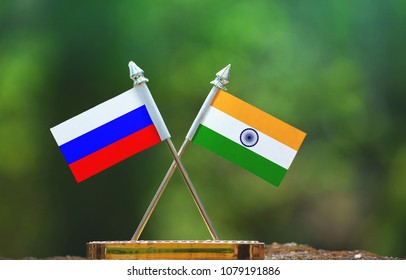
Russia and India Images, Stock Photos & Vectors | Shutterstock
India and Russia is said to share cordial relations and let us check the reality of this friendship
International relations have gained immense significance since time immemorial. India also handles its external relations with due importance. This has made India a significant player in international relations by establishing close relations with biggest nations of the world. One of the most important relation among them are India’s close ties with Russia.
Russia and its forefather USSR have always stood with India since independence. There were several instances when the socialist nation has offered support both ideologically as well as in person. Let us look into some such instances:
IRIGC
The Indo-Russian Inter-Governmental Commission (IRIGC) is a significant institution that manages the intergovernmental activities between both countries. It is considered as the steering committee of Indo-Russia relations. It has two wings, the first covering Trade, Economic, Scientific, Technological and Cultural Co-operation and is normally co-chaired by the deputy prime minister of Russia and the External affairs minister of India. The second wing of the commission deals with Military Technical Co-operation and is co-chaired by the respective Defense ministers of two countries. Both parts of IRIGC meet annually.
SPACE SECTOR
Historically, there has been a long history of cooperation between the Soviet Union and India in space. Examples include Aryabhata , India’s first satellite, was launched by the Soviet Union on 19 April 1975 from Kapustin Yar using a Kosmos 3M launch vehicle. Under Interkosmos space program, Rakesh Sharma was also launched by the Soviet Union.
DEFENCE ASSISTANCE
The Soviet Union was an important supplier of defense equipment for several decades, and this role has been inherited by the Russian federation. Russia 68%, USA 14% and Israel 7.2% are the major arms suppliers to India (2012-2016), and India and Russia have deepened their make in India defense manufacturing cooperation by signing agreements for the construction of naval frigates, Twin engine utility helicopters, Brahmos Cruise missiles and such joint venture initiatives. The co-operation is not limited to a buyer-seller relationship but includes joint research and development, training, service to service contacts, including joint exercises.
TRADE PARTNERSHIP
Bilateral trade between both countries is concentrated in key value chain sectors. These sectors include highly diversified segments such as aerospace, machinery, electronics, fertilizers, precious stones, oil, etc. Both Governments have jointly developed an economic strategy that involves using a number of economic components to increase future bilateral trade. Also, a Joint study group has been appointed to study the prospects of free trade.
POLITICAL RELATIONS
Irrespective of the changing government policies both countries have supported each other in political matters. Non participation of India in UN meetings to condemn Russian invasion of Ukraine and USSR’s support during Bangladesh war of 1971 are few examples. The socialist idea of planning is also an example of India’s relation with Russia and USSR.
NUCLEAR DEALS AND ENERGY SECTOR
On 7 November 2009, India signed a new nuclear deal with Russia apart from the deals that were agreed upon by the two countries earlier. India and Russia are in discussion for construction of two more nuclear power units at Kudankulam. Two units of the Kudankulam nuclear power plant are already operational. Similarly, several initiatives have been taken up by these nations collectively to ensure energy efficiency.
RUPEE ROUBLE AGREEMENT
Recently Russia has signed an agreement by which imports from Russia could be paid in Rupees. This was in response to India’s support for Russia even during trade restrictions from nations around the world. For the rupee-rouble mechanism to be implemented, Indian importers would pay for goods to the accounts of Russian banks in India and they in turn would make the payment in roubles to the Russian exporters.
The countries have agreed to carry forward a special and privileged strategic relationship. Irrespective of the changing governments both nations have stood in support of each other during the hardest times.
Russia and India Images, Stock Photos & Vectors | Shutterstock
India and Russia is said to share cordial relations and let us check the reality of this friendship
International relations have gained immense significance since time immemorial. India also handles its external relations with due importance. This has made India a significant player in international relations by establishing close relations with biggest nations of the world. One of the most important relation among them are India’s close ties with Russia.
Russia and its forefather USSR have always stood with India since independence. There were several instances when the socialist nation has offered support both ideologically as well as in person. Let us look into some such instances:
IRIGC
The Indo-Russian Inter-Governmental Commission (IRIGC) is a significant institution that manages the intergovernmental activities between both countries. It is considered as the steering committee of Indo-Russia relations. It has two wings, the first covering Trade, Economic, Scientific, Technological and Cultural Co-operation and is normally co-chaired by the deputy prime minister of Russia and the External affairs minister of India. The second wing of the commission deals with Military Technical Co-operation and is co-chaired by the respective Defense ministers of two countries. Both parts of IRIGC meet annually.
SPACE SECTOR
Historically, there has been a long history of cooperation between the Soviet Union and India in space. Examples include Aryabhata , India’s first satellite, was launched by the Soviet Union on 19 April 1975 from Kapustin Yar using a Kosmos 3M launch vehicle. Under Interkosmos space program, Rakesh Sharma was also launched by the Soviet Union.
DEFENCE ASSISTANCE
The Soviet Union was an important supplier of defense equipment for several decades, and this role has been inherited by the Russian federation. Russia 68%, USA 14% and Israel 7.2% are the major arms suppliers to India (2012-2016), and India and Russia have deepened their make in India defense manufacturing cooperation by signing agreements for the construction of naval frigates, Twin engine utility helicopters, Brahmos Cruise missiles and such joint venture initiatives. The co-operation is not limited to a buyer-seller relationship but includes joint research and development, training, service to service contacts, including joint exercises.
TRADE PARTNERSHIP
Bilateral trade between both countries is concentrated in key value chain sectors. These sectors include highly diversified segments such as aerospace, machinery, electronics, fertilizers, precious stones, oil, etc. Both Governments have jointly developed an economic strategy that involves using a number of economic components to increase future bilateral trade. Also, a Joint study group has been appointed to study the prospects of free trade.
POLITICAL RELATIONS
Irrespective of the changing government policies both countries have supported each other in political matters. Non participation of India in UN meetings to condemn Russian invasion of Ukraine and USSR’s support during Bangladesh war of 1971 are few examples. The socialist idea of planning is also an example of India’s relation with Russia and USSR.
NUCLEAR DEALS AND ENERGY SECTOR
On 7 November 2009, India signed a new nuclear deal with Russia apart from the deals that were agreed upon by the two countries earlier. India and Russia are in discussion for construction of two more nuclear power units at Kudankulam. Two units of the Kudankulam nuclear power plant are already operational. Similarly, several initiatives have been taken up by these nations collectively to ensure energy efficiency.
RUPEE ROUBLE AGREEMENT
Recently Russia has signed an agreement by which imports from Russia could be paid in Rupees. This was in response to India’s support for Russia even during trade restrictions from nations around the world. For the rupee-rouble mechanism to be implemented, Indian importers would pay for goods to the accounts of Russian banks in India and they in turn would make the payment in roubles to the Russian exporters.
The countries have agreed to carry forward a special and privileged strategic relationship. Irrespective of the changing governments both nations have stood in support of each other during the hardest times.




 Eduindex
You must be logged in to post a comment.