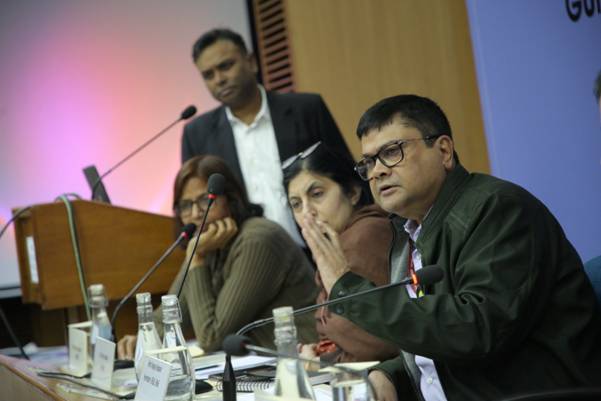
UN Biodiversity Conference, COP15 at Montreal, Canada


‘’The Goals and targets set in the Global Biodiversity Framework should be ambitious, yet realistic and practical’’

The Union Minister for Environment, Forest and Climate Change Shri Bhupender Yadav addressed the Stock taking Plenary at UN Biodiversity  Conference, COP15  at Montreal, Canada. Addressing the Plenary Shri Yadav said,

Mr. President, Excellencies, Ladies and Gentlemen,

I acknowledge the contribution of the parties for their valuable contribution and hope that this conference reaches a consensus on putting in place the Post 2020 Global Biodiversity Framework. Reversing ecosystem degradation and halting global biodiversity loss are essential for socioeconomic development, human wellbeing, and for advancing global sustainability. The goals and targets set in the Global Biodiversity Framework should be ambitious; yet realistic and practical. Conservation of biodiversity must also be based on Common but Differentiated Responsibilities and Respective capabilities as the climate change processes affect biodiversity.

Excellencies,

For the developing nations, agriculture is a paramount economic driver for rural communities, and the critical support provided to these sectors cannot be redirected.When food security is of paramount importance for developing countries, prescribing numerical targets in pesticide reductions is unnecessary and must be left to countries to decide, based on national circumstances, priorities and capabilities. Biodiversity conservation requires ecosystems to be conserved and restored holistically and in an integrated manner. It is in this context that Ecosystem Approaches for conservation of biodiversity need to be adopted rather than nature based solutions.


Excellencies

The successful implementation of the framework will squarely depend on the ways and means we put in place for an equally ambitious Resource Mobilization Mechanism. Hence there is a need to create a new and dedicated mechanism for the provision of financial resources to developing-country Parties. India is fully committed to working closely with all parties so that we are all able to bring out an ambitious and realistic Global Biodiversity Framework in COP 15.

Thank you very much.

MJPS

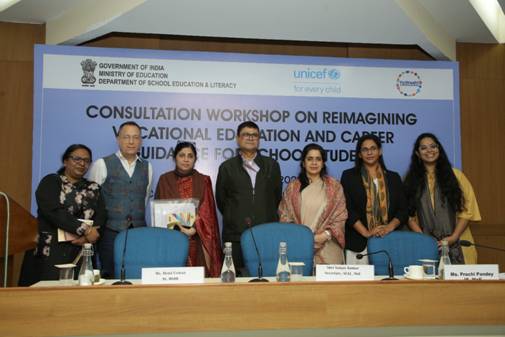
one-day Consultation Workshop on Reimagining Vocational Education and Career Guidance for School Students

 Key Highlights:

-NCrF will help dropouts from the formal education system to get reintegrated by aligning their practical experience with the appropriate Framework level- Shri Sanjay Kumar

-Discussions on career guidance reflected on the role of physical interventions and career counselling that could be done in schools itself.

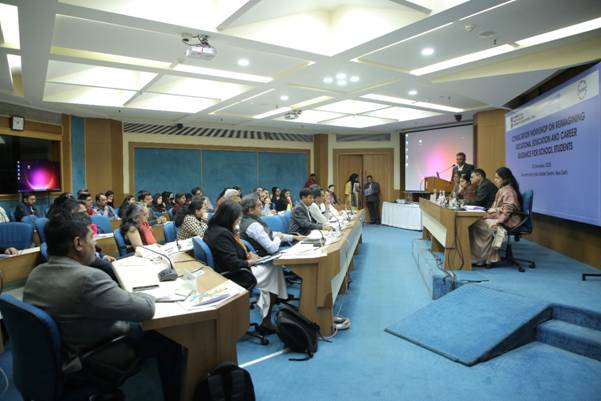
The Ministry of Education organized a one-day Consultation Workshop on Reimagining Vocational Education and Career Guidance for School Students in collaboration with UNICEF and YuWaah on 16th December 2022 at New Delhi.

WhatsApp Image 2022-12-17 at 8.24.57 PM (1).jpeg

WhatsApp Image 2022-12-17 at 8.25.53 PM (1).jpeg


Secretary, Department of School Education and Literacy, Shri Sanjay Kumar, chaired the consultation workshop and two roundtable interactions with Ministry of Skill Development and Entrepreneurship, Directorate General of Training (ITI), PSSCIVE,Bhopal, NCERT, CBSE, NCVET,AICTE etc. The workshop and roundtable interaction were also attended by various experts from PwC, YuWaah, Civil Society organizations, state education department, practitioners and organisations working in the fields of vocational education and career counselling, corporates and current and passed out students.

WhatsApp Image 2022-12-17 at 8.24.57 PM.jpeg

WhatsApp Image 2022-12-17 at 8.25.39 PM.jpeg

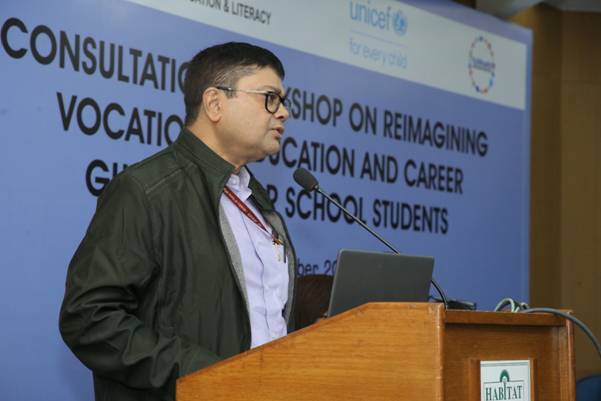
During the keynote address, Secretary, Department of School Education and Literacy, Shri Sanjay Kumar, pointed out that India needs to catch up with other countries in terms of skilling the workforce through formal vocational training during the student years. NEP 2020 has identified such issues and has suggested remedial measures, he added.

Shri Kumar pointed out that as per NEP, 2020 Vocational Education needs to be integrated into all schools and higher education institutions in a phased manner over the next decade. Trades and Courses shall be chosen based on skills gap analysis and mapping of local opportunities to make it demand driven. Concerted efforts from all stakeholders will be required to de-stigmatizeVocational Education and make it aspirational.  The National Credit Framework, currently under finalization by the Ministry of Skill Development and Entrepreneurship will also eliminate traditional hierarchies and silos between different areas of learning. It will help in removing complex separations between arts and sciences, between curricular and extra-curricular activities, between vocational and academic streams, etc. By providing credits for academic, extra-curricular and experiential learning, NCrF will help dropouts from the formal education system to get reintegrated by aligning their practical experience with the appropriate Framework level.

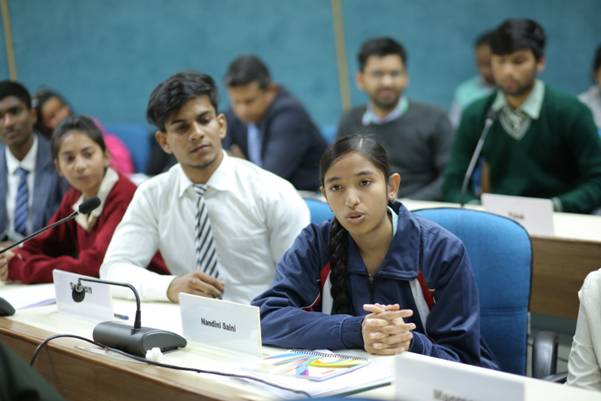
The consultations were also addressed by Ms. Dhuwarakha Sriram Chief of Generation Unlimited (YuWaah), Youth Development and Partnerships and Mr. Terry Durian, Chief of Education, UNICEF.  Various ideas related to reimagining, reinventing vocational education modules etc. were discussed at length. Importance of life skills – both vertical and horizontal, aspirational disconnect and information asymmetry in uptake of vocational education school,giving a gender perspective to vocational education, etc were also focus of these discussions.In the light of newly launched National Education Policy, 2020 the aim should be to empower students with skills such as cloud computing, artificial intelligence, machine learning, data analytics, robotic process automation, cybersecurity, etc. so that vocational graduates could compete in the global economy. The need to establish virtual labs, so that all students have equal access to high-quality practical and hands-on experience, was also stressed upon.  The Conference also benefitted from the feedback from students who have taken vocational courses like Multi-Skilling course and Information Technology course.

WhatsApp Image 2022-12-17 at 8.25.38 PM.jpeg

The 2nd Roundtable deliberated upon the current systems of career counseling in schools and what are the key learnings and best practices.  Secretary, DOSEL stated that solutions should focus on building an institutional model of career counseling in schools with scale, speed and sustainability utilising technological innovations including artificial intelligence.  He also stated that there was a need to map resources and build a database of the same.  Discussions on career guidance also reflected on the role of physical interventions and career counselling that could be done in schools itself.

*****

North Eastern Council

 Prime Minister Shri Narendra Modi addressed the meeting of North Eastern Council (NEC) in Shillong earlier today. The meeting marks the golden jubilee celebration of the North Eastern Council, which was formally inaugurated in 1972.

Hailing the contribution of NEC in the development of the North East region, Prime Minister said that this golden jubilee celebration of the NEC coincides with the ongoing Azadi ka Amrit Mahotsav. Underscoring that he often refers to the 8 states of the region as Asht Lakshmi, he said the government should work on  8 foundation pillars  for its development, viz. Peace, Power, Tourism, 5G connectivity, Culture, Natural farming, Sports, Potential.

Prime Minister said that the Northeast is our gateway to South -East Asia and can become a centre for development of the entire region. And to realise this potential of the region, work is going on the projects like Indian-Myanmar-Thailand trilateral highway and Agartala-Akhaura rail project. Prime Minister highlighted that the government has gone beyond the conversion of the ‘Look East’ policy to ‘Act East’, and now its policy is ‘Act Fast for Northeast’ and ‘Act First for Northeast.’ Highlighting the success of peace initiatives in the region, he said that many peace agreements have been signed, inter-state boundary agreements have been done and there has been a marked reduction in instances of extremism.

Discussing India’s commitment towards net zero, Prime Minister said Northeast can become a powerhouse of hydropower. This will make the states of the region power surplus, help in expansion of industries and generate a large number of jobs. Discussing the tourism potential of the region, he said that both culture and nature of the region are attracting tourists from across the world. He added that tourism circuits are being identified and developed in the region also. He also discussed sending students from 100 universities to Northeast, which will help bring people of different regions closer. These students can then ​​become ambassadors of the region.

Talking about boosting connectivity in the region, Prime Minister said that iconic bridge projects which were pending since several decades have now been completed. In last 8 years, number of airports in the region has jumped from 9 to 16, and the number of flights have increased from about 900 before 2014 to around 1900. Many North eastern states have come to Railway map for the first time and efforts are being done to expand the waterways also. The length of national highways has increased by 50% since 2014 in the region. He said that with the launch of the PM-DevINE scheme, the infrastructure projects in the Northeast have gained more momentum. He added that the government is also working on improving digital connectivity in the Northeast by increasing the optical fibre network. Talking about development of Aatmanirbhar 5G infrastructure, he said that 5G will help further development of startup ecosystem, service sector among others in the region. He said that the government is committed to making the Northeast not only a centre of economic growth, but also of cultural growth.

Speaking about the agriculture potential of the region, Prime Minister underlined the scope of natural farming, in which Northeast can play a leading role. He said that through Krishi UDAN, farmers of the region are able to send their products across the country and different parts of the world as well. He urged the North eastern states to participate in the ongoing National Mission on Edible Oils – Oil Palm. He also spoke how drones can help farmers overcome geographical challenges and help their produce reach the market.

Discussing the contribution of the region to the field of sports, he said that the government is working towards providing support to sportspersons of the region through development of India’s first sports university in Northeast. Also, more than 200 Khelo India Centres have been approved in the 8 states in the region, and many athletes of the region are getting benefits under the TOPS scheme.

Prime Minister also discussed India’s G20 Presidency and said that its meetings would witness people from all over the world coming to the Northeast. This will be an apt opportunity to showcase the nature, culture and potential of the region, he said.

****

Indigenous stealth guided-missile destroyer INS Mormugao

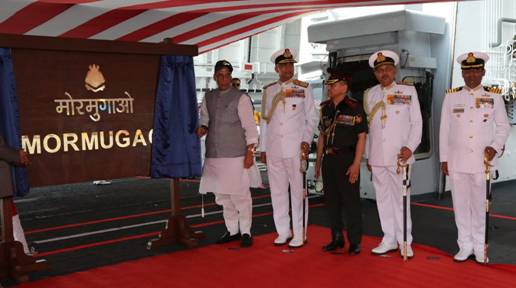
 Indian Naval Ship (INS) Mormugao (D67), second warship of the P15B class of stealth guided-missile destroyers, was commissioned in the august presence of Raksha Mantri Shri Rajnath Singh at Naval Dockyard, Mumbai on December 18, 2022. The event marked the formal induction of the second of the four ‘Visakhapatnam’ class destroyers, indigenously designed by the Indian Navy’s in-house organisation Warship Design Bureau and constructed by Mazagon Dock Shipbuilders Limited (MDL), Mumbai.
“Shining example of ‘Aatmanirbharta’ in defence”

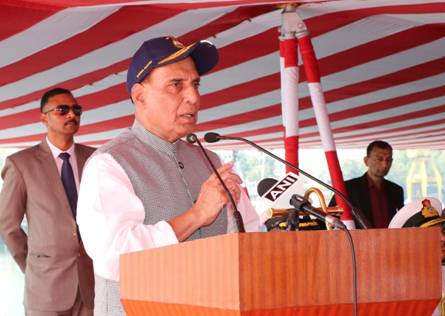
In his address, the Raksha Mantri described INS Mormugao as one of the most powerful indigenously-built warships which will significantly enhance the country’s maritime capabilities and secure national interests. “INS Mormugao is one of the world’s most technologically-advanced missile carriers. With over 75% indigenous content, it is a testimony to India’s excellence in design and development of warships and a shining example of our growing indigenous defence production capabilities. The warship will meet the present and future needs of our country as well as of our friendly countries across the globe,” he said.
“Navy securing maritime interests & contributing to socio-economic progress”

Shri Rajnath Singh commended the Indian Navy and MDL for the commissioning of INS Mormugao, describing it as the result of the hard work, dedication and aspirations of the engineers, technicians, designers and scientists. It is a matter of great pride for India, he said. The Raksha Mantri extended congratulations to the Indian Navy on behalf of the entire nation for not only safeguarding maritime interests, but also contributing significantly to the socio-economic progress.


The Raksha Mantri described safeguarding India’s interests in the Indian Ocean Region as the prime responsibility of the Navy. “Our growing economy is directly connected to the increasing trade, most of which is through sea routes. Our interest is directly linked to the Indian Ocean. Being an important country in this region, the role of Indian Navy becomes more important in its security. It is heartening to see that they are discharging their duties successfully,” he said.

“Armed Forces – backbone of India’s unprecedented growth”

Shri Rajnath Singh lauded the Armed Forces for protecting the borders and coasts with unmatched courage and dedication, terming them as the backbone of India’s unprecedented growth. “India is touching newer heights of success every day. We are now among the top five economies of the world. According to a report by investment firm Morgan Stanley, we will be among the top three economies in the next five years. India’s handling of the COVID-19 pandemic has been appreciated by the world. Our G-20 presidency is another landmark achievement. This has been successful due to the aspirations, hard work and determination of every Indian. But, the most important reason behind our success is our secure borders and coasts. It is due to the readiness and promptness of our Armed Forces that we have a fool-proof security apparatus,” he said.

“Bolstering security apparatus is our top priority”

         The Raksha Mantri reiterated the Government’s resolve to prepare the nation to deal with any situation arising due to the rapidly changing global scenario. He said, it is the Government’s top priority to continue strengthening the security infrastructure by equipping the military with state-of-the-art indigenous weapons/equipment.

         “Economic, political and trade relations between countries are constantly evolving. The Covid-19 pandemic, situation in the middle east, Afghanistan and now Ukraine. It directly or indirectly impacts every country in one way or another. In this era of globalisation, almost all nations are dependent on each other in the field of trade. Hence, rule-based freedom of navigation, security of sea lanes etc. have become more important than ever for stability and economic progress of the world,” he stated.

“Aim is to make India an indigenous shipbuilding hub”

Shri Rajnath Singh also praised MDL for growing in stature by continuously building new ships with state-of-the-art technologies. He urged them and other shipbuilding companies to enhance their capabilities by taking advantage of the Government’s initiatives and move forward towards making India an indigenous shipbuilding hub.

“Countries around the world are today moving towards modernising and strengthening their military power due to the global security scenario. The demand for military equipment is continuously increasing. We have introduced a number of policies which will help our public or private sector companies to become world class players. You all must take advantage of these policies and strive to cater to the needs of our Navy & Coast Guard, while meeting international requirements. We will extend all possible support to realise Prime Minister Shri Narendra Modi’s vision of ‘Make in India, Make for the World’,” he said.

“INS Mormugao – India’s giant leap in warship building capabilities”

         Speaking on the occasion, Chief of the Naval Staff Admiral R Hari Kumar stated that the commissioning of INS Mormugao is indicative of the large strides India has taken in warship design and building capability over the last decade. He added that the warship is a true illustration of ‘Aatmanirbhar Bharat’ and ‘Make in India’ initiative and it reinforces the Navy’s commitment to supporting India’s transformation into a global ship-building hub. The warship, with her multi-dimensional combat capability, will form part of the Western Fleet – the sword arm of the Indian Navy, he said.

         Admiral R Hari Kumar complimented the Commanding Officer and his team of officers and sailors for their sustained efforts and perseverance during the trials and acceptance of the warship. He urged them to move forward with the same momentum and prepare for future operational deployments. He also commended MDL for playing a significant role in the transition from a ‘Buyers Navy to a Builders Navy’.

About Ins Mormugao

Stealth, fire power & manoeuvrability with indigenous content

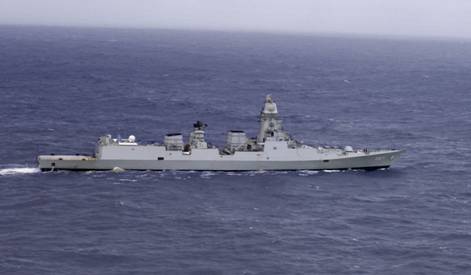
Measuring 163m in length and 17m in breadth with a displacement of 7,400 tonnes, INS Mormugao is packed with sophisticated state-of-the-art weapons and sensors such as Surface-to-Surface Missile and Surface-to-Air Missiles. The ship is fitted with a modern Surveillance Radar which provides target data to the gunnery weapon systems. Its Anti-Submarine Warfare capabilities are provided by the indigenously-developed Rocket Launchers, Torpedo Launchers and the ASW helicopters.
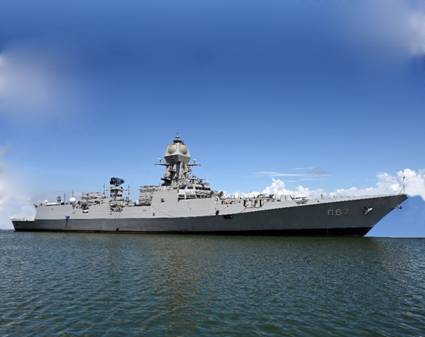
 

Named after the historic port city of Goa on the west coast, the ship is equipped to fight under Nuclear, Biological and Chemical warfare conditions. It is propelled by four powerful Gas Turbines, in a Combined Gas and Gas configuration, capable of achieving speeds in excess of 30 knots. The ship has enhanced stealth features resulting in a reduced Radar Cross Section. INS Mormugao has a complement of about 300 personnel.

With over 75% indigenous content, all her major weapons and sensors have been developed and manufactured in India either directly through design and development by Indian Original Equipment Manufacturers (OEMs) or through strategic tie-ups and Transfer of Technology with reputed foreign OEMs.
 

P15B destroyers

P15B destroyers incorporate new design concepts for improved survivability, seakeeping and manoeuvrability. Enhanced stealth has also been achieved, making the ships difficult to detect. With a significantly increased indigenous content, P15B destroyers are a hallmark of self-reliance in warship design and building and a shining example of ‘Aatmanirbhar Bharat’.

Vision & aim

With power dynamics in the Indian Ocean Region constantly changing, the ship’s all-domain capability will augment the Indian Navy’s mobility, reach and flexibility to accomplish any mission or task. Induction of the ship into the Navy also reflects India’s growing ability to remain First Responder and Preferred Security Partner in the region.

History

The ship was launched on September 17, 2016 and commenced sea trials on December 19, 2021, coinciding with 60 years of Goa Liberation. The commissioning on 18 December is significant as it was the same date in 1961 when Operation Vijay was launched to liberate Goa from Portuguese rule. Shri Rajnath Singh, in his address, paid glowing tributes to former Raksha Mantri late Manohar Parrikar, who hailed from Goa and had launched INS Mormugao in 2016.

Commissioning Ceremony at a glance

During the ceremony, Shri Rajnath Singh was presented with a guard of honour upon his arrival. The Commanding Officer Captain Kapil Bhatia then read out the Ship’s Commissioning Warrant. Subsequently, the Naval Ensign was hoisted onboard for the first time and the Commissioning Pennant broken (unfurled) on the main mast to the time of the national anthem played by the Naval Band. Before his address, the Raksha Mantri unveiled the Commissioning Plaque, dedicating the ship to the service of the nation.
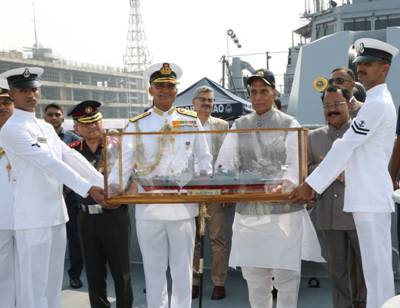


Governor of Goa Shri PS Sreedharan Pillai, Chief Minister of Goa Dr Pramod Sawant, Chief of Defence Staff General Anil Chauhan, Flag Officer Commanding-in-Chief, Western Naval Command Vice Admiral Ajendra Bahadur Singh and CMD, MDL Vice Admiral Narayan Prasad (Retd) also attended the event.


 

Tripura is one of the leading states when it comes to building houses for the poor

 The Prime Minister, Shri Narendra Modi laid the foundation stone, inaugurated and dedicated to the nation various key initiatives worth over Rs. 4350 crores. The projects include the launch of Grih Pravesh programme for beneficiaries under Pradhan Mantri Awas Yojana – Urban and Rural, connectivity projects for the widening of the Agartala bypass (Khayerpur – Amtali) NH-08, laying the foundation stones for 32 roads of more than 230 kilometres in length under PMGSY III and improvement projects of 112 roads covering a distance of over 540 kilometres. The Prime Minister also inaugurated the State Institute of Hotel Management at Anandnagar and Agartala Government Dental College.

Addressing the gathering, the Prime Minister thanked everyone present on the occasion for waiting eagerly for the commencement of the function and also apologised for the slight delay that was caused due to the engagements in Meghalaya where he laid the foundation stones and dedicated multiple projects earlier in the day. 

The Prime Minister acknowledged the commendable work carried out in the state regarding cleanliness campaigns for the past 5 years and remarked that it is the people of Tripura who have turned it into a public movement. As a result, Tripura has come out as the cleanest state in India when it comes to small states area-wise. “With the blessing of Maa Tripura Sundari, the development journey of Tripura is witnessing new heights”, he said.

The Prime Minister congratulated the people of Tripura for today’s projects which are related to connectivity, skill development and schemes related to the household of the poor. “Tripura is getting its first dental college today”, the Prime Minister remarked as he said that the youth of Tripura will now have the opportunity to become doctors without having to leave the state. He further informed that today, more than 2 lakh poor people from the state are performing Grih Pravesh in their new pucca homes where the owners of the houses are our mothers and sisters. The Prime Minister took the opportunity to congratulate the women from these households who will become homeowners for the first ever. “Tripura is one of the leading states when it comes to building houses for the poor”, the Prime Minister informed as he praised the work done by Shri Manik Saha ji and his team. He also remarked on the warm reception that he received from thousands of supporters while he was on the way to the venue.

Recalling the meeting of the North Eastern Council that the Prime Minister attended earlier in the day, he gave insights on the discussions of the road map of development of the future for all Northeastern states including Tripura. He informed about the ‘Asht Aadhar’ or eight key points for the development of ‘Asht Lakshmi’ or the eight Northeastern states. Highlighting the double-engine government of Tripura, the Prime Minister said that constant efforts are being made to pace up development initiatives in the state.

The Prime Minister pointed out that before the double-engine government, the Northeastern states were talked about only during the times of election and acts of violence. “Today, Tripura is being discussed for cleanliness, infrastructural development and providing houses to the poor”, he remarked. He further added that the Central Government is spending thousands of crores of rupees for infrastructure development and the state government is making it possible by showing the results on the ground. “In the last 5 years, many villages of Tripura got road connectivity and fast-paced work is already underway to connect all villages of Tripura by roads”, he said. The Prime Minister added that the projects whose foundation stones are laid today will further strengthen the road network of the state, ease the traffic in the capital and make life easier.

“The Northeast region via Tripura is becoming a gateway for international trade”, the Prime Minister remarked as he informed about the new avenues that will open up with the Agartala-Akhaura railway line and the India-Thailand-Myanmar highway infrastructure. He further added that connectivity has got a boost with the construction of the international terminal at Maharaja Bir Bikram Airport in Agartala. As a result, Tripura is developing as an important logistics hub of the Northeast. The Prime Minister credited the efforts of the government to make internet connectivity available in Tripura which is extremely useful for the youth of today. “It is due to the efforts of the double-engine government of Tripura that many panchayats are now connected with optical fiber”, he added.

Throwing light on the efforts of the double-engine government to strengthen social infrastructure, the Prime Minister gave the example of Ayushman Bharat Scheme under which seven thousand plus health and wellness centres have been approved in the villages of the Northeast. “Around a thousand such centres are being set up right here in Tripura. Similarly, under the Ayushman Bharat-PM Jay scheme, thousands of poor people of Tripura have got the facility of free treatment up to Rs.5 lakh”, he continued. “Be it toilets, electricity or gas connections, such extensive work has been carried out for the first time”, Shri Modi said. He further added that the double-engine government is working at a fast pace to bring piped gas at cheaper prices and deliver piped water to every household. The Prime Minister informed that 4 lakh new families of Tripura have been connected with piped water facilities in just 3 years.

The Prime Minister touched upon the Pradhan Mantri Matri Vandana Yojana which has benefitted more than 1 lakh pregnant mothers of Tripura, under which thousands of rupees have been directly deposited in the bank account of every mother for nutritious food. He further added that as a result, more and more deliveries are taking place in hospitals today and saving the lives of both mother and child. Throwing light on Atmanirbharta (self-reliance) for our mothers and sisters, the Prime Minister informed that the government has released a special package of hundreds of crores for the employment of women. He also praised the efforts of the state government and said, “The number of women self-help groups in Tripura has increased 9 times after the double engine government.”

“For decades, Tripura has been ruled by parties whose ideology has lost importance and who practice politics of opportunism”, the Prime Minister remarked as he lamented how Tripura had been deprived of development. He further added that it was the poor, the youth, the farmers and the women who were most affected by this. “This type of ideology, this type of mentality cannot benefit the public. They only know how to spread negativity and do not have any positive agenda”, he said. He further added that it is the double-engine government which has the resolve as well as a positive path for achievement.

Reflecting on the great harm caused to our tribal societies due to the politics of power, the Prime Minister lamented the lack of development in the tribal society and tribal areas. “BJP has changed these politics and that is why it has become the first choice of tribal society”, the Prime Minister said as he recalled the recent Gujarat elections and credited the contributions of the tribal society towards BJP’s massive victory even after 27 years. “The BJP has won 24 of the 27 seats reserved for tribals”, he added.

The Prime Minister highlighted the development works carried out for the betterment of tribal communities and recalled that it was Atal ji’s government that first arranged for a separate ministry and separate budget for the tribals. “The budget for the tribal community which was 21 thousand crore rupees, is 88 thousand crore rupees today”, he remarked. The Prime Minister informed that the scholarship of tribal students has also been more than doubled. “Before 2014 there were less than 100 Eklavya Model Schools in tribal areas whereas today this number is reaching more than 500. More than 20 such schools have been approved for Tripura as well”, the Prime Minister informed. He also drew everyone’s attention to the fact that earlier governments used to give MSP only on 8-10 forest products whereas the BJP government is giving MSP on 90 forest produce. “Today, there are more than 50,000 Van Dhan Kendras in tribal areas which are providing employment to about 9 lakh tribals, most of whom are women”, he added.

The Prime Minister also pointed out that it is the BJP government which understood what pride means for the tribals, and hence, started celebrating the birth anniversary of Lord Birsa Munda on November 15 as Janjatiya Gaurav Diwas across the country. The Prime Minister informed that 10 Tribal Freedom Fighter Museums are being set up across the country and in Tripura, President Draupadi Murmu ji recently laid the foundation stone of Maharaja Birendra Kishore Manikya Museum and Cultural Centre. He further added that the Tripura government is also making constant efforts to promote tribal contribution and culture and highlighted the privilege of awarding Padma Samman to the personalities who have taken forward the tribal art and culture of Tripura.

The Prime Minister reiterated the endeavour of the double-engine government to create better opportunities for small farmers and entrepreneurs of Tripura. “Efforts are being made to make the local here global”, Shri Modi highlighted as he gave the example of the pineapple from Tripura reaching abroad. “Not only this, hundreds of metric tonnes of other fruits and vegetables have also been exported from here to Bangladesh, Germany and Dubai and as a result, the farmers are getting higher prices for their produce. He further added that lakhs of farmers from Tripura have received more than Rs 500 crore so far from PM Kisan Samman Nidhi. He also highlighted the Agar-wood industry in Tripura and said that it will become a source of new opportunities and income for the youth of Tripura.

Concluding the address, the Prime Minister stated that Tripura is now on the path of peace and development with the advent of the double engine of development in the state. “I have full faith in the capability of the people of Tripura. We will speed up the pace of development, with this belief, many congratulations to all of you”, Shri Modi concluded.

Chief Minister of Tripura, Prof (Dr) Manik Saha, Governor of Tripura, Shri Satyadeo Narain Arya, Deputy Chief Minister of Tripura, Shri Jishnu Dev Varma and Union Minister of State Kum. Pratima Bhoumik were those present on occasion among others.


Background

A significant focus of the Prime Minister has been towards ensuring that everyone has a house of their own. In a key step towards ensuring the same in the region, the Prime Minister launched the Grih Pravesh programme for beneficiaries under Pradhan Mantri Awas Yojana – Urban and Pradhan Mantri Awas Yojana – Rural. These houses, developed at a cost of over Rs 3400 crores, will cover over 2 lakh beneficiaries.

With a focus on improving road connectivity, the Prime Minister inaugurated the project for widening the Agartala bypass (Khayerpur – Amtali) NH-08, which will help ease traffic congestion in Agartala city. He laid the foundation stones for 32 roads of more than 230 Km in length under PMGSY III (Pradhan Mantri Gram Sadak Yojana) and for the improvement of 112 roads covering a distance of over 540 Km. The Prime Minister also inaugurated the State Institute of Hotel Management at Anandnagar and Agartala Government Dental College.

*****

DS/TS

Indian Navy commissions guided missile destroyer INS Mormugao.

The Indian Navy’s latest  indigenous guided stealth destroyer Mormugao – which is armed with surface-to-surface BrahMos missiles and Barak-8 long range surface-to-air missiles – was commissioned.


INS Mormugao was built at Mazagon Dock Shipbuilders Ltd (MDSL) as part of the Project 15B destroyers or the Visakhapatnam-class.

The ship is constructed using Indigenous Steel DMR 249A and is amongst the largest destroyers constructed in India, with an overall length of 164 meters and a displacement of over 7,500 tons. The ship is a potent platform capable of undertaking a variety of tasks and missions, spanning the full spectrum of maritime warfare. It is armed with supersonic Surface-to-Surface ‘BrahMos’ missiles and ‘Barak-8’ Long Range Surface to Air Missiles. Towards undersea warfare capability the Destroyer is fitted with indigenously developed anti-submarine weapons and sensors, prominently the hull mounted Sonar Humsa NG, heavy weight torpedo tube launchers and ASW rocket launchers.

The ship can accommodate a crew of 312 persons, has an endurance of 4,000 nautical mile and can carry out a typical 42 days mission with extended mission time in out of area operation.

Enhanced stealth has also been achieved, making the ships difficult to detect. With a significantly increased indigenous content, P15B destroyers are a hallmark of self-reliance in warship design and building, and a shining example of Atmanirbhar Bharat.

The indigenous content in P15B class destroyers is 72per cent which is a notch above their predecessors P15A (59per cent) and P15 (42per cent) Class Destroyers, reaffirming the Government’s focus in the ‘Make in India’ programme.

The first Ship of P15B – INS Visakhapatnam was commissioned last year on 21 November,  2021. 

Indian Navy commissions guided missile destroyer INS Mormugao.

The Indian Navy’s latest  indigenous guided stealth destroyer Mormugao – which is armed with surface-to-surface BrahMos missiles and Barak-8 long range surface-to-air missiles – was commissioned.

INS Mormugao was built at Mazagon Dock Shipbuilders Ltd (MDSL) as part of the Project 15B destroyers or the Visakhapatnam-class.

The ship is constructed using Indigenous Steel DMR 249A and is amongst the largest destroyers constructed in India, with an overall length of 164 meters and a displacement of over 7,500 tons. The ship is a potent platform capable of undertaking a variety of tasks and missions, spanning the full spectrum of maritime warfare. It is armed with supersonic Surface-to-Surface ‘BrahMos’ missiles and ‘Barak-8’ Long Range Surface to Air Missiles. Towards undersea warfare capability the Destroyer is fitted with indigenously developed anti-submarine weapons and sensors, prominently the hull mounted Sonar Humsa NG, heavy weight torpedo tube launchers and ASW rocket launchers.

The ship can accommodate a crew of 312 persons, has an endurance of 4,000 nautical mile and can carry out a typical 42 days mission with extended mission time in out of area operation.

Enhanced stealth has also been achieved, making the ships difficult to detect. With a significantly increased indigenous content, P15B destroyers are a hallmark of self-reliance in warship design and building, and a shining example of Atmanirbhar Bharat.

The indigenous content in P15B class destroyers is 72per cent which is a notch above their predecessors P15A (59per cent) and P15 (42per cent) Class Destroyers, reaffirming the Government’s focus in the ‘Make in India’ programme.

The first Ship of P15B – INS Visakhapatnam was commissioned last year on 21 November,  2021. 

Russia remains India’s top oil supplier for the month of november too.

Russia has for the first time emerged as top oil supplier to India replacing Iraq as refiners last month snapped up oil from Moscow fearing a price cap from Dec. 5 could hit supplies and choke payment avenues, data obtained from trade sources showed.

India’s oil imports from Russia rose for the fifth straight month, totaling 908,000 barrels per day (bpd) in November, up 4% from October, the data showed.

The Group of Seven nations, Australia, and the 27 European Union countries have imposed a price cap of $60 a barrel on Russian seaborne oil from Dec. 5 as the West tries to limit Moscow’s ability to finance its war in Ukraine.

India, which rarely used to buy Russian oil because of costly logistics, has emerged as Russia’s second biggest oil client after China as refiners snap up discounted crude shunned by Western nations since the February invasion of Ukraine.

Higher purchases of Russian oil dragged down Indian imports from the Middle East and member nations of Organization of Petroleum Exporting Countries (OPEC) declined to the lowest ever in November, the data showed.

Russia remains India's top oil supplier for the month of november too.

Russia has for the first time emerged as top oil supplier to India replacing Iraq as refiners last month snapped up oil from Moscow fearing a price cap from Dec. 5 could hit supplies and choke payment avenues, data obtained from trade sources showed.

India’s oil imports from Russia rose for the fifth straight month, totaling 908,000 barrels per day (bpd) in November, up 4% from October, the data showed.

The Group of Seven nations, Australia, and the 27 European Union countries have imposed a price cap of $60 a barrel on Russian seaborne oil from Dec. 5 as the West tries to limit Moscow’s ability to finance its war in Ukraine.

India, which rarely used to buy Russian oil because of costly logistics, has emerged as Russia’s second biggest oil client after China as refiners snap up discounted crude shunned by Western nations since the February invasion of Ukraine.

Higher purchases of Russian oil dragged down Indian imports from the Middle East and member nations of Organization of Petroleum Exporting Countries (OPEC) declined to the lowest ever in November, the data showed.

Ukraine President’s request to FIFA ahead of the final match.

World Cup organizers have rejected a request from Ukrainian President Volodymyr Zelensky to deliver a message ahead of the tournament’s final. Zelensky had asked to share a plea for world peace ahead of Sunday’s World Cup final but was turned down by FIFA, soccer’s governing body, CNN reported.

FIFA has gone to significant lengths to try and remove elements of politics from the 2022 World Cup, despite the very tournament being a political issue itself due to the nature of where it is being held.

Addressing to the situation, the FIFA authority quoted  “We are defending values, we are defending human rights and rights of everyone at the World Cup. Those fans and the billions watching on TV, they have their own problems. They just want to watch 90 or 120 minutes without having to think about anything, but just enjoying a little moment of pleasure and joy. We have to give them a moment when they can forget about their problems and enjoy football.”

Ukraine President's request to FIFA ahead of the final match.

World Cup organizers have rejected a request from Ukrainian President Volodymyr Zelensky to deliver a message ahead of the tournament’s final. Zelensky had asked to share a plea for world peace ahead of Sunday’s World Cup final but was turned down by FIFA, soccer’s governing body, CNN reported.

FIFA has gone to significant lengths to try and remove elements of politics from the 2022 World Cup, despite the very tournament being a political issue itself due to the nature of where it is being held.

Addressing to the situation, the FIFA authority quoted  “We are defending values, we are defending human rights and rights of everyone at the World Cup. Those fans and the billions watching on TV, they have their own problems. They just want to watch 90 or 120 minutes without having to think about anything, but just enjoying a little moment of pleasure and joy. We have to give them a moment when they can forget about their problems and enjoy football.”

What is hooch tragedy, which is happening in Bihar recently.

The toll of dead in Bihar’s Chhapra Hooch tragedy has soared to 50, succumbing after consuming spurious liquor in the Saran district. People have died and several others hospitalised in India’s Bihar state after drinking toxic alcohol, authorities and local media said.

The deaths happened mainly in two villages in the impoverished eastern state, where the sale and consumption of liquor were banned in 2016 after women’s groups campaigned against poor workers splurging their meagre incomes on drinking.

Such bans are in force in several Indian states, driving a thriving black market for cheap alcohol made in unregulated backstreet distilleries that kills hundreds of people every year.

Hooch is a commonly used term for poor quality alcohol, derived from Hoochinoo, a native Alaskan tribe that was known to produce very strong liquor. Unlike branded liquor which is produced in factories with sophisticated equipment and rigorous quality control, hooch is made in more crude settings without any quality checks.

All that matters is to produce alcohol that will intoxicate, and hooch surely does that. The only problem is that if prepared incorrectly, it can kill. Importantly, it is near impossible to tell whether hooch is safe to consume before actual consumption.

What is hooch tragedy, which is happening in Bihar recently.

The toll of dead in Bihar’s Chhapra Hooch tragedy has soared to 50, succumbing after consuming spurious liquor in the Saran district. People have died and several others hospitalised in India’s Bihar state after drinking toxic alcohol, authorities and local media said.

The deaths happened mainly in two villages in the impoverished eastern state, where the sale and consumption of liquor were banned in 2016 after women’s groups campaigned against poor workers splurging their meagre incomes on drinking.

Such bans are in force in several Indian states, driving a thriving black market for cheap alcohol made in unregulated backstreet distilleries that kills hundreds of people every year.

Hooch is a commonly used term for poor quality alcohol, derived from Hoochinoo, a native Alaskan tribe that was known to produce very strong liquor. Unlike branded liquor which is produced in factories with sophisticated equipment and rigorous quality control, hooch is made in more crude settings without any quality checks.

All that matters is to produce alcohol that will intoxicate, and hooch surely does that. The only problem is that if prepared incorrectly, it can kill. Importantly, it is near impossible to tell whether hooch is safe to consume before actual consumption.

Amid border tension with China, India tested Agni-V missile.

The test-firing of the missile from the APJ Abdul Kalam Island off Odisha coast came amid India’s lingering border row with China.

The Agni-V project is aimed at boosting India’s nuclear deterrence against China which is known to have missiles like Dongfeng-41 having ranges between 12,000-15,000 km.

Agni-V can bring almost the entire Asia including the northernmost part of China as well as some regions in Europe under its striking range.

While the test was carried out days after the clashes, it had been planned earlier. India had announced its intention to test a long-range missile and issued a NOTAM or Notice to Airmen well before the incident in Arunachal’s Tawang.

Notably, Agni-5 is the most advanced missile in the Agni series with a strike range of over 5000 kms. Apart from Intercontinental Ballistic Missiles (ICBMs) Agni-5, the Indian armoury of the Agni series includes Agni-1 with a 700 km range, Agni-2 with a 2,000 km range, Agni-3 and Agni-4 with a 2500 km to more than 3500km range.

Amid border tension with China, India tested Agni-V missile.

The test-firing of the missile from the APJ Abdul Kalam Island off Odisha coast came amid India’s lingering border row with China.

The Agni-V project is aimed at boosting India’s nuclear deterrence against China which is known to have missiles like Dongfeng-41 having ranges between 12,000-15,000 km.

Agni-V can bring almost the entire Asia including the northernmost part of China as well as some regions in Europe under its striking range.

While the test was carried out days after the clashes, it had been planned earlier. India had announced its intention to test a long-range missile and issued a NOTAM or Notice to Airmen well before the incident in Arunachal’s Tawang.

Notably, Agni-5 is the most advanced missile in the Agni series with a strike range of over 5000 kms. Apart from Intercontinental Ballistic Missiles (ICBMs) Agni-5, the Indian armoury of the Agni series includes Agni-1 with a 700 km range, Agni-2 with a 2,000 km range, Agni-3 and Agni-4 with a 2500 km to more than 3500km range.