
Call for Book Chapters

Title: 

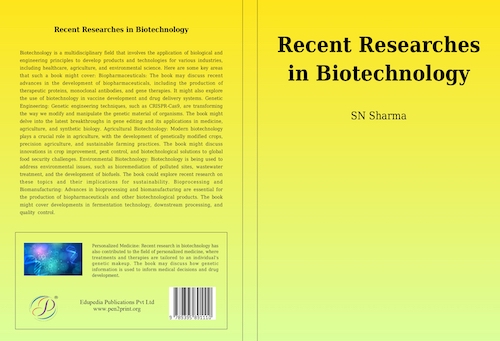
Recent Researches in Biotechnology

ISBN -978-93-95891-11-0

Editor: SN Sharma

Biotechnology is a multidisciplinary field that involves the application of biological and engineering principles to develop products and technologies for various industries, including healthcare, agriculture, and environmental science. Here are some key areas that such a book might cover:

Biopharmaceuticals: The book may discuss recent advances in the development of biopharmaceuticals, including the production of therapeutic proteins, monoclonal antibodies, and gene therapies. It might also explore the use of biotechnology in vaccine development and drug delivery systems.

Genetic Engineering: Genetic engineering techniques, such as CRISPR-Cas9, are transforming the way we modify and manipulate the genetic material of organisms. The book might delve into the latest breakthroughs in gene editing and its applications in medicine, agriculture, and synthetic biology.

Agricultural Biotechnology: Modern biotechnology plays a crucial role in agriculture, with the development of genetically modified crops, precision agriculture, and sustainable farming practices. The book might discuss innovations in crop improvement, pest control, and biotechnological solutions to global food security challenges.

Environmental Biotechnology: Biotechnology is being used to address environmental issues, such as bioremediation of polluted sites, wastewater treatment, and the development of biofuels. The book could explore recent research on these topics and their implications for sustainability.

Bioprocessing and Biomanufacturing: Advances in bioprocessing and biomanufacturing are essential for the production of biopharmaceuticals and other biotechnological products. The book might cover developments in fermentation technology, downstream processing, and quality control.

Personalized Medicine: Recent research in biotechnology has also contributed to the field of personalized medicine, where treatments and therapies are tailored to an individual’s genetic makeup. The book may discuss how genetic information is used to inform medical decisions and drug development.

Ethical and Regulatory Considerations: As biotechnology advances, there are important ethical and regulatory considerations to address. A book on recent research might explore these issues, including discussions on bioethics, intellectual property, and the impact of biotechnology on society.

Important Dates

Last Date to Submit Book Chapters 20 November 2023

Date of Acceptance 30 Nov 2023

Date of Publication 15 Dec 2023

Send your book chapter for publication to editor@pen2print.org 

Recent Researches in Biotechnology


Title: 

Recent Researches in Biotechnology

ISBN -978-93-95891-11-0
Editor: SN Sharma
Biotechnology is a multidisciplinary field that involves the application of biological and engineering principles to develop products and technologies for various industries, including healthcare, agriculture, and environmental science. Here are some key areas that such a book might cover:
Biopharmaceuticals: The book may discuss recent advances in the development of biopharmaceuticals, including the production of therapeutic proteins, monoclonal antibodies, and gene therapies. It might also explore the use of biotechnology in vaccine development and drug delivery systems.
Genetic Engineering: Genetic engineering techniques, such as CRISPR-Cas9, are transforming the way we modify and manipulate the genetic material of organisms. The book might delve into the latest breakthroughs in gene editing and its applications in medicine, agriculture, and synthetic biology.
Agricultural Biotechnology: Modern biotechnology plays a crucial role in agriculture, with the development of genetically modified crops, precision agriculture, and sustainable farming practices. The book might discuss innovations in crop improvement, pest control, and biotechnological solutions to global food security challenges.
Environmental Biotechnology: Biotechnology is being used to address environmental issues, such as bioremediation of polluted sites, wastewater treatment, and the development of biofuels. The book could explore recent research on these topics and their implications for sustainability.
Bioprocessing and Biomanufacturing: Advances in bioprocessing and biomanufacturing are essential for the production of biopharmaceuticals and other biotechnological products. The book might cover developments in fermentation technology, downstream processing, and quality control.
Personalized Medicine: Recent research in biotechnology has also contributed to the field of personalized medicine, where treatments and therapies are tailored to an individual’s genetic makeup. The book may discuss how genetic information is used to inform medical decisions and drug development.
Ethical and Regulatory Considerations: As biotechnology advances, there are important ethical and regulatory considerations to address. A book on recent research might explore these issues, including discussions on bioethics, intellectual property, and the impact of biotechnology on society.
Send your book chapter for publication to editor@pen2print.org 

Balancing Pain Relief and Side Effects: Tramadol – Role in Pain Management

 For anyone who has ever experienced chronic pain, the search for effective pain relief can be a significant challenge. The world of analgesics or pain relievers encompasses a vast array of medications, each with its set of benefits and potential drawbacks. One such medication that has gained attention is Tramadol. Understanding what is Tramadol, its uses, and the delicate balance between its efficacy and side effects is vital for patients and healthcare providers.

Photo by Tree of Life Seeds on Pexels.com

What is Tramadol?

Tramadol is an opioid analgesic, which means it’s in the same class of drugs as morphine, but it’s chemically different. It’s used primarily to treat moderate to severe pain, whether from surgery, injury, or chronic conditions like osteoarthritis. One of the main Tramadol uses is in long-term pain management due to its potential for lesser addiction compared to other opioids.

Tramadol Dosage and Formulations

Tramadol dosage can vary based on the patient’s pain level, age, and other factors. Typically, it starts with a lower dose, which can be increased until effective pain management is achieved without significant side effects. It’s available in various forms, including tablets, capsules, and liquid, with the Tramadol 200mg being one of the most potent doses. This high dosage is not common and is reserved for specific situations with strict monitoring due to its potency.

In some regions, like Mexico, the Tramadol 200 mg, especially Tramadol 200mg Mexico formulations, can be procured, often under different trade names. Tramadol pill forms, especially the Tramadol 200 mg tablet and Tramadol 200mg white capsules, are prevalent.

What is in Tramadol and How Does It Work?

The primary active ingredient in Tramadol is Tramadol hydrochloride, which works by changing the way the brain perceives pain. Unlike other opioids, it also has an effect on neurotransmitters, increasing levels of serotonin and norepinephrine, which can contribute to its pain-relieving effect.

Balancing Benefits and Tramadol Side Effects

Like all medications, Tramadol has side effects. The most common Tramadol side effects include dizziness, nausea, constipation, and headaches. It’s also essential to understand the more serious side effects like respiratory depression, which can be life-threatening.

An intriguing question for many is, “Does Tramadol make you sleepy or awake?” Tramadol can indeed cause drowsiness, but for some, it might cause insomnia. This duality underscores the importance of individualized care and monitoring when prescribing Tramadol.

Regarding its potency, many wonder about the effects of high dosages, like “Tramadol 200 mg high” or the impact of “200 milligrams of Tramadol.” The answer is that higher doses increase the risk of side effects, including the rare but serious risk of serotonin syndrome. Overdosing can also lead to slowed breathing, seizures, or even death.

How Long Does Tramadol Last?

The duration of Tramadol’s effects depends on the formulation. Immediate-release forms might last up to 6 hours, while extended-release tablets or capsules, such as Tramadol 200mg, can provide pain relief throughout the day.

Global Perspectives: Tramadol in Mexico and Beyond

While Tramadol is available worldwide, the regulations governing its sale and distribution vary. In some places, such as Mexico, Tramadol, including the Tramadol 200mg Mexico formulation, might be more accessible. It’s always crucial for patients to ensure they’re getting legitimate products, given the rise in counterfeit medications.

As the demand for reliable and authentic sources for medications rises, platforms like https://medicinesmexicamrx.com/ have come to the forefront, providing users with easy access to various drugs.

When deciding on the use of Tramadol or any medication, the goal is always to balance benefits with potential risks. It’s undeniable that Tramadol, from the standard Tramadol pill to the potent Tramadol 200mg white capsules, offers substantial pain relief for many.

Balancing Pain Relief and Side Effects: Tramadol’s Role in Pain Management

 For anyone who has ever experienced chronic pain, the search for effective pain relief can be a significant challenge. The world of analgesics or pain relievers encompasses a vast array of medications, each with its set of benefits and potential drawbacks. One such medication that has gained attention is Tramadol. Understanding what is Tramadol, its uses, and the delicate balance between its efficacy and side effects is vital for patients and healthcare providers.

Photo by Tree of Life Seeds on Pexels.com

What is Tramadol?

Tramadol is an opioid analgesic, which means it’s in the same class of drugs as morphine, but it’s chemically different. It’s used primarily to treat moderate to severe pain, whether from surgery, injury, or chronic conditions like osteoarthritis. One of the main Tramadol uses is in long-term pain management due to its potential for lesser addiction compared to other opioids.

Tramadol Dosage and Formulations

Tramadol dosage can vary based on the patient’s pain level, age, and other factors. Typically, it starts with a lower dose, which can be increased until effective pain management is achieved without significant side effects. It’s available in various forms, including tablets, capsules, and liquid, with the Tramadol 200mg being one of the most potent doses. This high dosage is not common and is reserved for specific situations with strict monitoring due to its potency.

In some regions, like Mexico, the Tramadol 200 mg, especially Tramadol 200mg Mexico formulations, can be procured, often under different trade names. Tramadol pill forms, especially the Tramadol 200 mg tablet and Tramadol 200mg white capsules, are prevalent.

What is in Tramadol and How Does It Work?

The primary active ingredient in Tramadol is Tramadol hydrochloride, which works by changing the way the brain perceives pain. Unlike other opioids, it also has an effect on neurotransmitters, increasing levels of serotonin and norepinephrine, which can contribute to its pain-relieving effect.

Balancing Benefits and Tramadol Side Effects

Like all medications, Tramadol has side effects. The most common Tramadol side effects include dizziness, nausea, constipation, and headaches. It’s also essential to understand the more serious side effects like respiratory depression, which can be life-threatening.

An intriguing question for many is, “Does Tramadol make you sleepy or awake?” Tramadol can indeed cause drowsiness, but for some, it might cause insomnia. This duality underscores the importance of individualized care and monitoring when prescribing Tramadol.

Regarding its potency, many wonder about the effects of high dosages, like “Tramadol 200 mg high” or the impact of “200 milligrams of Tramadol.” The answer is that higher doses increase the risk of side effects, including the rare but serious risk of serotonin syndrome. Overdosing can also lead to slowed breathing, seizures, or even death.

How Long Does Tramadol Last?

The duration of Tramadol’s effects depends on the formulation. Immediate-release forms might last up to 6 hours, while extended-release tablets or capsules, such as Tramadol 200mg, can provide pain relief throughout the day.

Global Perspectives: Tramadol in Mexico and Beyond

While Tramadol is available worldwide, the regulations governing its sale and distribution vary. In some places, such as Mexico, Tramadol, including the Tramadol 200mg Mexico formulation, might be more accessible. It’s always crucial for patients to ensure they’re getting legitimate products, given the rise in counterfeit medications.

As the demand for reliable and authentic sources for medications rises, platforms like https://medicinesmexicamrx.com/ have come to the forefront, providing users with easy access to various drugs.

When deciding on the use of Tramadol or any medication, the goal is always to balance benefits with potential risks. It’s undeniable that Tramadol, from the standard Tramadol pill to the potent Tramadol 200mg white capsules, offers substantial pain relief for many.

Opportunities for Grants for Research

 Working for sustainability science in Italy

Promising, early-career scientists from least developed countries have the opportunity to work at Centres of Excellence in Trieste, Italy, under The World Academy of Sciences (TWAS), Scuola Internazionale Superiore di Studi Avanzati (SISSA), Lincei Academy cooperation visits programme. The research projects should focus on sustainability science and sustainable development. Collaborations last three months. Applicants should hold an MSc degree (or higher), and the age limit is 40 years. Learn more

Deadline for submission is 6 November 2023.


The Shaping Futures: African-European network on development and sustainability academy 

Applications for the 2024 Shaping Futures Academy are now open. Shaping Futures Academy is a dynamic training program aligning with Africa’s Agenda 2063 and the 2030 Agenda for Sustainable Development. It unites professionals from African and European countries, offering in-person sessions in Bonn, Berlin, Brussels, and Accra, along with online modules. Participants and their institutions join a diverse network, fostering collaborative knowledge creation and sustainable partnerships. Learn more.

Deadline for submission is 15 November 2023


IPA and J-PAL Displaced Livelihoods Initiative

The Innovations for Poverty Action (IPA) and the Abdul Latif Jameel Poverty Action Lab (J-PAL) Displaced Livelihoods Initiative has issued a call for proposals to generate new evidence on livelihoods programs for displaced populations and host communities. They welcome proposals for full impact evaluations, pilot studies, exploratory work, infrastructure and public goods creation, and scaling support across several broad areas including resilience; entrepreneurship; wage employment; social cohesion, inclusion, and norms; rights and regulations. Exploratory grants in Africa are earmarked for early-career and low and middle income (LMIC)-based scholars. Learn more. 

Deadline for expressions of interest is 22 November 2023. 

Deadline for full proposals is 19 January 2024.


Building research collaborations in the Global South

Under the TWAS-UNESCO associateship programme highly qualified scientists from developing countries in the South have the chance to establish a three-year research collaboration. Associates may choose among almost 300 centres of excellence in the South, and visit the selected institute twice, for 2-3 months each time. Learn more

Deadline for submission is 4 December 2023.


Global health research career development

Round 7 of the Global Research Professorships award is now open. The National Institute for Health and Care Research is seeking candidates in low and middle income countries (LMICs) or the UK with an outstanding record of relevant research and its translation for improved health and welfare of people in LMICs. Learn more.

Deadline for submission is 6 December.


Targeting a PhD with TWAS-TÜBİTAK

MSc students from developing countries in the South wishing to obtain a PhD in natural and applied sciences may check out the Postgraduate Fellowship Programme from the Scientific and Technological Research Council of Türkiye (TÜBİTAK) and TWAS Fellowships are tenable for six to 12 months at public and private universities of Türkiye and TÜBİTAK Research Centres and Institutes. Learn more

Deadline for submission is 25 December 2023.


Postdoctoral positions available in Türkiye

If you wish to apply for a postdoctoral position in natural and applied sciences in Türkiye and with TÜBİTAK Research Centres and Institutes, don’t miss this chance. The TWAS-TÜBİTAK postdoctoral fellowship programme, which has a six to 36 months duration, is open to PhD holders from developing countries in the South. Learn more

Deadline for submission is 25 December 2023.


Innovations to prepare for future epidemics and pandemics

The Coalition for Epidemic Preparedness Innovations (CEPI) has launched a call for proposals. The Call invites applications from innovators seeking to speed up the development of, and equitable access to, safe and effective vaccines against epidemic and pandemic viral threats. This call will initially support transformative innovations in vaccine platforms, manufacturing technologies, and vaccine candidates against high-risk viruses, which are critical to the success of the 100 Days Mission. Learn more.


Consortium of Universities for Global Health (CUGH) Virtual Global Health Week

CUGH is hosting 20 free global health workshops from 30 October to 03 November 2023. Their virtual Satellite Sessions are being held prior to the CUGH 2024 conference in March 2024, and include topics such as climate change, global health in low- & middle-income countries, mental health, global health education, and pandemic response. Attendance and registration is free and open to all. Learn more and register here.

Dates: 30 October to 03 November 2023


The eLearning Africa 2024 Conference: Call for papers

The eLearning Africa annual conference and exhibition has announced a call for papers. The conference is a global forum for everyone with an interest in education, training, and skills development in Africa. The 17th Edition of the conference will take place from 29-31 May 2024 in Kigali, Rwanda, with the theme “Education Fuels Innovation, Investment Amplifies Skills”, focused on the essential roles of education and skills in national investment and innovation. Learn more.

Deadline for submission is 15 November 2023


Transforming Parkinson’s Care in Africa (TraPCAf) Webinar

TraPCAf is hosting the online webinar focused on ‘Transforming Parkinson’s in Africa’. The webinar aims to provide insights into Parkinson’s disease in Africa, introduce TraPCAf’s work and goals, and offer ways for participants to actively participate. Join to learn, discuss, and engage in Parkinson’s initiatives in Africa. Learn more.

Date: 18 November 2023