In the poem, Seven Ages of Man Shakespeare compares the entire world to a theatrical stage, where all the human beings perform their allotted role given by the God. Every individual has to go through seven acts that are seven stages of man’s life.Shakespeare has divided human life into seven stages, with each stage having its own qualities and characteristics. Shakespeare considers the world a stage and men and women actors on the stage of life. They play seven roles on the stage depending upon their age.
The first stage, in this phase of his life man, appears as a child in the world. As a child, he is a helpless creature. He cries in the arms of his nurse for one reason or the other. He cries and vomits.
The next phase of his life man appears as a child in the world. He goes to school with a bag hanging from his shoulder. He goes to the school creeping like a snail. He marches to the school unwillingly.
In the third stage of his life, a man plays the part of a lover. He grows into a young man full of desires, ambitions, and dreams. He becomes a romantic young man. He falls in love and sights like a furnace. He begins to write sad poems to his beloved he cannot control his sad feelings.
In the fourth stage of his life man becomes a foul-mouthed soldier who has learned queer words at this stage, he tries to give himself a formidable look with a beard like a part. He is emotional and jealous. He quarrels with others for his honor and grace. He hankers after temporary and bubble fame.
In the fifth stage of his life, he becomes a judge. He becomes mature and experienced in his thoughts. The heat of youth has completely cooled down and he becomes very realistic. He wishes to grab wealth by foul or fair means. He begins to accept bribe and thus adds much to his material comforts. He becomes ease-loving and therefore becomes fat. His belly becomes round. He eats healthy fowls and chicken presented to him as a bribe. His eyes become severe and he grows the beard of formal cut.
Then, in the sixth stage of his life, man grows old. He looks quite ridiculous in his movements. He wears glasses because his eyesight is weak. His shoes become wide for his feet. His voice suffers a change. It becomes a shrill and quivering whistle
However, in the final stage, the man turns into a child once again. He seems to forget everything. He becomes ‘toothless’. His eyesight is weakened and he is deprived of taste. He is ready to leave this world.
Shakespeare has the seven stages of man’s life with a touch of satire and cynicism. In each stage, man imagines himself great and important, but there is something ridiculous in his behavior all through his life. Shakespeare has described each of the man’s life stage with great economy of words. He uses living and concrete images to describe the different stages of life. The use of the word ‘mewling’ of the infant’s cry and the school boy’s reluctance for going to school described in phases ‘creeping like a snail’ are examples of living images.
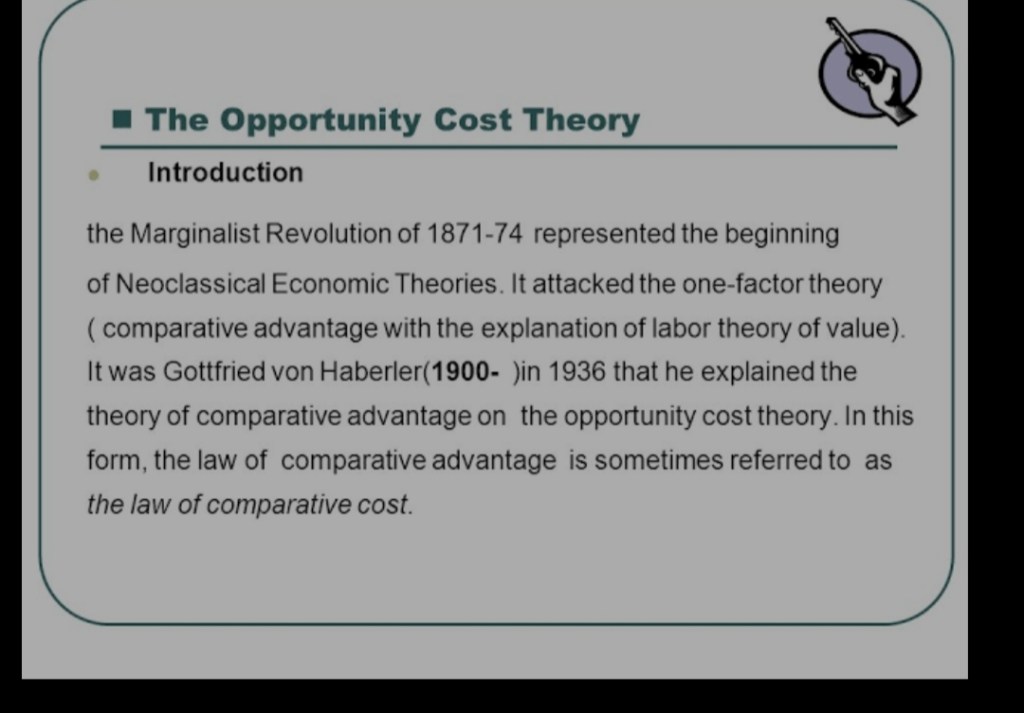
Innumerable theories are formulated by Haberler , Ohlin , Samuelson , Leontief , Hecksher and many others dealing with the macro and micro parts of international trade .
The principle of Comparative Cost theory by Ricardo, despite being the basis of international trade, has been criticized by many economists . Ricardo’s theory of comparative cost is based on the labour theory of value which means that labour is the only factor of production and labour is homogeneous . Such assumptions are found to be unrealistic .
Gottfired Haberler ‘ s theory of opportunity cost overcomes these shortcomings and explains the doctrine of the theory in terms of ” the substitution curve’ ‘ or as Samuelson entitled it as ” production possibility curve “or “transformation curve ” .
Lerner called it the ” production indifference curve ” or ” production frontier .”
Haberler’s theory is found to be more realistic .
The Theory of Opportunity cost
Opportunity cost is the value of loss when choosing between two or more commodities.
To elaborate more , The opportunity cost theory says that if a country can produce either commodity X or Y , the opportunity cost of commodity X is the amount of the other commodity Y that must be given up in order to get one additional unit of commodity X .
The exchange ratio between the two commodities is expressed in terms of their opportunity costs . The decrease in the quantity of the second commodity represents the opportunity cost of the additional quantity of the given commodity.
Haberler used the concept of opportunity cost with production possibility curves to illustrate international trade theory.
Assumptions :-
The following assumptions are formulated by Haberler to illustrate the theory :-
• There are only two countries , (A,B) • Each country possesses two factors of production – labour and capital. • Each country can produce two commodities , ( X and Y ,) • There is perfect competition in both the factor and commodity markets . • The price of each commodity equals its marginal money costs . • The price of each factor equals its marginal value productivity in each employment . • The supply of each factor is fixed . • Factors are immobile between the two countries. •. There is no change in technology . • Trade between the two countries is completely free and unrestricted.
Key terms :-
Production possibility curve :-
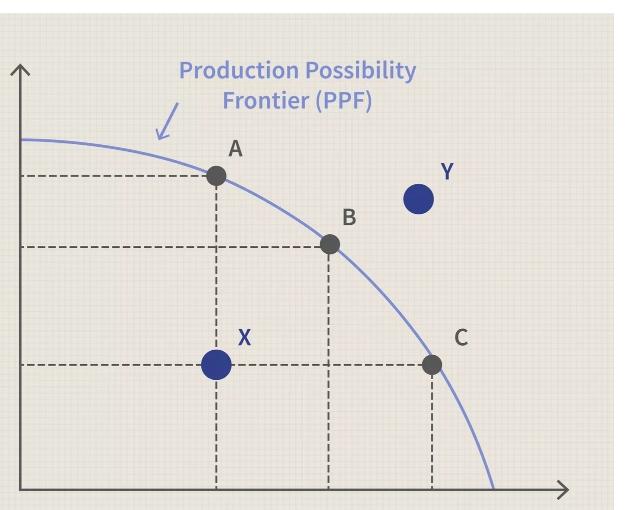
A production possibility curve or transformation curve is the curve that shows various combinations of two goods that can be produced with available amounts of resources . Production possibility curve shows that if an economy wants to produce more of one commodity ,it will have to transfer or divert resources from the production of another commodity to produce the one .
Different points on the production possibility curve show different combinations of the two goods . Points outside the curve are unattainable because of the scarce quantity of resources available.
Marginal Cost of Production :- The marginal cost of production measures the change in the total cost of a good that arises from producing one additional unit of that good.
Marginal Rate Of Transformation :- The marginal rate of transformation is the number of units of one product that can be increased by reducing the quantity of another product. It shows the number of goods that will be foregone to produce an additional unit of other goods while keeping the factors of production constant.
Comparative advantages: – A country can produce one commodity at a lower cost than the other because of comparative advantages such as favourable climate, natural resources, geographical situation and efficiency of labour.
Explanation Of the Opportunity Cost Theory
The production possibility curve indicates such combinations of two commodities . The shape of the production possibility curve determines the basis and the gain from international trade under the theory of opportunity curve .
The slope of the production possibility curve is determined by the ratio of units of the commodity given up in order to have one unit of the other commodity i.e by Marginal rate of transformation. (MRT)
MRT xy = ∆Y/ ∆X , where ,
X and Y are being produced by a country and some quantities of labour and capital input are used from the production of Y into the production process of commodity X.
Trade can take place only when each nation has a different MRT. The gains from trade for a particular nation depend on how much the international exchange rates differ from that nation’s MRT. The greater the difference, the greater is the gains from trade. The gains from trade rest further upon the amount of trade taking place. A larger volume of trade allows larger gains from trade and a greater increase in the standard of living.
Following the assumptions , two countries say A and B enter into a trade together .
Two commodities X and Y are being produced by using various alternative combinations that a country can produce most efficiently by fully utilising it’s factor of production i.e labour and capital ,are homogeneous , with the available technology in the fixed proportion due to perfect substitutability .
Conditions :-
1: Trade under Constant Opportunity Cost
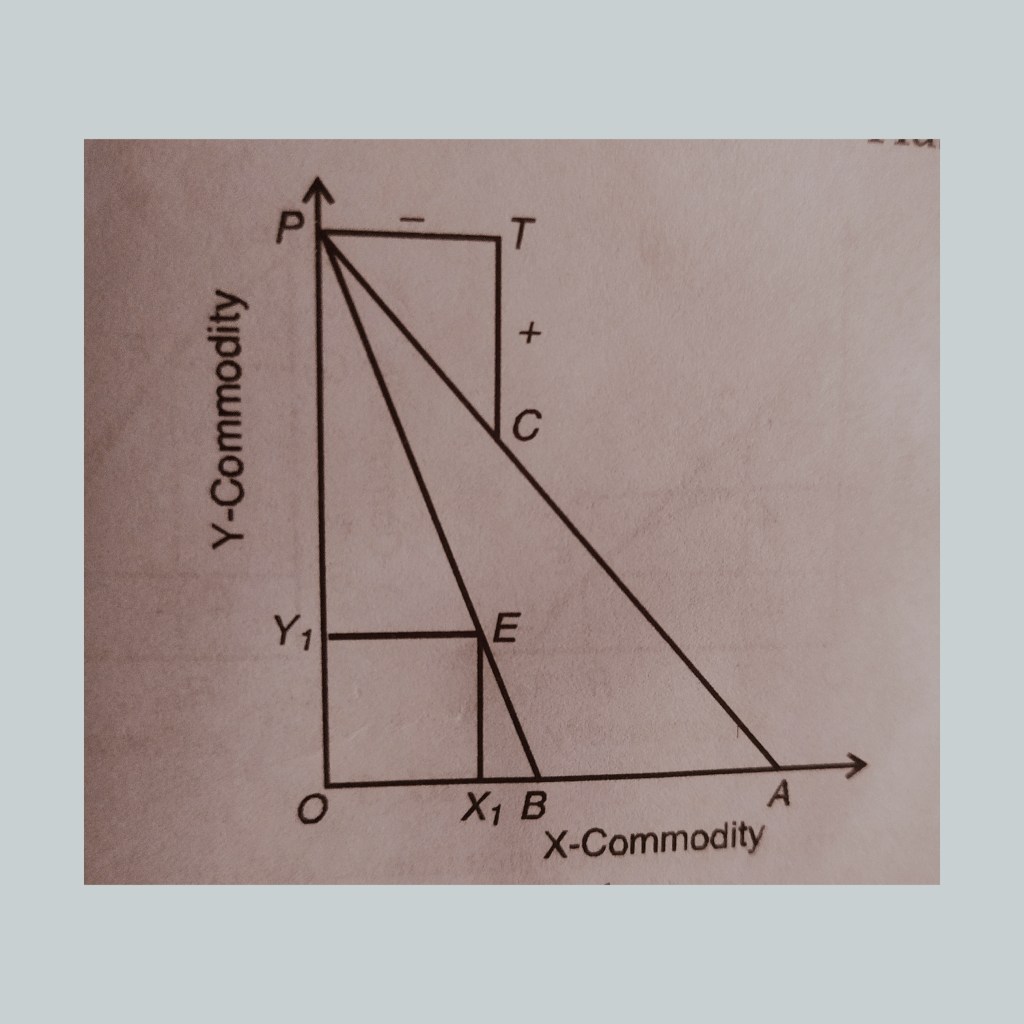
The production possibility curve under constant opportunity cost is a straight line .
In the figure , PA is the production possibility curve of country A , PB is the production possibility curve of country B .
Country A can produce either OP of Y , or OA of X
Similarly , Country B can produce OP of Y OB of X .
The slope of the production possibility curve determines the relative price of the two commodities , since the opportunity cost of leaving a unit of one commodity in order to have an additional unit of another is constant , the cost ratio ( relative price ) is the same on all the points on the production possibility curve.
Since , the MRT is constant i.e the slope of the production possibility curve is also constant, trade between the two countries is not possible as no country stands to gain through the trade .
Trade Under Increasing Opportunity Cost :-
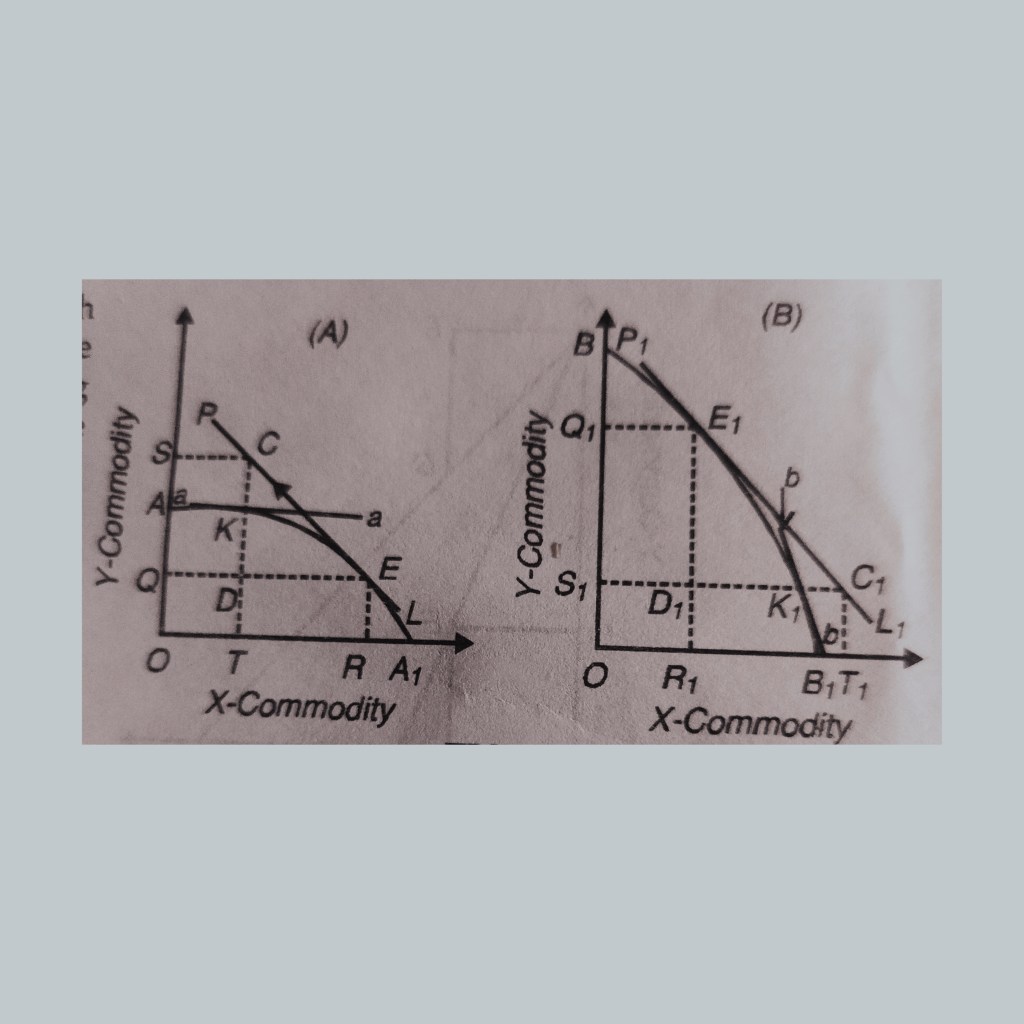
The production possibility curve under the increasing opportunity cost is concave to the origin because when a country specialises in the production of one commodity ,in which it possesses comparative advantage ,its opportunity costs increase .
In the above figure , AA1 is the production possibility curve of country A which is concave to the origin . The slope of this curve shows that country A will specialise in the production of commodity X . The larger amount of commodity Y will be given up to have additional amount of commodity X as we move from point A to A1 Thus ,the country faces increasing opportunity costs .
BB1 is the production possibility curve of a country which is concave to the origin . The slope of this curve shows that country B will specialise in the production of commodity Y. The larger amount of commodity Y will be given up to hsv additional amount of commodity Y as we move from B1` to B . Thus , the country faces increasing opportunity costs.
Let us assume the international price ratio is given by the line PL in country A , and PL1 in country B.
The slope of line PL is greater than domestic price line aa ,making commodity X expensive in international market than in domestic market and resulting in the interest of country A to shift some factor of production from the production of commodity Y to commodity X , moving it’s production level from point K to point E.
It will export TR of X and import QS of Y , domestically consuming OT of X ,and OQ of Y . The export and import can be shown by the “trade triangle ” CDE .
The slope of line PL1 is less steep than domestic price line bb ,making commodity Y expensive in international market than in domestic market and resulting in the interest of country B to shift some factor of production from the production of commodity X to commodity Y , moving it’s production level from point K1 to point E1
It will import D1C1 of X and export D1E1 of Y , domestically consuming OS1 of Y ,and OR1 of X. The export and import can be shown by the “trade triangle ” C1E1D1.
Trade Under Constant Decreasing :-
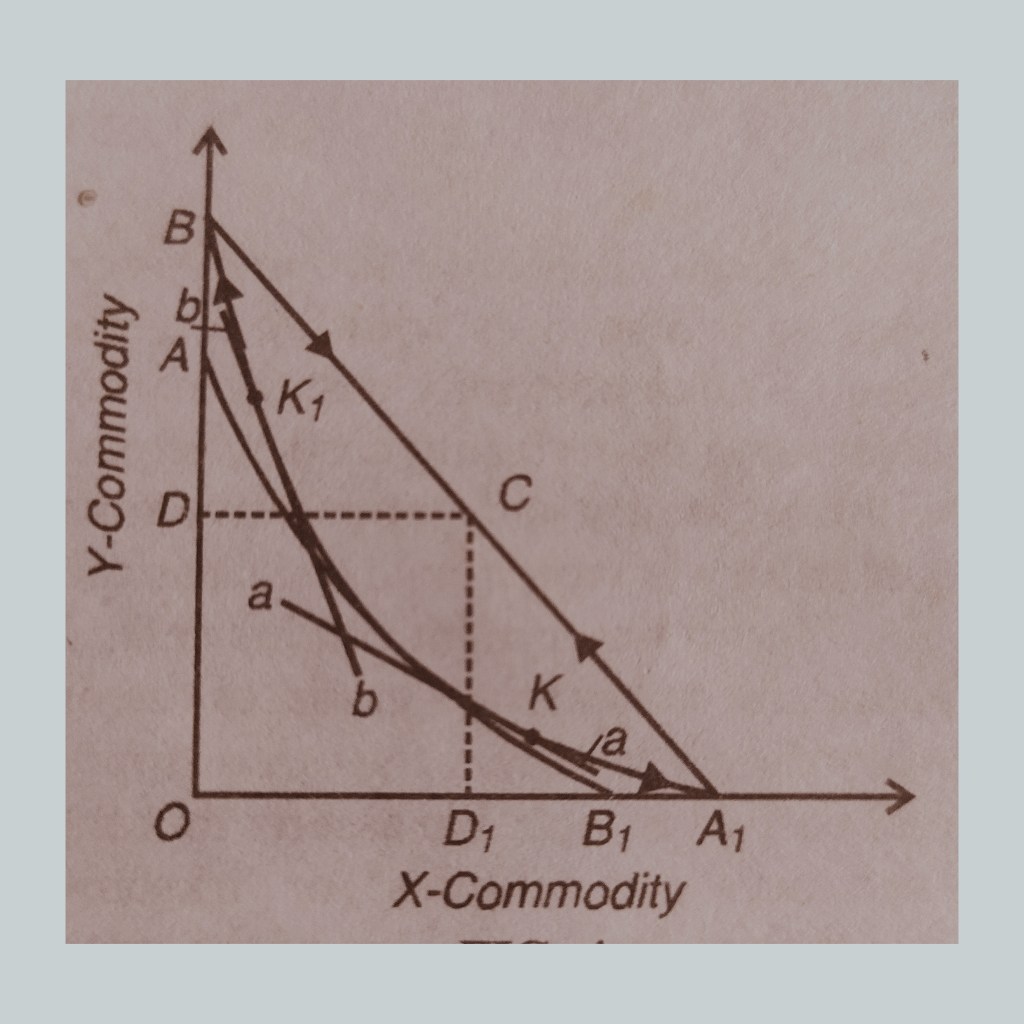
When two countries experience decreasing opportunity costs their production possibility curves are convex to the origin. Under decreasing opportunity costs , each country completely specialises in the production of only one commodity after trade because there are increasing returns based on internal economies of production .
In the figure , The production possibility curve of country A is AA 1 and B is BB1.
The pre trade production and consumption point of country A is K where it’s domestic price line aa is tangent to its production possibility curve and country B is K1 , where it’s domestic price line bb is tangent to its production possibility curve.
The international price line being BA1, if both the countries enter the trade , BA1 is steeper than the domestic line of country A , making X more expensive in the international market and resulting in shifting of resources of production to X from K to A1 .
On the other hand , the international price line BA1 is flatter than the domestic price line bb of the country making Y commodity expensive in the international market than in the domestic market and resulting in shifting of resources of production to commodity Y and moving from K1 to B .
Thus , country A will completely specialise in commodity X and B in commodity Y . Now both the countries will move along with the international price line BA1, Country A from A to point A1 upward , country B from B to point B1 downward and reach point C in consumption.
Note :-
The straight line tangent represents :-
‘A straight line tangent to the transformation curve indicates the ratio of market prices of the two commodities, and the condition of tangency expresses equilibrium in production, that is, equality between prices and marginal costs stated in opportunity terms. Domestic demand conditions enter into this construction via community indifference curves, or simply as a consumption point determined by a given arrangement of production and income distribution.”
Finally, tangency of a line representing the equilibrium international price ratio to both transformation function and community indifference curve indicates equilibrium in exchange, that is:
(i) Equality domestically between the marginal rate of substitution in consumption and marginal rate of transformation in production, and
(ii) Equality of the value of exports and the value of imports.
Critical Appraisal
As an alternative to classical comparative theory , the opportunity cost theory is more realistic .
The opportunity cost theory analyses pre- trade and post – trade situations under constant , increasing and decreasing opportunity cost whereas comparative advantage theory is based on constant cost of production within a country and comparative advantage and disadvantage between two countries.
Jacob Viber in his ” Studies in The Theory of International Trade ” ( 1937) criticized the opportunity cost theory of values which is the basis of Haberler’s theory . Some of his criticism were :-
• Neglecting of welfare • Failure in measuring in terms of strain , sacrifice or disutility. • Neglecting Change in Factors of Supplies . • Unrealistic Assumptions .
Despite criticism ,the opportunity cost theory has been regarded as more fertile because it can be readily extended into a general equilibrium system .
Pune, a vibrant city in Maharashtra, India, is renowned for its rich culinary heritage, blending traditional Maharashtrian flavors with diverse culinary influences from across India and the world. Here’s a glimpse into some of the top restaurants in Pune that offer an exquisite dining experience:
Shreyas: Nestled in the heart of Pune, Shreyas is celebrated for its authentic Maharashtrian thali, showcasing a delightful array of traditional dishes served in a classic ambiance. From delectable sabzis to fragrant rice and mouthwatering desserts, Shreyas offers a culinary journey through the flavors of Maharashtra.
Paasha: Perched atop the JW Marriott Hotel, Paasha offers panoramic views of Pune along with an extensive menu of North Indian cuisine. With its elegant décor and sumptuous dishes, Paasha promises a memorable dining experience, featuring flavorful kebabs, rich curries, and indulgent desserts.
Baan Tao: Located in the Hyatt Pune, Baan Tao invites diners to savor the flavors of Asia in a contemporary setting. Specializing in Thai, Chinese, and Vietnamese cuisine, this restaurant offers an innovative menu crafted with fresh, high-quality ingredients and impeccable presentation.
Malaka Spice: Known for its vibrant ambiance and eclectic menu, Malaka Spice is a beloved destination for lovers of Southeast Asian cuisine. From fragrant Thai curries to tangy Vietnamese salads, Malaka Spice offers a diverse culinary experience that delights the senses.
German Bakery: A Pune institution, the German Bakery is cherished for its cozy atmosphere and delectable baked goods. Whether it’s freshly baked bread, savory quiches, or decadent pastries, this charming café is a favorite among locals and tourists alike.
Café Moshes: Tucked away in Koregaon Park, Café Moshes is renowned for its relaxed vibe and delicious comfort food. From hearty sandwiches to indulgent desserts, this café offers a menu that caters to diverse tastes, making it a popular choice for casual dining.
The Flour Works: With its emphasis on fresh, seasonal ingredients and artisanal bread, The Flour Works has carved a niche for itself in Pune’s culinary scene. Whether it’s a leisurely brunch or an intimate dinner, this charming café offers a menu that celebrates the joys of simple yet flavorful cuisine.
Arthur’s Theme: Inspired by the legendary King Arthur, this restaurant exudes old-world charm and sophistication. Known for its European-inspired menu and extensive wine list, Arthur’s Theme offers an elegant dining experience that transports diners to a bygone era.
These are just a few highlights from Pune’s vibrant culinary landscape, which continues to evolve with new flavors and experiences waiting to be discovered. Whether you’re craving authentic regional cuisine or international flavors, Pune’s top restaurants promise a gastronomic adventure like no other.
Welcome to “Farming at Home”. In today’s fast-paced world, where urbanization is on the rise and environmental concerns loom large, reconnecting with nature and integrating it into our living spaces has become more crucial than ever. This book is a comprehensive guide to help you embark on a journey of creating vibrant greenery within the confines of your home, whether it’s a cozy apartment, a suburban house, or a bustling urban rooftop.
The book help to explore the diverse range of topics we’ll explore together. From unraveling the intricate relationships between plants and people to understanding the benefits of indoor plants in purifying the air we breathe, from combatting pollution with green solutions to harnessing the power of sustainable water management and alternative energy sources, this book covers it all.
We delve into practical advice on setting up your own mini gardens, whether it’s a nutritional kitchen garden brimming with fresh herbs and vegetables or a rooftop oasis flourishing with vibrant blooms. We also explore innovative techniques like vertical farming and soil-less food production, revolutionizing the way we think about agriculture and food sustainability.
Moreover, we provide insights into how you can incorporate backyard poultry rearing for a steady supply of protein and explore homemade recipes to nurture your indoor plants and gardens. We even guide you through the process of fixing your own water utilities, ensuring that every drop is utilized efficiently.
Our aim with this book is not just to provide information but to inspire action. We want to empower you to transform your living spaces into green sanctuaries that promote not only your well-being but also contribute positively to the environment.
So, whether you’re a seasoned gardener looking to expand your horizons or a novice eager to embark on your green journey, “Farming at Home” has something for everyone. Let’s embark together on this enriching and rewarding adventure of cultivating green spaces for a healthier, happier home.
Published By: Edupedia Publications Pvt Ltd, New Delhi
“EduPub” refers to educational publishing, it could be a term used to describe publishing activities related to educational materials, textbooks, research papers, or other educational content. Educational publishing often involves the creation and distribution of materials for academic purposes, and it can include both traditional print publications and digital resources.
To help build a more influential, equal and socially conscious society.
Mission:
Track2Training drives social change by fostering an environment where young adults & children learn, lead and thrive
Our Strategy: Engage, Execute, Empower & Exit – To engage rural communities with corporates, young urban India, not-for-profit organizations and Governments to execute programs that empower our communities to transform their own lives, enabling us to exit and allowing them to serve as role models and change agents for the rest of the country.
Do you have the passion to contribute towards the country’s progress? Join us! You could volunteer with us for a minimum of two hours every week or on and off for events and one-off volunteering opportunities.
Register with us and we will get in touch with you soon (please allow us two weeks) through Email and SMS regarding the next orientation programme. At the orientation you will get more information about all of Bhumi’s projects, the causes you can choose and the locations where you can volunteer.
Careers at Track2Training are suitable for dynamic people looking to grow as leaders, capable of functioning as one among our volunteers, enabling and complementing their work. Candidates should be willing to work flexible hours and on weekends. Remuneration is on par with the best in the sector.
Prior experience with volunteer, non-profit, education and /or youth organizations desirable. Prior volunteering experience
We offer internships at Hajipur throughout the year and at other chapters during specific periods. Interns are not provided any remuneration, food or accommodation, but will be equipped with professional skills and provided with a certificate at the end of the engagement.
Interns should be willing to work full time or part time.
Track2Training (AN INITIATIVE FOR DEVELOPMENT) IS WORKING ON THE DEVELOPMENT OF THE RURAL ECONOMY THROUGH REVIVAL OF THE AGRICULTURE AND COTTAGE INDUSTRY. Creating content for social benefits and sharing knowledge about government schemes and programs for development.
Track2Training (An Initiative for Development) is an active NGO in the city. Hariyali has been carrying out need based welfare and integrated programs of development for rural poor and needy especially belonging to marginalized and under privileged sections. The NGO primarily focus on the development of the rural economy through revival of the agriculture and cottage industry.
Track2Traing is one of India’s largest independent and youth volunteer non-profit organisations.
Bhumi was founded on 2013 by a small group of professionals with a strong passion to change society today and build a better India for tomorrow. The organisation provides youngsters a platform to serve the society and bridges the gap between the educated and the uneducated.
Our volunteers educate and mentor children from orphanages, slum and village community centres across the country to give them a better future, which will benefit them as well as our country. The learning experience is mutual – our volunteers gain perspective and the experience to mould themselves into tomorrow’s leaders.
ORGANISATION
The organization Hariyali operates through committed and dedicated local women and men workers who have developed support and trust with the communities. The operational strategy includes empowering the poor to become self reliant through continuous experience sharing workshops, exposure visits, skill building and training. Orientation will also be given on livelihood support health, education, biotechnology, animal husbandry and sanitation. The effort shall be made to enhance income through the use of farming systems technology. The organization strongly believes in working with others and learning from others experience and networking with government and local groups.
Sustainable development in the project shall be emphasized by :
Empowering communities through community mobilization.
Better opportunities for livelihood improvement.
Developing village based institutions.
Wider dissemination of lessons learnt and traditional technologies.
Experiences sharing workshops with different stakeholders.
To generate income of poor rural people by their traditional works like the field of Agriculture / Animal / husbandry / Forest produce value addition etc.
Our philosophy states that India lives in her villages and we cannot rise to our true potential as a country without a fundamental transformation in the lives of people in rural India. At the Swades Foundation we believe that the partnership of rural India with corporates, young urban India, the Government and other foundations is the key to create a permanent and irreversible change for good.
We aim at bringing together the best global practices, corporate thinking and accountability, the highest standards of corporate governance to create a model of sustainable development, which is a benchmark in the industry and can be replicated at scale. We strongly believe in collaboration and working with multiple partners including other foundations, NGOs, corporates and the government.
Our Mission is to empower 1 million rural Indians every 5 years, creating a permanent, irreversible change for good. We believe in a holistic 360-degree development with a focus on six verticals – Community Mobilisation, Water & Sanitation, Agriculture & Dairy, Livelihood, Education and Health & Nutrition. This model empowers our communities with the capability of creating choices for themselves and their families, allowing them to transform their own lives and ensuring a permanent and irreversible change for good
Our strategy is to Engage, Empower, Execute and Exit: To engage rural communities with corporates, young urban India, not-for-profit organizations and governments and empower our communities to execute programs that transform their own lives, enabling us to exit and allowing them to serve as role models and change agents for the rest of the country.
Our organization has well established Office, Training centre & Vehicles.
EQUIPMENT :
1. Telephone, Fax Machine ,Computers and Printers available.
2. LCD Projector time for video visuals trainings to peoples.
3. Having documentary films on watershed, sanitation, education, health, veterinary, agricultural fields.







 Eduindex
You must be logged in to post a comment.