Local to Global

 Taking a critical view of the Western approach of tackling Climate Change, the Economic Survey 2023-24 gives a clarion call to all developing countries to look at climate change problem from a ‘local lens’. It states that a ‘one-size-fits-all’ approach will not work, and developing countries need to be free to choose their own pathways since they are tasked with balancing developmental goals with meaningful climate action.

The Economic Survey 2023-24, tabled by the Union Minister for Finance and Corporate Affairs Smt. Nirmala Sitharaman in Parliament today, clearly states that current global strategies for climate change are flawed and not universally applicable. It states that adopting the practices of the West could prove to be disastrous for India where culture, economy, societal norms are already intertwined with the environment.

The document highlights that India, despite making significant strides in climate action, often faces criticism for not aligning with Western solutions. This criticism stems from a lack of appreciation for India’s unique social and cultural fabric, which is already rich with sustainable development ideas. It further goes on to point out inherent inconsistencies where the prescriptions to tackle Climate Change from the developed world do not hold ground globally. These are:

    • The Western approach does not seek to address the root of the problem, i.e. overconsumption, but rather chooses to substitute the means to achieve overconsumption.
    • The global pursuit of energy-guzzling technologies such as Artificial Intelligence and mining rare earth minerals in large quantities has only contributed to higher fossil fuel consumption. This is directly at odds with the stated objectives of climate change mitigation.
    • Lifestyles in developed countries ignore humans’ underlying relationship with Nature, with other people, with materiality and with themselves.

The Economic Survey 2023-24 stresses that India’s ethos emphasizes a harmonious relationship with nature, in sharp contrast to the culture of overconsumption prevalent in other parts of the developed world, thus offering sustainable solutions to problems plaguing Western societies. For instance:

    • The process of meat production adopted in the developed world presents credible food security risks and a threat of permanently degrading the land, water and natural resources critical for human survival. The reliance on human-edible crops to feed livestock has set into motion a ‘food-feed competition’ as less than half the cereals produced today go towards direct human consumption. These figures are even lower for many developed economies.

The Survey notes that traditional farming practices from the developing world, where several agricultural activities are integrated with livestock rearing, offer one solution to the problem. Repurposing farm waste and by-products from other agricultural activities as animal feed not only lowers the financial and environmental cost of meat production but also brings balance to the natural cycle. Shifting livestock to human-inedible feed can free up significant shares of global arable land to address global hunger, it adds.

    • Similarly, the adoption of nucleated families akin to the Western model of living places significant land and resource requirements on the environment, as the growth in urban nucleated settlements gives rise to the tendency of ‘urban sprawl’. Furthermore, these living spaces are highly inefficient, dominated by concrete, closed spaces, less ventilation and exacting higher energy costs during the summers.

A shift towards the ‘traditional multi-generational households’ would create the pathway towards sustainable housing, notes the Survey. Sourcing materials and labour locally for the construction of houses, central courtyards with well-ventilated spaces, and avenues for natural lighting and cooling would all exert a positive externality on the environment by lowering resource and energy requirements. Such a household would also prove immensely beneficial for the elderly, it states.   

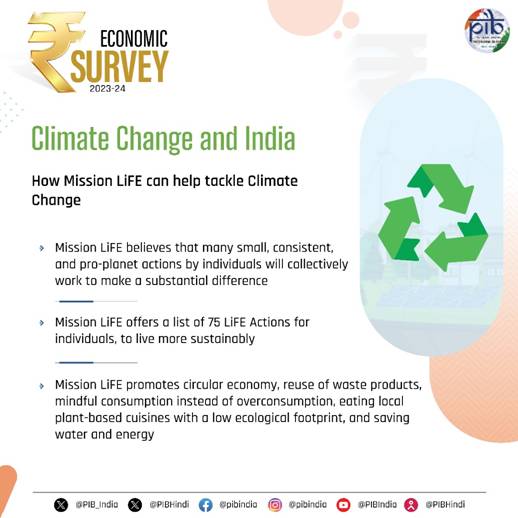
In order to profess a solution to these issues, the Economic Survey brings in perspective Prime Minister Shri Narendra Modi’s vision of Mission LiFE. It embodies a ‘Lifestyle For Environment’ seeking to address the ‘wants’ of the people without letting them hurt Nature. The approach seeks to bring individual responsibility to the forefront of the fight against climate change, as sustenance is at the core of Indian ethos.

The Mission encompasses a comprehensive but non-exhaustive list of 75 LiFE Actions for adoption by individuals to live more sustainably. At its heart, it promotes mindful consumption instead of overconsumption, encourages a circular economy and the reuse of waste products, eating local plant-based cuisines with a low ecological footprint, saving water and energy, notes the Survey. 

The document quotes the International Energy Agency and states that adoption of the kinds of actions and measures targeted by the LiFE initiative worldwide would reduce annual global carbon di-oxide emissions by more than 2 billion tonnes in 2030 (20% of the emissions reductions needed by 2030) and in consumer savings of about USD 440 billion.

In conclusion, the Survey document upholds the tenets of Mission ‘LiFE’ and notes that the global movement on climate change must be accommodative of sovereign choices and economic needs, but centered on individual behavior. ‘It’s time to rebuild societies with equanimity’, it adds.

*****

Adopting Building Information Modelling (BIM)

 In recent years, various aspects of infrastructure development have been integrated with technology to improve the efficiency of infrastructure plans, designs, and assets, states the Economic Survey 2023-24 tabled by Union Minister of Finance & Corporate Affairs Smt. Nirmala Sitharaman, in Parliament today. The survey says that some of the most significant uses of technology made possible through PM GatiShakti, Bhuvan, BharatMaps, Single Window Systems, PARIVESH portal, National Data Analytics Platform, Unified Logistics Interface Platform, Pro-Active Governance and Timely Implementation (PRAGATI), India Investment Grid (IIG) and many similar dashboards and data stacks for almost all ministries.

TELECOMMUNICATION SECTOR

The Economic Survey notes that the usage and underlying technologies of telecommunications have undergone massive changes, especially in the past decade. It says that the Telecommunications Act 2023 was enacted to amend and consolidate the laws on telecommunication services and networks, assignment of spectrum and related matters.

Highlighting the importance of test labs for ensuring the functionality, reliability and interoperability of telecommunications devices, the Survey observes that these specialised facilities are equipped with advanced testing infrastructure to evaluate the performance of various telecommunications equipment such as routers, switches, base stations, and communication protocols. It observes that more than 69 labs have been designated as conformity assessment bodies for EMI/EMC, safety evaluations, technical requirements and RF testing of telecom products.

The Survey further notes that the Government has introduced guidelines for the Spectrum Regulatory Sandbox (SRS), or Wireless Test Zones (WiTe Zones), as part of the Millennium SRS initiative to foster innovation, enhance ease of doing business, promote “Make in India” in the telecommunications sector. The survey states that, “This initiative provides a simplified regulatory framework to facilitate Research and Development (R&D) activities, promote exploration of spectrum bands and drive technological advancements”. WiTe Zones have been categorised into urban or remote areas for experimentation across various frequency bands, with eligibility extending to academia, R&D labs, telecom providers and others, says the Survey.

ELECTRONICS & INFORMATION TECHNOLOGY SECTOR

The Government has envisioned the India AI programme as a mission-centric approach for leveraging transformative technologies to boost inclusion, innovation, and adoption for social impact,mentions the Survey 2023-24.

According to the Survey, pillars of India AI include AI in Governance, AI IP & Innovation, AI Compute & Systems, Data for AI, Skilling in AI, and AI Ethics & Governance.  “As part of building ‘AI in India and AI for India’, the first edition of the IndiaAI was released in October 2023”, notes the Survey.

Being the founding member of the Global Partnership on Artificial Intelligence (GPAI), the Survey says that India has contributed to the GPAI goals and objectives and is working on various domestic initiatives for the responsible development, deployment, and adoption of AI. Further, it states that the Union Cabinet has approved an allocation of over ₹10,300 crore towards the comprehensive IndiaAl Mission to democratise access to Al innovation pillars and ensure global competitiveness of India’s Al ecosystem. “Under the Digital India programme, initiated in July 2015 to transform India into a digitally empowered society and knowledge economy, various digital initiatives have been undertaken for the delivery of citizen-centric services”, the Survey mentions.

BUILDING INFORMATION MODELLING (BIM)

For complex infrastructure projects in India,  the Economic Survey states, adopting Building Information Modelling can reduce the average project delays of 39 months, reduce infrastructure construction costs up to 30 per cent, maintenance costs up to 20 per cent, information and systemic inefficiencies up to 20 per cent, construction sector related carbon emission up to 38 per cent, water consumption up to 10 per cent and improve investments in construction R&D by one per cent, and result in over four million skilled professional employment and about 2.5 million additional construction sector jobs by reinvesting savings in additional infrastructure.

The motto of BIM is to construct digitally before constructing physically, notes the Survey. It says that NITI Aayog has identified the challenges, solutions and enablers related to BIM implementation. “Based on a roadmap for creating an ecosystem towards faster adoption of BIM in India, guidance, and strategies are being provided to infrastructure projects, including Central Vista, New Parliament, and Central Secretariat”, it mentions further.

The Economic Survey states that the BIM is now being extensively utilised and leveraged by some ministries and departments like the National Capital Region Transport Corporation, all metro rails, select complex industrial and tourism projects, various airports, along with organisation-wise acceptance at Central Public Works Department and extensive digitalisation in the form of Data Lake across NHAI that is now being extended to the entire Ministry of Road

Transport & Highways.

***

Serivce Sector Growth in India

 Discussing the sector wise performance of major services, the Economic Survey 2023-2024 tabled in Parliament today by the Union Minister for Finance and Corporate Affairs, Smt. Nirmala Sitharaman, highlighted“Two significant transformations are reshaping India’s services landscape: the rapid technology-driven transformation of domestic service delivery and the diversification of India’s services exports”.

India’s services sector encompasses a wide array of economic activities, which can be broadly classified into two categories:

  1. Contact-intensive (physical connectivity-based services): includes trade, hospitality, transport, real estate, social, community and personal services.
  2. Non-contact-intensive services (Information Technology services, tech start-ups and Global Capability Centres): comprises financial, information technology, professional, communication, broadcasting, and storage services. The sector also incorporates public administration and defence services.


Physical connectivity-based services

Myriad services are that are offered to ensure the seamless movement of goods, people, and information across diverse infrastructure networks encompass a broad spectrum, ranging from passenger transport via trains, buses, taxis, and airlines to freight transport facilitated by shipping companies, freight forwarders, and courier services.


  1. Roadways: A considerable portion of India’s cargo is transported via road. Accordingly, through various initiatives user convenience on National Highways (NH) has been enhanced:
    • Toll digitisation has drastically reduced waiting times at toll plazas, from 734 seconds in 2014 to 47 seconds in 2024.
    • Ministry of Road Transport and Highways (MoRTH) has devised a comprehensive ‘4E’ strategy – Engineering (roads and vehicles), Enforcement, Emergency Care, and Education – to elevate road safety standards on NHs.
    • The Government has utilised the PM Gati Shakti National Master Plan portal for network planning and congestion projections.


  1. Indian Railways: Indian Railways (IR) hosts many services to enhance user experience, efficiently manage the train system and build capacity for a Viksit Bharat.
    • Passenger traffic originating in IR was 673 crore in FY24 (provisional actuals), increasing by about 5.2 per cent compared to the previous year.
    • IR carried 158.8 crore tonnes of revenue-earning freight in FY24 (excluding Konkan Railway Corporation Limited), showing an increase of 5.3 per cent over the previous year.
    • To upgrade the passenger experience, railways have introduced Wi-Fi facilities at 6108 stations, bridging the digital divide between rural and urban citizens.


  1. Ports, Waterways and Shipping: The port sector is leveraging the Sagar Setu application to streamline daily vessel and cargo operations, aspiring to become a central hub for all maritime engagements.
    • Sagar Setu is also integrated with all the 13 major ports of India, along with 22 non-major ports and 28 private terminals.
    • There is a push for promoting river cruise tourism on national waterways. There has been a staggering 100 per cent surge in overnight cruise trips during FY24.


  1. Airways: India is the third-largest domestic aviation market and the aviation sector in India has shown substantial growth, with a 15 per cent YoY increase in total air passengers handled at Indian airports reaching 37.6 crore in FY24.
    • In FY24, the domestic air passenger traffic handled increased by 13 per cent YoY to 30.6 crore, and international air passenger traffic handled increased by 22 per cent YoY to 7 crore.
    • Air cargo handled at Indian airports increased by 7 per cent YoY to 33.7 lakh tonnes in FY24.
    • The Government has approved 21 greenfield airports nationwide and operationalised new terminal buildings to increase passenger handling capacity backed by a solid capex plan.
    • To promote regional equity, the ‘Ude Desh Ka Aam Nagrik’ (UDAN) scheme launched in 2016 facilitated the travel of over 141 lakh domestic passengers across various 579 Regional Connectivity Scheme routes connecting 85 unreserved and underserved airports since its inception.
    • Initiatives like Digi Yatra are enhancing efficiency through technology
    • Women constitute 15 per cent of the country’s pilots, which is almost three times higher than the global average, thus presenting greater opportunities for women in the sector. In the year 2023, a total of 1622 commercial pilot licenses were issued, of which 18 per cent were issued to women.


  1. Tourism: The tourism sector in India is rapidly expanding, with India being ranked at the 39th position in the World Economic Forum’s Travel and Tourism Development Index (TTDI) 2024.
    • Showing positive signs of revival post-pandemic, the tourism industry witnessed over 92 lakh foreign tourist arrivals in 2023, implying a YoY increase of 43.5 per cent.
    • India has significantly earned foreign exchange receipts amounting to over ₹2.3 lakh crore through tourism, indicating a 65.7 per cent YoY increase.
    • Swadesh Darshan 2.0, focuses on integrated tourism destination development, targeting 55 destinations across 32 states and Union Territories.


  1. Real Estate: Real estate and ownership of dwellings have accounted for over 7 per cent of the overall Gross Value Added (GVA) in the past decade, highlighting their integral role in the economy.
    • In 2023, residential real estate sales in India were at their highest since 2013, witnessing a 33 per cent YoY growth, with a total sale of 4.1 lakh units in the top eight cities.
    • The housing sector’s growth has been due to several key factors namely the Pradhan Mantri Awas Yojana-Urban (PMAY-U), policy reforms like the Goods and Services Tax, Real Estate (Regulation and Development) Act, and the Insolvency and Bankruptcy (SWAMIH), PMAY(U)-Credit Linked Subsidy Scheme interest subvention.
    • According to a report by CRISIL, the housing loan market in India grew at a CAGR of approximately 13 per cent from FY18 to FY23. The housing loan market in India is expected to continue growing at a CAGR of 13 to 15 per cent reaching ₹42 lakh crore to ₹44 lakh crore by FY26.


Information Technology Services, Tech start-ups and Global Capability centres

Over the past decade, information and computer-related services have become increasingly significant, with their share of total GVA rising from 3.2 per cent in FY13 to 5.9 per cent in FY23. Despite the pandemic-induced economic downturn, this sector achieved a real growth rate of 10.4 per cent in FY21. The flourishing growth of IT services has also supported the expansion of Global Capability Centers (GCCs) and the tech start-up ecosystem in India.

Global Capability Centres (GCCs) in India have grown significantly, from over 1,000 centres in FY15 to more than 2,740 units by FY23. These centres contribute to economic growth by providing high-quality employment. Revenue from India’s GCCs has increased from USD 19.4 billion in FY15 to USD 46 billion in FY23, growing at a compound annual growth rate (CAGR) of 11.4 per cent.

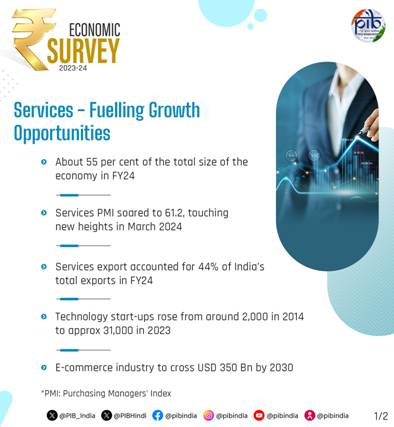
Technology start-ups in India have risen remarkably from around 2,000 in 2014 to approximately 31,000 in 2023. As per NASSCOM, the sector witnessed the inception of roughly 1000 new tech start-ups in 2023. Also, as per NASSCOM, India’s tech start-up ecosystem ranks third globally and has performed considerably better than the USA and the UK. The Start-up India Initiative and Start-up hubs across ministries and departments of the Government of India along with National Deep Tech Start-up Policy, the Drone Shakti Program and custom duty exemptions for EV-related capital goods and machinery have aided the growth of tech start-ups. Targeted efforts such as accelerating & strengthening the deep-tech ecosystem, strengthening domestic capital flow and leveraging initiatives such as Start-Up India have been undertaken to tap the potential of start-ups.


  1. Telecommunications: The overall tele density (number of telephones per 100 population) in India increased from 75.2 per cent in March 2014 to 85.7 per cent in March 2024.
    • Internet subscribers jumped from 25.1 crore in March 2014 to 95.4 crore in March 2024, of whom 91.4 crore are accessing the internet via wireless phones.
    • The internet density also increased to 68.2 per cent in March 2024.
    • The cost of data has declined substantially, vastly improving the average wireless data usage per subscriber.
    • India is amongst the fastest-growing 5G networks in the world. The Bharat 5G Portal propels India’s 5G capabilities and fosters innovation, collaboration, and knowledge-sharing within the telecom sector.


  1. E-Commerce: The Indian e-commerce industry is expected to cross USD 350 billion by 2030.

***

Integrated and sustainable development in rural India

 The integrated and sustainable development in rural India is at the heart of the Government’s strategy. The focus is on holistic economic betterment through decentralized planning, better access to credit, empowerment of women, basic housing, and education, among others. This was stated by the Economic Survey 2024 tabled by Union Minister for Finance and Corporate Affairs Smt. Nirmala Sitharaman in the Parliament today.

Enhancing the Quality of life in rural India

The Economic Survey stated that quality of life in rural areas has progressed in terms of basic amenities, education, health and financial inclusion. In terms of basic amenities, 11.57 crore toilets were constructed under the Swachh Bharat Mission- Grameen and 11.7 crore households were provided with tap water connection under Jal Jeevan Mission as of 10th July 2024. The Survey reports that in the PM-AWAS-Gramin, 2.63 crore houses were constructed for the poor in last nine years (as of 10th July 2024) .

In addition, 35.7 crore RuPay debit cards have been issued under Pradhan Mantri Jan Dhan Yojana (PMJDY) as of 26th June 2024  leading to enhanced financial inclusion in rural areas. In the health sector, 1.58 lakh sub centres and 24,935 primary health centres have resulted in enhancement of quality of life in the  rural areas.

Strengthening and modernising the safety net of MGNREGS

The Economic Survey 2023-24 observed that to ensure elimination of leakages in MGNREGS (Mahatma Gandhi National Rural Employment Guarantee Scheme), geotagging before, during and after the work is being done and 99.9 per cent payments are through National Electronic Management System.

The Survey stated that MGNREGS has made significant progress in terms of person-days generated and women participation rate with person-days generated increasing from 265.4 crore in 2019-20 to 309.2 crore in 2023-24 (as per MIS) and women participation rate increasing from 54.8 per cent in 2019-20 to 58.9 per cent in 2023-24.

The Economic Survey also points out that MGNREGS has evolved into an asset creation programme for sustainable livelihood diversification, as seen in the rise in the share of individual beneficiary ‘works on individual land’ from 9.6 per cent of total completed works in FY14 to 73.3 per cent in FY24.

Nurturing rural entrepreneurship at the grassroots

The Government continues to provide a fillip to rural entrepreneurship by implementing a bouquet of vibrant schematic interventions with a distinct focus on seamless access to affordable finance and generating lucrative market opportunities. Schemes and programmes like Deendayal Antyodaya Yojana- National Rural Livelihood Mission (DAY-NRLM), Lakhpati Didis initiative, and Deen Dayal Upadhyaya Grameen Kaushalya Yojana (DDU-GKY) have enhanced livelihood generation and easy access to finance in rural areas.

Digitisation initiatives for rural governance

Digitisation initiatives like e-Gram SWARAJ, SVAMITVA Scheme, Bhu-Aadhaar have improved rural governance. Under SVAMITVA Scheme, drone survey of  2.90 lakh villages has been completed and 1.66 crore property cards have been prepared. The Economic Survey points out that 200 per cent increase in rural internet subscriptions between 2015 and 2021 can reduce the distance between the village and the administrative headquarters leading to regional developments.

***

Service Sector in India

 Through the vicissitudes of the last three decades, the services sector stood as the bulwark of India’s economic growth. Aided by the focus on policy and procedural reforms, physical infrastructure and logistics, all significant business, personal, financial and infrastructure-based services have emerged strongly from the pandemic… However, the transformation lies in the fast-paced shift towards digital services like online payments, e-commerce, and entertainment platforms, as well as the increase in the demand for high-tech services as inputs in other productive activities.” This was highlighted in Economic Survey 2023-2024 tabled in Parliament by Union Minister for Finance and Corporate Affairs, Smt. Nirmala Sitharaman today.

The services sector continues to be a significant contributor to India’s growth, accounting for about 55 per cent of the total size of the economy in FY24, states Economic Survey. The significant domestic demand, rapid urbanization, expansion of e-commerce platforms generated heightened requirements for logistics, digital related services are important factors which have determined the domestic demand of services. The Economic Survey further states that the Government has played a crucial role in fostering the growth and competitiveness of India’s services by creating an enabling environment, promoting investment, enhancing skills and facilitating market access.

Gross Value Added (GVA) in the services sector

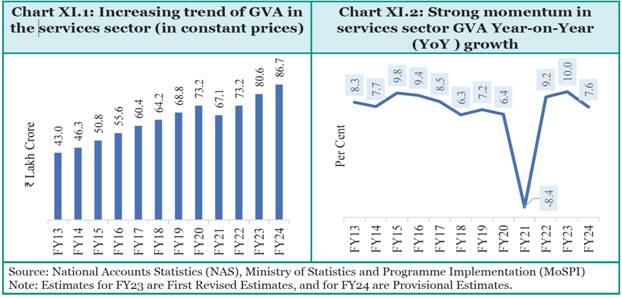
The contribution of the services sector to the overall GVA has increased significantly in the last decade. Globally, India’s services sector witnessed a real growth of more than 6 percent and the services exports constituted 4.4 per cent of the world’s commercial services exports in 2022.

For a decade before COVID, the services sector’s real growth rate consistently exceeded the overall economic growth. Post-COVID, the services sector’s growth, spurred by non-contact intensive services, primarily financial, information technology and professional services, outpaced overall GVA growth in FY23 and FY24, reclaiming its role in driving the economy’s upward trajectory.

The Survey further states that as per the Provisional Estimates, the services sector is estimated to have grown 7.6 percent in FY24. The gross GST collection reached ₹20.18 lakh crores in FY24, marking 11.7 per cent increase from the previous year, underscoring robust domestic trading activity.                                                                                                                                   

Purchasing Managers’ Index (PMI)- Services

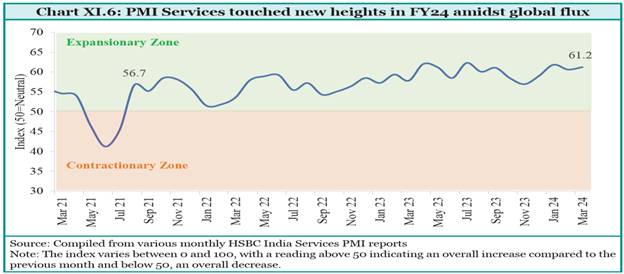
Business activity in the services sector in the country transcended the obstacles of the pandemic and other disruptions worldwide. In March 2024, services PMI soared to 61.2, marking one of the sector’s most significant sales and business activity expansions in nearly 14 years. As can be seen from Chart XI.6 (below), the services PMI has remained above 50 since August 2021, implying continuous expansion for the last 35 months.

Trade in the services sector

Post-pandemic, services exports have maintained a steady momentum and accounted for 44 per cent of India’s total exports in FY24 the survey notes. India ranked fifth in services exports, with other countries being the European Union (excluding intra-EU trade), the United States, the United Kingdom, and China.

India’s growing reputation as the preferred destination for Global Capability Centres (GCCs) by multinational corporations has significantly boosted software and business services exports.  India’s share in digitally delivered services exports globally increased to 6.0 per cent in 2023 from 4.4 per cent in 2019. This rise in services exports, coupled with a fall in imports, led to an increase in net services receipts on a YoY basis during FY24, which helped cushion India’s current account deficit.

Financing Sources for Services Sector Activity

The services sector fulfils its financing needs domestically through

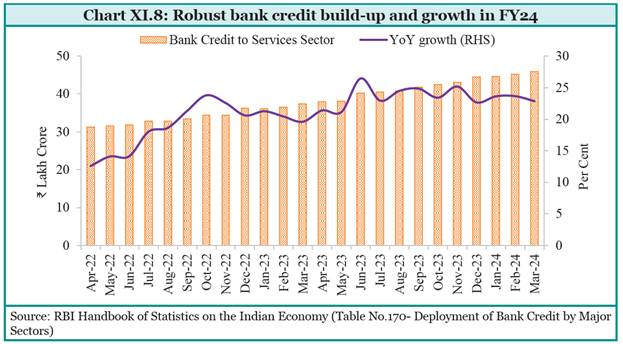
  1. Credit from domestic banks and capital markets: FY24 witnessed an upward trajectory of credit inflow in the services sector, with YoY growth rates surpassing the 20 per cent mark each month since April 2023.

  1. Internationally through Foreign Direct Investment (FDI) and External Commercial Borrowings (ECBs): The services sector accounted for 53 per cent share in total external commercial borrowing (ECB) inflows in FY24. The sector received inflows of USD 14.9 billion in FY24, thereby registering a YoY growth of 58.3 per cent.

***

MSME in India

 The Economic Survey tabled by the Union Minister of Finance and Corporate Affairs, Smt. Nirmala Sitharaman in Parliament today, highlights the importance of the MSME sector in the Indian economy with an all-India manufacturing output of 35.4 percent.

According to the survey, Gross Value Added (GVA) per worker increased from ₹1,38,207 to ₹1,41,769 and Gross Value of Output (GVO) per establishment increased from ₹3,98,304 to ₹4,63,389 showing  increased productivity and labour efficiency. The Survey highlights the success of the Udyam Registration portal that has received 4.69 Crore registrations as of 05 July 2024, playing an instrumental role in formalizing MSMEs by providing a simple, online, and free registration process based on self-declaration. The Survey notes that there has been significant growth between FY20 to FY24 in the amount and number of guarantees for MSMEs with Union Budget 2023-24 allocating ₹9,000 Crore to the Credit Guarantee Fund Trust, aiming to enable an additional ₹2 Lakh Crore in credit with reduced costs.

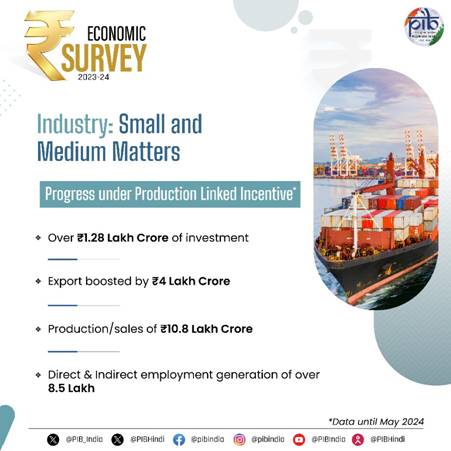
According to Survey, keeping in view India’s vision of becoming ‘Aatmanirbhar’, Production Linked Incentive (PLI) Schemes for 14 key sectors were announced with an outlay of ₹1.97 Lakh Crore to enhance India’s manufacturing capabilities and exports. Further survey states that over ₹1.28 Lakh Crore of investment was reported until May 2024, which has led to production/sales of ₹10.8 Lakh Crore and employment generation (direct & indirect) of over 8.5 Lakh. Survey states export boosted by ₹4 Lakh Crore, with significant contributions from sectors such as large-scale electronics manufacturing, pharmaceuticals, food processing, and telecom & networking products.

Survey highlights, to give an impetus to the One District One Product (ODOP) initiative, the Union Budget of FY24 announced that states would be encouraged to set up a “Unity Mall” in their capitals or most prominent tourism centre or the financial capital for the promotion and sale of their ODOPs. Survey also states that “PM-Ekta Malls” aims to link the artisans of ODOP and consumers. Survey  states that these malls are creating a vibrant marketplace for the nation’s unique products, aiming at both domestic and foreign markets. In addition to this survey ‘ODOP Sampark’ workshops were conducted in 15 States to facilitate collaboration between the Centre and local sellers and revive indigenous industries. According to the survey, ODOP showcased India to the world at the G20 events organised across the country during India’s G20 Presidency, where the artisans, sellers and weavers got visibility on the global stage.

*****

Skill Development in India

 India’s education policies and skill policies should adopt a laser-like focus on learning and skilling outcomes and need to be aligned with each other, as well. This is one of the six major pillars for realizing the collective goal of ViksitBharat@2047 in the medium term, as stated in the Economic Survey 2023-24, tabled by Union Minister for Finance and Corporate Affairs, Smt. Nirmala Sitharaman in Parliament today. Terming that the NEP (New Education Policy) 2020 provides a good framework to realise this objective, the Survey says new skilling initiatives and revamping the existing skilling initiatives should continue to be of high priority to the Government.

Skills are acquired on the foundations built by the education system, especially at the schools. Therefore, schooling should focus on the basic requirement of foundational literacy and numeracy and the realisation of grade-appropriate learning outcomes, adds the Survey. The Survey also calls upon the industry to take lead in skill creation saying it has much to gain from taking the initiative with academic institutions rather than leaving it only up to the governments to do the heavy lifting. Indeed, it should be the other way around, says the Survey.

The Economic Survey 2023-24 states that the government is taking measures to create the job and entrepreneurial opportunities that are in sync with the aspirations and abilities of India’s youth. Highlighting the significant improvement in the proportion of skilled people across all socio-economic classifications, the Survey mentions that 4.4 per cent of the youth in the age cohort of 15-29 years have received formal vocational/technical training, while another 16.6 per cent received training through informal sources.


The Economic Survey says that the skill development is at the centre of changes happening in education and labour markets amid the global megatrends, such as automation, action against climate change, the digitalisation of products and services, which are changing the nature of work and skills demands. It says that with one of the youngest populations, a median age of 28, India can harness its demographic dividend by nurturing a workforce that is equipped with employable skills and prepared for the needs of the industry.

The Survey mentions that India has not only recognised the potential of its young workforce but also the issues associated with skilling such a vast population. It says the National Policy on Skill Development & Entrepreneurship (NPSDE) focuses on bridging gaps, improving industry engagement, establishing a quality assurance framework, leveraging technology, and expanding apprenticeship opportunities. This, in combination with the National Education Policy (NEP), holds tremendous potential for bridging the education-employment gap in India, adds the Survey.

The Survey mentions that sixty-five per cent of India’s fast-growing population is under 35, and estimates show that about 51.25 per cent of the youth is deemed employable. However, it must be noted that the percentage has improved from around 34 per cent to 51.3 per cent in the last decade, the Survey adds.

Noting that productive jobs are vital for growth and inclusion, the survey says India’s workforce is estimated to be nearly 56.5 Crore and will continue to grow until 2044. It estimates that the Indian economy needs to generate nearly 78.51 lakh jobs annually in the non-farm sector to cater to the rising workforce. However, to create these many jobs, there is a need to create the conditions for faster growth of productive jobs outside of agriculture, especially in organized manufacturing and services, even while improving productivity in agriculture, the Survey adds.

The Survey calls for maximizing the outcomes from various skilling initiatives through convergence, and utilization of synergies with other employment-centric programmes which can further mutually benefit the two verticals. Linking skill development with Production Linked Incentive (PLI) scheme and employment-linked incentive schemes in high growth potential sectors like toy, apparel, tourism, logistics, textiles, leather sector etc. would aid upgrading of skills as production moves up the value chain. On the apprenticeship promotion front also, there remains considerable scope to add flexibility to the regulatory framework, the Survey noted.

*****

Health Sector in India

 A sound healthcare system interconnected with long-term factors responsible for inclusive growth is vital for a resilient economy, underscores the Economic Survey 2023-24 tabled by the Union Minister of Finance and Corporate Affairs Smt. Nirmala Sitharaman in Parliament today.

Aligned with the Government’s commitment to ensuring sound health and well-being of all ages through a preventive and promotive healthcare orientation in all developmental policies and universal access to good quality healthcare services, the Survey highlights key initiatives and schemes of the Government to ensure ‘Quality Healthcare for All’.

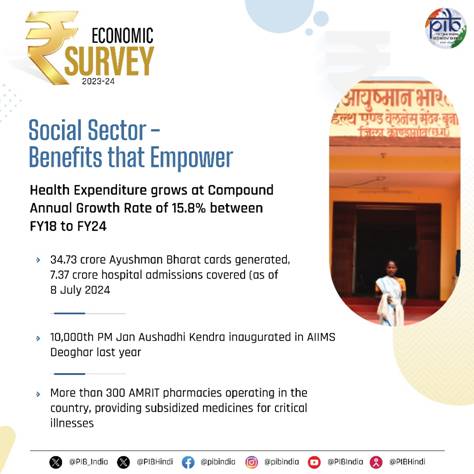
  • Ayushman Bharat Pradhan Mantri Jan Aarogya Yojana (AB-PMJAY):  Aimed at providing health insurance cover of ₹5 lakh/ year for underprivileged families for secondary and tertiary hospitalization, as of 8th July 2024, 34.73 crore Ayushman Bharat cards have been generated and 7.37 crore hospital admissions have been covered by the scheme. Notably, 49% of the beneficiaries of this scheme are women.
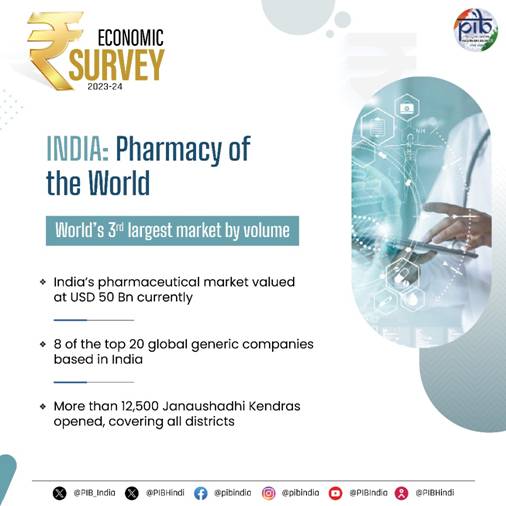
  • PM Jan Aushadhi Kendras: This scheme aims to provide quality medicines at 50-90 per cent cheaper than market rates. Under the scheme, 10,000th Jan Aushadhi Kendra was inaugurated in AIIMS Deoghar last year. 1965 medicines & 293 surgical equipments are available at the kendras.
  • AMRIT (Affordable Medicines and Reliable Implants for Treatment): More than 300 Amrit pharmacies are operating in different States/UTs. These aim to provide subsidized medicines for critical illnesses.
  • Ayushman Bhav Campaign: Launched in September 2023, this campaign aims to saturate selected healthcare services in every village/town across the country and inform citizens about the Government’s flagship schemes. Commendable milestones achieved during the campaign are:
    • 16.96 lakh wellness, yoga, and meditation sessions; 1.89 crore Tele consultations held
    • Free drugs availed by 11.64 crore people and free diagnostics services availed by 9.28 crore people
    • Ante-natal check-up (ANC) and Immunization availed by 82.10 lakh mothers and 90.15 lakh children
    • Seven types of screening (TB, Hypertension, diabetes, Oral Cancer, Breast Cancer, Cervical Cancer and Cataract) availed by 34.39 crore people.
    • 2.0 crore patients consulted general OPD, while 90.69 lakh patients consulted specialist OPD, and 65,094 major surgeries and 1,96,156 minor surgeries were conducted.
    • 13.48 crore ABHA accounts were created, 9.50 crore Ayushman cards were generated, and 1.20 lakh Ayushman Sabhas organized.
    • Cumulative footfall of 20.66 crore in 25.25 lakh health melas (as of 31 March 2024)


  • Ayushman Bharat Digital Mission (ABDM): Launched in 2021, the Scheme aims to create a national digital health ecosystem across the country. Under this scheme, 64.86 crore Ayushman Bharat Health Accounts (ABHA) have been created, 3.06 lakh Health Facility Registries generated, 4.06 lakh healthcare professionals registered, and 39.77 crore health records linked with ABHA.
  • eSanjeevani:  Launched in 2019, this scheme for telemedicine for virtual doctor consultations in remote areas has served 26.62 crore patients across 128 specialties at 1.25 lakh Health & Wellness Centres, now known as Ayushman Arogya Mandirs (as Spokes) through 15,857 hubs, as of 9th July 2024.

***

Expenditure on Social Services

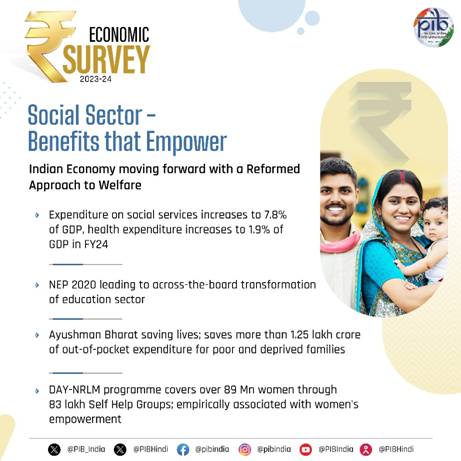
 India’s social and institutional progress in recent years has been achieved through an empowering approach to welfare as the new approach focuses on transforming the implementation and cost effectiveness of the Government programmes. The approach comprises targeted implementation of reforms for last-mile service delivery and affordable social security schemes for the unorganized sector workers through schemes such as Atal Pension Yojana (APY). This was stated by the Economic Survey 2023-24 tabled by Union Minister for Finance and Corporate Affairs Smt. Nirmala Sitharaman in the Parliament today.

Decline in Multidimensional Poverty

The expenditure on social services has increased from 6.7 % of GDP in 2017-18 to 7.8 % of GDP in 2023-24. The enhanced economic thrust along with better implementation of programmes has led to a sharp decline of Multidimensional Poverty with (National) Multidimensional Poverty Index (MPI) nearly halving from 0.117 in 2015-16 to 0.066 in 2019-21. Resultantly, 13.5 crore Indians are estimated to have escaped multidimensional poverty between 2015-16 and 2019-21, the Economic Survey 2023-24 noted.

The trend is driven by rural India, with the most significant improvements occurring in states like Bihar, Madhya Pradesh, Uttar Pradesh, Odisha and Rajasthan. Uttar Pradesh registered the most significant decline in the number of poor people, with 3.43 crore people escaping multidimensional poverty between 2015-16 and 2019-21.

Reduced Inequality and Decline in Rural-Urban divide

The Economic Survey also points out that the results of various initiatives in the social sector have translated into reduced inequality. The Gini coefficient has declined from 0.283 to 0.266 for the rural sector and from 0.363 to 0.314 for the urban sector in the past decade.

Similarly, the rural-urban divide has also declined considerably, as the difference between rural and urban monthly per capita consumption expenditure (MPCE) declined from 83.9 % in 2011-12 to 71.2 % in 2022-23.

***

Industrial Sector in India

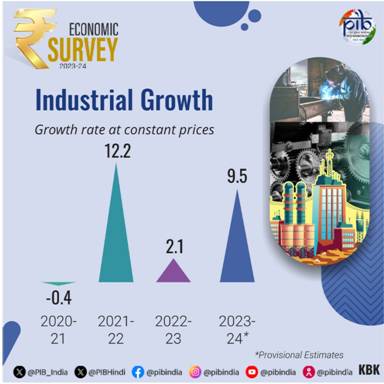
 Robust industrial growth of 9.5 percent was a key highlight of the Economic Survey 2023-24, presented by the Union Minister of Finance and Corporate Affairs, Smt. Nirmala Sitharaman, in Parliament today.

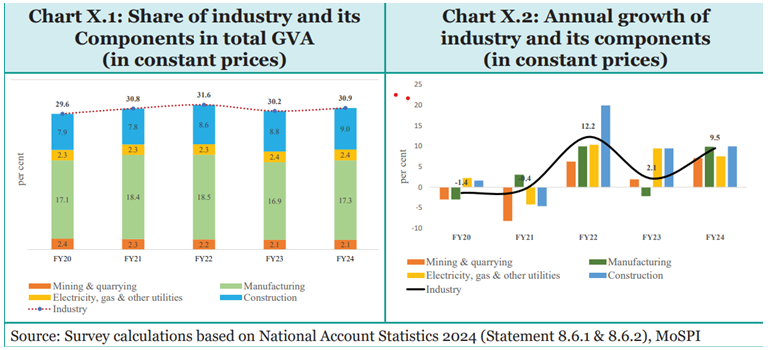
According to the Economic Survey, manufacturing remained at the forefront of the Indian industrial sector achieving an average annual growth rate of 5.2 per cent in the last decade. The sector had a gross value added at 14.3 per cent in FY23 and an output share of 35.2 per cent during the same period, indicating that the sector has significant backward and forward linkages. The HSBC India Purchasing Managers’ Index (PMI) for manufacturing also consistently remained well above the threshold value of 50 in all months of FY24, which is proof of a sustained expansion and stability in India’s manufacturing sector.

The Survey notes that about 47.5 per cent of the total value of output in the country is used as inputs in productive activities (inter-industry consumption). Manufacturing activities account for about 50 per cent of the inter-industry consumption and, at the same time, supply almost 50 per cent of inputs used in all productive activities (agriculture, industry and services).

Annotation 2024-07-21 140347.png

Physical infrastructure, logistics and compliance bottlenecks slowed capacity creation and expansion in the past. The Survey optimistically notes that majority of these restrictions have been now been lifted. The Survey states that physical infrastructure and connectivity is improving at a rapid pace. It further comments that the Goods and Services Tax has created a single market for several commodities, enabling manufacturing at scale. The Survey underlines the importance of deregulation along with the role of private sector in long-term investment. Boosting competitiveness and expanding the Indian manufacturing sector remains key to generation of semi-skilled employment thus bringing development closer to the people.

*****

Agriculture Sector in India

 Economic Survey 2023-24 presented in the Parliament today by Union Finance and Corporate Affairs Minister Smt. Nirmala Sitharaman. Economic Survey says that smallholder farmers need to move to high-value agriculture. The Survey says once the incomes of smallholders increases, they will demand manufactured goods, spurring a  manufacturing revolution.

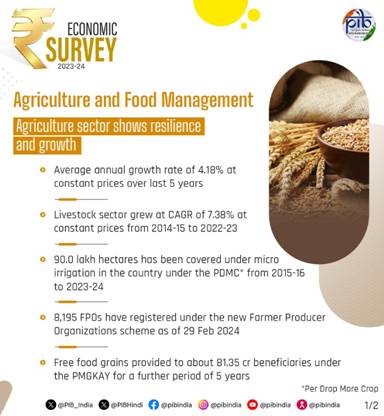
Economic Survey says that the Indian agriculture sector provides livelihood support to about 42.3 per cent of the population and has a share of 18.2 per cent in the country’s GDP  at current prices. The sector has been buoyant, which is evident from the fact that it has registered an average annual growth rate of 4.18 per cent at constant prices over the last five years and as as per provisional estimates for 2023-24, the growth rate of the agriculture sector stood at 1.4 percent.

Economic Survey states that the Investment in agriculture research and support of enabling policies have contributed substantially to food security. It is estimated that for every rupee invested in agricultural research (including education), there is a payoff of ₹13.85. In 2022-23, ₹19.65 Thousand Crore was spent on agriculture research.

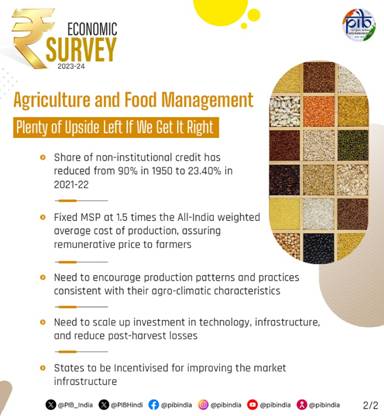
Economic Survey calls for enhancing private sector investment in agriculture saying it is vital to provide impetus to the agriculture sector. Investment in technology, production methods, marketing infrastructure, and reduction in post-harvest losses need to be scaled up. A greater focus on post-harvest infrastructure and the development of the food processing sector can reduce wastage/loss and increase the length of storage, ensuring better prices for the farmers.

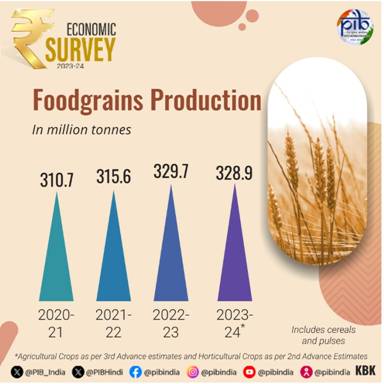
Economic Survey says that in 2022-23, foodgrain production hit an all-time high of 329.7 million tonnes, and oilseeds production reached 41.4 million tonnes. In 2023-24, food grain production is slightly lower at 328.8 million tonnes, primarily because of poor and delayed monsoons. The domestic availability of edible oil has risen from 86.30 lakh tonnes in 2015-16 to 121.33 lakh tonnes in 2023-24. The total area coverage of all oilseeds has increased from 25.60 million hectares in 2014-15 to 30.08 million hectares in 2023-24(17.5 percent growth). This has reduced the percentage share of imported edible oil, from 63.2 per cent in 2015-16 to 57.3 percent in 2022-23, despite rising domestic demand and consumption patterns.

Economic Survey suggests that to promote efficiency in agriculture marketing, and improve price discovery, the government implemented the e-NAM Scheme and as of 14th March 2024, more than 1.77 Crore farmers and 2.56 Lakh traders have been registered on the e-NAM portal. The Government of India launched the scheme to form and promote 10,000 FPOs in 2020 with a budget outlay of ₹6.86 thousand crore till 2027-28. As of 29 February 2024, 8,195 FPOs have registered under the new FPO scheme, and equity grants of ₹157.4 crore were released to 3,325 FPOs. Credit guarantee cover worth ₹278.2 crore was issued to 1,185 FPOs.

Economic Survey states that the Agricultural price support assures farmers of remunerative returns, increasing income and allows the Government to ensure a stable supply of staples at reasonable prices. Accordingly, the Government has been increasing the MSP for all Kharif, Rabi and other commercial crops with a margin of at least 50 per cent over the all-India weighted average cost of production since the agricultural year 2018-19.

Economic Survey shows that to provide social security to the most vulnerable farmer families, the Government implements Pradhan Mantri Kisan Maandhan Yojna (PMKMY). The scheme offers a monthly pension of ₹3,000 to the enrolled farmers on the attainment of 60 years of age, based on a nominal premium between ₹55 to ₹200 per month paid by the applicant (in the age group 18 to 40 years) subject to exclusion criteria. As of 07 July 2024, 23.41 lakh farmers have enrolled under the scheme.

Economic Survey, on focusing to reduce the use of chemical fertilizer, states that the PM Programme for Restoration, Awareness Generation, Nourishment, and  amelioration of Mother Earth (PM-PRANAM ) initiative incentivises states to reduce chemical fertiliser use. It promotes sustainable methods such as the use of alternative fertilisers, viz. Nano Urea, Nano DAP, and organic fertiliser.

Focusing on the security of farmers’ crop, Economic Survey highlighted the Pradhan Mantri Fasal Bima Yojana (PMFBY) which offer a safety net against crop losses due to natural calamities, pests, or diseases, ensuring financial stability for farmers. The scheme safeguards farmers’ livelihoods and encourage them to adopt modern farming practices and technologies. PMFBY is the largest crop insurance scheme in the world in terms of farmer enrolment and is the third largest scheme in terms of insurance premiums. The scheme ensure comprehensive risk cover for crops to farmers against all non-preventable natural risks from pre-sowing to post-harvest. The overall insured area in 2023-24 reached 610 lakh ha compared to 500.2 lakh ha in 2022-23. A total of 5549.40 Lakh farmer applications were insured under the scheme since 2016-17, and ₹150589.10 Crore has been paid as claims.

***

Gross Capital Formation

 Economic Survey 2023-24 was presented in the Parliament today by Union Finance and Corporate Affairs Minister Smt. Nirmala Sitharaman. The Economic Survey states that the Gross Capital Formation (GCF) of the agriculture sector and the share of GCF in the agriculture and allied sectors as a percentage of Gross Value Added (GVA) has been growing steadily, mainly due to increased public investment. The GCF of the agriculture sector grew at the rate of 19.04 per cent in 2022-23, and the GCF as a percentage of GVA rose from 17.7 per cent in 2021-22 to 19.9 per cent in 2022-23, suggesting an increase in investment in agriculture. The average annual growth in GCF from 2016-17 to 2022-23 was 9.70 percent. The Survey states that despite the increasing trend in GCF, there is a need to further boost agriculture investment, especially in the context of doubling farmers’ income. The DFI 2016 report indicated that to double farmers’ income over the period of 2016-17 to 2022-23, income would need to grow at an annual rate of 10.4 per cent in the farm sector, which in turn would require an annual growth rate in agriculture investment of 12.5 percent.

The government’s priority has been to provide timely, cost-effective, and adequate credit that reduces the dependence on non-institutional credit and increases investment. The measures have reduced the share of non-institutional credit from 90 per cent in 1950 to 23.40 per cent in 2021-22. As of 31 January 2024, the total credit disbursed to agriculture amounted to ₹ 22.84 lakh Crore, with ₹13.67 lakh Crore allocated to crop loans (short term) and ₹ 9.17 lakh Crore to term loans.

Kisan Credit Card(KCC):

The Economic Survey states that the Kisan Credit Card (KCC) has streamlined agricultural credit accessibility and as of January 31, 2024, banks issued 7.5 crores KCC with a limit of ₹9.4 lakh crores. As a further measure, the KCC was extended to meet the working capital needs of fisheries and animal husbandry activities in 2018-19, along with the enhancement of the limit for collateral-free loans to ₹1.6 lakh. In the case of a Tri-Partite Agreement (TPA) among borrowers, milk unions, & banks, the collateral-free loan can go up to ₹3 lakh As of March 31, 2024, 3.49 lakh KCC and 34.5 lakh KCC were issued to fisheries and animal husbandry activities, respectively. Economic Survey states that  Joint Liability Groups (JLGs) have emerged as an essential source of credit for tenant farmers. JLG accounts have grown at a compound annual growth rate (CAGR) of 43.76 per cent over the past five years, emerging as a vital source in meeting the credit needs of tenant farmers and  marginalised segments.

Agriculture Infrastructure:

Economic Survey shows that as of 30th April 2024, 48357 projects were sanctioned for storage infrastructure with ₹4570 Crore released as subsidy, and 20878 other projects are also under progress with ₹2084 Crore released as subsidy. To give further fillip to farm gate infrastructure and also involve the private sector more actively, the Agriculture Infrastructure Fund (AIF) was launched with a financing facility of ₹1 lakh Crore to be disbursed between FY 2020-21 to FY 2025-26 with support extending till FY 2032-33.

The Economic Survey states that the Agriculture Infrastructure Fund(AIF)  provides medium-term debt financing for post-harvest management and community farming projects, offering interest subvention and credit guarantee support. As of 5th July 2024, AIF mobilised an investment of ₹73194 Crore, supporting 17196 custom hiring centres, 14868 primary processing units, 13165 warehouses, 2942 sorting and grading units,1792 cold storage projects, and 18981 other projects. In addition, the Pradhan Mantri Kisan SAMPADA Yojana (PMKSY) introduced credit-linked financial assistance through grants-in-aid to build efficient supply chain management from farm to retail to reduce the wastage of perishable produce and extend food shelf life. Under PMKSY 1044 projects were completed till end March 2024. A total of 1685 projects with project cost ₹ 32.78 thousand crore and approved subsidy of ₹ 9.3 thousand crore have been approved till end March 2024.

***

Foreign Trade in India

 India’s external sector remained strong amidst ongoing geopolitical headwinds with services exports continuing to perform well. The overall trade deficit reduced from USD 121.6 billion in FY23 to USD 78.1 billion in FY24. This is stated in the Economic Survey 2023-24 tabled by the Union Minister for Finance and Corporate Affairs Smt. Nirmala Sitharaman in the Parliament today.

SERVICES TRADE

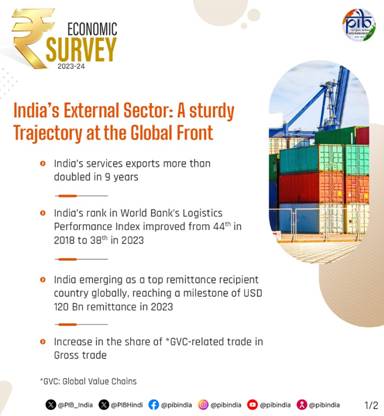
The Economic Survey highlights that the share of India’s services exports in world services exports has risen remarkably from 0.5 per cent in 1993 to 4.3 per cent in 2022. India is now the seventh-largest services exporting country globally rising phenomenally from its 24th position in 2001.

Amongst services exports, software/IT services and business services exports have increased. This was supported by India emerging as a hub for Global Capability Centres (GCCs). India ranks 2nd in the world in telecommunication, computer, and information services exports, 6th in personal, cultural and recreational services exports and 8th in other business services exports. 

The growth in Global Capability Centres (GCCs) is reflected in the services BoP, with ‘Other Business Services’ being the second-largest contributor in services exports in FY24 with a share of 26%. In 2012, about 760 GCCs were operating out of India and as of March 2023, India houses over 1,600 GCCs.

MERCHANDISE TRADE

India performed well in merchandise trade despite lowering in global demand with exports crossing USD 776 billion and imports reaching USD 898 billion in FY23. With this, merchandise trade deficit narrowed to USD 238.3 billion in FY24 compared to USD 264.9 billion in the previous year.

There was a slowdown in India’s major exporting partners (especially the EU, whose real GDP grew barely by 0.6 per cent in 2023, compared to 3.6 per cent growth in 2024), along with the lagged impact of monetary tightening carried out by many countries to control rising inflation.

The Survey notes that adverse trade environment in 2023 is expected to ease somewhat this year and next, boosting goods trade in 2024 and 2025. World merchandise trade volume is expected to grow at 2.6 per cent and 3.3 per cent in 2024 and 2025, respectively, as demand for traded goods rebounds.

India’s exports of engineering goods, electronic goods and drugs & pharmaceuticals increased in FY24 on a YoY basis. India’s share in world electronics exports also improved. India maintained a strong foothold in the drugs and pharmaceuticals sector.

Despite high domestic demand due to the relatively strong growth of India’s economy, merchandise imports contracted by 5.7 per cent in FY24, from USD 716 billion in FY23 to USD 675.4 billion in FY24. Imports of capital goods saw an increase, which is welcome as it indicates a heightened demand for machinery, equipment, and other durable goods used in production processes, suggesting potential investments in industrial infrastructure or technological upgrades. A marginal uptick in the share of consumer goods in merchandise imports reflects a stable but limited increase in the importation of finished products for direct consumption.

A targeted focus and a series of measures undertaken by the Government has shown robust growth in product-specific exports in sectors such as – Defence, Toys, Footwear and Smartphones. The share of electronics goods in merchandise exports of India rose from 2.7 per cent in FY19 to 6.7 per cent in FY24, taking India from 28th position in 2018 to 24th in 2022 in global electronics exports.


MEASURES TO EXPAND EXPORTS

The Government has undertaken various measures to promote exports and reduce logistics costs involved in international trade which include setting export targets and their monitoring, provision of export credit insurance services and encouraging banks to provide affordable and adequate export credit to micro, small and medium enterprises (MSME) exporters, enabling them to explore new markets and diversify their existing products competitively.

To boost efficiency and lower logistics costs, the Government launched the PM GatiShakti National Master Plan and the National Logistics Policy (NLP) in October 2021 and September 2022, respectively. Digital reforms, such as the Unified Logistics Interface Platform (ULIP) and the Logistics Data Bank, are additional measures taken towards improving logistics.

Initiatives, such as railway track electrification, reduced release times by the Land Ports Authority of India (LPAI), and the launch of NLP Marine for port-related logistics were also undertaken. Since the launch of the NLP, over 614 industry players have registered on ULIP, 106 private companies have signed Non-Disclosure Agreements (NDAs), 142 companies have submitted 382 use cases to be hosted on ULIP and 57 applications have been made live as of September 2023.

The Survey notes that India stands for an open, inclusive, predictable, non-discriminatory, and mutually beneficial international trade as it can provide an impetus to economic growth. India advocates for a rule-based international trading system with these attributes with WTO at its core. In this spirit, India considers Free Trade Agreements (FTAs) an instrument of trade liberalisation and a complement to the multilateral trading system under WTO. Accordingly, the country is engaged with all its trading partners/blocs to expand its export markets while ensuring better terms for essential imports to meet domestic demand in a cost competitive manner.

The Economic Survey highlighted that India is moving up the global value chains (GVCs), with the share of GVC-related trade in gross trade rising to 40.3 per cent in 2022 from 35.1 per cent in 2019. The improvement in GVC participation is also reflected in increased pure backward GVC participation.

The Survey added that India’s GVC participation has begun to rev up again on the back of incentives provided through schemes such as the PLI and Districts as Exports Hub (DEH) initiative, after the lull seen in the years succeeding the global financial crisis. Survey says that the evidence of India’s enhanced global supply chain participation is reflected in increased investment by foreign firms in electronics, apparel and toys, automobiles and components, capital goods and semiconductor manufacturing in India.

CURRENT ACCOUNT BALANCE

The Economic Survey highlighted that India’s Current Account Deficit (CAD) narrowed to USD 23.2 billion (0.7 per cent of GDP) in FY24 from USD 67 billion (2 per cent of GDP) during the previous year due to a decline in merchandise trade deficit, rising net services exports and increasing remittances.

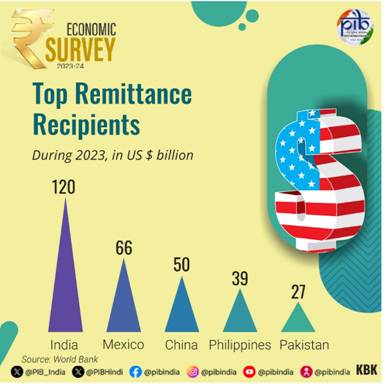
The Net services receipts increased from USD 143.3 billion during FY23 to USD 162.8 billion in FY24, primarily on account of rising exports of software, travel and business services. The remittances by Indians employed overseas, was USD 106.6 billion in FY24, against USD 101.8 billion during the previous year.

Remittances to India are forecasted to grow at 3.7 per cent to USD 124 billion in 2024 and at 4 per cent to reach USD 129 billion in 2025, emphasized the Survey.

CAPITAL ACCOUNT BALANCE

Emphasizing about the stable capital inflows which continue to finance the CAD, the Survey mentioned that during FY24, net capital flows stood at USD 86.3 billion against USD 58.9 billion during the previous year, primarily driven by FPI flows and net inflows of banking capital.

The Survey emphasized that India witnessed positive net foreign portfolio investment (FPI) inflows in FY24 of USD 44.1 billion, supported by strong economic growth, a stable business environment, and increased investor confidence.

Highlighting that India received the highest equity inflows among emerging market peers during FY24, the Survey listed financial services, automobile and auto components, healthcare, and capital goods were the significant sectors attracting equity inflows during FY24.

The Survey noted that the Net FDI inflows to India declined from USD 42.0 billion during FY23 to USD 26.5 billion in FY24 as an impact of decline in global FDI flows. It further added that the gross FDI inflows moderated only by 0.6 per cent from USD 71.4 billion in FY23 to just under USD 71 billion in FY24.

Highlighting that India has a well-established infrastructure to attract FDI in select sectors, i.e., Greenfield projects such as renewables, digital services such as telecommunications, software and hardware, and consultancy services, the Economic Survey suggested that where investment intentions are high, the sectors must be made more accessible for investments. It further added that the focus must remain on improving the ease of doing business across sectors and extend beyond sectors attractive to FDI alone by working out the details across all levels of government – national, state and local – and across regulators.

The Survey listed that educated labour and a skilled workforce coupled with a vibrant R&D culture are important magnets to enhance sustained investor interest, apart from political stability, policy predictability and stability, reasonable duties and taxes, dispute resolution mechanisms and ease of repatriation.

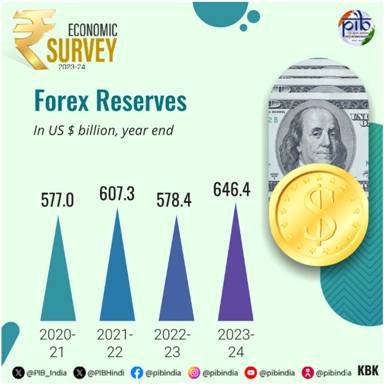
The Survey highlighted that during FY24, India’s Foreign Exchange Reserve (FER) increased by USD 68 billion, the highest increase among major foreign exchange reserves-holding countries.


The Survey notes that the Rupee emerged as the least volatile currency among its emerging market peers and a few advanced economies in FY24. It further stated that Rising FPI inflows kept the Indian Rupee in a manageable range of ₹82 to ₹83.5/USD in FY24.

The Economic Survey says that Indian residents’ overseas financial assets, by end of March 2024, was at USD 1,028.3 billion were higher by USD 109.7 billion or 11.9 per cent compared to the level as of March 2023. The factors attributed were mainly due to a rise in reserve assets, currency and deposits, overseas direct investment, trade credit and advances and loans.


EXTERNAL DEBT

The External debt to GDP ratio declined to 18.7 per cent at the end of March 2024 from 19.0 per cent at the end of March 2023. Survey added that comparing various debt vulnerability indicators of India with peer countries for 2022 indicates that India is in a better position with relatively low levels of total debt as a percentage of Gross National Income (GNI) and short-term external debt as a percentage of total external debt.

The Economy survey noted that India’s trade deficit is expected to decline further as the PLI scheme is expanded and India creates a globally competitive manufacturing base in several product categories. It added that the recently signed FTAs are expected to increase the global market share of the country’s exports. The Survey mentioned that various international agencies and RBI expect the CAD to GDP to moderate to below one per cent for FY24, driven by growing merchandise and services exports and resilient remittances.

The Survey listed the fall in demand from major trading partners, Rise in trade cost, Commodity price volatility, Trade policy changes as some of the major challenges to India’s balance of trade. The Survey suggested that the changing composition of India’s export basket, enhancement in trade-related infrastructure, enhanced quality consciousness and product safety considerations in the private sector and stable policy environment are expected to play a significant role in driving India’s rise as a global supplier of goods and services.

***

Trade Policy of India

 The Economic Survey 2023-24, that was tabled in Parliament today, lays special emphasis on controlling Prices and Inflation as ‘Low and stable inflation is key to sustaining economic growth.’ It states that Governments and Central Banks face the challenge of keeping inflation at a moderate level while ensuring financial stability. Achieving this delicate balance requires careful monitoring of economic indicators and taking appropriate and timely corrective actions. With the commitment of the Reserve Bank of India (RBI) to the goal of price stability and policy actions by the Central Government, India has successfully managed to keep retail inflation at 5.4 per cent in FY24, the lowest level in 4 years, since the Covid-19 pandemic period.

The Economic Survey highlights the fact that India’s retail inflation is lower than the emerging markets & developing economies (EMDES) and world average in 2022 and 2023 as per IMF data. Survey states that factors such as established monetary policies, economic stability, well-developed and efficient markets that balance supply and demand conditions, and stable currencies contribute to the effective management of inflation. Historically, inflation in advanced economies has generally been lower than in EMDEs.

Inflation Management

With the goal of maintaining price stability, many countries have established their own inflation targets based on various factors that serve their economic objectives best. Lauding India’s Inflation Management, the Economic Survey states that interestingly, India is performing better than various developed and emerging economies in relation to its inflation target. In 2023, India’s inflation rate was within its target range of 2 to 6 per cent. Compared to advanced economies like the USA, Germany, and France, India had one of the lowest deviations from its inflation target in the triennial average inflation from 2021-2023. Despite the challenges posed by global demand- supply imbalances due to ongoing geopolitical tensions, India’s inflation rate was 1.4 percentage points below the global average in 2023.

Since 2020, countries have been facing challenges in controlling inflation. India has been able to bring about a declining trend in Headline and Core Inflation through its prudent administrative measures and monetary policy. As per the Economic Survey, since May 2022, monetary policy broadly focused on absorbing excess liquidity in the system by increasing the policy repo rate by 250 basis points from 4 per cent in May 2022 to 6.5 per cent in February, 2023. Thereafter, the policy rate was kept unchanged by focusing on the gradual withdrawal of accommodation, aiming to align inflation with the target, while simultaneously fostering growth. Consequently, the persistent and sticky core inflation observed in FY23 declined to 3.1 per cent in June, 2024

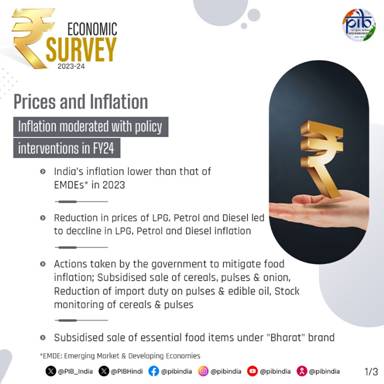
The Survey further asserts that administrative measures such as price cuts for LPG, petrol, and diesel led to lower LPG and petroleum product inflation. LPG inflation rate has been in the deflationary zone since September 2023 while retail inflation in petrol and diesel moved to the deflationary zone in March 2024. Additionally, global commodity prices declined in 2023, reducing price pressure in energy, metals, minerals, and agricultural commodities through the imported inflation channel. Low fuel and core inflation ensured a downward trajectory for headline inflation, despite volatility in food prices in FY24. As per the recent data released by MoSPI, the retail inflation rate was 5.1 per cent in June 2024.

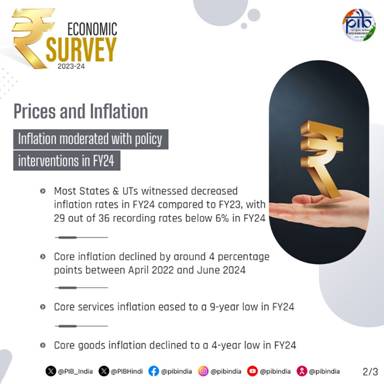
Core inflation, measured by excluding food and energy items from CPI headline inflation has witnessed a four year low in FY24. From the pandemic-driven highs, inflationary pressures in India eased in FY22, aided by softening food inflation. Inflationary pressures firmed up in FY23 yet again driven by the Russia-Ukraine war disrupting the recouping supply chains leading to a rise in food and fuel prices. In FY24, the price situation improved. CPI inflation moderated, driven by a decline in core inflation in both goods and services. Core services inflation eased to a nine-year low in FY24; at the same time, core goods inflation also declined to a four-year low.

Trends in core inflation are important in determining the contours of monetary policy. Assessing the emerging patterns of price pressures, the RBI increased the repo rate gradually by 250 basis points since May 2022 to curtail inflationary pressures, leading to reduction of around 4 percentage points in core inflation between April 2022 and June 2024. This was aided by moderation in housing rental inflation, with a significant increase in the stock of new houses in 2023.

Consumer durables inflation increased progressively between FY20 and FY23 by more than 5 percentage points, mainly due to increase in gold prices in FY21 and clothing in FY22 and FY23. With the improvement in the supply of key raw materials, the inflation rate for consumer durables declined in FY24. However, record-high gold prices, driven by anticipated Fed rate cuts and escalating geopolitical uncertainty, have exerted upward pressure on overall durables inflation. Consumer non-durables (CND) inflation plunged in FY20, it started to inch up in FY21, reached an all-time in FY22, and declined sharply in FY23 and FY24.

Food Inflation has been a global phenomenon in the last two years. Research indicates the rising vulnerability of food prices to climate change. In FY23 and FY24, the agriculture sector was affected by extreme weather events, lower reservoir levels, and damaged crops that adversely affected farm output and food prices. So, food inflation based on the Consumer Food Price Index (CFPI) increased from 3.8 per cent in FY22 to 6.6 per cent in FY23 and further to 7.5 per cent in FY24. However, the government took prompt actions, including open market sales, retailing in specified outlets, and timely imports, to ensure an adequate supply of essential food items. Additionally, to ensure food security for the poor, the Pradhan Mantri Garib Kalyan Anna Yojana, which provides free food grains to more than 81 crore beneficiaries, was extended for a period of five years starting from January 2024.

Global Food Prices and Domestic Inflation

Global food prices also have an impact on domestic inflation. In India, the edible oil market is heavily depends on imports, with more than 50 per cent of the total edible oil requirement being imported, making it sensitive to global prices. The Government closely monitors global market trends to ensure the availability of edible oils for consumers at an affordable price. Efforts are also made to balance imports with domestic production to mitigate the risks associated with global price volatility. In this context, the National Mission on Edible Oils Oil Palm aims to increase domestic crude palm oil production to reduce the import burden. In the case of sugar, the Government announced restrictions on export in June 2022 to ensure sufficient local supplies and thereby manage sugar inflation. These export restrictions have indeed played a role in stabilising domestic sugar prices. As a result, even though the global sugar price index inflated and has been showing volatility since February 2023, domestic sugar prices have remained much less volatile.

Elaborating on the Interstate variations in Retail Inflation, the Economic Survey asserts that inflation rate was less than 6 per cent in 29 out of the 36 States and Union Territories. These Interstate variations in inflation are more pronounced in rural areas since rural consumption basket has a much higher weightage of food items (47.3%) than the urban (29.6%). Hence, in the last two years, States that witnessed elevated food prices also experienced higher rural inflation.

Future Inflation Projections

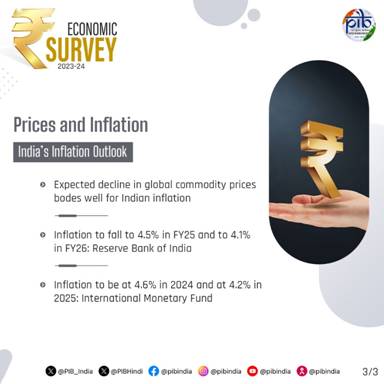
RBI and IMF have projected India’s consumer price inflation will progressively align towards the inflation target in FY26. Assuming a normal monsoon and no further external or policy shocks, the RBI expects headline inflation to be 4.5 per cent in FY25 and 4.1 per cent in FY26. IMF has projected an inflation rate of 4.6 per cent in 2024 and 4.2 per cent in 2025 for India. The World Bank expects that the global supply of commodities will increase, and so will their demand due to improved industrial activity and trade growth. It projects a 3 per cent decline in the commodity price index in 2024 and a 4 per cent decrease in 2025, mainly driven by lower energy, food and fertiliser prices. The energy price index is expected to reduce due to significant declines in coal and natural gas prices this year. Fertiliser prices are likely to weaken but remain above 2015-2019 levels due to strong demand and export restrictions. Base metal prices are projected to rise, reflecting increased global industrial activity and clean energy production. In general, the current downward movement in the prices of commodities imported by India is a positive for the domestic inflation outlook.

The short-term inflation outlook for India is benign. However, from the angle of long-term price stability, the Economic Survey suggests exploring the following options as the way forward:

1. Reducing import dependence for edible oils by increasing domestic production of major oilseeds, Exploring potential of non-conventional oils such as rice bran oil and corn oil and expanding scope of National Mission on Edible Oils

2. Expand the area under pulses, particularly lentils, tur, and urad, in more districts and rice- fallow areas. Promoting the summer cultivation of urad and moong in areas with assured irrigation facilities.

3. Further improving and developing modern storage and processing facilities for vegetables, especially tomatoes and onions.

4. Improving swiftness and effectiveness of administrative action by the Government to deal with price flare-ups in specific items by collating high-frequency price monitoring data, from the farm gate to the final consumer, in a quantifiable manner. Expediting producer price index for goods and services for better grasp on episodes of cost-push inflation and

5. Revising the consumer price index with fresh weights and item baskets using Household Consumer Expenditure Survey, 2022-23.


*****

Banking Sector Growth

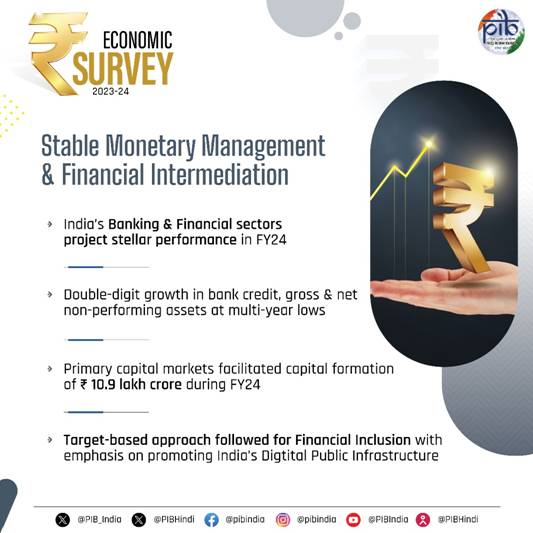
 Indian economy’s financial and banking sectors have shown strong performance despite continuous geopolitical challenges, said the Economic Survey 2023-24 tabled by Union Minister of Finance and Corporate Affairs, Smt. Nirmala Sitharaman in the Parliament today. The survey notes that the Central Bank maintained a steady policy rate throughout the year, with the overall inflation rate under control. The effects of the monetary tightening following the Russia-Ukraine conflict are evident in the lending and deposit interest rates increase among banks. Bank loans saw significant and widespread growth across various sectors, with personal loans and services leading the way.
Monetary Policy

The Monetary Policy Committee (MPC) maintained the status quo on the policy repo rate at 6.5 per cent in FY24. During the current tightening cycle, i.e., from May 2022 to May 2024, the external benchmark-based lending rate and the one-year median marginal-cost-of-funds based lending rate increased by 250 bps and 175 bps, respectively.

Important factors impacting the evolution of monetary and credit conditions during FY24 were the withdrawal of ₹2,000 banknotes (May 2023), the merger of HDFC, a non-bank, with HDFC Bank (July 2023), and the temporary imposition of the incremental CRR (I-CRR) (August 2023).

The growth in Broad Money (M3), excluding the impact of the merger of HDFC with HDFC Bank (with effect from 1 July 2023), was 11.2 per cent (YoY) as of 22 March 2024, compared to 9 per cent a year ago.

During FY24, 17 fortnightly Variable Rate Reverse Repo (VRRR) auctions and seven Variable Rate Repo (VRR) auctions were undertaken as the primary operation. In addition, 49 fine-tuning operations (25 VRRR and 24 VRR) were conducted intermittently, modulating liquidity conditions in alignment with the monetary policy stance, the survey notes.

Bank Credit

Credit growth remains robust, mainly driven by lending to services and personal loans.

Lending by non-banking financial companies (NBFCs) accelerated, led by personal loans and loans to the industry, and their asset quality improved. Credit disbursal by SCBs stood at ₹164.3 lakh crore, growing by 20.2 per cent at the end of March 2024, compared to 15 per cent growth at the end of March 2023.

Agricultural credit increased nearly 1.5 times from ₹13.3 lakh crore in FY21 to ₹20.7 lakh crore in FY24. The Kisan Credit Card (KCC) scheme played a pivotal role in providing timely and hassle-free credit to farmers, with over 7.4 crore operative KCC accounts at the end of 2023.

Industrial credit growth picked up in H2 of FY24, registering 8.5 per cent growth in March 2024, compared to 5.2 per cent a year ago, driven by an increase in bank credit to small and large industries.

Improving credit flow to the MSME sector at low cost has been a policy priority of the Government and RBI. Bank credit disbursal to the services sector remained resilient despite a slowdown in credit growth to NBFCs Credit disbursal for housing loans increased from ₹19.9 lakh crore in March 2023 to ₹27.2 lakh crore in March 2024.

Banking Sector

There has been a significant enhancement in the asset quality of banks, led by improved borrower selection, more effective debt recovery and heightened debt awareness among large borrowers. In addition to regulatory capital and liquidity requirements, qualitative metrics such as enhanced disclosures, robust code of conduct, and transparent governance structures also improved banking performance.

The gross non-performing assets (GNPA) ratio of SCBs continued its downward trend, reaching a 12-year low of 2.8 per cent at the end of March 2024 from its peak of 11.2 per cent in FY18.

The macro-and micro-prudential measures by RBI and the Government have enhanced risk absorption capacity in recent years, improving the banking system’s stability. For the top 10 Indian banks in asset size, loans constitute more than 50 per cent of their total assets, making banks immune to the rising interest rate cycle.

In the eight years since 2016, 31,394 corporate debtors involving a value of ₹13.9 lakh crore have been disposed of (including pre-admission case disposals) as of March 2024. ₹10.2 lakh crore of underlying defaults were addressed at the pre-admission stage.

The Government has taken several measures to improve the insolvency ecosystem. It has strengthened the NCLT regarding infrastructure, increasing its strength by filling vacancies and proposing an integrated IT platform. The regulations have been amended to keep in line with the needs of the markets and the advances in judicial pronouncements, the survey notes.

Strong Primary Markets

The Survey highlights the remarkable expansion of Indian capital markets. Capital markets have shown impressive results, with India’s stock market capitalisation to GDP ratio ranking fifth globally.

Primary markets remained robust during FY24, facilitating capital formation of ₹10.9 lakh crore (which approximates 29 per cent of the gross fixed capital formation of private and public corporates during FY23), compared to ₹9.3 lakh crore in FY23. Fund mobilisation through all three modes, viz., equity, debt, and hybrid, increased by 24.9 per cent, 12.1 per cent and 513.6 per cent, respectively, in FY24 compared to the previous year.

The number of initial public offers (IPOs) increased by 66 per cent in FY24 from 164 in FY23 to 272 in FY24, while the amount raised grew by 24 per cent (from ₹54,773 crore in FY23 to ₹67,995 crore in FY24). The corporate debt market in India is going from strength to strength. During FY24, the value of corporate bond issuances increased to ₹8.6 lakh crore from ₹7.6 lakh crore during the previous financial year. The number of corporate bonds public issues in FY24 was the highest for any financial year so far, with the amount raised (₹19,167 crore) at a four-year high. Increasing investor demand and the rise in the cost of borrowing from banks have made these markets more attractive for corporates for funding requirements.

Robust Secondary Markets

Indian stock market was among the best-performing markets, with India’s Nifty 50 index ascending by 26.8 per cent during FY24, as against (-)8.2 per cent during FY23. The Survey says that the exemplary performance of the Indian stock market compared to the world can be primarily attributed to India’s resilience to global geo-political and economic shocks, its solid and stable domestic macroeconomic outlook, and the strength of the domestic investor base.

The Indian capital markets have seen a surge in retail activity in the last few years. The registered investor base at NSE has nearly tripled from March 2020 to March 2024 to 9.2 crore as of 31 March 2024, potentially translating into 20 per cent of the Indian households now channelling their household savings into financial markets. The number of demat accounts rose from 11.45 crore in FY23 to 15.14 crore in FY24.

FY24 has been a spectacular year for Mutual Funds as their Assets under Management (AuM) increased by ₹14 lakh crore (YoY growth of 35 per cent) to ₹53.4 lakh crore at the end of FY24, boosted by mark-to-market (MTM) gains and expansion of the industry.

Economic Survey notes that the significant increase in retail investors in the stock market calls for careful consideration as there is the possibility of overconfidence leading to speculation. It says that the firms operating in banking and capital markets must keep the interests of the consumers in mind through fair selling, disclosure, transparency, reliability, and responsiveness.

Progress of financial inclusion

The Survey highlights that the Government has prioritised delivering financial services to the last mile. The number of adults with an account in a formal financial institution increased from 35 per cent in 2011 to 77 per cent in 2021. Not only there is a decline in the access gap between the rich and the poor but the gender divide in terms of financial inclusion has also narrowed.

Survey notes a shift in focus of the financial inclusion strategy in the country, from ‘every household’ to ‘every adult,’ with added emphasis on direct benefit transfer (DBT) flows, promoting digital payments using RuPay cards, UPI123 etc.

Highlighting the progress of financial inclusion so far in the country, the survey says that India is among the fastest-growing fintech markets in the World, hailing as the third-largest growing fintech economy. A key enabler of this financial inclusion drive has been the digitalisation of the financial system, which the survey terms “transformative”. ‘Digital financial inclusion (DFI)’ is the next big target of the government. The survey says that the COVID-19 pandemic gave further momentum to Digital financial inclusion (DFI) when the most vulnerable and excluded citizens were severely affected.  Some flagship schemes such as the Digital India Mission, Make-in-India, Aadhaar, e-KYC, Aadhaar-enabled Payment System, UPI, Bharat QR, DigiLocker, e-sign, Account Aggregator, Open Network for Digital Commerce, etc came to the rescue.

The success of UPI has been enhanced by the expansion of smartphone usage in India, with more than 116.5 crore smartphone subscribers as of 31 March 2024. The value of transactions conducted on the UPI platform has increased multifold from ₹0.07 lakh crore in FY17 to ₹200 lakh crore in FY24.

Microfinance has been playing an essential role in meeting low-income households’ credit needs by providing affordable doorstep services. Globally, the Indian microfinance sector is the second largest after China in terms of number of borrowing customers in India, which are about three times that of the next biggest market, i.e., Indonesia.

Insurance sector

The survey says that the insurance sector has seen a remarkable growth. India is poised to emerge as one of the fastest-growing insurance markets in the coming decade. Economic growth, an expanding middle class, innovation, and regulatory support have driven insurance market growth in India. Non-life premium growth moderated slightly from 9 per cent in FY22 to an estimated 7.7 per cent in as the market stabilised after the pandemic.  Recently, Ayushman Bharat Pradhan Mantri Jan Arogya Yojana (AB-PMJAY) achieved a milestone of generating 34.2 crore Ayushman cards across India, with 49.3 per cent of them held by females.

Pension sector

Talking about the developments in the pension sector, the survey states that India’s pension sector has expanded since the introduction of the National Pension Scheme (NPS) and, more recently, the Atal Pension Yojana (APY). The total number of subscribers stood at 735.6 lakh as of March 2024, registering a YoY growth of 18 per cent from 623.6 lakh as of March 2023. The total number of APY subscribers (including its earlier version, NPS Lite) increased from 501.2 lakh as of March 2023 to 588.4 lakh as of March 2024. APY subscribers account for around 80 per cent of the pension subscriber base. APY subscribers have witnessed an improvement in gender mix, with female subscriber share rising from 37.2 per cent in FY17 to 48.5 per cent in FY23.

The survey also mentions the mechanisms to ensure regulatory coordination and overall financial stability, which should withstand unforeseen shocks so that there is a high degree of confidence. It recognizes the key role of Financial Sector Development Council (FSDC) to deal with a wide range of issues relating to financial stability and financial sector development. 

*****