Skill India Digital Hub is a mobile-first digital platform

 Under the Government of India’s Skill India Mission (SIM), the Ministry of Skill Development and Entrepreneurship (MSDE) delivers skill, re-skill and up- skill training through an extensive network of skill development centres/colleges/ institutes etc. under various schemes, viz. Pradhan Mantri Kaushal Vikas Yojana (PMKVY), Jan Shikshan Sansthan (JSS), National Apprenticeship Promotion Scheme (NAPS) and Craftsman Training Scheme (CTS) through Industrial Training Institutes (ITIs), to all the sections of the society across the country. Opening of Skill Development Centres is demand based.    The SIM aims at enabling youth of India to get future ready & industry ready skills.  There are 10,006 number of Training Centres under PMKVY, 290 centres under JSS, 15,034 ITIs under CTS and 46,764 Establishments under NAPS.

The Government has taken various initiatives to promote employment and/or micro entrepreneurship across the Country.  The detailed initiatives taken by the Government in this regard are as under:


  1. The Government of India has announced Aatmanirbhar Bharat package to provide stimulus to business and to mitigate the adverse impact of Covid 19.  This package comprises of various long terms schemes/ programmes/ policies for making the country self-reliant and to create employment opportunities.
  2.  The Aatmanirbhar Bharat Rojgar Yojana (ABRY) was launched with effect from 1st October, 2020 to incentivize employers for creation of new employment and restoration of loss of employment during Covid-19 pandemic. The terminal date for registration of beneficiaries was 31.03.2022.
  3. The Government is implementing Prime Minister Street Vendor’s AtmaNirbharNidhi (PM SVANidhi Scheme) since June 01, 2020 to facilitate collateral free working capital loan to street vendors to restart their businesses, which were adversely impacted during the Covid-19 pandemic.
  4. Pradhan Mantri Mudra Yojana (PMMY) was launched by the Government for facilitating self-employment. Under PMMY, collateral free loans up to Rs. 10 lakh, are extended to micro/small business enterprises and to individuals to enable them to setup or expand their business activities.
  5. The Production Linked Incentive (PLI) scheme is being implemented by the Government with an outlay of Rs. 1.97 lakh crore, for a period of 5 years starting from 2021-22 which have potential for creating 60 lakh new jobs.
  6. PM GatiShakti is a transformative approach for economic growth and sustainable development. The approach is driven by seven engines, namely, Roads, Railways, Airports, Ports, Mass Transport, Waterways and Logistics Infrastructure. This approach is powered by Clean Energy and Sabka Prayas leading to huge job and entrepreneurial opportunities for all.
  7. The Government of India is encouraging various projects involving substantial investment and public expenditure on schemes like Prime Minister’s Employment Generation Programme (PMEGP), Mahatma Gandhi National Rural Employment Guarantee Scheme (MGNREGS) and Deen Dayal AntodayaYojana-National Urban Livelihoods Mission (DAY-NULM) etc. for employment generation.
  8. Besides these initiatives, various flagship programmes of the Government such as Make in India, Start-up India, Stand-up India, Digital India, Housing for All etc. are also oriented towards generating employment opportunities.


Skill India Digital Hub (SIDH) is a mobile-first digital platform designed to synergize India’s skill development, education, employment, and entrepreneurship landscape. Its primary objective is to provide a comprehensive and accessible platform for skill enhancement, offering industry-relevant skill courses, job opportunities, and entrepreneurship support. SIDH is a digital expansion of skilling opportunities and integrated platform that have digital job exchange between stakeholder.

The platform is designed to encompass all training programs implemented by various Ministries / Departments of the Central Government and State Governments. By integrating government training programs, the platform endeavors to create a unified and centralized hub for skill development initiatives.

SIDH is at the intersection of two of the most important components of the Government- Skill India & Digital India. Built on Mobile-First approach, SIDH caters diverse needs of a citizen for skill development such as discovery of courses, schemes, apprenticeships, and job opportunities based on preferences and aspirations, Learning Management System for digital skilling, Portable Verified Credentials and Multi-lingual to ensure inclusivity, etc. It aims to serve India’s Digital Public Infrastructure (DPI) for the skill development, education, employment and entrepreneurship landscape of India. The platform aligns with the vision articulated in the G20 outcome document for building DPIs.

SIDH supports Industry 4.0 by offering futuristic courses on Big Data, Machine Learning and Analytics, etc. provided by its digital learning partners. Focusing on digital technology and skills, SIDH ultimately paves the way for a more skilled and dynamic workforce needed for Industry 4.0. Industry 4.0 courses such as Python with Advanced AI, Artificial Intelligence Foundation, Generative AI, Build Classical Machine Learning Models with Supervised Learning, Data Analytics Essentials, Analyze Data in a Relational Data Warehouse, Cybersecurity Essentials, Introduction to Data Science, Kisan Drone Operator, EV Service Technician, Bio-waste Management, along with other certification courses, are being offered on the platform.
COVERAGE OF UJJWALA YOJANA

 Pradhan Mantri Ujjwala Yojana (PMUY) was launched on 01.05.2016 to release deposit free LPG connection in the name of adult woman member of poor households across the country. The primary objective of the PMUY is to provide access to clean cooking fuel LPG to such poor households thereby protecting their health by reducing the serious health hazards associated with use of conventional cooking fuel such as firewood, coal, cow dung etc. which cause severe indoor household air pollution. Use of LPG as cooking fuel frees women from the drudgery of collecting firewood, reduces time spent on cooking and prevents deforestation. As on 31.01.2024, 10.15 Crore PMUY connections have been released across the country.

In order to augment LPG coverage in the country various steps have been taken inter alia, including organizing campaigns for promotion of PMUY, organizing melas/camps to enroll and distribute connections, promotion through Out of Home (OOH) hoardings, radio jingles, Information, Education and Communication (IEC) Vans etc., spreading awareness about advantages of using LPG over other conventional fuels and safe usage of LPG through LPG Panchayats, enrolment/awareness camps under Viksit Bharat Sankalp Yatra, facilitation of consumers and their families for Aadhar enrolment and opening of bank accounts for getting PMUY connections, simplification of process of getting LPG connection, online application for PMUY connection at http://www.pmuy.gov.in, nearest LPG distributors, Common Service Centres (CSC) etc., option of 5 Kg Double Bottle Connection (DBC), swap option from 14.2 Kg to 5 Kg, provision for Migrant Families to avail new connection on Self-Declaration instead of Proof of Address  and Ration Card. Further, OMCs are continuously commissioning new LPG Distributorships, especially in rural areas. Since the launch of PMUY scheme, OMCs have commissioned 7905 Distributorships across the country, out of which 7325 (i.e. 93 %) are catering to rural areas (commissioned during 01.04.2016 to 30.06.2024). As a result of these efforts, the per capita consumption for PMUY beneficiaries has improved to 3.95 refills per year. Further, LPG coverage in the country has improved from 62% in April 2016 to near saturation now.

Independent studies and reports have shown that PMUY scheme has had a significant positive impact on the lives of rural households, especially women and families in rural and remote areas. Some key benefits are briefly explained below:

(i) PMUY had resulted in a shift from traditional cooking methods that involve burning solid fuels like wood, dung and crop residues. The use of cleaner fuel lowers indoor air pollution, leading to improved respiratory health, particularly among women and children who are traditionally more exposed to household smoke.

(ii) Households in rural areas, especially those in remote locations, often spend a significant portion of their time and energy in collecting traditional cooking fuels. LPG has reduced drudgery and the time spent on cooking by women of poor households. The free time, thus, available with them can be utilized in multiple spheres for enhanced economic productivity.

(iii) Transition from biomass and traditional fuels to LPG reduces the dependency on wood and other biomass for cooking purposes, leading to a decrease in deforestation and environmental degradation. This benefits not only the households but also contributes to broader environmental conservation efforts.

(iv) The use of LPG for cooking reduces the risk of accidents related to open fires, which is particularly important for the safety of women and children. Accidental burns and injuries associated with traditional cooking methods are minimized, contributing to a safer household environment.

(v) With improved cooking facilities, there is a potential positive impact on nutrition. Families may find it easier to cook a variety of nutritious meals, contributing to better overall health.

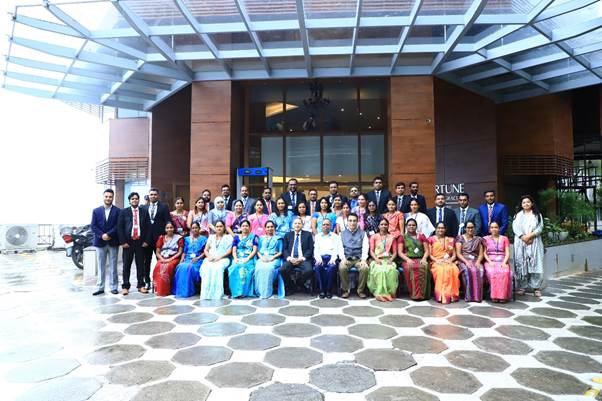
4th Capacity Building Program for the Civil Servants of the Socialist Republic of Sri Lanka commences today at National Centre for Good Governance (NCGG), Mussoorie

 The National Centre for Good Governance (NCGG) has launched the 4th Capacity Building Program for senior civil servants from the Socialist Republic of Sri Lanka today at NCGG, Mussoorie. The program will be organized from 22nd July to 2nd August 2024, with 40 distinguished participants.

Shri V. Srinivas, Director General of NCGG and Secretary of the Department of Administrative Reforms and Public Grievances (DARPG) addressed the inaugural session. In his address, Shri V.Srinivas emphasized on India’s vision of ‘Viksit Bharat 2047’. He highlighted the critical role of modern infrastructure and cutting-edge technology and the policy maxim of “Maximum Governance, Minimum Government.”  Highlighting India’s commitment to good governance through policies focused on social justice, transparency and accountability, aiming to provide equal opportunities for all citizens.

During the programme, Dr. AP Singh, Associate Professor, provided an overview of NCGG’s workings and the program’s focus. The program includes lectures on topics such as the Changing Paradigm of Governance, Overview of Indian Services, Climate Change and its Impact on Biodiversity: Policies and Global Practices, Right to Service: Ease of Living, E-Office, Planning and Building Eco-Friendly Smart Cities, Public-Private Partnerships, Digital India, Land Records Management (Swamitva Scheme & DILRMP), India’s Growth Story, Disaster Management, and Approaches to Achieving SDGs by 2030, among others. Participants will also visit key institutions and sites, including the Indira Gandhi Forest National Academy, Forest Research Institute, District Attachment to Panchkula, Cyber Crime Centre in Chandigarh, National Institute of Solar Energy, International Solar Alliance, Pradhanmantri Sanghralaya, and the Taj Mahal.

This program aims to educate participants on India’s good governance and advanced technology models, facilitating the implementation of better governance practices in Sri Lanka. The National Centre for Good Governance (NCGG), in partnership with MEA, has imparted training to civil servants of 17 countries, viz. Bangladesh, Kenya, Tanzania, Tunisia, Seychelles, Gambia, Maldives, Sri Lanka, Afghanistan, Laos, Vietnam, Nepal, Bhutan, Myanmar, Ethiopia, Eritrea, and Cambodia.

A group of people posing for a photoDescription automatically generated

****

Government initiatives to increase Hydrocarbon Production

 The government has been taking various steps to increase hydrocarbon production whichinter- alia include:

  1. Policy for Relaxations, Extensions and Clarifications under Production Sharing Contract (PSC) regime for early monetization of hydrocarbon discoveries, 2014.
  • ii. Discovered Small Field Policy, 2015.
  1. Hydrocarbon Exploration and Licensing Policy (HELP), 2016.
  2. Policy for Extension of Production Sharing Contracts, 2016 and 2017.
  3. Policy for early monetization of Coal Bed Methane 2017
  4. Setting up of National Data Repository, 2017. Further, the National Data Repository (NDR) is now being further upgraded to a cloud-based system for seamless dissemination of Exploration & Production data to global investors.
  5. Appraisal of Un-appraised areas in Sedimentary Basins under National Seismic Programme, 2017;
  6. Re-assessment of Hydrocarbon Resources, 2017.
  7. Policy framework to streamline the working of Production Sharing Contracts in Pre- NELP and NELP Blocks, 2018.
  8. Policy framework for extension of Production Sharing Contracts for Discovered Fields and Exploration Blocks under Pre-New Exploration Licensing Policy (Pre-NELP), 2016 and 2017.
  9. Policy to Promote and Incentivize Enhanced Recovery Methods for Oil and Gas, 2018.
  10. Policy framework for exploration and exploitation of Coal Bed Methane (CBM) from areas under Coal Mining Lease allotted to Coal India Limited (CIL) and its subsidiaries, 2018.
  11. Policy Framework for exploration and exploitation of Unconventional Hydrocarbons under Existing Production Sharing Contracts (PSCs), Coal Bed Methane (CBM) Contracts and Nomination Fields, 2018.
  12. Reforms in Hydrocarbon Exploration and Licensing Policy for enhancing domestic exploration and production of oil and gas, 2019.
  13. Natural Gas Marketing Reforms, 2020.
  14. Reforms in Model Revenue Sharing Contracts (RSCs) for Blocks under Open Acreage Licensing Programme (OALP), 2023.
  15. Lower Royalty Rates, Zero Revenue Share (till Windfall Gain) and no drilling commitment in Phase-I in OALP Blocks under Category II and III to attract bidders.
  16. Release of about 1 Million Sq. Km. ‘No-Go’ area in offshore which were blocked for exploration for decades. In these erstwhile ‘No-Go’ area, after the release now, so far bids/ expression of interests received for 1,52,325 Sq. Km. area.Two gas discoveries have also been made by ONGC in Mahanadi offshore recently in a block having 94% area in ‘No-Go’ area.  Andaman offshore area has also been opened for exploration and production activities after a long time post removal of restrictions imposed by defence and space agencies in 2022.
  17. Till now, 12 hydrocarbon discoveries have been made in blocks awarded under OALP, one already producing gas (0.44 MMSCMD) and condensate (819 BBL/Day) in Gujarat while other discoveries are under appraisal.
  18. Government is spending about Rs.7500 Cr. for acquisition of seismic data in onland and offshore areas and drilling of stratigraphic wells to make quality data of Indian Sedimentary Basins available to bidders.
  19. Government has also approved acquisition of additional 2D Seismic data of 20,000 LKM in onland and 30, 000 LKM in offshore beyond Exclusive Economic Zone (EEZ) of India.
  20. Production of Coal Bed Methane (CBM) has reached 2 Million Standard Cubic Meters per day and will increase further in coming years. More blocks are being identified for offer in future bid rounds.
  21. Cumulative production from Discovered Small Fields (DSF) till FY 2023-24 are ~5,56,000 bbl Oil and ~139 MMSCM Gas. More fields are being planned for offer in future rounds.

Various steps have been taken to reduce import of crude oil. These inter alia include demand substitution by promoting usage of natural gas as fuel/feedstock across the country towards increasing the share of natural gas in economy and moving towards gas based economy, promotion of renewable and alternate fuels like ethanol, second generation ethanol, compressed bio gas and biodiesel, refinery process improvements, promoting energy efficiency and conservation, efforts for increasing production of oil and natural gas through various policies initiatives, etc. To give a major thrust to Ethanol Blending Programme, Government of India through Oil Marketing Companies (OMCs) is establishing 2G Ethanol plants across the country.Also, for promoting the use of Compressed Bio Gas (CBG) as automotive fuel, Sustainable Alternative Towards Affordable Transportation (SATAT) initiative has been launched.

Major steps taken by Government for Water Conservation and Rainwater Harvesting to reduce Water Stress in the country

 Water conservation through rainwater harvesting is one of the foremost priorities of the Government, stated Union Minister of State for Jal Shakti, Shri Rajbhushan Choudhary, while giving a written reply to a question in Rajya Sabha today. Major steps taken by the Government for water conservation and rainwater harvesting to reduce water stress in the country are as follows:

  1. Government of India has been implementing a scheme namely Mahatma Gandhi National Rural Employment Guarantee Scheme (MGNREGS) which inter-alia includes water conservation and water harvesting structures.
  2. Financial assistance is given to various States under 15th Finance Commission tied grants which can be inter-alia utilized for rainwater harvesting.
  3. The Ministry of Jal Shakti has been implementing Jal Shakti Abhiyan (JSA) since 2019 on an annual basis. In the current year, Ministry of Jal Shakti is implementing Jal Shakti Abhiyan: Catch the Rain (JSA: CTR) 2024, 5th in the series of JSAs, in all the districts (rural as well as urban) of the country. JSA: CTR is a convergence of various Central Government schemes and funds like MGNREGS, Atal Mission for Rejuvenation and Urban Transformation (AMRUT), Per Drop More Crop, Repair, Renovation and Restoration Components under the Pradhan Mantri Krishi Sinchai Yojana (PMKSY), Compensatory Afforestation Fund Management and Planning Authority (CAMPA), Finance Commission grants, State Government schemes, Corporate Social Responsibility (CSR) funds etc. One of the major interventions undertaken under the campaign includes constructions and repair or rainwater harvesting structures including rooftop and water harvesting structures.
  4. Atal Mission for Rejuvenation and Urban Transformation (AMRUT) 2.0 has provisions for harvesting the rainwater through storm water drains into water body (which is not receiving sewage/effluent). Through preparation of ‘Aquifer Management Plan’ cities targets to strategize groundwater recharge augmentation by developing a roadmap for improving rain water harvesting within city limits. Through IEC campaign, awareness is created about practices for water conservation like rainwater harvesting.
  5. Ministry of Housing & Urban Affairs has formulated guidelines for the States to adopt measures suitable to local conditions, such as Unified Building Bye Laws (UBBL) of Delhi, 2016, Model Building Bye Laws (MBBL), 2016 and Urban and Regional Development Plan Formulation and Implementation (URDPFI) Guidelines, 2014 with adequate focus on requirement of rainwater harvesting and water conservation measures.
  6. Government of India is implementing Atal Bhujal Yojana, in 8,213 water stressed Gram Panchayats (GPs) in 80 districts of 7 States, viz., Haryana, Gujarat, Karnataka, Madhya Pradesh, Maharashtra, Rajasthan and Uttar Pradesh. The scheme marks a paradigm shift from groundwater development to groundwater management.
  7. Government of India has been implementing “Pradhan Mantri Krishi Sinchai Yojana (PMKSY)” with an aim to enhance physical access of water on farm and expand cultivable area under assured irrigation, improve on farm water use efficiency, introduce sustainable water conservation practices etc. PMKSY has three components/ schemes namely Har Khet Ko Pani (HKKP), Repair, Renovation & Restoration (RRR) Scheme of Water Bodies and Surface Minor irrigation (SMI) Scheme.
  8. The Ministry of Jal Shakti has set up the Bureau of Water Use Efficiency (BWUE) under the National Water Mission on 20.10.2022, to act as a facilitator for promotion of improving water use efficiency across various sectors namely irrigation, drinking water supply, power generation, industries, etc. in the country.
  9. Mission Amrit Sarovar was implemented in the recent times with provisions for creation/rejuvenation of at least 75 Amrit Sarovars in every district of the country with the purpose to harvest and conserve water.
  10. Central Ground Water Board (CGWB) has completed the National Aquifer Mapping (NAQUIM) Project in the entire mappable area of about 25 lakh sq. km. which has been shared with the respective State agencies for implementation. The management plans include various water conservation measures through recharge structures.
  11. CGWB has also prepared a Master Plan for Artificial Recharge to Groundwater- 2020 in consultation with States/UTs which is a macro level plan indicating various structures for the different terrain conditions of the country including estimated cost. The Master Plan has provisions for construction of about 1.42 crore Rain water harvesting and artificial recharge structures in the country to harness 185 Billion Cubic Metre (BCM) of monsoon rainfall.
  12. CGWB, under Ground Water Management and Regulation Scheme, has also implemented several successful artificial recharge projects in the country for demonstrative purpose which enable the State Governments to replicate the same in suitable hydro-geological conditions.
  13. National Water Policy (2012) has been formulated by Department of Water Resources, RD & GR, which inter-alia advocates rainwater harvesting and conservation of water and also highlights the need for augmenting the availability of water through direct use of rainfall.
  14. Department of Land Resources (DoLR) implements Watershed Development Component of Pradhan Mantri Krishi Sinchai Yojana (WDC-PMKSY) for the development of rainfed and degraded lands in the country. The activities undertaken, inter-alia, include ridge area treatment, drainage line treatment, soil and moisture conservation, rainwater harvesting, nursery raising, pasture development, livelihoods for asset-less persons etc. WDC-PMKSY, through these interventions, seeks to ensure sustainable development through improved natural resource management and better resilience of farmers to climate change.

Water is a State subject and the Central Government supplements the efforts of the States through technical and financial support, the Minister added.

*****

Carbon Emission in India

 Despite being one of the fastest-growing economies in the World, India’s annual per capita carbon emission is only about one-third of the global average, states Economic Survey 2023-24, which was tabled in Parliament today by Union Minister of Finance and Corporate Affairs, Smt. Nirmala Sitharaman.

Delving further into India’s achievements on addressing climate change, the Survey quoted a recent report by the International Finance Corporation, which highlighted that India is the only G20 nation in line with 2-degree centigrade warming. The survey further mentioned that the hallmark of India’s growth strategy is to manage the impact of climate change and at the same time give desired focus to developmental priorities.

Significant Progress Made by India on Climate Action

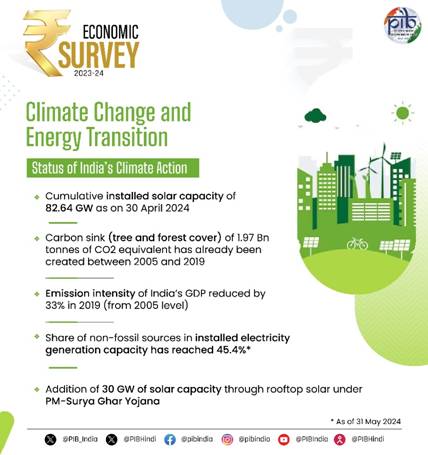
India achieved most targets of the first NDC well in advance. Nation achieved 40 per cent cumulative electrical power installed capacity from non-fossil fuel-based energy sources in 2021 and reduced the emission intensity of India’s GDP from 2005 levels by 33 per cent in 2019– nine and eleven years before the target year of 2030, respectively.

Further, as of 31 May 2024, the share of non-fossil sources in the installed electricity generation capacity has reached 45.4 per cent up from 32 per cent in April 2014. India is also on track to make an additional carbon sink of 2.5 to 3.0 billion tonnes through tree and forest cover by 2030, with a carbon sink of 1.97 billion tonnes of CO2 equivalent having already been created from 2005 to 2019.

India’s GDP between 2005 and 2019 has grown with a Compound Annual Growth Rate (CAGR) of about seven per cent, whereas the emissions grew at a CAGR of about four per cent. i.e., the rate of emissions growth is lower than the rate of growth of our GDP. This shows that India has successfully decoupled its economic growth from greenhouse gas emissions, reducing the emission intensity of its GDP.

India’s total adaptation-relevant expenditure has increased from 3.7 per cent of GDP in 2015-16 to 5.60 per cent of the GDP in 2021-2022, indicating integration of climate resilience and adaptation into development plans.

Low Carbon Development and Energy Composition

India’s energy needs are expected to grow 2 to 2.5 times by 2047 to meet a growing economy’s developmental priorities and aspirations. Considering that resources are limited, the survey pointed out that the pace of energy transition would need to factor in alternative demands on the resources for improving resilience to climate change and for sustained social and economic development.

Challenges for Energy Transition and Way Forward

Highlighting various challenges to India’s development of a low-carbon path, Economic Survey mentioned that expanding renewable energy and clean fuels will increase demand for land and water. Most renewables are land-intensive and demand the highest land use requirements among the different energy sources. Further, the expansion of renewable energy requires battery storage technologies which in turn require the availability of critical minerals and the source of such minerals is geographically concentrated.

Recognising the importance of energy efficiency measures in accelerating clean energy transitions while supporting energy security, the Survey highlighted several initiatives taken by the Government to improve energy efficiency. Some of them include implementing Energy Conservation Building Code (ECBC) for buildings, Standards and Labelling (S&L) and Star-rated program for appliances, Lifestyle for Environment (LiFE) initiative for encouraging the adoption of sustainable lifestyles, Perform, Achieve, and Trade (PAT) scheme for industrial sector, and Charging Infrastructure for Electric Vehicles for transport sector, among others.

All above mentioned initiatives translates to a total annual cost savings of approximately ₹1,94,320 Crore and an annual CO2 emissions reduction of around 306 million tonnes.

Finance for Sustainable Development

The Survey outlines that country has taken many measures to improve the business environment and catalyse greater quantum of resources. The Government undertook the issue of sovereign green bonds amounting to ₹16,000 Crore in January-February 2023 to raise proceeds for public sector projects that would contribute to the efforts to reduce the intensity of the economy’s emissions, followed by ₹20,000 Crore raised through sovereign green bonds in October-December 2023.

Further, RBI has implemented the Framework for Acceptance of Green Deposits for the Regulated Entities to foster and develop a green finance ecosystem in the country. In addition, the RBI promotes renewable energy through its Priority Sector Lending (PSL) rules.

India’s Innovative Green Credit Program

The Survey talks about the Government of India’s Mission LiFE, which is envisaged as a mass movement to address climate change and foster sustainable living based on conservation and moderation principles. It further states that to bolster LiFE’s effort and encourage eco-friendly practices, the Government also supports voluntary environmental actions such as the Green Credit Programme (GCP), which incentivises individuals, communities, private sector industries, and companies to participate in environment-positive activities by offering green credits as rewards.

India leading International Initiatives Addressing Climate Change Issues

The survey extensively talks about India leading several international initiatives towards climate change mitigation and building resilience. The International Solar Alliance (ISA), One World, One Sun, One Grid (OSOWOG), the Coalition for Disaster Resilient Infrastructure (CDRI), the Infrastructure for Resilient Island States’ (IRIS) and the Leadership Group for Industry Transition (LeadIT) are some of such important examples.

******

Local to Global

 Taking a critical view of the Western approach of tackling Climate Change, the Economic Survey 2023-24 gives a clarion call to all developing countries to look at climate change problem from a ‘local lens’. It states that a ‘one-size-fits-all’ approach will not work, and developing countries need to be free to choose their own pathways since they are tasked with balancing developmental goals with meaningful climate action.

The Economic Survey 2023-24, tabled by the Union Minister for Finance and Corporate Affairs Smt. Nirmala Sitharaman in Parliament today, clearly states that current global strategies for climate change are flawed and not universally applicable. It states that adopting the practices of the West could prove to be disastrous for India where culture, economy, societal norms are already intertwined with the environment.

The document highlights that India, despite making significant strides in climate action, often faces criticism for not aligning with Western solutions. This criticism stems from a lack of appreciation for India’s unique social and cultural fabric, which is already rich with sustainable development ideas. It further goes on to point out inherent inconsistencies where the prescriptions to tackle Climate Change from the developed world do not hold ground globally. These are:

    • The Western approach does not seek to address the root of the problem, i.e. overconsumption, but rather chooses to substitute the means to achieve overconsumption.
    • The global pursuit of energy-guzzling technologies such as Artificial Intelligence and mining rare earth minerals in large quantities has only contributed to higher fossil fuel consumption. This is directly at odds with the stated objectives of climate change mitigation.
    • Lifestyles in developed countries ignore humans’ underlying relationship with Nature, with other people, with materiality and with themselves.

The Economic Survey 2023-24 stresses that India’s ethos emphasizes a harmonious relationship with nature, in sharp contrast to the culture of overconsumption prevalent in other parts of the developed world, thus offering sustainable solutions to problems plaguing Western societies. For instance:

    • The process of meat production adopted in the developed world presents credible food security risks and a threat of permanently degrading the land, water and natural resources critical for human survival. The reliance on human-edible crops to feed livestock has set into motion a ‘food-feed competition’ as less than half the cereals produced today go towards direct human consumption. These figures are even lower for many developed economies.

The Survey notes that traditional farming practices from the developing world, where several agricultural activities are integrated with livestock rearing, offer one solution to the problem. Repurposing farm waste and by-products from other agricultural activities as animal feed not only lowers the financial and environmental cost of meat production but also brings balance to the natural cycle. Shifting livestock to human-inedible feed can free up significant shares of global arable land to address global hunger, it adds.

    • Similarly, the adoption of nucleated families akin to the Western model of living places significant land and resource requirements on the environment, as the growth in urban nucleated settlements gives rise to the tendency of ‘urban sprawl’. Furthermore, these living spaces are highly inefficient, dominated by concrete, closed spaces, less ventilation and exacting higher energy costs during the summers.

A shift towards the ‘traditional multi-generational households’ would create the pathway towards sustainable housing, notes the Survey. Sourcing materials and labour locally for the construction of houses, central courtyards with well-ventilated spaces, and avenues for natural lighting and cooling would all exert a positive externality on the environment by lowering resource and energy requirements. Such a household would also prove immensely beneficial for the elderly, it states.   

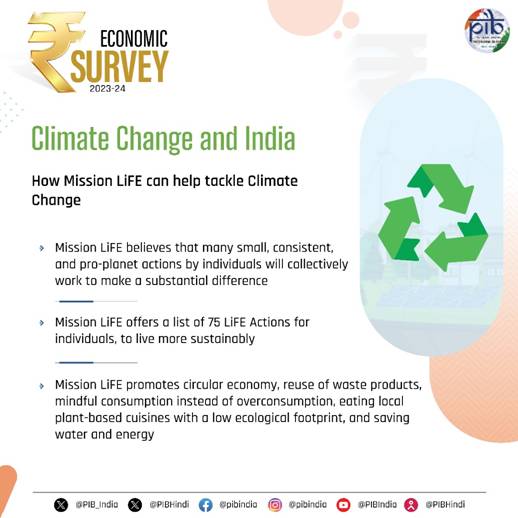
In order to profess a solution to these issues, the Economic Survey brings in perspective Prime Minister Shri Narendra Modi’s vision of Mission LiFE. It embodies a ‘Lifestyle For Environment’ seeking to address the ‘wants’ of the people without letting them hurt Nature. The approach seeks to bring individual responsibility to the forefront of the fight against climate change, as sustenance is at the core of Indian ethos.

The Mission encompasses a comprehensive but non-exhaustive list of 75 LiFE Actions for adoption by individuals to live more sustainably. At its heart, it promotes mindful consumption instead of overconsumption, encourages a circular economy and the reuse of waste products, eating local plant-based cuisines with a low ecological footprint, saving water and energy, notes the Survey. 

The document quotes the International Energy Agency and states that adoption of the kinds of actions and measures targeted by the LiFE initiative worldwide would reduce annual global carbon di-oxide emissions by more than 2 billion tonnes in 2030 (20% of the emissions reductions needed by 2030) and in consumer savings of about USD 440 billion.

In conclusion, the Survey document upholds the tenets of Mission ‘LiFE’ and notes that the global movement on climate change must be accommodative of sovereign choices and economic needs, but centered on individual behavior. ‘It’s time to rebuild societies with equanimity’, it adds.

*****

Adopting Building Information Modelling (BIM)

 In recent years, various aspects of infrastructure development have been integrated with technology to improve the efficiency of infrastructure plans, designs, and assets, states the Economic Survey 2023-24 tabled by Union Minister of Finance & Corporate Affairs Smt. Nirmala Sitharaman, in Parliament today. The survey says that some of the most significant uses of technology made possible through PM GatiShakti, Bhuvan, BharatMaps, Single Window Systems, PARIVESH portal, National Data Analytics Platform, Unified Logistics Interface Platform, Pro-Active Governance and Timely Implementation (PRAGATI), India Investment Grid (IIG) and many similar dashboards and data stacks for almost all ministries.

TELECOMMUNICATION SECTOR

The Economic Survey notes that the usage and underlying technologies of telecommunications have undergone massive changes, especially in the past decade. It says that the Telecommunications Act 2023 was enacted to amend and consolidate the laws on telecommunication services and networks, assignment of spectrum and related matters.

Highlighting the importance of test labs for ensuring the functionality, reliability and interoperability of telecommunications devices, the Survey observes that these specialised facilities are equipped with advanced testing infrastructure to evaluate the performance of various telecommunications equipment such as routers, switches, base stations, and communication protocols. It observes that more than 69 labs have been designated as conformity assessment bodies for EMI/EMC, safety evaluations, technical requirements and RF testing of telecom products.

The Survey further notes that the Government has introduced guidelines for the Spectrum Regulatory Sandbox (SRS), or Wireless Test Zones (WiTe Zones), as part of the Millennium SRS initiative to foster innovation, enhance ease of doing business, promote “Make in India” in the telecommunications sector. The survey states that, “This initiative provides a simplified regulatory framework to facilitate Research and Development (R&D) activities, promote exploration of spectrum bands and drive technological advancements”. WiTe Zones have been categorised into urban or remote areas for experimentation across various frequency bands, with eligibility extending to academia, R&D labs, telecom providers and others, says the Survey.

ELECTRONICS & INFORMATION TECHNOLOGY SECTOR

The Government has envisioned the India AI programme as a mission-centric approach for leveraging transformative technologies to boost inclusion, innovation, and adoption for social impact,mentions the Survey 2023-24.

According to the Survey, pillars of India AI include AI in Governance, AI IP & Innovation, AI Compute & Systems, Data for AI, Skilling in AI, and AI Ethics & Governance.  “As part of building ‘AI in India and AI for India’, the first edition of the IndiaAI was released in October 2023”, notes the Survey.

Being the founding member of the Global Partnership on Artificial Intelligence (GPAI), the Survey says that India has contributed to the GPAI goals and objectives and is working on various domestic initiatives for the responsible development, deployment, and adoption of AI. Further, it states that the Union Cabinet has approved an allocation of over ₹10,300 crore towards the comprehensive IndiaAl Mission to democratise access to Al innovation pillars and ensure global competitiveness of India’s Al ecosystem. “Under the Digital India programme, initiated in July 2015 to transform India into a digitally empowered society and knowledge economy, various digital initiatives have been undertaken for the delivery of citizen-centric services”, the Survey mentions.

BUILDING INFORMATION MODELLING (BIM)

For complex infrastructure projects in India,  the Economic Survey states, adopting Building Information Modelling can reduce the average project delays of 39 months, reduce infrastructure construction costs up to 30 per cent, maintenance costs up to 20 per cent, information and systemic inefficiencies up to 20 per cent, construction sector related carbon emission up to 38 per cent, water consumption up to 10 per cent and improve investments in construction R&D by one per cent, and result in over four million skilled professional employment and about 2.5 million additional construction sector jobs by reinvesting savings in additional infrastructure.

The motto of BIM is to construct digitally before constructing physically, notes the Survey. It says that NITI Aayog has identified the challenges, solutions and enablers related to BIM implementation. “Based on a roadmap for creating an ecosystem towards faster adoption of BIM in India, guidance, and strategies are being provided to infrastructure projects, including Central Vista, New Parliament, and Central Secretariat”, it mentions further.

The Economic Survey states that the BIM is now being extensively utilised and leveraged by some ministries and departments like the National Capital Region Transport Corporation, all metro rails, select complex industrial and tourism projects, various airports, along with organisation-wise acceptance at Central Public Works Department and extensive digitalisation in the form of Data Lake across NHAI that is now being extended to the entire Ministry of Road

Transport & Highways.

***

Serivce Sector Growth in India

 Discussing the sector wise performance of major services, the Economic Survey 2023-2024 tabled in Parliament today by the Union Minister for Finance and Corporate Affairs, Smt. Nirmala Sitharaman, highlighted“Two significant transformations are reshaping India’s services landscape: the rapid technology-driven transformation of domestic service delivery and the diversification of India’s services exports”.

India’s services sector encompasses a wide array of economic activities, which can be broadly classified into two categories:

  1. Contact-intensive (physical connectivity-based services): includes trade, hospitality, transport, real estate, social, community and personal services.
  2. Non-contact-intensive services (Information Technology services, tech start-ups and Global Capability Centres): comprises financial, information technology, professional, communication, broadcasting, and storage services. The sector also incorporates public administration and defence services.


Physical connectivity-based services

Myriad services are that are offered to ensure the seamless movement of goods, people, and information across diverse infrastructure networks encompass a broad spectrum, ranging from passenger transport via trains, buses, taxis, and airlines to freight transport facilitated by shipping companies, freight forwarders, and courier services.


  1. Roadways: A considerable portion of India’s cargo is transported via road. Accordingly, through various initiatives user convenience on National Highways (NH) has been enhanced:
    • Toll digitisation has drastically reduced waiting times at toll plazas, from 734 seconds in 2014 to 47 seconds in 2024.
    • Ministry of Road Transport and Highways (MoRTH) has devised a comprehensive ‘4E’ strategy – Engineering (roads and vehicles), Enforcement, Emergency Care, and Education – to elevate road safety standards on NHs.
    • The Government has utilised the PM Gati Shakti National Master Plan portal for network planning and congestion projections.


  1. Indian Railways: Indian Railways (IR) hosts many services to enhance user experience, efficiently manage the train system and build capacity for a Viksit Bharat.
    • Passenger traffic originating in IR was 673 crore in FY24 (provisional actuals), increasing by about 5.2 per cent compared to the previous year.
    • IR carried 158.8 crore tonnes of revenue-earning freight in FY24 (excluding Konkan Railway Corporation Limited), showing an increase of 5.3 per cent over the previous year.
    • To upgrade the passenger experience, railways have introduced Wi-Fi facilities at 6108 stations, bridging the digital divide between rural and urban citizens.


  1. Ports, Waterways and Shipping: The port sector is leveraging the Sagar Setu application to streamline daily vessel and cargo operations, aspiring to become a central hub for all maritime engagements.
    • Sagar Setu is also integrated with all the 13 major ports of India, along with 22 non-major ports and 28 private terminals.
    • There is a push for promoting river cruise tourism on national waterways. There has been a staggering 100 per cent surge in overnight cruise trips during FY24.


  1. Airways: India is the third-largest domestic aviation market and the aviation sector in India has shown substantial growth, with a 15 per cent YoY increase in total air passengers handled at Indian airports reaching 37.6 crore in FY24.
    • In FY24, the domestic air passenger traffic handled increased by 13 per cent YoY to 30.6 crore, and international air passenger traffic handled increased by 22 per cent YoY to 7 crore.
    • Air cargo handled at Indian airports increased by 7 per cent YoY to 33.7 lakh tonnes in FY24.
    • The Government has approved 21 greenfield airports nationwide and operationalised new terminal buildings to increase passenger handling capacity backed by a solid capex plan.
    • To promote regional equity, the ‘Ude Desh Ka Aam Nagrik’ (UDAN) scheme launched in 2016 facilitated the travel of over 141 lakh domestic passengers across various 579 Regional Connectivity Scheme routes connecting 85 unreserved and underserved airports since its inception.
    • Initiatives like Digi Yatra are enhancing efficiency through technology
    • Women constitute 15 per cent of the country’s pilots, which is almost three times higher than the global average, thus presenting greater opportunities for women in the sector. In the year 2023, a total of 1622 commercial pilot licenses were issued, of which 18 per cent were issued to women.


  1. Tourism: The tourism sector in India is rapidly expanding, with India being ranked at the 39th position in the World Economic Forum’s Travel and Tourism Development Index (TTDI) 2024.
    • Showing positive signs of revival post-pandemic, the tourism industry witnessed over 92 lakh foreign tourist arrivals in 2023, implying a YoY increase of 43.5 per cent.
    • India has significantly earned foreign exchange receipts amounting to over ₹2.3 lakh crore through tourism, indicating a 65.7 per cent YoY increase.
    • Swadesh Darshan 2.0, focuses on integrated tourism destination development, targeting 55 destinations across 32 states and Union Territories.


  1. Real Estate: Real estate and ownership of dwellings have accounted for over 7 per cent of the overall Gross Value Added (GVA) in the past decade, highlighting their integral role in the economy.
    • In 2023, residential real estate sales in India were at their highest since 2013, witnessing a 33 per cent YoY growth, with a total sale of 4.1 lakh units in the top eight cities.
    • The housing sector’s growth has been due to several key factors namely the Pradhan Mantri Awas Yojana-Urban (PMAY-U), policy reforms like the Goods and Services Tax, Real Estate (Regulation and Development) Act, and the Insolvency and Bankruptcy (SWAMIH), PMAY(U)-Credit Linked Subsidy Scheme interest subvention.
    • According to a report by CRISIL, the housing loan market in India grew at a CAGR of approximately 13 per cent from FY18 to FY23. The housing loan market in India is expected to continue growing at a CAGR of 13 to 15 per cent reaching ₹42 lakh crore to ₹44 lakh crore by FY26.


Information Technology Services, Tech start-ups and Global Capability centres

Over the past decade, information and computer-related services have become increasingly significant, with their share of total GVA rising from 3.2 per cent in FY13 to 5.9 per cent in FY23. Despite the pandemic-induced economic downturn, this sector achieved a real growth rate of 10.4 per cent in FY21. The flourishing growth of IT services has also supported the expansion of Global Capability Centers (GCCs) and the tech start-up ecosystem in India.

Global Capability Centres (GCCs) in India have grown significantly, from over 1,000 centres in FY15 to more than 2,740 units by FY23. These centres contribute to economic growth by providing high-quality employment. Revenue from India’s GCCs has increased from USD 19.4 billion in FY15 to USD 46 billion in FY23, growing at a compound annual growth rate (CAGR) of 11.4 per cent.

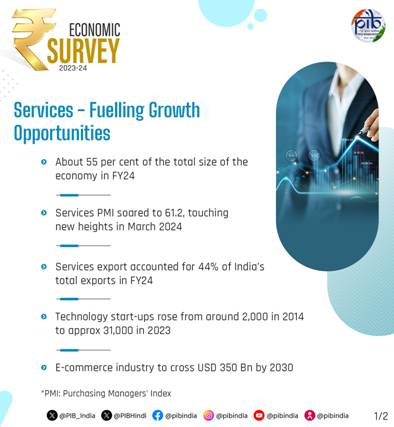
Technology start-ups in India have risen remarkably from around 2,000 in 2014 to approximately 31,000 in 2023. As per NASSCOM, the sector witnessed the inception of roughly 1000 new tech start-ups in 2023. Also, as per NASSCOM, India’s tech start-up ecosystem ranks third globally and has performed considerably better than the USA and the UK. The Start-up India Initiative and Start-up hubs across ministries and departments of the Government of India along with National Deep Tech Start-up Policy, the Drone Shakti Program and custom duty exemptions for EV-related capital goods and machinery have aided the growth of tech start-ups. Targeted efforts such as accelerating & strengthening the deep-tech ecosystem, strengthening domestic capital flow and leveraging initiatives such as Start-Up India have been undertaken to tap the potential of start-ups.


  1. Telecommunications: The overall tele density (number of telephones per 100 population) in India increased from 75.2 per cent in March 2014 to 85.7 per cent in March 2024.
    • Internet subscribers jumped from 25.1 crore in March 2014 to 95.4 crore in March 2024, of whom 91.4 crore are accessing the internet via wireless phones.
    • The internet density also increased to 68.2 per cent in March 2024.
    • The cost of data has declined substantially, vastly improving the average wireless data usage per subscriber.
    • India is amongst the fastest-growing 5G networks in the world. The Bharat 5G Portal propels India’s 5G capabilities and fosters innovation, collaboration, and knowledge-sharing within the telecom sector.


  1. E-Commerce: The Indian e-commerce industry is expected to cross USD 350 billion by 2030.

***

Integrated and sustainable development in rural India

 The integrated and sustainable development in rural India is at the heart of the Government’s strategy. The focus is on holistic economic betterment through decentralized planning, better access to credit, empowerment of women, basic housing, and education, among others. This was stated by the Economic Survey 2024 tabled by Union Minister for Finance and Corporate Affairs Smt. Nirmala Sitharaman in the Parliament today.

Enhancing the Quality of life in rural India

The Economic Survey stated that quality of life in rural areas has progressed in terms of basic amenities, education, health and financial inclusion. In terms of basic amenities, 11.57 crore toilets were constructed under the Swachh Bharat Mission- Grameen and 11.7 crore households were provided with tap water connection under Jal Jeevan Mission as of 10th July 2024. The Survey reports that in the PM-AWAS-Gramin, 2.63 crore houses were constructed for the poor in last nine years (as of 10th July 2024) .

In addition, 35.7 crore RuPay debit cards have been issued under Pradhan Mantri Jan Dhan Yojana (PMJDY) as of 26th June 2024  leading to enhanced financial inclusion in rural areas. In the health sector, 1.58 lakh sub centres and 24,935 primary health centres have resulted in enhancement of quality of life in the  rural areas.

Strengthening and modernising the safety net of MGNREGS

The Economic Survey 2023-24 observed that to ensure elimination of leakages in MGNREGS (Mahatma Gandhi National Rural Employment Guarantee Scheme), geotagging before, during and after the work is being done and 99.9 per cent payments are through National Electronic Management System.

The Survey stated that MGNREGS has made significant progress in terms of person-days generated and women participation rate with person-days generated increasing from 265.4 crore in 2019-20 to 309.2 crore in 2023-24 (as per MIS) and women participation rate increasing from 54.8 per cent in 2019-20 to 58.9 per cent in 2023-24.

The Economic Survey also points out that MGNREGS has evolved into an asset creation programme for sustainable livelihood diversification, as seen in the rise in the share of individual beneficiary ‘works on individual land’ from 9.6 per cent of total completed works in FY14 to 73.3 per cent in FY24.

Nurturing rural entrepreneurship at the grassroots

The Government continues to provide a fillip to rural entrepreneurship by implementing a bouquet of vibrant schematic interventions with a distinct focus on seamless access to affordable finance and generating lucrative market opportunities. Schemes and programmes like Deendayal Antyodaya Yojana- National Rural Livelihood Mission (DAY-NRLM), Lakhpati Didis initiative, and Deen Dayal Upadhyaya Grameen Kaushalya Yojana (DDU-GKY) have enhanced livelihood generation and easy access to finance in rural areas.

Digitisation initiatives for rural governance

Digitisation initiatives like e-Gram SWARAJ, SVAMITVA Scheme, Bhu-Aadhaar have improved rural governance. Under SVAMITVA Scheme, drone survey of  2.90 lakh villages has been completed and 1.66 crore property cards have been prepared. The Economic Survey points out that 200 per cent increase in rural internet subscriptions between 2015 and 2021 can reduce the distance between the village and the administrative headquarters leading to regional developments.

***

Service Sector in India

 Through the vicissitudes of the last three decades, the services sector stood as the bulwark of India’s economic growth. Aided by the focus on policy and procedural reforms, physical infrastructure and logistics, all significant business, personal, financial and infrastructure-based services have emerged strongly from the pandemic… However, the transformation lies in the fast-paced shift towards digital services like online payments, e-commerce, and entertainment platforms, as well as the increase in the demand for high-tech services as inputs in other productive activities.” This was highlighted in Economic Survey 2023-2024 tabled in Parliament by Union Minister for Finance and Corporate Affairs, Smt. Nirmala Sitharaman today.

The services sector continues to be a significant contributor to India’s growth, accounting for about 55 per cent of the total size of the economy in FY24, states Economic Survey. The significant domestic demand, rapid urbanization, expansion of e-commerce platforms generated heightened requirements for logistics, digital related services are important factors which have determined the domestic demand of services. The Economic Survey further states that the Government has played a crucial role in fostering the growth and competitiveness of India’s services by creating an enabling environment, promoting investment, enhancing skills and facilitating market access.

Gross Value Added (GVA) in the services sector

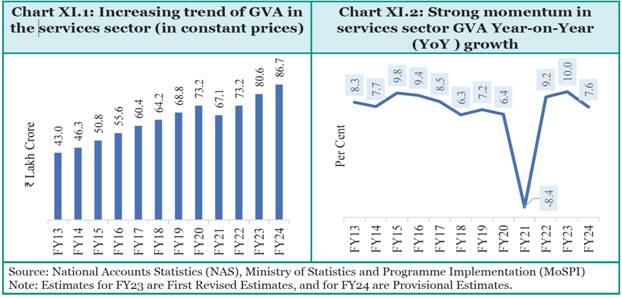
The contribution of the services sector to the overall GVA has increased significantly in the last decade. Globally, India’s services sector witnessed a real growth of more than 6 percent and the services exports constituted 4.4 per cent of the world’s commercial services exports in 2022.

For a decade before COVID, the services sector’s real growth rate consistently exceeded the overall economic growth. Post-COVID, the services sector’s growth, spurred by non-contact intensive services, primarily financial, information technology and professional services, outpaced overall GVA growth in FY23 and FY24, reclaiming its role in driving the economy’s upward trajectory.

The Survey further states that as per the Provisional Estimates, the services sector is estimated to have grown 7.6 percent in FY24. The gross GST collection reached ₹20.18 lakh crores in FY24, marking 11.7 per cent increase from the previous year, underscoring robust domestic trading activity.                                                                                                                                   

Purchasing Managers’ Index (PMI)- Services

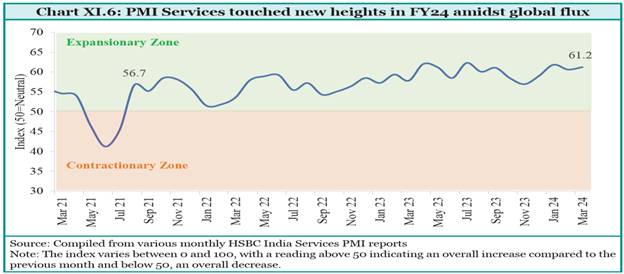
Business activity in the services sector in the country transcended the obstacles of the pandemic and other disruptions worldwide. In March 2024, services PMI soared to 61.2, marking one of the sector’s most significant sales and business activity expansions in nearly 14 years. As can be seen from Chart XI.6 (below), the services PMI has remained above 50 since August 2021, implying continuous expansion for the last 35 months.

Trade in the services sector

Post-pandemic, services exports have maintained a steady momentum and accounted for 44 per cent of India’s total exports in FY24 the survey notes. India ranked fifth in services exports, with other countries being the European Union (excluding intra-EU trade), the United States, the United Kingdom, and China.

India’s growing reputation as the preferred destination for Global Capability Centres (GCCs) by multinational corporations has significantly boosted software and business services exports.  India’s share in digitally delivered services exports globally increased to 6.0 per cent in 2023 from 4.4 per cent in 2019. This rise in services exports, coupled with a fall in imports, led to an increase in net services receipts on a YoY basis during FY24, which helped cushion India’s current account deficit.

Financing Sources for Services Sector Activity

The services sector fulfils its financing needs domestically through

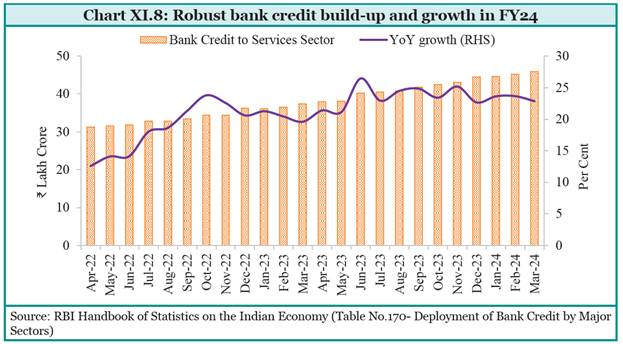
  1. Credit from domestic banks and capital markets: FY24 witnessed an upward trajectory of credit inflow in the services sector, with YoY growth rates surpassing the 20 per cent mark each month since April 2023.

  1. Internationally through Foreign Direct Investment (FDI) and External Commercial Borrowings (ECBs): The services sector accounted for 53 per cent share in total external commercial borrowing (ECB) inflows in FY24. The sector received inflows of USD 14.9 billion in FY24, thereby registering a YoY growth of 58.3 per cent.

***

MSME in India

 The Economic Survey tabled by the Union Minister of Finance and Corporate Affairs, Smt. Nirmala Sitharaman in Parliament today, highlights the importance of the MSME sector in the Indian economy with an all-India manufacturing output of 35.4 percent.

According to the survey, Gross Value Added (GVA) per worker increased from ₹1,38,207 to ₹1,41,769 and Gross Value of Output (GVO) per establishment increased from ₹3,98,304 to ₹4,63,389 showing  increased productivity and labour efficiency. The Survey highlights the success of the Udyam Registration portal that has received 4.69 Crore registrations as of 05 July 2024, playing an instrumental role in formalizing MSMEs by providing a simple, online, and free registration process based on self-declaration. The Survey notes that there has been significant growth between FY20 to FY24 in the amount and number of guarantees for MSMEs with Union Budget 2023-24 allocating ₹9,000 Crore to the Credit Guarantee Fund Trust, aiming to enable an additional ₹2 Lakh Crore in credit with reduced costs.

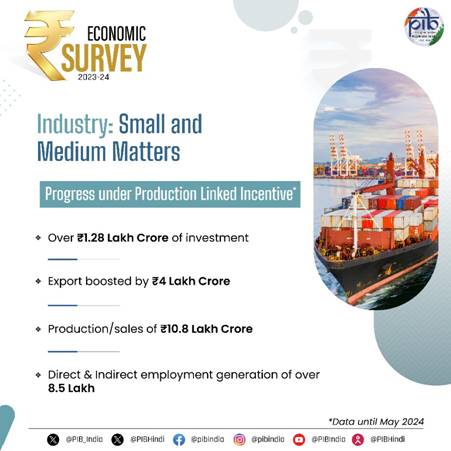
According to Survey, keeping in view India’s vision of becoming ‘Aatmanirbhar’, Production Linked Incentive (PLI) Schemes for 14 key sectors were announced with an outlay of ₹1.97 Lakh Crore to enhance India’s manufacturing capabilities and exports. Further survey states that over ₹1.28 Lakh Crore of investment was reported until May 2024, which has led to production/sales of ₹10.8 Lakh Crore and employment generation (direct & indirect) of over 8.5 Lakh. Survey states export boosted by ₹4 Lakh Crore, with significant contributions from sectors such as large-scale electronics manufacturing, pharmaceuticals, food processing, and telecom & networking products.

Survey highlights, to give an impetus to the One District One Product (ODOP) initiative, the Union Budget of FY24 announced that states would be encouraged to set up a “Unity Mall” in their capitals or most prominent tourism centre or the financial capital for the promotion and sale of their ODOPs. Survey also states that “PM-Ekta Malls” aims to link the artisans of ODOP and consumers. Survey  states that these malls are creating a vibrant marketplace for the nation’s unique products, aiming at both domestic and foreign markets. In addition to this survey ‘ODOP Sampark’ workshops were conducted in 15 States to facilitate collaboration between the Centre and local sellers and revive indigenous industries. According to the survey, ODOP showcased India to the world at the G20 events organised across the country during India’s G20 Presidency, where the artisans, sellers and weavers got visibility on the global stage.

*****

Skill Development in India

 India’s education policies and skill policies should adopt a laser-like focus on learning and skilling outcomes and need to be aligned with each other, as well. This is one of the six major pillars for realizing the collective goal of ViksitBharat@2047 in the medium term, as stated in the Economic Survey 2023-24, tabled by Union Minister for Finance and Corporate Affairs, Smt. Nirmala Sitharaman in Parliament today. Terming that the NEP (New Education Policy) 2020 provides a good framework to realise this objective, the Survey says new skilling initiatives and revamping the existing skilling initiatives should continue to be of high priority to the Government.

Skills are acquired on the foundations built by the education system, especially at the schools. Therefore, schooling should focus on the basic requirement of foundational literacy and numeracy and the realisation of grade-appropriate learning outcomes, adds the Survey. The Survey also calls upon the industry to take lead in skill creation saying it has much to gain from taking the initiative with academic institutions rather than leaving it only up to the governments to do the heavy lifting. Indeed, it should be the other way around, says the Survey.

The Economic Survey 2023-24 states that the government is taking measures to create the job and entrepreneurial opportunities that are in sync with the aspirations and abilities of India’s youth. Highlighting the significant improvement in the proportion of skilled people across all socio-economic classifications, the Survey mentions that 4.4 per cent of the youth in the age cohort of 15-29 years have received formal vocational/technical training, while another 16.6 per cent received training through informal sources.


The Economic Survey says that the skill development is at the centre of changes happening in education and labour markets amid the global megatrends, such as automation, action against climate change, the digitalisation of products and services, which are changing the nature of work and skills demands. It says that with one of the youngest populations, a median age of 28, India can harness its demographic dividend by nurturing a workforce that is equipped with employable skills and prepared for the needs of the industry.

The Survey mentions that India has not only recognised the potential of its young workforce but also the issues associated with skilling such a vast population. It says the National Policy on Skill Development & Entrepreneurship (NPSDE) focuses on bridging gaps, improving industry engagement, establishing a quality assurance framework, leveraging technology, and expanding apprenticeship opportunities. This, in combination with the National Education Policy (NEP), holds tremendous potential for bridging the education-employment gap in India, adds the Survey.

The Survey mentions that sixty-five per cent of India’s fast-growing population is under 35, and estimates show that about 51.25 per cent of the youth is deemed employable. However, it must be noted that the percentage has improved from around 34 per cent to 51.3 per cent in the last decade, the Survey adds.

Noting that productive jobs are vital for growth and inclusion, the survey says India’s workforce is estimated to be nearly 56.5 Crore and will continue to grow until 2044. It estimates that the Indian economy needs to generate nearly 78.51 lakh jobs annually in the non-farm sector to cater to the rising workforce. However, to create these many jobs, there is a need to create the conditions for faster growth of productive jobs outside of agriculture, especially in organized manufacturing and services, even while improving productivity in agriculture, the Survey adds.

The Survey calls for maximizing the outcomes from various skilling initiatives through convergence, and utilization of synergies with other employment-centric programmes which can further mutually benefit the two verticals. Linking skill development with Production Linked Incentive (PLI) scheme and employment-linked incentive schemes in high growth potential sectors like toy, apparel, tourism, logistics, textiles, leather sector etc. would aid upgrading of skills as production moves up the value chain. On the apprenticeship promotion front also, there remains considerable scope to add flexibility to the regulatory framework, the Survey noted.

*****

Health Sector in India

 A sound healthcare system interconnected with long-term factors responsible for inclusive growth is vital for a resilient economy, underscores the Economic Survey 2023-24 tabled by the Union Minister of Finance and Corporate Affairs Smt. Nirmala Sitharaman in Parliament today.

Aligned with the Government’s commitment to ensuring sound health and well-being of all ages through a preventive and promotive healthcare orientation in all developmental policies and universal access to good quality healthcare services, the Survey highlights key initiatives and schemes of the Government to ensure ‘Quality Healthcare for All’.

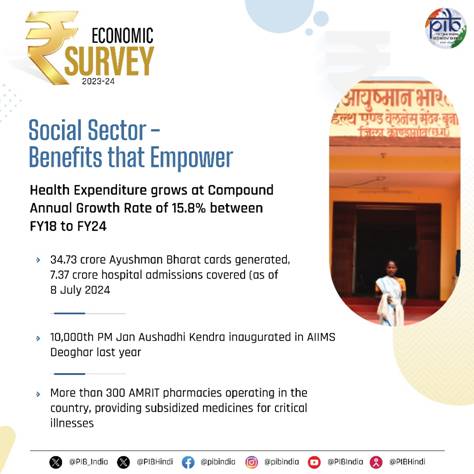
  • Ayushman Bharat Pradhan Mantri Jan Aarogya Yojana (AB-PMJAY):  Aimed at providing health insurance cover of ₹5 lakh/ year for underprivileged families for secondary and tertiary hospitalization, as of 8th July 2024, 34.73 crore Ayushman Bharat cards have been generated and 7.37 crore hospital admissions have been covered by the scheme. Notably, 49% of the beneficiaries of this scheme are women.
  • PM Jan Aushadhi Kendras: This scheme aims to provide quality medicines at 50-90 per cent cheaper than market rates. Under the scheme, 10,000th Jan Aushadhi Kendra was inaugurated in AIIMS Deoghar last year. 1965 medicines & 293 surgical equipments are available at the kendras.
  • AMRIT (Affordable Medicines and Reliable Implants for Treatment): More than 300 Amrit pharmacies are operating in different States/UTs. These aim to provide subsidized medicines for critical illnesses.
  • Ayushman Bhav Campaign: Launched in September 2023, this campaign aims to saturate selected healthcare services in every village/town across the country and inform citizens about the Government’s flagship schemes. Commendable milestones achieved during the campaign are:
    • 16.96 lakh wellness, yoga, and meditation sessions; 1.89 crore Tele consultations held
    • Free drugs availed by 11.64 crore people and free diagnostics services availed by 9.28 crore people
    • Ante-natal check-up (ANC) and Immunization availed by 82.10 lakh mothers and 90.15 lakh children
    • Seven types of screening (TB, Hypertension, diabetes, Oral Cancer, Breast Cancer, Cervical Cancer and Cataract) availed by 34.39 crore people.
    • 2.0 crore patients consulted general OPD, while 90.69 lakh patients consulted specialist OPD, and 65,094 major surgeries and 1,96,156 minor surgeries were conducted.
    • 13.48 crore ABHA accounts were created, 9.50 crore Ayushman cards were generated, and 1.20 lakh Ayushman Sabhas organized.
    • Cumulative footfall of 20.66 crore in 25.25 lakh health melas (as of 31 March 2024)


  • Ayushman Bharat Digital Mission (ABDM): Launched in 2021, the Scheme aims to create a national digital health ecosystem across the country. Under this scheme, 64.86 crore Ayushman Bharat Health Accounts (ABHA) have been created, 3.06 lakh Health Facility Registries generated, 4.06 lakh healthcare professionals registered, and 39.77 crore health records linked with ABHA.
  • eSanjeevani:  Launched in 2019, this scheme for telemedicine for virtual doctor consultations in remote areas has served 26.62 crore patients across 128 specialties at 1.25 lakh Health & Wellness Centres, now known as Ayushman Arogya Mandirs (as Spokes) through 15,857 hubs, as of 9th July 2024.

***

Expenditure on Social Services

 India’s social and institutional progress in recent years has been achieved through an empowering approach to welfare as the new approach focuses on transforming the implementation and cost effectiveness of the Government programmes. The approach comprises targeted implementation of reforms for last-mile service delivery and affordable social security schemes for the unorganized sector workers through schemes such as Atal Pension Yojana (APY). This was stated by the Economic Survey 2023-24 tabled by Union Minister for Finance and Corporate Affairs Smt. Nirmala Sitharaman in the Parliament today.

Decline in Multidimensional Poverty

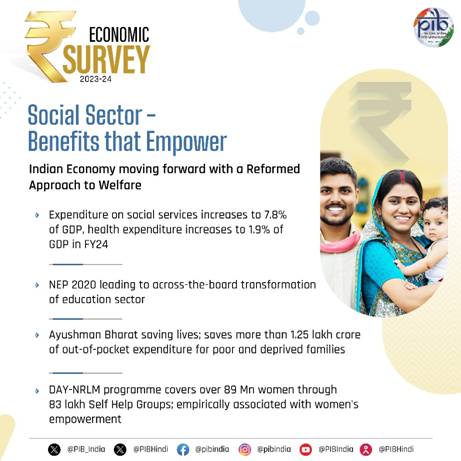
The expenditure on social services has increased from 6.7 % of GDP in 2017-18 to 7.8 % of GDP in 2023-24. The enhanced economic thrust along with better implementation of programmes has led to a sharp decline of Multidimensional Poverty with (National) Multidimensional Poverty Index (MPI) nearly halving from 0.117 in 2015-16 to 0.066 in 2019-21. Resultantly, 13.5 crore Indians are estimated to have escaped multidimensional poverty between 2015-16 and 2019-21, the Economic Survey 2023-24 noted.

The trend is driven by rural India, with the most significant improvements occurring in states like Bihar, Madhya Pradesh, Uttar Pradesh, Odisha and Rajasthan. Uttar Pradesh registered the most significant decline in the number of poor people, with 3.43 crore people escaping multidimensional poverty between 2015-16 and 2019-21.

Reduced Inequality and Decline in Rural-Urban divide

The Economic Survey also points out that the results of various initiatives in the social sector have translated into reduced inequality. The Gini coefficient has declined from 0.283 to 0.266 for the rural sector and from 0.363 to 0.314 for the urban sector in the past decade.

Similarly, the rural-urban divide has also declined considerably, as the difference between rural and urban monthly per capita consumption expenditure (MPCE) declined from 83.9 % in 2011-12 to 71.2 % in 2022-23.

***