STEPS TO STRENGTHEN COUNTRY’S POSITION IN GLOBAL STEEL MARKET

 Steel is a de-regulated sector and the Government acts as a facilitator, by creating conducive policy environment for development of the steel sector. The measures taken by the Government to improve production and consumption of steel in the country are as under:-

  1. Implementation of Domestically Manufactured Iron & Steel Products (DMI&SP) Policy for promoting Made in India steel for Government procurement.
  2. The Government has launched the Production Linked Incentive (PLI) Scheme for specialty steel to promote the manufacturing of ‘Specialty Steel’ within the country and reduce import by attracting capital investments. The anticipated additional investment under PLI Scheme for specialty steel is Rs. 29,500 crores and an additional capacity creation of around 25 million tonnes (MT) for specialty steel.
  3. Ministry of Steel has launched 16 process based safety guidelines on 25.07.2024, which in result help the steel industry to improve the productivity by standardising the safe practice in operations.
  4. Steel Import Monitoring System (SIMS) has been revamped and SIMS 2.0 was launched on 25.07.2024 for more effective monitoring of imports and to address the related concerns of domestic steel industry.
  5. Make in India initiative and the PM Gati-shakti National Master Plan with further engagement with potential users, including from Railways, Defence, Petroleum and Natural Gas, Housing, Civil Aviation, Road Transport and Highways, Agriculture and Rural Development sectors to enhance the steel usage, overall demand for steel and investment in the steel sector in the country.
  6. Coordination with Ministries and States, besides other countries for facilitating the availability of raw material for steel making on more favourable terms.
  7. Notification of Steel Scrap Recycling Policy to enhance the availability of domestically generated scrap.
  8. Notification of 145 numbers Steel Quality Control Orders to prevent manufacturing and import of non-standardized steel and to make available quality steel products to the public at large.


India became the world’s second-largest steel producer in 2018 surpassing Japan and remained so since then.

The steps taken by Government to reduce carbon footprint of the steel industry are as under:-

  1. 14 Task Forces had been constituted with engagement of industry, academia, think tanks, S&T bodies, different Ministries and other stakeholders to discuss deliberate and recommend upon different levers of decarbonisation of steel sector. 
  2. Steel Scrap Recycling Policy, 2019 enhances the availability of domestically generated scrap to reduce the consumption of coal in steel making.
  3. Ministry of New and Renewable Energy (MNRE) has notified National Green Hydrogen Mission for green hydrogen production and usage. The steel sector has also been made a stakeholder in the Mission.
  4. Motor Vehicles (Registration and Functions of Vehicles Scrapping Facility) Rules September 2021, envisages to increase availability of scrap in the steel sector.
  5. National Solar Mission launched by Ministry of New and Renewable Energy in January 2010 promotes the use of solar energy and also helps to reduce the emission of steel industry.
  6. Perform, Achieve and Trade (PAT) scheme, under National Mission for Enhanced Energy Efficiency, incentivizes steel industry to reduce energy consumption.
  7. The steel sector has adopted the Best Available Technologies (BAT) available globally, in the modernization & expansions projects.
  8. Japan’s New Energy and Industrial Technology Development Organization (NEDO) Model Projects for Energy Efficiency Improvement have been implemented in steel plants.
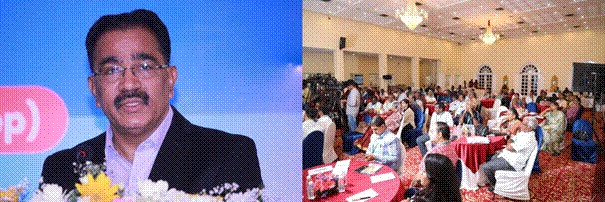
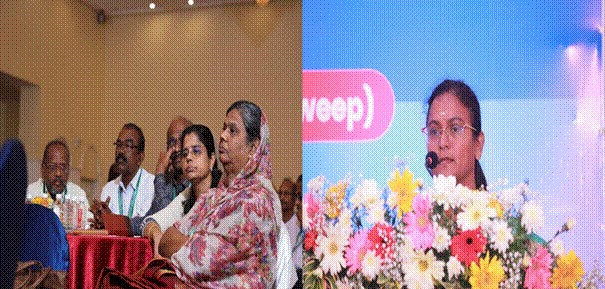
WORKSHOPS ON SAGAR SETU APP

 Sagar Setu has achieved integration with all 13 major ports and 41 non-major ports of India. The details of major ports and non-major ports are given in Annexure-I.

Sagar Setu application has garnered a base of over 21,000 users spread across diverse geographic regions within India. The sector wise details of user/Stakeholder using the Sagar Setu application is at Annexure-II. These users are port authorities, service providers like shipping agents, terminal operators, Customs House Agents (CHAs) Importers/ Exporters etc. The number of users, state wise including Andhra Pradesh is at Annexure-III.

The Benefits of Sagar Setu are as below:

  1. Real Time Data Exchange enabling the following in the long term:


  1. A single platform to perform all core activities for importers, exporters, customs brokers, and freight forwarders;
  2. end-to-end functionality for performing self-clearance digitally and online transactions with custodians;
  3. providing a level playing field for all relevant stakeholders, both large and small;
  4. complete domestic tracking of shipments with notifications at each stage;
  5. real-time information on activities;
  6. enhanced transparency in government-to-business relations and ease of doing business;
  7. reduced costs and timeframes for the execution of trade and logistics operations; and
  8. paperless transactions for all stakeholdersalong with business intelligence reporting and data analytics.


  1. The visibility of operation is indicated stakeholder wise, as detailed below:


  1. Ports & Terminal Operators: All 13 major ports (with their Terminal Operating System, TOS/ Port Operating System, POS) and 41 non-major ports are integrated with National Logistic Portal Marine (NLP-M). Almost all terminal operators at major ports have been onboarded.
  2. Customs: Integration with Indian Customs Electronics Gateway (ICEGATE) streamlines the electronic exchange of data and information between customs and ports.
  3. Port Health Organisation (PHO) module: PHOs can approve and issue certificates using the PHO module, and notifications will be sent to port officials. Requests for Free Pratique and Health Declaration Certificates to PHOs at ports are available through Sagar Setu.
  4. Mercantile Marine Department (MMD) module: Real-time and online information exchange regarding vessel detention and release is available to MMD inspectors, port authorities, and other stakeholders.
  5. Indian Railways: Messages from Sagar Setu are integrated with Frieght Operations Information System (FOIS) for sharing voyage registration, Electronic Verified Gross Margin (eVGM), berth allotment, container pendency, and bulk pendency.
  6. Unified Logistics Interface Platform (ULIP): Multiple messages are integrated between ULIP and Sagar Setu.
  7. Directorate General of Lighthouses and Lightships (DGLL): The DGLL module has been developed and provides information on lighthouse dues payment status on Sagar Setu.
  8. Banks: Multiple banks have been onboarded in Sagar Setu for Business to Government Transactions (B2G) transactions. Sagar Setu also plans to implement Business to Business (B2B) transactions on its platform.


  1. Improving Port Operations and Efficiency:


    1. 98 messages have been integrated over NLP-M, providing the Ministry of Ports, Shipping and Waterways (MoPSW) with visibility into key port operations metrics and monitoring efficiency.
    2. The processes for PHO free pratique and health declaration forms have shifted entirely from manual to NLP-M, leading to a much reduced process time of five hours at most major ports.
    3. With the data available in Sagar Setu, insights can be provided regarding vessel approval times, voyage tracking, and crew and cargo details, which can enable ports to improve their turnaround times and ensure greater transparency.


In the fiscal year 2024, there were close to 69 Lakhs message exchanges on Sagar Setu. The total value of financial transactions processed on the Sagar Setu platform amounted to INR 12,000+ crores.

The details of message exchange port/state wise including Andhra Pradesh are at Anneure-IV

A 24/7 Sagar Setu Helpdesk team operates to offer both operational and technical assistance. On an average around 1300 queries and issues are reported. The predominant issues reported by users are as under :

  1. Challenges encountered with the exchange of Electronic Data Interchange (EDI) files;
  2. difficulties related to the integration with Customs (ICEGATE);
  3. problems with the receipt of COPRAR (Container Pre-arrival Report) messages; and
  4. various lesser application-related issues, including those concerning user registration and login, payment processes, etc.

The average time to resolve an issue is around 4 days.

A series of workshops and training programs have been organized, featuring key events such as Conference Room Pilot sessions in August 2022, Port Feedback sessions in August 2023, and a User Acceptance Testing (UAT) Demo session in September 2023. In addition to these scheduled events, bespoke sessions are also offered on an as-needed basis to educate users about the Sagar Setu application. Tailored sessions are regularly provided upon the request of stakeholders, including Port Authorities, regulatory bodies, and shipping agents, to ensure they are well-versed in using the application. Furthermore, routine weekly and monthly meetings with the nodal officers from various trade associations are held to discuss and resolve any issues that users may encounter during their operations. Sagar Setu also offers a range of user guides and video tutorials that are readily accessible to the general public.

Conducting workshop/training is a periodic and continuous exercise.

Annexure-I

Details of Major and Non Major ports of India onboarded on Sagar Setu.


List of Major Ports onboarded on Sagar Setu:                                             

S. No

Port Name

State

1

Chennai Port Authority

Tamil Nadu

2

V.O.Chidambaranar Port Authority

Tamil Nadu

3

Kamarajar Port Limited

Tamil Nadu

4

Mumbai Port Authority

Maharashtra

5

Jawaharlal Nehru Port Authority

Maharashtra

6

Cochin Port Authority

Kerala

7

Visakhapatnam Port Authority

Andhra Pradesh

8

New Mangalore Port Authority

Karnataka

9

Paradip Port Authority

Odisha

10

SMPA Haldia Dock Complex

West Bengal

11

SMPA Kolkata Dock System

West Bengal

12

Deendayal Port Authority

Gujarat

13

Mormugao Port

Goa


List of Non-Major Ports onboarded on Sagar Setu:

Sr. No.

Port Name

State

1

Kakinada Seaport Limited

Andhra Pradesh

2

Krishnapatnam Port

Andhra Pradesh

3

Adani Gangavaram Port Pvt Ltd

Andhra Pradesh

4

Kakinada Anchorage Port

Andhra Pradesh

5

KAKINADA DEEP WATER PORT ( KDWP )

Andhra Pradesh

6

Ravva Port (Terminal)

Andhra Pradesh

7

Panaji Port

Goa

8

Adani Petronet (Dahej) Port

Gujarat

9

Hazira Port

Gujarat

10

Magdalla Group Of Ports

Gujarat

11

Mundra Port

Gujarat

12

Pipavav Port

Gujarat

13

Sika Port

Gujarat

14

AMNS Port Hazira

Gujarat

15

Gujarat Chemical Port Limited, Dahej

Gujarat

16

Essar Bulk Terminal (Salaya) Limited

Gujarat

17

Dahej Harbour and Infrastructure Limited

Gujarat

18

UltraTech Cement Ltd,GCW, Kovaya

Gujarat

19

Bhogat Port facility – Vedanta Limited

Gujarat

20

Bhavnagar Port

Gujarat

21

Vizhinjam International Port

Kerala

22

Kollam Port

Kerala

23

Beypore Port

Kerala

24

Vizhinjam Port

Kerala

25

Azhikkal Port

Kerala

26

Bankot Port

Maharashtra

27

Konkan LNG Pvt Ltd

Maharashtra

28

Dharamtar Port

Maharashtra

29

Dahanu Port

Maharashtra

30

Angre Port Pvt Ltd

Maharashtra

31

JSW Jaigarh Port

Maharashtra

32

REDI PORT LTD

Maharashtra

33

RANPAR

Maharashtra

34

Indo Eng Pvt Ltd

Maharashtra

35

JSW Revdanda Port

Maharashtra

36

Dighi Port Ltd.

Maharashtra

37

Karanja Terminal & Logistics Pvt. Ltd

Maharashtra

38

Dhamra Port Pvt Ltd

Odisha

39

Gopalpur Port

Odisha

40

Kattupalli Port Pvt Ltd

Tamil Nadu

41

MIDPL Kattupalli Port

Tamil Nadu


Annexure-II

Details of sector wise Stakeholders using the application:         

Sr. No.

Stakeholders

Count

1

Importer/Exporter

7519

2

Customs Broker

5685

3

Shipping Agent

4619

4

Importer

792

5

Container Agent

645

6

Stevedore

379

7

Empty Yard Operator

222

8

Ship Chandlers

192

9

Shipping Line

184

10

Container Freight Station

178

11

Port Operations

109

12

Freight Forwarder

105

13

Exporter

104

14

Inland Container Depot

95

15

Non Vessel Operating Common Carrier

85

16

Terminal Operator – Sea

80

17

Rail Transport

64

18

Port Authority

61

19

Road Transport Operator

34

20

Regulatory Authority

31

21

Surveyor

27

22

Barge Operator

25

23

Port Health Organization

21

24

Port Marine

20

25

Coast Guard / Indian Navy

19

26

ICD Shipping Line

19

27

RAIL TRANSPORT OPERATOR

18

28

Port Finance

16

29

Mercantile Marine Department

15

30

Bunker Supplier

14

31

Latch-On Service Provider

14

32

IW–Vessel Operators

13

33

SA Administrator

11

34

BANK

9

35

Inland Waterways

8

36

Port Traffic

8

37

Container Train Operator

6

38

DG Shipping

4

39

HMC Operator

4

40

Coastal Cargo Stakeholders

3

41

Regulatory Operation

3

42

Tank Farm Operator

3

43

Plant Quarantine Organisation

1

44

Export Promotion Council

2

45

Indian Customs

2

46

Ministry of Commerce and Industry(DPIIT)

2

47

Directorate General of Lighthouses And Lightships

1

48

Food Safety and Standards Authority of India

1

49

Freight Operating Information System

1


 Annexure-III

Number of Users, state-wise using Sagar Setu app:

Sl No

State

No of Stakeholders

1

Maharashtra

10285

2

West Bengal

3614

3

Tamil nadu

1804

4

Andhra Pradesh

1286

5

Gujarat

1123

6

Kerala

695

7

Odisha

483

8

Karnataka

249

9

Goa

199

Annexure-IV

Message exchanges (During FY24):

Sr. No

Port Name

State

Total (in Lakhs)

1

Chennai Port Authority

Tamil Nadu

29.4

2

V.O.Chidambaranar Port Authority

3

Kamarajar Port Limited

4

Jawaharlal Nehru Port Authority

Maharashtra

15.6

5

Mumbai Port Authority

6

Visakhapatnam Port Authority

Andhra Pradesh

9.5

7

SMPA KDS

West Bengal

9.3

8

SMPA HDC

9

Cochin Port Authority

Kerala

1.9

10

Deendayal Port Authority

Gujarat

1.9

11

New Mangalore Port Authority

Karnataka

0.8

12

Paradip Port Authority

Odisha

0.6

13

Mormugao Port Authority

Goa

0.2

Resource Allocation In Rural Areas To Push Demand

 Ministry of Rural Development (MoRD) is implementing a number of rural development schemes namely, Mahatma Gandhi National Rural Employment Guarantee Scheme (MGNREGS), Pradhan Mantri Awaas Yojana – Gramin (PMAY-G), Pradhan Mantri Gram Sadak Yojana (PMGSY), Deendayal Antyodaya Yojana – National Rural Livelihoods Mission (DAY-NRLM), Deendayal Upadhayay – Gramin Kaushalya Yojana (DDU-GKY), Rural Self Employment Training Institutes (RSETIs) and National Social Assistance Programme (NSAP) to alleviate poverty and to bring about overall improvement in the quality of life of the people in rural areas, strengthening of livelihood opportunities, providing minimum guaranteed employment, promoting self-employment, skilling of youths in various useful trades and entrepreneurship qualities, infrastructure development and provision of social assistance in alignment with the ‘India@100 Vision’. Allocation of resources under these schemes is a continuous process and funds are released to the States/UTs taking into account adherence of the schematic guidelines and assessing the actual requirement at ground level.

Mahatma Gandhi National Rural Employment Guarantee Scheme (MGNREGS) is a demand driven wage employment programme which envisages for the enhancement of livelihood security of the households in rural areas of the country by providing at least one hundred days of guaranteed wage employment in every financial year to every household whose adult members volunteer to do unskilled manual work. It offers rural households fall back livelihood options when better employment opportunities are unavailable. Additionally, it mandates an extra 50 days of wage employment for Scheduled Tribe households in forest areas and provides for an additional 50 days of wage employment in drought or natural calamity-affected rural areas. State Governments have the option to allocate additional days of employment beyond the guaranteed period using their funds

PMGSY is a one-time special intervention of the Central Government to improve the Rural Infrastructure through the construction of roads. PMGSY has been allocated a budget of Rs.19,000 crore for the current Financial Year. Out of this, Rs. 1,292.22 crore has been released to the States till 30.07.2024. Under PMGSY, the project proposals for 8,31,453 Km have been sanctioned with a value of Rs. 3,89,606.49 till 30.07.2024, and out of this, 7,65,719 Km of road length have been constructed at an expenditure of Rs. 3,24,993.65 crore. 20 to 25 % of the above spending is towards labour component which has created substantial employment opportunities in the rural area. Further in the Budget Speech 2024-25, the Government announced to launch of the fourth phase of PMGSY to provide connectivity to 25,000 rural habitations. When the roads and bridges to connect these habitations are sanctioned and construction starts on the ground substantial direct and indirect employment opportunities will be created in the rural area.

In order to achieve the target of “Housing for All” in rural areas, the Ministry of Rural Development is implementing Pradhan Mantri Awaas Yojana- Gramin (PMAY-G) with effect from 1st April, 2016 to construct 2.95 crore houses by providing assistance to eligible rural households with basic amenities. Under PMAY-G, out of the overall mandated target of 2.95 crore houses allocated to States/UTs, more than 2.94 crore houses have already been sanctioned to the beneficiaries and 2.64 crore houses have already been completed as on 29.07.2024. Government of India announced 2 Crore more houses to be constructed in the next five years till FY 2028-29 under Pradhan Mantri Awaas Yojana- Gramin (PMAY-G).

The construction of a house under PMAY-G generates direct employment of approximately 201 person-days, which includes 56 skilled, 34 Semi-skilled, and 111 unskilled person-days. Accordingly, the construction of 2.64 Crore houses under the scheme has generated employment of around 531 crores of person-days. Further, constructing the remaining 0.31 crores of houses and the proposed 2 crore new houses are expected to generate employment of 464 crore person-days. Under the Rural Mason Training program of PMAY-G so far 2.7 lakh candidates have been trained. Further, some of the well-trained certified masons also got opportunities to work abroad in the construction field. The PMAY-G has been converged with MGNREGA under which the beneficiary is entitled to 90/95 person-days of unskilled labour from MGNREGA for construction of house, over and above the unit assistance. Under PMAY-G, the indirect employment is also generated through the production of building materials and their transportation for the house construction.

National Centre of Good Governance (NCGG) successfully concludes 3rd Internship program 2024 for post-graduate scholars

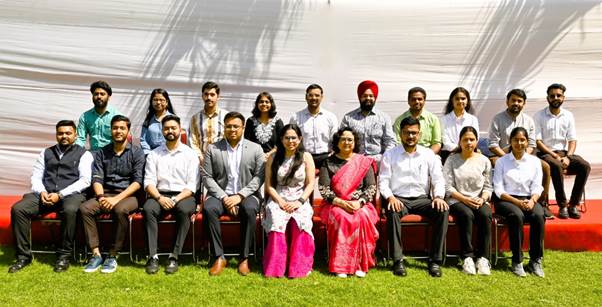
 The National Centre for Good Governance (NCGG) has successfully concluded the 3rd batch of Internship Programme 2024 on 30th July at the New Delhi campus.

The internship programme aims to provide young and post-graduate scholars to undertake research, critical study, documentation and dissemination of best practices to develop a national repository, and establishing a platform for wider dissemination. In three internship programmes, 37 interns have submitted their research papers on diverse subjects of public policy.  

The 3rd batch of the NCGG Internship Programme received more than 3,550 applications from across the country. After a rigorous selection process involving seven rounds of interviews, 17 interns were chosen based on their academic achievements and dedication to their respective fields. These interns represented diverse disciplines, including public policy, development, law, governance, and climate change, and from esteemed institutions such as the University of Delhi, IIM Shillong, IIT Kanpur, and the Tata Institute of Social Sciences. The interns worked with Senior Professors from eminent institutions like IIPA, JNU and Jamia Millia Islamia who guided their research work in a mentorship role.

 In the concluding session 17 research papers were present on contemporary areas of good governance like financial literacy initiatives, forecasting electric vehicles demand, digital currency transition in India, Reforming Public Services, e-Governance in Tertiary Health Care, Analysis of Health Insurance Schemes under the Ayushman Bharat PM-JAY, etc.

The overall programme was coordinated by Dr. Gazala Hasan, Course Coordinator and Assistant Professor, NCGG, with assistance from Shri Akash Sikdar and NCGG team.  The impactful research papers produced during the internship will be compiled into a comprehensive compendium, which will be accessible to the public via publication on the NCGG’s official website. This initiative underscores the Government of India’s commitment to nurturing young talent and advancing public policy research for a better governance framework.

***

National Federation of Information Commissions of India

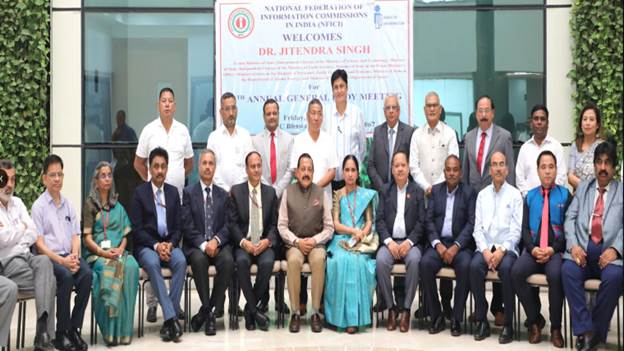
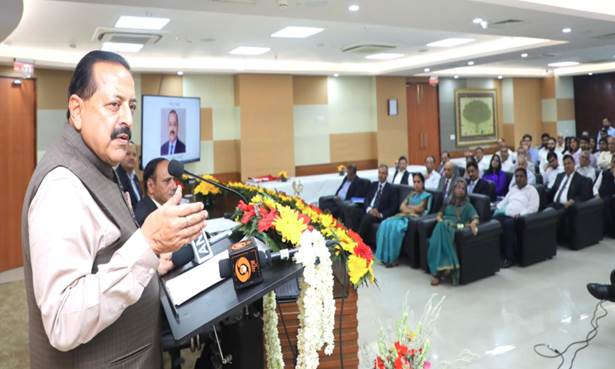
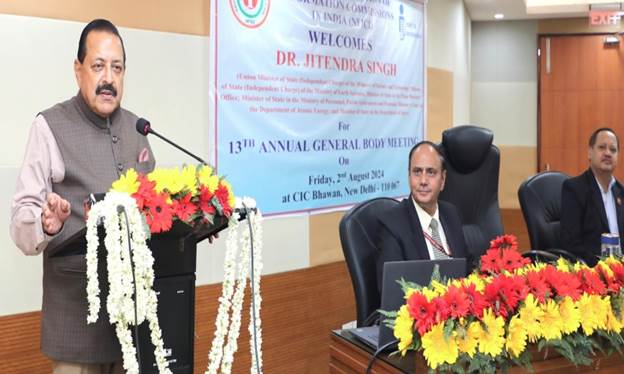
 Union Minister Dr. Jitendra Singh today addressed and later interacted with Central and State Information Commissioners at the 13th Annual General Body Meeting of the “National Federation of Information Commissions of India” (NFICI) at the Central Information Commission headquarters here today.

Addressing the annual meeting, Dr Jitendra Singh said “NFICI has been instrumental in advancing the cause of the Right to Information Act, 2005. Ever since Sh Narendra Modi took over as Prime Minister in 2014, transparency and citizen-centric governance have been central to the Government’s model of governance.”

Referring to RTI Act as a provision to ensure maximum disclosure and minimum exemptions, consistent with Prime Minister Narendra Modi’s Vision of “Maximum Governance Minimum Governance”, Dr Jitendra Singh shared that India’s CPRAMS is now a role model on Grievance Redressal for many other nations of the world who are keen to emulate the same. He shared that the effective time for redressal is as less as 5 days due technology linked solution and flagging of grievances.

Dr. Jitendra Singh directed the Information Commissioners to integrate Artificial Intelligence and new age tools to increase efficiency in public disclosure of Information. The Minister at the same time underscored the importance of Human Intervention by recalling the setting up of the Human Desk to take feedback from citizens after disposal of the grievances. The Minister reiterated the Modi Govt.’s driving principle of boosting transparency, Accountability and Citizen Centricity in the working of the Government. During The interaction he also heard the State Information commissioners noted their grievance and suggestions and assured a positive response to them.

Dr. Jitendra Singh appreciated Central Information Commission’s efforts in increasing efficiency and emphasized on almost 100 percent disposal of Right to Information (RTI) appeals with pendency coming down every year. The Minister also highlighted the exemplary work done by CIC during Covid pandemic as they were functional throughout. He categorically mentioned the ease to residents of J&K after opening a branch in the union territory.

Dr. Jitendra Singh recalled that the CIC got its independent office complex after 2014 when the new Government came, before that CIC was operated from a rented place. In an inspiring message to young officers of CIC, he called them torch bearers and conscience keepers of VISION 2047.

Chief Information Commissioner of India, Heeralal Samariya informed the minister about the steady progress and said the second appeals reaching to the CIC nearly 17000 appeals are disposed of every year.

Block chains, electronic discovery, cyber-security, robotics, Artificial Intelligence and bio-ethics etc. in their curricula

 As per the provisions of Sections 7(l)(h) and (i) of the Advocates Act, 1961, the Bar Council of India (BCI), is entrusted with the function inter-alia of promoting and laying down the standards of legal education in the country. The legal Education Rules, 2008 lay down the mandatory minimum standards and requirements for legal education in India. The BCI has informed that it periodically reviews and updates the curriculum to ensure that it remains relevant and comprehensive, and that it addresses the changing needs of the legal profession. The BCI has encouraged the law schools to include emerging areas of law, such as Intellectual Property Law, Cyber Law, and Environmental Law, in their curriculum. To make law courses more practical, the BCI has also introduced clinical legal education, which requires students to participate in internships, moot courts, and legal aid clinics. This helps students gain practical experience and develop their skills in a real-world setting. As per vision of Hon’ble Prime Minister the BCI has issued circular to all Universities and Centres of Legal Education to incorporate subjects such as block chains, electronic discovery, cyber-security, robotics, Artificial Intelligence and bio-ethics etc. in their curricula. Requisite Circular has also been issued to include the recently introduced three Criminal Laws i.e. Bharatiya Nyaya Sanhita, 2023, the Bharatiya Nagarik Suraksha Sanhita, 2023, and the Bharatiya Sakshya Adhiniyam, 2023 in the curriculum. Overall, the BCI is aware that curriculum of law courses in India remains comprehensive, practical and relevant to the needs of the legal profession and ensures that the graduates are well equipped to handle contemporary legal challenges.

Although, the BCI oversees the legal profession in India but it does not determine the fees for Advocates or Senior Advocates. Therefore, the matter of providing stipends to the junior advocates are totally at the discretion of the individual advocates and senior advocates. The BCI has further informed that the Delhi High Court vide order dated 25th July, 2024 in the case of Simran Kumari vs BCI & Anrs.,{W.P. (c) 10159/2024} has directed to consider representations regarding payment of minimum stipend to junior lawyers hired by advocates and senior advocates.

The BCI as a regulatory body, maintains the standards of legal education. Several circulars have been issued by BCI to State Governments and Universities to meticulously scrutinise the applications of new law Colleges before granting them NOCs and affiliations. If any deficiencies are found on the part of any Centres of Legal Educations (CLEs), the approval of affiliation are not granted. Moratorium to grant NOCs and affiliation to new law colleges and additional sections in existing centres was issued vide resolution dated 11.08.2019 which was subsequently overturned by Punjab and Haryana High Court in its order dated 04.12.2020. The BCI has also constituted a High-Level Committee headed by a former Chief Justice of High Court to identify such Centres of Legal Education which are not complying with the infrastructural, faculty, library and other requirements of Rules of Legal Education by conducting surprise inspections of these Centres of Legal Education without their knowledge. On the basis of the Report of High-Powered Surprise Inspection Committee, the BCI conducts rigorous inspections of Centres of Legal Educations (CLEs). Further, based on not meeting the standard, several CLEs have been barred from admitting students for the academic year 2024-25. The BCI has also launched Legal Education portal in December 2023, which has detected numerous irregularities committed by these CLEs which invite stringent action by BCI.

Schemes for accelerating the adoption of electric vehicles

 Ministry of Heavy Industries is currently implementing the following schemes for accelerating the adoption of electric vehicles in the country:


  1. Electric Mobility Promotion Scheme 2024 (EMPS) with an outlay of  ₹ 778 Crore for a period 6 months, w.e.f. 1st April 2024 till 30th September 2024, which provides incentives to buyers of e-2W and e-3W.
  2. Production Linked Incentive Scheme for Automobile and Auto Component Industry (PLI-AAT) with a budgetary outlay of  ₹ 25,938 Crore. The scheme incentivises various categories of electric vehicles including e-2W, e-3W, e-4W, e-buses & e-trucks also.
  3. Production Linked Incentive Scheme for manufacturing of Advanced Chemistry Cell (PLI-ACC) in the country with a budgetary outlay of ₹18,100 Crore.
  4. Scheme to Promote Manufacturing of Electric Passenger Cars to attract investments from global EV manufacturers and promote India as a manufacturing destination for e-vehicles.


The Ministry of Heavy Industries (MHI) formulated a Scheme namely; Faster Adoption and Manufacturing of (Hybrid &) Electric Vehicles in India (FAME India) Scheme in 2015 to promote adoption of electric/ hybrid vehicles (xEVs) in India. The Phase-I of the scheme was available up to 31st March, 2019 with budget outlay of Rs. 895 Crore. This phase of FAME India Scheme had four focus areas i.e. technological development, demand generation, pilot project and charging infrastructure components.


In the 1st phase of the scheme, about 2.8 lakh xEVs were supported with total demand incentives of Rs. 359 Crore (Approx). In addition, 425 electric and hybrid buses, as sanctioned under first phase of the scheme were deployed across various cities in the country with Government Incentive of about Rs. 280 Crore. The Ministry of Heavy Industries had also sanctioned about 520 Charging Stations/ Infrastructure for Rs. 43 Crore (approx.) under Phase-I of FAME India Scheme.


Projects worth about Rs. 158 Crore were sanctioned for the technology development projects like establishment of testing Infrastructure, setting up of ‘Centre of Excellence’ for Advanced Research in Electrified Transportation, Battery Engineering, etc. to various organisations / institutions like Automotive Research Association of India (ARAI), IIT Madras, IIT Kanpur, Non Ferrous Material Technology Development Centre (NFTDC), Aligarh Muslim University (AMU), etc.


Based on outcome and experience gained during Phase-I of FAME India Scheme and after having consultations with all stakeholders, including Industry and Industry Associations, the Government notified Phase-II of FAME India Scheme for a period of five years commencing from 1st Apri1, 2019 with a total budgetary support of Rs. 11,500 crore.


This phase-II mainly focused on supporting electrification of public & shared transportation, and aimed to support through demand incentive 7,262 e-Buses, 1,55,536 e-3 Wheelers, 30,461 e-4 Wheeler Passenger Cars and 15,50,225 e-2 Wheelers. In addition, creation of charging infrastructure is also supported under the Scheme.


Under Phase-II of FAME India Scheme, as on 31/07/2024, claims of 16,71,606 electric vehicles for Rs. 6,825 crore have been submitted for reimbursement of subsidy by the OEMs (EV manufacturers) as per http://fame2.heavyindustries.gov.in/dashboard. aspx. Category-wise details of claims submitted are as under:


Sl. No.

Wheeler Type

Total No. of Vehicle

1.

2 wheeler

14,69,343

2.

3 wheeler

1,78,952

3.

4 wheeler

23,311


Total

16,71,606


Further, 6862 electric buses were sanctioned to various cities/STUs/State Govt. entities for intra-city operations under the FAME-II Scheme. Out of 6,862 e-buses, 4,853 e-buses have been supplied till 31st July, 2024.


MHI has also sanctioned Rs. 800 Crore as capital subsidy to the three Oil Marketing Companies (OMCs) of the Ministry of Petroleum and Natural Gas (MoPNG) for establishment of 7,432 electric vehicle public charging stations. Subsidy of Rs.560 crore has already been released to OMCs. Further, in March 2024, MHI sanctioned additional Rs.73.50 Crore under FAME II to OMCs for set up/upgradation 980 public fast charging stations by installing new chargers across the country. Subsidy of Rs.51.45 crore has already been released to OMCs.


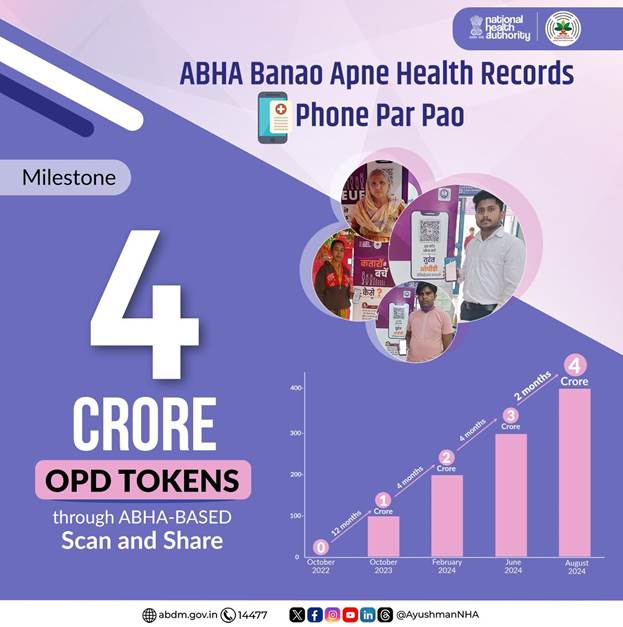
National Health Authority Achieves Milestone with 4 Crore OPD Registrations Through ABHA-based Scan and Share Service

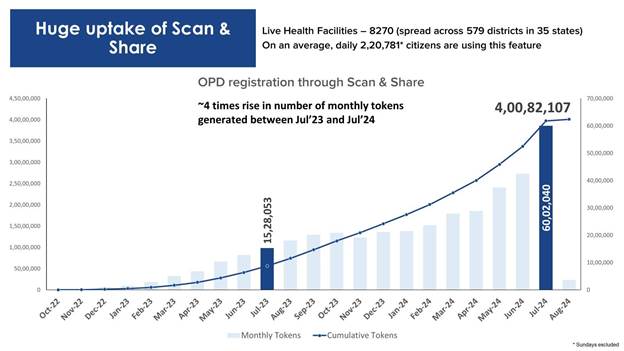
 The National Health Authority (NHA) has achieved a significant milestone in its mission towards digitizing healthcare services with the generation of over 4 Crore tokens for Out-Patient Department (OPD) registrations through the ABHA-based Scan and Share service.

Launched under the Ayushman Bharat Digital Mission (ABDM) in October 2022, this innovative paperless service has revolutionized the patient experience, particularly benefiting vulnerable groups such as the elderly, pregnant women, and those with mobility challenges, by eliminating the need to wait in long queues for appointments.

The ABHA-based Scan and Share service enables patients to conveniently register for OPD appointments by scanning a QR code displayed at the OPD registration counter, thereby instantaneously sharing their ABHA profile for registration.


The Scan and Share service is presently operational across over 8,270 healthcare facilities spanning 579 districts in 35 States and Union Territories of India. Notably, an average of 2.2 Lakh individuals avail the scan and share service daily, highlighting its usefulness and popularity among the citizens. The aforesaid 8,270 healthcare facilities include 5,875 public and 2,845 private healthcare facilities.

Leading the adoption journey are Uttar Pradesh, Andhra Pradesh, Karnataka, and Jammu & Kashmir. Uttar Pradesh has generated the maximum tokens of 1.11 Crore tokens, followed by Andhra Pradesh with 70.35 lakhs, Karnataka with 46.61 lakhs, and Jammu & Kashmir with 41.81 lakh tokens.

The ABDM Public Dashboard (https://dashboard.abdm.gov.in/abdm/) provides insights into the service’s utilization, with notable usage recorded at AIIMS in Delhi, Bhopal, Bhubaneshwar and Raipur. Remarkably, sixteen hospitals from Uttar Pradesh, Andhra Pradesh, and Jammu and Kashmir feature prominently in the top-performing facilities for the overall number of OPD tokens generated using ABHA-based Scan and Share service, exemplifying their dedication to enhancing healthcare accessibility and efficiency.

Government hospitals, including AIIMS in New Delhi with 18.3 lakh tokens, and those in Bhopal, Bhubaneshwar, and Raipur with 7.9 lakh, 6.1 lakh, and 5.7 lakh tokens respectively, have showcased outstanding performance by efficiently facilitating OPD registrations through the scan and share service.

While discussing the importance of digital healthcare services, the CEO of National Health Authority (NHA) said, “The “Scan and Share” feature for OPD registration under the Ayushman Bharat Digital Mission (ABDM) is transforming the way patients engage with healthcare services in India. This service allows patients to easily scan for OPD registration and digitally share their medical documents, such as prescriptions and test results, with healthcare providers.  The Scan and Share benefits approximately 2,20,000 patients daily. By facilitating secure and quick access to comprehensive health information, it enhances healthcare delivery, ensures data security and patient privacy, and contributes to the broader goal of building a connected and interoperable digital health ecosystem.”

Among all the token generations, approximately 76% are first-time users, while 24% use scan and share for subsequent visits, highlighting its widespread adoption and usefulness.

To drive further adoption of the Scan and Share service among hospitals and Digital Solution Companies (DSCs) providing technology to healthcare facilities, NHA offers financial incentives through the ABDM’s Digital Health Incentive Scheme (DHIS) for ‘Scan and Share’ transactions and the generation of electronic health records. More information about DHIS is accessible at https://abdm.gov.in/DHIS.

NHA is leveraging technology to enhance patients’ access to healthcare services. The ‘Scan and Share’ service is now being implemented at pharmacy counters of the public hospitals also and plans are underway to extend it to laboratory settings. Additionally, efforts are being made to launch upcoming services, like ‘Scan and Send’ and ‘Scan and Pay’ leveraging the comfort of citizens with QR codes. ‘ The ‘Scan and Pay’ service will enable the patients to make payments for tests or medicines prescribed to them directly through their app, eliminating the need to wait in lines for payment at healthcare facilities. Similarly, the ‘Scan and Send’ service will soon allow patients to conveniently scan a QR code at a facility (hospital or pharmacy) and send their health records, (including prescriptions or lab reports).

India's livestock sector is a vital economic pillar

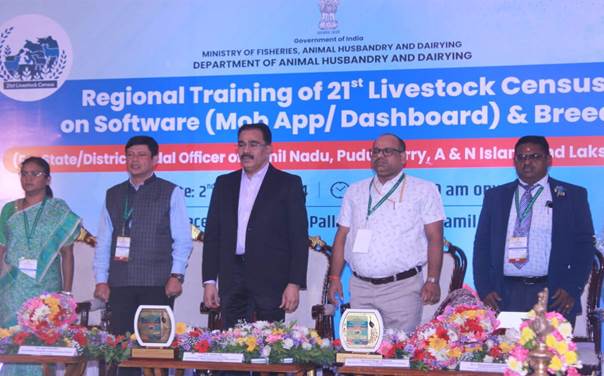
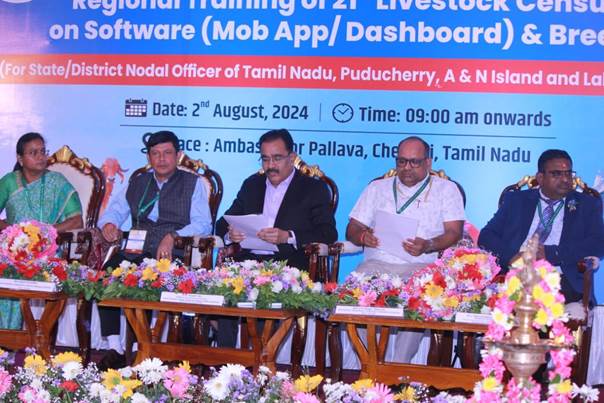
 The Department of Animal Husbandry & Dairying (DAHD), Ministry of Fisheries, Animal Husbandry & Dairying, Government of India and host State Tamil Nadu conducted a “Regional Training of 21st Livestock Census on Software (Mobile & Web Application/ Dashboard) and Breeds for State and District Nodal Officers (SNO/DNO) of Tamil Nadu, Puducherry, A & N Island, and Lakshadweep”. The workshop was held today in Chennai, Tamil Nadu to train the State/District Nodal Officers of these states on newly launched mobile and web applications for conducting 21st Livestock Census which is scheduled during September-December 2024.

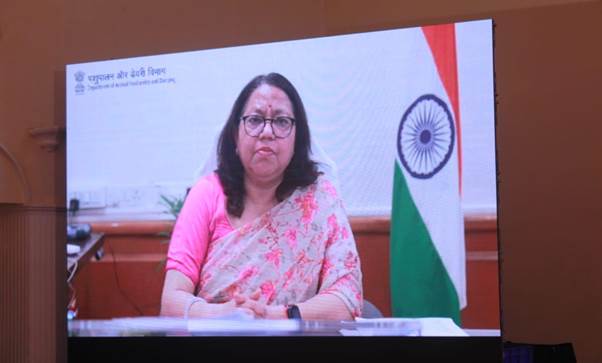
Smt. Alka Upadhyaya, Secretary, DAHD GoI conveyed her best wishes and greetings for the 21st Livestock Census virtually. She shared insights of the impact of Livestock Sector on the Indian Economy and the position of India in terms of global trade of livestock sector produce. She iterated that India’s livestock sector is a vital economic pillar, providing livelihoods for millions, contributing 5.5% to the national GDP, and supplying essential proteins. With a massive livestock population (53.6 crore) and global leadership in milk (1st) and egg (2nd) production, the sector is a powerhouse. She however mentioned that unlocking its full potential requires addressing challenges in productivity, infrastructure, and market access to tap into promising export opportunities.

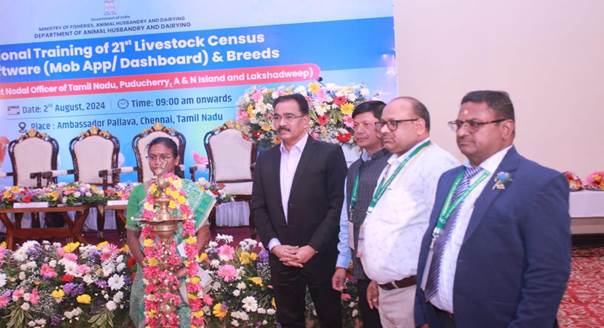
Additional Chief Secretary to Government, Department of Animal Husbandry, Dairying, Fisheries and Fishermen Welfare, Govt. of Tamil Nadu Dr. K Gopal inaugurated the workshop in the presence of Shri. Jagat Hazarika, Advisor (Statistics), Department of Animal Husbandry and Dairying, GoI, Shri V P Singh, Director, AHS, DAHD, GoI and Tmt. Mageswari Ravikumar, Director of Animal Husbandry and Veterinary Services, Govt. of TN.  

The ceremony commenced with the national anthem and the ceremonial lighting of the lamp. Addresses from these distinguished dignitaries marked the inauguration and set the stage for a collaborative effort towards the successful training of District and State level Nodal Offices for conducting the Livestock Census.

Dr. K Gopal addressed the workshop and highlighted the need for comprehensive training and capacity building at the grassroots level. He shared that Tamil Nadu is a key player in India’s animal husbandry and dairying sector, ranking among top states in milk production. The state boasts a significant livestock population and is a major contributor to national egg production through its robust poultry industry. He, however, highlighted that challenges like feed availability, animal diseases, and productivity enhancement need to be addressed to further boost the sector’s potential.

Sh. Jagat Hazarika highlighted the importance of this workshop in his address, underscoring the department’s commitment to leveraging technology for accurate and efficient data collection. He emphasized the collective responsibility of all stakeholders to ensure the success of the 21st Livestock Census, which will play a critical role in shaping the future policies and programs of the Animal Husbandry sector and urged them to leverage the latest technologies to ensure the success of the census.

Tmt Mageswari Ravikumar emphasized the integration of sustainable practices within the livestock sector. She pointed out that the analysis and logical use of the data obtained after the livestock census will pave the way for formulating future departmental policies and implementing programs, as well as creating new schemes and generating employment in the field of animal husbandry for the benefit of livestock farmers. She also talked about the latest technologies developed by the Department of Animal Husbandry and Dairying (DAHD), such as the use of sex-sorted semen. She extended a warm welcome to delegates from all states and wished them a successful training session.

The workshop featured a series of sessions beginning with a brief description of the 21st Livestock Census by the Animal Husbandry Statistics Division, followed by a detailed presentation by the team from ICAR-National Bureau of Animal Genetic Resources (NBAGR) on the breed details of species to be covered in the census. The importance of accurate breed identification was emphasized, which is crucial for producing precise statistics used in various livestock sector programs and for the National Indicator Framework (NIF) of Sustainable Development Goals (SDG).

The workshop included detailed sessions on the methodologies and live application of software of 21stLivestock Census by Software team of Department of Animal Husbandry and Dairying, Govt of India trained on the mobile application and dashboard software for State and District Nodal Officers.These Nodal officers shall conduct training for enumerators at their respective District Head Quarters.

A person speaking at a podiumDescription automatically generated

The workshop concluded with a vote of thanks by Sh. V.P. Singh, Director of the Animal Husbandry Statistics Division at the Department of Animal Husbandry & Dairying. In his address, he expressed gratitude to all the dignitaries and stakeholders for their presence and concluded with a hopeful note that the census operation would be successful.


******

DEDICATED PORTAL FOR EX-SERVICEMEN

 The Directorate General Resettlement (DGR), an attached office of Department of Ex-Servicemen Welfare (DESW) is to provide an interface between the retiring Service Personnel & Ex-Servicemen (ESM) (including Dis-abled Soldiers, Widows & Dependents) and the Environment (Skilling/ Training Institutes & Principal Employers) for ensuring their gainful Re-settlement.

The DGR has a website i.e.dgrindia.gov.in wherein registration and employment opportunities are provided to Ex-servicemen. Details of the same are as under:

  • Self-Employment Schemes such as Security Agency Scheme, Management of CNG Station, Coal Transportation & Company Owned Company Operated (COCO) Oil product agency outlets.
  • Employment opportunities/Jobs Vacancies received at DGR from Government & Non-Government Departments.
  • Regular updates on the sponsored Ex-servicemen for various DGR Schemes are also provided.

Registration on DGR website is restricted to only Ex-servicemen Officers as mentioned above. Details of last five Years Ex-Servicemen Officers registered on DGR website under various schemes are as under:

2020

2021

2022

2023

2024 (till 30.06.2024)

1087

856

910

1005

577

The data on the total number of ex-servicemen who have benefited from the information available on the DGR website for each scheme over the past five years is as follows:

S No

Details of Scheme

2020

 2021

 2022

 2023

2024 (till Jun 24)

a.

Security Agencies & State ESM Corporations Empaneled

625

932

732

750

504

b.

ESM sponsored in security agency

32469

34338

32240

48525

17359

c.

ESM sponsored in Coal Companies

51

06

00

12

00

d.

Widows/ disabled ESM attached in Coal Companies

121

14

00

16

00

e.

Management of Compressed Natural Gas (CNG) Station in National Capital Region (NCR)/ Pune

45

39

47

66

00

f.

Sponsored for Company Owned Company Operated (COCO) Scheme (Petrol Pumps)

139

20

47

138

157

g.

Issue of Eligibility Certificates for allotment of Oil Product Agency (OPA) Retail Outlets

07

07

01

44

10

h.

Mother Dairy Milk Booths/Safal Booths

340

536

835

553

209

i.

ESM Sponsored/ Placement by DGR (Emp Dte)

4157

25528

8974

3388

1197

j.

DGR Technical Service Scheme

211

56

313

77

k.

Placement Post completion of PRC through Training Institutes

33

83

00


Total

37954

61631

42965

53888

19513

WELFARE AND REHABILITATION SCHEMES FOR EX-SERVICEMEN

 The details of welfare and rehabilitation schemes, financial assistance provided to ex-servicemen/widows and their dependents are as follows:

1.       Financial assistance/ benefits given from Armed Forces Flag Day Fund (AFFDF) under Raksha Mantri Ex-Servicemen Welfare Fund (RMEWF):

S No

Grants

Amount(in Rs.)

(i)

Penury Grant (65 Yrs and above)

(Non-Pensioners up to Hav Rank)

Rs. 4,000/-pm         (Life time)

(ii)

Education Grant (up to two children)

  1. Boys/Girls up to Graduation
  2. Widows for PG

(Pensioner/Non Pensioner up to Hav Rank) and up to two children


Rs. 1,000/-pm

(iii)

Disabled Children Grant

(Pensioner/Non-pen up to JCO Rank)

Rs. 3,000/-pm


(iv)

Daughter’s Marriage Grant (up to 02 Daughters)

(Pensioner/Non-Pen up to Hav Rank)


Rs. 50,000/- *

Widow Re-Marriage Grant

(Pensioner/Non-Pen up to Hav Rank)

*  If married solemnly on or after 21 April 2016

(v)

Medical Treatment Grant

(Non-pensioner up to Hav Rank)


Rs. 50,000/- (Max)

(vi)

Orphan Grant

(Pensioner/Non-pen All Ranks)

  • Daughters of ex-servicemen till she is married.
  • One Son of ex-servicemen upto 21 years of age.


Rs. 3,000/-PM

(vii)

Vocational Trg Grant for Widows

(Pensioner/Non-Pen uptoHav Rank)

Rs. 50,000/-

(One Time)


2.     Serious diseases Grant from AFFD Fund to Non Pensioners ESM of all Ranks:


(i)

Serious Diseases   as listed below: –

Angioplasty, Angiography, CABG, Open Heart Surgery, Valve Replacement, Pacemaker Implant, Renal Implant, Prostate Surgery, Joint Replacement and Cerebral Stoke.

Other Diseases: Where more than Rs. 1.00 Lac has been spent on treatment


75% and 90% of total expenditure to Officer and Personnel Below Officer Rank (PBOR) respectively.

Up to a maximum of Rs. 1.50 Lac one time.

(ii)  

Dialysis and Cancer treatment

75% and 90% of total expenditure 

Officer and PBOR respectively.

Up to     a maximum of Rs. 75,000/- per FY only.


3.       Modified Scooter Grant: Rs. One lakh provided to those ESM, who are disabled after service with a disability of 50% or more and who are not covered under the scheme of AG’s Branch of IHQ (Army, Navy & Air Force).

4.       Subsidy on Home Loan:  KSB Reimburses, maximum of Rs. 1.00 Lac i.e. 50% of interest by way of subsidy on home loan from Bank/public sector institutions for construction of house to war bereaved, war disabled and attributable peace time casualties.

5.       Prime Minister’s Scholarship Scheme: Total 5500 scholarship are provided to eligible wards based on merit for the entire duration of the courses. The rates of Scholarship are as follows:

(a)   Rs. 2500/- per month for boys.

(b)   Rs. 3000/- per month for girls.

6.       Financial support to institutions involved in rehabilitation of ESM: – 


Sl. No.

Organisation

Quantum of Aid/Grant

(i)

Paraplegic Rehabilitation Centres


(i) Kirkee


(ii) Mohali

Establishment grant (per annum)


(i) Rs. 1.20 crore

w.e.f April, 2016          Rs. 30,000/-per Annum    

                                      per inmate

(ii)Rs. 10,00,000/-    

(w.e.f April, 2015)  

 (ii)

All India Gorkha Ex-servicemen Welfare Association, Dehradun

Rs. 12,00,000/- per annum


(iii)

Cheshire Homes

(i)   Lucknow, Delhi & Dehradun


Rs. 15,000/- per annum  per inmate

(iv)

War Memorial Hostels:  There are 36 WMHs which provide shelter to the children of War Widows/War disabled, attributable and non-attributable cases.

Rs. 1350/- per month


7.       Reservation of seats in Medical/Dental Colleges for wards of Defence Personnel as Government of India Nominee. A total of 42 MBBS seats and 3 seats in BDS courses are allotted by Ministry of Health & Family Welfare to KSB for wards of defence personnel as a Government of India nominee. Priority I is given to wards/widows of defence personnel killed in action.

8.       Rail Travel Concession Identity Cards: KSB Sectt issues rail travel concession identity cards to war widows.

DETAILS OF VARIOUS RESETTLEMENT SCHEMES IMPLEMENTED BY DIRECTORATE GENERAL RESETTLEMENT (DGR)

(a)     Upgrading their skills by imparting necessary training to prepare them to take on new assignments/jobs and assisting ESM in finding re-employment.

(b)     Constant endeavour to provide employment opportunities in Government/Quasi Government/Public Sector Organizations.

(c)     Pro-active action to facilitate re-employment of ESM in the Corporate Sector.

(d)     Providing Jobs through the following Schemes for self-employment.

  1. Placement Assistance through on-line registration at DGR.  
  2. DGR Sponsored Security Agency Scheme
  3. ESM Coal Loading and Transportation Scheme.   
  4. Coal Tipper Attachment Scheme. 
  5. Tipper Attachment Scheme for Widows and Disabled Soldiers. 
  6. Management of IGL/ MNGL CNG Stations by ESM in NCR/Pune.   
  7. Management of Company Owned Company Operated Retail Outlets. 
  8. Issue of DGR Eligibility Certificate for Allotment of LPG/Retail Outlet (Petrol/Diesel) Distributorship advertised by Oil Marketing Companies against 8% Reservation Quota.  
  9. Allotment of Mother Dairy Milk Booths and Fruit & Vegetable (Safal) Shops in NCR.   
  10. DGR Technical Service Scheme. 
  11. Resettlement Training/ Skill Development Courses. 

9.       Reservation in employment: The existing quota of reservations in employment is available for Ex-servicemen (ESM) in Public Sector Banks (PSBs) and Central Public Sector Undertakings (CPSUs) is 14.5% in all Direct Recruitment Group ‘C’ Posts and 24.5% in all Direct Recruitment Group ‘D’ Posts. This includes 4.5% for Disabled ESM and Dependents of Service personnel killed in action.

Raksha Mantri Discretionary Fund has been renamed as Raksha Mantri Ex-servicemen Welfare Fund (RMEWF). The details of payments made to the beneficiaries of ESM and their dependents under (RMEWF) for the last three years is as under:-           

Financial Year

Total Amount Paid

 Total Beneficiaries

2021-22

Rs. 395.69 Cr

182728

2022-23

Rs. 248.17 Cr

98615

2023-24

Rs. 366.54 Cr

172133

The details of main activities of Kendriya Sainik Board (KSB) and the manner in which it is beneficial for ESM and their families are as follows:

KSB organize and conduct following: –

  1. The meeting of KSB and Director, DSW / Secy, RSBs
  2. Annual Meeting of Management Committee of the Armed Forces Flag Day Fund.
  3. Periodic meetings of the Executive Committee of the Armed Forces Flag Day Fund.
  4. Progressing implementation of the decisions taken with concerned agencies.
  5. Provide policy directive, as approved by the MoD, to Depts. of Sainik Welfare in States / UTs on matters of welfare of Ex-Servicemen.
  6. Monitor and guide the Depts. of Sainik Welfare in the States in their functioning as per guidelines laid down by KSB / Ministry of Defence.
  7. Provide budgetary support for establishment and maintenance costs of Depts. of Sainik Welfare and Zila Sainik Welfare Offices to State / UTs.
  8. Attend as member of the Selection Committee convened invariably under the Chief Secretary of the State for selection of Director, Dept of Sainik Welfare / Secretary RSB and Zila Sainik Welfare Officer / Secretary ZSB convened one month prior to the post falling vacant.
  9. Inspect the Department of Sainik Welfare of States / UTs each year and report on their functioning to State Govt / MoD.
  10. Attend Rajya Sainik Board and Amalgamated Fund Meeting in States as special invitee.
  11. Administer Armed Forces Flag Day Fund (AFFDF).
  12. Deal with redressal and queries related to welfare of Ex-Servicemen and families of deceased service personnel.
  13. Operate the Scheme for allotment of Medical, Dental and Engineering seats under Ministry of Defence quota.
  14. Organize and conduct ‘Armed Forces Flag Day Collection’ at Central Govt. Depts. located at Delhi.
  15. Provide flags, posters and publicity material for conduct of the AFFD in States / UTs and Indian Mission abroad.
  16. Operation of centrally sponsored schemes such as RMEWF (Raksha Mantri Ex-servicemen Welfare Fund) and PM Scholarship Schemes.
  17. Issue I-Card for availing Rail Travel Concession to War Widows.
  18. Provide financial assistance to paraplegic homes at PRC Kirkee & Mohali, 36 War Memorial Hostels, Cheshire Homes and various institutes and visit them to check its proper distribution.
  19. Advise on the correct investment of the Amalgamated Fund by the RSBs of the States / UTs.
  20. Inspect ZSBs at random to check their functioning and effectiveness.
  21. All activities mentioned above cater for providing financial assistance related to welfare of ESM /Widows/wards and to redressal of grievances through 34 Rajya Sainik Boards and 413 Zila Sainik Boards, across the country.

A single window online grievance redressal mechanism (CPGRAMS) was launched by the Department of Administrative Reforms and Public Grievance in which any citizen can lodge grievances online and get response from the concerned department by clicking a single click on the portal. The Department of Ex-servicemen Welfare has extended this online grievance redressal mechanism (CPGRAMS/CPENGRAMS) to ex-servicemen also so that the grievances of Ex-servicemen can be redressed efficiently and in a time bound manner. The link of CPGRAMS/CPENGRAMS website has also been given in the website of Department of Ex-Servicemen Welfare, CGDA and all Pension Sanctioning Authorities so that ex-servicemen can lodge their grievances in any websites from their home by clicking on the pgportal.gov.in. Further, a dedicated portal (Raksha Pension Shikayat Nivaran Portal) for redressal of Pension grievances of Ex-servicemen (ESM) has been launched on 14th January, 2022. A Toll-free Number 1800111971 has also been made operational in order to facilitate the ESM pensioners for smooth redressal of their grievances.

Policies and Technological Innovations to mitigate Impact of climate Change

 The Government is implementing National Mission for Sustainable Agriculture (NMSA) to mitigate the impact of climate change on water and food security. The NMSA is one of the Missions within the National Action Plan on Climate Change (NAPCC) which aims to evolve and implement strategies to make Indian agriculture more resilient to the changing climate. Under NMSA, the Per Drop More Crop aims to improve on-farm water use efficiency, enhance the adoption of precision irrigation and other water saving technologies for which subsidy is being provided to the beneficiary to increase the area under micro irrigation. In addition, the Government is promoting organic farming in the country since 2015-16 through the schemes of Paramparagat Krishi Vikas Yojana (PKVY) and Mission Organic Value Chain Development for North Eastern Region (MOVCDNER). Both the schemes stress on end-to-end support to farmers engaged in organic farming i.e. from production to processing, certification and marketing and post-harvest management. Training and Capacity Building are integral part of the scheme. Incentives to farmers for producing and using organic fertilizers/manure are inbuilt in these schemes as on-farm and off-farm organic inputs. Direct Benefit Transfer (DBT) is provided to the farmers for using organic inputs including organic fertilizers. PKVY is being implemented in all the States other-than North Eastern (NE) States across the country whereas MOVCDNER scheme is being implemented exclusively in the NE States. The scheme Bharatiya Prakritik Krishi Paddhati Programme (BPKP) aims to promote traditional indigenous practices and to create awareness of farmers. Mission for Integrated Development of Horticulture (MIDH), Agroforestry & National Bamboo Mission also aim to increase climate resilience. The Pradhan Mantri Fasal Bhima Yojana (PMFBY) provides full insured amount on crop losses due to natural calamities.

Department of Agriculture and Farmers Welfare (DA&FW) is implementing a Sub-Mission on Nutri-Cereals (Millets) under National Food Security Mission (NFSM) in all districts of 28 States and 2 Union Territories viz. Jammu & Kashmir and Ladakh. The incentives are provided to the farmers, through the States/UTs, on crop production and protection technologies, cropping system based demonstrations, production & distribution of certified seeds of newly released varieties/hybrids, Integrated Nutrient and Pest Management techniques, improved farm implements /tools/ resource conservation machineries, water saving devices, capacity building of farmers through trainings during cropping season, organizing events/ workshops, distribution of seed minikits, publicity through print and electronic media etc.

The Indian Council of Agricultural Research (ICAR) under Ministry of Agriculture and Farmers Welfare, Government of India has launched a flagship network project namely National Innovations in Climate Resilient Agriculture (NICRA). The project aims to study the impact of climate change on agriculture including crops, livestock, horticulture and fisheries and to develop and promote climate resilient technologies in agriculture which will address vulnerable areas of the country and the outputs of the project help the districts and regions prone to extreme weather conditions like droughts, floods, frost, heat waves, etc. to cope with such extremes. The salient achievements of ICAR are as follows:

    • During last 10 years (2014-2024), a total of 2593 varieties have been released by ICAR, out of these 2177 varieties have been found tolerant to one or more biotic and/or abiotic stresses.
    • Risk and vulnerability assessment of agriculture to climate change is carried out at district-level for 651 predominantly agricultural districts as per Intergovernmental Panel on Climate Change (IPCC) protocols. A total of 109 districts are categorized as ‘very high’ and 201 districts as ‘highly’ vulnerable.
    • District Agriculture Contingency Plans (DACPs) for these 651 districts have been prepared for weather aberrations like drought, floods, unseasonal rains and extreme weather events such as heat wave, cold wave, frost, hailstorm, cyclone etc. and recommending location specific climate resilient crops and varieties and management practices for use by the State departments of agriculture and farmers.
    • Enhancing resilience and adaptive capacity of farmers to climate variability, the Concept of “Climate Resilient Villages” (CRVs) has been initiated under NICRA.
    • Location-specific climate resilient technologies demonstrated in 448 CRVs of 151 climatically vulnerable districts for adoption by the farmers.
    • ICAR through its NICRA project, creates awareness about impact of climate change in agriculture among farmers. Capacity building programmes are being conducted to educate the farmers on various aspects of climate change for wider adoption of climate resilient technologies.
    • Climate resilient technologies viz., resilient intercropping systems, conservation agriculture, crop diversification from paddy to other alternate crops like pulses, oilseeds, agroforestry systems, alternate methods of rice cultivation (system of rice intensification, aerobic rice, direct seeded rice), green manuring, integrated farming systems, integrated nutrient management, integrated pest management, organic farming, site specific nutrient management, in-situ moisture conservation, protective irrigation from harvested rainwater in farm pond, micro irrigation method (drip and sprinkler) etc. have been developed and demonstrated at the farmer’s fields. Also, planting methods such as zero till drill sowing of wheat to escape terminal heat stress, raised bed planting, cropping intensification with harvested water have been demonstrated in North-Eastern States.

32nd International Conference of Agricultural Economists

 Prime Minister Shri Narendra Modi will inaugurate the 32nd International Conference of Agricultural Economists (ICAE) on 3rd August 2024, at around 9.30 AM at National Agricultural Science Centre (NASC) Complex, New Delhi. Prime Minister will also address the gathering on the occasion.

The triennial conference, organised by the International Association of Agricultural Economists will be held from 02 to 07 August 2024. The ICAE is being held in India after 65 years.

The theme for this year’s conference is, “Transformation Towards Sustainable Agri-Food Systems.” It aims to tackle the pressing need for sustainable agriculture in the face of global challenges such as climate change, natural resource degradation, rising production costs and conflicts. The conference will highlight India’s proactive approach to global agricultural challenges and showcase the nation’s advancements in agricultural research and policy.

The ICAE 2024 will serve as a platform for young researchers and leading professionals to present their work and network with global peers. It aims to strengthen partnerships between research institutes and universities, influence policymaking on both national and global scales, and showcase India’s agricultural progress, including advancements in digital agriculture and sustainable agri-food systems. The conference will witness participation of around 1,000 delegates from around 75 countries.