

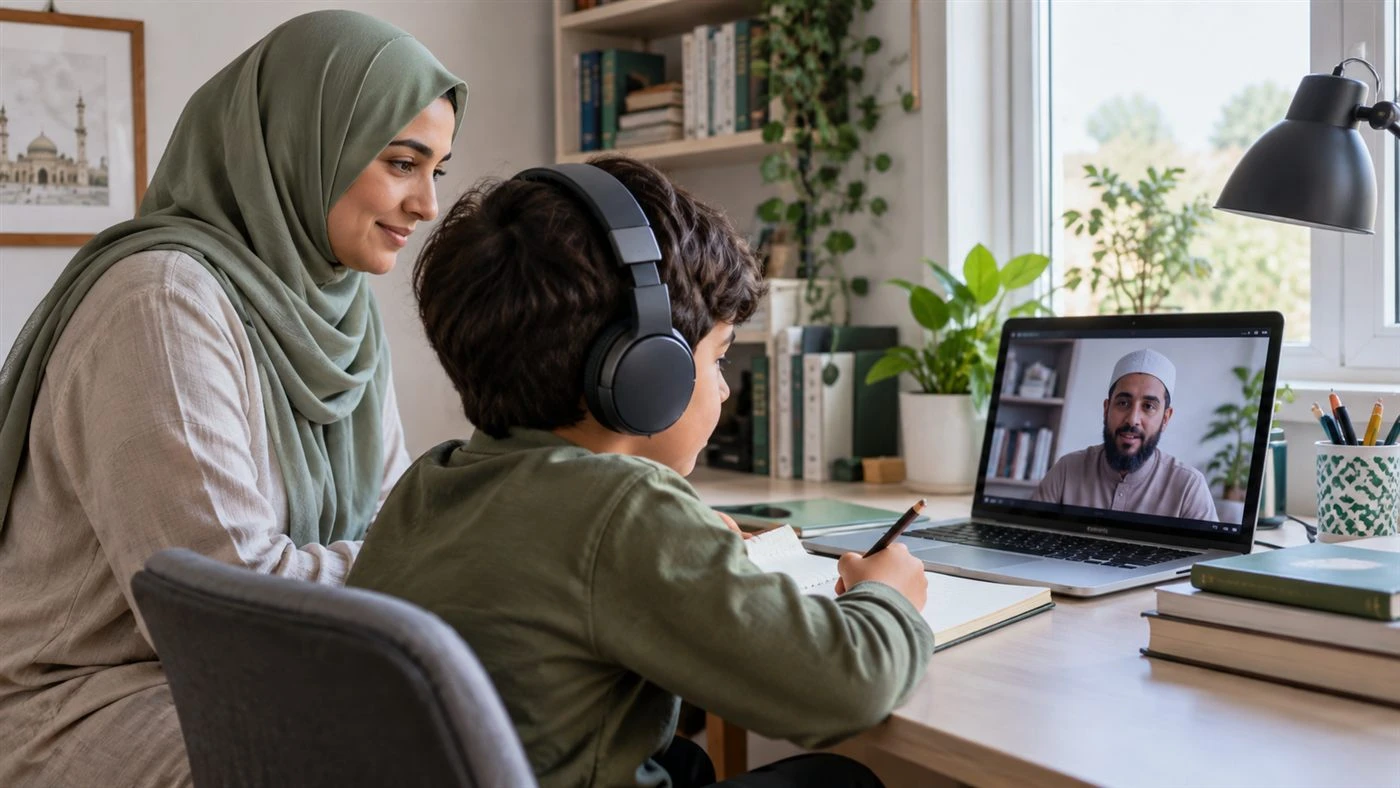
 Online learning has made specialist education available to families who may not live near a suitable teacher or who find regular travel difficult. For Quran education, however, convenience alone is not enough. A strong programme must combine accurate recitation, age-appropriate teaching, human attention and clear communication with parents.
The most useful question is therefore not whether Quran lessons can take place online. It is what good online Quran education should look like in practice.
One-to-one attention should be genuinely personalised
Children do not learn Quran reading at the same pace. One learner may recognise Arabic letters confidently but struggle to join them. Another may read fluently while needing careful correction of makharij, the points from which letters are pronounced. A third may be ready for structured memorisation but require more revision than new material.
In a high-quality one-to-one lesson, the teacher adjusts the content, pace and amount of repetition to the learner. The session should not simply reproduce a group lesson through a webcam. It should respond to what the child can do now and identify the next achievable step.
This individual attention is particularly valuable when a child is hesitant. A patient teacher can pause, model a sound, ask the learner to repeat it and correct the attempt immediately. That short feedback loop is difficult to achieve when one teacher is dividing attention among a large class.
Accurate recitation requires live feedback
Recorded videos and learning apps can support practice, but they cannot reliably hear and correct a learner’s recitation. Quran reading depends on details that may be subtle to an inexperienced student, including letter articulation, vowel length, stopping points and the application of Tajweed rules.
Live teaching allows the tutor to listen closely and correct an error before it becomes a habit. Good correction should be precise and encouraging. Instead of merely saying that a word is wrong, the teacher can isolate the sound, demonstrate it, explain the relevant rule when appropriate and then return to the full verse.
Parents should also be able to see that the lesson includes active participation. The child should read, answer questions and demonstrate understanding rather than spend most of the session listening passively.
Technology should support teaching, not distract from it
The best online lesson technology is often simple. A stable video connection, clear audio, screen sharing and a digital whiteboard are usually more useful than a long list of complicated features. These tools can help a teacher point to a letter, mark a reading position, display a rule or revisit a previous exercise.
The platform should also be easy enough for a child to use without constant technical help. Before lessons begin, families should test the device, headphones, microphone and internet connection. A quiet, visible study space helps the learner concentrate and allows a parent to supervise appropriately.
Structure matters more than lesson length
A productive lesson has a clear sequence. It may begin with revision, continue with a new reading or Tajweed objective, include guided practice and finish with a short task for the next session. The exact structure will vary by age and level, but the learner should understand what they are working towards.
Shorter, regular sessions may be more effective for young children than occasional long lessons. Consistency gives the teacher more opportunities to review learning, correct errors and build confidence. It also makes Quran study part of the child’s normal routine rather than an activity associated with last-minute pressure.
Progress should be visible to families
Parents should not have to guess whether lessons are working. A responsible provider should explain the learner’s starting point, current goals and recent progress in plain language. Useful feedback might cover reading fluency, pronunciation, Tajweed, memorisation, revision and participation.
Progress is not always linear. A child may need to revisit an earlier skill before moving forward, especially after a break. Honest reporting is more valuable than rushing through a syllabus. Parents should be able to ask why a particular exercise is being repeated and what they can reinforce between lessons.
The teacher-student relationship remains central
Online delivery does not reduce the importance of the teacher. Children learn best when expectations are clear and the relationship is calm, respectful and consistent. A good tutor notices when a learner is tired or confused, varies the activity where possible and corrects mistakes without embarrassment.
Families may also have practical preferences, such as choosing a male or female tutor, arranging lessons around school hours or requesting support for a particular goal. A suitable programme should discuss these needs before matching the learner with a teacher.
Safeguarding should be built into the service
Any online education provider working with children should be able to explain how lessons are supervised, how parents can raise concerns and what information is recorded. Parents should know who the teacher is, when lessons occur and how communication is handled.
Children should take lessons in an appropriate shared area where a parent or guardian can check in. Private contact outside the agreed platform should be limited, and families should receive clear guidance about account security and respectful online conduct. Safeguarding is not an optional extra; it is part of educational quality.
A useful example of the model
For families comparing providers, Online Quran Tuition illustrates several features worth looking for: one-to-one lessons, male and female tutors, Quran reading, Tajweed and Hifz options, interactive teaching tools, flexible monthly arrangements and trial lessons before a longer commitment. The organisation states that it has taught online since 2012 and provides programmes for both children and adults.
These details matter because a trial allows the parent to observe the teaching relationship directly. Families can assess whether the tutor listens carefully, corrects accurately, explains at the right level and helps the learner feel comfortable enough to participate.
Questions parents can ask before enrolling
Before choosing an online Quran programme, parents can ask:
- Will the lessons be one-to-one or shared with other learners?
- How are teachers selected and their recitation standards checked?
- Can the tutor provide live correction of pronunciation and Tajweed?
- How will goals and progress be recorded and shared?
- What safeguarding and supervision arrangements are in place?
- Can the family choose a suitable schedule and tutor?
- Is there a trial lesson or short trial period?
- What happens if the teacher is not a good match for the child?
Clear answers help families distinguish a structured educational service from a simple video call with no wider support.
Conclusion
High-quality online Quran education brings together specialist knowledge and good teaching practice. It gives the learner individual attention, accurate live feedback, manageable goals and a respectful relationship with a consistent tutor. Technology makes the connection possible, but thoughtful teaching is what makes the lesson effective.
Parents who observe a trial, ask about safeguarding and request regular progress information are better placed to choose a programme that supports both correct recitation and lasting confidence.
Tell us about your morning routine.
View all responses


