

Citation
Shukla, A., Onkar, P., Munoth, N., & Dhote, K. K. (2026). Walking the River: Narmada Parikrama, Sacred Geography and Riverine Cultural Memory in Madhya Pradesh, India. Journal for Studies in Management and Planning, 12(2), 74–97. https://doi.org/10.26643/jsmap/12
Ankita Shukla1*, Dr. Preeti Onkar2, Dr. Navneet Munoth3 and Dr. Krishna Kumar Dhote4
1Research Scholar, Department of Architecture and Planning, Maulana Azad National Institute of Technology, Bhopal, India *(Corresponding Author)
E-mail: ankita.academia@gmail.com,
ORCID ID: https://orcid.org/0009-0004-9429-2813
2Professor, Department of Architecture and Planning, Maulana Azad National Institute of Technology, Bhopal, India
E-mail: onkarpreeti@manit.ac.in,
ORCID ID: https://orcid.org/0000-0002-7967-8433
3Associate Professor, Department of Architecture and Planning, Maulana Azad National Institute of Technology, Bhopal, India
E-mail: navneet.munoth@manit.ac.in,
ORCID ID: https://orcid.org/0000-0003-2704-1403
4Professor, Department of Architecture and Planning, Maulana Azad National Institute of Technology, Bhopal, India
E-mail: kkdhote@gmail.com,
ORCID ID: https://orcid.org/0000-0002-3145-4801
Abstract
Narmada Parikrama is one of the most unique river-based pilgrimage traditions in India. It is usually described as a devotional journey between sacred places located along the Narmada. This paper tries to understand Narmada Parikrama as a route-based cultural practice through which the Narmada valley is remembered, respected and experienced as a sacred landscape. It draws on textual traditions related to the Narmada, including the Mahabharata, Kurma Purana, Skanda Purana/Reva-khanda and Narmada Mahatmya literature, along with secondary writings on sacred geography, pilgrimage, cultural landscapes, ritual ecology and riverine memory. The paper develops the idea of “circumambulatory river knowledge” to explain how the Narmada is known not only through texts or maps, but also through walking, halting, crossing, remembering, narrating and repeatedly staying in relation with the river. Twelve towns of Madhya Pradesh- Amarkantak, Dindori, Mandla, Jabalpur, Bhedaghat, Narmadapuram, Budni, Nemawar, Omkareshwar, Maheshwar, Mandleshwar and Dharampuri serve as interpretive nodes within this river corridor. The paper argues that Narmada Parikrama is best read as a living cultural-landscape tradition where sacred narratives, bodily movement, oral memory and place-based experience come together. Such a reading can help future research on sacred river corridors, pilgrimage heritage and route-based cultural landscapes.
Keywords: Narmada Parikrama; Narmada River; Intangible Heritage; sacred geography; circumambulatory river knowledge; pilgrimage mobility; cultural landscape; riverine memory; embodied movement; Madhya Pradesh; living heritage
1. Introduction
Rivers in the Indian subcontinent have never been understood only as physical channels carrying water (Gurchiani, 2023). They have also been seen as mothers, goddesses, sacred crossings, routes of memory and places of moral responsibility (Brunn & Gilbreath, 2015). Their banks hold settlements, temples, ghats, cremation grounds, fairs, local stories and everyday acts of worship. In this sense, a river is not only part of a landscape. It also helps people remember, organize and give meaning to that landscape (Gupta et al., 2020; Haberman, 2007).
Among India’s major rivers, the Narmada has a special position. Geographically, it is one of the largest west-flowing rivers of peninsular India (Bhaumik et al., 2017). It rises near Amarkantak in the Maikala range and flows westward towards the Gulf of Khambhat. But in cultural and religious imagination, it is not only a river system. She is Narmada Ma, Reva, a goddess, a purifier and a sacred presence (Agoramoorthy, 2015). Her sacredness is not limited to one temple, one town or one confluence. It is spread across the river’s entire course. The source, banks, ghats, islands, gorges, confluences and settlements are all connected through traditions of reverence and narration (Turkson, 2021).
The paper makes three main contributions. First, it reads Narmada Parikrama as an embodied sacred geography, not only as an itinerary of pilgrimage sites. Second, it proposes the concept of “circumambulatory river knowledge” to describe the type of route-based understanding that emerges through walking around the river. Third, it reads twelve towns as differentiated nodes within a corridor grammar of river memory, showing how different places along the Narmada carry different forms of memories, sacredness and landscape experience.
Narmada Parikrama gives this reverence a physical and spatial form. The practice involves circumambulating the river traditionally by moving along one bank towards the estuary and then returning along the opposite bank (Shubhashri & Dr. Kavita, 2024). In this journey, the river is not visited as one point or one destination. It is walked as a whole. A linear river becomes a sacred circuit. Its two banks become parallel routes of encounter. This is what gives the Parikrama its deeper meaning. In textual and pilgrimage traditions, the river may be known through walking, sequence, fatigue, hospitality, restraint, halts and repetition. Despite its significance, Narmada Parikrama has received little conceptual attention as a route-based form of river knowledge (Chandel, 2025).
This paper offers an interpretive reading based on textual traditions, secondary literatures, official geographic sources and cultural-geographical understandings. The purpose of such a paper is different from that of an empirical study. It does not claim to speak on behalf of parikramavasis or local communities. Rather, it develops a vocabulary through which future field-based research on Narmada Parikrama can be framed more carefully.
The paper is organized as follows. Section 2 reviews the literature on sacred geography, cultural landscapes, pilgrimage mobility, memory landscapes and ritual ecology. Section 3 explains the conceptual and interpretive methodology. Section 4 discusses the textual foundations of the Narmada’s sacred status. Section 5 develops the concept of “circumambulatory river knowledge”. Section 6 reads twelve towns as illustrative nodes within the Narmada corridor. Section 7 discusses the wider theoretical and heritage implications. Section 8 presents limitations and future research directions. The paper concludes by suggesting that Narmada Parikrama should be understood as a living cultural practice through which the river is continuously remembered and made meaningful.
Note on terminology. This paper retains some Sanskrit and Hindi terms where simple English translation would not carry the full meaning. Each important term is explained when it first appears and a glossary is provided in Appendix A. Common geographic names such as Narmada are written without diacritics for readability. Textual and conceptual terms such as Parikrama, tirtha, Purana, and Mahatmya are used consistently. These terms are not used for decoration. They are necessary for understanding the sacred geography and route-based memory of the Narmada tradition.
2. Literature Review and Theoretical Framework
2.1 Sacred Geography and the Logic of Tirtha
The literature on Hindu sacred geography provides the first foundation for this paper. Sacred geography does not treat space as empty or neutral (Alley, 2019). It understands places as shaped by myth, ritual, memory, cosmology and repeated practice. Diana Eck’s work on India as a sacred geography shows how pilgrimage traditions created a network of sacred places across the subcontinent (Natarajan, 2013). In this understanding, sacred places are not isolated points on a map. They are connected through stories, routes, deities, ritual calendars and acts of remembrance (Eck, D. L, 2012).
The Sanskrit term tirtha is important here. It literally refers to a ford or crossing, but in sacred geography it also means a place where physical crossing and spiritual transition come together. A tirtha is therefore not only a location, it is a passage between ordinary and sacred experience (Alley, 2019; Singh, 1973). Rana P. B. Singh and Martin Haigh describe Hindu pilgrimage landscapes as “faithscapes,” where sacred time, sacred place, ritual specialists, material settings, and devotional movement are joined together (Brunn & Gilbreath, 2015; Singh, 1973). This idea is useful for the Narmada because the Parikrama does not depend on one single centre. The entire river corridor becomes a sacred field. The Narmada corridor requires a route-centred vocabulary – one developed in Section 5 through the concept of “circumambulatory river knowledge”.
2.2 Cultural Landscape and Living Heritage
The second important idea comes from cultural landscape theory. The UNESCO framework understands cultural landscapes as the result of long interaction between people and natural environment (Mitchell et al., 2009). This is useful because it moves beyond the strict separation between nature and culture. A river valley is not just a natural system later surrounded by temples and towns. It is a landscape where water, settlement, worship, craft, memory and movement have shaped one another over time (Chattaraj, 2021).
The Narmada corridor fits this understanding well. It includes source landscapes, forest-edge settlements, ritual ghats, forts, temples, pilgrimage halts, island shrines, ferry crossings, artisanal riverfronts and smaller sacred places (Jain et al., 2007). These are not separate categories of heritage. They belong to a wider riverine cultural landscape. The Parikrama gives continuity to this landscape by linking these places through bodily movement and ritual discipline.
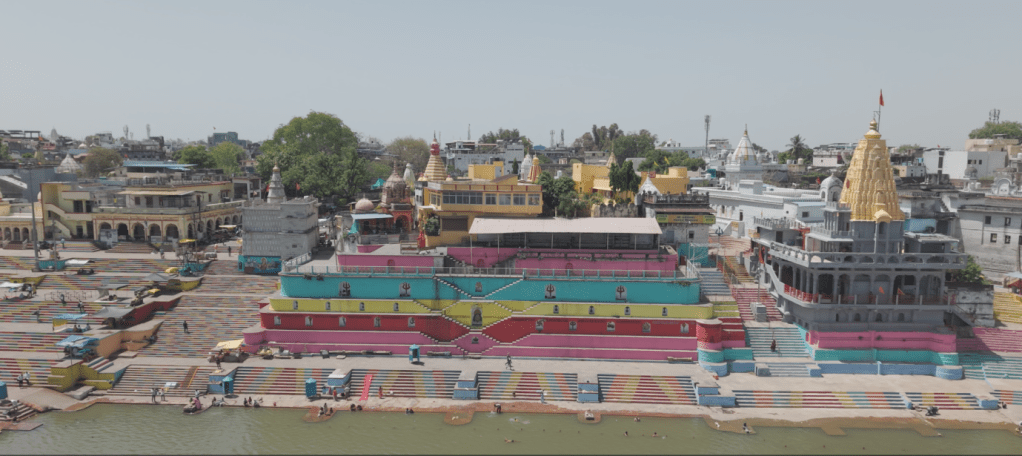
To read the Narmada as a living cultural landscape is not only a poetic statement (Figure 1). It is an analytical position. It means that the river’s heritage is not preserved only in monuments, texts or temple architecture. It is also preserved in routes, gestures, oral naming traditions, halting practices, craft ecologies and everyday ways of relating to the river.
Figure 1:Riverfront ghats and temple landscape at Sethani Ghat, Narmadapuram, Madhya Pradesh. The image illustrates the close relationship between ritual access, sacred architecture, and everyday riverine activity in Narmada-bank towns. The stepped ghat, temple structures, and river edge together show how the Narmada is approached as both a sacred presence and a lived public landscape. Photograph by a professional photographer, used with permission. All rights reserved.
2.3 Pilgrimage as Embodied Mobility
Pilgrimage studies have increasingly moved away from seeing pilgrimage only as a journey to a sacred destination. Scholars of sacred mobility argue that pilgrimage is also made through movement itself. Richard Scriven’s work on pilgrimage geographies stresses the importance of meaningful movement and embodied experience. The sacred is not encountered only at the final destination (Scriven, 2014). It is produced through walking, waiting, fatigue, repetition, discipline and encounters along the way.
Tim Ingold’s distinction between moving “across” a surface and moving “along” a path is useful here. A wayfarer does not simply move from one point to another. Knowledge is produced while going along a line of movement. The path is not secondary to knowledge. It is one of the ways through which knowledge becomes possible (Ingold, 2007). Ingold’s distinction between point-to-point transport and path-integrated wayfaring is directly applicable to Narmada Parikrama, where river knowledge is produced cumulatively through sustained movement (Ingold, 2007 ;Mazzarella, 2002)
2.4 Memory Landscapes and Repeated Practice
Another important body of scholarship deals with memory landscapes. Memory is not stored only in monuments, inscriptions or archives (Haberman, 2007). It is also performed and renewed through repeated practices. Gregor Maus’s practice-theory approach to memory landscapes is helpful because it shifts attention from static memorial objects to the actions through which landscapes become meaningful over time (Maus, 2015).
In the case of the Narmada, river memory is not found only in Purana texts or temple legends. It is also carried through walking, bathing, halting, offerings, storytelling, naming and returning (Chandel, 2025). A ghat becomes meaningful not only because it is old or architecturally important but because people repeatedly approach it, use it, narrate it and remember it (Figure 1). A small halting place may not be very visible as a monument but it can still carry deep ritual memory. A ferry crossing may become important because it marks the relation between two banks.
For the Narmada, this means that ghats, confluences and halting places become meaningful not because they are architecturally preserved but because they are repeatedly approached, narrated and returned to (Figure 2).
Figure 2:Ritual and everyday riverfront practices at Sethani Ghat, Narmadapuram, Madhya Pradesh. Collective worship on the river steps and individual bathing or offering practices at the water edge show how sacred river knowledge is enacted through bodily presence, repetition and direct contact with the Narmada. These practices demonstrate that river knowledge is not only textual or symbolic, but also performed through everyday acts at the ghat. Photograph by Shubhangi Thakre, Research Scholar, MANIT Bhopal. Used with permission. All rights reserved.
2.5 Sacred Water and Ritual Ecology
The fourth theoretical strand concerns sacred water and ritual ecology. In many Indian traditions, water is not only a material resource. It is a medium of purification, offering, transition and divine presence. Rivers are not simply used (Chattaraj, 2021; The et al., 1973). They are approached, greeted, worshipped, touched, crossed and remembered. Sacred-water traditions often carry ideas of restraint, reverence, purity, continuity and moral relation. These ideas may not always match modern conservation language but they preserve a way of thinking about rivers that does not reduce them to technical objects.
Narmada Parikrama is important in this context because it joins sacred water with route discipline. The pilgrim does not only bathe in or worship the river at one place. The pilgrim remains in relation to the river over a long period. Walking with the river, avoiding unnecessary crossings, depending on hospitality and following route discipline all shape the body’s relation with the river. This sustained relation gives the Parikrama its theoretical significance (Madhavendra et al., 2017).
2.6 Theoretical Synthesis
Three layers emerge from this literature. The first is textual-sacral as the Narmada is praised, personified and authorized through epic and Purana traditions. The second is embodied-circumambulatory where the river is known through walking, halting, crossing and returning. The third is memory-nodal such that the towns, ghats, confluence, islands and smaller sacred places become points where memory becomes dense.
The concept developed in this paper, “circumambulatory river knowledge”, emerges from these three layers. It names a form of understanding that is not only textual, not only sensory and not only spatial. It is produced when sacred narrative, bodily movement and place-based memory come together through the act of walking around a river.
Taken together, these bodies of scholarship offer rich conceptual resources. Yet a specific gap remains. The existing literature on pilgrimage mobility tends to focus on either arrival at a sacred centre or the experiential qualities of movement in general. It has not developed a vocabulary adequate to a tradition in which the river itself in its full spatial length, bilateral structure and cumulative sequence is the object of knowing. Similarly, cultural landscape theory, while attentive to the interaction between people and environment, has rarely been applied to route-based river traditions as integrated knowledge systems. Memory-landscape approaches offer useful tools but have not been applied to Narmada Parikrama specifically. The concept developed in this paper, “circumambulatory river knowledge,” is an attempt to address this gap. It brings together path-integrated mobility, mnemonic geography and textual-sacral tradition into a single analytical frame adequate to the scale and logic of the Parikrama.
3. Conceptual and Interpretive Methodology
This article follows a conceptual and interpretive research design. The study does not make empirical claims about what present-day pilgrims, priests, residents or local communities think or experience. Its purpose is to develop a theoretical framework for reading Narmada Parikrama as a route-based sacred river practice.
The paper uses four kinds of material. First, it draws on translated and secondary discussions of textual traditions associated with the Narmada, including the Mahabharata, Kurma Purana, Skanda Purana/Reva-khanda and Narmada Mahatmya traditions. Secondary sources consulted span roughly the 1970s to 2025, with an emphasis on scholarship published after 2000. Older translations of primary texts such as Ganguli’s Mahabharata (1884–1896), Bhatt’s Kurma Purana (1981–1999) and Tagare’s Reva-khanda (1996) are included because they remain the standard scholarly editions in English. Second, the paper uses scholarship on sacred geography, pilgrimage mobility, memory landscape, ritual ecology and cultural landscape theory. Third, it refers to official and contextual geographic descriptions of the Narmada basin and selected riverbank towns. Fourth, it uses twelve towns in Madhya Pradesh as interpretive anchors for conceptual discussions.
The twelve towns were selected on the basis of three criteria. First, representativeness across the corridor: the towns needed to cover the full east-to-west length of the Madhya Pradesh stretch of the Narmada, from Amarkantak in the upper catchment to Dharampuri near the state’s western boundary. Second, typological diversity: the selection sought to include a range of riverine registers – source landscape, tribal catchment, urban riverfront, geomorphic site, ghat-town, island shrine, paired bank, royal-craft settlement and smaller sacred anchorage. It is so that no single character of the river would dominate the analysis. Third, presence in the existing secondary and textual literature like towns with at least some documentation in sacred-geographical scholarship, gazetteers, pilgrimage texts or heritage records were preferred so that the interpretive readings could be grounded in available sources. These criteria do not make the twelve towns the only valid nodes for such an analysis. Other places along the Narmada, particularly in the Gujarat stretch are equally important to the Parikrama tradition. The typology is therefore heuristic and illustrative, not exhaustive. Regarding textual traditions, the paper includes those that have a direct and documented connection to the Narmada’s sacred geography or to the Parikrama rite. Traditions that mention the Narmada only in passing or without a clear ritual-geographical connection have been excluded, as have vernacular oral traditions that require primary fieldwork for responsible inclusion.
The twelve towns are not treated as surveyed case-study sites (Figure 3). They are used as illustrative nodes because they represent different registers of riverine cultural memory such as -source, upper catchment, tribal landscape, urban riverfront, gorge, civic ghat, paired bank, mid-route halt, island shrine, royal-craft riverfront, historical settlements and smaller sacred anchorage. The typology is therefore heuristic. It is not exhaustive and it is not presented as a canonical list of Parikrama sites.
Figure 3: Narmada River corridor in Madhya Pradesh showing the twelve selected riverbank towns considered in this conceptual study: Amarkantak, Dindori, Mandla, Jabalpur, Bhedaghat, Narmadapuram, Budni, Nemawar, Omkareshwar, Maheshwar, Mandleshwar, and Dharampuri. The highlighted river course and marked towns illustrate the spatial sequence of cultural nodes discussed in relation to Narmada Parikrama, sacred geography, and riverine cultural memory.
The method (Figure 4) proceeds in four steps. First, the paper reconstructs the sacred status of the Narmada through textual and cultural references. Second, it places the Parikrama within wider debates on sacred geography and embodied pilgrimage. Third, it develops the concept of “circumambulatory river knowledge”. Fourth, it uses this concept to interpret the twelve towns as nodes within a larger riverine memory corridor. Given that Narmada Parikrama remains understudied in cultural geography relative to its scale and complexity, a conceptual framework is a necessary prior step before ethnographic or GIS-based research can be meaningfully designed.
Figure 4. Conceptual framework for interpreting Narmada Parikrama as a route-based sacred river tradition. The framework shows how textual-sacral traditions, embodied-circumambulatory practice, and mnemonic-nodal landscapes collectively produce “circumambulatory river knowledge.” This knowledge is further expressed through five dimensions (path-integrated, banked, nodal, iterative, and more-than-textual) leading to three interpretive outcomes: embodied sacred geography, living cultural landscape, and riverine cultural memory.
4. Textual Foundations and Sacred Status of the Narmada
The sacred status of the Narmada does not come from one single text. It emerges from a layered tradition of epic, Purana, Mahatmya, local and oral narratives as shown in Table 1. These traditions differ in detail but they agree on one broad idea i.e., the Narmada is not an ordinary river. She is a divine and salvific presence whose sacredness extends along the river’s full length.
The Mahabharata gives one of the early sacred-geographical references by associating the source region of the Son and the Narmada with pilgrimage merit (Ganguli, 1884-1896). This is not a full birth story, but it is important because it places the Narmada within a wider range of tirtha geography. The Kurma Purana develops sacred personality of the river more clearly by locating its source at Amarakantak and associating it with Rudra (Bhatt, 1981-1999). The Skanda Purana, especially the Reva–khanda, further intensifies the Narmada’s sacred status by describing divine origin narratives giving extraordinary purifying power to the river (Tagare, 1996). Narmada Mahatmya traditions then extend this sacred geography through literature, place names and ritual associations.
These traditions are important not because they should be read as literal hydrological explanations. Their importance lies in the way they teach people to relate to the river. The river is given biography, agency, sanctity and presence. It is not only located on a map. She is born, praised, approached and circumambulated.
For a careful academic reading, it is important to distinguish between mythic origin, geographic source and scientific description. Traditions associate the Narmada’s birth with Shiva/Rudra and with Amarkantak/Narmada Kund. Geography can confirm the headwater location and the distinctive landscape setting of Amarkantak (a high plateau in the Maikala range, geologically part of the Satpura system). It is where the Narmada begins as a small spring before descending through a series of falls and forest-edge terrains (Jain et al., 2007).
What geomorphology cannot do is proving or disproving divine causation. But what it can do is explain why the landscape of Amarkantak (elevated, forested, spring-fed, at the watershed of multiple rivers) would have invited sacred interpretation across millennia. The plateau’s distinctive topography, where water gathers and divides, makes it a natural threshold as well as a mythic one. The aim here is not to validate myth through science, nor to reduce myth to landscape determinism. It is to understand how sacred narrative and geographic memory converge around the same terrain, each making the other richer in meaning.
Table 1. Principal textual traditions and their contribution to Narmada Parikrama
| Text / Corpus | Approximate Date | Key Content Relevant to Parikrama | Analytical Significance |
| Mahabharata, Vana Parva | c. 400 BCE–400 CE (received text) | Associates Narmada source region with sacrificial merit in tirtha catalogue | Establishes the river within brahmanical sacred geography from the earliest stratum. |
| Kurma Purana | c. 7th–10th century CE | Presents Narmada as issuing from Rudra; locates source at Amarakantak; claims sanctification by sight alone | Provides the theological core argument for the river’s exceptionalism. |
| Skanda Purana, Reva–khanda | c. 8th–12th century CE | States river has issued from Rudra’s body; emphasises liberative force and superiority of merit | Constitutes the principal scriptural foundation specifically cited for the parikrama rite. |
| Narmada Mahatmya corpus | Multiple recensions, medieval period | Praise literature fusing myth, place-names and ritual injunction | Accretive textual tradition that maps place-names from Sanskrit onto actual geography. |
Note: Approximate dates follow standard Indological periodisation. Primary texts are cited in translation; see References for full publication details.
This textual plurality is important. It would be misleading to speak of one fixed Narmada narrative. The river’s sacred status is built through accumulation of epic references, Purana elaboration, Mahatmya traditions, local retelling, temple narratives and pilgrimage practice. Jurgen Neuß’s detailed work on Narmada Parikrama is important because it shows that the tradition rests on a wider textual and ritual ecology rather than on one single authoritative passage (Neuß, 2012).
A theory of Narmada Parikrama must therefore avoid two extremes. It should not reduce the tradition only to texts because the Parikrama is lived through movement. At the same time, it should not treat walking as separate from textual memory as the river has already been made sacred through centuries of narration, praise and ritual imagination. The Parikrama becomes meaningful because text and route meet.
5. Circumambulatory River Knowledge: A Conceptual Elaboration
At the centre of this article is the idea of “circumambulatory river knowledge”. The phrase refers to a form of understanding produced by moving with and around a river in ritual relation. It is not knowledge gained by standing outside the landscape and describing it from some distance. Based on what textual and pilgrimage traditions consistently suggest, it may be understood as a form of knowing formed through movement, nearness, repetition and bodily discipline.
In Narmada Parikrama, the pilgrim does not encounter the river as one single object. The river is encountered in parts: source, bank, bend, village, forest edge, ghat, shrine, gorge, island, confluence, ferry and estuary. Yet these parts are not separate. They are held together by the logic of circumambulation. The route gives the river a ritual wholeness or kind of completeness (Table 2).
Table 2. Dimensions of “circumambulatory river knowledge” with conceptual basis and Narmada examples
| Dimension | Conceptual Description | Narmada Example |
| Path-integrated | Knowledge forms along a line of travel through changing horizons, delays, crossings and recurrences (Ingold, 2007). | Walking from Amarkantak to Bharuch and back; each day’s horizons differ from the last |
| Banked | Opposite banks have different ritual valences and different sequences of places; the rite is irreducibly bilateral | Northern-bank towns (Mandleshwar, Omkareshwar island, Nemawar) are encountered in a different sequence than southern-bank towns |
| Nodal | Towns act as dense condensations where material culture, architecture, mythology and memory accumulate | Omkareshwar as island mandala; Maheshwar as royal-craft riverfront; Amarkantak as cosmogonic source |
| Iterative | The route is not a one-time informational event but a performative repetition through which riverine memory is reproduced across generations | Pilgrims walk routes walked by their predecessors; ashrams reproduce place-narratives; festivals mark the same ghats annually |
| More-than-textual | Craft traditions, temple forms, marble cliffs, island topographies, market towns, and public ghats are not backdrops to meaning but media of meaning itself | Maheshwar’s Maheshwari saris; Bhedaghat’s marble geology; Narmadapuram’s public ghats |
Note: Conceptual dimensions developed by the author based on pilgrimage mobility, sacred geography, and cultural landscape literature.
The five dimensions of circumambulatory river knowledge may be summarized as follows before each is discussed:
- Path-integrated knowledge — The river is known by going along it. Each day’s movement brings a different horizon. The pilgrim learns distance, terrain, settlement rhythm, river behaviour and ritual discipline together, building understanding cumulatively rather than in a single encounter.
- Banked knowledge — The Parikrama is structured by the difference between the two banks. A river has two sides and the ritual insists that both matter. This makes Narmada Parikrama different from a linear journey to one shrine. It is a bilateral engagement with the river, where each bank unfolds in its own sequence of places and meanings.
- Nodal knowledge — Certain towns and places gather meanings. Amarkantak gathers source and origin. Bhedaghat gathers geology and spectacle. Omkareshwar gathers island, confluence and temple. Maheshwar gathers ghats, fort, textile memory and royal patronage (Government of Madhya Pradesh, n.d.; Shukla et al., 2015). These nodes do not replace the route but they make it richer.
- Iterative knowledge — Parikrama is not a one-time invention. It is repeated across generations. Through repetition, memory becomes durable. Stories, names, rules and expectations of the route continue to move from one generation to another. The river is kept meaningful through accumulated returns not through a single act of knowing.
- More-than-textual knowledge — Texts are important but the river is also known through stone, water, stairs, cloth, bells, ferry crossings, boatmen, ashrams, local stories and the changing appearance of the river itself. The Parikrama turns all these into ways of knowing. It is produced when sacred text, embodied movement and landscape memory remain connected and when none of the three is treated as sufficient on its own.
6. Interpretive Typology of Twelve Towns in the Madhya Pradesh Corridor
6.1 Rationale and Methodological Note
The twelve towns discussed here are used as illustrative nodes within the Madhya Pradesh stretch of the Narmada corridor. They are not presented as an exhaustive list of sacred places or as a definitive pilgrimage canon. They are also not treated as surveyed field sites. Rather, they are used to show how different kinds of riverine knowledge may be distributed across the corridor. Taken from east to west these towns allow the Narmada to be read as a sequence of cultural and sacred registers- source plateau, upper catchment, river-loop settlement, urban interface, marble gorge, public ghat town, paired bank, mid-route halt, island shrine, royal-craft riverfront, historical settlement and smaller sacred anchorage (Table 3).
Figure 3 shows the spatial sequence of the twelve selected towns along the Narmada corridor in Madhya Pradesh. It helps situate the interpretive typology by showing how the towns are distributed from the upper catchment near Amarkantak to the western stretch near Dharampuri.
Table 3. Interpretive typology of twelve Madhya Pradesh towns as nodes of “circumambulatory river knowledge”
| Town | Corridor Character | Interpretive Role | Contribution to Circumambulatory River Knowledge |
| Amarkantak | Source plateau; Maikala range | Cosmogonic beginning: where the river enters the world | Binds geography to genesis; establishes the ritual telos of the entire corridor |
| Dindori | Upper-catchment tribal district | Ecological intimacy: forest-edge knowing. | Preserves a non-monumental register of river knowledge rooted in dwelling and subsistence |
| Mandla | River-loop basin; strong tribal history | Historical settlement field: polity and basin memory | Embeds the river in long-duration human habitation and dynastic landscape |
| Jabalpur | Major city on corridor | Urban ritual interface: river made publicly visible | Shows how the sacred becomes socially mediated, accessible and institutionalized |
| Bhedaghat | Marble Rocks; Dhuandhar falls | Geomorphic revelation: geology as sacred spectacle | River apprehended through form, force and visual awe rather than only text |
| Narmadapuram | Ghat town; south bank | Civic riverfront devotion | Embodied regularized public worship and festival rhythm of the river |
| Budni | Central valley threshold | Paired-bank relationality: between-ness as knowledge | Knowledge produced across facing banks and ferry crossings, not within single sites |
| Nemawar | Mid-corridor node opposite Handia | Axial remembrance: internal centre and pause | Provides the pilgrimage corridor with a mid-route orientation and ritual breathing space |
| Omkareshwar | Island Jyotirlinga; Narmada–Kaveri confluence | Mandalic concentration: island, river, shrine, circumambulation | Compresses all registers of Narmada knowledge into one intense sacred geometry |
| Maheshwar | Fort, ghats, temples, weaving town | Royal-craft riverfront: devotion meets artisanal memory | Demonstrates coexistence of political history, spiritual practice and textile traditions |
| Mandleshwar | Ancient north-bank settlement | Scholastic-historical continuity: debate and administration | Adds an older stratum of urban intellectual and administrative culture to the corridor |
| Dharampuri | Island-temple; lesser-known site | Peripheral sacred anchorage: the texture of minor sites | Shows corridor’s meaning depends on persistent smaller nodes, not only major centres |
Note: Towns are listed east to west following the direction of the Narmada’s flow. Corridor characters and interpretive roles are based on secondary sources, textual traditions and official geographic descriptions. The typology is heuristic and not exhaustive.
6.2 Reading the Typology as Corridor Grammar
When read in sequence, the typology shows a kind of corridor grammar. The eastern stretch foregrounds origin, emergence and upper-catchment intimacy. The central stretch foregrounds public ritual, urban access and geomorphic spectacle. The western stretch foregrounds island cosmology, royal-craft memory, historical continuity and smaller sacred places.
Amarkantak is the cosmogonic node. It is the place where geographic source and sacred origin meet. The Narmada is physically associated with the Amarkantak plateau but in sacred imagination the source is more than a hydrological beginning. It is a scene of divine emergence. Because of this, every downstream point carries some memory of origin. The Parikrama begins, whether literally or symbolically under the shadow of Amarkantak.
Dindori and Mandla represented another register. They are not monumental in the same way as Omkareshwar or Maheshwar. Their significance lies in upper-river dwelling, tribal landscapes, forest-edge memory and long-term settlement. Jabalpur and Bhedaghat bring in the urban and geomorphic river. At Jabalpur, the river enters a larger public and urban field. At Bhedaghat, the marble gorge and Dhuandhar falls turn geological form into sacred spectacle. Here, the Narmada is not only narrated. She is seen, heard and felt as force. The visual and acoustic intensity of the gorge becomes part of the river’s sacred experience.
Narmadapuram and Budni show the importance of facing banks. Narmadapuram is a ghat-centred river town where public worship and civic riverfront practices become visible. Budni, across the river relation, suggests that meaning is produced not only inside single settlements but also between them. Nemawar works as a mid-corridor pause. Its importance lies not only in monumental scale, but in orientation, halting and internal rhythm. Long pilgrimages need such places. They allow the route to breathe. In a theoretical sense, Nemawar helps us understand that a sacred corridor is sustained by intermediate memory points, not only by famous destinations.
Omkareshwar is one of the most intense symbolic nodes in the sequence. The island, the Jyotirlinga, the confluence and the act of circumambulating the island together create a small version of the larger Parikrama (Gohil, 2015). Omkareshwar can be understood as a parikrama within the parikrama (an island form that concentrates the broader river logic into one sacred geometry). Maheshwar introduces the royal-craft riverfront. Its ghats, fort, temples and weaving traditions show how political memory, devotional practice and craft culture can coexist on a riverbank. The river is not only worshipped here. It is also woven into craft, patronage, architecture and everyday cultural production.
Mandleshwar and Dharampuri remind us that smaller and less globally visible nodes also matter. Mandleshwar carries older urban, administrative and historical associations. Dharampuri represents the kind of smaller sacred anchorage without which a river corridor would lose its texture. The Parikrama depends not only on famous places, but also on smaller sites that carry memory quietly.
Together, these towns show that the Narmada is not encountered in the same way everywhere. The river appears as source, forest, city, gorge, ghat, threshold, island, craft-town, historical settlement and smaller sacred place. The Parikrama works because it gathers these differences into one ritual sequence.
7. Discussion: Sacred Route, Cultural Landscape and Riverine Memory
7.1 Beyond the Site-Based View of Pilgrimage
Narmada Parikrama challenges a site-based understanding of pilgrimage. Many pilgrimage studies focus on arrival: the temple reached, the shrine visited or the ritual completed. In the Parikrama, arrival is less important than continuity. The river is not approached through one final destination. The whole practice depends on staying with the river. This makes the Parikrama useful for rethinking pilgrimage theory. It shows that sacred geography may be produced not only through major centres but also can be produced through route discipline. The sacred is not located only at the source, the island, the gorge or the ghat. It emerges from the ordered relation among them. A route is not merely a connector between sites. It is itself a form of meaning.
7.2 River as Text, Body and Corridor
Narmada Parikrama also unsettles the division between text and practice. The river is already textualised through Purana praise, Mahatmya traditions and sacred narratives. But the Parikrama does not leave the river inside the text. It brings out textual memory into landscape movement.
The Parikrama can be read as a case where cultural memory is not stored in any one mind or text but distributed across the landscape and activated through movement. The valley may be read as a kind of extended text, not one written only in letters, but one that textual and narrative traditions describe as inscribed in ghats, stories, stones, shrines, craft traditions, confluences, islands and remembered halts. This is why the Parikrama can be understood as a living archive. Its archive is not kept in one institution. It is distributed across the river corridor and activated through movement.
7.3 The Distributed Nature of Riverine Cultural Memory
The Narmada corridor does not have one exclusive centre. Amarkantak is foundational as source but the river’s memory does not end there. Omkareshwar is theologically powerful, but it does not absorb the whole river into itself. Maheshwar is culturally rich, but it is one node among many. Bhedaghat reveals the river through geological spectacle, while smaller towns such as Nemawar and Dharampuri preserve quieter forms of continuity (Pandey et al., 2014).
This distributed structure is one of the most important features of the Parikrama. Riverine cultural memory is carried from node to node. It is not stored in one monument. It is produced through movement across many kinds of places.
7.4 Heritage Implications: Toward Corridor-Based Interpretation
A cultural-landscape reading of Narmada Parikrama has important implications for documentation and heritage management. The route should not be treated only as religious tourism infrastructure. Its heritage should not be reduced to major temples and ghats. The Parikrama includes route continuity, oral naming, resting places, small shrines, ferry crossings, ghats, craft settlements, forest-edge memory and ordinary social spaces that support movement (Table 4).
Table 4. Heritage dimensions, pressures and policy implications for the Narmada Parikrama corridor
| Heritage Dimension | Current Pressure or Risk | Policy Implication |
| Route continuity | Dam construction, road development and resorts have altered or severed sections of the original footpath | Document and protect route alignments as intangible heritage corridors, not only built structures |
| Ghat fabric and access | Urban development pressures, encroachment and pollution threaten the physical and ritual integrity of bathing ghats | Integrate ghats into formal heritage zoning; institute riverfront buffer zones under heritage legislation |
| Oral naming traditions | Place-names carried in oral itinerary literature are at risk as vernacular pamphlets fall out of circulation | Commission multilingual documentation of place-naming traditions; support ashram oral archives |
| Artisanal ecologies | Maheshwar’s Maheshwari textile tradition and associated riverbank workshop culture are economically fragile | Treat artisanal craft traditions as part of river memory heritage; include in corridor management plans |
| Tribal landscape memory | Upper-catchment tribal communities in Mandla, Dindori and Anuppur carry distinct forest-edge river knowledge | Recognize tribal landscape knowledge as a substantive strand of Narmada heritage, not peripheral to it |
| Island shrines and ferries | Small island shrines such as Omkareshwar and Dharampuri depend on ferry access now threatened by dam operations | Commission heritage-impact assessments for major hydraulic infrastructure near sacred island nodes |
Note: Policy implications are interpretive and conceptual; they are not based on primary field survey.
The strongest heritage implication is that Narmada Parikrama should be approached as a corridor heritage system. This does not mean freezing the route or romanticizing the past. It means recognizing that the value of the Parikrama lies in continuity among places, not only in preserving individual monuments.
A corridor-based approach would document ghats, shrines, footpaths, ferries, ashrams, craft neighbourhoods, oral route names, small halting places, seasonal gatherings and lesser-known sacred nodes. Such documentation would also help separate heritage interpretation from commercial tourism packaging. The Parikrama is not simply a product to be promoted. It is a living cultural practice that needs careful interpretation.
7.5 Tensions within a Living Practice
The heritage implications described above are real, but they should not be read without qualification. Recognizing Narmada Parikrama as a living cultural landscape is not the same as declaring it uncomplicated or conflict-free. Several tensions sit at the heart of any effort to conserve or promote the route.
The first concerns infrastructure and displacement. Dam construction along the Narmada has altered river hydrology, submerged stretches of the traditional footpath and displaced communities whose presence was itself part of the corridor’s living memory (Routledge, 2003). The Parikrama route as it is walked today is not identical to the route walked a century ago. Some halting places have disappeared under reservoirs. Some ferry crossings no longer exist in the same form. Heritage documentation that ignores this altered geography risks romanticizing a continuity that has already been disrupted in practice.
The second tension concerns tourism. There are genuine reasons to welcome wider public awareness of the Parikrama tradition, but the conversion of a demanding route-based discipline into a packaged heritage experience carries its own risks. Tourism infrastructure such as roads, rest houses, signage, social-media trails etc may make the route more accessible while quietly replacing the slower, more demanding economy of hospitality, restraint and oral guidance that gave the Parikrama its distinctive character. The living practice and the heritage product can coexist, but they require careful differentiation in policy and documentation.
A corridor-based heritage approach therefore cannot be purely affirmative. It must acknowledge that the tradition is not static and that responsible documentation will need to record loss and transformation alongside continuity.
8. Limitations and Future Research
The limitations of this paper need to be stated clearly. This is a conceptual article. It does not present primary empirical data. No interviews were conducted with parikramavasis, priests, ashram caretakers, local residents, boatmen, women ritual practitioners or temple authorities. No participant observation of the Parikrama was undertaken. No vernacular pamphlets, oral route guide or local manuscripts were collected through fieldwork. Also, no GIS reconstruction of the complete route was produced.
Two further absences deserve explicit acknowledgement. First, this paper does not engage with gender-disaggregated perspectives on the Parikrama. Women’s experiences of the route including the distinct rhythms, constraints, forms of hospitality and spatial negotiations that women parikramavasis may encounter are mentioned only as a future research avenue. A fuller account of circumambulatory river knowledge would need to take these experiences seriously as substantive data, not as a supplementary addition to an otherwise complete framework. Second, the paper does not engage with Adivasi and tribal cosmologies of the upper-catchment region, particularly those associated with communities in Mandla, Dindori and Anuppur districts. These communities have long-standing relationships with the Narmada’s source landscapes, forest-edge ecologies and river-bank practices that are not reducible to the brahmanical and textual traditions discussed here. The paper’s interpretive framework risks inadvertently centring one strand of Narmada knowledge while leaving another largely unread. Future research should treat tribal cosmologies of the upper catchment as a substantive strand of river knowledge in their own right.
The twelve towns discussed in the paper are therefore analytical illustrations rather than empirical case-study sites. They should not be read as a definitive list of Parikrama nodes. Many other places along the Narmada are equally important to the route’s ritual and cultural continuity.
Future research can build on this foundation in several ways. Ethnographic work with parikramavasis would be especially useful for understanding how pilgrims describe the two banks, the discipline of walking, the role of halts, the meaning of river crossings and the difference between major and minor sacred sites. Such work would allow the idea of “circumambulatory river knowledge” to be tested against lived experience. Interviews with priests, ashram caretakers, boatmen, local residents, women engaged in river rituals and custodians of smaller shrines could further show how river memory is transmitted through oral narration, hospitality, ritual practice and everyday use of the riverbank.
There is also scope for spatial and archival research. A GIS-based reconstruction of the Parikrama route could map ghats, shrines, ashrams, ferry points, resting places, confluences, oral place names and changes in route continuity caused by roads, reservoirs, urban expansion or altered river access. Such mapping would help move the study of Narmada Parikrama beyond isolated sacred sites and towards an integrated understanding of the river as a cultural corridor.
Future work should also avoid a monument-centred bias by studying famous and lesser-known nodes together. Centres such as Amarkantak, Omkareshwar, Maheshwar and Bhedaghat are clearly important, but smaller places such as Nemawar, Dharampuri, Budni, Mandla and Dindori may preserve quieter forms of river memory. These are equally important for understanding the continuity of the Parikrama.
Finally, future research should connect cultural interpretations with heritage documentations and corridor management. If the Parikrama is understood as a living cultural landscape then its documentation cannot be limited to monuments or tourist destinations. It must also include route alignments, oral naming traditions, ghat access, craft ecologies, tribal landscape memory, island shrines and smaller sacred places that sustain the continuity of the river corridor.
9. Conclusion
Narmada Parikrama is not merely a pilgrimage around a river. It is a route-made sacred geography through which the Narmada is known, remembered, narrated and continuously remade as a living cultural landscape. Its importance lies not only in devotional belief, although devotion remains central to the practice. Its deeper analytical significance lies in the form of river knowledge that it produces. Such as- knowledge formed through walking, sequence, bodily discipline, oral narration, sacred memory and repeated encounter with riverbank places.
The pilgrim encounters the river as source, forest-edge, settlement, ghat, gorge, island, confluence, craft landscape and memory corridor. In this process, the river is not passively observed. It is gradually learned. The concept of “circumambulatory river knowledge” has been proposed to name this distinctive form of understanding. It refers to a mode of knowledge that is path-integrated, banked, nodal, iterative and more-than-textual. It is path-integrated because the river is understood through movement along a route. It is banked because the two banks are not interchangeable but form a bilateral sacred geography. It is nodal because particular towns, ghats, islands and halting places condense different forms of memory and meaning. It is iterative because the practice gains strength through repetition across generations. It is more-than-textual because the river is known not only through scriptures and myths, but also through stone steps, ferry crossings, temple bells, local stories, craft practices, river sounds, bodily fatigue and acts of reverence.
What this means in practice is that the Narmada corridor cannot be read through its famous centres alone. Amarkantak, Omkareshwar and Maheshwar are genuinely important nodes, but their importance is relational. They gather meaning partly because of what surrounds them. Such as- the forest-edge settlements upstream, the quieter ghats in between, the ferry crossings that stitch one bank to another, the smaller shrines that mark a halt or a night’s rest. If this connective tissue is removed, even the famous nodes lose much of their cultural depth. They become monuments without a landscape. The Parikrama resists this kind of reduction precisely because it is structured as a circuit but not as a collection of destinations. Its logic is cumulative. Each day’s walking carries the memory of the previous day. Each town arrives already prepared for by the road that led to it.
This is why a corridor-based understanding is not simply a methodological preference. It is the only way to account for how the Narmada’s sacredness is actually distributed. It is not concentrated in shrines but spread across banks, paths, crossings, stories and the bodies of those who have walked and returned. Rivers are not made sacred once, by a text or a deity. They are kept sacred through sustained human practice. The Parikrama is one of the oldest and most spatially demanding forms that such practice takes along any river in the subcontinent, and understanding it as a living corridor.
The paper also suggests that Narmada Parikrama has significance beyond the study of religion alone. It offers a way to think about rivers as cultural landscapes, memory systems and moral geographies. Modern institutional frameworks often describe rivers through basin boundaries, flow regimes, infrastructure, water allocation or administrative jurisdiction. These descriptions are necessary, but they do not fully capture how communities remember, revere and inhabit rivers. The Parikrama offers another vocabulary: one in which the river is a mother, a path, a witness, a purifier, a route of discipline and a living presence. This does not replace scientific or administrative understandings of rivers, but it deepens them by showing how river knowledge may also be embodied, narrated and ritually sustained.
From a heritage perspective, this matters directly. If Narmada Parikrama is a living cultural landscape, its documentation cannot be confined to monumental temples or selected tourist sites. The route itself requires attention such as ghats, ferries, ashrams, oral traditions, local shrines, craft settlements, upper-catchment memories and small halting places all form part of the corridor’s heritage value. A heritage approach that protects only visible monuments while ignoring the connective tissue of movement, memory and practice would preserve fragments but weaken the living system that gives those fragments meaning.
The conceptual nature of this paper should be acknowledged clearly. The article does not represent the voices of contemporary parikramavasis, priests, residents or riverbank communities. It offers a theoretical framework that can guide future field-based work on oral narratives, route practices, ghat cultures, women’s ritual experiences, Adivasi ecological memories and the changing experience of Parikrama under conditions of tourism, infrastructure development and altered hydrology.
Ultimately, Narmada Parikrama invites us to rethink what it means to know a river. The river is known through maps, measurements, scriptures, policies, songs and stories. But in the Parikrama, it is known also through the body in motion. The river is not simply remembered before the journey begins; it is remembered through the journey itself. This, perhaps, is the most durable insight the tradition offers: that rivers are not kept sacred by texts or monuments alone, but by the sustained human practice of walking back to them, again and again.
Appendix A. Glossary of Key Terms
| Term | Working meaning in this paper |
| Narmada Parikrama | Ritual circumambulation of the Narmada River, usually involving movement along one bank and return along the opposite bank. |
| Parikrama | Circumambulation; ritual movement around a sacred object, deity, temple, place, mountain or landscape. |
| Parikramavasi | A pilgrim undertaking the Narmada Parikrama. The term implies not only travelling but temporarily living within the discipline of the pilgrimage. |
| Tirtha | A sacred crossing, ford or pilgrimage place. In Hindu sacred geography, it refers to a site where physical passage and spiritual transition overlap. |
| Ghat | Riverfront steps or landing spaces used for bathing, worship, gathering, ritual access and everyday river contact. |
| Kund | A sacred pond, tank, or water basin, often associated with a temple, pilgrimage site, or river source. In this paper, Narmada Kund refers to the sacred source-site at Amarkantak, where the Narmada is ritually understood to emerge. |
| Purana | A genre of Sanskrit religious literature containing myth, cosmology, genealogy, sacred geography, ritual instruction and stories of deities and sacred places. |
| Skanda Purana | A major Sanskrit Purana associated with Hindu sacred geography, mythology, pilgrimage traditions and the glorification of sacred places. In this paper, it is important mainly because its Reva-khanda section is closely linked with Narmada sacred geography and Narmada Parikrama. |
| Kurma Purana | A Sanskrit Purana in which the Narmada is described as a sacred river associated with Rudra/Shiva and Amarakantak. It helps explain the theological importance and exceptional sacred status given to the Narmada. |
| Vana Parva | The “Book of the Forest” in the Mahabharata. It includes important pilgrimage-related passages and references to sacred places, including riverine tirthas. In this paper, it is relevant because it helps place the Narmada within an early sacred-geographical tradition. |
| Mahatmya | A praise text or textual section that glorifies the sacredness of a deity, river, place or pilgrimage site. |
| Mahabharata | One of the major Sanskrit epics of India. In this paper, it is used because its pilgrimage-related sections refer to the sacred geography of rivers, including the Narmada source region. |
| Reva–khanda | A section associated with the Skanda Purana that praises the Narmada, also known as Reva and describes her sacred geography. |
| Reva | A traditional name of the Narmada often associated with the river’s leaping or dynamic flow through rocky terrain. |
| Ashram | A religious retreat, monastic residence or place that may provide spiritual instruction, rest and support to pilgrims. |
| Jyotirlinga | A highly revered form of Shiva worship; Omkareshwar is traditionally counted among the twelve Jyotirlingas. |
ICSSR Funding Acknowledgement
This research paper is sponsored by the Indian Council of Social Science Research (ICSSR), New Delhi, under its research support initiative. The authors gratefully acknowledge the financial assistance and academic support provided by ICSSR for carrying out this study.
ICSSR Disclaimer Statement
The views expressed in this research paper are those of the authors alone and do not necessarily reflect the official policy or position of the Indian Council of Social Science Research (ICSSR), Ministry of Education, Government of India.
References
Agoramoorthy, G. (2015). Sacred Rivers: Their Spiritual Significance in Hindu Religion. Journal of Religion and Health, 54(3), 1080–1090. https://doi.org/10.1007/s10943-014-9934-z
Alley, K. D. (2019). River goddesses, personhood and rights of nature: Implications for spiritual ecology. Religions, 10(9), 1–17. https://doi.org/10.3390/rel10090502
Bhatt, G. P. (Trans.). (1981–1999). The Kurma Purana. Ancient Indian Tradition and Mythology Series. Delhi: Motilal Banarsidass.
Bhaumik, U., Mukhopadhyay, M. K., Shrivastava, N. P., Sharma, A. P., & Singh, S. N. (2017). A case study of the Narmada River system in India with particular reference to the impact of dams on its ecology and fisheries. Aquatic Ecosystem Health and Management, 20(1–2), 151–159. https://doi.org/10.1080/14634988.2017.1288529
Brunn, S. D., & Gilbreath, D. A. (2015). The changing world religion map: Sacred places, identities, practices and politics. The Changing World Religion Map: Sacred Places, Identities, Practices and Politics, March 2012, 1–3926. https://doi.org/10.1007/978-94-017-9376-6
Chandel, E. (2025). The Age-Old Tradition of Maa Narmada Parikrama: A Spiritual and Geographical Perspective. 1(1).
Chattaraj, A. (2021). Sacred Water and Cultures of Worship: Some Observations on the River in India. Humanities Bulletin, 4(2), 168–183. http://journals.lapub.co.uk/index.php/HB/article/download/2147/1572
Eck, D. L. (2012). India: A Sacred Geography. New York: Harmony Books (Random House).
Ganguli, K. M. (Trans.). (1884–1896). The Mahabharata of Krishna-Dwaipayana Vyasa: Vana Parva. Calcutta: Bharata Press.
Gohil, N. (2015). Role and Impact of Social Media in Tourism : A Case Study on the Initiatives of Madhya Pradesh State Tourism: 5(4), 8–15.
Government of Madhya Pradesh, (n.d.). Discovering Madhya Pradesh.
Gupta, D., Shukla, R., Barya, M. P., Singh, G., & Mishra, V. K. (2020). Water quality assessment of Narmada River along the different topographical regions of the central India. Water Science, 34(1), 202–212. https://doi.org/10.1080/11104929.2020.1839345
Gurchiani, K. (2023). Rivers between nature, infrastructure, and religion. Central Asian Survey, 42(1), 21–40. https://doi.org/10.1080/02634937.2022.2094892
Haberman, D. (2007). River of Love in an Age of Pollution: The Yamuna River of Northern India. Journal of Ecological Anthropology. https://doi.org/10.5038/2162-4593.11.1.7
Ingold, T. (2007). Lines: A Brief History. London: Routledge.
Jain, S. K., Agarwal, P. K., & Singh, V. P. (2007). Narmada Basin. Hydrology and Water Resources of India, 513–559. https://doi.org/10.1007/1-4020-5180-8_11
Madhavendra, A., Singh, P., & Sehgal, V. (2017). Parikrama: A spiritual walk to celebrate the Agricultural Harvest in Hindu Religious Cities. International Journal of Scientific and Research Publications, 7(11), 450. http://www.ijsrp.org
Maus, G. (2015). Landscapes of memory: A practice theory approach to geographies of memory. Geographica Helvetica, 70(3), 215–223. https://doi.org/10.5194/gh-70-215-2015
Mazzarella, W. T. S. (2002). Book Review: The Perception of the Environment: Essays in Livelihood, Dwelling and Skill. In Mind, Culture, and Activity (Vol. 9, Issue 2). https://doi.org/10.1207/s15327884mca0902_05
Mitchell, N., Rössler, M., & Tricaud, P.-M. (2009). World Heritage Cultural Landscapes: A Handbook for Conservation and Management. In World Heritage Papers 26.
Natarajan, K. (2013). India: A Sacred Geography by Diana L. Eck. Strategic Analysis, 37(3), 366–371. https://doi.org/10.1080/09700161.2013.782665
Neuß, J. (2012). Narmadaparikrama: Circumambulation of the Narmada River: On the Tradition of a Unique Hindu Pilgrimage. Brill’s Indological Library, Vol. 42. Leiden and Boston: Brill.
Pandey, D., Mishra, S., & Shukla, S. (2014). Tourism and resource development: a case study of Madhya Pradesh. International Journal of Biological Research, 2(2), 149–152. https://doi.org/10.14419/ijbr.v2i2.2440
Routledge, P. (2003). Voices of the dammed: Discursive resistance amidst erasure in the Narmada Valley, India. Political Geography, 22(3), 243–270. https://doi.org/10.1016/S0962-6298(02)00095-1
Scriven, R. (2014). Geographies of pilgrimage: Meaningful movements and embodied mobilities. Geography Compass, 8(4), 249–261.
Shubhashri, & Dr. Kavita. (2024). Investigating Role of Intangible Cultural Heritage in constructing the phenomenon of Narmada River Parikrama. International Research Journal on Advanced Engineering and Management (IRJAEM), 2(04), 993–999. https://doi.org/10.47392/irjaem.2024.0132
Shukla, A., Mishra, S., Rai, S., Science, M., College, A., Jabalpur, M. P., Jabalpur, M. P., College, G. M. H., Women, S., & Jabalpur, M. P. (2015). RESEARCH ARTICLE DISTRIBUTION AND DIVERSITY OF ZOOPLANKTON IN RIVER NARMADA MADHYA PRADESH 1 Monika. 7, 23471–23474.
Singh, R., & Cohen, E. (1973). V IEWS ON THE B OOK : Hindu Tradition of Pilgrimage.
Tagare, G. V. (Trans.). (1996). The Skanda Purana, Part XIX: Reva-khanda. Ancient Indian Tradition and Mythology Series, Vol. 55. Delhi: Motilal Banarsidass.
Turkson. (2021). Water and religion. Water in Times of Climate Change, August, 79–90. https://doi.org/10.1515/9789048555383-018


You must be logged in to post a comment.