

A traditional hair dryer does exactly what it is told: it blows air at whatever heat and speed the user selects, regardless of what is happening to the hair. The newest generation of devices is starting to change that by measuring conditions during use and responding to them, a shift that offers a clear example of how automation is spreading into everyday household products.
As covered by London Daily News, consumer technology company AENO has introduced the HD5 AI ProDryer, a dryer that uses artificial intelligence to control temperature, airflow and drying mode without manual adjustment. Nine patented technologies inside the device work together to track the condition of the hair and adapt the dryer’s performance in real time. Looking at how each of these systems functions helps explain why automated control can make a meaningful difference to the results of everyday styling.
The starting point is the relationship between heat and distance. The air leaving a dryer is hottest at the nozzle and cools as it travels, so the temperature that actually reaches the hair depends heavily on how far away the dryer is held. A setting that feels comfortable at arm’s length can become damaging when the nozzle is brought close to the scalp, and most people change that distance constantly while styling without thinking about it. The HD5 addresses this with a sensor that measures the gap between the nozzle and the hair and adjusts the heat to match. In effect, the device compensates for the user’s movements, aiming to keep the temperature on the hair steady even as the dryer moves closer or further away. A second thermal sensor adds a layer of protection by monitoring the temperature of the airflow continuously and reducing the heat automatically whenever it rises to a level considered risky for hair health. This combination of adaptive control and a safety limit is similar in principle to systems used in many other appliances, where one mechanism optimises performance and another prevents harmful extremes.
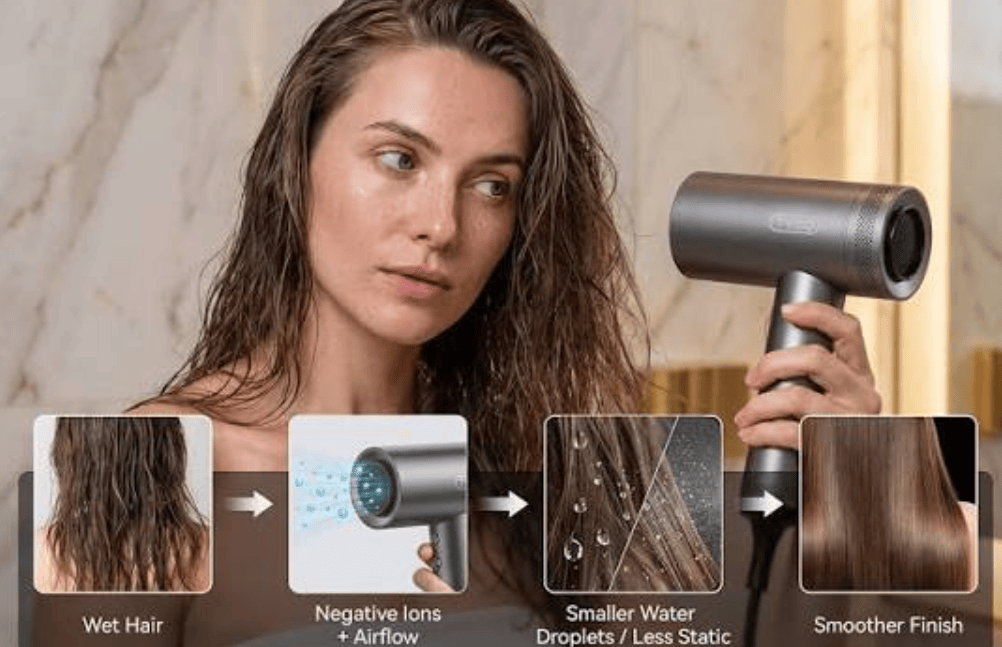
Other features in the HD5 target different aspects of the drying process. Static electricity builds up as hair dries and rubs against brushes and fingers, causing strands to repel one another and producing frizz. Ionic technology counters this by releasing charged particles intended to neutralise that effect, leaving hair smoother and shinier. The dryer also includes InfraCare, which uses light at a wavelength of 490 nm and, according to AENO, improves the texture and natural shine of hair over time. Automation extends to how the dryer behaves between uses as well. An auto start-stop function switches off the airflow when the dryer is placed on a surface and restarts it when it is picked up, which reduces energy use and wear on the motor during the frequent pauses of a styling session. Voice control lets users move between AI, Soft, Hot and Cold modes by speaking, which solves the practical problem of needing a free hand to press buttons.
Physical design plays a supporting role in making these features practical. Magnetic nozzles that rotate through 360 degrees can be changed quickly without tools, allowing users to switch between drying and styling tasks easily. A touchscreen displays all settings and gives live feedback on how the device is operating, making the automated decisions visible to the user. The dryer weighs around 600 grams, lighter than many professional models, whose extra weight can cause fatigue in the hand and arm during longer sessions. The HD5 is sold in black and other colours through AENO’s retail partners in several countries.
The product also illustrates a broader trend in consumer technology. A company spokesperson observed that good styling used to depend on either personal skill or a visit to a salon, and described the HD5 as a device that makes those decisions itself by adapting to the person using it. The same idea underpins much of AENO’s wider product range, which includes robot vacuums and kitchen appliances alongside personal care devices. The company focuses on building smart sensors and automation into products that have traditionally been operated manually, with the goal of making advanced technology simpler and more affordable. According to the report, the HD5 has already drawn interest from retailers and reviewers in Europe, largely because it combines AI-based automation with a price well below that of established salon brands. For students of technology and product design, it is a useful example of how relatively small sensors and control algorithms can transform a familiar everyday tool.
What’s the best way to explore a new city?
View all responses


You must be logged in to post a comment.