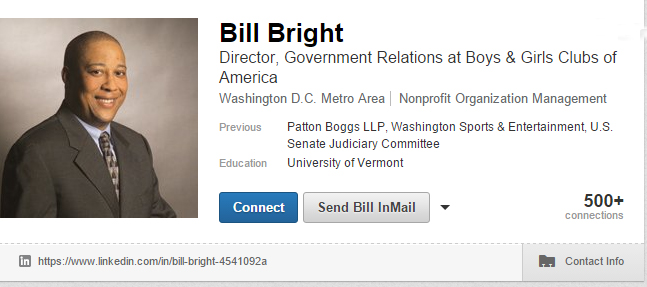
Alumni Advice: Bill Bright on the Art of Networking and Selling Yourself

Bill Bright’s passion for education, politics, and youth development runs in the family. His mother, Louvenia Dorsey Bright, was the first female African American to serve in the Vermont legislature. His father, William Bright, was a professor and served as interim dean of the UVM College of Education and Social Services.
uvm-alumni-adviceThe UVM alumnus, who graduated with a degree in political science in 1991, is the government relations director for the Boys and Girls Club in Washington, DC. After working for Sen. Patrick Leahy right out college and later as a lobbyist for 12 years, the South Burlington native decided to shake up his career in 2012 and move things in a new direction.
Changing his career three years ago was far from easy. We talked to Bright about the challenges he faced in finding a new job and what he learned along the way.

You studied political science at UVM and went on to work as a legislative aide and lobbyist. Did you know as an undergraduate that you wanted to do legislative and policy work?

It wasn’t necessarily a plan. My parents were active politically, but I got my first taste of politics while attending Boys State in high school, and then I interned for Senator Leahy while in college. I wasn’t sure what I was going to do, but Washington, DC, was a place I wanted to explore, and working in politics was a way to do that. I actually considered going to law school.

You then made a change in 2012 and became director of government relations for the Boys and Girls Club of America. Why did you decide to make this career transition after so many years as a lobbyist?

the-art-of-networking

Bright started his career in Washington, DC. (Photo: Flickr)
I never ended up going to law school, and without a law degree, I wasn’t seeing opportunities to move or grow up as a lobbyist at the law/lobbying firm I worked for, which was changing into a more true corporate law firm environment.
I liked what I did, and I was a good lobbyist. But I wasn’t happy with the types of clients I was working with anymore. At that point, I was sort of going through the motions, and my opportunities were dwindling. That made me step back and ask myself, What are you doing in Washington? What do you want? I had to re-evaluate what I was doing.

After working for a law/lobbying firm for a dozen years, did you feel a bit rusty when you decided to make a change?

It took me a while to re-acquaint myself with the process of the job search, from networking to interviewing. I had a career coach who helped me through some mental blocks, such as getting stuck on how to articulate concrete examples of professional successes. Once I was able to tease out key points and work through the narrative to sell myself, it became much easier.

How important was networking to finding your job at the Boys and Girls Club of America?

the-art-of-networking

Bright would cold call new contacts before emailing them.
Networking was crucial. I was moving into youth development, and it was a new area for me. I had to look at my network of contacts differently and figure out who – and how – those people were connected. You really have to work your existing network to then build your network.
For example, each time I met someone from my network, I would ask for a name of someone else I didn’t know, and I would then contact those people – sometimes with an introduction, sometimes with a cold call.
If I got their voicemail, I would leave a message and follow up by email. But I would always call first because I needed a voice and to be a real person to them.

Was that intimidating?

It was hard. For the most part, people were helpful and willing to chat. Still, not everyone wants to meet in person, and not everyone is going to respond or call back.

What advice would you give to someone looking to change careers or find a new job?

Get your resume and your narrative straight. Be ready to give specific examples of what you’ve referenced on your resume. Also, tailor your resume based on the job you’re seeking. I had five versions of the same resume.
When I was interviewing for my job at the Boys and Girls Club, I had to think about my experiences in a different way. I had to ask myself, How am I selling myself to this organization? On my resume, I would add four to five bullet points highlighting my successes that were directly relevant to the job description, and I developed narratives and examples to back them up.

How long did your job search take?

I was looking for seven months before I found the Boys and Girls Club job. My current boss was one of the first people I met with when I was building my network.

Could you share some mistakes you’ve made in your career and lessons you’ve learned along the way?

I don’t think there is necessarily a right path to a particular job or profession. My career path is not an obvious, straight thing. Sure, it looks linear and seems to all fit together. But when you look right below the surface, things are all over the place. The right career is the one that gets you to the job you’re looking for.
In addition, when you’re making a transition, be cognizant of your own professional development and how the next position helps move you forward. Companies are acting differently with employees these days, and they’re not as committed or loyal. So you have to own your professional development and build your network with an eye toward the future

Business of Craft Beer Certificate Sets Sights on Industry Growth

For the first time since 1873, there are more than 4,000 breweries in the United States, making the craft brewery market more competitive than ever. To succeed in the industry, the common denominator is a high level of craft beer knowledge and business acumen.
UVM is offering a new online Business of Craft Beer Professional Certificate Program in February with three career tracks: digital marketing, sales, and business operations. These areas reflect growing job trends in the craft beer industry. Of all job openings in the industry between August 2013 and July 2014, 87 percent required skills in sales, marketing, or business operations; only three percent were in brewing, according to data from Burning Glass Labor Insight TM.
“People in the craft beer industry are more innovative and business savvy than ever,” says Gregory Dunkling, program director of the UVM Business of Beer Program. “One of the things our program will do is help professionals outside the industry gain a better understanding of what it takes to succeed in today’s competitive craft beer market. We can help those people get their foot in the door, and also help those already in the industry advance their career to the next level.”

An Option for Apprenticeships and Career Coaching

Apprenticeships and career coaching make UVM’s program unique. This is the only program in the country that incorporates industry apprenticeships to gain on-the-job experience. UVM has entered into agreements with breweries and distributors to set up apprenticeship opportunities for participants. Apprenticeship partners include von Trapp Brewing, Harpoon Brewery, Whetstone Station Brewery, Sheehan Distributors, Farrell Distributing, the Massachusetts Beverage Alliance, and Craft Brew Alliance.
The career coaching option offers a job-search strategy that translates participants’ newly acquired skills into a full-time job or apprenticeship. While securing an apprenticeship is the responsibility of each participant and is not guaranteed, the career coaching option will provide substantial support along the way.
UVM’s Business of Craft Beer Certificate Program was developed in collaboration with the Vermont Brewers Association. The program is for those looking to start a brewery, those who work in sales, marketing, or operations and who want to move into the craft beer industry, as well as craft beer industry professionals seeking career advancement.
Most students will complete Fundamentals of Craft Beer in a 12-week online course, followed by a selected career track: business operations, digital marketing, or sales in craft beer.
The program offers three entry dates per year in February, May, and September. For more information, visit learn.uvm.edu/craftbeer.
*Photo courtesy of von Trapp Brewing

Women in Craft Beer: Celine Frueh Shares 5 Ways To Land a Brewery Job

By Tera Dacek
To have great beer, one may argue that you must have a great brewer. To run a great brewery and develop a strong brand, then you would also need great employees who are the perfect blend of qualified, passionate, and hardworking, right?
To test our assumptions, and to round out our final blog post in a four-part series on women in the craft beer industry, we reached out to someone who probably sees many résumés every day: Celine Frueh, human resources director at Allagash Brewing Company, in Portland, Maine.
Celine has worked in Human Resources for 17 years and has been a craft beer enthusiast since her college days. The amazing beer and the dynamic group of people drew her to jump at the opportunity to be a part of Allagash. She has now been with the brewery for 3½ years.
We asked Celine to provide us with her top five reasons a craft brewery should hire you, as well as a few no-nos. Of course, there is never a guarantee, but we will jump at receiving a few hints anytime.

Top 5 reasons why a craft brewery should hire you:

You like to work really hard. There is nothing glamorous about working at a brewery. It is a true labor of love and team effort to make consistently high-quality beer.
You are familiar with the brewery and our beer. You have tried a few different types of our beer and can articulate what you like about them. Knowing a bit about what makes our company unique is a bonus.
You are passionate about something in your life. It could be beer, or it might be music, skiing, art, your family, or your dog. It matters less about what it is and more about your energy when you describe it. We want people who are positive and who can bring that outlook to their work.
You are humble. You love beer, but you don’t claim to know everything about it. Our brewmaster would fall into this category—he knows a ton about beer but would never try to one-up anyone in a conversation.
You have a sense of humor. Life is never perfect, here or anywhere else. The ability to laugh through the harder days is a saving grace.
As promised, here are a few ways to really spoil a first impression:
Don’t send a bad cover letter. It sounds basic, but we put a lot of stock in a good cover letter. If you don’t take the time to tell us why you want to be considered for a position at Allagash, that is an automatic disqualifier. Show you care by double-checking the spelling—especially as it relates to our brewery’s name. Also, don’t ramble on about yourself; show us that your skills and our needs line up.
Don’t dwell on your current job and how much you hate it. We get it—not every job is not the greatest. But if you choose to share how your boss is the worst and you need to get out of there, it comes across as really negative. It makes us worry that you will have trouble getting along with your co-workers or managers.
Tera Dacek is a consultant and freelance writer. She most recently worked as Marketing Manager for Alchemy and Science. When she unplugs, she can be found at her local mountain or one of the many wonderful breweries in her home state of Vermont

Alumni Advice: Amelia Gulkis on Creating Your Own Success

A chance interaction changed the course of Amelia Gulkis’s career.
The UVM alumna, who graduated in 2001 with a degree in history, is now the chief operating officer of EnSave, an agricultural energy-efficiency company in Richmond that helps clients from around the country.
After earning her degree, Gulkis worked as a development researcher for UVM Medical Center before landing a job in 2004 at EnSave as a proposal writer. Gulkis learned about the unadvertised writing position at EnSave from a colleague in a book club. That colleague also sat on a local nonprofit board with EnSave president Craig Metz. For Gulkis, that connection changed everything.
“It’s so interesting that so much hinged on that interaction,” says Gulkis, who describes herself as an introvert. “I always think back to that, and it’s a strong lesson about what can come from networking and talking to people.”
uvm-alumni-adviceGulkis was named COO of EnSave in 2010. The company has 22 employees and more than 200 subcontracted data collectors around the country.
For our Alumni Advice series, we talked to Gulkis about what makes a good manager, questions she asks during an interview, and career lessons she has learned along the way.

As a chief operating officer, you clearly have some experience in management. What are two or three of the most important qualities a manager should have?

My job requires some personnel management, and these days I am fortunate to work with a strong team that helps me manage other staff and contractors. That said, I think a manager should be fair. You should be even-tempered and empathetic, but not let your emotions run the day. You’re not always going to be the most popular person in the office. A good manager is focused on helping others find solutions or remove roadblocks. Your job as a manager is as a facilitator to help others solve problems rather than thinking you have to solve every problem alone.

What qualities do you look for in a job candidate?

At the end of the day, someone’s attitude is more important than skills. You can always learn skills, but I look for a good attitude—someone who is committed to growing themselves and the company. How engaged is this person? Is the candidate interested in what he or she is doing and enthusiastic?

What are some questions you ask during a job interview?

One question I’ve been asking is, “If you were to come in next week and start this job, what would your approach be to learn about the position?” I ask this because as much as we have a training plan, success really depends on their ability to take ownership of their training. This question also gives me insight into their organizational approach and how much they can take on themselves.

What are some mistakes you see people make during the job search/interview process?

I’m always amazed that there are standard things about job searching that people don’t follow. For example, you need to proof your résumé, dress well for the interview, not be late, and send a thank-you note. Also, make sure you have questions for the interviewer. These are basic things you need to know for the job interview process. When I was looking to transition from UVM Medical Center to EnSave, I got plenty of rejections. Still, I always made sure to put my best foot forward.

What do you look for on a résumé?

It seems like the one-page résumé has gone by the wayside. When I see things go beyond two pages, especially with recent grads who don’t have much work experience, it begs a couple of questions. First, are they not able to edit down their work experience and highlight the most important points? Or do they think they need to use all that space because they have an inflated sense of accomplishment?

What about a cover letter?

A cover letter is more important to me than someone’s résumé. A cover letter is the creative side of the process and the person’s opportunity to tell me a story about why he or she should work with us, while a résumé is just the facts. I think people overlook the power of the cover letter.

Could you share some lessons you’ve learned in your career?

Whenever I put myself beyond my comfort zone, it’s benefited me. I always have to remind myself of this because it’s easy for me to keep doing my favorite things, but then I never grow and change. These days, I can be so busy with the day-to-day work that I have to make a conscious effort to set some goals for myself in addition to the goals I set for the company.

What would you say to a recent graduate feeling discouraged by the job market?

Before you get discouraged, do a reality check of sorts. Have people take a look at your résumé. Also, I think people are looking for the perfect fit right off the bat and coming out of school with pretty high expectations. I encourage people to focus on a job and get themselves into a company or organization. Delve into something, be as valuable as you can, and set yourself apart. In many ways, work is what you make of it.

Networking is clearly important and had a big impact on getting your foot in the door at EnSave. What advice would you give to people who might find networking difficult?

Networking can definitely be hard. It’s about getting out there and meeting people outside of your circle. For introverts, networking doesn’t have to be as forward as it sounds. Just being in the room with a professional group is a start because you’re benefiting from being around other people and making your presence known. Over time, you can build connections and start to feel more confident. Even if you don’t meet many people at an event or meeting, it’s worth it. Over time, you’ll make new connections and feel a difference

How to Be Successful in Sales

Closing the deal is what Joe Candido loves most about being in sales. The rush of signing a new prospect or selling a product makes his job feel meaningful and rewarding.
Joe_CandidoCandido, who is president of Fifth Element Associates, a Colchester-based research, marketing, and sales consultancy firm, is a seasoned sales professional with more than 30 years of experience working with multinational corporations, regional companies, and nonprofits.
His secret to success? For Candido, it’s all about time management and building relationships.
We talked to Candido, an instructor in UVM’s Collaborative Selling Professional Certificate Program, about what it takes to make it in the world of sales.

Sales is more complicated than it was 20 years ago. What kind of business sense do you need to be in sales?

Today, salespeople need to have a very strong business acumen. They need to understand finance, their customer’s business, the competition, the market, and a wide range of internal factors such as product pricing, margin, features, and value proposition. If you’re selling beer to a restaurant, for example, you can’t just go in there and say you have a great-tasting beer. You need to have a strong understanding of that restaurant’s business, their customers, and their needs.

What are some of the qualities you need to be effective in sales?

You need to be a problem solver. You have to know the problem your customer is having and work collaboratively with them and your company in finding a solution. Your customer needs to be shown the merit of what you’re recommending. You have to be smart, do your homework, and be disciplined.
I think most successful salespeople are good time managers. The average salesperson spends only about a third of his or her time selling. if you’re not vigilant, you won’t spend enough time selling, which means you won’t be successful. Compare that to the great salespeople who spend 50% or more of their time selling.

If one-third of a salesperson’s time is spent selling, what is he or she doing the rest of the time?

You’re spending your other time developing solutions and planning. You have to work internally with your company to determine things like a pricing model, credit checks, and intervals of delivery. You have to come up with a solution that works for everyone.
In order to be effective and efficient, your time should be spent on account planning and call planning. You want to look at your sales territory and accounts and make sure your level of service is appropriate. Without planning, you become highly reactionary and you’re just putting out fires. You also want to keep on learning about your product to stay current and research prospective customers.
You also want to figure out the right person to call and why, and figure out how to differentiate yourself. Ask yourself, “What do we bring to the table that no one else brings?” That’s smart selling. Otherwise, you’re basically just doing the equivalent of dialing for dollars.

Do you need to be an extrovert to be successful in sales?

I used to buy in to all those assumptions that I would be good at sales because I had an outgoing personality. I thought sales would be easy for me because I had the right personality. But I eventually learned that all kinds of personalities succeed in sales. It was a real eye-opener to see people who were on the introverted side be better at sales than me.

What do you love most about sales?

I love closing and I love getting the deal. It’s a rush. If you’ve done your job, then you know you can help the customer. Most of selling is building relationships and building trust. Customers are looking for salespeople who believe in the solution they’re proposing.

Why are relationships so important in sales?

Relationships are very important in sales because you need to establish trust and good communications. Customers buy from you because they trust you. It’s not about liking you; it’s about trusting you

Where The Mind Is Without Fear

Where the mind is without fear and the head is held high
Where knowledge is free
Where the world has not been broken up into fragments
By narrow domestic walls
Where words come out from the depth of truth
Where tireless striving stretches its arms towards perfection
Where the clear stream of reason has not lost its way
Into the dreary desert sand of dead habit
Where the mind is led forward by thee
Into ever-widening thought and action
Into that heaven of freedom, my Father, let my country awake.

Study the Latest Advances in Medicine at UVM’s Summer Academy

High school senior Carter Visicaro is setting his sights on becoming a pathologist.
The Vergennes High School student has always wanted to work in medicine, and participating in UVM’s Summer Academy’s Health and Medicine course helped him decide what he really wants for a career.
college prep classes

Carter Visicaro
“I’ve always wanted to be in the medical field, and Summer Academy help me realize where I wanted to land. It made me realize I want to be a pathologist,” he says.
The Health and Medicine course exposes students to the world of modern medicine and bioscience through active learning in labs, lectures, demonstrations, and hospital visits.
The course, which runs July 7 to Aug. 2, 2019, is part of UVM’s Summer Academy, a four-week residential and online program offered to high school juniors and seniors who want to explore areas of study and earn transferable college credit.
Health and Medicine students learn in the Larner College of Medicine’s academic facilities, including the Clinical Simulation Laboratory, where students perform virtual medical procedures. The program helps students discover their interests, learn about the latest advances in bioscience and molecular medicine, and develop an understanding of diverse medical and health science career paths that might be right for them.
Noah Fryou, a senior at Lexington High School in Massachusetts, is interested in studying pre-med when he heads to college this fall. He hopes to eventually become a physician assistant (PA) or surgeon. He attended Summer Academy last summer to learn about what kinds of medical careers he could pursue.
“The Summer Academy program seemed to be the most dynamic and was the best fit for me,” Fryou says. “It was more academic than some of the others I had looked into, and it was a good way to get hands-on experience in the labs.”
college prep classes

Noah Fryou
Fryou, who underwent a series of surgical procedures as a child, has a special appreciation for the medical field.
“The marvels of science and medicine have made me interested in this field for a long time,” he says. “It’s just amazing what we can do now.”
Students in the Health and Medicine program engage with experts in genomics, cancer research, medicine, nursing, and allied health practice on the latest advances in their fields. Students will interact with clinical and scientific faculty who train the University of Vermont medical students in the College of Medicine, known for being one of the most competitive and successful medical schools in the country.
For Visicaro and Fryou, the power of making a difference in people’s lives is the main reason they want to work in medicine.
“I’m doing this because I want to know, at the end of the day, that I helped someone,” Visicaro says. “I want to be able to help people in a serious and deeper way.

WHY ATTEND A CAREER FAIR

Career Fairs can be a helpful strategy for looking for internships or jobs. Here’s why you want to consider attending:
** Good way to learn about companies—Think of the career fair as a great way to explore and learn more about companies that will be a fit for you and that you may not have previously heard about.
**Puzzled about what you want to do? —By talking to employers you will get ideas about the type of companies that interest you. For example, if you have thought about working for a non-profit, but are unsure if this is right for you, introduce yourself to a non-profit employer and ask what they like about their work.
**Opportunity to talk with employers—Career fairs are a good way to get more comfortable speaking with employers so that you will be more confident and assured when you get an interview.
 **Give your resume to a person—Tired of submitting your resume online and not getting a response? A career fair is a chance to hand your resume to an employer and ask questions.
**For more ideas attend Prepare for the Fair: Career Fair Prep Workshop, Feb 20 1- 3pm– Anderson Academic Commons 290 and 340, The Hub, Leo Block Alumni House Drop-in on your way to the fair at any of the locations to practice your “elevator pitch” and get additional tips from professionals on how to get the most out of your career fair experience.

Cooking Up Job Satisfaction

As a college student, especially those close to graduation, there is a lot of pressure to get a job. People are always asking, “Have you found a job?”, “What are you doing after graduation?” or “How is the job search?” Due to this pressure, many new graduates will accept the first job offer they receive, but may not be a wise choice. Why you ask? The job may not be the right fit.  You might not enjoy this job, and within 6 months to 1 year you are already trying to search for a new role. I think having an idea of what will keep you happy at a job is just as important as finding a job. Job satisfaction will make you a better employee and allow you to have a better life, and that’s what we all want right?
So today I have created the recipe for job satisfaction.
Ingredient List and Directions
  • 1 or 2 degrees from a top institution in the country
  • Stir in your skills, interests, values – Find a role where your skills will shine, and you are excited to be there.
  • 1 Cup ideal work environment – This can change per person. Think about what will satisfy you every day. Do you want to work individually or with teams? What does the physical office, structure, lab, etc look like? What are your co-workers like? Do you want people who share the same interests and lifestyle, or are you looking to broaden your horizon by engaging in an entirely new culture?
  • A dash of humor – Who doesn’t want to laugh at work?
  • 3 ping-pong tournaments – Are perks like this something you desire? Many companies now have similar incentives. Free snacks, yoga classes, bringing your dog to work, or a coffee bar.
  • 20 DU Alumni – Recently the Career Center staff visited Denver based Four Winds Interactive, this innovative company has 20+ DU alumni who have created an alumni chapter at work. They even hold social events after work. Find a place where you feel like you belong.
  • Add $$$ – What is the right salary for you? Ideally we will all get paid more than we need but accepting the first job that comes along may not allow you to live within your means. Do some research on the city you are living in, how much will you need? $40,000 in San Francisco, CA is not the same as $40,000 in Columbus, OH.
  • Mix in a great leader – What does leadership mean to you? Do you value autonomy and ownership over your work? Do you need to feel like you are making an impact?
  • Sprinkle some desire – Do you believe in this organization? Are you a “company woman/man”? Can you stand behind your work and be excited to share what you do?
  • Cook for 20+ years at 40 hours a week
Enjoy!
I hope this helps you grasp what it means to be satisfied at work, and allows you to begin thinking about what you want out of a career and what will keep you engaged and satisfied every day!

Sustainability Professionals to Visit DU for Networking @ Nite!

Are you registered for Networking @ Nite? If not, you might want to see who’s coming and sign up!
Career & Professional Development has been working closely with our friends in Natural Sciences & Mathematics, and in alumni relations, to bring you a group of awesome, fun, talented people for you to meet at the end of the month! It’s not often that we are able to bring in a group of alumni who are making an impact on the world through sustainability in such diverse ways. We have an amazing group!
Have you heard of the Alliance Center?
It’s a beautiful, sustainable space (1908 Otero Building) that brings together climate, energy, and sustainability professionals to address issues relating to climate change and designing a more sustainable world. It’s a business incubator that brings in local organizations to innovate, collaborate, and make an impact.
Sounds like a pretty neat place to do an internship, doesn’t it?
Not convinced? Well, is water analysis something that interests you? Have you heard of Hach, a company that focuses on producing instruments to provide better, faster, and more informative analysis of our water supply?
We have someone from the Alliance Center AND Hach joining us at Networking @ Nite! Yes, you have the opportunity to learn more about this exciting organization and practice your “talking to really cool strangers” skills on February 28 from 5:00-6:30pm in ECS 510!
(P.S. Trout Unlimited, which aims to conserve our coldwater fisheries, is also joining us…)
Registration for this exciting event is slowly coming to a close, with just a few spots left, and you won’t want to miss this opportunity! We had the chance to extend student registration from 15 to 20 students so be sure to claim your spot today, or be sure to snag a spot on the waitlist in case we are able to bring in a few more students!
Whether you are exploring careers in the sciences, or seeking an internship for this summer, it’s never too late to get out there and start chatting with folks.
This is not a career fair, or an incredibly formal business-like event. It’s simply an opportunity to bring a bunch of fun scientists together, who are stoked to meet you.
Register today at du.edu/pioneercareers under the “Events” tab! (“Networking @ Nite”).

So…You Don’t Want to Go to Medical School?

The dreaded decision for any pre-health student is whether or not to pursue the health professions (particularly medicine) when times get tough. In many cases, pre-health students have always wanted to be a physician, nurse, pharmacist, or PA and help people through healthcare. Before coming to DU, I advised Pre-Nursing majors and had many conversations with students about why they wanted to go into nursing. I heard compelling stories that started from childhood and highlighted an unwavering desire to pursue one particular specialty within the nursing profession. This career goal led students to structure their academic lives around, say, neonatal nursing; that is, until they had the chance to volunteer or shadow in the NICU.
There are many factors, both inside and outside of the classroom, that cause students to question their career goals, but one of the most challenging conversations around career exploration often happens after doing an internship, shadowing, volunteering, or conducting informational interviews. It can be devastating to pursue an experiential learning opportunity in the field that has captured your heart for so long, only to find that it wasn’t what you thought it might be.
Have you ever experienced this? It’s frustrating. It can make us feel lost. “Where do I go from here?” was often a question that students leaving the Pre-Nursing major would ask me. Fortunately, there are many options to help people and make an impact on the world through healthcare that don’t require medical school; some paths don’t involve continuing your education at all. I will be hosting a mini-course this spring, designed around supportive and intentional conversations about career exploration in the world of healthcare. This isn’t a credited course and it’s not like other courses you may have taken – it will be heavily focused on discussion, exploration, and support.
The mini-course will take place in ECS 357 (or outside, but we will always meet in our classroom first!) for the first 4 Tuesdays in May, from 3:00-3:45pm.
In this mini-course, students will:
  1. Get to the heart of why they are interested in medicine (or anything in pre-health) through guided self-reflection;
  2. Learn how to uncover DU alumni in healthcare and ways to connect with them directly;
  3. Support one another in the exploratory process and use this course as a means for challenge, empowerment, and enlightenment.
I hope you will consider joining us! You can RSVP via Pioneer Careers; be sure to register for all four sections

Bloom’s Taxonomy Across Stages of Language Acquisition

Bloom’s Taxonomy Across Stages of Language Acquisition
Levels of thinking and language functions
Level of thinking and academic language move from concrete recall to more complex and more abstract in any undertaking.
Language use across stages of second-language acquisition
Moves from simple to complex in grammatical tenses, forms, vocabulary, etc.
Preproduction:
(Level 1)
Nonverbal response.
Early Production:
(Level 2)
One-word response.
Speech emergence:
(Level 3)
Phrases or short sentences.
Intermediate fluency:
(Level 3)
Longer and more complex sentences.
Advanced fluency:
(Level 3)
Near native-like.
Creating
Appraise, argue, assess, choose, compare, defend, estimate, judge, predict, rate. select, support, value, evaluate
Teacher mismatches animal with its environment and asks: Is this the right environment? Find the right environment.
What are the best materials for the duck to build a nest?
What makes a good home for a bear?  (Examine settings and evaluate: “A cave makes a good home.”)
What would happen if you put a worm in the desert?
Recommend a different environment for a mother duck to raise her ducklings.  Defend your choice.
Evaluating
Arrange, assemble, collect, compose, construct, create, design, develop, formulate, manage, organize, plan, prepare, propose, set up
Point to the animals that live in the soil.
Say the names of the animals that live in the soil.
How could you change a scorpion so it could swim?
What would a camel need to survive in the desert?
How would you protect the wildlife in a forest where hiking was popular?
Analyzing
Analyze, appraise, calculate, categorize, contrast, criticize, differentiate, discriminate, distinguish, examine, experiment, question, test
Show me an animal that cannot lie in the forest.
Name the parts of a fish that help it live in the water.
How are raccoons and squirrels the same?  How are they different?
How does a bear use its claws to catch fish?  Gather berries?
Why do you think a bear hibernates in winter?
Applying
Apply, choose, demonstrate, dramatize, employ, illustrate, interpret, operate, practice, schedule, sketch, solve, use
Show me what would happen I we put the fish in the desert.
Tell me what would happen if we put a fish in the desert.
How could you change the body of a fish to make it fly?
How would you capture and transport scorpions to a zoo?
How would a deer camouflage itself in the forest in winter?  In the desert?
Understanding
Classify, describe, discuss, explain, express, identify, indicate, locate, recognize, report, restate, review, select, translate
Show me where a deer lives.
Tell me which animals eat meat.
Why is a toad the color it is?
Explain how a snake catches its prey.
Why do fish need gills to live in the water?  How do gills work?
Remembering
Arrange, order, define, duplicate, label, list, name, recognize, relate, recall, repeat, reproduce
Where is the raccoon?
What is the name of this animal?
What are the body parts of a turtle?
Give the definition of a mammal.
Tell me everything you know about a clam.
Source: Adapted from Bloom’s TaxonomyHalliday’s language Functions, and Krashen’s Stages of Language Acquisition.  Contributors: Mike Gaddis and Cynthia Bjork.  As shown on the Journal of the National Staff Development Council, Winter 2008.                    

What Does a Day in the Life of a Paralegal Look Like?

Recent grad phone interview
From drafting correspondence to performing legal research, the life of a paralegal can be quite different from one day to the next. Despite these differences, most paralegals do a combination of the following things.

Conducting legal research

One of the most important tasks in any legal department is to conduct research on specific cases and legal precedents. This includes looking at court decisions that are relevant to an ongoing case and gathering information about those decisions such as what parties were involved and why the court decided to rule a certain way. Because of its importance, research is usually one of the biggest components of a paralegal’s work and tends to account for a large part of their day.

Interviewing clients

Another important component of legal research is to interview clients about their cases. This includes gathering general information about clients and their cases and also discussing more detailed elements of those cases such as the events that took place on a particular day. By conducting these interviews, paralegals are able to identify key facts that they can then pass on to the more senior legal team who can determine the best way to use them during legal proceedings.

Writing reports

In addition to conducting research and interviews, paralegals are responsible for gathering that information together into concise reports which are used by attorneys when preparing cases and developing strategies for arguing those cases. These reports are typically structured to include the facts of a specific case as well as relevant legal precedents and court decisions pertaining to that case.

Drafting correspondence and carrying out administrative tasks

Paralegals are also responsible for drafting letters to clients, judges and other attorneys and carrying out administrative tasks such as scheduling and filing. These tasks combined are part of the general support paralegals offer to the legal team and can be vary greatly from one one day to the next.
An exciting and diverse career, being a paralegal is a great career path for recent grads who are interested in working on a legal team. The best way to find out if being a paralegal is right for you is by interning with a legal department and getting a hands-on feel for the role.
Next, get more career tips for internships and entry-level jobs such as 3 Ways to Be More Productive at Work and find answers to common interview questions such as Are You Willing to Travel?

Job Offers: 6 Things to Consider

job offersCongratulations!!! You have a job offer.
Now what?
Job offers are exciting. You may have been through a grueling process and dozens of interviews before this offer arrived. But don’t accept it too quickly. Take some time to reflect and to review the offerYou will be spending a large number of hours at this job, so ask for a few days to review the offer. This will give you time to objectively decide if the job is a good fit for you. Here are a few points to consider:
  1. Salary: You will likely have to live with the salary for at least a year, so do your search on the salary range by checking with sites like salary.comsalaryexpert.com and glassdoor.com. If your offer is below an acceptable range, now is the time to negotiate. Attend a Job Offers and Negotiation Workshop on Thursday, April 28 to learn and practice negotiating. 
  2. Day-to-Day Work: Ask yourself if you are proud of the company, product or services provided by the company. Is the job interesting? Does the position fit with your career goals? Will you be challenged?
  3. Hidden Costs: Will you have a long commute? Need to upgrade your wardrobe? Be away from family and friends due to a lot of out-of-town travel?
  4. Benefits: A great benefit package can compensate for a lower salary. What is the health insurance plan and what percentage does the employer pay? Tuition reimbursement? What about employer contributions to a retirement plan? How much paid vacation and sick leave do they give employees? Some companies offer all of these and more, other companies offer very few benefits.  Decide what you or your family needs and consider these options carefully.
  5. Culture: Do you think that you will fit in easily? If not, are you willing to adjust? Is your supervisor interested in your growth and success? Are you comfortable with the management style?
  6. Consider Your Needs: Do you need to leave at a set time to pick-up a child from daycare or school? Do you need relocation assistance? Do you know what working hours are the norm in the office? Would you like to telecommute or do you need any physical accommodations made to your work space?