\’Should students be allowed to carry Mobile Phones with them\’ (290 Words)

The students of this generation want every gadget in their hands. They want to have the latest technology with them, and the first are mobile phones.

Nowadays, these are the most popular things to have. Even students are not able to escape from it.

Earlier, it was used to make and receive calls and send and receive messages, but nowadays students don\’t buy mobile phones for these purposes. They buy them to listen songs, to watch movies and videos, to play games etc. which hampers their studies. They listen audio with earphones which can cause a great problem in their ears as well as in their brains.

Every mobile has internet facility nowadays. By spending only few bucks they are able to get a multimedia mobile phone with every feature as well as with touch screen. Internet of the mobiles can be used by the students to gather some information which can help them in their studies, but they use this feature of mobiles to see the web pages which they should not see. They bring mobile phones to schools which is not allowed.

By calling and sending messages and using internet they waste a lot of money and pay the bill by wrong methods or the burden of the bill lies upon the parents. Mobile phones can also cause great damage when used while driving. Sometimes, they misuse the calling feature of the mobiles by making fake calls, which creates a problem in the work of the other people. The students use mobile phones to cheat while exams.

So what to do now? The answer is to stop the students from buying the mobile phones or the parents must not provide it to them. The main motive we have to follow is to save the future of the students going on wrong path. 
\’Should students be allowed to carry Mobile Phones with them\’ (290 Words)

The students of this generation want every gadget in their hands. They want to have the latest technology with them, and the first are mobile phones.

Nowadays, these are the most popular things to have. Even students are not able to escape from it.

Earlier, it was used to make and receive calls and send and receive messages, but nowadays students don\’t buy mobile phones for these purposes. They buy them to listen songs, to watch movies and videos, to play games etc. which hampers their studies. They listen audio with earphones which can cause a great problem in their ears as well as in their brains.

Every mobile has internet facility nowadays. By spending only few bucks they are able to get a multimedia mobile phone with every feature as well as with touch screen. Internet of the mobiles can be used by the students to gather some information which can help them in their studies, but they use this feature of mobiles to see the web pages which they should not see. They bring mobile phones to schools which is not allowed.

By calling and sending messages and using internet they waste a lot of money and pay the bill by wrong methods or the burden of the bill lies upon the parents. Mobile phones can also cause great damage when used while driving. Sometimes, they misuse the calling feature of the mobiles by making fake calls, which creates a problem in the work of the other people. The students use mobile phones to cheat while exams.

So what to do now? The answer is to stop the students from buying the mobile phones or the parents must not provide it to them. The main motive we have to follow is to save the future of the students going on wrong path. 
Short Paragraph on \’Binoculars\’ (85 Words)

The \’Binoculars\’ are an arrangement used for seeing distant objects erect. It consists of two telescopes fixed on the same frame for the two eyes. These telescopes produce an erect image of distant objects and have a sufficiently large field of view. Each telescope has two reflecting prisms in addition to an objective and an eye piece. The rays coming from a distant object suffer total internal reflection in the prisms and with the arrangement of an objective and an eye piece lense, the final image obtained is erect. 
 

Short Paragraph on \’Binoculars\’ (85 Words)

The \’Binoculars\’ are an arrangement used for seeing distant objects erect. It consists of two telescopes fixed on the same frame for the two eyes. These telescopes produce an erect image of distant objects and have a sufficiently large field of view. Each telescope has two reflecting prisms in addition to an objective and an eye piece. The rays coming from a distant object suffer total internal reflection in the prisms and with the arrangement of an objective and an eye piece lense, the final image obtained is erect. 
 

Short Paragraph on \’Binoculars\’ (85 Words)

The \’Binoculars\’ are an arrangement used for seeing distant objects erect. It consists of two telescopes fixed on the same frame for the two eyes. These telescopes produce an erect image of distant objects and have a sufficiently large field of view. Each telescope has two reflecting prisms in addition to an objective and an eye piece. The rays coming from a distant object suffer total internal reflection in the prisms and with the arrangement of an objective and an eye piece lense, the final image obtained is erect. 
 

Short Essay on \’Alexander Graham Bell\’ (120 Words)

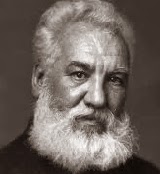
The inventor of the telephone, \’Alexander Graham Bell\’, was born on 3rd March 1847 in Edinburgh, Scotland. His father was Professor Alexander Melville Bell and his mother was Eliza Grace. He later settled in the United States of America.

Alexander Graham Bell was an eminent scientist, inventor, engineer and innovator. Throughout his life, Bell had been interested in the education of deaf people, as both his mother and his wife were deaf. This interest led to invent the microphone and in 1876, his \’Electrical Speech Machine\’, which we now call a telephone.

What followed after that is history. Bell Telephone Company (later AT&T) was set up in 1877, which grew to be one of the largest telephone companies in the world

Short Essay on \’Alexander Graham Bell\’ (120 Words)

The inventor of the telephone, \’Alexander Graham Bell\’, was born on 3rd March 1847 in Edinburgh, Scotland. His father was Professor Alexander Melville Bell and his mother was Eliza Grace. He later settled in the United States of America.

Alexander Graham Bell was an eminent scientist, inventor, engineer and innovator. Throughout his life, Bell had been interested in the education of deaf people, as both his mother and his wife were deaf. This interest led to invent the microphone and in 1876, his \’Electrical Speech Machine\’, which we now call a telephone.

What followed after that is history. Bell Telephone Company (later AT&T) was set up in 1877, which grew to be one of the largest telephone companies in the world

Short Essay on \’Alexander Graham Bell\’ (120 Words)

The inventor of the telephone, \’Alexander Graham Bell\’, was born on 3rd March 1847 in Edinburgh, Scotland. His father was Professor Alexander Melville Bell and his mother was Eliza Grace. He later settled in the United States of America.

Alexander Graham Bell was an eminent scientist, inventor, engineer and innovator. Throughout his life, Bell had been interested in the education of deaf people, as both his mother and his wife were deaf. This interest led to invent the microphone and in 1876, his \’Electrical Speech Machine\’, which we now call a telephone.

What followed after that is history. Bell Telephone Company (later AT&T) was set up in 1877, which grew to be one of the largest telephone companies in the world

Starting 2012 with a thought freedom of expression on the Internet

Is this a new year\’s resolution or just a considered way forward for 2012. I lost my way with blogging last year what with the Doctorate and one thing and another. So I have decided to post a blog about something at least once per week or whenever a item of interest – even if vaguely connected to education – comes up. So here is my response to the discussion facilitated by Hazel Owen about Wikipedia blacked out protest. She has lit my blogging fire so to speak after I discovered her blog at Ascilite 2011.

I have also signed the petition for a free and open Internet , and reject the ratification of the Anti-Counterfeiting Trade Agreement (ACTA), which would destroy it. This is open to anyone to sign via Avaaz.org

My response re an open Internet and freedom of expression
The idea of removing information because it is offensive for whatever reason is a tricky one. Well we already do it in society all the time – offensive human beings are removed to prison. This happens when the authorities get involved. When people act without involving the authorities people who offend also get removed, in one way or another. Vigilante behaviour is not favoured when it is against the law. Freedom of expression is important but offensive material and bullying behaviour via the Internet is not. I also don\’t agree with one group controlling the masses. 

To be effective people can learn to be assertive, ethical and responsible – and also may need to \’harden up\’ if others don\’t agree with them or challenge them. I believe that we learn appropriate behaviour best from our peers and by observing others. I believe that the Wikipedia model has shown us the power of networks in keeping things open and \’safe\’, and has done a great job in showing us how to \’share our toys\’ without throwing them out of the cot when things get sticky. Copyright does nothing in reality, but line the pockets of those who are probably already rich (in majority world terms) or have the money to sue – in contrast copyleft opens up a whole world of possibilities for anyone….if everyone plays fair and gives attribution where it is due. The question is how can we make enough money to live if we share our creativity freely with the world – or does this actually more likely our creative works will be seen, and we will make money anyway?

This is certainly a concern for educational institutions. Surprisingly enough sharing content and ideas can actually attract money. If an organisation is open and willing tio share, more people are given the opportunity to hear about what they offer. This can lead to more enrolments and opportunities for research and collaborative projects. My teaching materials are open on WikiEducator because it is important for me to model this to other teaching staff. Occasionally, someone comes along and contributes and adds to my work, and for me this adds richness to my work. I would love people to contribute to the Flexible Learning Guidebook, and this year I am going to use a student-generated model with the staff who take my course – this will be an interesting year.

What is Life Insurance?

\’Life Insurance\’ is a contract between the insurer and the insured. It pledges payment of certain amount to the person who is insured on happening of any event against him. The contract fulfils on the death, maturity or specified periodic intervals.

According to the Wikipedia

Life insurance or life assurance is a contract between the policy owner and the insurer, where the insurer agrees to pay a sum of money upon the occurrence of the insured individual\’s or individuals\’ death or other event, such as terminal illness or critical illness. In return, the policy owner agrees to pay a stipulated amount called a premium at regular intervals or in lump sums.


According to the Free Dictionary

Life Insurance- Insurance that guarantees a specific sum of money to a designated beneficiary upon the death of the insured or to the insured if he or she lives beyond a certain age.


According to the Your Dictionary

Life Insurance- Insurance in which a stipulated sum is paid to the beneficiary or beneficiaries at the death of the insured, or, if specified, to the insured at a certain age.

The Top 10 Best Life Insurance Companies in The UK. Definitive Guide 2020, at https://discountlifecover.co.uk/best-life-insurance-uk/ 

Short Article on \’My Life as a Teenager\’ (150 Words)

I am going to begin my real life out of the shell of security of my parents. What I know and understand about being a teenager is happiness, parties, friendship and attraction. But, what I am being told is that it is a period of life of rage and serenity. It is the delicate period of my life where I will be shutting between being a pampered child to being an adult of whom a lot is expected.

It will be difficult for me to understand the emotional and physical changes. I don\’t know how I will be able to handle the peer pressure but I will try to face all this with the support of my parents.

I hope that it will be a period which I will cherish and enjoy but within the limits, which if crossed then no Rama would come to save me from the clutches of Ravana. 

Short Article on \’My Life as a Teenager\’ (150 Words)

I am going to begin my real life out of the shell of security of my parents. What I know and understand about being a teenager is happiness, parties, friendship and attraction. But, what I am being told is that it is a period of life of rage and serenity. It is the delicate period of my life where I will be shutting between being a pampered child to being an adult of whom a lot is expected.

It will be difficult for me to understand the emotional and physical changes. I don\’t know how I will be able to handle the peer pressure but I will try to face all this with the support of my parents.

I hope that it will be a period which I will cherish and enjoy but within the limits, which if crossed then no Rama would come to save me from the clutches of Ravana. 

Can Maps Save The Planet? The Interactive Geography Of Crisis

Source: Loveland


Most famous maps capture a snapshot in time. Mercator’s Projection, Blaue’s Atlas Maior, John Smith’s Virginia — they all signal the cartography of an era. These geographies trumpet discovery and location. They welcome ornamentation. But they do not invite interaction. And they never change.

The blessings of technology today mean that maps now breathe in constant updates. The ability to track global changes and inform visual displays in real-time turns children and adults into earth monitors. Interactive geography provides unprecedented access to world data streams, such that humanitarian and ecological crises can be pinpointed in exact, colorful, dynamic degree.

The following resources have been painstakingly and brilliantly assembled by dedicated activists and educators. Each visual tool allows teachers, students, and viewers to explore past, present, and future conditions based on a host of critical criteria.

Flint Water Map


Source: Loveland


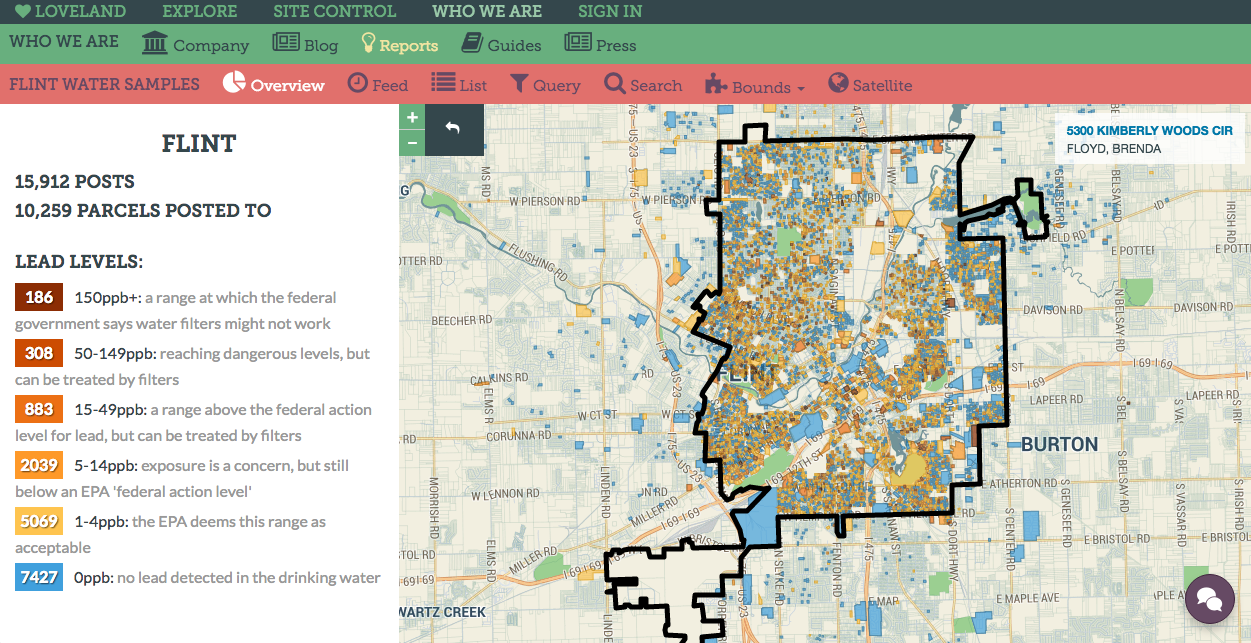
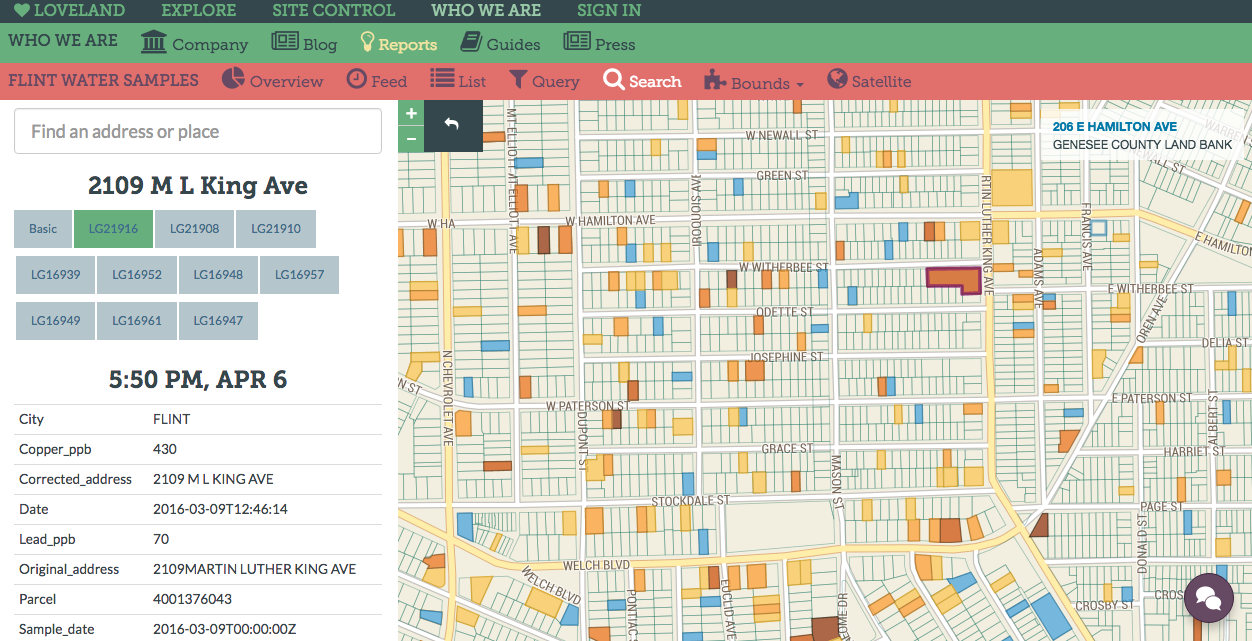
The Flint Water Map, by Loveland Technologies, provides a searchable database of 6000 residential lead samples from this hard-hit Michigan town. The relevant, valuable interface combines a color-coded visual field with a detailed, house-by-house catalog of lead testing results. The tool is easy to use for both Flint residents and interested students who are concerned about the state of localized health. It is a model of geographic action for public purpose.

Draining California


Source: National Geographic


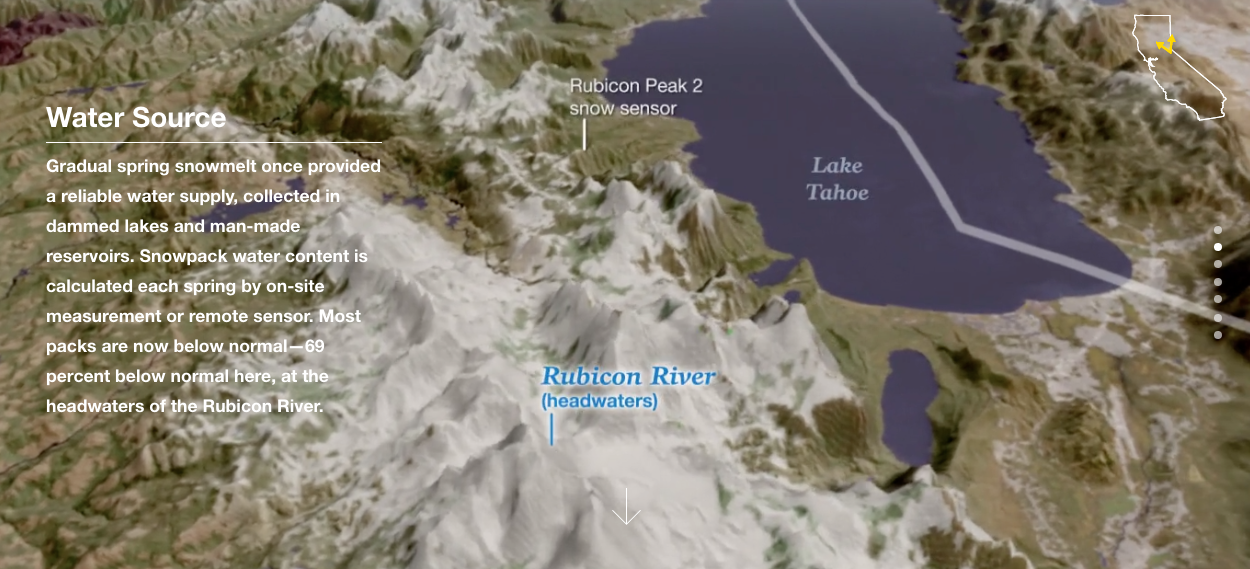
National Geographic has once again produced a stellar interactive about history and geography. This scrolling motion graphic traces the idiosyncrasies of California\’s water supply. It pinpoints the causes of the state\’s current drought, and it highlights the importance of groundwater, snowmelt, reserves, and cultivation in managing the pipeline to the people.

Global Forest Watch


Source: Global Forest Watch


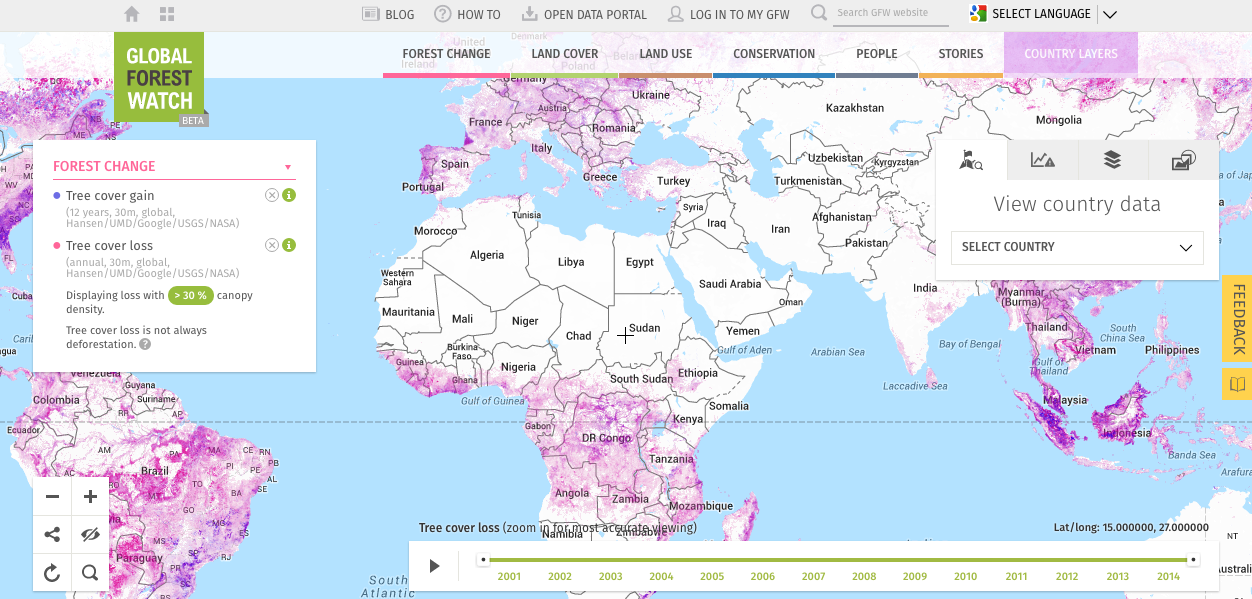
The highly customizable map by Global Forest Watch melds multiple data sources into one terrifically educational (and at times terrifying) survey of tree cover, land use, conservation, and population. The options are too many to list here, but they include Google Earth resolutions, specific country statistics, timeline progressions, and zoomable analyses. This is a great first landing site for teachers and students interested in displaying how the world\’s forests are changing over time.

World Air Quality Index


Source: World Air Quality


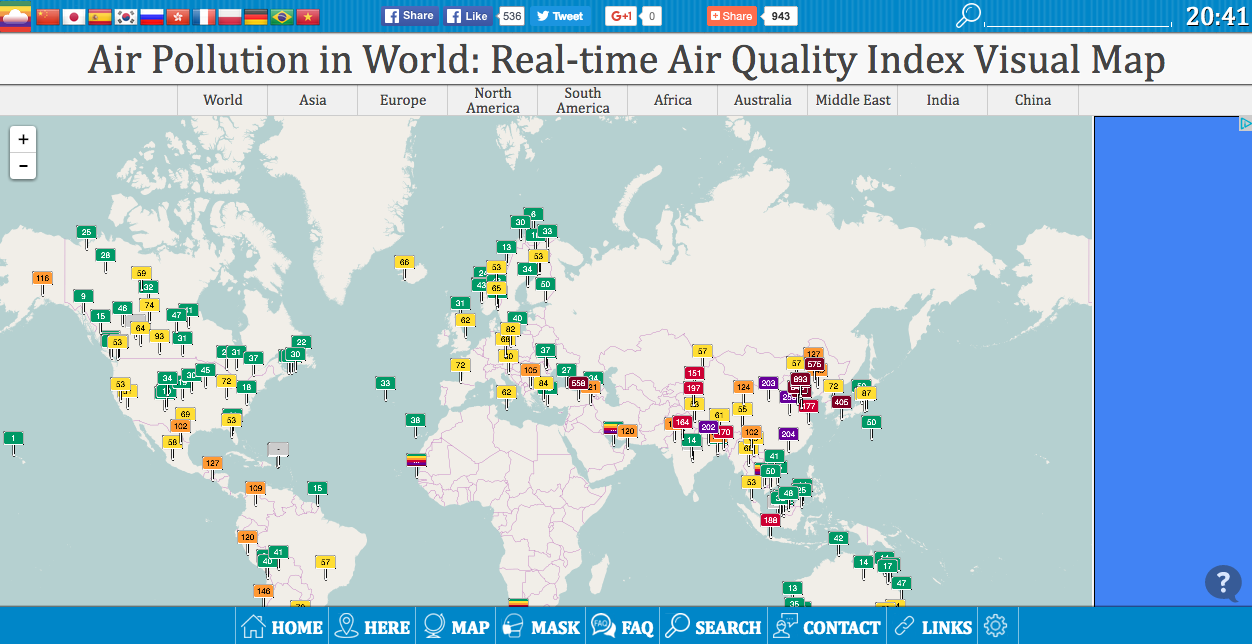
This index by World Air Quality employs an understated map of colored tags to let data be the star. Every flag reveals vital statistics for a global locale: the air quality index (AQI), air pollution level, health risks, and cautionary statements. Together, these figures furnish a revealing look at how atmospheric pollution can have concrete effects on the well-being of cities and citizens.

Unnatural Coastal Floods


Source: Climate Central


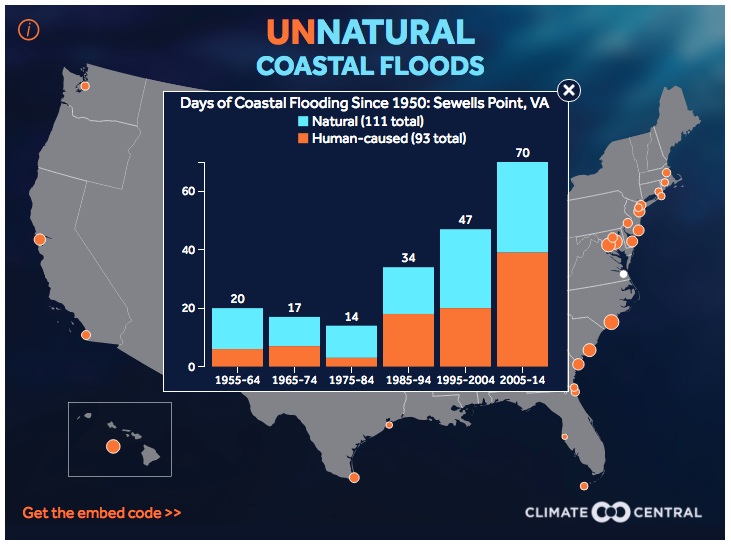
\”The Human Fingerprints On Coastal Floods,\” by Climate Central, is a compelling article that includes a clear interactive graphic about the flooding of American cities. The clickable map projects graphs of year-over-year increases in sea levels. For example, since 1950, parts of the Chesapeake Bay have seen water levels rise by a foot, directly due to human influence.

Climate Time Machine


Source: NASA


The Climate Time Machine from NASA is beguilingly simple at first glance. Upon deeper digging, though, the different interactives prove their complexity. The high-octane maps reveal historic transformations in sea ice, water levels, carbon emissions, and global temperatures. The site is a data gold mine of evidence to rebut those who claim that climate change is just unproven fear-mongering, rather than an immediate cause for concerted global action.

Short Biography of ‘Jai Prakash Narayan (JP Narayan)’ (200 Words)

‘Jai Prakash Narayan’ was born on October 11, 1902 in the village of Sitabdiara, Bihar, India. His father’s name was Harsu Dayal Srivastava and mother’s name was Phul Rani Devi. His father Harsu Dayal Srivastava was a junior official in the State Government Department. He was married to Prabhavati Devi in 1920.

Popularly known as ‘Lok Nayak’, Jai Prakash Narayan was a great freedom fighter and political leader. He was a leader (Nayak) of the people (Lok). He was dedicated social worker and took part in the Bhoodan Movement to give land to the poor and landless people of India. He is remembered especially for leading the opposition to Indira Gandhi in the 1970s and for giving a call for peaceful Total Revolution. He was an author too. His essay, ‘The present state of Hindi in Bihar’ won a best essay award. Lok Nayak Jai Prakash Narayan was awarded posthumously India’s highest civilian award, the ‘Bharat Ratna’ in 1999. He was also awarded by ‘Ramon Magsaysay Award’ in 1965.

Jai Prakash Narayan died on 8 October 1979 in Patna, Bihar, India. He was a great Indian Hero and will always be remembered as the true patriot and sarvodaya leader of India.  

Short Essay on ‘Jai Prakash Narayan (JP Narayan)’ (200 Words)

‘Jai Prakash Narayan’ was born on October 11, 1902 in the village of Sitabdiara, Bihar, India. His father’s name was Harsu Dayal Srivastava and mother’s name was Phul Rani Devi. His father Harsu Dayal Srivastava was a junior official in the State Government Department. He was married to Prabhavati Devi in 1920.

Popularly known as ‘Lok Nayak’, Jai Prakash Narayan was a great freedom fighter and political leader. He was a leader (Nayak) of the people (Lok). He was dedicated social worker and took part in the Bhoodan Movement to give land to the poor and landless people of India. He is remembered especially for leading the opposition to Indira Gandhi in the 1970s and for giving a call for peaceful Total Revolution. He was an author too. His essay, ‘The present state of Hindi in Bihar’ won a best essay award. Lok Nayak Jai Prakash Narayan was awarded posthumously India’s highest civilian award, the ‘Bharat Ratna’ in 1999. He was also awarded by ‘Ramon Magsaysay Award’ in 1965.

Jai Prakash Narayan died on 8 October 1979 in Patna, Bihar, India. He was a great Indian Hero and will always be remembered as the true patriot and sarvodaya leader of