Application Deadline for the National Startup Awards 2023 extended till15th June 2023

 The Department for Promotion of Industry and Internal Trade (DPIIT) under the Ministry of Commerce and Industry introduced the National Startup Awards (NSA) in 2020. The applications for National Startup Awards 2023 have been made live from 1st April 2023 and the deadline for submissions is now extended to 15th June 2023.

The extension of the National Startup Awards 2023 application deadline allows aspiring entrepreneurs and enablers additional time to showcase their innovative solutions and profound societal impact.

The National Startup Awards 2023 will commemorate innovations from all corners of the country, aligning with the vision of ‘Vision India @2047’, which charts the path for India’s transformation into a developed economy, driven by the spirit of Amrit Kaal across key themes.

DPIIT will award a cash prize of INR 10 lakhs to one winning startup in each category. Furthermore, the winners and finalists of the National Startup Awards 2023 will receive exclusive handholding support, including access to investors and government networks, mentorship programs, international market exposure, connections with corporates and unicorns, and various other valuable resources.

Through three successful editions, these prestigious awards have highlighted the invaluable contributions made by visionaries who have revolutionized the Indian startup ecosystem. NSA was started with the aim of bestowing recognition and rewards upon exceptional startups and enablers within the startup ecosystem. These entities have been instrumental in fostering innovation, creating groundbreaking products, and exhibiting tangible social impact.

Interested participants are encouraged to visit the official National Startup Awards website and submit their applications before the revised deadline of 15th June 2023.

For more details, visit https://www.startupindia.gov.in/

***

Startup20 Engagement Group

 Startup20 Engagement Group, operating under the esteemed India’s G20 presidency, is all set to host its much anticipated third meeting here in Goa.

International delegates from G20 nations and Indian delegates will be arriving on 2nd June onward to Goa.

The Startup20 Engagement Group extends a warm welcome to all delegates attending this significant gathering. Under India’s G20 presidency, Startup20 serves as a prime opportunity to foster collaboration, exchange ideas, and shape the future of startups and entrepreneurship on a global scale.

Embracing the spirit of “Sankalpana,” a Sanskrit term for collective resolve, brings together international delegates and experienced members of the Indian Startup Ecosystem, fostering collaboration and knowledge exchange.

The focal point of the meeting will be to build consensus on the Draft Policy Communique, which the Startup20 recently published asking public for feedback. The meeting will feature a startup showcase, exciting talks as part of the Startup20x series, cultural experiences, and discussions on the implementation and benefits of the ideas outlined in the document. Dignitaries from state, central, and international levels are expected to be present at the meeting, adding to the significance of the event.

In addition, the Goa Sankalpana event will offer various stimulating sessions, including presentations by taskforces on the final policy communiqué, closed group country huddles, closed-door HoD meetings etc. These sessions will provide a platform for engaging discussions, fostering collaboration, and advancing initiatives that will shape the future of startups and entrepreneurship across G20 nations.

Furthermore, a gala dinner with a mesmerizing cultural program will add a touch of grandeur to the event, offering delegates an opportunity to network and unwind amidst the enchanting charm of Goa.

Moreover, Startup20 recognizes the vital role that startups play in driving economic growth and development. It aims to foster global economic growth, enhance international cooperation, and address pressing global challenges. Through various engagement initiatives, Startup20 promotes dialogue and collaboration on crucial issues, including startups and entrepreneurship.

Negotiations for the Supply Chains (Pillar-II) Agreement

 Negotiations for the Supply Chains (Pillar-II) Agreement were substantially concluded during the second in-person Indo-Pacific Economic Framework (IPEF) Ministerial Meeting held in Detroit on 27 May 2023, hosted by the US.

Once implemented, the Supply Chain Agreement is expected to bring in a number of benefits to India and the other IPEF partner countries. Some of the key benefits expected are: potential shift of production centres in key goods/critical sectors to India; bolstering of domestic manufacturing capacities; giving a boost to Aatmanirbhar Bharat and Production Linked Initiatives schemes; mobilization of investments especially in production of key goods, logistics services and infrastructure; deeper integration of India in the Global Supply and Value Chains particularly of Indian MSMEs; enhanced exports from India; upward mobility in the value chains; mitigation of risks of economic disruptions to India from supply chain shocks/adverse events; creation of a seamless regional trade ecosystem facilitating flow of Indian products; enhanced trade facilitation including through digital exchange of trade documentation, quicker port clearances; joint Research and Development; and workforce development. 

India and other partner countries will continue to engage to ensure effective implementation of the Agreement so as to achieve the overall objectives of the Agreement which is to make IPEF supply chains more resilient, robust, and well-integrated, and contribute towards economic development and progress of the region as a whole.

The IPEF Supply Chains (Pillar-II) Agreement is one of the fastest ever concluded plurilateral economic cooperation Agreements. Under this Agreement, IPEF partner countries are seeking to: make supply chains more resilient, robust, and well-integrated through crisis response measures; cooperation for mitigation of the effect of disruptions to better ensure business continuity, and improve logistics and connectivity; promoting investments particularly in critical sectors and production of key goods; and worker role enhancement through requisite upskilling and reskilling, and increasing comparability of skills credentials frameworks across IPEF. It entails cooperative and collaborative efforts among the IPEF partners.

***

Bureau of Indian Standards notifies 31 Indian standards related to Ayush herbs and products

 The Bureau of Indian Standards (BIS), the national standard body of India, mandated for the development of the activities of standardization, marking and quality certification has taken an important step in a new push for standardization in the field of Ayush. BIS has notified 31 Indian standards related to Ayush, which includes 30 herbs and 1 product (stainless steel neti pot). These standards were recently published through gazette notification. BIS has also created an additional department for enabling dedicated focus on Ayush at BIS.

Ministry of Ayush appreciates this step and believes that this endeavor by BIS for development of standards and accreditation/certification of Ayush will augment international trade by ensuring quality of products & services, provide confidence to the manufactures and bring benefits to consumers in terms of reducing costs, enhancing performance and improving safety.

Recently, BIS has added another pillar to its robust structure of standardisation in India by establishing an additional department with a dedicated focus on Ayush at BIS. It is believed that the move will not only provide an impetus to the process of standardization but also will aid Ministry of Ayush objectives to ensure quality of Ayush products and services at all levels.

BIS has also taken the initiative to formulate International Standards in collaboration with the International Organization for Standardization (ISO). On the advice of BIS, a Working Group (WG–10) on ‘Traditional Medicine’ has been created in the ISO/TC-215 ‘Health Informatics’.

The globalisation and increasing usage of traditional systems of medicine, the need for national and international standards for Ayush systems has become imperative. Ministry of Ayush has been consistently working to create a vibrant quality ecosystem to facilitate trade and ensure the availability of quality products and services to consumers both at the national and global levels.

*****

National Conclave on 9 Years of Union Government Witnesses

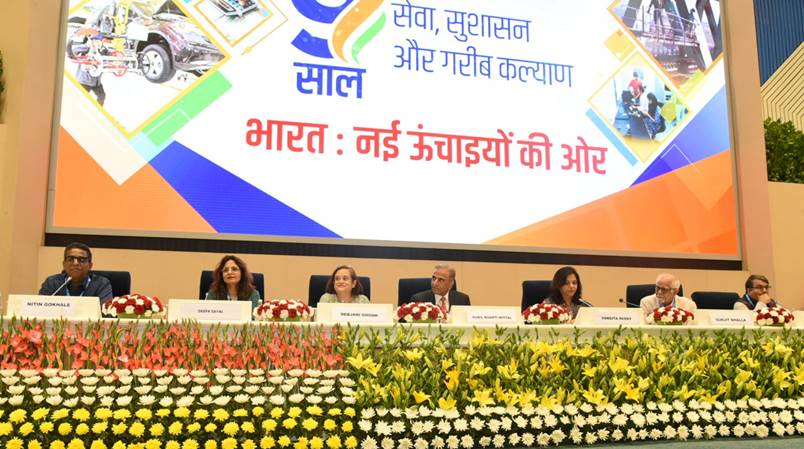
On completion of 9 Years of the Union Government, a National Conclave was organised by the Ministry of Information and Broadcasting with the theme “9 Years of Seva, Sushasan, Garib Kalyan” at Vigyan Bhawan in New Delhi. As part of the Conclave, three thematic sessions were held with esteemed panellists to discuss various achievements of the Union Government under the decisive leadership of Prime Minister Shri Narendra Modi and the persistent efforts being undertaken by the Government for rapid advancement of the nation and betterment of masses. The first session was on the theme ‘India: Surging Ahead’. The session elucidated how India has undergone a remarkable transformation into a prominent global leader under the able leadership of Prime Minister Shri Narendra Modi.
The session was moderated by eminent journalist, Shri Nitin Gokhale and featured distinguished speakers from different walks of life, including Shri Sunil Bharti Mittal, Founder Chairman of Bharti Enterprises, Smt. Sangita Reddy, Joint Managing Director, Apollo Hospital, Smt. Debjani Ghosh, President NASSCOM, Shri Surjit Bhalla, former Executive Director for IMF India, Shri Soumya Kanti Ghosh Group Chief Economic Advisor, State Bank of India and Smt. Deepa Sayal, Founder and President of Indian Women Institutional League (IWIL) India.
Shri Gokhale, setting the backdrop for the session said, “India has embarked on a path of transformation which has not been seen for decades together and India stock has risen globally”. He said “Morgan Stanley said in November 2022 that this is going to be India’s Decade. IMF in April, 2023 predicted India will emerge as the fastest growing economy in the world. India is surging and taking a lead in balancing the world order and therefore this conclave could not have come at a better time.”
Shri Sunil Bharti Mittal, talking about the decade of good governance under Prime Minister Shri Narendra Modi, said that we have all experienced and seen the difference in the past few years. He said businesses require decisive leadership and after a long period of time we have a leader who is recognised as a global leader and one determined to make India a developed nation. Talking about telecom sector, he said India has the fastest 5G rollout and by March, 2024, India will have 5G across every nook and cranny of the country. He added that “Government has used the power of technology to its utmost advantage for ushering in the reforms and benefits to the masses of the country”. He said we have seen fantastic 9 years and the audacious target of 5 trillion-dollar economy which looked like a difficult task a few years back is now in sight and we should be able to achieve it by 2027.
Smt. Sangita Reddy, Joint Managing Director, Apollo Hospital, spoke about how India made extensive and effective plan to fight the COVID Pandemic. She said our country stood out in tackling a crisis which wiped out many countries and it was due to the masterful management of the situation by our Prime Minister and the Government. She praised the People’s curfew which provided the time and space for the necessary infrastructure to be put in place and helped in tackling the pandemic effectively. Talking about the COVID Vaccines, she said “its commendable and reflective of India and our Prime Minister’s Global thought process that 50% of world’s vaccines were manufactured in India and it created a vaccine diplomacy on an unprecedented scale”. She said Government’s approach was “well-coordinated, fantastically masterminded strategy which was powerfully executed”. She further added that “the foundation is well set in India and not only can India take care of its own people well but has become the medical tourism destination of the world, currently we are number 4 but I believe that soon we will be number 2”. She urged the youngsters to use Yoga, Ayush and take care of their health as India has a great future ahead and it lies with the younger Generation.
Shri Surjit Bhalla, former Executive Director for IMF India, at the very onset said India has emerged as the best performing economy in the world during the shocking COVID period and today. Talking about the poverty reduction he said, “the entire process of government was geared towards ensuring that the bottom half of the population at least did not suffer any hardship as a consequence of COVID”. He spoke about the infrastructure transformation and said he is working on a study to see whether there is any economy in the world that has shown such a transformation in the last 9 years. He added that this government has shown to first, imagine the impossible and second, deliver it effectively and this is the real performance index of this government. He said Indian innovation is truly unique, Indian and better than any country in the world and books will be written about the speed of the transformation of India.
Smt. Debjani Ghosh, President NASSCOM said in 2008 only 17% Indians had bank accounts and a study said it would take India 46 years to achieve 80% penetration but India took just 7 years to do it. Why India could do it and disrupt status quo is due to technology, Aadhar, India stack, Digital Payment and the most genius financial inclusion program Jan Dhan Yojana. She said “the JAM trinity programme has enabled us to take banking to the grassroot level. Technology is available to all but what made the difference in India was the talent, the people which enabled us to challenge the status quo. 245 billion dollar revenue is what our tech industry generates and pace of growth and innovation is unprecedented and is being driven by talent which has made India an innovation hub and a startup hub”. She asserted that the ‘I’ in innovation stands for India., it has brought all big companies to do their innovation in India. She further added that “technology had been a luxury of the rich and urban but India turned this on its head and started from the grassroots and scaled it up. Ability to think bottoms up has made it possible”. She said 36% of the 5.3 million people working in tech sector are women and they are driving the change and innovation.
Smt. Deepa Sayal, Founder and President of Indian Women Institutional League (IWIL) India said she is very proud that my nation is changing at such pace and the pace and scale at which the government is bringing change praise worthy and immaculate. She stated that “Morgan Stanley has said our GDP will double to 7.5 trillion dollars by the end of the decade which is huge”. She said I have been lucky to be able to go to various states and connect with Startups, and women and children all are so charged up to begin and be self-employed. She talked about the phenomenal journey of startup that have increased from 450 in 2016 to 90000 startups in 2023 and said she must congratulate Prime Minister Shri Narendra Modi for this.
Shri Soumya Kanti Ghosh, Group Chief Economic Advisor, State Bank of India talking about the key numbers said “COVID was the largest disruption for mankind but last year our nominal GDP expanded by 37 trillion. FY 2014 – 20 our average was 14.5 trillion so we did 2.5 times more than last 6 years that’s why recovery was fastest. Talking about 5 Trillion Dollar Economy goal, he said India took 57 years to get to 1 trillion and then every 7 years we added 1 trillion and now norm is every three years we add one trillion and in the last two years our economy added 750 billion and that is why in 2014 we were 10th largest economy, in 2015 we are 7th, in 2019 we were 6th and 2022 we were 5th and supposed to be 4th in 2026 and 3rd in 2028 and this is the transition in terms of rebound”. He talked about various schemes of the Union government and informed that women involvement has been very high in all of them and it has led to women empowerment and financial freedom. He said our service exports has doubled in past 7 years. Summing up he said that all numbers point out towards an India which is inclusive and expanding at an exponential rate.
In conclusion, all spoke about what is next for India in the coming 5-10 years. Smt. Deepa Sayal said employability is an opportunity and a challenge and we need to inculcate the right skill set to tap this opportunity. Smt. Debjani Ghosh said the power of youth, talent, innovation will ensure that when the world thinks digital, technology and innovation the world will think of India. Shri Sunil Mittal said “the foundation for a very bright future for our country has been laid in the last 9 years and we need to build on what we need to do. This is a rare opportunity for India with a confluence of a decision leadership and strong tailwinds and it is a delightful position for India, and we need to ensure good education, training and skilled for our large young population which will together ensure a bright future for India”. Smt. Sangeeta Reddy said last 9 years is 468 weeks and over 500 schemes launched so 1 scheme every week and we have the time to guide these schemes over next 10 years. She praised Prime Minister Shri Modi for promoting women led development and said the respect for women is going to be transformational for India and set an example for the world. In terms of thought and spiritual and humane leadership India is and will always be number one. Shri Surjit Bhalla said a lot has been achieved and a major reform that India needs is in Direct Taxation and concluded by saying the India is one of the most overtaxed economies in the world and hoped that a reform will come to lower the effective tax rate which will help in achieving a higher GDP Growth Rate.
*****

National Conclave: 9 Saal – Seva, Sushasan, Gareeb Kalyan

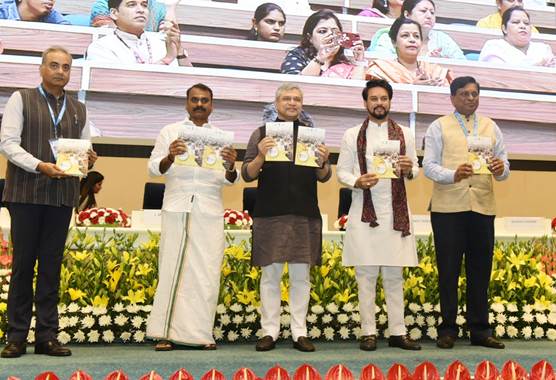
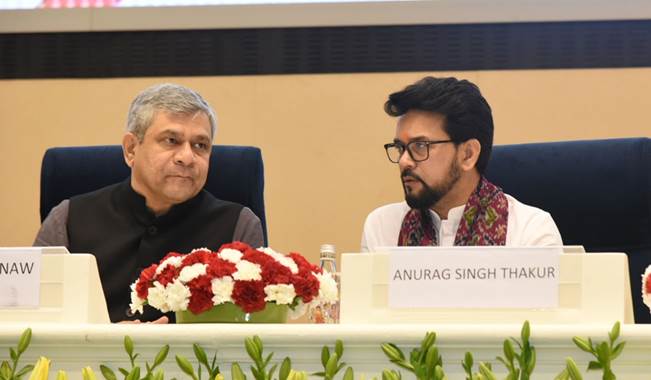
 Union Minister of Railways Shri Ashwini Vaishnav today inaugurated the National Conclave: 9 Saal – Seva, Sushasan, Gareeb Kalyan at Vigyan Bhawan in New Delhi. The event witnessed the presence of Union Minister of Information and Broadcasting Shri Anurag Thakur, Union Minister of State for Information and Broadcasting Dr L. Murugan. Secretary, Min of I&B Shri Apurva Chandra and CEO, Prasar Bharati, Shri Gaurav Dwivedi were also present on the occasion.

Union Minister Shri Ashwini Vaishnav made a comparative presentation juxtaposing the performance of the governments before 2014 with the government since and said while the previous governance efforts had become synonymous with scams, the current Government works with the ethos of ‘Pai Pai Se Gareeb Ki Bhalai’ (every penny for the benefit of the poor). This has been reflected in the way schemes and programmes have been implemented keeping the poor and the destitute as its central pillar, he added.

The Minister underlined that owning a house is a factor that brings a transformative change in a poor person’s life. To that end, today 3.5 crore houses have been constructed in the country under PM Awas Yojana bringing qualitative change in the lives of the poor.

The Minister said that the idea of connecting every house with piped water connection was always considered a behemoth, never to be attempted or achieved. But, he added, the Prime Minister took it up as a challenge and today 12 crore people have water connections. At the same time, he said the Government has strived to end the travesty that was traditional chulhas and provided 9.6 crore families with gas cylinders.

He further spoke about the efforts of the government to come through for the people in need and said that when the world was struggling to fight the travails of the COVID19 pandemic, the government overcame massive logistical challenges to bring free ration to 80 crore people. No government has spoken of fundamental human needs, like toilets, that are the indicators of inclusive growth, during Independence Day speeches. But PM Modi spoke about the construction of toilets in every house in his speech from Red Fort. This has caused a revolution in the field of women safety and sanitation with the construction of 11.72 crore toilets today. 

Shri Vaishnav said that India today runs the world’s largest healthcare insurance programme under Ayushman Bharat that has created provisions for free medicare up to Rs five lakh for the needy, the total coverage which is more than the population of the USA and Russia combined.

Shri Vaishnav credited the Prime Minister with creating a new definition of social justice taking it away from appeasement and towards empowerment.

The Minister said that domestic infrastructure has seen an unprecedented makeover since 2014, which was largely missing earlier due to a lack of proper mindset and thought process in the past. He cited the creation of 74 airports in 9 years, a figure matching the number created till 2014. He added that where 91 thousand kilometers of road were created since independence, almost 54 thousand kilometers have been constructed since 2014. India has gone from having no waterways till 2014 to having 111 waterways today and India’s railway stations have world-class facilities like airports.

The Minister said that India had lagged in world economic rankings for a long time, but today India stands tall as the 5th largest economy. He further said that India is well on its way to becoming the 4th largest economy in another two years and the third largest in another six years.

The Minister spoke about the government’s strong commitment to national security and said that when in past India has been at the receiving end of major terror activities, today the country has the means and willingness to respond to attacks in kind.       

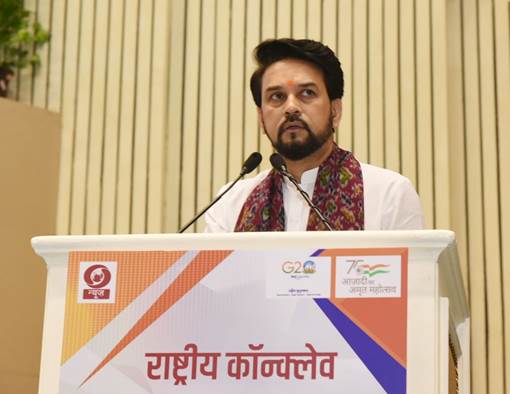
Shri Anurag Thakur, while addressing the audience gathered at the conclave, said that the past nine years have seen a dramatic change in the life of the common people of India and the achievements of the Government have surpassed expectations of the people. He exemplified this by adding further that where India was a weak and ramshackle economy riddled with corruption in the past, today it has covered the distance from Fragile Five to Top Five economies of the world.

He further stated that while the benefits of government schemes used to reach only a few in the past, the government today works with the motto of Antyodaya, where the Government is committed to the upliftment of the last person standing at the end of the queue. Herein lies the secret of our efforts that have lifted 27% of people out of poverty, he added. A combination of a sense of service, big ideas, good governance, infusion of technology, and building transparency and accountability into the delivery mechanism, are the things that have gone into ensuring last-mile delivery of public services.

The Minister said that the government has been steadfast in shedding legacies of the colonial past and adopting modern and domestic symbols. This is evident in the creation of the Kartavya Path and will be evident in the new parliament.

The Minister highlighted that the Prime Minister had said that the youth had a critical role to play in shaping the future of this country. To that end, the Minister credited the youth for achieving a milestone where India can today boast of almost one lakh startups and over hundred Unicorns.

The Minister said that while on the one hand the country answered the Prime Minister’s call for Har Ghar Tiranga, the same tricolor was used by students of other countries to get out of a conflict zone during Operation Ganga. While surveys have called him the most popular leader, Shri Thakur said that he has in fact made the tricolour the strongest flag in the world.

Secretary Shri Apurva Chandra welcomed all the guests for the various thematic sessions during the day. He also welcomed the audience from various sections of society.

The National Conclave on 9 years of the Government is comprised of three thematic sessions after the inaugural session and a valedictory session.

Session 1 “India: Surging Ahead” moderated by Shri Nitin Gokhale, Senior Journalist will see participation from

  • Sunil Bharti Mittal, Founder and Chairman, Bharti Enterprises
  • Sangita Reddy, Joint Managing Director of Apollo Hospitals
  • Debjani Ghosh, President of NASSCOM
  • Surjit Bhalla, Former Executive Director for International Monetary Fund, India
  • Soumya Kanti Ghosh, Group Chief Economic Advisor, State Bank of India
  • Deepa Sayal, President and Patron in Chief, IWIL India


Session 2: Jan Jan Ka Vishwas moderated by Richa Anirudh, Journalist will see participation from

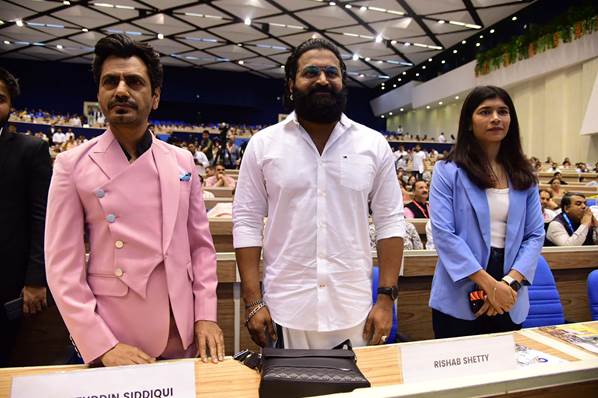
  • Nawazuddin Siddiqui, Actor
  • Cynthia McCaffrey, UNICEF Representative to India
  • Kiran Mazumdar Shaw, Executive Chairperson, Biocon Limited (Video message)
  • Padma Shri Shanti Teresa Lakra, Nurse
  • Nikhat Zareen, Boxer
  • Anil Prakash Joshi, Environmentalist Divya Jain, Co-founder, Seekho


Session 3: Yuva Shakti: Galvanizing India moderated by Raunac, Radio Jockey, Red FM with the following panelists

  • Ritesh Agarwal, CEO, OYO Rooms Rishab Shetty, Actor
  • Amaan Ali Bangash, Musician
  • Viren Rasquinha, Former Indian Hockey Captain
  • Yashodhara Bajoria, Director, Espresso Technologies
  • Akhil Kumar, Boxer

****

Cooperation under EU – India Clean Energy and Climate Partnership

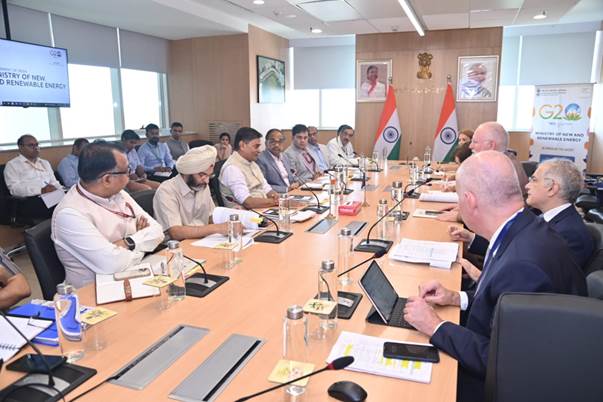
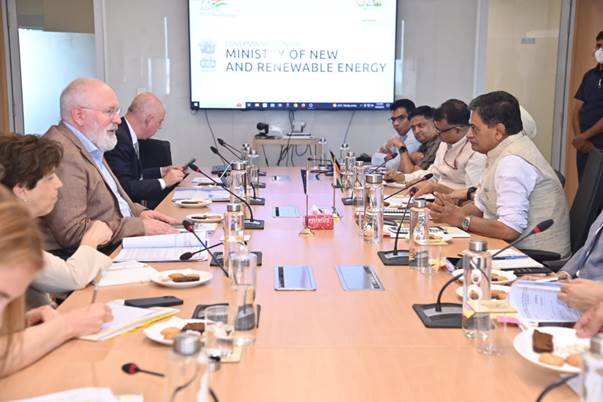
 The Union Power and New & Renewable Energy Minister R. K. Singh held a meeting with Frans Timmermans, Executive Vice President, European Green Deal, European Union in New Delhi yesterday, May 26, 2023. The meeting was held to discuss cooperation under the EU – India Clean Energy and Climate Partnership. The discussion touched upon energy efficiency; renewable energy, including solar and offshore wind, green hydrogen; energy storage, diversification of global supply chain for energy sector, the International Solar Alliance, India’s presidency of the G20 and how India and EU can partner each other on the clean energy transition.
“Looking for Partners who believe in going Green as fast as possible”

The Power and New & Renewable Energy Minister informed the visiting EU delegation that as India is growing, the power demand is accelerating. While the established capacity in India is 416 GW, it is going to double by 2030. India is accordingly adding rapidly to its power generation capacity. onHHonTheThe Minister pointed out that despite India’s per capita and cumulative emissions being one of the lowest in the world, it has emerged as a leader in Energy Transition and Climate Action.   

“Need to Add Manufacturing Facilities for Energy Storage, to Bring Down Storage Cost”

The Power and New & Renewable Energy Minister informed the European Union delegation of the various steps being taken by India to ramp up renewable energy capacity. He said that manufacturing capacity for the most advanced solar cells and panels is coming up; and by 2030, total manufacturing capacity of 80 GW will come up. This will meet India’s requirements and provide surplus for exports. This will address the supply chain issues of the world. The Minister stated that storage is needed in order to provide round-the-clock renewable energy and the transition to Net Zero. He informed that recognizing the need to add storage capacity, the government is coming up with bids for more storage.  Government of India has already come up with a bid for Production Linked Incentive for energy storage; and it is planning to have one more bid. He sought the cooperation of the EU in encouraging other countries too to add manufacturing facilities for energy storage so that the price of storage comes down.

Speaking of the need for alternative chemistries such as sodium ion, the Minister suggested that India and the EU do joint pilots, in areas such as green steel and other frontier technologies. The Minister informed that India is doing a pilot for round-the-clock renewables, using hydrogen and ammonia as storage. A construct across the world in this respect will help, he added.

“Journey to Green Hydrogen needs to be on the basis of free and open trade”

The Power and New & Renewable Energy Minister observed that the industry is switching to green hydrogen and that if the journey is to continue, it will have to be on the basis of free and open trade, without barriers. He told the EU delegation that we should guard against protectionism. He also said that we need to increase electrolyser manufacturing capacity if we need to increase use of green hydrogen. India is going to come up with a PLI bid on that, he informed.

The Executive Vice President of European Green Deal appreciated India for its leadership in Renewable energy and energy efficiency and suggested that the two sides find ways to bring the agenda of energy efficiency to the global stage, and help set global energy efficiency targets.

The Executive Vice President spoke of the need for global targets in introduction of renewables and said that we need to look at developing industrial ecosystems which promote renewables. He said that the EU is developing new generations of solar panels and that green hydrogen is also taking off and Europe will become a truly global market. Given the high costs of transporting green hydrogen, he opined that the places producing green hydrogen will attract industrial investment.
Grid-Scale Battery-based Energy Storage Systems

The Power and New & Renewable Energy Minister spoke of the opportunity for collaboration in batteries for grid-scale storage. He informed that India has come out with a separate Production Linked Incentive for batteries for green mobility. He said that India is going to be one of the biggest markets for green mobility, with 80% of India’s 2-wheelers, 3-wheelers and about 50% of 4-wheelers expected to be green by 2030.

The Executive Vice President said that heat pumps is an area where lot of innovation is expected to happen, given the rising needs for cooling and heating. He also said that there is a strong consensus in the EU on need to adopt renewable energy and on making the green transition.

Need to Detoxify Agriculture

The Power and New & Renewable Energy Minister expressed the government’s goal of detoxifying agriculture, by making a transition away from chemical fertilizers in the times to come.

“Need to Support Energy-Populations in Getting Energy Access”

The problem of lack of access to energy by 800 million people around the world was discussed. The Power and New & Renewable Energy Minister recalled that even as India and the EU make progress through this collaboration, a large part of the world population, especially in the African continent, suffers from poor energy access.

The two sides discussed the role of International Solar Alliance in bringing solar energy to the millions of people in Africa without access to energy. We need to support them to help them get clean energy and we need to get countries to work with the International Solar Alliance to contribute to clean energy, said the Minister.

This suggestion has been welcomed heartily by the Executive Vice President of the European Green Deal. It was agreed that EU, ISA, Africa and India will need to set up a partnership to address this issue.
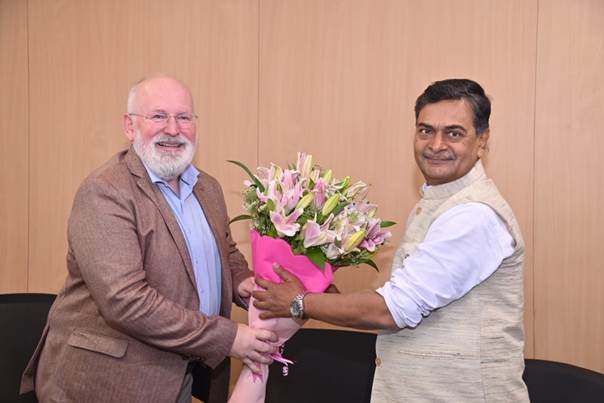
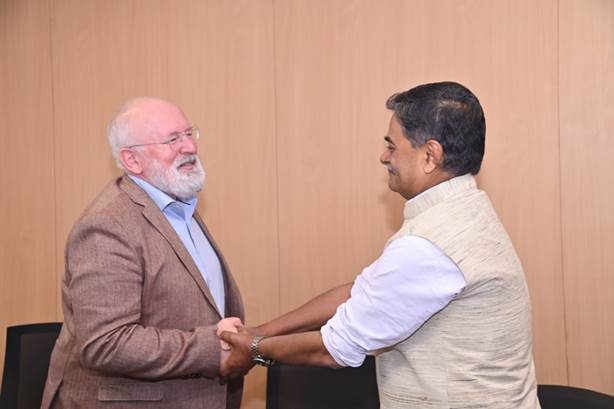
The Executive Vice President of European Green Deal was accompanied by Ugo Astuto, Ambassador of the European Union to India; Edwin Koekkoek, First Counsellor, Energy & Climate Action, EU Delegation; Sara Zennaro Atre, First Secretary, Trade Section, EU Delegation; Estela Pineiro Kruik, Member of Cabinet; Damyana Stoynova, Member of Cabinet; and Diana Acconcia, Director, International Affairs and Climate Finance, Directorate-General for Climate Action, EU.

The Power and New & Renewable Energy Minister was joined by Alok Kumar, Power Secretary; Bhupinder Singh Bhalla, New & Renewable Energy Secretary; and other officers of the two Ministries.

About European Green Deal

As per the European Union, the European Green Deal seeks to transform the EU into a modern, resource-efficient and competitive economy, ensuring:

  • no net emissions of greenhouse gases by 2050
  • economic growth decoupled from resource use
  • no person and no place left behind

One third of the €1.8 trillion investments from the Next Generation EU Recovery Plan, and the EU’s seven-year budget will finance the European Green Deal. More about the Deal here.

***

REWARD Program with World Bank Team

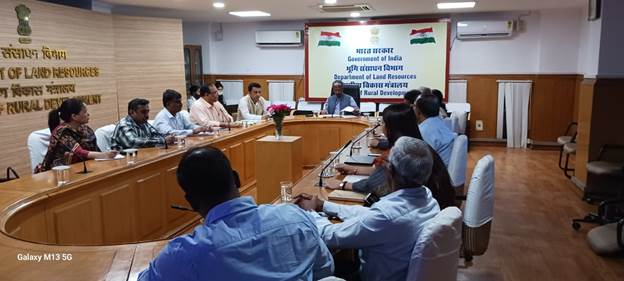
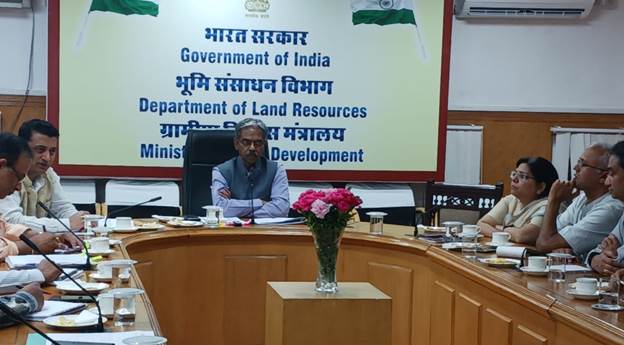
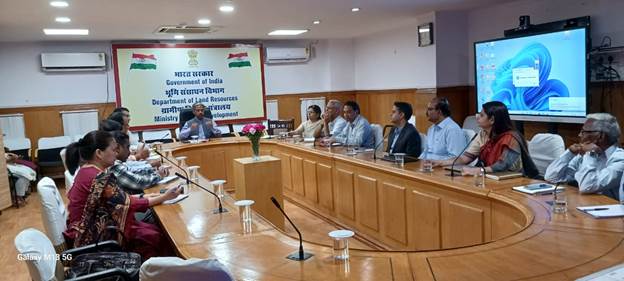
 The Secretary, Department of Land Resources (DoLR), Government of India (GoI) Shri Ajay Tirkey reviewed the Implementation Support Mission of World Bank Assisted Rejuvenating Watersheds for Agricultural Resilience through Innovative Development (REWARD) program.

REWARD is a World Bank assisted Watershed development program which is being implemented from 2021 to 2026. The Development Objectives of REWARD program is to “Strengthen capacities of National and State institutions to adopt improved watershed management for increasing farmers resilience and support value chains in selected watersheds of participating States”. The program is being implemented to introduce modern watershed practices in the Department of Land Resources in the Ministry of Rural Development and in the States of Karnataka and Odisha. The total budget outlay of REWARD program is USD 167.71 million over a program period of 4.5 years. This includes USD 115 million from World Bank [Karnataka (USD 60 million), Odisha (USD 49 million) and DoLR (USD 6 million)], USD 46.71 million from two participating States [Karnataka (USD 25.71) and Odisha (USD 21.0 million)] and USD 6 million from DoLR. The funding pattern is 70:30, between World Bank and States whereas it is 50:50 between World Bank and DoLR.

At the central level, the scope of the REWARD program covers management, monitoringcommunication and knowledge sharing functions by DoLR. At the State level, the REWARD program will be contiguous in scope to the WDC-PMKSY 2.0, and support implementation of key science-based activities and demonstrations which eventually aims at synergising broader perspective of WDC-PMKSY 2.0 in other States in India.

As a part of third Implementation Support Mission (ISM), the team of World Bank headed by Smt. Preeti Kumar visited DoLR & REWARD States for 3rd ISM to review the progress and to discuss about the plan of action for the next 6 months. After completing the mission, yesterday the team visited Department of Land Resources, Government of India to debrief the outcomes of ISM to the Secretary, DoLR. During the debriefing, the team felt that the progress of REWARD is on track and complemented the efforts of DoLR for the present progress and requested Secretary, DoLR for his continuous support to achieve the progress as per the Disbursement Linked Indicators of the program.

The other points discussed during the debriefing meeting includes strengthening of Centre for Excellence on watershed component which was established in Bengaluru under REWARD program, organizing National level workshop on science based watershed management, development of protocols for expansion of Land Resource Inventory (LRI) across the country on a pilot basis, providing LRI based digital advisory services to farmers and Exposure visits of REWARD officials etc.

Shri Nitin Khade, Joint Secretary (WM), Dr. C.P. Reddy, Senior Additional Commissioner, ISM members from World Bank, Experts of NPMU of REWARD program and other officials of DoLR attended the meeting.                                         

*****

8th Governing Council Meeting of NITI Aayog

 Prime Minister Shri Narendra Modi chaired the 8th Governing Council Meeting of NITI Aayog earlier today. The Meeting was held at the New Convention Centre, Pragati Maidan, New Delhi.  It was attended by Chief Ministers/Lt.Governors representing 19 States and 6 UTs.

Prime Minister stressed that the Centre, States and UTs should work as Team India and fulfil the dreams and aspirations of people for a Viksit Bharat @ 2047. He said that NITI Aayog can play a critical role in helping States to develop their strategies for the next 25 years and align the same with the National Development Agenda. He urged the States and UTs to work with NITI Aayog so that the country can take a quantum leap towards achieving its vision for the Amrit Kaal.

Prime Minister mentioned that NITI Aayog is taking multiple initiatives for strengthening cooperative and competitive federalism like the Aspirational Districts Programme (ADP) and Aspirational Blocks Programme (ABP). Both these programmes showcase the power of working together as Centre, States and Districts, and the impact of data-driven governance in improving the lives of common citizens at the grassroots level.

Prime Minister stressed on the need for States and Centre to promote Shree Anna in the International Year of Millets. He also deliberated on the need for working towards water conservation through the Amrit Sarovar programme. 

Prime Minister spoke about the importance of maintaining fiscal discipline at the State levels. He urged the States to proactively use the  Gati Shakti Portal not only for infrastructure and logistics but also for local area development and creation of social infrastructure.

Speaking about G20 meetings being held in the country, he said that while G20 has brought glory to India on the world stage, it has provided States the opportunity for global exposure. 

Prime Minister also spoke about the importance of skilling people with a view to meet global requirements, supporting MSMEs, developing the tourism potential of the country,  reducing compliances at the State level including decriminalisation of minor offences, creation of Ekta Malls. Talking about Nari Shakti, he highlighted the significance of women-led development. He also spoke about ending the menace of TB by 2025.

Chief Minister/Lt. Governors gave various policy level suggestions. They mentioned specific issues pertaining to the States which require Centre-State cooperation. Some of the key suggestions and best practices highlighted by them included in areas like opting for green strategies, need for zone wise planning, tourism, urban planning, agriculture, quality of workmanship, logistics, among others.

Prime Minister expressed his gratitude to the CMs and LGs for participating in the meeting and sharing their views and experiences. He said NITI Aayog will study the states’ concerns, challenges, and best practices and subsequently plan the way forward.

****

Roundtable conference with leading CEOs of Pharmaceutical industry

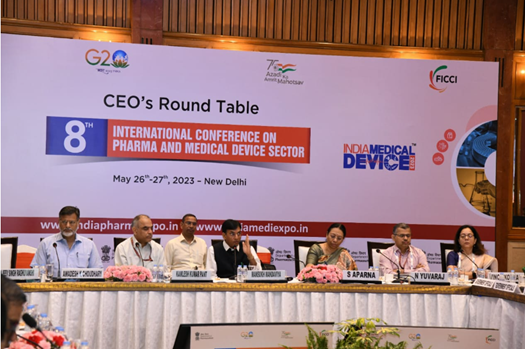
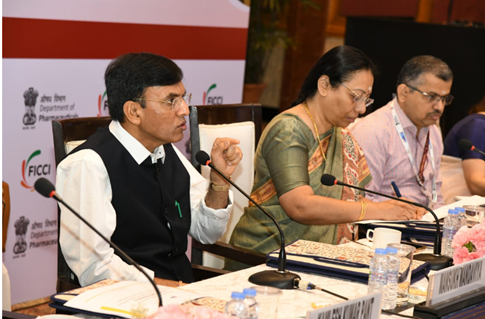
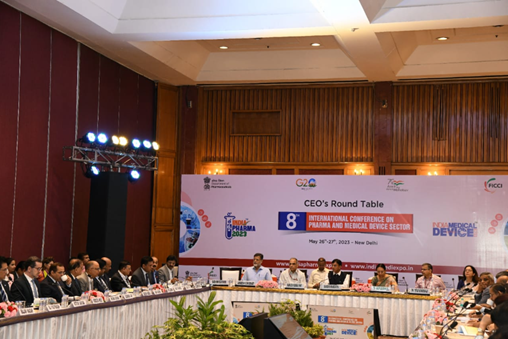
 Union Minister of Chemicals and Fertilizers, and Health and Family Welfare Dr Mansukh Mandaviya chaired a roundtable meeting with the leading CEOs of pharmaceutical industry in the country on the second day of 8th International Conference on Pharma and Medical Device Sector, here today. Ms. S Aparna, Secretary, Department of Pharmaceuticals was also present.

Lauding the growth momentum of the industry, the Minister said “the industry is progressing at a rapid rate, and to maintain our stature as the ‘Pharmacy of the World’, we need to focus on quality and affordable manufacturing with an increased focus on research and innovation.” Adding further Dr. Mandaviya urged the stakeholders to capitalize on the current opportunities, stating “substantial investment in terms of Production Linked Incentive schemes as well as upcoming drug parks are bearing fruitful results. To catalyze growth, we must maintain a degree of competitiveness to consolidate our presence in the world.”

Reiterating the government’s commitment and resolve, the Union Health Minister stated “the government is industry friendly and welcomes opportunities for collaboration. The government and industry, both integral to the nation’s progress, must work cohesively to achieve holistic growth.”

Affirming government support, Dr. Mandaviya invited the stakeholders to put forth their suggestions addressing the aspects of pricing, regulatory, policy and strategy, with the respective action points in a detailed presentation and due consideration will be given to facilitate further policy support and growth.

Underscoring the potential future growth of the industry, Ms. S Aparna, Secretary, Department of Pharmaceuticals urged the attending representatives to collate and collectively represent their perspectives adhering to the aforementioned four categories to facilitate policy makers, government in fostering a stronger ecosystem for all.

The roundtable brought together participants from over 60 companies represented by senior leadership, with several key players having a presence in the national as well as international markets. Shri N Yuvaraj, Joint Secretary, Department of Pharmaceuticals, Shri Awadhesh Kumar Choudhary, Senior Economic Advisor, Smt. Vinod Kotwal Member Secretary, National Pharmaceutical Pricing Authority, DCGI Dr. Rajeev Raghuvanshi, Chairman NPPA Shri Kamlesh Pant, various industry stakeholders and representatives of academia and associations were also present in the conference.

About International Conference on Pharma and Medical Device Sector:

The annual flagship conference will be conducted over two days – 26th May 2023 dedicated for India Medical Device sector on the theme “Sustainable MedTech 5.0: Scaling and Innovating Indian MedTech,” and 27th May 2023 dedicated for the Pharmaceutical sector on the theme “Indian pharma industry: Delivering Value through Innovation.

****

‘Yoga Mahotsav’ in Hyderabad

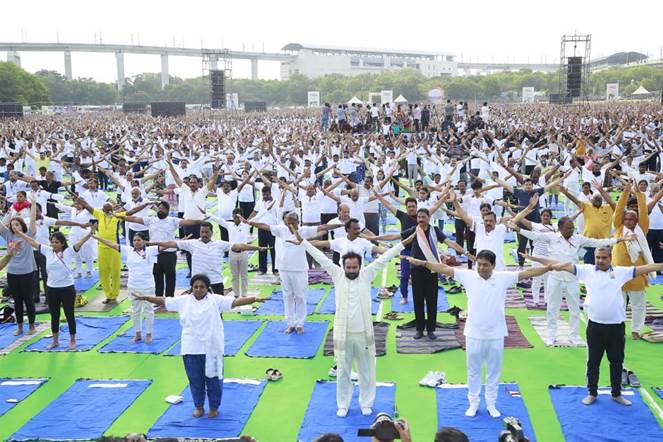
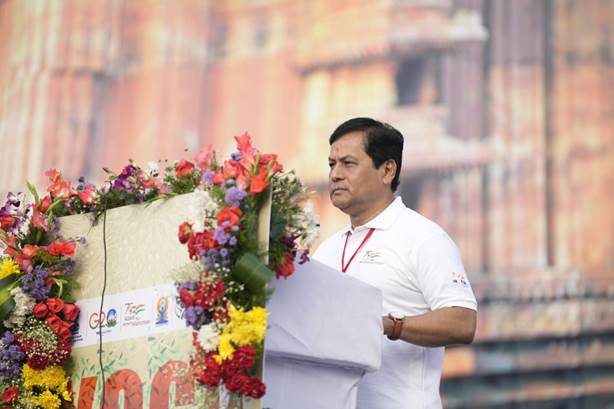
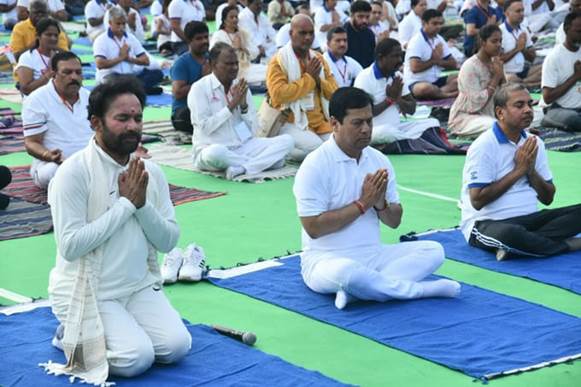
 The ‘Yoga Mahotsav’ witnessed a massive participation of 50,000 enthusiasts at the NCC Parade Ground here today. The event – organised by the Morarji Desai National Institute of Yoga (MDNIY), under the Ministry of Ayush was held to commemorate 25 days to the International Day of Yoga.

Hon’ble Governor of Telangana, Dr. Tamilisai Soundararajan graced the occasion as the Chief Guest as the Union Minister of Ayush Shri Sarbananda Sonowal; the Union Minister of Culture, Tourism & DoNER Shri  G Kishan Reddy; the Union Minster of State for Ayush Dr Munjpara Mahendrabhai actively participated in making this grand event a great success. Celebrities from the city like Padma Bhushan awardee & noted Badminton player & coach Pullela Gopichand; cine actors Srileela, Vishwak Sen, Krishan Chaitanya among other dignitaries were also witness to the electrifying atmosphere here today. Dr Ishwar V Basavaraddi, Director, MDNIY conducted the Common Yoga Protocol (CYP) as thousands performed Yoga in a spiritually uplifting atmosphere.

Speaking on the occasion, the Dr. Tamilisai Soundararajan said that this is a wonderful opportunity for all of us to celebrate Yoga as a festival of happiness, festival of health. She urge everyone to embrace yoga.  She further said that Yoga will make you happy, yoga will make you healthy, yoga will make you beautiful.”

Addressing the gathering, Shri   Sarbananda Sonowal said, “My heart is filled with joy to see massive participation in the Yoga Mahotsav by the people celebrating the cause of good health through Yoga. As a true sign of India’s glorious heritage, Yoga received an unprecedented boost when the world started celebrating Yoga every year on 21 June. Yoga has continued to reach more and more people around the world and has benefited all for their physical, mental and spiritual well-being. Yoga has surpassed all divisions of caste, creed, gender, religion and nationalities. In the whole world, people of all ages have embraced it for their benefit. The theme of IDY for this year is quite apt — Yoga for Vasudhaiva Kutumbkam. It perfectly echoes the mood, spirit and acceptance of Yoga at national and global levels. From villagers to city dwellers, from students to home makers to corporate employees – all are embracing Yoga to remain healthy both physically as well as mentally. The untiring efforts of our charismatic Prime Minister Shri Narendra Modi ji have resulted in ever increasing impact of Yoga and its acceptance by the world community. Today, the whole world is accepting Yoga as an unfailing vehicle of holistic health and well-being.”

Highlighting the novelties in the celebration of this year’s IDY, Shri Sonowal added that these novelties would be on international, national and local levels.

He informed, “On the International level, an Ocean Ring of Yoga will be created on June 21st when with the help of the Ministry of Defense, Ministry of External Affairs and the Ministry of Ports, Shipping and Waterways Yoga demonstrations at many ports, on many ships will take place and many friendly countries will also join hands in this exercise. Similarly, Yoga demonstrations will also take place from Arctic to Antarctica— countries falling on or near the Prime Meridian line will join the Yoga demonstration. The flight Decks of INS Vikrant and INS Vikramaditya will showcase Yoga demonstration in synergy. Under Yog Bharatmala. Indian Army, Indian Air Force, Indian Coast Guard and Border Road Organisation will join hands for Yoga demonstration at borders, coasts and Islands to form a Yog Bharatmala. Yoga will also happen on North and South Pole regions. Himadri — the Indian Research Base in Svalbard, Arctic as well as Bharati — the third Indian Research Base in Antarctica. At the local level, Panchayats, Anganwadis, Asha/ANM will be involved in Yoga demonstrations. Health and Wellness centres of both Health and Ayush Ministries, which are more than 1.5 lakh in the country and all the Amrit Sarovars (around 50 thousand) will have Yoga demonstrations. This year we will witness ‘Har Aangan Yog’ is going to happen in true spirit.”

Speaking on the occasion Shri G Kishan Reddy said, “Yoga is a wonderful gift of India’s rich heritage to empower humanity to remain hale & hearty. As all of us have congregated here, the massive turnout by all of you has affirmed people’s outpour of love for Yoga. This wonder of India’s culture was rejuvenated under the dynamic leadership of Prime Minister Shri Narendra Modi ji as it has now become a global movement towards living healthy. In today’s world, the role of Yoga in keeping one calm and focussed is immense. We must all embrace Yoga and keep doing it regularly thereby celebrating it always. Let us make this event a grand success as we move on to celebrate International Day of Yoga.”

In his welcome address, Dr Munjpara Mahendra said, “International Day of Yoga is now well known throughout the world. Thanks to the untiring and visionary approach of our Hon’ble Prime Minister Shri Narendra Modi ji, the ancient science of Yoga is now fast becoming part and parcel of wellness journey of almost all nations in the world. This 25 Day Countdown is an indication that IDY 2023 is just round the corner and I congratulate all of you again to be part of such an important event. I appeal to all to keep this torch alight.”

The event was also attended by Vaidya Rajesh Kotecha, Secretary, Ministry of Ayush; Joint Secretary, Kavita Garg, Ministry of Ayush among other senior officials of union government and state government of Telangana. The event was also attended by Table Tennis player Naina Jaiswal, actress Eesha Rebba, G Sridhar Rao of Patanjali Yoga Peeth, Nandanam Krupakar, Joint Secretary, National Yogasana Sports Federation among other dignitaries and guests.

****

Methods commonly used to substitute inconsistent values in a data set

There are several methods commonly used to substitute inconsistent values in a data set. Here are a few examples:
Mean/Median Imputation: In this method, the missing or inconsistent values are replaced with the mean or median value of the corresponding variable. This method assumes that the missing values are missing completely at random and replaces them with the central tendency of the variable.
Regression Imputation: In this method, the inconsistent values are replaced by predicting their values based on a regression model. The model is built using the other variables in the data set that are not missing or inconsistent.
Hot Deck Imputation: In this method, the inconsistent values are replaced with values from similar cases in the data set. Similar cases are identified based on a set of matching variables. This method preserves the pattern of the data and replaces missing values with observed values from similar cases.
Multiple Imputation: This method involves creating multiple imputations for the inconsistent values based on statistical models. Multiple imputations allow for uncertainty in the imputed values and provide a range of plausible values for each inconsistent value.
Expert Knowledge: In some cases, domain experts or researchers may have specific knowledge about the data and can manually substitute inconsistent values based on their expertise. This method relies on human judgment and expertise.
It’s important to note that the choice of method for substituting inconsistent values depends on the nature of the data, the extent of inconsistency, and the assumptions made about the missing or inconsistent values. Different methods may be more appropriate in different situations, and it’s essential to consider the limitations and potential biases introduced by the chosen method.
Among the options provided, the correct method to substitute inconsistent values in a data set is “Editing.” Editing involves identifying and correcting inconsistent or erroneous values in the data set. It typically involves a manual or automated review of the data to detect outliers, errors, or inconsistencies. Once identified, the inconsistent values can be corrected or replaced using appropriate methods such as imputation or removal. Coding and elimination, on the other hand, are not specific methods for substituting inconsistent values but can be part of the data cleaning process. Coding refers to assigning numerical codes or categories to represent certain values or variables, while elimination involves removing observations or variables from the data set.

Development of Unani Medicine System

 Ministry of Minority Affairs has supported Central Council of Research in Unani Medicine (CCRUM) and National Institute of Unani Medicine (NIUM) Bengaluru, under the Ministry of Ayush, for the promotion and upgradation of Unani Medicine facilities in India. Ministry of Minority Affairs has approved a grant of Rs. 45.34 Crores under Pradhan Mantri Jan Vikas Karyakram (PMJVK), a centrally sponsored scheme (CSS). This will support the upgradation of Unani Medicine facilities at Hyderabad, Chennai, Lucknow, Silchar and Bengaluru.

Ministry of Minority Affairs has sanctioned a total amount of Rs. 35.52 crores to CCRUM and Rs. 9.81 crores to NIUM. Ministry of Ayush appreciates the leadership of Union Minister MoMA Smt. Smriti Irani, under her able guidance, MoMA has granted funds for development and upgradation of Unani medicine facilities under MoA.

The grant has been approved for establishing various facilities of Unani Medicine at Hyderabad, Chennai, Lucknow, Silchar and Bengaluru locations. Central Council for Research in Unani Medicine (CCRUM) has been sanctioned a total amount of Rs. 35.52 crores and National Institute of Unani Medicine (NIUM), Bengaluru has been sanctioned Rs. 9.81 crores.

A centre for fundamental research in Unani Medicine at National Research Institute of Unani Medicine for Skin Disorders, Hyderabad will be established at a cost of Rs. 16.05 crores. Ministry has proposed cost of Rs. 8.15 crores for a preclinical laboratory facility at Regional Research Institute of Unani Medicine, Chennai, Rs. 8.55 crores for a centre of Ilaj bit Tadbeer (regimenal therapy) for musculoskeletal disorders at Central Research Institute of Unani Medicine, Lucknow, and Rs. 2.75 crores for a centre of Ilaj bit Tadbeer (regimenal therapy) for skin and lifestyle disorders at Regional Research Institute of Unani Medicine, Silchar.

NIUM, Bengaluru will get Rs. 5.55 Crores for establishing a Vishram Girah for patients’ attendants and Rs. 4.26 Crores for a skill centre of model Unani cosmetic care, a small-scale Unani pharmacy and Unani crude drug storage.

The proposals were considered by the Empowered Committee of the Ministry of Minority Affairs in its meeting held on March 02, 2023 and Rs. 4.86 Crores has already been released to the CCRUM as the first instalment (25%) of total sanctioned cost of its three projects at Chennai, Lucknow and Silchar. The grant of CCRUM project for Hyderabad and the projects of NIUM, Bengaluru would be released once their DPRs are approved and other technicalities finalized. PMJVK is an area development programme under which community infrastructure and basic amenities are being created in the identified areas.

******

Vande Bharat Express from Dehradun to Delhi

Governor of Uttarakhand Shri Gurmeet Singh ji, popular Chief Minister of Uttarakhand Shri Pushkar Singh Dhami, Railway Minister Ashwini Vaishnaw, Ministers of Uttarakhand Government, various MPs, MLAs, Mayors, Zilla Parishad members, other dignitaries, and my dear brothers and sisters of Uttarakhand! Many congratulations to all the people of Uttarakhand for the Vande Bharat Express train.

This train between Delhi and Dehradun will connect the country’s capital with Devbhoomi at a faster speed. Now the journey time between Delhi-Dehradun will also be reduced considerably due to this Vande Bharat train. The speed of this train is in its place, however, the facilities are also going to make the journey enjoyable.

Friends,

I have just returned from a trip to three countries a few hours ago. Today the whole world is looking at India with great expectations. The way Indians have strengthened our economy, the way we are fighting poverty, it has instilled the confidence of the whole world in us. Together we succeeded in meeting the challenge of the Corona, whereas many major countries continue to grapple with it. We launched the world’s largest vaccination campaign. Today India is being discussed all over the world. People from across the world want to come to India to see and understand India. In such a situation, this is a great opportunity for beautiful states like Uttarakhand. This Vande Bharat train is also going to help Uttarakhand in taking full advantage of this opportunity.

Friends,

Uttarakhand is Devbhoomi. I remember when I went to visit Baba Kedar, I muttered something spontaneously. These were in the form of Baba Kedar’s blessings and I had then said that this decade would be the decade of Uttarakhand. The manner, in which Uttarakhand is carrying forward the campaign of development, while keeping law and order paramount, is commendable. It is also important to preserve the identity of this Devbhoomi. And I believe that this Devbhoomi will become the center of attraction for the spiritual consciousness of the whole world in the near future. We have to develop Uttarakhand according to this potential as well.

The number of pilgrims visiting Char Dham Yatra every year is breaking all the previous records and setting new records. Right now, we can see devotees thronging to have darshan of Baba Kedar. Crores of devotees from all over the world come to the Kumbh and Ardh Kumbh held in Haridwar. Lakhs of people reach Uttarakhand during the Kanwar Yatra held every year. There are very few states in the country which attract such a large number of devotees. This number of devotees is also a gift and handling such a large number is also a herculean task. The double engine government is working with double the speed and with double the power to make this herculean task easy.

The BJP government is laying special emphasis on the Navratnas of development. The first is the reconstruction of Kedarnath-Badrinath Dham with an estimated cost of Rs 1300 crore, the second is the ropeway work of Gaurikund-Kedarnath and Govindghat-Hemkunt Sahib at a cost of Rs 2500 crore, the third is the Manaskhand Mandir Mala Mission to make the mythological temples of Kumaon grand, the fourth is promotion of home stays in the entire state. I am told that more than 4000 home stays have been registered in the state. The fifth is the development of 16 eco-tourism destinations, the sixth is the expansion of health services in Uttarakhand. A satellite center of AIIMS is also being built in Udham Singh Nagar.  The seventh is the Tehri Lake Development Project costing about Rs 2000 crore, the eighth is the development of Rishikesh-Haridwar as the capital of adventure tourism and Yoga and the ninth is the Tanakpur-Bageshwar Rail Line. Work on this railway line will also start soon. You must have heard a saying – icing on the cake. Therefore, Dhami ji’s government has given new impetus to the infrastructure projects here to string the garland of these Navratnas. Work on the Rs. 12,000 crore Char Dham mega project is going on at a rapid pace. With the completion of the Delhi-Dehradun Expressway, the journey between Dehradun and Delhi will become easier. Along with road connectivity, ropeway connectivity is also being developed in a big way in Uttarakhand. The Parvat Mala Yojana is going to change the fate of Uttarakhand in the near future. For this, our government is ending the wait of the people of Uttarakhand for this connectivity for years.

The Rishikesh-Karnprayag rail project will be completed in two-three years. More than 16,000 crore rupees are being spent on this project. After the completion of the Rishikesh Karnprayag Rail Project, a large part of Uttarakhand will become accessible to the people of the state and tourists. As a result, new opportunities for investment, development of industries and employment will be created here. And in the midst of this grand campaign of development of Devbhoomi, this Vande Bharat train will also prove to be a grand gift for the people of Uttarakhand.

Friends,

Today Uttarakhand is fast emerging as a tourism hub, adventure tourism hub, film shooting destination and wedding destination with the efforts of the state government. Today new places and tourist hubs of Uttarakhand are attracting tourists from India and abroad. They will also get a lot of help from the Vande Bharat train. Now Vande Bharat trains have started running in every corner of the country. Trains are the first choice of people wishing to travel long distances with family. In such a situation, Vande Bharat is now becoming the first choice of ordinary families of India.

Brothers and sisters,

The 21st century India can develop more rapidly by modernizing its infrastructure. Earlier, the parties which were in power for a long time never understood this need of the country. The focus of those parties was on scams and corruption. They were confined to nepotism. They did not have the strength to come out of nepotism. The previous governments also made lofty claims regarding high speed trains in India. Many years have passed since they made these claims. Leave aside the high speed trains; they could not even remove unmanned level crossings from the rail network. The situation of railway electrification was even worse. By 2014, only one-third of the country’s rail network had been electrified. In such a situation, it was impossible to even think of running a fast train. We started all-round work to transform the Railways after 2014. On the one hand, we started implementing the dream of the country’s first high speed train, on the other hand, we started preparing the whole country for semi-high speed trains. When, on an average, 600 km of rail lines were electrified every year before 2014, now 6,000 kilometers of railway lines are being electrified every year. See the difference between 600 kms and 6000 kms. As a result, more than 90 percent of the country’s railway network has been electrified. In Uttarakhand, 100 percent electrification of the entire rail network has been achieved.

Brothers and sisters,

This has been made possible because today there is the right intention for development, policy and trust. The increase in the railway budget in comparison to 2014 has directly benefited Uttarakhand as well. In the five years before 2014, on an average, less than Rs 200 crore was allocated for Uttarakhand. And just now Ashwini ji explained about it in detail. Less than 200 crore rupees for such a remote hilly area and lack of railways! The rail budget of Uttarakhand is 5,000 crore rupees this year. It is a 25-fold increase. This is the reason that today the railway is expanding to new areas of Uttarakhand. Not only railways, but modern highways are also expanding unprecedentedly in Uttarakhand. We understand how important this connectivity is for a hilly state like Uttarakhand. We understand the pain of how villages became deserted in the past due to lack of connectivity. We want to save the coming generation from that suffering. We are working hard today so that employment opportunities are created in Uttarakhand itself through tourism, agriculture and industries. This modern connectivity will also be very useful for easy access to our borders and convenience for our soldiers engaged in the defence of the nation.

Brothers and sisters,

Our double engine government is committed to the development of Uttarakhand. The rapid development of Uttarakhand will also help in the rapid development of India. And the country is not going to stop now as it has now gathered its momentum. The whole country is moving ahead at the speed of Vande Bharat and will continue to move ahead. Once again, many congratulations and best wishes to all of you for the first Vande Bharat Express train of Uttarakhand. And nowadays, people from all over the country are visiting Baba Kedar, Badri Vishal, Yamunotri and Gangotri. The launch of the Vande Bharat Express at the same time will be a very pleasant experience for them too. I once again bow down at the feet of Baba Kedar and greet the Devbhoomi and wish you all the very best. Thank you!


DISCLAIMER: This is the approximate translation of PM’s speech. Original speech was delivered in Hindi.

***

Assam Rozgar Mela

 Addressing the gathering, the Prime Minister congratulated the youth and their families who were recruited for government jobs in the Government of Assam. He recalled his visit to the state last month on the occasion of Bihu and said that the memory of the grand event which was a symbol of the glorification of Assamese culture, is still fresh in his mind. He noted that today’s Rozgar Mela is a reflection of the seriousness towards the future of the youth in Assam. Even before this, the Prime Minister said, more than 40 thousand youths have been given government jobs through the Rozgar Mela in Assam. He informed that appointment letters have been handed over to about 45 thousand youths today and wished a bright future for the youth.

“Assam is witnessing a new era of peace and development and this pace of development has spread positivity and inspiration in Assam.”, the Prime Minister said. Reflecting on the processes initiated by the Government of Assam to make government recruitment more transparent, the Prime Minister touched upon the ‘Assam Direct Recruitment Commission’ that has been formed to carry out the recruitment process in various departments. He mentioned that many recruitments could not be completed on time due to the earlier process where each department had different rules and the candidates had to appear for different examinations for different departments. He stated that all these processes have now been made very easy, and congratulated the Assam Government for this feat.

“All of us have taken a pledge to make our country a developed nation in the Azadi Ka Amrit Kaal”, the Prime Minister remarked as he stressed that the next 25 years of Amrit Kaal are as important as Seva Kaal. Underlining the importance of the appointees’ behavior, thinking, approach to work, and impact on the public, the Prime Minister emphasized that the new appointees will be the face of the Assam Government for every common citizen. He mentioned that society is becoming aspirational and no citizen wants to wait for development. “In this era of Twenty20 cricket, the people of the country want quick results”, Shri Modi said as he highlighted the need for government systems to transform themselves accordingly. He underlined the responsibilities of  Government employees in fulfilling the aspirations of the citizens of the country. The Prime Minister urged the appointees to move forward with the same dedication that brought them here and stressed that they can contribute to improving society and the system by being open to learning new things.

The Prime Minister underlined that lakhs of crores of rupees are being spent on modernizing India’s infrastructure at a very fast pace and gave examples of new highways and expressways, railway lines, ports, airports and waterways, these projects. He mentioned that employment and self-employment opportunities are getting a boost in every sector with every new infrastructure project. He gave the example of the requirement of engineers, technicians, accountants, laborers, and various types of equipment, steel and cement for the development of an airport. He also mentioned that employment opportunities are being created by the expansion of railway lines and their electrification. He touched upon the emphasis towards ease of living and stated that since 2014, the government has constructed about 4 crore pucca houses with facilities like toilets, gas connections, tapped water supply and electricity, and handed them to the poor. He lauded the contributions of the manufacturing sector, logistics, skilled workers and laborers who put effort into building these houses and arranging these facilities. The Prime Minister also highlighted the role played by Ayushman Bharat Yojana in employment generation and mentioned that many new hospitals and clinics have been established in the country. Shri Modi also recalled the privilege of dedicating AIIMS Guwahati and 3 Medical Colleges a few weeks ago. Dental colleges have also expanded in Assam in the last few years, he added.  Due to this, the Prime Minister said, employment opportunities have been created for the youth associated with the medical profession.

“Today, youth are moving forward in many such sectors which no one could have imagined ten years ago”, the Prime Minister said as he highlighted the startup ecosystem that has helped in creating lakhs of direct and indirect jobs in the country. He also mentioned the growing demand for drones in agriculture, social events, survey and defence sectors and said that it has created new opportunities for the youth.  The Prime Minister also touched upon the Atmanirbhar Bharat campaign which is contributing towards India’s growth by manufacturing crores of mobile phones in India.  Referring to the expanding broadband connectivity that is reaching every village, the Prime Minister said that it has encouraged employment and self-employment on a large scale. Shri Modi underlined that just one plan or one decision can impact the lives of people.

Crediting the policies of the present government, the Prime Minister underlined that a large number of youths from the North East are coming into the mainstream of development. “The Government is committed to fulfilling the dreams of the youth by giving new opportunities for employment and self-employment. We are also taking rapid steps towards building a new India”, the Prime Minister concluded.

*****

DS/TS