

Author: Admin
Track2Training for students. Learn more on https://track2training.com
Salient Features of NEP, 2020
Salient Features of NEP, 2020
The National Education Policy 2020 was unveiled on July 29, 2020. The National Education Policy 2020 makes a number of changes to both higher education and secondary education, including technical education. The National Education Policy 2020 lists a number of action items/activities that should be implemented in both higher education and schooling.
The following are specifics of NEP 2020’s key features:
• Ensuring universal access at all educational levels, from preschool to grade 12;
• Ensuring that all children between the ages of 0 and 3 receive high-quality early care and education;
• New Pedagogical and Curricular Framework (5+3+3+4);
• There are no clear distinctions between the humanities and sciences, academic and extracurricular pursuits, or career paths;
• Launching a national initiative on basic literacy and numeracy;
• Promoting multilingualism and Indian languages as a priority; The home language, mother tongue, local language, or regional language will be used as the primary medium of teaching until at least Grade 5, but ideally until Grade 8 and beyond.
• Assessment reforms, including up to two Board Exams per school year, one for the main exam and one for improvement, if requested;
• The establishment of the PARAKH (Performance Assessment, Review, and Analysis of Knowledge for Holistic Development) National Assessment Center;
• Educational equity and inclusion, with a focus on Socially and Economically Disadvantaged Groups (SEDGs);
• Special Education Zones and a specific gender inclusion fund for underprivileged areas and groups;
• Effective and open procedures for hiring teachers and performance evaluations based on merit;
• Ensuring that all resources are accessible via school complexes and clusters;
State School Standards Authority (SSSA) establishment (xiii);
(xiv) Promotion of vocational education throughout the K–12 and tertiary systems of instruction;
• raising GER to 50% in higher education;
(xvi) Multidisciplinary, all-encompassing education with numerous points of access and departure;
• NTA will conduct a Common Entrance Exam for HEI Admission;
• The founding of an academic bank of credit
Multidisciplinary Education and Research Universities (MERUs) establishment (xix);
The National Research Foundation (NRF) was established.
“Light yet Tight” regulation (xxi);
• The Higher Education Commission of India (HECI), a single overarching umbrella organisation, with independent bodies for standard setting (the General Education Council), funding (the Higher Education Grants Council), accreditation (the National Accreditation Council [NAC]), and regulation (the National Higher Education Regulatory Council [NHERC]), is responsible for promoting the higher education sector, including teacher education but excluding medical and legal education;
• Growing open and distant education to boost the gross enrollment ratio (GER).
• Globalization in Education
• The higher education system will include professional education as a core component. The goal of institutions in these and other sectors, including independent technical universities, law schools, medical schools, and agricultural colleges, is to become multidisciplinary institutions.
• 4-year integrated stage- and subject-specific teacher education degree in education
• Creating a National Mentoring Mission.
the establishment of the National Educational Technology Forum (NETF), an independent organisation that would serve as a forum for the unrestricted discussion of ways to use technology to improve instruction, evaluation, planning, and administration.
The appropriate use of technology in all educational levels.
Objectives Reaching 100% adult and juvenile literacy.
• The commercialization of higher education will be fought and stopped by a number of methods with checks and balances.
• As a “not for profit” company, all educational institutions will be held to the same standards of audit and disclosure.
• The Center and the States will collaborate to boost public spending on education so that it reaches 6% of GDP as soon as possible.
• The Central Advisory Board of Education should be strengthened to maintain coordination and to put more of an emphasis on quality education overall.
By 2030, the NEP, 2020 aims to raise the GER in preschool through secondary education to 100%, while it will rise from 26.3% in 2018 to 50% in higher education, including vocational education.
The Pandit Madan Mohan Malaviya National Mission on Teachers and Teaching (PMMMNMTT), a central sector scheme, was established in 2014 to address all concerns pertaining to teacher preparation, capacity building, and professional development of teachers. The country’s 95 centres, through which faculties and teachers were taught, were founded under the components. The Scheme has been evaluated by the Standing Finance Committee, which has recommended that it be continued through 2025–2026 with a total outlay of Rs. 493.68 crore. The establishment of PMMMNMTT Scheme Centers is based on the proposals that are received from educational institutions, are reviewed by the Screening Committee, and are approved by the Project Approval Board.
In a written response submitted to the Lok Sabha, Dr. Subhas Sarkar, Minister of State for Education, provided the information.
Salient Features of NEP, 2020
Salient Features of NEP, 2020
The National Education Policy 2020 was unveiled on July 29, 2020. The National Education Policy 2020 makes a number of changes to both higher education and secondary education, including technical education. The National Education Policy 2020 lists a number of action items/activities that should be implemented in both higher education and schooling.
The following are specifics of NEP 2020’s key features:
• Ensuring universal access at all educational levels, from preschool to grade 12;
• Ensuring that all children between the ages of 0 and 3 receive high-quality early care and education;
• New Pedagogical and Curricular Framework (5+3+3+4);
• There are no clear distinctions between the humanities and sciences, academic and extracurricular pursuits, or career paths;
• Launching a national initiative on basic literacy and numeracy;
• Promoting multilingualism and Indian languages as a priority; The home language, mother tongue, local language, or regional language will be used as the primary medium of teaching until at least Grade 5, but ideally until Grade 8 and beyond.
• Assessment reforms, including up to two Board Exams per school year, one for the main exam and one for improvement, if requested;
• The establishment of the PARAKH (Performance Assessment, Review, and Analysis of Knowledge for Holistic Development) National Assessment Center;
• Educational equity and inclusion, with a focus on Socially and Economically Disadvantaged Groups (SEDGs);
• Special Education Zones and a specific gender inclusion fund for underprivileged areas and groups;
• Effective and open procedures for hiring teachers and performance evaluations based on merit;
• Ensuring that all resources are accessible via school complexes and clusters;
State School Standards Authority (SSSA) establishment (xiii);
(xiv) Promotion of vocational education throughout the K–12 and tertiary systems of instruction;
• raising GER to 50% in higher education;
(xvi) Multidisciplinary, all-encompassing education with numerous points of access and departure;
• NTA will conduct a Common Entrance Exam for HEI Admission;
• The founding of an academic bank of credit
Multidisciplinary Education and Research Universities (MERUs) establishment (xix);
The National Research Foundation (NRF) was established.
“Light yet Tight” regulation (xxi);
• The Higher Education Commission of India (HECI), a single overarching umbrella organisation, with independent bodies for standard setting (the General Education Council), funding (the Higher Education Grants Council), accreditation (the National Accreditation Council [NAC]), and regulation (the National Higher Education Regulatory Council [NHERC]), is responsible for promoting the higher education sector, including teacher education but excluding medical and legal education;
• Growing open and distant education to boost the gross enrollment ratio (GER).
• Globalization in Education
• The higher education system will include professional education as a core component. The goal of institutions in these and other sectors, including independent technical universities, law schools, medical schools, and agricultural colleges, is to become multidisciplinary institutions.
• 4-year integrated stage- and subject-specific teacher education degree in education
• Creating a National Mentoring Mission.
The establishment of the National Educational Technology Forum (NETF), an independent organisation that would serve as a forum for the unrestricted discussion of ways to use technology to improve instruction, evaluation, planning, and administration.
The appropriate use of technology in all educational levels.
Objectives Reaching 100% adult and juvenile literacy.
• The commercialization of higher education will be fought and stopped by a number of methods with checks and balances.
• As a “not for profit” company, all educational institutions will be held to the same standards of audit and disclosure.
• The Center and the States will collaborate to boost public spending on education so that it reaches 6% of GDP as soon as possible.
• The Central Advisory Board of Education should be strengthened to maintain coordination and to put more of an emphasis on quality education overall.
By 2030, the NEP, 2020 aims to raise the GER in preschool through secondary education to 100%, while it will rise from 26.3% in 2018 to 50% in higher education, including vocational education.
The Pandit Madan Mohan Malaviya National Mission on Teachers and Teaching (PMMMNMTT), a central sector scheme, was established in 2014 to address all concerns pertaining to teacher preparation, capacity building, and professional development of teachers. The country’s 95 centres, through which faculties and teachers were taught, were founded under the components. The Scheme has been evaluated by the Standing Finance Committee, which has recommended that it be continued through 2025–2026 with a total outlay of Rs. 493.68 crore. The establishment of PMMMNMTT Scheme Centers is based on the proposals that are received from educational institutions, are reviewed by the Screening Committee, and are approved by the Project Approval Board.
In a written response submitted to the Lok Sabha, Dr. Subhas Sarkar, Minister of State for Education, provided the information.
What are Sustainable Development Goals explain?
The Sustainable Development Goals (SDGs), also known as the Global Goals, were adopted by the United Nations in 2015 as a universal call to action to end poverty, protect the planet, and ensure that by 2030 all people enjoy peace and prosperity.
The 17 SDGs are integrated—they recognize that action in one area will affect outcomes in others, and that development must balance social, economic and environmental sustainability.
Countries have committed to prioritize progress for those who’re furthest behind. The SDGs are designed to end poverty, hunger, AIDS, and discrimination against women and girls.
The creativity, knowhow, technology and financial resources from all of society is necessary to achieve the SDGs in every context.
NO POVERTY

ZERO HUNGER

GOOD HEALTH AND WELL-BEING

QUALITY EDUCATION

GENDER EQUALITY

CLEAN WATER AND SANITATION

AFFORDABLE AND CLEAN ENERGY

DECENT WORK AND ECONOMIC GROWTH

INDUSTRY, INNOVATION AND INFRASTRUCTURE

REDUCED INEQUALITIES

SUSTAINABLE CITIES AND COMMUNITIES

RESPONSIBLE CONSUMPTION AND PRODUCTION
CLIMATE ACTION

LIFE BELOW WATER

LIFE ON LAND

PEACE, JUSTICE AND STRONG INSTITUTIONS

PARTNERSHIPS FOR THE GOALS


New Education Policy 2022
New Education Policy 2022
the central committee of the central government has approved a new education policy some months ago. there are a lot of changes that have been done to the old policy which we were following for the past few years.
What is NEP? NEP is a new education policy that has replaced the old one from 1986. In the new policy, the government has highly focused on primary and vocational education in rural & urban areas. the motive of introducing the new policy is to enhance the quality of education from 2022 onwards.
- The policy states that now the education will be taught in more regional and mother tongues languages prefeerd by different states.
- in place of 10+2 now the 5+3+3+4 system will be applied which includes foundation, preparatory, middle, and secondary.
- if someone wants to make a teacher then they should possess a four-year bachelor’s degree.
major changes in NEP 2022:
- for 3.5.8 grade students are mandatory to attempt the school exam conducted by the appropriate authority.
- for admission to higher education institutions, the students need to qualify common entrance exam named NTA.
- the policy ensures 100 % literacy for youth and adults by 2030.
- more focus is given to e-learning than textbook reading
- regulation is expecting light but sticks for higher education.
- the policy replaced 10+2 with 5+3+3+4.
- students have an option of choosing the option of higher education.
features of NEP :
- It has been enacted by the minister of education.
- from now onwards education will be universal, except for law and medical discipline.
- the science, commerce, and arts stream will be discontinued.
- now the student will learn coding from 6 the standard
- digital learning will be part of all schools.
- 6% of GDP will spend on executing NEP.
- Students now can learn Sanskrit if they wish.
- A special focus will be given to child education.
Top 10 medical colleges in India

Medical colleges in India provide medical education. It provides all the various medical courses and they can do training as well. The students can choose their career in the medical if they have a passion to study. There are various medical courses available in the best colleges in India.
1. Kasturba Medical College, Manipal
Kasturba medical college is established in 1953 in Karnataka, India. The colleges were established in a single unit and later became colleges with teaching hospitals.
2. King George’s Medical University
King George’s medical university is located in Lucknow, Uttar Pradesh, India. This is a medical college, and hospital which has 1250 undergraduate students including 280 dental students and 450 postgraduate students. In 2002 the Government of Uttar Pradesh, led by Mayawati of the Bahujan Samaj Party (BSP), granted university status to the college and renamed it Chhatrapati Shahuji Maharaj Medical University (CSMMU), under the Uttar Pradesh Chhatrapati Shahuji Medical University Act, 2002.
3. Maulana Azad Medical College
Maulana Azad medical college is a medical college in New Delhi, India affiliated with the University of Delhi and run by the Delhi government. It is established in 1959 at Bahadur Shah Zafar Marg near Delhi gate.
4. St. John’s medical college
It was established in 1963. St. John’s medical college is situated in Bangalore, India and is a private medical college. The college annually accepts 150 students for the MBBS undergraduate course based on a national entrance exam. It also accepts 100 postgraduate students (80 MD & 20 Diploma) in several medical specialities. The college culfest Autumn Muse is one of the oldest in South India.
5. Madras Medical College
Madras Medical College (MMC) is a public medical college located in Chennai, Tamil Nadu, India. Established on 2 February 1835, it is the third oldest medical college in India, established after the Jawaharlal Institute of Postgraduate Medical Education.
6. Dayanand Medical College
Dr Banarsi Dass Soni, former Captain in the Indian Military Service, conceived the idea in 1934 and started Arya Medical School in a rented building in Civil Lines, Ludhiana. In 1936, the management of the school was handed over to the Arya Samaj, Saban Bazar, Ludhiana, under the aegis of Arya Pratinidhi Sabha, Punjab.
7. Grant Medical College
The Grant Government Medical College, Mumbai, is a public medical college, affiliated with the Maharashtra University of Health Sciences. Founded in 1845, it is one of the oldest institutions teaching medicine in South Asia.
8. JSS Medical College
JSS Medical College (JSSMC) is a medical college based in Mysore, Karnataka, India. The graduate and post-graduate programs of the college are recognized by the Medical Council of India. The courses offered are also recognized by General Medical Council (UK), Sri Lanka Medical Council and WHO. The college has been recognized by the Royal College of Obstetricians.
9. Armed Forces Medical College
Established in May 1948 as a post-graduate teaching institution after World War II on the recommendation of the BC Roy Committee, remnants of various Indian Army Medical Corps units were amalgamated to create the Armed Forces Medical Services.
10. University College of Medical Sciences
The University College of Medical Sciences was founded in 1971 by efforts of the Health Minister of Delhi.[2] The Health Ministry proposed to provide medical education to every student who qualified. Even with the presence of two medical colleges in Delhi, MAMC and LHMC, many students were denied the opportunity to study medicine.
ONLINE PLATFORMS FOR LEARNING

BEST ONLINE EDUCATIONAL PLATFORMS
Everyone is searching for jobs and it has become very difficult to get one, so you have to acquire new skills to stand out from the crowd. Getting a platform to learn new skills is difficult. Online platforms are the escape in this scenario.
List of online learning platforms-
1) COURSERA – It is a global online platform that offers 3000+ courses to anyone, anywhere, with access to online courses and degrees from well-known universities.
- courses- 3000+
- cost- starting from 9 dollars.
- certificate- yes
Why choose it?
It partners with 250 top universities to bring affordable, job- relevant courses.
It also provides hundreds of free courses .
2) UDEMY- It offers 185,000 online video courses along with extra additions every month.
- cost- starts from INR449.
- Certificate- yes but not for all.
- authorised institution- no
3) SKILLSHARE- It is a subscription-based online platform that offers around 70 different creative courses.
- courses- 70+
- cost- 14 dollar per month
- certificate-no
- authorised institution- no
why choose it ?
It provides 7-day free trial for subscriptions.
4) MASTERCLASS- It offers you to learn from the inspiring artists of the world.
- courses- 100+
- cost- 1295 INR per annum.
- certificate- no
- authorised institution- no
why choose it?
Memberships in MASTERCLASS gives unlimited access to all courses.
5) EdX- It has partnerships with top institutions like Harvard, MIT, Berkeley etc.
- courses- 3500+
- cost –
- certificate- yes
- Authorised institution – yes
why choose it?
It has bachelor’s as well as master’s degree programmes and also provides 90% financial assistance.
Difference between E-learning vs live online learning
E-learning Live online learning
1) Pre-recorded video lectures. 1) live lectures conducted by online tutors.
2) students have to understand the study materials. 2) Tutor guide the students.
3) Students can give test, quizzes any time . 3) Students have to give test in presence of tutor.
Tips to choose the best online learning platform-
1) Must have easy interface.
2) Quality lectures.
3) Must have demo lectures.
4) Must have assignments at the end of topic.
5) Must give certificate at the end of course.
Pros and Cons of learning online-
Pros Cons
1) Easily accessible. 1) Distraction.
2) Affordable. 2) Isolated environment
3) Choice of tutors. 3) Technology issues
Top 20 IIM in India
Top 20 IIM in India
What is IIM?
The full form of IIM is Indian institute of Management. This is central government – owned – public business schools for management profession offering undergraduate, postgraduate, doctoral and executive programmes along with some additional courses in the field of business administration.
In India there are many colleges which offer the course of management online as well as offline but IIM has their own recognition if a person study in IIM she or he will getting better job and better offers that the normal one .

List of top 20 IIM in India
1. Indian Institute of Management Ahmedabad
2. Indian Institute of Management Calcutta
3. Indian Institute of Management Banglore
4. Indian Institute of Management Lucknow
5. Indian Institute of Management Indore
6. Indian Institute of Management Kozhikode
7. Indian Institute of Management Shillong
8. Indian Institute of Management Rohtak
9. Indian Institute of Management Udaipur
10. Indian Institute of Management Ranchi
11. Indian Institute of Management Raipur
12. Indian Institute of Management Kashipur
13. Indian Institute of Management Tiruchirapalli
14. Indian Institute of Management Vishakhapatnam
15. Indian Institute of Management Amritsar
16. Indian Institute of Management Nagpur
17. Indian Institute of Management Bodh Gaya
18. Indian Institute of Management Sirmaur
19. Indian Institute of Management Sambalpur
20. Indian Institute of Management Jammu
These are the top 20 IIM in India on the basis of NIRF ranking.
Some important points about IIM
1. These IIMs colleges are known for their high paying placement opportunities in the corporate as well as government sectors.
2. IIM Ahmedabad, IIM Bangalore and IIM Calcutta are among the top 50 institutes for management education in the world .
3. For executive PGP courses , CAT and GMAT scores are accepted for shortlisting of candidates for WAT/ GD and PI rounds .
4. IIMs are located all across the country and rank the highest in terms of pedagogy, faculty, infrastructure, and training.
Programmes offered by the IIMs in India
1. MBA ( Master in Business Administration) / PGP ( Post Graduate Programme in Management)
2. EPGP ( Executive Post Graduate Programme)
3. IPM ( Integrated Programme in Management)
4. PGPX
5. FPM ( Fellow Programme in Management)
6. Certificate Executive Programmes
India’s Performance in Commonwealth game 2022
India’s Performance in Commonwealth game 2022
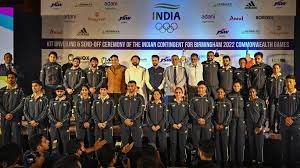

Commonwealth games were held in Birmingham, United Kingdom. India performs really good in commonwealth games 2022, with 22 Gold Medals, 16 Silver, and 23 Bronze. 215 Indian athletes participate in CWG and the star athletes of the country proudly marked themselves in the multi-sport event. From Table Tennis to Badminton to Wrestling, India Medal Tally at the Commonwealth Games 2022 reached to total of 61 medals by grabbing 4th position in the medal standings.
Commonwealth Games 2022 started with the opening ceremony on July 28 while, the closing ceremony of the event will be held on August 8, 2022. CWG 2022 saw the athletes competing in 20 sports and India had successfully named over 200 athletes or players who participated in 16 sports including hockey, cricket, badminton, and athletics, to name a few.
Various Indian sportsperson who participates in CWG 2022:
Mirabai Chanu
Mirabai Chanu, a star weightlifter from India, went on a record-smashing spree in Commonwealth Games 2022, claiming four of them in a power-packed performance. Mirabai Chanu claimed India’s first Gold Medal at Commonwealth Games 2022 in Birmingham on July 30, 2022.
Anchita Sheuli
Weightlifter Anchita Sheuli continued India’s victory spree at Commonwealth Games 2022 as he clinched India’s third Gold Medal in CWG 2022.
Bindyarani Devi
Weightlifter Bindyarani Devi won a Silver in the women’s 55 kg as India continued its medal rush at the Commonwealth Games 2022.
Vijay Kumar Yadav
The 26-years old Vijay Kumar Yadav produced a superlative performance and grabbed Bronze Medal in Men’s 60-kg class at the ongoing CWG 2022. He pounded on the mistake of his opponent and pinned him down for 10 seconds to end the contest in just 58 seconds.
Harjinder Kaur
India’s Harjinder Kaur won Bronze Medal in the women’s 71 kg weightlifting competition after the dramatic climax at the Commonwealth Games 2022.
Lovepreet Singh
India’s weightlifter Lovepreet Singh has won Bronze Medal in the men’s 109 kg category at the ongoing Commonwealth Games 2022.
Tejaswin Shankar
Tejaswin Shankar, a National Record holder, opened the Indian athletics team’s medal account with a Bronze in the men’s high jump event in the Commonwealth Games 2022.
Bajrang Punia
Tokyo Olympics Bronze Medalist Bajrang Punia defended his title in the 65 kg competition that he won three of his four bouts inside first rounds. Wrestler Bajrang Punia made the country proud by winning Gold in Men’s 65 Kg category.
Sakshi Malik
Wrestler Sakshi Malik won Gold in the Women’s 62 Kg category in the Commonwealth Games 2022. Her winning gave a boost to the country’s increasing medal tally.
Deepak Nehra
Deepak Nehra outplayed Pakistan’s Tayab Raza 10-2 in the bronze play-off as the country signed off from the wrestling competition with a high success rate.
Kidambi Srikanth
World Championship Silver Medallist Kidambi Srikanth signed off with the Bronze Medal in the Badminton competition of the Commonwealth Games 2022.
PV Sindhu
PV Sindhu has once again made the country proud by winning Gold Medal in the ongoing Commonwealth Games 2022 in Birmingham. The badminton player defeated Michelle Li of Canada 21-15 21-13 in the final of Women’s Singles to win a Gold Medal at CWG 2022.
The names of our stars are not limited. Their performance has made India proud. It was their hard work and courage which took our country at the height.
Top 10 MBA colleges in India
Top 10 MBA colleges in India
In India, MBA is one of the popular courses after completing graduation in youth. it is the best course if you want to build your career to the next level. the best thing about an MBA course is that it does not matter what stream you opt for your graduation whether it’s engineering or the law still you can pursue it which attracts a lot of aspirants to opt for it as a career option. the other thing which influences the student about MBA is it has good placement and one of the high paying jobs. MBA course includes theoretical, practical, and peer learning. presently in India, there are 20 IIMs and 6000 B-Schools operating in India.
the facility, infrastructure, availability of courses, and faculty might vary among all institutions but the process of admission is quite similar. it is divided into 5 steps:
- Register and apply for the MBA entrance exam like CAT/GMAT/MAT/XAT/NMAT.
- attempt the exam
- the college will shortlist on the basis of merit
- appear in the final round conducted by the college like GD, PI, and aptitude exam.
- now after considering all the factors like scores for the entrance exam, 12 and 10, and graduation the college will select suitable candidates.
.jpg)
Top 10 colleges for MBA in India:
- Indian Institute of Management, Ahmedabad
- Indian Institute of Management, Bangalore
- Indian Institute of Management, Calcutta
- Faculty of Management Studies, Delhi
- Indian Institute of Management, Lucknow
- Indian Institute of Management, Kozhikode
- SP Jain Institute of Management and Research, Mumbai
- Indian Institute of Foreign Trade, New Delhi
- Jamnalal Bajaj Institute of Management Studies, Mumbai
- Narsee Monjee Institute of Management Studies – School of Business Management, Mumbai
1: Indian Institute of Management, Ahmedabad:
IIT Ahmedabad is one of the top MBA colleges in India. it is a B-School which is situated in Ahmedabad, Gujarat. it provides Master’s degree programs in management, marketing, HR, and many more. it offers placement from international companies. if you want to study at this college then you need to qualify CAT/GMAT entrance exam. it is a well-reputed college for providing MBA /PGDM programs to students and for working professionals if you are a working person then you can opt it part-time MBA program.
Tuition fees:- 2320000
duration- 24 months
total seats – 60
2: Indian Institute of Management, Bangalore:
it is also one of the leading colleges in India that caters to MBA courses while adopting high technology .it offers a doctorate and MBA program. it is the high tech business school in India for MBA. it always has a motive to provide the best exposure to the students of its program and ensure placement to each and every student as it scales the career of the student to the next level.
Tuition fees:- 2320000
duration- 24 months
total seats – 60
3:Indian Institute of Management, Calcutta:
it is the first national institute for pursuing postgraduate and research study programs in management. it offers high-quality education as it is the leader in the business world for giving expert professionals managers and entrepreneurs.
Tuition fees:- 2260000
duration- 24 months
total seats – 390
4: Faculty of Management Studies, Delhi:
it is one of the oldest b-school in India offering an MBA. it provides quality education and has very fees and a good placement record which attracts the candidates to this college. over the years I have built a strong bond with students, staff, and faculty.
Tuition fees:- 192000
duration- 24 months
total seats -251
5 Indian Institute of Management, Lucknow:
Since 1984, it has been a leading and top college in India that offers MBA. it has molded its students into sharpened leaders, leading professionals, and excellent managers. it offers placement from both domestic and international companies.
Tuition fees:- 1925000
duration- 24 months
total seats -405
6 Indian Institute of Management, Kozhikode:
the institute trains its students as business leaders through its consulting, teaching, and learning. since 1996 it has innovated itself over the years which makes them special. it offers MBAs in various specializations along with that is also caters to doctoral programs.
Tuition fees:- 1900000
duration- 24 months
total seats -375
7: SP Jain Institute of Management and Research, Mumbai:
the institute offers a diverse range of programs and courses for postgraduates, NPO, entrepreneurs, and family businesses. it is a part of Vidhya Bhavan and operates as a self-contained institute .it consistently ranked among 10 colleges.
Tuition fees:- 1900000
duration- 24 months
total seats -276
8: Indian Institute of Foreign Trade, New Delhi:
it is a well-known college for providing an MBA in the specialization of international business. it has two campuses in India Kolkata and in Delhi. it also strives to bring companies for placement into the campus domestically and internationally. if someone who is looking for doing MBA in foreign trade mgmt then can opt this college thorgh qualify the entrance exam.
Tuition fees:- 1825000
duration- 24 months
total seats -258
9: Jamnalal Bajaj Institute of Management Studies, Mumbai:
The institute is also known as the CEO factory and one of the top MBA colleges in India. it has built many business leaders. industry leaders, entrepreneurs. it is a leading college in Maharashtra and is always ranked on the top of the B-Schools list.
Tuition fees:- 600000
duration- 24 months
total seats -120
10:Narsee Monjee Institute of Management Studies – School of Business Management, Mumbai:
For the last 40 years, it has been a leading college because of its expertise and experience and ranked among the top colleges’ list of MBAs. here a strong focus is given to the teaching process. over the years it has grown and expanded itself and become the best college for MBA aspirants.
Tuition fees:- 20280000
duration- 24 months
total seats -600
Top 10 Engineering Collage in India
Top 10 Engineering collage in India

Getting admission to an engineering college is a dream for a lot of students in India. IITs and NITs are engineering colleges that provide education in the field of engineering.
These are the top ten engineering collage in India:
1. Indian Institute of Technology, Madras
It is an internationally complemented institution and stands in the top five engineering institutions by the ranking system of NIRF. The IIT Madras has all the basic amenities including a beautiful garden which is always taken care of and the Central library present at the hostel. As the students are excellent in their technical efficiency and have a very good practical knowledge in their field of engineering, there are always pre-placement offers and many workshops are conducted by these companies to hire the students. Interaction seminars are also conducted and internships are also a medium for the placement procedure.
2. Indian Institute of Technology, Delhi
Indian Institute of Technology Delhi has bagged the second position in the NIRF ranking for its efficient faculties and excellent teaching content. The knowledge provided is not only commendable but also layered up with technical enhancements so that theoretical, as well as practical knowledge, grows up simultaneously. A total of 11 hostels for the boys and three hostels for the girls are present on the campus with the facilities of a beautiful launch, areas of gaming, computer rooms, and study rooms provided. The placements are based on a procedure and over 500 companies come to the campus to hire the students. The placement is totally on campus and more than 60% of the students get selected for the offers which provide a dream package. Unlike all other IITs, it has a beautiful robotics room, a gymnasium for fitness awareness, and swimming pools with a central library that is always open. All the laboratories work according to the latest technologies.
3.Indian Institute of Technology, Bombay
As it is one of the most reputed engineering institutions in India, it stands within the top 10 engineering institutions by the ranking system of NIRF. Not only it is highly qualified faculty members but also innovative methods in the field of teaching and practical application. A total of 16 hostels with all the facilities are provided on the campus. Generally, the placement records show a 100% placement rate, and the companies which offer and provide packages in lakhs are very popular including Amazon, Flipkart, and Cadbury. The placement as well as the professional board of IIT Bombay with all the companies is not only strong but also provides commendable statistics for building up the career of the students. The infrastructure is not only beautiful but has all the amenities including the staff room, library, lecture halls and seminar halls, and E consortium.
4.Indian Institute of Technology, Kanpur
Academically, the IIT Kanpur bags its position in the top five of the NIRF ranking and it is also complimented for its extracurricular activities. Students not only better themselves in the field of engineering but also polish their extracurricular talents. The placement records stand is very high and the packages of the salary increase arithmetically each year. Sometimes there are international companies that provide packages in crores.
5. Indian Institute of Technology, Kharagpur
Like all other IITs, it also provides quality education along with commendable teachers Who are highly educated in the field of teaching with many years of experience. Apart from this, it is fully facilitated with fans that work according to the Wi-Fi and the campus LANs. The highest packages are offered to the students in lakhs and around 15 LPA is the average score of the batch Income.
6. Indian Institute of Technology, Roorkee
It has multi-variant courses along with 14 undergraduate and 24 post-graduate courses. It also provides Ph.D. courses which is not only restricted to engineering but also extend to the field of science and architecture, social studies, and business management. With a total of 13 hostels among which two are for girls and 11 are for male students, it facilitates the mess, stationery shop, a salon, gymnasium, gaming room, reading space, and laundry. It also facilitates a guest room which is provided in every single hostel. For the history of placements, 85% of the students are completely placed and both international, as well as domestic offers, are received. The average amount goes to INR 2.17 crores for the international packages and 1.92 crores for the domestic packages.
7. Indian Institute of Technology, Guwahati
It has highly skilled professors along with experienced teachings are provided in the IIT Guwahati. It comprises a canteen, mess, a juice corner, an in-campus shop of stationery, a gymnasium, and a laundry room. The central library and TV room are common in every IIT. The Wi-Fi connections are very efficient. For the enhancement of the sports activities, various basketball, football, and volleyball courts are available on the campus.
8. Birla Institute of Technology and Science (BITS)
The Birla Institute of science and technology has a very good bond with both the students as well as the teachers. The first campus was situated at Pilani on the year 1943. Later it stretched its branches all over India and outside like Dubai, Hyderabad, etc. The BITS Pilani is the most famous institution for the engineering field and various courses including BE, management, B pharma, M.Sc. Every year, the Birla Institute of technology and science conducts its entrance examinations for the students to get admitted for these courses.
9. Vellore Institute of Technology
This institute provides many courses including graduate, postgraduate, and also research programs. It also gives dual integrated courses for the students. The placement records are excellent and the whole average batch is being offered jobs from various companies. The B.Tech courses are the most popular in the field of biotechnology, electronics and communication, and computer science engineering. The Vellore Institute of Technology conducts its examination and students have to achieve the minimum cut-off to get admitted to this college.
10. Delhi Technological University
This college was previously known as Delhi College of engineering. After it had got its affiliated with the University of Delhi the year of 1962 it came to be known as Delhi Technological University. It also provides a lot of courses including BTech, MTech, MBA, and BBA courses, and offers research programs. The facility of both shifts is provided while conducting the classes. The mode of admission is by the scores of the joint entrance examination and students have to achieve the minimum cut-off to get into this college.
Thus, if you want to get admission to an engineering college you can choose the best collage of your choice.
Online learning platforms
What do you mean by an online learning platform?
The online learning platform is a website where students can learn online. They can attend all the lectures, recordings, live classes and tests. Online learning platform are very easy to attend. It is very helpful because you can do from your own comfort zone.
From 2020 onwards when covid – 19 came from that time the online learning platforms are very much active and have came forward to help the students with their academics.
Some of the best online learning platforms are below –
1. Skill share
Skill share is a online learning platform where you can get free trial for 1 month and you can cancel at any time before the month get over to not being charged. In skill share you get all the courses on ver high quality. The lectures are very good. You can easily learn from their videos
2. Unacademy
Unacademy is an Indian online platform where you can get all the live classes and recordings after you get subscription. They take a fee from Rs 1200 to Rs 6200 per annum. They also prepare for all the competitive exams like UPSC, NEET, JEE, CUET and many more.
3. Udemy
Udemy is a online learning platform where you can learn various course in all the particular fields. In udemy there are 49 millions students have been enrolled. You can learn various programmes like python, programming, photography and more.
4. Coursera
Coursera is a online learning platform where that provide top learning courses from top educators around the world. It has 23 million users. Coursera provides university level courses and certification programmes.
5. edX
edX is a MOOC platform that offers university level online courses. You can enroll onedX and learn various courses according to your interests and make you career growth personally and professionally.
A brief history of Yoga in India
One cannot imagine Indian culture and heritage without the presence of Yoga. Tracing its root in ancient India, Yoga is known as an art of attaining spiritual and mental peace.
Yoga has evolved over the course of time and is considered an effective means of maintaining physical, spiritual, and mental wellbeing. The word ‘Yoga’ is derived from the Sanskrit word ‘Yuj’, which means ‘to unite’. Every Yogic mudra focuses on spiritual alignment between the mind and body, for attaining inner peace.
A brief history of Yoga in India
Yoga traces down its history thousands of years ago in India, early traces were found in the Pre-Vedic period (2700 B.C.). Yoga developed prominently between 500 BC-800 A.D. and has evolved since then. Sage Maharshi Patanjali codified the existing Yoga practices that had been in practice, and which are now performed worldwide. Today in contemporary times, Yoga is a means to preserve and maintain health. It has helped individuals with their well-being, from generation to generation.
Yoga and Indian Culture
Yoga has a presence in the folk traditions, Vedic, and Upanishadic heritage of India. Yoga tends to the body, mind, emotions, and energy and follows four major oaths namely: Karma Yoga focused on the body; Bhakti Yoga focused on emotions; Gyana Yoga, which focused on intellect; and Kriya Yoga, which focused on energy.
In olden times, Yoga education was imparted by gurus in ashrams. In today’s time, several Yoga institutes and colleges are providing lessons on Yoga across India.
Actions@75, The Future of Yoga in India!
― Hon’ble Prime Minister Narendra Modi
India is referred to as the land of Yoga and is continuing to take initiative for promoting the importance of Yoga education. The United Nations General Assembly honored the suggestion of Hon’ble Prime Minister Narendra Modi and declared ‘21st June’ as the International Day of Yoga. This aims to make people aware of the significance of Yoga and the positive changes it can yield in everyday life.
The International Day of Yoga in India is celebrated every year since 2015 with distinct themes such as ‘Yoga for Harmony and Peace’, ‘Connect the Youth’, ‘Yoga for Health, and Yoga at Home’ reflecting the emergence of Yoga as a path for maintaining well-being.
The government aims to equip more and more people with the knowledge of Yoga, preserve Yogic heritage, and introduce it to future generations. Yoga has become a part of the curriculum in schools across the country. The Central Council for Research in Yoga and Naturopathy (CCRYN), an autonomous body under the Ministry of AYUSH, has created eight Yoga outpatient clinics in Delhi and Haryana Government hospitals.
Summing it up
At a time when the world is facing the wrath of the COVID-19 pandemic, Yoga can have positive effects on the mind and physical well-being of individuals. Increasing the involvement of youth in Yoga can yield a generation of Yoga instructors, learners, and promoters who can be the future flag bearers of Yogic culture and heritage.
Shri Anurag Thakur urges youth to hoist Tiranga at their homes from 13-15th August
Union Minister for Information and Broadcasting, and Youth Affairs and Sports Shri Anurag Singh Thakur urged the youth to unfurl Tiranga at their homes from 13th to 15th August 2022 as a part of the celebration of “Har Ghar Tiranga” campaign in the country. He said that today being the “August Kranti” Diwas our youth should take oath to hoist Tiranga at the top of the world by contributing with their dedication and hard work in their respective field. Shri Anurag said that our national flag is not mere a piece of cloth but the power of Tricolour unites 130 crore Indians. He further said that our youth should take pledge that they will keep the country united and will take India forward and make India stronger. He was addressing during a Youth conference held with the members of Nehru Yuva Kendra, NSS volunteers and different Yuva Mandals in Shimla today. The programme was organized by the Nehru Yuva Kendra, Shimla (HP).
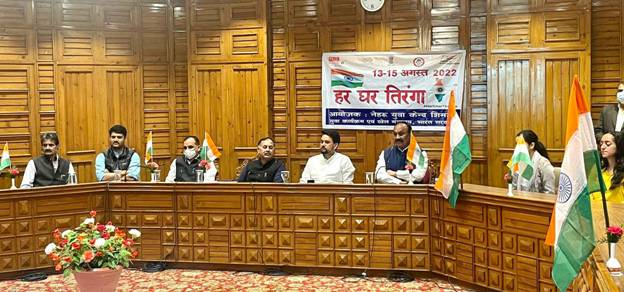
While interacting with the youth, he called for inculcating the feeling of patriotism and national integration among the younger generation through Bharat Darshan programme. He said that every youth should visit and see the other places and parts of their State and the country which will infuse a sense of belonging and patriotism among them and help them becoming responsible citizens. He also mentioned about the role of the “EK Bharat Shreshth Bharat” (EBSB) programme in breaking the barriers of language, culture and different cuisines of different states thus bringing youths of different states closer to each other. The Minister said that it will work towards maintaining the unity and integrity of the nation and thus will enhance the glory of India.
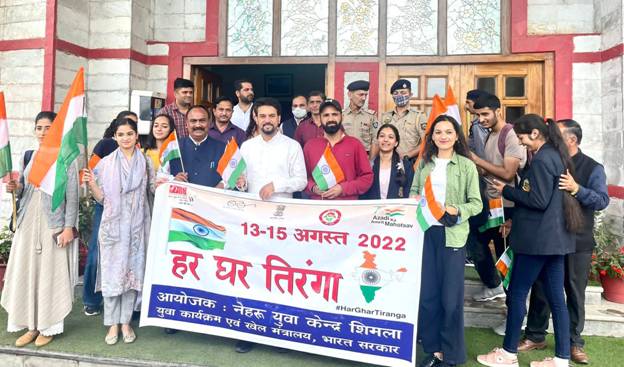
In a candid discussion with the participants, Shri Anurag Thakur tried to know the views of the youth on the different issues and problems in the country. He discussed the issues of women empowerment, Ek Bharat Shreshth Bharat, skill development, role of sports, Fit India movement and carrier counseling threadbare with the youths of Nehru Yuva Kendra, NSS volunteers and different Yuva Mandals. He expressed hope that such meetings will continue in future also so that youth of this country can come to know about the Government schemes and can approach the Government.
The Minister also mentioned about the achievements of the Central Government schemes like the Har Ghar Jal Yojna, sanitation drive Ujala, Ujwala Yojna, and Digital India etc. He said that to promote the Fit India movement he has established 250 gyms in his parliamentary constituency.
While replying to the questions of the media persons, he said that under the leadership of Prime Minister, Shri Narendera Modi India has done remarkable progress in every sphere. He said that in sports our achievements have increased manifold as results of the recent Commonwealth Games show that India got 61 medals and scored 4th position in the tournament.
******
WIPS (Forum for Women in Public Sector) formation day celebrated at Visakhapatnam Steel Plant
Silver Jubilee of WIPS (Forum for Women in Public Sector) formation day was celebrated in VSP today in a grand manner. Addressing the women employees of RINL, Shri Atul Bhatt, CMD, RINL-VSP in his address, lauded the exceptional contribution by the women fraternity of RINL in turning around the company after six years of making losses.” I am very happy to note that Women in Public Sector (WIPS) of RINL, which was established in 1997 has completed 25 long and successful years and is celebrating silver Jubilee this year”, Shri Atul Bhatt said. He congratulated all the women employees of RINL on this special occasion and appreciated them for their active role in improving the awareness on the role of women in the society.
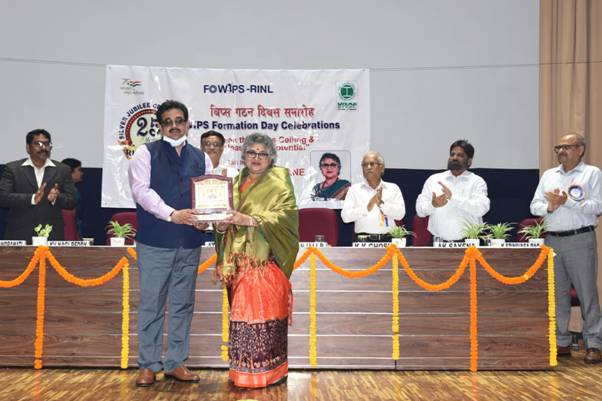
Shri Atul Bhatt congratulated Ms.PV Sindhu, for bagging the prestigious gold at the Commonwealth Games in Badminton women’ singles competition and said that it is matter of pride for entire RINL family that Ms. PV Sindhu is the brand ambassador of RINL.
Shri Atul Bhatt complimented Ms. Sheela Priyadarsini, Chief General Manager & head of the department -Materials Management, RINL for efficiently handling the extremely complex supply chain management of steel plant. “It is heartening to note that more number of women are joining RINL and it is a matter of pride to note that women are increasingly and gradually seen marching into domains which were once reserved only for men like the armed forces.I would like to compliment WIPS of RINL for their active role in improving the awareness about the role of women in society and the various programmes they undertake for this cause.”, Shri Atul Bhatt added.
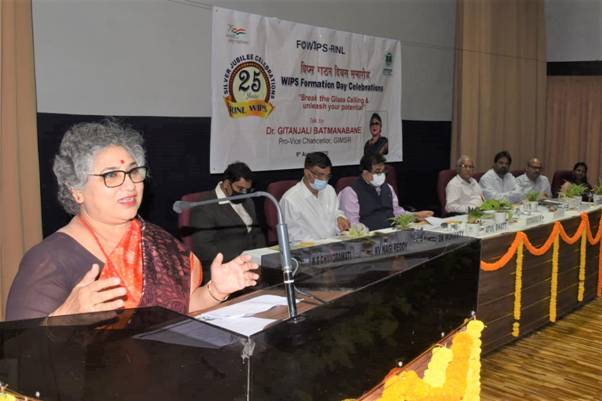
Shri Atul Bhatt thanked Dr.GitanjaliBatmanabane for her gracious presence and said that her presence and message will certainly inspire the women participants to scale greater height in professional life.
The Guest of honour, Dr Gitanjali Batmanabane, Pro-Vice Chancellor, GITAM Institute of Medical Sciences and Research(GIMSR) highlighted the need for women to develop the culture of courage to encounter the difficulties being faced in the society for success in their life. She said that India is known for youngest population and next gen women would play a dominant role in variety of fields. Dr.Gitanjali Batmanabane, Shri Atul Bhatt and Directors of RINL felicitated some of the women employees of RINL and also gave prizes to winners of various competitions held on the occasion.
*****
 Eduindex
You must be logged in to post a comment.