Purchasing Managers’ Index (PMI)

Purchasing Managers’ Index (PMI)

• A survey-based economic indicator designed to provide a timely insight into business conditions.

• Widely used
 To anticipate changing economic trends in official data such as GDP.
 An alternative measure to official data about economic
performance and business conditions.
 Used by financial and corporate professionals to better understand economies and markets, and to uncover
opportunities.

• Compiled and produced globally by IHS Markit – for more than 40 economies worldwide.
• Originally compiled for manufacturing sector
only – later extended to include sectors – services, construction and retail.
Manufacturing PMI .

• A survey-based economic indicator designed to provide a timely insight into changing business conditions in the goods-producing sector.

• Weighted average of five indices

  • New orders
  • Output
  • Employment
  • Suppliers’ delivery times
  • Inventories of goods
    purchases.
  • News
  • • India’s manufacturing output shrank in June
    according to this article.
  • • PMI in May was 50.8.
  • • June – slid to 48.1.
  • • Companies are least optimistic and continue
    to shed jobs.
  • • Buying levels – falling at a greater pace.
  • • Weak demand reduction in production requirements.
  • • COVID-19 restrictions – curtailed international
    demand for Indian goods.

• Strict containment measures – negatively
impacted demand and led to the contractions in factory orders, production, exports and quantities of purchases.

• Capital goods – worst-affected area in June.

• Output of Capital goods declined at a steep rate due to a sharp fall in sales.

• Falling new orders, business closures and the
COVID-19 crisis triggered a reduction in output
among Indian manufacturers.

• Growth of new orders, production, exports and
input purchasing was interrupted in June lockdown.

MEDICAL TERMINATION OF PREGNANCY (AMENDMENT) BILL 2021

Context: Recently, the Rajya Sabha passed the Medical Termination Pregnancy (Amendment) Bill, 2021.

● The Bill seeks to amend the Medical Termination of Pregnancy Act, 1971.

● This Act covers abortions in India. It had been amended in 1975 and 2002.

●This is an important Bill that seeks to enhance the reproductive rights of women in india .

● Before the enactment of this legislation, abortion was prohibited under Section 312 of the Indian Penal Code.

According to this MTP Act, 1971, a pregnancy may be medically terminated by a registered medical practitioner:

  1. Where the length of the pregnancy does not exceed twelve weeks (for this, the opinion of one doctor was required).
  2. Where the length of the pregnancy has exceeded twelve weeks but does not exceed 20 weeks. In this case, for the abortion to take place, two doctors must be of the opinion that the continuation of the pregnancy would impair the mental and/or physical health of the mother, and/or that if the child were to be born, it would suffer from serious physical or mental abnormalities causing it to be handicapped.
  3. The law also required minor pregnant women to get written consent from the guardian for the abortion to be allowed.

Provisions:

Termination due to Failure of Contraceptive Method

Under the Act, a pregnancy may be terminated up to 20 weeks by a married woman in the case of failure of contraceptive method or device. The Bill allows unmarried women to also terminate a pregnancy for this reason.

Opinion Needed for Termination of Pregnancy:

• Opinion of one registered medical practitioner (instead of two or more) for termination of pregnancy up to 20 weeks of gestation.

• Opinion of two registered medical practitioners for termination of pregnancy of 20-24 weeks of gestation.

• Opinion of the State-level medical board is essential for a pregnancy to be terminated after 24 weeks in case of substantial foetal abnormalities.

Medical Boards:

Every state government is required to constitute a Medical board

These Medical Boards will consist of the 5 members:

(i) a gynaecologist

(ii) a paediatrician

(iii) a radiologist or sonologist

(iv) any other number of members, as may be notified by the state government.

Upper Gestation Limit for Special Categories:

It enhances the upper gestation limit from 20 to 24 weeks for special categories of women which will be defined in the amendments to the MTP Rules and would include survivors of rape, victims of incest and other vulnerable women (like differently-abled women, minors) etc.

Confidentiality:

The “name and other particulars of a woman whose pregnancy has been terminated shall not be revealed”, except to a person authorised in any law that is currently in force.

Benefits:

Termination in Case of Anomaly:

A number of foetus abnormalities are detected after the 20th week, often turning a wanted pregnancy into an unwanted one.

Helps Special Category Women:

The law will help the rape victims, ill and under-age women to nd unde terminate the unwanted pregnancy lawfully.

Beneficial for Unmarried Women:

The Bill also applies to unmarried women and therefore, relaxes one of the regressive clauses of the 1971 Act, i.e., single women couldn’t cite contraceptive failure as a reason for seeking an abortion.

Allowing unmarried women to medically terminate pregnancies and a provision to protect the privacy of the person seeking an abortion will bestow reproductive rights to the women.

Abortion laws across the world:

Abortion laws vary across the world. It is learnt that around 60 countries prescribe gestational limits.

• 52 % including France, the UK, Austria, Ethiopia, Italy, Spain, Iceland, Finland, Sweden, Norway, Switzerland and even Nepal, allow for termination beyond 20 weeks on the diagnosis of foetal abnormalities.

● Some countries go beyond even these limits with laws in 23 countries-Canada, Germany, Vietnam, Denmark, Ghana, and Zambia-allowing for abortion at any time during the pregnancy on the request of the mother.

●Recently, Argentina became both the largest Latin American country and the third South American country to legalize abortion.

Challenges:

Viability of the Foetus:

● A key aspect of the legality governing abortions has always been the ‘viability’ of the foetus.

● Viability implies the period from which a foetus is capable of living outside the womb.

● As technology improves, with infrastructure up-gradation, and with skilful professionals driving medical care, this ‘viability’ naturally improves.

• Currently, viability is usually placed at about seven months (28 weeks) but may occur earlier, even at 24 weeks.

Thus, late termination of pregnancy may get in conflict with the viability of the foetus.

Preference for a Male Child:

The preference for a male child keeps sex determination centres in bussiness in spite of their illegal status. There are concerns that a more liberal abortion law can aggravate this state-of-affairs.

Change of Choice:

The current Bill does not consider factors such as personal choice, a sudden change in circumstances (due to separation from or eath of a partner), and domestic violence

Medical Boards:

●The present healthcare budgetary allocation makes setting up a board across the country, both financially and practically impossible.

● Access to the board by pregnant women in remote areas of the state is a matter of concern.

●No time limit set to respond to the requests.

● The board will subject women to multiple examinations before allowing her to terminate her pregnancy. This is a violation of right to privacy and right to live with dignity.

Way Forward

●Though Medical Termination of Pregnancy (Amendment) bill 2021 is a step in the right direction, the government needs to ensure that all norms and standardised protocols in clinical practice to facilitate abortions are followed in health care institutions across the country.

●Along with that, the question of abortion needs to be decided on the basis of human rights, the principles of solid science, and in step with advancements in technology.


Traditional food

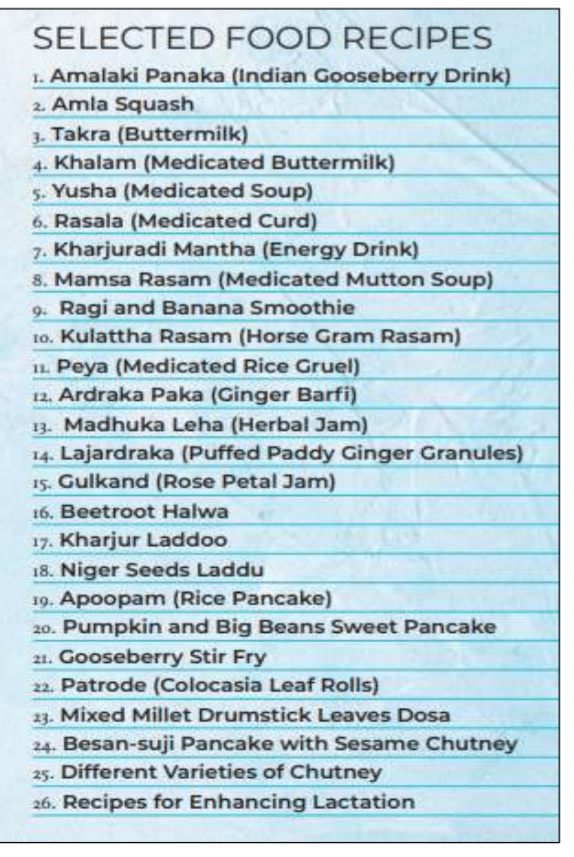
Traditional food recipes from the AYUSH system of
medicine

Source: https://ayushportal.nic.in/

• India has a very rich tradition of diverse food
practices in different parts.

• AYUSH compilation of recipes- exploration of
traditional systems of eating for health and
nourishment.

• Encompasses cooking methods of some selected
traditional food items.

Patrode (Colocasia Leaf Rolls)

• A delicacy made with colocasia leaves.

• Popular in Malnad and coastal Karnataka;
prepared in Maharashtra, Goa, Himachal Pradesh,
Gujarat, and NE region.

Malnad region

• A region of Karnataka.

• covers the western and eastern slopes of the Western Ghats – 100 km in width.

• A hilly terrain under the heavy rain fall belt – annual rainfall of 1000 to 3800 mm.

• Agumbe, Shivamogga: receives highest rainfall in Karnataka (10000 mm).

• Known as Karnataka’s
Cherrapunji.

Health benefits of Patrode

• Easily digestible; rich in dietary fibres- help in easy bowel movement.

• Iron rich colocasia leaves- improving the hemoglobin.

• Colocasia leaves contain phenols, tannins, flavonoids, glycosides and sterols.
 Help in reducing chronic inflammation- rheumatoid arthritis.

• Colocasia leaves have significant amounts of vitamin C and beta carotene.

Contraindications:
 Using too much of oil- unsuitable for cardiac patients, diabetics, obese etc.
 Too much spice is not recommended in acid peptic diseases.

Liberalization

• A relaxation of government restrictions in the areas of social, political and economic policies.

• Economic policy – lessening of government regulations and restrictions for greater
participation by private entities in order to encourage economic development.

Economic liberalization

• Initiated in 1991 .

• Goal – making the economy more market-oriented.

• Aim – Expanding the role of private and foreign investment in a manner that ensured an adequate flow of benefits to the poor .

Situation – Prior Reforms.

• Control system in the Indian Economy – rigid
and restricted entrepreneurship.
 Private sector was not allowed to invest in a number of sectors
 Imports were more strictly controlled
 Import of technology was controlled and Foreign Direct Investment was discouraged.

• 1991 reforms – P.V. Narasimha Rao-Manmohan
Singh duo Evolution of the economy .

• Full benefits took time to materialize – the final results were striking.

• Example:
 GDP growth averaged 7% – 1992 to 2017
 Average of 5% in the preceding ten years
 4% in the preceding 20 years.

• Increase in economic growth – poverty gradually began to decline.
• In-adequate recognition – Sectors like health, education and environmental concerns • Pending reforms – Areas such as labour and land.

• India’s decision – Regional Comprehensive
Economic Partnership.
 Need to enhance its competitiveness.
 Unfair competition from China – imposing
anti-dumping duties on China instead of
raising import duties across the board
 Geopolitics – reducing their dependence on
China.
 India can expect to become a major
player in non-China-dominated supply
chains.
 RCEP membership – Reassuring partners that
trade policy will not be arbitrarily changed.
• Free trade agreements – agreements with
important groups bilaterally • Requires – more give and take policy

Pandemic – collapse in employment.

• National Income – GDP contracted by 7.3% in
2020-21.

• Priority – vaccination coverage expanded as
soon as possible
 Creates conditions conducive to a return to
normalcy.

• Achieving the 2019-20 level economic recovery.

• India’s decision – Regional Comprehensive Economic Partnership.
 Need to enhance its competitiveness.
 Unfair competition from China – imposing anti-dumping duties on China instead of raising import duties across the board
 Geopolitics – reducing their dependence on China.
 India can expect to become a major player in non-China-dominated supply chains.
 RCEP membership – Reassuring partners that
trade policy will not be arbitrarily changed.
• Free trade agreements – agreements with important groups bilaterally .

• Requires – more give and take policy Pandemic – collapse in employment.

• National Income – GDP contracted by 7.3% in
2020-21.

• Priority – vaccination coverage expanded as
soon as possible
 Creates conditions conducive to a return to
normalcy.

• Achieving the 2019-20 level economic recovery.

• Analyse the grounds that caused the slowdown before the pandemic.

• Mutually supportive policies – higher growth
and higher employment with a target for post-pandemic growth.

COVID-19 and Tourism


• UN report – COVID-19 and Tourism: An Update.

• Collapse of international tourism -cost the world at least $4 trillion.

• Report -jointly released by UN Conference on Trade and Development (UNCTAD) and UN World Tourist Organization (UNWTO).

• India – 54% drop in tourist arrivals in 2020.

• Tourism is not expected to return to pre- COVID levels until 2023.
 Cost the world -$1.7 trillion and $2.4 trillion in 2021.

• Three scenarios.
 Optimistic.
 Pessimistic.
 Uneven roll-out of vaccines. • Developing countries -majority in losses due
to the asymmetric roll-out of vaccines. • Tourism likely to pick up faster this summer

  • North America and Europe.
  • • Loss in tourism sector -Felt particularly by women and young people. • 100-120 million tourism jobs are at stake.
  • • Recommended quick roll-out of vaccines
    globally.
    • Appreciated The EU Digital COVID Certificate
    initiative.
     Facilitate safe free movement of citizens
    in the EU during the COVID-19 pandemic.
  • • Recommended socio-economic measures to
    protect livelihoods.
  • • Grim warning -some tourism-related businesses
    would not survive even after restrictions are
    removed.

ISRO

• Dr Vikram Sarabhai – Indian National Committee
for Space Research (INCOSPAR)

• INCOSPAR renamed as ISRO (Indian Space Research organization).

• Department of Space.

• Vision of ISRO – Harness space technology for
national development, pursuing space science
research and planetary exploration.

Achievements

Aryabhata – India’s first satellite .

Rohini – first satellite to be placed into orbit – Indian-made launch vehicle SLV-3.

Chandrayaan -1 – unmanned lunar orbiter, success.
• Mars orbiter Mission (MOM)
 India first nation to succeed on maiden attempt to Mars.
 ISRO – Fourth space agency in the world
 First space agency in Asia.

• Astro-Sat


 launched on September 28, 2015, by PSLV-C30
 Space observatory
 First dedicated Indian astronomy mission to studying celestial
sources in X-ray, optical and UV spectral bands simultaneously.

• ISRO launched 104 satellites – single rocket
(PSLV-C37).

• ‘Chandrayaan-2’ – Partial success, Orbiter successfully launched .

Chandraayan 3 – in pipe line.

IRNSS/ NAVIC
 To meet the user requirements of the
positioning, navigation and timing services based on the indigenous system
 Navigation details in the Indian Ocean
regions.

• Upcoming mission – Gaganyaan : Indias
manned space mission

Chamoli disaster

Avalanche

• A large amount of snow moving quickly down a
mountain- on slopes of 30 to 45 degrees.

• When it stops, the snow becomes solid – people
may die from suffocation, trauma or hypothermia.

Flash Floods

• Caused by heavy rainfall in a short period of time – generally less than 6 hours.

• Characteristics: raging torrents after heavy rains.
 Rip through river beds, urban streets, or mountain canyons etc.

• Can also occur even if no rain has fallen.
 After a dam has failed/after a sudden release of water by ice jam.

Glacial Lake Outburst Flood (GLOF)

• Glacial lakes: bodies of water influenced by the presence of glaciers.

• Moraine: field of dirt and rocks/debris moving with glaciers- •

When glacier melts, it will change into a lake- moraines act as a dam to the lake.

• When this moraine dam fails- water will be drained through the subsurface tunnels.

• GLOF: release of meltwater from a moraine/ice-dam glacial lake due to dam failure.

Cloudbursts

• A sudden, very heavy rainfall- localised and brief.

• Most cloudbursts occur in connection with
thunderstorms.

• Usually occurs in high altitude areas.
 Formation of a low-pressure zones on
the top of a mountain.

Climate Change

• Long-term change in the average weather patterns that have come to define Earth’s local, regional and
global climates.
 Frequent and intense drought.
 Increased frequency and intensity of storms and heat waves.
 Caused rising sea levels, melting of glaciers and warming of oceans.
 Directly harm flora and fauna, destroy the places they live, and wreak havoc on people’s livelihoods
and communities.

Atlas of Glacial Lakes

• Ministry of Jal Shakti -updated atlas of glacial
lakes that are part of the Ganga River basin.

• Similar inventory of glacial lakes was prepared for the Indus River basin.

• Present Ganga study – Glacial lakes were mapped
using Resourcesat-2 (RS-2) Linear Imaging Self Scanning Sensor-IV (LISS-IV) satellite data.

• Process of lake formation, location, and type of damming material – glacial lakes are identified in
nine different types & majorly grouped into four
categories.

• Bhuvan portal of National Remote Sensing Centre, ISRO.

• Create “comprehensive and systematic” glacial lake database for Ganga River basin.

Ganga River

• Ganga rises in the Gangotri glacier -Uttarkashi district of Uttarakhand.

• Source -Bhagirathi.

 At Devprayag joining another hill stream Alaknanda becomes Ganga.

• Principal tributaries from right – Yamuna, the Son and the Damodar.

• Principal tributaries from left -The Ramganga, the Ghaghra, the Gomati, the Gandak, the Kosi and the
Mahananda.
• The Chambal and the Betwa -important sub- tributaries.

• River Ganga -Uttarakhand, Uttar Pradesh, Bihar, Jharkhand, and West Bengal.

• River basin -Uttar Pradesh, Bihar, West Bengal, Madhya Pradesh, Rajasthan, Jharkhand, Haryana,
Uttarakhand, Chhattisgarh, Himachal Pradesh and the Union Territory of Delhi.

Film certification and censorship inIndia

Cinematograph Act of 1952

 Film certification and censorship in India
 Established the Central board for film certification
 Statutory body
 Under ministry of information and
broadcasting
 Head quartered in Mumbai
 Members of the committee are appointed by the central
government inc Chairman.

Justice Mukul Mudgal, 2013 – To examine the issues of certification under the Cinematograph Act, 1952.

Shri Shyam Benegal Committee in 2016

  • To evolve broad guidelines for film certification within the ambit of the
    Cinematograph Act and Rules.
  • • With that consultation the ministry has
    proposed to introduce the
    Cinematograph (Amendment) Bill, 2021.
  • • Up for public consultati

• Age-based categories:

 ‘Unrestricted public exhibition’ category is
proposed to be amended
 Film category
 “U” – unrestricted public exhibition
 “A” – restricted to adult audiences
 “UA” – unrestricted public exhibition subject to parental guidance for children below the age of twelve
 “S” – Restricted to a special class of audience.

• Draft bill proposes to further sub-divide the
existing UA category into age-based categories –
U/A 7+, U/A 13+ and U/A 16+

• Amendment of sub-section (3) of section 5A – ‘Validity of certificate’

 Act of 1952 – certificate issued by the CBFC is valid for 10 years
 Amendment – certificate will be valid in
perpetuity.

• Adding sub-section(1) of section 6 – when the Central government received any
complaints for violation of section 5B(1) on any film that is already certified by CBFC –
in that case the Central government may ask
the chairman of the CBFC to reconsider the certification.

Film piracy – insertion of section 6AA:

 Piracy rose 62% in India in the last week of March 2020 compared to the last week of February 2020 following the
COVID lockdowns.
 Cinematograph Act, 1952 – No provision
to check privacy
 Prohibits unauthorised recording
 Prescribes punishment – imprisonment for
minimum of three months and maximum
of three years, fines the individual with
minimum of Rs 3 lakhs.

Criticism

• An attempt by union government o act as a “super censor” body.
 SC in K.M. Shankarappa vs Union of India, 2000 case – Union government
cannot exercise revision powers on films that are already certified by the CBFC
 Despite the SC judgement, this is an attempt to add another layer to quell
freedom of expression through films
 Government scraped the existence of Film Certificate Appellate Tribunal
(FCAT) through an ordinance. (A body to hear appeals of film-makers against decisions of the CBFC)

Conclusion

A way to stifle free speech as expressed
through films. And that is why this draft
bill is being criticised

Criminal justice system

• TADA and UAPA – anti-terror special laws.
 2015-2019- 7,840 persons were arrested under UAPA but only 155 were convicted.
 TADA-67,000 people were detained but just 725 were convicted.

• Kartar Singh case – prosecution had unjustifiably invoked provisions of TADA ‘with an oblique motive of depriving the accused persons from getting bail’.

 ‘Nothing but the sheer misuse and abuse of the Act by the police’.

No consensus

• Grossly misused – no consensus on definition of
the term ‘terrorism’.

• Neither TADA/UAPA defines -‘terror’ and ‘terrorism’.

 Section 15 (UAPA) – Any act with intent to threaten or likely to threaten the unity,
integrity, security, or sovereignty of India or with intent to strike terror or likely to strike terror in the people.
 UAPA – acts committed by using bombs, dynamite or other explosive substances or
inflammable substances or firearms or other lethal weapons or poisonous or
noxious gases … or by any other means of whatever nature to cause or likely to
cause death or injuries…

Judicial Cases .

• Yaqoob Abdul Razzak Memon case – Terrorist acts range from threats to actual
assassinations, kidnappings, airline hijacking, car bombs, explosions, mailing of dangerous materials, use of chemical, biological, nuclear
weapons etc.

• Hitendra Vishnu Thakur case – ‘use of violence when its most important result is
not merely the physical and mental damage of the victim but the prolonged psychological effect it produces … on the society as a whole’.

 Overawe the government or disturb the harmony of society or ‘terrorise’ people…’.

 Deliberate and systematic use of coercive intimidation’.

• Kartar Singh case – Mere disturbance of public
order is not a terrorist act.

• Ram Manohar Lohia case -Distinction between ‘law and order’, ‘public order’ and ‘security of state’.

 Law and order represent the largest circle within which is the next circle representing ‘public order’ and the smallest circle
represents the ‘security of state’.

 Act may affect ‘law and order’ but not ‘public order’.  Act may adversely affect ‘public order’ but not the ‘security of state.’

 Police have failed to understand these distinctions.

Way Forward

• Police will be far more cautious in charging people under special laws like
UAPA and TADA.

• No anti-terror law can really end the problem of terrorism.

• Must remove injustices in our society to combat terrorism.

• Creation of a truly just, egalitarian and non-oppressive society – far more effective in combating terrorism.

Institute of Chartered Accountants ofIndia (ICAI)

• statutory body set up in 1949 – by The Chartered Accountants Act, 1949.

• premier accounting body.

• regulates the profession of Chartered Accountancy in the country.

• functions under the administrative control of
the Ministry of Corporate Affairs.

• second largest professional body of Chartered Accountants in the world.
• Management:
 in accordance with the provisions of Chartered Accountants Act, 1949 and the Chartered Accountants Regulations of 1988.
 Council – empowered to frame Regulations under the Act and to constitute necessary standing and non-standing Committees.
 40 members – 32 elected by CAs and 8 nominated by the Central Government.
 nominees generally represent the Comptroller and Auditor General of India,
SEBI, Ministries of Corporate Affairs and Finance etc.

• maintains highest standards in technical,
ethical areas and for sustaining stringent
examination and education standards.

Role:
 Regulate the profession of Accountancy
 Education and Examination of Chartered Accountancy Course
 Continuing Professional Education of Members
 Conducting Post Qualification Courses
 Formulation of Accounting Standards
 Prescription of Standard Auditing Procedures
 Laying down Ethical Standards
 Monitoring Quality through Peer Review
 Ensuring Standards of performance of Members
 Exercise Disciplinary Jurisdiction
 Financial Reporting Review
 Input on Policy matters to Government .

• functions– Educational, Regulatory and Disciplinary.
 formulates the code of ethics to be followed by its members.

National Investigation Agency (NIA)

• NIA Act, 2008– established the National Investigation Agency (NIA).

• Extends to the whole of India. Applies to Citizens of India outside India.

• Government servants wherever they may be.

• Persons on ships and aircrafts registered in India wherever they may be.

• NIA is the Central Counter Terrorism Law Enforcement Agency in India.

• Can investigate and prosecute for offences under the following Schedule.

National Security Guard (NSG)

• 1984: Union Cabinet decided to create a Federal Contingency Force to tackle terrorism.

• NSG formally came into being in 1986: the NSG Act 1986.

• Modelled on the pattern of Special Air Service (SAS) of the UK and GSG9 of Germany.

• NIA Act, 2008- established the National Investigation Agency
(NIA).

Two complementary elements:
 Special Action Group (SAG)- comprising Army personnel.
 Special Ranger Group (SRG)- comprising personnel drawn from CAPF/State police forces.

Hunger watch report

News

Source: Department of Consumer Affairs, Hunger Watch

• Impacts of Covid-19 pandemic, lockdown – on
personal income and food consumption.

• Hunger watch report analysed to provide
important information.
Income drop.

• In October 2020 – compared to pre lockdown
level
 27% of respondents lost their income due to
the national lockdown
 24% of its respondents record that they lost
50% of their income
 6% responded that their income did not change
despite the lockdown
Source: Department of Consumer Affairs, Hunger Watch

Retail inflation

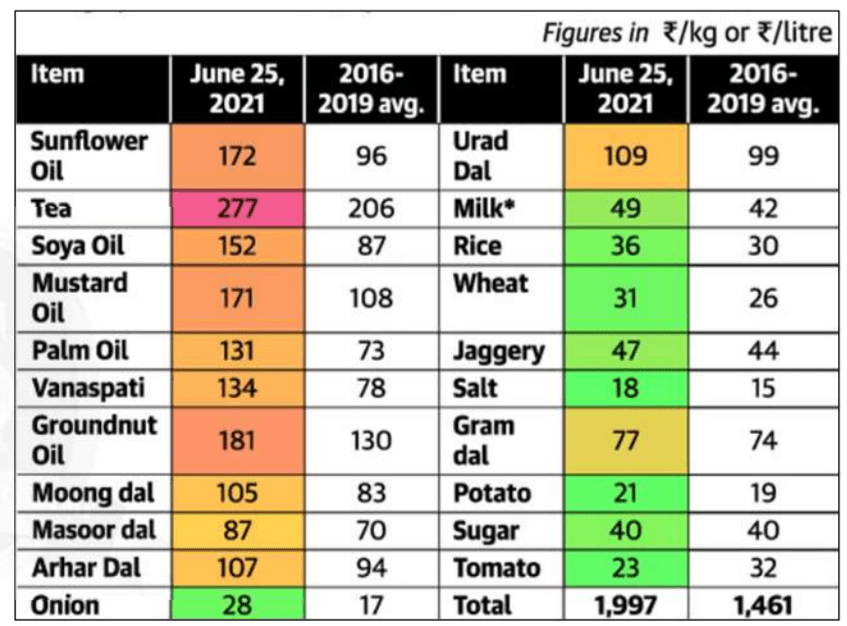
• In June 2021 – the prices of edible oil and pulses are increasing significantly .

• retail price analysis of 21 essential items across India.

• In June 2021- a Consumer – to buy a kg of essential item – has to spend rs.500 more compared to average cost between the year 2016 and 2019 .

• table given – indicates the retail price difference in various occasions .

• with retail inflation – the drop in income level has burdened the consumers.

hold Consumption of Commodities

• the impact of income factor and inflation
factor can be seen from the change in consumption level
 data of October 2020 is compared with March 2020.

• Report – level of household consumption of all
commodities listed have decreased.

• In October 2020 – 38% of households reported
that the consumption of vegetables decreased a lot.

• consumption of egg/meat commodities have also decreased – another problem in ensuring nutrient security.

Conclusion

adequate policy responses are the need of the hour to address both food and nutrition security in the country.

Mediterranean Sea,Red sea ,and Aegean Sea

Red Sea

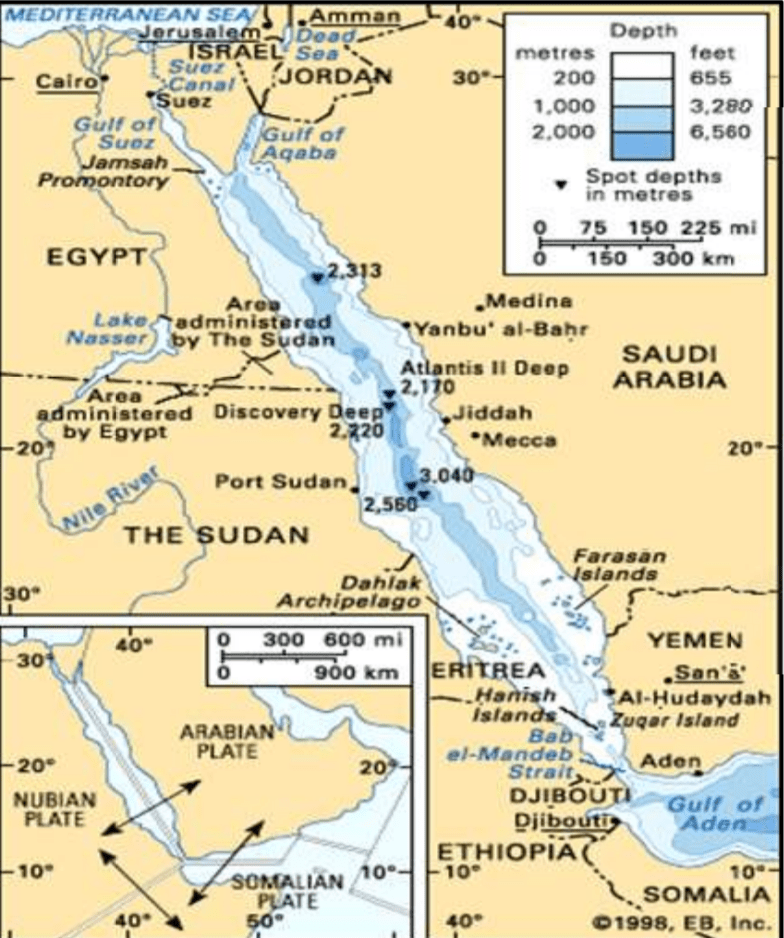
• Extending southeastward from Suez to the Bab el-Mandeb Strait.

• Northern end splits into- the Gulf of Suez to the NW and the Gulf of Aqaba to the NE.

• Separates the coasts of Egypt, Sudan, and Eritrea to the west from those of Saudi
Arabia and Yemen to the east.

• Connected to Mediterranean Sea via the Suez Canal.
 one of the most heavily traveled waterways
in the world.

• Derives its name from the colour changes observed in its waters.
 occasionally populated by the algae Trichodesmium erythraeum.

Mediterranean Sea

• An intercontinental sea .

• Often called the incubator of Western civilization.

• Extends from the Strait of Gibraltar to the Gulf of Iskenderun.

• West- connected with Atlantic Ocean by the
Strait of Gibraltar.

• Northeast- connected with the Black Sea through the strait of Dardanelles, the Sea of Marmara, and the strait of the Bosporus.

• Southeast- connected with the Red Sea by the Suez Canal.

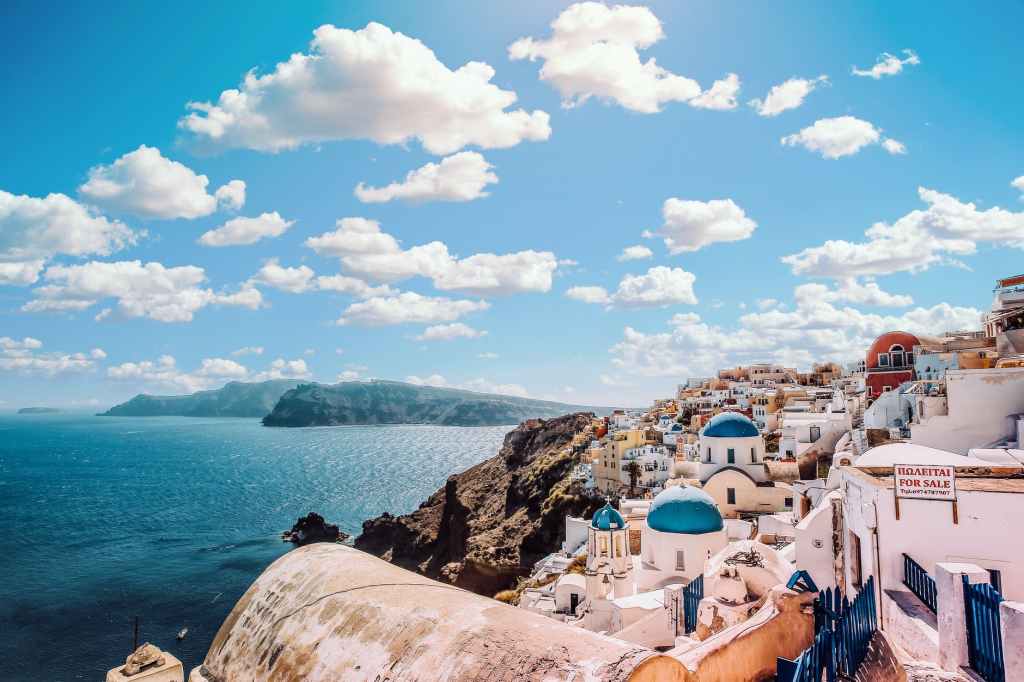
Aegean Sea

• An arm of the Mediterranean Sea- between
the Greek peninsula and Asia Minor.

• Connected through the straits of the Dardanelles, the Sea of Marmara, and the
Bosporus to the Black Sea.

CONVERSATIONS ABOUT AIDS

News


● HIV infection and few facts of policy targets – suggestions to tackle the spread of HIV
infections.

HIV – Human Immunodeficiency Virus.

• attacks the body’s immune system
• currently no effective cure – once people get HIV, they have to live with it for life .

• HIV can be controlled – with proper medical care.

• If HIV is not treated – it can lead to AIDS.

• HIV infection unnoticed – due to COVID-19
outbreak India’s Achievements .

• took every possible step to fight against HIV/AIDS .

• in 1990s – information and education campaigns – helped to check the transmission
of HIV infection.

• enforce strict ante-natal protocols – Upgradation of Blood banks with superior
testing facilities.

• excellent awareness programmes and intensive
follow-up action plans .

• led to significant decline in incidence of HIV – till 2013

Facts

• careless approach of the government -resulted in poor implementation of AIDS
control programmes countrywide.

• aim of the World Health Organization – ensure antiretroviral therapy to 90% of the people living with HIV/AIDS – by 2020
 India – pushed the target year by at least five years .

• National Health Policy 2017 and the UN Sustainable Development Goals – aim to end AIDS by 2030.
 This goal – may take longer to achieve.
• HIV infection diagnosis rate dropped from 60% in 2010 to 23% in 2019.
 2010-2019 – mortality rate doubled and new cases spiked five times more .

• National AIDS Control Organization – annual
HIV Estimates report of 2019 – 58,000 AIDS-related deaths and over 69,000 new
HIV infections were added
 Reason – the campaign to educate and empower the vulnerable communities was
losing steam.

Suggestions

• Strong political leadership, financial support, public support and activism essential in the successful handling
 Keep debating the HIV issue – need for multi-sectoral and multi-pronged strategy .

• Trust the formula that supports science- driven responses – good quality data, research findings and consolidating guidelines .

• Repurpose the road map for reducing new HIV infections by 2030
• Strong surveillance system
 The nationalised AIDS treatment plan is a perfect example – early detection,
diagnosis and treatment saved many lives
 use of Integrated Counselling and Testing
Centres in early detection of infections.

• Government – re-energise Integrated Counselling and Testing Centres – to uphold
the right to treatment and the dignity of individuals affected.