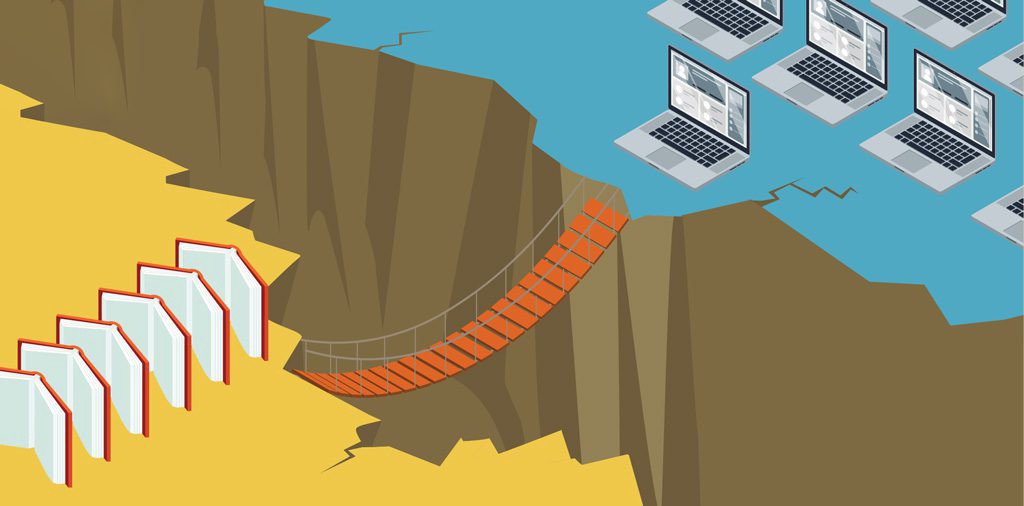
Recent Major Administrative Reforms

Recently, the Union Government gave the information on Major Administrative Reforms which were introduced in recent years and emphasised the importance of these reforms in making governance more accessible.

These reforms aim to encourage greater efficiency, transparent and corruption free governance, accountability and reduce scope for discretion. The Government follows the maxim “Minimum Government – Maximum Governance”.

Mission Karmayogi

  • This is a National Programme for Civil Services Capacity Building (NPCSCB). It is a comprehensive reform of the capacity building apparatus at individual, institutional and process levels for efficient public service delivery.
  • It is aimed at building a future-ready civil service with the right attitude, skills and knowledge, aligned to the vision of New India.
  • The capacity building will be delivered through iGOT-Karmayogi digital platform, with content drawn from global best practices.

Lateral Entry

  • Lateral entry means when personnel from the private sector are selected to an administrative post of the government despite them not being selected in or being part of a bureaucratic setup.
  • This is significant because contemporary times require highly skilled and motivated individuals at the helm of administrative affairs, without which public service delivery mechanisms do not work smoothly.
  • Lateral Entry helps in bringing the values of economy, efficiency, and effectiveness in the Government sector. It will help in building a culture of performance within the Government sector.

e-Samiksha

  • real time online system for monitoring and follow up action on the decisions taken by the Government at the Apex level in respect of implementation of important Government programmes/projects.
  • It is a digital monitor for bureaucracy to rein in slackers.
  • Also, the government has been taking an intensive review for weeding out inefficient and Officers of doubtful integrity by premature retirement.

e-Office

  • e-Office Mission Mode Project (MMP) has been strengthened for enabling Ministries/Departments to switch over to paperless office and efficient decision making.

Citizen Charters

  • Government has mandated Citizen Charters for all Ministries/Departments which are updated and reviewed on a regular basis.
  • It is a written document that spells out the service provider’s efforts taken to focus on their commitment towards fulfilling the needs of the citizens/customers.

Good Governance Index 2019

  • It assesses the Status of Governance and impact of various interventions taken up by the State Government and Union Territories (UTs).
  • The objectives of GGI are to provide quantifiable data to compare the state of governance in all States and UTs, enable States and UTs to formulate and implement suitable strategies for improving governance and shift to result oriented approaches and administration.
  • It has been launched by the Ministry of Personnel, Public Grievances & Pensions.

National Conference on e-Governance

  • It provides a platform for the government to engage with experts, intellectuals from industry and academic institutions to exchange experiences relating to e-Governance initiatives.
  • In 2020, the 23rd National Conference on e-Governance was organised by the Department of Administrative Reforms and Public Grievances (DARPG) along with the Ministry of Electronics and Information Technology (MeitY) in Mumbai.

Centralized Public Grievance Redress and Monitoring System (CPGRAMS)

  • It is an online web-enabled system developed by National Informatics Centre (Ministry of Electronics & IT [MeitY]), in association with Directorate of Public Grievances (DPG) and Department of Administrative Reforms and Public Grievances (DARPG).
  • The CPGRAMS provides the facility to lodge a grievance online from any geographical location. It enables the citizen to track online the grievance being followed up with Departments concerned and also enables DARPG to monitor the grievance.

National e-Governance Service Delivery Assessment: It aims at assessing the States, UTs and Central Ministries on the efficiency of e-Governance service delivery.

Comprehensive restructuring of the Scheme for ‘Prime Minister’s Awards for Excellence in Public Administration’ in 2014 and thereafter in 2020.

Way Forward

  • Reforms are an obvious response to the new challenges confronting the state institution managing public affairs; what lies at the root of such an exercise is the effort to enhance administrative capability in the changed scenario.
  • Since the civil servants are accountable to political executives and that results in politicisation of civil services, the focus must be on external accountability mechanisms like citizen charters, social audits and encouraging outcome orientation among civil servants.
  • Civil servants should provide unbiased, rational and meritorious suggestions to the political executive in policy formulation. It requires an impartial Civil Services Board that can look after all the aspects related to promotions, transfers, posting and suspensions.
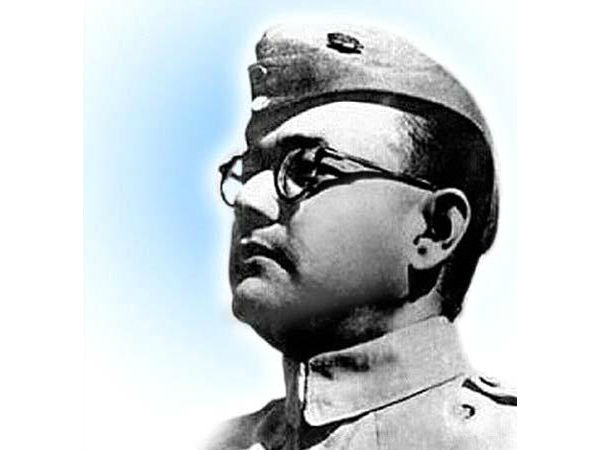
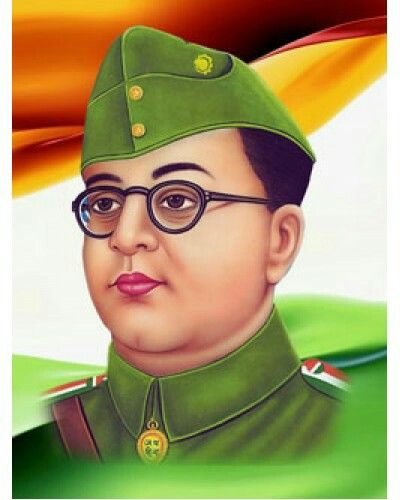
Netaji Subhash Chandra Bose

The Grand Festival of the Indian Democracy is round the corner – You guessed it right! Its the Independence day!!!

On this occasion let’s remember a very Important Freedom fighter in the Freedom struggle of our Country – Netaji Subhash Chandra Bose

Netaji Subhas Chandra Bose was a fierce nationalist, whose defiant patriotism made him one of the greatest freedom fighters in Indian history. He was also credited with setting up the Indian Army as a separate entity from the British Indian Army – which helped to propel the freedom struggle.

Life of Netaji Subhash Chandra Bose

  • Subhas Chandra Bose was born on 23rd January 1897, in Cuttack, Orissa Division, Bengal Province, to Prabhavati Dutt Bose and Janakinath Bose.
  • After his early schooling, he joined Ravenshaw Collegiate School. From there he went to join Presidency College, Calcutta and was expelled due to his nationalist activities. Later, he went to University of Cambridge, U.K.
  • In 1919, Bose headed to London to give the Indian Civil Services (ICS) examination and he was selected. Bose, however, resigned from Civil Services as he believed he could not side with the British.
  • He was highly influenced by Vivekananda’s teachings and considered him as his spiritual Guru. His political mentor was Chittaranjan Das.
  • In 1921, Bose took over the editorship of the newspaper ‘Forward’, founded by Chittaranjan Das’s Swaraj Party.
  • In 1923, Bose was elected the President of the All India Youth Congress and also the Secretary of Bengal State Congress.
  • He was also sent to prison in Mandalay in 1925 due to his connections with revolutionary movements where he contracted Tuberculosis.
  • During the mid-1930s Bose travelled in Europe. He researched and wrote the first part of his book, The Indian Struggle, which covered the country’s independence movement in the years 1920–1934.
  • After his return, Bose took over as the elected President of Indian National Congress in 1938 (Haripur) and stood for unqualified Swaraj (self-governance) and the use of force against the British which then combated against Mahatma Gandhi and his views.
  • Bose was re-elected in 1939 (Tripuri) but soon resigned from the presidency and formed the All India Forward Bloc, a faction within the Congress which aimed at consolidating the political left.
  • He died on 18th August 1945, in a plane crash in Japanese-ruled Formosa (now Taiwan).

Netaji Subhash Chandra Bose Contribution to Freedom Struggle

  • Association with C.R Das: He was associated with C.R. Das’ political endeavour, and was also jailed along with him. When C.R. Das was elected Mayor of Calcutta Cooperation, he nominated Bose as the chief executive. He was arrested for his political activities in 1924.
  • Trade union movements: He organised youth and promoted trade union movements. In 1930, he was elected Mayor of Calcutta, the same year he was elected the President of AITUC.
  • Association with congress: He stood for unqualified swaraj (independence), and opposed Motilal Nehru Report which spoke for dominion status for India.
    • He actively participated in the Salt Satyagraha of 1930 and vehemently opposed the suspension of Civil Disobedience Movement and signing of the Gandhi-Irwin Pact in 1931.
    • In the 1930s, he was closely associated with left politics in Congress along with Jawaharlal Nehru and M.N. Roy.
    • Because of the endeavour of the left group, the congress passed very far reaching radical resolutions in Karachi in 1931 which declared the main Congress aim as socialization of means of production besides guaranteeing fundamental rights.
  • Congress presidentship: Bose won the congress presidential elections at Haripura in 1938.
    • Next year at Tripuri, he again won the presidential elections against Gandhi’s candidate Pattabhi Sitarammayya.
    • Due to ideological differences with Gandhi, Bose left congress and found a new party, ‘the Forward Bloc’.
    • The purpose was to consolidate the political left and major support base in his home state Bengal.
  • Civil disobedience movement: When World War II began, he was again imprisoned for participation in civil disobedience and was put under house arrest.
  • Indian National Army: Bose manages to escape to Berlin by way of Peshawar and Afghanistan. He reached Japan and from there to Burma and organised the Indian National Army to fight the british and liberate India with the help of Japan.
    • He gave famous slogans ‘Jai Hind’ and ‘Dilli Chalo’. He died in a plane crash before realising his dreams.

Azad Hind

  • Indian Legion: Bose founded the free India centre in Berlin and created the Indian Legion out of the Indian prisoners of war who had previously fought for the British in North Africa prior to their capture by Axis forces.
    • In Europe, Bose sought help from Hitler and Mussolini for the liberation of India.
  • In Germany, he was attached to the special bureau for India which was responsible for the broadcasting on the German sponsored Azad Hind Radio.
    • On this radio, Bose on 6th July 1944, addressed Mahatma Gandhi as the ‘Father of the Nation’.
  • Indian National Army: He reached Japanese-controlled Singapore from Germany in July 1943, issued from there his famous call, ‘Delhi Chalo’, and announced the formation of the Azad Hind Government and the Indian National Army on 21st October 1943.
    • The INA was first formed under Mohan Singh and Japanese Major Iwaichi Fujiwara and comprised Indian prisoners of war of the British-Indian Army captured by Japan in the Malayan (present-day Malaysia) campaign and at Singapore.
    • The INA included both, the Indian prisoners of war from Singapore and Indian civilians in South-East Asia. It’s strength grew to 50,000.
    • The INA fought allied forces in 1944 inside the borders of India in Imphal and in Burma.
    • However, with the fall of Rangoon, Azad Hind Government ceased to be an effective political entity.
    • In November 1945 a British move to put the INA men on trial immediately sparked massive demonstration all over the country.
  • Impact: The I.N.A. experience created the wave of disaffection in the British Indian army during the 1945-46, which culminated in the great Bombay naval strike of February 1946 and was one of the most decisive reasons behind the British decision to  make a quick withdrawal.
  • Composition of I.N.A: The I.N.A. was essentially non-communal, with Muslims quite prominent among its officers and ranks, and it also introduced the innovation of a women’s detachment named after the Rani of Jhansi.

He was indeed a Patriot in the true sense of the word who worked for freedom until his last breath! and played a very important role in the freedom struggle of India.

Utilising the potential of the youth of the country

In India over 62% of the population is aged between 15 and 59 years, and the median age of the population is less than 30 years. This means India is going through the stage of ‘demographic dividend’ representing the potential for economic growth based on the age structure of the population.

However, transforming this potential into reality requires adolescents and the youth to be healthy and well-educated.

A study on demographic dividend in India by United Nations Population Fund (UNFPA) said the window of demographic dividend opportunity in India is available for five decades from 2005-06 to 2055-56.

Therefore, more than the fears of a ‘population explosion’, it is critical that India focus attention on safeguarding young people’s well-being because India’s welfare hinges on them.

With so much potential we can march ahead in the path of success! Then what’s stopping us?

What are the Challenges In Realising Youth Potential

  • Lack of Education and Skill: India’s underfunded education system is inadequately equipped to provide the skills young people need to take advantage of emerging employment opportunities.
    • According to the World Bank, public expenditure on education constituted only 3.4% of GDP in 2020.
    • Another report revealed that India stands 62nd in terms of public expenditure per student, and fares badly in quality of education measures such as student-teacher ratios.
  • Impact of the Pandemic: Various studies show that school closures have a serious impact on the learning, lives and mental well-being of children. A survey by the International Labour Organization (ILO) reveals that 65% of adolescents worldwide reported having learnt less during the pandemic.
  • Issues of Young Women: Child marriage, gender-based violence, their vulnerability to abuse and trafficking, especially if primary caregivers fall ill or die. All these issues restrict young women to achieve their full potential.
  • Jobless Growth: The main contributor in India’s GDP is the service sector which is not labour intensive and thus adds to jobless growth. Further about 50% of India’s population is still dependent on agriculture which is notorious for underemployment and disguised unemployment.
  • Low Social Capital: Further high levels of hunger, malnutrition, stunting among children, high levels of anaemia among adolescent girls, poor sanitation etc., have reduced the productivity of India’s youth in realising their potential.

What is the way forward?

  • Inter-sectoral Collaboration: It is imperative to have in place mechanisms for better inter-sectoral collaboration to safeguard the futures of the young generation. Coordination across departments can enable better solutions and greater efficiencies in tackling any crisis.
    • Eg.: Mid-day meals scheme not only provides an incentive for parents to send their children to school but also provides the calorie intake required to stay alert in the classroom.
  • Skill Development to increase employability of the young population. India’s labour force needs to be empowered with the right skills for the modern economy.
    • Government has established the National Skill Development Corporation (NSDC) with the overall target of skilling/up-skilling 500 million people in India by 2022.
  • Improving Social Infrastructure: If India wants to leverage the economic potential of its youth bulge, then it must invest in improving social infrastructure viz. good health, quality education, and endeavour to provide decent employment to their entire population.
  • Maintaining Basic Hygiene: As school closures have impacted access to schemes such as the delivery of menstrual hygiene products to adolescents, teachers can work as volunteers for collaborating with frontline health workers to distribute sanitary napkins to girls.
  • Helpline For Youth: To address the mental health of adolescents, the Health and Education Ministries should strengthen outreach via existing helplines and by enabling conversations on critical issues regarding their reproductive and sexual health.
  • Immediate Steps After Pandemic: It is important for policymakers to balance the risks of transmission through children with the harm of prolonged school closures.
    • By prioritising the vaccination of teachers and school support staff and also allowing a decentralised approach where district-level officials may reopen schools based on local Covid-19 transmission rates, schools could be opened in a safe and phased manner.

Conclusion

Improving the lives of youth in mission mode would lift their lives, generate a virtuous cycle with healthier and educated young adults contributing substantially to securing India’s future.

The policies for empowerment of youth and their effective implementation will ensure that demographic dividend, which is a time-limited opportunity, becomes a boon for India.

Secularism – An Integral part of Indian Democracy

The term “Secular” means being “separate” from religion, or having no religious basis.

A secular person is one who does not owe his moral values to any religion. His values are the product of his rational and scientific thinking.

Secularism means separation of religion from political, economic, social and cultural aspects of life, religion being treated as a purely personal matter.

It emphasized dissociation of the state from religion and full freedom to all religions and tolerance of all religions.
It also stands for equal opportunities for followers of all religions, and no discrimination and partiality on grounds of religion.

Secularism in the History of India

  • Secular traditions are very deep rooted in the history of India. Indian culture is based on the blending of various spiritual traditions and social movements.
  • In ancient India, the Santam Dharma (Hinduism) was basically allowed to develop as a holistic religion by welcoming different spiritual traditions and trying to integrate them into a common mainstream.
  • The development of four Vedas and the various interpretations of the Upanishads and the Puranas clearly highlight the religious plurality of Hinduism.
  • Emperor Ashoka was the first great emperor to announce, as early as third century B.C. that, the state would not prosecute any religious sect.
    • In his 12th Rock Edict, Ashoka made an appeal not only for the toleration of all religion sects but also to develop a spirit of great respect toward them.
  • Even after the advent of Jainism, Buddhism and later Islam and Christianity on the Indian soil, the quest for religious toleration and coexistence of different faiths continued.
  • In medieval India, the Sufi and Bhakti movements bond the people of various communities together with love and peace.
  • The leading lights of these movements were Khwaja Moinuddin Chisti, Baba Farid, Sant Kabir Das, Guru Nanak Dev, Saint Tukaram and Mira Bai etc.
  • In medieval India, religious toleration and freedom of worship marked the State under Akbar. He had a number of Hindus as his ministers, forbade forcible conversions and abolished Jizya.
    • The most prominent evidence of his tolerance policy was his promulgation of ‘Din-i-Ilahi’ or the Divine Faith, which had elements of both Hindu and Muslim faith.
    • That this was not imposed upon the subjects is obvious from the fact that there were few adherents to it. Along with this he emphasized the concept of ‘sulh-i-kul’ or peace and harmony among religions.
    • He even sponsored a series of religious debates which were held in the ‘Ibadat Khana’ of the Hall of Worship, and the participants in these debates included theologians from amongst Brahmins, Jains and Zoroastrians.
  • Even before Akbar, Babar had advised Humayun to “shed religious prejudice, protect temples, preserve cows, and administer justice properly in this tradition.”
  • The Indian freedom movement was characterized by secular tradition and ethos right from the start.
    • In the initial part of the Indian freedom movement, the liberals like Sir Feroz Shah Mehta, Govind Ranade, Gopal Krishna Gokhale by and large pursued a secular approach to politics.
    • The constitution drafted by Pandit Moti Lal Nehru as the chairman of the historic Nehru Committee in 1928, had many provision on secularism as: ‘There shall be no state religion for the commonwealth of India or for any province in the commonwealth, nor shall the state, either directly or indirectly, endow any religion any preference or impose any disability on account of religious beliefs or religious status’.
    • Gandhiji’s secularism was based on a commitment to the brotherhood of religious communities based on their respect for and pursuit of truth, whereas, J. L. Nehru’s secularism was based on a commitment to scientific humanism tinged with a progressive view of historical change.
  • At present scenario, in the context of Indian, the separation of religion from the state constitutes the core of the philosophy of secularism.

Philosophy of Indian Secularism

  • The term ‘secularism’ is akin to the Vedic concept of ‘Dharma nirapekshata’ i.e. the indifference of state to religion.
  • This model of secularism is adopted by western societies where the government is totally separate from religion (i.e. separation of church and state).
  • Indian philosophy of secularism is related to “Sarva Dharma Sambhava” (literally it means that destination of the paths followed by all religions is the same, though the paths themselves may be different) which means equal respect to all religions.
  • This concept, embraced and promoted by personalities like Vivekananda and Mahatma Gandhi is called ‘Positive secularism’ that reflects the dominant ethos of Indian culture.
  • India does not have an official state religion. However, different personal laws – on matters such as marriage, divorce, inheritance, alimony varies with an individual’s religion.
  • Indian secularism is not an end in itself but a means to address religious plurality and sought to achieve peaceful coexistence of different religions.

Secularism and the Indian Constitution

  • There is a clear incorporation of all the basic principles of secularism into various provisions of constitution.
  • The term ‘Secular’ was added to the preamble by the forty-second constitution Amendment Act of 1976, (India is a sovereign, socialist, secular, democratic, republic).
    • It emphasise the fact that constitutionally, India is a secular country which has no State religion. And that the state shall recognise and accept all religions, not favour or patronize any particular religion.
  • While Article 14 grants equality before the law and equal protection of the laws to all, Article 15 enlarges the concept of secularism to the widest possible extent by prohibiting discrimination on grounds of religion, race, caste, sex or place of birth.
  • Article 16 (1) guarantees equality of opportunity to all citizens in matters of public employment and reiterates that there would be no discrimination on the basis of religion, race, caste, sex, descent, place of birth and residence.
  • Article 25 provides ‘Freedom of Conscience’, that is, all persons are equally entitled to freedom of conscience and the right to freely profess, practise and propagate religion.
  • As per Article 26, every religious group or individual has the right to establish and maintain institutions for religious and charitable purposes and to manage its own affairs in matters of religion.
  • As per Article 27, the state shall not compel any citizen to pay any taxes for the promotion or maintenance of any particular religion or religious institution.
  • Article 28 allows educational institutions maintained by different religious groups to impart religious instruction.
  • Article 29 and Article 30 provides cultural and educational rights to the minorities.
  • Article 51A i.e. Fundamental Duties obliges all the citizens to promote harmony and the spirit of common brotherhood and to value and preserve the rich heritage of our composite culture.

How is our Secularism different than the western form of Secularism

Over the years, India has developed its own unique concept of secularism that is fundamentally different from the parallel western concept of secularism in the following ways:

  • As per the western model of secularism, the “State” and the “religion” have their own separate spheres and neither the state nor the religion shall intervene in each other’s affairs. Thus, the western concept of secularism requires complete separation of religion and state.
  • However, in India, neither in law nor in practice any ‘wall of separation’ between religion and the State exists. In India, both state and religion can, and often do, interact and intervene in each other’s affairs within the legally prescribed and judicially settled parameters. In other words, Indian secularism does not require a total banishment of religion from the State affairs.
  • As per the western model, the state cannot give any financial support to educational institutions run by religious communities.
  • On the other hand, Indian model has chosen a positive mode of engagement. In India, the state provides all religious minorities the right to establish and maintain their own educational institutions which may receive assistance from state.
  • In the western model, State does not intervene in the affairs of religion till the time religion is working within the limits of the law.
  • On the other hand, in Indian secularism, state shall interfere in religion so as to remove evils in it. India has intervened by enforcing legislation against the practices of sati or widow-burning, dowry, animal and bird sacrifice, child marriage, and preventing Dalits from entering temples.
  • In western concept of secularism, religion is relegated entirely to the private sphere and has no place in public life whatsoever. The western model prohibits any public policy to be drafted on the basis of religion therefore; state is absolutely distanced from the religious activities and practices of its citizens.
  • In India, state has the policy of setting up Departments of Religious Endowments, Wakf Boards, etc. It is also involved in appointing Trustees of these boards.

Conclusion

  • In a pluralistic society, the best approach to nurture secularism is to expand religious freedom rather than strictly practicing state neutrality.
  • It is incumbent on us to ensure value-education that makes the younger generation understands and appreciates not only its own religious traditions but also those of the other religions in the country.

Skilling the youth of India

The success of any endeavour is an interplay of capital, collaboration, regulatory mechanisms and, most importantly, the scientific and technological know-how, put simply, skills.

In India, many initiatives have been undertaken in the skills sector by governments in the last decade. However, outcomes are still elusive. According to the UNDP’s Human Development Report-2020, only 21.1 per cent of the labour force was skilled in the period 2010-2019 in India.

This dismal result is due to lack of cohesion within policy actions, absence of holistic approach and working in silos. Therefore, if India wants to reap the demographic advantage, it needs to fix the challenges pertaining to skill development in India.

What are the issues with Skill development?

  • Piecemeal Approach: The piecemeal approach to skilling can be seen in this year’s Budget which has allocated ₹3,000 crore to realign the National Apprenticeship Training scheme but has restricted it to only engineering stream and not to other science and arts streams.
  • Overburdened Responsibility: Phase III of Pradhan Mantri Kaushal Vikas Yojana, launched to impart skills development to over 8 lakh persons in 2020-21.
    • However, it suffers from excessive reliance on the District Skills Development Committees, chaired by District Collectors, who would not be able to prioritise this role, given their other assignments.
  • Discontinuity in Policy Process: The National Skill Development Agency (NSDA), created in 2013 for resolving the inter-ministerial and inter-departmental issues and eliminating duplicates of efforts of the Centre.
    • However, it has been now subsumed as part of the National Council for Vocational Training (NCVT).
    • This reflects not only discontinuity in the policy process, but also some obfuscation among policy makers.
  • Humongous Number of New Entrants: According to a 2019 study by the National Skills Development Corporation (NSDC), 7 crore additional people in the working-age of 15-59 years are expected to enter the labour force by 2023.
    • Given the sheer magnitude of youth to be skilled, it is paramount that the policy efforts are adequate in all respects.
  • Employers’ Unwillingness: India’s joblessness issue is not only a skills problem, it is representative of the lack of appetite of industrialists and SMEs for recruiting.
    • Due to limited access to credit because of Banks’ NPAs, investment rate has declined and thus has a negative impact on job creation.

What is the way forward?

  • Ending Separation Between Education & Skills: There is a need to end the artificial separation of the education system into formal and vocational shall end with such enabling frameworks allowing seamless integration.
    • In this context, the New Education Policy (NEP) 2020 envisaged a right policy as it emphasises on integration of vocational and formal education both at school and higher education levels.
    • The NEP also proposed a pilot ‘hub-n-spoke’ model with the conceptual framework of ITI becoming a ‘Hub’ for providing VET related training and exposure to students of adjoining 5-7 schools.
  • Skills survey: Surveys can be conducted to find the exact skill requirements from the employers.
    • Analysis of such surveys would help in designing course structures of the training programs and thus standardized course curriculum or training delivery systems can be developed.
  • Enhanced Expenditure on Education and Training: In the long run, Skill India will also not be enough if government expenditures in education remain low and if, therefore, the ground isn’t prepared for proper training.
    • In this case, the proposal of NEP to enhance public expenditure on education to 6% of GDP is a step in the right direction.
  • Imbibing International Success Models: India needs to learn from technical and vocational training/education models in China, Germany, Japan, Brazil, and Singapore, who had similar challenges in the past, along with learning from its own experiences to adopt a comprehensive model that can bridge the skill gaps and ensure employability of youths.

Conclusion:

To truly live in an Atmanirbhar Bharat, all the skilling efforts need to be brought under one platform and to be executed with full efficiency. A sturdy institutional framework with practical and real pathways to change course between mainstream and vocational programmes needs to be put in place.

Global Cyber security Index

India has ranked tenth (10th) in Global Cybersecurity Index (GCI) 2020 by ITU (International Telecommunication Union) by moving up 37 places.

India’s Position

  • India scored a total of 97.5 points from a possible maximum of 100 points, to make it to the tenth position worldwide in the GCI 2020.
  • India secured the fourth position in the Asia Pacific region.
  • India is emerging as a global IT superpower, asserting its digital sovereignty with firm measures to safeguard data privacy and online rights of citizens.
  • The result shows substantial overall improvement and strengthening under all parameters of the cybersecurity domain.

Countries which topped the list

  • The US topped (1st), followed by the UK (United Kingdom) and Saudi Arabia tied on the second position together.
  • Estonia was ranked third (3rd) in the index.

What is the basis of the assessment?

  • On the basis of performance on five parameters of cybersecurity, which are Legal measures, technical measures, organisational measures, capacity development, and cooperation.
  • The performance is then aggregated into an overall score.

What are the challenges to cyber security in India?

  • Deploying multiple cybersecurity tools reinforces a fragmented and complex security environment that is prone to risks arising from human error.
  • Cybersecurity challenges companies face as they shift the majority of their employees to a remote working arrangement in a really short period of time.
  • India lacks indigenization in hardware as well as software cybersecurity tools. This makes India’s cyberspace vulnerable to cyberattacks motivated by state and non-state actors. India doesn’t have an ‘active cyber defense’ like the EU’s General Data Protection Regulation (GDPR) or the US’ Clarifying Lawful Overseas Use of Data (CLOUD) Act.

What are the Efforts to Improve Cyber Security in India?

  • National Cyber Security Strategy 2020: It is being formulated to improve cyber awareness and cybersecurity through more stringent audits.
  • Draft Personal Data Protection Bill, 2018 (based on the recommendation of Justice BN Srikrishna Committee) to secure citizens’ data.
  • The scheme to set up I4C (Indian Cyber Crime Coordination Centre) was approved in October 2018, to deal with all types of cybercrimes in a comprehensive and coordinated manner.
  • National Computer Emergency Response Team (CERT-In) functions as the nodal agency for coordination of all cyber security efforts, emergency responses, and crisis management.
  • Protection and resilience of critical information infrastructure with the set up of National Critical Information Infrastructure Protection Centre (NCIIPC).

e-RUPI – To Revolutionise Indian Digital payment system in India

The Indian government has launched an electronic voucher based digital payment system e-RUPI.

What is e-Rupi ?

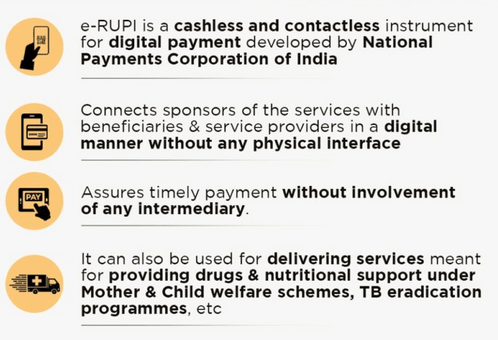
  • It is a cashless and contactless method for digital payment. It is a Quick Response (QR) code or SMS string-based e-voucher, which is delivered to the mobile of the users.
  • The users will be able to redeem the voucher without needing a card, digital payments app, or internet banking access, at the service provider.
  • It connects the sponsors of the services with the beneficiaries and service providers in a digital mode without any physical interface.
  • The mechanism also ensures that the payment to the service provider is made only after the transaction is completed.
  • The system is pre-paid in nature and hence, assures timely payment to the service provider without the involvement of any intermediary.

How is it different from Digital Currency?

e-RUPI is backed by the existing Indian rupee as the underlying asset and specificity of its purpose makes it different to a virtual currency and puts it closer to a voucher-based payment system.

Issuing Entities & Beneficiary Identification

  • The one-time payment mechanism has been developed by the National Payments Corporation of India on its Unified Payments Interface (UPI) platform, in collaboration with the Department of Financial Services, Ministry of Health & Family Welfare, and National Health Authority.
  • It has boarded banks that will be the issuing entities. Any corporate or government agency will have to approach the partner banks, which are both private and public-sector lenders, with the details of specific persons and the purpose for which payments have to be made.
  • The beneficiaries will be identified using their mobile number and a voucher allocated by a bank to the service provider in the name of a given person would only be delivered to that person.

What are its uses?

For the Government

It is expected to ensure a leak-proof delivery of welfare services and can also be used for delivering services under schemes meant for providing drugs and nutritional support under Mother and Child welfare schemes, drugs & diagnostics under schemes like Ayushman Bharat Pradhan Mantri Jan Arogya Yojana, fertiliser subsidies etc.

For the Private entities

Even the private sector can leverage these digital vouchers as part of their employee welfare and Corporate Social Responsibility (CSR) programmes.

What is the significance of e-Rupi?

The government is already working on developing a Central Bank Digital Currency and the launch of e-RUPI could potentially highlight the gaps in digital payments infrastructure that will be necessary for the success of the future digital currency.

Will this workout for India?

According to the Reserve Bank of India (RBI), there are at least four reasons why digital currencies are expected to do well in India

  • Increasing Penetration: There is increasing penetration of digital payments in the country that exists alongside sustained interest in cash usage, especially for small value transactions.
  • High Currency to GDP Ratio: India’s high currency to Gross Domestic Product (GDP) ratio holds out another benefit of CBDCs.
    • Cash-to-GDP Ratio or Currency in Circulation (CIC) to GDP Ratio or simply currency-to-GDP ratio shows the value of cash in circulation as a ratio of GDP.
  • Spread of Virtual Currencies: The spread of private virtual currencies such as Bitcoin and Ethereum may be yet another reason why CBDCs become important from the point of view of the central bank.
  • Will Act as a Cushion: Central bank digital currencies might also cushion the general public in an environment of volatile private virtual currencies.

A magnified view of our Health care system

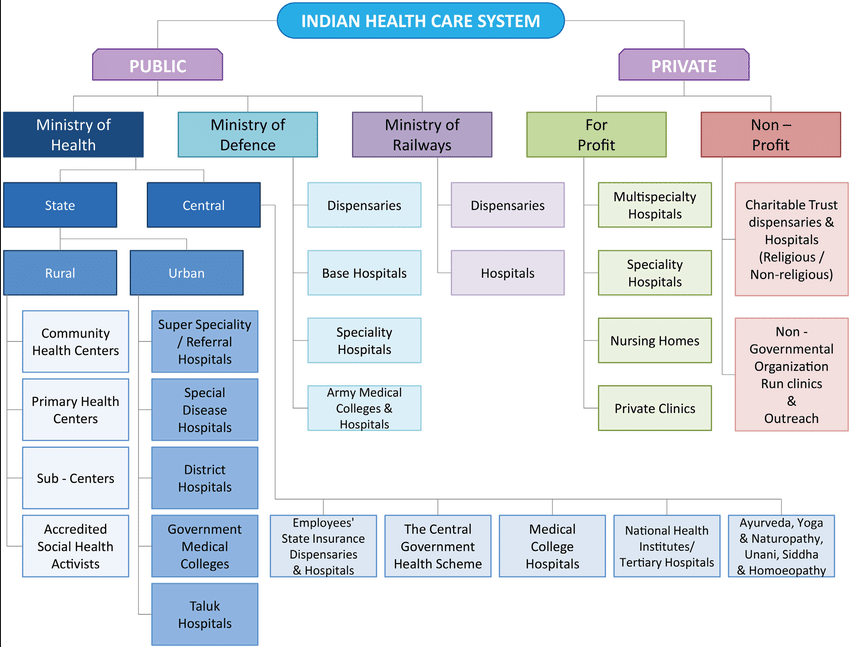
The Covid-19 pandemic reiterates the importance of Public Health systems. The private health sector which accounts for 70% of healthcare services in India, is playing only a supporting role.

There is a need to address the constraints and revamp of the public health system in India which would not only enable improved handling of Covid-19, but would also have widespread positive impacts extending much beyond the Covid-19 situation.

Covid-19 And Significance of Public Health Care

  • For Indian population, the availability of functional public health systems is literally a question of life and death.
  • A robust government health-care service is translated into a more effective outreach, timely testing, early case detection and more rational treatment for Covid patients. This is evident by comparing two States— Maharashtra and Kerala. Their per capita gross State domestic product (GSDP) is similar. However, their Covid-19 case fatality rates are hugely different — this being 0.48% for Kerala and 2.04% for Maharashtra.
  • A major reason for such critical divergence is likely to be the huge differences in the effectiveness of public health systems. Kerala has per capita two and a half times more government doctors, and an equally higher proportion of government hospital beds when compared to Maharashtra, while allocating per capita over one and half times higher funds on public health every year.
  • Despite Maharashtra having a large private health-care sector, its weak public health system has proved to be a critical deficiency.

Issues With Current Healthcare System

  • Lack of Primary Healthcare Services: The existing public primary health care model in the country is limited in scope. Even where there is a well-functioning public primary health centre, only services related to pregnancy care, limited childcare and certain services related to national health programmes are provided.
  • Supply-Side Deficiencies: Poor health management skills and lack of appropriate training and supportive supervision for health workers prevent delivery of the desired quality of health services.
  • Inadequate Funding: Expenditure on public health funding has been consistently low in India (approximately 1.3% of GDP). As per OECD, India’s total out-of-pocket expenditure is around 2.3 % of GDP.
  • Sub-optimal Public Health System: Due to this, it is challenging to tackle Non-communicable Diseases, which is all about prevention and early detection. It diminishes preparedness and effective management for new and emerging threats such as pandemic like Covid-19.

What can be done?

  • Focus On Public Health:
    • Need for a larger programme which requires the immediate attention is the National Health Mission (NHM); since 2017-18, Union government allocations for the NHM have declined in real terms, resulting in inadequate support to States for core activities such as immunisation, while systemic gaps affect the delivery of Covid-19 vaccination.
    • The condition of the National Urban Health Mission (NUHM) also remains pathetic.
      • This year’s Central allocation for the NUHM is ₹1,000 crore, which amounts to less than ₹2 per month per urban Indian.
  • Private Sector Regulation:
    • Another clear priority that has been highlighted during the Covid-19 pandemic is the need to regulate rates and standards of care in the private sector.
    • Massive hospital bills have caused untold distress even among the middle class.
    • Although various determinants have contributed to the Mucormycosis outbreak, irrational use of steroids in Covid-19 patients, especially diabetics, appears to be an important factor.
    • The central government should take necessary steps to promote the implementation of the Clinical Establishments (Registration and Regulation) Act (CEA).
      • Passed in 2010 and presently applicable to 11 States across India, this Act is not effectively implemented due to a major delay in notification of central minimum standards, and failure to develop the central framework for regulation of rates.
  • NITI Aayog Prescriptions:
    • NITI Aayog has recently published the document, ‘Investment Opportunities in India’s Healthcare Sector’.
    • The document states that ‘in the hospital segment, the expansion of private players to Tier 2 and Tier 3 locations, beyond metropolitan cities, offers an attractive investment opportunity’.
    • Manufacturing of medical devices and equipment, expansion of diagnostic and pathology centres and miniaturized diagnostics have high growth potential.
    • Technology advancements such as Artificial Intelligence, wearables and other mobile tech, along with the Internet of Things, also offer numerous avenues for investment.

Conclusion

Existing evidence from the Covid-19 pandemic provides a clear message that a neglect of public health systems can mean large-scale, avoidable losses of lives; hence, public health services must be upgraded rapidly and massively as a topmost priority.

Digging deep into Green Revolution — The game changer

  • The Green Revolution was an endeavour initiated by Norman Borlaug in the 1960s. He is known as the ‘Father of Green Revolution’ in world.
    • It led to him winning the Nobel Peace Prize in 1970 for his work in developing High Yielding Varieties (HYVs) of wheat.
  • In India, the Green Revolution was mainly led by M.S. Swaminathan.
  • The Green Revolution resulted in a great increase in production of food grains (especially wheat and rice) due to the introduction into developing countries of new, high-yielding variety seeds, beginning in the mid-20th century.
    • Its early dramatic successes were in Mexico and the Indian subcontinent.
  • The Green Revolution, spreading over the period from 1967-68 to 1977-78, changed India’s status from a food-deficient country to one of the world’s leading agricultural nations.

An Insight into The Green Revolution

Objectives

  • Short Term: The revolution was launched to address India’s hunger crisis during the second Five Year Plan.
  • Long Term: The long term objectives included overall agriculture modernization based on rural development, industrial development; infrastructure, raw material etc.
  • Employment: To provide employment to both agricultural and industrial workers.
  • Scientific Studies: Producing stronger plants which could withstand extreme climates and diseases.
  • Globalization of the Agricultural World: By spreading technology to non-industrialized nations and setting up many corporations in major agricultural areas.

Basic Elements

  • Expansion of Farming Areas: Although the area of land under cultivation was being increased from 1947 itself, this was not enough to meet the rising demand.
  • The Green Revolution provided assistance in this quantitative expansion of farmlands.
  • Double-cropping System: Double cropping was a primary feature of the Green Revolution. The decision was made to have two crop seasons per year instead of just one.
  • The one-season-per-year practice was based on the fact that there is only one rainy season annually.
  • Water for the second phase now came from huge irrigation projects. Dams were built and other simple irrigation techniques were also adopted.
  • Using seeds with improved genetics: Using seeds with superior genetics was the scientific aspect of the Green Revolution.
  • The Indian Council for Agricultural Research developed new strains of high yield variety seeds, mainly wheat and rice, millet and corn.
  • Important Crops in the Revolution:
  • Main crops were Wheat, Rice, Jowar, Bajra and Maize.
  • Non-food grains were excluded from the ambit of the new strategy.
  • Wheat remained the mainstay of the Green Revolution for years.

The Green revolution in India – A revolution which changed India

Background of Green Revolution in India

  • In 1943, India suffered from the world’s worst recorded food crisis; the Bengal Famine, which led to the death of approximately 4 million people in eastern India due to hunger.
  • Even after independence in 1947, until 1967 the government largely concentrated on expanding the farming areas. But the population was growing at a much faster rate than food production.
  • This called for an immediate and drastic action to increase yield. The action came in the form of the Green Revolution.
  • The green revolution in India refers to a period when Indian Agriculture was converted into an industrial system due to the adoption of modern methods and technology such as the use of HYV seeds, tractors, irrigation facilities, pesticides and fertilizers.
  • It was funded by the US and the Indian Government and the Ford and Rockefeller Foundation.
  • The Green Revolution in India is largely the Wheat Revolution as the wheat production increased by more than three times between 1967-68 and 2003-04, while the overall increase in the production of cereals was only two times

Positive Impacts of Green Revolution

  • Tremendous Increase in Crop Produce: It resulted in a grain output of 131 million tonnes in the year 1978-79 and established India as one of the world’s biggest agricultural producers. The crop area under high yielding varieties of wheat and rice grew considerably during the Green Revolution.
  • Reduced Import of Food-Grains: India became self-sufficient in food-grains and had sufficient stock in the central pool, even, at times, India was in a position to export food-grains. The per capita net availability of food-grains has also increased.
  • Benefits to the Farmers: The introduction of the Green Revolution helped the farmers in raising their level of income. Farmers ploughed back their surplus income for improving agricultural productivity. The big farmers with more than 10 hectares of land were particularly benefited by this revolution by investing large amounts of money in various inputs like HYV seeds, fertilizers, machines, etc. It also promoted capitalist farming.
  • Industrial Growth: The Revolution brought about large scale farm mechanization which created demand for different types of machines like tractors, harvesters, threshers, combines, diesel engines, electric motors, pumping sets, etc. Besides, demand for chemical fertilizers, pesticides, insecticides, weedicides, etc. also increased considerably. Several agricultural products were also used as raw materials in various industries known as agro based industries.
  • Rural Employment: There was an appreciable increase in the demand for labour force due to multiple cropping and use of fertilizers. The Green Revolution created plenty of jobs not only for agricultural workers but also industrial workers by creating related facilities such as factories and hydroelectric power stations.

Negative Impacts of Green Revolution

  • Non-Food Grains Left Out : Although all food-grains including wheat, rice, jowar, bajra and maize have gained from the revolution, other crops such as coarse cereals, pulses and oilseeds were left out of the ambit of the revolution. Major commercial crops like cotton, jute, tea and sugarcane were also left almost untouched by the Green Revolution.
  • Limited Coverage of HYVP: High Yielding Variety Programme (HYVP) was restricted to only five crops: Wheat, Rice, Jowar, Bajra and Maize. Therefore, non-food grains were excluded from the ambit of the new strategy. (The HYV seeds in the non-food crops were either not developed so far or they were not good enough for farmers to risk their adoption.)
  • Regional Disparities:
    • Green Revolution technology has given birth to growing disparities in economic development at interred and intra regional levels.
    • It has so far affected only 40 percent of the total cropped area and 60 per cent is still untouched by it.
    • The most affected areas are Punjab, Haryana and western Uttar Pradesh in the north and Andhra Pradesh and Tamil Nadu in the south.
    • It has hardly touched the Eastern region, including Assam, Bihar, West Bengal and Orissa and arid and semi-arid areas of Western and Southern India.
    • The Green Revolution affected only those areas which were already better placed from an agricultural point of view.
    • Thus the problem of regional disparities has further aggravated as a result of the Green Revolution.
  • Excessive Usage of Chemicals: The Green Revolution resulted in a large-scale use of pesticides and synthetic nitrogen fertilisers for improved irrigation projects and crop varieties. However, little or no efforts were made to educate farmers about the high risk associated with the intensive use of pesticides.(Pesticides were sprayed on crops usually by untrained farm labourers without following instructions or precautions.) This causes more harm than good to crops and also becomes a cause for environment and soil pollution.
  • Water Consumption: The crops introduced during the green revolution were water-intensive crops. Most of these crops being cereals, required almost 50% of dietary water footprint. Canal systems were introduced, and irrigation pumps also sucked out the groundwater to supply the water-intensive crops, such as sugarcane and rice, thus depleting the groundwater levels. Punjab is a major wheat- and rice-cultivating area, and hence it is one of the highest water depleted regions in India.
  • Impacts on Soil and Crop Production: Repeated crop cycle in order to ensure increased crop production depleted the soil’s nutrients. To meet the needs of new kinds of seeds, farmers increased fertilizer usage. The pH level of the soil increased due to the usage of these alkaline chemicals. Toxic chemicals in the soil destroyed beneficial pathogens, which further led to the decline in the yield.
  • Unemployment: Except in Punjab, and to some extent in Haryana, farm mechanization under the Green Revolution created widespread unemployment among agricultural labourers in the rural areas. The worst affected were the poor and the landless labourers.
  • Health Hazards: The large-scale use of chemical fertilizers and pesticides such as Phosphamidon, Methomyl, Phorate, Triazophos and Monocrotophos resulted in resulted in a number of critical health illnesses including cancer, renal failure, stillborn babies and birth defects.

Green Revolution – Krishonnati Yojana

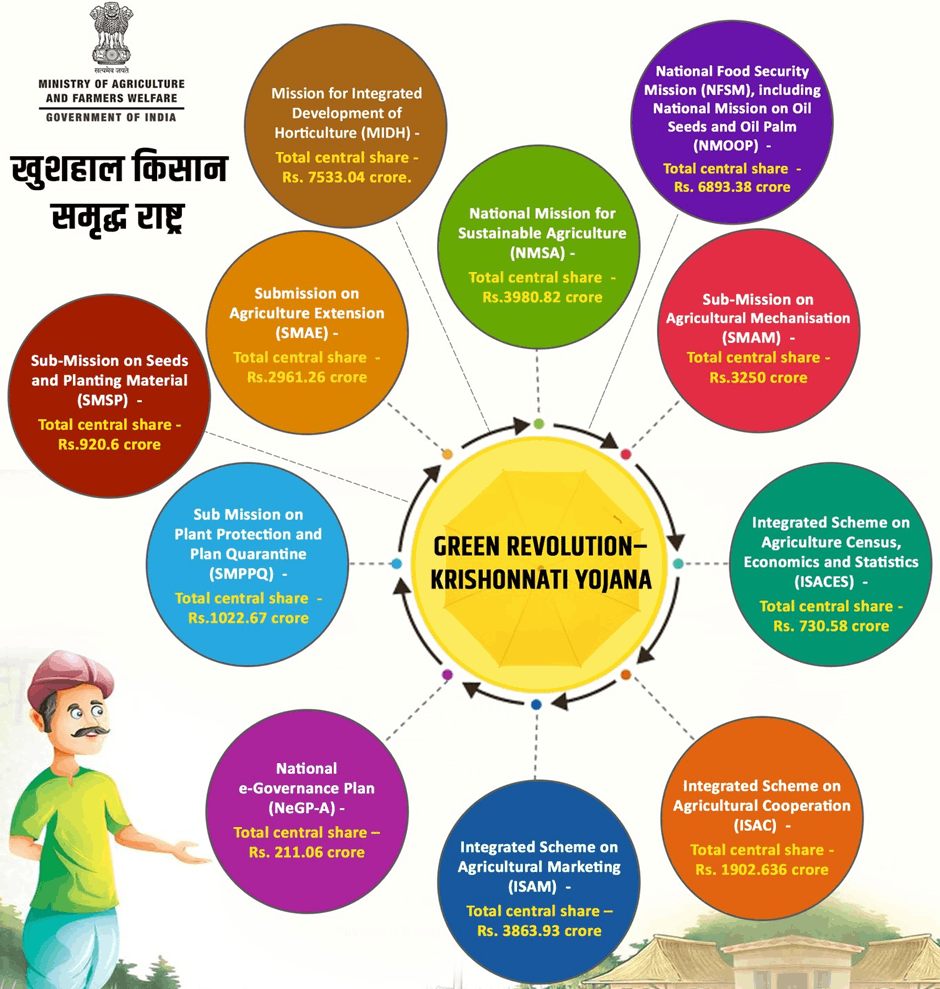
  • The government of India introduced the Green Revolution Krishonnati Yojana in 2005 to boost the agriculture sector.
  • Government through the scheme plans to develop the agriculture and allied sector in a holistic & scientific manner to increase the income of farmers.
  • It comprises of 11 schemes and mission under a single umbrella scheme:
    • Mission for Integrated Development of Horticulture (MIDH)
    • National Food Security Mission (NFSM)
    • National Mission for Sustainable Agriculture (NMSA)
    • Submission on Agriculture Extension (SMAE)
    • Sub-Mission on Seeds and Planting Material (SMSP)
    • Sub-Mission on Agricultural Mechanization (SMAM)
    • Sub-Mission on Plant Protection and Plan Quarantine (SMPPQ)
    • Integrated Scheme on Agriculture Census, Economics and Statistics (ISACES)
    • Integrated Scheme on Agricultural Cooperation (ISAC)
    • Integrated Scheme on Agricultural Marketing (ISAM)
    • National e-Governance Plan in Agriculture (NeGP-A)

The Evergreen Revolution

  • The improvements brought out by the Green Revolution came at the cost of adverse environmental effects in areas subjected to intensive farming. However, where population pressure is high, there is no option except to produce more food.
  • Hence, the need for the Evergreen Revolution was called out by Dr. M S Swaminathan, the Father of the Green Revolution in India.
  • Under the Evergreen Revolution, it is envisaged that productivity must increase, but in ways which are environmentally safe, economically viable and socially sustainable. The evergreen revolution involves the integration of ecological principles in technology development and dissemination.

Conclusion

  • Overall, the Green Revolution was a major achievement for many developing countries, specially India and gave them an unprecedented level of national food security.
  • It represented the successful adaptation and transfer of the same scientific revolution in agriculture that the industrial countries had already appropriated for themselves.
  • However, lesser heed was paid to factors other than ensuring food security such as environment, the poor farmers and their education about the know-how of such chemicals.
  • As a way forward, the policymakers must target the poor more precisely to ensure that they receive greater direct benefits from new technologies and those technologies will also need to be more environmentally sustainable.
  • Also, taking lessons from the past, it must be ensured that such initiatives include all of the beneficiaries covering all the regions rather than sticking to a limited field.
  • The awareness of Green Revolution – Krishonnati Yojana must be given to all farmers across the country
  • The government and the civil society should work towards bringing an Evergreen Revolution

Can a good leader change a country from swamps to Skyscraper?

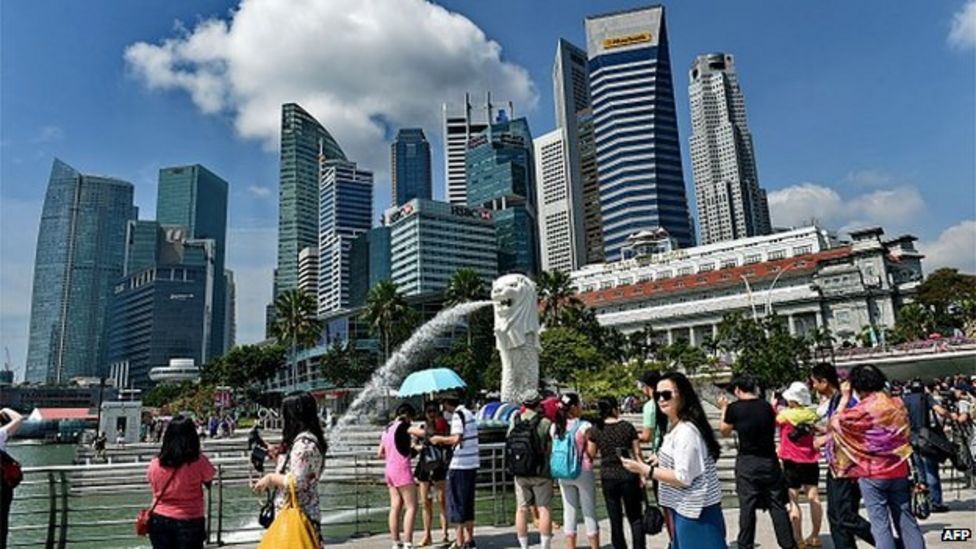
The Success story of Singapore – The vision of its first Prime minister — Lee Kuan Yew

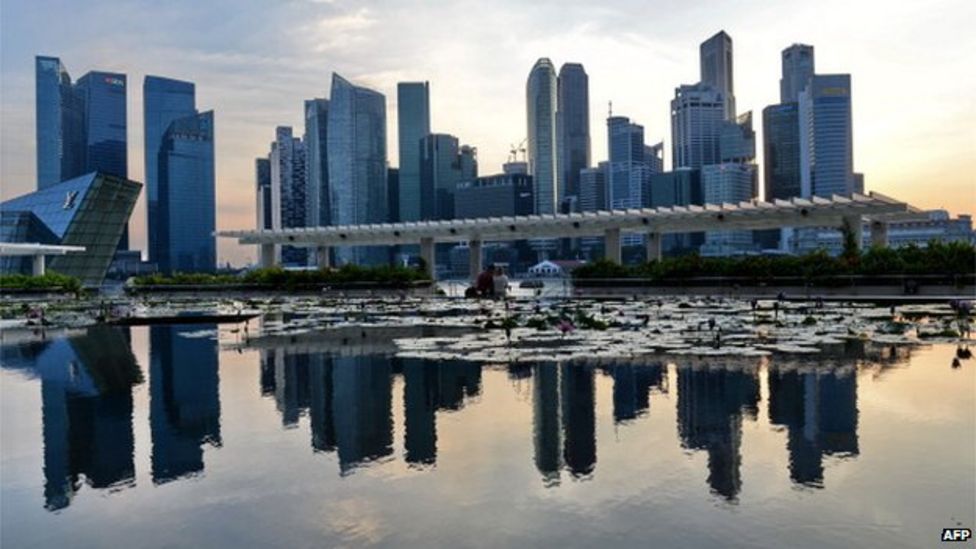
At one degree north of the equator, tropical Singapore has become a hotspot known for its efficient infrastructure, rooftop bars, chilli crab, and host city to the only night race on the Formula 1 racing calendar.

Often dubbed as the “Monaco of the East”, the red dot has beaten a path to steady economic progress and prosperity since the 1970s.

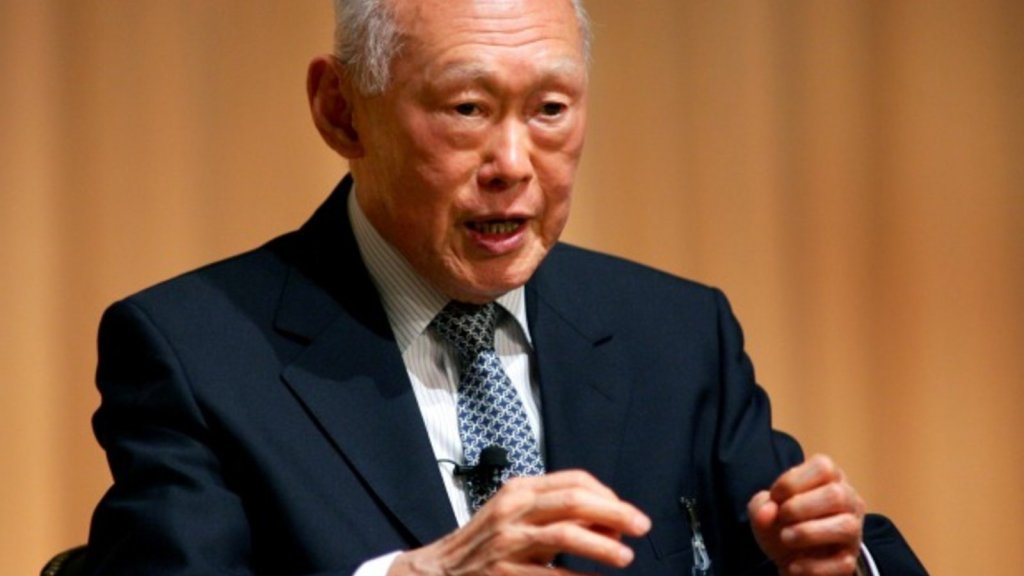
Much of the city’s success can be attributed to the vision of one man – Lee Kuan Yew, Singapore’s first prime minister who was in office from 1959 to 1990.

The tenure made him the world’s longest-serving prime minister in history. Singapore broke away from neighbouring Malaysia and gained independence in 1965.

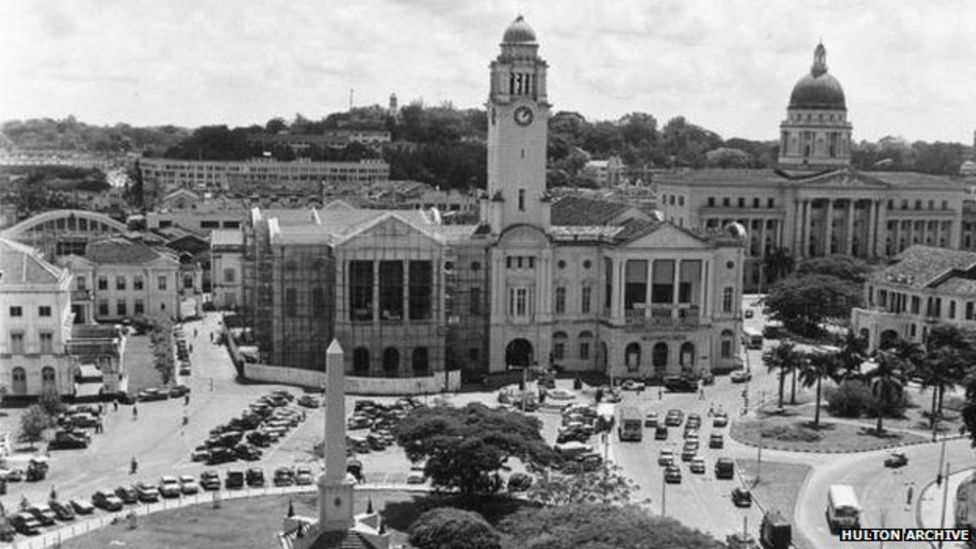
About half a century ago, Singapore was an island without any natural resources to call its own.

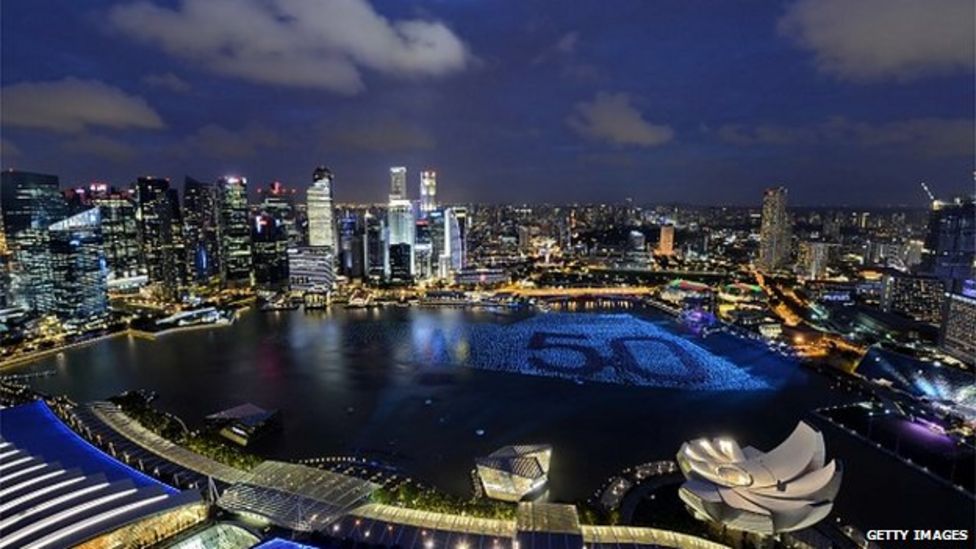
Since then, it has pulled off a dramatic transformation – boasting two casino-integrated resorts and an airport that has frequently topped the “world’s best” list.

In addition, the central business district is crowded with skyscrapers that rival neighbouring Hong Kong and mid-town Manhattan in far-flung New York.

Mr Lee was not one to shy away from his achievements for Singapore. The second volume of his published memoirs carries the title, From Third World to First: The Singapore Story: 1965-2000. To help sum up his economic triumphs for the city state, several experts shared their views on Lee Kuan Yew’s economic legacies for Singapore.

HOW did all this happen?

I’ll try to summarise the legacy for you

Attractive destination

Lee Kuan Yew’s emphasis on growth, the thrust on making Singapore attractive as a destination for investment as well as the focus on drawing world class manpower; building state of the art infrastructure and excellent air and sea linkages; a low and transparent tax regime; clean and efficient bureaucracy; a strong regulatory and legal framework; a neutral diplomatic policy which has ensured it is an ally of the US as well as China; and developing a clean and green city, have ensured Singapore’s stupendous economic success. These factors have led to the emergence of Singapore as a powerful and wealthy financial centre.

Legacy of a luminary

A trained lawyer, this visionary leader was Singapore’s chief architect in harnessing social cohesion despite ethnic and religious diversity; and in engineering an economic miracle.

His defining economic policy is arguably uncompromising standards for a universally accessible, top-flight public education system – astutely identifying human capital as Singapore’s key competitive advantage – supplemented with rigorous application of meritocracy.

This understated principle accelerated economic ascendancy by unleashing the forces of upward social mobility for all, with little tolerance for complacency or corruption. Complemented by a fair and transparent judiciary, businesses thrived.

But above all, Mr Lee’s principled approach to nation building forged his legacy as a luminary.

Unparalleled set-up

Lee Kuan Yew performed a miracle transforming Singapore from one of the poorest countries in the world in the 1960s to being among the most advanced today.

His main contribution, and the key to his success, was that he understood that in order to put Singapore on a sustainable growth trajectory one needs much more than sound economic policy.

Any policy can be reversed, any incentives for growth can be dismantled. Mr Lee built a country whose institutional set-up is unparalleled.

This includes the rule of law; efficient government structures; the continuous fight against corruption; and overall stability.

Immigrant integration

Lee Kuan Yew’s vision was to build an economically sound country that would be robust enough for future generations. But he knew Singapore had limitations.

To achieve his dream, he had to change the mindset of its then population of around two million people. Singaporeans had to be more welcoming to immigrants if the country were to grow.

The population needed to expand by continually attracting high-calibre people who would create employment, bring in much-needed capital and most importantly, pass on their key skills. Thanks to Lee Kuan Yew’s vision that Singapore is as welcoming to immigrants today as it was 50 years ago.

It is the integration of foreign and home-grown talent that has allowed the country to enjoy decades of economic growth.

The economic value of every person in Singapore today is as high as that of the US.

Regional hub

After the separation from Malaysia, Lee Kuan Yew developed a highly technocratic government which led to competitive, meritocratic and results-based economic policies.

Some key decisions were the development of Changi Airport as a regional transport hub after Singapore outgrew the previous Paya Lebar airport, which was a state-of-the-art facility when it opened in the 1950s.

The air hub and the aggressive defence of Singapore as a sea freight trans-shipment hub – as well as the technocratic foundations of transparency and good governance – led to Singapore’s position as a natural hub for multinational businesses in Asia.

Other key positive economic policies included the Central Provident Fund, Housing Development Board flat ownership and integrated education, which all helped Singapore transition from a village setting towards towns and the highly sophisticated cosmopolitan global city we see today.

The unfortunate event

However bright a star is, Even though it has given life, Helped lives sustain, the star has to run out of energy one day…

Mr. Lee kuan yew died on 23 March 2015 in Singapore General Hospital.

What lies ahead for Singapore ?

Singapore is one of the most competitive economies in the world today.

In order to maintain rising wages and improving living standards, Singapore will continue to transform its economy towards higher-value-added industries with strong productivity growth.

However, There are downside risks to growth which stem from rising income inequality and restrictions on free speech.

There is an attempt to widen the social security net, which could partially ease signs of unrest in a local population grappling with the high cost of living.

The government will have to strike a fine balance between being fiscally prudent and expanding welfare schemes, in order to retain its high sovereign ratings.

A population that is social media savvy is also more politically engaged and this will mean that a higher proportion of younger voters will demand the right to dissent.

Key growth drivers for Singapore over the next decade will be Singapore’s role as one of the world’s leading financial centres; its competitiveness as a logistics, shipping and aviation hub; and its role as a regional HQ for global multinationals.

The long-term outlook for Singapore remains very bright.

Indian Temple Architecture

India is a Diverse country with many Cultures, religions, Traditions and beliefs living in Harmony. The true meaning of Unity in Diversity. Today we’ll talk about the diverse Temple architecture of India.

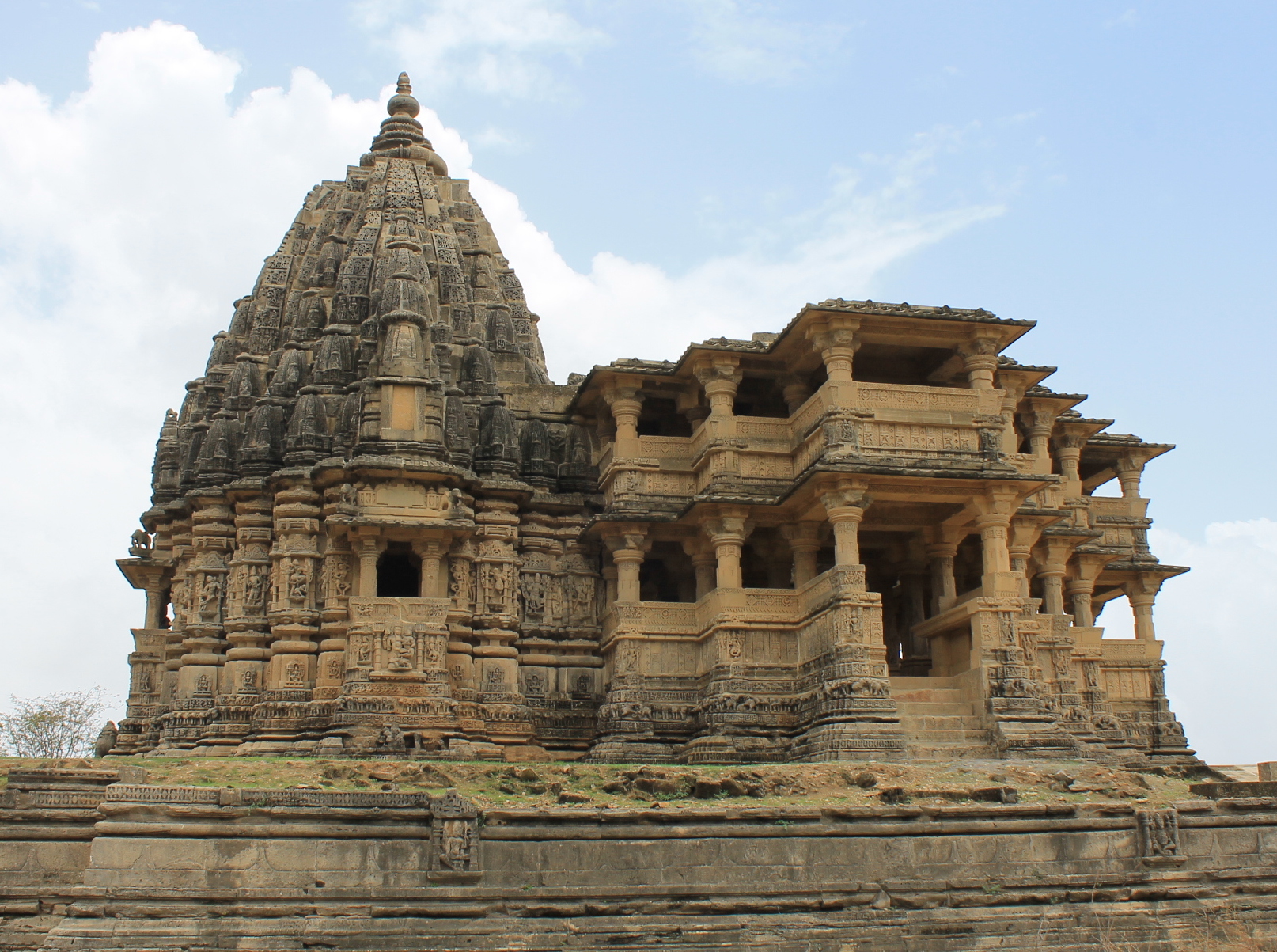
As temples grew more complex, more surfaces were created for sculpture by adding more and more rhythmically projecting, symmetrical walls and niches, without breaking away from the fundamental plan of the shrine.

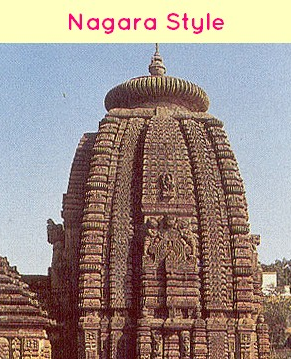
Nagara or North Indian Temple Style

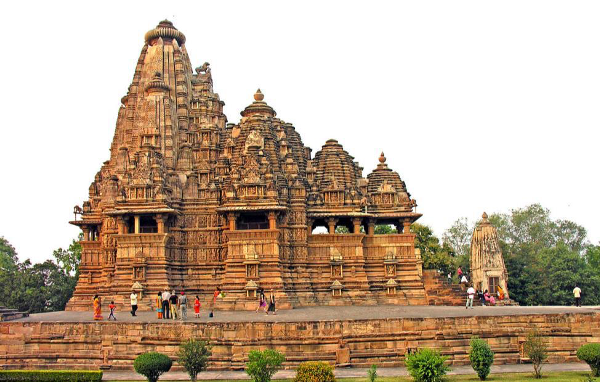
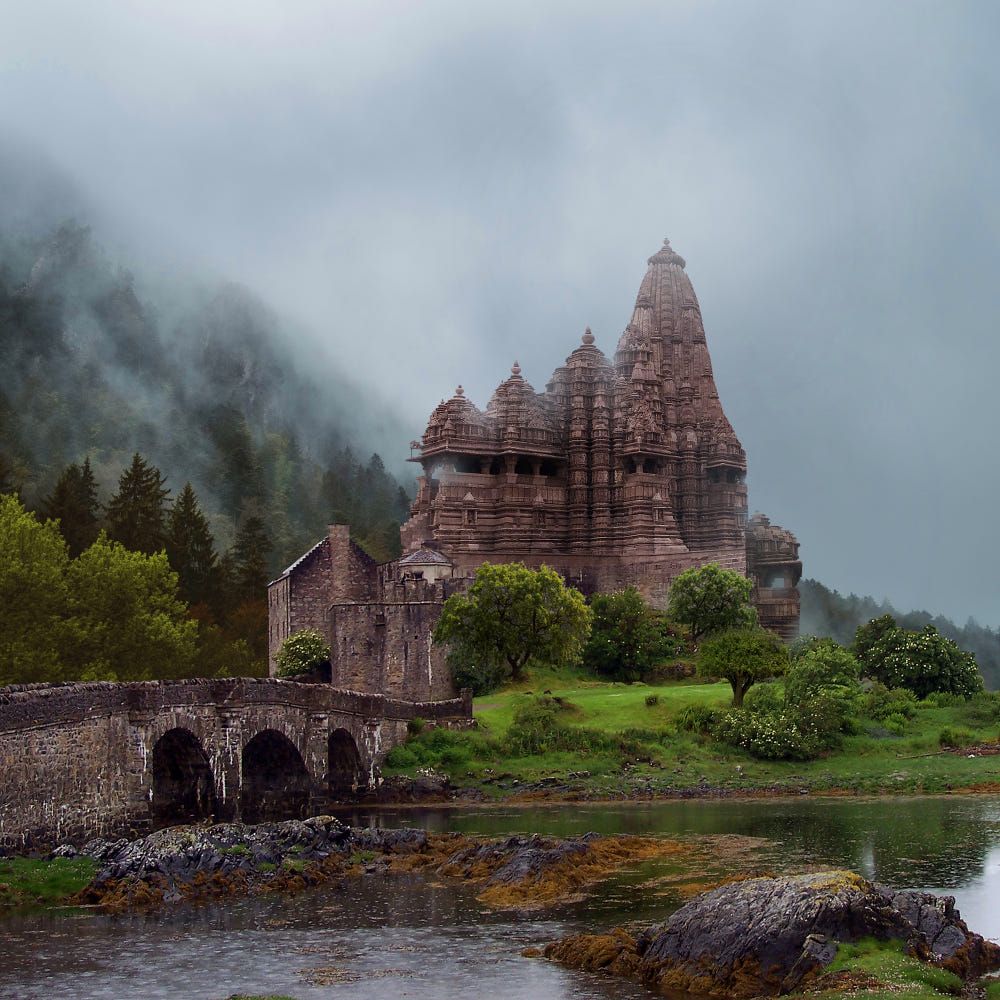
  • In North India it is common for an entire temple to be built on a stone platform with steps leading up to it.
  • Further, unlike in South India it does not usually have elaborate boundary walls or gateways.
  • While the earliest temples had just one tower, or shikhara, later temples had several.
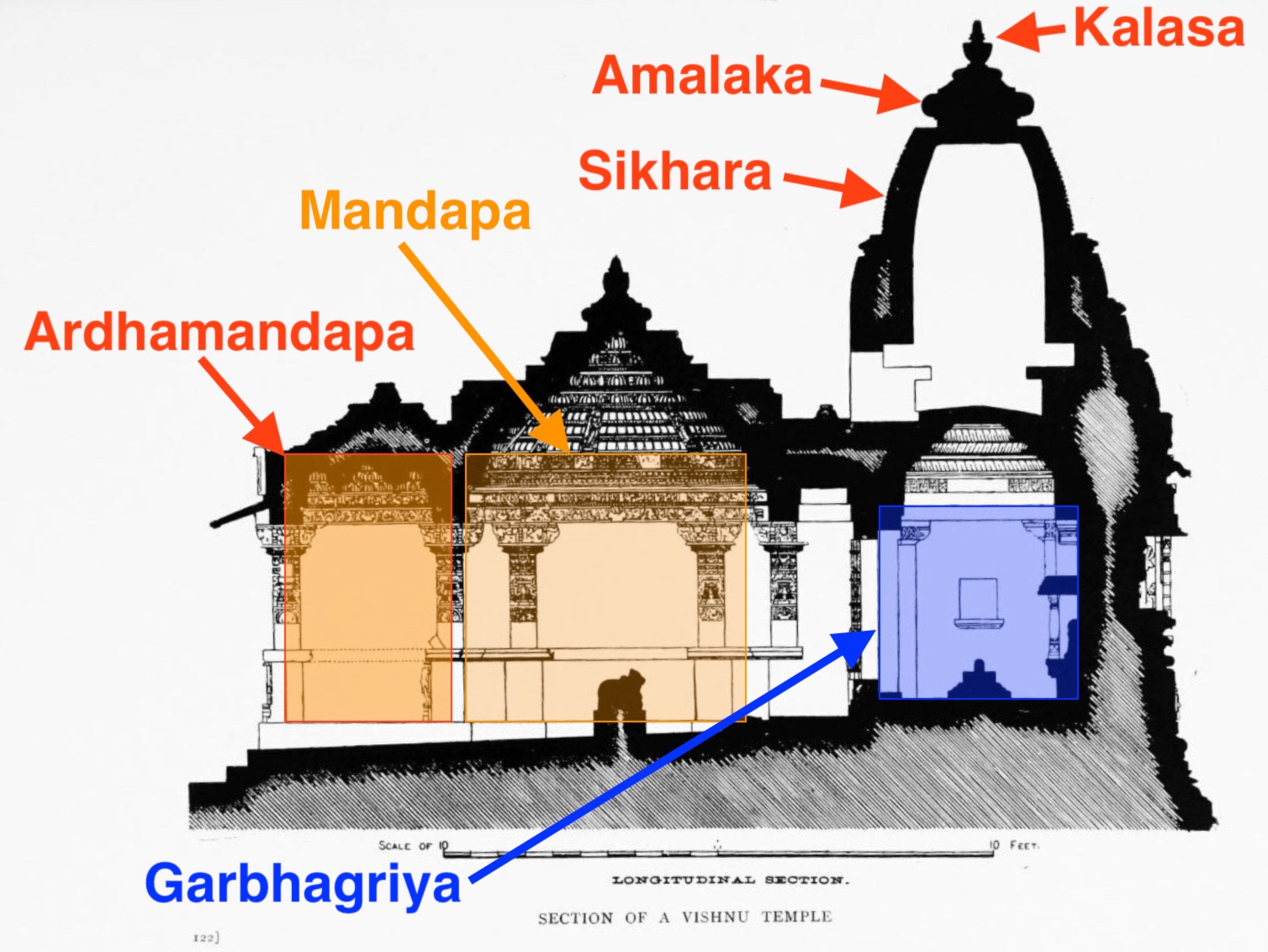
  • The garbhagriha is always located directly under the tallest tower.
  • There are many subdivisions of nagara temples depending on the shape of the shikhara.
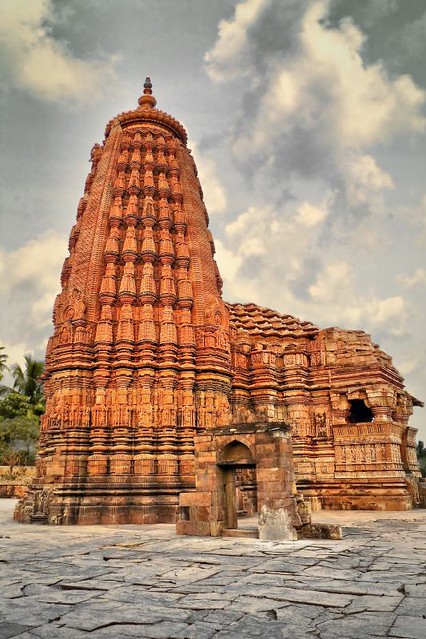
  • There are different names for the various parts of the temple in different parts of India; however, the most common name for the simple shikhara which is square at the base and whose walls curve or slope inward to a point on top is called the ‘latina’ or the rekha-prasada type of shikara.
  • The second major type of architectural form in the nagara order is the phamsana, which tends to be broader and shorter than latina ones. Their roofs are composed of several slabs that gently rise to a single point over the centre of the building, unlike the latina ones which look like sharply rising tall towers.
  • The third main sub-type of the nagara building is generally called the valabhi type. These are rectangular buildings with a roof that rises into a vaulted chamber.

Central India Temples

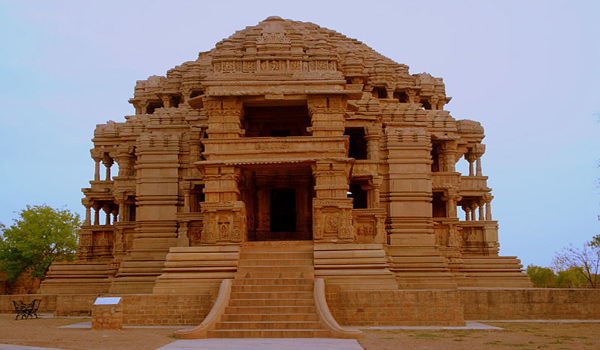
  • Ancient temples of Uttar Pradesh, Madhya Pradesh and Rajasthan share many traits. The most visible is that they are made of sandstone.
  • Some of the oldest surviving structural temples from the Gupta Period are in Madhya Pradesh.
  • The crowning elements- amalak and kalash, are to be found on all nagara temples of this period.
  • These are relatively modest-looking shrines each having four pillars that support a small mandapa which looks like a simple square porch-like extension before an equally small room that served as the garbhagriha.
  • Udaigiri, which is on the outskirts of Vidisha is part of a larger Hindu complex of cave shrines, while the other one is at Sanchi, near the stupa.
  • Deogarh (in Lalitpur District, Uttar Pradesh) was built in the early sixth century CE, is a classic example of a late Gupta Period type of temple. This temple is in the panchayatana style of architecture where the main shrine is built on a rectangular plinth with four smaller subsidiary shrines at the four corners (making it a total number of five shrines, hence the name, panchayatana).
  • The presence of this curving latina or rekha-prasada type of shikhara also makes it clear that this is an early example of a classic nagara style of temple.
  • The temple depicts Vishnu in various forms, due to which it was assumed that the four subsidiary shrines must also have housed Vishnu’s avatars and the temple was mistaken for a dashavatara temple.
  • Predating the tenth century, Chausath Yogini temple is a temple of small, square shrines of roughly-hewn granite blocks, each dedicated to goddesses associated with the rise of Tantric worship after the seventh century.Built between 7th and 10th centuries, several such temples were dedicated to the cult of the yoginis across Madhya Pradesh, Odisha and even as far south as Tamil Nadu.
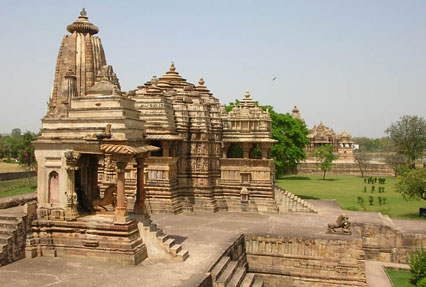
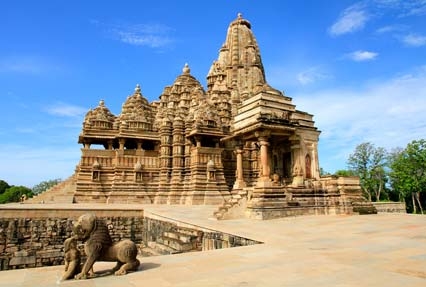
  • There are many temples at Khajuraho, most of them devoted to Hindu gods. There are some Jain temples as well. Khajuraho’s temples are also known for their extensive erotic sculptures; the erotic expression is given equal importance in human experience as spiritual pursuit, and it is seen as part of a larger cosmic whole.
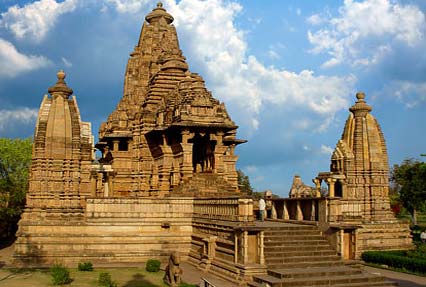
  • The Lakshmana temple of Khajuraho, dedicated to Vishnu, was built in 954 by the Chandela king, Dhanga. It is a nagara temple placed on a high platform accessed by stairs.
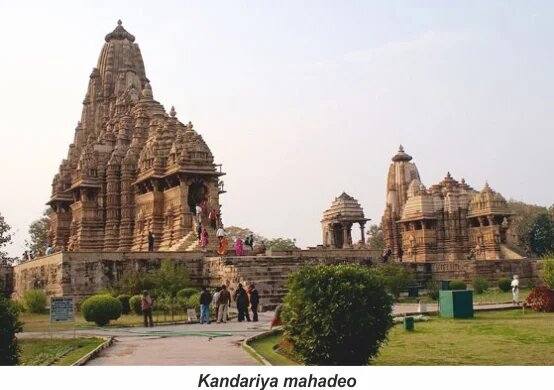
  • Kandariya Mahadeo temple at Khajuraho is the epitome of temple architecture in Central India.

Western Indian Temples

  • The temples in the north-western parts of India including Gujarat and Rajasthan, and in western Madhya Pradesh are large in numbers.
  • The stone used to build the temples ranges in colour and type.
  • While sandstone is the commonest, a grey to black basalt can be seen in some of the 10th to 12th century temple sculptures.
  • The most exuberant and famed is the manipulatable soft white marble which is also seen in some of the 10th-12th century Jain temples in Mount Abu and the 15th century temple at Ranakpur.
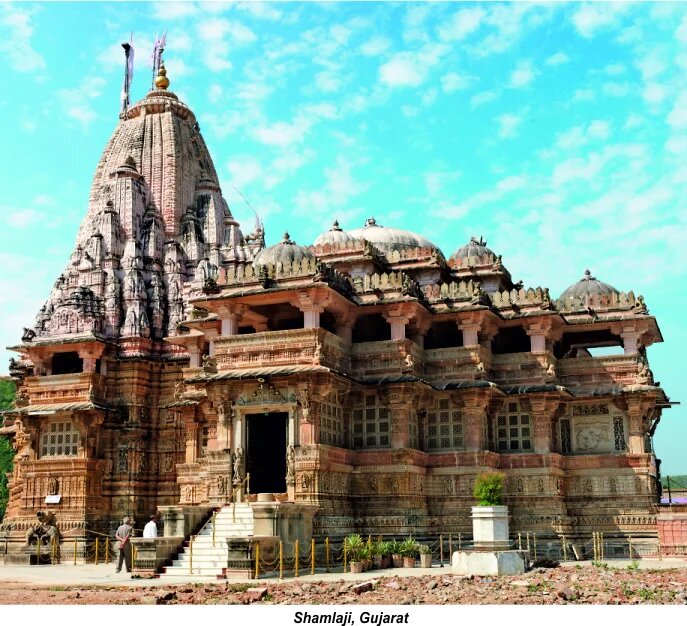
  • Among the most important art-historical sites in the region is Samlaji in Gujarat.
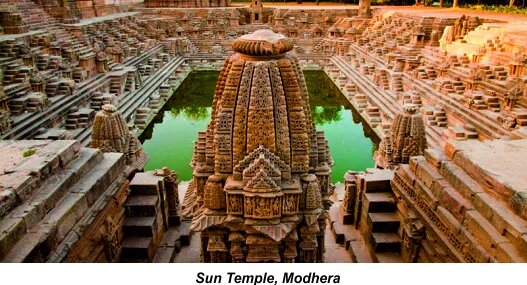
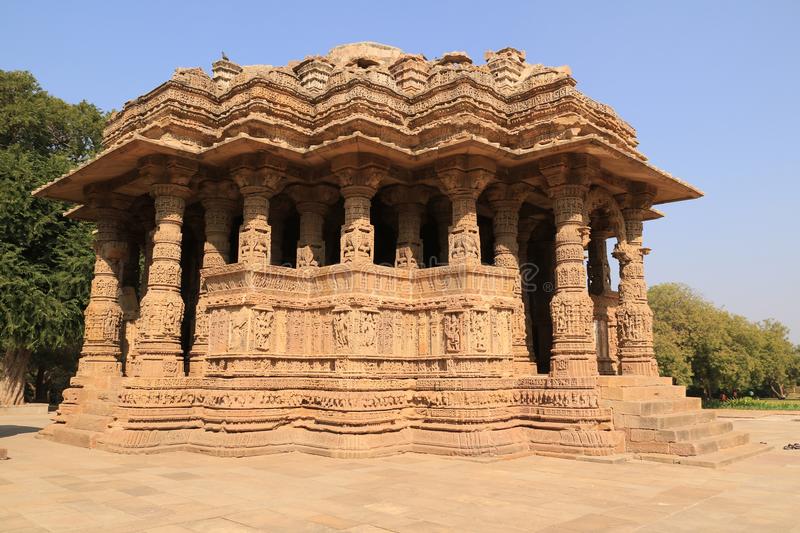
  • The Sun temple at Modhera dates back to the early 11th century and was built by Raja Bhimdev I of the Solanki Dynasty in 1026. There is a massive rectangular stepped tank called the surya kund in front of it, perhaps the grandest temple tank in India.
  • Every year, at the time of the equinoxes, the sun shines directly into this central shrine of the temple.

Eastern Indian temples

  • Eastern Indian temples include those found in the North East, Bengal and Odisha.
  • It appears that terracotta was the main medium of construction, and also for moulding plaques which depicted Buddhist and Hindu deities in Bengal until the 7th century.

Assam

  • An old sixth-century sculpted door frame from Dah Parvatia near Tezpur and another few stray sculptures from Rangagora Tea Estate near Tinsukia in Assam bear witness to the import of the Gupta idiom in that region.By the 12th-14th centuries, a distinct regional style developed in Assam.
  • The style that came with the migration of the Tais from Upper Burma mixed with the dominant Pala style of Bengal and led to the creation of what was later known as the Ahom style in and around Guwahati.
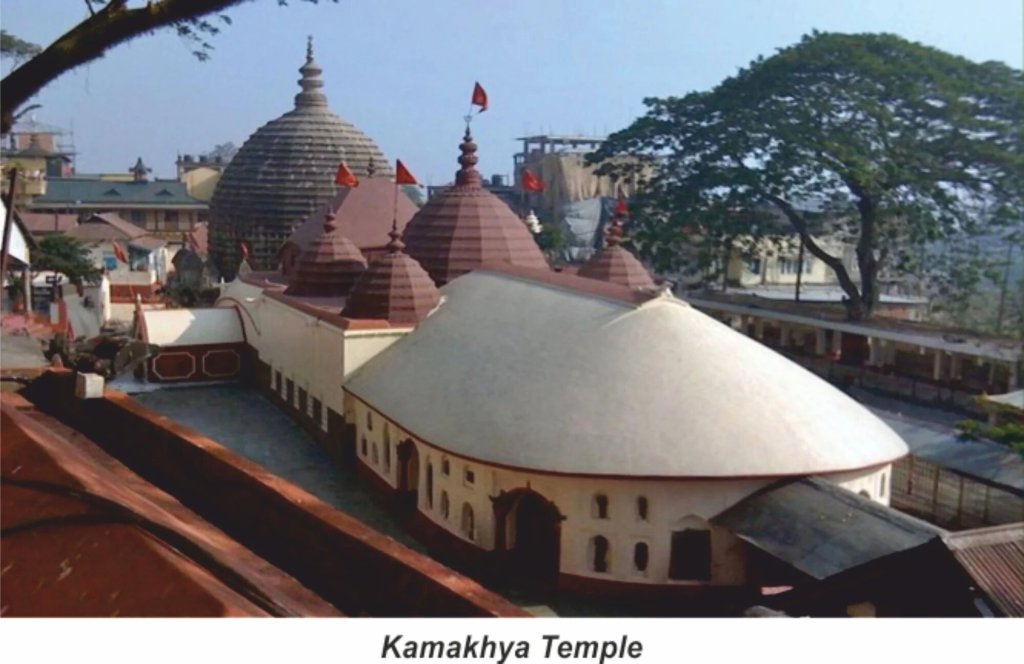
  • Kamakhya temple, a Shakti Peeth, is dedicated to Goddess Kamakhya and was built in the 17th century in Assam.

Bengal

  • The style of the sculptures during the period between the ninth and eleventh centuries in Bengal (including Bangladesh) and Bihar is known as the Pala style, named after the ruling dynasty at the time.
  • While the style of those of the mid-eleventh to mid-thirteenth centuries is named after the Sena kings.
  • While the Palas are celebrated as patrons of many Buddhist monastic sites, the temples from that region are known to express the local Vanga style.
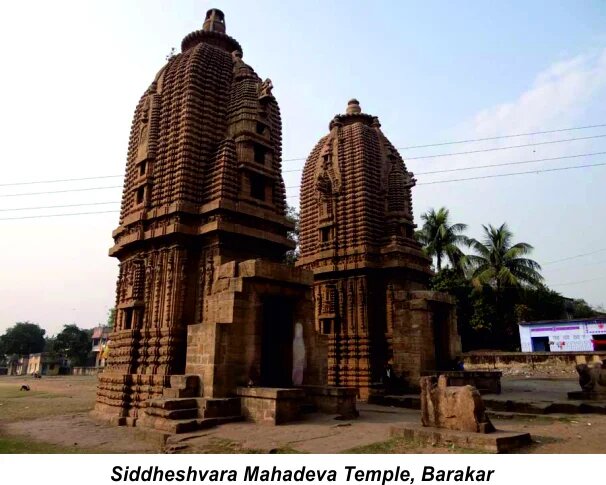
  • The 9th century Siddheshvara Mahadeva Temple in Barakar in Burdwan District, for example, shows a tall curving shikhara crowned by a large amalaka and is an example of the early Pala style.
  • The black to grey basalt and chlorite stone pillars and arched niches of Purlia temples heavily influenced the earliest Bengal sultanate buildings at Gaur and Pandua.
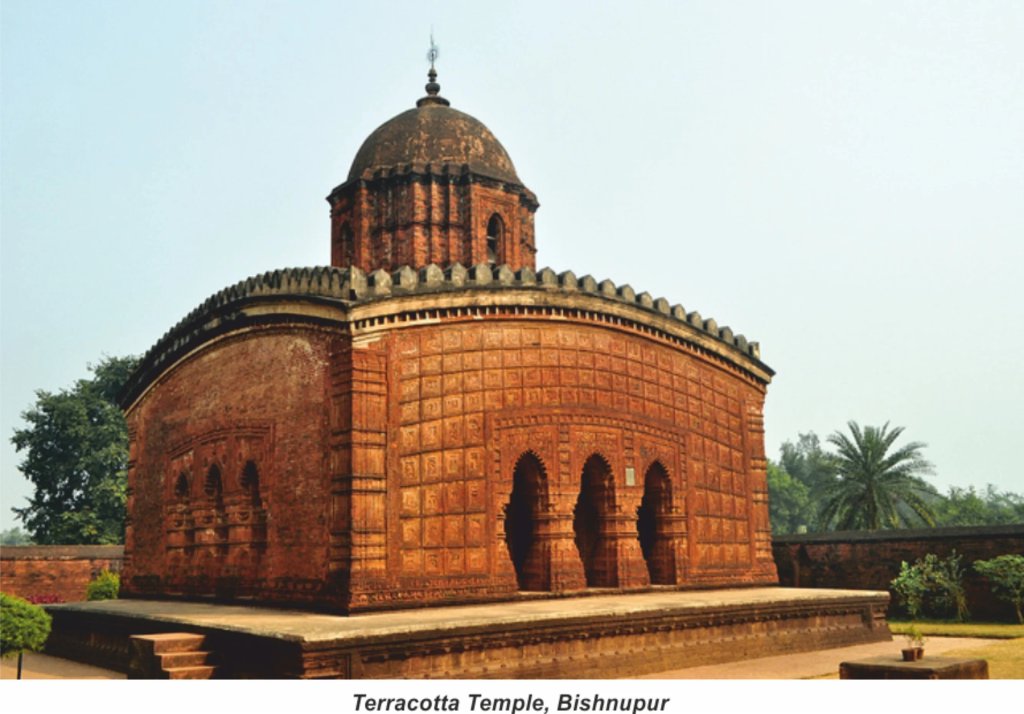
  • In the Mughal period and later, scores of terracotta brick temples were built across Bengal and Bangladesh in a unique style that had elements of local building techniques seen in bamboo huts.

Orissa

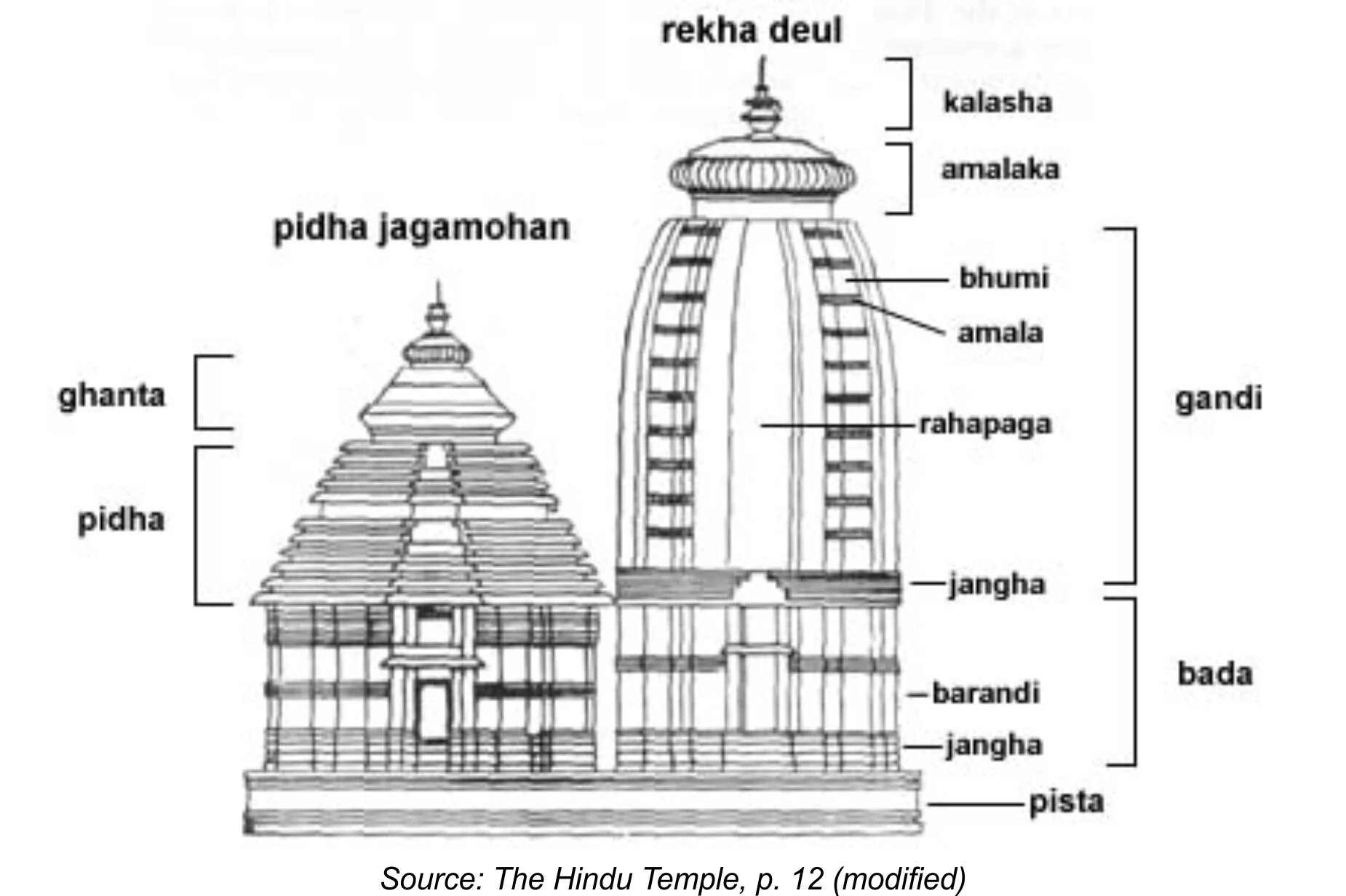
  • The main architectural features of Odisha temples are classified into three orders, i.e., rekhapida, pidhadeul and khakra.
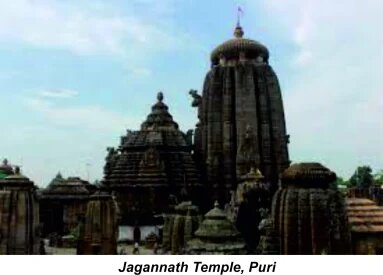
  • Most of the main temple sites are located in ancient Kalinga—modern Puri District, including Bhubaneswar or ancient Tribhuvanesvara, Puri and Konark.
  • In general, the shikhara, called deul in Odisha, is vertical almost until the top when it suddenly curves sharply inwards.
  • Deuls are preceded, as usual, by mandapas called jagamohana in Odisha.
  • Odisha temples usually have boundary walls.
  • The ground plan of the main temple is almost always square, which, in the upper reaches of its superstructure becomes circular in the crowning mastaka.
  • Compartments and niches are generally square, the exterior of the temples are lavishly carved, their interiors generally quite bare.
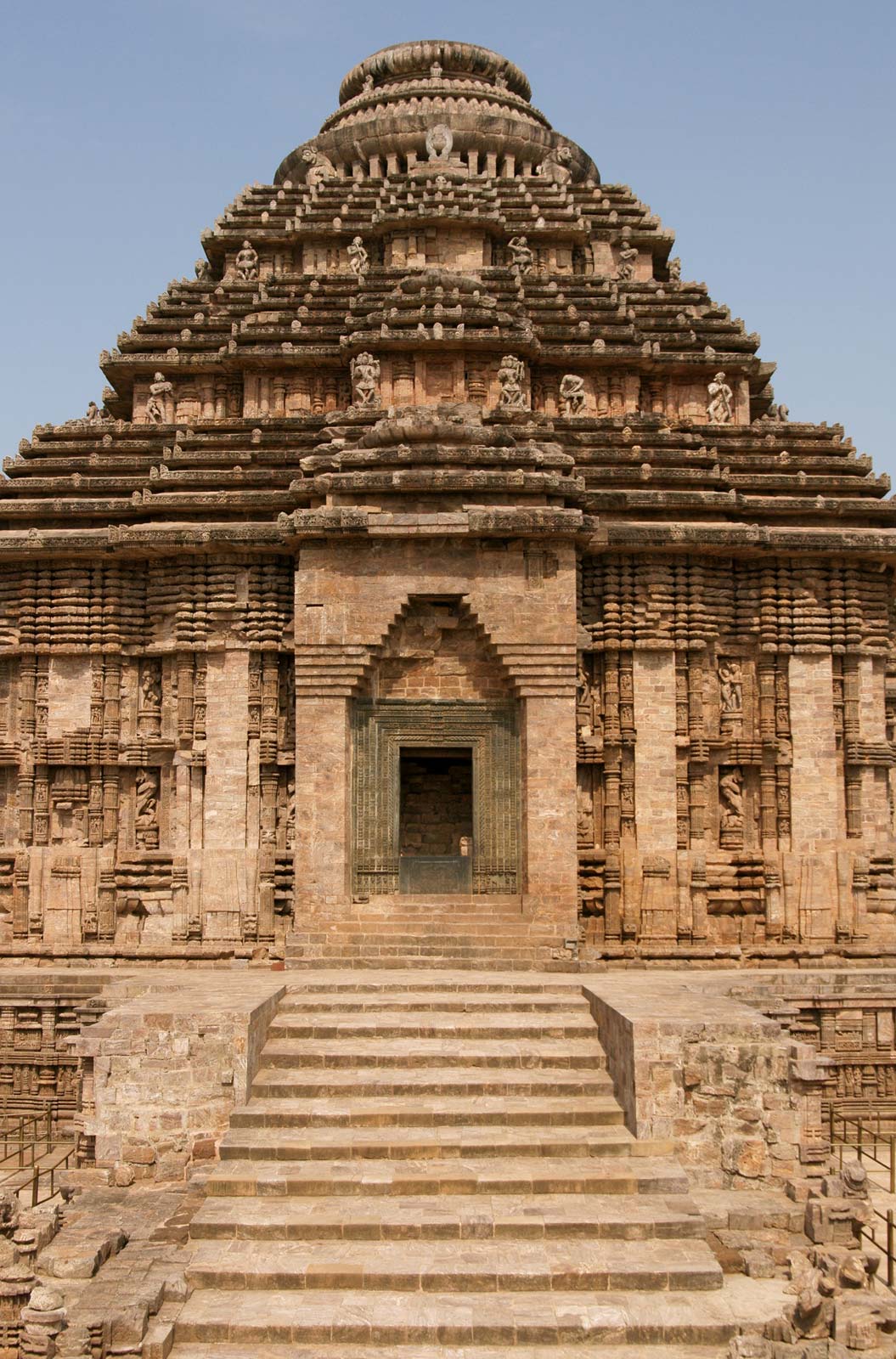
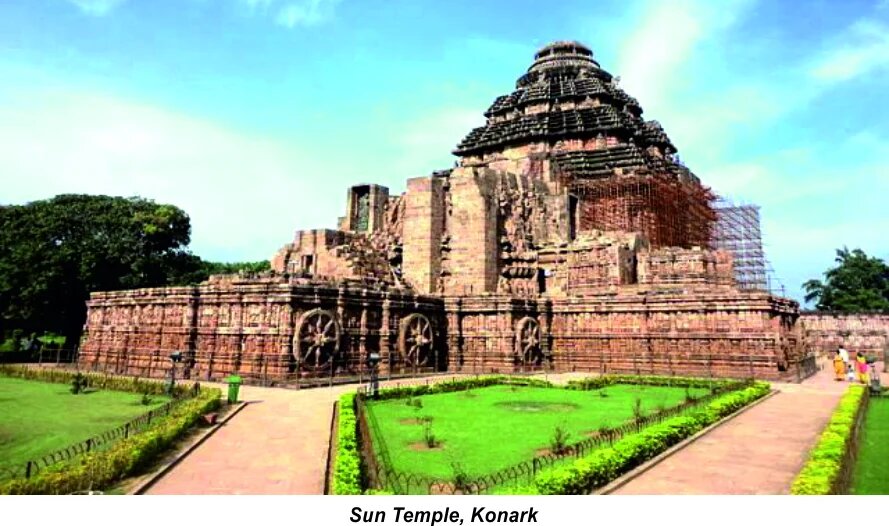
  • At Konark, on the shores of the Bay of Bengal, lie the ruins of the Surya or Sun temple built in stone around 1240. The Sun temple is set on a high base, its walls covered in extensive, detailed ornamental carving.
  • These include twelve pairs of enormous wheels sculpted with spokes and hubs, representing the chariot wheels of the Sun god who, in mythology, rides a chariot driven by seven horses, sculpted here at the entrance staircase.

Hill Temples

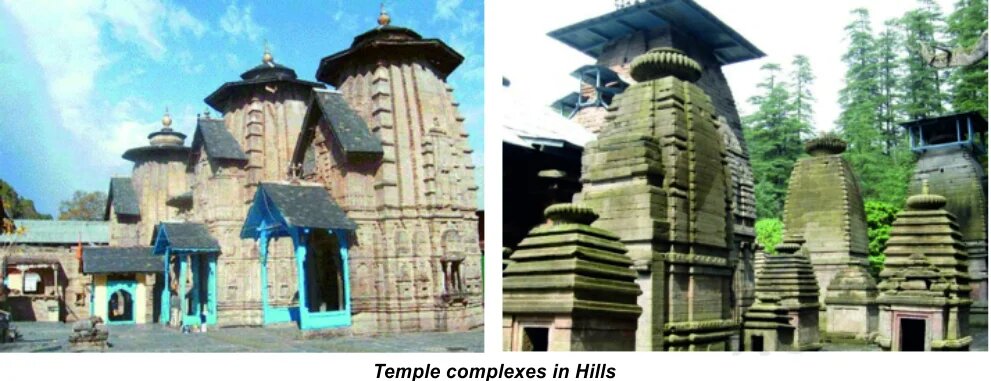
  • A unique form of architecture developed in the hills of Kumaon, Garhwal, Himachal and Kashmir.Kashmir’s proximity to prominent Gandhara sites (such as Taxila, Peshawar and the northwest frontier) lent the region a strong Gandhara influence by the 5th century CE.
  • This began to mix with the Gupta and post-Gupta traditions that were brought to it from Sarnath, Mathura and even centres in Gujarat and Bengal.
  • Brahmin pundits and Buddhist monks frequently travelled between Kashmir, Garhwal, Kumaon and religious centres in the plains like Banaras, Nalanda and even as far south as Kanchipuram.
  • As a result both Buddhist and Hindu traditions began to intermingle and spread in the hills.
  • The hills also had their own tradition of wooden buildings with pitched roofs.
  • At several places in the hills, while the main garbhagriha and shikhara are made in a rekha-prasada or latina style, the mandapa is of an older form of wooden architecture.
  • Sometimes, the temple itself takes on a pagoda shape.
  • The Karkota period of Kashmir is the most significant in terms of architecture.
  • One of the most important temples is Pandrethan, built during the 8th and 9th centuries. In keeping with the tradition of a water tank attached to the shrine, this temple is built on a plinth built in the middle of a tank.
  • Like the findings at Samlaji, the sculptures at Chamba also show an amalgamation of local traditions with a post Gupta style.
  • The images of Mahishasuramardini and Narasimha at the Laksna-Devi Mandir are evidences of the influence of the post-Gupta tradition.
  • Of the temples in Kumaon, the ones at Jageshwar near Almora, and Champavat near Pithoragarh, are classic examples of nagara architecture in the region.

Dravida Or South Indian Temple Style

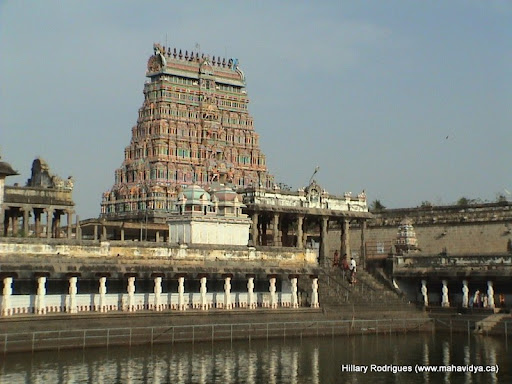
  • Unlike the nagara temple, the dravida temple is enclosed within a compound wall.
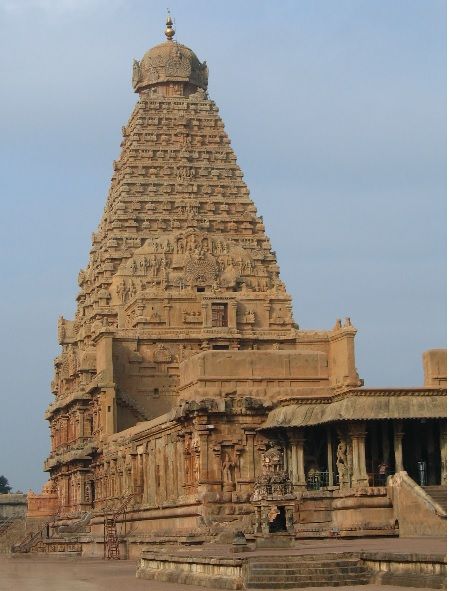
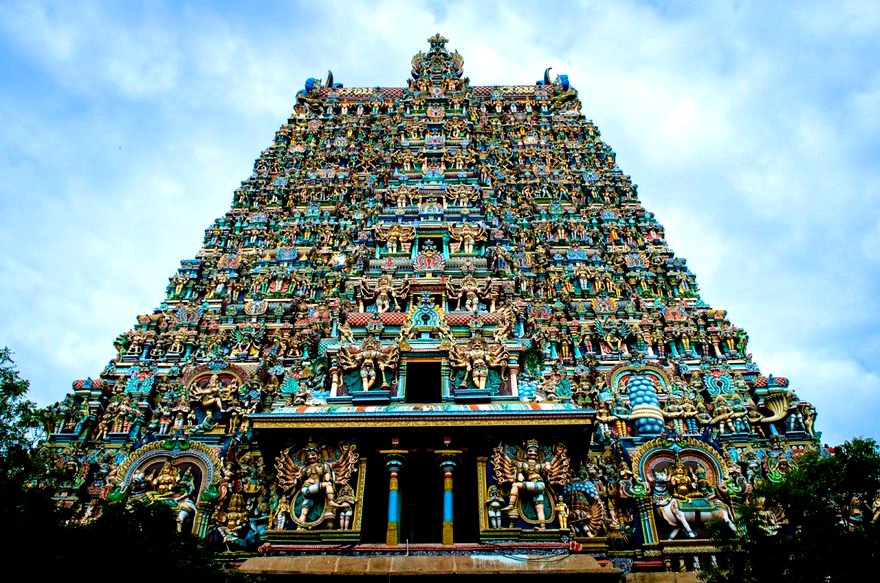
  • The front wall has an entrance gateway in its centre, which is known as a gopuram.
  • The shape of the main temple tower known as vimana in Tamil Nadu, is like a stepped pyramid that rises up geometrically rather than the curving shikhara of North India.
  • It is common to find a large water reservoir, or a temple tank, enclosed within the complex.
  • Subsidiary shrines are either incorporated within the main temple tower, or located as distinct, separate small shrines beside the main temple.
  • Kanchipuram, Thanjavur or Tanjore, Madurai and Kumbakonam are the most famous temple towns of Tamil Nadu, where, during the 8th-12th centuries, the role of the temple was not limited to religious matters alone.
  • Temples became rich administrative centres, controlling vast areas of land.
  • Just as there are many subdivisions of the main types of nagara temples, there are subdivisions also of dravida temples.
  • These are basically of five different shapes: square, usually called kuta, and also caturasra
  • rectangular or shala or ayatasra
  • elliptical, called gaja-prishta or elephant backed, or also called vrittayata, deriving from wagon vaulted shapes of apsidal chaityas with a horse-shoe shaped entrance facade usually called a nasi
  • circular or vritta
  • octagonal or ashtasra.
  • The Pallavas were one of the ancient South Indian dynasties. They spread their empire to various parts of the subcontinent, at times reaching the borders of Odisha, and their links with South–East Asia were also strong.
  • Although they were mostly Shaivite, several Vaishnava shrines also survived from their reign, and there is no doubt that they were influenced by the long Buddhist history of the Deccan.
  • Their early buildings, it is generally assumed, were rock cut, while the later ones were structural.
  • The early buildings are generally attributed to the reign of Mahendravarman I, a contemporary of the Chalukyan king, Pulakesin II of Karnataka.
  • Narasimhavarman I, also known as Mamalla, inaugurated most of the building works at Mahabalipuram which came to be known after him as Mamallapuram.
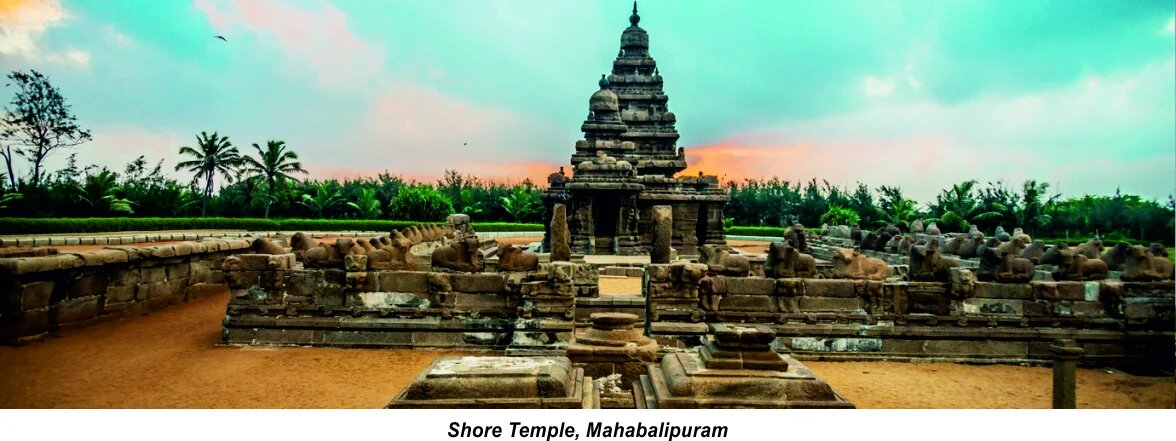
  • The shore temple at Mahabalipuram was built later, probably in the reign of Narasimhavarman II, also known as Rajasimha who reigned from 700 to 728 CE. The temple houses three shrines, two to Shiva, one facing east and the other west, and a middle one to Vishnu.
  • In the compound there is evidence of a water tank, an early example of a gopuram, and several other images.
  • Sculptures of the bull, Nandi, Shiva’s mount, line the temple walls, and these, along with the carvings on the temple’s lower walls have suffered severe disfiguration due to erosion by salt-water laden air over the centuries.
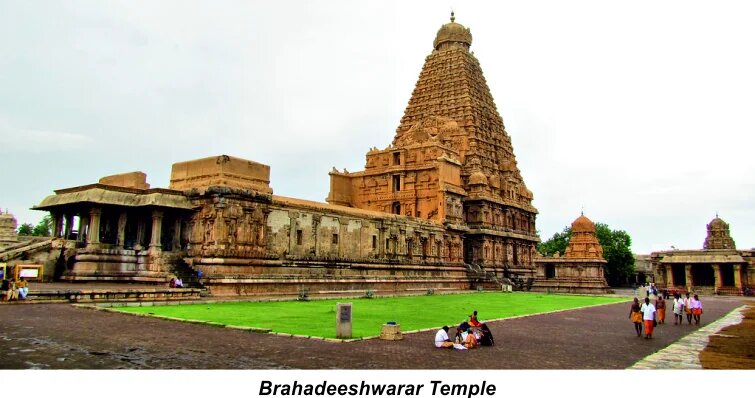
  • The magnificent Shiva temple of Thanjavur, called the Rajarajeswara or Brahadeeshwarar temple, was completed around 1009 by Rajaraja Chola, and is the largest and tallest of all Indian temples.
  • It is in this temple that one notices for the first time two large gopurams (gateway towers) with an elaborate sculptural programme which was conceived along with the temple.

Vesara / Deccan Style of Indian Temple Architecture

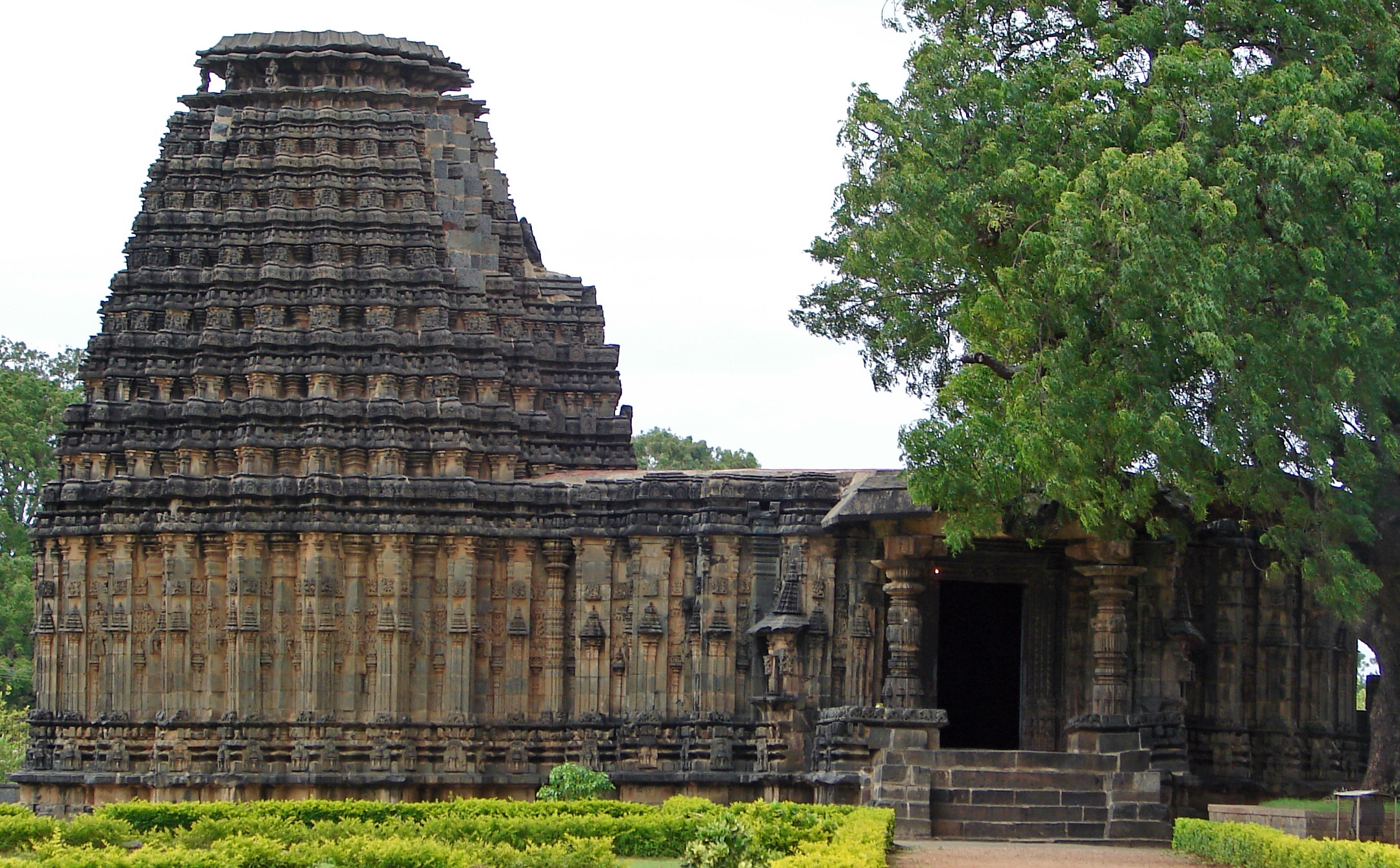
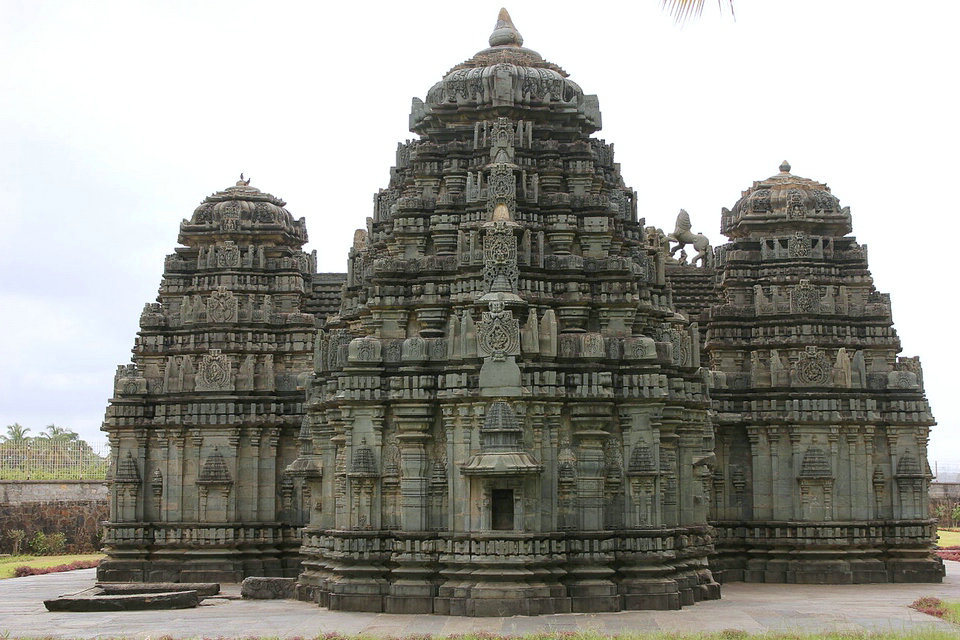
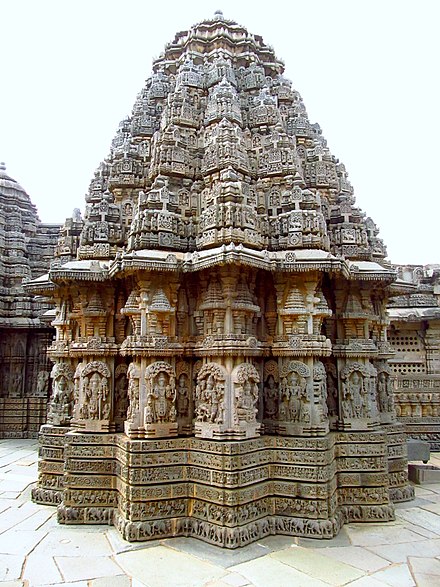
  • Many different styles of temple architecture influenced by both North and South Indian temples were used in regions like Karnataka.
  • By the late 7th or early 8th century, the ambitious projects at Ellora became even grander.
  • By about 750 CE, the early western Chalukya control of the Deccan was taken by the Rashtrakutas.
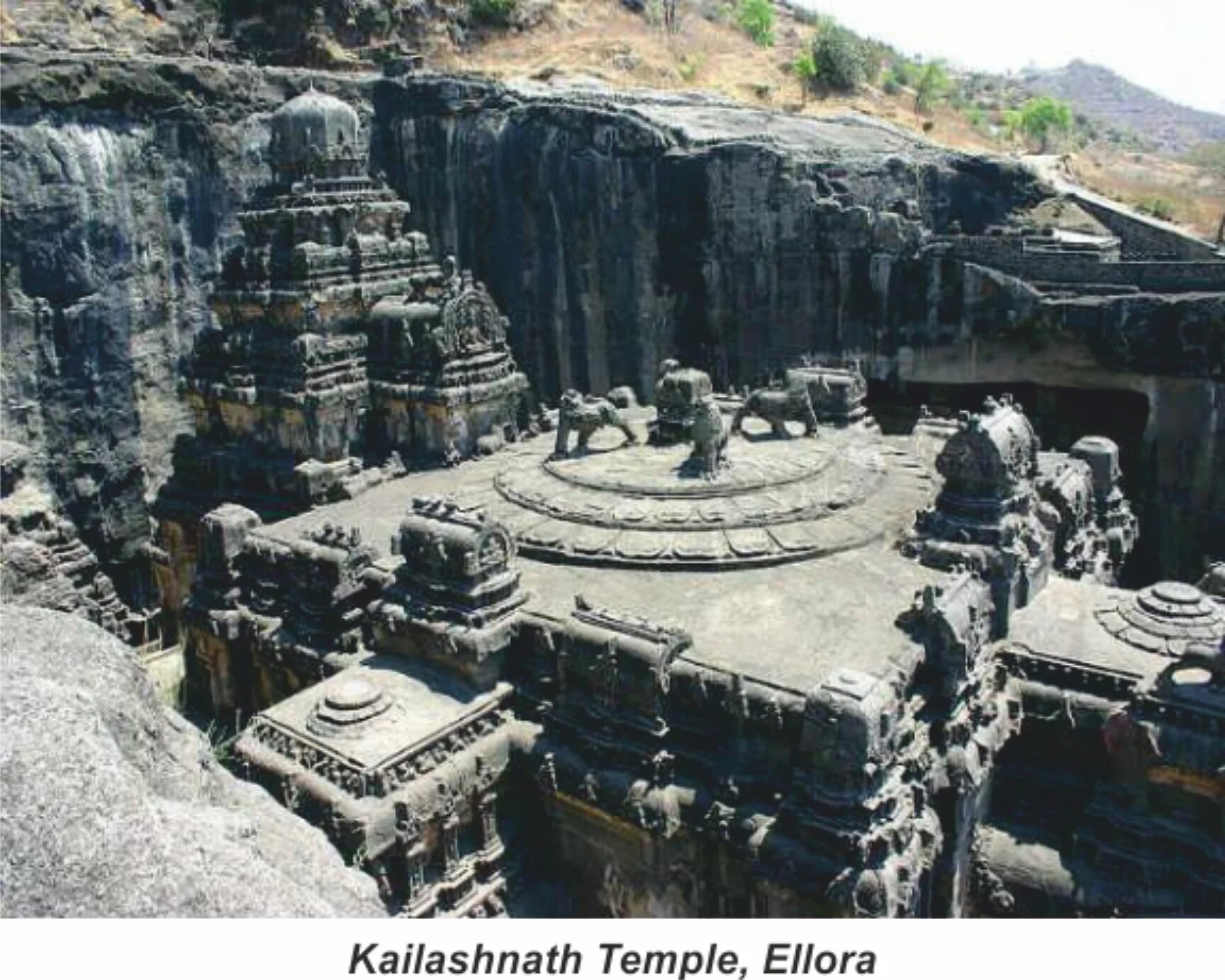
  • Their greatest achievement in architecture is the Kailashnath temple at Ellora, a culmination of at least a millennium-long tradition in rock-cut architecture in India.
  • It is a complete dravida building with a Nandi shrine—since the temple is dedicated to Shiva—a gopuram-like gateway, surrounding cloisters, subsidiary shrines, staircases and an imposing tower or vimana rising to thirty metres.
  • Importantly, all of this is carved out of living rock. One portion of the monolithic hill was carved patiently to build the Kailashnath temple.
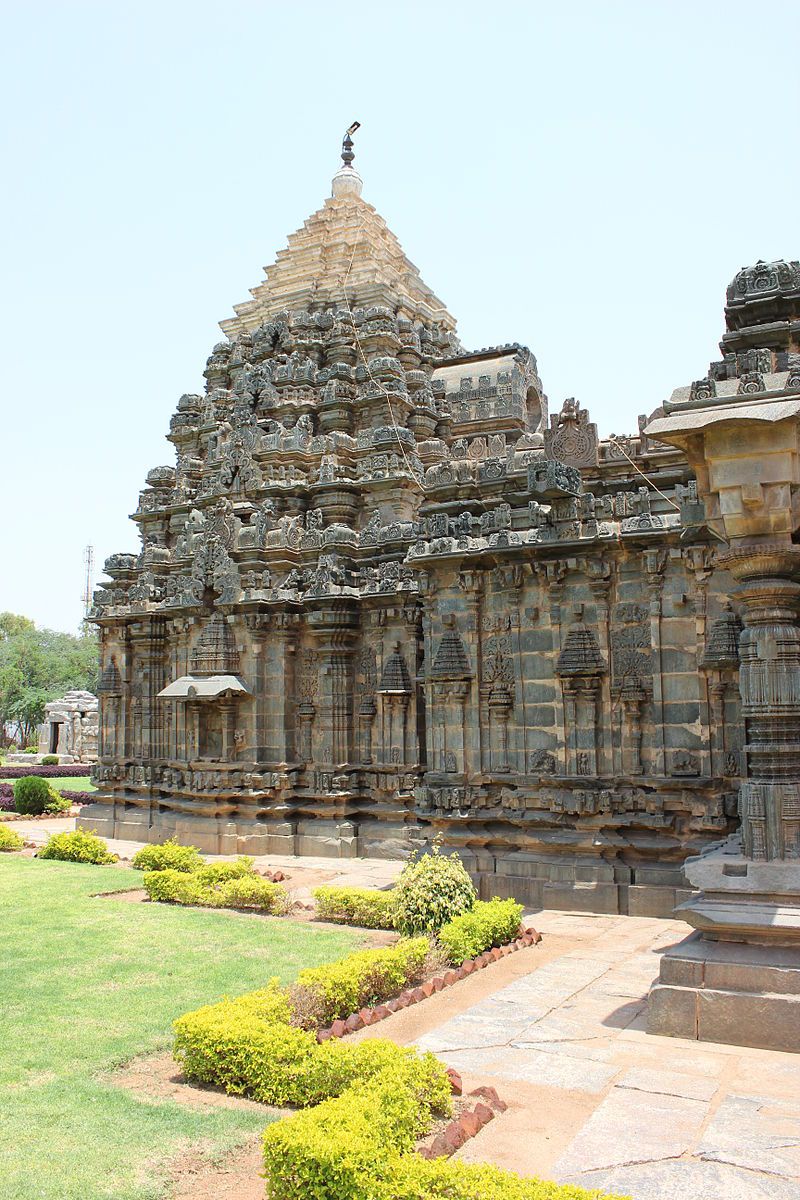
  • In the southern part of the Deccan, i.e., in the region of Karnataka where some of the most experimental hybrid styles of vesara architecture are to be found.
  • Pulakesin I established the western Chalukya kingdom when he secured the land around Badami in 543.
  • Early Chalukyan activity also takes the form of rock-cut caves while later activity is of structural temples.
  • The earliest is probably the Ravana Phadi cave at Aihole which is known for its distinctive sculptural style.
  • One of the most important sculptures at the site is of Nataraja, surrounded by larger -than-life-size depictions of the saptamatrikas: three to Shiva’s left and four to his right.
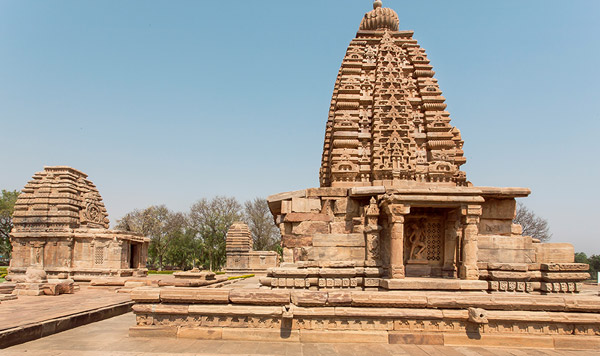
  • The most elaborate of all Chalukyan temples at Pattadakal made in the reign of Vikramaditya II (733-44) by his chief queen Loka Mahadevi is Virupaksha temple. Another important temple from this site is Papnath temple, dedicated to Lord Shiva.
  • Lad Khan temple at Aihole in Karnataka, seems to be inspired by the wooden-roofed temples of the hills, except that it is constructed out of stone.
  • The Hoysaleswara temple (Lord of the Hoysalas) at Halebid in Karnataka was built in dark schist stone by the Hoysala king in 1150. Dedicated to Shiva as Nataraja, the Halebid temple is a double building with a large hall for the mandapa to facilitate music and dance.
  • Founded in 1336, Vijayanagara, literally ‘city of victory’, attracted a number of international travellers such as the Italian, Niccolo di Conti, the Portuguese Domingo Paes etc.who have left vivid accounts of the city.
  • In addition, various Sanskrit and Telugu works document the vibrant literary tradition of this kingdom.
  • Architecturally, Vijayanagara synthesises the centuries-old dravidian temple architecture with Islamic styles demonstrated by the neighbouring sultanates.

Doubling Farmers Income

  • Agriculture sustains livelihood for more than half of India’s total population. Doubling farmers’ income in such a short period is an overwhelming task for decision makers, scientists and policy makers because of its continued role in employment, income and most importantly in national food security.
  • Doubling farmers’ income is possible through increasing total output and better price realization in the market, reduction in production costs,diversification of product, efficient post-harvest management, value addition, etc.

What are the needs of the Agricultural sector?

  • Extension of Irrigation Facilities:
    • The coverage of irrigation facilities needs to be extended while ensuring an effective water conservation mechanism.
  • Improve Agricultural Credit:
    • An inclusive approach to provision for agricultural credit has to be undertaken to address the issue of skewness in its regional distribution, it said.
  • Land Reform:
    • As the proportion of small and marginal holdings is significantly large, land reform measures like freeing up land markets can help farmers improve their Income.
  • Boost to Allied Sectors:
    • Allied sectors, such as animal husbandry, dairying and fisheries, need to be given a boost to provide an assured secondary source of employment and income, especially for small and marginal farmers.
  • Farm Mechanisation:
    • There is also a need to address the issue of lower farm mechanisation in India which is only about 40% as compared to about 60% in China and around 75 % in Brazil.
  • Improving Food Processing Sector:
    • More focussed attention” is required to be given to the sector due to its significant role in reducing post-harvest losses and creation of an additional market for farm outputs.
      • The food processing sector is growing at an average annual growth rate of more than 5% over the last six years ending 2017-18.
  • Exploring Global Markets:
    • There is a need to give increased focus on exploring global markets for agricultural commodities to give an additional source of market for the surplus of agricultural produce India currently has.
  • Reallocation of Labour:
    • There is also a need to reallocate labour resources to other sectors.
    • Though the structural transformations involved a falling share of the agriculture sector and rising share of services sector jobs, more needs to be done to create manufacturing jobs to absorb the large pool of workers.
  • Other Issues:
    • Issues such as investment in agriculture, insurance coverage, water conservation, improved yields through better farming practices, access to market, availability of institutional credit, increasing the linkages between agricultural and non-agricultural sectors need urgent attention.

What are the Government policies and interventions?

Institutional reforms

  • Pradhan Mantri Krishi Sinchai Yojana, Soil health card, and Prampragat Krishi Vikas Yojana: Aiming to raise output and reduce cost.
  • Pradhan Mantri Fasal Bima Yojana: To provide insurance against crop and income loss and to encourage investment in farming.
  • Interlinking of rivers – To raise output and farm incomes.
  • Operation Greens: To address price volatility of perishable commodities like Tomato, Onion and Potato (TOP).
  • PM Kisan Sampada Yojana: To promote food processing in a holistic manner.

Technological Reforms

  • Initiating E-NAM: The National Agriculture Market (eNAM) is a pan-India electronic trading portal which networks the existing Agricultural Produce Market Committees (APMCs) mandis to create a unified national market for agricultural commodities.
  • Technology mission on cotton: It aims to increase the income of the cotton growers by reducing the cost of cultivation as well as by increasing the yield per hectare through proper transfer of technology to the growers.
  • Technology Mission on Oilseeds, Pulses and Maize (TMOPM): Few schemes implemented under TMOPM are: Oilseeds Production Programme (OPP), National Pulses Development Project (NPDP), etc.
  • Mission for Integrated Development of Horticulture (MIDH): It is a scheme for the holistic growth of the horticulture sector covering fruits, vegetables, root & tuber crops, mushrooms, spices, flowers, aromatic plants, coconut, cashew, cocoa and bamboo.
  • Sugar Technology Mission: Aimed at reducing the cost of production of sugar and improving sugar quality through steps for improvements in productivity, energy conservation and improvements in capital output ratio.
  • National Mission on Sustainable Agriculture: It aims at promoting sustainable agriculture through a series of adaptation measures focusing on ten key dimensions encompassing Indian agriculture namely; ‘Improved crop seeds, livestock and fish cultures’, ‘Water Use Efficiency’, ‘Pest Management’, ‘Improved Farm Practices’, ‘Nutrient Management’, ‘Agricultural insurance’, ‘Credit support’, ‘Markets’, ‘Access to Information’ and ‘Livelihood diversification’.
  • In addition, schemes relating to tree plantation (Har Medh Par Ped), Bee Keeping, Dairy and Fisheries are also implemented.

Way Forward

  • The low level of farmers’ income and year to year fluctuations in it are a major source of agrarian distress.
  • To secure the future of agriculture and to improve the livelihood of half of India’s population, adequate attention needs to be given to improve the welfare of farmers and raise agricultural income.
  • It is essential to mobilize States and UTs to own and achieve the goal of doubling farmers’ income with active focus on capacity building (technology adoption and awareness) of farmers that will be the catalyst to boost farmers income.
  • The National Sample Survey Office’s last survey on agricultural households was conducted in 2013. There has been no further assessment of the farmers income. Therefore there is an urgent need to track the progress of farmers and help them increase their income.

India of 1991 in 2021 – 30 Years of LPG

Do you remember the 1991 Economic crisis which led to Liberalisation, Privatisation and Globalisation (LPG) reforms ?

So lets us compare the India of 1991 with the India of 2021 which also marks 30 years of LPG Reforms

  • The Crisis of 1991 & Reforms:
    • 1991 Crisis: In 1990-91, India faced a severe Balance of Payments (BOP) crisis, where its foreign exchange reserves were just adequate to finance 15 days of imports. There were many factors that led to the BOP crisis:
      • Fiscal Deficit: The fiscal deficit during 1990-91 was around 8.4% of GDP.
      • Gulf War I: In 1990-91, the situation was aggravated by the rise in the price of oil due to Iraq’s invasion of Kuwait.
      • Rise in Prices: The inflation rate increased from 6.7% to 16.7% due to a rapid increase in money supply and the country’s economic position became worse.
    • Nature and Scope of 1991 Reforms: In order to get out of the macro-economic crisis in 1991, India launched a New Economic Policy, which was based on LPG or Liberalisation, Privatisation and Globalisation model.
      • Then Finance Minister, Manmohan Singh, was the prime architect of the historic 1991 liberalisation.
      • The broad range of reforms under the LPG model included:
        • Liberalising Industrial Policy: Abolition of industrial license permit raj, Reduction in import tariffs, etc.
        • Beginning of Privatisation: Deregulation of markets, Banking reforms, etc.
        • Globalisation: Exchange rate correction, liberalising foreign direct investment and trade policies, Removal of mandatory convertibility cause, etc.
      • These reforms are credited and applauded for the high economic growth seen from 1991 to 2011 and substantial reduction of poverty from 2005 to 2015.
  • The Crisis of 2021 :
    • The World Economic Outlook Report 2021, states that the Indian economy is expected to grow by 12.5% in 2021 and 6.9% in 2022.
      • However, the pandemic has led to massive unemployment in the informal sector and poverty is increasing after decades of decline.
    • The social sectors of health and education have lagged behind and not kept pace with our economic progress.
      • Too many lives and livelihoods have been lost that should not have been, during the pandemic.
    • Inspector Raj is set to make a comeback through the policy for e-commerce entities.
    • India is back to the old habits of borrowing excessively or extracting money (in form of dividends) from the RBI to finance the fiscal deficit.
    • The migrant labour crisis has laid bare the gaps in the growth model.
    • India foreign trade policy is again suspecting trade liberalisation, as India has already decided to opt-out of the 16-nation Regional Comprehensive Economic Partnership (RCEP) trade deal.

Way Forward

The 1991 reforms helped the economy stave off a crisis and then bloom. It is time to outline a credible new reform agenda that will not just bring GDP back to pre-crisis levels, but also ensure growth rates higher than it had when it entered the pandemic.

Challenges in the new Digital era

Covid-19 pandemic has exposed the deep fault lines that have created challenges for India’s march towards a digitally enabled society.

During the pandemic, several essential services, ranging from access to healthcare services (including vaccination) to education, livelihoods, and rations — have felt the effects of unequal distribution of technology in the country.

Thus, with increasing inequalities and the burden on systems, the need for digitally driven programmes is now more urgent than ever before.

Digital Challenge

  • Digitally Inaccessible Remote Communities: The first wave of Covid-19 brought with it an immediate and urgent need for the development sector to shift towards technology, when faced by the inability to access communities remotely.
    • A survey in June 2020 indicated that only about half of the respondents were aware of online classes being held in their communities.
    • The consequences of these gaps are likely dire – an estimated 10 million girls could drop out of school.
  • Unserved Remote Areas: With digital services not being uniformly distributed, communities in remote areas often require on-ground staff to deploy and supplement digital tools.
    • They may also face significant barriers in accessing funding for innovative and infrastructural digital solutions.
  • Digital Divide: During the second wave, urban Indians have consistently relied on social media platforms to seek life-saving medical supplies but rural Indian could not utilise it to the fullest.
    • Unequal access to the internet has also made accessing and registering for Covid-19 vaccines in India a challenge, leaving millions of Indians unable to even register for them.
  • Digital Illiteracy: It’s apparent that a majority of Indian citizens lack digital literacy and online safety is an alien concept to many who may have digital literacy.
    • Language and accessibility barriers and limited data and infrastructural systems further compound the scenario.
  • Social barriers and systemic inequality also play a large role in this — even today, mobile ownership among women is significantly lower than their male counterparts.
    • Moreover, communities continue to remain averse to mobile devices in the hands of young people, especially young women, to prevent them from disrupting existing patriarchal systems.

Way Forward

  • Need For Technology Enabled Development Sector: It is time for the development sector to shift towards technology-driven ecosystems, to enable a more systematic and concerted effort to bridge the present digital divide and help access remote communities digitally. NGO’s and CSO’s can play a vital role in this step.
  • Technological Intervention: The process of creating and implementing digital solutions is multi-layered and complex. According to many CSOs, the first step is to address the demands posed by technological interventions across a programme life cycle.
    • This calls for customised digital interventions. The issue gets complicated because CSOs need to work with local communities who face digital challenges themselves. Digital interventions have to factor in these imperatives.
  • Feedback from People: The success of technology-based programmes is ultimately contingent on the support for it on the ground, and community feedback is critical to driving successful and sustainable programmes.
    • Programmes, therefore, need to integrate and account for interpersonal mediation and the last-mile “human touch”.
  • Partnership with Stakeholders: To enable them to incorporate technology at scale, CSOs require more systematic partnerships with stakeholders across the development ecosystem.
    • Collaboration with the government and other civil society partners is vital to normalising the use of technology-based interventions at scale.
    • For example, the government and private sector service providers need to prioritise the availability of digital infrastructure and connectivity while civil society integrates programmatic responses into government priorities.
  • Documenting the Learning: There are no blanket solutions to the critical challenges that come with embracing technology in framing programmes for the development sector.
    • Documenting their learnings is an important first step in pushing for more open conversations with regard to digital interventions in India.

Conclusion

Recognising the essential role that digital tools, access and literacy will play in the months and years to come, Civil societies and NGOs can play a major role in bringing technological revolution in their working.

Pegasus – A threat to your Privacy

What is Pegasus?

  • It is a type of malicious software or malware classified as a spyware.
  • It is designed to gain access to devices, without the knowledge of users, and gather personal information and relay it back to whoever it is that is using the software to spy.
  • Pegasus has been developed by the Israeli firm NSO Group that was set up in 2010.
  • The earliest version of Pegasus discovered, which was captured by researchers in 2016, infected phones through what is called spear-phishing – text messages or emails that trick a target into clicking on a malicious link.
  • Since then, however, NSO’s attack capabilities have become more advanced. Pegasus infections can be achieved through so-called “zero-click” attacks, which do not require any interaction from the phone’s owner in order to succeed.
  • These will often exploit “zero-day” vulnerabilities, which are flaws or bugs in an operating system that the mobile phone’s manufacturer does not yet know about and so has not been able to fix.

What are the types of cyber attacks?

  • Malware: It is short for malicious software, refers to any kind of software that is designed to cause damage to a single computer, server, or computer network. Ransomware, Spy ware, Worms, viruses, and Trojans are all varieties of malware.
  • Phishing: It is the method of trying to gather personal information using deceptive e-mails and websites.
  • Denial of Service attacks: A Denial-of-Service (DoS) attack is an attack meant to shut down a machine or network, making it inaccessible to its intended users. DoS attacks accomplish this by flooding the target with traffic, or sending it information that triggers a crash.
  • Man-in-the-middle (MitM) attacks: Also known as eavesdropping attacks, occur when attackers insert themselves into a two-party transaction. Once the attackers interrupt the traffic, they can filter and steal data.
  • SQL Injection: SQL stands for Structured Query Language, a programming language used to communicate with databases. Many of the servers that store critical data for websites and services use SQL to manage the data in their databases. A SQL injection attack specifically targets such kinds of servers, using malicious code to get the server to divulge information it normally wouldn’t.
  • Cross-Site Scripting (XSS): Similar to an SQL injection attack, this attack also involves injecting malicious code into a website, but in this case the website itself is not being attacked. Instead the malicious code the attacker has injected, only runs in the user’s browser when they visit the attacked website, and it goes after the visitor directly, not the website.
  • Social Engineering: It is an attack that relies on human interaction to trick users into breaking security procedures in order to gain sensitive information that is typically protected.

What are the initiatives taken by the government to tackle the issue of cyber attacks?

  • Cyber Surakshit Bharat Initiative: It was launched in 2018 with an aim to spread awareness about cybercrime and building capacity for safety measures for Chief Information Security Officers (CISOs) and frontline IT staff across all government departments.
  • National Cyber security Coordination Centre (NCCC): In 2017, the NCCC was developed to scan internet traffic and communication metadata (which are little snippets of information hidden inside each communication) coming into the country to detect real-time cyber threats.
  • Cyber Swachhta Kendra: In 2017, this platform was introduced for internet users to clean their computers and devices by wiping out viruses and malware.
  • Indian Cyber Crime Coordination Centre (I4C): I4C was recently inaugurated by the government.
  • National Cyber Crime Reporting Portal has also been launched pan India.
  • Computer Emergency Response Team – India (CERT-IN): It is the nodal agency which deals with cybersecurity threats like hacking and phishing.

Laws in India related to Cyber Security

  • Information Technology Act, 2000.
  • Personal Data Protection Bill, 2019.
  • International Telecommunication Union (ITU): It is a specialized agency within the United Nations which plays a leading role in the standardization and development of telecommunications and cyber security issues.