Quality of Work Life

Quality of work life is very important for employee because employee work in which era and society . If the employees work more times in the office and after that they not have enough time to spend with their family , have not good relationships with their colleagues and employers it’s affect the employee’s quality of work life. It’s affects the working in the office and it’s upset mentally to employee.

Some knowledge workers work for more than 60 hours a week. As a result of this, their personal hobbies and interests clash with their work. Life is a bundle that contains all the strands together and hence the need to balance work life with other related issues.’ One must have both love and work in one’s life to make it healthy. Gone are the days when the priority of employees used to be for physical and material needs. With the increasing shift of the economy towards knowledge economy, the meaning and quality of work life has undergone a drastic change.

MEANING OF QUALITY OF WORK LIFE

Quality of work life refers to the favourable favourableness or unfavourable unfavourableness of a job environment for the people working in an organisation. The period of scientific management which focused solely on specialization and efficiency , has undergone a revolutionary change.

The traditional management inadequate ttention to human values. In the present senario , needs and aspirations of the employees are changing . Employers are now redesigning job for better quality of work life .

# The QWL as strategy of Human Resource Management has assumed increasing interest and importance. Many other terms have come to be used interchangeably with QWL such as ‘humanisations of work’ ‘quality of working life, ‘industrial democracy’ and ‘participative work’.

# “Quality of work life is based on a general approach and an organisation approach. The general approach includes all those factors affecting the physical, social economic, psychological and cultural well-being of workers, the organisational approach refers to the redesign and operation of organisations in accordance with the value of democratic society.”

“The overriding purpose of QWL is to change the climate at work so that the human-technological-organisational interface leads to a better quality of work life.”

Quality is work life involves three major parts :

Occupational health care : Safe work environment provides the basis for people to enjoy his work. The work should not pose health hazards for the employees.

Suitable work time: Companies should observe the number of working hours and the standard limits on overtime, time of vacation and taking free days before national holidays.

Appropriate salary: The employee and the employer agree upon appropriate salary. The Government establishes the rate of minimum salary ; the employer should not pay less than that to the employee. Work represent a role which a person has designated to himself. On the other hand, work earns one’s living for the family , on the other hand it is a self realization that provides employment and satisfaction.

work life quality- defined as the balance between an employee’s work demands and outside interests or pressures – is a long – standing but ever- evolving area of corporate social responsibility . Some organisations view QWL as important, but do not formally link it to their strategic or business plans.

Some people by nature are not committed to anything and anyone and as such they would not be committed to their employers also. Commitment is an attitude and those who lack it will not be committed to their jobs.

Importance of quality of work life

▪︎Enhance stakeholder relations and credibility

▪︎Increase Productivity

▪︎Attractions and retention

▪︎Reduces absenteeism

▪︎Improve the quality of working lives

▪︎Beneting families and communities

▪︎Job involvement

▪︎Job satisfaction

▪︎Company reputation

Significance of good quality of work life:

# Decrease absenteeism and increase turnover

# Less number of accidents

# Improved labour relations

# Employee personification

# Positive employee attitudes toward thei work and the company.

# Increase productivity and intrinsic motivation

# Employee gain a high sense of control over their work

Problems in improving the quality of work life:

These problems may occur because of:

poor reward and recognition: People will not do their best when they feel that employers’ commitment in terms of reward and recognition is lacking. Commitment is a mutual phenomenon. When employers want to get the best from employees but do not give them reward and recognition, people will not be committed to work.

Dead-end jobs: Work which does not offer opportunities for growth and promotion is one of the greatest reasons for employees’ de-motivation and non-commitment. Jobs which deprive employees of self-development and growth opportunities lead to high dissatisfaction and disloyalty.

Managing by intimidation : Mistreating people and managing them by threats and embarrassment leads to employees’ dissatisfaction and weakens their commitment. In a best seller book” The Loyalty Link” Dennis G. Mc Carthty has identified managing by intimidation as one of the seven ways which undermine employees’ loyalty.

Negative working environment: Non-acceptance by colleagues, non-cooperation, too much politics, and negative behaviour by colleagues, supervisors and other people in the company also hamper commitment. At the end of the day people want peace of mind, which if not available in the work environment will discourage them to show total support to the company.

No job security: One of the major needs of employees is job security. If the employee feels that he can lose his job anytime, he would not be committed towards company’s goals.

Negative attitude: Some people by nature are not committed to anything and anyone and as such they would not be committed to their employers also. Commitment is an attitude and those who lack it will not be committed to their jobs.

India’s Shifting Export Market and Global Economy Change Under Pandemic

India the only major Asian economy that’s grown its export share since the start of the tariff wars in 2018 is the one with the fewest trade links to China. India’s share of world exports rose to 1.71% in the first quarter of 2019 from 1.58% in the fourth quarter of 2017, data compiled by Bloomberg show. The share of every other economy among Asia’s 10 biggest exporting nations fell in the same period.

The two largest goods traded by India are mineral fuels (refined or unrefined) and gold (finished gold ware or gold metal). In the year 2013-14, mineral fuels (HS code 27) were the largest traded item with 181 billion USD worth imports and 64.685 billion USD worth re-exports after refining. In the year 2013-14, gold and its finished items (HS code 71) were the second largest traded items with 58.465 billion USD worth imports and 41.692 billion USD worth re-exports after value addition. These two goods constitute 53 per cent total imports, 34 per cent total exports and nearly 100 per cent of total trade deficit (136 billion USD) of India in the financial year 2013-14. The services trade (exports and imports) are not part of commodities trade. The trade surplus in services trade is 70 billion USD in the year 2017-18.

Part of the reason for India’s outperformance is that it’s not as integrated into global manufacturing supply chains as peers, which means exporters are cushioned from rising trade tensions in the region.

It’s a sentiment that was flagged by central bank Governor Shaktikanta Das in an interview.

“India is not part of the global value chain,” he said. “So, U.S.-China trade tension does not impact India as much as several other economies.”

China is the biggest buyer of goods from South Korea and Japan, whose share of world exports have fallen the most in Asia. For India, China is the third-largest market, after the U.S. and the U.A.E.

“Our biggest advantage is that our product basket and market basket are both quite diversified,” said Rakesh Mohan Joshi, a professor at the Indian Institute of Foreign Trade in Delhi.

Trade tensions between the U.S. and China have given India an opportunity to ramp up exports to both countries, according to Ajay Sahai, director general and chief executive officer of the Federation of Indian Export Organisations.

India’s exports to the U.S. grew at the fastest pace in six years in the year ended March 2018, while exports to China surged 31%, the second highest annual pace of growth in more than a decade, data from India’s Ministry of Commerce show.

“China is more willing to give market access to India than ever before,” said Sahai, pointing to increased access for products such as rice, fruits and vegetables, with potential for greater exports of pharmaceuticals and automobile components to China.

On the other hand, India’s exports to the U.S. could lose momentum. President Donald Trump has criticized India for its tariffs on U.S. products, and withdrew trade concessions on $6.3 billion of Indian goods on June 1. India responded with higher tariffs on about 30 American products.

India stands at number 16 in the list of global trading partners and the nation is running with its pace to reach under top 10 in the list but the covid-19 pandemic has hit not just Indian economy but the entire world economy. The all of world would take steep financial dive with this epidemic before reaching on its initial status, till then let’s hope for the betterment of not just India, but the whole of world and the severely impacted victims of this contagious virus.

Most frightening moments

MOMENT 1:

The doctor said I had three more hours.
I think I was stabbed, I don’t remember much. Nevertheless, I was at my home. I was going to take a bath. Something didn’t add up. I then woke up
I still felt the pain. Fear gripped me.
I was frightened that this might come to pass

MOMENT 2:

Dogs were crying, Cricket was on peak
Ticking of clock, Subtle BREATHING
Silence EVERYWHERE, Not in my heart, it was beating, STILL postures, Pointed look of eyes, Somewhere in the air
LIFE was LOST.

MOMENT 3:

I had never been more frightened than when I noticed I was walking alone and felt someone followed me. I hurriedly climbed the stairs with bags full of weekly groceries and went straight into the kitchen. No one are at home back home and I was expecting my father and mother in some time from their evening walk and as usual would expect the soup and salad immediately, followed with regular dinner. I suddenly felt silence all over and heard noise from my lift but ignored it. The fear wasn’t subsiding, I entered my room to safe guard myself . To my horror, It was my parents who are in the lift.

MOMENT 4:

I have never been more frightened than when, I remember was a kid playing at home, my mumma was taking afternoon nap and suddenly when I opened window I saw a big cat which was about to attack me.
That dreadful and cruel look of cat is still in my mind and always reminds me of that incidence whenever I see a cat.
“Ailurophobia is now part of my life”

MOMENT 5:

I had never been so frightened than the day I was standing alone among the gushing crowd of people! I felt as if I’m alone as I missed my 3 years old younger brother in the exhibition!

I still remember my promise to my aunt, “Don’t worry aunt, I will take care of him to the fullest! The exhibition might be crowded but my eyes will be fixed on him… Please send him with me!”

But now I feel like I can’t move to search for him. The feel of ‘he is gone forever’ never leaves my anxious heart! Nobody is here for me among the hundreds around me! My God! Am I still alive?

Child Labour

Child labour is a term you might have heard about in news or movies. It refers to a crime where children are forced to work from a very early age. It is like expecting kids to perform responsibilities like working and fending for themselves. There are certain policies which have put restrictions and limitations on children working.
The average age for a child to be appropriate to work is considered fifteen years and more. Children falling below this age limit won’t be allowed to indulge in any type of work forcefully. Why is that so? Because child labour takes away the kids opportunity of having a normal childhood, a proper education, and physical and mental well-being. In some countries, it is illegal but still, it’s a far way from being completely eradicated.

Causes of Child Labour
Child Labour happens due to a number of reasons. While some of the reasons may be common in some countries, there are some reasons which are specific in particular areas and regions. When we look at what is causing child labour, we will be able to fight it better.
Firstly, it happens in countries that have a lot of poverty and unemployment. When the families won’t have enough earning, they put the children of the family to work so they can have enough money to survive. Similarly, if the adults of the family are unemployed, the younger ones have to work in their place.
Child labour is a term you might have heard about in news or movies. It refers to a crime where children are forced to work from a very early age. It is like expecting kids to perform responsibilities like working and fending for themselves. There are certain policies which have put restrictions and limitations on children working.

Health benefits of various juices.

We get various nutrients by drinking fresh fruit juices or vegetable juices. The daily needs of minerals, vitamins, fiber and antioxidants can be fulfilled by having these juices. Also, drinking juices increases our metabolism and helps in weight loss.

Fiber burns fat and helps in weight loss. You will be surprised to know that vegetables that have high fiber content absorb water from the body and helps indigestion. Along with this, you will not feel hungry for long time. Consuming juices of many vegetables and fruits is beneficial for burning calories and weight loss.

Orange juice: Fresh orange juice not only tasty, it can also be helpful in reducing your weight. Orange is also called anti-calorie fruit because it has very few calories and drinking it provides many benefits to the body.

Bitter gourd juice: Drinking Bitter Gourd Juice helps us to increase the metabolism. Also, bitter gourd helps in keeping our weight under control due to being a low-calorie food.

Cucumber Juice: This vegetable contains a lot of water and hence, cucumber keeps the body hydrated. Also, due to being a low-calorie food this juice makes you feel full for a long time. So, you don’t have any unhealthy cravings.

Pomegranate juice: Pomegranate contains antioxidants and polyphenols. Therefore, it is considered to increase metabolic rate, decrease appetite, and burns fat.

Pineapple juice: Pineapple juice is rich in nutrients. This is considered good for gym lovers, people can have it after their workouts. In it, elements called vitamin C and bromillian are found. which, reduces inflammation of the body.

Poverty; the silent killer of Indian society

Haven’t we heard this word too often or have we stopped listening? We have all felt a shortage of cash at times. That is an individual experience. It is not the same as the social problem of poverty. While money is a measure of wealth, lack of cash can be a measure of lack of wealth, but it is not the social problem of poverty.

Poverty as a social problem is a deeply embedded wound that permeates every dimension of culture and society. It includes sustained low levels of income for members of a community. It includes a lack of access to services like education, markets, health care, lack of decision making ability, and lack of communal facilities like water, sanitation, roads, transportation, and communications. Furthermore, it is a “poverty of spirit,” that allows members of that community to believe in and share despair, hopelessness, apathy, and timidity. Poverty, especially the factors that contribute to it, is a social problem, and its solution is social

Poverty is a peculiar problem from which various countries of the world, particularly the Third World, have been suffering. There cannot be a common definition of poverty which can be broadly accepted everywhere. Thus there are large differences between the definitions of poverty accepted in various countries of the world.

Poverty is considered as the greatest challenge faced by the societies in the third world countries. Poverty is also concerned with the comparison with respect to a fixed line—known as poverty line. However, the poverty line is fixed extraneously and, therefore, remains fixed for a certain period.

Poverty Line:

Normally poverty is defined with poverty line. Now the question which is relevant at this point is what the poverty line is and how is it fixed? The answer to the question is that the poverty line is a cut-off point on the line of distribution, which usually divides the population of the country as poor and non-poor.

Accordingly, people having income below the poverty line are called poor and people with income above poverty line are called non-poor. Accordingly, this measure, i.e., the percentage of people living below the poverty line is known as head count ratio.

In India, broadly accepted definition of poverty emphasises more on minimum level of living rather than on reasonable level of living. Accordingly, it is broadly agreed that poverty can be termed as a situation where a section of the population fails to reach a certain minimum consumption standard. Differences arise with the fixing of this minimum consumption standard.

After a thorough examination, the study group set up by the Planning Commission in July 1962 recommended a standard of private consumption expenditure of Rupees 20 (at 1960-61 prices) per capita per month as the bare minimum amount common to both rural and urban areas.

Top 7 Causes of Poverty in India

1. Lack of Inclusive Economic Growth:

The first important reason for mass poverty prevailing in India is lack of adequate economic growth in India. In the first three decades of planned development (1951-81) in India, annual average growth in national income had been 3.6 per cent. With 2.1 per cent per cent per annum growth in population, per capita income grew by only 1.5 per cent per annum during this period. In addition, with the increase in saving rate from about 9 per cent in 1950-1951 to 20 per cent of GDP in 1979-80, increase in per capita consumption expenditure was too small to make any significant dent on the problem of poverty. Besides, because of prevailing income inequalities per capita consumption expenditure of the poor could have hardly risen.

2. Sluggish Agricultural Performance and Poverty:

Many economists have pointed out that in the year of good agricultural output, poverty ratio declines. Good performance in agriculture leads to more employment opportunities and fall in prices of food grains. More employment opportunities and lower food price cause poverty ratio to decline. The experience of Punjab and Haryana shows that with agricultural growth through use of new high yielding technology (popularly called green revolution); poverty ratio can be significantly reduced. However, in various states of the country such as Orissa, Bihar, Madhya Pradesh, Assam, East Uttar Pradesh, where poverty ratio is still very high new high-yielding technology has not been adopted on a significant scale and as a result agricultural performance has not been good. As a result, poverty prevails to a larger extent in them.

3. Non-implementation of Land Reforms:

Equitable access to land is an important measure of poverty reduction. Access to adequate land, a productive asset, is necessary for fuller employment of members of an agricultural household. Most of the rural poor are agricultural labourers (who are generally landless) and self-employed small farmers owning less than 2 acres of land.They are unable to find employment throughout the year. As a result, they remain unemployed and under-employed for a large number of days in a year. No wonder that these landless agricultural labourers and self- employed small farmers remain poor. Land-reforms were intended to provide them equitable access to land.

4. Rapid Population Growth:

Rapid population growth since 1951 is another important factor responsible for persisting poverty in India. Population in India has increased from 36 crores in 1951 to 102.7 crores in 2001, that is, 66 crores people have been added to the Indian population in the last about 50 years since independence. Rapid population growth causes excessive sub-division and fragmentation of holdings. As a result, per person available land has greatly declined so that households do not have access to sufficient land to produce enough output and income for them.

Further, rapid growth of population increases the dependency ratio, that is, an earning member has more persons to support. This causes lower per capita consumption expenditure which is not enough even to meet the basic needs.

5. Unemployment and Under-employment:

The existence of unemployment and under­employment in the Indian economy is another cause of poverty in India. Unemployment prevails more among casual labour whose proportion in labour force has been increasing and in their case unemployment and poverty go together.

The unemployment has been caused by rapid growth of population and labour force on the one hand and relatively low rate of capital formation and economic growth on the other. Besides, the generation of employment opportunities by the organised sector has been quite insignificant.

As a result, the demographic reassure on land has been increasing resulting in unemployment, and disguised unemployment in agriculture and the informal sector. Thus has caused low productivity, low incomes and poverty.

6. Slow Growth of Employment:

In the beginning of the planning era it was thought the organised sector over a period of 20 years will generate sufficient employment opportunities for the unemployed poor. The actual experience has belied these hopes. Take, for instance, the experience of the last decade (1990-2000) of economic development.

7. Inflation and Food Prices:

Rate of inflation and level of food prices is an important factor that causes poverty. Inflation, especially rise in food prices, raises the cost of minimum consumption expenditure required to meet the basic needs. Thus, inflation especially raises in food prices pushes down many households below the poverty line.

Global Programmes Impacting against Poverty in India

Many initiatives are being taken up at the global front as well to help solve the problem of hunger and poverty. Some of these are:

1.      Ending Child Hunger and Undernutrition Initiative (ECHUI)-

This is a global initiative started by World Food Programme (WFP) that ensues global partnership and aims at reducing the causes and effects of child hunger and undernutrition. It aims to mobilise resources for actions on national levels to build awareness and address the issue on a global scale. On any given day, WFP has 5,000 trucks, 20 ships and 92 planes on the move, delivering food and other assistance to those in most need. Every year, they distribute more than 15 billion rations at an estimated average cost per ration of US$ 0.31.

2.      Agenda 2030-

Agenda 2030 is the shortened name given to the Sustainable Development Goals (SDGs) is 17 goals set by the UN General Assembly in 2015. The top two goals of the agenda are to “End Poverty in all its forms, everywhere” and “End Hunger, achieve food security and improved nutrition, and promote sustainable agriculture”. This shows that the need of the hour is focusing on the poverty and its most drastic side effect of hunger. Most countries lack data on poverty and especially child poverty and thus it makes it difficult to make projections for the future.

3.      US Government Global Food Security Strategy (2017-2021)-

After the Global Food Security Act on 2016, the US Government, in partnership with other governments, universities, research institutes, civil societies and private sector built this strategy to focus on challenges like poverty and hunger. The vision of this strategy is “A world free from hunger, malnutrition and extreme poverty.”

Mercy Corps worked closely with private sector partners, other NGOs, academic and research institutions, the faith community and Members of Congress to help pass H.R. 5129 and S. 2269 amendment bills. This bill ensures the Global Food Security Act’s improvements to the Global Food Security Strategy and the Feed the Future Initiative will continue beyond 2018.

TRIAL OF SUMMONS CASES BY MAGISTRATE

INTRODUCTION

Summon is a legal document which is issued by the court that notifies or commands a person to whom it is served to show his/ her presence in the court in order to answer the questions raised upon/to that person.

A summons case signifies a case concerning to an offence not punishable with death, imprisonment for life or imprisonment for a term exceeding two years. The trial procedure prescribed for summons cases is mainly contained in sections 251 to 259 of Criminal Procedure Code, 1973. These cases are tried with much less formality than warrant cases, and the manner of their trial is less elaborate.

STEPS IN THE TRIAL PROCEDURE

Chapter XX of CRPC deals with Trial of summons cases by Magistrates.

Section 251: explaining the substance of the accusation to the accused.

“When in a summons case a accused appears or is brought before the magistrate, the particulars of the offence of which he is accused shall be stated to him, and he shall be asked whether he pleads guilty or has any defence to make, but it shall not be necessary to frame a formal charge.”[1]

The section only dispenses with a formal charge in a summons case but is does not dispense with the statement of particulars of the offence for which accused is to be dealt with. The purpose of questioning the accused under this section is to appraise him of the charge against him. The accused should have clear statement made to him:

  • That he is about to be put on trial
  • The offence or facts constituting the offence with the commission of which he is accused.

The record must show the facts which were stated or explained to the accused by the magistrate.

Section 252: conviction on plea of guilty.

“If the accused pleads guilty, the Magistrate shall record the plea as nearly as possible in the words used by the accused and may, in his discretion, convict him thereon.”[2]

When guilty is pleaded by the accused, it is imperative that the magistrate shall record the plea of guilty as nearly as possible in words used by accused. The requirement of section 252 is not merely empty formality but is a matter of substance intended to secure proper administration of justice, because the right to appeal of the accused depends upon circumstance whether he pleaded guilty or not. It is because of the reason that the legislature requires the exact words used by accused in hid plea of guilty should be as nearly as possible be recorded in his own words or language in order to avert any inaccuracy, error or misapprehension. If there are number of accused persons, the plea of ach accused shall be recorded separately in their own words after the accusation was read over to each one of them.

Section 253: conviction on plea of guilty in nonappearance of accused in petty cases.

It has been provided by section 206 that in the case of certain petty offences, an accused who is willing to plead guilty need not appear in the court either in person or through his pleader provided, he satisfies the conditions of that section. The object is to avoid unnecessary trouble to offenders who have committed petty offences and are willing to pay the penalty. Section 253 prescribes the procedure where a person to whom a summons has been issued under sec. 206 has transmitted to magistrate his plea to guilty without appearing before the magistrate. Where the accused wishes to plead guilty without attending the court, the accused is expected to pay Rs.1000/- by post or via a messenger (pleader) to the Magistrate.

Section 254: Process if the accused not convicted on plea

Section 254 specifies for both defence and prosecution case if the accused is not convicted on appeal under section 252 and 253.

Prosecution Case

The magistrate listens to the accused and collects all the evidence. In the hearing, the prosecution will be given opportunity to try its case by putting relevant facts which represent the case and by revealing the evidence which he relied upon to justify the case. The magistrate upon this application of the prosecution, present summon to any witness to attend and to produce some document or object. The judge must write the report of the facts according to section 274. Similar as other trials in summon cases even the magistrate must comply with section 279 i.e., presentation of evidence to the accused and 280 i.e., documentation of the conduct of the witnesses.

Hearing of Defence Case

Following the prosecution of the evidence referred to in section 254 and the defence examination referred to in section 313, the court shall proceed to the defence hearing referred to in section 254(1). In the hearing of the court, the defendant is asked to say about the evidence of the prosecution. In any case, failure to hear the accused constitutes a major error in the criminal process and cannot be cured pursuant to Article 465. Evidence provided by the accused is reported in the manner set out in section 274, 279, 280 for prosecution. Upon the facts provided by the defendant, his claims under section 314 shall be allowed to be presented.

Section 255: Acquittal or conviction

Subsequently, after the evidence is recorded under 254, the magistrate shall absolve the accused if he finds the accused not guilty. If the accused is guilty, the Magistrate shall proceed otherwise in accordance with Section 360 or Section 325, sentence him in accordance with the law.

A Magistrate may convict the accused of any offence (amenable to the trial in a summons case) which from the facts admitted or proved the accused appears to have committed.[3]

Section 256: Non-appearance or the death of the complainant

Pursuant to section 256, on the date set for the trial of the accused, the complainant will be allowed by the court to acquit the accused unless the court has cause to adjourn the case for another day. Section 256(1) shall also apply in the event of the demise of the complainant. In the event that the representative of the deceased complainant does not appear within 15 days, the defendant may be absolved by the Supreme Court.

CONCLUSION

Chapter XX of Criminal Procedure Code is outlined for the trial of summons cases satisfied all the requirements of fair trial. “Fair Trial is the heart of criminal jurisprudence and the denial of fair trial is the denial of human right” as held in Rattiram v. State of Madhya Pradesh.[4] The trial of the summon cases is less formal and less strict than other trial procedure just for the quick remedy and resolution of the case .


[1] The Code of Criminal Procedure, 1973

[2] The Code of Criminal Procedure, 1973

[3] R.V. Kelkar, “Lectures on Criminal Procedure”, Fourth Edition, 2006

[4] A.I.R 2012, SC 1485

Study reveals Covid-19 can infect ears

While Covid-19 continues to wreak havoc across the globe, a recent study suggests that the virus can infect the ear as well. The study, which was published in the scientific journal JAMA, was based on the autopsy carried out on three patients who died from Covid-19. The findings revealed the virus’ presence inside the middle ear and in the mastoid area of the head. The mastoid is a hollow bone behind the ear.
The research was carried out with the team removing the mastoids from the deceased patients’ bodies and taking specimens from their middle ears. Mastoid specimens from two patients tested positive for SARS-CoV-2 .
‘Two of the 3 patients tested positive for SARS-CoV-2 virus in the mastoid or middle ear, with viral isolation from 2 of 6 mastoids and 3 of 6 middle ears.

Results for case 1 were positive for the right middle ear only. Case 2 had negative results for all samples,’ the study stated.

‘This study confirms the presence of SARS-CoV-2 virus in the middle ear and mastoid, with significant implications for otolaryngology procedures,’ it added.

The team calls for taking proper precautions to stop the spread of infection in patients visiting hospitals or during surgical procedures.

‘Droplet precautions (including eye protection and proper N95 level mask) are warranted for outpatient procedures involving the middle ear due to proximity to these potentially infectious spaces. Given the high asymptomatic rate of Covid-19 cases, caution is warranted for all elective ear surgery, and negative status by testing is indicated,’ the study stated.

The perpetual war between the two countries

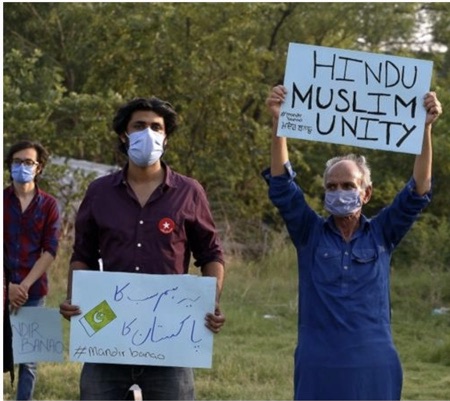
You must have seen a video which got viral few days back where a boy was seen damaging the walls of a temple that is currently being built in Islamabad(Pakistan). Another example like this was where a five year old boy was seen warning the Pakistani Prime Minister Imran Khan that if he will allow the the temples to be built, he will “kill all the Hindus”. Imagine a five year child speaking in his childish voice and warning such higher authority which may seem funny, but on the other hand this is a very important matter for the society that some people of Pakistan are filling up their children’s mind with filth and not showing them the right way where they should treat everyone as equal irrespective of caste, colour, gender plus nationality. I do agree with some of the things that the conflict between India and Pakistan is never ending but at least we can try to change the minds of the youth who will take the country forward.

Let me begin with the actual story where the Pakistani Government has decided to release funds for the Hindu temple to be built in Islamabad. This decision was made for the Minority class- the Hindu’s in Pakistan who also have the right to worship God in the temples. This plan was committed in the year 2017 by Nawaz Sharif’s government but it got delayed due to some issues. This is not the first time where the government has taken such step, before this the government took many initiatives for Hindu pilgrimage like they renovated Katas Raj Temple– a buddhist temple for the Hindus to worship. The Government has also helped the Sikh community with building gurudwaras for them like The Peshawar Gurudwara and the Nankana Sahib in Sailkot which was renovated for the sikhs.

aljazeera.com

Well, all of these things are small stepping stones by the Government for the minority so that they can also live like normal people without the barriers of religion. But on the other hand some projects have been backlashed by the Muslims of Pakistan where in a recent example the Pakistani government was planning to celebrate the legacy of Maharaja Ranjit Singh with statue, but it ended up causing a controversy on social media and in less than two months the statue was vandalised by the people. How will the country progress like this where the people are still not agreeing to some basic terms of accepting their fellow citizens as equal, building a temple or a gurudwara will never harm the other religion in fact all of these initiatives will bring the conflicts to an end. I am not saying that we Indians are the best and we don’t do such things, we are still facing major conflicts between Hindu and Muslim and there is no other solution to bring an end to this but there are Gurudwaras, Temples, Mosque and Church which are built together on the same lane and people respect that.

But why are these issues still arising, why can’t the soldiers just guard the country peacefully? The major reason for this is ‘Education‘ where the children are taught some facts which are against Hindus and Muslims, the facts which are putting them apart instead of living in tranquility and in harmony. The youth is being taught the wrong subjects with wrong facts and the society is also playing a major role in this, where they term minority people with funny names, where they are always referred to as a ‘minority class‘ instead of terming them as equal citizens.

All these examples and statements are not to hurt anyone be it from any religion or country. Building a temple or a gurudwara or even a mosque will never help the people to understand and have respect for the other religious sentiments, but education is and will be the only factor to bring everyone together and to treat everyone as equal, not becoming religion bias.

“My religion is ver simple, my religion is Kindness.” -Dalai Lama

BULLYING; a known DEVIL

One of the biggest problems that people face these days is bullying. Right from children to adults everyone has faced bullying some or the other way. Bullying is unwanted, aggressive behaviour among school-aged children that involves a real or perceived power imbalance. The behaviour is repeated, or has the potential to be repeated, over time. Both kids who are bullied and who bully others may have serious, lasting problems.

To be considered bullying, the behaviour must be aggressive and include:

  • An Imbalance of Power: Kids who bully use their power—such as physical strength, access to embarrassing information, or popularity—to control or harm others. Power imbalances can change over time and in different situations, even if they involve the same people.
  • Repetition: Bullying behaviours happen more than once or have the potential to happen more than once.

Bullying includes actions such as making threats, spreading rumours, attacking someone physically or verbally, and excluding someone from a group on purpose.

Bullying can occur during or after school hours. While most reported bullying happens in the school building, a significant percentage also happens in places like on the playground or the bus. It can also happen travelling to or from school, in the youth’s neighbourhood, or on the Internet. People usually think of bullying as taking place between children at school. However, it can also occur at work and include aggressive behaviour’s like verbal abuse, sabotaging the victim’s job or work relationship, or misusing authority. Adult bullies who engage in these behaviours are males 60% of the time. While men who bully tend to victimize both genders equally, women bullies target other women about 80% of the time.

Types of Bullying

There are three types of bullying:

  • Verbal bullying is saying or writing means things. Verbal bullying includes:
    • Teasing
    • Name-calling
    • Inappropriate sexual comments
    • Taunting
    • Threatening to cause harm
  • Social bullying, sometimes referred to as relational bullying, involves hurting someone’s reputation or relationships. Social bullying includes:
    • Leaving someone out on purpose
    • Telling other children not to be friends with someone
    • Spreading rumours about someone
    • Embarrassing someone in public
  • Physical bullying involves hurting a person’s body or possessions. Physical bullying includes:
    • Hitting/kicking/pinching
    • Spitting
    • Tripping/pushing
    • Taking or breaking someone’s things
    • Making mean or rude hand gestures

Cyberbullying

As the social life of young people has moved onto the internet, so has bullying, with electronic bullying becoming a significant new problem in the past decade. Whereas bullying was once largely confined to school, the ubiquity of hand-held devices affords bullies constant access to their prey. Cyber harassment can be especially disturbing because it can often be carried out anonymously; victims may have no idea who the perpetrators are.

How has the internet changed bullying?

The anonymity of cyberbullying removes many restraints on meanness and amplifies the ferocity of aggression. It’s easier to inflict pain and suffering on others when you don’t have to look them in the eye. Constantly evolving digital technologies enable new ways of spreading false information about targets.

How do bullies harm others on the internet?

Both direct harassment and relational aggression thrive on the internet. Cyberbullies can spread false rumours with viral speed on social media. They can falsely impersonate someone and conduct all manner of mischief in someone else’s name. Sexual harassment and cyberstalking particularly target women. And long after the active bullying has stopped, malicious information can linger on the internet and continue to harm.

How can people reduce their risk for being bullied?

Since low self-esteem tends to be a risk factor for becoming the victim of bullying, interventions that promote confidence and self-esteem are important ways to reduce the risk of being bullied. Confidence builders can range from engaging in activities at which the person excels (for example, theatrical performances, sports teams, and special work projects) to engaging in psychotherapy. As isolation is both a risk factor and result of bullying, helping the person feel less alone by lending a listening ear and/or engaging in a support group can go a long way toward providing the community needed to prevent a person from being bullied. The government has launched a helpline to take care of bullying please do not hesitate to take help.

Women’s empowerment

Most of the time we discuss about this topic Women’s empowerment do you think that now women have there right and compete with men in every field. women’s empowerment is a critical aspect of achieving gender equality. It includes increasing a woman’s sense of self-worth, her decision-making power, her access to opportunities and resources, her power and control over her own life inside and outside the home, and her ability to effect change.Yet gender issues are not focused on women alone, but on the relationship between men and women in society. An educated girl is more likely to postpone marriage, raise a smaller family, have healthier children, and send her own children to school. She has more opportunities to earn an income and to participate in political processes, and she is less likely to become infected with HIV.The political sphere of the country is, by and large, reserved for men alone. The place of women in society is also relegated to contributing minimally to the social development of the country.

As women were not allowed to make decisions  for them, women empowerment came in like a breath of fresh air. It made them aware of their rights and how they must make their own place in society rather than depending on a man. It recognized the fact that things cannot simply work in someone’s favor because of their gender. However, we still have a long way to go when we talk about the reasons why we need it.In other words, women from all over the world have been rebellious to reach the status they have today. While the western countries are still making progress, third world countries like India still lack behind in Women Empowerment.

domestic violence is a major problem in India. The men beat up their wife and abuse them as they think women are their property. More so, because women are afraid to speak up. Similarly, the women who do actually work get paid less than their male counterparts. It is downright unfair and sexist to pay someone less for the same work because of their gender. Thus, we see how women empowerment is the need of the hour. We need to empower these women to speak up for themselves. women must be given equal opportunities in every field, irrespective of gender.women’s empowerment  is a part to encourage women to feel strong by telling them that they can do everything that they want to do. women can work outside their home, have opportunity to make up their mind. women are not depended on men. They can earn money to support their family by working through their abilities.

Women’s empowerment is a part to encourage women to feel strong by telling them that they can do everything that they want to do. Women can work outside their home, have opportunity to make up their mind. Women are not depended on men. They can earn money to support their family by working through their abilities. As some women are not confident to work in a hard condition or a high position because they still determine that it’s not women’s job.

Empowerment helps to reduce in domestic violence due people promote and give the value to women. Women are not abused by any factors such as sexual abuse, emotion abuse and physical abuse.

These day women are achieving high-level job just as man do. Some women are promoted to become a president, leader, chief of commune and other high-level positions. And there are many women now are participating in society, politically, education and economically.

Empowering women and making full use of their labour force for economic growth.

Educating and maintaining the health of women to enhance productivity and social development.and we should also respect every women they deserve equal respect as men please don’t compare with others everyone have their own unique quality.

Impact from social media

Social media are interactive computer-mediated technologies that facilitate the creation or sharing of information, ideas, career interests and other forms of expression via virtual communities and networks.The variety of stand-alone and built-in social media services currently available introduces challenges of definition; however, there are some common features:

  1. Social media are interactive Web 2.0Internet-based applications.
  2. User-generated content such as text posts or comments, digital photos or videos, and data generated through all online interactions, is the lifeblood of social media.
  3. Users create service-specific profiles and identities for the website or app that are designed and maintained by the social media organization.
  4. Social media facilitate the development of online social networks by connecting a user’s profile with those of other individuals or groups.

Users usually access social media services via web-based apps on desktops and laptops, or download services that offer social media functionality to their mobile devices (e.g., smartphones and tablets). As users engage with these electronic services, they create highly interactive platforms through which individuals, communities, and organizations can share, co-create, discuss, participate and modify user-generated content or self-curated content posted online. Networks formed through social media change the way groups of people interact and communicate or stand with the votes. They “introduce substantial and pervasive changes to communication between organizations, communities, and individuals”.[1]These changes are the focus of the emerging fields of technoself studies. Social media differ from paper-based media (e.g., magazines and newspapers) and traditional electronic media such as TV broadcasting, Radio broadcasting in many ways, including quality,reachfrequency, interactivity, usability, immediacy, and performance. Social media outlets operate in a dialogic transmission system (many sources to many receiversThis is in contrast to traditional media which operates under a mono-logic transmission model (one source to many receivers), such as a newspaper which is delivered to many subscribers, or a radio station which broadcasts the same programs to an entire city. Some of the most popular social media websites, with over 100 million registered users, include Facebook (and its associated Facebook Messenger), TikTokWeChatInstagramQZoneWeiboTwitterTumblrBaidu Tieba and LinkedIn. Other popular platforms that are sometimes referred to as social media services (differing on interpretation) include YouTubeQQQuoraTelegramWhatsAppLINESnapchatPinterestViberRedditDiscordVK and more.

Observers have noted a wide range of positive and negative impacts of social media use. Social media can help to improve an individual’s sense of connectedness with real or online communities and can be an effective communication (or marketing) tool for corporations, entrepreneurs, non-profit organizations, advocacy groups, political parties, and governments.

Information and communication technology has changed rapidly over the past 20 years with a key development being the emergence of social media.

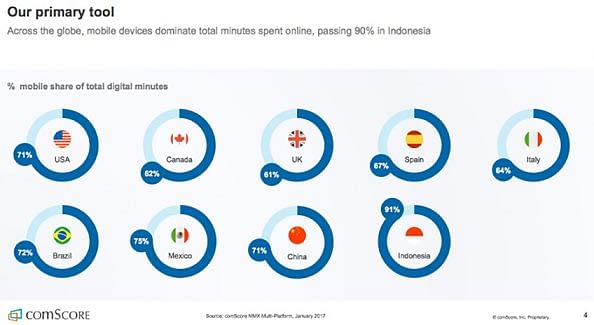
The pace of change is accelerating. For example, the development of mobile technology has played an important role in shaping the impact of social media. Across the globe, mobile devices dominate in terms of total minutes spent online. This puts the means to connect anywhere, at any time on any device in everyone’s hands.

What is the real impact of Social Media
Source: Smart Insights

Why People Share Information

Afascinating study by the New York Times Consumer Insight Group revealed the motivations that participants cited for sharing information on social media. These include a desire to reveal valuable and entertaining content to others; to define themselves; to grow and nourish relationships and to get the word out about brands and causes they like or support.

These factors have caused social networks to evolve from being a handy means for keeping in touch with friends and family to being used in ways that have a real impact on society.

Social media is being used in ways that shape politics, business, world culture, education, careers, innovation, and more.

Satti pratha: a dark side

The ancient Hindu tradition called ‘sati’ (or ‘suttee’), wherein a widow would burn herself to death on her husband’s pyre, was initially a voluntary act that was considered to be quite courageous and heroic, but it later became a forced practice. Although sati is now banned all over India and no longer practised, it has a rather dark history that you must know.
‘Sati’ originally meant a woman who performed the act of immolating herself after her husband’s death. The word is derived from the Sanskrit word ‘asti’, which means ‘she is pure or true’.

In mythological terms, Sati was the name of the wife of Lord Shiva. Her father never respected Shiva and often despised him. To protest against the hatred that her father held for her husband, she burned herself. While she was burning, she prayed to be reborn as Shiva’s wife again. This did happen, and her new incarnation was called Parvati. People used to justify the practice based on this tale, but when Sati burned herself, she wasn’t a window, and thus the practice is quite unrelated to this tale.
According to ancient Hindu customs, sati symbolised closure to a marriage. It was a voluntary act in which, as a sign of being a dutiful wife, a woman followed her husband to the afterlife. It was, therefore, considered to be the greatest form of devotion of a wife towards her dead husband.

With time, it became a forced practice. Women who did not wish to die like this were forced to do so in different ways. Traditionally, a widow had no role to play in society and was considered a burden. So, if a woman had no surviving children who could support her, she was pressurised to accept sati.

History of sati:
Historical records tell us that sati first appeared between 320 to 550 CE, during the rule of Gupta Empire. Incidents of sati were first recorded in Nepal in 464 CE, and later on in Madhya Pradesh in 510 CE. The practice then spread to Rajasthan, where most number of sati cases happened over the centuries.

Initially, the practice of sati was confined to royal families of the Kshatriya caste and only later spread to the lower castes, becoming widely practised among all social classes.

Sati was at its peak between the 15th and 18th centuries. During this period, as many as 1000 widows were burned alive every year, most commonly in India and Nepal. However, records show that the practice was also popular in other traditions and in countries like Russia, Fiji and Vietnam.

Different ways of execution:
Various accounts tell us about different ways in which the ritual of sati was carried out. Most accounts either describe women seated on their husbands’ funeral pyre or lying down next to the dead body. Some say women would jump or walk into the pyre after it had been lit, while others report that women would sit on the pyre and then light it themselves. The practice also varied from region to region. In some places, a small hut was constructed for the widow and her deceased husband. In several other regions, the corpse of the husband was placed in a pit along with combustible raw materials, and then the widow was required to jump in after the fire had been lit.

Some less torturous methods of execution were also prevalent back then. For example, before being placed on the funeral pyre, a woman could take poison or drugs, so that she would either start dying slowly or at least become unconscious. Sometimes, the widow herself would get snake-bitten or use a sharp blade on her throat or wrist before entering the pyre.

Sati hand prints and sati stones
Sati was frequently practised in Rajasthan, more specifically by the women of royal families. A sati stone was created, which was a memorial of all the wives of the kings who died this way. Before giving up their lives, the queens left their handprints on the wall, to be remembered as valiant and devotional wives. Some of these handprints can still be found inside the Mehrangarh Fort.

A different version of sati – Jauhar
Rajputs from Rajasthan and Madhya Pradesh practised Jauhar. This was collective suicide by the widows of the royal families who preferred dying, rather than being captured, raped and disgraced by soldiers who defeated their kings in the wars. This practice grew in the 14th and 15th centuries, when the Hindu-Muslim wars were at their peak in northwest India. To commit Jauhar, special flammable rooms were built inside the forts out of lacquer and other combustible materials. The practice of Jauhar has been well depicted in the Bollywood movie Padmavat.

Domestic Violence

Domestic violence is an issue that no one takes seriously. Many Indian households don’t have any knowledge on domestic violence or its laws and the punishment awarded for offending the law. The prevalence of domestic violence is arguably one of the top health concerns in the country. Understanding its definition can help you to take more effective action against its many manifestations of abuse. In some cases, abusers may not even realize that they’re inflicting domestic violence on someone else. On the flipside, victims may not take action against their abusers if they don’t realize that the behaviour they’re experiencing is indeed domestic violence.

Also important is that friends and loved ones of victims are in a better place to help if they understand what domestic violence looks like. Therefore, it’s important that people understand the definition of domestic violence and the many forms it can take.

Definition of Domestic Violence: Types of Abuse

According to the United States Department of Justice Office on Violence Against Women, the definition of domestic violence is a pattern of abusive behaviour in any relationship that is used by one partner to gain or maintain control over another intimate partner. Many types of abuse are included in the definition of domestic violence:

  • Physical abuse can include hitting, biting, slapping, battering, shoving, punching, pulling hair, burning, cutting, pinching, etc. (any type of violent behaviour inflicted on the victim). Physical abuse also includes denying someone medical treatment and forcing drug/alcohol use on someone.

  • Sexual abuse occurs when the abuser coerces or attempts to coerce the victim into having sexual contact or sexual behaviour without the victim’s consent. This often takes the form of marital rape, attacking sexual body parts, physical violence that is followed by forcing sex, sexually demeaning the victim, or even telling sexual jokes at the victim’s expense.

  • Emotional abuse involves invalidating or deflating the victim’s sense of self-worth and/or self-esteem. Emotional abuse often takes the form of constant criticism, name-calling, injuring the victim’s relationship with his/her children, or interfering with the victim’s abilities.

  • Economic abuse takes place when the abuser makes or tries to make the victim financially reliant. Economic abusers often seek to maintain total control over financial resources, withhold the victims’ access to funds, or prohibit the victim from going to school or work.

  • Psychological abuse involves the abuser invoking fear through intimidation; threatening to physically hurt himself/herself, the victim, children, the victim’s family or friends, or the pets; destruction of property; injuring the pets; isolating the victim from loved ones; and prohibiting the victim from going to school or work.

  • Threats to hit injure, or use a weapon is a form of psychological abuse.

  • Stalking can include following the victim, spying, watching, harassing, showing up at the victim’s home or work, sending gifts, collecting information, making phone calls, leaving written messages, or appearing at a person’s home or workplace. These acts individually are typically legal, but any of these behaviours done continuously results in a stalking crime.

  • Cyberstalking refers to online action or repeated emailing that inflicts substantial emotional distress in the recipient.

Domestic violence is not physical violence alone. Domestic violence is any behaviour the purpose of which is to gain power and control over a spouse, partner, girl/boyfriend or intimate family member. Abuse is a learned behaviour; it is not caused by anger, mental problems, drugs or alcohol, or other common excuses. Recently a Bollywood movie named ‘Thappad’, it spoke about domestic violence and how disrespecting someone you love is unacceptable under any circumstance. So do not hesitate to call out on anyone disrespecting you, if they love you they should definitely respect you.

China’s Wuhan Institute signs covert deal with Pak military for bio-warfare capabilities against India

China’s Wuhan Institute signs covert deal with Pak military for bio-warfare capabilities against India

China and Pakistan, the all-weather friends, have entered a three-year deal to expand potential bio-warfare capabilities against India, including several research projects related to the deadly agent anthrax. The deal has been inked between Wuhan Institute of Virology and Pakistan military’s Defense Science and Technology Organisation (DESTO) to collaborate research in “emerging infectious diseases” and advance studies on the biological control of transmitted diseases.

It is pertinent to mention that China has been criticized for handling of coronavirus pandemic with speculations that the disease could have emerged from the Wuhan Institute of Virology.

What we know about the covert deal

Collaboration for Emerging Infectious Diseases and Studies on Biological Control of Vector Transmitting Diseases.


China is testing biological agents outside its borders (in Pakistan) in an apparent bid to minimize the risk of drawing condemnation from the international community.


DESTO has been engaged in various dual-use research projects related to anthrax under a covert biological weapons program. The covert China-Pakistan project has conducted ‘successful soil sampling tests’ to isolate Bacillus Thuringiensis (BT), which has a striking similarity to Bacillus Anthracis – or anthrax.


The Wuhan lab was providing extensive training on the manipulation of pathogens and bio-informatics to Pakistani scientists ‘to help Pakistan develop its own virus collection database’.


The secret project was detached from the supervision of civilian universities or government health departments in Pakistan and was structured so as to allow ‘unspecified’ future operations.


China’s keen interest in the project is driven chiefly by its agenda to engage Pakistan against India and to conduct potentially dangerous experiments on foreign soil, without subjecting its own land and people to risk.


The plan was part of a move by Beijing to designate Pakistan a destination for hazardous biochemical research while evading use of its own territory for such activities, which stand the risk of drawing criticism and condemnation from the international community.


The China-Pakistan biological project had already undertaken experiments on the Crimean-Congo Hemorrhagic Fever Virus (CCHFV). CCHFV is a rapid-onset fever virus that causes death in about 25% of cases and is similar to the Ebola virus.CCHFV is categorized as a ‘class-4’ microorganism – the highest possible risk category.


Pakistan is allegedly carrying out tests on CCHFV in laboratories that are not equipped to handle Bio-Safety Level-4 diseases.
There were concerns the Kunming facility, which is controlled by the Chinese Academy of Medical Sciences, was also handling class-4 diseases without proper protections.