Courses and Career: Peaking Into Some Lesser Explored Ones

Selecting a future line of study and eventually profession can sometimes become a bit stressful. Or bland. If not many options are known. We all, at some point of time, have dreamt of doing something unique, or tread on, as Robert Frost’s poem title beautifully captures, ‘The Road Not Taken’. Hence, you are being presented with a collection of courses of scientific discipline, which is not mainstream, yet.

  • Ethical Hacking: Wait a second before judging this profession! It is hacking, yes, but for a good cause. Ethical hacking, also known as penetration testing, is used to test the security and susceptibility of an organization’s network to a breach. This usually results in data theft, identity thefts and other cyber crimes. So, the job of an ethical hacker is to identify and possibly, help to rectify the more weak openings in a network. Though, this course can be more unambiguously classified under IT, but in recent times, the subject has carved its own niche in the market, with an ever increasing demand. Ethical hacking courses usually also include other forms of security to impart an holistic understanding of IT security.
  • Geology: One common misconception about this branch of science is that this deals only with rocks. But in reality, it does not! Geology aims to provide a more in depth understanding about the physical and structural development of Earth. It inter relates various disciplines of science in relation to Earth. Geology also encompasses the study of materials and components making up the Earth, including living organisms. It is a lesser known fact, but geology is a vast and diverse study, overlapping with various scientific disciplines. Hence, the geologists have no dearth of options to consider while embarking on a professional journey.
  • Urban planning: Unplanned expansion of a settlement leads to many short and long term issues. And in today’s world, space crunch is a very real problem. So large scale developments need to be planned to have optimum utility and also not cause much harm to the surrounding environment. Here comes in the job of urban planner. The individual might be responsible for things like sustainable designing, good connectivity with other locations, optimum structures with respect to geographical location and climatic conditions, land use planning etc. 
  • Astrobiology: Sounds interesting, right? And it is! Astrobiology deals with the study of the scope of extraterrestrial life in the Universe. The study includes origin, evolution, distribution and future possibility of life across the unending stretch of cosmos. Astrobiologists, alongside other individuals from disciplines like astroecology, astrogeology and biochemistry, analyze these possibilities based on whatever knowledge is obtained about other planets and planetary systems.
  • Pisciculture: India, with an abundance of water bodies, also has a large population of fish consumers. And, obviously with growing demand, sometimes it’s hard to keep up with a constant supply. Hence like the Green Revolution, Blue Revolution happened too in India. It aimed at the development of the aquatic industry, for various purposes. Pisciculture, also known as fish farming, focuses mainly at rearing and breeding fishes in an economic manner, usually as a source of food. Optimum use of water bodies (usually fish tanks or enclosures) is also an important aspect, so that maximum cultivation can be done at minimum permissible limits.

IMPORTANT TERMS OF STOCK MARKET

  • Agent:

An agent is a brokerage firm which does buying/selling of shares on behalf of the investor in the stock market.

  • Ask/Offer:

It refers to the lowest price at which the owner of the equity shares is ready to sell the shares in the stock market.

Broker

A person who purchases or sells an investment on behalf of the investor/trader in return for a commission.

Bear Market It refers to a period in which the prices of equity shares fall consistently. You may look at it like beginning of a downward trend in the stock market.

Bull Market: An opposite of bear market, a bull market situation in which the prices of the stocks are increasing over a prolonged period of time. A single stock and a sector can be bullish at one time and bearish at another time.

Bid:

It is the highest price that the buyer of a stock is ready to pay for a particular stock.

Face value:

It relates to the amount of money or the value in cash that the holder of a security will obtain from the issuer of the security when the security matures at the specific date.

Limit Order –

A limit order is a type of order which executes at the price placed for buy or sell.

Market Order –

A market order is a type of order which executes as quickly as possible at the market price.

Day Order –

A day order is a direction to a broker to execute a trade at a specific price that expires at the end of the trading day if it is not complicated.

Authorized Shares –

This is the total number of shares that a company can trade.IPO – It is an Initial Public Offering that happens when the private company becomes a publicly traded company.

Secondary Offering –

This is another offering in order to sell more stocks and to raise more money form the public

Portfolio –

A collection of investments owned by you.

Margin –

Margin account lets a person to borrow money from the broker to buy shares.

SCHEMES BY MODI GOVERNMENT

Hello readers I am the intern of HARYALI organisation and today I want to share the contribution of Modi government to us through the various schemes .The Modi government has started many welfare schemes which include; Beti Bachao-Beti Padhao, Swachchh Bharat Mission, PM Mudra Yojna, Atal Pension Yojna, Smart city scheme, and Make in India etc. Read this article to know the list of important welfare schemes started by Narendra Modi.

Pradhan Mantri Jan Dhan Yojana

The financial inclusion scheme launched in August 2014 aims to provide universal access to banking facilities with at least one basic banking account for every household, and increasing financial literacy, access to credit, insurance and pension.There are 20 crore women Jan Dhan beneficiaries across the country.

 Make in India: PM Narendra Modi launched the ‘Make in India’ campaign that will facilitate investment, foster innovation, enhanced protection for intellectual property and build best in manufacturing infrastructure.

‘Make in India’ has identified 25 sectors in manufacturing, infrastructure and service activities and detailed information is being shared through interactive web-portal and professionally developed brochures.

 Swachh Bharat Mission: Swachh Bharat Mission was launched in the entire country as a national movement. The campaign aims to achieve the vision of a ‘Clean India’ by 2nd October 2019. The Swachh Bharat Abhiyan is the most significant campaign with regards to sanitation by the Government of India.

Beti Bachao Beti Padhao: The goal of this scheme is to make girls socially and financially self-reliant through education.

Atal Pension Yojna: Atal Pension Yojana is a pension scheme mainly aimed at providing a universal pension scheme for those who are a part of the unorganized sector such as maids, gardeners, delivery boys, etc. This scheme replaced the previous Swavalamban Yojana which wasn’t well-received by the people.

Digital India Mission: The Digital India programme is a flagship programme of the Government of India with a vision to transform India into a digitally empowered society and knowledge economy.

Stand Up India Scheme

Government of India launched the Stand Up India scheme on 5th April, 2016. The Scheme facilitates bank loans between Rs.10 lakh and Rs.1 crore to at least one Scheduled Caste/ Scheduled Tribe borrower and at least one Woman borrower per bank branch for setting up greenfield enterprises. This enterprise may be in manufacturing, services or the trading sector. The scheme which is being implemented through all Scheduled Commercial Banks is to benefit at least 2.5 lakh borrowers. The scheme is operational and the loan is being extended through Scheduled Commercial Banks across the country.

Java

Java is an object-oriented programming language developed by Sun Microsystems in 1991 and first released in 1995. Its development was led by the “Green Team”, managed by the flagship programmer James Gosling. In the beginning was to be called “Oak”, and there are many theories of why this name, being the most accepted the fact that there was an oak tree (Oak in English) against the Green Team office. That name turned out to be little commercial locations, apart from already having been registered. Finally, at the offices of Sun, it was decided to call it Java.

Java does not take long to reach the hearts of desktop programmers, providing a platform multiplatform and robust for developers. In its beginnings left much to be desired in the graphical interface, because the original graphics library, AWT (Abstract Window Toolkit), was much attached to the operating system and engaged in targeted bugs, that is to say, bugs specific to each operating system.

However, the biggest market of Java now is aimed at server applications, offering in the platform J2EE a wide range of tools to develop secure systems, scalable and robust.

Java, rather than a programming language, was developed considering a technology or framework. 

J2ME: Java Micro Edition, destined for develop mobile applications. It is developed considering the limited resources that have a mobile device.

J2SE: Java Standard Edition, for the world of desktop applications. It is the core of the language; containing the base of the API (Application Programming Interface) this offers us.

J2EE: Java Enterprise Edition, for the systems business. It is built on J2SE, but with the addition of a large security API, giving the developer all the tools necessary.

Java, like any programming language object-oriented, depends on Classes and Objects. A class is nothing more than a template from which an object is created. But once again, this can only be understood by a technical user. In plain words, a class is a blueprint from which it is possible to construct a building.

Java can be used to create two types of programs

Applications: An application is a program that runs on our Computer under the operating system of that computer. It is more or less like one creating using C or C++. Java’s ability to create Applets makes it important.

Applet: An Applet is an application designed to be transmitted over the Internet and executed by a Java compatible web browser. An applet is actually a tiny Java program, dynamically downloaded across the network, just like an image. But the difference is it is an intelligent program, not just a media file. It can react to the user input and dynamically change.

Every time you that you download a program you are risking a viral infection. Prior to Java, most users did not download executable programs frequently and most users were worried about the possibility of infecting their systems with a virus. Java answers both these concerns by providing a “firewall” between a network application and your computer. When you use a Java-compatible Web browser, you can safely download Java applets without fear of virus infection.

For programs to be dynamically downloaded to all the various types of platforms connected to the Internet, some means of generating portable executable code is needed .As you will see, the same mechanism that helps ensure security also helps create portability. Indeed Java’s solution to these two problems is both elegant and efficient.

Beyond the language there is the Java virtual machine. The Java virtual machine is an important element of the Java technology. The virtual machine can be embedded within a web browser or an operating system. Once a piece of Java code is loaded onto a machine, it is verified. As part of the loading process, a class loader is invoked and does byte code verification makes sure that the code that’s has been generated by the compiler will not corrupt the machine that it’s loaded on. Byte code verification takes place at the end of the compilation process to make sure that is all accurate and correct.

When you compile the code, the Java compiler creates machine code (called byte code) for a hypothetical machine called Java Virtual Machine (JVM). The JVM is supposed to execute the byte code. The JVM is created for overcoming the issue of portability. The code is written and compiled for one machine and interpreted on all machines. This machine is called Java Virtual Machine.

Servlets provide a Java-based solution used to address the problems currently associated with doing server-side programming, including inextensible scripting solutions, platform-specific APIs, and incomplete interfaces.

Servlets are objects that conform to a specific interface that can be plugged into a Java-based server. Servlets are to the server-side what applets are to the client-side – object byte codes that can be dynamically loaded off the net. They differ from applets in that they are faceless objects (without graphics or a GUI component). They serve as platform independent, dynamically loadable, pluggable helper byte code objects on the server side that can be used to dynamically extend server-side functionality.

JDBC is a Java API for executing SQL statements. (As a point of interest, JDBC is a trademarked name and is not an acronym; nevertheless, JDBC is often thought of as standing for Java Database Connectivity. It consists of a set of classes and interfaces written in the Java programming language. JDBC provides a standard API for tool/database developers and makes it possible to write database applications using a pure Java API.

Like human languages, programming languages have different levels of writing difficulty; some are easy to write, while others require extensive computer knowledge to understand. In programming, high-level languages are easier to understand, learn and write because of the use of natural language. But, as the use of natural language decreases and more words and computer statements are added, the difficulty level of language increases. This process eventually stops when we get to the lowest level of programming languages, machine language or Assembly language. This language strictly deals with solving problems using hardware, thus, requiring extensive knowledge of hardware and well as software to effectively write programs.

Since Java is so widely used in the world, its impact on the economy is large for a software language. “Sun estimates the total Java Economy to be more than (USD) $100 billion in sales annually driving an additional $110 billion in related IT spending” (Sun). Adding that up, Java’s economic impact compares to about 1.4% of the U.S. $14 trillion economy. Splitting the total value up, “The Java economy includes 2.5 billion smart cards, 800 million PCs shipped with Java, 1.85 billion Java Powered phones (source: Ovum), and over 180 telecom providers who deploy Java technology based content/services” (Sun).

At this point, Microsoft’s ODBC (Open Database Connectivity) API is that probably the most widely used programming interface for accessing relational databases. It offers the ability to connect to almost all databases on almost all platforms.

So why not just use ODBC from Java? The answer is that you can use ODBC from Java, but this is best done with the help of JDBC in the form of the JDBC-ODBC Bridge, which we will cover shortly. The question now becomes “Why do you need JDBC?” There are several answers to this question:

ODBC is not appropriate for direct use from Java because it uses a C interface. Calls from Java to native C code have a number of drawbacks in the security, implementation, robustness, and automatic portability of applications.

A literal translation of the ODBC C API into a Java API would not be desirable. For example, Java has no pointers, and ODBC makes copious use of them, including the notoriously error-prone generic pointer “void *”. You can think of JDBC as ODBC translated into an object-oriented interface that is natural for Java programmers.

ODBC is hard to learn. It mixes simple and advanced features together, and it has complex options even for simple queries. JDBC, on the other hand, was designed to keep simple things simple while allowing more advanced capabilities where required.

A Java API like JDBC is needed in order to enable a “pure Java” solution. When ODBC is used, the ODBC driver manager and drivers must be manually installed on every client machine. When the JDBC driver is written completely in Java, however, JDBC code is automatically installable, portable, and secure on all Java platforms from network computers to mainframes.

Two-tier and three-tier Models

The JDBC API supports both two-tier and three-tier models for database access.

In the two-tier model, a Java applet or application talks directly to the database. This requires a JDBC driver that can communicate with the particular database management system being accessed. A user’s SQL statements are delivered to the database, and the results of those statements are sent back to the user. The database may be located on another machine to which the user is connected via a network. This is referred to as a client/server configuration, with the user’s machine as the client, and the machine housing the database as the server. The network can be an Intranet, which, for example, connects employees within a corporation, or it can be the Internet.


Overpopulation


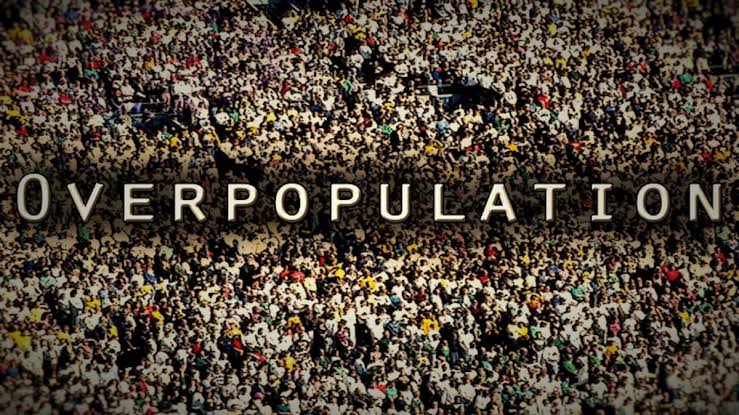
Overpopulation is defined as the number of people exceeding the capacity of the environment in terms of resources to sustain them. Presently, overpopulation poses as one of the gravest problems at the global level. The population of the world has increased seven-folds, from 1 billion to 7.7 billion, in just the last 200 years. The mammoth number indicates the seriousness of the situation which should be attended by all the governments collectively and by international organisations on a priority basis. The burden on our planet Earth should be reduced in order to prevent any harm to its inhabitants or the planet itself. 

This issue has been attributed to several factors such as:

-Low death rate

Due to advancement in the medical field, the death rates have lowered drastically. This technological advancement is seen as a leap in science but it has also largely contributed to the increase in population. 

-High birth rate

With an increase in the success of fertility treatments, the birth rate has also risen. 

-Lack of family planning

In most of the countries, family planning is not given much importance. There is a dire need to realise the benefits of planning before increasing the mouths to feed. As the number of people rises, more forest or rural areas are being urbanised. 

-Poverty

Many people believe that the more hands they have, the more they’ll earn and get out of the cycle of poverty. They fail to see other consequences of having many children, like more mouths to feed, overcrowding in their homes, parenting problems, further distribution of their income, et cetera. 

-The taboo on sex education 

Lack of sex education in school or by parents is a major factor contributing to overpopulation. Many teenagers and adults do not have sufficient information about contraceptives that can be used to prevent early or unwanted pregnancies.

-Agricultural advancement 

Villages and cities came into existence wherever they could find food to sustain them or land well-suited for practicing agriculture. Even today, if there’s a famine, a downfall in the population is observed whereas if there is a surplus, the opposite is observed. Thus, advancement in agriculture has led to overpopulation. 

Apart from these, there are still many reasons due to which this problem is being amplified. 

India is the second-most populous country in the world. Its population alone accounts for 17.7% of the world as per the statistics of 2018. India needs to introduce policies for population control which are effective while avoiding any extreme measures. One such extreme measure was forceful sterilisation of 6.2 million men during the 1976 emergency under the former Prime Minister Indira Gandhi’s son, Sanjay Gandhi. 

Some of the measures that can be introduced are tax and employment benefits for small families, compulsory sex education classes in schools, awareness about family planning, promoting adoption, removing taboo from female or male sterilisation surgeries, normalising and allowing easy abortion (which should be gender-neutral and only after consent is taken from the pregnant woman) and other steps. 

Overpopulation threatens the future availability of resources. It has led to deforestation, global warming, unemployment, and has affected all natural phenomena. We need to practice population control and raise awareness about it. 

Biodiversity : An overview

The earth provides for millions of species across the globe. Some of which are known to us and others not. We all are connected to each other in various ways and have to support each other too. Species which make proper and sustainable use of this system perish while others meet their destruction.

Biodiversity deals with the degree of nature’s variety in biosphere. This variety can be observed at three levels

  • The genetic variability within a species
  • The variety of species within a community
  • And the organization of species in an area into distinctive plant and animal communities.

Biodiversity provides a variety of environmental services from its species and ecosystem that are essential at the global, regional and local levels. The Production of oxygen, reduction of carbon dioxide, maintenance of the water cycle and protection of the soil are some important services.

Biodiversity is the amount of variety of life on Earth. It is the number of different species of plants, animals, and microorganisms. It includes organisms from Earth’s vastly different ecosystems, including deserts, rainforests, coral reefs, grasslands, tundra, and polar ice caps. Our biodiversity is very important to the well-being of our planet. Most cultures, at least at some time, have recognized the importance of conserving natural resources. Biodiversity is the occurrence of different types of ecosystems, different species of organisms with the whole range of their variants and genes adapted to different climates, environments along with their interactions and processes.

Importance of Conserving Biodiversity

Biodiversity produces a number of products harvested from nature and sold in commercial markets. Indirectly it provides economic benefits to people which include water quality soil protection, equalisation of climate, environmental monitoring, scientific research, recreation etc. The consumptive value can be assigned to goods such as fuel woods, leaves, forest products etc. which may be consumed locally and do not figure in national and international market.

The loss of biodiversity directly influences the social life of the country possibly through influencing ecosystem functions (energy flow and biogeochemical cycle). This be easily understood by observing detrimental effects of global warming and acid rain which cause an unfavourable alteration in logical processes

Aesthetic values such as refreshing fragrance of the flowers, taste of berries, softness of mossed, melodious songs of birds, etc. compel the human beings to preserve them. The earth’s natural beauty with its colour and hues, thick forest, and graceful beasts has inspired the human beings from their date of birth to take necessary steps for its maintenance. Similarly botanical and zoological gardens are the means of biodiversity conservation and are of aesthetic values.

Since earth is homeland of all living organisms, all have equal right to coexist on the surface of earth with all benefits. Unless some legal value is attached to biodiversity, it will not be possible to protect the rapid extinction of species. Biodiversity must be seen in the light of holding ethical value. Since man is the most intelligent amongst the living organisms, it should be prime responsibility and moral obligation of man to preserve and conserve other organisms which will directly or indirectly favour the existence of the man.

Biodiversity holds great ecological value because it is indispensable to maintain the ecological balance. Any disturbance in the delicately fabricated ecological balance maintained by different organisms, will lead to severe problems, which may threaten the survival of human beings.

Biodiversity has great economic value because economic development depends upon efficient and economic management of biotic resources. In the day to day life, human beings are maintaining their lifestyle at the sacrifice of surrounding species which come from diversity of plants and animals struggling for their existence.

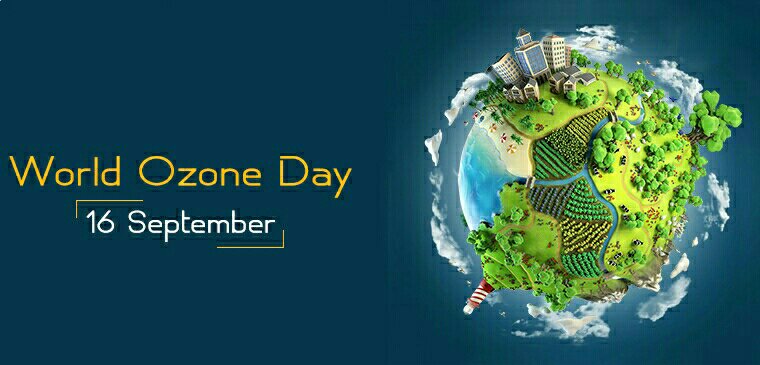
World Ozone Day 2020 – Ozone For Life!

There are problems that human beings should not interfere in the environment and this is also true. For our protection, all humans on earth have been placed in the middle of a protective shield which is being contaminated by humans nowadays. People may not know much about the ozone layer, but it acts as a protective shield for the Earth and the Environment and protects it from the sun’s dangerous ultraviolet rays. 

In this era of technology, man is killing everything that is hindering his progress. Similarly, for his comfort and convenience, man is determined to destroy the ozone layer which protects him from the dangerous ultraviolet rays emanating from the sun. The ozone layer that saved our lives has become a threat today due to the industrial activities that have taken place day after day.

What is Ozone after all?

Ozone is a light blue gas that is a compound of three atoms of oxygen (O3). The ozone layer is generally found between 10 km to 50 km above the ground level. This gas acts as a good filter for ultraviolet rays emanating from the Sun.

Danger from damage in ozone layer

The ozone layer is very important which protects us from the sun’s dangerous ultraviolet rays. If the ozone layer is damaged then all skin diseases can occur in humans.
Without the ozone layer, we cannot survive because these rays can cause cancer, damage to crops and threat to marine organisms and the ozone layer protects us from these ultraviolet rays. Another danger is the melting of the poles due to this. There is a large hole in ozone in Antarctica. The Antarctica region has large icebergs. If these icebergs melt, coastal areas can face many hazards, including flooding. Apart from this, heat will also increase, which will be harmful. Damage to the ozone layer also affects biological diversity and can destroy many crops. They have an effect on microorganisms. Apart from this, it also affects small plants in the sea, which can reduce the quantity of fish and other animals. 


History of World Ozone Day

Keeping in mind the importance of the ozone layer, work has been done to protect it from the last decade. But on January 23, 1995, the United Nations General Assembly passed a resolution to celebrate December 16 as International Ozone Day to bring awareness to people all over the world. At that time, the goal was to create an ozone friendly environment by 2010 across the world. Although the target is still far away, the world has done remarkable work in the direction of saving the ozone layer. 

The result of the exercise to protect the ozone layer is that today ozone-friendly fridges, coolers etc. have come in the market. To protect this layer it is necessary that foam mattresses are not used. Use of plastic should be minimized. Room fresheners and chemical perfumes should not be used and ozone-friendly refrigerators, air conditioners should be used only. Apart from this, the design of your house should be done in an ozone-friendly manner, using natural sources for light, air and energy. 

We have got this earth as an inheritance which we also have to give to the coming generation. We should take such a path that not only benefits us but also our upcoming generations can enjoy this very beautiful earth.

The Power of Communication.

Communication is a process of transferring information from one person to another. But is that the sole purpose of communication? Basically, NO. Communication has a broader concept. Communication helps you to grow as a person, to speak your heart out, to express what you feel, to persuade others, to heal. Just like the picture says that even if it is uncomfortable or uneasy one should communicate in order to find peace in your mind because if you keep things inside you all you it will only eat your soul and turn ugly or rather leave you overthinking. It helps you come out of your comfort zones.

Communication helps you solve so many things. In a fight between two people if they chose not to talk to each other and remain enemies they will remain that. But, on the contrary if they think of communicating their point of views with peace, they can end up retaining their friendship again. In a class if you choose to stay quiet and not ask a question because you feel you will sound dumb, maybe that doubt will remain with you forever and your decision to stay shut later proves to be the dumb one. If you keep things in your heart that will bother you continously thus causing stress. As mature adults we should not bring in our ego and not solve a conflict that is of no use instead talk our mind and solve things that can save a relationship.

Communication does not help us in human lives but also in the business life . In order to establish a good organisation one has to build a solid communication system, both Formal and Informal. A formal communication is the one that passes through well definite channels of communication throughout the organisation. An informal communication is the one which moves freely i.e. in all directions. If a leader or a manager has to lead it’s followers or subordinates he has to be confident enough to deliver his orders or requirements so that his followers listen to his orders and not take him for granted. On the other hand the informal communication builds up unity, integrity and solidarity among them and boosts up their morale. Grapevine is the name of the informal communication. And  managers can get feedback from their subordinates quickly on the plan and policies through grapevine.\

Not only verbal communication but non verbal communication is also useful and important. The power of expressions is irreplaceable. Gestures while communicating shows that you are confident enough to prove and state your point. The happy or a sad face of your loved one gives you a hint of their mood. A confused face of a student tells the teacher that he is in doubt even though he spoke nothing. The annoying face of a person tells that he is not liking something or a frowning face tells you that the person is tensed.

Finally, it is important for a person to communicate. Your mind is the most powerful speaker,your tongue just expresses it. If you see somebody struggling with their lives ask them to talk about it .Be a listener maybe you can help them in any way. Maybe you can make them smile.

A beautiful thing happens when we start paying attention to each other. It is by participating more in your relationship that you breathe life into it.”
― Steve Maraboli

Government related Schemes for Rural India.

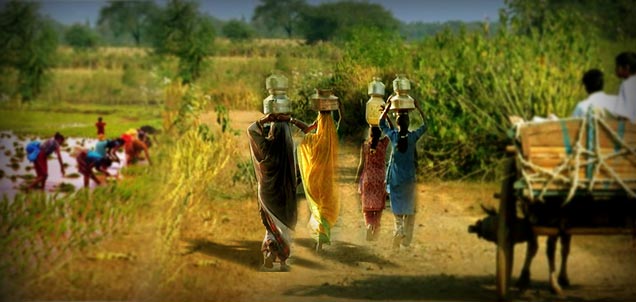
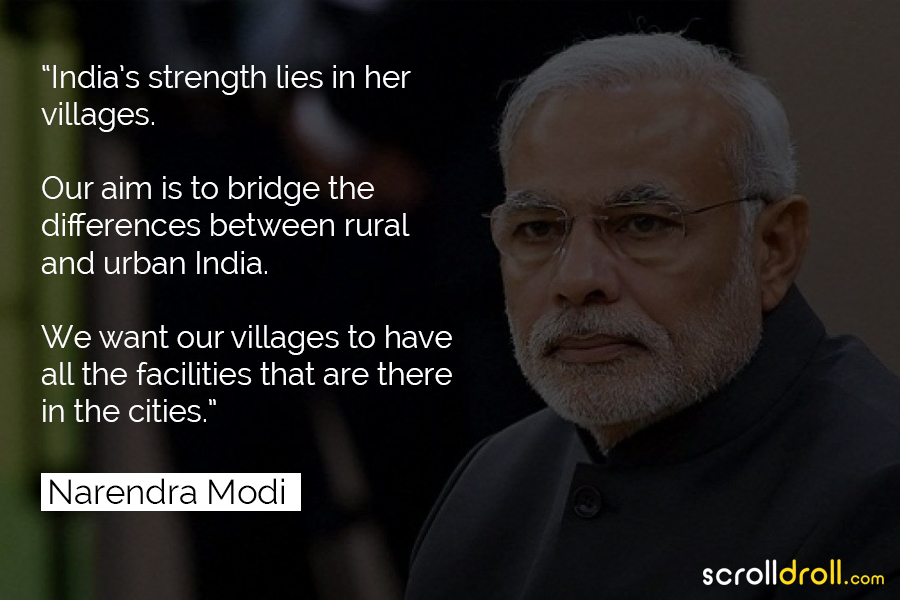
The rural sector is the heart and soul of the Indian economy. And the development of Rural India is the development of India. To enhance and make the rural economy progressive the Government of India has launched various schemes in favor of them.

The main aim of rural ministries is not to make profit out of them but for the welfare of the societies out there.These schemes are :

  1. Deen Dayal Upadhyay Grameen Kaushal Yojna: This is a placement linked skill development scheme for rural poor youth It was launched by on 25 September 2014 by Union Ministers Nitin Gadkari and Venkaiah Naidu on the occasion of 98th birth anniversary of Pandit Deendayal Upadhyaya.  It aims to target youth, under the age group of 15–35 years.A total of 52000 candidates have been skilled under this programme till 2014-15.

2. Roshni: Skill Development Scheme for Tribals: The Ministry of Rural Development on 7 June 2013 launched a new skill development scheme designed to offer employment to tribal youth in 24 Naxal -affected districts. The scheme, which is named Roshni is supposed to provide training and employment to an anticipated 50000 youth in the 10-35 years age group, for a period of three years.  As per the Ministry 50 per cent of the beneficiaries of the scheme will be women only.The scheme is designed in light of the Himayat project model, which was launched in Jammu and Kashmir has been implemented in Sukma, Chhattisgarh, and West Singhbhum, Jharkand, on a pilot basis over the last 18 months.

3. Swachchh Bharat Mission : The Prime Minister launched Swachh Bharat Mission on the birth anniversary of Mahatma Gandhi on 2nd October, 2014. The concept of Swachh Bharat Abhiyan is to pave access for every person to sanitation facilities including toilets, solid and liquid waste disposal systems, village cleanliness and safe and adequate drinking water supply. The programme is to be implemented by Ministry of Drinking Water and Sanitation.  An action plan has been drawn up for Swachh Bharat to become a reality by 2019, the 150th birth anniversary of Mahatma Gandhi.  The Mission aims to triple the growth percentage of toilet from present 3% to 10% by 2019.

4Sansad Adarsh Gram Yojna: This programme was launched by the Prime Minister Narendra Modi on the birth anniversary of Lok Nayak Jai Prakash Narayan on 11 October 2014. Ministry of Rural Development will be the supervising authority for this programme.  Under this programme each Member of Parliament will take the responsibility for developing physical and institutional infrastructure in three villages by 2019.

5. Heritage Development and Augmentation Yojna (HRIDAY):
This scheme was launched on the 21 January 2015 under the care of The Union Ministry of Urban Development.  Its aim is to preserve and rejuvenate the rich cultural heritage of the country.  In the initial phase of HRIDAY, 12 heritage cities have been identified which will be rejuvenated and developed. Union Government will provide 500 crore rupees to these 12 cities.

6. Mahatma Gandhi National Rural Employment Guarantee Scheme (MGNREGS): National Rural Employment Guarantee Act 2005, was launched on the 2nd Feb.2006. Now the new name of this scheme is “Mahatma Gandhi National Rural Employment Guarantee Act” (or, MGNREGA). This scheme is an Indian labour law and social security measure that aims to provide ‘right to work’ to the people falling Below Poverty Line. It guarantees 100 days employment in a year to the village people.

7. Aam Aadmi Bima Yojna: It was launched on october2, 2007.  It’s a social security scheme for rural households.  Under this scheme one member of the family is covered. The premium of Rs. 200 per person per annum is shared by the state and central government. V. The insured person need not to pay any premium if his/her age is between the 18 years to 59 years.

The period of Giant Insects.

Many types of insects exist in this world. The approximation being of around 900 thousand species of insects. But can you believe that one of them…..were giants once?

  • Arthropods

The etymology (origin of word) ‘Arthropod’ comes from the Greek words meaning “joint” and “foot”.  These insects elongated to the phylum of Euarthropoda. Okay,enough ofthe scientific explanations. Let’s get to our point. What makes these animals different. Well, these insects breathe through something called the spiracles. Spiracles are holes on the sides of the insects. From the inside,these holes are connected to the trachea holes which make the respiration process of every cell in the organism possible. Arthropods have this kind of breathing system or maybe similar. Alright ,till now we got no problems. But here’s when geology steps out in the frame of reference.

Photo by icon0

( Do observe closely to find the spiracles)

  • Geology

We humans have divided the history into small portions to make it easier and better to understand the concepts. One of the geological period,which was about 298 million years to somewhere around è58 million years. During this time,the atmosphere of our Earth was completely different from that of today.

But….why was it any different at all? Because ,it was a time when microbes were still evolving. The trees looked completely different. Where,the oxygen levels in the atmosphere was around thirty five percent. Yes,it was the Carboniferous Period.

Geologists say that this was the period when a lot of coal beds were formed i.e the fossil fuels. Now, why would have  this  happened? This was because,the microbes at that time did not have the specific enzymes in them to decompose the dead remains. So they stayed and with time,got buried under the layers and layers of soil over them. Now by layers and layers of soil you must’ve understood that this would’ve taken some millions of years. Why? Because,only to produce a single layer of soil,it takes roughly around a thousand years. Layers and layers of soil till they finally were converted into fossil fuels can just be left to our imagination.

 Photo by Alejandro Quintanar from Pexels

(Fossils)

Now ,the Carboniferous period has a lot of study to it. In fact  scientists out there are probably still exploring and discovering new factors and so much more. But we are not particularly that domain of this period,though the period was very interesting and fascinating. We are interested in the the insects of those times.

  • Giants

Were insects all magnanimous and large in that period of time. I hate to ruin it for you,but it was not so. The thing was,it is said the oxygen levels were very large in that period. Why so? Because the planet’s lands were literally green! Set aside the deserts of course. Or were they? 

This caused a lot of production of  oxygen in the atmosphere. Remember-These are all estimations which were discovered through various proofs collected,but the truth still remains a mystery to us!

So when we said about Arthropods,these insects were totally different from what they look like today. This is because nature has always had a crucial law,a law of adaptation. Right? So naturally they were different in 35% oxygen (then) compared to the 21% oxygen(now). As the levels were higher,the respiration ability probably increased as well. The trachea holes became bigger, eventually making the organism bigger as well. This made them have larger body parts and organs. For example,a specific type of dragonfly,actually grew wings of around 40 cm! Now,this might look like a small amount to you but it was pretty unusual and disturbing,that the insects which were around the length of our palm were once actually that to  our arms!

But suppose, what will happen if oxygen levels get increased to 35% today? Do you know how combustion happens? Yes, basically ‘the burning of oxygen’.  For first consequences,forest fires will drastically increase. How do they happen? When two branches rub against a tree,they create friction. Friction is the force which acts opposite to which force we apply. This friction makes fire. This is how campers light a fire through stones. Now that that the Oxygen levels are 35%, even the slightest rub will light a fire and the fire will spread very rapidly through the entire forest due to the same reason. Can you think of any other consequences? If the atmosphere did change into 35% in our future,will we evolve or adapt to the conditions too? List down your possible theories down below

Fact -Why is it that the spider legs never stick to the spider’s legs? This is because the spider legs  have tiny hairs on them. Even if the hairs stick to the webs,the spider can walk further. Also,not every web is sticky. The webs are altered with non sticky webs in which the spider walks on.

Bonus fact- Like liquid nitrogen,liquid oxygen also does exist! It’s just that the melting point of it is so low that it rarely occurs naturally.

Online mode of Education: Is it really advantageous to the Indian youth or there are any limitations too?

Article by – Shishir Tripathi

Intern at Hariyali Foundation
In collaboration with
Educational News

After the arrival of Corona Virus into the country after the months of February and March, educational institutions including schools and colleges were shut down and the normal teaching learning process was hampered. After, a certain time, the Teaching process again started through online mode and till now the same process is being followed.

Now, the question arises that the available mode of teaching is accessible to all the students across India or there are other students left who still are not connected with their respective educational institutions through the new mode of learning?

The normal classroom learning is not possible at present because of transmission of virus amongst the students and that will make the situation even worse than before. Therefore, lectures and notes to the students are given via the online mode with help of apps like Zoom, Google meet, Jio meet, Google Classroom and many more. These apps can only be accessed with the help of a Smartphone. Now, being a developing country, unequal distribution of wealth and resources is genuine in a country like India.

According to a survey by Central Board of Secondary Education (CBSE), at least 27% students do not have access to Smart phones, tablets or laptops for online classes. Such college and school students are facing a lot of problems in their studies

According to a real time progress tracker, 83% of households in India had electricity connection till 2018, and after some tome Modi government claimed that they have electrified India to 100% but everyone knows that laying wire lines, and transformers doesn’t mean that electricity reaches to the place.

Though the data is unavailable, there are villages still left waiting for electricity and hence in such remote areas it is so difficult for a student having a phone or any other electronic device and charging it properly for uninterrupted attendance in the online classes.

Now, there are sudden prolonged power cuts too which occur and can obstruct the power supply to electronic devices which can hamper the delivery of education through online mode from teachers and professors to the students and scholars. The all India average duration of power cuts was 5 hours and 28 minutes on May 2, 2019. And also, in villages sometimes the reason is all unknown to the people behind the sudden power cuts.

There is also a problem of slow speed in congested localities, small towns, villages and remote areas of the country. According to the Akamai Q1 2017 State of the Internet Report, the average internet connection speed in India is 6.5 Mbit/s and the average peak connection speed is 41.4 Mbit/s. Globally, India was ranked 89th out of 149 countries/regions by average internet connection speed and 97th by average peak connection speed. According to telecom industry experts, the slow bandwidth speed in India is due to the high cost of spectrum leading to Internet Service Providers (ISPs) not investing much into the spectrum. The growing number of telecom users and Smartphone users are also cited as one of the reasons for slow speed in the country.

Therefore, taking into consideration the present situation, the online mode of education is the best way possible to deliver knowledge to the students in these tough times of Corona. Also, the problems of unavailability of electronic devices and slow internet speed and proper supply of electricity to each and every household must be ensured so that the youth which is the future of the nation gets uninterrupted education and training through online mode.

Social Media Anxiety!…

Every one of you must have heard about anxiety or depression or overthinking. Then what’s this I’m talking about. Most of you have faced fear, anxiety or stress in real life but what if things happening in your virtual world affecting your real life. This is what we call social media anxiety.
We are so much cautious about our virtual world. We think 10 times before posting a photo or art. How people will receive it, how will they react, will I get enough likes, I hope these photos grab many comments. Such thoughts always brew in our mind. This peer pressure put us in some anxiety.
Now if you’re an introvert and chicken-hearted preservative person, then every little thing in the virtual world might affect you. Social media is filled with every variety of people introvert, shy, extrovert, extrovert, pervert, marketer and many more. Life is all good in this world till the day we face people of different thought process other than us. If we meet like-minded people, we feel safe and happy and if not anxiety begins to develop. There is another thing which matters here the most. How you deal with all the hatred, threats, scary messages and people. If you’re headstrong and master in ignoring this shit, then you’re at mental peace. If you’re an active overthinker and even if little mess happens in this world, it will totally take away your peace. You will try to run away from this, but you’ll fail. Then sooner or later, this anxiety will occupy the space in your real life. You will be always thinking about that particular incident on social media which is not even a part of the real world. You will lose your appetite. You won’t be able to concentrate on your work. You will always feel some burden on your head. This mess is nothing but social anxiety.
So how to deal with it? Chicken hearted persons and introverts should try not to take virtual shit in the real world. Just keep it there only. The second most important thing is to make yourself strong mentally. Handle all this drama keeping your head calm. Don’t let it form a chain of thoughts which exist nowhere but your head. It will trouble only you. So just avoid going deeper into things. Keep it simple. Even after taking all the care, some mess happens and it’s affecting your real life, then talk to your closed ones. Don’t hesitate to open up. Talk to them. Tell them what you feel, what is affecting you. This will make you feel you’re not alone. You will have someone with you. One more thing, don’t fear if you’re not wrong. Make time for meditation, keep yourself busy. Keep phone as a PART of your life only. Don’t make it your life. Your life is much bigger and better than that. Hold yourself. Focus on things which will make you grow as a person. Take criticism as a chance to improve yourself. Free your heart from self-created destructive thoughts. Make yourself a priority before anything in virtual world.

FREE TRADE AGREEMENTS

A free trade agreement(FTA) or treaty is a multinational agreement according to international law to form a free-trade area between the cooperating states. FTAs, a form of trade pacts, determine the tariffs and duties that countries impose on imports and exports with the goal of reducing or eliminating trade barriers, thus encouraging international trade.  Such agreements usually “center on a chapter providing for preferential tariff treatment”, but they also often “include clauses on trade facilitation and rule-making in areas such as investment, intellectual property, government procurement, technical standards and sanitary and phytosanitary issues”.

Important distinctions exist between customs unions and free-trade areas. Both types of trading bloc have internal arrangements which parties conclude in order to liberalize and facilitate trade among themselves. The crucial difference between customs unions and free-trade areas is their approach to third parties. While a customs union requires all parties to establish and maintain identical external tariffs with regard to trade with non-parties, parties to a free-trade area are not subject to such a requirement. Instead, they may establish and maintain whatever tariff regime applying to imports from non-parties as they deem necessary.  In a free-trade area without harmonized external tariffs, to eliminate the risk of trade deflection, parties will adopt a system of preferential rules of origin.

The General Agreement on Tariffs and Trade (GATT 1994) originally defined free-trade agreements to include only trade in goods.  An agreement with a similar purpose, i.e., to enhance liberalization of trade in services, is named under Article V of the General Agreement on Trade in Service (GATS) as an “economic integration agreement”.  However, in practice, the term is now widely used to refer to agreements covering not only goods but also services and even investment.

Misuse of FTA is to be controlled by Government of India :

The customs department will be keeping a close eye on imports of items such as mobiles, white goods, set-top boxes, agarbattis, cameras and other electronic products under a new verification mechanism that kicks in from September 21 to plug misuse of free trade agreements. Sources in the finance ministry said the new measures for administration of Rules of Origin under FTAs coming into force are expected to help curb the misuse of FTAs. The new mechanism requires importers to exercise due diligence before importing goods to ensure they satisfy the origin criterion for eligibility of duty concession under the FTA and declare this to the customs authorities.

Finance Minister Nirmala Sitharaman in the Budget this year had announced that undue claims of benefits under FTAs have posed a threat to the domestic industry and such imports require stringent checks. A new provision was introduced during the Budget session in February this year in the Customs Act for strict verification of rules of origin of imports under FTAs to ensure that FTA benefits are taken correctly. The rules for implementation of this provision were issued last month.

While India’s exports to FTA partner countries remain almost flat, imports rose rapidly. The trade deficit widened. In case of Asian countries, the merchandise trade gap has risen from $5 billion 2010, when the Asian FTA was implemented, to more than $22 billion now. This steep increase in trade deficit has become a serious cause of concern for the country.

Food from scratch…

Noodles

A 4000 year old bowl of noodles unearthed in China is the earliest example ever found of one of the world’s most popular foods. Noodles have been a staple food in many parts of the world for at least 2000 years. But who inverted the noodle? This is a hotly contested topic – with the Chinese , Italian and Arabs all staking a claim.

Ice cream

The first ice cream was probably made by chance when someone left some milk outside on a cold night and it froze!

Alexander the great enjoyed ice cream made with milk, fruit juice, honey and snow in the 4th century B.C. and the Roman emperor Nero ordered ice to ne brought from the mountains and combined it with fruit toppings. The Chinese also had a method of making ice creams and some believe that ice cream came to Europe from China.

It was Quintus Maximus, a roman general, who first wrote down a recipe for ice cream. Marco Polo brought the Chinese recipe to Venice after his visit to Peking. The king of England, Charles I is supposed to have offered his chef a handsome reward to keep his ice cream recipe a secret!

You favourite ice cream cone was invented by a pastry maker Ernest Hamwi in 1904, at the World Fair in St. Louis. He put a scoop of ice cream on his pastry when an ice cream seller in a neighbouring stall ran out of dishes- and it became an instant hit!

Chocolate

Cocoa, from which chocolate is made is said to have originated in the Amazon atleast 4000 years ago. The origins of chocolate can be traced back to the ancient Mayan and Aztec civilization in central America, who first enjoyed ‘chocolatel’, a much prized spicy drink made from roasted cocoa beans, the Aztecs believed that the cocoa tree was a gift from their God, Quetzalcoatl. According to legend, He had been banished by the other gods for giving the tree to mankind, but he promised to return to them one day.

The Spanish, led by Hernando Cortez, invaded Mexico in the 16th century. When the Aztecs saw Cortez, they believed their god had returned and welcomed him with a golden cup of chocolate! When Cortez returned to Spain in 1528, he loaded his galleons with cocoa beans and equipment for making the chocolate drink. Soon ‘chocolate’ became a fashionable drink enjoyed by the rich in Spain.

It was in 1847 that solid chocolate, as we know of today, was made by Fry and sons of Bristol by mixing sugar with cocoa powder and cocoa butter and your favourite treat was born.

Chewing gum

Thousands of years ago people chewed gum in it’s natural form. The most common ancient chewing gum was tree resin lumps, but people chewed various sweet grasses, leaves, grains and waxes also. The first commercial Chewing gum was made and sold in 1848 by John Bacon Curtis. He made a sticky, rubbery material from the spruce tree which could be chewed. In the 1860’s, Thomas Adams began selling chicle, a gum from the sapodilla tree of Mexico’s Yucatan desert.

Thank you for reading. Have a nice day!🌼

Child Marriage

Priya Yadav,

Along with the promotion of education, the practice of child marriage is being raised from Indian society. But a few years ago this was a terrible problem. Along with the question of child marriage, there is also the question of the appropriate age of marriage, which is necessary to decide in all countries.

The reason for child marriage are:-
(I) Religious conservatism:

Religious fundamentalism is the biggest reason for child marriage. Many Hindu scriptures have strongly supported child marriage and it has been called a sin to keep the tides of a girl for a long time. Therefore, religion also makes his parents yellow at the tender age.

(II) Intermarriage:

Due to the prohibition of marriage, caste, gotra, and exclusion among Hindus, the parents of the girl had a lot of trouble in finding the bride. Therefore, as soon as a good boy was found, as soon as the guardian of the girl was married to him.

(III) Sati practice:

Indirectly, the practice of Sati was also the reason for child marriage. When his husband died, his wife would also become sati with him. Therefore, with the idea of ​​protecting the children, they were married in childhood so that the boy could get protection in the house of the girl-boy after the death of the parents.

(IV) bridesmaid system:

A major reason for child marriage is the bridesmaid or dowry system. Due to this, many people think of marrying a girl as soon as possible after getting a bride.

(V) Joint family:

Even when married in a joint family, the boys had no responsibility for their wife and children. Therefore, there was no difficulty in getting married at a young age. This encouraged child marriage. All the above reasons except dowry are now gradually ending. Hence, child marriage is also seen to occur very rarely. Nowadays, the reason for this is high illiteracy and consequently conservatism.

In India, the first act was made in 1860 to stop child marriage, according to which the minimum age of marriage of girls was fixed at 10 years, but the public did not accept this law.

In 1891, an act was made to increase the age of marriage of girls to 13 years. In 1928, the Age Acceptance Committee strongly opposed child marriage and stated that most people do not know the laws made in this subject until now. In 1929, Har Vilas Sarada introduced a bill that was approved under the Prevention of Child Marriage Act. According to this, the age of marriage was fixed at least 18 years for boys and 14 years for girls.

In 1954, the Special Marriage Act fixed the age limit of civil marriage for boys and girls as 21 and 18 years respectively.
These legal measures have not completely removed the evil of child marriage from the country.