TROPICAL FOREST

The Andaman and Nicobar Islands, the western Ghats which borders on the Arabian Sea, the coasts of peninsular India and the larger Assam region of North-East India are home to tropical Evergreen forests of Indian territory. In Odisha State, a half evergreen forest is larger than evergreen formation mainly because evergreen forests appear to become semi-evergreen, with human contact. Small traces of evergreen forests are found. Between the three main evergreen forest regions there are significant variations.

The monsoon woods of the Western Ghats are present both at the western (ghat) edge of the coast and in less precipitation at the eastern side. There are many tree species of high commercial value in these forests, but they have now been removed from many areas. There are an immense amount of plants in evergreen forests; at least 60 percent of the upper cotton trees are species that make up not more than 1 % of the total number individually. The evergreen and semi-evergreen forests of south West India, perhaps in areas once cleared for transporting agriculture, are battered across streams or in underdrained hollows.

North-east India is traditionally a tropical area (which covers Assam, Nagaland, Manipur , Mizoram, Tripura and Meghalaya as well as Arunachal Pradesh’s plains) up to 900 metres (3,000 ft.) wide. It comprises evergreen and semi-eternal trees, wet feed trees of monsoon, riparian woodland, swamps with wildlife and pastures. The Assam Valley, the foothills of the eastern and lower Himalayan Hills and the Meghalayan, Mizoram and Manipur Forest are found to have evergreen forests, where the rainfall exceeds 2300 mm (91 in) per year.

The Andaman Islands and the Nicobar are inhabited by tropical and evergreen forests and rainforests and by tropical monsoon forests. The Keruing Wood dominate the hilly areas, while on some islands in the southern parts of the archipelago Dipterocare Kerrii is predominant. Andaman Redwood and Terminalia spp. prevail in its monsoon forests. Tropical forests in the eastern part of India contrast fully with Western Himalayan pine and coniferous trees. India’s natural cover differs in altitude: these evergreen forests are surrounded by high Alpine mountains close to the snowline and the dense forests of low-lying trees.

The northern plains of India, the Ganges and Yamuna Rivers, and the Thar Desert to the west, the Sundarbans, the marshy swamplands, the Ganges Delta and the Brahmaputra to the east; the Deccan Plateau, lying at the rainy shadows of the thick hills and the western ghats. These forests host 350 mammal species, 2,100 types of birds, nearly 350 reptile and countless insect species, both local and migrating. Environmental sustainability is maintained and our networks of support for life — water, air and land are protected. It helps to conserve plant and animal genetic diversity for better species growth. From the earliest times, the need to protect the climate and forests has been exercised. The forests were recently demarcated by the managers and prince-rulers as private protected. Today, many of the forested areas form the base of the shrines and parks of India. Nevertheless, the growing population, hunting and invasion continue to threaten the forest lands of India.
Staying single forever by choice

A relatively large number of people in Western societies are single; that is, they are not involved in any romantic relationship. That actually couldn’t be further from the truth, however. There’s so much value in being single that people often overlook, when we should be embracing and appreciating it instead. When you’re not legally bound to another person, you have the freedom to learn, grow, and explore, without any of the guilt associated with taking time for selfcare. And the payoff there is that if you do decide you’d like to pair off with someone, you know exactly who you are and what you want.

More specifically, men were more likely than women to indicate that they were single in order to be free to flirt around, and because they were not into family making; while women were more likely to indicate that they were single in order to avoid getting hurt, and because they have considered themselves not to be desirable as mates. Older people were more likely to indicate that they were single in order to be free to do what they have wanted. 

I think it is the right of the individual whether men or women to be in a relationship or to do marriage.The society do not have a right on this take .Everyone makes their own opinions that now a days women gets freedom and misuse this by making these types of decisions .But why everyone women do according to this society want them to do,it’s her choice .As it is famously said that “ALL FINGERS ARE NOT SAME”,so why we think every girl wants to marry in future ,it’s her choice and priority what to do in future.The society thinks its not safe for a women to live single in the society as anyone can take advantage of this status of her.

Maybe, counterintuitively, women are the ones who are especially likely to want to live alone. In our cultural imaginations, men are supposed to be the rugged individualists, the solo explorers, and the swaggering cowboys. But maybe, in fact, they are the ones pining for a live-in partner.

In a heartwarming essay from the upcoming book, Single by Choice, sports journalist Sharda Ugra recounts a scene from more than 10 years ago. A male friend, upon walking into her Delhi apartment (where she lived alone), asked astonished, “Who did all this?”“What provoked this question perhaps, was its sheer normalcy,” Ugra writes. And possibly the assumption that unmarried women lead dark, forlorn, depressing lives. But the writer goes on to remind us that singlehood is, in fact, a normal experience.

Contribution of NGOs towards the society

Non-governmental Organizations (NGOs) play an important role in the economic development of developing countries. They provide services to society through welfare works for community development, assistance in national disasters, sustainable system development, and popular movements. They take numerable for actions developing our society. NGOs take up and execute projects to promote welfare of the community they work with. They work to address various concerns and issues prevailing within the society. NGOs are not-for-profit bodies which means they do not have any commercial interest. NGOs are run on donations made by individuals, corporate and institutions. They engage in fundraising activities to raise money for carrying out the work they do. Ever since independence, NGOs have played a crucial role in helping the needy in India, providing aid to the distressed and elevating the socio-economic status of millions in the country.

NGOs which have revolutionised Healthcare in India:

1.CRY: Child Rights and You

CRY works towards several causes for children, one of them being malnutrition. It introduced kitchen gardens in anganwadis in Chhattisgarh to provide fresh and healthy food to children. This not only came as a boon to the underprivileged children but also accelerated the anganwadi workers in the same direction. This noble initiative of CRY has helped to see a decrease in the number of malnourished children by about 9-10%.

2.Smile Foundation

Inspired by the philosophy of Peter Senge, the founder of ‘Society for Organisational Learning’, a group of young corporate professionals founded this in 2002. They began working from scratch to bring about a difference in the lives of underprivileged families and communities. Since urban slum dwellers lack the education to be aware of diseases and healthcare, they do not approach hospitals for checkups out of risking a day’s wages. Smile has a two-fold approach to tackle this problem. They first bring quality healthcare services within easy access of the needy. The second step is to promote healthcare awareness and encourage the poor to seek help.

3. Goonj

Goonj has several campaigns, one of them being ‘Share a Bite to your Heart’s Delight.’ It is a venture to encourage people to contribute daily essentials like rice, pulses and so on to the less fortunate. This is an innovative step towards solving the problem of food shortage and thus nutrition among the poor. Goonj has also taken considerable effort towards detaching the stigma associated with menstruation. It has helped college girls speak more boldly and openly about the issue and also involved many Rajasthani women in their menstrual hygiene initiative.

4. HelpAge India

A leading charity working for the disadvantaged elderly of India, has been active for over four decades. It has one of the largest mobile healthcare programs across India, providing free healthcare services to destitute elders. HelpAge India also works towards providing palliative care to end-stage cancer patients. Pairing with several credible and competent hospitals, the organisation helps the poor elderly who cannot afford expensive medication for cancer. HelpAge India has received several awards for his commendable contribution to society. It holds the Chairman’s Challenge Award, Times Social Impact Award and NGO Leadership & Excellence Award among several others.

History of Kashmir


The large Indian subcontinent was very different from what it is today. From colonial rule to gaining independence and consolidation of states, India had to go through many challenges and changes. One major change which broke not only the country but also millions of hearts was the Partition.

During the British rule, India was divided into provinces, areas of the country which were directly under the administration of the British, and Princely states, territories which were ruled by kings or princes who accepted the supremacy of the British and agreed to rule according to them.

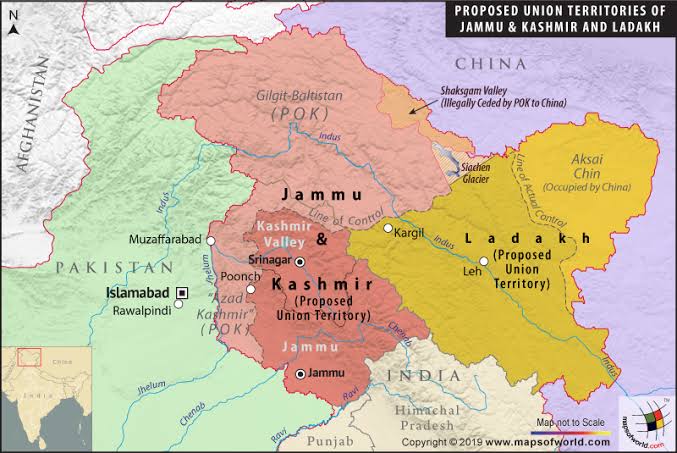
Jammu and Kashmir was a princely state during the colonial rule. This area of 2,22,441 square kilometres is now Jammu and Kashmir and Ladakh (parts of India), Azad Jammu and Kashmir and Gilgit-Baltistan (under the control of Pakistan), and Xinjiang and Tibet (administered by China). 

Religious History 

Jammu and Kashmir is rich in terms of its religious history. It is associated with Buddhism, Shaivism (now a part of Hinduism) and Islam, three of the majorly followed religions in the world. At first, Hinduism was popularly followed in this area. However, when Ashoka assumed the throne of this kingdom, Buddhism was introduced here. Under his reign, grand stupas as well as temples dedicated to Lord Shiva were built, which shows harmonious existence of the two religions. It was through Kashmiri Buddhist missionaries that Buddhism became widely followed in Tibet and known in China. The corruption, heavy taxation and constant fighting under the Lohara dynasty gave way to foreign invasions. A Tibetan Buddhist took the throne from a Turkish-Mongol chief and, due to political reasons, converted into Islam.

Eventually, Islam replaced Hinduism as the dominant religion in Kashmir. Rulers of Jammu and Kashmir treated all of their subjects equally, irrespective of the religion they followed, with the exception of a few who imposed taxes on the non-Muslims and favoured the ones who followed Islam. 

After Mughal rule in Kashmir, Sikhs took over. Initially, their rule was oppressive and they introduced many anti-Muslim measures but later, the Sikh rulers became more considerate towards farmers. The status of Muslim subjects did not change. 

Today, it is a home of multiple religions with Buddhism, Islam, Sikhism and Hinduism still dominating the area. 

British Raj and Independence 

The Sikh ruler of Jammu and Kashmir, Gulab Singh, won the trust of British and sided with them. The loyalty of the Sikhs proved favourable for the British, especially during the revolt of 1857. However, the Princely state never became a true state because its residents did not connect with each other or the rulers. When the colonial rule ended, the British left the decision of whether the Princely States should unite with India or Pakistan, or become independent states with the rulers of these states. This threatened the existence of the already-partitioned country. 

Maharaja Hari Singh, the monarch of J&K at the time, was yet to make a decision regarding accession of Jammu and Kashmir. When invaded by Pakistan, J&K needed the help of the Indian army to defend themselves. The Maharaja had to sign the Instrument of Accession to get assistance from India with special conditions. These conditions were translated into Article 370 which gave special status to the state. 

However, Article 370 was removed from the Indian Constitution in 2019. Further, the state has been divided into Jammu & Kashmir and Ladakh which are now recognised as union territories. 

Japan:a country to live in

Japan, one of the world’s most literate and technically advanced nations, is an East Asian archipelago country made up of four primary islands and more than 6,800 others. While most of Japan is covered by mountains and heavily wooded areas, the country’s people lead a distinctly urban lifestyle. Long culturally influenced by its neighbors, today the country blends its ancient traditions with aspects of Western life.

The land that brought you sushi, bonsai, and the bright lights of Tokyo is ripe with fascinating tidbits. 
Japan consists of 6,852 islands. The islands were originally attached to the eastern coast of Asia, until tectonic activity caused them to split off, creating the Sea of Japan around 15 million years ago.

Japan has the third longest life expectancy in the world with men living to 81 years old and women living to almost 88 years old. The Japanese live on average four years longer than Americans.
Japan has a ‘suicide forest’. Called ‘the perfect place to die’, the Aokigahara forest has the unfortunate distinction of the world’s second most popular place to take one’s life. (The first is the Golden Gate Bridge).Japan has more than 3,000 McDonald’s restaurants, the largest number in any country outside the U.S.
Japanese trains are among the world’s most punctual: their average delay is just 18 seconds!

The Japanese survivor of the Titanic was called a coward in his country for not dying with the other passengers.
Japan has just 2 gun-related homicides per year on average. Japan feels very safe in general. They say you could leave your wallet on the floor of the busiest metro station and come back an hour later to still find it there.

Over two billion manga, Japanese comic books or graphic novels, are sold in Japan each year.Japan has 5.52 million vending machines offering anything from soda to sex toys and live crabs.Ronald McDonald is called Donald McDonald in Japan due to a lack of a clear ‘R’ sound in Japanese.


Traditional Japanese rooms are tiled with Tatami, or mats made with rice straw. A mat’s length is always twice its width, and its size is standardized depending on the region. For that reason, room size is often indicated by the number of mats needed to cover the space.The kimono is a traditional Japanese garment worn by both men and women. It consists of a long robe-like dress that is wrapped around the body, with the left side always covering the right. The obi is the belt that keeps the kimono secure. A single kimono can cost over $10,000.

Tokyo is the second most expensive city in the world to live in.Japan is truly unique if you want to experience.

Now bollywood is full of nepotism

Bollywood, an industry that has taken India to an entirely new level and has given us moments to be proud of, seems to have come to a standstill with lack of novelty, almost 100 years later since its origin. Gone are the days when actors were known to be artists, their aura served as a light to many and their art was not only a source of entertainment but an inspiration to many. It was many decades ago when no ‘Kapoors’, ‘Khans’ or ‘Bhatts’ used to rule Bollywood, the fact that performance and stardom used to walk hand-in-hand is no more completely valid these days. While ‘Kapoors’ are known to be the flag bearers of nepotism, almost every second actor in the Indian film industry is the flag bearer of families which have produced some of the greatest actors, ironical is the fact that these flag bearers are not born actors.

Nepotism is an act of favoritism in appointing or giving an opportunity to work in various fields of human endeavor including politics, economics, etc. The origin of the term “nepotism” can be traced to the Catholic bishops who would bequeath wealth, property, and priesthood to their nephews. The nephews were usually their illegitimate offspring, and this was a way by which the clergy could own property and retain power within their families. Nepotism is as rampant as any other bad facet of the society but due to its covert nature and as almost everybody engages in it, it is never talked about.

India and other third world countries face the issue of nepotism in every field and it is a major cause and effect of every other issue such as populism, corruption, etc.

We saw the seeds of nepotism easily sprouting in Bollywood. Actors with pure talent are sidelined due to first priorities given to recommendations. And the worst part is, if an outsider tries to raise his voice, he is slammed, cursed and denoted a wannabe seeking attention.

The unfortunate suicide of Sushant Singh Rajput, a promising and talented actor from Bollywood, brought the issue of nepotism in the public debate. It is alleged that Sushant committed suicide due to rampant nepotism in Bollywood and the inability to handle the unspoken boycott by the big and mighty from the Bollywood industry. The social media, especially, raised its voice against the nepotism in Bollywood and sad end to a very promising career. Nepotism is a concept that engulfs almost all sectors of society. We shall understand its socio-economic origins, its all-pervasive nature, and multiple impacts in this article.

Nepotism or not, star kids have always been a part of Bollywood. Some of those who made an entry riding on family names made a quick exit, while others like Alia, Ranbir Kapoor, Varun Dhawan, Kareena Kapoor, Kajol, Hritik Roshan, Jahnvi Kapoor have carved a niche for themselves without depending on their star parents.

Kangana Ranaut appeared on a channel where she spoke about the prevalent culture of nepotism in Bollywood and how that resulted in Sushant Singh Rajput’s death. The conversation around nepotism was first ignited by Ranaut on Karan Johar’s chat show Koffee with Karan in 2017, where she called the filmmaker the ‘flag-bearer of nepotism’.

Why do scars never Fade?

Our body is strong. But everything has a stage, where it just can’t. This is when bruises and scars form. When our body tries to heal itself.But how exactly does our body heal itself….?

Image by <a href=”https://pixabay.com/users/Hans-2/?utm_source=link-attribution&amp;utm_medium=referral&amp;utm_campaign=image&amp;utm_content=474279″>Hans Braxmeier</a> from <a href=”https://pixabay.com/?utm_source=link-attribution&amp;utm_medium=referral&amp;utm_campaign=image&amp;utm_content=474279″>Pixabay</a&gt;

  •  The Healing process

 Now, your skin consists of some hardened cells which are called keratinocytes. These are the cells which shed constantly. In fact it is said that throughout your life, you shed about 18 kgs of skin cells! Now, imagine that you’ve gotten  a wound. Let’s say it was pretty deep. What’s the first thing you notice? Well, bleeding of course. The first stage through which your body recognises that you’ve been hurt is hemostasis. Hemostasis is our body’ s response from losing blood and the epidermis being compromised.Your blood vessels start to shrink themselves from further bleeding. This process is also known as vasoconstriction. The fibrin starts to make the cross link patterns,  also making the germs  not enter  the inside of the body .Hemostasis basically  means stopping the flow  of blood. The second step is inflammation. Now the wound may redden, swell up or hurt. This can vary from  person to another, maybe due to the difference in genetics of the cells. During this process, WBCs come towards the wound, killing the germs or pathogens which may have entered while the wound was still open. It also eats up the damaged tissue. This  process has a name. It is called Phagocytosis. As the WBCs travel through the bloodstream to reach the site of injury,the the ,the shrunken blood vessels, now expand a bit. After some point of time, the proliferative stage- where the fibroblasts come into the scene. These fibroblasts are the one which produce collagen. Collagen is a protein which is a primary tissue. These usually form a certain kind of  pattern. But, immediate cure is needed when you are wounded. They are deposited as soon as possible. They initially replace the work of the fibrin. Slowly, but steadily,the epidermis layer closes. The hardened RBCs get peeled off in due course of time. It is believed that  the skin is never fully recovered. In some minor cases, the scar eventually fades and works normally, but when the wound is severe, meaning the wound makes  contact with the dermis(the second layer of the skin) then , maybe it leaves a dark line or a pale mark. In the most severe cases, for example, the major burn cases, the skin never quite recovers. Sure it retains its sensory 

properties ,but the skin no longer remains the same. 

This is why you must have noticed, wherever there is a scar, there grows no hair. 

  • Types Of Scars

There is a differentiation between scars as well. Basically, there are 4 types of scars.Let’s see them!

  1. Keloids-  When you get a wound, and the scar formed is bigger than your actual injury, then that scar would be termed as keloid scar. These are usually due something called the ‘overproduction of cells’, according to a site. These are usually treated with surgeries, laser treatments etc. This scar is more common with the darker skin tones.
  2. Hypertrophic scars- When you get an injury ,and the affected skin rises above or swells, this red scar is named as ‘Hypertrophic scars. 
  3. Contracture scars- These type  scars occur after a burn. They include tightening of skin and sometimes, the scars may even go into the nerves or muscles.
  4. Acne scars- Many acnes leaves scar. These scars can sometimes be quite deep, but not usually.
  • Difference Between bruise and scar

When you hit something, one says that it will leave a bruise. The bruise turns purple due to lack of oxygen. A bruise is never permanent and eventually fades away. Bruises are more common than scars.

When one experiences severe wounds, usually tending to bleed excessively, this usually leads to a scar. Scars may or may not be permanent. A deep injury may gradually heal but rarely fades away and is usually permanent.

Scientists  fully do not know how exactly our body heals itself. Various researchers are working hard to break the code on how and what processes does our body use to heal itself. In fact we don’t even know how a deer is able to completely heal itself from the most severe scars completely whereas a human being is not. The mysteries are endless. We haven’t even cracked ⅓ of the nature’s  pecicular happening , but do not worry, the day will come soon!

Many people think that scars are not pleasurable. But let me tell, there are people out there suffering with diseases which include the body losing its property to heal and regenerate itself. Even a small bleeding does not stop. Scars define how strong your body is to heal it so efficiently. Never be ashamed of your scars. Because they are a part of you. And you never neglect a part of you. Be proud that you survived that injury. A scar speaks for itself. Even if the scar was due to some silly mistake. None of us are Harry Potter to have a deep reason behind a scar and that scar will always be pretty( though one can dream right?).

Changing trends of marketing

The marketing is being practiced by the businesses since the business have evolved. The increase in competition also increase the need of marketing to make your business survive in the competitive era. A good marketing strategy is an important ingredient for the recipe of your successful business. A business has to change with time the marketing tools and strategies are not evergreen because the interest of your target audience is dynamic the eyeballs of your target customers keep shifting from one platform to another from TV to social media and from Google to Gmail. So if you are a marketer it is very important for you to be updated with latest marketing trends that fits your business domain

Previously only advertising was considered as marketing even today some small business consider advertising and marketing as one thing but marketing is lot more than advertising collection of data , product development, understanding consumer behaviour, making sales strategy, public relations management, and many more aspects which connects the business and customer, comes under the scope of marketing. Earlier door to door sales were in trend but today everything is online you place the order and it’s delivered. Today if a company do door to door sales it have a negative impact on brand equity.

When it comes to change in marketing trends the most important thing is Digital marketing. It is the future of marketing it is more dynamic like interest of people, narrow targeting is possible, calculation of ROI is very easy least expensive and most effective. Couple of decades back marketing was to find your customers and often marketers wasted their time and energy on a wrong customer but with the help of technology we can target a very specific audience which is our target audience so the major problem of searching target audience base is sorted here only next step is to penetrate it with a great strategy to build trust for the brand and get maximum conversions.

Critical Security Studies

Any analysis on Security Studies first and foremost requires one to understand what the term ‘security’ entails. This, however, is not an easy task. As scholars like Ken Booth pointed out, this is because Security is a Derivative concept. This implies that one’s understanding of the term is derived from their political outlook and philosophical worldview. Hence, even within the same community, different conceptions of security may exist. In this sense, the process becomes political in nature.

In 1991, Ken Booth gave a minimalist definition of security i.e. security as the absence of threat. This may further be questioned as to what all can be termed as a ‘threat’ is it only physical in nature? Or are other factors involved? This is where Critical Security Studies (CSS) differs from Traditional Security Studies.

The foundations of Security Studies are based on the Traditionalist understanding also known as the Realist approach. This follows a Top-Down strategy that focuses inherently on state-centrism. The problem that CSS notes with this is that it tends to overlook the potential of human agency as it gets marginalized or is rendered absolutely invisible in such an approach. It reflects and constitutes a state dominated field with the belief that liberty can only be achieved through military force. Therefore, CSS deem it as narrow in nature and entirely masculinist as it overlooks aspects of gender inequality, wartime rape, trafficking and among other aspects. They also criticize the traditionalist approach for being Eurocentric in its nature and scope.

As aforementioned, Security is a derivative concept and the process is political in nature. Ken Booth also highlighted that Security has 1) an instrumental value. It provides the freedom to do something other than security from threat. 2) it is a process rather than an end point. That is to say that it enables the possibility of finding ways of coexistence without depriving others of their life chances. Being a pioneer of this approach Booth called for the rethinking of security as Emancipation. One of the first and foremost aspects that he recognized was that security is what we make of it. It is created inter-subjectively and it is possible to expand international security studies and still remain within an asserted neo-realist framework and approach.

A key idea of CSS is Emancipation. Booth identifies Emancipation as freeing of people from physical and human constraints which stop them from carrying out what they would freely choose to do. For him, it is emancipation that produces true security. Security and emancipation are therefore identified as two sides of the same coin. This understanding helps to gauge that the relationship between critical theory and security is crucial to CSS. This enables 1) Broadening i.e. includes a range of issues beyond military force. 2) Deepening i.e. connects our understanding of security to deeply rooted assumptions about political life. 3) Extending i.e. recognizes a multiplicity of issues and actors. 4) Focusing i.e. it has a normative goal in the form of Human Emancipation of security studies.

CSS does have its own share of limitations but it also has inherent potentialities. It attempts to offer a way to change the traditional global security narrative. Its focus is on the development of human potential.

The Bandung Initiative

The first Asian-African Conference, or more popularly known as the Bandung Conference, was held in Bandung, Indonesia in April 1955. It brought together the newly independent countries of Asia and Africa to discuss a range of issues.

Bandung was the initial stage of a Third World movement of newly independent countries that sought to move on from their colonial histories by using the State as means to freedom, self-determination and modernization that would unite its citizens and carry them towards development. This was argued to be the essence of the ‘Bandung Spirit’. The heyday of this Third World-ism was the period from 1955 to 1975 and the call for a New International Economic Order (NIEO) by the developing world was an integral part of the Bandung Era.

Scholars of International Relations [IR] have argued that the Bandung Conference sowed the seeds for re-envisioning international society in two significant ways. Bandung’s call for equitable representation in international decision-making for the new members was marked by international justice principles, particularly that of procedural justice, in the management of international affairs. Bandung participants also articulated an alternative set of principles for inter-state engagement that emphasized dialogue and accommodation, collective and peaceful problem-solving, and the search for consensus or compromise.

By the late 1940s, the Afro-Asian movement’s specific aim had already become clearly defined, which was to speed up decolonization and achieve independence for the colonies. Although these objectives formed the basis for the Bandung Conference, the immediate focus at Bandung was that of peaceful co-existence in the broader society of states, especially between the communist and non-communist worlds. And more broadly there was the need felt for association and brotherhood amid an unfolding Cold War.

Although the 1955 Bandung Conference had been divided into three committees i.e. political, economic and cultural, it was politics that took centre-stage. But the emphasis on political matters notwithstanding, economics also was of some importance. A 12-point Economic Cooperation agenda was issued as part of the Final Communique. The economic agenda was non-controversial. The participating countries affirmed the importance of economic cooperation with states outside the region, and the value of foreign investment for their countries.

The Bandung participants endorsed the rights of governments to freely choose their own political and economic systems. But Bandung and its successor saw the independence of individual states as the primary medium to achieve freedom, development and modernization for their peoples.

The Bandung Conference did not directly address justice and fairness in substantive economic matters, but its emphasis on equitable participation and representation in international decision-making implied a concern with matters of procedural justice. The Bandung participants were not only attempting to create a more hospitable international arena for themselves but were also attempting to enhance their ability to meaningfully participate in world affairs. The core premise of Bandung was based on the belief that if IR focused on dialogue and diplomacy, there would offer far greater chances for post-colonial states to engage in world affairs than a world based on confrontation, power politics, and the use of force. Bandung’s legacy might be its emphasis on deliberative politics.

Reference- https://www.rsis.edu.sg/wp-content/uploads/rsis-pubs/WP95.pdf

Food : The Life Preserver

Article by – Shishir Tripathi
Intern at Hariyali Foundation
In collaboration with
Educational News

When an individual studies economics during the higher studies, they are told about different types of goods including the normal goods, inferior goods, luxurious goods and the essential goods. Energy is required by every organism to survive on the planet earth. Energy is gained in various forms like heat energy from consuming food. Whether a person is rich or poor, tall or short, fat or skinny, or just any other person and all other organisms need food and making it as an essential commodity required by all.


After a tiring day at the office, after an exhausting day with scorching sun on the farm, after a day with extra classes in the school, after a day with endless house chores, every other person of different age groups performing different roles in the economy need food at the end of the day. A Thali with 2 Chapattis and veggie, some pulse and rice will make the day of such an individual after a tiring day.


Fine, but the question arises that whether the availability of food is there for every person in the country? Is there any family or a person who sleeps without food? Does every family which is affording food is using it for filling their tummies or a part of food is wasted too in a country like India? Let’s move ahead to get answers to these questions.


India has been placed at 103 out of 119 countries surveyed for the World Global Hunger Index (GHI) by two credible international NGOs based on the indicators of undernourishment and under-5 child wasting, child stunting and child mortality. Its score is 31.1 in the GHI, among the worst in the world, and below close neighbourers Bangladesh and Nepal in the SAARC region.


At least 20 crore Indians go to bed hungry daily.


Yes, a country with a lot of resources, vegetation, a country which is amongst the biggest exporters of food grains faces the problem of hunger for its 20 – 25 million population. A person who didn’t had food for days from him; one can understand that what pain is. When one takes a fast, they know that how body agonizes without water and food for the whole day. So staying hungry for days is so bad and tremendous.


According to a Report, India wastes INR 244 Crore worth of Food per Day. At the same time, one should notice that approximately 20 million people go hungry in nation where food is wasted in such a high quantity every day. In every Indian wedding, food is the most important part and the most wasted too! In India, statistics related to food wastage at weddings have been quite shocking, given the fact that it is the same country where countless number of people have to survive without the basic necessity of two meals a day. Around 100,000 weddings and social events are held in India every day. Food wasted each day at weddings and family functions in the metro cities alone would be enough to feed the vast slum population sleeping hungry at night without food. About one-fifth of the food served at weddings and social gatherings is discarded. The prodigious waste that follows has horrified many in a country where food prices are skyrocketing and tens of millions of young children are malnourished.


About 58 per cent of people in the country are food insecure, says the findings of the National Nutritional Survey (NNS) 2011. The country has enough food to feed its people but that poor cannot afford even two-square meals a day.


No government scheme will work unless and until the people who have food on their table will realize the actual demand of food from their stomach and their tongue. Those who fill their bellies till esophagus at the table or the silly ones who just don’t know that what food they like and waste a whole plate at the function, they must try to know the importance of food and stop wasting it.

Stop food wastage, give it to a hungry person and the be the reason for someone’s filled tummy.

face.

Find happiness in little things!..

In a small village, there lived a family of a farmer. The farmer had two kids, a boy named Gana and a girl Meena. Both mother and father used to go to farm daily for work. Gana and Meena used to go to school at that time. Their school was handled by an NGO which offered quality education to the unprivileged children. Both the kids used to study well. The younger one Meena always had a fascination towards the mall. She used to watch it in the cinemas and had a great fantasy about it. They never got a chance to visit the city, so they never saw a mall which added into their fantasy. Meena used to always talk about the mall. The shops, the lighting, the food courts, Meena was fascinated by all this. She always asked Gana to take her to the mall. Gana loved his sister very much. But he also knew their financial condition, so he kept on avoiding her demand. But secretly he was saving some money every day so that he could take her to the mall one day.
Few days passed and now Gana had enough amount of money to buy and eat something from the mall. But he didn’t tell anything to Meena. All the farmers of the village used to sell their vegetables in the city. Then one day, they got an order from Jordan mall of the city. When Meena got to know about it, she rushed towards her brother and pleaded him to take her to the mall. Firstly he acts like resisting but later agreed to take her to the city. Both Gana and Meena went with the truck to the mall. They only had time until they unload the vegetables and receive the payment. When Meena reached the mall, she was very happy. She was literally dancing with joy. Gana also felt good watching her happy. The lighting, the shops, everything made them feel that they’ve come to a different world. Meena they took him to a garments shop. But by looking at their cloth, the shopkeeper didn’t allow them to come in. This thing happened with a few more shops. Both Gana and Meena felt very bad. Then finally one shopkeeper allowed them to come in. Meena purchased a dress for her there. She was looking pretty in the new dress. Now after wandering over the mall, both of them were very hungry. So they went to the food court and ordered a burger and pizza to eat. They were eating it for the first time in their lives. Till then, they didn’t even know that a food item costs this much. When they had their first bite, they hated it totally. Both of them missed their mommy made roti chatni badly. By the time they could finish it, driver uncle called them back. Now it was time to return.
They were travelling back home. Gana was trying to talk to Meena, but she wasn’t speaking much. Gana got that she must be thinking something. When they got home, Gana made her sit and asked her what happened. She hugged him and said,” Sorry Bhaiyya! I unnecessarily forced you to take me to the mall”. It looked so fascinating on the TV but it wasn’t in reality. Shopkeepers there looked at us with hatred. They didn’t even allow us to come in. They asked for money before we buy to eat anything. It made me feel so bad and poor. Our world is way better than the mall world. Here, shopkeeper chacha takes me to his shop, make me select whichever dress I want and don’t even ask for money, cause he believe us that we’ll pay for sure. The hotel owner uncle let me eat my favourite dishes. When I return, he hands over chocolates to me, each time. He also never asked for money. I always felt like a family there. But when I went to the mall, I got to know this side of the world. Our world is the happiest Bhaiyaa, I’m very much happy here, she said. Listening to her words, tears rolled down by Gana’s cheeks.

Public and Private Administration

These are a few terms we have familiarized in the past years. Administration means ‘to administer’ , derived from a Latin word ‘ad’ and ‘ministrare’, it means to serve or manage. We all do know the difference in the meaning of Public and Private.

Administration came as a activity from the times of men and women but as a discipline it emerged only a century and decade ago. In order to live together harmoniously there was a need for a system of control and rules. A leader was much needed to make amendments and negotiations.

As this became a discipline there was a need to categorize it and so the two broad categories of Public and Private administration emerged.

Public Administration can be briefly said as implementation of public policy, as laid down by a competent authority, economically and efficiently for the benefit of the people.

Private Administration refers to the implementation of policy and management of private property or administration.

The following are the similarities between Private and Public Administration

  • Skills

No matter which sector you work for, private or public the usage of your skill is the same. The skills and techniques adopted by both the sector are the same. The work of an engineer or a teacher is the same in both private and public sector.

  • Influence

There has been a profound influence on each other. Public corporations are set up as an idea to import the private administration into it. Likewise big and private firms have taken up policies like welfare and insurance too.

  • Administrative set up

The administrative set up is the same for both the administration. There is a certain level of hierarchy existing in both. And people are recognized according to it. The work is divided on this basis of this structure.

  • Public Relations

Both of the administrations make sure to have contact with the masses. Even though private administration work on their self-interest, they work according to the needs of the people too. Public administration is for the people. Many private industries are taken up by the government too and vice versa. This proves the how much alike they are.

  • Research and Improvement

No matter how far both the industries have come, they always improve and make alternative changes. They constantly try to bring innovations and changes according to time.

Differences between Public and Private Administration.

  • Prestige

Prestige for public administration is very much important. Public administration works for the people and what people think about the government is very Important for them and hence there are a wide range of opportunities available to the public.

  • Political direction

Sometimes public administration is pushed according to the party’s needs. There is can be a bias due to the influence of a particular party, after all it’s the party which wins the election.

  • Profit motive

Private administration run on the basis of profit and their own self- interest, while public administration is for public welfare. There is no other motive like private administration, their duty is to serve people.

  • Uniformity of treatment

Public administration is bound by certain laws and regulations, there is equality of treatment for everyone, No one is treated indifferently. But the same cannot be said for private administration, there is a chance of personal bias in it.

  • Monopolistic

Some services of the public administration are monopolistic, the government does not allow a second party to invest or make business out of it, this is done for the welfare of the people of the nation.

  • Responsibility to Public

Public administration is made for the people and so it is accountable to the law and its people. It owes a certain amount of responsibility to the government.

These are the similarities and differences of private and public administration. Both of these are necessary for a nation of succeed

TIGERTAIL (2020) MOVIE REVIEW

Tigertail (2020) is about a young Taiwanese man, Pin-Jui (Tzi Ma) who leaves his homeland and the woman he loves to look for better opportunities in America. Many years of monotonous work and a marriage devoid of any love affect him deeply. He isn’t able to sympathise with his daughter and he must reconnect with his past in order to finally build a life that he always dreamed of having.


I loved this movie. After watching a lot of heavy and intense films this week, Tigertail was a warm and breezy peek into the life of this lonely man. All of you would relate to him a little bit. Alan Yang who’s the co creator of Master of None, and Parks and Recreation has crafted a poignant tale about love, regret and passion. A lot of it is based on his father’s experience of adjusting in America after moving from Taiwan.


The writing is what you’d expect from him, it’s sharp, and I loved the mellow and soft atmosphere that he’s gone for. The pacing is meditative and it’s perfect, it hits you right in the feels and gives you time to process what you’re seeing. The meditativeness also creates a soothing mood perfectly.


I loved Tzi Ma in The Farewell and here also he’s given a brilliant performance. He plays this stern but soft man. Alan Yang has told the story from an empathetic lens, so you empathise with him and you understand why he is the way he is.


A few nitpicks I had are that some characters aren’t that well fleshed out, and the script       does seem a LITTLE undercooked at some places.


Apart from these minor nitpicks, Tigertail is a brilliant movie that I thoroughly enjoyed. Do check it out if you want to watch something light and breezy.

CLASSIC MOVIE RECOMMENDATION – ELEVATOR TO THE GALLOWS (1958)

Elevator to the Gallows (Ascenseur pour l’échafaud) (1958) is about Julien Tavernier (Maurice Ronet) who kills his lover, Florence’s(Jeanne Moreau) husband in his office because Julien plans on eloping with her, but while he’s leaving the office building he gets stuck in the elevator. While he’s stuck, his car is stolen by two juvenile delinquents. All this starts a chain of events that may turn out to be bad for Julien and Florence.

I loved the writing, it checks all the boxes for crafting a film noir. The script is very well measured, no detail is wasted. All the little plot details thrown throughout are tied together really smartly. Louis Malle has used mostly natural lighting, setting a new example for French cinema during that period. One remarkable scene is this stunning sequence in which Jeanne Morreau is walking around rainy Paris at night searching for Julien. Her face is lit by the street lamps. French films used a lot of artificial lighting to light up their actors, so this usage of natural light was new for that time.

Miles Davis’ incredible jazzy score creates a lonely and gloomy atmosphere. Henri Decai’s cinematography is bleak and his camera work sucks you in. This film is directed by the legend, Louis Malle and I was surprised to discover that this was his first feature. The way he’s told a noirish story with some elements of the French New Wave is outstanding. We can see the influence of Hitchcock and Welles in this, but he’s still managed to keep it very unique.

Elevator to the Gallows is a stylish noir that gave the French New Wave a head start and it’s one of the most influential films ever made. It’s perfect, go check it out.