Figuring out what Ideology is, when understanding these Marxist terminology, it’s important to look at these ideas not as obsolete reality but an ever evolving pervasive concept. Karl Marx, has his own definition of Ideology as ideas and beliefs set out by the dominant class of a society for everyone to obey and thus justify the actions of the dominant class in any society. Here, Louis Althusser sets out with his own interpretation and has worked in “On The Reproduction Of Capitalism: Ideology And Ideological State Apparatuses”, that; i) Ideology has no history, it is eternal; ii) Ideology represents the imaginary relationship of individuals to their real conditions of existence; iii) Ideology has a material (or spiritual) existence; iv) Ideology interpellates individuals as subjects. The four of these points become a pinnacle to what Althusser insists in the nature of Ideology.
These 4 parameters help us understand its nature, to what Ideology represents, for when man entered the state of nature, by subscribing to ideas and beliefs, we subscribed to this ideology, which though speaks of, no history in itself, it’s still is an implicit force that drives the Capitalistic existence, although omnipresent. And leading on to the second point, that “men represent their real conditions of existence to themselves in an imaginary form”. Who one is, is just another fragmented idea of you, which Lacan also states in the Mirror Stage and this is crucial in the understanding of this idea as well, that ideology works within multiplicity of narratives, conscious or unconscious, that shapes or has the ability to shape one’s identity. When the material existence of ideology is brought up, it is the material practices, ritual, and action that works under Ideology, unsuspecting and yet controlling one within their grasp. And lastly, Althusser believes, ideology interpellates individuals as subjects – their subjection to the category of subjects. There is no ideology except by the subject and for subjects, which by working seamlessly and weaving thoroughly over the three previous paradigms to concreticise the concept of ideology.
One could say, Althusser’s insight about the “social unconscious” when it comes to assessing the concrete political realities and struggles, is thus become not just another crucial point to define and understand Ideology, but in itself a very significant negotiation of the concept of ideology in itself.
Average is sum of all observations upon number of observation. For eg. Kripa had monthly salary of 20000 and krishna of 40000. There average would be 40000+20000 i.e. sum 60000 upon 2. Answer is 30000. In this question there were 2 observation.
some basic formulas
Sum of first n natural no. = n(n+1)/2
Sum of first n odd no. = n square
Sum of first n even no.= n(n+1)
sum of square of first n natural no. = n(n+1)(2n+1)/6
sum of cube of first n natural no= (n(n+1/2))whole square
If n is odd: The average of n consecutive numbers, consecutive even numbers or consecutive odd numbers is always the middle number.
If n is even: The average of n consecutive numbers, consecutive even numbers or consecutive odd numbers is always the average of the middle two numbers.
When two groups of Parts or objects are combined together, then we can talk of the average of the entire group. However, if we know only the average of the two groups individually, we cannot find out the average of the combined group of objects.
Ex: The average of 6 consecutive even number is 21. Find the largest number? Largest no. = A + (n−1) A = average n = no. of terms Largest no. = 21 + ( 6 -1) = 26
Ex: The average of 5 consecutive even number is 46. Find the smallest number? Smallest no. = A – (n – 1) A = average n = no. of terms Smallest no. = 46 -( 5 -1) = 42
Ex: The average of 6 consecutive odd number is 22. Find the smallest number?Smallest no. = A – (n – 1) A = average n = no. of terms Smallest no. = 22 – ( 6 – 1) = 17
The Google every knows about Google, it gives us access to almost all information by typing what you want to know into the search bar. There are some interesting secrets you can have enjoy.
Then why are u waitimg just go with my steps ,
Go with,you have type the phrase “Do a barrel roll” into the search bar of Google and press enter, the entire page spin around once.
Second is a fun trick if you like Chuck Norris jokes. If you type in ‘Find Chuck Norris’ and click ‘I’m feeling lucky’, you will get a little message from Google about being careful what you search for.
Next, and this is one of my favourites, try typing ‘Google Gravity’ into the search bar on Google and pressing search. It will cause the entire page to fall into pieces. Although sometimes this doesn’t work, if you search it and click the first result on the page, it will take you back to the homepage which will then fall. The best part is that you can still search for things even after it has taken effect. It will, however, cause all of the results to fall from the sky and crash down on top of the already fallen homepage.
Finally, my favourite. Type ‘Zerg Rush’ into the search bar and hit enter. This will cause many ‘o’s to appear from all directions! But beware, they are not your friends. You must hover over each of the ‘o’s with your cursor and click like crazy. Soon they will vanish. Attempt this at your own peril, you have been warned.
So there you have it, a few cool things to do with Google when you’re bored. Of course, there are far more tricks to do with Google, but you can always find them by, you know, googling it. A little extra for reading this far: if you leave the search bar blank and click ‘I’m Feeling Lucky’, you’ll be shown all of the Google doodles that have ever been used on special dates.
Here are way more tricks you can do on google.
Do a Barrel Roll. Search for “do a barrel roll” without the quotes, and hold onto your desk for dear life. …
“As I rained blows upon him, I realized there had to be another way!” It’s a Festivus MIIIRACLE! …
There is no perfect person in the world, but the most holy and supreme person has his shortcomings, but I believe that everyone is born innocent, because of course you can’t make mistakes in your childhood. But I think people are not really good or bad or both.
Not all people are good people. No matter how hard you try, everyone has their own shortcomings. I also feel bad about people.
The mistakes they make will anger God; therefore human beings are both. People are bad because someone has to do some naughty or bad things in their lives. No one can be so good, because I believe that if you think you are a good person, you should not do anything at all. Lock yourself in the room. people are bad mainly because of temptation. We have all done some non-model things, sometimes without even realizing it.At some point we are all bad people, but most people are not bad, just like everyone goes to jail, so we keep our balance. So we have good and bad. We have holy days and bad days.
We are not perfect people. When we start to think for ourselves and know what is happening, we will do this to ourselves. Our environment, except when we were young, they told us what to do, and now we can control our lives. Our daily decisions make us who we are today.
Sometimes we can be good, sometimes we can be bad. He mentioned in his sermon that God loves everyone, no matter what. Whether you are good or bad, as long as you are willing to give, God will always find in his heart to forgive your sins.
A computer virus is a piece of software that can “infect” other programs by modifying them; The modification includes injecting the original program with a routine to make copies of the virus program, which can then go on to infect other programs. A virus can do anything that other programs do. The difference is that a virus attaches itself to another program and executes secretly when the host program is run.
The terminology in this area presents problems because of a lack of universal agreement on all of the terms and because some of the categories overlap. Malicious software can be divided into two categories: those that need a host program, and those that are independent.
Need a host program : The former, referred to as parasitic, are essentially fragments of programs that cannot exist independently of some actual application program, utility, or system program. Examples: Viruses, logic bombs, and backdoors
Independent malware is a self-contained program that can be scheduled and run by the operating system. Examples : Worms and bot programs
Backdoor or Trapdoor
A backdoor, also known as a trapdoor, is a secret entry point into a program that allows someone who is aware of the backdoor to gain access without going through the usual security access procedures. Programmers have used backdoors legitimately for many years to debug and test programs; such a backdoor is called a maintenance hook. It Has been commonly used by developers. A threat when left in production programs allowing exploited by attackers. It is very hard to block in O/S. It requires good s/w development & update.
Logic Bomb
It is one of oldest types of malicious software. The code is embedded in legitimate program. It is activated when specified conditions met Eg presence/absence of some file Particular date/time Particular user When it is triggered it typically damages system, Modify/delete files/disks, halt machine, etc.
Trojan Horse
A Trojan horse is a useful, or apparently useful, program or command procedure containing hidden code that, when invoked, performs some unwanted or harmful function. Trojan horse programs can be used to accomplish functions indirectly that an unauthorized user could not accomplish directly, Which is usually superficially attractive. Eg game, s/w upgrade etc. When it runs performs some additional tasks. Allows attacker to indirectly gain access they do not have directly. Often used to propagate a virus/worm or install a backdoor. Another common motivation for the Trojan horse is data destruction. The program appears to be performing a useful function (e.g., a calculator program), but it may also be quietly deleting the user’s files.
Zombie
Program which secretly takes over another networked computer is called zombie. Then uses it to indirectly launch attacks. Often used to launch distributed denial of service (DDoS) attacks. Exploits known flaws in network systems.
Year after year, Google has been ranked as one of the top companies to work for, so it’s no surprise that the tech giant receives roughly three million applications per year. With an acceptance rate of 0.2%, you’d have a better chance of getting into Harvard.
It is difficult to get a job at Google because of their quality standards and the high number of applications they receive per year. For example, INC reported that Google receives 2 million job applications per year, which means it’s more competitive to get into than Harvard University.
Google is an employer of choice for the world’s top talent, typically receiving hundreds of resumes for every opening, which allows them to be extremely selective in their hiring.The hardest part is getting an interview. If you attend a university, go through campus recruiting.
According to the Pascale, The lowest paid Google employees are Entry Levels at $51,000.Google says there is no degree or prior experience required. In fact, 61% of learners enrolled do not hold a four-year degree. This certificate could be a perfect launchpad to a career in IT.
So if you have a keen interest in working at Google California or at any other branches of Google work hard my friend. More than studies work on yourselves, on your IQ level the interviewees are not going to ask you a question from your syllabus.
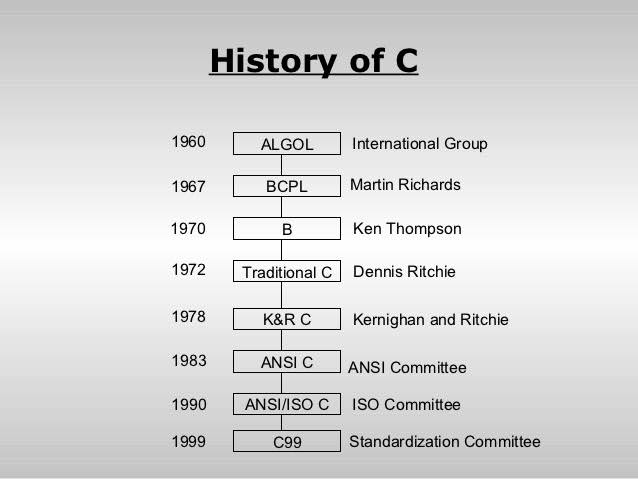
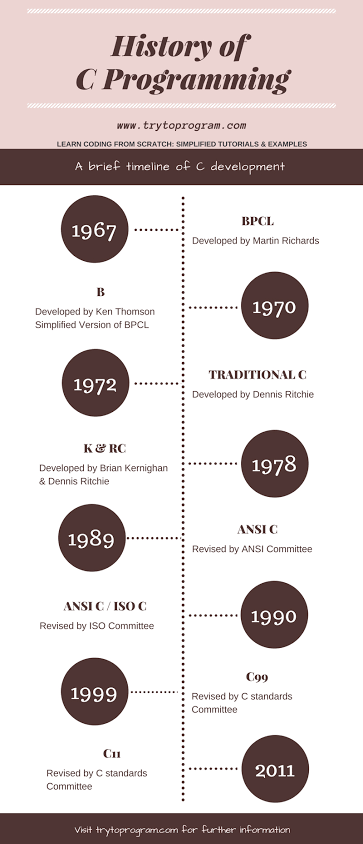
There are many programming languages in use today, one of which is C. There are many offshoots of the C programming language, including Objective-C, C++, and C#. None of these are the same language. THE BEGINNING: The C programming language came out of Bell Labs in the early 1970s. According to the Bell Labs paper The Development of the C Language by Dennis Ritchie, “The C programming language was devised in the early 1970s as a system implementation language for the nascent Unix operating system. Derived from the typeless language BCPL, it evolved a type structure; created on a tiny machine as a tool to improve a meager programming environment.” Originally, Ken Thompson, a Bell Labs employee, desired to make a programming language for the new Unix platform. Thompson modified the BCPL system language and created B. However, not many utilities were ever written in B due to its slow nature and inability to take advantage of PDP-11 features in the operating system. This led to Ritchie improving on B, and thus creating C.
The development of C was to become the basis for Unix. According to the Bell Labs paper, “By early 1973, the essentials of modern C were complete. The language and compiler were strong enough to permit us to rewrite the Unix kernel for the PDP-11 in C during the summer of the year.” This now meant that C was becoming a strong language that could, and would be, implemented across many systems. By the middle of the 1970s, the C-based Unix was used in many projects within the Bell System as well as “a small group of research-oriented industrial, academic, and government organizations outside [Bell Labs]”. In 1978, Brian Kernighan and Dennis Ritchie published The C Programming Language, which would serve as the language reference until a formal standard was adopted. Five years later, the American National Standard Institute (ANSI) formed the committee, X3J11, to establish the formal standard of C. The C standard was ratified as ANSI X3.159-1989 “Programming Language C”. This was the first formal standard of C. Currently, we are on the fourth standard of C, known as C18 as it was published in June of 2018
Over time, C began to be used in personal computers for developing software applications and other purposes. The first change (even if only a little) came when the American National Standards Institute (ANSI) formed a committee in 1983 to standardize C. After a review of the language, they modified it a little so that it was also compatible with other programs that preceded C. So the new ANSI standard came into being in 1989, and is known as ANSI C or C89. The International Organization for Standardization (ISO) has also contributed to the standardization of C. Over time, C has evolved as it has added some significant features like memory management, functions, classes and libraries to its rich feature set. C is being used in some of the biggest and most prominent projects and products in the world. C has also influenced the development of numerous languages such as AMPL, AWK, csh, C++, C–, C#, Objective-C, Bit C, D, Go, Java, JavaScript, Julia, Limbo, LPC, Perl, PHP, Pike, Processing, Python, Rust, Seed7, Vala and Verilog. USES TODAY : According to Toptal, UNIX operating systems are written in C and most of Linux is also in C. Also databases such as Oracle Database, MySQL, MS SQL Server, and PostgresSQL are at least partially written in C. C is the basis of many system kernels. Other programming languages, like Python and Perl, use compilers or interpreters that are written in C. C has changed over the years and is still a common language to use in lower level programs, like kernels. But it is also used for many applications ranging from device drivers to other programming languages’ compilers or interpreters. The language also made way for C++, Objective-C, C#, and many more C-based languages that each have their own speciality.
The Birla Institute of Technology & Science, Pilani, popularly known as BITS Pilani, was established in 1964. It is a Deemed to be University for higher education. BITS Pilani is accredited by the NAAC with ‘A’ Grade with a 3.45 CGPA. In addition, BITS Pilani is ranked among the top 10 Engineering institutes in India by India Today 2020 Ranking survey.
The campus of BITS Pilani is sprawled over an area of 328 acres and is equipped with all necessary facilities. It specifically emphasises research and development and considers it as an integral part of its higher education ecosystem. The Centre for Material Science & Technology, Embedded Controller Application Centre and Centre for Robotics and Intelligent System are a few among many research centres that are there at BITS Pilani campus.
BITS Pilani provides decent infrastructure throughout the college. Following are the key highlights:
Hostels: There are eleven hostels for boys and one hostel complex for girls.
Sports: Swimming Pool, Volleyball Court, Tennis court, etc.
Library: Library has room for up to 8,000 students, offers 738 open-access study places and 246 open-access IT work stations. As well as the books and periodicals you expect, it is home to computing facilities for students.
Other facilities: Gym, Cafeteria, Wi-Fi campus. AC Classrooms, etc.
Colonial data recorded by the census officials are more like violence, where Indians are continuously finding troubles and combusting into violence and the British officials tirelessly working on to keep peace. But in return, the census is mostly replete of the references to shared sacred spaces, mixed congregation, common goods and a general laxity and catholicity of religion. (The Historian and Indian Census , p. 63)
For instance, in the reading of ‘The Shepard’ by Ashfaq Ahmad set back the story during the 1930s and 1940s , where towards the end it describes about the communal riots as the independence for the country drew nearer. People during those time were not acceptable of the other religious identities especially when it comes to Hindus and Muslims. Instead of accepting people belonging to the other religious identity, they only tried to show off their identities over one another, which ended up creating communal violence.
So, in conclusion, the categorization of Hindu, Muslim and Sikh were all an outcome of Census, in which the British officials made religion as a fundamental category to be mapped. The Census which was conceptualized and institutionalized in India, became clear while studying the census of Punjab between 1858 and 1921. (The Historian and Indian Census , p. 45)
Hinduism was seen as a native religion of India and Islam as a foreign religion. This made the British officials to see them to be fundamentally opposite to each other and later conducted the census marking the religion as a fundamental category further leading it into the communal riots which we can see in the short story of ‘The Shepard’ in the nineteenth century.
Therefore, it was the religious identity that played a pivotal part in creating the political identities as a result of the census.So, in a way religious identity are interconnected with political character taking outline of our chief Narendra Modi starting late we can see how the religious identity expectscritical part in impacting the political character influencing the Hindu majority share portion of resident to transform into the political figure.
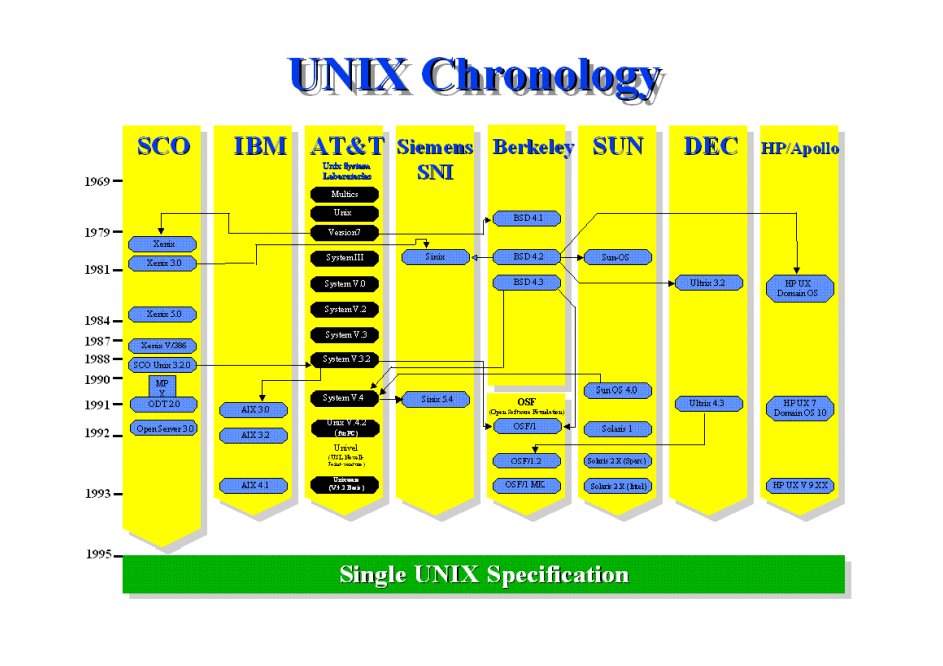
Unix is not a single operating system. It is in fact a general name given to dozens of o.s. by different companies, organizations or groups of individuals. These variants of unix are referred to as flavors. Although based on the same core set of unix commands, different flavors can have their own unique commands and features, and are designed to work with different types of h/w. Linux is often considered a unix flavor.
Among the ways in which the various flavors of UNIX differ are (1) fundamental design, (2) commands and features, (3) the hardware platform(s) (i.e., processors) for which they are intended and (4) whether they are proprietary software (i.e., commercial software) or free software (i.e., software that anyone can obtain at no cost and use for any desired purpose).
Linux : The most popular and fastest growing of all the Unix-like operating systems. It is developed by Linus Torvalds, Linux is a product that mimics the form and function of a UNIX system, but is not derived from licensed source code. Rather, it was developed independently; by a group of developers in an informal alliance on the net. A major benefit is that the source code is freely available (under the GNU copyleft), enabling the technically astute to alter and amend the system; it also means that there are many, freely available, utilities and specialist drivers available on the net. Linux is a registered trademark of Linus Torvalds. Recent versions of Glibc include much functionality from the Single UNIX Specification, Version 2 (for UNIX 98) and later.
FreeBSD : The most popular of the BSD systems (all of which are direct descendants of BSD UNIX, which was developed at the University of California at Berkeley). BSDI is an independent company that markets products derived from the Berkeley Systems Distribution (BSD), developed at the University of California at Berkeley in the 60’s and 70’s. It is the operating system of choice for many Internet service providers. It is, as with Linux, not a registered. UNIX system, though in this case there is a common code heritage if one looks far enough back in history.
IBM : IBM has been quietly working on its mainframe operating system (formerly MVS) to add open interfaces for some years. In September 1996, The Open Group announced that OS/390 had been awarded the X/Open UNIX brand, enabling IBM to identify its premier operating system to be marked UNIX 95. This is a significant event as OS/390 is the first product to guarantee conformance to the Single UNIX Specification, and therefore to carry the label UNIX 95, that is not derived from the AT&T/ SCO source code.
NetBSD : NetBSD is a free, fast, secure, and highly portable Unix-like Open Source operating system. It is available for a wide range of platforms, from large-scale servers and powerful desktop systems to handheld and embedded devices. Features the ability to run on more than 50 platforms, ranging from acorn26 to x68k
OpenBSD : The OpenBSD project produces a FREE, multi-platform 4.4BSD-based UNIX-like operating system. Our efforts emphasize portability, standardization, correctness, proactive security and integrated cryptography. As an example of the effect OpenBSD has, the popular OpenSSH software comes from OpenBSD. It May have already attained its goal of becoming the most secure of all computer operating systems.
Darwin : Darwin is an open-source Unix-like operating system first released by Apple Inc. in 2000. It is composed of code developed by Apple, as well as code derived from NeXTSTEP, BSD, Mach, and other free software projects The new version of BSD that serves as the core for the Mac OS X
Many of the proprietary flavors have been designed to run only (or mainly) on proprietary hardware sold by the same company that has developed them. Examples include:
AIX – developed by IBM for use on its mainframe computers
BSD/OS – a commercial version of BSD developed by Wind River for Intel processors
HP-UX – developed by Hewlett-Packard for its HP 9000 series of business servers
IRIX – developed by SGI for applications that use 3-D visualization and virtual reality
QNX – a real time operating system developed by QNX Software Systems primarily for use in embedded systems
Solaris – developed by Sun Microsystems for the SPARC platform and the most widely used proprietary flavor for web servers
Tru64 – developed by Compaq for the Alpha processor
China and Japan India and Byzantium traveling culture and history vector geisha and samurai men and women Taj Mahal and torii gate capitol building and Great wall landmarks and heritage nationalities.
Culture and history is the main building block of our lifes
The Culture is the characteristics and knowledge of a particular group of people, encompassing language, religion, cuisine, social habits, music and arts.
The word “culture” derives from a French term, which in turn derives from the Latin “colere,” which means to tend to the earth and grow, or cultivation and nurture
History is the study of life in society in the past, in all its aspect, in relation to present developments and future hopes. It is the story of man in time, an inquiry into the past based on evidence.
As with any scholarly approach that boasts of being “new” when it bursts onto the scene, new cultural history was fairly well established as one among many ways of thinking about history by the twenty-first century. This is not to say that new cultural historians enjoyed the unanimous esteem of their more traditional colleagues, for the field still managed to draw the fire of critics from the left and the right who believed that after twenty years this approach still represented a mere “trend.” One could agree with Peter Novick that this attests to the fragmentation of the historical profession into a plethora of specializations that no longer cohered around shared principles and whose denizens had little common ground for discussion. Yet much has changed in cultural history since its heyday in the 1980s.
When new cultural history was actually “new” it provided innovations both in terms of the topics considered worthy of historical attention and in terms of the ways of theorizing such topics within their respective contexts. It is nevertheless apparent that a good portion of what was marketed in 2000 as “cultural history” reflected more of the topical rather than theoretical innovations entailed by this approach. In fact, some of these works even read more like conventional social histories with a few obligatory nods to one of many privileged theorists.
To some extent this state of affairs reflects the success of this approach in the academy and the willingness of historians to combine methodologies in a creative and eclectic manner. On the other hand, though, one might argue that cultural history lost much of its edge by becoming subsumed into a more or less nonreflective historical establishment. Some historians see less fragmentation than the cooptation of erstwhile radical approaches back into a surprisingly resilient mainstream.
“Whatever possibilities become evident,” notes Patrick Joyce, “something is needed to shake the hold of a history which continually reproduces itself, in the process sucking the erstwhile heterodox into its consensus, in much the way that ‘cultural history’ is slowly but surely becoming routinized as more methodology, yet one more subdiscipline in the house of history.” Joyce’s observation is astute, yet one wonders whether a historical approach that could successfully resist such cooptation is possible and, even if it were, whether it would still merit the name “history.” It seems evident that what makes history “history” has little to do with methodologies and innovations that are unique to it, and perhaps a more thoroughgoing interdisciplinarity would discourage the domestication of future innovations into mere additions to the mansion of conventional history.
A job is something you simply do for the money. Usually, jobs have a small impact on future resumes because they aren’t typically related to what your career is or will be. Also, jobs usually offer less networking opportunities because your coworkers often won’t be continuing on to the same field as you in your future career.
Most jobs consist of hourly wages, are more short-term, and focus on getting a task done.
What is a career ?
A career is all about building up skills through various employment opportunities, giving you the ability to move on to higher paying and more prestigious ones. Careers provide a foundation of experiences that help fuel your professional life for many years.
Careers are more long-term and are about learning, gaining experience, building connections, and putting yourself in the right position for promotions and raises. Also, careers tend to be more salary based, as opposed to hourly based like jobs, and often include benefits such as paid time off and healthcare.
While more education is often required for a career, you don’t need to spend the rest of your life in school just to get ahead. South College offers many associate degree programs that can be completed in just two years, getting you started on your new career before you know it.
If you’re interested in finding out what your future career should be or in getting the right education to put you there, contact us today!
That’s not to say that jobs aren’t valuable. Jobs show your work ethic, which is important to future employers, and money pays the bills! Jobs can help prepare you for a career by providing you with valuable skills like time management and communication.
DIFFERENCE
A job is more short-term oriented and tends to focus purely on earning money. On the other hand, a career is a series of related employment in one field that provides experience for your future and helps you earn a better paycheck and living status
7 Strategies to Build A Successful Career
Identify with Your Goals. Before even considering following a career route, you must get to know yourself. …
Geneva Gear Mechanism The main component of this machine will be the Geneva mechanism (or Maltese Cross). The Geneva drive or Maltese cross is a gear mechanism that translates a continuous rotation into an intermittent rotary motion. Geneva mechanism, also called Geneva Stop, is one of the most commonly used devices for producing intermittent rotary motion, characterized by alternate periods of motion and rest with no reversal in direction. Geneva Mechanisms are widely used in motion picture film projectors to intermittently advance film through a film gate having a projection aperture.
Geneva wheels having the form of the driven wheel were also used in mechanical watches , but not in a drive, rather to limit the tension of the spring , such that it would operate only in the range where its elastic force is nearly linear. If one of the slots of the driven wheel is occluded, the number of rotations the drive wheel can make is limited. In watches, the “drive” wheel is the one that winds up the spring, and the Geneva wheel with four or five spokes and one closed slot prevents overwinding (and also complete unwinding) of the spring. This so-called Geneva stop or “Geneva stop work” was the invention of 17th or 18th century watchmakers.
Other applications of the Geneva drive include the pen change mechanism in plotters , automated sampling devices, banknote counting machines, and many forms of indexable equipment used in manufacturing (such as the tool changers in CNC machines; the turrets of turret lathes , screw machines , and turret drills; some kinds of indexing heads and rotary tables ; and so on). The Iron Ring Clock uses a Geneva mechanism to provide intermittent motion to one of its rings.
India which was considered to be the land of many nations and varying races should understand its population based on their ethnographic, communal and geographic distinction which is not an easy task. In a country like India, National identity has consistently been a part of human life both socially and personally ever since the beginning of ancient history. During the nineteenth century, Punjab became a source of the study of religious identity because of their ethnographic and histories of the local population. Britishers viewed the conflict in the state of Punjab during the colonial period as the result of the deep-seated religious hostility. (The Historian and Indian Census , p. 41)
The historical backdrop of Punjab can be seen driving constantly from Cultural variety and heterogeneity to an expanding fixation on network limits. The Census of Punjab was directed to build up a comprehension of population but it turned out to be understanding the religious identities which later resulted in the partition and turned out to be a political identity. In the minds of Census officials, Punjab society was highly organized on religion and it could be understood in terms of religion. (The Historian and Indian Census , p. 43)The census made strict character more impossible to miss and it turned into the establishment for expanding religion between networks for admittance to employment, education and political representation.
India the rulers of Mughals and maharaja, they made efforts to understand their territories. By mapping and measuring under their control of revenue process, however they didn’t lead any known Census of individual, though they generally acknowledge the identity.
But the census by the Britishers conducted turned to create more communal issues mainly in the urban spaces and religious identities began to dominate the urban politics as these censuses only concentrated their records on religion apart from the survey conducted in 1851. This was despite the fact that in mid nineteenth century when Britain strict alliance made a serious difference between Anglicans, protesters and Catholics had been seen separated from one another since the time of reformation. (The Historian and Indian Census , p. 46)
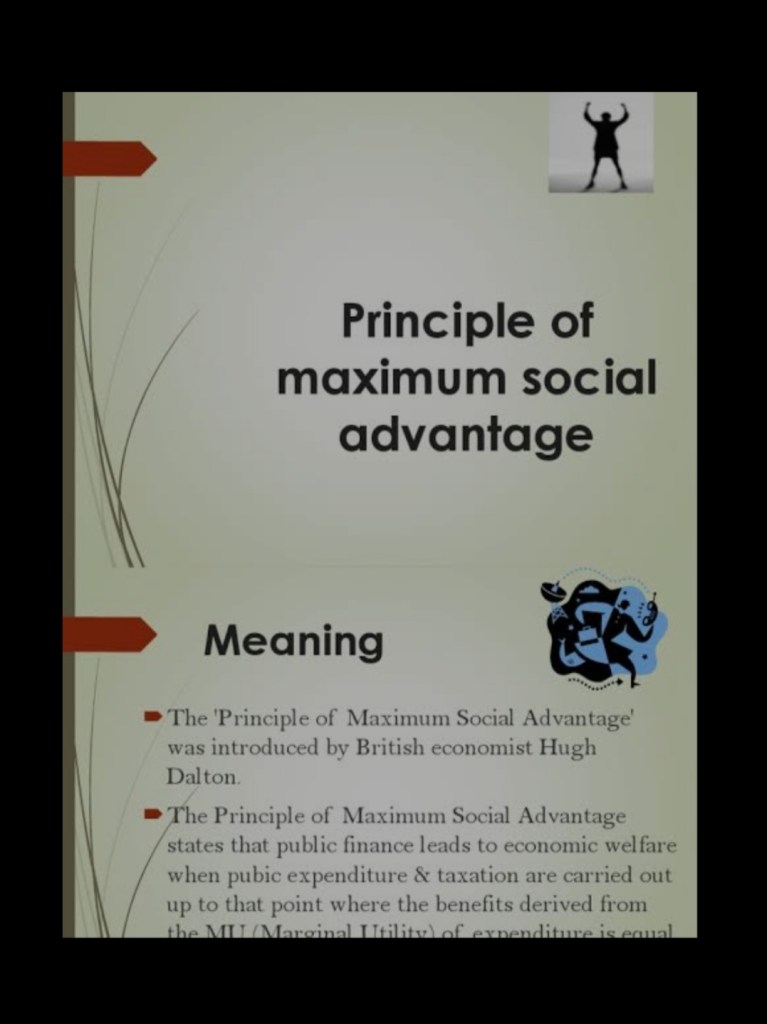
“The Principle of Public Finance means the fundamental rule by which the financial policy of the state is determined. This fundamental rule of principle of public finance is called “The Principle of Maximum Social Advantage “
The credit for the implementation of this principle goes to Prof. Pigou and Prof. Dalton . Just like an individual seeks to maximize his satisfaction or welfare by the use of his resources ,the state ought to maximize social advantages or benefit from the resources at its command .
According to Dalton , principle lies “at the root of public finance “. The principles of maximum social advantage are applied to determine whether the tax or the expenditure has proved to be the optimum benefit .
He stated “The best system of public finance is that which secures the maximum social advantage from the operation which it conducts “ This principle is also called as ” Principle of Maximum Social Benefits “
Prof Pigou called this principle ” The Principle of Maximum Aggregate Welfare “
Significance of the principle :-
Public revenue and public finance are two important financial operations of the state. These operations should be performed on fundamental principles so as to obtain maximum social benefit .
Prof. Hugh Dalton and Prof. Pigou were two famous economists who implemented the principle of Maximum Social Advantage to give the fundamental basis of the function performed by the state to earn revenue and to spend the revenue in the best possible way to Maximum benefit incrementation in the welfare of the public .
Prof. Dalton has expressed it in these words , “As a result of operations of public finance ,the nature and quantity of money produced and between the categories and different persons there are many changes in the distribution of that money . The question is do these changes ; leave a profitable impact on society ? If it is so then it will be considered that the operations of public finance are justified , otherwise not .The best system of public finance is that can obtain maximum social profit by the operation organised by them .”
Therefore , the Principle of Maximum Social Advantage is the principle that guides the operation of financial activities of the government to obtain economic welfare of the society .
According to Dalton , attainment of the principle requires :-
• Public expenditure and taxation should be carried out up to certain limits i.e where marginal utility received by the Government expenditure must be equal to marginal disutility due to taxation ( government income ).
• Public expenditure should be utilised among the various uses in an optimum manner
• The different sources of taxation should be so trapped that the aggregate sacrifice entailed is the minimum .
Assumptions :-
• The public revenue consists of only taxes ( and not gifts , loans , fees ,etc.,) and the state has no surplus or deficit budgets.
•Public expenditure is subject to diminishing marginal social benefits and the taxes are subject to increasing marginal cost or disutility .
Principle Of Maximum Social Advantage:-
The Principle states that :-
“The state should collect revenue and spend the money so as to maximize the welfare of the people. When the state imposes taxes, some disutility is created. On the On the other hand, when the state spends some money, there is a gain in utility. The state should so adjust revenue and expenditure that surplus of utility is maximised and disutility is minimised.”
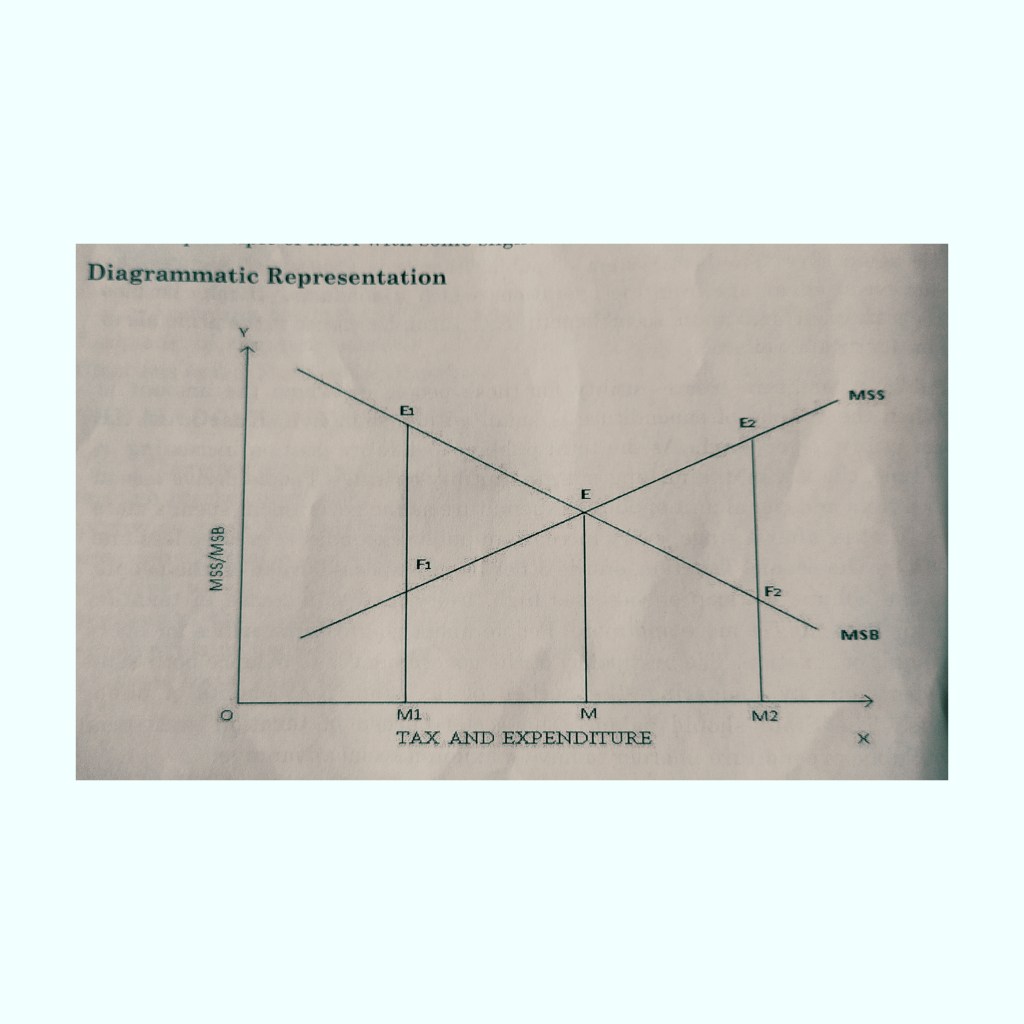
According to Dalton , “ maximum social advantage is at a point where the Marginal Social Sacrifice of Taxation ( MSS) and Marginal Social Benefit ( MSB) are equal . The point of equality between MSS and MSB is referred to as the point of maximum social advantage or least aggregate social sacrifice .
• Maximum social sacrifice of taxation :-
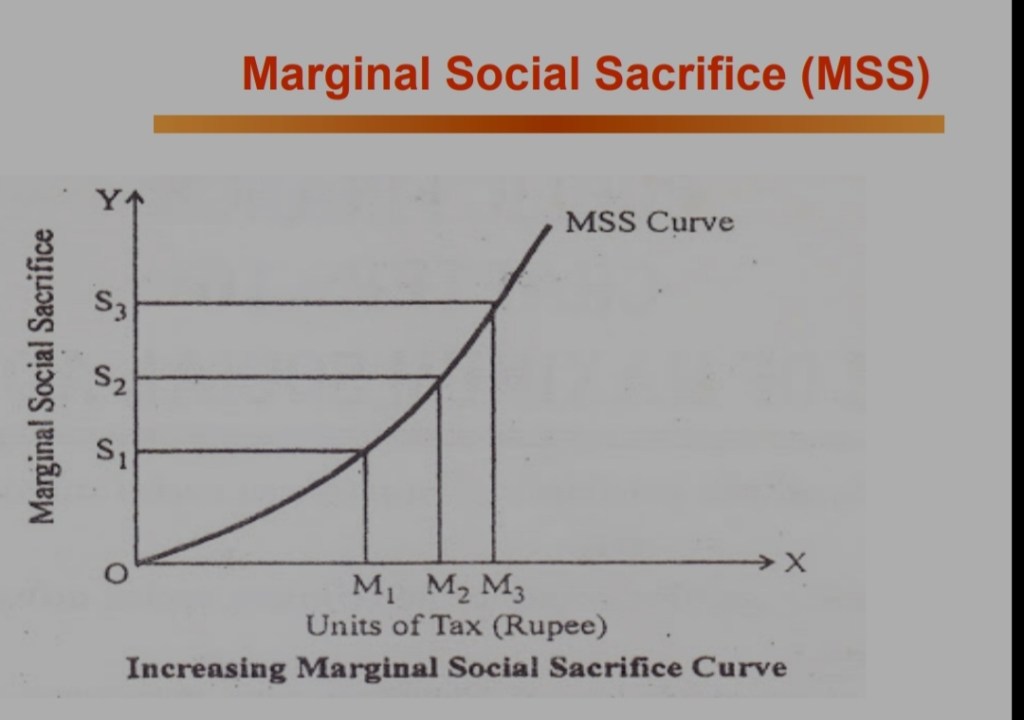
The amount of social sacrifice undergone by the public due to the imposition of an additional unit of tax is called Maximum Social Sacrifice of taxation . Every unit of tax imposed by the government taxes result in loss of utility.
According to Dalton , “The additional burden (marginal sacrifice) resulting from additional units of taxation goes on increasing. Every additional unit of taxation creates greater amount of sacrifice on the society”
The Marginal Social Sacrifice (MSS) curve rises upwards from left to right. This indicates that with each additional unit of taxation, the level of sacrifice also increases.
•. Marginal Social Benefit :–
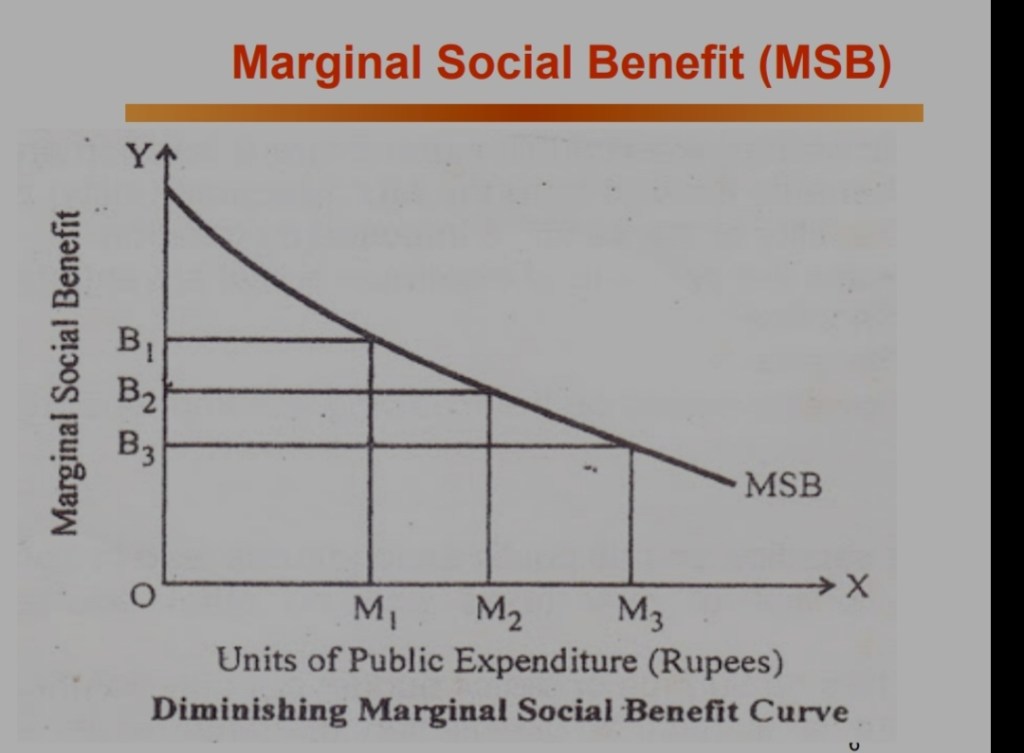
The benefit conferred on the society, by an additional unit of public expenditure is called the Marginal Social Benefit curve .
The social benefit from each additional unit of public expenditure declines as more and more units of public expenditure are spent. The marginal utility from commodity to a consumer declines as more and more units of the commodity are made available to him .
MSB curve slopes downward from left to right. This indicates that the social benefit derived out of public expenditure is reducing at a diminishing rate.
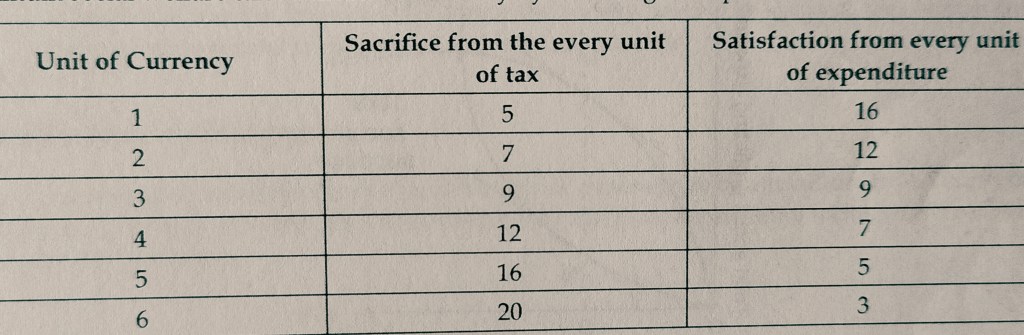
Maximum social welfare can be understood by the following example :-
Table
It can be seen in the above table that marginal sacrifice is increasing due to the increase in every unit weight of tax on society. Inversely , from every additional unit of Government expenditure ,its utilities diminish .
On the third unit of currency , marginal social sacrifice is equal to marginal social advantage ( 9 units ) . At this point the tax and public expenditure will be fixed .
In the above given figure , MSS represent marginal social sacrifice of the taxation curve , slopes upward since taxation increases resulting in Increasing of MSS,. and MSB represents the marginal social benefit of the public expenditure curve , slopes downwards showing that public benefit goes on declining with every unit increase in public expenditure.
The point E where the MSS curve intersects MSB curve , is the ideal point of financial operations where the government collects OM taxation from the society and uses it for public expenditure .
According to Dalton , “Public expenditure in every direction should be carried just so far that the advantage to the community of a further small increase in any direction is just counterbalanced by the disadvantage of a corresponding increase in taxation or in receipts from any other source of public income . This gives the ideal public expenditure and income.”
Musgrave’s View :-
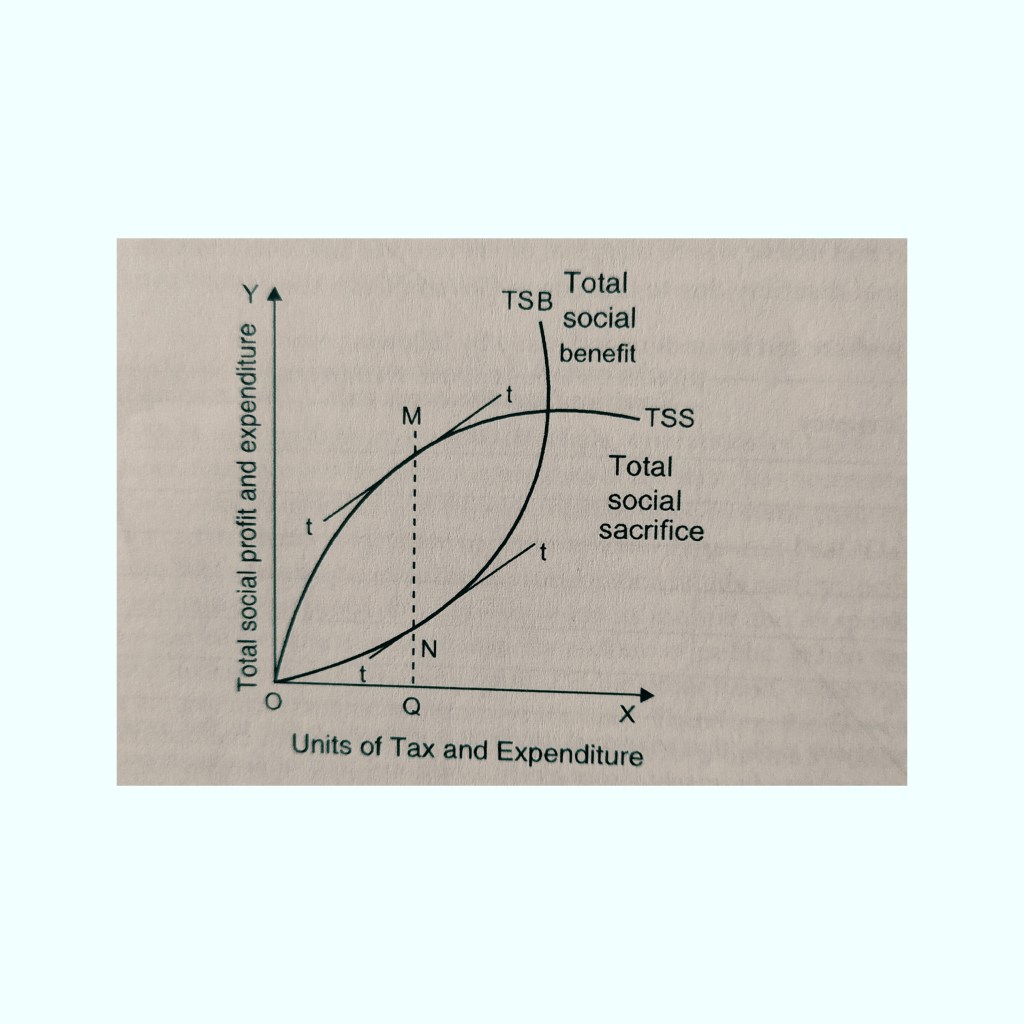
The Principle of maximum social advantage can be explained using total sacrifice and total benefit curve as well .
Musgrave called Dalton ‘s principle as “Maximum Welfare Principle Of Budget Determination “ According to him , the difference between total social benefit and total social sacrifice is the net social benefit where maximum social benefit is obtainable .
The TSB curve represents total social benefit received from public expenditure which slopes upward but decreases after some time , showing that as public expenditure increases total social benefit increases . The TSS curve represents total social sacrifice produced due to tax showing that as total social sacrifice increases with increase in amount of tax but rapidly .
Maximum social benefit will be achieved at a point where the difference between total social benefit and total social sacrifice is maximum . MN denotes the difference between TSB and TSS showing net social benefit.
Objective Tests Of Social Advantage :-
Dalton has given the following three objective Tests which can lead to Maximum Social Advantage :-
• To preserve the Community :- According to Dalton , the first test is the need to preserve the community against internal disorders and external attacks. The financial operations of the state to preserve the society in this manner leads to maximum social advantage .
• To increase Economic Welfare :- Increasing the economic welfare of the community leads to maximum social advantage . According to Dalton ,this can be achieved by improvements in production and improvements in the distribution of national product ( or income ) through state’s financial operations .
• To provide for Future Generation :- According to Dalton , the financial operations of the state should provide for the future generation . The state should prefer a larger social advantage in the future to a smaller one in the present .
Limitations of Maximum Social Advantage :-
In spite being guiding principle of financial operations of the state , the principle of maximum social advantage possesses the following limitations :-
• Vague and Abstract :- The terms “benefit ” and “sacrifice ” are vague and abstract concepts. It is not possible to quantify them and find out their exact implications.
• Different Areas :- It is not possible to compare the marginal benefits accruing to people in one area from a given public expenditure with marginal sacrifice undergone by persons who are taxed in some other areas .
• Lack of Divisibility :- In order to equate the marginal benefit from public expenditure with the marginal sacrifice from taxation , the resources are required to be divided into smaller units . But it is not possible because of the lack of Divisibility of public expenditure and taxes in small units .
• Ignores Non- Tax Revenues:– This principle takes into consideration the sacrifice on the part of direct tax payers and ignores Non- tax revenues like fines , fees ,market borrowing , profits of public undertaking ,etc., are equally important sources of revenue and in the effects on social benefit are as important as those of taxes.
• Maintaining Balance :- It is a difficult task for the state to maintain balance between disutility and utility produced due to imposing tax and utility obtained by people from the Government expenditure as the government is not a single person but different servants at different places in different departments .
• Simultaneous Calculation not Possible :- This principle requires simultaneous calculations and equating marginal social benefits from public expenditure and sacrifices from taxation which is not easy . As put by Prof. Buchana , ” To match them is a function for the’ fiscal brain ”and ‘computers ‘. “
According it Dalton , despite these limitations ,the principle of maximum social advantage is “the best system of public finance “.

















 Eduindex
You must be logged in to post a comment.