DRDO’s 500-bed COVID Care Hospital inaugurated in Haldwani, Uttarakhand

A 500-bed COVID Care Hospital set up by Defence Research and Development Organisation (DRDO) in Haldwani, was virtually inaugurated today by Uttarakhand Chief Minister Tirath Singh Rawat. This facility comprises 375 oxygen beds and 125 ICU beds with ventilators. With 100 per cent power backup, it is centrally air conditioned for all weather conditions.

Pathology laboratory, Pharmacy, X-Ray and ECG etc. are inherent part of the facility. The Centre will become fully operational from tomorrow. It has been dedicated and named after late General Bipin Chandra Joshi who belonged to Uttarakhand and was the 17th Chief of Indian Army.

Gujarat govt cancels state board exams for Class 12 students

The Gujarat government has cancelled the state board exams for Class 12 students. This decision has been taken at the state cabinet meeting held today in Gandhinagar. Announcing this decision, the state Education Minister Bhupendrasinh Chudasama said that this decision has been taken following the cancellation of CBSE Class 12th examination.

Mr. Chudasama said that a decision about conducting exams for Class 10 and Class 12 repeater students would be taken shortly. He said that the decision has been taken keeping in view the larger interest of more than 6 lakh students of Class 12th during the COVID-19 pandemic. Earlier, the Gujarat State Higher Secondary Education Board had announced the dates for Class 12th board examinations from July 1 to July 16. However, the examination has been cancelled soon after the central government’s decision to cancel the Class 12 board exams of CBSE.

3 wheeler auto drivers can now use 3 wheeler auto rickshaws for driving test for licence in Punjab

Punjab Transport Minister Razia Sultana, has announced that now 3 wheeler auto drivers can give the driving test for getting Driving License by using a 3 wheeler auto rickshaw. Earlier, three-wheeler drivers were tested on four-wheelers.

She also directed to all the Enforcement Authorities that if any three-wheeler driver has Driving License of Light Motor Vehicle he should not be harassed, because as per provisions of the Motor Vehicle Act 1988, the 3 wheeler auto rickshaw has been categorized into Light Motor Vehicle.

State Transport Commissioner Dr. Amarpal Singh said that instructions have been issued to the Licensing Authorities & Automated Driving Test Tracks of Punjab.

He said that the enforcement agencies have been instructed that a person producing a digital Driving License/Registration Certificate of vehicle and other documents in digital format on m Parivahan application of Union Ministry of Road Transport and Highways and DigiLocker app of Govt. of India, he/she is not required to produce the printed document, accordingly, all the enforcement staff should be sensitized.

Dr. Amarpal said that in case enforcement staff will not accept documents in digital format, a strict action would be taken

Meghalaya reports 24 deaths from COVID-19 complications in last 24 hours

n the last 24 hours, Meghalaya reported 24 deaths from COVID 19 complications; 13 from East Khasi Hills, six from West Jaintia Hills, two each from East Jaintia Hills and West Garo Hills and one from Ri Bhoi district. A statement from the Directorate of Health Services informed that the total number of COVID 19 fatalities in the State has reached 616.

The State also registered 711 recoveries tallying the total number of recovered cases to 29,578 while logging 532 fresh new cases in the last 24 hours. The number of active cases in Meghalaya has reached 6,403. So far 4,67,452 people have been vaccinated in the State.

HOW EXAMINATION OF WITNESESSES DONE?

Procedure for Examination of Witnesses


Examination of witness means asking the witness questions regarding relevant facts in the case and recording those statements as evidence.

General rule is that the order in which witnesses are produced and examined shall be regulated by the law and practice for the time being relating to the civil and criminal procedure respectively, and, in the absence of any such law, by the discretion of the court.

re examination of witnesses – StudyBix

In both the civil as well as the examination of witness will be in the following manner :

  •  EXAMINATION-IN-CHIEF : the examination of witness by the person who calls him shall be called his examination-in-chief.Evidence-Examination of Witness


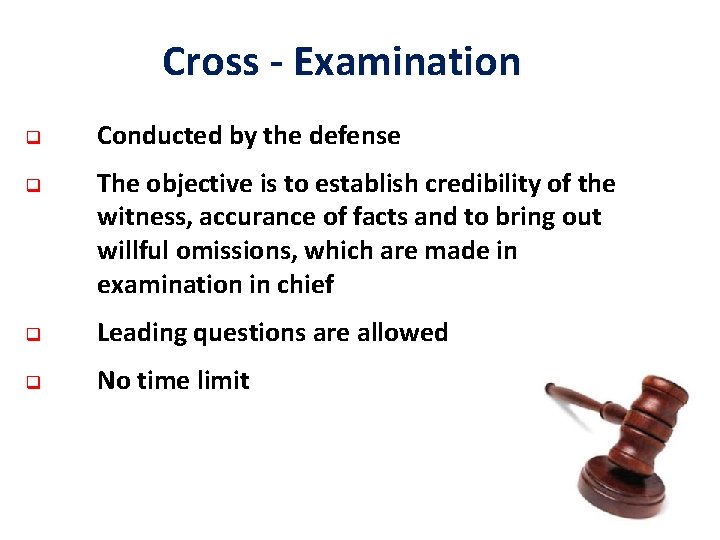
  •  CROSS-EXAMINATION : the examination of a witness by the adverse party shall be called his cross-examination.
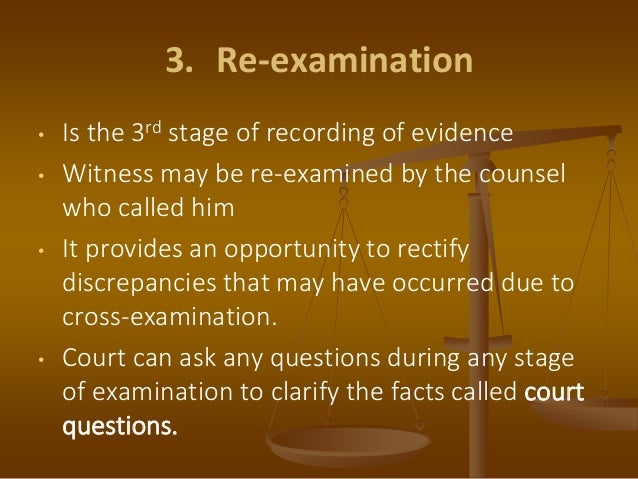
  •  RE-EXAMINATION : the examination of a witness, subsequent to the cross-examination by the party who called him, shall be called his re-examination.


Law


CROSS-EXAMINATION

Ganesh Yadav vs. State of Assam,1995 Cr. L. J

The testimony of a witness is not legal evidence unless it is subject to the cross-examination and where no opportunity has been given to the appellant’s counsel to test the veracity of the principle prosecution witness, the evidence of such a witness is not legal testimony and cannot be the basis of a judicial pronouncement.

Jwar Singh vs. State of M.P, A.I.R 1981 (SC)

The objects of the cross-examination are to impeach the accuracy, credibility and general value of the evidence given in-chief, to shift the facts already stated by the witness, to detect and expose discrepancies, or to elicit suppressed facts which will support the case of the cross-examining party.


EVIDENCE ACT Law of evidence lay rules for


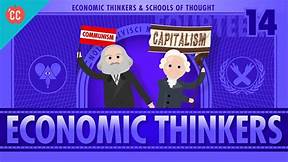
Economists from pre-classical to neo-classical era


Economics is a social science which studies interaction of people in markets. It is concerned with production, consumption, distribution and transfer of wealth from one individual or organization to another. It is a dynamic subject based on postulations and hypothesis. We have to modify its very aspects according to the situation in which it is applied. Classical, Keynesian and Neo-classical are regarded as the three major theories of economics. There were some notable pre-classical economists. 


Pre-classical economists:


William Petty: 

He is remembered for his contribution in the field of economic theory and is regarded as the founder of political economy and statistical method. His contribution to economics was his three most important theories namely- “The Treaties of taxes and contributions” -1662. “A track concerning money”- 1682 and “Discourses on political arithmetic”- 1660. 


John Law: (1671-1729) 

He is regarded as the man of practical affairs. He made important contribution to the theory of money. He made distinction between use value and market value of a commodity. He is regarded as the founder of subjected theory of value. Richard Cantillon: He was an economic thinker who wrote essay on “nature of commerce in general” which is regarded as the most systematic statement before Adam Smith’s Wealth of Nations. 


Sir David Hume: (1711-1776)

He was Philosopher, economist and was regarded as liberal mercantilist because of his advance economic theories. His work “Political discourses” collection of economic essays is regarded as most important. 


James Stuart: (1712-1780)

He was Chief English Mercantilist writer of 18th century. He wrote a book names “An enquiry into principles of political economy” – essay on science of domestic policy in free nations which focused mainly on aspects like population, agriculture, trade, industry, money, coin, interest, circulation, banks, exchange, public credit and taxes 


These were some important pre-classical economists who helped shape the foundation of other important economic theories. 


Classical economists: 

Adam Smith is regarded as the father of economics. His book “An enquiry into nature and causes of the wealth of nations (1776) is regarded as the very first book on classical economics. His concepts of supply side economics and supply side policies majorly focuses on the presence of invisible hand in markets. According to his theories markets can flourish without intervention from external authority which is government here. Invisible hand draws market forces into equilibrium. His theories very widely used before 1930s ‘The great economic’ depression. 

Other notable classical thinkers include – Jean Baptiste who propounded say’s law which states that supply creates its own demand (1803). David Ricardo who developed classical theory of comparative advantage in 1817, Labor theory of value and law of diminishing returns. Thomas Robert Malthus in 1798 wrote a book on “An essay on the principle of population”. John Stuart Mill propounded Utilitarianism in 1881. 


Keynesian economists: 

After 1930 John Maynard Keynes developed his economic theories which is regarded as Keynesian economics. His book on ‘The theory of employment, interest and money’ publish in 1936 was revolutionary. His theories mainly focuses on demand side economics. Government spending is critical factor to drive economy’s demand. Expansionary fiscal policy is regarded as main tool and was widely used after the great depression. Other Keynesian economists include: Dean Baker, Evsay domar, Wynne Godley and several other who found several new theories which gets its foundation from Keynesian economics. 


Neo- Classical economists: 

This theory focuses on supply and demand as driving forces behind production, pricing and consumption of goods and services. It emerged in 1900 to compete with other theories of classical economics.




SALE OF IMMOVABLE PROPERTY

What If Buyer/Seller Breaches Sale Agreement


Sale is the transfer of ownership for money consideration. Section 54 of the Transfer Of Property Act defines sales as a transfer of ownership in exchange for a price paid or promised to be paid.

The elements which are necessary to continue a sale as under :

  • Transfer of ownership
  • Money consideration

Parties of sale :

SELLER AND BUYER

Essentials for a valid sale are as follows :

  1. the parties i.e. the seller and the purchaser are competent
  2. the subject matter i.e. the property is in existence
  3. the money consideration i.e. the price has been fixed or referred
  4. the conveyance i.e. the transfer has been made as prescribed under the law.

Cancellation of sale deed :

A sale deed can be got cancelled, if the contract is affected by coercion, undue influence, fraud. An agreement to sell immovable property may also be void under section 29 of the Indian Contract Act, 1882.

If non-transferable property is transferred by a sale-deed, it is void and liable to be cancelled.

Seller’s duties and rights :

(BEFORE SALE )

  • to disclose material defects in the property or title, if any.
  • to produce the title-deeds for inspection.
  • to answer relevant questions as to title.
  • to execute conveyance.
  • to take care of the property and title-deeds.
  • to pay the outgoings.

(AFTER SALE)

  • to give possession to the buyer.
  • to covenant for title.
  • to deliver title-deeds on receipt of the price.

Buyer’s rights and duties :

(BEFORE SALE)

  • to disclose facts which materially increases the value of property.
  • to pay the price.

(AFTER SALE)

  • to bear the loss to property, if any.
  • to pay the outgoings.

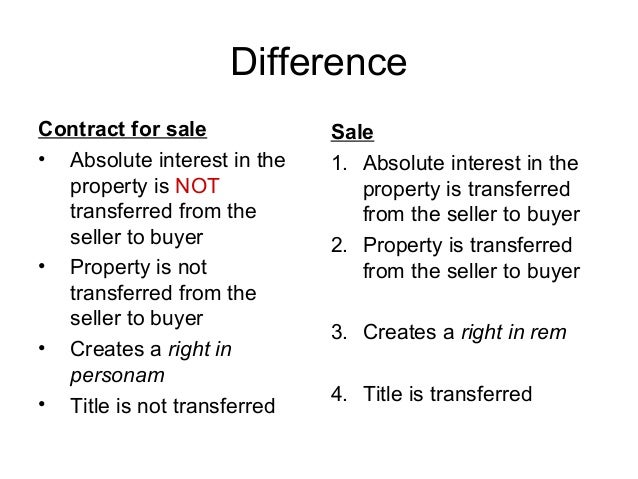
DIFFERENCE BETWEEN CONTRACT FOR SALE AND SALE :

Topic 9. Sale of immovable property


WHAT IS TRANSFER OF PROPERTY?

Rakesh Narula & Co. – Medium

Transfer of property means an act by which a living person conveys property in present or in future, to one or more other living persons (or to himself) and to transfer property is to perform such act.

ESSENTIALS OF A VALID TRANSFER :

In order to constitute a valid transfer of property, whether movable or immovable, under the Transfer Of Property Act :

  1. the property must be transferable
  2. the transfer must be competent to transfer
  3. the transferee must be competent to take the transfer
  4. the consideration or object of the transfer must be lawful
  5. the transfer must not be opposed to the nature of the interest affected thereby
  6. it must be in the manner and in the form required by the act if any.

WHAT PROPERTIES MAY NOT BE TRANSFERRED :

The general rule is that property of any kind may be transferred  but here are properties which cannot be transferred :-

  1. Spes Successionis
  2. Right of re-entry
  3. Easement
  4. Restricted interests
  5. Mere right to sue
  6. Public office
  7. Pensions
  8. Nature of Interests
  9. Un-transferable interests

PERSONS COMPETENT TO TRANSFER :

Every person competent to contract and entitled to transferable property or authorised to dispose of transferable property not his own, is competent to transfer such property either wholly or in part and either absolutely or conditionally, in the circumstances, to the extent and in the manner, allowed and prescribed by any law for the time being in force.

SECTION 11 OF THE CONTRACT ACT provides what persons are, and what persons are not competent to contract. Every person is competent to contract who is of the sound mind and is not disqualified from contracting by any law to which he is subject.


WHAT IS EVIDENCE?

The Evolution of Admissibility of Tape Recorded Statements As Evidence

Evidence means and includes-

  1. all statements which the court permits or requires to be made before it by witnesses, in relation to matters of fact under inquiry; such statements are called oral evidence;
  2. all documents; including electronic records, produced for the inspection of the court; such documents are called documentary evidence.

That means evidence can be in given in any form oral, documentary as well as electronic.

A document means anything which is a permanent record of the happening of a fact. Oral statements of a witnesses become evidence only when the right and opportunity is given to the opposite party to cross-examine, failing which they remain only bare statements.

The word ‘evidence’ in its relation to law includes all the legal means exclusive of mere arguments which tend to prove or disprove any fact the truth of which is submitted to judicial investigation.

Every case that comes before a court of law has a fact story behind it. Facts out of which cases arise keep happening in the ordinary course of life. The means by which facts are proved governed by the law of evidence. The function of the law of evidence is to lay down rules according to which the facts of a case can be proved or disproved before a court of law. The means which can be used to prove a fact are all controlled by the rules and principles laid down by the law of evidence.

The facts of the case will be proved by way of evidence act whether it is civil cases or criminal cases. It is the burden of proof which is different in both the cases like in Civil Cases burden of proof will be the balance of probability and in case of criminal cases the facts must be proved beyond all the reasonable doubts.

FOLLOWING ARE THE TYPES OF EVIDENCES :

  1. ORAL EVIDENCEHow to Introduce Court Exhibits Into Evidence at Trial – Legal Seagull
  2. DOCUMENTARY EVIDENCE
  3. PRIMARY EVIDENCE
  4. SECONDARY EVIDENCE
  5. REAL EVIDENCE
  6. HEARSAY EVIDENCE
  7. JUDICIAL EVIDENCE
  8. NON-JUDICIAL EVIDENCE
  9. DIRECT EVIDENCE
  10. INDIRECT EVIDENCE OR CIRCUMSTANTIAL EVIDENCE


Cancellation of class XII CBSE board exams

A review meeting regarding the decision of CBSE board exams of class XII was held on Tuesday, June 1, 2021. In that meeting our Honorable Prime Minister, Mr. Narendra Modi has declared the decision to cancel exams due to the uncertain conditions of covid 19. And also he stressed that the safety and health of our students is important and the exams should not be the reason behind putting our youth at risk. It was also announced that Central Board of Secondary Education will take necessary steps in evaluating student’s results of class XII on a well defined objective criteria in a time bound manner. After hearing this, school students are happy and have trolled happy memes in social media platforms.

Unlock process to begin today in Madhya Pradesh and Uttar Pradesh

In Uttar Pradesh, the unlock process of Corona curfew will start in a phased manner from today across 61 districts. State government had yesterday decided to lift the covid curfew with certain guidelines but weekend covid curfew will continue to remain throughout the state. The covid curfew will continue in 14 districts that have more than 600 active cases.

In the remaining 61 districts, shops will be allowed to open with strict safety protocols from 7 am to 7 pm. Night curfew will continue in the whole state. Yesterday Sonbhadra, Deoria, Baghpat, Prayagraj, Bijnore and Moradabad were added to the earlier list due to the declining number of active cases in these districts.

However, there  are 14 districts where no relaxation has been permitted by the government. These are Meerut, Lucknow, Saharanpur, Varanasi, Ghaziabad, Gorakhpur, Muzaffarnagar, Bareilly, Gautam Buddh Nagar, Bulandshahr, Jhansi, Lakhimpur-Khiri, Jaunpur and Ghazipur. The Chief Minister said that if cases rise above 600 in any district the relaxation in corona curfew will end automatically.

After nearly two months of lock-down, Madhya Pradesh is being

Karnataka CM appreciates yeoman service rendered by staff nurses working with Covid patients

Karnataka Chief Minister B S Yediyurappa has appreciated the yeoman service rendered by staff nurses working with the Covid patients across the state. He held a virtual interaction with the staff nurses working in the district hospitals across the state yesterday. He acknowledged the valuable contribution of the nurses during this adverse situation by remaining away from their families for days together. AIR correspondent reports that there are 21,574 staff nurses working in various Government hospitals across the state.

Chief Minister asked the nurses on their working conditions and safety protocols being followed. He informed Santosh of Bidar medical college that the risk allowance given to health department staff will be extended to medical colleges staff too.

Waheeda of Wenlock hospital asked the Chief Minister to provide vaccine to their families too. Nurse Renuka Gugihaal who lost her husband recently was consoled by the Chief Minister. Shashikala of S N R hospital said that efforts should be made to infuse confidence in the Covid patients who are emotionally disturbed. Shwetha of Harihar general hospital said that the staff are disturbed by the incidents of deaths and agony of Covid patients and need counselling facilities.

Under Pradhan Mantri Gareeb Kalyan Bima Yojana the family of the deceased nurses is being paid 50 lakh rupees. The state government pays 8000 rupees Covid allowance to the nurses apart from the salary.

COVID-19 recovery rate rises to 97 % in Bihar

In Bihar, over six lakh 85 thousand people have so far recovered from Corona. State’s recovery rate has risen to 97 per cent, while the test positivity rate has declined to 1.10 per cent. Covid cases in all districts are less than one hundred cases except Patna.

The number of active cases is also decreasing and presently stands at 16 thousand 235. One thousand 113 fresh COVID cases were reported in the state during the last 24 hours and three thousand 196 people recovered yesterday. Over one crore four lakh 34 thousand people have been vaccinated in the state so far

DREAMS AND REALITIES

People Who Live Without Dreams. Insights of the people who don't have… | by  Vinod Sharma | Live Your Life On Purpose | Medium

“History has proven that those who dare to imagine the impossible are the ones who break all humans limitations”

Your dream is the reason for the way you are. Your dream is not a coincidence. Your dream IS who you are. You SHOULD pursue it. Your dream gives you a sense of meaning and purpose, and drives you on into your chosen future. Your dream IS the meaning of your life.


Every person dreams to become something, to do something, to make the name of his parents and family proud with pride.
Some dreams are fulfilled and some remain unfulfilled, but this does not mean that you could not achieve anything in life. A human being should try their best with all dedication, whatever the outcome may be.

In the Bhagavad Geeta, Lord Krishna has given the same instruction that a person should do his work without worrying about the result. 

Everything teaches us something, whether it is a success or whether it is a failure. On one hand, where success gives us courage that if anything is done with a true mind then nothing is difficult and on the other hand, failure teaches us to be patient and persistent. A man should learn from his mistakes because there is no better teacher than mistakes. No effort ever goes in vain, with every effort made we get a new experience that helps us to move forward. This life is a school where a person learns at every step. The process of learning goes on till a person dies. Difficulties come in life to make us move forward, to make us strong. We should not be afraid of difficulties and should face them boldly.

Steve Keating on Twitter in 2021 | Dreams come true quotes, Chase your dreams  quotes, Dream of you quotes

Everyone should dream and try their best to fulfill them. Every effort made moves us towards our destination. In order to fulfill dreams, one should be patient and must have believe that you will do something good in life, it is very important to have this kind of attitude in the achievement of your goals. It is not necessary that you get success in the first attempt, sometimes a person has to make continuous efforts. I know all these things are easy to say but it feels like a shock.

 The more you pursue your dreams, the more exciting your life becomes.
God is going to use you in ways you never imagined possible. And the only side effect is: feeling GOOD! 

So, here are some ways which can help to make your dreams fulfilled :

  • Determination170 Dream Quotes That Will Boost Your Motivation
  • Stay motivated
  • Keep remembering your goal
  • Reward yourself
  • Take some breaks
  • Stay among people with positive mindset
  • Don’t hesitate to make mistakes


India’s Foreign policy under Jawaharlal Nehru


A country’s foreign policy is determined by its history, geographical position and the time in which it is undertaken. Geopolitics plays a very dominant role in shaping its foreign policies. India’s foreign policy was first nurtured by Jawaharlal Nehru, post- independent India’s Prime minister. It was fostered at the time when the world was busy contending from imperialist and capitalist and had growing influence of socialist and democratic institutions.

The Indian National Congress in as early as 1920s made a resolution conveying its aspiration to establish cooperation with neighboring countries. But the internal situation of that time did not permit them to develop international relations. Even before independence Indian leaders contentiously extended their support to many liberalized nations in their struggle against imperialist nations, they fought against various issues like racism, capitalism, freedom, equality and participated in various conference at the international level.

After independence India took devisive steps to establish friendly relations with other countries. India started establishing its foreign relations by exchanging ambassadors with USA, USSR, China and some other countries. India followed the path of non- alignment, its focus was majorly on peaceful coexistence. Nehru was quite realistic to recognize that economic strength was central to stability and social coherence of the country. Strengthening the country’s economy would even mean a stable guaranteed security and viability. Jawaharlal Nehru concentrated on the construction of heavy industries like steel mills, engineering and infrastructure projects.